كم تستهلك الأجهزة الكهربائية من الطاقة، وكيف نحسب ذلك في دائرة توالي أو توازي؟How much energy do electrical devices use, and how do we calculate it in a series or parallel circuit?
- القدرة الكهربائية: التعريف والقانونElectrical power: definition and formula
- الطاقة المصروفة والوحداتEnergy consumed and units
- محاكاة: قدرة مقاومة واحدةSimulation: power of a single resistor
- العوامل المؤثرة في القدرةFactors affecting power
- القدرة في دائرة التواليPower in a series circuit
- القدرة في دائرة التوازيPower in a parallel circuit
- مقارنة سريعة بين التوالي والتوازيQuick comparison of series and parallel
- الدوائر المركبة والتطبيقاتCombined circuits and applications
- ملخص القوانين، والمراجعة، والامتحان من 20 سؤالًاFormula summary, review, and a 20-question exam
- تجارب قسم الكهرباء في آخر الصفحةElectricity experiments at the end of the page
🎯 نواتج التعلم
🎯 Learning Outcomes
بعد هذه الدرس ستكون قادرًا على أن:
After this lesson you will be able to:
- تحسب القدرة الكهربائية بالعلاقات \(P=VI\) و\(P=I^2R\) و\(P=\dfrac{V^2}{R}\).Calculate electrical power using \(P=VI\), \(P=I^2R\) and \(P=\dfrac{V^2}{R}\).
- تحسب الطاقة المصروفة \(E=Pt\) وتحوّلها بين الجول والكيلوواط ساعة.Calculate the energy consumed, \(E=Pt\), and convert between joules and kilowatt-hours.
- تقارن توزيع القدرة بين المقاومات المتصلة على التوالي وعلى التوازي.Compare how power is distributed among resistors connected in series and in parallel.
- تحسب القدرة الكلية للدوائر المركبة، وتتحقق أن مجموع القدر المبددة يساوي قدرة البطارية.Calculate the total power of combined circuits, and verify that the sum of the dissipated powers equals the battery power.
١. القدرة الكهربائية1. Electrical Power
القدرة الكهربائية هي معدل استهلاك الطاقة الكهربائية، وتقاس بوحدة الواط (W).Electrical power is the rate at which electrical energy is used, measured in watts (W).
وباستخدام قانون أوم V = I × R نحصل على صيغتين أخريين:Using Ohm's law V = I × R, we get two other forms:
٢. الطاقة المصروفة2. Energy Consumed
الطاقة المصروفة هي الطاقة الكلية التي يستهلكها الجهاز خلال فترة زمنية، وتقاس بالجول (J) أو كيلوواط ساعة (kWh) في الفواتير.Energy consumed is the total energy a device uses over a period of time, measured in joules (J) or in kilowatt-hours (kWh) on bills.
🧪 محاكاة: قدرة مقاومة واحدة
🧪 Simulation: power of a single resistor
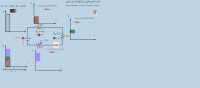
غيّر جهد البطارية والمقاومة والزمن، واستنتج التيار \(I=\dfrac{V}{R}\) والقدرة \(P=VI=I^2R=\dfrac{V^2}{R}\) والطاقة \(E=Pt\). تتوهج المقاومة بحسب قدرتها: كلما زادت القدرة زاد التوهج.
Change the battery voltage, the resistance and the time, and find the current \(I=\dfrac{V}{R}\), the power \(P=VI=I^2R=\dfrac{V^2}{R}\) and the energy \(E=Pt\). The resistor glows according to its power: the higher the power, the brighter the glow.
٣. العوامل المؤثرة في القدرة3. Factors Affecting Power
- الجهد (V): القدرة تتناسب مع مربع الجهد عند ثبات المقاومة (P ∝ V²).Voltage (V): power is proportional to the square of the voltage when resistance is constant (P ∝ V²).
- التيار (I): القدرة تتناسب مع مربع التيار عند ثبات المقاومة (P ∝ I²).Current (I): power is proportional to the square of the current when resistance is constant (P ∝ I²).
- المقاومة (R): عند ثبات الجهد، زيادة المقاومة تقلل التيار والقدرة.Resistance (R): at constant voltage, more resistance means less current and less power.
- الزمن (t): كلما طالت مدة التشغيل زادت الطاقة المصروفة.Time (t): the longer a device runs, the more energy it uses.
٤. القدرة في دائرة التوالي4. Power in a Series Circuit
في دائرة التوالي يتساوى التيار في جميع المقاومات، وتنقسم المقاومات الكلي للجهد. المقاومة الكلية: R = R₁ + R₂ + R₃.In a series circuit the current is the same in all resistors, and the total voltage divides among them. Total resistance: R = R₁ + R₂ + R₃.
مقاومات 2 Ω و 3 Ω و 5 Ω على التوالي مع بطارية 20 V.Resistors 2 Ω, 3 Ω and 5 Ω in series with a 20 V battery.
R = 2 + 3 + 5 = 10 Ω ← I = 20/10 = 2 A ← P = I²R = 4 × 10 = 40 WR = 2 + 3 + 5 = 10 Ω → I = 20/10 = 2 A → P = I²R = 4 × 10 = 40 W
🧪 تجربة 1: ثلاث مقاومات على التوالي مع بطارية: كيف تتوزع القدرة؟
🧪 Experiment 1: Three resistors in series with a battery: how is the power shared?
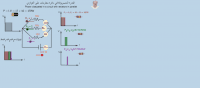
في التوصيل على التوالي يمر التيار نفسه \(I\) في كل مقاومة: \(I=\dfrac{V}{R_1+R_2+R_3}\)، ويتوزع جهد البطارية على المقاومات: \(V_k=IR_k\) و\(V=V_1+V_2+V_3\). فتكون القدرة المصروفة في كل مقاومة \(P_k=IV_k=I^2R_k\): المقاومة الأكبر تصرف قدرة أكبر، ومجموع القدرات \(P_1+P_2+P_3=IV\) يساوي قدرة البطارية. في مخطط المساحات عرض كل مستطيل هو \(I\) (واحد للجميع) وارتفاعه جهد المقاومة، فتتناسب المساحة (القدرة) مع ارتفاعه. غيّر الجهد والمقاومات وراقب التوزيع (تتوهج كل مقاومة بحسب قدرتها).
In a series connection the same current \(I\) flows in every resistor: \(I=\dfrac{V}{R_1+R_2+R_3}\), and the battery voltage divides among the resistors: \(V_k=IR_k\) and \(V=V_1+V_2+V_3\). So the power dissipated in each resistor is \(P_k=IV_k=I^2R_k\): the larger resistance dissipates more power, and the sum of the powers \(P_1+P_2+P_3=IV\) equals the battery power. In the area chart the width of every rectangle is \(I\) (the same for all) and its height is the voltage of the resistor, so the area (power) is proportional to its height. Change the voltage and the resistances and watch the distribution (each resistor glows according to its power).
٥. القدرة في دائرة التوازي5. Power in a Parallel Circuit
في دائرة التوازي يكون الجهد نفسه على كل فرع، والقدرة الكلية هي مجموع قدرات الفروع.In a parallel circuit the voltage is the same across each branch, and the total power is the sum of the branch powers.
مقاومتان 10 Ω و 20 Ω على التوازي مع بطارية 12 V.Resistors 10 Ω and 20 Ω in parallel with a 12 V battery.
P₁ = 144/10 = 14.4 W، P₂ = 144/20 = 7.2 W، P = 21.6 WP₁ = 144/10 = 14.4 W, P₂ = 144/20 = 7.2 W, P = 21.6 W
🧪 تجربة 1: ثلاث مقاومات على التوازي مع بطارية: كيف تتوزع القدرة؟
🧪 Experiment 1: Three resistors in parallel with a battery: how is the power shared?
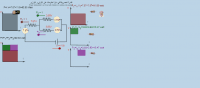
في التوصيل على التوازي يكون فرق الجهد \(V\) واحدًا على كل فرع، ولكل فرع تياره: \(I_k=\dfrac{V}{R_k}\). فتكون القدرة المصروفة في كل مقاومة \(P_k=I_kV=\dfrac{V^2}{R_k}\): المقاومة الأصغر تمرّر تيارًا أكبر وتصرف قدرة أكبر. وتيار البطارية \(I=I_1+I_2+I_3\) وقدرتها \(P=IV=P_1+P_2+P_3\). في مخطط المساحات ارتفاع كل مستطيل هو \(V\) (واحد للجميع) وعرضه تيار الفرع، فتتناسب المساحة (القدرة) مع عرضه. غيّر الجهد والمقاومات وراقب التوزيع (تتوهج كل مقاومة بحسب قدرتها).
In a parallel connection the voltage \(V\) is the same across every branch and each branch has its own current \(I_k=\dfrac{V}{R_k}\). So the power dissipated in each resistor is \(P_k=I_kV=\dfrac{V^2}{R_k}\): the smaller resistance passes a larger current and dissipates more power. The battery current is \(I=I_1+I_2+I_3\) and its power \(P=IV=P_1+P_2+P_3\). In the area chart the height of every rectangle is \(V\) (the same for all) and its width is the branch current, so the area (power) is proportional to its width. Change the voltage and the resistances and watch the distribution (each resistor glows according to its power).
٦. ملخص سريع: التوالي والتوازي6. Quick Comparison: Series and Parallel
بعد أن درست الدائرتين، قارن بينهما في الجدول:Now that you have studied both circuits, compare them in the table:
| الكميةQuantity | التواليSeries | التوازيParallel |
|---|---|---|
| التيارCurrent | ثابت في كل المقاوماتSame in every resistor | ينقسم بين الفروعDivides among the branches |
| الجهدVoltage | ينقسم بين المقاوماتDivides among the resistors | ثابت على كل الفروعSame across every branch |
| المقاومة المكافئةEquivalent resistance | R = R₁ + R₂ + … | 1/R = 1/R₁ + 1/R₂ + … |
| القدرة الكليةTotal power | مجموع القدرات، ويمكن حسابها من V²/RSum of powers, or V²/R | مجموع القدرات، ويمكن حسابها من V²/RSum of powers, or V²/R |
٧. الدوائر المركبة والتطبيقات7. Combined Circuits and Applications
في الدائرة المركبة نحسب المقاومة المكافئة لكل جزء، ثم نجمعها حسب طريقة التوصيل، ثم نستخدم P = V²/R.In a combined circuit, first find the equivalent resistance of each part, combine them according to how they are connected, then use P = V²/R.
- احسب المقاومة المكافئة للجزء المتوازي.Find the equivalent resistance of the parallel part.
- اجمعها مع المقاومات المتصلة على التوالي.Add it to the resistors connected in series.
- احسب القدرة الكلية بالقانون المناسب.Calculate the total power with the suitable formula.
🧪 تجربة 1: أين تذهب قدرة البطارية؟ مقاومة على التوالي مع فرعين على التوازي
🧪 Experiment 1: Where does the battery power go? A resistor in series with two parallel branches
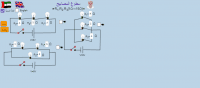
يمر تيار البطارية \(I\) في \(R_1\) على التوالي ثم ينقسم بين \(R_2\) و\(R_3\) على التوازي. القدرة المصروفة في كل مقاومة \(P=IV=I^2R=\dfrac{V^2}{R}\)، ومجموع القدرات المصروفة يساوي قدرة البطارية \(P=IV\) (حفظ الطاقة). يمثل مخطط المساحات القدرة بمساحة المستطيل (التيار × فرق الجهد): المستطيل الكبير هو قدرة البطارية، ويتكوّن من مستطيل \(R_1\) ومستطيلي \(R_2\) و\(R_3\). غيّر الجهد والمقاومات وراقب كيف تتوزع القدرة (تتوهج المقاومة بحسب قدرتها).
The battery current \(I\) flows through \(R_1\) in series and then divides between \(R_2\) and \(R_3\) in parallel. The power dissipated in each resistor is \(P=IV=I^2R=\dfrac{V^2}{R}\), and the sum of the dissipated powers equals the battery power \(P=IV\) (conservation of energy). The area chart represents power by the area of a rectangle (current × voltage): the big rectangle is the battery power and it is made of the rectangle of \(R_1\) and the two rectangles of \(R_2\) and \(R_3\). Change the voltage and the resistances and see how the power is shared (each resistor glows according to its power).
٨. ملخص القوانين8. Formula Summary
| الكميةQuantity | القانونFormula | الوحدةUnit |
|---|---|---|
| القدرةPower | P = V·I = I²R = V²/R | W |
| الطاقةEnergy | E = P·t | J, kWh |
| المقاومة المكافئة (توالي)Equivalent resistance (series) | R = R₁ + R₂ + … | Ω |
| المقاومة المكافئة (توازي)Equivalent resistance (parallel) | 1/R = 1/R₁ + 1/R₂ + … | Ω |
📖 مراجعة الدرس📖 Lesson Review
1ما الفرق بين القدرة والطاقة المصروفة؟What is the difference between power and energy consumed?
2مصباح قدرته 60 W يعمل 2 h. ما الطاقة بالكيلوواط ساعة؟A 60 W bulb runs for 2 h. What is the energy in kWh?
3لماذا تتضاعف القدرة أربع مرات عند مضاعفة التيار في مقاومة ثابتة؟Why does power quadruple when the current doubles through a fixed resistor?
4تطبيقApplication مقاومتان 6 Ω و 12 Ω على التوازي مع بطارية 12 V. احسب القدرة الكلية.Resistors 6 Ω and 12 Ω in parallel with a 12 V battery. Find the total power.
🧪 اختبر نفسك: امتحان من 20 سؤالاً
🧪 Test Yourself: a 20-Question Exam
أنهِ الدرس بالاختبار التفاعلي التالي، وأسئلته تجمع بين الفهم وقراءة البيانات والحساب.
Finish with the interactive exam below: its questions mix understanding, data reading, and calculation.
اختبار القدرة والطاقة المصروفة Power and Energy Quiz
20 سؤالاً - القدرة والطاقة المصروفة في الدوائر الكهربائية 20 Questions - Power and energy consumed in electric circuits
• عدد الأسئلة: 20 سؤالاً
• مدة الاختبار: 30 دقيقة
• لا يمكنك تغيير إجاباتك أو إعادة الاختبار إلا بعد 24 ساعة من التسليم.
• تأكد من إجاباتك قبل التسليم! 📌 Important Instructions:
• Number of questions: 20 questions
• Quiz duration: 30 minutes
• You cannot change your answers or retake the quiz for 24 hours after submission.
• Make sure of your answers before submitting!
🔗 تجارب قسم الكهرباء للاستعانة بها عند اللزوم🔗 Electricity experiments for reference
اضغط «تشغيل» لتعمل التجربة هنا داخل الدرس؛ ويمكن للطالب الرجوع إليها لتجربة الفكرة بطريقة أخرى.Press “Run” to start the experiment right here inside the lesson; the student can come back to it to try the idea another way.