🎯 نواتج التعلم
🎯 Learning Outcomes
بعد هذه التجربة ستكون قادرًا على أن:
After this experiment you will be able to:
- تحسب تيار كل فرع وقدرته في دائرة مقاومات على التوازي \(I_k=\dfrac{V}{R_k}\) و\(P_k=\dfrac{V^2}{R_k}\).Calculate the current and the power of each branch in a parallel circuit \(I_k=\dfrac{V}{R_k}\) and \(P_k=\dfrac{V^2}{R_k}\).
- تحسب المقاومة المكافئة وتيار البطارية وقدرتها.Calculate the equivalent resistance, the battery current and its power.
- تفسّر لماذا تصرف المقاومة الأصغر قدرة أكبر على التوازي وأن مجموع القدرات يساوي قدرة البطارية.Explain why the smaller resistance dissipates more power in parallel and why the sum of the powers equals the battery power.
🎬 شاهد الفيديو
🎬 Watch the Video
🔀 التوصيل على التوازي
🔀 The Parallel Connection
في التوصيل على التوازي تتصل أطراف المقاومات كلها بنقطتين مشتركتين فيكون فرق الجهد واحدًا على كل مقاومة ويساوي جهد البطارية \(V\)، أما التيار الكلي فيتفرع إلى تيارات الفروع:
In a parallel connection the ends of all the resistors are joined at two common points so the potential difference is the same across every resistor and equals the battery voltage \(V\), while the total current divides into the currents of the branches:
📘 قوانين التوازي والقدرة
📘 The laws of parallel connection and power
\[I_k=\dfrac{V}{R_k}\qquad I=I_1+I_2+I_3\qquad\dfrac{1}{R_{eq}}=\dfrac1{R_1}+\dfrac1{R_2}+\dfrac1{R_3}\]
\[P_k=I_kV=\dfrac{V^2}{R_k}\qquad P=IV=P_1+P_2+P_3\]
💡 شرح إضافي: لماذا المقاومة الأصغر تصرف قدرة أكبر على التوازي؟
💡 Extra explanation: why does the smaller resistance dissipate more power in parallel?
الجهد على كل فرع واحد \(V\)، والمقاومة الأصغر تسمح بمرور تيار أكبر (\(I=V/R\))، فتكون القدرة \(P=IV=V^2/R\) أكبر. مثلًا مقاومتان \(1\ \Omega\) و\(5\ \Omega\) على جهد \(11\ \mathrm{V}\): الأولى تصرف \(121\ \mathrm{W}\) والثانية \(24.2\ \mathrm{W}\) فقط. وهذا عكس التوالي (حيث \(P=I^2R\) والمقاومة الأكبر تصرف أكبر). وكذلك المقاومة المكافئة على التوازي أصغر من أصغر مقاومة لأن كل فرع جديد يفتح طريقًا إضافيًا للتيار، فيزداد تيار البطارية وتزداد قدرتها. ومن مخطط المساحات: ارتفاع كل المستطيلات \(V\)، فمساحة كل منها (القدرة) تتناسب مع عرضه (تياره).
The voltage across every branch is the same \(V\), and the smaller resistance lets a larger current pass (\(I=V/R\)), so the power \(P=IV=V^2/R\) is larger. For example, two resistors \(1\ \Omega\) and \(5\ \Omega\) at \(11\ \mathrm{V}\): the first dissipates \(121\ \mathrm{W}\) and the second only \(24.2\ \mathrm{W}\). This is the opposite of series (where \(P=I^2R\) and the larger resistance dissipates more). Also the equivalent resistance in parallel is smaller than the smallest resistance because each new branch opens an extra path for the current, so the battery current and power increase. From the area chart: the heights of all the rectangles are \(V\), so the area of each (the power) is proportional to its width (its current).
🧪 تجربة 1: ثلاث مقاومات على التوازي مع بطارية: كيف تتوزع القدرة؟
🧪 Experiment 1: Three resistors in parallel with a battery: how is the power shared?
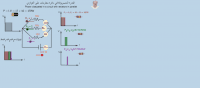
في التوصيل على التوازي يكون فرق الجهد \(V\) واحدًا على كل فرع، ولكل فرع تياره: \(I_k=\dfrac{V}{R_k}\). فتكون القدرة المصروفة في كل مقاومة \(P_k=I_kV=\dfrac{V^2}{R_k}\): المقاومة الأصغر تمرّر تيارًا أكبر وتصرف قدرة أكبر. وتيار البطارية \(I=I_1+I_2+I_3\) وقدرتها \(P=IV=P_1+P_2+P_3\). في مخطط المساحات ارتفاع كل مستطيل هو \(V\) (واحد للجميع) وعرضه تيار الفرع، فتتناسب المساحة (القدرة) مع عرضه. غيّر الجهد والمقاومات وراقب التوزيع (تتوهج كل مقاومة بحسب قدرتها).
In a parallel connection the voltage \(V\) is the same across every branch and each branch has its own current \(I_k=\dfrac{V}{R_k}\). So the power dissipated in each resistor is \(P_k=I_kV=\dfrac{V^2}{R_k}\): the smaller resistance passes a larger current and dissipates more power. The battery current is \(I=I_1+I_2+I_3\) and its power \(P=IV=P_1+P_2+P_3\). In the area chart the height of every rectangle is \(V\) (the same for all) and its width is the branch current, so the area (power) is proportional to its width. Change the voltage and the resistances and watch the distribution (each resistor glows according to its power).
✍️ أمثلة محلولة
✍️ Worked Examples
ثلاث مقاومات \(1\ \Omega\) و\(2\ \Omega\) و\(5\ \Omega\) على التوازي مع بطارية \(11\ \mathrm{V}\) (قيم الأداة الأصلية). احسب تيار كل فرع وقدرته وتيار البطارية وقدرتها.
Three resistors \(1\ \Omega\), \(2\ \Omega\) and \(5\ \Omega\) in parallel with an \(11\ \mathrm{V}\) battery (the values of the original applet). Calculate the current and the power of each branch and the battery current and power.
احسب المقاومة المكافئة في المثال السابق وتحقق من القدرة الكلية.
Calculate the equivalent resistance in the previous example and check the total power.
مصباحان قدرتاهما \(60\ \mathrm{W}\) و\(100\ \mathrm{W}\) عند \(220\ \mathrm{V}\) موصولان على التوازي بمصدر \(220\ \mathrm{V}\). ما القدرة الكلية والتيار الكلي؟
Two lamps of \(60\ \mathrm{W}\) and \(100\ \mathrm{W}\) at \(220\ \mathrm{V}\) are connected in parallel to a \(220\ \mathrm{V}\) source. What are the total power and the total current?
مقاومتان على التوازي \(R_1\lt R_2\). أيهما تصرف قدرة أكبر؟
Two resistors in parallel \(R_1\lt R_2\). Which dissipates more power?
عند إضافة فرع جديد على التوازي (بالجهد نفسه) فإن تيار البطارية:
When a new branch is added in parallel (the same voltage) the battery current:
القدرة الكلية في دائرة توازي تساوي:
The total power in a parallel circuit equals:
ثلاث مقاومات متساوية \(R\) على التوازي مع جهد \(V\). القدرة الكلية:
Three equal resistors \(R\) in parallel at a voltage \(V\). The total power:
📚 ملخص
📚 Summary
| المفهومConcept | القانونLaw |
|---|---|
| جهد الفروعBranch voltage | \(V_1=V_2=V_3=V\)\(V_1=V_2=V_3=V\) |
| التيارات والمقاومة المكافئةCurrents and equivalent resistance | \(I=\sum\dfrac{V}{R_k}\ ,\ \dfrac1{R_{eq}}=\sum\dfrac1{R_k}\)\(I=\sum\dfrac{V}{R_k}\ ,\ \dfrac1{R_{eq}}=\sum\dfrac1{R_k}\) |
| القدرةPower | \(P_k=\dfrac{V^2}{R_k}\ ,\ P=\sum P_k=IV\)\(P_k=\dfrac{V^2}{R_k}\ ,\ P=\sum P_k=IV\) |
⚠️ أخطاء شائعة
⚠️ Common mistakes
- جمع المقاومات مباشرة \(R_1+R_2+R_3\) بدل جمع مقلوباتها.Adding the resistances directly \(R_1+R_2+R_3\) instead of adding their reciprocals.
- الاعتقاد بأن التيار نفسه يمر في كل فرع؛ التيار يتفرع والجهد هو الواحد.Believing that the same current flows in every branch; the current divides and it is the voltage that is the same.
- استعمال \(P=I^2R\) بتيار البطارية الكلي لكل فرع؛ لكل فرع تياره.Using \(P=I^2R\) with the total battery current for every branch; each branch has its own current.
🔗 محاكيات GeoGebra للاستعانة بها عند اللزوم
🔗 GeoGebra Simulations to Use When Needed
اضغط «تشغيل» لتعمل المحاكاة هنا داخل الدرس؛ ويمكن للطالب الرجوع إليها لتجربة الفكرة بطريقة أخرى.
Press “Run” to run the simulation right here inside the lesson; the student can use it to try the idea in another way.