🎯 نواتج التعلم
🎯 Learning Outcomes
بعد هذه التجربة ستكون قادرًا على أن:
After this experiment you will be able to:
- تربط سطوع المصباح بالقدرة المستهلكة فيه \(P=I^2R=\dfrac{V^2}{R}=VI\).Relate the brightness of a bulb to the power it consumes \(P=I^2R=\dfrac{V^2}{R}=VI\).
- تحدّد المصباح الأسطع في دائرة توالٍ (الأكبر مقاومة) ودائرة توازٍ (الأصغر مقاومة) وتعلّل ذلك.Identify the brightest bulb in a series circuit (the larger resistance) and in a parallel circuit (the smaller resistance) and explain why.
- تحلل دائرة مركبة بحساب المقاومة المكافئة لكل قسم ثم التيار والجهد والقدرة لكل مصباح.Analyse a combination circuit by finding the equivalent resistance of each part, then the current, voltage and power of every bulb.
🎬 شاهد الفيديو
🎬 Watch the Video
💡 السطوع هو القدرة
💡 Brightness Is Power
يتوهّج المصباح لأن طاقة كهربائية تتحول فيه إلى حرارة وضوء، ومعدل هذا التحول هو القدرة \(P\). فكلما زادت القدرة المستهلكة في المصباح زاد سطوعه. وللقدرة ثلاث صيغ متكافئة نختار منها الأنسب حسب ما يبقى ثابتًا في الدائرة:
A bulb glows because electrical energy changes into heat and light in it, and the rate of this change is the power \(P\). The more power a bulb consumes, the brighter it is. Power has three equivalent forms and we choose the most convenient according to what stays constant in the circuit:
📘 قوانين القدرة والسطوع
📘 The laws of power and brightness
\[V=IR\qquad P=VI=I^2R=\dfrac{V^2}{R}\]
\[\text{series: }I\text{ same}\Rightarrow P=I^2R\propto R\qquad\text{parallel: }V\text{ same}\Rightarrow P=\dfrac{V^2}{R}\propto\dfrac1R\]
🔗 سطوع المصابيح في كل نوع دائرة
🔗 Brightness in Each Type of Circuit
1) دائرة التوالي
1) The series circuit
- التيار نفسه يمر في جميع المصابيح: \(I\) ثابت، والمقاومة الكلية \(R_t=R_1+R_2+\dots+R_n\)، والجهد يتوزع بين المصابيح.The same current flows through all the bulbs: \(I\) is constant, the total resistance is \(R_t=R_1+R_2+\dots+R_n\) and the voltage is shared between the bulbs.
- \(P=I^2R\): القدرة تتناسب طرديًا مع \(R\) فيكون المصباح الأكبر مقاومة هو الأسطع.\(P=I^2R\): the power is directly proportional to \(R\), so the bulb of the largest resistance is the brightest.
- إذا احترق أحدها انقطعت الدائرة وانطفأت كلها.If one burns out the circuit is broken and all of them go out.
2) دائرة التوازي
2) The parallel circuit
- الجهد نفسه على كل المصابيح: \(V\) ثابت، والتيار يتوزع، و\(\dfrac1{R_t}=\dfrac1{R_1}+\dfrac1{R_2}+\dots\).The same voltage is across every bulb: \(V\) is constant, the current divides and \(\dfrac1{R_t}=\dfrac1{R_1}+\dfrac1{R_2}+\dots\).
- \(P=\dfrac{V^2}{R}\): القدرة تتناسب عكسيًا مع \(R\) فيكون المصباح الأصغر مقاومة هو الأسطع.\(P=\dfrac{V^2}{R}\): the power is inversely proportional to \(R\), so the bulb of the smallest resistance is the brightest.
- إذا احترق أحدها بقيت الأخرى مضيئة بالسطوع نفسه (كما في دوائر المنزل).If one burns out the others keep shining with the same brightness (as in house wiring).
3) الدائرة المركبة
3) The combination circuit
تجمع التوالي والتوازي معًا، فلا توجد قاعدة جاهزة بل نحلّلها خطوة خطوة: (1) نقسّم الدائرة إلى أجزاء توالٍ وتوازٍ، (2) نحسب المقاومة المكافئة لكل جزء، (3) نطبّق قانون أوم \(V=IR\) لإيجاد تيار وجهد كل فرع، (4) نحسب \(P\) لكل مصباح بالصيغة المناسبة لما يعرفه عنه (\(I^2R\) أو \(V^2/R\)).
It joins series and parallel together, so there is no ready rule and we analyse it step by step: (1) split the circuit into series and parallel parts, (2) find the equivalent resistance of each part, (3) apply Ohm’s law \(V=IR\) to find the current and voltage of each branch, (4) find \(P\) of every bulb using the form that suits what we know about it (\(I^2R\) or \(V^2/R\)).
في تجربتنا: المصباحان \(R_1\) و\(R_2\) على التوالي في فرع، والمصباح \(R_3\) في فرع آخر على التوازي مع الفرع الأول، والبطارية على الطرفين.
In our experiment: the bulbs \(R_1\) and \(R_2\) are in series in one branch, the bulb \(R_3\) is in another branch in parallel with the first branch, and the battery is across both.
📊 مقارنة بين أنواع الدوائر
📊 Comparison of the Circuit Types
| النوعType | التيارCurrent | الجهدVoltage | علاقة السطوع بالمقاومةBrightness and resistance |
|---|---|---|---|
| التواليSeries | متساوٍsame | مختلفdifferent | طردية: الأكبر مقاومة أسطعdirect: larger \(R\) is brighter |
| التوازيParallel | مختلفdifferent | متساوٍsame | عكسية: الأصغر مقاومة أسطعinverse: smaller \(R\) is brighter |
ملاحظة: نفترض هنا أن مقاومة كل مصباح ثابتة. أما في المصباح الحقيقي فتزداد مقاومة الفتيل مع ارتفاع حرارته، لكن الاستنتاجات الكيفية تبقى كما هي.
Note: here we assume that the resistance of every bulb is constant. In a real bulb the filament resistance increases as it gets hotter, but the qualitative conclusions stay the same.
🧪 تجربة 1: قارن سطوع المصابيح في التوالي والتوازي والدائرة المركبة
🧪 Experiment 1: Compare the brightness of bulbs in series, parallel and combination circuits
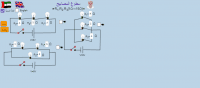
ثلاث دوائر لها المصدر نفسه والمصابيح نفسها \(R_1,R_2,R_3\) (قيم الأداة الأصلية: \(8\) و\(5\) و\(4\ \Omega\) و\(8\ \mathrm{V}\)). يتوهّج كل مصباح بقدر قدرته \(P\) (التوهج بمقياس واحد للدوائر الثلاث فيمكنك المقارنة بينها)، وتتحرك الشحنات بسرعة تتناسب مع التيار، والنجمة ★ تدل على الأسطع في كل دائرة. غيّر المقاومات والجهد وافتح المفتاح وأغلقه. جرّب أن تجعل المقاومات متساوية فتتساوى المصابيح.
Three circuits have the same source and the same bulbs \(R_1,R_2,R_3\) (the values of the original applet: \(8\), \(5\), \(4\ \Omega\) and \(8\ \mathrm{V}\)). Each bulb glows according to its power \(P\) (one common glow scale for the three circuits so you can compare them), the charges move at a speed proportional to the current, and the star ★ marks the brightest in each circuit. Change the resistances and the voltage and open and close the switch. Try making the resistances equal and the bulbs become equal.
🧪 تجربة 2: تنبّأ: أي مصباح هو الأسطع؟
🧪 Experiment 2: Predict: which bulb is the brightest?
لثلاثة مصابيح مقاوماتها مختلفة اختر الأسطع في كل دائرة من دون محاكاة، ثم اضغط «صحّح». مسألة جديدة في كل مرة.
For three bulbs of different resistances choose the brightest in each circuit without a simulation, then press “Check”. A new problem every time.
🛠️ تطبيقات عملية
🛠️ Practical applications
- دوائر المنزل: الأجهزة موصولة على التوازي فيعمل كلٌّ منها بجهد المصدر كاملًا ولا يتأثر بقية الأجهزة إذا توقف أحدها.House wiring: the appliances are connected in parallel so each works at the full source voltage and the others are not affected if one stops.
- سلاسل الزينة القديمة: المصابيح على التوالي فإذا احترق واحد انطفأت السلسلة كلها، ويتوزع الجهد بينها.Old string lights: the bulbs are in series so if one burns out the whole string goes off, and the voltage is shared between them.
- اختيار المصباح: للحصول على سطوع أكبر على التوازي نستخدم مصباحًا أقل مقاومة (قدرة مقننة أكبر عند الجهد نفسه).Choosing a bulb: to get more brightness in parallel we use a bulb of lower resistance (a larger rated power at the same voltage).
✍️ أمثلة محلولة
✍️ Worked Examples
ثلاثة مصابيح \(R_1=8\ \Omega\) و\(R_2=5\ \Omega\) و\(R_3=4\ \Omega\) موصولة على التوالي بمصدر \(8\ \mathrm{V}\) (قيم الأداة الأصلية). احسب التيار وقدرة كل مصباح وحدّد الأسطع.
Three bulbs \(R_1=8\ \Omega\), \(R_2=5\ \Omega\) and \(R_3=4\ \Omega\) are connected in series to an \(8\ \mathrm{V}\) source (the values of the original applet). Calculate the current, the power of each bulb and find the brightest.
المصابيح نفسها (\(8\ \Omega\) و\(5\ \Omega\) و\(4\ \Omega\)) موصولة على التوازي بالمصدر \(8\ \mathrm{V}\). احسب قدرة كل مصباح وحدّد الأسطع.
The same bulbs (\(8\ \Omega\), \(5\ \Omega\) and \(4\ \Omega\)) are connected in parallel to the \(8\ \mathrm{V}\) source. Calculate the power of each bulb and find the brightest.
دائرة مركبة: \(R_1=8\ \Omega\) و\(R_2=5\ \Omega\) على التوالي في فرع، و\(R_3=4\ \Omega\) في فرع موازٍ، والمصدر \(8\ \mathrm{V}\). احسب قدرة كل مصباح.
A combination circuit: \(R_1=8\ \Omega\) and \(R_2=5\ \Omega\) in series in one branch, \(R_3=4\ \Omega\) in a parallel branch, and an \(8\ \mathrm{V}\) source. Calculate the power of each bulb.
مصباحان \(A=4\ \Omega\) و\(B=12\ \Omega\) وُصلا بمصدر \(8\ \mathrm{V}\) مرةً على التوالي ومرةً على التوازي. أيهما أسطع في كل حالة؟
Two bulbs \(A=4\ \Omega\) and \(B=12\ \Omega\) are connected to an \(8\ \mathrm{V}\) source once in series and once in parallel. Which is brighter in each case?
ثلاثة مصابيح مختلفة المقاومة على التوالي. أسطعها هو:
Three bulbs of different resistances are in series. The brightest is the one with:
ثلاثة مصابيح مختلفة المقاومة على التوازي. أسطعها هو:
Three bulbs of different resistances are in parallel. The brightest is the one with:
مصباحان على التوازي احترق أحدهما. ماذا يحدث لسطوع الآخر؟
Two bulbs are in parallel and one burns out. What happens to the brightness of the other?
إذا تضاعف جهد المصدر على مصباح مقاومته ثابتة فإن قدرته تصبح:
If the source voltage across a bulb of constant resistance doubles, its power becomes:
📚 ملخص
📚 Summary
| الدائرةCircuit | الثابتConstant | القدرةPower | الأسطعBrightest |
|---|---|---|---|
| التواليSeries | \(I\)\(I\) | \(P=I^2R\)\(P=I^2R\) | الأكبر مقاومةlargest \(R\) |
| التوازيParallel | \(V\)\(V\) | \(P=\dfrac{V^2}{R}\)\(P=\dfrac{V^2}{R}\) | الأصغر مقاومةsmallest \(R\) |
| المركبةCombination | حسب الفرعper branch | نحلّل خطوة بخطوةstep-by-step analysis | نقارن \(P\) المحسوبةcompare the calculated \(P\) |
⚠️ أخطاء شائعة
⚠️ Common mistakes
- القول إن الأكبر مقاومة أسطع دائمًا؛ هذا صحيح على التوالي فقط وعلى التوازي يحدث العكس.Saying that the larger resistance is always brighter; this is true in series only and in parallel it is the opposite.
- استعمال \(P=\dfrac{V^2}{R}\) في دائرة التوالي بجهد المصدر الكلي؛ على التوالي لا يقع الجهد الكلي على كل مصباح.Using \(P=\dfrac{V^2}{R}\) in a series circuit with the total source voltage; in series the total voltage is not across every bulb.
- الخلط بين سطوع المصباح وتياره: الأسطع هو الأكبر قدرة \(P\) لا الأكبر تيارًا فقط.Confusing the brightness with the current: the brightest is the one of the largest power \(P\), not just the largest current.
🔗 محاكيات GeoGebra للاستعانة بها عند اللزوم
🔗 GeoGebra Simulations to Use When Needed
اضغط «تشغيل» لتعمل المحاكاة هنا داخل الدرس؛ ويمكن للطالب الرجوع إليها لتجربة الفكرة بطريقة أخرى.
Press “Run” to run the simulation right here inside the lesson; the student can use it to try the idea in another way.