🎯 نواتج التعلم
🎯 Learning Outcomes
بعد هذه التجربة ستكون قادرًا على أن:
After this experiment you will be able to:
- تحسب القدرة المصروفة في مقاومة بالصيغ \(P=IV=I^2R=\dfrac{V^2}{R}\).Calculate the power dissipated in a resistor with \(P=IV=I^2R=\dfrac{V^2}{R}\).
- تحل دائرة فيها مقاومات على التوالي والتوازي وتجد التيار والجهد على كل مقاومة.Solve a circuit with resistors in series and in parallel and find the current and the voltage of each resistor.
- تقارن توزيع القدرة بين المقاومات المتصلة على التوالي وعلى التوازي وتثبت أن مجموعها يساوي قدرة البطارية.Compare how the power is shared between resistors in series and in parallel and show that their sum equals the battery power.
🎬 شاهد الفيديو
🎬 Watch the Video
⚡ القدرة المصروفة في مقاومة
⚡ Power Dissipated in a Resistor
عندما يمر تيار في مقاومة تتحول الطاقة الكهربائية إلى طاقة حرارية، ومعدل هذا التحول هو القدرة المصروفة. وبتطبيق قانون أوم \(V=IR\) نحصل على ثلاث صيغ متكافئة، نختار الأنسب بحسب ما هو ثابت في الدائرة:
When a current flows in a resistor electrical energy turns into thermal energy, and the rate of this conversion is the dissipated power. Applying Ohm’s law \(V=IR\) we get three equivalent forms, and we choose the most suitable according to what is constant in the circuit:
📘 صيغ القدرة
📘 The forms of power
\[P=IV=I^2R=\dfrac{V^2}{R}\]
وحدتها الواط \(1\ \mathrm{W}=1\ \mathrm{J/s}=1\ \mathrm{V\cdot A}\).
Its unit is the watt \(1\ \mathrm{W}=1\ \mathrm{J/s}=1\ \mathrm{V\cdot A}\).
| التوصيلConnection | الثابتWhat is constant | الصيغة الأنسبThe best form | أي مقاومة تصرف قدرة أكبر؟Which resistor dissipates more power? |
|---|---|---|---|
| على التواليseries | التيار \(I\)the current \(I\) | \(P=I^2R\)\(P=I^2R\) | الأكبر مقاومةthe larger resistance |
| على التوازيparallel | الجهد \(V\)the voltage \(V\) | \(P=\dfrac{V^2}{R}\)\(P=\dfrac{V^2}{R}\) | الأصغر مقاومةthe smaller resistance |
💡 شرح إضافي: لماذا تتبدل النتيجة بين التوالي والتوازي؟ ولماذا يتحقق حفظ الطاقة؟
💡 Extra explanation: why does the result change between series and parallel? And why is energy conserved?
في التوالي يمر التيار نفسه في المقاومات فتكون \(P=I^2R\) متناسبة طرديًا مع \(R\): المصباح الأكبر مقاومة أسطع. وفي التوازي يتساوى الجهد على الفروع فتكون \(P=V^2/R\) متناسبة عكسيًا مع \(R\): المصباح الأصغر مقاومة أسطع. أما في أي دائرة فالبطارية تعطي الطاقة بمعدل \(P=IV\)، وكل هذه الطاقة تصرفها المقاومات حرارةً: \(IV=I^2R_1+I_2^2R_2+I_3^2R_3\). وهذا ما يظهر في مخطط المساحات: مساحة المستطيل الكبير (التيار الكلي × جهد البطارية) تساوي مجموع مساحات المستطيلات الصغيرة.
In series the same current flows in the resistors so \(P=I^2R\) is directly proportional to \(R\): the lamp with the larger resistance is brighter. In parallel the voltage is the same across the branches so \(P=V^2/R\) is inversely proportional to \(R\): the lamp with the smaller resistance is brighter. In any circuit the battery supplies energy at the rate \(P=IV\), and all this energy is dissipated by the resistors as heat: \(IV=I^2R_1+I_2^2R_2+I_3^2R_3\). This is what the area chart shows: the area of the big rectangle (the total current × the battery voltage) equals the sum of the areas of the small rectangles.
🔌 حل الدائرة خطوة بخطوة
🔌 Solving the Circuit Step by Step
🪜 الخطوات
🪜 The steps
- المقاومة المكافئة للفرعين المتوازيين: \(R_{23}=\dfrac{R_2R_3}{R_2+R_3}\).The equivalent resistance of the two parallel branches: \(R_{23}=\dfrac{R_2R_3}{R_2+R_3}\).
- المقاومة الكلية: \(R_{eq}=R_1+R_{23}\) والتيار الكلي \(I=\dfrac{V}{R_{eq}}\).The total resistance: \(R_{eq}=R_1+R_{23}\) and the total current \(I=\dfrac{V}{R_{eq}}\).
- جهد \(R_1\): \(V_1=IR_1\)، وجهد الفرعين \(V_{23}=V-V_1=IR_{23}\).The voltage of \(R_1\): \(V_1=IR_1\), and the voltage of the two branches \(V_{23}=V-V_1=IR_{23}\).
- تياراهما: \(I_2=\dfrac{V_{23}}{R_2}\) و\(I_3=\dfrac{V_{23}}{R_3}\) ومجموعهما \(I\).Their currents: \(I_2=\dfrac{V_{23}}{R_2}\) and \(I_3=\dfrac{V_{23}}{R_3}\) and their sum is \(I\).
- القدرات: \(P_1=IV_1\) و\(P_2=I_2V_{23}\) و\(P_3=I_3V_{23}\) ومجموعها \(IV\).The powers: \(P_1=IV_1\), \(P_2=I_2V_{23}\), \(P_3=I_3V_{23}\) and their sum is \(IV\).
🧪 تجربة 1: أين تذهب قدرة البطارية؟ مقاومة على التوالي مع فرعين على التوازي
🧪 Experiment 1: Where does the battery power go? A resistor in series with two parallel branches
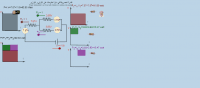
يمر تيار البطارية \(I\) في \(R_1\) على التوالي ثم ينقسم بين \(R_2\) و\(R_3\) على التوازي. القدرة المصروفة في كل مقاومة \(P=IV=I^2R=\dfrac{V^2}{R}\)، ومجموع القدرات المصروفة يساوي قدرة البطارية \(P=IV\) (حفظ الطاقة). يمثل مخطط المساحات القدرة بمساحة المستطيل (التيار × فرق الجهد): المستطيل الكبير هو قدرة البطارية، ويتكوّن من مستطيل \(R_1\) ومستطيلي \(R_2\) و\(R_3\). غيّر الجهد والمقاومات وراقب كيف تتوزع القدرة (تتوهج المقاومة بحسب قدرتها).
The battery current \(I\) flows through \(R_1\) in series and then divides between \(R_2\) and \(R_3\) in parallel. The power dissipated in each resistor is \(P=IV=I^2R=\dfrac{V^2}{R}\), and the sum of the dissipated powers equals the battery power \(P=IV\) (conservation of energy). The area chart represents power by the area of a rectangle (current × voltage): the big rectangle is the battery power and it is made of the rectangle of \(R_1\) and the two rectangles of \(R_2\) and \(R_3\). Change the voltage and the resistances and see how the power is shared (each resistor glows according to its power).
✍️ أمثلة محلولة
✍️ Worked Examples
دائرة بطارية \(8.7\ \mathrm{V}\): \(R_1=2.4\ \Omega\) على التوالي مع الفرعين \(R_2=1\ \Omega\) و\(R_3=1.1\ \Omega\) على التوازي (قيم الأداة الأصلية). احسب القدرة المصروفة في كل مقاومة وقدرة البطارية.
A battery circuit of \(8.7\ \mathrm{V}\): \(R_1=2.4\ \Omega\) in series with the branches \(R_2=1\ \Omega\) and \(R_3=1.1\ \Omega\) in parallel (the values of the original applet). Calculate the power dissipated in each resistor and the battery power.
مقاومتان \(2\ \Omega\) و\(6\ \Omega\) على التوالي مع بطارية \(8\ \mathrm{V}\). احسب القدرة في كل منهما.
Two resistors \(2\ \Omega\) and \(6\ \Omega\) in series with an \(8\ \mathrm{V}\) battery. Calculate the power in each.
المقاومتان نفساهما \(2\ \Omega\) و\(6\ \Omega\) على التوازي مع بطارية \(12\ \mathrm{V}\). احسب القدرة في كل منهما والقدرة الكلية.
The same two resistors \(2\ \Omega\) and \(6\ \Omega\) in parallel with a \(12\ \mathrm{V}\) battery. Calculate the power in each and the total power.
مقاومتان على التوالي \(R_1\lt R_2\). أيهما تصرف قدرة أكبر؟
Two resistors in series \(R_1\lt R_2\). Which dissipates more power?
مقاومتان على التوازي \(R_1\lt R_2\). أيهما تصرف قدرة أكبر؟
Two resistors in parallel \(R_1\lt R_2\). Which dissipates more power?
قدرة البطارية في دائرة بمقاومات تساوي:
The battery power in a circuit of resistors equals:
إذا تضاعف جهد البطارية في الدائرة نفسها فإن القدرة الكلية:
If the battery voltage doubles in the same circuit the total power:
📚 ملخص
📚 Summary
| المفهومConcept | القانونLaw |
|---|---|
| القدرة في مقاومةPower in a resistor | \(P=IV=I^2R=\dfrac{V^2}{R}\)\(P=IV=I^2R=\dfrac{V^2}{R}\) |
| قدرة البطاريةBattery power | \(P=IV=P_1+P_2+P_3\)\(P=IV=P_1+P_2+P_3\) |
| المقاومة المكافئةEquivalent resistance | \(R_{eq}=R_1+\dfrac{R_2R_3}{R_2+R_3}\)\(R_{eq}=R_1+\dfrac{R_2R_3}{R_2+R_3}\) |
⚠️ أخطاء شائعة
⚠️ Common mistakes
- استعمال \(V\) البطارية على كل مقاومة؛ جهد كل مقاومة هو فرق الجهد بين طرفيها هي.Using the battery \(V\) for every resistor; the voltage of each resistor is the potential difference between its own ends.
- الاعتقاد بأن أكبر مقاومة تصرف أكبر قدرة دائمًا؛ هذا صحيح على التوالي فقط.Believing that the largest resistance always dissipates the most power; this is true in series only.
- نسيان أن مجموع القدرات يساوي قدرة البطارية \(IV\) (وسيلة للتحقق من الحل).Forgetting that the sum of the powers equals the battery power \(IV\) (a way to check the solution).
🔗 محاكيات GeoGebra للاستعانة بها عند اللزوم
🔗 GeoGebra Simulations to Use When Needed
اضغط «تشغيل» لتعمل المحاكاة هنا داخل الدرس؛ ويمكن للطالب الرجوع إليها لتجربة الفكرة بطريقة أخرى.
Press “Run” to run the simulation right here inside the lesson; the student can use it to try the idea in another way.