🎯 نواتج التعلم
🎯 Learning Outcomes
بعد دراسة هذا الدرس ستكون قادرًا على أن:
After this lesson you will be able to:
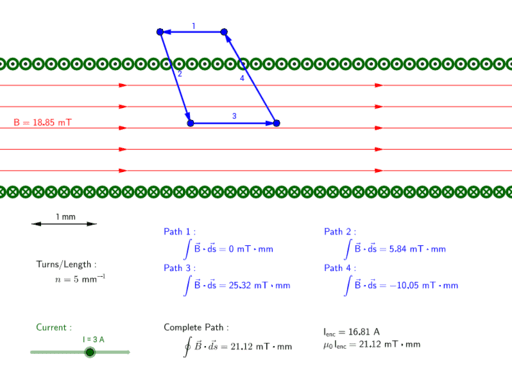
- تنص على قانون أمبير \(\oint\vec B\cdot d\vec l=\mu_0I_{enc}\) وتختار حلقة أمبير المناسبة.State Ampère’s law \(\oint\vec B\cdot d\vec l=\mu_0I_{enc}\) and choose a suitable Amperian loop.
- تحسب المجال على محور حلقة دائرية وتصف ملفات هلمهولتز وانتظام مجالها.Calculate the field on the axis of a circular loop and describe Helmholtz coils and their uniform field.
- تستنتج مجال سلك مستقيم سميك داخله وخارجه.Derive the field of a thick straight wire inside and outside it.
- تستنتج مجال الملف اللولبي \(B=\mu_0nI\) والملف الحلقي \(B=\dfrac{\mu_0NI}{2\pi r}\).Derive the field of a solenoid \(B=\mu_0nI\) and of a toroid \(B=\dfrac{\mu_0NI}{2\pi r}\).
- تحلّ مسائل عددية وتقرأ منحنى المجال مع المسافة.Solve numerical problems and read the graph of field against distance.
📜 قانون أمبير
📜 Ampère’s Law
التكامل الخطي لـ \(\vec B\) على أي مسار مغلق يساوي \(\mu_0\) مضروبًا في التيار الكلي المحصور داخل ذلك المسار:
The line integral of \(\vec B\) around any closed path equals \(\mu_0\) times the total current enclosed by that path:
\[\oint\vec B\cdot d\vec l=\mu_0\,I_{enc}\]
ويُحدَّد اتجاه \(\vec B\) بقاعدة قبضة اليد اليمنى: الإبهام باتجاه التيار والأصابع باتجاه المجال.
The direction of \(\vec B\) comes from the right-hand grip rule: the thumb along the current and the fingers along the field.
📘 كيف نختار «حلقة أمبير»؟
📘 How do we choose the “Amperian loop”?
- اختر مسارًا مغلقًا يتبع تناظر المسألة (دائرة حول سلك، مستطيل عند الملف اللولبي…).Choose a closed path that follows the symmetry of the problem (a circle around a wire, a rectangle at a solenoid…).
- اجعل \(\vec B\) على كل جزء من المسار إما موازيًا لـ \(d\vec l\) وثابتًا في المقدار، أو عموديًا عليه، أو صفرًا، ليسهل التكامل.Make \(\vec B\) on each part of the path either parallel to \(d\vec l\) and constant in magnitude, or perpendicular to it, or zero, so the integral is easy.
- احسب \(I_{enc}\): التيارات التي تخترق السطح الذي يحدّه المسار فقط، مع الإشارة بقاعدة اليد اليمنى.Find \(I_{enc}\): only the currents crossing the surface bounded by the path, with signs from the right-hand rule.
💡 متى نستعمل قانون أمبير؟
💡 When do we use Ampère’s law?
يعطي قانون أمبير \(B\) بسهولة فقط عندما يكون توزيع التيار متناظرًا (سلك طويل، ملف لولبي مثالي، ملف حلقي). أما في غير المتناظر كحلقة دائرية فنستعمل قانون بيو–سافار بالتكامل.
Ampère’s law gives \(B\) easily only when the current distribution is symmetric (a long wire, an ideal solenoid, a toroid). For non-symmetric cases such as a circular loop we integrate with the Biot–Savart law.
⭕ المجال على محور حلقة دائرية
⭕ The Field on the Axis of a Circular Loop
لحلقة نصف قطرها \(R\) يمر فيها تيار \(I\)، نأخذ جزءًا صغيرًا \(d\vec l\) ونحسب مجاله بقانون بيو–سافار ثم نكامل على الحلقة. على المحور على بعد \(x\) من المركز، الزاوية بين \(d\vec l\) و\(\hat r\) تساوي \(90^\circ\):
For a loop of radius \(R\) carrying a current \(I\), take a small element \(d\vec l\), find its field with the Biot–Savart law, and integrate around the loop. On the axis at a distance \(x\) from the centre, the angle between \(d\vec l\) and \(\hat r\) is \(90^\circ\):
\[dB=\dfrac{\mu_0I}{4\pi}\dfrac{dl}{x^{2}+R^{2}}\]
يُحلَّل \(dB\) إلى مركبتين: موازية للمحور \(dB_x=dB\cos\theta\) وعمودية عليه \(dB_y=dB\sin\theta\). وبتناظر الحلقة تلغي مركبتا أي جزأين متقابلين إحداهما الأخرى (المركبة العمودية)، فتبقى المركبة الموازية للمحور فقط، حيث \(\cos\theta=\dfrac{R}{\sqrt{x^2+R^2}}\):
\(dB\) splits into a component along the axis \(dB_x=dB\cos\theta\) and one perpendicular to it \(dB_y=dB\sin\theta\). By symmetry the perpendicular components of two opposite elements cancel, leaving only the component along the axis, with \(\cos\theta=\dfrac{R}{\sqrt{x^2+R^2}}\):
📌 المجال على محور حلقة
📌 The field on the axis of a loop
\[B=\dfrac{\mu_0IR^{2}}{2\,(x^{2}+R^{2})^{3/2}}\]
وفي المركز \(x=0\): \(B=\dfrac{\mu_0I}{2R}\)، وللملف من \(N\) لفة نضرب في \(N\). وبعيدًا عن الحلقة (\(x\gg R\)): \(B\approx\dfrac{\mu_0IR^2}{2x^3}\) أي يتناقص بسرعة مع \(x^3\).
At the centre \(x=0\): \(B=\dfrac{\mu_0I}{2R}\), and for a coil of \(N\) turns we multiply by \(N\). Far from the loop (\(x\gg R\)): \(B\approx\dfrac{\mu_0IR^2}{2x^3}\), falling quickly as \(x^3\).
حلقة نصف قطرها \(R=0.2\ \mathrm{m}\) يمر فيها تيار \(I=3\ \mathrm{A}\). احسب المجال في مركزها.
A loop of radius \(R=0.2\ \mathrm{m}\) carries \(I=3\ \mathrm{A}\). Calculate the field at its centre.
🧪 تجربة 1: حلقات دائرية محورية: المجال وخطوط المجال
🧪 Experiment 1: Coaxial circular loops: the field and field lines
اختر عدد الحلقات (1 إلى 4) والمسافة بين كل حلقتين متجاورتين \(d\) مقيسة بـ \(R\). اسحب النقطة الزرقاء لترى المجال \(\vec B\) عند أي موضع. يبيّن الرسم السفلي \(B\) على المحور. اضغط «ترتيب هلمهولتز» (حلقتان و\(d=R\)) وراقب أن المجال بينهما يصبح شبه منتظم.
Choose the number of loops (1 to 4) and the distance \(d\) between neighbouring loops in units of \(R\). Drag the blue point to see the field \(\vec B\) anywhere. The lower graph shows \(B\) along the axis. Press “Helmholtz arrangement” (two loops with \(d=R\)) and notice the field between them becomes nearly uniform.
🧲 ملفات هلمهولتز
🧲 Helmholtz Coils
المجال الناتج عن حلقة واحدة غير منتظم، لكن كثيرًا من التجارب تحتاج مجالًا منتظمًا. اكتشف العالم هيرمان فون هلمهولتز (1821–1894) أنه إذا وُضع ملفان متطابقان محوريان تفصل بينهما مسافة تساوي نصف القطر \(d=R\) صار المجال بينهما منتظمًا إلى حدٍّ كبير. يُعرف هذا الترتيب بـ ملفي هلمهولتز.
The field of a single loop is not uniform, yet many experiments need a uniform field. The scientist Hermann von Helmholtz (1821–1894) found that two identical coaxial coils separated by a distance equal to their radius \(d=R\) give a field between them that is highly uniform. This arrangement is called Helmholtz coils.
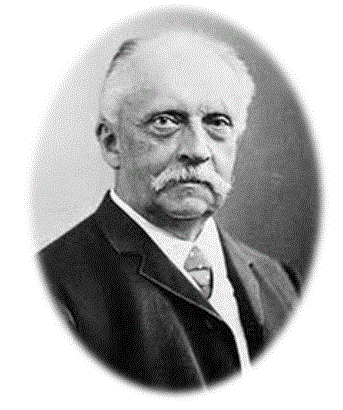
هيرمان فون هلمهولتز.
Hermann von Helmholtz.
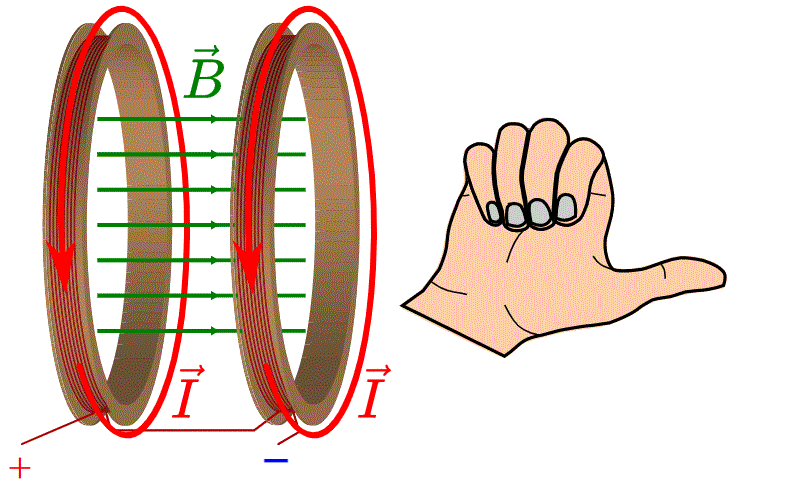
ملفا هلمهولتز: مجال منتظم بينهما.
Helmholtz coils: a uniform field between them.
📌 مجال هلمهولتز في المنتصف
📌 The Helmholtz field at the midpoint
لملفين من \(N\) لفة لكل منهما ونصف قطر \(R\) والمسافة \(d=R\)، يكون المجال في المنتصف مجموع مجالي الملفين:
For two coils of \(N\) turns each, radius \(R\) and separation \(d=R\), the field at the midpoint is the sum of the two coils’ fields:
\[B=\left(\dfrac{4}{5}\right)^{3/2}\dfrac{\mu_0NI}{R}\approx0.716\,\dfrac{\mu_0NI}{R}\]
وإذا كانت المسافة \(d\) أي قيمة أخرى فاجمع مجالي الملفين على المحور: \(B=2\cdot\dfrac{\mu_0NIR^2}{2\left(R^2+(d/2)^2\right)^{3/2}}\).
For any other separation \(d\) add the two coils’ axial fields: \(B=2\cdot\dfrac{\mu_0NIR^2}{2\left(R^2+(d/2)^2\right)^{3/2}}\).
🌟 تطبيقات
🌟 Applications
تُستعمل ملفات هلمهولتز لإلغاء المجال المغناطيسي الأرضي في التجارب، ولمعايرة مجسات المجال المغناطيسي، وفي تجارب الجسيمات المشحونة وأجهزة قياس النسبة \(e/m\)، وفي بعض أجهزة التصوير بالرنين المغناطيسي.
Helmholtz coils are used to cancel the Earth’s magnetic field in experiments, to calibrate magnetic-field sensors, in experiments on charged particles and \(e/m\) apparatus, and in some magnetic-resonance imaging setups.
ملفا هلمهولتز: عدد لفات كل ملف \(N=80\) والتيار \(I=5\ \mathrm{A}\) ونصف القطر \(R=0.08\ \mathrm{m}\). احسب المجال في المنتصف (أ) إذا كانت المسافة بينهما \(d=R\) (ب) إذا كانت \(d=0.16\ \mathrm{m}\).
Helmholtz coils: each has \(N=80\) turns, \(I=5\ \mathrm{A}\) and \(R=0.08\ \mathrm{m}\). Find the field at the midpoint (a) when the separation is \(d=R\) (b) when \(d=0.16\ \mathrm{m}\).
الشكل: ملفان محوريان يمر فيهما التيار في الاتجاه نفسه.
The figure: two coaxial coils with current in the same direction.
المسافة المثلى بين ملفي هلمهولتز لأقصى انتظام للمجال تساوي:
The optimal separation of Helmholtz coils for the most uniform field is:
➖ مجال سلك مستقيم سميك
➖ The Field of a Thick Straight Wire
سلك طويل نصف قطره \(R\) يحمل تيارًا \(I\) موزعًا بانتظام على مقطعه. نطبّق قانون أمبير بحلقة دائرية نصف قطرها \(r\) مركزها محور السلك، فيكون \(B\) مماسيًا ثابتًا عليها: \(\oint\vec B\cdot d\vec l=B(2\pi r)\).
A long wire of radius \(R\) carries a current \(I\) spread uniformly over its cross-section. We apply Ampère’s law with a circular loop of radius \(r\) centred on the wire’s axis, so \(B\) is tangential and constant on it: \(\oint\vec B\cdot d\vec l=B(2\pi r)\).
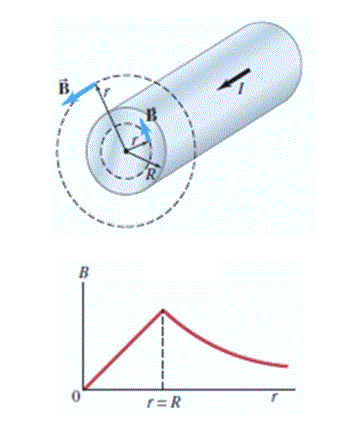
سلك سميك، وحلقتا أمبير داخله وخارجه، ومنحنى \(B\) مع \(r\).
A thick wire, Amperian loops inside and outside it, and the graph of \(B\) against \(r\).
| المنطقةRegion | التيار المحصورEnclosed current | المجالField |
|---|---|---|
| داخل السلك \(r\lt R\)Inside \(r\lt R\) | \(I_{enc}=I\dfrac{r^{2}}{R^{2}}\)\(I_{enc}=I\dfrac{r^{2}}{R^{2}}\) | \(B=\dfrac{\mu_0Ir}{2\pi R^{2}}\)\(B=\dfrac{\mu_0Ir}{2\pi R^{2}}\) |
| خارج السلك \(r\gt R\)Outside \(r\gt R\) | \(I_{enc}=I\)\(I_{enc}=I\) | \(B=\dfrac{\mu_0I}{2\pi r}\)\(B=\dfrac{\mu_0I}{2\pi r}\) |
🔎 معنى الرسم البياني
🔎 What the graph means
يزداد \(B\) خطيًا من الصفر في المحور حتى قيمته العظمى عند سطح السلك \(r=R\)، ثم يتناقص بـ \(1/r\) خارج السلك. وتتساوى القيمتان عند \(r=R\): \(B_{max}=\dfrac{\mu_0I}{2\pi R}\).
\(B\) rises linearly from zero on the axis to its maximum at the wire’s surface \(r=R\), then falls as \(1/r\) outside. The two formulas agree at \(r=R\): \(B_{max}=\dfrac{\mu_0I}{2\pi R}\).
🧪 تجربة 2: قانون أمبير: حلقة اختبار حول سلك سميك
🧪 Experiment 2: Ampère’s law: a test loop around a thick wire
سلك نصف قطره \(R\) يحمل تيارًا منتظمًا. حرّك نصف قطر حلقة أمبير \(r\) من المركز إلى خارج السلك. داخل السلك يُحاط جزء من التيار فقط \(I\,r^2/R^2\) فيزداد \(B\) خطيًا، وخارجه يُحاط التيار كله فيتناقص \(B\) بـ \(1/r\). أقصى مجال عند \(r=R\).
A wire of radius \(R\) carries a uniform current. Move the radius \(r\) of the Amperian loop from the centre to outside the wire. Inside, only a fraction \(I\,r^2/R^2\) of the current is enclosed so \(B\) rises linearly; outside, all the current is enclosed so \(B\) falls as \(1/r\). The maximum is at \(r=R\).
رُسمت العلاقة بين \(B\) والبعد \(r\) لسلك فكان أقصى مجال \(4\times10^{-3}\ \mathrm{T}\) عند \(r=20\ \mathrm{mm}\) وهو سطح السلك (انظر الشكل). أوجد \(B\) عند \(r=12\ \mathrm{mm}\) وعند \(r=40\ \mathrm{mm}\)، ثم التيار \(I\).
The graph of \(B\) against \(r\) for a wire shows a maximum of \(4\times10^{-3}\ \mathrm{T}\) at \(r=20\ \mathrm{mm}\), the wire’s surface (see the figure). Find \(B\) at \(r=12\ \mathrm{mm}\) and \(r=40\ \mathrm{mm}\), then the current \(I\).
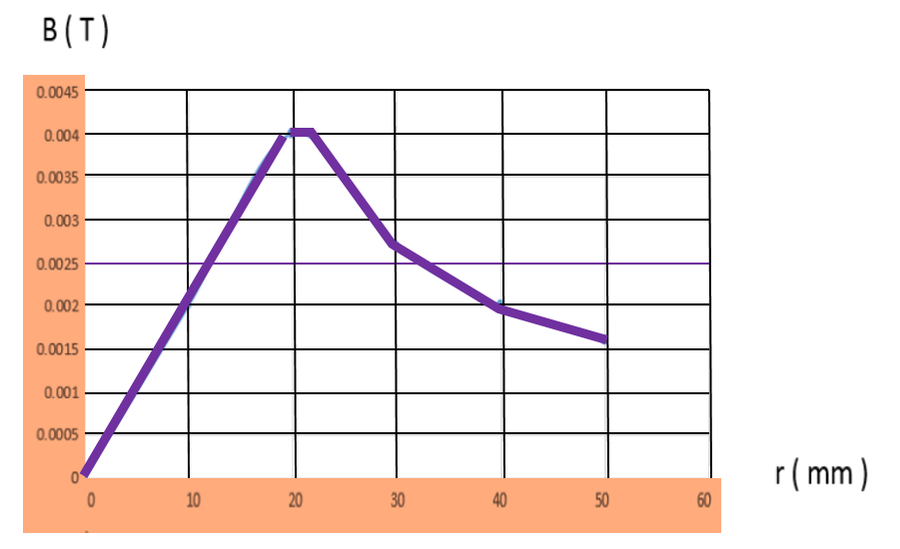
منحنى \(B\) مع \(r\): خطي حتى \(20\ \mathrm{mm}\) ثم يتناقص.
The graph of \(B\) against \(r\): linear up to \(20\ \mathrm{mm}\), then falling.
سلك مستقيم رفيع يمر به تيار \(I=10\ \mathrm{A}\). احسب المجال على بعد \(0.05\ \mathrm{m}\) منه.
A thin straight wire carries \(I=10\ \mathrm{A}\). Calculate the field at \(0.05\ \mathrm{m}\) from it.
داخل سلك سميك يحمل تيارًا منتظمًا، عند مضاعفة \(r\) فإن \(B\):
Inside a thick wire carrying a uniform current, when \(r\) is doubled \(B\):
🌀 الملف اللولبي
🌀 The Solenoid
الملف اللولبي المثالي ملف طويل متراص اللفات يمر فيه تيار مستمر. بقاعدة القبضة يكون \(\vec B\) داخله موازيًا لمحوره ومنتظمًا، وينعدم خارجه تقريبًا. لحساب \(B\) نختار حلقة أمبير على شكل مستطيل \(abcd\) أحد ضلعيه (طوله \(L\)) داخل الملف والآخر خارجه.
An ideal solenoid is a long, tightly wound coil carrying a steady current. By the grip rule \(\vec B\) inside is parallel to its axis and uniform, and almost zero outside. To find \(B\) we choose a rectangular Amperian loop \(abcd\) with one side (length \(L\)) inside the solenoid and the other outside.
| الضلعSide | موضعهLocation | \(\int\vec B\cdot d\vec l\)\(\int\vec B\cdot d\vec l\) |
|---|---|---|
| الضلع الداخليInner side | داخل الملف موازيًا للمجالinside, parallel to the field | \(BL\)\(BL\) |
| الضلعان الجانبيانThe two ends | عموديان على \(\vec B\) أو خارج الملفperpendicular to \(\vec B\) or outside | \(0\)\(0\) |
| الضلع الخارجيOuter side | خارج الملف حيث \(B\approx0\)outside where \(B\approx0\) | \(0\)\(0\) |
📌 مجال الملف اللولبي
📌 The solenoid field
\(\oint\vec B\cdot d\vec l=0+0+BL+0=BL\). والتيار المحصور: \(nL\) لفة يحمل كل منها \(I\) فـ \(I_{enc}=nLI\). ومنه:
\(\oint\vec B\cdot d\vec l=0+0+BL+0=BL\). The enclosed current: \(nL\) turns each carrying \(I\) so \(I_{enc}=nLI\). Hence:
\[B=\mu_0\,n\,I,\qquad n=\dfrac{N}{\ell}\]
حيث \(n\) عدد اللفات لكل وحدة طول، وبقلب مغناطيسي \(B=\mu_r\mu_0nI\). والمجال لا يعتمد على نصف قطر الملف ولا على طوله مع ثبات \(n\).
where \(n\) is the number of turns per unit length, and with a magnetic core \(B=\mu_r\mu_0nI\). The field does not depend on the solenoid’s radius or length for fixed \(n\).
🧪 تجربة 3: الملف اللولبي: حلقة أمبير المستطيلة
🧪 Experiment 3: The solenoid: the rectangular Amperian loop
اختر موضع المستطيل \(abcd\) بالنسبة للملف. عندما يكون ضلع واحد داخل الملف فقط (طوله \(L\)) يكون \(\oint\vec B\cdot d\vec l=BL\) و\(I_{enc}=nLI\)، ومنه \(B=\mu_0nI\). جرّب الموضعين الآخرين لترى لماذا يصير التكامل صفرًا.
Choose the position of the rectangle \(abcd\) relative to the solenoid. When only one side is inside (length \(L\)), \(\oint\vec B\cdot d\vec l=BL\) and \(I_{enc}=nLI\), hence \(B=\mu_0nI\). Try the other two positions to see why the integral becomes zero.
ملف لولبي طوله \(\ell=0.5\ \mathrm{m}\) وعدد لفاته \(N=500\) ويمر فيه \(I=2\ \mathrm{A}\). احسب المجال داخله.
A solenoid of length \(\ell=0.5\ \mathrm{m}\) has \(N=500\) turns and carries \(I=2\ \mathrm{A}\). Calculate the field inside.
ملف لولبي مثالي: عند مضاعفة طوله مع بقاء عدد اللفات لكل متر والتيار ثابتين فإن المجال داخله:
In an ideal solenoid, if its length is doubled while the turns per metre and the current stay the same, the field inside:
🍩 الملف الحلقي
🍩 The Toroid
إذا ثُني الملف اللولبي حتى يلتقي طرفاه سُمّي ملفًا حلقيًا. وهو مثالي: لا مجال خارجه، والمجال محصور بين اللفات. بحلقة أمبير نصف قطرها \(r\) داخل اللفات: \(B(2\pi r)=\mu_0NI\):
If the solenoid is bent until its ends meet it is called a toroid. It is ideal: there is no field outside and the field is confined to the winding. With an Amperian loop of radius \(r\) inside the winding: \(B(2\pi r)=\mu_0NI\):
\[B=\dfrac{\mu_0\,N\,I}{2\pi\,r}\]
المجال غير ثابت: يتناسب مع \(1/r\). وللتوسع انظر درس الملف الحلقي مع تجربتيه التفاعليتين.
The field is not constant: it is proportional to \(1/r\). For more see the Toroid lesson with its two interactive experiments.
ملف حلقي نصف قطره \(r=0.15\ \mathrm{m}\) وعدد لفاته \(N=300\) ويمر فيه \(I=1.5\ \mathrm{A}\). احسب المجال داخله.
A toroid of radius \(r=0.15\ \mathrm{m}\) has \(N=300\) turns and carries \(I=1.5\ \mathrm{A}\). Calculate the field inside.
المجال المغناطيسي في ثقب الملف الحلقي وخارجه المثالي:
The magnetic field in the hole of an ideal toroid and outside it is:
📚 ملخص الدرس
📚 Lesson Summary
| النظامSystem | المجالField |
|---|---|
| قانون أمبيرAmpère’s law | \(\oint\vec B\cdot d\vec l=\mu_0I_{enc}\)\(\oint\vec B\cdot d\vec l=\mu_0I_{enc}\) |
| حلقة على محورهاLoop on its axis | \(B=\dfrac{\mu_0IR^2}{2(x^2+R^2)^{3/2}}\)\(B=\dfrac{\mu_0IR^2}{2(x^2+R^2)^{3/2}}\) |
| ملفا هلمهولتز (\(d=R\))Helmholtz coils (\(d=R\)) | \(B=0.716\,\dfrac{\mu_0NI}{R}\)\(B=0.716\,\dfrac{\mu_0NI}{R}\) |
| سلك: خارجه / داخلهWire: outside / inside | \(\dfrac{\mu_0I}{2\pi r}\ /\ \dfrac{\mu_0Ir}{2\pi R^2}\)\(\dfrac{\mu_0I}{2\pi r}\ /\ \dfrac{\mu_0Ir}{2\pi R^2}\) |
| ملف لولبيSolenoid | \(B=\mu_0nI\)\(B=\mu_0nI\) |
| ملف حلقيToroid | \(B=\dfrac{\mu_0NI}{2\pi r}\)\(B=\dfrac{\mu_0NI}{2\pi r}\) |
⚠️ أخطاء شائعة
⚠️ Common mistakes
- القول إن المسافة المثلى لهلمهولتز \(R/2\)؛ هي \(R\) (والبعد من كل ملف إلى المنتصف \(R/2\)).Saying the Helmholtz separation is \(R/2\); it is \(R\) (each coil is \(R/2\) from the midpoint).
- استعمال \(\mu_0I/2\pi r\) داخل السلك السميك؛ داخله \(B\propto r\).Using \(\mu_0I/2\pi r\) inside a thick wire; inside it \(B\propto r\).
- في الملف اللولبي استعمال \(N\) بدل \(n=N/\ell\).Using \(N\) instead of \(n=N/\ell\) for the solenoid.
- كتابة \(6\pi\times10^{-4}\) بدل \(6\times10^{-4}\) عند حساب الملف الحلقي: \(\mu_0/2\pi=2\times10^{-7}\) لا يحمل \(\pi\).Writing \(6\pi\times10^{-4}\) instead of \(6\times10^{-4}\) for the toroid: \(\mu_0/2\pi=2\times10^{-7}\) has no \(\pi\).
- عدّ تيارات خارج حلقة أمبير ضمن \(I_{enc}\).Counting currents outside the Amperian loop in \(I_{enc}\).
🧪 اختبر نفسك: امتحان من 20 سؤالاً
🧪 Test Yourself: a 20-Question Exam
أنهِ الدرس بالاختبار التفاعلي التالي؛ أسئلته تجمع بين الفهم والحساب وتغطي جميع أقسام الدرس.
Finish with the interactive exam below; its questions mix understanding with calculation and cover every section of the lesson.
اختبار قانون أمبير Ampère’s Law Quiz
20 سؤالاً - المجال الناتج عن الحلقات والسلك والملف اللولبي والحلقي 20 Questions - loops, wires, solenoids and toroids
• عدد الأسئلة: 20 سؤالاً
• مدة الاختبار: 30 دقيقة
• لا يمكنك تغيير إجاباتك أو إعادة الاختبار إلا بعد 24 ساعة من التسليم.
• تأكد من إجاباتك قبل التسليم! 📌 Important Instructions:
• Number of questions: 20 questions
• Quiz duration: 30 minutes
• You cannot change your answers or retake the quiz for 24 hours after submission.
• Make sure of your answers before submitting!
🔗 محاكيات GeoGebra للاستعانة بها عند اللزوم
🔗 GeoGebra Simulations to Use When Needed
اضغط «تشغيل» لتعمل المحاكاة هنا داخل الدرس؛ ويمكن للطالب الرجوع إليها لتجربة الفكرة بطريقة أخرى.
Press “Run” to run the simulation right here inside the lesson; the student can use it to try the idea in another way.