🎯 Learning Outcomes
- Identify the difference between series and parallel connections in a circuit that contains both.
- Simplify a compound circuit step by step, from the inside out.
- Calculate the total equivalent resistance of a compound circuit.
- Calculate the total current, then distribute it among the branches and resistors.
- Apply Kirchhoff’s laws to check your results.
- Calculate the voltage and the current of any resistor in a compound circuit.
- Avoid common mistakes, such as confusing series with parallel or forgetting a battery’s internal resistance.
- Use the interactive simulation to check your calculations.
1) What is a compound circuit?
A compound (mixed) circuit combines resistors connected in series with resistors connected in parallel in the same circuit. Most real circuits are of this type: for example, a main element in series with a group of parallel devices, or a battery’s internal resistance in series with the whole load.
The reason this lesson matters is simple: you cannot apply one law to the whole circuit at once. Instead, you break the circuit into small groups, reduce each group to a single resistor, and repeat until one equivalent resistance remains.
2) How do you tell series from parallel?
- In series: the resistors form a single path for the current, so the same current flows through each one. There is no junction between them.
- In parallel: the resistors connect to the same two junction points, so they share the same voltage and the current splits between them.
- Be careful: a wire between two points with no element means those points are one single junction. Confusing these is one of the most common mistakes.
tip
3) Steps for solving a compound circuit
- Identify the junctions (nodes) and redraw the circuit clearly. This step prevents confusing series with parallel.
- Start from the smallest clear group, far from the source. Add resistors that are in series: R = R₁ + R₂ + ….
- Reduce parallel groups to a single resistor using 1/R = 1/R₁ + 1/R₂ + …, or the quick formula for two resistors: R = R₁R₂ / (R₁ + R₂).
- Repeat the two previous steps until one resistor remains: the equivalent resistance R_eq. If the battery has an internal resistance, add it in series with the rest.
- Find the total current from the source: I = V / R_eq.
- Work back inward, step by step: each parallel group has the voltage V_p = I × R_p, and from it you find each branch current I = V_p / R_branch.
- Check: the branch currents add up to the total current (Kirchhoff’s first law), and the voltages around each loop add up to zero (Kirchhoff’s second law).
4) Helpful formulas you always need
- Series: R = R₁ + R₂ + ⋯, and the same current flows through every element.
- Parallel: 1/R = 1/R₁ + 1/R₂ + ⋯, and the same voltage appears across every branch.
- Ohm’s law: V = I·R, so I = V/R and R = V/I.
- Power: P = V·I = I²R = V²/R.
5) Worked examples with detailed explanations
Example 1: a battery with internal resistance. A 15 V battery with internal resistance r = 1 Ω is in series with Rc = 2 Ω, then a parallel group of Ra = 6 Ω and Rb = 3 Ω. Find the total resistance and the current.
\[ R_{ab} = \left(\frac{1}{6} + \frac{1}{3}\right)^{-1} = 2\,\Omega \]
\[ R_{eq} = R_{ab} + R_c + r = 2 + 2 + 1 = 5\,\Omega \qquad I = \frac{15}{5} = 3\,\text{A} \]
Extra explanation: The battery’s internal resistance is not part of the external load, but it lies on the same current path, so it is added in series with the rest. Ignoring it would give the wrong total current. Notice that R_ab is found first because it is the only group connected in parallel.
Example 2: two identical groups. R₁ = 4 Ω ∥ R₂ = 4 Ω, and this group is in series with R₃ = 6 Ω ∥ R₄ = 6 Ω, with a 20 V source. Find the current through each resistor.
\[ R_{12} = \left(\frac{1}{4}+\frac{1}{4}\right)^{-1} = 2\,\Omega \qquad R_{34} = \left(\frac{1}{6}+\frac{1}{6}\right)^{-1} = 3\,\Omega \]
\[ R_{eq} = 2 + 3 = 5\,\Omega \qquad I_{tot} = \frac{20}{5} = 4\,\text{A} \]
Extra explanation: In each parallel group the two resistors are equal, so the current splits equally: I₁ = I₂ = 2 A, and likewise I₃ = I₄ = 2 A. The total current of 4 A flows through both groups, because they are in series.
Example 3: the voltage across a resistor. A 12 V source is connected to R₁ = 6 Ω in series, then the circuit splits into a branch (R₂ = 8 Ω in series with R₃ = 4 Ω) and a branch R₄ = 12 Ω. Find the voltage across R₄.
\[ R_{23} = 8 + 4 = 12\,\Omega \qquad R_{234} = \left(\frac{1}{12}+\frac{1}{12}\right)^{-1} = 6\,\Omega \]
\[ R_{eq} = 6 + 6 = 12\,\Omega \qquad I_{tot} = \frac{12}{12} = 1\,\text{A} \]
\[ V_{234} = I_{tot} \times R_{234} = 1 \times 6 = 6\,\text{V} \quad\Rightarrow\quad V_4 = 6\,\text{V} \]
Extra explanation: The 12 V divides between two elements in series: R₁ takes 1 × 6 = 6 V, and the parallel group takes the remaining 6 V. R₄ is connected directly across the two ends of that group, so it has the same 6 V. The key idea: all parallel branches share the same voltage.
6) The interactive simulation
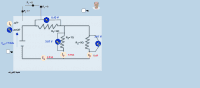
Build your own circuit by changing the voltage and the four resistances, and watch the equivalent resistance, the current and their distribution. Try to answer these before reading the calculation:
- What happens to the total current if you increase R₁? Why?
- If R₄ becomes very small, which branch takes most of the current?
- Is the sum of the two branch currents always equal to the total current? Try different values and check for yourself.
- Press “Reset to the original values” and confirm that the results match Example 3.
7) Common mistakes to avoid
- Confusing series with parallel: remember that series means one current, and parallel means one voltage.
- Adding parallel resistors as if they were in series: you will get a value larger than the real one. A parallel equivalent is always smaller than the smallest resistor in the group.
- Forgetting the battery’s internal resistance: when it is given, it lies on the current path and must be added in series.
- Using the full source voltage across an inner branch: the voltage across a parallel group is not necessarily V; it depends on where the group is in the circuit.
- Not redrawing the circuit: a clear redraw reveals most mistakes before they happen.
8) Lesson summary
- A compound circuit combines series and parallel; solve it by simplifying one group after another.
- Series: R = ΣR and one current. Parallel: 1/R = Σ(1/R) and one voltage.
- Total current: I = V / R_eq, then distribute it step by step over the branches.
- Always check with the current law at the junctions and the voltage law around the loops.