🎯 نواتج التعلم
بعد دراسة هذا الدرس ستكون قادراً على أن:
- تميّز التوصيل على التوالي عن غيره، وتصف مسار التيار فيه خطوة بخطوة.
- تحسب المقاومة المكافئة لعدة مقاومات متصلة على التوالي: R = R₁ + R₂ + …
- تستنتج أن التيار نفسه يمر في جميع عناصر الدائرة المتصلة على التوالي.
- تحسب فرق الجهد على كل مقاومة باستخدام V = IR، وتتحقق من أن مجموعها يساوي جهد المصدر.
- تفسّر توزيع الجهد بين المقاومات المتصلة على التوالي.
- تحل مسائل على دائرة فيها عدة مقاومات على التوالي، وتحسب التيار الكلي.
- تفسّر سبب نقصان سطوع المصابيح عند زيادة عددها على التوالي.
- تذكر تطبيقات التوصيل على التوالي وعيوبه، ومنها توقف الدائرة كلها عند عطل أحد عناصرها.
- تستخدم المحاكاة التفاعلية للتحقق من العلاقات الرياضية بنفسك.
⚡ طريقة التوصيل
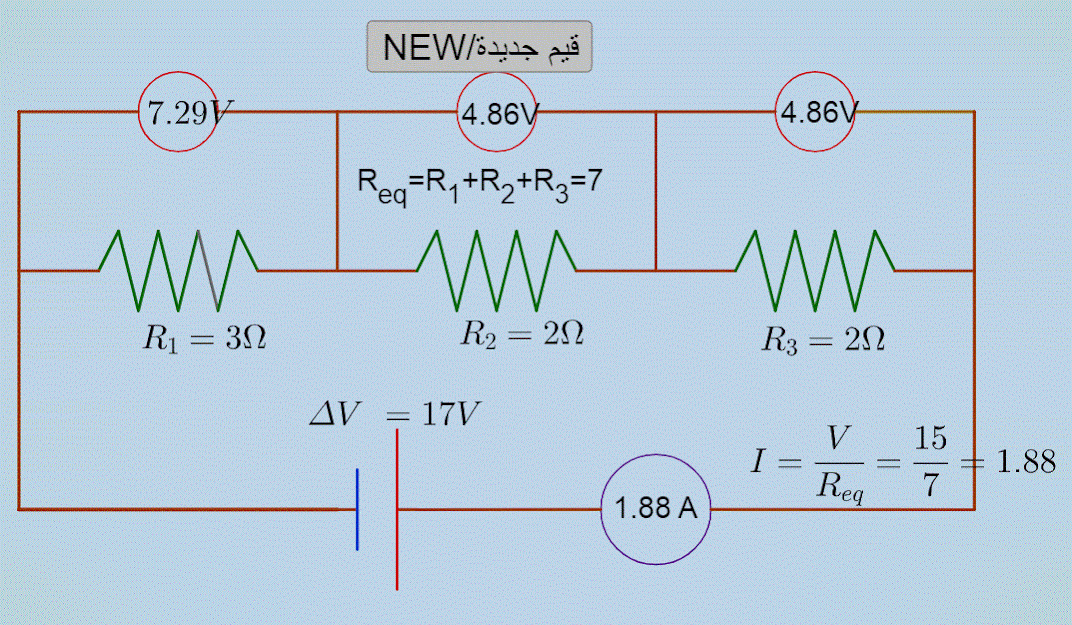
تُوصَل المقاومات على التوالي عن طريق ربطها واحدة تلو الأخرى في مسار واحد للتيار، بحيث يمر نفس التيار عبر جميع المقاومات، بينما يتوزع الجهد الكلي بينها.
📜 المعادلات الأساسية
المقاومة الكلية:
\[ R_{total} = R_1 + R_2 + \cdots + R_n \]
التيار:
\[ I = I_1 = I_2 = \cdots = I_n \]
الجهد الكهربائي:
\[ V_{total} = V_1 + V_2 + \cdots + V_n \]
🎯 الغاية من التوصيل على التوالي
- زيادة المقاومة الكلية في الدائرة للحصول على مقاومة مكافئة لم تكن موجودة من قبل
- تقسيم الجهد الكهربائي بين المكونات
- التحكم في شدة التيار المار في الدائرة
💡 تطبيقات عملية
- 🚨 دوائر الإضاءة: مثل مصابيح الزينة القديمة التي تنطفئ جميعًا إذا احترق أحدها
- 💡 حماية الـ LED: توصيل مقاومة على التوالي مع مصباح LED لتقليل التيار
- 🔋 مقسم الجهد: في المجسّات الإلكترونية وأجهزة القياس
- 🎚️ التحكم في الصوت: استخدام "مقياس الجهد" (Potentiometer)
مثال عملي:
إذا كان جهد البطارية 12 فولت، وقمنا بتوصيل مقاومتين (3Ω و6Ω) على التوالي:
\[ R_{total} = 3 + 6 = 9\,\Omega \qquad I = \frac{12}{9} \approx 1.33 \; A \]
مثال مفصّل بثلاث مقاومات
إذا كانت \(R_1 = 2\Omega\)، \(R_2 = 3\Omega\)، \(R_3 = 5\Omega\)، \(V_{tot} = 10V\):
\[ R_{eq} = 2 + 3 + 5 = 10\,\Omega \]
\[ I_{tot} = I_1 = I_2 = I_3 = \frac{V_{tot}}{R_{eq}} = \frac{10}{10} = 1\,A \]
فرق الجهد على كل مقاومة:
\[ V_1 = 1 \times 2 = 2V \qquad V_2 = 1 \times 3 = 3V \qquad V_3 = 1 \times 5 = 5V \]
سطوع المصابيح المتصلة على التوالي
سطوع المصابيح
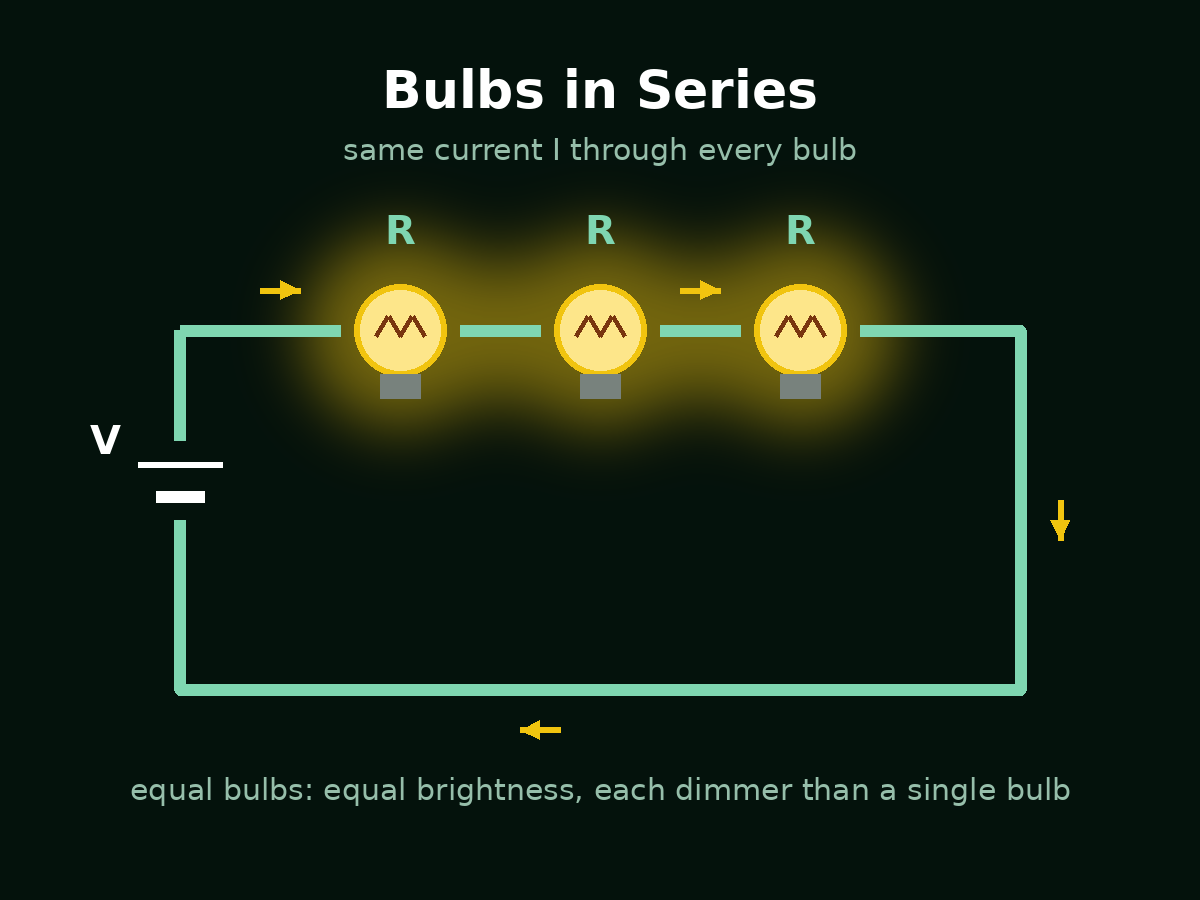
في التوصيل على التوالي، يمر نفس التيار عبر جميع المصابيح، لذا يُحسب السطوع بناءً على القدرة الكهربائية التي يستهلكها كل مصباح:
\[ P = I^2 \times R \]
بثبات شدة التيار، كلما كانت مقاومة المصباح أكبر كانت قدرته (وبالتالي سطوعه) أكبر — على عكس التوصيل على التوازي حيث العلاقة عكسية.
مثال عملي:
دائرة تحتوي على مصباحين متطابقين على التوالي: جهد المصدر 12 فولت، مقاومة كل مصباح 6 أوم.
\[ R_{eq} = 6 + 6 = 12\,\Omega \qquad I_{tot} = \frac{12}{12} = 1\,A \qquad P = 1^2 \times 6 = 6\,W \]
الغاية من التوصيل على التوالي (المصابيح)
- التحكم في شدة التيار عبر الدائرة
- توفير الحماية: عند احتراق أحد المصابيح، تنقطع الدائرة بالكامل
- استخدامها في أنظمة تتطلب توزيع جهد منخفض على مكونات متعددة
عيوب التوصيل على التوالي
- 🔌 زيادة عدد المكونات يقلل سطوع كل مصباح لأن الجهد يتوزع بينها
- ⚠️ عطل أحد المصابيح يؤدي إلى توقف الدائرة بالكامل
🎯 Learning Outcomes
After studying this lesson, you will be able to:
- Distinguish a series connection from other connections and describe the current path step by step.
- Calculate the equivalent resistance of several resistors in series: R = R₁ + R₂ + …
- Conclude that the same current flows through every element of a series circuit.
- Calculate the voltage across each resistor using V = IR, and verify that their sum equals the source voltage.
- Explain how the voltage is shared among resistors connected in series.
- Solve problems on a circuit with several series resistors and find the total current.
- Explain why bulbs become dimmer when more of them are connected in series.
- State the applications and disadvantages of a series connection, including the whole circuit stopping when one element fails.
- Use the interactive simulations to check the mathematical relations yourself.
⚡ Connection Method
Resistors are connected in series by linking them one after another in a single current path, so the same current flows through all resistors, while the total voltage is divided between them.
📜 Basic Equations
Total Resistance:
\[ R_{total} = R_1 + R_2 + \cdots + R_n \]
Current:
\[ I = I_1 = I_2 = \cdots = I_n \]
Voltage:
\[ V_{total} = V_1 + V_2 + \cdots + V_n \]
🎯 Purpose of a Series Connection
- Increase the circuit's total resistance to obtain an equivalent resistance not otherwise available
- Divide the electrical voltage between components
- Control the current flowing through the circuit
💡 Practical Applications
- 🚨 Lighting circuits: like old Christmas lights that all go out if one burns
- 💡 LED protection: connecting a resistor in series with an LED to reduce current
- 🔋 Voltage divider: in electronic sensors and measuring devices
- 🎚️ Volume control: using a potentiometer
Worked Example:
If battery voltage is 12V, and we connect two resistors (3Ω and 6Ω) in series:
\[ R_{total} = 3 + 6 = 9\,\Omega \qquad I = \frac{12}{9} \approx 1.33 \; A \]
Detailed Example with Three Resistors
If \(R_1 = 2\Omega\), \(R_2 = 3\Omega\), \(R_3 = 5\Omega\), \(V_{tot} = 10V\):
\[ R_{eq} = 2 + 3 + 5 = 10\,\Omega \]
\[ I_{tot} = I_1 = I_2 = I_3 = \frac{V_{tot}}{R_{eq}} = \frac{10}{10} = 1\,A \]
Voltage across each resistor:
\[ V_1 = 1 \times 2 = 2V \qquad V_2 = 1 \times 3 = 3V \qquad V_3 = 1 \times 5 = 5V \]
Light Bulbs Connected in Series
Bulb Brightness
In a series connection, the same current flows through all bulbs, so brightness is determined by the electrical power each bulb consumes:
\[ P = I^2 \times R \]
With current fixed, a bulb with a larger resistance dissipates more power (and is brighter) — the opposite of a parallel connection, where the relationship is inverse.
Worked Example:
A circuit with two identical bulbs in series: source voltage 12V, each bulb's resistance 6Ω.
\[ R_{eq} = 6 + 6 = 12\,\Omega \qquad I_{tot} = \frac{12}{12} = 1\,A \qquad P = 1^2 \times 6 = 6\,W \]
Purpose of Series Connection (Bulbs)
- Control current intensity through the circuit
- Provide protection: if one bulb burns, the entire circuit stops
- Used in systems requiring low voltage distribution across multiple components
Disadvantages of Series Connection
- 🔌 Adding more components reduces each bulb's brightness, since voltage is divided between them
- ⚠️ One bulb failure stops the entire circuit