🎯 نواتج التعلم
🎯 Learning Outcomes
بعد هذه التجربة ستكون قادرًا على أن:
After this experiment you will be able to:
- تركّب سلسلة من المقاومات على التوالي وتقيس \(V\) و\(I\) لكل مقاومة وللمجموعة.Build a chain of resistors in series and measure \(V\) and \(I\) for each resistor and for the whole group.
- ترسم خطوط \(V\)–\(I\) وتستنتج المقاومة من الميل.Plot \(V\)–\(I\) lines and deduce the resistance from the slope.
- تثبت أن ميل خط المجموعة يساوي مجموع ميول المقاومات: \(R_{eq}=\sum R\).Show that the slope of the group line equals the sum of the resistors’ slopes: \(R_{eq}=\sum R\).
🎬 شاهد الفيديو
🎬 Watch the Video
🔗 سلسلة المقاومات
🔗 A Chain of Resistors
إذا وُصلت عدة مقاومات واحدة بعد الأخرى فهي على التوالي، ويمر فيها كلها التيار نفسه \(I\). ولكل مقاومة خط \(V\)–\(I\) مستقيم ميله \(R_i\). عند أي تيار يكون فرق جهد المجموعة مجموع فروق الجهد، لذلك ميل خط المجموعة هو مجموع الميول.
If several resistors are connected one after another they are in series and the same current \(I\) passes through all of them. Each resistor has a straight \(V\)–\(I\) line whose slope is \(R_i\). At any current the voltage of the group is the sum of the voltages so the slope of the group line is the sum of the slopes.
📘 القوانين
📘 The laws
\[V_i=IR_i\qquad V=V_1+V_2+\cdots=I\,(R_1+R_2+\cdots)\]
\[R_{eq}=\dfrac{V}{I}=R_1+R_2+R_3+\cdots\qquad \text{ميل الخط }V\text{–}I=R\]
💡 ملاحظات
💡 Notes
- كلما زادت المقاومة زاد ميل خطها، والخط الأكثر ميلًا هو خط المجموعة.The greater the resistance the steeper its line, and the steepest line is that of the group.
- عند التيار نفسه فرق الجهد على المقاومة الأكبر هو الأكبر.At the same current the largest resistor has the largest voltage.
- إضافة مقاومة إلى السلسلة تزيد \(R_{eq}\) وتقلل التيار عند الجهد نفسه.Adding a resistor to the chain increases \(R_{eq}\) and reduces the current at the same voltage.
🧪 تجربة 1: سلسلة المقاومات ورسم V–I
🧪 Experiment 1: The chain of resistors and the V–I graph
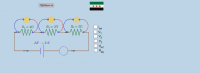
1) اسحب مقاومات من الصندوق إلى مواضع السلسلة الأربعة (الموضع الفارغ سلك). 2) أغلق المفتاح وغيّر جهد البطارية. 3) اضغط «سجّل قراءة» عدة مرات بجهود مختلفة: تظهر نقاط \(V\)–\(I\) لكل مقاومة وللمجموعة. 4) اضغط «ارسم الخطوط» لتحصل على ميل كل خط، وقارن ميل المجموعة بمجموع الميول. (لا شيء يتحرك من تلقاء نفسه.)
1) Drag resistors from the tray to the four positions of the chain (an empty position is a wire). 2) Close the switch and change the battery voltage. 3) Press “Record reading” several times at different voltages: \(V\)–\(I\) points appear for each resistor and for the group. 4) Press “Draw the lines” to get each line’s slope and compare the group slope with the sum of the slopes. (Nothing moves by itself.)
🧪 تجربة 2: حاسبة: سلسلة مقاومات
🧪 Experiment 2: Calculator: a chain of resistors
مسألة جديدة في كل مرة. احسب \(R_{eq}\) والتيار وفرق الجهد على المقاومة الثانية.
A new problem every time. Calculate \(R_{eq}\), the current and the voltage across the second resistor.
✍️ أمثلة محلولة
✍️ Worked Examples
ثلاث مقاومات \(10\ \Omega\) و\(20\ \Omega\) و\(30\ \Omega\) على التوالي مع \(12\ \mathrm{V}\). احسب \(I\) وفرق الجهد على كل منها.
Three resistors \(10\ \Omega\), \(20\ \Omega\) and \(30\ \Omega\) in series with \(12\ \mathrm{V}\). Find \(I\) and the voltage across each.
خط \(V\)–\(I\) لمجموعة مقاومات على التوالي يمر بالنقطة \((0.3\ \mathrm{A},\ 12\ \mathrm{V})\). احسب \(R_{eq}\).
The \(V\)–\(I\) line of a series group passes through \((0.3\ \mathrm{A},\ 12\ \mathrm{V})\). Find \(R_{eq}\).
مقاومتان في السلسلة ميل خطيهما \(15\ \Omega\) و\(25\ \Omega\). ما ميل خط المجموعة؟
Two resistors in a chain have line slopes of \(15\ \Omega\) and \(25\ \Omega\). What is the slope of the group line?
سلسلة \(R_1=8\ \Omega\) و\(R_2=12\ \Omega\) تمر فيها \(0.5\ \mathrm{A}\). احسب جهد البطارية.
A chain \(R_1=8\ \Omega\) and \(R_2=12\ \Omega\) carries \(0.5\ \mathrm{A}\). Find the battery voltage.
ميل خط \(V\)–\(I\) لسلسلة مقاومات يساوي:
The slope of the \(V\)–\(I\) line of a chain of resistors equals:
أي خط أشد ميلًا؟
Which line is steepest?
عند تيار ثابت يكون فرق الجهد الأكبر على:
At a constant current the largest voltage is across:
إذا أضفنا مقاومة إلى السلسلة مع ثبات الجهد فإن التيار:
If a resistor is added to the chain at a constant voltage the current:
📚 ملخص
📚 Summary
| الكميةQuantity | القانونLaw |
|---|---|
| التيارCurrent | ثابت في كل المقاوماتthe same in all |
| فرق الجهد الكليTotal voltage | \(V=\sum V_i\)\(V=\sum V_i\) |
| المقاومة المكافئةEquivalent resistance | \(R_{eq}=\sum R_i\)\(R_{eq}=\sum R_i\) |
⚠️ أخطاء شائعة
⚠️ Common mistakes
- الخلط بين ميل \(V\)–\(I\) (وهو \(R\)) وميل \(I\)–\(V\) (وهو \(1/R\)).Confusing the slope of \(V\)–\(I\) (\(R\)) with that of \(I\)–\(V\) (\(1/R\)).
- قراءة الميل من نقطة واحدة لا تمر بالأصل.Reading the slope from a point with an offset instead of from the origin.
- الظن أن التيار يتجزأ بين المقاومات في التوالي.Thinking the current is divided among the resistors in series.
🔗 محاكيات GeoGebra للاستعانة بها عند اللزوم
🔗 GeoGebra Simulations to Use When Needed
اضغط «تشغيل» لتعمل المحاكاة هنا داخل الدرس؛ ويمكن للطالب الرجوع إليها لتجربة الفكرة بطريقة أخرى.
Press “Run” to run the simulation right here inside the lesson; the student can use it to try the idea in another way.