🔥 بنك الأسئلة: %s
🔥 Question Bank: %s
الشغل والقدرة، الطاقة الحركية، الاتزان الحراري، الحرارة النوعية والكامنة، انتقال الحرارة، التدرجات الحرارية، قانون الغاز المثالي، الضغط، والقانون الثاني للديناميكا الحرارية
Work and Power, Kinetic Energy, Thermal Equilibrium, Specific and Latent Heat, Heat Transfer, Temperature Scales, the Ideal Gas Law, Pressure, and the Second Law of Thermodynamics
⏱️ 24 سؤال اختيار من متعدد بتصحيح فوري، و7 مسائل محلولة بالكامل⏱️ 24 multiple-choice questions with instant feedback, plus 7 fully-solved problems
\[1\,\star\]
أحد المقادير الفيزيائية التالية تعبر عن مقدار القوة 1 نيوتن والقادرة على تحريك جسم باتجاهها مسافة 1 متر وتقدر بوحدة الجول:Which of the following physical quantities represents a force of 1 Newton that moves an object 1 meter in its direction, and is measured in Joules?
السرعةVelocity
الشغلWork
التسارعAcceleration
القوةForce
الحلSolution
📌 الشغل هو حاصل ضرب القوة في الإزاحة بنفس اتجاهها: \(W=F\,d\)، فقوة \(1\,N\) تحرك الجسم \(1\,m\) تنجز شغلًا قدره \(1\,N\cdot m=1\,J\).
✅ الشغل
📌 Work is force times displacement in the same direction: \(W=F\,d\). A force of \(1\,N\) moving an object \(1\,m\) does \(1\,N\cdot m=1\,J\) of work.
✅ Work
\[2\,\star\]
أحد وحدات القياس التالية تعادل وحدة الطاقة جول:Which of the following units is equivalent to the Joule (unit of energy)?
\(kg\cdot m/s^2\)\(kg\cdot m/s^2\)
\(kg\cdot m^2/s^2\)\(kg\cdot m^2/s^2\)
\(kg\cdot m/s\)\(kg\cdot m/s\)
\(kg\cdot m^2/s\)\(kg\cdot m^2/s\)
الحلSolution
📌 \(J=N\cdot m\) و \(N=kg\cdot m/s^2\)، إذًا: \(J=kg\cdot m/s^2\times m=kg\cdot m^2/s^2\).
✅ \(kg\cdot m^2/s^2\)
📌 \(J=N\cdot m\) and \(N=kg\cdot m/s^2\), so \(J=kg\cdot m/s^2\times m=kg\cdot m^2/s^2\).
✅ \(kg\cdot m^2/s^2\)
\[3\,\star\]
مكعب من الخشب موضوع على بداية سطح أملس أثرت به قوة وتم تحريكه إلى نهاية السطح وبسرعة مقدارها \(v\,m/s\) وبذل عليه شغل مقداره \(10\,J\). أُعيد المكعب إلى الموضع نفسه وبُذلت قوة أكبر حتى أصبحت سرعته عند نهاية السطح ضعف ما كانت عليه، فإن الشغل المنجز يعادل:A wooden cube is placed at the start of a smooth surface. A force moves it to the end with speed \(v\,m/s\), doing \(10\,J\) of work. The cube is returned and a larger force is applied so its final speed is double. The new work done is:
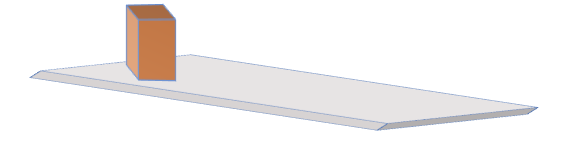
\(W=20\,J\)\(W=20\,J\)
\(W=40\,J\)\(W=40\,J\)
\(W=30\,J\)\(W=30\,J\)
\(W=60\,J\)\(W=60\,J\)
الحلSolution
📌 السطح أملس، فالشغل الكلي يساوي التغير في الطاقة الحركية: \(W=\tfrac12mv^2\) (الجسم يبدأ من السكون).
📌 عند مضاعفة السرعة: \(W_2=\tfrac12m(2v)^2=4\times\tfrac12mv^2=4\times10=40\,J\).
✅ \(W=40\,J\)
📌 The surface is smooth, so the work equals the change in kinetic energy: \(W=\tfrac12mv^2\) (starting from rest).
📌 Doubling the speed: \(W_2=\tfrac12m(2v)^2=4\times\tfrac12mv^2=4\times10=40\,J\).
✅ \(W=40\,J\)
\[4\,\star\]
في تدريب رياضي على التسلق، طالب وزنه \(700\,N\) تسلق حبلًا لمسافة \(10\,m\) فاستهلك قدرة قدرها \(1865\,J/s\)، فإن الزمن الذي أنجز به هذا التسلق:In a climbing exercise, a student weighing \(700\,N\) climbs a rope \(10\,m\) long, consuming power of \(1865\,W\). The time taken is:
\(t=5.25\,s\)\(t=5.25\,s\)
\(t=2.5\,s\)\(t=2.5\,s\)
\(t=3.75\,s\)\(t=3.75\,s\)
\(t=4.25\,s\)\(t=4.25\,s\)
الحلSolution
📌 الشغل المبذول ضد الجاذبية: \(W=Fd=700\times10=7000\,J\).
📌 القدرة \(P=\dfrac{W}{t}\Rightarrow t=\dfrac{W}{P}=\dfrac{7000}{1865}\approx3.75\,s\).
✅ \(t=3.75\,s\)
📌 Work done against gravity: \(W=Fd=700\times10=7000\,J\).
📌 Power \(P=\dfrac{W}{t}\Rightarrow t=\dfrac{W}{P}=\dfrac{7000}{1865}\approx3.75\,s\).
✅ \(t=3.75\,s\)
\[5\,\star\]
طالب كتلته \(50\,kg\) يستغرق \(40\,s\) لتسلق درج بارتفاع \(18\,m\)، فإن مقدار القدرة التي استهلكها (\(g=9.81\,m/s^2\)):A student of mass \(50\,kg\) takes \(40\,s\) to climb stairs \(18\,m\) high. The power consumed is (\(g=9.81\,m/s^2\)):
\(P=187.4\,W\)\(P=187.4\,W\)
\(P=115.9\,W\)\(P=115.9\,W\)
\(P=220.7\,W\)\(P=220.7\,W\)
\(P=330.1\,W\)\(P=330.1\,W\)
الحلSolution
📌 \(W=mgh=50\times9.81\times18=8829\,J\).
📌 \(P=\dfrac{W}{t}=\dfrac{8829}{40}\approx220.7\,W\).
✅ \(P=220.7\,W\)
📌 \(W=mgh=50\times9.81\times18=8829\,J\).
📌 \(P=\dfrac{W}{t}=\dfrac{8829}{40}\approx220.7\,W\).
✅ \(P=220.7\,W\)
\[6\,\star\]
في حالة الاتزان الحراري بين جسمين وبفرض عدم وجود فقدان للطاقة، فإن أحد العبارات التالية لا تعبر عن حالة الاتزان الحراري:In thermal equilibrium between two bodies with no energy loss, which statement does NOT describe thermal equilibrium?
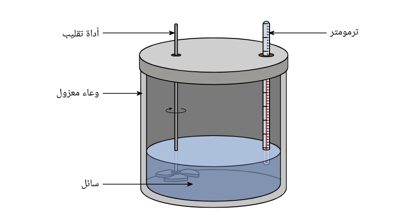
تنتقل الطاقة الحرارية من الجسم الساخن إلى الجسم الباردHeat energy transfers from the hot body to the cold body
التغير في الطاقة الحرارية للماء البارد يساوي سالب التغير في الطاقة الحرارية للمادة المجهولةThe change in thermal energy of the cold water equals the negative of the change in thermal energy of the unknown substance
تتساوى درجتا حرارة الجسمين عند الوصول إلى الاتزان الحراري النهائيThe two bodies end up at the same temperature once final thermal equilibrium is reached
يتم بذل شغل في نظام الطاقة المعزولWork is done on the isolated energy system
الحلSolution
📌 في النظام المعزول لا تدخل طاقة ولا تخرج: الحرارة تنتقل من الساخن إلى البارد حتى تتساوى درجتا الحرارة، وما يفقده أحد الجسمين يكسبه الآخر: \(\Delta Q_1=-\Delta Q_2\).
📌 أما بذل شغل على النظام المعزول فيعني تبادل طاقة مع الوسط الخارجي، وهذا لا يحدث في الاتزان الحراري بين الجسمين.
✅ يتم بذل شغل في نظام الطاقة المعزول
📌 In an isolated system no energy enters or leaves: heat flows from hot to cold until the temperatures are equal, and what one body loses the other gains: \(\Delta Q_1=-\Delta Q_2\).
📌 Doing work on an isolated system would mean exchanging energy with the surroundings, which is not part of thermal equilibrium between the two bodies.
✅ Work is done on the isolated energy system
\[7\,\star\]
تعتبر البلازما إحدى حالات المادة الأربعة، أحد العبارات التالية لا تعبر عن خصائص هذه الحالة:Plasma is one of the four states of matter. Which statement does NOT describe its properties?
البلازما تحتوي على أيوناتPlasma contains ions
تتكوّن البلازما عادةً عند درجات حرارة مرتفعة جدًاPlasma usually forms at very high temperatures
الفراغ بين النجوم مليء بالبلازماThe space between stars is filled with plasma
البلازما غير قادرة على توصيل الكهرباءPlasma cannot conduct electricity
الحلSolution
📌 البلازما غاز مؤيَّن يحتوي على أيونات وإلكترونات حرة، لذلك فهي موصلة جيدة للكهرباء وتتأثر بالمجالات المغناطيسية.
✅ البلازما غير قادرة على توصيل الكهرباء (عبارة خاطئة)
📌 Plasma is an ionized gas containing ions and free electrons, so it is a good conductor of electricity and responds to magnetic fields.
✅ “Plasma cannot conduct electricity” (a false statement)
\[8\,\star\]
الشكل البياني التالي يبين العلاقة بين الطاقة الحرارية ودرجة الحرارة لجسم. أي جزء من الخط البياني يبين أن الطاقة الحرارية اللازمة لتحويل المادة من الحالة الصلبة إلى السائلة تعادل \(Q=m\cdot H_f\)؟The graph shows the relationship between thermal energy and temperature for an object. Which segment represents the heat required for the phase change from solid to liquid (\(Q=m\,H_f\))?
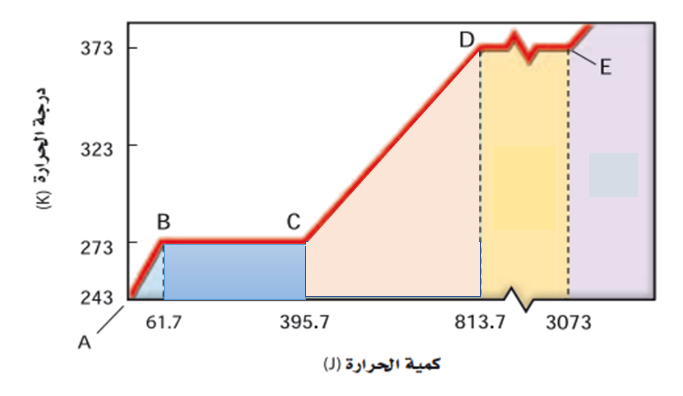
A-BA-B
B-CB-C
C-DC-D
D-ED-E
الحلSolution
📌 أثناء تغير الحالة (الانصهار) تمتص المادة حرارة دون ارتفاع في درجة الحرارة، فيظهر في الرسم مستوى أفقي عند \(273\,K\).
📌 الجزء الأفقي الأول هو B-C: بين \(61.7\,J\) و \(395.7\,J\) (جليد + ماء).
✅ B-C
📌 During a phase change (melting) the material absorbs heat without a rise in temperature, which appears as a horizontal segment at \(273\,K\).
📌 The first horizontal segment is B-C: between \(61.7\,J\) and \(395.7\,J\) (ice + water).
✅ B-C
\[9\,\star\]
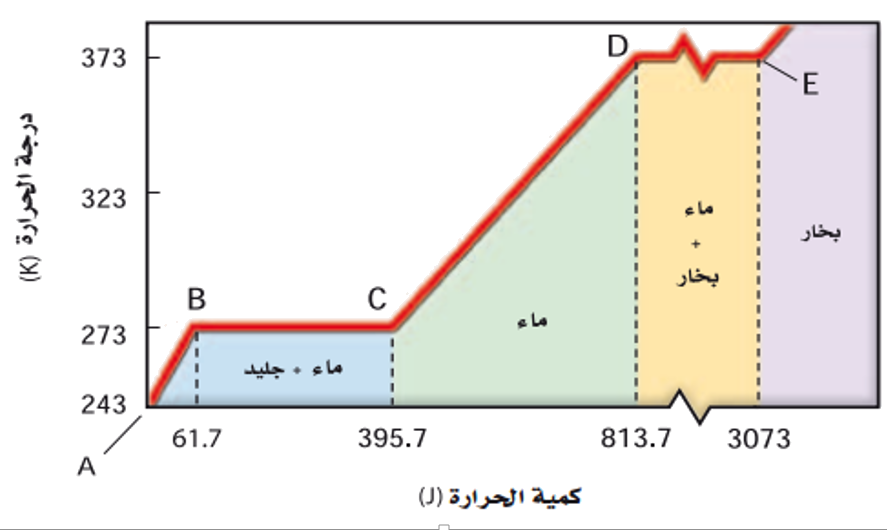
الشكل البياني التالي يبين العلاقة بين الطاقة الحرارية ودرجة الحرارة لجسم كتلته \(0.001\,kg\) تم تسخينه، فإن الحرارة الكامنة للانصهار تعادل:The graph shows thermal energy versus temperature for a \(0.001\,kg\) object being heated. The latent heat of fusion is:
\(H_f=5.264\times10^{5}\,J/kg\)\(H_f=5.264\times10^{5}\,J/kg\)
\(H_f=6.67\times10^{4}\,J/kg\)\(H_f=6.67\times10^{4}\,J/kg\)
\(H_f=6.28\times10^{4}\,J/kg\)\(H_f=6.28\times10^{4}\,J/kg\)
\(H_f=3.34\times10^{5}\,J/kg\)\(H_f=3.34\times10^{5}\,J/kg\)
الحلSolution
📌 الانصهار يحدث على الجزء الأفقي عند \(273\,K\) من \(61.7\,J\) إلى \(395.7\,J\):
📌 \(Q=395.7-61.7=334\,J\)، ومنها \(H_f=\dfrac{Q}{m}=\dfrac{334}{0.001}=3.34\times10^{5}\,J/kg\).
✅ \(H_f=3.34\times10^{5}\,J/kg\)
📌 Melting occurs on the horizontal segment at \(273\,K\), from \(61.7\,J\) to \(395.7\,J\):
📌 \(Q=395.7-61.7=334\,J\), so \(H_f=\dfrac{Q}{m}=\dfrac{334}{0.001}=3.34\times10^{5}\,J/kg\).
✅ \(H_f=3.34\times10^{5}\,J/kg\)
\[10\,\star\]
مكعب خشبي وُضع عند قاعدة مستوى مائل خشن يميل على الأفق بزاوية \(\theta\) وتم سحبه بقوة موازية للسطح المائل باتجاه قمة المستوى. إحدى القوى التالية شغلها معدوم:A wooden cube is placed at the bottom of a rough inclined plane (angle \(\theta\)) and pulled up by a force parallel to the incline. Which force does zero work?
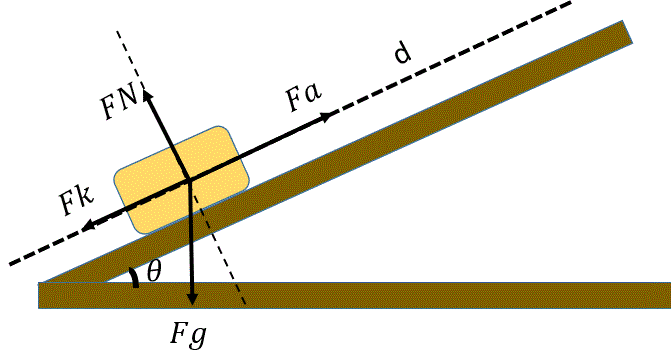
\(W(F_a)=0\)\(W(F_a)=0\)
\(W(F_k)=0\)\(W(F_k)=0\)
\(W(F_N)=0\)\(W(F_N)=0\)
\(W(F_g)=0\)\(W(F_g)=0\)
الحلSolution
📌 \(W=Fd\cos\phi\) حيث \(\phi\) الزاوية بين القوة والإزاحة.
📌 القوة العمودية \(F_N\) عمودية على السطح، أي على اتجاه الحركة: \(\phi=90^\circ\Rightarrow\cos90^\circ=0\Rightarrow W(F_N)=0\). أما \(F_a\) فموجبة، و\(F_k\) سالبة، و\(F_g\) لها مركبة موازية للمستوى فشغلها سالب.
✅ \(W(F_N)=0\)
📌 \(W=Fd\cos\phi\), where \(\phi\) is the angle between the force and the displacement.
📌 The normal force \(F_N\) is perpendicular to the surface, hence to the motion: \(\phi=90^\circ\Rightarrow\cos90^\circ=0\Rightarrow W(F_N)=0\). \(F_a\) does positive work, \(F_k\) negative work, and \(F_g\) has a component along the incline so its work is negative.
✅ \(W(F_N)=0\)
\[11\,\star\]
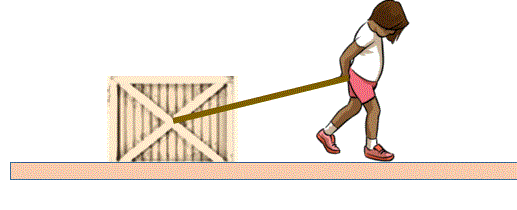
وُضع صندوق كتلته \(10\,kg\) على سطح أفقي خشن، وربط بحبل يميل فوق الأفق بزاوية \(25^\circ\) وسحبته طالبة بقوة ثابتة مقدارها \(50\,N\) فتحرك الصندوق مسافة \(8\,m\). فإذا كانت قوة الاحتكاك بين الصندوق والسطح تعادل \(15\,N\)، فإن الشغل الكلي المبذول على الصندوق يعادل:A \(10\,kg\) box rests on a rough horizontal surface and is tied to a rope inclined \(25^\circ\) above the horizontal. A student pulls it with a constant force of \(50\,N\) for a distance of \(8\,m\). If the friction force is \(15\,N\), the total work done on the box is:
\(W_{tot}=242.5\,J\)\(W_{tot}=242.5\,J\)
\(W_{tot}=482.5\,J\)\(W_{tot}=482.5\,J\)
\(W_{tot}=385.5\,J\)\(W_{tot}=385.5\,J\)
\(W_{tot}=255.5\,J\)\(W_{tot}=255.5\,J\)
الحلSolution
📌 شغل قوة السحب: \(W_F=Fd\cos25^\circ=50\times8\times0.906=362.5\,J\).
📌 شغل الاحتكاك: \(W_f=-fd=-15\times8=-120\,J\). أما الوزن والقوة العمودية فعموديان على الإزاحة وشغلهما صفر.
📌 \(W_{tot}=362.5-120=242.5\,J\).
✅ \(W_{tot}=242.5\,J\)
📌 Work by the pulling force: \(W_F=Fd\cos25^\circ=50\times8\times0.906=362.5\,J\).
📌 Work by friction: \(W_f=-fd=-15\times8=-120\,J\). Weight and the normal force are perpendicular to the displacement, so they do zero work.
📌 \(W_{tot}=362.5-120=242.5\,J\).
✅ \(W_{tot}=242.5\,J\)
\[12\,\star\]
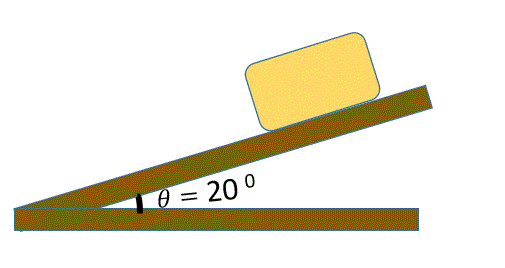
جسم كتلته \(3\,kg\) وُضع على مستوى مائل يميل على الأفق بزاوية \(20^\circ\) فانزلق نحو الأسفل مسافة \(4\,m\)، فإن شغل قوة الوزن يعادل (\(g=9.8\,m/s^2\)):A \(3\,kg\) object slides \(4\,m\) down an incline of \(20^\circ\). The work done by gravity is (\(g=9.8\,m/s^2\)):
\(W=11.2\,J\)\(W=11.2\,J\)
\(W=4.1\,J\)\(W=4.1\,J\)
\(W=40.2\,J\)\(W=40.2\,J\)
\(W=110.5\,J\)\(W=110.5\,J\)
الحلSolution
📌 مركبة الوزن الموازية للمستوى: \(mg\sin\theta=3\times9.8\times\sin20^\circ\approx10.06\,N\).
📌 \(W=mg\sin\theta\cdot d=10.06\times4\approx40.2\,J\).
✅ \(W=40.2\,J\)
📌 Component of weight along the incline: \(mg\sin\theta=3\times9.8\times\sin20^\circ\approx10.06\,N\).
📌 \(W=mg\sin\theta\cdot d=10.06\times4\approx40.2\,J\).
✅ \(W=40.2\,J\)
\[13\,\star\]
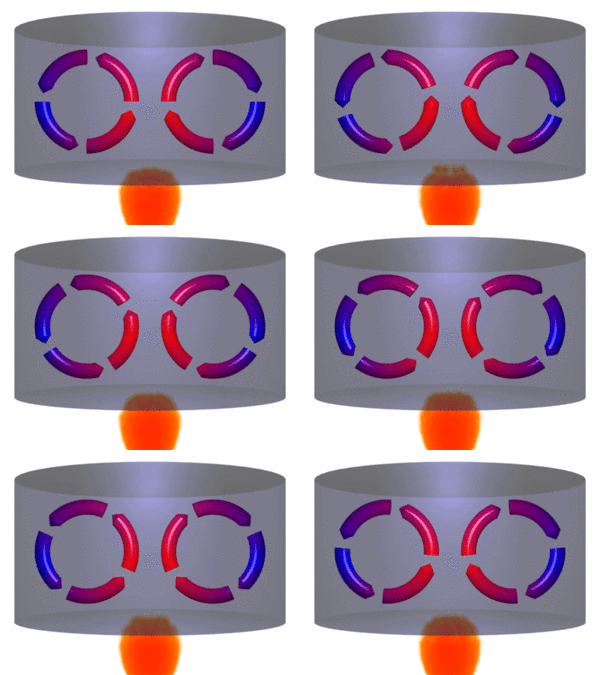
يرتفع الهواء الدافئ نحو الأعلى ويحل بدلًا منه الهواء البارد. هذا النوع من نقل الحرارة يُدعى:Warm air rises and is replaced by cool air. This type of heat transfer is called:
التوصيلConduction
الاتزانEquilibrium
الحملConvection
الإشعاعRadiation
الحلSolution
📌 الحمل الحراري هو انتقال الحرارة بحركة المائع (سائل أو غاز) نفسه: يسخن الجزء السفلي فتقل كثافته ويصعد، ويهبط المائع البارد الأكثر كثافة ليحل محله.
✅ الحمل
📌 Convection is heat transfer by the motion of the fluid (liquid or gas) itself: the lower part heats up, becomes less dense and rises, while the cooler, denser fluid sinks to replace it.
✅ Convection
\[14\,\star\]
هناك ثلاثة أنواع من الأجهزة المستخدمة لقياس درجة الحرارة (سليزي، فهرنهايتي، مطلق). أدنى درجة حرارة يتم التوصل إليها والتي يصبح عندها حجم الغاز المثالي مساويًا لحجم الذرات فقط هي:There are three temperature scales (Celsius, Fahrenheit, absolute). The lowest achievable temperature, at which the volume of an ideal gas equals the volume of its atoms only, is:
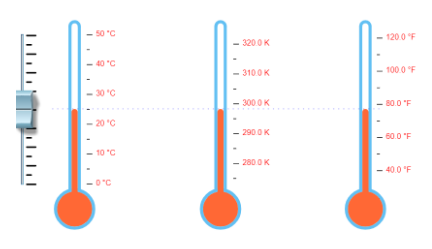
\(T=0\,^\circ C\)\(T=0\,^\circ C\)
\(T=0\,^\circ F\)\(T=0\,^\circ F\)
\(T=-165\,^\circ C\)\(T=-165\,^\circ C\)
\(T=0\,K\)\(T=0\,K\)
الحلSolution
📌 الصفر المطلق هو أدنى درجة حرارة ممكنة، وعندها ينعدم حجم الغاز المثالي ولا يبقى إلا حجم الذرات نفسها: \(0\,K=-273.15\,^\circ C\).
✅ \(T=0\,K\)
📌 Absolute zero is the lowest possible temperature, where an ideal gas’s volume extrapolates to zero, leaving only the volume of the atoms: \(0\,K=-273.15\,^\circ C\).
✅ \(T=0\,K\)
\[15\,\star\]
سُخّنت عينة من الماء كتلتها \(60\,g\) من \(18^\circ C\) إلى \(70^\circ C\)، فإن كمية الحرارة الممتصة بواسطة الماء تعادل (علمًا بأن \(C_p=4180\,J/(kg\cdot K)\)):A \(60\,g\) water sample is heated from \(18^\circ C\) to \(70^\circ C\). The heat absorbed is (\(C_p=4180\,J/(kg\cdot K)\)):
\(Q=24325\,J\)\(Q=24325\,J\)
\(Q=13041\,J\)\(Q=13041\,J\)
\(Q=176547\,J\)\(Q=176547\,J\)
\(Q=56175\,J\)\(Q=56175\,J\)
الحلSolution
📌 \(m=60\,g=0.06\,kg\) و \(\Delta T=70-18=52\,^\circ C\).
📌 \(Q=mC_p\Delta T=0.06\times4180\times52\approx13041\,J\).
✅ \(Q=13041\,J\)
📌 \(m=60\,g=0.06\,kg\) and \(\Delta T=70-18=52\,^\circ C\).
📌 \(Q=mC_p\Delta T=0.06\times4180\times52\approx13041\,J\).
✅ \(Q=13041\,J\)
\[16\,\star\]
عينة من الحديد كتلتها \(2.5\,kg\) عند درجة حرارة \(50^\circ C\) تم تسخينها بواسطة فرن وإعطاؤها طاقة مقدارها \(1.5\times10^{6}\,J\)، فإن درجة الحرارة النهائية للحديد تعادل (\(C_p=450\,J/(kg\cdot K)\)):A \(2.5\,kg\) iron sample at \(50^\circ C\) is heated in a furnace and receives \(1.5\times10^{6}\,J\). Its final temperature is (\(C_p=450\,J/(kg\cdot K)\)):
\(T_f=908.7\,^\circ C\)\(T_f=908.7\,^\circ C\)
\(T_f=1520.5\,^\circ C\)\(T_f=1520.5\,^\circ C\)
\(T_f=1383.3\,^\circ C\)\(T_f=1383.3\,^\circ C\)
\(T_f=2320.6\,^\circ C\)\(T_f=2320.6\,^\circ C\)
الحلSolution
📌 \(\Delta T=\dfrac{Q}{mC_p}=\dfrac{1.5\times10^{6}}{2.5\times450}\approx1333.3\,^\circ C\).
📌 \(T_f=T_i+\Delta T=50+1333.3=1383.3\,^\circ C\).
✅ \(T_f=1383.3\,^\circ C\)
📌 \(\Delta T=\dfrac{Q}{mC_p}=\dfrac{1.5\times10^{6}}{2.5\times450}\approx1333.3\,^\circ C\).
📌 \(T_f=T_i+\Delta T=50+1333.3=1383.3\,^\circ C\).
✅ \(T_f=1383.3\,^\circ C\)
\[17\,\star\]
أنبوب مياه مصنوع من النحاس كتلته \(5\,kg\) يُستخدم لنقل المياه، ترتفع درجة حرارته من \(20^\circ C\) إلى \(85^\circ C\)، فإن الطاقة الحرارية التي يكتسبها أنبوب النحاس تعادل (\(C_p=385\,J/(kg\cdot ^\circ C)\)):A \(5\,kg\) copper water pipe is used to carry water; its temperature rises from \(20^\circ C\) to \(85^\circ C\). The thermal energy gained by the copper is (\(C_p=385\,J/(kg\cdot ^\circ C)\)):
\(Q=323425\,J\)\(Q=323425\,J\)
\(Q=125125\,J\)\(Q=125125\,J\)
\(Q=565342\,J\)\(Q=565342\,J\)
\(Q=314227\,J\)\(Q=314227\,J\)
الحلSolution
📌 \(Q=mC_p\Delta T=5\times385\times(85-20)=5\times385\times65=125125\,J\).
✅ \(Q=125125\,J\)
📌 \(Q=mC_p\Delta T=5\times385\times(85-20)=5\times385\times65=125125\,J\).
✅ \(Q=125125\,J\)
\[18\,\star\]
أُضيفت كتلة من معدن مقدارها \(0.25\,kg\) عند درجة حرارة \(90^\circ C\) إلى \(0.5\,kg\) من الماء داخل مسعر (يُهمل ما يمتصه المسعر من حرارة) درجة حرارته \(25^\circ C\)، فأصبحت درجة حرارة المزيج \(29.8^\circ C\). فإذا علمت أن الحرارة النوعية للماء \(4200\,J/(kg\cdot ^\circ C)\)، فإن الحرارة النوعية للمعدن تعادل:A \(0.25\,kg\) piece of metal at \(90^\circ C\) is added to \(0.5\,kg\) of water at \(25^\circ C\) in a calorimeter (heat absorbed by the calorimeter is neglected). The final temperature of the mixture is \(29.8^\circ C\). If the specific heat of water is \(4200\,J/(kg\cdot ^\circ C)\), the specific heat of the metal is:
\(670\,J/(kg\cdot ^\circ C)\)\(670\,J/(kg\cdot ^\circ C)\)
\(840\,J/(kg\cdot ^\circ C)\)\(840\,J/(kg\cdot ^\circ C)\)
\(468\,J/(kg\cdot ^\circ C)\)\(468\,J/(kg\cdot ^\circ C)\)
\(920\,J/(kg\cdot ^\circ C)\)\(920\,J/(kg\cdot ^\circ C)\)
الحلSolution
📌 في النظام المعزول: الحرارة المفقودة من المعدن = الحرارة المكتسبة بواسطة الماء.
📌 \(m_mC_m(90-29.8)=m_wC_w(29.8-25)\Rightarrow0.25\times C_m\times60.2=0.5\times4200\times4.8\).
📌 \(C_m=\dfrac{10080}{15.05}\approx670\,J/(kg\cdot ^\circ C)\).
✅ \(670\,J/(kg\cdot ^\circ C)\)
📌 In an isolated system: heat lost by the metal = heat gained by the water.
📌 \(m_mC_m(90-29.8)=m_wC_w(29.8-25)\Rightarrow0.25\times C_m\times60.2=0.5\times4200\times4.8\).
📌 \(C_m=\dfrac{10080}{15.05}\approx670\,J/(kg\cdot ^\circ C)\).
✅ \(670\,J/(kg\cdot ^\circ C)\)
\[19\,\star\]
تم تسخين قطعة من النحاس كتلتها \(0.2\,kg\) من \(10^\circ C\) إلى \(30^\circ C\). فإذا أُضيفت نفس كمية الحرارة إلى قطعة من الحديد كتلتها \(0.3\,kg\)، فإن التغير في درجة حرارة قطعة الحديد يعادل (\(C_{p,Cu}=376,\ C_{p,Fe}=450\,J/(kg\cdot K)\)):A \(0.2\,kg\) copper piece is heated from \(10^\circ C\) to \(30^\circ C\). The same amount of heat is added to a \(0.3\,kg\) iron piece. The temperature change of the iron is (\(C_{p,Cu}=376,\ C_{p,Fe}=450\,J/(kg\cdot K)\)):
\(\Delta T=20\,^\circ C\)\(\Delta T=20\,^\circ C\)
\(\Delta T=18.2\,^\circ C\)\(\Delta T=18.2\,^\circ C\)
\(\Delta T=11.1\,^\circ C\)\(\Delta T=11.1\,^\circ C\)
\(\Delta T=13.9\,^\circ C\)\(\Delta T=13.9\,^\circ C\)
الحلSolution
📌 الحرارة المكتسبة بواسطة النحاس: \(Q=0.2\times376\times20=1504\,J\).
📌 للحديد: \(\Delta T=\dfrac{Q}{mC_p}=\dfrac{1504}{0.3\times450}\approx11.1\,^\circ C\).
✅ \(\Delta T=11.1\,^\circ C\)
📌 Heat gained by the copper: \(Q=0.2\times376\times20=1504\,J\).
📌 For the iron: \(\Delta T=\dfrac{Q}{mC_p}=\dfrac{1504}{0.3\times450}\approx11.1\,^\circ C\).
✅ \(\Delta T=11.1\,^\circ C\)
\[20\,\star\]
كأس يحتوي على ماء كتلته \(0.4\,kg\) ودرجة حرارته \(25^\circ C\)، أُضيف إلى كأس آخر يحتوي على ماء كتلته \(0.5\,kg\) ودرجة حرارته \(65^\circ C\). بفرض عدم وجود فقدان للطاقة الحرارية، فإن درجة حرارة المزيج النهائية تعادل:A cup contains \(0.4\,kg\) of water at \(25^\circ C\) and is poured into another cup containing \(0.5\,kg\) of water at \(65^\circ C\). Assuming no heat loss, the final temperature of the mixture is:
\(T_f=52.6\,^\circ C\)\(T_f=52.6\,^\circ C\)
\(T_f=35.4\,^\circ C\)\(T_f=35.4\,^\circ C\)
\(T_f=40.8\,^\circ C\)\(T_f=40.8\,^\circ C\)
\(T_f=47.2\,^\circ C\)\(T_f=47.2\,^\circ C\)
الحلSolution
📌 الحرارة المفقودة = الحرارة المكتسبة: \(0.5\,C(65-T_f)=0.4\,C(T_f-25)\) (الحرارة النوعية \(C\) تُحذف من الطرفين).
📌 \(T_f=\dfrac{0.4\times25+0.5\times65}{0.4+0.5}=\dfrac{42.5}{0.9}\approx47.2\,^\circ C\).
✅ \(T_f=47.2\,^\circ C\)
📌 Heat lost = heat gained: \(0.5\,C(65-T_f)=0.4\,C(T_f-25)\) (the specific heat \(C\) cancels).
📌 \(T_f=\dfrac{0.4\times25+0.5\times65}{0.4+0.5}=\dfrac{42.5}{0.9}\approx47.2\,^\circ C\).
✅ \(T_f=47.2\,^\circ C\)
\[21\,\star\]
عينة من الغاز حجمها \(V=0.003\,m^3\) عند درجة حرارة \(T=290\,K\) وضغط \(P=1.2\times10^{5}\,Pa\)، فإن عدد المولات التي تحتويها العينة يعادل (\(R=8.31\,J/(mol\cdot K)\)):A gas sample has volume \(V=0.003\,m^3\) at temperature \(T=290\,K\) and pressure \(P=1.2\times10^{5}\,Pa\). The number of moles is (\(R=8.31\,J/(mol\cdot K)\)):
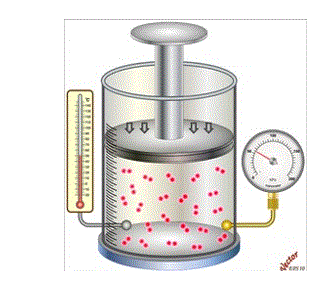
\(0.26\,mol\)\(0.26\,mol\)
\(0.15\,mol\)\(0.15\,mol\)
\(0.37\,mol\)\(0.37\,mol\)
\(0.42\,mol\)\(0.42\,mol\)
الحلSolution
📌 قانون الغاز المثالي: \(PV=nRT\Rightarrow n=\dfrac{PV}{RT}\).
📌 \(n=\dfrac{1.2\times10^{5}\times0.003}{8.31\times290}=\dfrac{360}{2409.9}\approx0.15\,mol\).
✅ \(0.15\,mol\)
📌 Ideal gas law: \(PV=nRT\Rightarrow n=\dfrac{PV}{RT}\).
📌 \(n=\dfrac{1.2\times10^{5}\times0.003}{8.31\times290}=\dfrac{360}{2409.9}\approx0.15\,mol\).
✅ \(0.15\,mol\)
\[22\,\star\]
أربعة مكعبات لها نفس الوزن وُضعت على سطح من الرمل، أحد المكعبات يحدث أكبر مقدار من الضغط على سطح الرمل:Four blocks of equal weight are placed on sand. Which block exerts the greatest pressure on the sand?

AA
BB
CC
DD
الحلSolution
📌 الضغط \(P=\dfrac{F}{A}\): عند تساوي الوزن (القوة) يكون الضغط أكبر ما يمكن حيث تكون مساحة التلامس أصغر ما يمكن.
📌 المكعب C واقف على وجهه الضيق، فمساحة تلامسه مع الرمل هي الأصغر.
✅ C
📌 Pressure \(P=\dfrac{F}{A}\): for equal weights, the pressure is greatest where the contact area is smallest.
📌 Block C stands on its narrow face, so it has the smallest contact area with the sand.
✅ C
\[23\,\star\]
جسم وزنه \(200\,N\) وُضع على سطح رملي بمساحة قدرها \(0.2\,m^2\)، فإن الجسم يؤثر بضغط على الرمل قدره:An object weighing \(200\,N\) is placed on sand over an area of \(0.2\,m^2\). The pressure it exerts is:
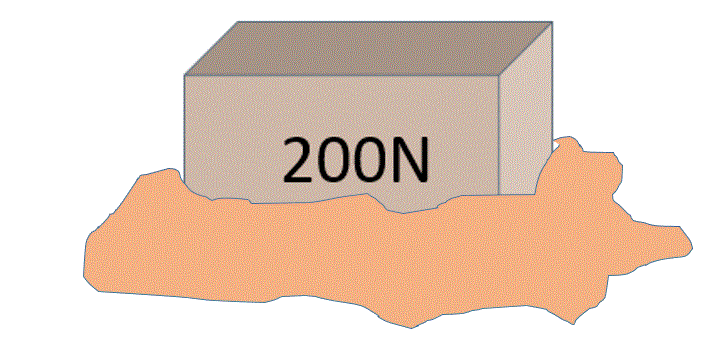
\(P=600\,Pa\)\(P=600\,Pa\)
\(P=800\,Pa\)\(P=800\,Pa\)
\(P=1000\,Pa\)\(P=1000\,Pa\)
\(P=1200\,Pa\)\(P=1200\,Pa\)
الحلSolution
📌 \(P=\dfrac{F}{A}=\dfrac{200}{0.2}=1000\,Pa\).
✅ \(P=1000\,Pa\)
📌 \(P=\dfrac{F}{A}=\dfrac{200}{0.2}=1000\,Pa\).
✅ \(P=1000\,Pa\)
\[24\,\star\]
لدينا العبارتان التاليتان:
العبارة الأولى: لا توجد عملية ممكنة تكون نتيجتها الوحيدة امتصاص الحرارة من خزان وتحويل الحرارة بالكامل إلى شغل.
العبارة الثانية: لا توجد عملية ممكنة تكون نتيجتها الوحيدة هي نقل الحرارة من جسم أبرد إلى جسم أسخن.
أي العبارتين تتوافق مع القانون الثاني للديناميكا الحرارية؟We have the following two statements:
Statement 1: No process is possible whose sole result is the absorption of heat from a reservoir and its complete conversion into work.
Statement 2: No process is possible whose sole result is the transfer of heat from a cooler body to a hotter body.
Which statement(s) agree with the second law of thermodynamics?
العبارة الأولى فقطStatement 1 only
العبارة الثانية فقطStatement 2 only
العبارة الأولى والثانيةBoth Statement 1 and Statement 2
لا توجد عبارة تتوافق مع هذا القانونNeither statement agrees with this law
الحلSolution
📌 العبارة الأولى هي صيغة كلفن–بلانك للقانون الثاني، والعبارة الثانية هي صيغة كلاوزيوس، وهما صيغتان متكافئتان للقانون نفسه.
✅ العبارة الأولى والثانية
📌 Statement 1 is the Kelvin–Planck form of the second law and Statement 2 is the Clausius form; the two forms are equivalent.
✅ Both Statement 1 and Statement 2
📝 حل المسائل التالية
📝 Solve the Following Problems
\[1\,\star\star\]
تم قياس درجة حرارة غاز الهيليوم فكانت \(T=-100\,^\circ C\). احسب درجة حرارة الغاز بالتدرج المطلق (كلفن).The temperature of helium gas is measured as \(T=-100\,^\circ C\). Calculate its temperature on the absolute (Kelvin) scale.
.....................................................................
الحلSolution
📌 \(T(K)=T(^\circ C)+273.15\)
📌 \(T=-100+273.15=173.15\,K\)
✅ \(T=173.15\,K\)
📌 \(T(K)=T(^\circ C)+273.15\)
📌 \(T=-100+273.15=173.15\,K\)
✅ \(T=173.15\,K\)
\[2\,\star\star\]
درجة حرارة مريض بحمى \(40\,^\circ C\). احسب درجة الحرارة بالتدرج الفهرنهايتي.A patient with a fever has a temperature of \(40\,^\circ C\). Calculate the temperature on the Fahrenheit scale.
.....................................................................
الحلSolution
📌 \(T(^\circ F)=T(^\circ C)\times\dfrac{9}{5}+32\)
📌 \(T=40\times\dfrac{9}{5}+32=72+32=104\,^\circ F\)
✅ \(T=104\,^\circ F\)
📌 \(T(^\circ F)=T(^\circ C)\times\dfrac{9}{5}+32\)
📌 \(T=40\times\dfrac{9}{5}+32=72+32=104\,^\circ F\)
✅ \(T=104\,^\circ F\)
\[3\,\star\star\]
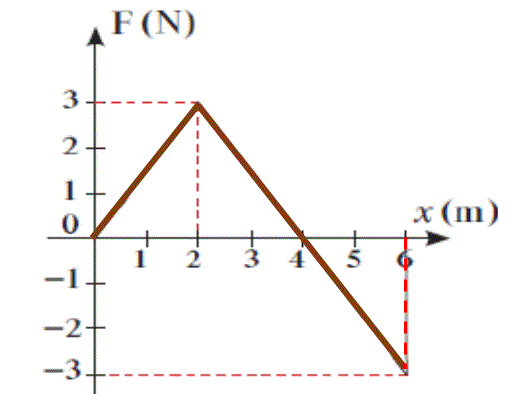
الخط البياني أدناه يبين العلاقة بين القوة والإزاحة لجسم متأثر بقوة متغيرة. احسب الشغل المبذول من القوة.The graph below shows the relationship between force and displacement for an object acted on by a variable force. Calculate the work done by the force.
.....................................................................
الحلSolution
📌 الشغل = المساحة تحت الخط البياني (قوة–إزاحة)، وتُحسب المساحة فوق المحور موجبة وتحته سالبة.
📌 من \(0\) إلى \(4\,m\) (مثلث فوق المحور): \(W_1=\tfrac12\times4\times3=6\,J\).
📌 من \(4\) إلى \(6\,m\) (مثلث تحت المحور): \(W_2=-\tfrac12\times2\times3=-3\,J\).
📌 \(W=W_1+W_2=6-3=3\,J\).
✅ \(W=3\,J\)
📌 Work = area under the force–displacement graph; area above the axis counts as positive and below it as negative.
📌 From \(0\) to \(4\,m\) (triangle above the axis): \(W_1=\tfrac12\times4\times3=6\,J\).
📌 From \(4\) to \(6\,m\) (triangle below the axis): \(W_2=-\tfrac12\times2\times3=-3\,J\).
📌 \(W=W_1+W_2=6-3=3\,J\).
✅ \(W=3\,J\)
\[4\,\star\star\]
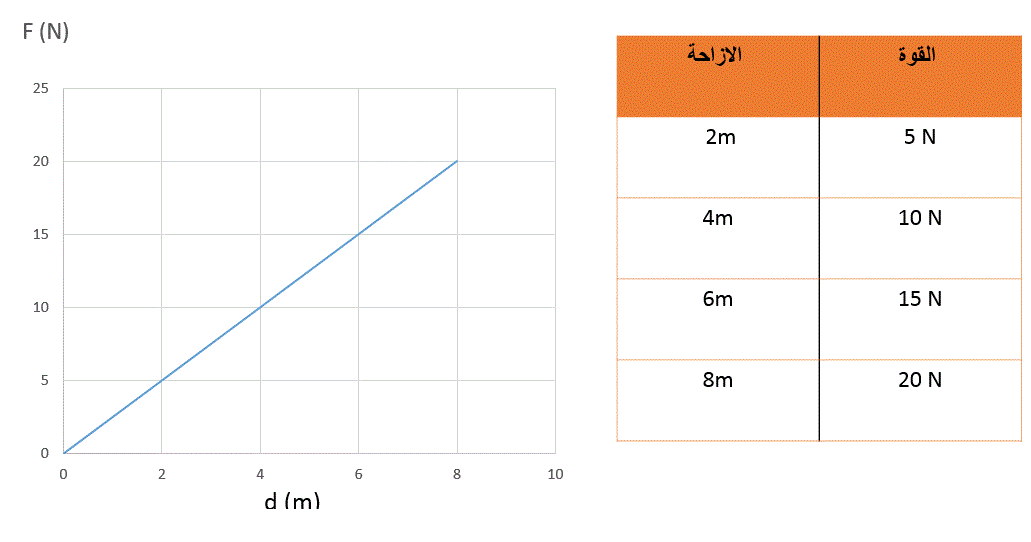
أثرت قوة متغيرة على سيارة تتحرك على مستوى أفقي. تم رصد تغير القوة والإزاحة وكتابتها بالجدول، وعند رسم العلاقة بين القوة والإزاحة نتج الخط البياني التالي. احسب الشغل المبذول على الجسم.A variable force acts on a car moving on a horizontal surface. The force and displacement were recorded in a table, and plotting them gave the graph below. Calculate the work done on the object.
.....................................................................
الحلSolution
📌 الخط البياني مستقيم يمر بنقطة الأصل من \(F=0\) عند \(d=0\) إلى \(F=20\,N\) عند \(d=8\,m\) (يتفق مع الجدول: \(5,10,15,20\,N\)).
📌 الشغل = مساحة المثلث تحت الخط: \(W=\tfrac12\times8\times20=80\,J\).
✅ \(W=80\,J\)
📌 The graph is a straight line from the origin (\(F=0\) at \(d=0\)) to \(F=20\,N\) at \(d=8\,m\) (consistent with the table: \(5,10,15,20\,N\)).
📌 Work = area of the triangle under the line: \(W=\tfrac12\times8\times20=80\,J\).
✅ \(W=80\,J\)
\[5\,\star\star\]
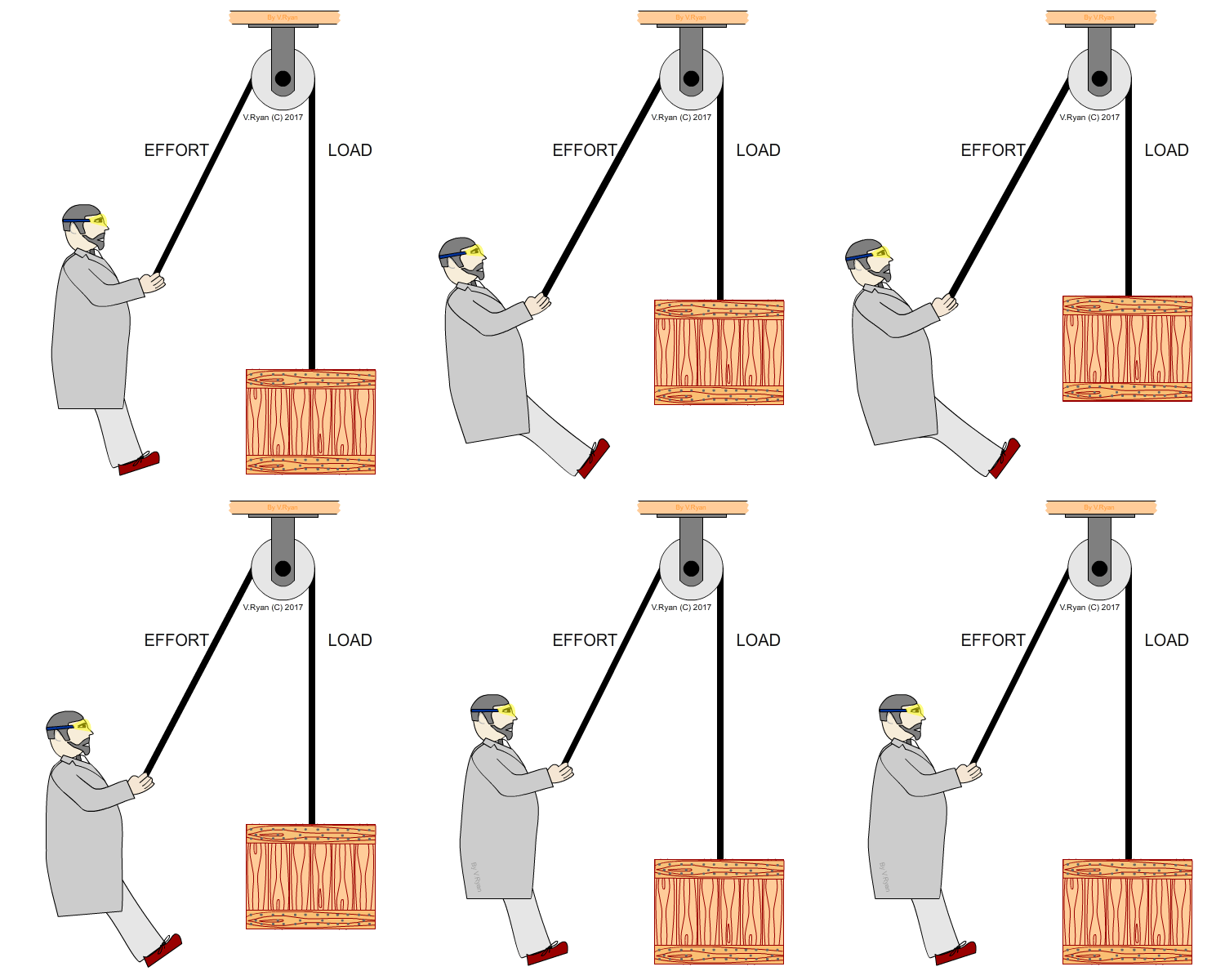
صندوق كتلته \(15\,kg\) يتم رفعه عن سطح الأرض مسافة \(2\,m\) خلال زمن قدره \(10\,s\). احسب القدرة المطلوبة لإنجاز هذا العمل (\(g=9.8\,m/s^2\)).A \(15\,kg\) box is lifted \(2\,m\) above the ground in \(10\,s\). Calculate the power required to do this work (\(g=9.8\,m/s^2\)).
.....................................................................
الحلSolution
📌 \(W=mgh=15\times9.8\times2=294\,J\)
📌 \(P=\dfrac{W}{t}=\dfrac{294}{10}=29.4\,W\)
✅ \(P=29.4\,W\)
📌 \(W=mgh=15\times9.8\times2=294\,J\)
📌 \(P=\dfrac{W}{t}=\dfrac{294}{10}=29.4\,W\)
✅ \(P=29.4\,W\)
\[6\,\star\star\]
احسب الطاقة اللازمة لصهر \(0.5\,kg\) من الجليد عند درجة حرارة صفر مئوية، علمًا بأن \(H_f=3.34\times10^{5}\,J/kg\).Calculate the energy required to melt \(0.5\,kg\) of ice at \(0^\circ C\), given that \(H_f=3.34\times10^{5}\,J/kg\).
.....................................................................
الحلSolution
📌 \(Q=mH_f=0.5\times3.34\times10^{5}=1.67\times10^{5}\,J=167000\,J\)
✅ \(Q=1.67\times10^{5}\,J\)
📌 \(Q=mH_f=0.5\times3.34\times10^{5}=1.67\times10^{5}\,J=167000\,J\)
✅ \(Q=1.67\times10^{5}\,J\)
\[7\,\star\star\]
قطعة من الثلج كتلتها \(0.02\,kg\) ودرجة حرارتها \(-40\,^\circ C\) يراد تحويلها إلى ماء درجة حرارته \(40\,^\circ C\). احسب الطاقة الحرارية اللازمة لإتمام هذه العملية (\(H_f=3.34\times10^{5}\,J/kg,\ C_{p,ice}=2000\,J/(kg\cdot ^\circ C),\ C_{p,water}=4200\,J/(kg\cdot ^\circ C)\)).A \(0.02\,kg\) piece of ice at \(-40\,^\circ C\) is to be converted into water at \(40\,^\circ C\). Calculate the heat energy required (\(H_f=3.34\times10^{5}\,J/kg,\ C_{p,ice}=2000\,J/(kg\cdot ^\circ C),\ C_{p,water}=4200\,J/(kg\cdot ^\circ C)\)).
.....................................................................
الحلSolution
📌 تسخين الجليد من \(-40\) إلى \(0^\circ C\): \(Q_1=0.02\times2000\times40=1600\,J\)
📌 الانصهار عند \(0^\circ C\): \(Q_2=mH_f=0.02\times3.34\times10^{5}=6680\,J\)
📌 تسخين الماء من \(0\) إلى \(40^\circ C\): \(Q_3=0.02\times4200\times40=3360\,J\)
📌 \(Q_{total}=1600+6680+3360=11640\,J\)
✅ \(Q_{total}=11640\,J\)
📌 Warming the ice from \(-40\) to \(0^\circ C\): \(Q_1=0.02\times2000\times40=1600\,J\)
📌 Melting at \(0^\circ C\): \(Q_2=mH_f=0.02\times3.34\times10^{5}=6680\,J\)
📌 Warming the water from \(0\) to \(40^\circ C\): \(Q_3=0.02\times4200\times40=3360\,J\)
📌 \(Q_{total}=1600+6680+3360=11640\,J\)
✅ \(Q_{total}=11640\,J\)
لاحظت خطأ؟ أو عندك سؤال عن أحد الأسئلة؟ اكتبه بالتعليقات وحدد رقم السؤال بالضبط.
Noticed an error? Or have a question about one of the questions? Write it in the comments and specify the exact question number.