"My Lord, enable me to be grateful for Your favor which You have bestowed upon me and upon my parents, and to work righteousness of which You approve, and make righteous for me my offspring. Indeed, I have repented to You, and indeed, I am of the Muslims." (Quran 46:15)
"Our Lord, grant us from among our wives and offspring comfort to our eyes, and make us an example for the righteous." (Quran 25:74)
"My Lord, grant me authority and join me with the righteous. And grant me a mention of honor among later generations. And make me among the inheritors of the Garden of Pleasure." (Quran 26:83-85)
\[1\;\star\star\]
طول أحمد \((4\,foot,\,20\,in)\). كم طول أحمد بوحدة المتر؟Ahmed's height is \((4\,feet,\,20\,in)\). What is Ahmed's height in meters?
يُخزَّن وقود الطائرات في أسطوانة ارتفاعها \(82.6\,in\) ومحيطها \(249\,in\). فإن حجم الوقود بالوحدة المترية تعادلAircraft fuel is stored in a cylinder with height \(82.6\,in\) and circumference \(249\,in\). The fuel volume in metric units equals
v=7.25 m³
v=5.42 m³
v=4.65 m³
v=6.67 m³
الحلSolution
📌 الخطوة 1: نحوّل الارتفاع والمحيط إلى متر: \(h=82.6\times0.0254\approx2.098\,m\)، \(C=249\times0.0254\approx6.325\,m\)
📌 الخطوة 2: نستنتج نصف القطر من المحيط: \(r=\dfrac{C}{2\pi}\approx1.007\,m\)
📌 الخطوة 3: حجم الأسطوانة \(V=\pi r^2h\approx\pi\times(1.007)^2\times2.098\approx6.68\,m^3\)
✅ الإجابة الصحيحة هي: D (\(V\approx6.67\,m^3\))
📌 Step 1: Convert height and circumference to meters: \(h=82.6\times0.0254\approx2.098\,m\), \(C=249\times0.0254\approx6.325\,m\)
📌 Step 2: Find the radius from the circumference: \(r=\dfrac{C}{2\pi}\approx1.007\,m\)
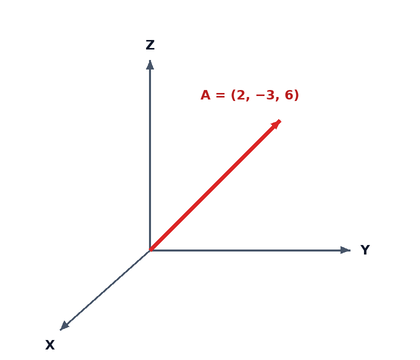
أحد المعادلات التالية من الممكن أن تعبّر عن موقع المتجه \(\vec A\) في الشكل أدناهOne of the following could represent the position of vector \(\vec A\) in the figure below
\(\vec A=+2\hat X,-3\hat Y,+2\hat Z\)
\(\vec A=-2\hat X,+3\hat Y,+2\hat Z\)
\(\vec A=-2\hat X,+3\hat Y,-2\hat Z\)
\(\vec A=+2\hat X,+3\hat Y,-2\hat Z\)
الحلSolution
📌 الخطوة 1: من الشكل، نقطة A تقع خلف مستوى y-x الأصلي (باتجاه سالب X، أي إلى يسار المحور y)، وفوق المستوى الأفقي (باتجاه موجب Y).
📌 الخطوة 2: كما تقع في اتجاه المحور Z الموجب (نفس جهة عمق الصندوق التي يشير إليها محور Z في الرسم).
📌 الخطوة 3: هذا يطابق المركبات \((-2,+3,+2)\).
✅ الإجابة الصحيحة هي: B
📌 Step 1: From the figure, point A lies behind the y-axis (negative X direction) and above the horizontal plane (positive Y).
📌 Step 2: It also lies in the positive Z direction (same side as the box depth indicated by the Z-axis in the drawing).
📌 Step 3: This matches components \((-2,+3,+2)\).
✅ Correct answer: B
\[5\;\star\]
(A) المتجه إحداثياته الديكارتية \(\vec A=(+23\hat X,+59\hat Y)\). احسب مقدار واتجاه المتجه.Vector (A) has Cartesian coordinates \(\vec A=(+23\hat X,+59\hat Y)\). Calculate the magnitude and direction of the vector.
متجه إحداثياته الديكارتية \(\vec A=(-3\hat X,-5\hat Y)\)، فإنه يصنع زاوية مع محور X الموجب بدوران عكس عقارب الساعة تساويA vector with Cartesian coordinates \(\vec A=(-3\hat X,-5\hat Y)\) makes an angle with the positive X-axis (counterclockwise) equal to
θ=59°
θ=31°
θ=239°
θ=121°
الحلSolution
📌 الخطوة 1: المركبتان سالبتان معًا، فالمتجه يقع في الربع الثالث.
📌 الخطوة 2: الزاوية المرجعية: \(\tan^{-1}\left(\dfrac{5}{3}\right)\approx59^\circ\)
📌 الخطوة 3: الزاوية الكاملة من المحور الموجب X عكس عقارب الساعة (الربع الثالث): \(180^\circ+59^\circ=239^\circ\)
✅ الإجابة الصحيحة هي: C (θ≈239°)
📌 Step 1: Both components are negative, so the vector lies in the third quadrant.
📌 Step 3: Full angle from the positive X-axis, counterclockwise (third quadrant): \(180^\circ+59^\circ=239^\circ\)
✅ Correct answer: C (θ≈239°)
\[7\;\star\star\]
أثّرت قوتان على جسم، مركبات كل قوة موضّحة في الشكل أدناه. فإن محصلة القوتين واتجاهها \(\vec F_{net}=\vec F_1+\vec F_2\) تعادلTwo forces act on an object; the components of each force are shown below. The resultant and its direction \(\vec F_{net}=\vec F_1+\vec F_2\) equal
F=6.3 N, θ=54.2°
F=8.4 N, θ=28.4°
F=10.8 N, θ=38.8°
F=9.5 N, θ=71.6°
الحلSolution
📌 الخطوة 1: نجمع المركبات الأفقية للقوتين للحصول على \(F_{net,x}\)، والمركبات الرأسية للحصول على \(F_{net,y}\) (حسب القيم الموضحة في الشكل).
📌 Step 1: Add the horizontal components of the two forces to get \(F_{net,x}\), and the vertical components to get \(F_{net,y}\) (per the values shown in the figure).
📌 Step 2: Resultant magnitude: \(F_{net}=\sqrt{F_{net,x}^2+F_{net,y}^2}\), direction \(\theta=\tan^{-1}\left(\dfrac{F_{net,y}}{F_{net,x}}\right)\)
✅ Correct answer: D (F≈9.5 N, θ≈71.6°)
\[8\;\star\star\star\]
قياس الزاوية المحصورة بين المتجهين \(\vec A=\hat X+2\hat Y+3\hat Z\) و\(\vec B=-2\hat X+2\hat Y+2\hat Z\) يعادلThe angle between \(\vec A=\hat X+2\hat Y+3\hat Z\) and \(\vec B=-2\hat X+2\hat Y+2\hat Z\) equals
📌 الخطوة 3: \(\cos\theta=\dfrac{8}{3.74\times3.46}\approx0.617\Rightarrow\theta\approx52^\circ\)، وهو الأقرب لقيمة الخيار B.
✅ الإجابة الصحيحة هي: B (θ≈52°، الأقرب للخيارات المتاحة)
ملاحظة: التحقق الدقيق يعطي θ≈51.9° بدلاً من 54° تمامًا؛ الفارق ضئيل (~2°) وقد يعود لتقريب في الخطوات الوسيطة عند وضع السؤال، لكن الخيار B يبقى الأقرب بفارق واضح عن بقية الخيارات.
📌 Step 3: \(\cos\theta=\dfrac{8}{3.74\times3.46}\approx0.617\Rightarrow\theta\approx52^\circ\), closest to option B.
✅ Correct answer: B (θ≈52°, closest among the listed options)
Note: precise recalculation gives θ≈51.9° rather than exactly 54°; the gap is small (~2°), likely from intermediate rounding when the question was set, but option B remains clearly the closest of the listed choices.
\[9\;\star\star\]
في الشكل أدناه المتجهان \(\vec A=(+5\hat X,+4\hat Y)\) و\(\vec B=(-4\hat X,+2\hat Y)\). أوجد \(C=\vec A\cdot\vec B\)In the figure, vectors \(\vec A=(+5\hat X,+4\hat Y)\) and \(\vec B=(-4\hat X,+2\hat Y)\). Find \(C=\vec A\cdot\vec B\)
✅ الإجابة الصحيحة هي: C (\(\vec R=(+7\hat X,+7\hat Y)\))
📌 Step 1: \(R_x=2-(-5)+0=2+5=7\)
📌 Step 2: \(R_y=4-2+5=7\)
✅ Correct answer: C (\(\vec R=(+7\hat X,+7\hat Y)\))
\[13\;\star\]
متجه قوة \(F=60\,N\) يصنع زاوية \(\theta=30^\circ\) جنوب الغرب. فإن مركبتي القوة تعادلانA force \(F=60\,N\) makes an angle \(\theta=30^\circ\) south of west. The components equal
\(F_X=-45.42\,N,\;F_Y=-18\,N\)
\(F_X=35.56\,N,\;F_Y=18.9\,N\)
\(F_X=-51.96\,N,\;F_Y=-30\,N\)
\(F_X=45.8\,N,\;F_Y=27.4\,N\)
الحلSolution
📌 الخطوة 1: الزاوية 30° جنوب الغرب تعني أن القوة تميل 30° عن محور الغرب (السالب X) باتجاه الجنوب (السالب Y)، فكلتا المركبتين سالبتان.
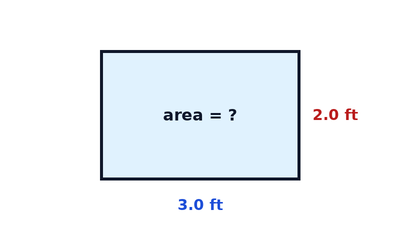
مساحة لوحة مستطيلة بعداها \(3.0\,ft\) و\(2.0\,ft\) كما في الشكل. فإن مساحتها بوحدة \(m^2\) (\(1\,ft=0.3048\,m\)):A rectangular board has dimensions \(3.0\,ft\) and \(2.0\,ft\) as shown. Its area in \(m^2\) is (\(1\,ft=0.3048\,m\)):
\(0.56\,m^2\)
\(1.83\,m^2\)
\(0.37\,m^2\)
\(5.6\,m^2\)
الحلSolution
📌 الخطوة 1: نحوّل كل بُعد إلى متر: \(3.0\,ft=0.914\,m\) و\(2.0\,ft=0.610\,m\)
📌 الخطوة 2: المساحة: \(A=0.914\times0.610\approx0.56\,m^2\) (لاحظ أن معامل التحويل للمساحة هو مربع معامل الطول).
✅ الإجابة الصحيحة هي: A (\(0.56\,m^2\))
📌 Step 1: Convert each side to metres: \(3.0\,ft=0.914\,m\) and \(2.0\,ft=0.610\,m\)
📌 Step 2: Area: \(A=0.914\times0.610\approx0.56\,m^2\) (the area factor is the square of the length factor).
✅ Correct answer: A (\(0.56\,m^2\))
\[17\;\star\star\star\]
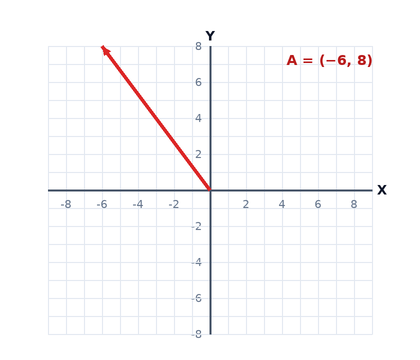
المتجه \(\vec A=(-6\hat X,+8\hat Y)\) كما في الشكل. فإن مقداره واتجاهه (الزاوية مع المحور \(+X\) عكس عقارب الساعة):The vector \(\vec A=(-6\hat X,+8\hat Y)\) is shown. Its magnitude and direction (angle from the \(+X\) axis, counterclockwise) are:
📌 Step 2: The reference angle is \(\tan^{-1}(8/6)=53.1^\circ\) and the vector lies in the second quadrant: \(\theta=180^\circ-53.1^\circ=126.9^\circ\)
✅ Correct answer: D (\(10,\;126.9^\circ\))
\[18\;\star\star\star\]
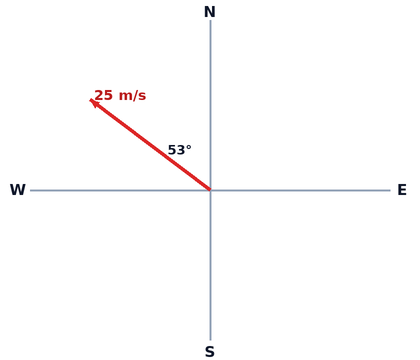
سرعة جسم \(25\,m/s\) باتجاه \(53^\circ\) غرب الشمال كما في الشكل (الشرق \(+X\) والشمال \(+Y\)). فإن مركبتاها \((v_x,v_y)\):A body moves at \(25\,m/s\) at \(53^\circ\) west of north as shown (east is \(+X\), north is \(+Y\)). Its components \((v_x,v_y)\) are:
\((-20,\;+15)\,m/s\)
\((-15,\;+20)\,m/s\)
\((+20,\;+15)\,m/s\)
\((-20,\;-15)\,m/s\)
الحلSolution
📌 الخطوة 1: الزاوية مقيسة من الشمال (المحور \(Y\)) فالمركبة الرأسية بجيب التمام: \(v_y=25\cos53^\circ=15\,m/s\)
📌 الخطوة 2: المركبة الأفقية بجيب الزاوية وباتجاه الغرب (سالبة): \(v_x=-25\sin53^\circ=-20\,m/s\)
✅ الإجابة الصحيحة هي: A (\((-20,\;+15)\,m/s\))
📌 Step 1: The angle is measured from north (the \(Y\) axis) so the vertical component uses cosine: \(v_y=25\cos53^\circ=15\,m/s\)
📌 Step 2: The horizontal component uses sine and points west (negative): \(v_x=-25\sin53^\circ=-20\,m/s\)
✅ Correct answer: A (\((-20,\;+15)\,m/s\))
\[19\;\star\star\star\]
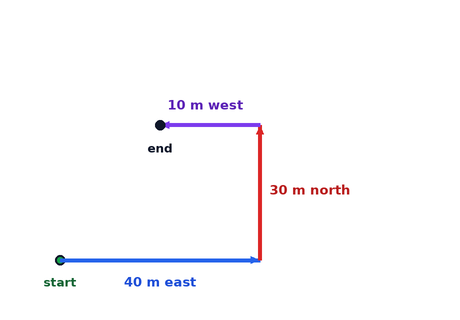
سار شخص \(40\,m\) شرقًا ثم \(30\,m\) شمالًا ثم \(10\,m\) غربًا كما في الشكل. فإن مقدار إزاحته الكلية واتجاهها:A person walks \(40\,m\) east, then \(30\,m\) north, then \(10\,m\) west as shown. The magnitude and direction of the total displacement are:
📌 الخطوة 2: المقدار والاتجاه: \(R=\sqrt{30^2+30^2}=42.4\,m,\quad\theta=\tan^{-1}(30/30)=45^\circ\) شمال الشرق.
✅ الإجابة الصحيحة هي: B (\(42.4\,m,\;45^\circ\text{ north of east}\))
📌 Step 1: Add the components: \(R_x=40-10=30\,m,\quad R_y=30\,m\)
📌 Step 2: Magnitude and direction: \(R=\sqrt{30^2+30^2}=42.4\,m,\quad\theta=\tan^{-1}(30/30)=45^\circ\) north of east.
✅ Correct answer: B (\(42.4\,m,\;45^\circ\text{ north of east}\))
\[20\;\star\star\star\]
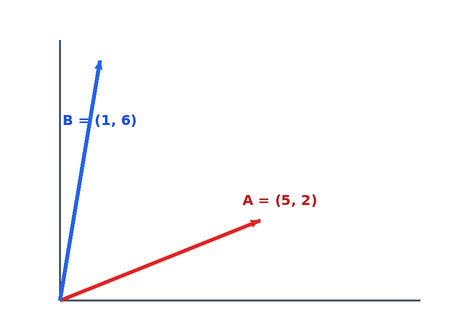
المتجهان \(\vec A=(5,2)\) و\(\vec B=(1,6)\) كما في الشكل. فإن مقدار \(\vec A-\vec B\):The vectors \(\vec A=(5,2)\) and \(\vec B=(1,6)\) are shown. The magnitude of \(\vec A-\vec B\) is:
المتجهان \(\vec A=(2\hat X,\,3\hat Y,\,-1\hat Z)\) و\(\vec B=(1\hat X,\,-2\hat Y,\,4\hat Z)\). فإن الزاوية بينهما:Given \(\vec A=(2\hat X,\,3\hat Y,\,-1\hat Z)\) and \(\vec B=(1\hat X,\,-2\hat Y,\,4\hat Z)\), the angle between them is:
📌 الخطوة 3: \(\cos\theta=\dfrac{-8}{\sqrt{14}\sqrt{21}}=-0.466\Rightarrow\theta=118^\circ\) (زاوية منفرجة لأن الضرب القياسي سالب).
✅ الإجابة الصحيحة هي: A (\(118^\circ\))
📌 Step 1: The scalar product: \(\vec A\cdot\vec B=(2)(1)+(3)(-2)+(-1)(4)=-8\)
📌 Step 2: The magnitudes: \(|\vec A|=\sqrt{14},\;|\vec B|=\sqrt{21}\)
📌 Step 3: \(\cos\theta=\dfrac{-8}{\sqrt{14}\sqrt{21}}=-0.466\Rightarrow\theta=118^\circ\) (obtuse since the scalar product is negative).
✅ Correct answer: A (\(118^\circ\))
\[22\;\star\star\star\]
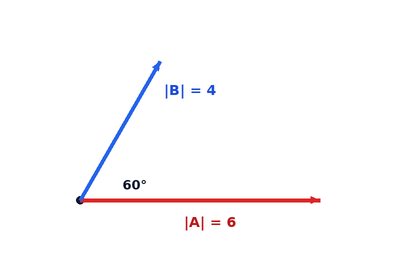
يبين الشكل متجهين \(|\vec A|=6\) و\(|\vec B|=4\) بينهما زاوية \(60^\circ\). فإن حاصل الضرب القياسي \(\vec A\cdot\vec B\):The figure shows two vectors \(|\vec A|=6\) and \(|\vec B|=4\) with \(60^\circ\) between them. The scalar product \(\vec A\cdot\vec B\) is:
📌 Step 2: Substituting: \(6\times4\times\cos60^\circ=24\times0.5=12\) (20.8 results from wrongly using sine).
✅ Correct answer: C (\(12\))
\[23\;\star\star\star\]
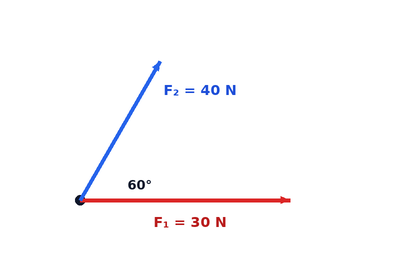
قوتان \(30\,N\) و\(40\,N\) تؤثران في نقطة وبينهما زاوية \(60^\circ\) كما في الشكل. فإن مقدار محصلتهما:Two forces \(30\,N\) and \(40\,N\) act at a point with \(60^\circ\) between them as shown. The magnitude of their resultant is:
\(70\,N\)
\(60.8\,N\)
\(50\,N\)
\(43.6\,N\)
الحلSolution
📌 الخطوة 1: قانون محصلة متجهين: \(R=\sqrt{F_1^2+F_2^2+2F_1F_2\cos\theta}\)
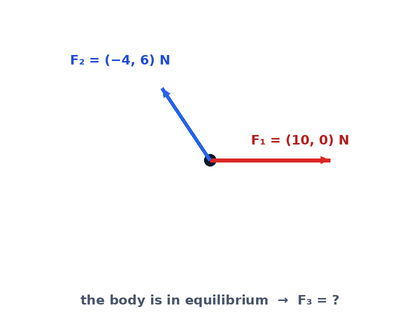
تؤثر ثلاث قوى في جسم فيبقى في حالة اتزان: \(\vec F_1=(10,0)\,N\) و\(\vec F_2=(-4,6)\,N\) كما في الشكل. فإن القوة الثالثة \(\vec F_3\):Three forces act on a body that remains in equilibrium: \(\vec F_1=(10,0)\,N\) and \(\vec F_2=(-4,6)\,N\) as shown. The third force \(\vec F_3\) is:
\((6,\;6)\,N\)
\((-6,\;6)\,N\)
\((14,\;-6)\,N\)
\((-6,\;-6)\,N\)
الحلSolution
📌 الخطوة 1: الاتزان يعني أن المحصلة صفر: \(\vec F_1+\vec F_2+\vec F_3=0\)
📌 Step 1: Compute the magnitude: \(|\vec A|=\sqrt{3^2+(-4)^2}=5\)
📌 Step 2: The unit vector: \(\hat A=\dfrac{\vec A}{|\vec A|}=(0.6,\,-0.8)\) with magnitude 1.
✅ Correct answer: A (\(0.6\hat X-0.8\hat Y\))
\[26\;\star\star\star\]
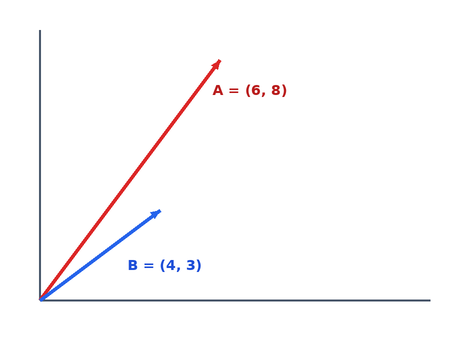
المتجهان \(\vec A=(6,8)\) و\(\vec B=(4,3)\) كما في الشكل. فإن مركبة \(\vec A\) في اتجاه \(\vec B\) (الإسقاط):The vectors \(\vec A=(6,8)\) and \(\vec B=(4,3)\) are shown. The component of \(\vec A\) along \(\vec B\) (the projection) is:
📌 Step 1: The scalar product: \(\vec A\cdot\vec B=(6)(4)+(8)(3)=48\)
📌 Step 2: The projection: \(A_B=\dfrac{\vec A\cdot\vec B}{|\vec B|}=\dfrac{48}{5}=9.6\)
✅ Correct answer: B (\(9.6\))
\[27\;\star\star\star\]
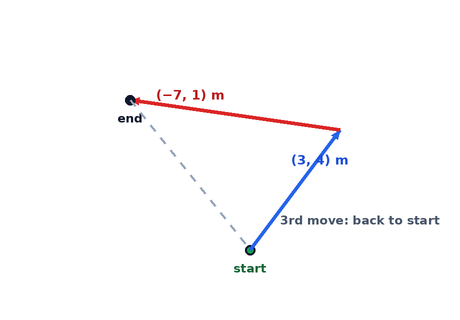
تحرك جسم من نقطة البداية إزاحتين \((3,4)\,m\) ثم \((-7,1)\,m\) كما في الشكل. فإن مقدار الإزاحة الثالثة اللازمة لعودته إلى نقطة البداية:A body moves from its starting point through displacements \((3,4)\,m\) then \((-7,1)\,m\) as shown. The magnitude of the third displacement needed to return it to the start is:
\(6.4\,m\)
\(8.6\,m\)
\(4.1\,m\)
\(10\,m\)
الحلSolution
📌 الخطوة 1: مجموع الإزاحتين: \((3,4)+(-7,1)=(-4,5)\,m\)
📌 الخطوة 2: لتعود يجب أن يكون المجموع الكلي صفرًا: \(\vec d_3=(4,-5)\)، ومقدارها \(\sqrt{16+25}=6.4\,m\)
✅ الإجابة الصحيحة هي: A (\(6.4\,m\))
📌 Step 1: The sum of the two displacements: \((3,4)+(-7,1)=(-4,5)\,m\)
📌 Step 2: To return the total must be zero: \(\vec d_3=(4,-5)\), magnitude \(\sqrt{16+25}=6.4\,m\)
✅ Correct answer: A (\(6.4\,m\))
\[28\;\star\star\star\]
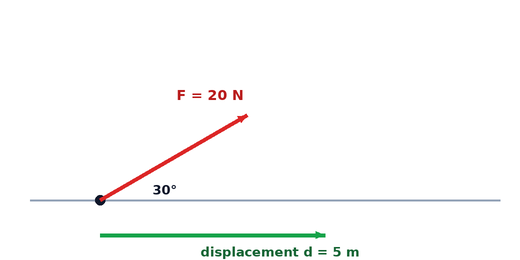
تؤثر قوة \(20\,N\) بزاوية \(30^\circ\) فوق الأفق في جسم أزاحته \(5\,m\) أفقيًا كما في الشكل. فإن الشغل الذي تبذله القوة (الضرب القياسي \(\vec F\cdot\vec d\)):A force of \(20\,N\) at \(30^\circ\) above the horizontal acts on a body displaced \(5\,m\) horizontally as shown. The work done by the force (scalar product \(\vec F\cdot\vec d\)) is:
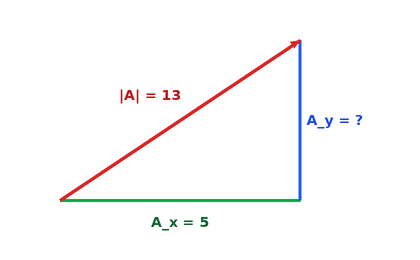
متجه مقداره \(13\) ومركبته الأفقية \(A_x=5\) ومركبته الرأسية سالبة كما في الشكل. فإن مركبته الرأسية \(A_y\):A vector has magnitude \(13\), horizontal component \(A_x=5\) and a negative vertical component as in the figure. Its vertical component \(A_y\) is:
\(-12\)
\(+12\)
\(-8\)
\(-18\)
الحلSolution
📌 الخطوة 1: من فيثاغورس: \(A_y^2=13^2-5^2=144\)
📌 الخطوة 2: \(|A_y|=12\) وبما أن المركبة سالبة: \(A_y=-12\)
✅ الإجابة الصحيحة هي: A (\(-12\))
📌 Step 1: From Pythagoras: \(A_y^2=13^2-5^2=144\)
📌 Step 2: \(|A_y|=12\) and since the component is negative: \(A_y=-12\)
✅ Correct answer: A (\(-12\))
أسئلة مقالية
Essay Questions
\[1\;\star\star\]
متجهات أبعادها الديكارتية مبيَّنة في الشكل أدناه. بالاعتماد على بيانات الشكل:Vectors with Cartesian dimensions are shown in the figure below. Based on the figure:
حدّد إحداثيات المتجهين \(\vec A\) و\(\vec B\)Determine the coordinates of \(\vec A\) and \(\vec B\)
أوجد الزاوية التي يصنعها \(\vec D\) مع المحور الأفقي الموجب عكس عقارب الساعةFind the angle \(\vec D\) makes with the positive horizontal axis, counterclockwise
الحلSolution
📌 الخطوة 1: من الشبكة: \(\vec A\) يمتد من \((2,1)\) إلى \((8,3)\)، إذن \(\vec A=(6,2)\). و\(\vec B\) يمتد بمقدار \((-6,4)\) تقريبًا حسب الشكل.
📌 الخطوة 4: \(\vec D=(4,-4)\) يقع في الربع الرابع؛ الزاوية المرجعية \(=\tan^{-1}(4/4)=45^\circ\)، والزاوية الكاملة عكس عقارب الساعة \(=360^\circ-45^\circ=315^\circ\)
✅ الإجابات: \(\vec A\approx(6,2)\)، \(\vec K\approx(12,-2)\)، \(|\vec k|\approx13.42\)، زاوية D ≈315°
📌 Step 1: From the grid: \(\vec A\) runs from \((2,1)\) to \((8,3)\), so \(\vec A=(6,2)\). \(\vec B\) spans approximately \((-6,4)\) per the figure.