⚡ بنك الأسئلة: المجال الكهربائي وتطبيقات المجال
⚡ Question Bank: The Electric Field and Its Applications
مجال الشحنة النقطية، خطوط المجال، المجال المنتظم، طاقة الوضع وفرق الجهد، تجربة ميليكان، والمجال داخل الموصلات
Field of a Point Charge, Field Lines, the Uniform Field, Potential Energy and Potential Difference, Millikan’s Experiment, and the Field Inside Conductors
⏱️ 39 سؤال اختيار من متعدد بتصحيح فوري بمستويات متدرجة، و5 مسائل مقالية محلولة⏱️ 39 multiple-choice questions of graded difficulty with instant feedback, plus 5 solved essay problems
\[1\,\star\]
وُضع إلكترون داخل مجال كهربائي شدته \(3\times10^{2}\,N/C\). القوة الكهربائية المؤثرة على الإلكترون (شحنته \(1.6\times10^{-19}\,C\)):An electron is placed in an electric field of strength \(3\times10^{2}\,N/C\). The electric force on the electron (charge \(1.6\times10^{-19}\,C\)) is:
\(F=5.2\times10^{-12}\,N\) باتجاه المجال\(F=5.2\times10^{-12}\,N\) along the field
\(F=4.8\times10^{-17}\,N\) عكس اتجاه المجال\(F=4.8\times10^{-17}\,N\) opposite to the field
\(F=5.2\times10^{-12}\,N\) عكس اتجاه المجال\(F=5.2\times10^{-12}\,N\) opposite to the field
\(F=4.8\times10^{-17}\,N\) باتجاه المجال\(F=4.8\times10^{-17}\,N\) along the field
الحلSolution
📌 المقدار: \(F=|q|E=(1.6\times10^{-19})(3\times10^{2})=4.8\times10^{-17}\,N\).
📌 الاتجاه: الإلكترون سالب الشحنة فالقوة عكس اتجاه المجال.
✅ \(F=4.8\times10^{-17}\,N\) عكس اتجاه المجال (B)
📌 Magnitude: \(F=|q|E=(1.6\times10^{-19})(3\times10^{2})=4.8\times10^{-17}\,N\).
📌 Direction: the electron is negative, so the force is opposite to the field.
✅ \(F=4.8\times10^{-17}\,N\) opposite to the field (B)
\[2\,\star\]
شحنة نقطية موجبة \(q=+6\,\mu C\). المجال الكهربائي عند النقطة \(a\) التي تبعد \(0.2\,m\) عنها (كما في الشكل):A positive point charge \(q=+6\,\mu C\). The electric field at point \(a\), \(0.2\,m\) from it (as in the figure), is:
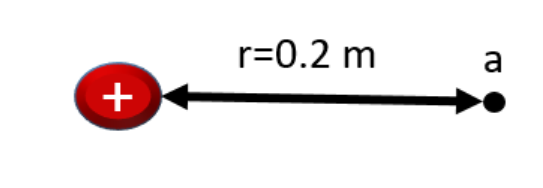
\(E=4.52\times10^{6}\,N/C\) نحو اليسار\(E=4.52\times10^{6}\,N/C\) to the left
\(E=6.75\times10^{6}\,N/C\) نحو اليمين\(E=6.75\times10^{6}\,N/C\) to the right
\(E=1.35\times10^{6}\,N/C\) نحو اليمين\(E=1.35\times10^{6}\,N/C\) to the right
\(E=3.25\times10^{6}\,N/C\) نحو اليسار\(E=3.25\times10^{6}\,N/C\) to the left
الحلSolution
📌 \(E=\dfrac{kq}{r^{2}}=\dfrac{9\times10^{9}\times6\times10^{-6}}{(0.2)^{2}}=1.35\times10^{6}\,N/C\).
📌 الشحنة موجبة فالمجال يبتعد عنها: نحو اليمين (النقطة على يمين الشحنة).
✅ \(E=1.35\times10^{6}\,N/C\) نحو اليمين (C)
📌 \(E=\dfrac{kq}{r^{2}}=\dfrac{9\times10^{9}\times6\times10^{-6}}{(0.2)^{2}}=1.35\times10^{6}\,N/C\).
📌 The charge is positive so the field points away from it: to the right (the point is to the right of the charge).
✅ \(E=1.35\times10^{6}\,N/C\) to the right (C)
\[3\,\star\star\]
مجال كهربائي شدته \(E=300\,N/C\) وُضع فيه جسيم فتأثر بقوة كهربائية \(9\times10^{-12}\,N\) باتجاه المجال (كما في الشكل). نوع الشحنة ومقدارها:In an electric field of strength \(E=300\,N/C\) a particle experiences an electric force \(9\times10^{-12}\,N\) along the field (as in the figure). The sign and magnitude of its charge are:
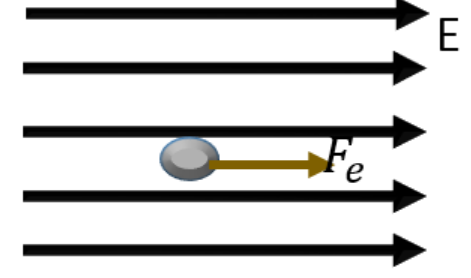
\(q=3\times10^{-14}\,C\) موجبة\(q=3\times10^{-14}\,C\) positive
\(q=9\times10^{-14}\,C\) سالبة\(q=9\times10^{-14}\,C\) negative
\(q=6\times10^{-14}\,C\) سالبة\(q=6\times10^{-14}\,C\) negative
\(q=4\times10^{-14}\,C\) موجبة\(q=4\times10^{-14}\,C\) positive
الحلSolution
📌 \(q=\dfrac{F}{E}=\dfrac{9\times10^{-12}}{300}=3\times10^{-14}\,C\).
📌 القوة باتجاه المجال فالشحنة موجبة.
✅ \(q=3\times10^{-14}\,C\) موجبة (A)
📌 \(q=\dfrac{F}{E}=\dfrac{9\times10^{-12}}{300}=3\times10^{-14}\,C\).
📌 The force is along the field, so the charge is positive.
✅ \(q=3\times10^{-14}\,C\) positive (A)
\[4\,\star\star\]
شحنة مقدارها \(Q=4\,\mu C\) حُسب مجالها عند النقطة A فكانت شدته \(3\times10^{4}\,N/C\). بُعد النقطة A عن الشحنة:A charge \(Q=4\,\mu C\) produces a field of strength \(3\times10^{4}\,N/C\) at point A. The distance of A from the charge is:
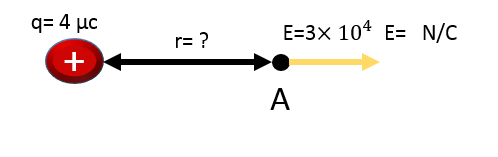
\(r=0.56\,m\)\(r=0.56\,m\)
\(r=1.1\,m\)\(r=1.1\,m\)
\(r=0.85\,m\)\(r=0.85\,m\)
\(r=1.4\,m\)\(r=1.4\,m\)
الحلSolution
📌 \(E=\dfrac{kQ}{r^{2}}\Rightarrow r=\sqrt{\dfrac{kQ}{E}}\).
📌 \(r=\sqrt{\dfrac{9\times10^{9}\times4\times10^{-6}}{3\times10^{4}}}=\sqrt{1.2}\approx1.1\,m\).
✅ \(r=1.1\,m\) (B)
📌 \(E=\dfrac{kQ}{r^{2}}\Rightarrow r=\sqrt{\dfrac{kQ}{E}}\).
📌 \(r=\sqrt{\dfrac{9\times10^{9}\times4\times10^{-6}}{3\times10^{4}}}=\sqrt{1.2}\approx1.1\,m\).
✅ \(r=1.1\,m\) (B)
\[5\,\star\]
أي وحدة من الوحدات التالية تكافئ وحدة قياس المجال الكهربائي (\(N/C\))؟Which of the following units is equivalent to the unit of the electric field (\(N/C\))?
\(kg\cdot m\cdot A^{-1}\cdot s^{-1}\)\(kg\cdot m\cdot A^{-1}\cdot s^{-1}\)
\(kg\cdot m\cdot A^{-1}\cdot s^{-3}\)\(kg\cdot m\cdot A^{-1}\cdot s^{-3}\)
\(kg\cdot m\cdot A^{-2}\cdot s^{-2}\)\(kg\cdot m\cdot A^{-2}\cdot s^{-2}\)
\(kg\cdot m\cdot A^{-1}\cdot s^{-2}\)\(kg\cdot m\cdot A^{-1}\cdot s^{-2}\)
الحلSolution
📌 \(E=\dfrac{F}{q}\Rightarrow\dfrac{N}{C}=\dfrac{kg\cdot m/s^{2}}{A\cdot s}=kg\cdot m\cdot A^{-1}\cdot s^{-3}\).
✅ \(kg\cdot m\cdot A^{-1}\cdot s^{-3}\) (B)
📌 \(E=\dfrac{F}{q}\Rightarrow\dfrac{N}{C}=\dfrac{kg\cdot m/s^{2}}{A\cdot s}=kg\cdot m\cdot A^{-1}\cdot s^{-3}\).
✅ \(kg\cdot m\cdot A^{-1}\cdot s^{-3}\) (B)
\[6\,\star\star\]
في الشكل النسبة بين مجال النقطة A إلى مجال النقطة B الناتجين عن الشحنة السالبة تعادل (المسافة من الشحنة إلى A تساوي \(r\) ومن A إلى B تساوي \(2r\)):In the figure, the ratio of the field at point A to the field at point B due to the negative charge is (the distance from the charge to A is \(r\) and from A to B is \(2r\)):
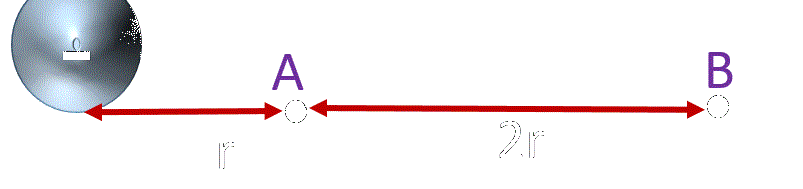
44
66
99
22
الحلSolution
📌 بُعد A عن الشحنة \(r\) وبُعد B عنها \(r+2r=3r\).
📌 \(E\propto\dfrac{1}{r^{2}}\Rightarrow\dfrac{E_A}{E_B}=\dfrac{(3r)^{2}}{r^{2}}=9\).
✅ C
📌 A is at distance \(r\) from the charge and B at \(r+2r=3r\).
📌 \(E\propto\dfrac{1}{r^{2}}\Rightarrow\dfrac{E_A}{E_B}=\dfrac{(3r)^{2}}{r^{2}}=9\).
✅ C
\[7\,\star\]
أي العبارات التالية من صفات خطوط المجال الكهربائي؟Which of the following is a property of electric field lines?
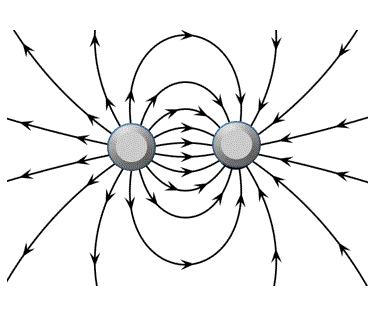
يزداد عدد خطوط المجال كلما قل مقدار الشحنة المولّدة للمجالThe number of field lines increases as the source charge decreases
خطوط المجال لا تتقاطعField lines do not intersect
تزداد كثافتها كلما ابتعدنا عن الشحنةTheir density increases as we move away from the charge
تخرج من الشحنة السالبة وتدخل إلى الشحنة الموجبةThey leave the negative charge and enter the positive charge
الحلSolution
📌 خطوط المجال تخرج من الشحنة الموجبة وتدخل في السالبة، ولا تتقاطع أبدًا (لأن للمجال اتجاهًا واحدًا عند كل نقطة)، وكثافتها تتناسب مع شدة المجال (تزداد قرب الشحنة وبزيادة مقدارها).
✅ خطوط المجال لا تتقاطع (B)
📌 Field lines leave the positive charge and enter the negative one, and never cross (the field has a single direction at each point); their density is proportional to the field strength (larger near the charge and for a larger charge).
✅ Field lines do not intersect (B)
\[8\,\star\]
أي العبارات التالية ليست من صفات خطوط المجال الكهربائي؟Which of the following is not a property of electric field lines?
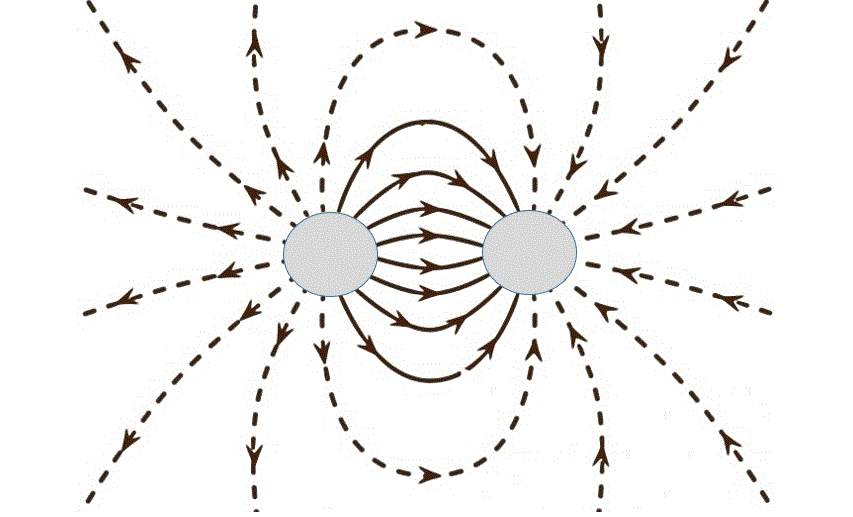
تخرج من الشحنة الموجبة وتدخل إلى الشحنة السالبةThey leave the positive charge and enter the negative charge
يزداد عدد خطوط المجال كلما قل مقدار الشحنة المولّدة للمجالThe number of field lines increases as the source charge decreases
تزداد كثافة خطوط المجال كلما اقتربنا من الشحنةThe density of field lines increases as we approach the charge
خطوط المجال لا تتقاطعField lines do not intersect
الحلSolution
📌 عدد الخطوط المرسومة يتناسب طرديًا مع مقدار الشحنة: يزداد بزيادتها لا بنقصانها. لذلك العبارة الثالثة ليست من صفات الخطوط.
✅ يزداد عدد خطوط المجال كلما قل مقدار الشحنة المولّدة للمجال (B)
📌 The number of lines drawn is directly proportional to the magnitude of the charge: it grows as the charge grows, not as it shrinks. So the third statement is not a property.
✅ The number of field lines increases as the source charge decreases (B)
\[9\,\star\]
تزداد طاقة الوضع الكهربائية لشحنة سالبة (كما في الشكل) عند حركتها:The electric potential energy of a negative charge (as in the figure) increases when it moves:
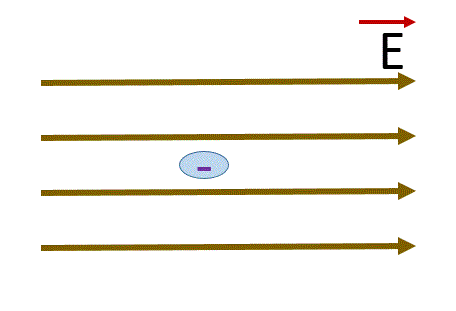
عكس المجالopposite to the field
بشكل عمودي على المجالperpendicular to the field
باتجاه المجالalong the field
باتجاه القوة الكهربائيةalong the electric force
الحلSolution
📌 القوة الكهربائية على الشحنة السالبة عكس اتجاه المجال. تزداد طاقة الوضع عندما تتحرك الشحنة ضد القوة الكهربائية، أي باتجاه المجال.
✅ باتجاه المجال (C)
📌 The electric force on a negative charge is opposite to the field. The potential energy increases when the charge moves against the electric force, i.e. along the field.
✅ along the field (C)
\[10\,\star\]
تزداد طاقة الوضع الكهربائية لشحنة موجبة (كما في الشكل) عند حركتها:The electric potential energy of a positive charge (as in the figure) increases when it moves:
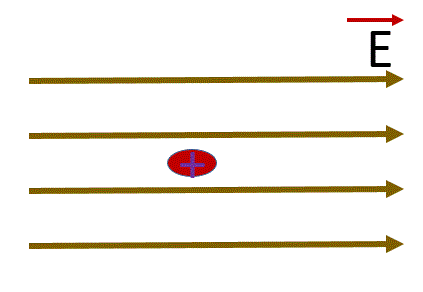
عكس المجالopposite to the field
باتجاه القوة الكهربائيةalong the electric force
باتجاه المجالalong the field
بشكل عمودي على المجالperpendicular to the field
الحلSolution
📌 القوة على الشحنة الموجبة باتجاه المجال. تزداد طاقة الوضع عندما تتحرك ضد القوة أي عكس المجال.
✅ عكس المجال (A)
📌 The force on a positive charge is along the field. The potential energy rises when it moves against the force, i.e. opposite to the field.
✅ opposite to the field (A)
\[11\,\star\]
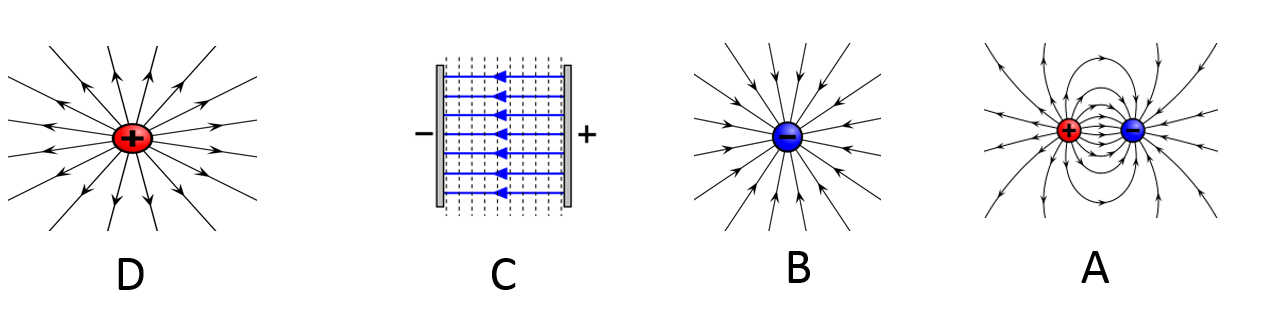
أي الأشكال التالية يمثل مجالًا كهربائيًا منتظمًا؟Which of the following figures represents a uniform electric field?
AA
BB
CC
DD
الحلSolution
📌 المجال المنتظم ثابت المقدار والاتجاه، وخطوطه متوازية ومتساوية البعد: هذا ما يظهر بين اللوحين المتوازيين في الشكل C.
📌 (A شحنتان، B شحنة سالبة، D شحنة موجبة: خطوطها غير متوازية.)
✅ C
📌 A uniform field has constant magnitude and direction and its lines are parallel and equally spaced: this is what appears between the parallel plates in figure C.
📌 (A: two charges, B: a negative charge, D: a positive charge: their lines are not parallel.)
✅ C
\[12\,\star\star\]
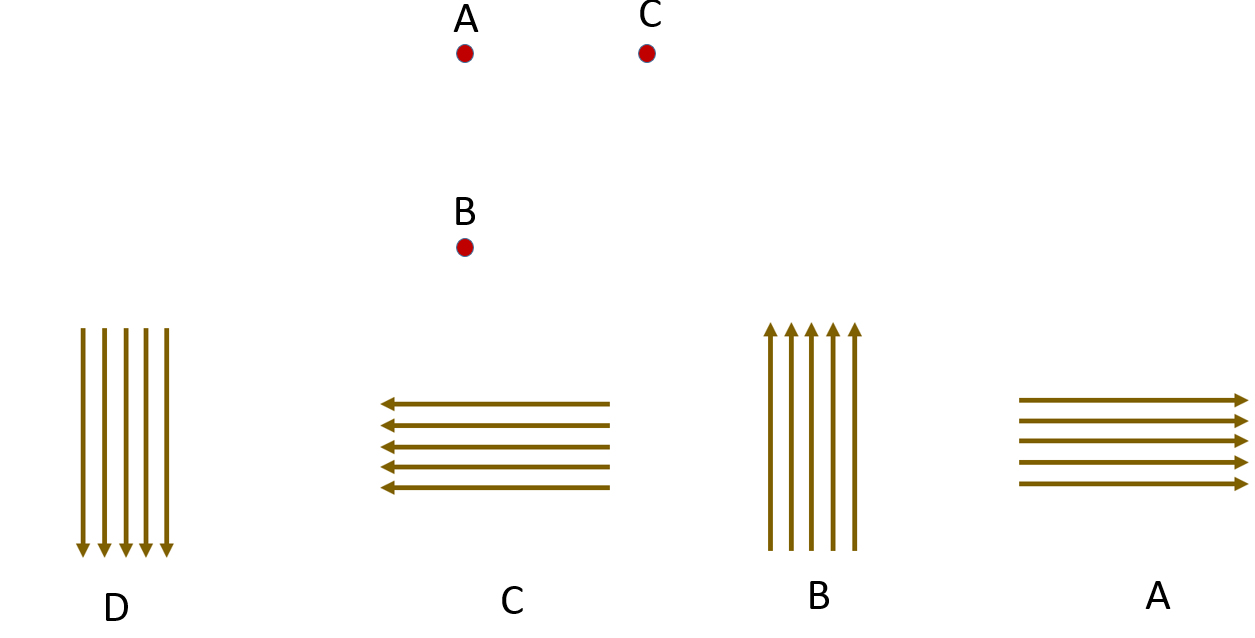
ثلاث نقاط A وB وC في مجال منتظم كما في الشكل، وكان \(V_A=8\,V,\ V_B=6\,V,\ V_C=8\,V\). أي الأشكال تمثل خطوط المجال الصحيحة؟Three points A, B and C lie in a uniform field as in the figure with \(V_A=8\,V,\ V_B=6\,V,\ V_C=8\,V\). Which figure shows the correct field lines?
AA
BB
CC
DD
الحلSolution
📌 \(V_A=V_C\) والنقطتان A وC على خط أفقي، فالخط الأفقي سطح تساوي جهد، وخطوط المجال عمودية عليه أي رأسية.
📌 الجهد يقل باتجاه المجال: B تحت A وجهدها أقل (\(6\lt 8\))، فالمجال نحو الأسفل: الشكل D.
✅ D
📌 \(V_A=V_C\) and A and C lie on a horizontal line, so that line is an equipotential and the field lines are perpendicular to it, i.e. vertical.
📌 The potential decreases along the field: B is below A and has a lower potential (\(6\lt 8\)), so the field points downward: figure D.
✅ D
\[13\,\star\star\]
يزداد الجهد الكهربائي عند نقطة كلما تحركنا:The electric potential increases as we move:
باتجاه المجالalong the field
بشكل عمودي على خطوط المجالperpendicular to the field lines
بشكل دائري حول الشحنةin a circle around the charge
عكس اتجاه المجالopposite to the field direction
الحلSolution
📌 \(\Delta V=-E\,d\): الجهد يقل باتجاه المجال ويزداد عكسه. وعمودي على الخطوط لا يتغير الجهد.
✅ عكس اتجاه المجال (D)
📌 \(\Delta V=-E\,d\): the potential falls along the field and rises against it. Perpendicular to the lines it does not change.
✅ opposite to the field direction (D)
\[14\,\star\]
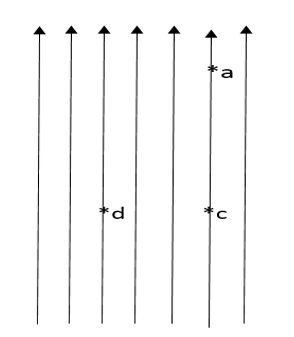
في الشكل مجال كهربائي منتظم (خطوطه نحو الأعلى) والنقطتان c وd على الارتفاع نفسه والنقطة a أعلى منهما. أي العبارات صحيحة؟The figure shows a uniform field (its lines point upward); points c and d are at the same height and point a is above them. Which statement is correct?
\(V_a\gt V_d=V_c\)\(V_a\gt V_d=V_c\)
\(V_c=V_d\gt V_a\)\(V_c=V_d\gt V_a\)
\(V_a=V_c\gt V_d\)\(V_a=V_c\gt V_d\)
\(V_a\gt V_c\gt V_d\)\(V_a\gt V_c\gt V_d\)
الحلSolution
📌 النقطتان c وd على الخط نفسه العمودي على المجال فلهما الجهد نفسه: \(V_c=V_d\).
📌 الجهد يقل باتجاه المجال (نحو الأعلى) والنقطة a أعلى منهما: \(V_c=V_d\gt V_a\).
✅ \(V_c=V_d\gt V_a\) (B)
📌 Points c and d lie on the same line perpendicular to the field, so they have the same potential: \(V_c=V_d\).
📌 The potential falls along the field (upward) and a is above them: \(V_c=V_d\gt V_a\).
✅ \(V_c=V_d\gt V_a\) (B)
\[15\,\star\star\]
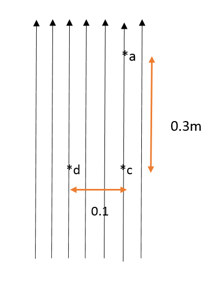
في الشكل مجال كهربائي منتظم شدته \(E=1000\,N/C\) نحو الأعلى، وبُعد a عن c يساوي \(0.3\,m\) وبُعد d عن c يساوي \(0.1\,m\) أفقيًا. فرق الجهد \(\Delta V_{ad}\) يساوي:In the figure a uniform field of strength \(E=1000\,N/C\) points upward; a is \(0.3\,m\) above c and d is \(0.1\,m\) horizontally from c. The potential difference \(\Delta V_{ad}\) is:
\(200\,V\)\(200\,V\)
\(300\,V\)\(300\,V\)
\(400\,V\)\(400\,V\)
\(600\,V\)\(600\,V\)
الحلSolution
📌 النقطة d في ارتفاع c نفسه، فإزاحة a إلى d موازية للمجال \(0.3\,m\) بعكس اتجاهه (من الأعلى إلى الأسفل بينما المجال نحو الأعلى): \(d=-0.3\,m\).
📌 \(\Delta V_{ad}=V_d-V_a=-E\,d=-1000\times(-0.3)=+300\,V\) (الإزاحة الأفقية لا تؤثر).
✅ \(300\,V\) (B)
📌 Point d is at the same height as c, so the displacement from a to d parallel to the field is \(0.3\,m\) against its direction (downward while the field points up): \(d=-0.3\,m\).
📌 \(\Delta V_{ad}=V_d-V_a=-E\,d=-1000\times(-0.3)=+300\,V\) (the horizontal displacement has no effect).
✅ \(300\,V\) (B)
\[16\,\star\]
في الشكل نفسه (مجال منتظم \(E=1000\,N/C\))، فرق الجهد \(\Delta V_{cd}\) يساوي:In the same figure (uniform field \(E=1000\,N/C\)), the potential difference \(\Delta V_{cd}\) is:
\(0\,V\)\(0\,V\)
\(200\,V\)\(200\,V\)
\(100\,V\)\(100\,V\)
\(300\,V\)\(300\,V\)
الحلSolution
📌 النقطتان c وd على خط عمودي على المجال (الإزاحة بينهما أفقية): لا مركّبة موازية للمجال، إذن \(\Delta V_{cd}=-Ed=0\).
✅ \(0\,V\) (A)
📌 Points c and d lie on a line perpendicular to the field (the displacement between them is horizontal): there is no component parallel to the field, so \(\Delta V_{cd}=-Ed=0\).
✅ \(0\,V\) (A)
\[17\,\star\star\]
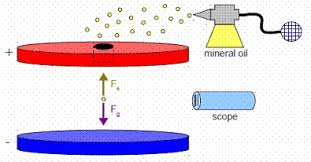
في تجربة ميليكان وُضعت قطرة زيت كتلتها \(m=2\times10^{-8}\,kg\) بين لوحين فأصبحت متزنة، وكانت شدة المجال \(E=1\times10^{3}\,N/C\). مقدار شحنة القطرة (\(g=9.8\,m/s^2\)):In Millikan’s experiment an oil drop of mass \(m=2\times10^{-8}\,kg\) is placed between two plates and is in equilibrium, with a field strength \(E=1\times10^{3}\,N/C\). The charge of the drop (\(g=9.8\,m/s^2\)) is:
\(q=2.54\times10^{-12}\,C\)\(q=2.54\times10^{-12}\,C\)
\(q=9.55\times10^{-9}\,C\)\(q=9.55\times10^{-9}\,C\)
\(q=3.42\times10^{-13}\,C\)\(q=3.42\times10^{-13}\,C\)
\(q=1.96\times10^{-10}\,C\)\(q=1.96\times10^{-10}\,C\)
الحلSolution
📌 الاتزان: القوة الكهربائية = الوزن: \(qE=mg\).
📌 \(q=\dfrac{mg}{E}=\dfrac{2\times10^{-8}\times9.8}{10^{3}}=1.96\times10^{-10}\,C\).
✅ \(q=1.96\times10^{-10}\,C\) (D)
📌 Equilibrium: electric force = weight: \(qE=mg\).
📌 \(q=\dfrac{mg}{E}=\dfrac{2\times10^{-8}\times9.8}{10^{3}}=1.96\times10^{-10}\,C\).
✅ \(q=1.96\times10^{-10}\,C\) (D)
\[18\,\star\star\]
وُضعت قطرة زيت مشحونة بين لوحين (العلوي موجب والسفلي سالب) فأصبحت متزنة. القطرة:A charged oil drop is placed between two plates (the upper positive, the lower negative) and is in equilibrium. The drop is:
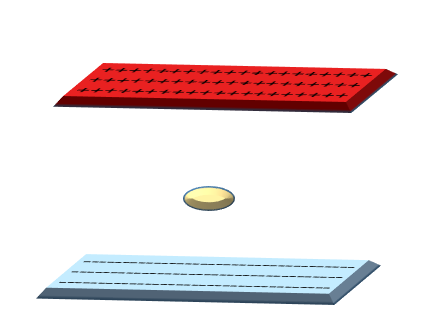
سالبة الشحنة وتتأثر بقوة كهربائية نحو الأعلىnegative, with an upward electric force
سالبة الشحنة وتتأثر بقوة كهربائية نحو الأسفلnegative, with a downward electric force
موجبة الشحنة بقوة كهربائية نحو الأعلىpositive, with an upward electric force
موجبة الشحنة وتتأثر بقوة كهربائية نحو الأسفلpositive, with a downward electric force
الحلSolution
📌 الوزن نحو الأسفل، فلكي تتزن يجب أن تكون القوة الكهربائية نحو الأعلى.
📌 المجال من اللوح الموجب (العلوي) إلى السالب: نحو الأسفل. قوة نحو الأعلى عكس المجال ⇒ الشحنة سالبة.
✅ سالبة الشحنة وتتأثر بقوة كهربائية نحو الأعلى (A)
📌 The weight points downward, so for equilibrium the electric force must point upward.
📌 The field points from the positive (upper) plate to the negative one: downward. An upward force is opposite to the field ⇒ the charge is negative.
✅ negative, with an upward electric force (A)
\[19\,\star\star\]
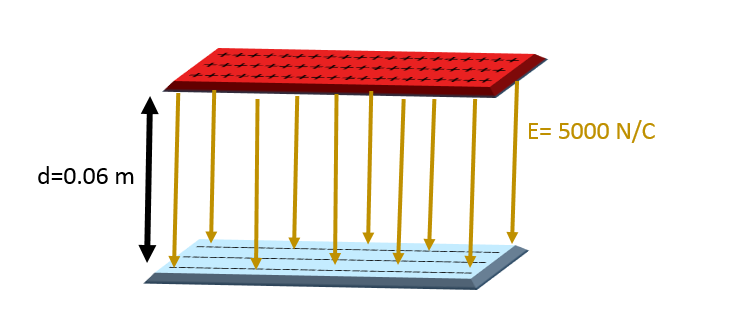
مجال منتظم شدته \(5\times10^{3}\,N/C\) بين لوحين المسافة بينهما \(0.06\,m\). فرق الجهد بين اللوحين:A uniform field of strength \(5\times10^{3}\,N/C\) exists between two plates \(0.06\,m\) apart. The potential difference between the plates is:
\(200\,V\)\(200\,V\)
\(300\,V\)\(300\,V\)
\(600\,V\)\(600\,V\)
\(60\,V\)\(60\,V\)
الحلSolution
📌 \(\Delta V=E\,d=5\times10^{3}\times0.06=300\,V\).
✅ \(300\,V\) (B)
📌 \(\Delta V=E\,d=5\times10^{3}\times0.06=300\,V\).
✅ \(300\,V\) (B)
\[20\,\star\star\]
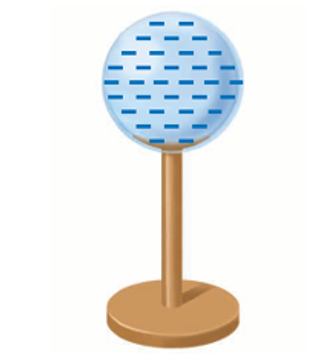
موصل كروي أجوف نصف قطره \(R=0.08\,m\) شُحن بشحنة سالبة \(Q=3\,\mu C\). شدة المجال عند نقطة تبعد \(r=0.05\,m\) عن مركزه:A hollow spherical conductor of radius \(R=0.08\,m\) is given a negative charge \(Q=3\,\mu C\). The field at a point \(r=0.05\,m\) from its centre is:
\(E=5.6\times10^{6}\,N/C\)\(E=5.6\times10^{6}\,N/C\)
\(E=14.4\times10^{6}\,N/C\)\(E=14.4\times10^{6}\,N/C\)
\(E=2.7\times10^{6}\,N/C\)\(E=2.7\times10^{6}\,N/C\)
\(E=0\,N/C\)\(E=0\,N/C\)
الحلSolution
📌 النقطة داخل الموصل (\(r=0.05\lt R=0.08\)).
📌 في حالة الاتزان الكهروستاتيكي تستقر الشحنات على السطح الخارجي ويكون المجال داخل الموصل صفرًا.
✅ \(E=0\,N/C\) (D)
📌 The point is inside the conductor (\(r=0.05\lt R=0.08\)).
📌 In electrostatic equilibrium the charges sit on the outer surface and the field inside the conductor is zero.
✅ \(E=0\,N/C\) (D)
\[21\,\star\]
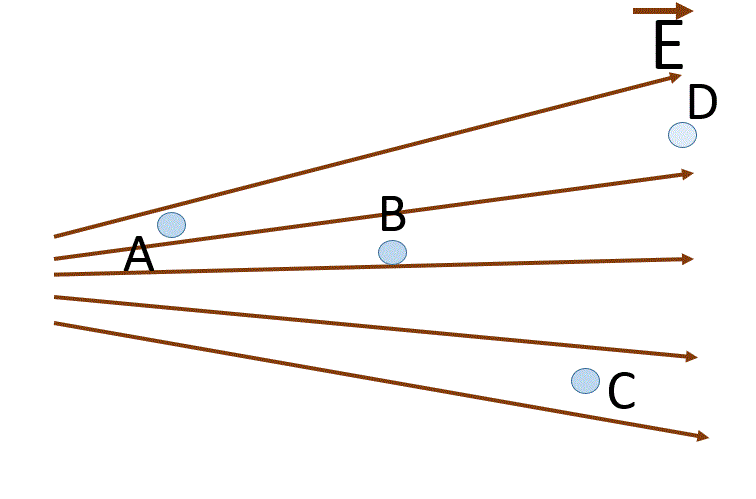
مجال غير منتظم كما في الشكل وُضعت فيه شحنة سالبة في مواضع مختلفة. أكبر قوة تؤثر على الشحنة تكون عند الموضع:A non-uniform field is shown with a negative charge placed at different positions. The greatest force on the charge is at position:
AA
BB
CC
DD
الحلSolution
📌 \(F=|q|E\): القوة أكبر ما يمكن حيث المجال أقوى، أي حيث تكون خطوط المجال أكثر كثافة (أقرب بعضها من بعض).
📌 الخطوط أقرب ما تكون عند الموضع A (قرب منبع الخطوط)، فالقوة هناك أكبر.
✅ A
📌 \(F=|q|E\): the force is greatest where the field is strongest, i.e. where the field lines are densest (closest together).
📌 The lines are closest at position A (near where they converge), so the force is greatest there.
✅ A
\[22\,\star\]
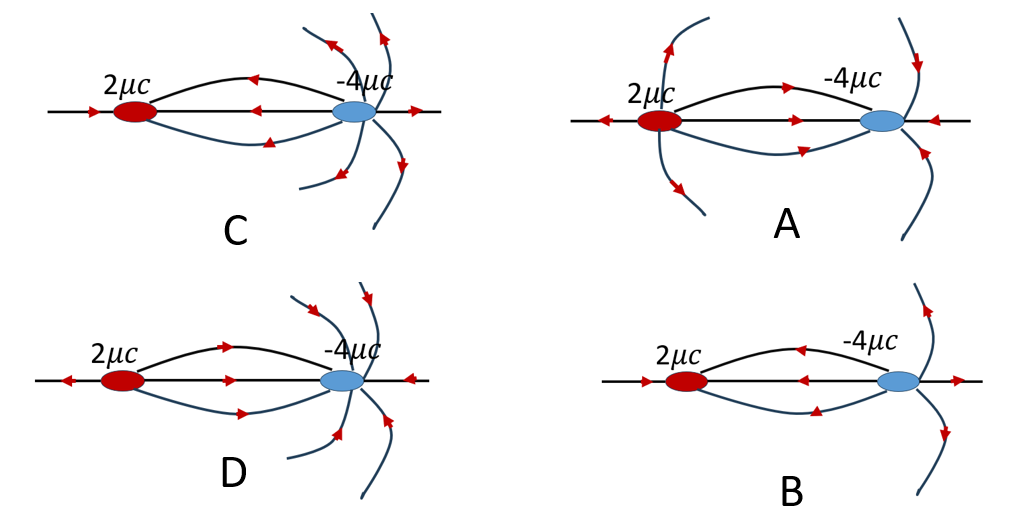
رُسمت خطوط المجال لشحنتين نقطيتين \(Q_1=-4\,\mu C\) و\(Q_2=+2\,\mu C\). أي الرسوم يعبّر بشكل صحيح عن المجال من حيث نوع الشحنتين وكثافة الخطوط؟Field lines are drawn for two point charges \(Q_1=-4\,\mu C\) and \(Q_2=+2\,\mu C\). Which figure represents the field correctly in terms of the sign and the density of lines?
AA
BB
CC
DD
الحلSolution
📌 الخطوط تخرج من الموجبة (\(+2\,\mu C\)) وتدخل في السالبة (\(-4\,\mu C\)).
📌 مقدار السالبة أكبر، فعدد الخطوط الداخلة إليها أكبر من الخارجة من الموجبة؛ فتأتي خطوط إضافية من اللانهاية وتنتهي عليها: هذا ما يظهر في الشكل D.
✅ D
📌 The lines leave the positive charge (\(+2\,\mu C\)) and enter the negative one (\(-4\,\mu C\)).
📌 The negative charge is larger, so more lines enter it than leave the positive one; extra lines come from infinity and end on it: this is what figure D shows.
✅ D
\[23\,\star\]
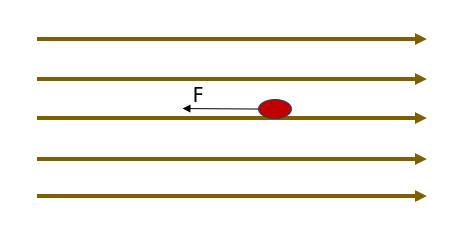
بُذل شغل خارجي على شحنة موجبة فنُقلت عكس اتجاه المجال بين نقطتين (كما في الشكل). أي العبارات تصف ما حدث؟External work is done on a positive charge and it is moved opposite to the field between two points (as in the figure). Which statement describes what happened?
تزداد طاقة وضع الشحنة ويزداد الجهد (تنتقل إلى نقطة أعلى جهدًا)Its potential energy increases and the potential increases (it moves to a higher-potential point)
تقل طاقة وضع الشحنة ويقل فرق الجهد بين النقطتينIts potential energy decreases and the potential difference decreases
تزداد طاقة وضع الشحنة ويقل فرق الجهد بين النقطتينIts potential energy increases and the potential difference decreases
تقل طاقة وضع الشحنة ويزداد فرق الجهد بين النقطتينIts potential energy decreases and the potential difference increases
الحلSolution
📌 الشحنة الموجبة تتحرك عكس المجال ⇒ تنتقل إلى جهد أعلى (\(\Delta V\gt 0\)).
📌 الشغل الخارجي يُخزَّن طاقة وضع: \(\Delta U=q\Delta V\gt 0\) فتزداد طاقة الوضع.
✅ تزداد طاقة وضع الشحنة ويزداد الجهد (تنتقل إلى نقطة أعلى جهدًا) (A)
📌 A positive charge moving against the field ⇒ it moves to a higher potential (\(\Delta V\gt 0\)).
📌 The external work is stored as potential energy: \(\Delta U=q\Delta V\gt 0\), so the potential energy increases.
✅ Its potential energy increases and the potential increases (it moves to a higher-potential point) (A)
\[24\,\star\]
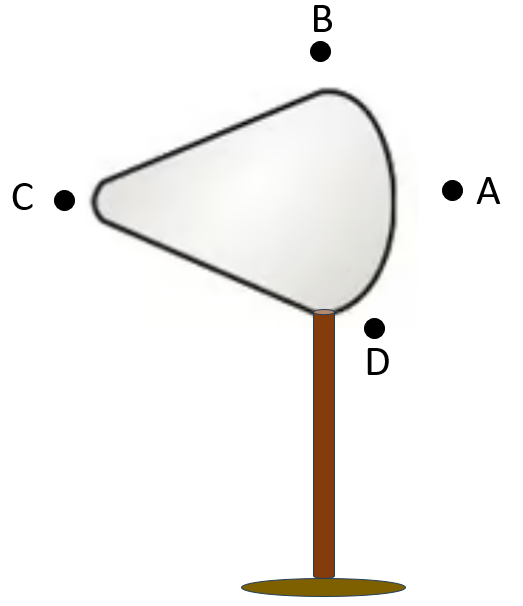
شُحن موصل غير منتظم الشكل كما في الشكل. أكبر شدة للمجال الكهربائي تكون عند النقطة:An irregularly shaped conductor is charged as shown. The strongest electric field is at point:
AA
BB
CC
DD
الحلSolution
📌 تتجمع الشحنة على سطح الموصل بكثافة أكبر عند الأجزاء الحادة (أصغر نصف قطر انحناء)، والمجال قرب السطح يتناسب مع كثافة الشحنة.
📌 الطرف الحاد في الشكل عند النقطة C.
✅ C
📌 Charge gathers on the surface of a conductor with a higher density at sharp parts (the smallest radius of curvature), and the field near the surface is proportional to the surface charge density.
📌 The sharpest tip in the figure is at point C.
✅ C
\[25\,\star\]
بروتون (\(q=1.6\times10^{-19}\,C\)) موضوع في مجال كهربائي منتظم شدته \(500\,N/C\). القوة الكهربائية المؤثرة عليه:A proton (\(q=1.6\times10^{-19}\,C\)) is in a uniform field of strength \(500\,N/C\). The electric force on it is:
\(8\times10^{-17}\,N\) عكس المجال\(8\times10^{-17}\,N\) opposite to the field
\(3.2\times10^{-22}\,N\) باتجاه المجال\(3.2\times10^{-22}\,N\) along the field
\(8\times10^{-17}\,N\) باتجاه المجال\(8\times10^{-17}\,N\) along the field
\(3.1\times10^{21}\,N\) باتجاه المجال\(3.1\times10^{21}\,N\) along the field
الحلSolution
📌 \(F=qE=1.6\times10^{-19}\times500=8\times10^{-17}\,N\)، والشحنة موجبة فالقوة باتجاه المجال.
✅ \(8\times10^{-17}\,N\) باتجاه المجال (C)
📌 \(F=qE=1.6\times10^{-19}\times500=8\times10^{-17}\,N\), and the charge is positive so the force is along the field.
✅ \(8\times10^{-17}\,N\) along the field (C)
\[26\,\star\]
المجال الكهربائي عند نقطة تبعد \(0.5\,m\) عن شحنة نقطية مقدارها \(2\,\mu C\):The electric field at a point \(0.5\,m\) from a point charge of \(2\,\mu C\) is:
\(3.6\times10^{4}\,N/C\)\(3.6\times10^{4}\,N/C\)
\(1.8\times10^{4}\,N/C\)\(1.8\times10^{4}\,N/C\)
\(7.2\times10^{4}\,N/C\)\(7.2\times10^{4}\,N/C\)
\(3.6\times10^{10}\,N/C\)\(3.6\times10^{10}\,N/C\)
الحلSolution
📌 \(E=\dfrac{kq}{r^{2}}=\dfrac{9\times10^{9}\times2\times10^{-6}}{0.25}=7.2\times10^{4}\,N/C\).
✅ \(7.2\times10^{4}\,N/C\) (C)
📌 \(E=\dfrac{kq}{r^{2}}=\dfrac{9\times10^{9}\times2\times10^{-6}}{0.25}=7.2\times10^{4}\,N/C\).
✅ \(7.2\times10^{4}\,N/C\) (C)
\[27\,\star\star\]
إذا ضوعف بُعد نقطة عن شحنة نقطية فإن شدة المجال الكهربائي عندها:If the distance of a point from a point charge is doubled, the electric field strength there:
تصبح نصف قيمتهاbecomes half
تصبح ربع قيمتهاbecomes one quarter
تتضاعفdoubles
تبقى ثابتةstays constant
الحلSolution
📌 \(E\propto\dfrac{1}{r^{2}}\): عند \(r\to2r\) يصبح \(E\to\dfrac{E}{4}\).
✅ تصبح ربع قيمتها (B)
📌 \(E\propto\dfrac{1}{r^{2}}\): for \(r\to2r\) we get \(E\to\dfrac{E}{4}\).
✅ becomes one quarter (B)
\[28\,\star\star\]
وُضعت شحنة اختبار في مجال شدته \(3\times10^{5}\,N/C\) فتأثرت بقوة \(6\times10^{-3}\,N\). مقدار الشحنة:A test charge placed in a field of strength \(3\times10^{5}\,N/C\) experiences a force \(6\times10^{-3}\,N\). The magnitude of the charge is:
\(5\times10^{7}\,C\)\(5\times10^{7}\,C\)
\(1.8\times10^{3}\,C\)\(1.8\times10^{3}\,C\)
\(2\times10^{-3}\,C\)\(2\times10^{-3}\,C\)
\(2\times10^{-8}\,C\)\(2\times10^{-8}\,C\)
الحلSolution
📌 \(q=\dfrac{F}{E}=\dfrac{6\times10^{-3}}{3\times10^{5}}=2\times10^{-8}\,C\).
✅ \(2\times10^{-8}\,C\) (D)
📌 \(q=\dfrac{F}{E}=\dfrac{6\times10^{-3}}{3\times10^{5}}=2\times10^{-8}\,C\).
✅ \(2\times10^{-8}\,C\) (D)
\[29\,\star\star\]
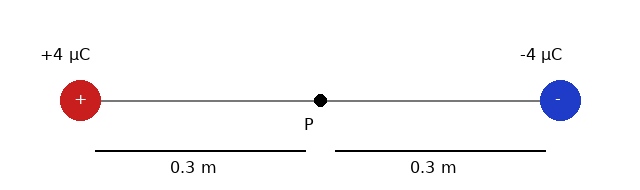
شحنتان \(+4\,\mu C\) و\(-4\,\mu C\) تفصل بينهما \(0.6\,m\) (كما في الشكل). المجال الكهربائي عند نقطة في منتصف المسافة بينهما:Two charges \(+4\,\mu C\) and \(-4\,\mu C\) are \(0.6\,m\) apart (as in the figure). The electric field at the midpoint between them is:
\(8\times10^{5}\,N/C\) نحو الشحنة الموجبة\(8\times10^{5}\,N/C\) toward the positive charge
صفرzero
\(4\times10^{5}\,N/C\) نحو الشحنة السالبة\(4\times10^{5}\,N/C\) toward the negative charge
\(8\times10^{5}\,N/C\) نحو الشحنة السالبة\(8\times10^{5}\,N/C\) toward the negative charge
الحلSolution
📌 النقطة تبعد \(0.3\,m\) عن كل شحنة: \(E_1=E_2=\dfrac{9\times10^{9}\times4\times10^{-6}}{(0.3)^{2}}=4\times10^{5}\,N/C\).
📌 مجال الموجبة يبتعد عنها ومجال السالبة يتجه نحوها، فالاتجاهان نفسهما (نحو السالبة)، فيجمعان: \(E=8\times10^{5}\,N/C\).
✅ \(8\times10^{5}\,N/C\) نحو الشحنة السالبة (D)
📌 The point is \(0.3\,m\) from each charge: \(E_1=E_2=\dfrac{9\times10^{9}\times4\times10^{-6}}{(0.3)^{2}}=4\times10^{5}\,N/C\).
📌 The positive charge’s field points away from it and the negative charge’s field points toward it, so both point toward the negative charge and add: \(E=8\times10^{5}\,N/C\).
✅ \(8\times10^{5}\,N/C\) toward the negative charge (D)
\[30\,\star\star\star\]
شحنتان موجبتان \(q_1=4\,nC\) عند \(x=0\) و\(q_2=16\,nC\) عند \(x=0.6\,m\) على المحور \(x\). نقطة انعدام المجال الكهربائي بينهما تقع عند:Two positive charges \(q_1=4\,nC\) at \(x=0\) and \(q_2=16\,nC\) at \(x=0.6\,m\) on the \(x\) axis. The point between them where the electric field is zero is at:
\(x=0.2\,m\)\(x=0.2\,m\)
\(x=0.3\,m\)\(x=0.3\,m\)
\(x=0.4\,m\)\(x=0.4\,m\)
\(x=0.15\,m\)\(x=0.15\,m\)
الحلSolution
📌 عند نقطة الانعدام يتساوى مجالا الشحنتين (متعاكسان): \(\dfrac{kq_1}{x^{2}}=\dfrac{kq_2}{(0.6-x)^{2}}\).
📌 \(\dfrac{(0.6-x)^{2}}{x^{2}}=\dfrac{16}{4}=4\Rightarrow\dfrac{0.6-x}{x}=2\Rightarrow x=0.2\,m\) (أقرب إلى الشحنة الأصغر).
✅ \(x=0.2\,m\) (A)
📌 At the zero point the two fields are equal in magnitude (and opposite): \(\dfrac{kq_1}{x^{2}}=\dfrac{kq_2}{(0.6-x)^{2}}\).
📌 \(\dfrac{(0.6-x)^{2}}{x^{2}}=\dfrac{16}{4}=4\Rightarrow\dfrac{0.6-x}{x}=2\Rightarrow x=0.2\,m\) (nearer the smaller charge).
✅ \(x=0.2\,m\) (A)
\[31\,\star\star\]
بروتون (\(m=1.67\times10^{-27}\,kg\)) تُرك حرًّا في مجال منتظم شدته \(1000\,N/C\). تسارعه تقريبًا:A proton (\(m=1.67\times10^{-27}\,kg\)) is released in a uniform field of strength \(1000\,N/C\). Its acceleration is approximately:
\(9.6\times10^{13}\,m/s^2\)\(9.6\times10^{13}\,m/s^2\)
\(1.04\times10^{-11}\,m/s^2\)\(1.04\times10^{-11}\,m/s^2\)
\(9.8\,m/s^2\)\(9.8\,m/s^2\)
\(9.6\times10^{10}\,m/s^2\)\(9.6\times10^{10}\,m/s^2\)
الحلSolution
📌 \(a=\dfrac{F}{m}=\dfrac{qE}{m}=\dfrac{1.6\times10^{-19}\times1000}{1.67\times10^{-27}}\approx9.6\times10^{10}\,m/s^2\).
📌 تسارع هائل مقارنة بتسارع الجاذبية، لذلك نهمل الوزن في مثل هذه المسائل.
✅ \(9.6\times10^{10}\,m/s^2\) (D)
📌 \(a=\dfrac{F}{m}=\dfrac{qE}{m}=\dfrac{1.6\times10^{-19}\times1000}{1.67\times10^{-27}}\approx9.6\times10^{10}\,m/s^2\).
📌 A huge acceleration compared with that of gravity, which is why we neglect the weight in such problems.
✅ \(9.6\times10^{10}\,m/s^2\) (D)
\[32\,\star\star\star\]
إلكترون ينطلق من السكون في مجال منتظم شدته \(4000\,N/C\) ويقطع مسافة \(0.02\,m\) باتجاه القوة. طاقته الحركية عند نهاية المسافة:An electron starts from rest in a uniform field of strength \(4000\,N/C\) and travels \(0.02\,m\) along the force. Its kinetic energy at the end of the path is:
\(1.28\times10^{-15}\,J\)\(1.28\times10^{-15}\,J\)
\(5.1\times10^{-16}\,J\)\(5.1\times10^{-16}\,J\)
\(1.28\times10^{-17}\,J\)\(1.28\times10^{-17}\,J\)
\(3.2\times10^{-17}\,J\)\(3.2\times10^{-17}\,J\)
الحلSolution
📌 شغل القوة الكهربائية يساوي التغير في الطاقة الحركية: \(K=W=qEd\).
📌 \(K=1.6\times10^{-19}\times4000\times0.02=1.28\times10^{-17}\,J\).
✅ \(1.28\times10^{-17}\,J\) (C)
📌 The work of the electric force equals the change in kinetic energy: \(K=W=qEd\).
📌 \(K=1.6\times10^{-19}\times4000\times0.02=1.28\times10^{-17}\,J\).
✅ \(1.28\times10^{-17}\,J\) (C)
\[33\,\star\]
وحدة المجال الكهربائي \(V/m\) تكافئ الوحدة:The unit of the electric field \(V/m\) is equivalent to:
\(N\cdot C\)\(N\cdot C\)
\(J/C\)\(J/C\)
\(C/N\)\(C/N\)
\(N/C\)\(N/C\)
الحلSolution
📌 \(V=\dfrac{J}{C}\Rightarrow\dfrac{V}{m}=\dfrac{J}{C\cdot m}=\dfrac{N\cdot m}{C\cdot m}=\dfrac{N}{C}\).
✅ \(N/C\) (D)
📌 \(V=\dfrac{J}{C}\Rightarrow\dfrac{V}{m}=\dfrac{J}{C\cdot m}=\dfrac{N\cdot m}{C\cdot m}=\dfrac{N}{C}\).
✅ \(N/C\) (D)
\[34\,\star\star\star\]
قطرة زيت كتلتها \(1.6\times10^{-15}\,kg\) متزنة في مجال منتظم شدته \(1.96\times10^{4}\,N/C\) (\(g=9.8\,m/s^2\)). عدد الإلكترونات الفائضة على القطرة (\(e=1.6\times10^{-19}\,C\)):An oil drop of mass \(1.6\times10^{-15}\,kg\) is in equilibrium in a uniform field of strength \(1.96\times10^{4}\,N/C\) (\(g=9.8\,m/s^2\)). The number of excess electrons on the drop (\(e=1.6\times10^{-19}\,C\)) is:
55
88
1212
33
الحلSolution
📌 الاتزان: \(q=\dfrac{mg}{E}=\dfrac{1.6\times10^{-15}\times9.8}{1.96\times10^{4}}=8\times10^{-19}\,C\).
📌 \(n=\dfrac{q}{e}=\dfrac{8\times10^{-19}}{1.6\times10^{-19}}=5\) إلكترونات.
✅ A
📌 Equilibrium: \(q=\dfrac{mg}{E}=\dfrac{1.6\times10^{-15}\times9.8}{1.96\times10^{4}}=8\times10^{-19}\,C\).
📌 \(n=\dfrac{q}{e}=\dfrac{8\times10^{-19}}{1.6\times10^{-19}}=5\) electrons.
✅ A
\[35\,\star\star\]
يشكّل لوحان متوازيان مجالًا منتظمًا، وفرق الجهد بينهما \(500\,V\) والمسافة بينهما \(0.05\,m\). شدة المجال بينهما:Two parallel plates produce a uniform field; the potential difference between them is \(500\,V\) and their separation is \(0.05\,m\). The field strength between them is:
\(25\,N/C\)\(25\,N/C\)
\(1\times10^{4}\,N/C\)\(1\times10^{4}\,N/C\)
\(1\times10^{-4}\,N/C\)\(1\times10^{-4}\,N/C\)
\(2.5\times10^{4}\,N/C\)\(2.5\times10^{4}\,N/C\)
الحلSolution
📌 \(E=\dfrac{\Delta V}{d}=\dfrac{500}{0.05}=1\times10^{4}\,V/m=1\times10^{4}\,N/C\).
✅ \(1\times10^{4}\,N/C\) (B)
📌 \(E=\dfrac{\Delta V}{d}=\dfrac{500}{0.05}=1\times10^{4}\,V/m=1\times10^{4}\,N/C\).
✅ \(1\times10^{4}\,N/C\) (B)
\[36\,\star\star\]
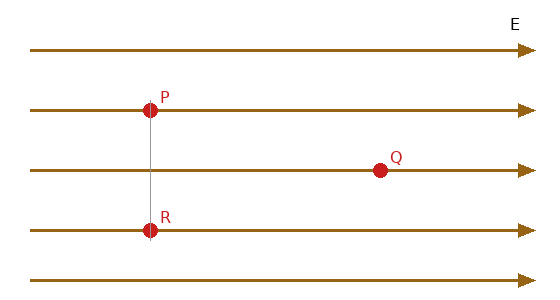
في الشكل مجال منتظم نحو اليمين، والنقطتان P وR على الخط الرأسي نفسه والنقطة Q على يمينهما. أي العلاقات صحيحة؟In the figure a uniform field points to the right; points P and R lie on the same vertical line and point Q is to their right. Which relation is correct?
\(V_Q\gt V_P=V_R\)\(V_Q\gt V_P=V_R\)
\(V_P\gt V_R\gt V_Q\)\(V_P\gt V_R\gt V_Q\)
\(V_P=V_R\gt V_Q\)\(V_P=V_R\gt V_Q\)
\(V_P=V_Q\gt V_R\)\(V_P=V_Q\gt V_R\)
الحلSolution
📌 P وR على خط عمودي على المجال فلهما الجهد نفسه.
📌 الجهد يقل باتجاه المجال، والنقطة Q أبعد باتجاه المجال: \(V_P=V_R\gt V_Q\).
✅ \(V_P=V_R\gt V_Q\) (C)
📌 P and R lie on a line perpendicular to the field, so they have the same potential.
📌 The potential falls along the field and Q is farther along the field: \(V_P=V_R\gt V_Q\).
✅ \(V_P=V_R\gt V_Q\) (C)
\[37\,\star\star\star\]
مجالان متعامدان عند نقطة: \(E_1=300\,N/C\) نحو اليمين و\(E_2=400\,N/C\) نحو الأعلى. مقدار المجال المحصّل:Two perpendicular fields at a point: \(E_1=300\,N/C\) to the right and \(E_2=400\,N/C\) upward. The magnitude of the net field is:
\(500\,N/C\)\(500\,N/C\)
\(700\,N/C\)\(700\,N/C\)
\(100\,N/C\)\(100\,N/C\)
\(350\,N/C\)\(350\,N/C\)
الحلSolution
📌 المجالان متعامدان فنجمعهما كمتجهين بنظرية فيثاغورث: \(E=\sqrt{300^{2}+400^{2}}=500\,N/C\).
📌 (وليس مجموع المقدارين 700 N/C، لأن المجال كمية متجهة.)
✅ \(500\,N/C\) (A)
📌 The fields are perpendicular so we add them as vectors with the Pythagorean theorem: \(E=\sqrt{300^{2}+400^{2}}=500\,N/C\).
📌 (Not the sum of the magnitudes, 700 N/C, because the field is a vector.)
✅ \(500\,N/C\) (A)
\[38\,\star\star\star\]
كرتان موصلتان نصفا قطريهما \(2\,cm\) و\(4\,cm\) متصلتان بسلك طويل (تكتسبان الجهد نفسه). النسبة بين المجال عند سطح الكرة الصغرى إلى المجال عند سطح الكبرى:Two conducting spheres of radii \(2\,cm\) and \(4\,cm\) are joined by a long wire (so they reach the same potential). The ratio of the field at the surface of the small sphere to that at the large one is:
22
1/21/2
44
11
الحلSolution
📌 الجهد نفسه: \(k\dfrac{q_1}{R_1}=k\dfrac{q_2}{R_2}\Rightarrow\dfrac{q_1}{q_2}=\dfrac{R_1}{R_2}=\dfrac12\).
📌 المجال عند السطح \(E=\dfrac{kq}{R^{2}}\): \(\dfrac{E_1}{E_2}=\dfrac{q_1}{q_2}\cdot\dfrac{R_2^{2}}{R_1^{2}}=\dfrac12\times4=2\).
📌 فالمجال أقوى عند الكرة الصغرى (الأشد انحناءً)، وهو سبب قوة المجال عند الأطراف الحادة.
✅ A
📌 The same potential: \(k\dfrac{q_1}{R_1}=k\dfrac{q_2}{R_2}\Rightarrow\dfrac{q_1}{q_2}=\dfrac{R_1}{R_2}=\dfrac12\).
📌 The field at the surface is \(E=\dfrac{kq}{R^{2}}\): \(\dfrac{E_1}{E_2}=\dfrac{q_1}{q_2}\cdot\dfrac{R_2^{2}}{R_1^{2}}=\dfrac12\times4=2\).
📌 So the field is stronger at the smaller (more curved) sphere, which is why the field is strong at sharp points.
✅ A
\[39\,\star\star\]
شحنة موجبة \(3\,\mu C\) تتحرك \(0.04\,m\) باتجاه مجال منتظم شدته \(2000\,N/C\). الشغل الذي يبذله المجال الكهربائي عليها:A positive charge \(3\,\mu C\) moves \(0.04\,m\) along a uniform field of strength \(2000\,N/C\). The work done on it by the electric field is:
\(W=-2.4\times10^{-4}\,J\)\(W=-2.4\times10^{-4}\,J\)
\(W=1.5\times10^{-1}\,J\)\(W=1.5\times10^{-1}\,J\)
\(W=2.4\times10^{-4}\,J\)\(W=2.4\times10^{-4}\,J\)
\(W=0\)\(W=0\)
الحلSolution
📌 القوة باتجاه المجال والإزاحة باتجاهه فالشغل موجب: \(W=qEd=3\times10^{-6}\times2000\times0.04=2.4\times10^{-4}\,J\).
📌 وتقل طاقة وضع الشحنة بالمقدار نفسه: \(\Delta U=-W\).
✅ \(W=2.4\times10^{-4}\,J\) (C)
📌 The force and the displacement are both along the field so the work is positive: \(W=qEd=3\times10^{-6}\times2000\times0.04=2.4\times10^{-4}\,J\).
📌 and the potential energy of the charge decreases by the same amount: \(\Delta U=-W\).
✅ \(W=2.4\times10^{-4}\,J\) (C)
📝 المسائل المقالية
📝 Essay Problems
\[1\,\star\star\]
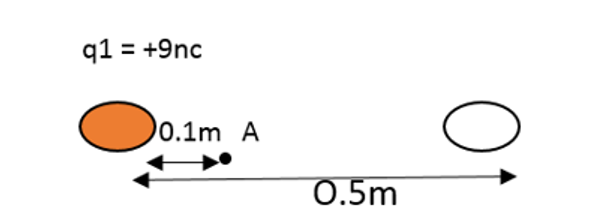
في الشكل شحنتان على الخط نفسه، \(q_1=+9\,nC\) و\(q_2=?\)، والمسافة بينهما \(0.5\,m\)، وتبعد النقطة A عن الشحنة الأولى \(0.1\,m\). إذا انعدم المجال الكهربائي عند النقطة A فما نوع الشحنة \(q_2\) ومقدارها؟In the figure two charges lie on the same line, \(q_1=+9\,nC\) and \(q_2=?\), \(0.5\,m\) apart, and point A is \(0.1\,m\) from the first charge. If the electric field is zero at A, what are the sign and magnitude of \(q_2\)?
.....................................................................
الحلSolution
📌 من الشكل: \(r_1=0.1\,m\) و\(r_2=0.5-0.1=0.4\,m\)، والنقطة A بين الشحنتين.
📌 بين شحنتين على الخط نفسه ينعدم المجال فقط إذا كان المجالان متعاكسين، أي أن الشحنتين من النوع نفسه: \(q_2\) موجبة.
📌 \(E_1=E_2\Rightarrow k\dfrac{q_1}{r_1^{2}}=k\dfrac{q_2}{r_2^{2}}\).
📌 \(q_2=q_1\left(\dfrac{r_2}{r_1}\right)^{2}=9\times10^{-9}\times\left(\dfrac{0.4}{0.1}\right)^{2}=1.44\times10^{-7}\,C\).
✅ \(q_2=+1.44\times10^{-7}\,C\) (\(144\,nC\))
📌 From the figure: \(r_1=0.1\,m\) and \(r_2=0.5-0.1=0.4\,m\), and A lies between the charges.
📌 Between two charges on a line the field can vanish only if the two fields are opposite, i.e. the charges are of the same sign: \(q_2\) is positive.
📌 \(E_1=E_2\Rightarrow k\dfrac{q_1}{r_1^{2}}=k\dfrac{q_2}{r_2^{2}}\).
📌 \(q_2=q_1\left(\dfrac{r_2}{r_1}\right)^{2}=9\times10^{-9}\times\left(\dfrac{0.4}{0.1}\right)^{2}=1.44\times10^{-7}\,C\).
✅ \(q_2=+1.44\times10^{-7}\,C\) (\(144\,nC\))
\[2\,\star\star\star\]
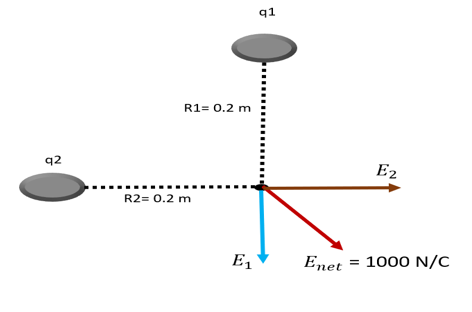
في الشكل حُسب المجال الكلي عند النقطة P فكان \(E_{net}=1000\,N/C\) واتجاهه كما في الشكل، ومجال الشحنة الأولى \(E_1=600\,N/C\) (نحو الأسفل) ومجال الشحنة الثانية \(E_2\) نحو اليمين، وبُعد P عن كل شحنة \(0.2\,m\). احسب نوع الشحنة الثانية ومقدارها.In the figure the net field at point P is \(E_{net}=1000\,N/C\) with the direction shown; the field of the first charge is \(E_1=600\,N/C\) (downward) and the field of the second charge \(E_2\) points to the right; P is \(0.2\,m\) from each charge. Find the sign and magnitude of the second charge.
.....................................................................
الحلSolution
📌 المجالان \(E_1\) (رأسي) و\(E_2\) (أفقي) متعامدان، فالمحصلة وتر المثلث القائم: \(E_{net}^{2}=E_1^{2}+E_2^{2}\).
📌 \(E_2=\sqrt{1000^{2}-600^{2}}=\sqrt{640000}=800\,N/C\).
📌 \(q_2=\dfrac{E_2\,r_2^{2}}{k}=\dfrac{800\times(0.2)^{2}}{9\times10^{9}}=3.56\times10^{-9}\,C\).
📌 النوع: \(E_2\) يبتعد عن الشحنة \(q_2\) (الواقعة يسار P والمجال نحو اليمين) فهي موجبة.
✅ \(q_2\approx+3.6\times10^{-9}\,C\)
📌 The fields \(E_1\) (vertical) and \(E_2\) (horizontal) are perpendicular, so the net field is the hypotenuse: \(E_{net}^{2}=E_1^{2}+E_2^{2}\).
📌 \(E_2=\sqrt{1000^{2}-600^{2}}=\sqrt{640000}=800\,N/C\).
📌 \(q_2=\dfrac{E_2\,r_2^{2}}{k}=\dfrac{800\times(0.2)^{2}}{9\times10^{9}}=3.56\times10^{-9}\,C\).
📌 Sign: \(E_2\) points away from \(q_2\) (which lies to the left of P while the field points right), so it is positive.
✅ \(q_2\approx+3.6\times10^{-9}\,C\)
\[3\,\star\star\]
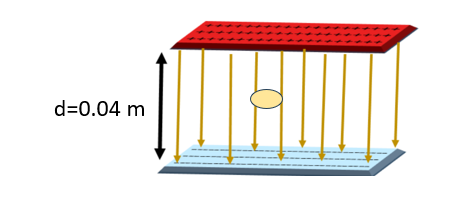
قطرة زيت مشحونة كتلتها \(m=0.003\,kg\) وشحنتها \(q=6\,nC\) حُرّرت في مجال منتظم بين لوحين المسافة بينهما \(0.04\,m\)، فلوحظ أنها متزنة. احسب فرق الجهد بين اللوحين.A charged oil drop of mass \(m=0.003\,kg\) and charge \(q=6\,nC\) is released in a uniform field between two plates \(0.04\,m\) apart and is found to be in equilibrium. Find the potential difference between the plates.
.....................................................................
الحلSolution
📌 الاتزان: القوة الكهربائية = الوزن: \(qE=mg\).
📌 \(E=\dfrac{mg}{q}=\dfrac{0.003\times9.8}{6\times10^{-9}}=4.9\times10^{6}\,N/C\).
📌 \(\Delta V=E\,d=4.9\times10^{6}\times0.04=1.96\times10^{5}\,V\).
✅ \(\Delta V=1.96\times10^{5}\,V\)
📌 Equilibrium: electric force = weight: \(qE=mg\).
📌 \(E=\dfrac{mg}{q}=\dfrac{0.003\times9.8}{6\times10^{-9}}=4.9\times10^{6}\,N/C\).
📌 \(\Delta V=E\,d=4.9\times10^{6}\times0.04=1.96\times10^{5}\,V\).
✅ \(\Delta V=1.96\times10^{5}\,V\)
\[4\,\star\]
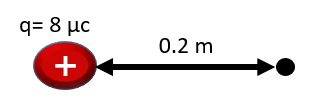
شحنة نقطية موجبة مقدارها \(8\,\mu C\). (أ) احسب مقدار المجال الكهربائي واتجاهه عند نقطة تبعد \(0.2\,m\) عنها. (ب) وُضع إلكترون (\(q_e=-1.6\times10^{-19}\,C\)) عند النقطة نفسها، احسب مقدار القوة الكهربائية المؤثرة عليه واتجاهها.A positive point charge of \(8\,\mu C\). (a) Find the magnitude and direction of the electric field at a point \(0.2\,m\) from it. (b) An electron (\(q_e=-1.6\times10^{-19}\,C\)) is placed at the same point; find the magnitude and direction of the electric force on it.
.....................................................................
الحلSolution
📌 (أ) \(E=\dfrac{kQ}{r^{2}}=\dfrac{9\times10^{9}\times8\times10^{-6}}{(0.2)^{2}}=1.8\times10^{6}\,N/C\)، واتجاهه يبتعد عن الشحنة (لأنها موجبة).
📌 (ب) \(F=|q_e|E=1.6\times10^{-19}\times1.8\times10^{6}=2.88\times10^{-13}\,N\)، واتجاهها عكس المجال أي نحو الشحنة (الإلكترون سالب).
✅ \(E=1.8\times10^{6}\,N/C\)، \(F=2.88\times10^{-13}\,N\)
📌 (a) \(E=\dfrac{kQ}{r^{2}}=\dfrac{9\times10^{9}\times8\times10^{-6}}{(0.2)^{2}}=1.8\times10^{6}\,N/C\), directed away from the charge (it is positive).
📌 (b) \(F=|q_e|E=1.6\times10^{-19}\times1.8\times10^{6}=2.88\times10^{-13}\,N\), directed opposite to the field, i.e. toward the charge (the electron is negative).
✅ \(E=1.8\times10^{6}\,N/C\), \(F=2.88\times10^{-13}\,N\)
\[5\,\star\star\]
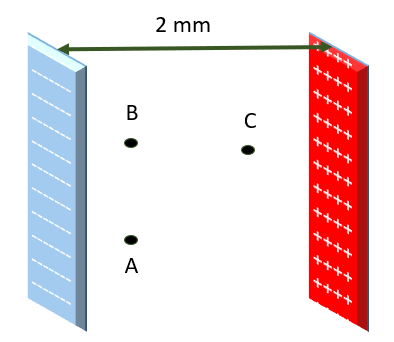
يكوّن لوحا مكثف مجالًا منتظمًا شدته \(E=5\times10^{3}\,N/C\) والمسافة بينهما \(2\,mm\)، وُضعت النقاط الثلاث A وB وC داخل المجال كما في الشكل. (1) رتّب النقاط من الجهد الأدنى إلى الجهد الأعلى. (2) احسب فرق الجهد بين اللوحين. (3) احسب شغل المجال عند نقل إلكترون (\(q_e=-1.6\times10^{-19}\,C\)) من اللوح السالب إلى اللوح الموجب.The plates of a capacitor form a uniform field of strength \(E=5\times10^{3}\,N/C\) and are \(2\,mm\) apart; points A, B and C lie inside the field as in the figure. (1) Arrange the points from the lowest to the highest potential. (2) Find the potential difference between the plates. (3) Find the work done by the field when an electron (\(q_e=-1.6\times10^{-19}\,C\)) moves from the negative plate to the positive plate.
.....................................................................
الحلSolution
📌 (1) المجال من اللوح الموجب (يمين) إلى السالب (يسار)، والجهد يقل باتجاه المجال أي يزداد نحو اللوح الموجب.
📌 A وB على البعد نفسه من اللوحين (على خط عمودي على المجال) فلهما الجهد نفسه، وC أقرب إلى اللوح الموجب: \(V_A=V_B\lt V_C\).
📌 (2) \(\Delta V=E\,d=5\times10^{3}\times2\times10^{-3}=10\,V\).
📌 (3) الإلكترون ينتقل من الجهد الأدنى إلى الأعلى \((\Delta V=+10\,V)\): \(\Delta U=q\Delta V=(-1.6\times10^{-19})(10)=-1.6\times10^{-18}\,J\).
📌 شغل المجال \(W=-\Delta U=+1.6\times10^{-18}\,J\) (موجب لأن القوة على الإلكترون نحو اللوح الموجب، أي باتجاه الإزاحة، فتزداد طاقته الحركية).
✅ \(V_A=V_B\lt V_C\)، \(\Delta V=10\,V\)، \(W_{field}=+1.6\times10^{-18}\,J\)
📌 (1) The field points from the positive (right) plate to the negative (left) one, and the potential falls along the field, i.e. it rises toward the positive plate.
📌 A and B are at the same distance from the plates (on a line perpendicular to the field) so they have the same potential, and C is nearer the positive plate: \(V_A=V_B\lt V_C\).
📌 (2) \(\Delta V=E\,d=5\times10^{3}\times2\times10^{-3}=10\,V\).
📌 (3) The electron moves from the lower to the higher potential \((\Delta V=+10\,V)\): \(\Delta U=q\Delta V=(-1.6\times10^{-19})(10)=-1.6\times10^{-18}\,J\).
📌 The work of the field is \(W=-\Delta U=+1.6\times10^{-18}\,J\) (positive, since the force on the electron points toward the positive plate, i.e. along the displacement, so its kinetic energy grows).
✅ \(V_A=V_B\lt V_C\), \(\Delta V=10\,V\), \(W_{field}=+1.6\times10^{-18}\,J\)
لاحظت خطأ؟ أو عندك سؤال عن أحد الأسئلة؟ اكتبه بالتعليقات وحدد رقم السؤال بالضبط.
Noticed an error? Or have a question about one of the questions? Write it in the comments and specify the exact question number.