📏 بنك الأسئلة: الحركة في بعد واحد (11A)
📏 Question Bank: Motion in One Dimension (11A)
الموقع والمسافة والإزاحة، قراءة الرسوم البيانية، السرعة والعجلة (متوسطة ولحظية)، معادلات الحركة، والسقوط الحر والمقذوف الرأسي
Position, Distance and Displacement, Reading Graphs, Average and Instantaneous Velocity and Acceleration, Equations of Motion, Free Fall and Vertical Projectile Motion
⏱️ 53 سؤال اختيار من متعدد بتصحيح فوري، و5 مسائل محلولة بالكامل⏱️ 53 multiple-choice questions with instant feedback, plus 5 fully-solved problems
\[1\,\star\]
تحرّك أحمد نحو الشرق مسافة \(80\,m\)، ثم تابع سيره بنفس الاتجاه مسافة \(50\,m\)، ثم غيّر اتجاهه وقطع مسافة \(160\,m\) غربًا. فإن المسافة والإزاحة المقطوعتين:Ahmed walked east \(80\,m\), continued in the same direction \(50\,m\), then changed direction and covered \(160\,m\) west. The distance and displacement traveled are:

\(S=30\,m\;,\;\Delta x=290\,m\) غربًا\(S=30\,m\;,\;\Delta x=290\,m\) west
\(S=290\,m\;,\;\Delta x=30\,m\) غربًا\(S=290\,m\;,\;\Delta x=30\,m\) west
\(S=290\,m\;,\;\Delta x=30\,m\) شرقًا\(S=290\,m\;,\;\Delta x=30\,m\) east
\(S=30\,m\;,\;\Delta x=290\,m\) شرقًا\(S=30\,m\;,\;\Delta x=290\,m\) east
الحلSolution
📌 المسافة (مجموع أطوال المسار): \(S=80+50+160=290\,m\)
📌 الإزاحة (نعتبر نقطة البداية أصلًا، والشرق موجبًا): الموقع النهائي \(x_f=80+50-160=-30\,m\)، أي \(\Delta x=-30\,m\)؛ الإشارة السالبة تعني الغرب.
✅ S=290 m، Δx=30 m غربًا
📌 Distance (sum of path lengths): \(S=80+50+160=290\,m\)
📌 Displacement (start as origin, east positive): final position \(x_f=80+50-160=-30\,m\), so \(\Delta x=-30\,m\); the negative sign means west.
✅ S=290 m, Δx=30 m west
\[2\,\star\]
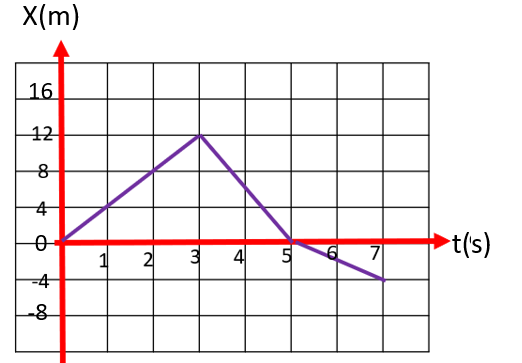
تم رسم العلاقة بين الموقع والزمن لدرّاجة كما في الشكل المجاور. فإن المسافة المقطوعة والإزاحة خلال كامل الفترة تعادل:The position-time relationship for a bicycle is plotted as shown. The distance and displacement over the whole period equal:
\(S=20\,m\;,\;\Delta x=-8\,m\)\(S=20\,m\;,\;\Delta x=-8\,m\)
\(S=28\,m\;,\;\Delta x=-4\,m\)\(S=28\,m\;,\;\Delta x=-4\,m\)
\(S=20\,m\;,\;\Delta x=4\,m\)\(S=20\,m\;,\;\Delta x=4\,m\)
\(S=28\,m\;,\;\Delta x=4\,m\)\(S=28\,m\;,\;\Delta x=4\,m\)
الحلSolution
📌 المسافة (من الخط البياني): \(0\to3s\): \(0\to12m\) (12م)، \(3\to5s\): \(12\to0m\) (12م)، \(5\to7s\): \(0\to-4m\) (4م). \(S=12+12+4=28\,m\)
📌 الإزاحة: \(x_i=0,\;x_f=-4\Rightarrow\Delta x=x_f-x_i=-4\,m\)
✅ S=28 m، Δx=-4 m
📌 Distance (from the graph): \(0\to3s\): 12m, \(3\to5s\): 12m, \(5\to7s\): 4m. \(S=12+12+4=28\,m\)
📌 Displacement: \(x_i=0,\;x_f=-4\Rightarrow\Delta x=-4\,m\)
✅ S=28 m, Δx=-4 m
\[3\,\star\]
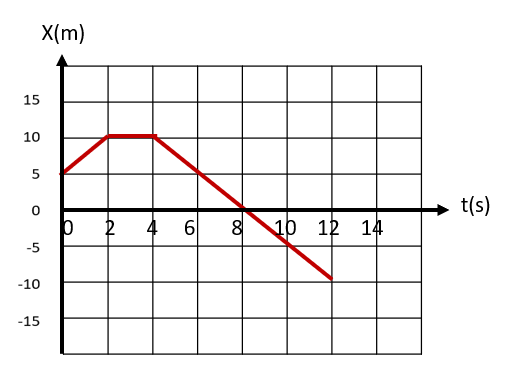
تم رسم العلاقة بين الموقع والزمن لدرّاجة فنتج الخط البياني التالي. فإن المسافة المقطوعة والإزاحة تعادل:The position-time graph for a bicycle is shown below. The distance and displacement equal:
\(S=20\,m\;,\;\Delta x=-15\,m\)\(S=20\,m\;,\;\Delta x=-15\,m\)
\(S=25\,m\;,\;\Delta x=-15\,m\)\(S=25\,m\;,\;\Delta x=-15\,m\)
\(S=25\,m\;,\;\Delta x=-10\,m\)\(S=25\,m\;,\;\Delta x=-10\,m\)
\(S=10\,m\;,\;\Delta x=10\,m\)\(S=10\,m\;,\;\Delta x=10\,m\)
الحلSolution
📌 المسافة: \(0\to2s\): \(5\to10m\) (5م)، \(2\to4s\): ثابت (0م)، \(4\to12s\): \(10\to-10m\) (20م). \(S=5+0+20=25\,m\)
📌 الإزاحة: \(x_i=5,\;x_f=-10\Rightarrow\Delta x=-10-5=-15\,m\)
✅ S=25 m، Δx=-15 m
📌 Distance: \(0\to2s\): 5m, \(2\to4s\): 0m, \(4\to12s\): 20m. \(S=5+0+20=25\,m\)
📌 Displacement: \(x_i=5,\;x_f=-10\Rightarrow\Delta x=-15\,m\)
✅ S=25 m, Δx=-15 m
\[4\,\star\star\]
معادلة الموقع لسيارة تتحرك في محور واحد \(X(t)=t^3-5t^2+15t\). فإن السرعة اللحظية المتجهة في الثانية الرابعة \((t=4\,s)\) تعادل:A car's position equation along one axis is \(X(t)=t^3-5t^2+15t\). The instantaneous velocity at the fourth second \((t=4\,s)\) equals:
\(v=20\,m/s\)\(v=20\,m/s\)
\(v=18\,m/s\)\(v=18\,m/s\)
\(v=23\,m/s\)\(v=23\,m/s\)
\(v=15\,m/s\)\(v=15\,m/s\)
الحلSolution
📌 نشتق معادلة الموقع: \(v(t)=\dfrac{dX}{dt}=3t^2-10t+15\)
📌 نعوّض t=4: \(v(4)=3(16)-10(4)+15=48-40+15=23\,m/s\)
✅ v=23 m/s
📌 Differentiate the position equation: \(v(t)=\dfrac{dX}{dt}=3t^2-10t+15\)
📌 Substitute t=4: \(v(4)=3(16)-10(4)+15=23\,m/s\)
✅ v=23 m/s
\[5\,\star\star\]
معادلة الموقع لانطلاق صاروخ رأسيًا في محور واحد \(Y(t)=3t^3-6t^2+5\). فإن السرعة المتوسطة المتجهة بين اللحظتين \(t=5\,s,\;t=8\,s\) تعادل:A rocket's vertical position equation is \(Y(t)=3t^3-6t^2+5\). The average velocity between \(t=5\,s\) and \(t=8\,s\) equals:
\(v_{avg}=115\,m/s\)\(v_{avg}=115\,m/s\)
\(v_{avg}=205\,m/s\)\(v_{avg}=205\,m/s\)
\(v_{avg}=309\,m/s\)\(v_{avg}=309\,m/s\)
\(v_{avg}=236\,m/s\)\(v_{avg}=236\,m/s\)
الحلSolution
📌 نحسب الموقع عند كل لحظة: \(Y(5)=3(125)-6(25)+5=230\,m\)؛ \(Y(8)=3(512)-6(64)+5=1157\,m\)
📌 السرعة المتوسطة: \(v_{avg}=\dfrac{Y_f-Y_i}{t_f-t_i}=\dfrac{1157-230}{8-5}=309\,m/s\)
✅ v_avg=309 m/s
📌 Position at each instant: \(Y(5)=230\,m\); \(Y(8)=1157\,m\)
📌 Average velocity: \(v_{avg}=\dfrac{1157-230}{8-5}=309\,m/s\)
✅ v_avg=309 m/s
\[6\,\star\]
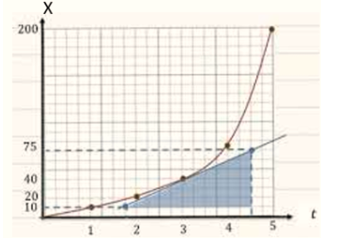
ميل المماس للمنحنى البياني (الموقع - الزمن) يعادل:The slope of the tangent to the position-time graph equals:
التسارع المتوسطAverage acceleration
السرعة المتوسطةAverage velocity
التسارع اللحظيInstantaneous acceleration
السرعة اللحظيةInstantaneous velocity
الحلSolution
📌 بالتعريف: \(v(t)=\dfrac{dX}{dt}=\) ميل المماس للخط البياني (الموقع-الزمن)، وهذا هو تعريف السرعة اللحظية.
✅ السرعة اللحظية
📌 By definition: \(v(t)=\dfrac{dX}{dt}=\) the slope of the tangent to the position-time graph, which is the definition of instantaneous velocity.
✅ Instantaneous velocity
\[7\,\star\star\]
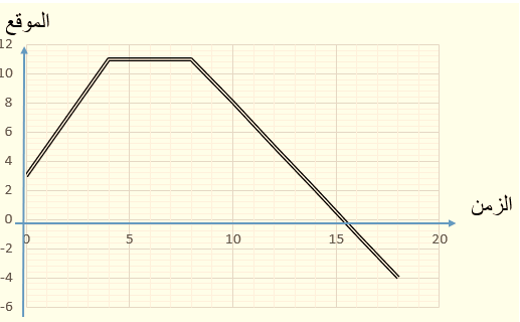
تم رسم العلاقة بين الموقع والزمن لدرّاجة، فإن السرعة المتوسطة المتجهة خلال كامل الفترة تعادل:The position-time graph of a bicycle is shown. The average velocity over the whole period equals:
\(v_{avg}=0.67\,m/s\)\(v_{avg}=0.67\,m/s\)
\(v_{avg}=0.85\,m/s\)\(v_{avg}=0.85\,m/s\)
\(v_{avg}=0.12\,m/s\)\(v_{avg}=0.12\,m/s\)
\(v_{avg}=0.39\,m/s\)\(v_{avg}=0.39\,m/s\)
الحلSolution
📌 من الخط البياني: \(x_i=3\,m\) عند \(t=0\)، \(x_f=-4\,m\) عند \(t=18\,s\)
📌 السرعة المتوسطة: \(v_{avg}=\dfrac{x_f-x_i}{t_f-t_i}=\dfrac{-4-3}{18-0}\approx-0.39\,m/s\)
✅ |v_avg|=0.39 m/s
📌 From the graph: \(x_i=3\,m\) at \(t=0\), \(x_f=-4\,m\) at \(t=18\,s\)
📌 Average velocity: \(v_{avg}=\dfrac{-4-3}{18-0}\approx-0.39\,m/s\)
✅ |v_avg|=0.39 m/s
\[8\,\star\star\]
سيارة بدأت حركتها من السكون متسارعة بعجلة منتظمة مقدارها \(2\,m/s^2\). فإن سرعتها بعد أن تقطع مسافة قدرها \(20\,m\) تعادل:A car starts from rest with a uniform acceleration of \(2\,m/s^2\). Its speed after covering \(20\,m\) equals:

\(v_f=4.6\,m/s\)\(v_f=4.6\,m/s\)
\(v_f=8.9\,m/s\)\(v_f=8.9\,m/s\)
\(v_f=12.2\,m/s\)\(v_f=12.2\,m/s\)
\(v_f=6.7\,m/s\)\(v_f=6.7\,m/s\)
الحلSolution
📌 نستخدم المعادلة الخالية من الزمن: \(v_f^2=v_i^2+2a\Delta x=0^2+2(2)(20)=80\)
📌 نحل لإيجاد السرعة: \(v_f=\sqrt{80}\approx8.9\,m/s\)
✅ v_f ≈ 8.9 m/s
📌 Time-free equation: \(v_f^2=v_i^2+2a\Delta x=0+2(2)(20)=80\)
📌 Solve: \(v_f=\sqrt{80}\approx8.9\,m/s\)
✅ v_f ≈ 8.9 m/s
\[9\,\star\star\]
أحد المعادلات التالية يعبّر عن الموقع بدلالة الزمن لجسم يتحرك بتسارع ثابت (غير معدوم):Which of the following equations represents the position as a function of time for a body moving with constant (nonzero) acceleration?
\(X(t)=3t^3-2t^2+5\)\(X(t)=3t^3-2t^2+5\)
\(X(t)=2t+4\)\(X(t)=2t+4\)
\(X(t)=4t^3-4t\)\(X(t)=4t^3-4t\)
\(X(t)=3t^2+5t\)\(X(t)=3t^2+5t\)
الحلSolution
📌 التسارع الثابت يعني أن a(t) ثابت ولا يساوي صفرًا؛ نشتق كل معادلة مرتين: \(X=3t^3-2t^2+5\Rightarrow a=18t-4\) (غير ثابت). \(X=2t+4\Rightarrow a=0\) (سرعة ثابتة، ليس تسارعًا). \(X=4t^3-4t\Rightarrow a=24t\) (غير ثابت). \(X=3t^2+5t\Rightarrow v=6t+5\Rightarrow a=6\) (ثابت وغير معدوم ✓).
✅ X(t)=3t²+5t
📌 Constant acceleration means a(t) is constant and nonzero; differentiate each twice: \(X=3t^3-2t^2+5\Rightarrow a=18t-4\) (not constant). \(X=2t+4\Rightarrow a=0\) (constant velocity, not acceleration). \(X=4t^3-4t\Rightarrow a=24t\) (not constant). \(X=3t^2+5t\Rightarrow v=6t+5\Rightarrow a=6\) (constant, nonzero ✓).
✅ X(t)=3t²+5t
\[10\,\star\star\star\]
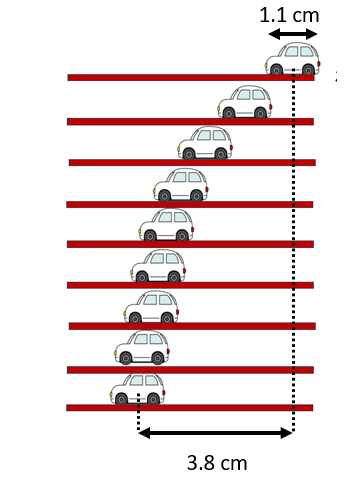
تتباطأ سيارة حتى تتوقف تمامًا. يوضح الشكل سلسلة صور متتابعة لهذه العملية، الزمن بين صورتين متتاليتين \(0.4\,s\)، وطول السيارة \(2.5\,m\). من خلال بيانات الشكل، فإن السيارة تتحرك بتسارع ثابت قدره:A car decelerates to a complete stop. The figure shows a sequence of strobe photos, with time between consecutive photos \(0.4\,s\), and car length \(2.5\,m\). From the figure's data, the car's constant acceleration is:
\(a=-3.5\,m/s^2\)\(a=-3.5\,m/s^2\)
\(a=-2.6\,m/s^2\)\(a=-2.6\,m/s^2\)
\(a=-1.7\,m/s^2\)\(a=-1.7\,m/s^2\)
\(a=-0.9\,m/s^2\)\(a=-0.9\,m/s^2\)
الحلSolution
📌 مقياس الرسم: \(1.1\,cm\) تمثل \(2.5\,m\) (طول السيارة)، فتكون المسافة الحقيقية بين أول موضعين: \(\Delta X=\dfrac{3.8\times2.5}{1.1}\approx8.64\,m\)
📌 الزمن للوصول للتوقف (8 فترات زمنية): \(t=8\times0.4=3.2\,s\)
📌 السرعة الابتدائية من \(\Delta X=\tfrac12(v_f+v_i)t\): \(8.64=\tfrac12(0+v_i)(3.2)\Rightarrow v_i=5.4\,m/s\)
📌 التسارع: \(v_f=v_i+at\Rightarrow0=5.4+a(3.2)\Rightarrow a\approx-1.7\,m/s^2\)
✅ a ≈ -1.7 m/s²
📌 Scale: \(1.1\,cm\) represents \(2.5\,m\) (car length), so the real distance between the first two positions: \(\Delta X=\dfrac{3.8\times2.5}{1.1}\approx8.64\,m\)
📌 Time to stop (8 intervals): \(t=8\times0.4=3.2\,s\)
📌 Initial velocity from \(\Delta X=\tfrac12(v_f+v_i)t\): \(v_i=5.4\,m/s\)
📌 Acceleration: \(0=5.4+a(3.2)\Rightarrow a\approx-1.7\,m/s^2\)
✅ a ≈ -1.7 m/s²
\[11\,\star\star\]
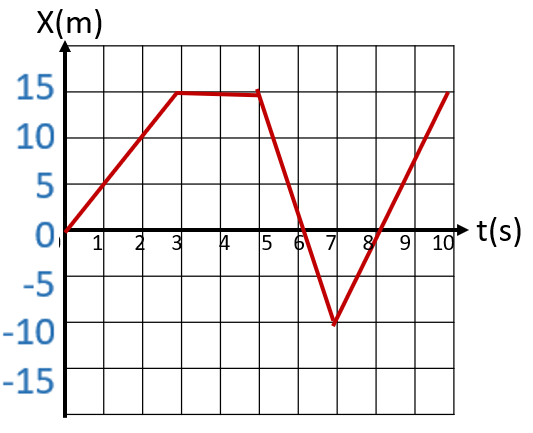
يصف الخط البياني موقع جسم ما يتحرك في بعد واحد كدالة للزمن. في أي فترة زمنية يصل الجسم إلى أقصى سرعة؟The graph describes the position of a body moving in one dimension as a function of time. During which time interval does the body reach its maximum speed?
\(t=0\,s \rightarrow t=3\,s\)\(t=0\,s \rightarrow t=3\,s\)
\(t=3\,s \rightarrow t=5\,s\)\(t=3\,s \rightarrow t=5\,s\)
\(t=5\,s \rightarrow t=7\,s\)\(t=5\,s \rightarrow t=7\,s\)
\(t=7\,s \rightarrow t=10\,s\)\(t=7\,s \rightarrow t=10\,s\)
الحلSolution
📌 السرعة = ميل الخط البياني؛ نحسب الميل في كل مرحلة: \(0\to3s:\;\dfrac{15-0}{3}=5\); \(3\to5s:\;0\); \(5\to7s:\;\dfrac{-10-15}{2}=-12.5\); \(7\to10s:\;\dfrac{15-(-10)}{3}\approx8.33\)
📌 أقصى سرعة (بالمقدار): \(|-12.5|=12.5\,m/s\)، وهي الأكبر بين كل المراحل.
✅ t=5s → t=7s
📌 Speed = slope of the graph; compute the slope in each stage: values are 5, 0, -12.5, 8.33 m/s
📌 Maximum speed (magnitude): \(12.5\,m/s\), the largest among all stages.
✅ t=5s → t=7s
\[12\,\star\]
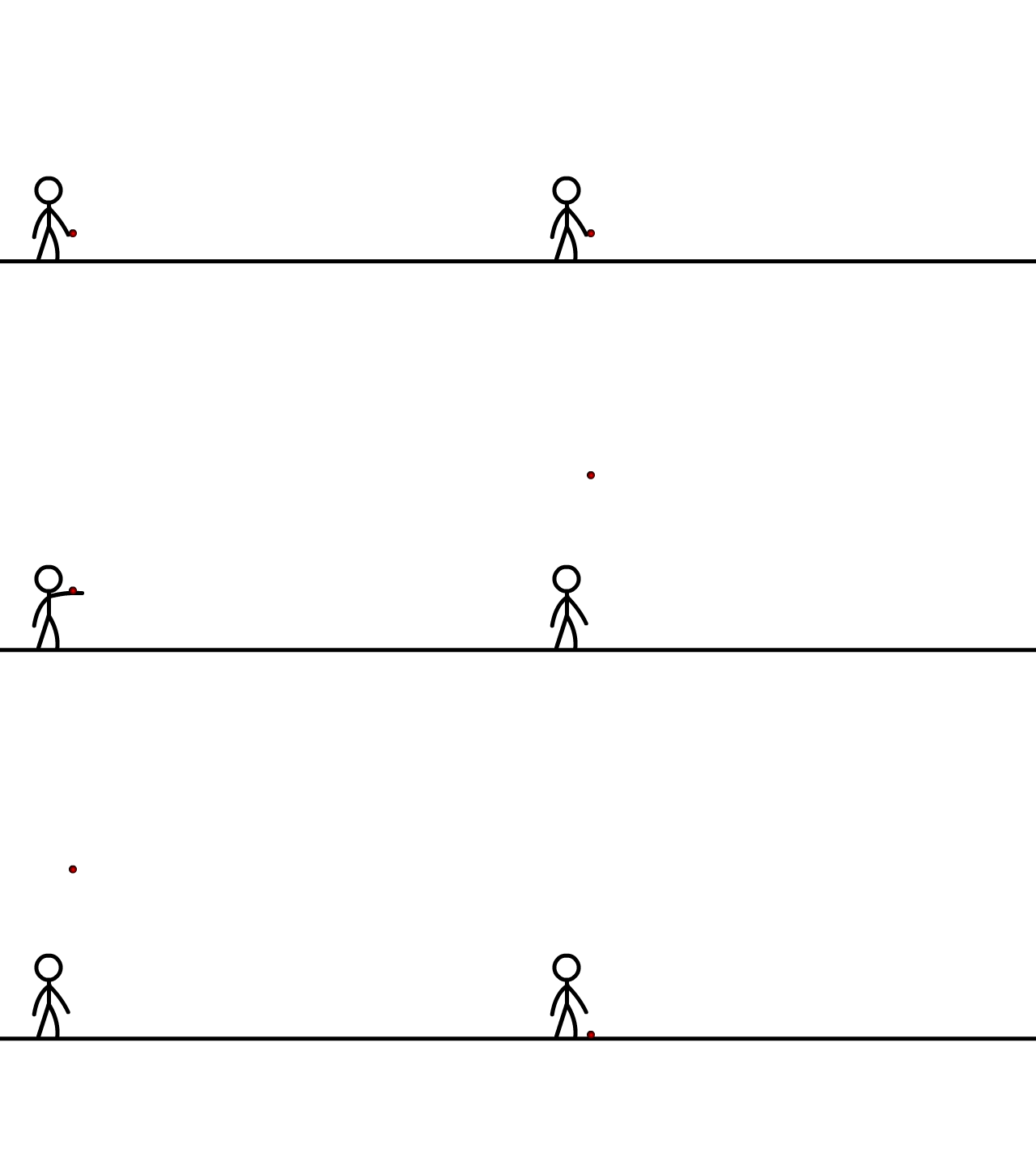
قُذف حجر بشكل رأسي إلى أعلى بسرعة ابتدائية. فإن العجلة التي يتحرك بها الحجر لحظة وصوله إلى أقصى ارتفاع تعادل:A stone is thrown vertically upward with some initial velocity. The acceleration of the stone at the instant it reaches maximum height equals:
\(a=0\,m/s^2\)\(a=0\,m/s^2\)
\(a=2\,m/s^2\)\(a=2\,m/s^2\)
\(a=-9.81\,m/s^2\)\(a=-9.81\,m/s^2\)
\(a=4\,m/s^2\)\(a=4\,m/s^2\)
الحلSolution
📌 العجلة ثابتة طوال حركة الحجر صعودًا وهبوطًا لأنه خاضع فقط لقوة وزنه، وهي تعادل \(g=-9.81\,m/s^2\) في كل لحظة — بما فيها لحظة السكون المؤقت عند أقصى ارتفاع (السرعة صفر، لكن العجلة ليست صفرًا).
✅ a=-9.81 m/s²
📌 Acceleration is constant throughout the stone's rise and fall, since it is subject only to its weight, equal to \(g=-9.81\,m/s^2\) at every instant — including the momentary rest at maximum height (velocity is zero, but acceleration is not).
✅ a=-9.81 m/s²
\[13\,\star\star\]
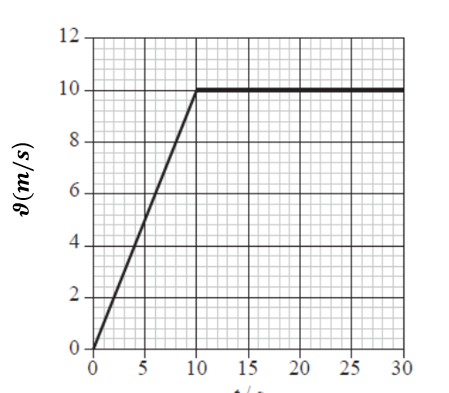
الخط البياني يبين العلاقة بين السرعة والزمن لسيارة. من خلال الخط البياني، فإن المسافة المقطوعة تعادل:The velocity-time graph of a car is shown. The distance traveled equals:
\(\Delta x=50\,m\)\(\Delta x=50\,m\)
\(\Delta x=200\,m\)\(\Delta x=200\,m\)
\(\Delta x=250\,m\)\(\Delta x=250\,m\)
\(\Delta x=100\,m\)\(\Delta x=100\,m\)
الحلSolution
📌 المسافة = المساحة تحت الخط البياني: مثلث \((0\to10s)\): \(\tfrac12\times10\times10=50\,m\)؛ مستطيل \((10\to30s)\): \(10\times20=200\,m\)
📌 المجموع: \(\Delta x=50+200=250\,m\)
✅ Δx=250 m
📌 Distance = area under the graph: triangle (0→10s): 50m; rectangle (10→30s): 200m
📌 Total: \(\Delta x=250\,m\)
✅ Δx=250 m
\[14\,\star\star\]
سيارة تتحرك بسرعة \(2\,m/s\)، غيّر السائق سرعتها بمعدل \(0.5\,m/s^2\). فإن المسافة التي قطعتها خلال \(1\,min\) تعادل:A car moves at \(2\,m/s\); the driver changes its speed at a rate of \(0.5\,m/s^2\). The distance it covers in \(1\,min\) equals:

\(\Delta x=850\,m\)\(\Delta x=850\,m\)
\(\Delta x=730\,m\)\(\Delta x=730\,m\)
\(\Delta x=1250\,m\)\(\Delta x=1250\,m\)
\(\Delta x=1020\,m\)\(\Delta x=1020\,m\)
الحلSolution
📌 الزمن بالثواني: \(t=1\,min=60\,s\)
📌 نستخدم: \(\Delta x=v_i t+\tfrac12 a t^2=2(60)+\tfrac12(0.5)(60)^2=120+900=1020\,m\)
✅ Δx=1020 m
📌 Time in seconds: \(t=60\,s\)
📌 Using: \(\Delta x=v_i t+\tfrac12 a t^2=120+900=1020\,m\)
✅ Δx=1020 m
\[15\,\star\star\star\]
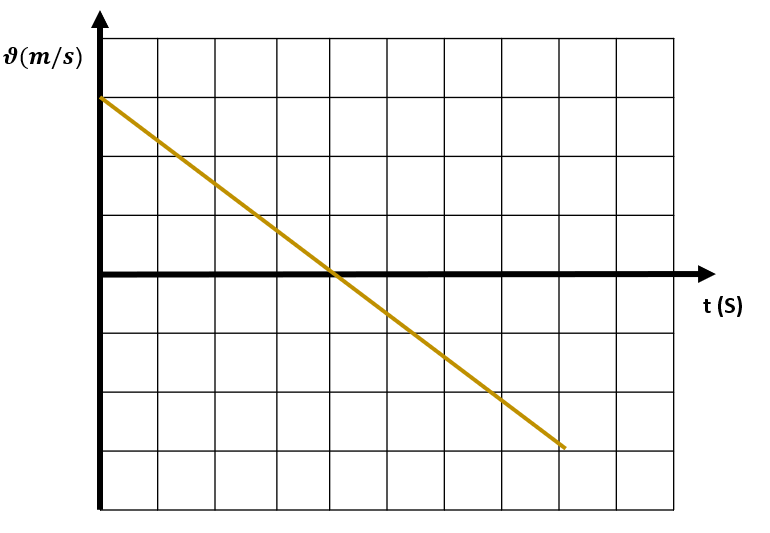
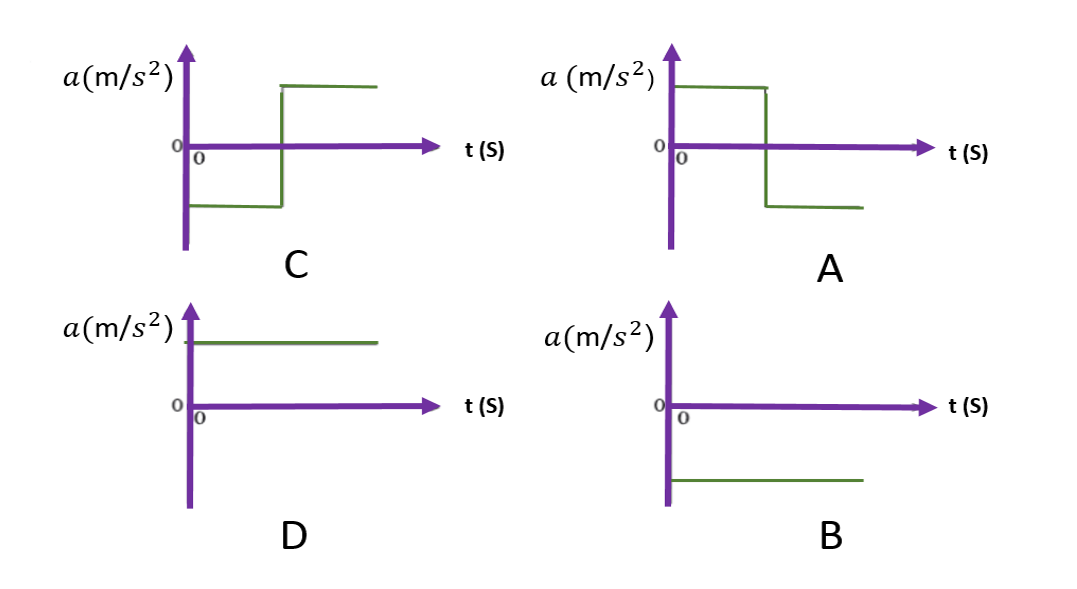
الخط البياني يبين العلاقة بين (السرعة – الزمن) لجسم تم قذفه إلى أعلى بسرعة ابتدائية في بعد واحد. أفضل خط بياني يبين العلاقة بين (التسارع – الزمن) لهذه الحركة هو:The graph shows (velocity–time) for a body thrown upward with an initial velocity in one dimension. The best graph representing (acceleration–time) for this motion is:
AA
BB
CC
DD
الحلSolution
📌 الخط البياني (السرعة-الزمن) خط مستقيم واحد بميل ثابت طوال الحركة (من قبل عبور الصفر وبعده)، وهذا يعني أن التسارع ثابت القيمة والإشارة طوال الحركة (= ميل ذلك الخط المستقيم)، فلا يوجد أي تغيّر أو قفزة في قيمته عند أي لحظة.
✅ الخط B (قيمة ثابتة واحدة طوال الزمن)
📌 The velocity-time graph is a single straight line with constant slope throughout the motion (before and after crossing zero), meaning the acceleration has one constant value and sign the whole time (equal to that line's slope), with no jump at any instant.
✅ Graph B (one constant value throughout)
\[16\,\star\star\]
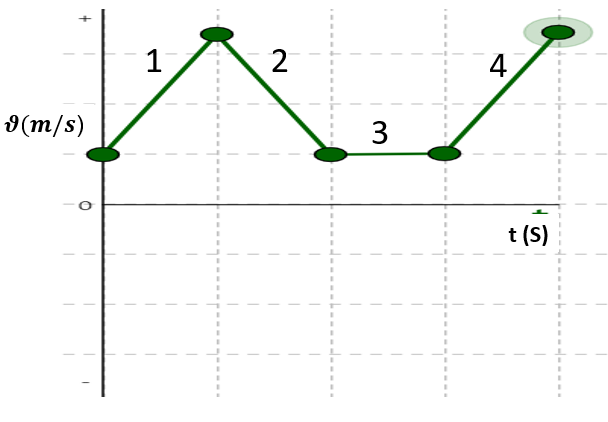
الخط البياني يبين العلاقة بين السرعة والزمن لدرّاجة. أحد أجزاء الخط البياني المرقّمة يمثل حركة جسم تسارعه معدوم:The velocity-time graph of a bicycle is shown, with numbered segments. Which segment represents motion with zero acceleration?
11
22
33
44
الحلSolution
📌 التسارع = ميل خط (السرعة-الزمن): الجزء 1 يرتفع (a>0)، الجزء 2 يهبط (a<0)، الجزء 3 أفقي بسرعة ثابتة (a=0)، الجزء 4 يرتفع مجددًا (a>0).
✅ الجزء 3
📌 Acceleration = slope of the velocity-time line: segment 1 rises (a>0), segment 2 falls (a<0), segment 3 is flat at constant velocity (a=0), segment 4 rises again (a>0).
✅ Segment 3
\[17\,\star\star\]
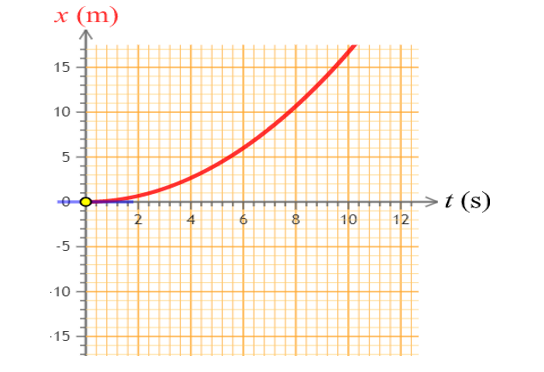
الخط البياني التالي يبين العلاقة بين (السرعة – الزمن) لدرّاجة تتحرك في بعد واحد. احسب التسارع المتوسط بين الفترة الزمنية \(t=4\,s \rightarrow t=8\,s\)The following graph shows (velocity–time) for a bicycle moving in one dimension. Calculate the average acceleration between \(t=4\,s\) and \(t=8\,s\)
\(a=1\,m/s^2\)\(a=1\,m/s^2\)
\(a=2\,m/s^2\)\(a=2\,m/s^2\)
\(a=3\,m/s^2\)\(a=3\,m/s^2\)
\(a=4\,m/s^2\)\(a=4\,m/s^2\)
الحلSolution
📌 لحساب التسارع المتوسط نرسم القاطع بين النقطتين عند t=4s وt=8s ونحسب ميله: من الخط البياني: \(v(4)\approx2\,m/s\)، \(v(8)\approx10\,m/s\)
📌 الميل: \(a_{avg}=\dfrac{v_2-v_1}{t_2-t_1}=\dfrac{10-2}{8-4}=2\,m/s^2\)
✅ a=2 m/s²
📌 To find average acceleration, draw the secant between the points at t=4s and t=8s and compute its slope: from the graph: \(v(4)\approx2\,m/s\), \(v(8)\approx10\,m/s\)
📌 Slope: \(a_{avg}=\dfrac{10-2}{8-4}=2\,m/s^2\)
✅ a=2 m/s²
\[18\,\star\star\star\]
الخط البياني التالي يبين العلاقة بين (السرعة – الزمن) لدرّاجة تتحرك في بعد واحد. احسب التسارع اللحظي في اللحظة \(t=8\,s\)The following graph shows (velocity–time) for a bicycle moving in one dimension. Calculate the instantaneous acceleration at \(t=8\,s\)
\(a_i=2.5\,m/s^2\)\(a_i=2.5\,m/s^2\)
\(a_i=3.5\,m/s^2\)\(a_i=3.5\,m/s^2\)
\(a_i=4.5\,m/s^2\)\(a_i=4.5\,m/s^2\)
\(a_i=5.5\,m/s^2\)\(a_i=5.5\,m/s^2\)
الحلSolution
📌 لحساب التسارع اللحظي عند t=8s نرسم المماس عند هذه النقطة ونحسب ميله: يمر المماس تقريبًا بالنقطتين \((4,5)\) و\((10,15)\)
📌 الميل: \(a_i=\dfrac{15-5}{10-4}=\dfrac{10}{6}\approx2.5\,m/s^2\)
✅ a_i ≈ 2.5 m/s²
📌 To find instantaneous acceleration at t=8s, draw the tangent at that point and compute its slope: the tangent passes approximately through \((4,5)\) and \((10,15)\)
📌 Slope: \(a_i=\dfrac{15-5}{10-4}\approx2.5\,m/s^2\)
✅ a_i ≈ 2.5 m/s²
\[19\,\star\star\star\]
قُذفت كرة بشكل رأسي للأعلى، فعند ثلاثة أرباع الارتفاع الأقصى وصلت سرعتها إلى \(12\,m/s\). فإن أقصى ارتفاع تصل إليه الكرة تعادل: (اعتبر \(g=9.81\,m/s^2\))A ball is thrown vertically upward; at three-quarters of the maximum height its speed is \(12\,m/s\). The maximum height the ball reaches equals: (take \(g=9.81\,m/s^2\))
\(h=19.3\,m\)\(h=19.3\,m\)
\(h=22.5\,m\)\(h=22.5\,m\)
\(h=29.4\,m\)\(h=29.4\,m\)
\(h=12.8\,m\)\(h=12.8\,m\)
الحلSolution
📌 بين نقطة ثلاثة أرباع الارتفاع وأقصى ارتفاع (حيث v=0)، المسافة المتبقية = h-¾h = ¼h: \(v_f^2=v_i^2-2g\left(\tfrac14h\right)\Rightarrow0=12^2-2(9.81)\left(\tfrac14h\right)\)
📌 نحل لإيجاد h: \(144=4.905h\Rightarrow h\approx29.4\,m\)
✅ h ≈ 29.4 m
📌 Between three-quarters height and max height (where v=0), remaining distance = h-¾h = ¼h: \(0=12^2-2(9.81)\left(\tfrac14h\right)\)
📌 Solve for h: \(144=4.905h\Rightarrow h\approx29.4\,m\)
✅ h ≈ 29.4 m
\[20\,\star\star\star\]
في مباراة كرة قدم، تحرّك لاعب الهجوم نحو الشرق مسافة \(50\,m\) في خط مستقيم خلال زمن قدره \(t_1=8\,s\)، ثم ارتدّت الكرة فتحرك في الاتجاه المعاكس وقطع مسافة \(30\,m\) خلال زمن قدره \(t_2=10\,s\). فإن السرعة المتوسطة في مرحلة الهجوم، والسرعة المتوسطة في مرحلة الارتداد، والسرعة المتوسطة في كامل الفترة تعادل:In a football match, an attacking player moved east \(50\,m\) in a straight line in \(t_1=8\,s\), then the ball rebounded and he moved in the opposite direction covering \(30\,m\) in \(t_2=10\,s\). The average velocity during the attack phase, during the rebound phase, and over the entire period equal:

\(v_1=3.33\,m/s\;,\;v_2=-3\,m/s\;,\;v=4.44\,m/s\)\(v_1=3.33\,m/s\;,\;v_2=-3\,m/s\;,\;v=4.44\,m/s\)
\(v_1=6.25\,m/s\;,\;v_2=3\,m/s\;,\;v=4.44\,m/s\)\(v_1=6.25\,m/s\;,\;v_2=3\,m/s\;,\;v=4.44\,m/s\)
\(v_1=3.33\,m/s\;,\;v_2=1.7\,m/s\;,\;v=-4.44\,m/s\)\(v_1=3.33\,m/s\;,\;v_2=1.7\,m/s\;,\;v=-4.44\,m/s\)
\(v_1=6.25\,m/s\;,\;v_2=-3\,m/s\;,\;v=1.11\,m/s\)\(v_1=6.25\,m/s\;,\;v_2=-3\,m/s\;,\;v=1.11\,m/s\)
الحلSolution
📌 سرعة مرحلة الهجوم (الشرق موجب): \(v_1=\dfrac{50-0}{8}=6.25\,m/s\)
📌 سرعة مرحلة الارتداد (الموقع ينتقل من 50 إلى 20): \(v_2=\dfrac{20-50}{10}=-3\,m/s\)
📌 السرعة المتوسطة للفترة الكاملة: \(v_{avg}=\dfrac{x_f-x_i}{t_1+t_2}=\dfrac{20-0}{8+10}\approx1.11\,m/s\)
✅ v₁=6.25 m/s، v₂=-3 m/s، v=1.11 m/s
📌 Attack-phase velocity (east positive): \(v_1=\dfrac{50-0}{8}=6.25\,m/s\)
📌 Rebound-phase velocity (position goes from 50 to 20): \(v_2=\dfrac{20-50}{10}=-3\,m/s\)
📌 Average velocity for the whole period: \(v_{avg}=\dfrac{20-0}{8+10}\approx1.11\,m/s\)
✅ v₁=6.25 m/s, v₂=-3 m/s, v=1.11 m/s
\[21\,\star\star\star\]
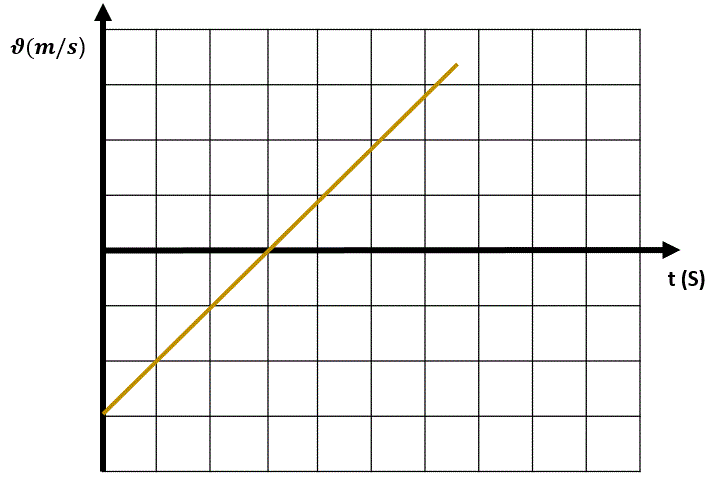
الخط البياني يبين العلاقة بين السرعة والزمن لدرّاجة تتحرك في بعد واحد. أفضل خط بياني يبين العلاقة بين التسارع والزمن لهذه الحركة هو:The velocity-time graph of a bicycle moving in one dimension is shown. The best graph representing acceleration-time for this motion is:
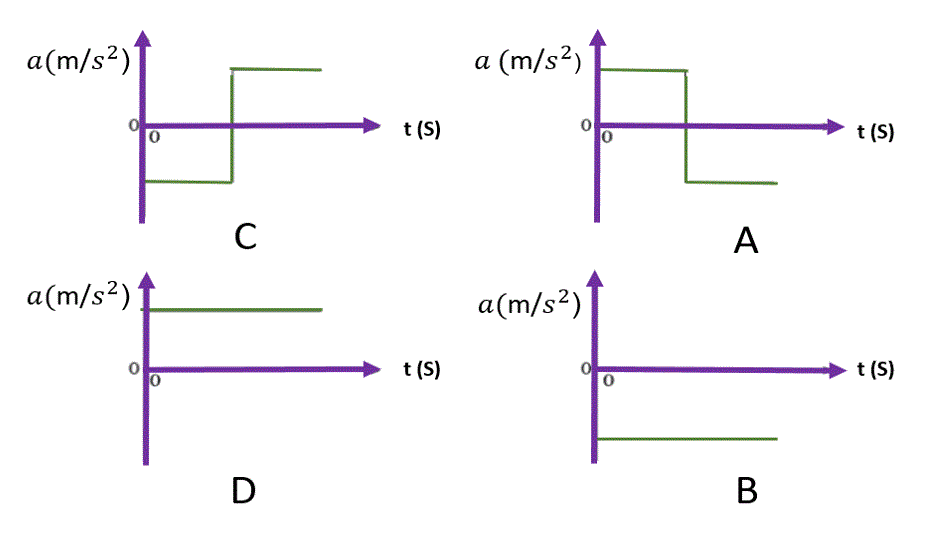
AA
BB
CC
DD
الحلSolution
📌 الخط البياني خط مستقيم واحد موجب الميل طوال الحركة (من سرعة سالبة إلى موجبة دون أي انكسار)، فالتسارع ثابت القيمة والإشارة (موجب) طوال الزمن، بلا أي قفزة.
✅ الخط D (قيمة موجبة ثابتة طوال الزمن)
📌 The graph is a single straight line with positive slope throughout the motion (from negative to positive velocity without any break), so the acceleration has one constant positive value the whole time, with no jump.
✅ Graph D (one constant positive value throughout)
\[22\,\star\star\]
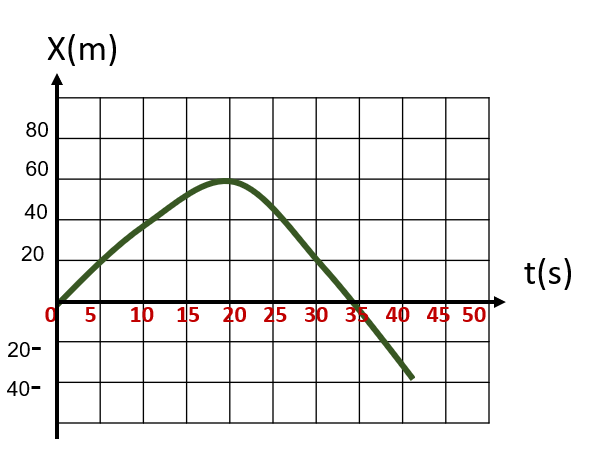
الخط البياني يبين العلاقة بين (الموقع - الزمن) لحركة جرّار زراعي. في أي لحظة كانت السرعة معدومة، وفي أي لحظة كان التسارع معدومًا؟The position-time graph of a tractor's motion is shown. At which instant was the velocity zero, and at which instant was the acceleration zero?
\((v=0\to t=20\,s)(a=0\to t=20\,s)\)\((v=0\to t=20\,s)(a=0\to t=20\,s)\)
\((v=0\to t=35\,s)(a=0\to t=20\,s)\)\((v=0\to t=35\,s)(a=0\to t=20\,s)\)
\((v=0\to t=10\,s)(a=0\to t=35\,s)\)\((v=0\to t=10\,s)(a=0\to t=35\,s)\)
\((v=0\to t=20\,s)(a=0\to t=30\,s)\)\((v=0\to t=20\,s)(a=0\to t=30\,s)\)
الحلSolution
📌 السرعة تنعدم عندما يكون ميل الخط البياني (الموقع-الزمن) معدومًا: يحدث ذلك عند قمة الخط البياني، عند \(t=20\,s\)
📌 التسارع ينعدم عندما يكون الخط البياني (الموقع-الزمن) خطًا مستقيمًا (سرعة ثابتة، تسارع معدوم): يبدأ ذلك عند \(t=30\,s\)
✅ (v=0 عند t=20s)، (a=0 عند t=30s)
📌 Velocity is zero when the slope of the position-time graph is zero: this occurs at the graph's peak, at \(t=20\,s\)
📌 Acceleration is zero when the position-time graph is a straight line (constant velocity, zero acceleration): this begins at \(t=30\,s\)
✅ (v=0 at t=20s), (a=0 at t=30s)
\[23\,\star\star\star\]
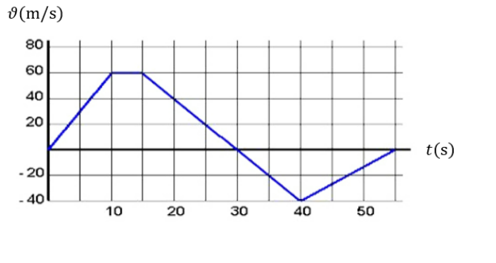
الخط البياني التالي يبين العلاقة بين (السرعة – الزمن) لحركة سيارة. احسب إزاحة السيارة من الثانية \(t=15\,s \Rightarrow t=40\,s\)The following graph shows (velocity–time) for a car's motion. Calculate the car's displacement from \(t=15\,s\) to \(t=40\,s\)
\(\Delta X=250\,m\)\(\Delta X=250\,m\)
\(\Delta X=200\,m\)\(\Delta X=200\,m\)
\(\Delta X=450\,m\)\(\Delta X=450\,m\)
\(\Delta X=650\,m\)\(\Delta X=650\,m\)
الحلSolution
📌 الإزاحة = المساحة الجبرية تحت المنحنى (موجبة فوق المحور، سالبة تحته): من t=15s إلى t≈30s (فوق المحور، مثلث): \(\Delta X_1=\tfrac12\times15\times60=450\,m\)
📌 من t≈30s إلى t=40s (تحت المحور، مثلث): \(\Delta X_2=\tfrac12\times10\times40=200\,m\) (تؤخذ بإشارة سالبة)
📌 المجموع: \(\Delta X=\Delta X_1-\Delta X_2=450-200=250\,m\)
✅ ΔX=250 m
📌 Displacement = signed area under the curve (positive above the axis, negative below): from t=15s to t≈30s (above axis, triangle): \(\Delta X_1=450\,m\)
📌 From t≈30s to t=40s (below axis, triangle): \(\Delta X_2=200\,m\) (taken negative)
📌 Total: \(\Delta X=450-200=250\,m\)
✅ ΔX=250 m
\[24\,\star\star\]
سار متنزّه مسافة \(120\,m\) نحو الشمال، ثم عاد مسافة \(45\,m\) نحو الجنوب، ثم تابع \(30\,m\) أخرى نحو الشمال. فإن المسافة الكلية المقطوعة والإزاحة تعادلان:A hiker walked \(120\,m\) north, then back \(45\,m\) south, then another \(30\,m\) north. The total distance and displacement equal:
\(S=195\,m\;,\;\Delta x=105\,m\) شمالًا\(S=195\,m\;,\;\Delta x=105\,m\) north
\(S=105\,m\;,\;\Delta x=195\,m\) شمالًا\(S=105\,m\;,\;\Delta x=195\,m\) north
\(S=195\,m\;,\;\Delta x=195\,m\) شمالًا\(S=195\,m\;,\;\Delta x=195\,m\) north
\(S=105\,m\;,\;\Delta x=105\,m\) جنوبًا\(S=105\,m\;,\;\Delta x=105\,m\) south
الحلSolution
📌 المسافة: \(S=120+45+30=195\,m\)
📌 الإزاحة (الشمال موجب): المواقع المتتالية: \(0\to120\to75\to105\)، فـ \(\Delta x=105\,m\) شمالًا
✅ S=195 m، Δx=105 m شمالًا
📌 Distance: \(S=120+45+30=195\,m\)
📌 Displacement (north positive): successive positions: \(0\to120\to75\to105\), so \(\Delta x=105\,m\) north
✅ S=195 m, Δx=105 m north
\[25\,\star\star\star\star\]
يتحرك جسيم في خط مستقيم بسرعة ثابتة خلال كل فترة من فترات الزمن التالية، وتم تسجيل موقعه كل ثانيتين: \(t=0s,x=2m\)؛ \(t=2s,x=14m\)؛ \(t=4s,x=18m\)؛ \(t=6s,x=10m\)؛ \(t=8s,x=2m\). فإن المسافة الكلية المقطوعة والسرعة المتوسطة المتجهة خلال الثواني الثماني تعادلان:A particle moves at constant velocity during each interval below, with its position recorded every two seconds: \(t=0s,x=2m\); \(t=2s,x=14m\); \(t=4s,x=18m\); \(t=6s,x=10m\); \(t=8s,x=2m\). The total distance traveled and the average velocity over the 8 seconds equal:
\(S=32\,m\;,\;v_{avg}=0\,m/s\)\(S=32\,m\;,\;v_{avg}=0\,m/s\)
\(S=0\,m\;,\;v_{avg}=4\,m/s\)\(S=0\,m\;,\;v_{avg}=4\,m/s\)
\(S=32\,m\;,\;v_{avg}=4\,m/s\)\(S=32\,m\;,\;v_{avg}=4\,m/s\)
\(S=16\,m\;,\;v_{avg}=0\,m/s\)\(S=16\,m\;,\;v_{avg}=0\,m/s\)
الحلSolution
📌 المسافة (مجموع مقادير كل مرحلة): \(|14-2|+|18-14|+|10-18|+|2-10|=12+4+8+8=32\,m\)
📌 السرعة المتوسطة: \(x_i=2,\;x_f=2\Rightarrow\Delta x=0\Rightarrow v_{avg}=0/8=0\,m/s\)
💡 ملاحظة: الجسيم قطع مسافة فعلية 32م، لكنه عاد إلى موقعه الابتدائي بالضبط، فإزاحته الكلية (وبالتالي سرعته المتوسطة) صفر — هذا يوضّح الفرق الجوهري بين المسافة (سلّمية) والإزاحة (متجهة).
✅ S=32 m، v_avg=0 m/s
📌 Distance (sum of each leg's magnitude): \(12+4+8+8=32\,m\)
📌 Average velocity: \(x_i=2,\;x_f=2\Rightarrow\Delta x=0\Rightarrow v_{avg}=0\,m/s\)
💡 Note: the particle traveled 32m but returned exactly to its starting position, so its net displacement (and average velocity) is zero — illustrating the core difference between distance (scalar) and displacement (vector).
✅ S=32 m, v_avg=0 m/s
\[26\,\star\star\]
معادلة موقع جسيم \(X(t)=5t^2-2t+3\) (بالمتر). فإن السرعة المتوسطة المتجهة بين اللحظتين \(t=1\,s\) و\(t=3\,s\) تعادل:A particle's position equation is \(X(t)=5t^2-2t+3\) (meters). The average velocity between \(t=1\,s\) and \(t=3\,s\) equals:
\(v_{avg}=18\,m/s\)\(v_{avg}=18\,m/s\)
\(v_{avg}=16\,m/s\)\(v_{avg}=16\,m/s\)
\(v_{avg}=20\,m/s\)\(v_{avg}=20\,m/s\)
\(v_{avg}=12\,m/s\)\(v_{avg}=12\,m/s\)
الحلSolution
📌 نحسب الموقع عند كل لحظة: \(X(1)=5-2+3=6\,m\)؛ \(X(3)=45-6+3=42\,m\)
📌 السرعة المتوسطة: \(v_{avg}=\dfrac{42-6}{3-1}=18\,m/s\)
✅ v_avg=18 m/s
📌 Position at each instant: \(X(1)=6\,m\); \(X(3)=42\,m\)
📌 Average velocity: \(v_{avg}=\dfrac{42-6}{3-1}=18\,m/s\)
✅ v_avg=18 m/s
\[27\,\star\star\star\]
معادلة موقع جسيم \(X(t)=t^3-6t^2+9t\) (بالمتر). في أي لحظتين (لـ \(t\geq0\)) يكون الجسيم في حالة سكون لحظي؟A particle's position equation is \(X(t)=t^3-6t^2+9t\) (meters). At which two instants (for \(t\geq0\)) is the particle instantaneously at rest?
\(t=1\,s\) و\(t=3\,s\)\(t=1\,s\) and \(t=3\,s\)
\(t=0\,s\) و\(t=3\,s\)\(t=0\,s\) and \(t=3\,s\)
\(t=1\,s\) فقط\(t=1\,s\) only
\(t=2\,s\) و\(t=4\,s\)\(t=2\,s\) and \(t=4\,s\)
الحلSolution
📌 السكون اللحظي يعني v(t)=0: \(v(t)=\dfrac{dX}{dt}=3t^2-12t+9\)
📌 نساوي بالصفر ونحلّل: \(3t^2-12t+9=0\Rightarrow t^2-4t+3=0\Rightarrow(t-1)(t-3)=0\)
✅ t=1s و t=3s
📌 Instantaneous rest means v(t)=0: \(v(t)=3t^2-12t+9\)
📌 Set to zero and factor: \(t^2-4t+3=0\Rightarrow(t-1)(t-3)=0\)
✅ t=1s and t=3s
\[28\,\star\star\star\]
لنفس الجسيم في السؤال السابق \(X(t)=t^3-6t^2+9t\)، فإن العجلة التي يتحرك بها عند اللحظة \(t=2\,s\) (منتصف لحظتي السكون) تعادل:For the same particle \(X(t)=t^3-6t^2+9t\) from the previous question, the acceleration at \(t=2\,s\) (the midpoint between the two rest instants) equals:
\(a=0\,m/s^2\)\(a=0\,m/s^2\)
\(a=6\,m/s^2\)\(a=6\,m/s^2\)
\(a=-6\,m/s^2\)\(a=-6\,m/s^2\)
\(a=3\,m/s^2\)\(a=3\,m/s^2\)
الحلSolution
📌 نشتق السرعة لإيجاد العجلة: \(v(t)=3t^2-12t+9\Rightarrow a(t)=6t-12\)
📌 نعوّض t=2: \(a(2)=12-12=0\,m/s^2\)
✅ a=0 m/s²
📌 Differentiate velocity to find acceleration: \(a(t)=6t-12\)
📌 Substitute t=2: \(a(2)=12-12=0\,m/s^2\)
✅ a=0 m/s²
\[29\,\star\star\]
سيارة تتحرك بسرعة \(15\,m/s\)، كبح سائقها بتباطؤ ثابت فتوقفت بعد أن قطعت \(50\,m\). فإن مقدار التباطؤ والزمن اللازم للتوقف يعادلان:A car moving at \(15\,m/s\) brakes with constant deceleration and stops after covering \(50\,m\). The deceleration and the time to stop equal:
\(a=-2.25\,m/s^2\;,\;t\approx6.67\,s\)\(a=-2.25\,m/s^2\;,\;t\approx6.67\,s\)
\(a=-1.5\,m/s^2\;,\;t=10\,s\)\(a=-1.5\,m/s^2\;,\;t=10\,s\)
\(a=-2.25\,m/s^2\;,\;t\approx3.33\,s\)\(a=-2.25\,m/s^2\;,\;t\approx3.33\,s\)
\(a=-4.5\,m/s^2\;,\;t\approx3.33\,s\)\(a=-4.5\,m/s^2\;,\;t\approx3.33\,s\)
الحلSolution
📌 التباطؤ من المعادلة الخالية من الزمن: \(v_f^2=v_i^2+2a\Delta x\Rightarrow0=225+2a(50)\Rightarrow a=-2.25\,m/s^2\)
📌 الزمن: \(v_f=v_i+at\Rightarrow0=15-2.25t\Rightarrow t\approx6.67\,s\)
✅ a≈-2.25 m/s²، t≈6.67 s
📌 Deceleration from the time-free equation: \(0=225+2a(50)\Rightarrow a=-2.25\,m/s^2\)
📌 Time: \(0=15-2.25t\Rightarrow t\approx6.67\,s\)
✅ a≈-2.25 m/s², t≈6.67 s
\[30\,\star\star\star\]
قطار بدأ حركته من السكون متسارعًا بعجلة منتظمة، وقطع \(180\,m\) خلال أول \(12\,s\). فإن عجلته وسرعته عند \(t=12\,s\) تعادلان:A train starts from rest with uniform acceleration and covers \(180\,m\) in the first \(12\,s\). Its acceleration and velocity at \(t=12\,s\) equal:
\(a=2.5\,m/s^2\;,\;v_f=30\,m/s\)\(a=2.5\,m/s^2\;,\;v_f=30\,m/s\)
\(a=1.25\,m/s^2\;,\;v_f=15\,m/s\)\(a=1.25\,m/s^2\;,\;v_f=15\,m/s\)
\(a=2.5\,m/s^2\;,\;v_f=15\,m/s\)\(a=2.5\,m/s^2\;,\;v_f=15\,m/s\)
\(a=5\,m/s^2\;,\;v_f=30\,m/s\)\(a=5\,m/s^2\;,\;v_f=30\,m/s\)
الحلSolution
📌 العجلة: \(\Delta x=v_it+\tfrac12at^2\Rightarrow180=\tfrac12a(144)\Rightarrow a=2.5\,m/s^2\)
📌 السرعة عند t=12s: \(v_f=v_i+at=0+2.5(12)=30\,m/s\)
✅ a=2.5 m/s²، v_f=30 m/s
📌 Acceleration: \(180=\tfrac12a(144)\Rightarrow a=2.5\,m/s^2\)
📌 Velocity at t=12s: \(v_f=0+2.5(12)=30\,m/s\)
✅ a=2.5 m/s², v_f=30 m/s
\[31\,\star\star\star\star\]
دراجة نارية تتسارع من السكون بعجلة ثابتة مقدارها \(4\,m/s^2\) لمدة \(5\,s\)، ثم تتابع الحركة بالسرعة التي وصلت إليها لمدة \(8\,s\) إضافية. فإن المسافة الكلية التي قطعتها الدراجة تعادل:A motorcycle accelerates from rest at a constant \(4\,m/s^2\) for \(5\,s\), then continues at the velocity it reached for an additional \(8\,s\). The total distance covered equals:
\(\Delta x=210\,m\)\(\Delta x=210\,m\)
\(\Delta x=260\,m\)\(\Delta x=260\,m\)
\(\Delta x=160\,m\)\(\Delta x=160\,m\)
\(\Delta x=50\,m\)\(\Delta x=50\,m\)
الحلSolution
📌 المرحلة الأولى (تسارع من السكون): \(v_f=0+4(5)=20\,m/s\)؛ \(\Delta x_1=\tfrac12(0+20)(5)=50\,m\)
📌 المرحلة الثانية (سرعة ثابتة 20م/ث لمدة 8ث): \(\Delta x_2=20\times8=160\,m\)
📌 المجموع: \(\Delta x=50+160=210\,m\)
✅ Δx=210 m
📌 Stage 1 (accelerating from rest): \(v_f=20\,m/s\); \(\Delta x_1=50\,m\)
📌 Stage 2 (constant 20 m/s for 8s): \(\Delta x_2=160\,m\)
📌 Total: \(\Delta x=50+160=210\,m\)
✅ Δx=210 m
\[32\,\star\star\]
سقط حجر سقوطًا حرًا من دون سرعة ابتدائية، واستغرق \(3\,s\) حتى وصل الأرض. فإن الارتفاع الذي سقط منه وسرعته لحظة الوصول للأرض يعادلان: (اعتبر \(g=9.81\,m/s^2\))A stone falls freely from rest and takes \(3\,s\) to reach the ground. The height it fell from and its speed on impact equal: (take \(g=9.81\,m/s^2\))
\(h\approx44.1\,m\;,\;v_f\approx29.4\,m/s\)\(h\approx44.1\,m\;,\;v_f\approx29.4\,m/s\)
\(h\approx29.4\,m\;,\;v_f\approx44.1\,m/s\)\(h\approx29.4\,m\;,\;v_f\approx44.1\,m/s\)
\(h\approx88.3\,m\;,\;v_f\approx29.4\,m/s\)\(h\approx88.3\,m\;,\;v_f\approx29.4\,m/s\)
\(h\approx44.1\,m\;,\;v_f\approx9.81\,m/s\)\(h\approx44.1\,m\;,\;v_f\approx9.81\,m/s\)
الحلSolution
📌 الارتفاع: \(h=\tfrac12gt^2=\tfrac12(9.81)(9)\approx44.1\,m\)
📌 السرعة عند الوصول: \(v_f=gt=9.81\times3\approx29.4\,m/s\)
✅ h≈44.1 m، v_f≈29.4 m/s
📌 Height: \(h=\tfrac12gt^2\approx44.1\,m\)
📌 Impact speed: \(v_f=gt\approx29.4\,m/s\)
✅ h≈44.1 m, v_f≈29.4 m/s
\[33\,\star\star\star\star\]
تم إسقاط كرتين من السكون في اللحظة نفسها من ارتفاعي \(20\,m\) و\(80\,m\) على التوالي (سقوط حر، بإهمال مقاومة الهواء). فإن النسبة بين زمن سقوط الكرة الثانية إلى زمن سقوط الكرة الأولى \((t_{80}/t_{20})\) تعادل:Two balls are dropped from rest at the same instant from heights of \(20\,m\) and \(80\,m\) respectively (free fall, neglecting air resistance). The ratio of the second ball's fall time to the first's \((t_{80}/t_{20})\) equals:
22
44
1.411.41
88
الحلSolution
📌 من \(h=\tfrac12gt^2\)، فإن \(t=\sqrt{2h/g}\)، أي أن \(t\) يتناسب طرديًا مع \(\sqrt{h}\) وليس مع \(h\) نفسها: \(\dfrac{t_{80}}{t_{20}}=\sqrt{\dfrac{80}{20}}=\sqrt4=2\)
💡 تحقق عددي: \(t_{20}=\sqrt{40/9.81}\approx2.02\,s\)، \(t_{80}=\sqrt{160/9.81}\approx4.04\,s\)، والنسبة \(\approx2\)
✅ النسبة = 2
📌 From \(h=\tfrac12gt^2\), \(t=\sqrt{2h/g}\), so t is proportional to \(\sqrt{h}\), not h itself: \(\dfrac{t_{80}}{t_{20}}=\sqrt{\dfrac{80}{20}}=\sqrt4=2\)
💡 Numeric check: \(t_{20}\approx2.02\,s\), \(t_{80}\approx4.04\,s\), ratio ≈2
✅ Ratio = 2
\[34\,\star\star\star\]
قُذفت كرة رأسيًا إلى أعلى من سطح الأرض بسرعة ابتدائية \(25\,m/s\). فإن الزمن الكلي الذي تبقاه الكرة في الهواء قبل عودتها إلى سطح الأرض يعادل: (اعتبر \(g=9.81\,m/s^2\))A ball is thrown vertically upward from the ground with an initial speed of \(25\,m/s\). The total time it remains in the air before returning to the ground equals: (take \(g=9.81\,m/s^2\))
\(t\approx5.10\,s\)\(t\approx5.10\,s\)
\(t\approx2.55\,s\)\(t\approx2.55\,s\)
\(t\approx6.37\,s\)\(t\approx6.37\,s\)
\(t\approx25.5\,s\)\(t\approx25.5\,s\)
الحلSolution
📌 بما أن الكرة تعود لنفس الارتفاع الذي انطلقت منه، فإن الإزاحة الكلية صفر: \(0=v_it-\tfrac12gt^2\Rightarrow t\left(v_i-\tfrac12gt\right)=0\)
📌 الحل غير الصفري: \(t=\dfrac{2v_i}{g}=\dfrac{2(25)}{9.81}\approx5.10\,s\)
✅ t ≈ 5.10 s
📌 Since the ball returns to its launch height, total displacement is zero: \(0=v_it-\tfrac12gt^2\)
📌 Nonzero solution: \(t=\dfrac{2v_i}{g}\approx5.10\,s\)
✅ t ≈ 5.10 s
\[35\,\star\star\star\star\]
قُذفت كرة رأسيًا إلى أعلى بسرعة \(18\,m/s\) من حافة جرف يعلو الأرض أسفله بمقدار \(25\,m\). فإن سرعة الكرة لحظة وصولها إلى الأرض عند قاعدة الجرف تعادل: (اعتبر \(g=9.81\,m/s^2\))A ball is thrown vertically upward at \(18\,m/s\) from the edge of a cliff \(25\,m\) above the ground below. The ball's speed when it reaches the ground at the base of the cliff equals: (take \(g=9.81\,m/s^2\))
\(v_f\approx28.5\,m/s\)\(v_f\approx28.5\,m/s\)
\(v_f\approx22.1\,m/s\)\(v_f\approx22.1\,m/s\)
\(v_f=18\,m/s\)\(v_f=18\,m/s\)
\(v_f\approx31.3\,m/s\)\(v_f\approx31.3\,m/s\)
الحلSolution
📌 نعتبر حافة الجرف أصلًا (Yi=0) والأعلى موجبًا، فموقع الأرض أسفل الجرف \(Y_f=-25\,m\): \(v_f^2=v_i^2-2g(Y_f-Y_i)=18^2-2(9.81)(-25-0)\)
📌 نحسب: \(v_f^2=324+490.5=814.5\Rightarrow v_f=\sqrt{814.5}\approx28.5\,m/s\)
✅ v_f ≈ 28.5 m/s
📌 Take the cliff edge as origin (Yi=0), up positive, ground at \(Y_f=-25\,m\): \(v_f^2=18^2-2(9.81)(-25)\)
📌 Compute: \(v_f^2=324+490.5=814.5\Rightarrow v_f\approx28.5\,m/s\)
✅ v_f ≈ 28.5 m/s
\[36\,\star\star\]
عند اللحظة \(t=0\) كان موقع جسيم \(x=-5\,m\)، وهو يتحرك بسرعة ثابتة \(+8\,m/s\). فإن موقعه عند \(t=4\,s\) يعادل:At \(t=0\), a particle's position is \(x=-5\,m\), moving at a constant velocity of \(+8\,m/s\). Its position at \(t=4\,s\) equals:
\(x=27\,m\)\(x=27\,m\)
\(x=32\,m\)\(x=32\,m\)
\(x=-27\,m\)\(x=-27\,m\)
\(x=22\,m\)\(x=22\,m\)
الحلSolution
📌 معادلة الموقع لسرعة ثابتة: \(X(t)=x_i+vt=-5+8t\)
📌 نعوّض t=4: \(X(4)=-5+8(4)=-5+32=27\,m\)
✅ x=27 m
📌 Position equation for constant velocity: \(X(t)=-5+8t\)
📌 Substitute t=4: \(X(4)=-5+32=27\,m\)
✅ x=27 m
\[37\,\star\star\star\star\]
معادلة موقع جسيم \(X(t)=t^2-4t+6\) (بالمتر). احسب السرعة اللحظية عند \(t=2\,s\)، وبيّن هل تساوي السرعة المتوسطة المتجهة خلال الفترة \([0,4]\,s\) أم لا.A particle's position equation is \(X(t)=t^2-4t+6\) (meters). Find the instantaneous velocity at \(t=2\,s\), and determine whether it equals the average velocity over \([0,4]\,s\).
\(v(2)=0\,m/s\)، تساوي السرعة المتوسطة\(v(2)=0\,m/s\), equals the average velocity
\(v(2)=0\,m/s\)، لا تساوي السرعة المتوسطة\(v(2)=0\,m/s\), does not equal the average velocity
\(v(2)=4\,m/s\)، تساوي السرعة المتوسطة\(v(2)=4\,m/s\), equals the average velocity
\(v(2)=-4\,m/s\)، تساوي السرعة المتوسطة\(v(2)=-4\,m/s\), equals the average velocity
الحلSolution
📌 السرعة اللحظية: \(v(t)=2t-4\Rightarrow v(2)=4-4=0\,m/s\)
📌 السرعة المتوسطة: \(X(0)=6,\;X(4)=16-16+6=6\Rightarrow v_{avg}=\dfrac{6-6}{4}=0\,m/s\)
💡 ملاحظة عامة: لأي حركة بعجلة ثابتة، تساوي السرعة اللحظية عند منتصف أي فترة زمنية السرعةَ المتوسطة خلال تلك الفترة بالضبط (لأن v(t) دالة خطية، وt=2 هو منتصف [0,4]).
✅ v(2)=0 m/s، وتساوي السرعة المتوسطة
📌 Instantaneous velocity: \(v(t)=2t-4\Rightarrow v(2)=0\,m/s\)
📌 Average velocity: \(X(0)=6,\;X(4)=6\Rightarrow v_{avg}=0\,m/s\)
💡 General note: for any constant-acceleration motion, the instantaneous velocity at the midpoint of any time interval exactly equals the average velocity over that interval (since v(t) is linear and t=2 is the midpoint of [0,4]).
✅ v(2)=0 m/s, and it equals the average velocity
\[38\,\star\star\star\]
كرة تتدحرج على منحدر بعجلة ثابتة مقدارها \(1.5\,m/s^2\). إذا قطعت \(40\,m\) خلال \(5\,s\)، فإن سرعتها الابتدائية تعادل:A ball rolls down a ramp with a constant acceleration of \(1.5\,m/s^2\). If it covers \(40\,m\) in \(5\,s\), its initial velocity equals:
\(v_i=4.25\,m/s\)\(v_i=4.25\,m/s\)
\(v_i=8\,m/s\)\(v_i=8\,m/s\)
\(v_i=3.5\,m/s\)\(v_i=3.5\,m/s\)
\(v_i=5\,m/s\)\(v_i=5\,m/s\)
الحلSolution
📌 نستخدم: \(\Delta x=v_it+\tfrac12at^2\Rightarrow40=v_i(5)+\tfrac12(1.5)(25)\)
📌 نحل: \(40=5v_i+18.75\Rightarrow5v_i=21.25\Rightarrow v_i=4.25\,m/s\)
✅ v_i=4.25 m/s
📌 Using: \(40=v_i(5)+\tfrac12(1.5)(25)\)
📌 Solve: \(40=5v_i+18.75\Rightarrow v_i=4.25\,m/s\)
✅ v_i=4.25 m/s
\[39\,\star\star\star\]
يمثل الرسم العلاقة بين السرعة والزمن لجسم يتحرك في خط مستقيم. فإن إزاحته خلال الـ \(12\,s\) تعادل:The graph shows velocity against time for an object moving in a straight line. Its displacement during the \(12\,s\) is:
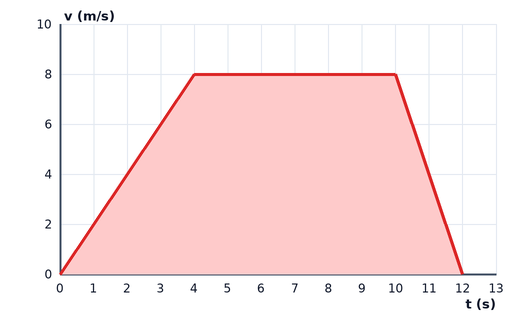
\(64\,m\)\(64\,m\)
\(72\,m\)\(72\,m\)
\(80\,m\)\(80\,m\)
\(96\,m\)\(96\,m\)
الحلSolution
📌 الإزاحة = المساحة تحت المنحنى (شبه منحرف): \(\Delta x=\tfrac12(4)(8)+(6)(8)+\tfrac12(2)(8)\)
📌 المجموع: \(16+48+8=72\,m\)
✅ \(72\,m\)
📌 Displacement = area under the graph (a trapezoid): \(\Delta x=\tfrac12(4)(8)+(6)(8)+\tfrac12(2)(8)\)
📌 Total: \(16+48+8=72\,m\)
✅ \(72\,m\)
\[40\,\star\star\star\]
تحرك جسم \(40\,m\) شرقًا خلال \(10\,s\) ثم \(30\,m\) غربًا خلال \(5\,s\) كما في الشكل. فإن متوسط سرعته المتجهة خلال الحركة كلها:An object moves \(40\,m\) east in \(10\,s\) then \(30\,m\) west in \(5\,s\) as shown. Its average velocity for the whole motion is:
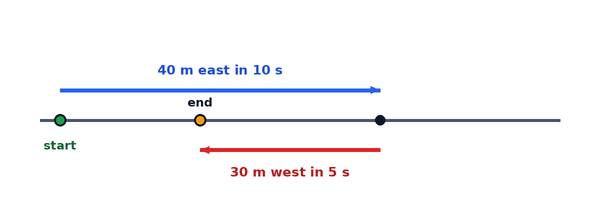
\(4.67\,m/s\) شرقًا\(4.67\,m/s\) east
\(0.67\,m/s\) غربًا\(0.67\,m/s\) west
\(0.67\,m/s\) شرقًا\(0.67\,m/s\) east
\(2.0\,m/s\) شرقًا\(2.0\,m/s\) east
الحلSolution
📌 الإزاحة الكلية: \(\Delta x=40-30=10\,m\ (\text{east})\)
📌 السرعة المتجهة المتوسطة: \(\bar v=\dfrac{\Delta x}{\Delta t}=\dfrac{10}{15}=0.67\,m/s\ (\text{east})\)
📌 (أما المسافة الكلية \(70\,m\) فتعطي السرعة العددية المتوسطة \(4.67\,m/s\)).
✅ \(0.67\,m/s\) شرقًا
📌 Total displacement: \(\Delta x=40-30=10\,m\ (\text{east})\)
📌 Average velocity: \(\bar v=\dfrac{\Delta x}{\Delta t}=\dfrac{10}{15}=0.67\,m/s\ (\text{east})\)
📌 (The total distance \(70\,m\) would give the average speed \(4.67\,m/s\)).
✅ \(0.67\,m/s\) east
\[41\,\star\star\star\]
يبين الرسم العلاقة بين الموقع والزمن لجسم خلال \(9\,s\). فإن السرعة العددية المتوسطة والسرعة المتجهة المتوسطة على الترتيب:The graph shows position against time for an object during \(9\,s\). Its average speed and average velocity are, respectively:
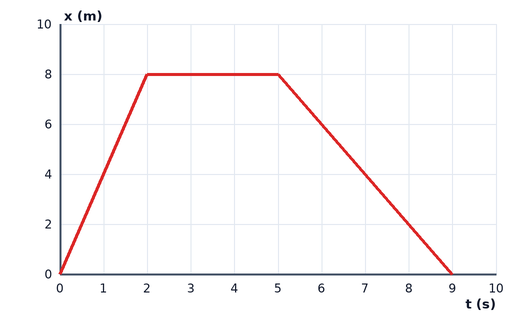
\(0\) و \(1.8\,m/s\)\(0\) and \(1.8\,m/s\)
\(0\) و \(0\)\(0\) and \(0\)
\(0.9\,m/s\) و \(0.9\,m/s\)\(0.9\,m/s\) and \(0.9\,m/s\)
\(1.8\,m/s\) و \(0\)\(1.8\,m/s\) and \(0\)
الحلSolution
📌 المسافة الكلية: \(S=8+8=16\,m\Rightarrow\text{speed}=\dfrac{16}{9}\approx1.8\,m/s\)
📌 الإزاحة الكلية صفر لأن الجسم عاد إلى موضع البداية: \(\bar v=\dfrac{0}{9}=0\)
✅ \(1.8\,m/s\) و \(0\)
📌 Total distance: \(S=8+8=16\,m\Rightarrow\text{speed}=\dfrac{16}{9}\approx1.8\,m/s\)
📌 The total displacement is zero since the object returned to its start: \(\bar v=\dfrac{0}{9}=0\)
✅ \(1.8\,m/s\) and \(0\)
\[42\,\star\star\star\]
يبين الرسم تغيّر التسارع مع الزمن لجسم بدأ حركته بسرعة \(3\,m/s\). فإن سرعته عند اللحظة \(t=10\,s\):The graph shows acceleration against time for an object that starts with speed \(3\,m/s\). Its speed at \(t=10\,s\) is:
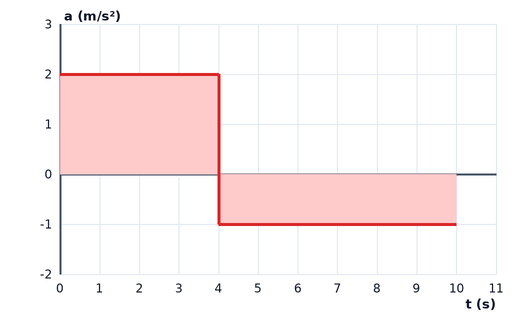
\(11\,m/s\)\(11\,m/s\)
\(5\,m/s\)\(5\,m/s\)
\(2\,m/s\)\(2\,m/s\)
\(8\,m/s\)\(8\,m/s\)
الحلSolution
📌 التغير في السرعة = المساحة تحت منحنى التسارع–الزمن: \(\Delta v=(2)(4)+(-1)(6)=8-6=2\,m/s\)
📌 السرعة النهائية: \(v=v_0+\Delta v=3+2=5\,m/s\)
✅ \(5\,m/s\)
📌 Change in velocity = area under the acceleration–time graph: \(\Delta v=(2)(4)+(-1)(6)=8-6=2\,m/s\)
📌 Final velocity: \(v=v_0+\Delta v=3+2=5\,m/s\)
✅ \(5\,m/s\)
\[43\,\star\star\star\]
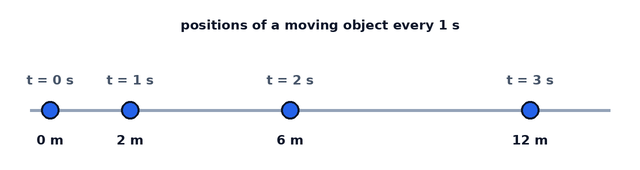
يبين الشكل مواقع جسم متحرك مسجّلة كل ثانية. فإن مقدار تسارعه (على فرض أنه ثابت):The figure shows the positions of a moving object recorded every second. Its acceleration (assumed constant) is:
\(4\,m/s^2\)\(4\,m/s^2\)
\(1\,m/s^2\)\(1\,m/s^2\)
\(6\,m/s^2\)\(6\,m/s^2\)
\(2\,m/s^2\)\(2\,m/s^2\)
الحلSolution
📌 الإزاحات خلال الثواني المتتالية: \(2-0=2,\;6-2=4,\;12-6=6\,m\)
📌 الفرق بين إزاحتين متتاليتين: \(\Delta x_{n+1}-\Delta x_n=a\,(\Delta t)^2\Rightarrow a=\dfrac{4-2}{1^2}=2\,m/s^2\)
✅ \(2\,m/s^2\)
📌 Displacements in successive seconds: \(2-0=2,\;6-2=4,\;12-6=6\,m\)
📌 The difference between successive displacements: \(\Delta x_{n+1}-\Delta x_n=a\,(\Delta t)^2\Rightarrow a=\dfrac{4-2}{1^2}=2\,m/s^2\)
✅ \(2\,m/s^2\)
\[44\,\star\star\star\]
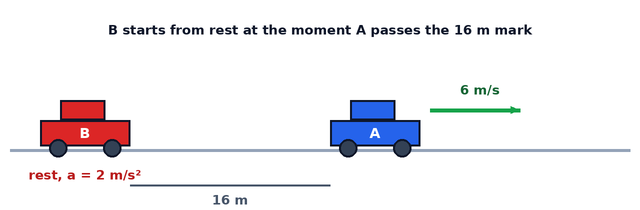
تمر السيارة A بسرعة ثابتة \(6\,m/s\) عند علامة تبعد \(16\,m\) عن السيارة B الساكنة، وفي اللحظة نفسها تنطلق B بتسارع ثابت \(2\,m/s^2\) باتجاه A. فإن الزمن اللازم لتدرك B السيارة A:Car A passes at a constant \(6\,m/s\) a mark \(16\,m\) ahead of the stationary car B, and at that instant B starts with constant acceleration \(2\,m/s^2\) in the same direction. The time for B to catch A is:
\(4\,s\)\(4\,s\)
\(6\,s\)\(6\,s\)
\(8\,s\)\(8\,s\)
\(11\,s\)\(11\,s\)
الحلSolution
📌 معادلتا الموقعين من موضع B: \(x_B=\tfrac12(2)t^2=t^2,\qquad x_A=16+6t\)
📌 عند الإدراك \(x_A=x_B\): \(t^2-6t-16=0\Rightarrow(t-8)(t+2)=0\Rightarrow t=8\,s\)
✅ \(8\,s\)
📌 The two position equations measured from B: \(x_B=\tfrac12(2)t^2=t^2,\qquad x_A=16+6t\)
📌 At the catch-up \(x_A=x_B\): \(t^2-6t-16=0\Rightarrow(t-8)(t+2)=0\Rightarrow t=8\,s\)
✅ \(8\,s\)
\[45\,\star\star\star\]
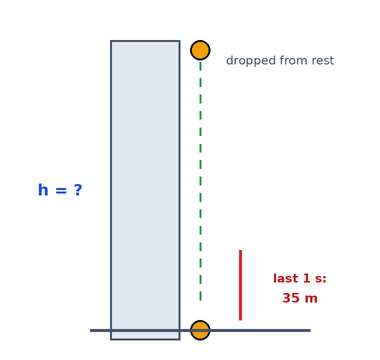
سقط حجر سقوطًا حرًّا من السكون من قمة برج، وقطع في آخر ثانية من سقوطه \(35\,m\). فإن ارتفاع البرج (\(g=10\,m/s^2\)):A stone falls freely from rest from the top of a tower and covers \(35\,m\) in the last second of its fall. The height of the tower is (\(g=10\,m/s^2\)):
\(45\,m\)\(45\,m\)
\(80\,m\)\(80\,m\)
\(125\,m\)\(125\,m\)
\(60\,m\)\(60\,m\)
الحلSolution
📌 نفرض زمن السقوط الكلي \(T\)، والمسافة في آخر ثانية = \(\tfrac12gT^2-\tfrac12g(T-1)^2\): \(5T^2-5(T-1)^2=35\Rightarrow10T-5=35\Rightarrow T=4\,s\)
📌 الارتفاع: \(h=\tfrac12gT^2=5\times16=80\,m\)
✅ \(80\,m\)
📌 Let the total fall time be \(T\); the distance in the last second = \(\tfrac12gT^2-\tfrac12g(T-1)^2\): \(5T^2-5(T-1)^2=35\Rightarrow10T-5=35\Rightarrow T=4\,s\)
📌 The height: \(h=\tfrac12gT^2=5\times16=80\,m\)
✅ \(80\,m\)
\[46\,\star\star\star\]
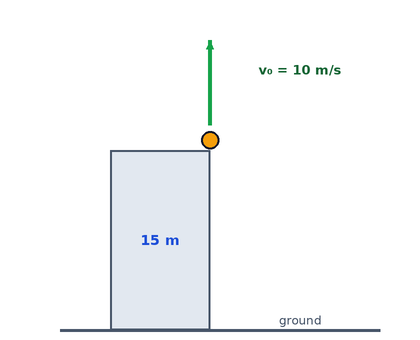
قُذفت كرة رأسيًا إلى الأعلى بسرعة \(10\,m/s\) من شرفة ترتفع \(15\,m\) عن الأرض. فإن زمن وصولها إلى الأرض (\(g=10\,m/s^2\)):A ball is thrown vertically upward at \(10\,m/s\) from a balcony \(15\,m\) above the ground. The time it takes to reach the ground is (\(g=10\,m/s^2\)):
\(3\,s\)\(3\,s\)
\(1\,s\)\(1\,s\)
\(2\,s\)\(2\,s\)
\(5\,s\)\(5\,s\)
الحلSolution
📌 نأخذ الاتجاه الموجب للأعلى، والإزاحة النهائية \(-15\,m\): \(-15=10t-5t^2\Rightarrow t^2-2t-3=0\)
📌 بالتحليل: \((t-3)(t+1)=0\Rightarrow t=3\,s\)
✅ \(3\,s\)
📌 Taking up as positive, the final displacement is \(-15\,m\): \(-15=10t-5t^2\Rightarrow t^2-2t-3=0\)
📌 Factoring: \((t-3)(t+1)=0\Rightarrow t=3\,s\)
✅ \(3\,s\)
\[47\,\star\star\star\]
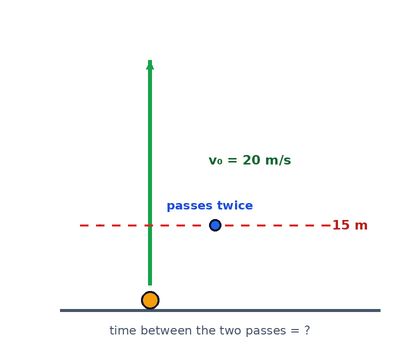
قُذفت كرة رأسيًا إلى الأعلى من الأرض بسرعة \(20\,m/s\). فإن الزمن بين مرورها مرتين بالارتفاع \(15\,m\) (\(g=10\,m/s^2\)):A ball is thrown vertically upward from the ground at \(20\,m/s\). The time between its two passes through the height \(15\,m\) is (\(g=10\,m/s^2\)):
\(1\,s\)\(1\,s\)
\(3\,s\)\(3\,s\)
\(4\,s\)\(4\,s\)
\(2\,s\)\(2\,s\)
الحلSolution
📌 معادلة الارتفاع: \(15=20t-5t^2\Rightarrow t^2-4t+3=0\)
📌 الحلان: \(t=1\,s\ (\text{going up}),\ t=3\,s\ (\text{coming down})\)
📌 الفرق بينهما: \(\Delta t=3-1=2\,s\)
✅ \(2\,s\)
📌 Height equation: \(15=20t-5t^2\Rightarrow t^2-4t+3=0\)
📌 The two roots: \(t=1\,s\ (\text{going up}),\ t=3\,s\ (\text{coming down})\)
📌 The difference: \(\Delta t=3-1=2\,s\)
✅ \(2\,s\)
\[48\,\star\star\star\]
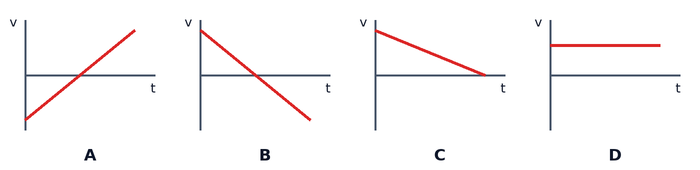
قُذفت كرة رأسيًا إلى الأعلى ثم عادت إلى نقطة القذف (الاتجاه الموجب للأعلى وتُهمل مقاومة الهواء). أي رسم يمثل العلاقة بين سرعتها والزمن؟A ball is thrown vertically upward and returns to the launch point (up is positive, air resistance neglected). Which graph represents its velocity against time?
الرسم AGraph A
الرسم BGraph B
الرسم CGraph C
الرسم DGraph D
الحلSolution
📌 التسارع ثابت (\(-g\)) طوال الحركة (صعودًا وهبوطًا)، فالرسم خط مستقيم واحد ميله سالب.
📌 تبدأ السرعة موجبة (للأعلى) وتنعدم عند أقصى ارتفاع ثم تصبح سالبة (للأسفل) بنفس مقدار البداية عند العودة: الرسم B.
✅ الرسم B
📌 The acceleration is constant (\(-g\)) throughout (up and down), so the graph is a single straight line with negative slope.
📌 The velocity starts positive (upward), becomes zero at the top and then negative (downward), with the same magnitude as at the start on return: graph B.
✅ Graph B
\[49\,\star\star\]
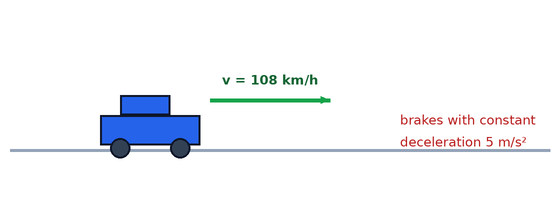
سيارة تسير بسرعة \(108\,km/h\) فضغط سائقها المكبح فتباطأت بتباطؤ ثابت \(5\,m/s^2\). فإن المسافة التي تقطعها حتى تتوقف:A car moving at \(108\,km/h\) brakes with a constant deceleration of \(5\,m/s^2\). The distance it travels before stopping is:
\(45\,m\)\(45\,m\)
\(180\,m\)\(180\,m\)
\(90\,m\)\(90\,m\)
\(22.5\,m\)\(22.5\,m\)
الحلSolution
📌 نحوّل السرعة: \(108\,km/h=\dfrac{108}{3.6}=30\,m/s\)
📌 نستخدم \(v^2=v_0^2+2a\Delta x\): \(0=30^2-2(5)\Delta x\Rightarrow\Delta x=\dfrac{900}{10}=90\,m\)
✅ \(90\,m\)
📌 Convert the speed: \(108\,km/h=\dfrac{108}{3.6}=30\,m/s\)
📌 Using \(v^2=v_0^2+2a\Delta x\): \(0=30^2-2(5)\Delta x\Rightarrow\Delta x=\dfrac{900}{10}=90\,m\)
✅ \(90\,m\)
\[50\,\star\star\star\]
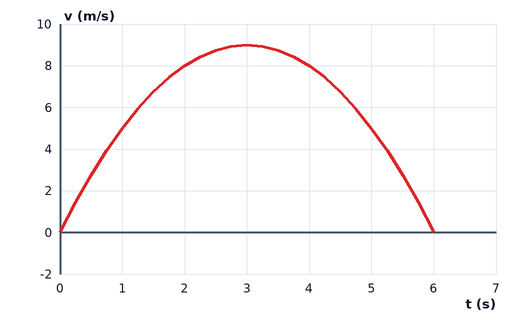
تتحرك سيارة بحيث تتغير سرعتها حسب العلاقة \(v(t)=6t-t^{2}\) (بالوحدات الدولية). يمثل الرسم هذه العلاقة. فإن أكبر سرعة تصل إليها السيارة خلال الحركة:A car’s velocity varies as \(v(t)=6t-t^{2}\) (SI units), as shown in the graph. The maximum speed reached by the car is:
\(6\,m/s\)\(6\,m/s\)
\(9\,m/s\)\(9\,m/s\)
\(12\,m/s\)\(12\,m/s\)
\(18\,m/s\)\(18\,m/s\)
الحلSolution
📌 السرعة العظمى عندما يكون التسارع صفرًا: \(a=\dfrac{dv}{dt}=6-2t=0\Rightarrow t=3\,s\)
📌 التعويض: \(v_{max}=6(3)-3^2=9\,m/s\)
✅ \(9\,m/s\)
📌 The maximum speed occurs when the acceleration is zero: \(a=\dfrac{dv}{dt}=6-2t=0\Rightarrow t=3\,s\)
📌 Substituting: \(v_{max}=6(3)-3^2=9\,m/s\)
✅ \(9\,m/s\)
\[51\,\star\star\star\]
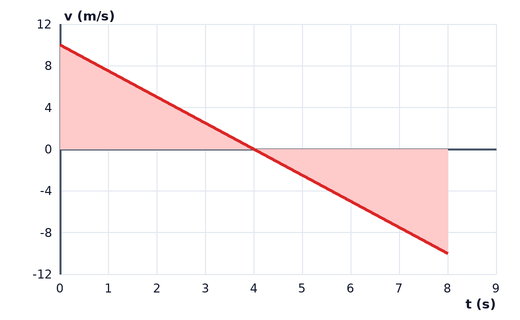
يبين الرسم السرعة مقابل الزمن لجسم يتحرك على محور مستقيم خلال \(8\,s\). فإن المسافة المقطوعة والإزاحة على الترتيب:The graph shows velocity against time for an object moving along a straight axis for \(8\,s\). The distance covered and the displacement are, respectively:
\(0\) و \(40\,m\)\(0\) and \(40\,m\)
\(20\,m\) و \(0\)\(20\,m\) and \(0\)
\(40\,m\) و \(40\,m\)\(40\,m\) and \(40\,m\)
\(40\,m\) و \(0\)\(40\,m\) and \(0\)
الحلSolution
📌 المساحة فوق المحور (حركة بالاتجاه الموجب): \(\tfrac12(4)(10)=+20\,m\)
📌 المساحة تحت المحور (حركة بالاتجاه السالب): \(\tfrac12(4)(-10)=-20\,m\)
📌 المسافة = مجموع القيم المطلقة، والإزاحة = المجموع الجبري: \(S=20+20=40\,m,\quad\Delta x=20-20=0\)
✅ \(40\,m\) و \(0\)
📌 Area above the axis (positive direction): \(\tfrac12(4)(10)=+20\,m\)
📌 Area below the axis (negative direction): \(\tfrac12(4)(-10)=-20\,m\)
📌 Distance = sum of magnitudes, displacement = algebraic sum: \(S=20+20=40\,m,\quad\Delta x=20-20=0\)
✅ \(40\,m\) and \(0\)
\[52\,\star\star\]
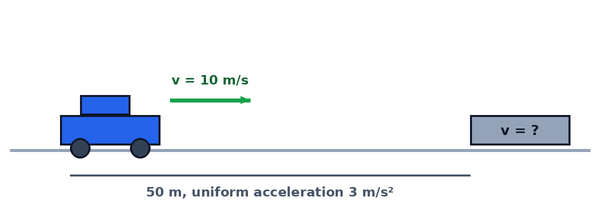
تتسارع سيارة بتسارع ثابت \(3\,m/s^2\) من سرعة ابتدائية \(10\,m/s\) خلال مسافة \(50\,m\). فإن سرعتها النهائية:A car accelerates at a constant \(3\,m/s^2\) from an initial speed of \(10\,m/s\) over a distance of \(50\,m\). Its final speed is:
\(16\,m/s\)\(16\,m/s\)
\(25\,m/s\)\(25\,m/s\)
\(20\,m/s\)\(20\,m/s\)
\(13\,m/s\)\(13\,m/s\)
الحلSolution
📌 معادلة الحركة بدون زمن: \(v^2=v_0^2+2a\Delta x=10^2+2(3)(50)=400\)
📌 السرعة النهائية: \(v=\sqrt{400}=20\,m/s\)
✅ \(20\,m/s\)
📌 The time-independent equation: \(v^2=v_0^2+2a\Delta x=10^2+2(3)(50)=400\)
📌 Final speed: \(v=\sqrt{400}=20\,m/s\)
✅ \(20\,m/s\)
\[53\,\star\star\star\]
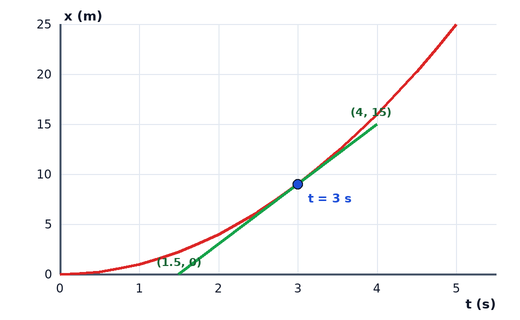
يمثل المنحنى موقع جسم مقابل الزمن، والخط الأخضر مماس للمنحنى عند اللحظة \(t=3\,s\) ويمر بالنقطتين \((1.5,0)\) و\((4,15)\). فإن السرعة اللحظية للجسم عند هذه اللحظة:The curve shows position against time and the green line is the tangent at \(t=3\,s\), passing through \((1.5,0)\) and \((4,15)\). The instantaneous velocity of the object at that moment is:
\(9\,m/s\)\(9\,m/s\)
\(6\,m/s\)\(6\,m/s\)
\(3\,m/s\)\(3\,m/s\)
\(4.5\,m/s\)\(4.5\,m/s\)
الحلSolution
📌 السرعة اللحظية = ميل المماس للمنحنى (الموقع–الزمن): \(v=\dfrac{15-0}{4-1.5}=\dfrac{15}{2.5}=6\,m/s\)
✅ \(6\,m/s\)
📌 Instantaneous velocity = the slope of the tangent to the position–time curve: \(v=\dfrac{15-0}{4-1.5}=\dfrac{15}{2.5}=6\,m/s\)
✅ \(6\,m/s\)
📝 حل المسائل التالية
📝 Solve the Following Problems
\[1\,\star\star\]
يحدَّد موقع جسم يتحرك على المحور (X) من خلال العلاقة \(X=9+10t-2t^2\)، حيث تُقدَّر \(X(m), t(s)\). حدِّد موقع الجسم عندما يصل إلى أقصى إزاحة.A body's position on the X-axis is given by \(X=9+10t-2t^2\), with \(X(m), t(s)\). Find the body's position when it reaches its maximum displacement.
.....................................................................
الحلSolution
📌 عند أقصى إزاحة تكون السرعة صفرًا: \(v(t)=\dfrac{dX}{dt}=10-4t\)
📌 نساوي بالصفر: \(10-4t=0\Rightarrow t=2.5\,s\)
📌 نعوّض لإيجاد الموقع: \(X=9+10(2.5)-2(2.5)^2=9+25-12.5=21.5\,m\)
✅ X=21.5 m عند t=2.5s
📌 At maximum displacement, velocity is zero: \(v(t)=\dfrac{dX}{dt}=10-4t\)
📌 Set equal to zero: \(10-4t=0\Rightarrow t=2.5\,s\)
📌 Substitute to find position: \(X=9+10(2.5)-2(2.5)^2=21.5\,m\)
✅ X=21.5 m at t=2.5s
\[2\,\star\star\star\]
سيارة حمراء تقف على جانب الطريق، مرت بجوارها سيارة زرقاء تتحرك بسرعة ثابتة \(20\,m/s\). في تلك اللحظة تحركت السيارة الحمراء بتسارع ثابت مقداره \(3\,m/s^2\). كم تحتاج السيارة الحمراء من الزمن حتى تلحق بالسيارة الزرقاء؟ وكم المسافة التي قطعتها حتى وصلت إليها؟A red car is parked by the roadside. A blue car passes it moving at a constant \(20\,m/s\). At that instant, the red car starts moving with a constant acceleration of \(3\,m/s^2\). How long does the red car take to catch up to the blue car? What distance does it cover by then?

.....................................................................
الحلSolution
📌 معادلتا الموقع: السيارة الحمراء: \(X_2=0+0+\tfrac12(3)t^2=1.5t^2\)؛ السيارة الزرقاء: \(X_1=0+20t\)
📌 عند التقاء السيارتين: \(X_2=X_1\Rightarrow1.5t^2=20t\Rightarrow1.5t=20\Rightarrow t\approx13.33\,s\)
📌 المسافة عند اللقاء: \(X_1=20(13.33)\approx266.5\,m\)
✅ t ≈ 13.33 s، المسافة ≈ 266.5 m
📌 Position equations: red car: \(X_2=1.5t^2\); blue car: \(X_1=20t\)
📌 When the cars meet: \(1.5t^2=20t\Rightarrow t\approx13.33\,s\)
📌 Distance at meeting: \(X_1=20(13.33)\approx266.5\,m\)
✅ t ≈ 13.33 s, distance ≈ 266.5 m
\[3\,\star\star\]
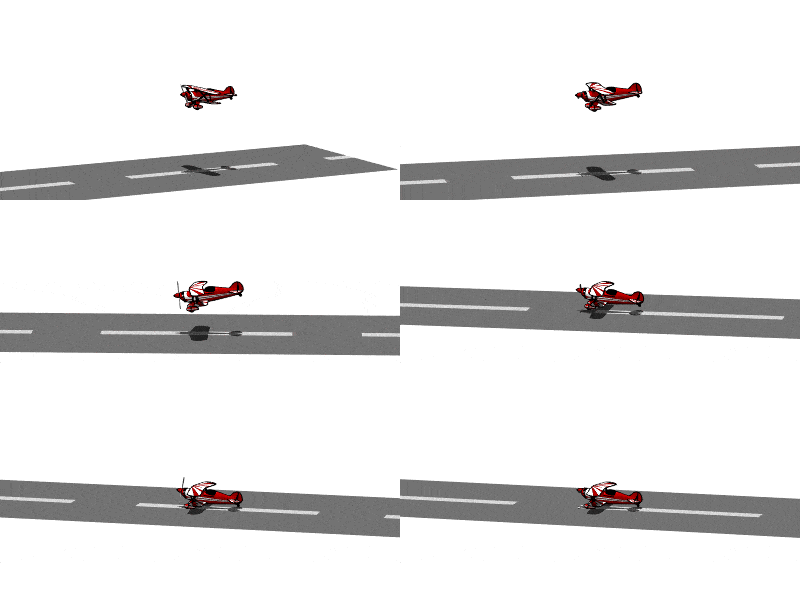
هبطت طائرة على سطح مدرج ولامست الأرض بسرعة \(50\,m/s\)، متحركة بتسارع تباطؤ ثابت، وتوقفت تمامًا على بعد \(700\,m\). كم كانت سرعتها بعد أن تحركت على المدرج مسافة \(500\,m\)؟A plane lands, touching down at \(50\,m/s\) with constant deceleration, and stops completely after \(700\,m\). What was its speed after traveling \(500\,m\) on the runway?
.....................................................................
الحلSolution
📌 نحسب التسارع الثابت لكامل الرحلة (vf=0, vi=50, Δx=700): \(0^2=50^2+2a(700)\Rightarrow a=\dfrac{-2500}{1400}\approx-1.79\,m/s^2\)
📌 نحسب السرعة بعد 500م: \(v_f=\sqrt{50^2+2(-1.79)(500)}\approx\sqrt{714}\approx26.7\,m/s\)
✅ v ≈ 26.7 m/s
📌 Find the constant acceleration for the whole trip (vf=0, vi=50, Δx=700): \(a=\dfrac{-2500}{1400}\approx-1.79\,m/s^2\)
📌 Find the speed after 500m: \(v_f=\sqrt{50^2+2(-1.79)(500)}\approx26.7\,m/s\)
✅ v ≈ 26.7 m/s
\[4\,\star\star\]
قُذفت كرة من سطح الأرض بسرعة ابتدائية مقدارها \(20\,m/s\). احسب سرعة الكرة عند منتصف أقصى ارتفاع (بإهمال مقاومة الهواء، \(g=9.81\,m/s^2\)).A ball is thrown from the ground with an initial speed of \(20\,m/s\). Calculate the ball's speed at half of its maximum height (neglecting air resistance, \(g=9.81\,m/s^2\)).
.....................................................................
الحلSolution
📌 أولًا نحسب أقصى ارتفاع (vf=0 عنده): \(0^2=20^2-2(9.81)h\Rightarrow h=\dfrac{400}{19.62}\approx20.4\,m\)
📌 منتصف أقصى ارتفاع: \(h/2\approx10.2\,m\)
📌 السرعة عند h/2: \(v_f=\sqrt{20^2-2(9.81)(10.2)}\approx\sqrt{199.9}\approx14.1\,m/s\)
✅ v ≈ 14.1 m/s
📌 First find max height (vf=0 there): \(h=\dfrac{400}{19.62}\approx20.4\,m\)
📌 Half of max height: \(h/2\approx10.2\,m\)
📌 Speed at h/2: \(v_f=\sqrt{20^2-2(9.81)(10.2)}\approx14.1\,m/s\)
✅ v ≈ 14.1 m/s
\[5\,\star\star\star\]
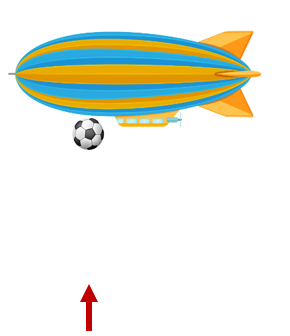
منطاد يقف ساكنًا على ارتفاع \(40\,m\) من سطح الأرض، تُركت منه كرة لتسقط سقوطًا حرًا رأسيًا. وبنفس اللحظة التي تُركت بها الكرة، أُطلق سهم من سطح الأرض رأسيًا نحو الكرة بسرعة \(30\,m/s\). عند أي ارتفاع تلتقي الكرة والسهم؟A balloon hovers stationary at \(40\,m\) above the ground. A ball is released from it to fall freely. At the same instant, an arrow is shot vertically upward from the ground at \(30\,m/s\). At what height do the ball and arrow meet?
.....................................................................
الحلSolution
📌 معادلتا الموقع (الأصل عند سطح الأرض): الكرة: \(Y_1(t)=h_0-\tfrac12gt^2=40-4.905t^2\)؛ السهم: \(Y_2(t)=v_0t-\tfrac12gt^2=30t-4.905t^2\)
📌 عند الالتقاء \(Y_1=Y_2\): حدّا \(-4.905t^2\) يتلاشيان من الطرفين، فيتبقى \(40=30t\Rightarrow t\approx1.33\,s\)
📌 ارتفاع اللقاء: \(Y_1(1.33)=40-4.905(1.33)^2\approx31.3\,m\)
✅ الالتقاء عند ارتفاع ≈ 31.3 m، بعد t ≈ 1.33 s
📌 Position equations (origin at ground): ball: \(Y_1(t)=40-4.905t^2\); arrow: \(Y_2(t)=30t-4.905t^2\)
📌 At the meeting point \(Y_1=Y_2\): the \(-4.905t^2\) terms cancel on both sides, leaving \(40=30t\Rightarrow t\approx1.33\,s\)
📌 Meeting height: \(Y_1(1.33)\approx31.3\,m\)
✅ They meet at height ≈ 31.3 m, after t ≈ 1.33 s
لاحظت خطأ؟ أو عندك سؤال عن أحد الأسئلة؟ اكتبه بالتعليقات وحدد رقم السؤال بالضبط.
Noticed an error? Or have a question about one of the questions? Write it in the comments and specify the exact question number.