📐 بنك الأسئلة: الإزاحة والقوة في بعدين
📐 Question Bank: Displacement and Force in Two Dimensions
تحليل المتجهات، الجمع الرسومي والتحليلي، محصلة القوى والإزاحات في بعدين
Vector Analysis, Graphical and Analytical Addition, Resultant Forces and Displacements in Two Dimensions
⏱️ 39 سؤال اختيار من متعدد بتصحيح فوري، و7 مسائل محلولة بالكامل⏱️ 39 multiple-choice questions with instant feedback, plus 7 fully-solved problems
\[1\,\star\]
أحد الكميات الفيزيائية التالية هي كمية قياسيةOne of the following physical quantities is a scalar quantity
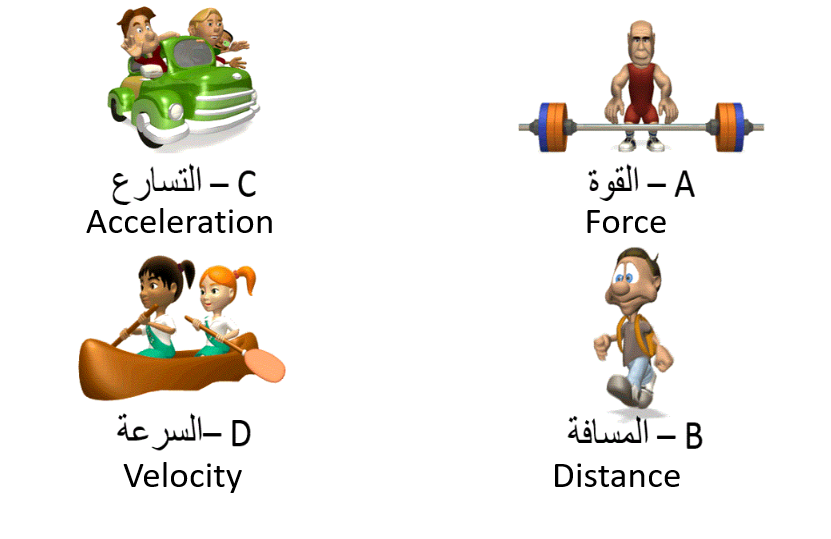
القوةForce
المسافةDistance
التسارعAcceleration
السرعةVelocity
الحلSolution
📌 الفكرة: الكمية القياسية لها مقدار فقط بلا اتجاه. المسافة (الطول الكلي المقطوع) كمية قياسية، بينما القوة والتسارع والسرعة كميات متجهة (تحتاج مقدارًا واتجاهًا).
✅ المسافة
📌 Idea: A scalar quantity has magnitude only, no direction. Distance (total path length) is scalar, while force, acceleration, and velocity are vectors (need magnitude and direction).
✅ Distance
\[2\,\star\]
القوة تعتبر من الكميات الفيزيائية المتجهة وتتحدد بمعرفةForce is a vector physical quantity and is determined by knowing

اتجاهها فقطIts direction only
مقدارها فقطIts magnitude only
وحدة قياسهاIts unit of measurement
مقدارها واتجاههاIts magnitude and direction
الحلSolution
📌 تعريف الكمية المتجهة: لتحديد أي كمية متجهة (كالقوة) تحديدًا كاملاً، يجب معرفة كل من مقدارها واتجاهها معًا؛ المقدار وحده أو الاتجاه وحده لا يكفي.
✅ مقدارها واتجاهها
📌 Definition of a vector quantity: To fully specify any vector quantity (like force), both its magnitude and direction must be known together; either alone is insufficient.
✅ Its magnitude and direction
\[3\,\star\]
في الشبكة أدناه مجموعة من المتجهات أبعادها حقيقية، أحد العبارات التالية صحيحةIn the grid below, a set of vectors are drawn to true scale. Which of the following statements is correct?

\(\vec A=\vec E\)\(\vec A=\vec E\)
\(\vec C=\vec B\)\(\vec C=\vec B\)
\(\vec A=\vec D\)\(\vec A=\vec D\)
\(\vec F=\vec B\)\(\vec F=\vec B\)
الحلSolution
📌 تساوي المتجهات: متجهان متساويان إذا وفقط إذا كان لهما المقدار نفسه والاتجاه نفسه تمامًا. بقراءة الشبكة، \(\vec A\) و\(\vec D\) لهما نفس الطول ونفس الاتجاه بالضبط.
✅ \(\vec A=\vec D\)
📌 Equal vectors: Two vectors are equal only if they have the exact same magnitude and the exact same direction. Reading the grid, \(\vec A\) and \(\vec D\) have the same length and exactly the same direction.
✅ \(\vec A=\vec D\)
\[4\,\star\]
أربعة متجهات \(A,B,C,D\) مقاديرها واتجاهها موضحة في الشكل أدناه. أي من الطرق التالية تبين محصلة المتجهات بالرسم \(\vec A+\vec B+\vec C+\vec D=?\)Four vectors \(A,B,C,D\) with magnitudes and directions shown below. Which of the following graphical methods correctly shows the resultant \(\vec A+\vec B+\vec C+\vec D=?\)

الشكل 1Figure 1
الشكل 2Figure 2
الشكل 3Figure 3
جميع ما سبقAll of the above
الحلSolution
📌 خاصية الجمع الاتجاهي: جمع المتجهات تبادلي وتجميعي؛ يمكن ترتيب المتجهات (رأسًا لذيل) بأي ترتيب وسنحصل دائمًا على نفس المحصلة النهائية، لذا فإن جميع الطرق الرسومية الصحيحة تعطي نفس النتيجة.
✅ جميع ما سبق
📌 Property of vector addition: Vector addition is commutative and associative; the vectors can be arranged tip-to-tail in any order and will always give the same final resultant, so all correct graphical methods yield the same result.
✅ All of the above
\[5\,\star\star\]
صندوق تم التأثير عليه بقوتين \(F_1=50\,N\) نحو الشرق، \(F_2=30\,N\) نحو الشمال. فإن محصلة القوى المؤثرة على الصندوق تعادلA box is acted on by two forces \(F_1=50\,N\) east and \(F_2=30\,N\) north. The resultant force on the box equals
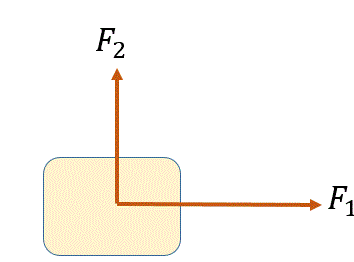
\(F_{net}=80\,N,\;\theta=20^0\)شمال الشرق\(F_{net}=80\,N,\;\theta=20^0\) north of east
\(F_{net}=58.3\,N,\;\theta=30.9^0\)شمال الشرق\(F_{net}=58.3\,N,\;\theta=30.9^0\) north of east
\(F_{net}=65.4\,N,\;\theta=69.9^0\)شرق الشمال\(F_{net}=65.4\,N,\;\theta=69.9^0\) east of north
\(F_{net}=75.2\,N,\;\theta=33.8^0\)شرق الشمال\(F_{net}=75.2\,N,\;\theta=33.8^0\) east of north
الحلSolution
📌 القوتان متعامدتان: \(F_{net}=\sqrt{50^2+30^2}=\sqrt{3400}\approx58.3\,N\)
📌 الاتجاه (من الشرق نحو الشمال): \(\theta=\arctan(30/50)\approx30.9^0\) شمال الشرق
✅ \(F_{net}\approx58.3\,N,\;\theta\approx30.9^0\) شمال الشرق
📌 The two forces are perpendicular: \(F_{net}=\sqrt{50^2+30^2}=\sqrt{3400}\approx58.3\,N\)
📌 Direction (from east toward north): \(\theta=\arctan(30/50)\approx30.9^0\) north of east
✅ \(F_{net}\approx58.3\,N\) at \(30.9^0\) north of east
\[6\,\star\]
متجهان مقدار كل منهما هو طول المتجه، واتجاه كل منهما موضح في الشكل أدناه. أحد الإجابات التالية تعبر بشكل صحيح عن محصلة المتجهينTwo vectors, each with magnitude equal to its drawn length, with directions shown below. Which of the following correctly represents their resultant?

الشكل 1Figure 1
الشكل 2Figure 2
الشكل 3Figure 3
الشكل 4Figure 4
الحلSolution
📌 قاعدة متوازي الأضلاع / رأس لذيل: محصلة متجهين تُرسم بوضع ذيل الثاني عند رأس الأول ثم رسم متجه من ذيل الأول إلى رأس الثاني، بنفس مقداري واتجاهي المتجهين الأصليين دون تغيير.
✅ الشكل 3
📌 Parallelogram / tip-to-tail rule: The resultant of two vectors is drawn by placing the tail of the second at the tip of the first, then drawing a vector from the tail of the first to the tip of the second, preserving both original magnitudes and directions.
✅ Figure 3
\[7\,\star\star\]
تحركت أحمد نحو الغرب مسافة \(60\,m\)، ثم غيّر اتجاهه وتحرك مسافة قدرها \(80\,m\) نحو الجنوب. فإن محصلة الإزاحتين تعادلAhmed moved \(60\,m\) west, then changed direction and moved \(80\,m\) south. The resultant of the two displacements equals

\(R=110\,m,\;\theta=53.1^0\)غرب الجنوب\(R=110\,m,\;\theta=53.1^0\) west of south
\(R=120\,m,\;\theta=53.1^0\)غرب الجنوب\(R=120\,m,\;\theta=53.1^0\) west of south
\(R=140\,m,\;\theta=35.3^0\)جنوب الغرب\(R=140\,m,\;\theta=35.3^0\) south of west
\(R=100\,m,\;\theta=53.1^0\)جنوب الغرب\(R=100\,m,\;\theta=53.1^0\) south of west
الحلSolution
📌 الساقان متعامدتان (مثلث 6-8-10): \(R=\sqrt{60^2+80^2}=\sqrt{10000}=100\,m\)
📌 الاتجاه (من الغرب نحو الجنوب): \(\theta=\arctan(80/60)\approx53.1^0\) جنوب الغرب
✅ \(R=100\,m\) بزاوية \(53.1^0\) جنوب الغرب
📌 The two legs are perpendicular (6-8-10 triangle): \(R=\sqrt{60^2+80^2}=\sqrt{10000}=100\,m\)
📌 Direction (from west toward south): \(\theta=\arctan(80/60)\approx53.1^0\) south of west
✅ \(R=100\,m\) at \(53.1^0\) south of west
\[8\,\star\star\]
يتحرك ماجد نحو الشرق مسافة \(50\,m\)، ثم غيّر اتجاهه وتحرك نحو الجنوب مسافة \(40\,m\). أوجد محصلة الإزاحةMajid moves \(50\,m\) east, then changes direction and moves \(40\,m\) south. Find the resultant displacement

\(X=77\,m,\;\theta=51.33^0\)شرق الجنوب\(X=77\,m,\;\theta=51.33^0\) east of south
\(X=73\,m,\;\theta=45.46^0\)جنوب الشرق\(X=73\,m,\;\theta=45.46^0\) south of east
\(X=64\,m,\;\theta=38.66^0\)جنوب الشرق\(X=64\,m,\;\theta=38.66^0\) south of east
\(X=90\,m,\;\theta=38.66^0\)شرق الجنوب\(X=90\,m,\;\theta=38.66^0\) east of south
الحلSolution
📌 الساقان متعامدتان: \(X=\sqrt{50^2+40^2}=\sqrt{4100}\approx64\,m\)
📌 الاتجاه (من الشرق نحو الجنوب): \(\theta=\arctan(40/50)\approx38.66^0\) جنوب الشرق
✅ \(X\approx64\,m\) بزاوية \(38.66^0\) جنوب الشرق
📌 The two legs are perpendicular: \(X=\sqrt{50^2+40^2}=\sqrt{4100}\approx64\,m\)
📌 Direction (from east toward south): \(\theta=\arctan(40/50)\approx38.66^0\) south of east
✅ \(X\approx64\,m\) at \(38.66^0\) south of east
\[9\,\star\star\star\]
من خلال الشكل أدناه لدينا إزاحتان \(\vec A=3\,m,\vec B=5\,m\)، ويصنع المتجه \(B\) مع المحور \(X\) الموجب زاوية قدرها \(\theta=53.1^0\) (و\(A\) واقع على المحور \(X\)). أوجد محصلة الإزاحة \(\vec R=\vec A+\vec B\) وحدد الزاوية بين المحصلة والمتجه \(\vec A\)From the figure, two displacements \(\vec A=3\,m,\vec B=5\,m\), with \(B\) making \(\theta=53.1^0\) with the positive \(X\)-axis (\(A\) lies on the \(X\)-axis). Find the resultant \(\vec R=\vec A+\vec B\) and the angle between the resultant and \(\vec A\)

\(R=7.2\,m,\;\alpha=33.7^0\)\(R=7.2\,m,\;\alpha=33.7^0\)
\(R=8.4\,m,\;\alpha=24.3^0\)\(R=8.4\,m,\;\alpha=24.3^0\)
\(R=9.1\,m,\;\alpha=14.8^0\)\(R=9.1\,m,\;\alpha=14.8^0\)
\(R=11.4\,m,\;\alpha=23.1^0\)\(R=11.4\,m,\;\alpha=23.1^0\)
الحلSolution
📌 بطريقة جيب التمام (الزاوية بين \(A\) و\(B\) تساوي \(53.1^0\)): \(R^2=3^2+5^2+2(3)(5)\cos53.1^0=9+25+30(0.6)=52\Rightarrow R\approx7.21\,m\)
📌 الزاوية بين \(R\) و\(A\) (بطريقة جيب الزاوية): \(\dfrac{\sin\alpha}{5}=\dfrac{\sin53.1^0}{7.21}\Rightarrow\sin\alpha\approx0.555\Rightarrow\alpha\approx33.7^0\)
✅ \(R\approx7.2\,m\)، والزاوية بين \(R\) و\(A\) \(\approx33.7^0\)
📌 Law of cosines (angle between \(A\) and \(B\) is \(53.1^0\)): \(R^2=3^2+5^2+2(3)(5)\cos53.1^0=52\Rightarrow R\approx7.21\,m\)
📌 Angle between \(R\) and \(A\) (law of sines): \(\sin\alpha=\dfrac{5\times0.8}{7.21}\approx0.555\Rightarrow\alpha\approx33.7^0\)
✅ \(R\approx7.2\,m\), angle between \(R\) and \(A\) \(\approx33.7^0\)
\[10\,\star\]
متجه قوة \(F=60\,N\) ويصنع المتجه زاوية قدرها \(\theta=30^0\) جنوب الغرب، فإن مركبتي القوة على المحاور المتعامدة تعادلA force vector \(F=60\,N\) makes an angle of \(\theta=30^0\) south of west. The force components on the perpendicular axes equal

\(F_X=-51.96\,N,\;F_Y=-30\,N\)\(F_X=-51.96\,N,\;F_Y=-30\,N\)
\(F_X=-45.36\,N,\;F_Y=-18.2\,N\)\(F_X=-45.36\,N,\;F_Y=-18.2\,N\)
\(F_X=41.58\,N,\;F_Y=54.3\,N\)\(F_X=41.58\,N,\;F_Y=54.3\,N\)
\(F_X=-42.64\,N,\;F_Y=40.7\,N\)\(F_X=-42.64\,N,\;F_Y=40.7\,N\)
الحلSolution
📌 الزاوية من المحور \(X\) الموجب: جنوب الغرب بزاوية \(30^0\) عن الغرب تعني زاوية \(210^0\) من المحور \(X\) الموجب (الغرب \(180^0\) زائد \(30^0\) نحو الجنوب).
✅ \(F_X=-51.96\,N,\;F_Y=-30\,N\)
📌 Angle from the positive \(X\)-axis: \(30^0\) south of west means an angle of \(210^0\) from the positive \(X\)-axis (west \(=180^0\) plus \(30^0\) toward south).
✅ \(F_X=-51.96\,N,\;F_Y=-30\,N\)
\[11\,\star\]
ثلاث متجهات كما في الشكل، أحد العبارات التالية صحيحةThree vectors as shown in the figure. Which of the following statements is correct?

\(\vec B=\vec C+\vec A\)\(\vec B=\vec C+\vec A\)
\(\vec A=\vec C+\vec B\)\(\vec A=\vec C+\vec B\)
\(\vec C=\vec A+\vec B\)\(\vec C=\vec A+\vec B\)
\(\vec A+\vec C+\vec B=0\)\(\vec A+\vec C+\vec B=0\)
الحلSolution
📌 قراءة المثلث رأسًا لذيل: بمتابعة اتجاهات المتجهات الثلاثة في الشكل، يتضح أن \(\vec A\) و\(\vec C\) متتاليان رأسًا لذيل ومحصلتهما تساوي \(\vec B\).
✅ \(\vec B=\vec C+\vec A\)
📌 Reading the tip-to-tail triangle: Following the directions of the three vectors in the figure, \(\vec A\) and \(\vec C\) are placed tip-to-tail and their resultant equals \(\vec B\).
✅ \(\vec B=\vec C+\vec A\)
\[12\,\star\]
ثلاث متجهات كما في الشكل، أحد العبارات التالية صحيحةThree vectors as shown in the figure. Which of the following statements is correct?

\(\vec B=\vec C+\vec A\)\(\vec B=\vec C+\vec A\)
\(\vec A=\vec C+\vec B\)\(\vec A=\vec C+\vec B\)
\(\vec C=\vec A+\vec B\)\(\vec C=\vec A+\vec B\)
\(\vec A+\vec C+\vec B=0\)\(\vec A+\vec C+\vec B=0\)
الحلSolution
📌 مثلث متجهات مغلق: في هذا الشكل تُشكّل المتجهات الثلاثة مثلثًا مغلقًا (رأس الأخير يعود لذيل الأول)، وهذا يعني أن محصلتها معًا تساوي الصفر.
✅ \(\vec A+\vec C+\vec B=0\)
📌 Closed vector triangle: In this figure the three vectors form a closed triangle (the tip of the last returns to the tail of the first), meaning their combined resultant is zero.
✅ \(\vec A+\vec C+\vec B=0\)
\[13\,\star\]
متجهان الأول مقداره 15 والثاني مقداره 10. أحد الإجابات التالية لا يمكن أن يكون محصلة المتجهينTwo vectors, the first has magnitude 15 and the second 10. Which of the following CANNOT be the magnitude of their resultant?
R=20R=20
R=5R=5
R=4R=4
R=25R=25
الحلSolution
📌 مدى محصلة متجهين: مقدار محصلة متجهين يتراوح دائمًا بين الفرق المطلق للمقدارين (عند التعاكس التام) ومجموعهما (عند التوافق التام): \(|15-10|\le R\le15+10\Rightarrow5\le R\le25\).
📌 الفحص: القيمة \(R=4\) أقل من الحد الأدنى الممكن \(5\)، فهي وحدها غير ممكنة؛ أما \(5,20,25\) جميعها ضمن المدى المسموح.
✅ R=4 (غير ممكنة)
📌 Range of the resultant of two vectors: The resultant magnitude always lies between the absolute difference of the two magnitudes (fully opposite) and their sum (fully aligned): \(|15-10|\le R\le15+10\Rightarrow5\le R\le25\).
📌 Checking: \(R=4\) is below the minimum possible value of \(5\), so it alone is impossible; \(5,20,25\) are all within the allowed range.
✅ R=4 (not possible)
\[14\,\star\star\star\]
مثلث متجهات كما في الشكل، قيم المتجهات موضحة على الشكل أدناه، فإن الزاوية \(\theta=?\) تعادلA vector triangle as shown, with vector values given in the figure. The angle \(\theta=?\) equals

\(\theta=140^0\)\(\theta=140^0\)
\(\theta=110^0\)\(\theta=110^0\)
\(\theta=130^0\)\(\theta=130^0\)
\(\theta=120^0\)\(\theta=120^0\)
الحلSolution
📌 بتطبيق قانون جيب التمام على مثلث المتجهات: باستخدام أطوال أضلاع المثلث الثلاثة الموضحة في الشكل وحل قانون جيب التمام لإيجاد الزاوية المقابلة، ينتج \(\cos\theta\) الذي يعطي \(\theta=120^0\).
✅ \(\theta=120^0\)
📌 Applying the law of cosines to the vector triangle: Using the three side lengths shown in the figure and solving the law of cosines for the opposite angle gives \(\cos\theta\) corresponding to \(\theta=120^0\).
✅ \(\theta=120^0\)
\[15\,\star\]
يُحلَّل متجه إلى مركبتين كما في الشكل أدناه، فكانت قيم المركبات \(A_X=6,A_Y=5\). فإن مقدار المتجه يعادلA vector is resolved into two components as shown, with \(A_X=6,A_Y=5\). The magnitude of the vector equals

A=8.9A=8.9
A=11A=11
A=7.8A=7.8
A=10.2A=10.2
الحلSolution
📌 نظرية فيثاغورس: \(A=\sqrt{A_X^2+A_Y^2}=\sqrt{6^2+5^2}=\sqrt{61}\approx7.8\)
✅ A≈7.8
📌 Pythagorean theorem: \(A=\sqrt{6^2+5^2}=\sqrt{61}\approx7.8\)
✅ A≈7.8
\[16\,\star\]
أربعة متجهات \(A,B,C,D\) موجودة على الشبكة أدناه. أحد المتجهات عند تحليلها مركبتها الرأسية على المحور \(Y\) معدومةFour vectors \(A,B,C,D\) are shown on the grid below. One of them has zero vertical (\(Y\)) component when resolved

AA
BB
CC
DD
الحلSolution
📌 المركبة الرأسية المعدومة: المتجه الذي مركبته الرأسية معدومة هو المتجه الأفقي بالكامل (موازٍ للمحور \(X\))؛ بقراءة الشبكة، هذا هو المتجه \(C\).
✅ C
📌 Zero vertical component: The vector with zero vertical component is the one lying entirely horizontal (parallel to the \(X\)-axis); reading the grid, this is vector \(C\).
✅ C
\[17\,\star\star\]
أثّرت قوتان على جسم، مركبات كل قوة موضحة في الشكل أدناه. باستخدام الشكل فإن محصلة القوتين واتجاه المحصلة تعادلTwo forces act on a body, with each force's components shown below. Using the figure, the resultant of the two forces and its direction equal

\(F_{net}=6.3\,N,\;\theta=54.2^0\)\(F_{net}=6.3\,N,\;\theta=54.2^0\)
\(F_{net}=8.4\,N,\;\theta=28.4^0\)\(F_{net}=8.4\,N,\;\theta=28.4^0\)
\(F_{net}=9.5\,N,\;\theta=71.6^0\)\(F_{net}=9.5\,N,\;\theta=71.6^0\)
\(F_{net}=10.8\,N,\;\theta=38.8^0\)\(F_{net}=10.8\,N,\;\theta=38.8^0\)
الحلSolution
📌 جمع المركبات (من الشكل): بجمع مركبات القوتين على المحورين \(X\) و\(Y\) من الشكل، ثم تطبيق \(F_{net}=\sqrt{F_X^2+F_Y^2}\) و\(\theta=\arctan(F_Y/F_X)\)، ينتج \(F_{net}\approx9.5\,N\) بزاوية \(\approx71.6^0\).
✅ \(F_{net}\approx9.5\,N\) بزاوية \(71.6^0\)
📌 Summing components (from the figure): Summing the two forces' \(X\) and \(Y\) components from the figure, then applying \(F_{net}=\sqrt{F_X^2+F_Y^2}\) and \(\theta=\arctan(F_Y/F_X)\), gives \(F_{net}\approx9.5\,N\) at \(\approx71.6^0\).
✅ \(F_{net}\approx9.5\,N\) at \(71.6^0\)
\[18\,\star\]
قوتان مقدار كل منهما \(50\,N\) أثّرتا على صندوق بطرق مختلفة. رتّب مقدار محصلة القوة الناتجة من الأصغر إلى الأكبرTwo forces, each of magnitude \(50\,N\), act on a box in different configurations. Rank the resulting force magnitude from smallest to largest

C > B > A > DC > B > A > D
A > C > B > DA > C > B > D
B > C > D > AB > C > D > A
A > D > B > CA > D > B > C
الحلSolution
📌 قاعدة الزاوية بين قوتين متساويتين: محصلة قوتين متساويتي المقدار \(F\) بزاوية \(\phi\) بينهما تُعطى بـ \(F_{net}=2F\cos(\phi/2)\): كلما صغرت الزاوية بينهما زادت المحصلة، وكلما اقتربت من \(180^0\) قلّت (وتصل للصفر عند التعاكس التام).
📌 الترتيب حسب زوايا الحالات الأربع في الشكل: بتطبيق القاعدة على زوايا الحالات \(A,B,C,D\) الموضحة، ينتج الترتيب من الأصغر إلى الأكبر: \(C>B>A>D\).
✅ C > B > A > D
📌 Rule for the angle between two equal forces: The resultant of two equal-magnitude forces \(F\) separated by angle \(\phi\) is \(F_{net}=2F\cos(\phi/2)\): the smaller the angle between them, the larger the resultant, and as it approaches \(180^0\) the resultant shrinks (reaching zero when fully opposite).
📌 Ranking by the angle of each case in the figure: Applying the rule to the angles of cases \(A,B,C,D\) shown gives the order from smallest to largest: \(C>B>A>D\).
✅ C > B > A > D
\[19\,\star\star\star\]
انطلق طالب من المدرسة باتجاه الشرق وقطع مسافة قدرها \(120\,m\)، ثم غيّر اتجاهه وانحرف بزاوية قدرها \(40^0\) شمال الشرق وقطع مسافة قدرها \(90\,m\) حتى وصل إلى المنزل. فإن الإزاحة المقطوعة تعادلA student set out from school heading east and covered \(120\,m\), then changed direction by \(40^0\) north of east and covered \(90\,m\) until reaching home. The displacement covered equals

\(d=210\,m,\;\theta=35^0\)شمال الشرق\(d=210\,m,\;\theta=35^0\) north of east
\(d=157.8\,m,\;\theta=23^0\)شرق الشمال\(d=157.8\,m,\;\theta=23^0\) east of north
\(d=197.6\,m,\;\theta=17^0\)شمال الشرق\(d=197.6\,m,\;\theta=17^0\) north of east
\(d=167.3\,m,\;\theta=45^0\)شرق الشمال\(d=167.3\,m,\;\theta=45^0\) east of north
الحلSolution
📌 تحليل الساقين إلى مركبات: الساق الأولى: \((120,0)\). الساق الثانية بزاوية \(40^0\) عن الشرق: \((90\cos40^0,90\sin40^0)\approx(68.9,57.9)\)
📌 جمع المركبات والمقدار: \(R_x\approx188.9,\;R_y\approx57.9\Rightarrow d=\sqrt{188.9^2+57.9^2}\approx197.6\,m\)
📌 الاتجاه: \(\theta=\arctan(57.9/188.9)\approx17^0\) شمال الشرق
✅ \(d\approx197.6\,m\) بزاوية \(17^0\) شمال الشرق
📌 Resolving both legs into components: First leg: \((120,0)\). Second leg at \(40^0\) from east: \((90\cos40^0,90\sin40^0)\approx(68.9,57.9)\)
📌 Summing components and magnitude: \(R_x\approx188.9,\;R_y\approx57.9\Rightarrow d\approx197.6\,m\)
📌 Direction: \(\theta=\arctan(57.9/188.9)\approx17^0\) north of east
✅ \(d\approx197.6\,m\) at \(17^0\) north of east
\[20\,\star\star\]
مكعب خشبي كتلته \(30\,kg\) وُضع على مستوى أفقي خشن. أثّرت به قوة تميل فوق الأفق بزاوية قدرها \(30^0\) ومقدارها \(400\,N\). فإن قيمة القوة المتعامدة تعادلA wooden block of mass \(30\,kg\) is on a rough horizontal surface. A \(400\,N\) force acts on it at \(30^0\) above the horizontal. The normal force equals

\(F_N=294.3\,N\)\(F_N=294.3\,N\)
\(F_N=94.3\,N\)\(F_N=94.3\,N\)
\(F_N=157.4\,N\)\(F_N=157.4\,N\)
\(F_N=135.4\,N\)\(F_N=135.4\,N\)
الحلSolution
📌 توازن رأسي (المركبة الرأسية للقوة تجذب الجسم للأعلى): \(F_N=mg-F\sin30^0=30(9.81)-400(0.5)=294.3-200=94.3\,N\)
✅ \(F_N=94.3\,N\)
📌 Vertical equilibrium (the force's vertical component pulls the block upward): \(F_N=mg-F\sin30^0=294.3-200=94.3\,N\)
✅ \(F_N=94.3\,N\)
\[21\,\star\star\]
في الشكل أدناه جسم وُضع على مستوى أفقي خشن. أثّرت عليه قوة شد مقدارها \(20\,N\) تميل فوق الأفق بزاوية \(30^0\) فتحرك الجسم. فإن محصلة القوى على المحور \(X\) تعادلA body on a rough horizontal surface is pulled by a \(20\,N\) force at \(30^0\) above horizontal and moves. The net force on the \(X\)-axis equals

\(\sum F_X=10\,N\)\(\sum F_X=10\,N\)
\(\sum F_X=2.4\,N\)\(\sum F_X=2.4\,N\)
\(\sum F_X=7.3\,N\)\(\sum F_X=7.3\,N\)
\(\sum F_X=9.6\,N\)\(\sum F_X=9.6\,N\)
الحلSolution
📌 من الشكل (الاحتكاك الحركي \(F_K=10\,N\)): \(\sum F_X=F\cos30^0-F_K=20(0.866)-10=17.3-10\approx7.3\,N\)
✅ \(\sum F_X\approx7.3\,N\)
📌 From the figure (kinetic friction \(F_K=10\,N\)): \(\sum F_X=20\cos30^0-10\approx7.3\,N\)
✅ \(\sum F_X\approx7.3\,N\)
\[22\,\star\star\]
في الشكل أدناه جسم وزنه \(26\,N\) وُضع على مستوى أفقي خشن. أثّرت عليه قوة شد مقدارها \(20\,N\) تميل فوق الأفق بزاوية \(30^0\). فإذا كانت قوة الاحتكاك الحركي \(10\,N\)، فإن معامل الاحتكاك الحركي يعادلA body weighing \(26\,N\) on a rough horizontal surface is pulled by a \(20\,N\) force at \(30^0\) above horizontal. If the kinetic friction force is \(10\,N\), the coefficient of kinetic friction equals

\(\mu_K=0.43\)\(\mu_K=0.43\)
\(\mu_K=0.625\)\(\mu_K=0.625\)
\(\mu_K=0.542\)\(\mu_K=0.542\)
\(\mu_K=0.384\)\(\mu_K=0.384\)
الحلSolution
📌 القوة العمودية أولًا: \(F_N=F_g-F\sin30^0=26-20(0.5)=16\,N\)
📌 معامل الاحتكاك الحركي: \(\mu_K=\dfrac{F_K}{F_N}=\dfrac{10}{16}=0.625\)
✅ \(\mu_K=0.625\)
📌 Normal force first: \(F_N=26-10=16\,N\)
📌 Coefficient of kinetic friction: \(\mu_K=\dfrac{10}{16}=0.625\)
✅ \(\mu_K=0.625\)
\[23\,\star\star\]
ثلاث قوى متلاقية أثّرت على جسم كما في الشكل أدناه. فإن محصلة القوى على المحور الأفقي وعلى المحور الرأسي تعادلThree concurrent forces act on a body as shown. The net force on the horizontal axis and vertical axis equal

\(F_X=-131.2\,N,\;F_Y=-10\,N\)\(F_X=-131.2\,N,\;F_Y=-10\,N\)
\(F_X=11.2\,N,\;F_Y=-40\,N\)\(F_X=11.2\,N,\;F_Y=-40\,N\)
\(F_X=91.2\,N,\;F_Y=40\,N\)\(F_X=91.2\,N,\;F_Y=40\,N\)
\(F_X=-0\,N,\;F_Y=0\,N\)\(F_X=-0\,N,\;F_Y=0\,N\)
الحلSolution
📌 تحليل القوى الثلاث (\(F_1=50\,[email protected]^0,\;F_2=41.2\,N@194^0,\;F_3=40\,N\) للأسفل): \(F_{1x}\approx40.0,\;F_{2x}\approx-40.0\Rightarrow\sum F_X\approx0\). \(F_{1y}\approx30.0,\;F_{2y}\approx10.0,\;F_{3y}=-40\Rightarrow\sum F_Y\approx0\)
📌 الاستنتاج: الجسم في حالة اتزان تام؛ القوى الثلاث تلغي بعضها تمامًا في كلا الاتجاهين.
✅ \(\sum F_X\approx0,\;\sum F_Y\approx0\)
📌 Resolving the three forces (\(F_1=50\,[email protected]^0,\;F_2=41.2\,N@194^0,\;F_3=40\,N\) down): \(F_{1x}\approx40.0,\;F_{2x}\approx-40.0\Rightarrow\sum F_X\approx0\). \(F_{1y}\approx30.0,\;F_{2y}\approx10.0,\;F_{3y}=-40\Rightarrow\sum F_Y\approx0\)
📌 Conclusion: The body is in complete equilibrium; the three forces exactly cancel in both directions.
✅ \(\sum F_X\approx0,\;\sum F_Y\approx0\)
\[24\,\star\star\]
جسم وُضع على قمة مستوى مائل أملس يميل على الأفق بزاوية \(20^0\). فإن التسارع الذي يتحرك به الجسم يعادلA body is placed at the top of a smooth (frictionless) incline at \(20^0\) to the horizontal. The acceleration with which it moves equals

\(a=6.43\,m/s^2\)\(a=6.43\,m/s^2\)
\(a=3.35\,m/s^2\)\(a=3.35\,m/s^2\)
\(a=4.25\,m/s^2\)\(a=4.25\,m/s^2\)
\(a=5.75\,m/s^2\)\(a=5.75\,m/s^2\)
الحلSolution
📌 مستوى أملس (بلا احتكاك): \(a=g\sin\theta=9.81\times\sin20^0=9.81\times0.342\approx3.35\,m/s^2\)
✅ \(a\approx3.35\,m/s^2\)
📌 Smooth (frictionless) incline: \(a=g\sin20^0=9.81\times0.342\approx3.35\,m/s^2\)
✅ \(a\approx3.35\,m/s^2\)
\[25\,\star\]
أثّرت قوتان على جسم: \(F_1=30\,N\) نحو الشرق، \(F_2=40\,N\) نحو الشمال. فإن محصلة القوتين واتجاهها يعادلTwo forces act on a body: \(F_1=30\,N\) east, \(F_2=40\,N\) north. The resultant force and its direction equal
\(F_{net}=50\,N,\;\theta=53.1^0\)شمال الشرق\(F_{net}=50\,N\) at \(53.1^0\) north of east
\(F_{net}=70\,N,\;\theta=36.9^0\)شمال الشرق\(F_{net}=70\,N\) at \(36.9^0\) north of east
\(F_{net}=50\,N,\;\theta=36.9^0\)شمال الشرق\(F_{net}=50\,N\) at \(36.9^0\) north of east
\(F_{net}=60\,N,\;\theta=45^0\)شمال الشرق\(F_{net}=60\,N\) at \(45^0\) north of east
الحلSolution
📌 القوتان متعامدتان (مثلث 3-4-5×10): \(F_{net}=\sqrt{30^2+40^2}=\sqrt{2500}=50\,N\)
📌 الاتجاه: \(\theta=\arctan(40/30)\approx53.1^0\) شمال الشرق
✅ \(F_{net}=50\,N\) بزاوية \(53.1^0\) شمال الشرق
📌 The forces are perpendicular (3-4-5×10 triangle): \(F_{net}=\sqrt{30^2+40^2}=50\,N\)
📌 Direction: \(\theta=\arctan(40/30)\approx53.1^0\) north of east
✅ \(F_{net}=50\,N\) at \(53.1^0\) north of east
\[26\,\star\star\]
متجه قوة \(A=100\,N\) يصنع زاوية \(60^0\) فوق الأفق. فإن مركبتي القوة \(A_X,A_Y\) تعادلانA force vector \(A=100\,N\) makes a \(60^0\) angle above the horizontal. Its components \(A_X,A_Y\) equal
\(A_X=50\,N,\;A_Y=86.6\,N\)\(A_X=50\,N,\;A_Y=86.6\,N\)
\(A_X=86.6\,N,\;A_Y=50\,N\)\(A_X=86.6\,N,\;A_Y=50\,N\)
\(A_X=50\,N,\;A_Y=50\,N\)\(A_X=50\,N,\;A_Y=50\,N\)
\(A_X=100\,N,\;A_Y=86.6\,N\)\(A_X=100\,N,\;A_Y=86.6\,N\)
الحلSolution
📌 تحليل المتجه: \(A_X=A\cos60^0=100(0.5)=50\,N\)، \(A_Y=A\sin60^0=100(0.866)\approx86.6\,N\)
✅ \(A_X=50\,N,\;A_Y=86.6\,N\)
📌 Resolving the vector: \(A_X=100\cos60^0=50\,N\), \(A_Y=100\sin60^0\approx86.6\,N\)
✅ \(A_X=50\,N,\;A_Y=86.6\,N\)
\[27\,\star\star\]
أثّرت ثلاث قوى متساوية المقدار \(30\,N\) على جسم، بحيث تفصل بين كل قوتين متتاليتين زاوية \(120^0\) (كما في الشكل). فإن القوة المحصلة على الجسم تعادلThree equal forces of \(30\,N\) act on a body, each separated from the next by \(120^0\) (as shown). The net force on the body equals
صفر (اتزان تام)Zero (complete equilibrium)
30N30N
90N90N
\(51.96\,N\)\(51.96\,N\)
الحلSolution
📌 التناظر: ثلاث قوى متساوية المقدار تفصل بينها زوايا متساوية \(120^0\) تكوّن دائمًا نظامًا متزنًا تمامًا؛ محصلتها = صفر (يمكن التحقق بجمع المركبات: كل مجموع \(\cos\) و\(\sin\) للزوايا الثلاث يساوي صفرًا).
✅ صفر (اتزان تام)
📌 Symmetry: Three equal-magnitude forces separated by equal \(120^0\) angles always form a perfectly balanced system; their resultant is zero (verified by summing components: the three cosines and three sines each sum to zero).
✅ Zero (complete equilibrium)
\[28\,\star\star\star\]
تحرك شخص \(100\,m\) نحو الشرق، ثم انحرف بزاوية \(60^0\) شمال الشرق وتحرك \(100\,m\) أخرى. فإن محصلة الإزاحة الكلية تعادلA person walks \(100\,m\) east, then turns \(60^0\) north of east and walks another \(100\,m\). The total resultant displacement equals
\(d=173.2\,m,\;\theta=30^0\)شمال الشرق\(d=173.2\,m\) at \(30^0\) north of east
\(d=200\,m,\;\theta=60^0\)شمال الشرق\(d=200\,m\) at \(60^0\) north of east
\(d=150\,m,\;\theta=45^0\)شمال الشرق\(d=150\,m\) at \(45^0\) north of east
\(d=186.6\,m,\;\theta=36.9^0\)شمال الشرق\(d=186.6\,m\) at \(36.9^0\) north of east
الحلSolution
📌 تحليل الساقين: الساق الأولى: \((100,0)\). الساق الثانية بزاوية \(60^0\): \((100\cos60^0,100\sin60^0)=(50,86.6)\)
📌 الجمع والمقدار: \(R_x=150,\;R_y=86.6\Rightarrow d=\sqrt{150^2+86.6^2}\approx173.2\,m\)
📌 الاتجاه: \(\theta=\arctan(86.6/150)\approx30^0\) شمال الشرق
✅ \(d\approx173.2\,m\) بزاوية \(30^0\) شمال الشرق
📌 Resolving both legs: First leg: \((100,0)\). Second leg at \(60^0\): \((50,86.6)\)
📌 Summing and magnitude: \(R_x=150,\;R_y=86.6\Rightarrow d\approx173.2\,m\)
📌 Direction: \(\theta=\arctan(86.6/150)\approx30^0\) north of east
✅ \(d\approx173.2\,m\) at \(30^0\) north of east
\[29\,\star\star\]
قوتان مقدار كل منهما \(40\,N\) أثّرتا على جسم بزوايا مختلفة بينهما: الحالة A بزاوية \(0^0\)، B بزاوية \(90^0\)، C بزاوية \(120^0\)، D بزاوية \(180^0\). رتّب مقدار المحصلة من الأصغر إلى الأكبرTwo \(40\,N\) forces act on a body with different angles between them: case A at \(0^0\), B at \(90^0\), C at \(120^0\), D at \(180^0\). Rank the resultant magnitude from smallest to largest
D < C < B < AD < C < B < A
A < B < C < DA < B < C < D
B < A < D < CB < A < D < C
C < D < A < BC < D < A < B
الحلSolution
📌 قاعدة \(F_{net}=2F\cos(\phi/2)\): D (\(\phi=180^0\)): \(2(40)\cos90^0=0\). C (\(\phi=120^0\)): \(2(40)\cos60^0=40\). B (\(\phi=90^0\)): \(2(40)\cos45^0\approx56.6\). A (\(\phi=0^0\)): \(2(40)\cos0^0=80\)
✅ D < C < B < A
📌 Rule \(F_{net}=2F\cos(\phi/2)\): D: \(0\,N\). C: \(40\,N\). B: \(\approx56.6\,N\). A: \(80\,N\)
✅ D < C < B < A
\[30\,\star\star\]
متجه له مركبتان \(A_X=-4,\;A_Y=3\) (كما في الشبكة). فإن مقدار المتجه واتجاهه (من المحور \(X\) الموجب) يعادلانA vector has components \(A_X=-4,\;A_Y=3\) (as shown on the grid). Its magnitude and direction (from the positive \(X\)-axis) equal
\(A=5,\;\theta=143.1^0\)\(A=5,\;\theta=143.1^0\)
\(A=5,\;\theta=36.9^0\)\(A=5,\;\theta=36.9^0\)
\(A=7,\;\theta=143.1^0\)\(A=7,\;\theta=143.1^0\)
\(A=5,\;\theta=216.9^0\)\(A=5,\;\theta=216.9^0\)
الحلSolution
📌 المقدار (فيثاغورس): \(A=\sqrt{(-4)^2+3^2}=\sqrt{25}=5\)
📌 الاتجاه (الربع الثاني: \(A_X\lt0,A_Y\gt0\)): الزاوية المرجعية \(\arctan(3/4)\approx36.9^0\)، فالزاوية من المحور \(X\) الموجب \(=180^0-36.9^0=143.1^0\)
✅ \(A=5,\;\theta=143.1^0\)
📌 Magnitude (Pythagorean theorem): \(A=\sqrt{16+9}=5\)
📌 Direction (2nd quadrant: \(A_X\lt0,A_Y\gt0\)): Reference angle \(\arctan(3/4)\approx36.9^0\), so angle from positive \(X\)-axis \(=180^0-36.9^0=143.1^0\)
✅ \(A=5,\;\theta=143.1^0\)
\[31\,\star\star\]
متجهان \(A=7\,N\) نحو الشرق، \(B=7\,N\) نحو الغرب. فإن محصلة المتجهين تعادلTwo vectors \(A=7\,N\) east and \(B=7\,N\) west. Their resultant equals
صفرZero
14N نحو الشرق14N east
14N نحو الغرب14N west
7N7N
الحلSolution
📌 متجهان متعاكسان تمامًا ومتساويان في المقدار: \(R=A-B=7-7=0\) (لأنهما بنفس خط العمل وباتجاهين متعاكسين تمامًا)
✅ صفر (R=0)
📌 Two fully opposite, equal-magnitude vectors: \(R=A-B=7-7=0\) (same line of action, exactly opposite directions)
✅ Zero (R=0)
\[32\,\star\star\]
جسم على قمة مستوى مائل أملس يميل على الأفق بزاوية \(25^0\). فإن التسارع الذي يتحرك به الجسم يعادل (اعتبر \(g=9.81\,m/s^2\))A body is at the top of a smooth (frictionless) incline at \(25^0\) to the horizontal. Its acceleration equals (take \(g=9.81\,m/s^2\))
\(a=4.14\,m/s^2\)\(a=4.14\,m/s^2\)
\(a=9.81\,m/s^2\)\(a=9.81\,m/s^2\)
\(a=8.89\,m/s^2\)\(a=8.89\,m/s^2\)
\(a=2.07\,m/s^2\)\(a=2.07\,m/s^2\)
الحلSolution
📌 مستوى أملس: \(a=g\sin25^0=9.81\times0.4226\approx4.14\,m/s^2\)
✅ \(a\approx4.14\,m/s^2\)
📌 Smooth incline: \(a=g\sin25^0\approx4.14\,m/s^2\)
✅ \(a\approx4.14\,m/s^2\)
\[33\,\star\star\]
جسم كتلته \(10\,kg\) على سطح أفقي خشن، أثّرت عليه قوة أفقية \(F=50\,N\)، ومعامل الاحتكاك الحركي \(0.2\) (اعتبر \(g=9.81\,m/s^2\)). فإن القوة المحصلة على الجسم تعادلA \(10\,kg\) body on a rough horizontal surface has a horizontal force \(F=50\,N\) applied, with kinetic friction coefficient \(0.2\) (take \(g=9.81\,m/s^2\)). The net force on the body equals
\(F_{net}\approx30.4\,N\)\(F_{net}\approx30.4\,N\)
50N50N
\(19.6\,N\)\(19.6\,N\)
\(69.6\,N\)\(69.6\,N\)
الحلSolution
📌 القوة العمودية والاحتكاك: \(F_N=mg=10(9.81)=98.1\,N,\;F_K=\mu_K F_N=0.2(98.1)\approx19.62\,N\)
📌 المحصلة: \(F_{net}=F-F_K=50-19.62\approx30.4\,N\)
✅ \(F_{net}\approx30.4\,N\)
📌 Normal force and friction: \(F_N=98.1\,N,\;F_K\approx19.62\,N\)
📌 Net force: \(F_{net}=50-19.62\approx30.4\,N\)
✅ \(F_{net}\approx30.4\,N\)
\[34\,\star\star\star\]
جسم كتلته \(8\,kg\) ينزلق على مستوى مائل خشن بزاوية \(30^0\)، ومعامل الاحتكاك الحركي بينه وبين المستوى \(0.2\) (اعتبر \(g=9.81\,m/s^2\)). فإن التسارع الذي ينزلق به الجسم يعادلAn \(8\,kg\) body slides down a rough incline at \(30^0\), with kinetic friction coefficient \(0.2\) between body and incline (take \(g=9.81\,m/s^2\)). The acceleration with which it slides equals
\(a\approx3.21\,m/s^2\)\(a\approx3.21\,m/s^2\)
\(a\approx4.91\,m/s^2\)\(a\approx4.91\,m/s^2\)
\(a\approx2.45\,m/s^2\)\(a\approx2.45\,m/s^2\)
\(a\approx1.70\,m/s^2\)\(a\approx1.70\,m/s^2\)
الحلSolution
📌 بطول المستوى (نيوتن الثاني، مطروحًا منها الاحتكاك الصاعد): \(a=g(\sin\theta-\mu_K\cos\theta)=9.81(\sin30^0-0.2\cos30^0)\)
📌 الحساب: \(a=9.81(0.5-0.2\times0.866)=9.81(0.5-0.173)=9.81(0.327)\approx3.21\,m/s^2\)
✅ \(a\approx3.21\,m/s^2\)
📌 Along the incline (Newton's second law, minus friction acting up-slope): \(a=g(\sin30^0-0.2\cos30^0)\)
📌 Calculation: \(a=9.81(0.5-0.173)\approx3.21\,m/s^2\)
✅ \(a\approx3.21\,m/s^2\)
\[35\,\star\star\]
جسم وزنه \(60\,N\) معلَّق من نقطة بحبلين متماثلين، كل منهما يصنع زاوية \(40^0\) مع الرأسي (كما في الشكل). فإن الشد في كل حبل يعادلA \(60\,N\) weight hangs from a point by two identical ropes, each making a \(40^0\) angle with the vertical (as shown). The tension in each rope equals
\(T\approx39.2\,N\)\(T\approx39.2\,N\)
30N30N
\(46.6\,N\)\(46.6\,N\)
60N60N
الحلSolution
📌 بالتناظر، المركبتان الرأسيتان للحبلين تحملان الوزن معًا: \(2T\cos40^0=W\Rightarrow T=\dfrac{60}{2\cos40^0}=\dfrac{60}{2(0.766)}=\dfrac{60}{1.532}\approx39.2\,N\)
✅ \(T\approx39.2\,N\)
📌 By symmetry, the two ropes' vertical components together carry the weight: \(2T\cos40^0=W\Rightarrow T=\dfrac{60}{1.532}\approx39.2\,N\)
✅ \(T\approx39.2\,N\)
\[36\,\star\]
متجه له مركبتان \(A_X=6,\;A_Y=8\). فإن مقدار المتجه يعادلA vector has components \(A_X=6,\;A_Y=8\). Its magnitude equals
A=10A=10
A=14A=14
A=7A=7
A=8.5A=8.5
الحلSolution
📌 فيثاغورس (مثلث 6-8-10): \(A=\sqrt{6^2+8^2}=\sqrt{100}=10\)
✅ A=10
📌 Pythagorean theorem (6-8-10 triangle): \(A=\sqrt{36+64}=10\)
✅ A=10
\[37\,\star\star\]
يتحرك قارب بسرعة \(8\,m/s\) نحو الشرق في نهر يجري تياره بسرعة \(6\,m/s\) نحو الشمال. فإن سرعة القارب الفعلية بالنسبة للأرض (مقدارًا واتجاهًا) تعادلA boat moves at \(8\,m/s\) east in a river whose current flows at \(6\,m/s\) north. The boat's actual velocity relative to the ground (magnitude and direction) equals
\(v=10\,m/s,\;\theta=36.9^0\)شمال الشرق\(v=10\,m/s\) at \(36.9^0\) north of east
\(v=14\,m/s,\;\theta=45^0\)\(v=14\,m/s\) at \(45^0\)
\(v=10\,m/s,\;\theta=53.1^0\)شمال الشرق\(v=10\,m/s\) at \(53.1^0\) north of east
\(v=2\,m/s\)\(v=2\,m/s\)
الحلSolution
📌 السرعتان متعامدتان (مثلث 6-8-10): \(v=\sqrt{8^2+6^2}=\sqrt{100}=10\,m/s\)
📌 الاتجاه: \(\theta=\arctan(6/8)\approx36.9^0\) شمال الشرق
✅ \(v=10\,m/s\) بزاوية \(36.9^0\) شمال الشرق
📌 The two velocities are perpendicular (6-8-10 triangle): \(v=\sqrt{8^2+6^2}=10\,m/s\)
📌 Direction: \(\theta=\arctan(6/8)\approx36.9^0\) north of east
✅ \(v=10\,m/s\) at \(36.9^0\) north of east
\[38\,\star\star\star\]
تحرك شخص \(200\,m\) بزاوية \(30^0\) شمال الشرق، ثم تحرك \(150\,m\) نحو الجنوب مباشرة. فإن محصلة الإزاحة تعادلA person moves \(200\,m\) at \(30^0\) north of east, then moves \(150\,m\) due south. The resultant displacement equals
\(d=180.3\,m,\;\theta=16.1^0\)جنوب الشرق\(d=180.3\,m\) at \(16.1^0\) south of east
\(d=150\,m,\;\theta=30^0\)\(d=150\,m\) at \(30^0\)
\(d=200\,m,\;\theta=45^0\)\(d=200\,m\) at \(45^0\)
\(d=223.2\,m,\;\theta=26.6^0\)جنوب الشرق\(d=223.2\,m\) at \(26.6^0\) south of east
الحلSolution
📌 تحليل الساقين: الساق الأولى بزاوية \(30^0\): \((200\cos30^0,200\sin30^0)\approx(173.2,100)\). الساق الثانية (جنوبًا): \((0,-150)\)
📌 الجمع والمقدار: \(R_x\approx173.2,\;R_y=100-150=-50\Rightarrow d=\sqrt{173.2^2+50^2}\approx180.3\,m\)
📌 الاتجاه (\(R_y\) سالبة، أي جنوب الشرق): \(\theta=\arctan(50/173.2)\approx16.1^0\) جنوب الشرق
✅ \(d\approx180.3\,m\) بزاوية \(16.1^0\) جنوب الشرق
📌 Resolving both legs: First leg at \(30^0\): \(\approx(173.2,100)\). Second leg (south): \((0,-150)\)
📌 Summing and magnitude: \(R_x\approx173.2,\;R_y=-50\Rightarrow d\approx180.3\,m\)
📌 Direction (\(R_y\) negative, i.e. south of east): \(\theta=\arctan(50/173.2)\approx16.1^0\) south of east
✅ \(d\approx180.3\,m\) at \(16.1^0\) south of east
\[39\,\star\star\]
ثلاث قوى متلاقية أثّرت على جسم: \(F_1=25\,N\) بزاوية \(30^0\) فوق الأفق، \(F_2=25\,N\) بزاوية \(150^0\) (أعلى اليسار)، \(F_3=25\,N\) نحو الأسفل مباشرة. فإن محصلة القوى على المحورين \(X,Y\) تعادلThree concurrent forces act on a body: \(F_1=25\,N\) at \(30^0\) above horizontal, \(F_2=25\,N\) at \(150^0\) (up-left), \(F_3=25\,N\) straight down. The net force on the \(X\) and \(Y\) axes equals
\(F_X=0,\;F_Y=0\)\(F_X=0,\;F_Y=0\)
\(F_X=43.3,\;F_Y=0\)\(F_X=43.3,\;F_Y=0\)
\(F_X=0,\;F_Y=25\)\(F_X=0,\;F_Y=25\)
\(F_X=21.65,\;F_Y=-12.5\)\(F_X=21.65,\;F_Y=-12.5\)
الحلSolution
📌 تحليل القوى الثلاث: \(F_{1x}=25\cos30^0\approx21.65,\;F_{2x}=25\cos150^0\approx-21.65\Rightarrow\sum F_X\approx0\)
📌 المركبات الرأسية: \(F_{1y}=25\sin30^0=12.5,\;F_{2y}=25\sin150^0=12.5,\;F_{3y}=-25\Rightarrow\sum F_Y=12.5+12.5-25=0\)
📌 الاستنتاج: القوى الثلاث متزنة تمامًا (تصميم متناظر مقصود).
✅ \(F_X=0,\;F_Y=0\) (اتزان تام)
📌 Resolving the three forces: \(F_{1x}\approx21.65,\;F_{2x}\approx-21.65\Rightarrow\sum F_X\approx0\)
📌 Vertical components: \(F_{1y}=12.5,\;F_{2y}=12.5,\;F_{3y}=-25\Rightarrow\sum F_Y=0\)
📌 Conclusion: The three forces are in complete equilibrium (an intentionally symmetric setup).
✅ \(F_X=0,\;F_Y=0\) (complete equilibrium)
✏️ حلّ المسائل التالية
✏️ Solve the Following Problems
المسألة 1Problem 1
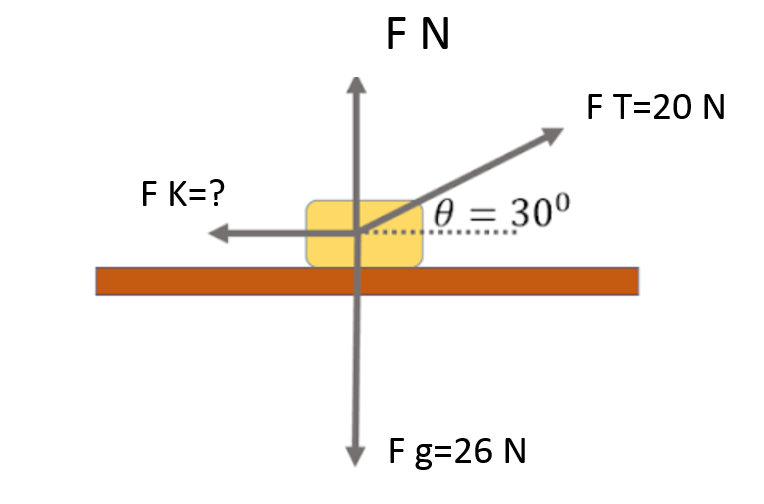
جسم كتلته \(2.65\,kg\) وُضع على مستوى أفقي خشن. أثّرت عليه قوة شد مقدارها \(20\,N\) تميل فوق الأفق بزاوية \(30^0\)، فتحرك الجسم، ومعامل الاحتكاك الحركي \(0.625\) (اعتبر \(g=9.81\,m/s^2\)). حدد القوى المؤثرة على الشكل، واحسب التسارع الذي يتحرك به الجسم.A body of mass \(2.65\,kg\) on a rough horizontal surface is pulled by a \(20\,N\) force at \(30^0\) above horizontal, with kinetic friction coefficient \(0.625\) (take \(g=9.81\,m/s^2\)). Mark the forces on the figure and find the acceleration.
الحلSolution
📌 القوة العمودية: \(F_N=mg-F\sin30^0=2.65(9.81)-20(0.5)=26.0-10=16.0\,N\)
📌 الاحتكاك الحركي: \(F_K=\mu_K F_N=0.625\times16.0=10.0\,N\)
📌 أفقيًا (نيوتن الثاني): \(F\cos30^0-F_K=ma\Rightarrow20(0.866)-10.0=7.32\,N\)
📌 التسارع: \(a=\dfrac{7.32}{2.65}\approx2.76\,m/s^2\)
✅ \(a\approx2.76\,m/s^2\)
📌 Normal force: \(F_N=mg-F\sin30^0=26.0-10=16.0\,N\)
📌 Kinetic friction: \(F_K=\mu_K F_N=0.625\times16.0=10.0\,N\)
📌 Horizontally (Newton's second law): \(F\cos30^0-F_K=ma\Rightarrow17.32-10.0=7.32\,N\)
📌 Acceleration: \(a=\dfrac{7.32}{2.65}\approx2.76\,m/s^2\)
✅ \(a\approx2.76\,m/s^2\)
المسألة 2Problem 2
في الشبكة المجاورة ثلاث متجهات أبعادها \(\vec A=5,\;\vec B=2,\;\vec C=3\)، اتجاهها موضح على الشكل. حلّل كل متجه إلى مركبتين، ثم احسب مقدار واتجاه \(\vec R=\vec A+\vec B+\vec C\)، وتحقق بالرسم باستخدام المسطرة على الشبكة نفسها.In the adjacent grid, three vectors have magnitudes \(\vec A=5,\;\vec B=2,\;\vec C=3\), with directions shown. Resolve each vector into components, then find the magnitude and direction of \(\vec R=\vec A+\vec B+\vec C\), and verify graphically with a ruler on the same grid.

الحلSolution
📌 تحليل \(\vec A\) (بزاوية \(36.8^0\) — مثلث 3-4-5): \(A_x=5\cos36.8^0\approx4.0,\;A_y=5\sin36.8^0\approx3.0\)
📌 تحليل \(\vec B\) (رأسي للأعلى) و\(\vec C\) (أفقي لليمين): \(B_x=0,\;B_y=2\). \(C_x=3,\;C_y=0\)
📌 جمع المركبات: \(R_x=4.0+0+3=7.0,\;R_y=3.0+2+0=5.0\)
📌 المقدار والاتجاه: \(R=\sqrt{7.0^2+5.0^2}=\sqrt{74}\approx8.60,\;\theta=\arctan(5/7)\approx35.5^0\)
✅ \(R\approx8.60\) بزاوية \(\approx35.5^0\) (يتفق مع الرسم على الشبكة)
📌 Resolve \(\vec A\) (at \(36.8^0\) — 3-4-5 triangle): \(A_x\approx4.0,\;A_y\approx3.0\)
📌 Resolve \(\vec B\) (vertical, up) and \(\vec C\) (horizontal, right): \(B_x=0,\;B_y=2\). \(C_x=3,\;C_y=0\)
📌 Summing components: \(R_x=7.0,\;R_y=5.0\)
📌 Magnitude and direction: \(R=\sqrt{74}\approx8.60,\;\theta\approx35.5^0\)
✅ \(R\approx8.60\) at \(\approx35.5^0\) (matches the grid construction)
المسألة 3Problem 3
ثلاث قوى متلاقية أثّرت على جسم كما في الشكل أدناه فأصبح الجسم في حالة اتزان. حدد مقدار واتجاه القوة \(\vec F_2=?\)Three concurrent forces act on a body as shown, bringing it to equilibrium. Find the magnitude and direction of \(\vec F_2=?\)

الحلSolution
📌 تحليل \(F_1=4.9\,N\) عند \(39^0\) و\(F_3=7.6\,N\) للأسفل: \(F_{1x}=4.9\cos39^0\approx3.81,\;F_{1y}=4.9\sin39^0\approx3.08\). \(F_{3x}=0,\;F_{3y}=-7.6\)
📌 شرط الاتزان \(\sum\vec F=0\Rightarrow\vec F_2=-(\vec F_1+\vec F_3)\): \(F_{2x}=-(3.81+0)=-3.81,\;F_{2y}=-(3.08-7.6)=4.52\)
📌 المقدار والاتجاه: \(F_2=\sqrt{3.81^2+4.52^2}\approx5.91\,N,\;\theta=\arctan(4.52/3.81)\approx49.9^0\) فوق المحور \(-X\) (أعلى اليسار، يطابق اتجاه \(F_2\) في الشكل)
✅ \(F_2\approx5.91\,N\) بزاوية \(\approx49.9^0\) أعلى اليسار
📌 Resolve \(F_1=4.9\,N\) at \(39^0\) and \(F_3=7.6\,N\) downward: \(F_{1x}\approx3.81,\;F_{1y}\approx3.08\). \(F_{3x}=0,\;F_{3y}=-7.6\)
📌 Equilibrium condition \(\sum\vec F=0\Rightarrow\vec F_2=-(\vec F_1+\vec F_3)\): \(F_{2x}=-3.81,\;F_{2y}=4.52\)
📌 Magnitude and direction: \(F_2\approx5.91\,N\) at \(\approx49.9^0\) above the \(-X\) axis (up-left, matching \(F_2\)'s direction in the figure)
✅ \(F_2\approx5.91\,N\) at \(\approx49.9^0\) up-left
المسألة 4Problem 4
جسم كتلته \(5\,kg\) ينزلق على مستوى مائل خشن بزاوية \(20^0\)، ومعامل الاحتكاك الحركي بينه وبين المستوى \(0.15\) (اعتبر \(g=9.81\,m/s^2\)). احسب: (أ) القوة العمودية. (ب) قوة الاحتكاك الحركي. (ج) التسارع الذي ينزلق به الجسم.A \(5\,kg\) body slides down a rough incline at \(20^0\), with kinetic friction coefficient \(0.15\) (take \(g=9.81\,m/s^2\)). Find: (a) the normal force. (b) the kinetic friction force. (c) the sliding acceleration.
الحلSolution
📌 (أ) القوة العمودية (عمودية على سطح الميل): \(F_N=mg\cos20^0=5(9.81)(0.9397)\approx46.09\,N\)
📌 (ب) الاحتكاك الحركي (يعاكس حركة الانزلاق، أي يعمل للأعلى): \(F_K=\mu_K F_N=0.15(46.09)\approx6.91\,N\)
📌 (ج) بطول المستوى (نيوتن الثاني): \(mg\sin20^0-F_K=ma\Rightarrow5(9.81)(0.342)-6.91=16.77-6.91=9.86\,N\)
📌 التسارع: \(a=\dfrac{9.86}{5}\approx1.97\,m/s^2\)
✅ \(F_N\approx46.09\,N\)، \(F_K\approx6.91\,N\)، \(a\approx1.97\,m/s^2\)
📌 (a) Normal force (perpendicular to the incline surface): \(F_N=mg\cos20^0\approx46.09\,N\)
📌 (b) Kinetic friction (opposes the sliding motion, acting up-slope): \(F_K=\mu_K F_N\approx6.91\,N\)
📌 (c) Along the incline (Newton's second law): \(mg\sin20^0-F_K=5(9.81)(0.342)-6.91\approx9.86\,N\)
📌 Acceleration: \(a=\dfrac{9.86}{5}\approx1.97\,m/s^2\)
✅ \(F_N\approx46.09\,N\), \(F_K\approx6.91\,N\), \(a\approx1.97\,m/s^2\)
المسألة 5Problem 5
ثلاث قوى متلاقية: \(\vec A=6\,N\) بزاوية \(0^0\)، \(\vec B=6\,N\) بزاوية \(90^0\)، \(\vec C=6\,N\) بزاوية \(225^0\). حلّل كل قوة إلى مركبتين، ثم احسب مقدار واتجاه المحصلة \(\vec R=\vec A+\vec B+\vec C\).Three concurrent forces: \(\vec A=6\,N\) at \(0^0\), \(\vec B=6\,N\) at \(90^0\), \(\vec C=6\,N\) at \(225^0\). Resolve each into components, then find the magnitude and direction of the resultant \(\vec R=\vec A+\vec B+\vec C\).
الحلSolution
📌 تحليل كل قوة: \(A_x=6,\;A_y=0\). \(B_x=0,\;B_y=6\). \(C_x=6\cos225^0\approx-4.24,\;C_y=6\sin225^0\approx-4.24\)
📌 جمع المركبات: \(R_x=6+0-4.24=1.76,\;R_y=0+6-4.24=1.76\)
📌 المقدار والاتجاه (\(R_x=R_y\) يعطي زاوية \(45^0\) بالضبط): \(R=\sqrt{1.76^2+1.76^2}\approx2.49\,N,\;\theta=45^0\)
✅ \(R\approx2.49\,N\) بزاوية \(45^0\)
📌 Resolving each force: \(A_x=6,A_y=0\). \(B_x=0,B_y=6\). \(C_x\approx-4.24,\;C_y\approx-4.24\)
📌 Summing components: \(R_x\approx1.76,\;R_y\approx1.76\)
📌 Magnitude and direction (\(R_x=R_y\) gives exactly \(45^0\)): \(R\approx2.49\,N,\;\theta=45^0\)
✅ \(R\approx2.49\,N\) at \(45^0\)
المسألة 6Problem 6
جسم وزنه \(100\,N\) معلَّق بحبلين: الحبل الأول أفقي تمامًا ومثبَّت في الحائط، والحبل الثاني يصنع زاوية \(37^0\) مع الحبل الأفقي ومثبَّت في السقف. احسب الشد في كل حبل (استخدم \(\sin37^0\approx0.6\)، \(\cos37^0\approx0.8\)).A \(100\,N\) weight hangs from two ropes: one perfectly horizontal, fixed to a wall; the other making a \(37^0\) angle with the horizontal rope, fixed to the ceiling. Find the tension in each rope (use \(\sin37^0\approx0.6\), \(\cos37^0\approx0.8\)).
الحلSolution
📌 عند نقطة التقاء الحبلين، ثلاث قوى متزنة: الوزن \(W=100\,N\) للأسفل، شد الحبل الأفقي \(T_1\)، وشد الحبل المائل \(T_2\) (بزاوية \(37^0\) عن الأفقي)
📌 رأسيًا (\(T_2\) يحمل الوزن كاملًا): \(T_2\sin37^0=W\Rightarrow T_2=\dfrac{100}{0.6}\approx166.7\,N\)
📌 أفقيًا: \(T_1=T_2\cos37^0=166.7\times0.8\approx133.3\,N\)
✅ \(T_1\approx133.3\,N\) (الحبل الأفقي)، \(T_2\approx166.7\,N\) (الحبل المائل)
📌 At the junction, three forces balance: weight \(W=100\,N\) down, horizontal rope tension \(T_1\), angled rope tension \(T_2\) (at \(37^0\) from horizontal)
📌 Vertically (\(T_2\) carries the whole weight): \(T_2=\dfrac{100}{0.6}\approx166.7\,N\)
📌 Horizontally: \(T_1=166.7\times0.8\approx133.3\,N\)
✅ \(T_1\approx133.3\,N\) (horizontal), \(T_2\approx166.7\,N\) (angled)
المسألة 7Problem 7
تحرك طالب \(300\,m\) نحو الجنوب، ثم تحرك \(400\,m\) نحو الشرق. احسب مقدار واتجاه محصلة الإزاحة.A student walks \(300\,m\) south, then \(400\,m\) east. Find the magnitude and direction of the resultant displacement.
الحلSolution
📌 الساقان متعامدتان (مثلث 3-4-5×100): \(R=\sqrt{300^2+400^2}=\sqrt{250000}=500\,m\)
📌 الاتجاه (من الشرق نحو الجنوب): \(\theta=\arctan(300/400)\approx36.9^0\) جنوب الشرق
✅ \(R=500\,m\) بزاوية \(36.9^0\) جنوب الشرق
📌 The two legs are perpendicular (3-4-5×100 triangle): \(R=\sqrt{300^2+400^2}=500\,m\)
📌 Direction (from east toward south): \(\theta=\arctan(300/400)\approx36.9^0\) south of east
✅ \(R=500\,m\) at \(36.9^0\) south of east
لاحظت خطأ؟ أو عندك سؤال عن التجربة؟ اكتبه بالتعليقات وحدد مكانه بالضبط.
Noticed an error? Or have a question? Write it in the comments and specify exactly where.