🏋️ بنك الأسئلة: القوى في بعد واحد
🏋️ Question Bank: Forces in One Dimension
أنواع القوى ومحصلتها، قانونا نيوتن الأول والثاني، الوزن والقوة العمودية، الفعل ورد الفعل، المصعد وآلة أتوود، والقوة المعيقة
Types of Forces and Net Force, Newton’s First and Second Laws, Weight and Normal Force, Action and Reaction, Elevators and Atwood Machine, Drag
⏱️ 41 سؤال اختيار من متعدد بتصحيح فوري بمستويات متدرجة، وخمس مسائل محلولة، مع حل مفصل لكل سؤال⏱️ 41 multiple-choice questions of graded difficulty with instant feedback, and 5 solved problems, with a detailed solution for each
\[1\,\star\]
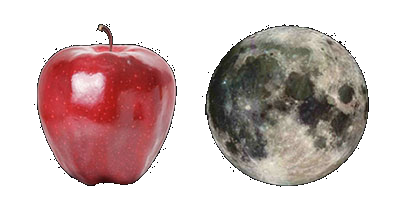
تفاحة كتلتها \(0.2\ kg\)؛ وزنها على سطح الأرض (\(g=10\ m/s^2\)):An apple has mass \(0.2\ kg\); its weight on the Earth’s surface is (\(g=10\ m/s^2\)):
\(F_g=10\ N\)\(F_g=10\ N\)
\(F_g=0.02\ N\)\(F_g=0.02\ N\)
\(F_g=2\ N\)\(F_g=2\ N\)
\(F_g=0.01\ N\)\(F_g=0.01\ N\)
الحلSolution
\(F_g=mg=0.2\times10=2\ \mathrm{N}\)
✅ \(F_g=2\ N\) (C)
\(F_g=mg=0.2\times10=2\ \mathrm{N}\)
✅ \(F_g=2\ N\) (C)
\[2\,\star\]
إحدى القوى التالية تُعد قوة مجالية:One of the following forces is a field force:
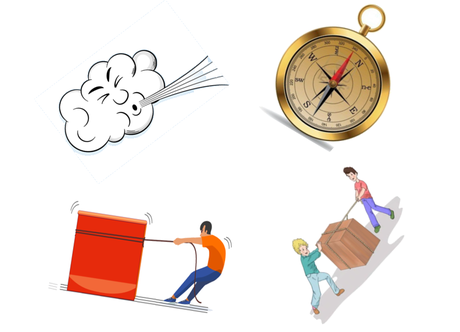
البوصلة (القوة المغناطيسية)the compass (magnetic force)
قوة الرياحwind force
قوة الاحتكاكfriction force
قوة الدفعpush force
الحلSolution
📌 القوى المجالية تؤثر عن بعد دون تلامس (مغناطيسية، كهربائية، جاذبية)، أما الرياح والاحتكاك والدفع فقوى تلامس.
✅ البوصلة (القوة المغناطيسية) (A)
📌 Field forces act at a distance without contact (magnetic, electric, gravitational), whereas wind, friction and push are contact forces.
✅ the compass (magnetic force) (A)
\[3\,\star\]
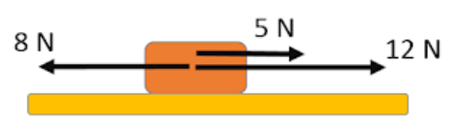
محصلة القوى المؤثرة على الجسم في الشكل (\(8\ N\) يسارًا و\(5\ N\) و\(12\ N\) يمينًا):The net force on the object in the figure (\(8\ N\) to the left, \(5\ N\) and \(12\ N\) to the right):
\(F_{net}=15\ N\) نحو الغرب\(F_{net}=15\ N\) west
\(F_{net}=9\ N\) نحو الغرب\(F_{net}=9\ N\) west
\(F_{net}=15\ N\) نحو الشرق\(F_{net}=15\ N\) east
\(F_{net}=9\ N\) نحو الشرق\(F_{net}=9\ N\) east
الحلSolution
\(F_{net}=12+5-8=9\ \mathrm{N}\ (\text{east})\)
✅ \(F_{net}=9\ N\) نحو الشرق (D)
\(F_{net}=12+5-8=9\ \mathrm{N}\ (\text{east})\)
✅ \(F_{net}=9\ N\) east (D)
\[4\,\star\]
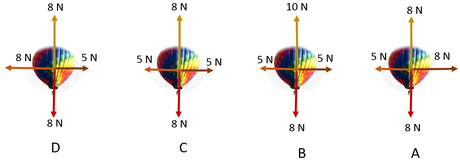
أحد البالونات التالية يتحرك بسرعة ثابتة (القوى موضحة على كل بالون):One of these balloons moves at constant velocity (the forces are shown on each balloon):
البالون Aballoon A
البالون Bballoon B
البالون Cballoon C
البالون Dballoon D
الحلSolution
📌 السرعة الثابتة تعني اتزانًا: محصلة القوى صفر في الاتجاهين: القوتان الأفقيتان متساويتان (\(5=5\)) والرأسيتان متساويتان (\(8=8\)) وهذا في C فقط.
✅ البالون C (C)
📌 Constant velocity means equilibrium: zero net force in both directions: the horizontal forces are equal (\(5=5\)) and the vertical ones are equal (\(8=8\)), which holds for C only.
✅ balloon C (C)
\[5\,\star\]
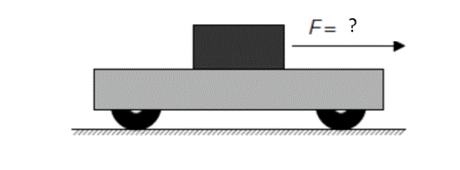
سيارة كتلتها \(10\ kg\) تتحرك بتسارع \(5\ m/s^2\) نحو الشرق؛ مقدار القوة المؤثرة عليها واتجاهها:A car of mass \(10\ kg\) accelerates at \(5\ m/s^2\) east; the net force on it is:
\(F=2\ N\) شرقًا\(F=2\ N\) east
\(F=50\ N\) شرقًا\(F=50\ N\) east
\(F=2\ N\) غربًا\(F=2\ N\) west
\(F=50\ N\) غربًا\(F=50\ N\) west
الحلSolution
\(F=ma=10\times5=50\ \mathrm{N}\)
📌 اتجاه القوة هو اتجاه التسارع: شرقًا.
✅ \(F=50\ N\) شرقًا (B)
\(F=ma=10\times5=50\ \mathrm{N}\)
📌 The force is in the direction of the acceleration: east.
✅ \(F=50\ N\) east (B)
\[6\,\star\star\]
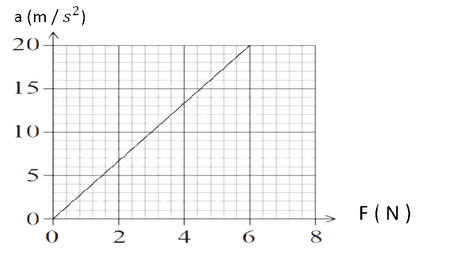
الرسم يمثل العلاقة بين التسارع \(a\) (المحور الرأسي) والقوة \(F\)؛ ميل الخط البياني يمثل:The graph shows acceleration \(a\) (vertical axis) against force \(F\); the slope of the line represents:
\(\dfrac1v\) مقلوب السرعة\(\dfrac1v\) the reciprocal of velocity
\(m\) كتلة الجسم\(m\) the mass of the body
\(v\) سرعة الجسم\(v\) the velocity of the body
\(\dfrac1m\) مقلوب الكتلة\(\dfrac1m\) the reciprocal of mass
الحلSolution
📌 من \(a=\dfrac{F}{m}\) العلاقة بين \(a\) (رأسي) و\(F\) (أفقي) خط مستقيم ميله \(\dfrac{\Delta a}{\Delta F}=\dfrac1m\).
✅ \(\dfrac1m\) مقلوب الكتلة (D)
📌 From \(a=\dfrac{F}{m}\) the relation between \(a\) (vertical) and \(F\) (horizontal) is a straight line of slope \(\dfrac{\Delta a}{\Delta F}=\dfrac1m\).
✅ \(\dfrac1m\) the reciprocal of mass (D)
\[7\,\star\star\]
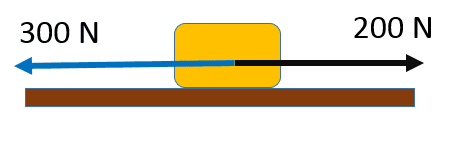
جسم كتلته \(5\ kg\) أثّرت عليه قوتان كما في الشكل (\(300\ N\) يسارًا و\(200\ N\) يمينًا)؛ التسارع:A \(5\ kg\) body is acted on by two forces as shown (\(300\ N\) to the left and \(200\ N\) to the right); its acceleration is:
\(a=20\ m/s^2\) غربًا\(a=20\ m/s^2\) west
\(a=20\ m/s^2\) شرقًا\(a=20\ m/s^2\) east
\(a=0.05\ m/s^2\) غربًا\(a=0.05\ m/s^2\) west
\(a=0.05\ m/s^2\) شرقًا\(a=0.05\ m/s^2\) east
الحلSolution
\(F_{net}=300-200=100\ \mathrm{N}\ (\text{west})\)
\(a=\dfrac{F_{net}}{m}=\dfrac{100}{5}=20\ \mathrm{m/s^2}\ (\text{west})\)
✅ \(a=20\ m/s^2\) غربًا (A)
\(F_{net}=300-200=100\ \mathrm{N}\ (\text{west})\)
\(a=\dfrac{F_{net}}{m}=\dfrac{100}{5}=20\ \mathrm{m/s^2}\ (\text{west})\)
✅ \(a=20\ m/s^2\) west (A)
\[8\,\star\]
إحدى العبارات التالية تشير إلى جسم في حالة اتزان:One of the following statements describes a body in equilibrium:
محصلة القوى على الجسم غير معدومةthe net force on the body is not zero
جسم يتحرك تحت تأثير وزنه فقطa body moving under its weight alone
جسم يتحرك بسرعة ثابتةa body moving at constant velocity
جسم يتحرك بتسارع متباطئa body moving with a decelerating acceleration
الحلSolution
📌 الاتزان: التسارع صفر أي محصلة القوى صفر، وهذا يشمل السكون والحركة بسرعة ثابتة في خط مستقيم.
✅ جسم يتحرك بسرعة ثابتة (C)
📌 Equilibrium: zero acceleration, i.e. zero net force, which includes rest and motion at constant velocity in a straight line.
✅ a body moving at constant velocity (C)
\[9\,\star\star\]
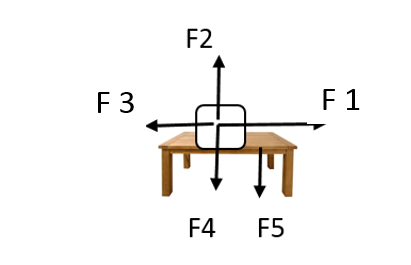
أحد أزواج القوى التالية يمثل فعلًا ورد فعل (جسم موضوع على طاولة):One of these pairs of forces is an action–reaction pair (a body on a table):
\(F_2,\ F_5\)\(F_2,\ F_5\)
\(F_4,\ F_5\)\(F_4,\ F_5\)
\(F_2,\ F_4\)\(F_2,\ F_4\)
\(F_1,\ F_3\)\(F_1,\ F_3\)
الحلSolution
📌 \(F_2\) قوة الطاولة على الجسم (عمودية للأعلى) و\(F_5\) قوة الجسم على الطاولة (للأسفل): من جسمين مختلفين ومتساويتان ومتعاكستان.
📌 أما \(F_4\) (وزن الجسم) و\(F_2\) فتؤثران على الجسم نفسه فلا تشكلان فعلًا ورد فعل.
✅ \(F_2,\ F_5\) (A)
📌 \(F_2\) is the table’s force on the body (normal, upward) and \(F_5\) is the body’s force on the table (downward): on two different bodies, equal and opposite.
📌 \(F_4\) (the weight) and \(F_2\) act on the same body so they are not an action–reaction pair.
✅ \(F_2,\ F_5\) (A)
\[10\,\star\]
عندما يصل المظلي الساقط إلى السرعة الحدية فإن:When a falling skydiver reaches terminal velocity:

\(F_g=F_d\)\(F_g=F_d\)
\(F_g\gt F_d\)\(F_g\gt F_d\)
\(F_g=F_d=0\)\(F_g=F_d=0\)
\(F_d\gt F_g\)\(F_d\gt F_g\)
الحلSolution
📌 عند السرعة الحدية يتوقف التسارع فتكون محصلة القوى صفرًا: قوة المقاومة تساوي الوزن.
✅ \(F_g=F_d\) (A)
📌 At terminal velocity the acceleration stops so the net force is zero: the drag equals the weight.
✅ \(F_g=F_d\) (A)
\[11\,\star\]
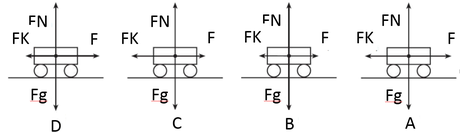
جميع السيارات تتحرك نحو اليمين؛ إحداها تتحرك بتسارع متباطئ (القوى موضحة):All the cars move to the right; one moves with deceleration (forces shown):
السيارة Acar A
السيارة Bcar B
السيارة Ccar C
السيارة Dcar D
الحلSolution
📌 التباطؤ يعني أن محصلة القوى عكس اتجاه الحركة، أي قوة الاحتكاك أكبر من القوة المحركة نحو اليمين: السيارة C.
✅ السيارة C (C)
📌 Deceleration means the net force opposes the motion, i.e. friction is greater than the driving force to the right: car C.
✅ car C (C)
\[12\,\star\star\]
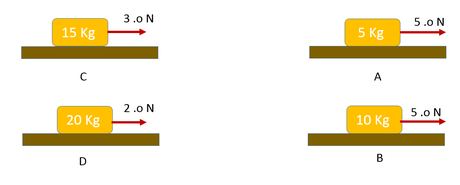
أي العربات التالية لها أكبر تسارع (الكتلة والقوة مكتوبتان على كل عربة)؟Which of the following carts has the greatest acceleration (mass and force are written on each cart)?
العربة Acart A
العربة Bcart B
العربة Ccart C
العربة Dcart D
الحلSolution
\(a_A=\dfrac5{5}=1,\ a_B=\dfrac5{10}=0.5,\ a_C=\dfrac3{15}=0.2,\ a_D=\dfrac2{20}=0.1\ \mathrm{m/s^2}\)
📌 أكبرها A.
✅ العربة A (A)
\(a_A=\dfrac5{5}=1,\ a_B=\dfrac5{10}=0.5,\ a_C=\dfrac3{15}=0.2,\ a_D=\dfrac2{20}=0.1\ \mathrm{m/s^2}\)
📌 The greatest is A.
✅ cart A (A)
\[13\,\star\star\]
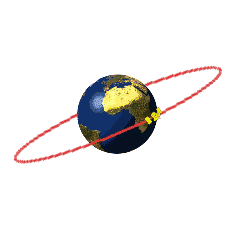
قمر صناعي كتلته \(370\ kg\) وزنه عند ارتفاعه \(2775\ N\)؛ عجلة الجاذبية عند هذا الارتفاع:A satellite of mass \(370\ kg\) has weight \(2775\ N\) at its altitude; the gravitational acceleration there is:
\(g=4.3\ m/s^2\)\(g=4.3\ m/s^2\)
\(g=9.81\ m/s^2\)\(g=9.81\ m/s^2\)
\(g=7.5\ m/s^2\)\(g=7.5\ m/s^2\)
\(g=6.4\ m/s^2\)\(g=6.4\ m/s^2\)
الحلSolution
\(g=\dfrac{F_g}{m}=\dfrac{2775}{370}=7.5\ \mathrm{m/s^2}\)
✅ \(g=7.5\ m/s^2\) (C)
\(g=\dfrac{F_g}{m}=\dfrac{2775}{370}=7.5\ \mathrm{m/s^2}\)
✅ \(g=7.5\ m/s^2\) (C)
\[14\,\star\star\star\]
فتاة كتلتها \(60\ kg\) تقف على ميزان في مصعد يتحرك نحو الأعلى بتسارع \(2\ m/s^2\) (\(g=10\))؛ وزنها الظاهري:A girl of mass \(60\ kg\) stands on a scale in an elevator accelerating upward at \(2\ m/s^2\) (\(g=10\)); her apparent weight is:

\(F_N=660\ N\)\(F_N=660\ N\)
\(F_N=720\ N\)\(F_N=720\ N\)
\(F_N=480\ N\)\(F_N=480\ N\)
\(F_N=60\ N\)\(F_N=60\ N\)
الحلSolution
\(F_N-mg=ma\Rightarrow F_N=m(g+a)=60(10+2)=720\ \mathrm{N}\)
✅ \(F_N=720\ N\) (B)
\(F_N-mg=ma\Rightarrow F_N=m(g+a)=60(10+2)=720\ \mathrm{N}\)
✅ \(F_N=720\ N\) (B)
\[15\,\star\star\star\]
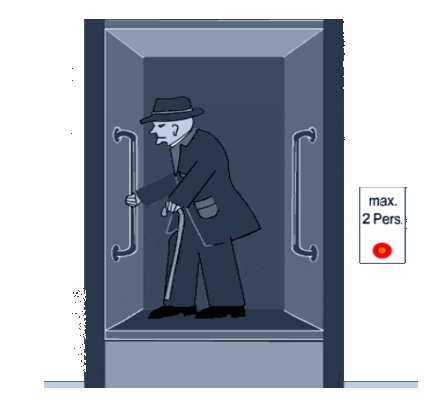
رجل كتلته \(80\ kg\) يقف على ميزان في مصعد يتحرك نحو الأسفل بتسارع \(2\ m/s^2\) (\(g=10\))؛ وزنه الظاهري:A man of mass \(80\ kg\) stands on a scale in an elevator accelerating downward at \(2\ m/s^2\) (\(g=10\)); his apparent weight is:
\(F_N=800\ N\)\(F_N=800\ N\)
\(F_N=640\ N\)\(F_N=640\ N\)
\(F_N=720\ N\)\(F_N=720\ N\)
\(F_N=960\ N\)\(F_N=960\ N\)
الحلSolution
\(mg-F_N=ma\Rightarrow F_N=m(g-a)=80(10-2)=640\ \mathrm{N}\)
✅ \(F_N=640\ N\) (B)
\(mg-F_N=ma\Rightarrow F_N=m(g-a)=80(10-2)=640\ \mathrm{N}\)
✅ \(F_N=640\ N\) (B)
\[16\,\star\]
ما وزن رائد فضاء كتلته \(80\ kg\) في الفضاء حيث لا توجد جاذبية؟What is the weight of an astronaut of mass \(80\ kg\) in space where there is no gravity?
\(0\ N\)\(0\ N\)
\(784\ N\)\(784\ N\)
\(80\ N\)\(80\ N\)
\(9.81\ N\)\(9.81\ N\)
الحلSolution
📌 الوزن \(mg\) ينعدم مع انعدام الجاذبية، أما الكتلة فتبقى \(80\ \mathrm{kg}\).
✅ \(0\ N\) (A)
📌 The weight \(mg\) vanishes with no gravity but the mass stays \(80\ \mathrm{kg}\).
✅ \(0\ N\) (A)
\[17\,\star\]
ما القوة التي تمنع الأجسام من السقوط عبر سطح الطاولة عندما توضع عليها؟What force prevents objects from falling through a table surface when placed on it?
قوة الجاذبيةgravity
القوة العموديةthe normal force
قوة الاحتكاكfriction
قوة الشدtension
الحلSolution
📌 القوة العمودية قوة تلامس يؤثر بها السطح عموديًا على الجسم وتوازن وزنه.
✅ القوة العمودية (B)
📌 The normal force is a contact force exerted perpendicular to the surface that balances the weight.
✅ the normal force (B)
\[18\,\star\star\]
إذا كانت قوة الجاذبية بين جسمين \(36\ N\)، فما مقدارها إذا زادت كتلة أحدهما إلى ثلاثة أضعاف؟If the gravitational force between two bodies is \(36\ N\), what is it if the mass of one becomes three times as large?
\(12\ N\)\(12\ N\)
\(36\ N\)\(36\ N\)
\(72\ N\)\(72\ N\)
\(108\ N\)\(108\ N\)
الحلSolution
\(F=\dfrac{Gm_1m_2}{r^2}\propto m_1\Rightarrow F'=3\times36=108\ \mathrm{N}\)
✅ \(108\ N\) (D)
\(F=\dfrac{Gm_1m_2}{r^2}\propto m_1\Rightarrow F'=3\times36=108\ \mathrm{N}\)
✅ \(108\ N\) (D)
\[19\,\star\star\]
وزني على القمر \(115\ N\) علمًا بأن جاذبية القمر سدس جاذبية الأرض؛ كتلتي (\(g=9.81\)):My weight on the Moon is \(115\ N\) given that the Moon’s gravity is one sixth of the Earth’s; my mass is (\(g=9.81\)):
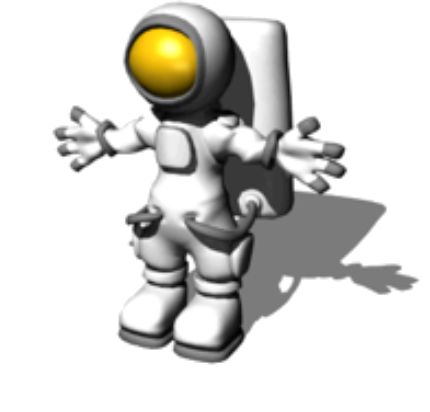
\(m=60.4\ kg\)\(m=60.4\ kg\)
\(m=70.3\ kg\)\(m=70.3\ kg\)
\(m=82.5\ kg\)\(m=82.5\ kg\)
\(m=65.7\ kg\)\(m=65.7\ kg\)
الحلSolution
\(g_{moon}=\dfrac{9.81}{6}=1.635\ \mathrm{m/s^2}\)
\(m=\dfrac{F_g}{g_{moon}}=\dfrac{115}{1.635}=70.3\ \mathrm{kg}\)
✅ \(m=70.3\ kg\) (B)
\(g_{moon}=\dfrac{9.81}{6}=1.635\ \mathrm{m/s^2}\)
\(m=\dfrac{F_g}{g_{moon}}=\dfrac{115}{1.635}=70.3\ \mathrm{kg}\)
✅ \(m=70.3\ kg\) (B)
\[20\,\star\star\]
الرسم البياني يوضح العلاقة بين التسارع \(a\) والقوة \(F\)؛ كتلة الجسم:The graph shows the relation between acceleration \(a\) and force \(F\); the mass of the body is:
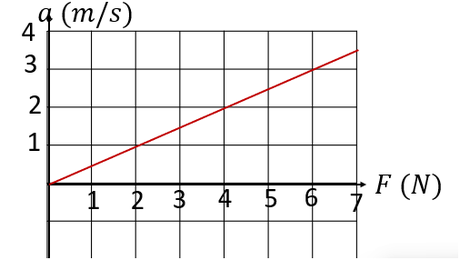
\(m=0.25\ kg\)\(m=0.25\ kg\)
\(m=4\ kg\)\(m=4\ kg\)
\(m=2\ kg\)\(m=2\ kg\)
\(m=0.5\ kg\)\(m=0.5\ kg\)
الحلSolution
📌 الميل = \(\dfrac{\Delta a}{\Delta F}=\dfrac1m\): عند \(F=6\ N\) يكون \(a=3\ \mathrm{m/s^2}\) فالميل \(0.5\).
\(m=\dfrac1{0.5}=2\ \mathrm{kg}\)
✅ \(m=2\ kg\) (C)
📌 Slope = \(\dfrac{\Delta a}{\Delta F}=\dfrac1m\): at \(F=6\ N\) the acceleration is \(a=3\ \mathrm{m/s^2}\) so the slope is \(0.5\).
\(m=\dfrac1{0.5}=2\ \mathrm{kg}\)
✅ \(m=2\ kg\) (C)
\[21\,\star\]
ما نص قانون نيوتن الأول (قانون القصور الذاتي)؟What is Newton’s first law (the law of inertia)?
القوة المؤثرة على جسم تساوي كتلته في تسارعهthe force on a body equals its mass times its acceleration
الطاقة لا تفنى ولا تُستحدثenergy is neither created nor destroyed
يبقى الساكن ساكنًا والمتحرك بسرعة منتظمة في خط مستقيم ما لم تؤثر عليه قوة خارجيةa body at rest stays at rest and a moving body keeps its uniform motion in a straight line unless an external force acts on it
لكل فعل رد فعل مساوٍ له ومعاكسevery action has an equal and opposite reaction
الحلSolution
📌 هذا هو قانون القصور الذاتي؛ الخيار الأول هو القانون الثاني والثالث هو القانون الثالث.
✅ يبقى الساكن ساكنًا والمتحرك بسرعة منتظمة في خط مستقيم ما لم تؤثر عليه قوة خارجية (C)
📌 This is the law of inertia; the first option is the second law and the third is the third law.
✅ a body at rest stays at rest and a moving body keeps its uniform motion in a straight line unless an external force acts on it (C)
\[22\,\star\star\]
رجل كتلته \(65\ kg\) يقف على ميزان في مصعد يتحرك نحو الأعلى بسرعة ثابتة (\(g=10\))؛ قراءة الميزان:A man of mass \(65\ kg\) stands on a scale in an elevator moving upward at constant speed (\(g=10\)); the scale reads:
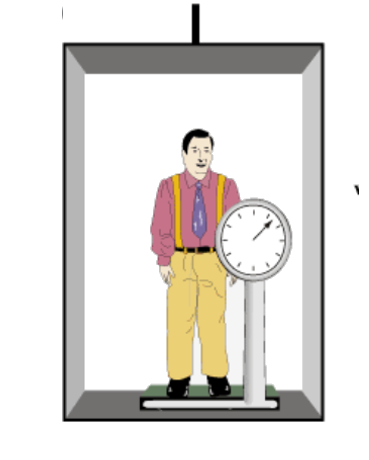
\(F_N=650\ N\)\(F_N=650\ N\)
\(F_N=700\ N\)\(F_N=700\ N\)
\(F_N=660\ N\)\(F_N=660\ N\)
\(F_N=0\ N\)\(F_N=0\ N\)
الحلSolution
📌 السرعة ثابتة فالتسارع صفر: \(F_N=mg=65\times10=650\ \mathrm{N}\).
✅ \(F_N=650\ N\) (A)
📌 The speed is constant so the acceleration is zero: \(F_N=mg=65\times10=650\ \mathrm{N}\).
✅ \(F_N=650\ N\) (A)
\[23\,\star\]
أحد العبارات التالية تحدد العوامل التي تعتمد عليها القوة المعيقة (قوة السحب):Which statement gives the factors that the drag force depends on?
جميع ما سبقall of the above
مساحة الجسم وشكلهthe area and shape of the body
لزوجة المائع وكثافتهthe viscosity and density of the fluid
سرعة الجسمthe speed of the body
الحلSolution
📌 تعتمد القوة المعيقة على شكل الجسم ومساحته وعلى خصائص المائع وعلى السرعة.
✅ جميع ما سبق (A)
📌 Drag depends on the shape and area of the body, on the properties of the fluid and on the speed.
✅ all of the above (A)
\[24\,\star\star\]
مظلي كتلته \(62\ kg\) ومجال الجاذبية في منطقة السقوط \(g=9.2\ m/s^2\)؛ القوة المعيقة عند السرعة الحدية:A skydiver of mass \(62\ kg\) falls where \(g=9.2\ m/s^2\); the drag force at terminal velocity is:
\(F_d=0\)\(F_d=0\)
\(F_d=6.74\ N\)\(F_d=6.74\ N\)
\(F_d=570.4\ N\)\(F_d=570.4\ N\)
\(F_d=62\ N\)\(F_d=62\ N\)
الحلSolution
\(F_d=F_g=mg=62\times9.2=570.4\ \mathrm{N}\)
✅ \(F_d=570.4\ N\) (C)
\(F_d=F_g=mg=62\times9.2=570.4\ \mathrm{N}\)
✅ \(F_d=570.4\ N\) (C)
\[25\,\star\star\]
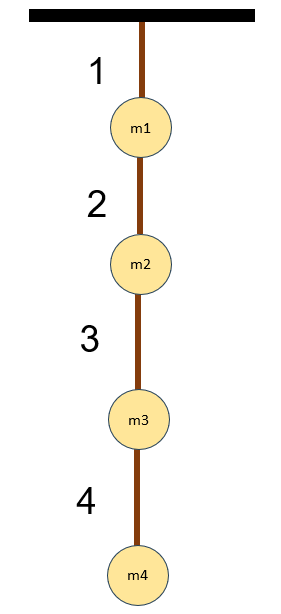
أربع كرات متساوية الكتلة مربوطة بأربعة حبال عديمة الكتلة ومعلقة بالسقف (الشكل)؛ أكثر حبل يتعرض لقوة شد وقد ينقطع:Four equal-mass balls are tied together by four massless ropes and hung from the ceiling (figure); the rope under the greatest tension, which may break, is:
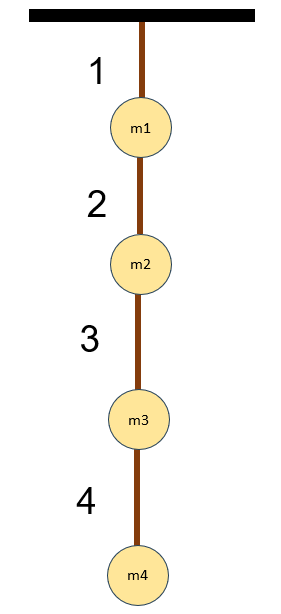
\(1\)\(1\)
\(2\)\(2\)
\(3\)\(3\)
\(4\)\(4\)
الحلSolution
📌 الحبل 1 (العلوي) يحمل الكرات الأربع، والحبل 2 يحمل ثلاثًا... والحبل 4 يحمل كرة واحدة؛ فالشد الأكبر في الحبل 1.
✅ A
📌 Rope 1 (the top one) carries all four balls, rope 2 carries three ... rope 4 carries one; so the greatest tension is in rope 1.
✅ A
\[26\,\star\star\star\]
أربع كرات كتلة كل منها \(1.5\ kg\) مربوطة كما في الشكل؛ قوة الشد في الحبل الثاني (\(g=9.81\)):Four balls of mass \(1.5\ kg\) each are tied as in the figure; the tension in rope 2 is (\(g=9.81\)):
\(F_T=14.7\ N\)\(F_T=14.7\ N\)
\(F_T=29.4\ N\)\(F_T=29.4\ N\)
\(F_T=58.86\ N\)\(F_T=58.86\ N\)
\(F_T=44.15\ N\)\(F_T=44.15\ N\)
الحلSolution
📌 الحبل 2 يحمل ثلاث كرات: \(F_T=3mg=3\times1.5\times9.81=44.15\ \mathrm{N}\).
✅ \(F_T=44.15\ N\) (D)
📌 Rope 2 carries three balls: \(F_T=3mg=3\times1.5\times9.81=44.15\ \mathrm{N}\).
✅ \(F_T=44.15\ N\) (D)
\[27\,\star\star\]
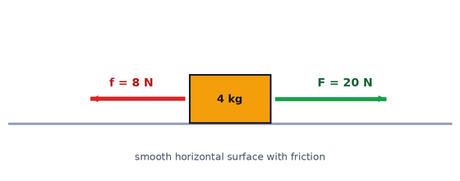
كتلة \(4\ kg\) على سطح أفقي تُسحب بقوة \(20\ N\) ويعاكسها احتكاك \(8\ N\)؛ تسارعها:A \(4\ kg\) block on a horizontal surface is pulled by \(20\ N\) against a friction force of \(8\ N\); its acceleration is:
\(a=3\ m/s^2\)\(a=3\ m/s^2\)
\(a=5\ m/s^2\)\(a=5\ m/s^2\)
\(a=7\ m/s^2\)\(a=7\ m/s^2\)
\(a=2\ m/s^2\)\(a=2\ m/s^2\)
الحلSolution
\(F_{net}=20-8=12\ \mathrm{N}\)
\(a=\dfrac{12}{4}=3\ \mathrm{m/s^2}\)
✅ \(a=3\ m/s^2\) (A)
\(F_{net}=20-8=12\ \mathrm{N}\)
\(a=\dfrac{12}{4}=3\ \mathrm{m/s^2}\)
✅ \(a=3\ m/s^2\) (A)
\[28\,\star\star\]
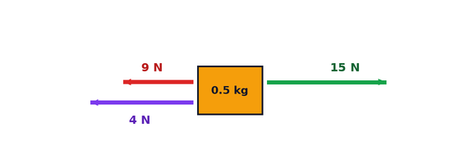
جسم كتلته \(0.5\ kg\) تؤثر عليه ثلاث قوى على استقامة واحدة كما في الشكل (\(15\ N\) يمينًا و\(9\ N\) و\(4\ N\) يسارًا)؛ تسارعه:A \(0.5\ kg\) body is acted on by three collinear forces as shown (\(15\ N\) to the right, \(9\ N\) and \(4\ N\) to the left); its acceleration is:
\(4\ m/s^2\) نحو اليسار\(4\ m/s^2\) to the left
\(56\ m/s^2\) نحو اليمين\(56\ m/s^2\) to the right
\(0\)\(0\)
\(4\ m/s^2\) نحو اليمين\(4\ m/s^2\) to the right
الحلSolution
\(F_{net}=15-9-4=2\ \mathrm{N}\ (\text{right})\)
\(a=\dfrac{2}{0.5}=4\ \mathrm{m/s^2}\)
✅ \(4\ m/s^2\) نحو اليمين (D)
\(F_{net}=15-9-4=2\ \mathrm{N}\ (\text{right})\)
\(a=\dfrac{2}{0.5}=4\ \mathrm{m/s^2}\)
✅ \(4\ m/s^2\) to the right (D)
\[29\,\star\star\star\]
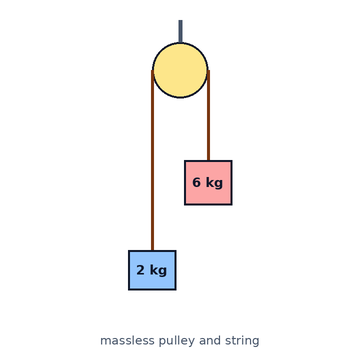
آلة أتوود: كتلتان \(2\ kg\) و\(6\ kg\) مربوطتان بخيط على بكرة مهملة الكتلة (\(g=10\)). قوة الشد في الخيط:An Atwood machine: masses \(2\ kg\) and \(6\ kg\) on a massless pulley (\(g=10\)). The tension in the string is:
\(T=20\ N\)\(T=20\ N\)
\(T=30\ N\)\(T=30\ N\)
\(T=60\ N\)\(T=60\ N\)
\(T=40\ N\)\(T=40\ N\)
الحلSolution
\(a=\dfrac{(m_2-m_1)g}{m_1+m_2}=\dfrac{4\times10}{8}=5\ \mathrm{m/s^2}\)
\(T=m_1(g+a)=2(10+5)=30\ \mathrm{N}\)
✅ \(T=30\ N\) (B)
\(a=\dfrac{(m_2-m_1)g}{m_1+m_2}=\dfrac{4\times10}{8}=5\ \mathrm{m/s^2}\)
\(T=m_1(g+a)=2(10+5)=30\ \mathrm{N}\)
✅ \(T=30\ N\) (B)
\[30\,\star\star\star\]
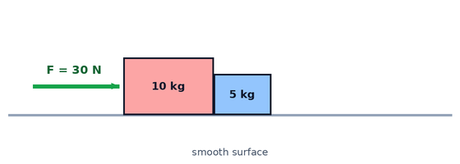
كتلتان \(10\ kg\) و\(5\ kg\) متلامستان على سطح أملس دُفعت الأولى بقوة \(30\ N\)؛ القوة التي تؤثر بها الأولى على الثانية:Masses \(10\ kg\) and \(5\ kg\) touch on a smooth surface and the first is pushed by \(30\ N\); the force the first exerts on the second is:
\(30\ N\)\(30\ N\)
\(20\ N\)\(20\ N\)
\(15\ N\)\(15\ N\)
\(10\ N\)\(10\ N\)
الحلSolution
\(a=\dfrac{F}{m_1+m_2}=\dfrac{30}{15}=2\ \mathrm{m/s^2}\)
\(F_{12}=m_2a=5\times2=10\ \mathrm{N}\)
✅ \(10\ N\) (D)
\(a=\dfrac{F}{m_1+m_2}=\dfrac{30}{15}=2\ \mathrm{m/s^2}\)
\(F_{12}=m_2a=5\times2=10\ \mathrm{N}\)
✅ \(10\ N\) (D)
\[31\,\star\star\]
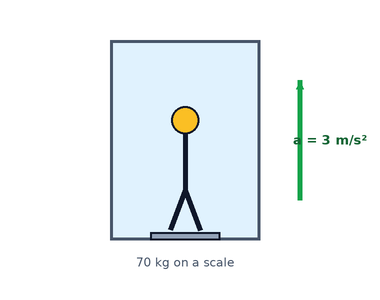
رجل كتلته \(70\ kg\) في مصعد يتسارع نحو الأعلى بـ \(3\ m/s^2\) (\(g=10\))؛ وزنه الظاهري:A man of mass \(70\ kg\) is in an elevator accelerating upward at \(3\ m/s^2\) (\(g=10\)); his apparent weight is:
\(F_N=490\ N\)\(F_N=490\ N\)
\(F_N=700\ N\)\(F_N=700\ N\)
\(F_N=210\ N\)\(F_N=210\ N\)
\(F_N=910\ N\)\(F_N=910\ N\)
الحلSolution
\(F_N=m(g+a)=70\times13=910\ \mathrm{N}\)
✅ \(F_N=910\ N\) (D)
\(F_N=m(g+a)=70\times13=910\ \mathrm{N}\)
✅ \(F_N=910\ N\) (D)
\[32\,\star\star\star\]
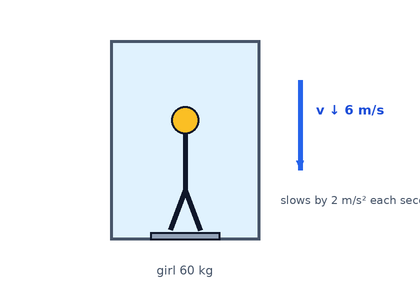
فتاة كتلتها \(60\ kg\) في مصعد يتحرك نحو الأسفل بسرعة \(6\ m/s\) ويتباطأ بمعدل \(2\ m/s^2\) (\(g=10\))؛ قراءة الميزان:A girl of mass \(60\ kg\) is in an elevator moving downward at \(6\ m/s\) and slowing at \(2\ m/s^2\) (\(g=10\)); the scale reads:
\(F_N=480\ N\)\(F_N=480\ N\)
\(F_N=600\ N\)\(F_N=600\ N\)
\(F_N=720\ N\)\(F_N=720\ N\)
\(F_N=120\ N\)\(F_N=120\ N\)
الحلSolution
📌 يتحرك نحو الأسفل ويتباطأ فالتسارع نحو الأعلى \(a=2\ \mathrm{m/s^2}\).
\(F_N=m(g+a)=60\times12=720\ \mathrm{N}\)
✅ \(F_N=720\ N\) (C)
📌 It moves down and slows so the acceleration is upward \(a=2\ \mathrm{m/s^2}\).
\(F_N=m(g+a)=60\times12=720\ \mathrm{N}\)
✅ \(F_N=720\ N\) (C)
\[33\,\star\star\]
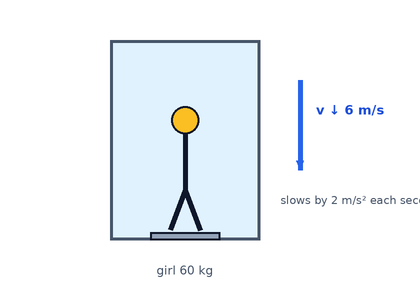
انقطع كابل مصعد فسقط سقوطًا حرًّا؛ قراءة ميزان وُضع عليه شخص كتلته \(60\ kg\):The cable of an elevator breaks and it falls freely; the reading of a scale carrying a \(60\ kg\) person is:
\(600\ N\)\(600\ N\)
\(0\ N\)\(0\ N\)
\(60\ N\)\(60\ N\)
\(300\ N\)\(300\ N\)
الحلSolution
📌 في السقوط الحر \(a=g\) فتكون \(F_N=m(g-a)=0\) (انعدام الوزن الظاهري).
✅ \(0\ N\) (B)
📌 In free fall \(a=g\) so \(F_N=m(g-a)=0\) (apparent weightlessness).
✅ \(0\ N\) (B)
\[34\,\star\star\star\]
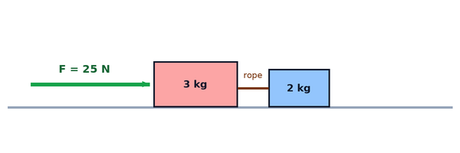
عربتان \(3\ kg\) و\(2\ kg\) مربوطتان بحبل على سطح أملس تُسحب الأولى بقوة \(25\ N\)؛ الشد في الحبل بين العربتين:Carts of \(3\ kg\) and \(2\ kg\) are tied by a rope on a smooth surface and the first is pulled by \(25\ N\); the tension in the rope between them is:
\(15\ N\)\(15\ N\)
\(10\ N\)\(10\ N\)
\(25\ N\)\(25\ N\)
\(5\ N\)\(5\ N\)
الحلSolution
\(a=\dfrac{25}{5}=5\ \mathrm{m/s^2}\)
\(T=m_2a=2\times5=10\ \mathrm{N}\)
✅ \(10\ N\) (B)
\(a=\dfrac{25}{5}=5\ \mathrm{m/s^2}\)
\(T=m_2a=2\times5=10\ \mathrm{N}\)
✅ \(10\ N\) (B)
\[35\,\star\star\]
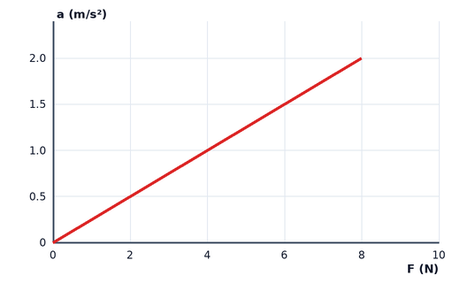
يمثل الرسم العلاقة بين التسارع والقوة المؤثرة على جسم (خط يمر بالنقطتين \((0,0)\) و\((8\ N,\ 2\ m/s^2)\))؛ كتلة الجسم:The graph shows acceleration against force on a body (a line through \((0,0)\) and \((8\ N,\ 2\ m/s^2)\)); the mass of the body is:
\(m=0.25\ kg\)\(m=0.25\ kg\)
\(m=16\ kg\)\(m=16\ kg\)
\(m=2\ kg\)\(m=2\ kg\)
\(m=4\ kg\)\(m=4\ kg\)
الحلSolution
\(\text{slope}=\dfrac{2}{8}=0.25=\dfrac1m\)
\(m=4\ \mathrm{kg}\)
✅ \(m=4\ kg\) (D)
\(\text{slope}=\dfrac{2}{8}=0.25=\dfrac1m\)
\(m=4\ \mathrm{kg}\)
✅ \(m=4\ kg\) (D)
\[36\,\star\star\star\]
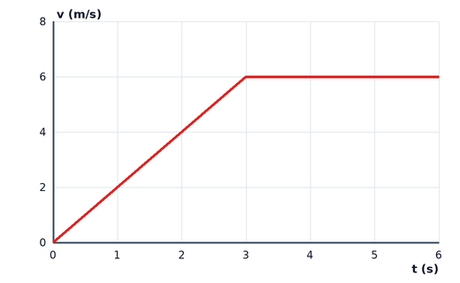
يمثل الرسم سرعة جسم كتلته \(2\ kg\) مع الزمن؛ مقدار القوة المحصلة المؤثرة عليه في أول \(3\ s\):The graph shows the velocity of a \(2\ kg\) body against time; the net force on it during the first \(3\ s\) is:
\(12\ N\)\(12\ N\)
\(2\ N\)\(2\ N\)
\(0\)\(0\)
\(4\ N\)\(4\ N\)
الحلSolution
📌 التسارع = ميل منحنى السرعة–الزمن: \(a=\dfrac{6-0}{3}=2\ \mathrm{m/s^2}\).
\(F=ma=2\times2=4\ \mathrm{N}\)
✅ \(4\ N\) (D)
📌 Acceleration = the slope of the velocity–time graph: \(a=\dfrac{6-0}{3}=2\ \mathrm{m/s^2}\).
\(F=ma=2\times2=4\ \mathrm{N}\)
✅ \(4\ N\) (D)
\[37\,\star\star\]
كتلة جسم \(50\ kg\)؛ وزنه على كوكب جاذبيته \(4\ m/s^2\):The mass of a body is \(50\ kg\); its weight on a planet where \(g=4\ m/s^2\) is:
\(500\ N\)\(500\ N\)
\(12.5\ N\)\(12.5\ N\)
\(200\ N\)\(200\ N\)
\(50\ N\)\(50\ N\)
الحلSolution
\(F_g=mg=50\times4=200\ \mathrm{N}\)
📌 الكتلة ثابتة في كل مكان (\(50\ \mathrm{kg}\)) أما الوزن فيتغير مع \(g\).
✅ \(200\ N\) (C)
\(F_g=mg=50\times4=200\ \mathrm{N}\)
📌 The mass is the same everywhere (\(50\ \mathrm{kg}\)) while the weight changes with \(g\).
✅ \(200\ N\) (C)
\[38\,\star\star\star\]
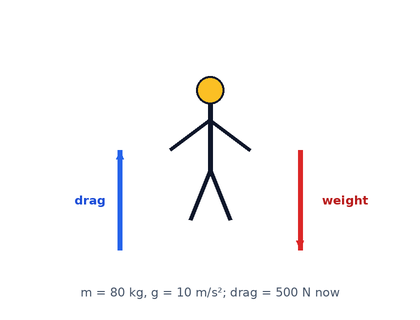
مظلي كتلته \(80\ kg\) يسقط وقوة المقاومة عليه الآن \(500\ N\) (\(g=10\))؛ تسارعه:A skydiver of mass \(80\ kg\) is falling and the drag on him is now \(500\ N\) (\(g=10\)); his acceleration is:
\(3.75\ m/s^2\ \downarrow\)\(3.75\ m/s^2\ \downarrow\)
\(6.25\ m/s^2\ \downarrow\)\(6.25\ m/s^2\ \downarrow\)
\(10\ m/s^2\ \downarrow\)\(10\ m/s^2\ \downarrow\)
\(0\)\(0\)
الحلSolution
\(F_g=800\ \mathrm{N},\quad F_{net}=800-500=300\ \mathrm{N}\ (\downarrow)\)
\(a=\dfrac{300}{80}=3.75\ \mathrm{m/s^2}\ (\downarrow)\)
📌 لم يصل بعد إلى السرعة الحدية لأن المقاومة أقل من الوزن.
✅ \(3.75\ m/s^2\ \downarrow\) (A)
\(F_g=800\ \mathrm{N},\quad F_{net}=800-500=300\ \mathrm{N}\ (\downarrow)\)
\(a=\dfrac{300}{80}=3.75\ \mathrm{m/s^2}\ (\downarrow)\)
📌 He has not reached terminal velocity because the drag is less than the weight.
✅ \(3.75\ m/s^2\ \downarrow\) (A)
\[39\,\star\star\]
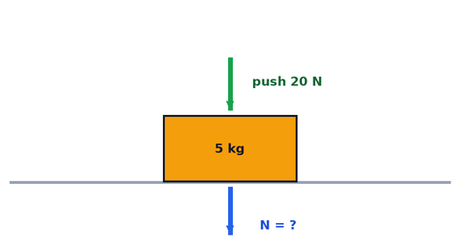
كتلة \(5\ kg\) موضوعة على طاولة أفقية ويدفعها شخص رأسيًا نحو الأسفل بقوة \(20\ N\) (\(g=10\))؛ القوة العمودية من الطاولة:A \(5\ kg\) block rests on a horizontal table and a person pushes it vertically down with \(20\ N\) (\(g=10\)); the normal force of the table is:
\(50\ N\)\(50\ N\)
\(70\ N\)\(70\ N\)
\(30\ N\)\(30\ N\)
\(20\ N\)\(20\ N\)
الحلSolution
\(F_N=mg+20=50+20=70\ \mathrm{N}\)
✅ \(70\ N\) (B)
\(F_N=mg+20=50+20=70\ \mathrm{N}\)
✅ \(70\ N\) (B)
\[40\,\star\star\star\]
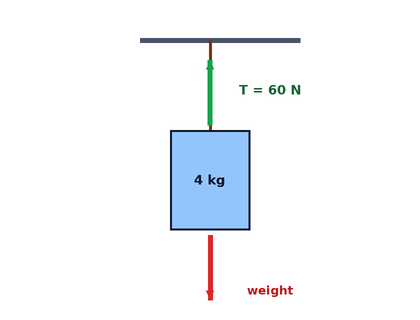
حبل يرفع كتلة \(4\ kg\) بقوة شد \(60\ N\) (\(g=10\))؛ تسارع الكتلة:A rope lifts a \(4\ kg\) mass with tension \(60\ N\) (\(g=10\)); the acceleration of the mass is:
\(15\ m/s^2\) نحو الأعلى\(15\ m/s^2\) upward
\(5\ m/s^2\) نحو الأعلى\(5\ m/s^2\) upward
\(5\ m/s^2\) نحو الأسفل\(5\ m/s^2\) downward
\(0\)\(0\)
الحلSolution
\(T-mg=ma\Rightarrow60-40=4a\)
\(a=5\ \mathrm{m/s^2}\ (\uparrow)\)
✅ \(5\ m/s^2\) نحو الأعلى (B)
\(T-mg=ma\Rightarrow60-40=4a\)
\(a=5\ \mathrm{m/s^2}\ (\uparrow)\)
✅ \(5\ m/s^2\) upward (B)
\[41\,\star\star\]
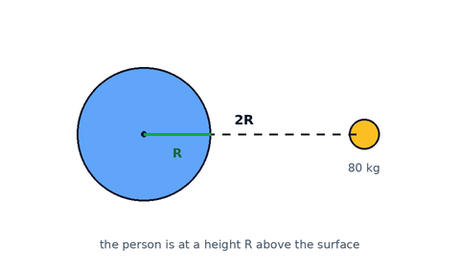
شخص يزن \(800\ N\) على سطح الأرض؛ وزنه على ارتفاع يساوي نصف قطر الأرض (\(R\)) فوق السطح (أي على بعد \(2R\) من المركز):A person weighs \(800\ N\) on the Earth’s surface; his weight at a height equal to the Earth’s radius \(R\) above the surface (i.e. \(2R\) from the centre) is:
\(400\ N\)\(400\ N\)
\(100\ N\)\(100\ N\)
\(800\ N\)\(800\ N\)
\(200\ N\)\(200\ N\)
الحلSolution
\(g\propto\dfrac1{r^2}\Rightarrow F=\dfrac{800}{(2)^2}=200\ \mathrm{N}\)
✅ \(200\ N\) (D)
\(g\propto\dfrac1{r^2}\Rightarrow F=\dfrac{800}{(2)^2}=200\ \mathrm{N}\)
✅ \(200\ N\) (D)
📝 المسائل المقالية
📝 Essay Problems
\[1\,\star\]
اكتب أمام كل قوة هل هي قوة تلامس أم قوة مجال: القوة الكهربائية، قوة الدفع، قوة الاحتكاك، قوة الرياح، القوة المغناطيسية، قوة التجاذب الكتلي.Write next to each force whether it is a contact force or a field force: electric force, push force, friction force, wind force, magnetic force, gravitational attraction.
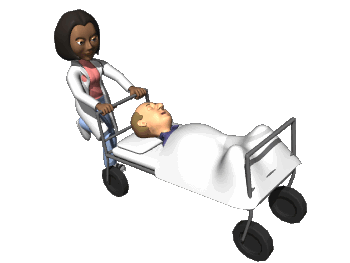
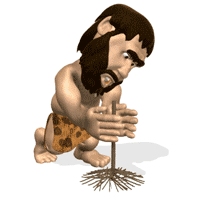

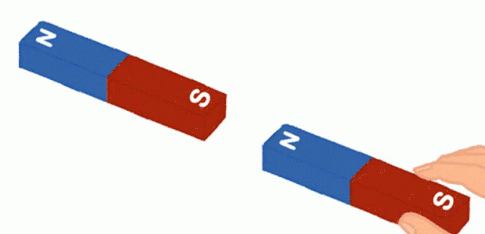
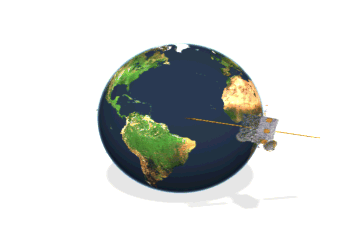
.....................................................................
الحلSolution
📌 قوى مجال (تؤثر عن بعد دون تلامس): القوة الكهربائية، القوة المغناطيسية، قوة التجاذب الكتلي (الجاذبية).
📌 قوى تلامس: قوة الدفع، قوة الاحتكاك، قوة الرياح (تلامس جزيئات الهواء مع الشراع).
✅ مجال: كهربائية ومغناطيسية وتجاذب كتلي — تلامس: دفع واحتكاك ورياح
📌 Field forces (act at a distance without contact): the electric force, the magnetic force and gravitational attraction.
📌 Contact forces: the push force, friction and wind force (air molecules touching the sail).
✅ Field: electric, magnetic, gravitational — contact: push, friction, wind
\[2\,\star\star\]
جسم كتلته \(5\ kg\) أثّرت عليه قوتان كما في الشكل (\(300\ N\) نحو اليسار و\(200\ N\) نحو اليمين). احسب التسارع الذي يتحرك به الجسم.A body of mass \(5\ kg\) is acted on by two forces as shown (\(300\ N\) to the left and \(200\ N\) to the right). Calculate its acceleration.
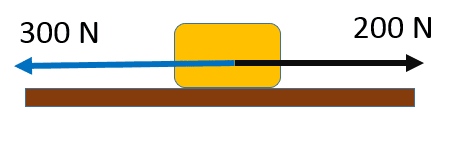
.....................................................................
الحلSolution
\(F_{net}=300-200=100\ \mathrm{N}\) نحو اليسار.
\(a=\dfrac{F_{net}}{m}=\dfrac{100}{5}=20\ \mathrm{m/s^2}\) نحو اليسار (الغرب).
✅ \(a=20\ m/s^2\) نحو الغرب
\(F_{net}=300-200=100\ \mathrm{N}\) to the left.
\(a=\dfrac{F_{net}}{m}=\dfrac{100}{5}=20\ \mathrm{m/s^2}\) to the left (west).
✅ \(a=20\ m/s^2\) west
\[3\,\star\star\]
علّق خيط لا يمتط في السقف وعُلقت في طرفه الآخر كتلة \(4\ kg\) فأصبح الجسم في حالة اتزان (\(g=9.8\ m/s^2\)). (أ) حدد القوى المؤثرة على الجسم. (ب) احسب قوة الشد. (ج) ما القوة التي يؤثر بها الحبل على السقف؟ وأي قوانين نيوتن تتبع؟An inextensible string hangs from the ceiling with a \(4\ kg\) mass at its other end and the body is in equilibrium (\(g=9.8\ m/s^2\)). (a) Identify the forces on the body. (b) Calculate the tension. (c) What force does the string exert on the ceiling and which Newton law does it obey?
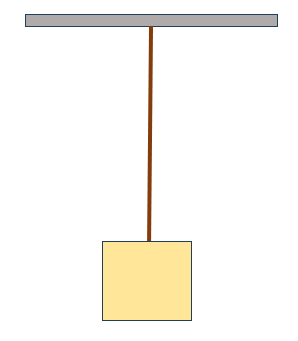
.....................................................................
الحلSolution
📌 (أ) قوتان: الوزن \(F_g=mg\) نحو الأسفل وقوة الشد \(T\) نحو الأعلى.
📌 (ب) اتزان: \(T=mg=4\times9.8=39.2\ \mathrm{N}\).
📌 (ج) الحبل يؤثر على السقف بقوة \(39.2\ \mathrm{N}\) نحو الأسفل؛ وهي رد فعل لقوة السقف على الحبل (قانون نيوتن الثالث: الفعل ورد الفعل).
✅ \(T=39.2\ N\)
📌 (a) Two forces: the weight \(F_g=mg\) downward and the tension \(T\) upward.
📌 (b) Equilibrium: \(T=mg=4\times9.8=39.2\ \mathrm{N}\).
📌 (c) The string pulls the ceiling down with \(39.2\ \mathrm{N}\); it is the reaction to the ceiling’s force on the string (Newton’s third law: action and reaction).
✅ \(T=39.2\ N\)
\[4\,\star\star\]
آلة أتوود بكرتها مهملة الكتلة وخيطها لا يمتط (\(m_1=2\ kg\) و\(m_2=3\ kg\)، \(g=9.8\)). احسب تسارع الجملة وقوة الشد.An Atwood machine with a massless pulley and inextensible string (\(m_1=2\ kg\), \(m_2=3\ kg\), \(g=9.8\)). Calculate the acceleration of the system and the tension.
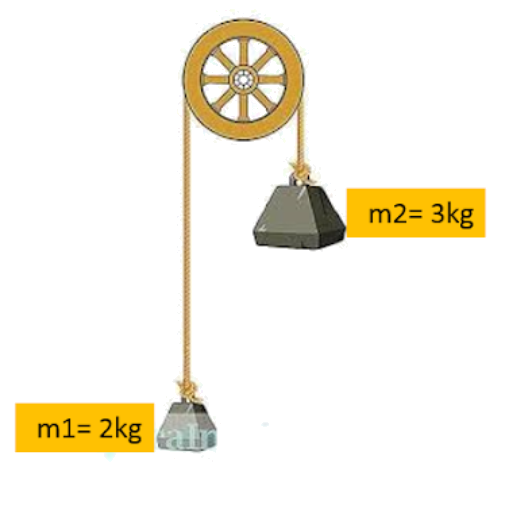
.....................................................................
الحلSolution
\(a=\dfrac{(m_2-m_1)g}{m_1+m_2}=\dfrac{(3-2)\times9.8}{5}=1.96\ \mathrm{m/s^2}\).
\(T=m_1(g+a)=2(9.8+1.96)=23.5\ \mathrm{N}\).
✅ \(a=1.96\ m/s^2,\ T=23.5\ N\)
\(a=\dfrac{(m_2-m_1)g}{m_1+m_2}=\dfrac{(3-2)\times9.8}{5}=1.96\ \mathrm{m/s^2}\).
\(T=m_1(g+a)=2(9.8+1.96)=23.5\ \mathrm{N}\).
✅ \(a=1.96\ m/s^2,\ T=23.5\ N\)
\[5\,\star\star\star\]
مكعبان \(m_1=3\ kg\) و\(m_2=2\ kg\) على مستوى أفقي أملس؛ أثّرت قوة أفقية \(20\ N\) نحو اليمين على المكعب الكبير. احسب تسارع الجسمين وقوة الفعل ورد الفعل بينهما.Two cubes \(m_1=3\ kg\) and \(m_2=2\ kg\) on a smooth horizontal plane; a horizontal force of \(20\ N\) to the right acts on the larger cube. Calculate the acceleration of both and the action and reaction forces between them.
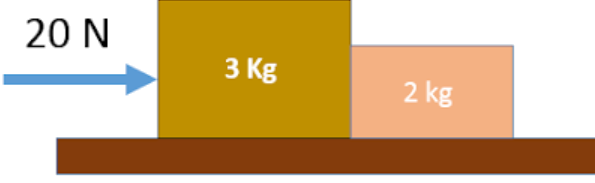
.....................................................................
الحلSolution
📌 الجسمان يتحركان معًا: \(a=\dfrac{F}{m_1+m_2}=\dfrac{20}{5}=4\ \mathrm{m/s^2}\).
📌 القوة التي يؤثر بها المكعب الكبير على الصغير (الفعل): \(F_{12}=m_2a=2\times4=8\ \mathrm{N}\) نحو اليمين.
📌 رد الفعل: \(F_{21}=8\ \mathrm{N}\) نحو اليسار على المكعب الكبير؛ فمحصلة القوى على الكبير \(20-8=12=3\times4\) ✓.
✅ \(a=4\ m/s^2,\ F_{12}=F_{21}=8\ N\)
📌 The two move together: \(a=\dfrac{F}{m_1+m_2}=\dfrac{20}{5}=4\ \mathrm{m/s^2}\).
📌 The force the large cube exerts on the small one (action): \(F_{12}=m_2a=2\times4=8\ \mathrm{N}\) to the right.
📌 The reaction: \(F_{21}=8\ \mathrm{N}\) to the left on the large cube; the net force on it is \(20-8=12=3\times4\) ✓.
✅ \(a=4\ m/s^2,\ F_{12}=F_{21}=8\ N\)
لاحظت خطأ؟ أو عندك سؤال عن أحد الأسئلة؟ اكتبه بالتعليقات وحدد رقم السؤال بالضبط.
Noticed an error? Or have a question about one of the questions? Write it in the comments and specify the exact question number.