"My Lord, enable me to be grateful for Your favor which You have bestowed upon me and upon my parents, and to work righteousness of which You approve, and make righteous for me my offspring. Indeed, I have repented to You, and indeed, I am of the Muslims." (Quran 46:15)
"Our Lord, grant us from among our wives and offspring comfort to our eyes, and make us an example for the righteous." (Quran 25:74)
"My Lord, grant me authority and join me with the righteous. And grant me a mention of honor among later generations. And make me among the inheritors of the Garden of Pleasure." (Quran 26:83-85)
⚡ بنك أسئلة: القوى الكهروستاتيكية
⚡ Question Bank: Electrostatic Force
الصف 12 متقدم 🇦🇪 دولة الإمارات العربية المتحدة
Grade 12 Advanced 🇦🇪 United Arab Emirates
⏱️ 47 سؤال اختيار من متعدد بتصحيح فوري، و4 أسئلة مقالية محلولة بالكامل⏱️ 47 multiple-choice questions with instant feedback, plus 4 fully-solved essay questions
\[1\,\star\]
أحد الشحنات التالية من الممكن أن تكون شحنة جسمWhich of the following charges could be the charge of an object?
\(q=3\times10^{-19}\,C\)
\(q=5.2\times10^{-19}\,C\)
\(q=2\times10^{-19}\,C\)
\(q=8\times10^{-19}\,C\)
الحلSolution
📌 الخطوة 1: أي شحنة يجب أن تكون مضاعفًا صحيحًا لشحنة الإلكترون \(e=1.6\times10^{-19}\,C\).
📌 الخطوة 2: بقسمة كل خيار على \(e\): فقط \(8\times10^{-19}/1.6\times10^{-19}=5\) عدد صحيح؛ الباقي أعداد كسرية.
✅ الإجابة الصحيحة: \(8\times10^{-19}\,C\)
📌 Step 1: Any real charge must be a whole-number multiple of \(e=1.6\times10^{-19}\,C\).
📌 Step 2: Only \(8\times10^{-19}/1.6\times10^{-19}=5\) is an integer; the others are not.
✅ Correct answer: 8×10⁻¹⁹ C
\[2\,\star\]
تم دلك قضيب من الزجاج بقطعة من الصوف فأصبح القضيب مشحونًا بشحنة موجبة، فإن القضيب يكونA glass rod is rubbed with wool and becomes positively charged. This means the rod:
فقد بروتوناتLost protons
اكتسب بروتوناتGained protons
اكتسب إلكتروناتGained electrons
فقد إلكتروناتLost electrons
الحلSolution
📌 الخطوة 1: البروتونات مثبتة داخل النواة ولا تنتقل بالدلك؛ الشحن بالدلك ينتج دائمًا عن انتقال الإلكترونات فقط.
📌 الخطوة 2: أصبح القضيب موجبًا، أي أنه فقد إلكترونات (انتقلت إلى الصوف).
✅ الإجابة الصحيحة: فقد إلكترونات
📌 Step 1: Protons are fixed inside the nucleus and never transfer by rubbing; only electrons move.
📌 Step 2: The rod became positive, meaning it lost electrons (to the wool).
✅ Correct answer: Lost electrons
\[3\,\star\]
أحد الموصلات التالية قد قلّت كتلته، مع العلم أن (A,B) حدث فيهما التقريب (الحث)، و(C,D) حدث فيهما التلامسWhich conductor below has decreased in mass, given that (A,B) show induction (approach only) and (C,D) show contact charging?
AA
BB
CC
DD
الحلSolution
📌 الخطوة 1: الشحن بالتأثير (الحث، A وB) لا ينقل أي شحنة فعلية إلى الموصل؛ الكتلة لا تتغير في الحالتين.
📌 الخطوة 2: في الشحن بالتلامس مع قضيب موجب (C)، تنتقل إلكترونات من الموصل إلى القضيب ليصبح الموصل موجبًا أيضًا، فتقل كتلة الموصل (فقد إلكترونات = فقد كتلة ولو ضئيلة). أما D (تلامس مع قضيب غير مشحون) فلا ينتج عنه انتقال شحنة.
✅ الإجابة الصحيحة: الموصل C
📌 Step 1: Induction (A, B) transfers no actual charge to the conductor; mass is unchanged in both.
📌 Step 2: Contact with a positive rod (C) makes electrons flow from the conductor into the rod, so the conductor loses electrons — and mass. D (contact with an uncharged rod) transfers no charge.
✅ Correct answer: Conductor C
\[4\,\star\star\]
عدد الإلكترونات الموجودة في \(0.5\,g\) من الماء يعادل (الكتلة المولية للماء \(18\,g\)، العدد الذري للأكسجين 8 وللهيدروجين 1)The number of electrons in \(0.5\,g\) of water equals (molar mass of water = 18 g/mol, atomic numbers O=8, H=1)
\(N=1.67\times10^{25}\)
\(N=1.67\times10^{24}\)
\(N=1.67\times10^{23}\)
\(N=1.67\times10^{22}\)
الحلSolution
📌 الخطوة 1: عدد المولات \(=\dfrac{0.5}{18}=0.02778\,mol\)
📌 الخطوة 2: عدد الجزيئات \(=0.02778\times6.02\times10^{23}=1.672\times10^{22}\) جزيء
📌 الخطوة 3: كل جزيء ماء \(H_2O\) يحتوي \(2(1)+8=10\) إلكترونات
📌 الخطوة 4: العدد الكلي \(=1.672\times10^{22}\times10=1.672\times10^{23}\) إلكترون
✅ الإجابة الصحيحة: \(1.67\times10^{23}\)
📌 Step 1: Moles \(=0.5/18=0.02778\,mol\)
📌 Step 2: Molecules \(=1.672\times10^{22}\)
📌 Step 3: Each \(H_2O\) has \(2(1)+8=10\) electrons
📌 Step 4: Total \(=1.672\times10^{23}\) electrons
✅ Correct answer: 1.67×10²³
\[5\,\star\star\]
عدد الإلكترونات الموجودة في \(2\,g\) من جزيء الأكسجين \(O_2\) (الكتلة الذرية للأكسجين \(M=16\,g\)، العدد الذري 8)The number of electrons in \(2\,g\) of oxygen molecule \(O_2\) (atomic mass O=16 g, atomic number=8)
\(N=6.02\times10^{22}\)
\(N=6.02\times10^{23}\)
\(N=6.02\times10^{24}\)
\(N=6.02\times10^{25}\)
الحلSolution
📌 الخطوة 1: الكتلة المولية لـ\(O_2=32\,g\)؛ عدد المولات \(=2/32=0.0625\,mol\)
📌 الخطوة 2: عدد الجزيئات \(=0.0625\times6.02\times10^{23}=3.7625\times10^{22}\)
📌 الخطوة 3: كل جزيء \(O_2\) يحوي \(2\times8=16\) إلكترونًا
📌 الخطوة 4: العدد الكلي \(=3.7625\times10^{22}\times16=6.02\times10^{23}\) إلكترون (يساوي عدد أفوجادرو بالصدفة الحسابية)
✅ الإجابة الصحيحة: \(6.02\times10^{23}\)
📌 Step 1: Molar mass of \(O_2=32\,g\); moles \(=2/32=0.0625\)
📌 Step 2: Molecules \(=3.7625\times10^{22}\)
📌 Step 3: Each \(O_2\) has 16 electrons
📌 Step 4: Total \(=6.02\times10^{23}\) — numerically equal to Avogadro's number
✅ Correct answer: 6.02×10²³
\[6\,\star\]
كشاف كهربائي متعادل تم تقريب موصل مشحون بشحنة موجبة منه (دون ملامسة)، فلوحظ أن الكشاف قد انفرجت ورقتاه، فإنA neutral electroscope has a positively charged conductor brought near it (no contact). The leaves diverge. This means:
📌 Step 1: The external positive charge attracts the electroscope's electrons toward the (nearer) knob, making it negative.
📌 Step 2: The (farther) leaves become positive (electron-deficient) and repel each other, diverging.
✅ Correct answer: Knob negative, leaves positive
\[7\,\star\]
موصلان متشابهان متعادلان تم تقريب جسم مشحون بشحنة موجبة كما في الشكل من الموصلين، وتم إبعاد الموصلين عن بعضهما دون إبعاد الجسم المشحون، فإن شحنة الموصلينTwo identical neutral conductors have a positive object brought near as shown. They are separated without removing the charged object. Their charges are:
(A سالبة)(B سالبة)(A negative)(B negative)
(A موجبة)(B موجبة)(A positive)(B positive)
(A سالبة)(B موجبة)(A negative)(B positive)
(A موجبة)(B سالبة)(A positive)(B negative)
الحلSolution
📌 الخطوة 1: الشحنة الموجبة تجذب إلكترونات الموصلين المتلامسين نحو B (الأقرب)، فيصبح B سالبًا.
📌 الخطوة 2: يصبح A (الأبعد) ناقص إلكترونات، أي موجبًا. الفصل يتم والقضيب لا يزال قريبًا، فيبقى هذا التوزيع محتبسًا.
✅ الإجابة الصحيحة: A موجبة، B سالبة
📌 Step 1: The positive charge attracts electrons in the touching conductors toward B (the nearer one), making B negative.
📌 Step 2: A (the farther one) becomes electron-deficient, i.e. positive. Separating while the rod is still present traps this distribution.
✅ Correct answer: A positive, B negative
\[8\,\star\star\]
موصلان متشابهان متعادلان تم تقريب جسم مشحون بشحنة سالبة منهما، ثم وُصلا بالأرض، ثم قُطع الاتصال بالأرض، ثم أُبعد الموصلان عن بعضهما دون إبعاد الجسم المشحون، فإن شحنة الموصلينTwo identical neutral conductors have a negative object brought near. They are grounded, ground disconnected, then separated without removing the charged object. Their charges are:
(A متعادل)(B سالبة)(A neutral)(B negative)
(A موجبة)(B سالبة)(A positive)(B negative)
(A متعادل)(B موجبة)(A neutral)(B positive)
(A موجبة)(B موجبة)(A positive)(B positive)
الحلSolution
📌 الخطوة 1: تأريض موصل واحد متصل (B وA معًا) يجبر النظام كله على الوصول لجهد صفر، وهذا يتطلب أن يكتسب النظام شحنة كلية معاكسة لإشارة الجسم الخارجي (هنا: موجبة، لأن الجسم سالب).
📌 الخطوة 2: نقطة التأريض (B، الأقرب للجسم السالب) هي حيث تُستنزف الإلكترونات فعليًا، فتحمل B معظم الشحنة الموجبة الصافية، بينما يبقى A (الأبعد) قريبًا من التعادل.
✅ الإجابة الصحيحة: A متعادل، B موجبة
📌 Step 1: Grounding the connected A+B system forces it to zero potential, requiring the whole system to end up with net charge OPPOSITE the external charge (positive here, since the rod is negative).
📌 Step 2: The grounding point (B, nearer the negative rod) is where electrons actually drain out, so B ends up carrying essentially all the net positive charge while A (farther) stays close to neutral.
✅ Correct answer: A neutral, B positive
\[9\,\star\star\]
موصلان متشابهان متعادلان تم تقريب جسم مشحون بشحنة موجبة منهما، ثم وُصلا بالأرض، ثم قُطع الاتصال بالأرض، ثم أُبعد الجسم المشحون، ثم أُبعد الموصلان عن بعضهما، فإن شحنة الموصلينTwo identical neutral conductors have a positive object brought near. They are grounded, ground disconnected, the charged object removed, THEN the conductors separated. Their charges are:
(A سالبة)(B سالبة)(A negative)(B negative)
(A موجبة)(B سالبة)(A positive)(B negative)
(A متعادل)(B موجبة)(A neutral)(B positive)
(A موجبة)(B متعادل)(A positive)(B neutral)
الحلSolution
📌 الخطوة 1: التأريض مع جسم موجب قريب يجبر النظام على اكتساب شحنة كلية سالبة (معاكسة للجسم الخارجي).
📌 الخطوة 2: بما أن الجسم المشحون أُبعد قبل الفصل، يزول أي استقطاب موضعي، فتتوزع الشحنة السالبة بالتساوي على الموصلين المتماثلين قبل فصلهما.
✅ الإجابة الصحيحة: كلاهما سالب بالتساوي
📌 Step 1: Grounding with a nearby positive object forces the system to a net negative charge (opposite the external charge).
📌 Step 2: Since the object is removed before separation, any local polarization vanishes, so the negative charge spreads evenly over both identical conductors before they are separated.
✅ Correct answer: Both equally negative
\[10\,\star\]
موصلان كرويان متماثلان: A شُحن بشحنة \(-3\,\mu C\)، B شُحن بشحنة \(+9\,\mu C\). تم تلامس الموصلين ثم إبعادهما، فإن عدد الإلكترونات التي فقدها الموصل A يعادلTwo identical spherical conductors: A charged \(-3\,\mu C\), B charged \(+9\,\mu C\). They are touched then separated. The number of electrons LOST by conductor A is:
\(3.75\times10^{13}\)
\(1.87\times10^{13}\)
\(4.43\times10^{13}\)
\(5.85\times10^{13}\)
الحلSolution
📌 الخطوة 1: الشحنة الكلية \(=-3+9=+6\,\mu C\)، تتوزع بالتساوي (موصلان متماثلان): كل منهما \(+3\,\mu C\)
📌 الخطوة 2: تغيّر شحنة A: من \(-3\,\mu C\) إلى \(+3\,\mu C\)، أي تغيّر مقداره \(6\,\mu C\) (فقدان إلكترونات)
📌 الخطوة 3: عدد الإلكترونات \(=\dfrac{6\times10^{-6}}{1.6\times10^{-19}}=3.75\times10^{13}\)
✅ الإجابة الصحيحة: \(3.75\times10^{13}\) إلكترون
📌 Step 1: Total charge \(=+6\,\mu C\), shared equally: \(+3\,\mu C\) each
📌 Step 2: A's charge changes from \(-3\) to \(+3\,\mu C\), a \(6\,\mu C\) change (electrons lost)
📌 Step 3: Electrons lost \(=6\times10^{-6}/1.6\times10^{-19}=3.75\times10^{13}\)
✅ Correct answer: 3.75×10¹³ electrons
\[11\,\star\]
شبه موصل نمط n (مُطعَّم بعناصر من المجموعة 15)، فإن المسؤول عن نقل التيار فيه عند درجة حرارة الصفر المطلقAn n-type semiconductor (doped with group-15 elements). At absolute zero temperature, the charge carriers responsible for current are:
الفجوات والإلكتروناتHoles and electrons
الفجوات فقطHoles only
الإلكترونات فقطElectrons only
الشحنات الموجبة فقطPositive charges only
الحلSolution
📌 الخطوة 1: التطعيم بعناصر خماسية التكافؤ (المجموعة 15) يضيف إلكترونات فائضة (حاملات الأغلبية) دون أن يترافق ذلك مع فجوات مقابلة.
📌 الخطوة 2: شبه الموصل النقي (توليد أزواج إلكترون-فجوة داخليًا) يتطلب طاقة حرارية؛ عند الصفر المطلق لا توجد أزواج داخلية، فتبقى الإلكترونات المانحة فقط كحاملات.
📌 Step 2: Intrinsic electron-hole pair generation needs thermal energy; at absolute zero none occur, leaving only the donor electrons as carriers.
✅ Correct answer: Electrons only
\[12\,\star\star\]
كشاف كهربائي قاعدته متصلة بالأرض باستمرار، تم تقريب جسم مشحون بشحنة سالبة منه دون ملامسة، أي الأشكال التالية يبيّن ما يحدث للكشاف؟An electroscope with its base continuously grounded has a negative object brought near without touching. Which figure shows what happens?
AA
BB
CC
DD
الحلSolution
📌 الخطوة 1: بما أن الكشاف مؤرَّض باستمرار، يبقى عند جهد الأرض (صفر) طوال الوقت.
📌 الخطوة 2: الشحنة السالبة الخارجية تطرد الإلكترونات عبر سلك التأريض، فيتولد شحن موجب مستحث عند المقبض القريب، بينما تبقى الورقتان البعيدتان بلا شحنة صافية، أي لا تنفرجان.
✅ الإجابة الصحيحة: الشكل C (المقبض موجب، الورقتان بلا انفراج)
📌 Step 1: Since the electroscope is continuously grounded, it stays at ground (zero) potential throughout.
📌 Step 2: The negative rod repels electrons out through the ground wire, inducing positive charge at the near knob, while the leaves — carrying no net charge — do not diverge.
✅ Correct answer: Figure C (knob positive, leaves undeflected)
\[13\,\star\]
بأي عامل يتغير البعد بين شحنتين إذا تضاعفت القوة المتبادلة بينهما مع بقاء باقي العوامل ثابتة؟By what factor does the distance change if the mutual force between two charges doubles, all else constant?
📌 Step 2: Doubling F gives \(r_2=r/\sqrt2\approx0.7r\)
✅ Correct answer: r₂ ≈ 0.7r
\[14\,\star\]
إذا أثّرت الشحنة الأولى بقوة كهربائية على الثانية مقدارها 10N نحو اليمين، فإن القوة التي تؤثر بها الثانية على الأولى تعادلIf charge 1 exerts a force of 10 N to the right on charge 2, the force exerted by charge 2 on charge 1 is:
لا نستطيع التحديد لعدم معرفة مقدار الشحنتينCannot determine without knowing the magnitudes
\(F_{21}=10\,N\) نحو اليمينF₂₁=10 N to the right
لا نستطيع التحديد لعدم معرفة نوع الشحنتينCannot determine without knowing the signs
\(F_{21}=10\,N\) نحو اليسارF₂₁=10 N to the left
الحلSolution
📌 الخطوة 1: بحسب قانون نيوتن الثالث، فإن \(F_{21}=-F_{12}\) دائمًا: متساويان في المقدار ومتعاكسان في الاتجاه — بغض النظر عن مقدار أو نوع الشحنتين.
✅ الإجابة الصحيحة: \(10\,N\) نحو اليسار
📌 Step 1: By Newton's third law, \(F_{21}=-F_{12}\) always: equal magnitude, opposite direction — regardless of the charges' magnitude or sign.
✅ Correct answer: 10 N to the left
\[15\,\star\star\]
ثلاث شحنات من نفس النوع على استقامة واحدة كما في الشكل، فإن اتجاه ومقدار القوة المؤثرة على \(q_2\) تعادلThree charges of the same type on a line as shown. The direction and magnitude of the force on \(q_2\) is:
\(F_{net}=0.0\)
\(F_{net}=\dfrac{Kq^2}{2r^2}\) نحو اليمينF_net=Kq²/2r² to the right
\(F_{net}=\dfrac{Kq^2}{4r^2}\) نحو اليمينF_net=Kq²/4r² to the right
\(F_{net}=\dfrac{Kq^2}{2r^2}\) نحو اليسارF_net=Kq²/2r² to the left
الحلSolution
📌 الخطوة 1: من الشكل: \(q_1=q\) على بُعد \(r\) يسار \(q_2=q\)، و\(q_3=2q\) على بُعد \(2r\) يمين \(q_2\)، جميعها موجبة.
📌 Step 3: \(F_{net}=Kq^2/r^2-Kq^2/2r^2=Kq^2/2r^2\) to the right
✅ Correct answer: Kq²/2r² to the right
\[16\,\star\star\star\]
حُسبت القوة المؤثرة على \(q_1\) فكانت 5N باتجاه موضح على الرسم، وكانت القوة من \(q_3\) على \(q_1\) تعادل 3N، فإن الشحنة الثانية مقدارها ونوعهاThe force on \(q_1\) was 5 N in the direction shown; the force from \(q_3\) on \(q_1\) is 3 N. Find the magnitude and sign of \(q_2\)
\(q_2=2.2\times10^{-6}\,C\) موجبةq₂=2.2×10⁻⁶ C positive
\(q_2=4.4\times10^{-6}\,C\) موجبةq₂=4.4×10⁻⁶ C positive
\(q_2=6.6\times10^{-6}\,C\) سالبةq₂=6.6×10⁻⁶ C negative
\(q_2=3.3\times10^{-6}\,C\) سالبةq₂=3.3×10⁻⁶ C negative
الحلSolution
📌 الخطوة 1: \(q_2\) على بُعد \(0.2m\) أفقيًا من \(q_1\)، و\(q_3\) على بُعد \(0.2m\) رأسيًا؛ القوتان متعامدتان، فمحصلتهما بفيثاغورس: \(F_{21}=\sqrt{5^2-3^2}=4\,N\)
📌 الخطوة 2: اتجاه \(F_{net}\) للأعلى واليمين؛ المركبة الأفقية (من \(q_2\)) موجبة (لليمين) أي تنافر، فـ\(q_2\) من نفس نوع \(q_1\) (موجبة).
شحنتان: \(q_1=-4\,\mu C\) والثانية \(q_2=?\)، المسافة بينهما \(0.1\,m\). وُضع إلكترون بينهما على بُعد \(0.02\,m\) من \(q_2\) كما في الشكل، ولوحظ أن الإلكترون متزن، فإن مقدار ونوع \(q_2\)Two charges: \(q_1=-4\,\mu C\) and \(q_2=?\), separated by \(0.1\,m\). An electron placed between them, \(0.02\,m\) from \(q_2\), is in equilibrium. Find the magnitude and sign of \(q_2\)
\(q_2=2.5\times10^{-7}\,C\) سالبةq₂=2.5×10⁻⁷ C negative
\(q_2=5.3\times10^{-7}\,C\) موجبةq₂=5.3×10⁻⁷ C positive
\(q_2=6.4\times10^{-7}\,C\) موجبةq₂=6.4×10⁻⁷ C positive
\(q_2=3.5\times10^{-7}\,C\) سالبةq₂=3.5×10⁻⁷ C negative
الحلSolution
📌 الخطوة 1: المسافة من \(q_1\) للإلكترون \(r_1=0.1-0.02=0.08\,m\)؛ من \(q_2\): \(r_2=0.02\,m\)
📌 الخطوة 2: النوع: \(q_1\) سالبة تنافر الإلكترون بعيدًا عنها (نحو \(q_2\)). للاتزان يجب أن تنافره \(q_2\) أيضًا (بعيدًا عنها، نحو \(q_1\))، أي أن \(q_2\) سالبة مثل الإلكترون.
📌 ملاحظة: بما أن \(q_2\) أقرب بكثير للإلكترون من \(q_1\)، يجب أن تكون أصغر مقدارًا من \(q_1\) لتعطي نفس شدة المجال؛ هذا يؤكد أن القيمة الصحيحة أصغر من \(4\,\mu C\)، وليست أكبر منها كما في بعض المصادر.
📌 Step 2: Sign: \(q_1\) repels the electron toward \(q_2\); for equilibrium \(q_2\) must also repel it (toward \(q_1\)), so \(q_2\) is negative like the electron.
📌 Note: Since \(q_2\) is much closer to the electron than \(q_1\) is, it must be smaller in magnitude to produce the same field strength — confirming the correct value is smaller than \(4\,\mu C\), not larger.
✅ Correct answer: q₂ ≈ 2.5×10⁻⁷ C, negative
\[18\,\star\star\]
يوضح الشكل ثلاث شحنات نقطية موجبة على استقامة واحدة. إذا كانت القوة الكلية المؤثرة على الشحنة الثانية معدومة، فإن النسبة \(\dfrac{r_1}{r_2}\) تعادلThree positive point charges on a line as shown. If the net force on the middle charge is zero, the ratio \(\dfrac{r_1}{r_2}\) equals
\(0.81\)
\(1.22\)
\(0.57\)
\(1.41\)
الحلSolution
📌 الخطوة 1: من الشكل: \(q_1=2q\)، \(q_2=q\)، \(q_3=3q\)؛ \(r_1\) بين \(q_1,q_2\)، و\(r_2\) بين \(q_2,q_3\)
📌 Step 1: From the figure: \(q_1=2q\), \(q_2=q\), \(q_3=3q\)
📌 Step 2: Equilibrium: \(2/r_1^2=3/r_2^2\)
📌 Step 3: \(r_1/r_2=\sqrt{2/3}\approx0.81\)
✅ Correct answer: 0.81
\[19\,\star\star\star\]
شحنتان مختلفتا النوع: الأولى موجبة وتعادل أربعة أمثال الثانية السالبة. الأولى عند نقطة الأصل، والثانية على بُعد \(10\,cm\) على المحور الأفقي. عند أي موضع نضع بروتونًا لتكون محصلة القوى عليه معدومة؟Two charges of opposite type: the first is positive, 4× the second (negative). First at origin, second at 10 cm along x-axis. Where should a proton be placed for zero net force?
\(X=0.14\,m\)
\(X=0.04\,m\)
\(X=0.2\,m\)
\(X=0.16\,m\)
الحلSolution
📌 الخطوة 1: بما أن الشحنتين متعاكستان في النوع، فلا تنعدم القوة بينهما (كلتا القوتين على نفس الاتجاه)؛ نقطة الاتزان تقع خارج الشحنتين، على جهة الشحنة الأصغر (السالبة).
📌 الخطوة 3: \(2(X-0.1)=X\Rightarrow X=0.2\,m\) (الحل الآخر يقع بين الشحنتين ومرفوض)
✅ الإجابة الصحيحة: \(X=0.2\,m\)
📌 Step 1: Opposite-sign charges: the null point lies beyond the smaller (negative) charge, not between them.
📌 Step 2: With \(X\) measured from \(q_1\): \(4(X-0.1)^2=X^2\)
📌 Step 3: \(X=0.2\,m\)
✅ Correct answer: X = 0.2 m
\[20\,\star\star\star\]
كرتان مشحونتان بشحنة متماثلة، كتلة كل منهما \(m=0.1\,kg\)، معلقتان بخيط عديم الكتلة، تباعدتا حتى شكّل كل خيط زاوية \(\theta=10°\) مع الرأسي، فإن القوة الكهربائية المؤثرة على كل كرةTwo identical charged balls, mass \(0.1\,kg\) each, hang from strings and repel until each string makes \(\theta=10°\) with vertical. The electric force on each ball is:
\(Fe=0.43\,N\)
\(Fe=0.33\,N\)
\(Fe=0.59\,N\)
\(Fe=0.17\,N\)
الحلSolution
📌 الخطوة 1: عند الاتزان: \(\tan\theta=\dfrac{F_e}{mg}\Rightarrow F_e=mg\tan\theta\)
إذا أثّرت الشحنة الأولى بقوة كهربائية على الثانية مقدارها 10N نحو اليمين، فإن القوة التي تؤثر بها الثانية على الأولى تعادلIf charge 1 exerts a force of 10 N to the right on charge 2, the force exerted by charge 2 on charge 1 is:
لا نستطيع التحديد لعدم معرفة مقدار الشحنتينCannot determine without knowing the magnitudes
\(F_{21}=10\,N\) نحو اليمينF₂₁=10 N to the right
لا نستطيع التحديد لعدم معرفة نوع الشحنتينCannot determine without knowing the signs
\(F_{21}=10\,N\) نحو اليسارF₂₁=10 N to the left
الحلSolution
📌 الخطوة 1: قانون نيوتن الثالث: \(F_{21}=-F_{12}\) دائمًا، بغض النظر عن مقدار أو نوع الشحنتين.
✅ الإجابة الصحيحة: \(10\,N\) نحو اليسار
📌 Step 1: Newton's third law: \(F_{21}=-F_{12}\) always, regardless of the charges' magnitude or sign.
✅ Correct answer: 10 N to the left
\[22\,\star\star\]
شحنتان من نفس النوع، الأولى تعادل ثلاثة أمثال الثانية، المسافة بينهما \(0.2\,m\). إذا كانت القوة المتبادلة بينهما \(0.6\,N\)، فإن مقدار كل من الشحنتينTwo like charges, the first three times the second, separated by \(0.2\,m\). If the mutual force is \(0.6\,N\), the magnitudes are:
ثلاث شحن متساوية المقدار (نوعها موضح على الشكل) على رؤوس مثلث متساوي الأضلاع، فإن اتجاه ومقدار القوة المؤثرة على الشحنة الأولىThree equal-magnitude charges (types shown) at the vertices of an equilateral triangle. The direction and magnitude of the force on the first charge:
\(F_{net}=K\dfrac{q^2}{r^2}\) شمالًاNorth
\(F_{net}=K\dfrac{2q^2}{r^2}\) شمال شرقNortheast
\(F_{net}=K\dfrac{2q^2}{r^2}\) شرقًاEast
\(F_{net}=K\dfrac{q^2}{r^2}\) شرقًاEast
الحلSolution
📌 الخطوة 1: من الشكل: \(q_1=+q\) (أعلى)، \(q_2=+q\) (أسفل يسار)، \(q_3=-q\) (أسفل يمين)، جميعها على بُعد \(r\) من بعضها.
📌 الخطوة 2: قوة \(q_2\) على \(q_1\): تنافر (نفس النوع)، بمركبتين \((0.5,\;\sqrt3/2)\times kq^2/r^2\). قوة \(q_3\) على \(q_1\): تجاذب، بمركبتين \((0.5,\;-\sqrt3/2)\times kq^2/r^2\)
وُضعت ثلاث شحن متساوية النوع والمقدار \(2q\) على محيط نصف دائرة بأبعاد متساوية كما في الشكل، ووُضعت عند مركز الدائرة شحنة \(-q\)، فإن مقدار واتجاه القوة على الشحنة المركزيةThree equal charges of \(2q\) placed on a semicircle at equal spacing as shown, with \(-q\) at the center. The magnitude and direction of the force on the central charge:
\(F_{net}=K\dfrac{2q^2}{r^2}\) نحو اليسارTo the left
\(F_{net}=K\dfrac{q^2}{r^2}\) نحو اليمينTo the right
\(F_{net}=K\dfrac{q^2}{2r^2}\) نحو اليسارTo the left
\(F_{net}=K\dfrac{2q^2}{4r^2}\) شمال شرقNortheast
الحلSolution
📌 الخطوة 1: الشحنتان العلوية والسفلية (\(2q\) كل منهما) متماثلتان في البعد والزاوية عن المركز، فمركبتاهما الرأسيتان (على الخط الواصل للمركز) تُلغيان تمامًا.
📌 الخطوة 2: يبقى تأثير الشحنة الوسطى (\(2q\) على المحور الأفقي): تجاذب مع \(-q\)، بمقدار \(F=\dfrac{k(2q)(q)}{r^2}=\dfrac{2kq^2}{r^2}\)، تسحب الشحنة المركزية نحوها (نحو اليسار).
✅ الإجابة الصحيحة: \(\dfrac{2Kq^2}{r^2}\) نحو اليسار
📌 Step 1: The top and bottom charges are symmetric about the center; their vertical components cancel exactly.
📌 Step 2: Only the middle charge (on the horizontal axis) remains: attraction, \(F=2kq^2/r^2\), pulling the center charge toward it (left).
✅ Correct answer: 2Kq²/r², to the left
\[25\,\star\star\]
بافتراض شحن الأرض والقمر بشحنة متساوية \(q_e=q_m=q\)، والمسافة بينهما \(r\)، أصبحت القوة الكهربائية تساوي قوة الجذب الكتلي. قُرِّب القمر والأرض إلى نصف المسافة، فأي شحنة يجب أن تحملها الأرض والقمر لتبقى القوتان متساويتين؟Assume Earth and Moon carry equal charge \(q_e=q_m=q\) at distance \(r\), where electric force equals gravitational force. If the distance is halved, what charge keeps the forces equal?
\(q_e=q_m=0.5q\)
\(q_e=q_m=q\)
\(q_e=q_m=0.25q\)
\(q_e=q_m=2q\)
الحلSolution
📌 الخطوة 1: الشرط الأصلي: \(\dfrac{kq^2}{r^2}=\dfrac{GMm}{r^2}\Rightarrow kq^2=GMm\) — لاحظ أن \(r\) تُحذف تمامًا من المعادلة!
📌 الخطوة 2: عند المسافة الجديدة \(r/2\): كلا الطرفين (الكهربائي والجذبي) يتغيران بنفس النسبة \((1/(r/2)^2=4/r^2)\)، فتبقى المساواة \(kq^2=GMm\) صحيحة بنفس قيمة \(q\) دون أي تغيير.
📌 Step 2: At half the distance, both sides scale by the same factor \((1/(r/2)^2)\), so the equality still holds with the SAME charge \(q\), unchanged.
✅ Correct answer: qₑ=q_m=q (unchanged)
\[26\,\star\star\]
ثلاث شحن متساوية المقدار والنوع على رؤوس مثلث متساوي الأضلاع، والقوة المتبادلة بين أي شحنتين \(12\,N\)، فإن محصلة القوى المؤثرة على أي شحنة تعادلThree equal charges at the vertices of an equilateral triangle; the mutual force between any two is \(12\,N\). The net force on any charge is:
\(F_{net}=24\,N\)
\(F_{net}=16.65\,N\)
\(F_{net}=10.39\,N\)
\(F_{net}=20.87\,N\)
الحلSolution
📌 الخطوة 1: كل الشحنات موجبة ومتساوية، فجميع القوى تنافرية.
📌 الخطوة 2: بوضع الشحنات عند رؤوس مثلث متساوي الأضلاع طول ضلعه \(r\) وجمع متجهي القوتين المؤثرتين على أي شحنة (كل منهما مقدارها 12N)، ينتج \(F_{net}=12\sqrt3\approx20.78\,N\) (يطابق تقريبًا الخيار D).
✅ الإجابة الصحيحة: \(20.87\,N\)
📌 Step 1: All charges are equal and positive, so all forces are repulsive.
📌 Step 2: Direct vector addition (placing the charges at the vertices of an equilateral triangle) gives \(F_{net}=12\sqrt3\approx20.78\,N\), matching option D.
✅ Correct answer: 20.87 N
\[27\,\star\star\]
ثلاث شحنات على رؤوس مثلث قائم الزاوية كما في الشكل. القوة من الثانية على الأولى \(F_{21}=(-0.4\hat x,-0.3\hat y)\)، ومن الثالثة على الأولى \(F_{31}=(0,+0.6\hat y)\)، فأي صف في الجدول يطابق المعطيات؟Three charges at a right triangle's vertices. \(F_{21}=(-0.4,-0.3)\), \(F_{31}=(0,+0.6)\). Which table row matches?
الصف A: كلاهما موجبة، 0.7NRow A: both positive, 0.7N
✅ Correct answer: Row D (q3 positive, q2 negative, 0.5N)
\[28\,\star\]
شحنتان مختلفتان في النوع: \(q_1=+2q\)، \(q_2=-q\). إذا أثّرت الأولى بقوة \(F_{12}=10\,N\) نحو اليمين على الثانية، فإن القوة التي تؤثر بها الثانية على الأولى تعادلTwo opposite charges: \(q_1=+2q\), \(q_2=-q\). If \(F_{12}=10\,N\) to the right, the force from charge 2 on charge 1 is:
\(F_{21}=20\,N\) نحو اليمينF₂₁=20 N right
\(F_{21}=20\,N\) نحو اليسارF₂₁=20 N left
\(F_{21}=10\,N\) نحو اليمينF₂₁=10 N right
\(F_{21}=10\,N\) نحو اليسارF₂₁=10 N left
الحلSolution
📌 الخطوة 1: قانون نيوتن الثالث ينطبق دائمًا بغض النظر عن نسبة مقداري الشحنتين: \(F_{21}=-F_{12}\) دائمًا (متساويان بالمقدار، متعاكسان بالاتجاه).
✅ الإجابة الصحيحة: \(10\,N\) نحو اليسار
📌 Step 1: Newton's third law always applies regardless of the charge ratio: \(F_{21}=-F_{12}\).
✅ Correct answer: 10 N to the left
\[29\,\star\]
شحنتان متساويتان المقدار، المسافة بينهما \(0.2\,m\)، والقوة المتبادلة بينهما \(0.4\,N\)، فإن مقدار كل من الشحنتينTwo equal charges separated by \(0.2\,m\) with mutual force \(0.4\,N\). The magnitude of each charge is:
جسم كروي لُمس بجسم مشحون، فاكتسب الكرة شحنة مشابهة عند موقع التلامس فقط، وبقي باقي الجسم متعادلًا. فإن الجسم الكروي يُعتبرA sphere touched by a charged object acquires charge only at the contact point, the rest stays neutral. The sphere is:
كرة فلزيةMetal sphere
كرة جرافيتGraphite sphere
كرة نحاسيةCopper sphere
كرة زجاجيةGlass sphere
الحلSolution
📌 الخطوة 1: في الموصلات (فلز، جرافيت، نحاس)، تنتشر أي شحنة فورًا على كامل السطح الخارجي بسبب حرية حركة الإلكترونات.
📌 الخطوة 2: بقاء الشحنة موضعية عند نقطة التلامس فقط يميّز العوازل (مثل الزجاج)، حيث لا تتحرك الشحنات بحرية.
✅ الإجابة الصحيحة: كرة زجاجية
📌 Step 1: In conductors, any charge instantly spreads over the whole surface due to free electron mobility.
📌 Step 2: Charge staying localized at the contact point is characteristic of insulators like glass.
✅ Correct answer: Glass sphere
\[31\,\star\]
جسم مجهول الشحنة لامس كشافًا فانفرجت ورقتاه. أُبعد الجسم، ثم قُرِّب جسم موجب الشحنة دون ملامسة، فلوحظ أن انفراج الورقتين قلّ. هذا دليل على أن الجسم المجهول كانAn unknown-charge object touches an electroscope, leaves diverge. Object removed; a positive object approaches (no touch) and divergence DECREASES. This shows the unknown object was:
مشحونًا بشحنة موجبةPositively charged
مشحونًا بشحنة سالبةNegatively charged
فقد إلكتروناتLost electrons
غير مشحونUncharged
الحلSolution
📌 الخطوة 1: التلامس شحن الكشاف بشحنة الجسم المجهول نفسها (انفراج الورقتين يثبت وجود شحنة صافية).
📌 الخطوة 2: اقتراب جسم موجب وتقليل الانفراج يعني أن شحنات الكشاف (السالبة لو كانت كذلك) انجذبت نحو المقبض القريب من الجسم الموجب، مبتعدة عن الورقتين، فقلّت كثافة الشحنة فيهما وقلّ التنافر.
📌 الخطوة 3: هذا يحدث فقط إذا كان الكشاف مشحونًا بشحنة سالبة أصلًا (لتنجذب نحو الموجب)، أي أن الجسم المجهول كان سالبًا.
✅ الإجابة الصحيحة: مشحون بشحنة سالبة
📌 Step 1: Contact charged the electroscope with the same sign as the unknown object.
📌 Step 2: A positive object nearby attracting the electroscope's charge toward the knob (away from the leaves) reduces leaf divergence only if the electroscope carries negative charge.
📌 Step 3: So the unknown object was negatively charged.
✅ Correct answer: Negatively charged
\[32\,\star\star\]
مكشاف كهربائي متعادل. رتّب الخطوات الصحيحة لشحنه بالتأثير (الحث) باستخدام قضيب مشحون دون ملامستهA neutral electroscope. Arrange the correct steps to charge it by induction, without touching it, using a charged rod
\(B\Rightarrow D\Rightarrow C\Rightarrow A\)
\(D\Rightarrow B\Rightarrow C\Rightarrow A\)
\(C\Rightarrow B\Rightarrow D\Rightarrow A\)
\(B\Rightarrow C\Rightarrow D\Rightarrow A\)
الحلSolution
📌 الخطوة 1: C: الحالة المتعادلة الابتدائية (المفتاح مفتوح، الورقتان مرتخيتان، لا تأثير بعد).
📌 الخطوة 2: B: يقترب القضيب (قبل التأريض) فيستقطب الكشاف — تنفرج الورقتان بشحنة من نفس نوع القضيب (استقطاب بسيط).
📌 الخطوة 3: D: يوصَل الكشاف بالأرض والقضيب لا يزال قريبًا — تُصرَّف الشحنة الحرة عبر السلك فترتخي الورقتان من جديد.
📌 الخطوة 4: A: يُقطع التأريض ثم يُبعد القضيب — تنتشر الشحنة المحتبسة (المعاكسة لنوع القضيب) على كامل الكشاف فتنفرج الورقتان نهائيًا.
📌 ملاحظة: المصدر الأصلي وضع علامة "صحيح" على إجابتين مختلفتين في آنٍ واحد (خطأ واضح في الترميز)؛ تم اعتماد الترتيب C⇐B⇐D⇐A وحده هنا لأنه يطابق فيزياء التجربة خطوة بخطوة.
📌 Step 1: C: initial neutral state (switch open, leaves relaxed, no influence yet).
📌 Step 2: B: rod approaches (before grounding) — simple polarization diverges the leaves with the same sign as the rod.
📌 Step 3: D: electroscope grounded, rod still near — free charge drains through the wire, leaves relax again.
📌 Step 4: A: ground disconnected, then rod removed — the trapped opposite-sign charge spreads over the whole electroscope, leaves diverge permanently.
📌 Note: The original source marked two different option letters as "correct" simultaneously (a clear source error); only the sequence C⇒B⇒D⇒A is kept here, since it matches the physics of the experiment step by step.
✅ Correct answer: C⇒B⇒D⇒A
\[33\,\star\star\star\]
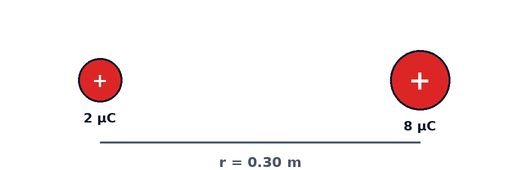
شحنتان نقطيتان \(+2\,\mu C\) و\(+8\,\mu C\) تفصل بينهما مسافة \(0.30\,m\) كما في الشكل. فإن مقدار القوة المتبادلة بينهما ونوعها:Two point charges \(+2\,\mu C\) and \(+8\,\mu C\) are \(0.30\,m\) apart as shown. The magnitude and type of the force between them is:
1.6 N تنافر1.6 N repulsion
1.6 N تجاذب1.6 N attraction
0.16 N تنافر0.16 N repulsion
16 N تنافر16 N repulsion
الحلSolution
📌 الخطوة 1: قانون كولوم: \(F=\dfrac{kq_1q_2}{r^2}=\dfrac{9\times10^9(2\times10^{-6})(8\times10^{-6})}{0.3^2}=1.6\,N\)
📌 الخطوة 2: الشحنتان من النوع نفسه فالقوة تنافر (القوتان متساويتان في المقدار رغم اختلاف الشحنتين).
📌 Step 2: The charges have the same sign so the force is repulsive (the two forces are equal in magnitude although the charges differ).
✅ Correct answer: 1.6 N repulsion
\[34\,\star\star\star\]
إذا تضاعفت إحدى شحنتين نقطيتين وزاد البعد بينهما إلى ثلاثة أمثاله، فإن القوة المتبادلة بينهما تصبح:If one of two point charges is doubled and the distance between them is tripled, the force between them becomes:
\(\dfrac{2}{3}F\)
\(\dfrac{2}{9}F\)
\(6F\)
\(\dfrac{1}{9}F\)
الحلSolution
📌 الخطوة 1: القوة تتناسب طرديًا مع حاصل ضرب الشحنتين وعكسيًا مع مربع البعد: \(F'=\dfrac{k(2q_1)q_2}{(3r)^2}\)
📌 Step 1: The force is directly proportional to the product of the charges and inversely proportional to the square of the distance: \(F'=\dfrac{k(2q_1)q_2}{(3r)^2}\)
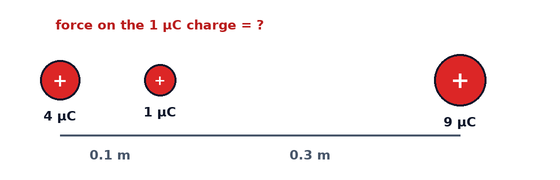
ثلاث شحنات على استقامة واحدة كما في الشكل. فإن القوة المحصلة على الشحنة \(+1\,\mu C\) (الموجب نحو اليمين):Three charges are collinear as shown. The net force on the \(+1\,\mu C\) charge (positive to the right) is:
📌 الخطوة 3: المحصلة: \(3.6-0.9=2.7\,N\) نحو اليمين.
✅ الإجابة الصحيحة: 2.7 N نحو اليمين
📌 Step 1: The \(4\,\mu C\) charge (left) pushes it to the right: \(F_1=\dfrac{9\times10^9(4\times10^{-6})(10^{-6})}{0.1^2}=3.6\,N\)
📌 Step 2: The \(9\,\mu C\) charge (right) pushes it to the left: \(F_3=\dfrac{9\times10^9(9\times10^{-6})(10^{-6})}{0.3^2}=0.9\,N\)
📌 Step 3: Net force: \(3.6-0.9=2.7\,N\) to the right.
✅ Correct answer: 2.7 N to the right
\[36\,\star\star\star\]
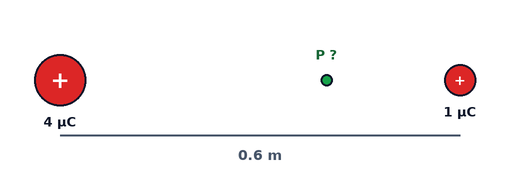
شحنتان موجبتان \(4\,\mu C\) و\(1\,\mu C\) تفصل بينهما \(0.6\,m\). فإن النقطة على الخط بينهما التي تنعدم عندها القوة المحصلة على شحنة اختبار تبعد عن الشحنة \(1\,\mu C\):Two positive charges \(4\,\mu C\) and \(1\,\mu C\) are \(0.6\,m\) apart. The point between them where the net force on a test charge is zero is at a distance from the \(1\,\mu C\) charge of:
\(0.3\,m\)
\(0.2\,m\)
\(0.4\,m\)
\(0.1\,m\)
الحلSolution
📌 الخطوة 1: عند نقطة الاتزان تتساوى القوتان: \(\dfrac{k(4)q}{(0.6-x)^2}=\dfrac{k(1)q}{x^2}\)
📌 الخطوة 2: بأخذ الجذر: \(\dfrac{2}{0.6-x}=\dfrac{1}{x}\Rightarrow2x=0.6-x\Rightarrow x=0.2\,m\) من الشحنة الأصغر.
✅ الإجابة الصحيحة: \(0.2\,m\)
📌 Step 1: At the equilibrium point the two forces are equal: \(\dfrac{k(4)q}{(0.6-x)^2}=\dfrac{k(1)q}{x^2}\)
📌 Step 2: Taking square roots: \(\dfrac{2}{0.6-x}=\dfrac{1}{x}\Rightarrow2x=0.6-x\Rightarrow x=0.2\,m\) from the smaller charge.
✅ Correct answer: \(0.2\,m\)
\[37\,\star\star\star\]
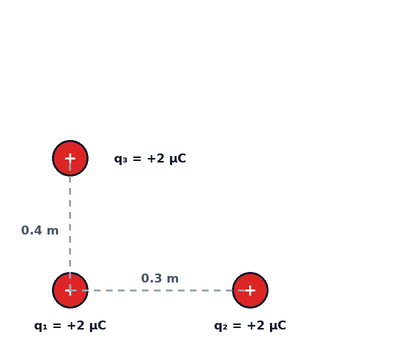
ثلاث شحنات متساوية \(+2\,\mu C\) على رؤوس مثلث قائم كما في الشكل. فإن مقدار القوة المحصلة على \(q_1\):Three equal charges \(+2\,\mu C\) sit at the vertices of a right triangle as shown. The magnitude of the net force on \(q_1\) is:
\(0.63\,N\)
\(0.18\,N\)
\(0.46\,N\)
\(0.23\,N\)
الحلSolution
📌 الخطوة 1: القوة من \(q_2\) (أفقية): \(F_{12}=\dfrac{9\times10^9(2\times10^{-6})^2}{0.3^2}=0.40\,N\)
📌 الخطوة 2: القوة من \(q_3\) (رأسية): \(F_{13}=\dfrac{9\times10^9(2\times10^{-6})^2}{0.4^2}=0.225\,N\)
📌 Step 1: The force from \(q_2\) (horizontal): \(F_{12}=\dfrac{9\times10^9(2\times10^{-6})^2}{0.3^2}=0.40\,N\)
📌 Step 2: The force from \(q_3\) (vertical): \(F_{13}=\dfrac{9\times10^9(2\times10^{-6})^2}{0.4^2}=0.225\,N\)
📌 Step 3: The forces are perpendicular: \(F=\sqrt{0.40^2+0.225^2}=0.46\,N\)
✅ Correct answer: \(0.46\,N\)
\[38\,\star\star\star\]
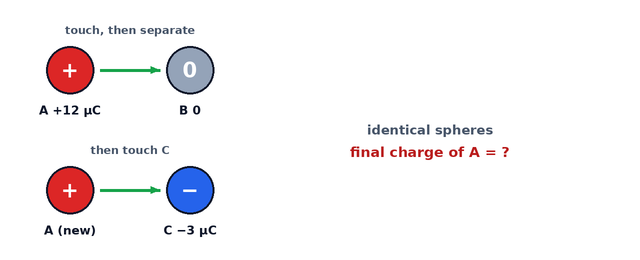
كرة موصلة A شحنتها \(+12\,\mu C\) لامست كرة مماثلة متعادلة B ثم فُصلتا، ثم لامست A كرة ثالثة مماثلة C شحنتها \(-3\,\mu C\) كما في الشكل. فإن شحنة A النهائية:A conducting sphere A with charge \(+12\,\mu C\) touches an identical neutral sphere B and they are separated, then A touches a third identical sphere C of charge \(-3\,\mu C\) as shown. The final charge of A is:
📌 الخطوة 2: الملامسة الثانية مع C: \(q_A=\dfrac{6+(-3)}{2}=+1.5\,\mu C\)
✅ الإجابة الصحيحة: \(+1.5\,\mu C\)
📌 Step 1: First contact (identical spheres share the charge): \(q_A=\dfrac{12+0}{2}=+6\,\mu C\)
📌 Step 2: Second contact with C: \(q_A=\dfrac{6+(-3)}{2}=+1.5\,\mu C\)
✅ Correct answer: \(+1.5\,\mu C\)
\[39\,\star\star\star\]
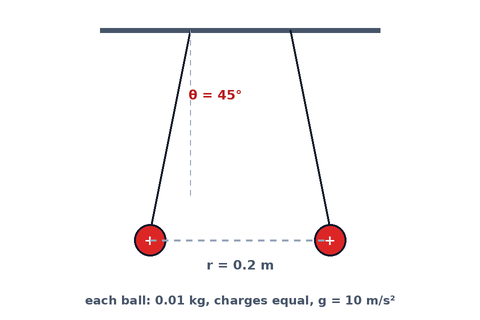
كرتان صغيرتان متماثلتان كتلة كل منهما \(0.01\,kg\) ومشحونتان بشحنتين متساويتين، معلقتان بخيطين فاستقرتا والخيط يصنع \(45^\circ\) مع الرأسي والمسافة بينهما \(0.2\,m\) (\(g=10\,m/s^2\)). فإن شحنة كل كرة:Two identical small balls, each of mass \(0.01\,kg\) and equal charges, hang from threads and settle with each thread at \(45^\circ\) to the vertical and separation \(0.2\,m\) (\(g=10\,m/s^2\)). The charge on each ball is:
\(1.5\,\mu C\)
\(0.67\,\mu C\)
\(0.2\,\mu C\)
\(2.0\,\mu C\)
الحلSolution
📌 الخطوة 1: اتزان إحدى الكرتين: \(F_e=mg\tan\theta=0.01\times10\times\tan45^\circ=0.1\,N\)
📌 الخطوة 2: من قانون كولوم: \(q=r\sqrt{\dfrac{F_e}{k}}=0.2\sqrt{\dfrac{0.1}{9\times10^9}}=0.67\times10^{-6}\,C\)
✅ الإجابة الصحيحة: \(0.67\,\mu C\)
📌 Step 1: Equilibrium of one ball: \(F_e=mg\tan\theta=0.01\times10\times\tan45^\circ=0.1\,N\)
📌 Step 2: From Coulomb’s law: \(q=r\sqrt{\dfrac{F_e}{k}}=0.2\sqrt{\dfrac{0.1}{9\times10^9}}=0.67\times10^{-6}\,C\)
✅ Correct answer: \(0.67\,\mu C\)
\[40\,\star\star\star\]
القوة الكهربائية بين بروتونين على بعد معين أكبر من قوة التجاذب الكتلي بينهما تقريبًا بـ:The electric force between two protons at a given distance is larger than their gravitational attraction by approximately:
\(10^{12}\)
\(10^{24}\)
\(10^{36}\)
\(10^{-36}\)
الحلSolution
📌 الخطوة 1: النسبة لا تعتمد على البعد لأن القوتين تتناسبان مع \(1/r^2\): \(\dfrac{F_e}{F_g}=\dfrac{ke^2}{Gm_p^2}=\dfrac{9\times10^9(1.6\times10^{-19})^2}{6.67\times10^{-11}(1.67\times10^{-27})^2}\)
📌 الخطوة 2: \(\approx1.2\times10^{36}\) فالقوة الكهربائية أكبر بكثير (ولهذا تُهمل الجاذبية في الذرة).
✅ الإجابة الصحيحة: \(10^{36}\)
📌 Step 1: The ratio does not depend on distance since both forces are proportional to \(1/r^2\): \(\dfrac{F_e}{F_g}=\dfrac{ke^2}{Gm_p^2}=\dfrac{9\times10^9(1.6\times10^{-19})^2}{6.67\times10^{-11}(1.67\times10^{-27})^2}\)
📌 Step 2: \(\approx1.2\times10^{36}\), so the electric force is far larger (gravity is negligible in the atom).
✅ Correct answer: \(10^{36}\)
\[41\,\star\star\star\]
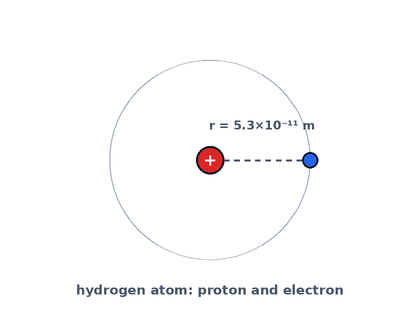
في ذرة الهيدروجين يبعد الإلكترون عن البروتون \(5.3\times10^{-11}\,m\) كما في الشكل (\(e=1.6\times10^{-19}\,C\)). فإن القوة الكهربائية بينهما:In a hydrogen atom the electron is \(5.3\times10^{-11}\,m\) from the proton as shown (\(e=1.6\times10^{-19}\,C\)). The electric force between them is:
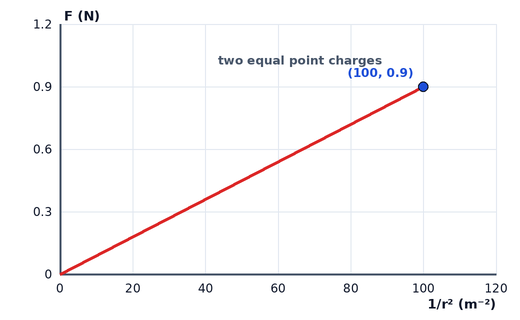
يبين الرسم العلاقة بين القوة الكهربائية بين شحنتين نقطيتين متساويتين ومقلوب مربع البعد بينهما. فإن مقدار كل شحنة (\(k=9\times10^9\)):The graph shows the electric force between two equal point charges against the inverse square of their separation. The magnitude of each charge is (\(k=9\times10^9\)):
\(0.1\,\mu C\)
\(1\,\mu C\)
\(10\,\mu C\)
\(3\,\mu C\)
الحلSolution
📌 الخطوة 1: من \(F=kq^2\cdot\dfrac{1}{r^2}\) الميل يساوي \(kq^2\): \(\text{slope}=\dfrac{0.9}{100}=9\times10^{-3}\)
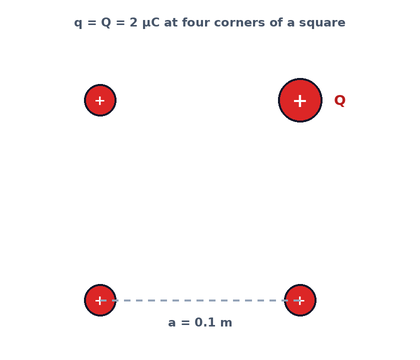
أربع شحنات \(2\,\mu C\) موجبة على رؤوس مربع طول ضلعه \(0.1\,m\) كما في الشكل. فإن القوة المحصلة على الشحنة \(Q\) في الرأس العلوي الأيمن:Four positive charges of \(2\,\mu C\) sit at the corners of a square of side \(0.1\,m\) as shown. The net force on the charge \(Q\) at the upper right corner is:
\(6.9\,N\)
\(5.1\,N\)
\(3.6\,N\)
\(8.6\,N\)
الحلSolution
📌 الخطوة 1: قوة كل شحنة مجاورة: \(F_0=\dfrac{9\times10^9(2\times10^{-6})^2}{0.1^2}=3.6\,N\) (متعامدتان فمحصلتهما \(\sqrt2F_0=5.09\,N\)).
📌 الخطوة 2: الشحنة القطرية على بعد \(\sqrt2a\): \(F_d=\dfrac{F_0}{2}=1.8\,N\) وفي اتجاه المحصلة نفسه.
📌 الخطوة 3: \(F=5.09+1.8=6.9\,N\)
✅ الإجابة الصحيحة: \(6.9\,N\)
📌 Step 1: The force from each adjacent charge: \(F_0=\dfrac{9\times10^9(2\times10^{-6})^2}{0.1^2}=3.6\,N\) (perpendicular so their resultant is \(\sqrt2F_0=5.09\,N\)).
📌 Step 2: The diagonal charge is at \(\sqrt2a\): \(F_d=\dfrac{F_0}{2}=1.8\,N\) along the same direction as the resultant.
📌 Step 3: \(F=5.09+1.8=6.9\,N\)
✅ Correct answer: \(6.9\,N\)
\[44\,\star\star\]
تبلغ القوة الكهربائية بين شحنتين في الهواء \(8\,N\). فإذا غُمرتا في زيت ثابت عزله النسبي \(\varepsilon_r=2\) مع بقاء البعد نفسه فإن القوة تصبح:The electric force between two charges in air is \(8\,N\). If they are immersed in oil of relative permittivity \(\varepsilon_r=2\) at the same separation, the force becomes:
\(16\,N\)
\(4\,N\)
\(2\,N\)
\(8\,N\)
الحلSolution
📌 الخطوة 1: القوة في وسط عازل: \(F=\dfrac{1}{\varepsilon_r}\dfrac{kq_1q_2}{r^2}=\dfrac{F_{air}}{\varepsilon_r}\)
📌 الخطوة 2: \(F=\dfrac{8}{2}=4\,N\)
✅ الإجابة الصحيحة: \(4\,N\)
📌 Step 1: The force in a dielectric medium: \(F=\dfrac{1}{\varepsilon_r}\dfrac{kq_1q_2}{r^2}=\dfrac{F_{air}}{\varepsilon_r}\)
📌 Step 2: \(F=\dfrac{8}{2}=4\,N\)
✅ Correct answer: \(4\,N\)
\[45\,\star\star\star\]
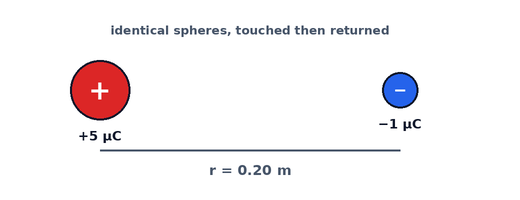
كرتان موصلتان متماثلتان شحنتاهما \(+5\,\mu C\) و\(-1\,\mu C\) على بعد \(0.20\,m\)، لُمستا ببعضهما ثم أُعيدتا إلى البعد نفسه كما في الشكل. فإن القوة بينهما بعد ذلك:Two identical conducting spheres with charges \(+5\,\mu C\) and \(-1\,\mu C\) are \(0.20\,m\) apart, touched together, then returned to the same separation as shown. The force between them afterwards is:
0.9 N تجاذب0.9 N attraction
0.9 N تنافر0.9 N repulsion
1.125 N تنافر1.125 N repulsion
0.225 N تنافر0.225 N repulsion
الحلSolution
📌 الخطوة 1: بعد التلامس تتقاسم الكرتان الشحنة الكلية بالتساوي: \(q=\dfrac{5+(-1)}{2}=+2\,\mu C\) لكل كرة.
📌 Step 1: After touching, the spheres share the total charge equally: \(q=\dfrac{5+(-1)}{2}=+2\,\mu C\) each.
📌 Step 2: \(F=\dfrac{9\times10^9(2\times10^{-6})^2}{0.2^2}=0.9\,N\) and the charges are alike so the force is repulsive (it was attractive before touching).
✅ Correct answer: 0.9 N repulsion
\[46\,\star\star\star\]
جسم شحنته \(-4.8\,\mu C\). فإن عدد الإلكترونات الزائدة عليه (\(e=1.6\times10^{-19}\,C\)):An object carries a charge of \(-4.8\,\mu C\). The number of excess electrons on it is (\(e=1.6\times10^{-19}\,C\)):
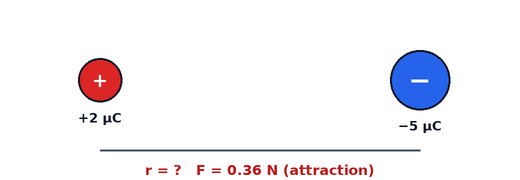
شحنتان \(+2\,\mu C\) و\(-5\,\mu C\) تتجاذبان بقوة \(0.36\,N\) كما في الشكل. فإن البعد بينهما:Two charges \(+2\,\mu C\) and \(-5\,\mu C\) attract each other with a force of \(0.36\,N\) as shown. The distance between them is:
\(0.5\,m\)
\(0.25\,m\)
\(0.1\,m\)
\(1.0\,m\)
الحلSolution
📌 الخطوة 1: من قانون كولوم: \(r=\sqrt{\dfrac{k|q_1q_2|}{F}}=\sqrt{\dfrac{9\times10^9(2\times10^{-6})(5\times10^{-6})}{0.36}}\)
📌 الخطوة 2: \(r=\sqrt{0.25}=0.5\,m\)
✅ الإجابة الصحيحة: \(0.5\,m\)
📌 Step 1: From Coulomb’s law: \(r=\sqrt{\dfrac{k|q_1q_2|}{F}}=\sqrt{\dfrac{9\times10^9(2\times10^{-6})(5\times10^{-6})}{0.36}}\)
📌 Step 2: \(r=\sqrt{0.25}=0.5\,m\)
✅ Correct answer: \(0.5\,m\)
✍️ أسئلة مقالية
✍️ Essay Questions
\[1\,\star\star\star\]
في الشكل أدناه، أربع شحنات على رؤوس مربع طول ضلعه \(10\,cm\): \(q_1=-3\,\mu C\)، \(q_2=-2\,\mu C\)، \(q_3=+3\,\mu C\)، \(q_4=-2\,\mu C\)Four charges at the corners of a \(10\,cm\) square: \(q_1=-3\,\mu C\), \(q_2=-2\,\mu C\), \(q_3=+3\,\mu C\), \(q_4=-2\,\mu C\)
احسب القوة الكهربائية المؤثرة على \(q_1\)Calculate the electric force on \(q_1\)
📌 Step 4: From \(q_3\) (attractive, diagonal): \(F=4.05\,N\), components \((-2.86,-2.86)\,N\)
📌 Step 5: Net: \(F_x=F_y=2.54\,N\Rightarrow F_{net}\approx3.59\,N\) at 45°, away from the square
✅ F_net ≈ 3.59 N, 45° away from the square
\[2\,\star\star\star\]
حُسبت القوة على \(q_1\) فكانت \(5\,N\) باتجاه موضح على الرسم، والقوة من \(q_3\) على \(q_1\) تعادل \(3\,N\). احسب مقدار ونوع الشحنة الثانية \(q_2\)The force on \(q_1\) was \(5\,N\) in the shown direction; the force from \(q_3\) is \(3\,N\). Calculate the magnitude and sign of \(q_2\)
احسب مقدار ونوع الشحنة \(q_2\)Calculate the magnitude and sign of \(q_2\)
📌 Step 2: Horizontal component points right (repulsive) ⇒ \(q_2\) same sign as \(q_1\) (positive)
📌 Step 3: \(q_2\approx4.44\times10^{-6}\,C\)
✅ q₂ ≈ 4.4×10⁻⁶ C, positive
\[3\,\star\star\]
ثلاث شحنات: \(q_1=-3\,\mu C\)، \(q_2=+2\,\mu C\)، \(q_3=-4\,\mu C\) على خط واحد، \(r_1=0.1\,m\) بين \(q_1,q_2\)، \(r_2=0.2\,m\) بين \(q_2,q_3\)Three charges on a line: \(q_1=-3\,\mu C\), \(q_2=+2\,\mu C\), \(q_3=-4\,\mu C\), with \(r_1=0.1\,m\) between \(q_1,q_2\) and \(r_2=0.2\,m\) between \(q_2,q_3\)
احسب القوة الكهربائية المؤثرة على \(q_3\) وحدد اتجاههاCalculate the electric force on \(q_3\) and its direction
الحلSolution
📌 الخطوة 1: من \(q_2\) (تجاذب، \(q_2\) موجبة و\(q_3\) سالبة): \(F_{23}=\dfrac{k(2)(4)\times10^{-12}}{(0.2)^2}=1.8\,N\)، تسحب \(q_3\) نحو \(q_2\) (نحو اليسار)
📌 الخطوة 2: من \(q_1\) (تنافر، \(q_1\) و\(q_3\) كلاهما سالب، البعد \(r_1+r_2=0.3\,m\)): \(F_{13}=\dfrac{k(3)(4)\times10^{-12}}{(0.3)^2}=1.2\,N\)، تدفع \(q_3\) بعيدًا عن \(q_1\) (نحو اليمين)
📌 الخطوة 3: المحصلة: \(F_{net}=1.8-1.2=0.6\,N\) نحو اليسار (نحو \(q_1,q_2\))
✅ \(F_{net}=0.6\,N\) نحو اليسار (نحو \(q_1\) و\(q_2\))
📌 Step 1: From \(q_2\) (attractive): \(F_{23}=1.8\,N\), pulling \(q_3\) left
📌 Step 2: From \(q_1\) (repulsive, distance 0.3m): \(F_{13}=1.2\,N\), pushing \(q_3\) right
📌 Step 3: Net: \(F_{net}=0.6\,N\) to the left
✅ F_net = 0.6 N, to the left (toward q₁ and q₂)
\[4\,\star\star\]
شحنتان متماثلتا النوع، \(q_1=4q_2\)، المسافة بينهما \(r=0.4\,m\)، والقوة على \(q_1\) تعادل \(0.8\,N\) نحو اليمينTwo like charges, \(q_1=4q_2\), separated by \(r=0.4\,m\), with force \(0.8\,N\) to the right on \(q_1\)
احسب مقدار كل من الشحنتينCalculate the magnitude of each charge
إذا زادت المسافة إلى أربعة أمثالها، فما مقدار القوة الكهربائية الجديدة؟If the distance increases to four times, what is the new electric force?