🔍 بنك الأسئلة: العدسات وقانون الانكسار
🔍 Question Bank: Lenses and the Law of Refraction
قانون سنل ومعامل الانكسار، الزاوية الحرجة والانعكاس الكلي، العدسات المحدبة والمقعرة، معادلة العدسة والتكبير، المنشور
Snell’s Law and Refractive Index, Critical Angle and Total Internal Reflection, Convex and Concave Lenses, the Lens Equation and Magnification, the Prism
⏱️ 37 سؤال اختيار من متعدد بتصحيح فوري بمستويات متدرجة، و4 مسائل مقالية محلولة⏱️ 37 multiple-choice questions of graded difficulty with instant feedback, plus 4 solved essay problems
\[1\,\star\]
في أي الأشكال التالية لا ينكسر الضوء؟ (الشكل D: شعاع يسير في الماء ثم يدخل الماء نفسه)In which of the following cases does light not refract? (Figure D: a ray travelling in water and entering the same water)
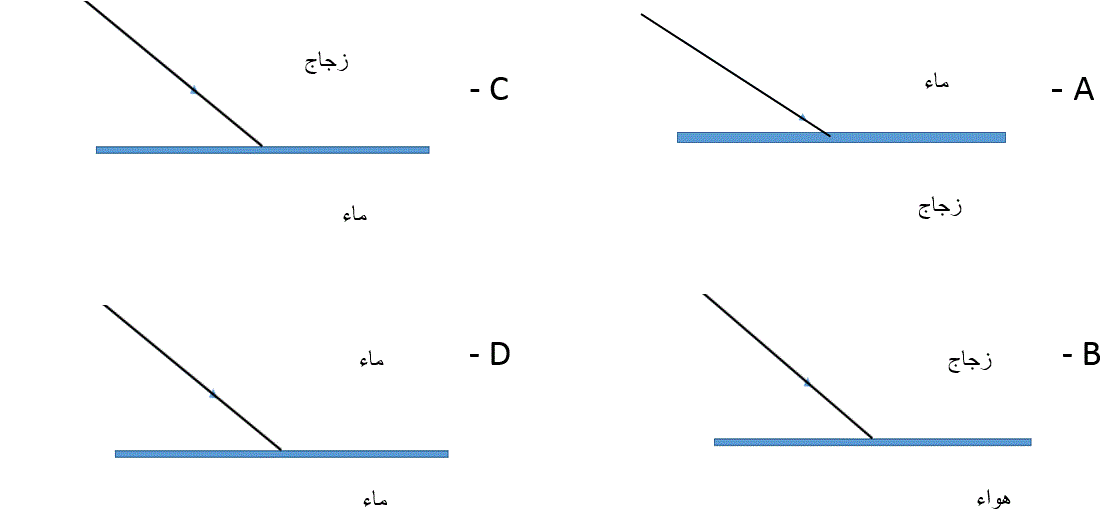
AA
BB
CC
DD
الحلSolution
📌 حتى ينكسر الضوء يجب أن: (1) ينتقل من وسط إلى وسط آخر، (2) يسقط بشكل غير عمودي على السطح الفاصل.
📌 في الشكل D ينتقل الضوء في الوسط نفسه (ماء إلى ماء) فلا ينكسر ويتابع طريقه مستقيمًا.
✅ D
📌 For light to refract it must: (1) travel from one medium into a different medium, and (2) strike the interface at a non-perpendicular angle.
📌 In figure D the light stays in the same medium (water to water), so it does not refract and continues straight.
✅ D
\[2\,\star\]
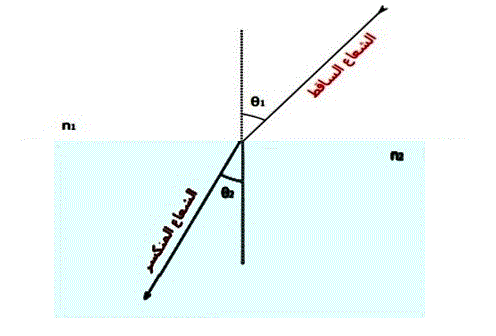
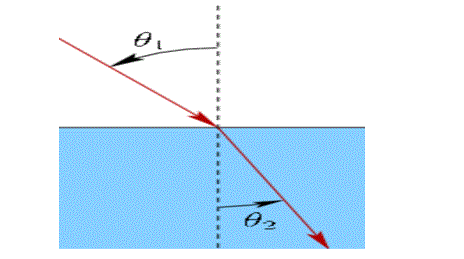
سقط ضوء من الهواء إلى الماء كما في الشكل. إذا كانت زاوية السقوط \(\theta_1=30^\circ\) ومعامل انكسار الوسط الأول 1 والثاني 1.33 فإن زاوية الانكسار تساوي:Light falls from air into water as shown. If the angle of incidence is \(\theta_1=30^\circ\), the refractive index of the first medium is 1 and of the second 1.33, the angle of refraction is:
\(\theta=18^\circ\)\(\theta=18^\circ\)
\(\theta=16^\circ\)\(\theta=16^\circ\)
\(\theta=22^\circ\)\(\theta=22^\circ\)
\(\theta=20^\circ\)\(\theta=20^\circ\)
الحلSolution
📌 قانون سنل: \(n_1\sin\theta_1=n_2\sin\theta_2\).
\(\sin\theta_2=\dfrac{1\times\sin30^\circ}{1.33}=0.376\Rightarrow\theta_2\approx22^\circ\).
✅ \(\theta=22^\circ\) (C)
📌 Snell's law: \(n_1\sin\theta_1=n_2\sin\theta_2\).
\(\sin\theta_2=\dfrac{1\times\sin30^\circ}{1.33}=0.376\Rightarrow\theta_2\approx22^\circ\).
✅ \(\theta=22^\circ\) (C)
\[3\,\star\]
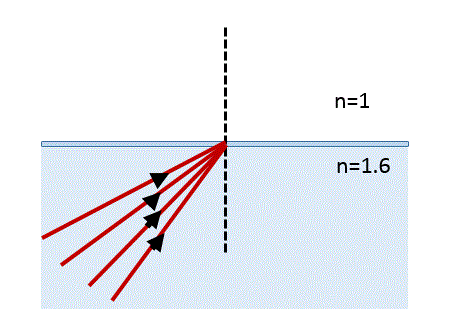
سقط ضوء من الزجاج الذي معامل انكساره 1.6 إلى الهواء الذي معامل انكساره 1. أحد الإجابات التالية يعبر عن الزاوية الحرجة:Light passes from glass (refractive index 1.6) to air (refractive index 1). Which of the following is the critical angle?
\(\theta_C=38.7^\circ\)\(\theta_C=38.7^\circ\)
\(\theta_C=40.7^\circ\)\(\theta_C=40.7^\circ\)
\(\theta_C=52.7^\circ\)\(\theta_C=52.7^\circ\)
\(\theta_C=33.7^\circ\)\(\theta_C=33.7^\circ\)
الحلSolution
📌 الزاوية الحرجة هي زاوية السقوط التي تكون عندها زاوية الانكسار \(90^\circ\): \(\sin\theta_C=\dfrac{n_2}{n_1}\).
\(\sin\theta_C=\dfrac{1}{1.6}=0.625\Rightarrow\theta_C=38.7^\circ\).
✅ \(\theta_C=38.7^\circ\) (A)
📌 The critical angle is the angle of incidence for which the angle of refraction is \(90^\circ\): \(\sin\theta_C=\dfrac{n_2}{n_1}\).
\(\sin\theta_C=\dfrac{1}{1.6}=0.625\Rightarrow\theta_C=38.7^\circ\).
✅ \(\theta_C=38.7^\circ\) (A)
\[4\,\star\]
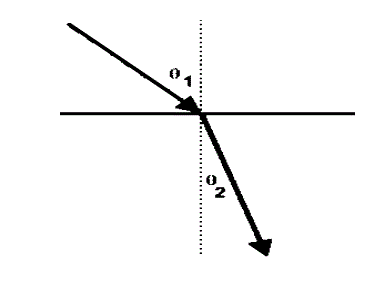
أحد الإجابات التالية ينكسر الضوء فيها مقتربًا من عمود الانكسار إذا سقط بشكل غير عمودي على السطح الفاصل بين وسطين:In which of the following cases does light refract toward the normal when it strikes the interface between two media at a non-perpendicular angle?
سقط ضوء من الزجاج إلى الماءLight from glass to water
سقط ضوء من وسط ذي معامل انكسار أقل إلى وسط ذي معامل انكسار أكبرLight from a medium of lower refractive index to one of higher refractive index
سقط ضوء من الماء إلى الهواءLight from water to air
سقط ضوء من وسط سرعة الضوء فيه أقل إلى وسط سرعة الضوء فيه أكبرLight from a medium with lower speed of light to one with higher speed
الحلSolution
📌 حتى ينكسر الضوء مقتربًا من العمود يجب أن يسقط من وسط ذي معامل انكسار أقل إلى وسط ذي معامل انكسار أكبر.
📌 أو نقول: من وسط سرعة الضوء فيه أكبر إلى وسط سرعة الضوء فيه أقل (سرعة الضوء في الغازات > السوائل > الأجسام الصلبة).
📌 الخيارات الأخرى كلها تجعل الضوء ينكسر مبتعدًا عن العمود.
✅ سقط ضوء من وسط ذي معامل انكسار أقل إلى وسط ذي معامل انكسار أكبر (B)
📌 For light to bend toward the normal it must pass from a medium of lower refractive index to one of higher refractive index.
📌 Equivalently, from a medium where light is faster to one where it is slower (speed in gases > liquids > solids).
📌 All the other options make the light bend away from the normal.
✅ Light from a medium of lower refractive index to one of higher refractive index (B)
\[5\,\star\]
أحد الإجابات التالية من الممكن أن تحدث فيه زاوية حرجة:In which of the following cases can a critical angle occur?
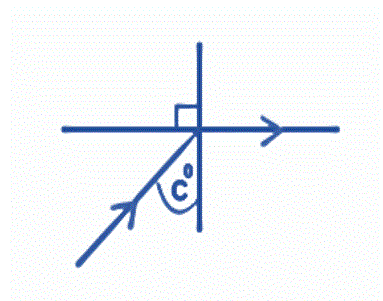
سقط ضوء من الماء إلى الزجاجLight from water to glass
سقط ضوء من وسط ذي معامل انكسار أقل إلى وسط ذي معامل انكسار أكبرLight from a medium of lower refractive index to one of higher refractive index
سقط ضوء من وسط سرعة الضوء فيه أكبر إلى وسط سرعة الضوء فيه أقلLight from a medium where light is faster to one where it is slower
سقط ضوء من الماء إلى الهواءLight from water to air
الحلSolution
📌 حتى تحدث زاوية حرجة هناك شرطان: (1) أن يسقط الضوء من وسط ذي معامل انكسار أكبر إلى وسط ذي معامل انكسار أقل (أي من وسط سرعة الضوء فيه أقل إلى وسط سرعة الضوء فيه أكبر)، (2) أن تكون زاوية الانكسار \(90^\circ\).
📌 مثال: انتقال الضوء من الماء إلى الهواء.
✅ سقط ضوء من الماء إلى الهواء (D)
📌 A critical angle requires: (1) light passing from a medium of higher refractive index to one of lower index (lower speed to higher speed), and (2) a refraction angle of \(90^\circ\).
📌 Example: light passing from water to air.
✅ Light from water to air (D)
\[6\,\star\star\]
سقط ضوء على سطح فاصل بين وسطين وكانت الزاوية الحرجة \(\theta_C=42^\circ\). أحد زوايا السقوط التالية تؤدي إلى حدوث انعكاس كلي:Light falls on the interface between two media whose critical angle is \(\theta_C=42^\circ\). Which of the following angles of incidence leads to total internal reflection?
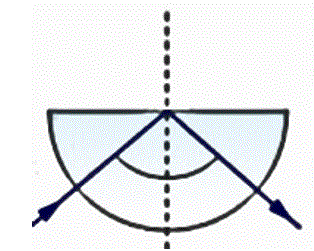
\(\theta=44^\circ\)\(\theta=44^\circ\)
\(\theta=0^\circ\)\(\theta=0^\circ\)
\(\theta=37^\circ\)\(\theta=37^\circ\)
\(\theta=42^\circ\)\(\theta=42^\circ\)
الحلSolution
📌 يحدث الانعكاس الكلي الداخلي عندما تكون زاوية السقوط أكبر من الزاوية الحرجة (وبشرط أن ينتقل الضوء من وسط أكبر معامل انكسار إلى أقل).
📌 من الخيارات فقط \(44^\circ\gt 42^\circ\)؛ أما \(42^\circ\) فهي الزاوية الحرجة نفسها (الانكسار بزاوية \(90^\circ\)) والبقية أصغر منها فينكسر الضوء.
✅ \(\theta=44^\circ\) (A)
📌 Total internal reflection occurs when the angle of incidence is greater than the critical angle (and light goes from the higher to the lower refractive index).
📌 Only \(44^\circ\gt 42^\circ\); \(42^\circ\) is the critical angle itself (refraction at \(90^\circ\)) and the others are smaller, so the light refracts.
✅ \(\theta=44^\circ\) (A)
\[7\,\star\]
سقط ضوء بين وسطين وانكسر مبتعدًا عن عمود الانكسار. أحد الإجابات التالية يعبر عن الوسطين:Light passes between two media and refracts away from the normal. Which of the following describes the two media?
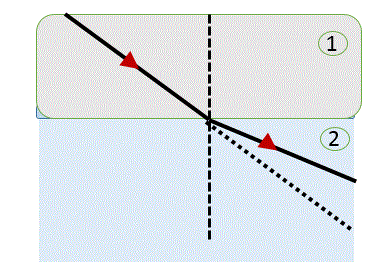
\(v_1\gt v_2\)\(v_1\gt v_2\)
\(n_1=n_2\)\(n_1=n_2\)
\(n_2\gt n_1\)\(n_2\gt n_1\)
\(n_1\gt n_2\)\(n_1\gt n_2\)
الحلSolution
📌 ينكسر الضوء مبتعدًا عن العمود إذا انتقل من وسط ذي معامل انكسار أكبر إلى وسط ذي معامل انكسار أقل: \(n_1\gt n_2\).
📌 وسرعة الضوء في الوسط الثاني أكبر (\(v_2\gt v_1\)) ولذلك الخيار \(v_1\gt v_2\) خاطئ.
✅ \(n_1\gt n_2\) (D)
📌 Light bends away from the normal when it goes from a medium of higher refractive index to one of lower refractive index: \(n_1\gt n_2\).
📌 The speed of light in the second medium is greater (\(v_2\gt v_1\)), so the option \(v_1\gt v_2\) is wrong.
✅ \(n_1\gt n_2\) (D)
\[8\,\star\]
سقط ضوء من وسط ذي معامل انكسار أقل إلى وسط ذي معامل انكسار أكبر فانكسر مقتربًا من العمود. أحد الإجابات التالية يعبر عن الطول الموجي والتردد:Light passes from a medium of lower refractive index to one of higher refractive index and refracts toward the normal. Which of the following describes the wavelength and frequency?
يقل الطول الموجي ويزداد الترددThe wavelength decreases and the frequency increases
الطول الموجي والتردد ثابتانThe wavelength and the frequency are constant
يزداد الطول الموجي ويقل الترددThe wavelength increases and the frequency decreases
يقل الطول الموجي والتردد ثابتThe wavelength decreases and the frequency is constant
الحلSolution
📌 \(n=\dfrac{c}{v}\): كلما زاد \(n\) قلّت سرعة الضوء، وبالتالي يقل الطول الموجي (\(v=\lambda f\)).
📌 أما التردد فيبقى ثابتًا لأن المصدر واحد للموجتين الساقطة والمنكسرة.
✅ يقل الطول الموجي والتردد ثابت (D)
📌 \(n=\dfrac{c}{v}\): as \(n\) increases the speed of light decreases, and therefore the wavelength decreases (\(v=\lambda f\)).
📌 The frequency stays constant because the source is the same for the incident and refracted waves.
✅ The wavelength decreases and the frequency is constant (D)
\[9\,\star\]
من الظواهر الطبيعية التالية، أي ظاهرة لا تُعدّ من ظواهر انكسار الضوء؟Which of the following natural phenomena is not a result of the refraction of light?
الشفق القطبيAurora
قوس قزحRainbow
السرابMirage
تألق الماسDiamond sparkle
الحلSolution
📌 قوس قزح: انكسار وانعكاس الضوء داخل قطرات الماء. السراب: انكسار الضوء في طبقات هواء مختلفة الكثافة. تألق الماس: انعكاسات كلية داخلية متعددة داخل الماس.
📌 الشفق القطبي ينتج من إصدار فوتونات ملونة من ذرات الغاز المثارة، وليس من الانكسار.
✅ الشفق القطبي (A)
📌 Rainbow: refraction and reflection of light inside water droplets. Mirage: refraction of light in air layers of different densities. Diamond sparkle: multiple total internal reflections inside the diamond.
📌 The aurora is produced by excited gas atoms emitting coloured photons; it is not caused by refraction.
✅ Aurora (A)
\[10\,\star\]
جسم شفاف يكسر الأشعة الضوئية ويجمعها ليكوّن الصورة هو:A transparent object that refracts light rays and brings them together to form an image is:
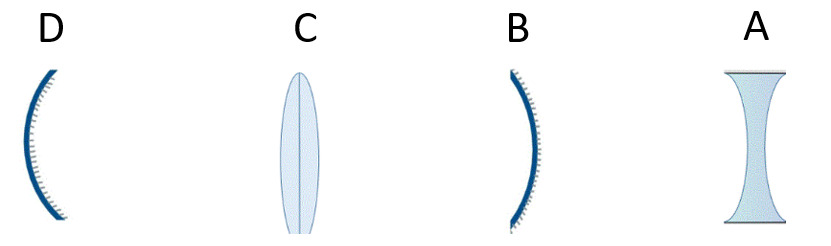
العدسة المحدبةa convex lens
العدسة المقعرةa concave lens
المرآة المقعرةa concave mirror
المرآة المحدبةa convex mirror
الحلSolution
📌 المرايا تعكس الضوء (لا تكسره)، أما العدسات فتكسر الضوء.
📌 العدسة المحدبة تجمع الأشعة المنكسرة، والعدسة المقعرة تفرّقها. لذلك الجواب: العدسة المحدبة.
✅ العدسة المحدبة (A)
📌 Mirrors reflect light; lenses refract light.
📌 A convex lens converges refracted rays and a concave lens diverges them. So the answer is a convex lens.
✅ a convex lens (A)
\[11\,\star\]
سقط شعاع ضوئي على عدسة مارًّا بالمركز البصري كما في الشكل، فإنه:A light ray falls on a lens passing through its optical centre as shown. It:
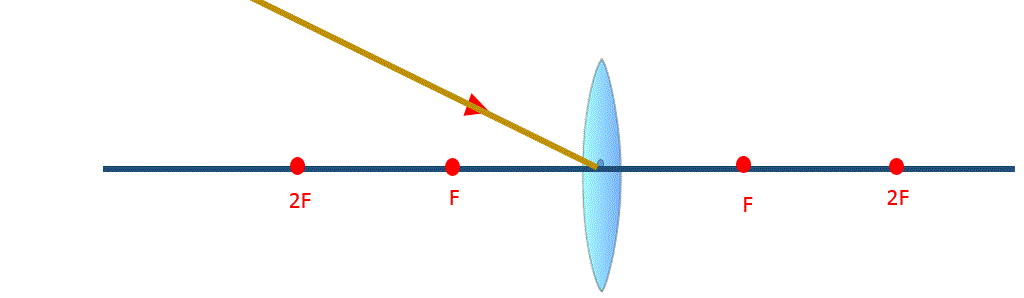
ينكسر مارًّا بضعف البعد البؤريrefracts passing through twice the focal length
ينكسر موازيًا للمحور الأساسيrefracts parallel to the principal axis
لا ينكسر ويتابع طريقهdoes not refract and continues on its path
ينكسر مارًّا بالبؤرةrefracts passing through the focus
الحلSolution
📌 الشعاع الساقط موازيًا للمحور ينكسر مارًّا بالبؤرة، والمار بالبؤرة ينكسر موازيًا للمحور.
📌 أما الشعاع المار بالمركز البصري فيسقط عموديًا تقريبًا على سطحي العدسة الرقيقة فيتابع طريقه دون انكسار ملحوظ.
✅ لا ينكسر ويتابع طريقه (C)
📌 A ray parallel to the axis refracts through the focus, and a ray through the focus refracts parallel to the axis.
📌 A ray through the optical centre meets the surfaces of the thin lens practically perpendicularly, so it continues undeviated.
✅ does not refract and continues on its path (C)
\[12\,\star\]
وُضع جسم أمام عدسة محدبة. عند أي موقع للجسم تظهر له صورة مساوية له في الحجم؟An object is placed in front of a convex lens. At which position is the image equal in size to the object?
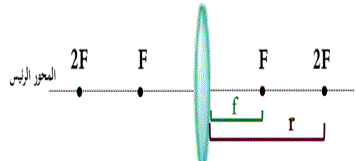
عند ضعف البعد البؤريat twice the focal length
بين البؤرة والعدسةbetween the focus and the lens
عند البؤرةat the focus
بين البؤرة وضعف البعد البؤريbetween the focus and twice the focal length
الحلSolution
📌 إذا وُضع الجسم عند ضعف البعد البؤري (\(2F\)) تكون الصورة حقيقية مقلوبة مساوية للجسم وتقع عند \(2F\) على الجانب الآخر.
📌 ولا تظهر صورة عند البؤرة، وكلما اقترب الجسم من العدسة (داخل البؤرة) تكبر الصورة الوهمية.
✅ عند ضعف البعد البؤري (A)
📌 If the object is at twice the focal length (\(2F\)) the image is real, inverted, the same size, and located at \(2F\) on the other side.
📌 No image forms with the object at the focus, and as the object moves toward the lens (inside the focus) the virtual image grows.
✅ at twice the focal length (A)
\[13\,\star\star\]
عدسة محدبة بعدها البؤري \(20\,cm\) وُضع جسم على بعد \(50\,cm\) من العدسة. بعد الصورة عن العدسة:A convex lens has focal length \(20\,cm\) and an object is placed \(50\,cm\) from it. The image distance from the lens is:
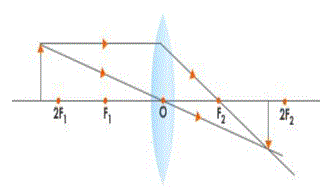
\(x_i=70\,cm\)\(x_i=70\,cm\)
\(x_i=39\,cm\)\(x_i=39\,cm\)
\(x_i=33.3\,cm\)\(x_i=33.3\,cm\)
\(x_i=45.4\,cm\)\(x_i=45.4\,cm\)
الحلSolution
📌 معادلة العدسة: \(\dfrac1f=\dfrac1{x_o}+\dfrac1{x_i}\).
\(\dfrac1{20}=\dfrac1{50}+\dfrac1{x_i}\Rightarrow\dfrac1{x_i}=0.05-0.02=0.03\Rightarrow x_i=33.3\,cm\).
✅ \(x_i=33.3\,cm\) (C)
📌 Lens equation: \(\dfrac1f=\dfrac1{x_o}+\dfrac1{x_i}\).
\(\dfrac1{20}=\dfrac1{50}+\dfrac1{x_i}\Rightarrow\dfrac1{x_i}=0.05-0.02=0.03\Rightarrow x_i=33.3\,cm\).
✅ \(x_i=33.3\,cm\) (C)
\[14\,\star\star\star\]
وُضع جسم أمام عدسة فظهرت له صورة، وكانت نسبة طول الجسم إلى طول الصورة \(\dfrac{h_o}{h_i}=-2\). صفات الصورة الصحيحة:An object is placed in front of a lens and the ratio of object height to image height is \(\dfrac{h_o}{h_i}=-2\). The correct image properties are:
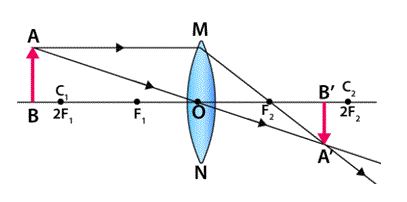
مكبرة – وهمية – معتدلةmagnified – virtual – upright
مكبرة – حقيقية – مقلوبةmagnified – real – inverted
مصغرة – وهمية – معتدلةdiminished – virtual – upright
مصغرة – حقيقية – مقلوبةdiminished – real – inverted
الحلSolution
📌 \(m=\dfrac{h_i}{h_o}=-\dfrac12\) والقيمة المطلقة \(|m|\lt 1\) فالصورة مصغرة.
📌 الإشارة السالبة للتكبير تعني أن \(x_i\) موجب، أي أن الصورة حقيقية، والصور الحقيقية دومًا مقلوبة.
✅ مصغرة – حقيقية – مقلوبة (D)
📌 \(m=\dfrac{h_i}{h_o}=-\dfrac12\) and \(|m|\lt 1\), so the image is diminished.
📌 The negative sign of \(m\) means \(x_i\) is positive, i.e. the image is real, and real images are always inverted.
✅ diminished – real – inverted (D)
\[15\,\star\star\star\]
وُضع جسم طوله \(h_o=10\,cm\) أمام عدسة على بعد \(20\,cm\) فظهرت له صورة معتدلة طولها \(h_i=6\,cm\). نوع العدسة وبعدها البؤري:An object of height \(h_o=10\,cm\) is placed \(20\,cm\) in front of a lens and forms an upright image of height \(h_i=6\,cm\). The type of lens and its focal length are:
\(f=-7.5\,cm\) عدسة مقعرة\(f=-7.5\,cm\) concave lens
\(f=7.5\,cm\) عدسة محدبة\(f=7.5\,cm\) convex lens
\(f=-30\,cm\) عدسة مقعرة\(f=-30\,cm\) concave lens
\(f=30\,cm\) عدسة محدبة\(f=30\,cm\) convex lens
الحلSolution
📌 الصورة معتدلة فهي وهمية والتكبير موجب: \(\dfrac{h_i}{h_o}=-\dfrac{x_i}{x_o}\Rightarrow\dfrac{6}{10}=-\dfrac{x_i}{20}\Rightarrow x_i=-12\,cm\).
\(\dfrac1f=\dfrac1{20}+\dfrac1{-12}=\dfrac{3-5}{60}\Rightarrow f=-30\,cm\) والإشارة السالبة تعني عدسة مقعرة.
✅ \(f=-30\,cm\) عدسة مقعرة (C)
📌 The image is upright, so it is virtual and the magnification is positive: \(\dfrac{h_i}{h_o}=-\dfrac{x_i}{x_o}\Rightarrow\dfrac{6}{10}=-\dfrac{x_i}{20}\Rightarrow x_i=-12\,cm\).
\(\dfrac1f=\dfrac1{20}+\dfrac1{-12}=\dfrac{3-5}{60}\Rightarrow f=-30\,cm\); the negative sign means a concave lens.
✅ \(f=-30\,cm\) concave lens (C)
\[16\,\star\star\star\]
في الجدول معاملات انكسار الضوء الأصفر لبعض المواد. سقط ضوء أصفر من الهواء إلى وسط مجهول وانكسر كما في الشكل، وكانت زاوية السقوط \(40^\circ\) وزاوية الانكسار \(25^\circ\). الوسط المجهول هو:The table lists refractive indices of yellow light in some materials. Yellow light falls from air into an unknown medium and refracts as shown, with angle of incidence \(40^\circ\) and angle of refraction \(25^\circ\). The unknown medium is:
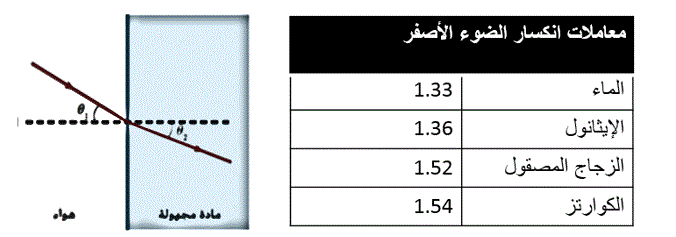
الماء (1.33)water (1.33)
الزجاج المصقول (1.52)polished glass (1.52)
الإيثانول (1.36)ethanol (1.36)
الكوارتز (1.54)quartz (1.54)
الحلSolution
\(n_1\sin\theta_1=n_2\sin\theta_2\Rightarrow n_2=\dfrac{1\times\sin40^\circ}{\sin25^\circ}=\dfrac{0.643}{0.423}=1.52\).
📌 القيمة 1.52 تطابق الزجاج المصقول.
✅ الزجاج المصقول (1.52) (B)
\(n_1\sin\theta_1=n_2\sin\theta_2\Rightarrow n_2=\dfrac{1\times\sin40^\circ}{\sin25^\circ}=\dfrac{0.643}{0.423}=1.52\).
📌 The value 1.52 matches polished glass.
✅ polished glass (1.52) (B)
\[17\,\star\star\star\]
عدسة محدبة بعدها البؤري \(f=20\,cm\) وُضع أمامها جسم فظهرت له صورة مكبرة حقيقية حجمها ضعف الجسم وفي الجهة الأخرى من العدسة. بعد الجسم عن العدسة:A convex lens of focal length \(f=20\,cm\) forms a real magnified image, twice the size of the object, on the other side of the lens. The object distance from the lens is:
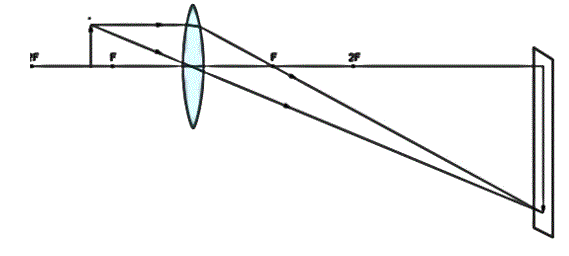
\(x_o=25\,cm\)\(x_o=25\,cm\)
\(x_o=35\,cm\)\(x_o=35\,cm\)
\(x_o=40\,cm\)\(x_o=40\,cm\)
\(x_o=30\,cm\)\(x_o=30\,cm\)
الحلSolution
📌 الصورة حقيقية فالتكبير سالب: \(m=-2=-\dfrac{x_i}{x_o}\Rightarrow x_i=2x_o\).
\(\dfrac1{20}=\dfrac1{x_o}+\dfrac1{2x_o}=\dfrac{3}{2x_o}\Rightarrow x_o=30\,cm\).
✅ \(x_o=30\,cm\) (D)
📌 The image is real so the magnification is negative: \(m=-2=-\dfrac{x_i}{x_o}\Rightarrow x_i=2x_o\).
\(\dfrac1{20}=\dfrac1{x_o}+\dfrac1{2x_o}=\dfrac{3}{2x_o}\Rightarrow x_o=30\,cm\).
✅ \(x_o=30\,cm\) (D)
\[18\,\star\]
جسم طوله \(4\,cm\) وُضع على بعد \(15\,cm\) من عدسة محدبة بعدها البؤري \(10\,cm\). ما تكبير الصورة؟An object of height \(4\,cm\) is placed \(15\,cm\) from a convex lens of focal length \(10\,cm\). What is the magnification of the image?
\(|m|=0.5\)\(|m|=0.5\)
\(|m|=2\)\(|m|=2\)
\(|m|=1\)\(|m|=1\)
\(|m|=1.5\)\(|m|=1.5\)
الحلSolution
\(\dfrac1{10}=\dfrac1{15}+\dfrac1{x_i}\Rightarrow x_i=30\,cm\).
\(m=-\dfrac{x_i}{x_o}=-\dfrac{30}{15}=-2\Rightarrow|m|=2\).
✅ \(|m|=2\) (B)
\(\dfrac1{10}=\dfrac1{15}+\dfrac1{x_i}\Rightarrow x_i=30\,cm\).
\(m=-\dfrac{x_i}{x_o}=-\dfrac{30}{15}=-2\Rightarrow|m|=2\).
✅ \(|m|=2\) (B)
\[19\,\star\star\star\]
عدسة محدبة بعدها البؤري \(25\,cm\) تكوّن صورة حقيقية مقلوبة لجسم. إذا كان التكبير \(0.5\) بالقيمة المطلقة فما بعد الجسم عن العدسة؟A convex lens of focal length \(25\,cm\) forms a real inverted image of an object. If the magnification is \(0.5\) in magnitude, what is the object distance from the lens?
\(50\,cm\)\(50\,cm\)
\(37.5\,cm\)\(37.5\,cm\)
\(25\,cm\)\(25\,cm\)
\(75\,cm\)\(75\,cm\)
الحلSolution
📌 الصورة حقيقية مقلوبة: \(m=-0.5=-\dfrac{x_i}{x_o}\Rightarrow x_i=0.5x_o\).
\(\dfrac1{25}=\dfrac1{x_o}+\dfrac1{0.5x_o}=\dfrac{3}{x_o}\Rightarrow x_o=75\,cm\).
✅ \(75\,cm\) (D)
📌 Real and inverted: \(m=-0.5=-\dfrac{x_i}{x_o}\Rightarrow x_i=0.5x_o\).
\(\dfrac1{25}=\dfrac1{x_o}+\dfrac1{0.5x_o}=\dfrac{3}{x_o}\Rightarrow x_o=75\,cm\).
✅ \(75\,cm\) (D)
\[20\,\star\star\]
شعاع ضوئي يسقط من الماء (\(n=1.33\)) إلى الهواء (\(n=1\)) بزاوية سقوط \(50^\circ\). ما زاوية الانكسار؟A light ray falls from water (\(n=1.33\)) to air (\(n=1\)) at an angle of incidence of \(50^\circ\). What is the angle of refraction?
\(80.5^\circ\)\(80.5^\circ\)
لا ينكسر (يحدث انعكاس كلي)no refraction (total internal reflection occurs)
\(72.8^\circ\)\(72.8^\circ\)
\(65.2^\circ\)\(65.2^\circ\)
الحلSolution
📌 نحسب الزاوية الحرجة أولًا: \(\theta_C=\sin^{-1}\!\left(\dfrac{1}{1.33}\right)=48.8^\circ\).
📌 زاوية السقوط \(50^\circ\gt 48.8^\circ\) فيحدث انعكاس كلي ولا ينكسر الشعاع (ولو طُبِّق قانون سنل لخرجت \(\sin\theta_2=1.33\sin50^\circ=1.02\gt 1\) وهو مستحيل).
✅ لا ينكسر (يحدث انعكاس كلي) (B)
📌 First the critical angle: \(\theta_C=\sin^{-1}\!\left(\dfrac{1}{1.33}\right)=48.8^\circ\).
📌 The angle of incidence \(50^\circ\gt 48.8^\circ\) so total internal reflection occurs and the ray is not refracted (Snell's law would give \(\sin\theta_2=1.33\sin50^\circ=1.02\gt 1\), impossible).
✅ no refraction (total internal reflection occurs) (B)
\[21\,\star\star\]
جسم طوله \(3\,cm\) وُضع على بعد \(40\,cm\) من عدسة محدبة بعدها البؤري \(30\,cm\). ما طول الصورة المتكونة؟An object of height \(3\,cm\) is placed \(40\,cm\) from a convex lens of focal length \(30\,cm\). What is the height of the image formed?
\(4.5\,cm\)\(4.5\,cm\)
\(6\,cm\)\(6\,cm\)
\(9\,cm\)\(9\,cm\)
\(12\,cm\)\(12\,cm\)
الحلSolution
\(\dfrac1{30}=\dfrac1{40}+\dfrac1{x_i}\Rightarrow x_i=120\,cm\).
\(|m|=\dfrac{120}{40}=3\Rightarrow h_i=3\times3=9\,cm\).
✅ \(9\,cm\) (C)
\(\dfrac1{30}=\dfrac1{40}+\dfrac1{x_i}\Rightarrow x_i=120\,cm\).
\(|m|=\dfrac{120}{40}=3\Rightarrow h_i=3\times3=9\,cm\).
✅ \(9\,cm\) (C)
\[22\,\star\]
وُضعت شمعة أمام عدسة فظهرت لها صورة كما في الشكل (الصورة أقرب إلى العدسة من الشمعة ومصغرة ومعتدلة وعلى جهة الشمعة نفسها). نوع العدسة وصفات الصورة والإشارات الجبرية:A candle is placed in front of a lens and its image appears as shown (the image is nearer the lens than the candle, smaller, upright and on the same side as the candle). The type of lens, the image properties and the algebraic signs are:
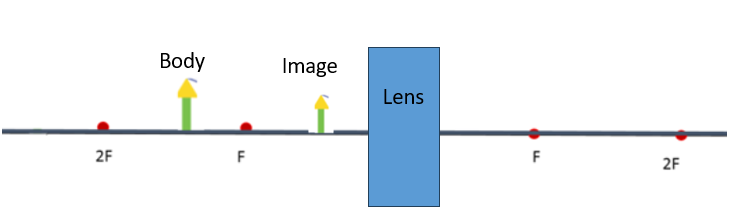
\(f=-,\ x_i=-,\ x_o=+\) — وهمية، معتدلة، مصغرة — عدسة مقعرة\(f=-,\ x_i=-,\ x_o=+\) — virtual, upright, diminished — concave lens
\(f=+,\ x_i=-,\ x_o=+\) — حقيقية، معتدلة، مكبرة — عدسة محدبة\(f=+,\ x_i=-,\ x_o=+\) — real, upright, magnified — convex lens
\(f=+,\ x_i=-,\ x_o=+\) — وهمية، معتدلة، مكبرة — عدسة مقعرة\(f=+,\ x_i=-,\ x_o=+\) — virtual, upright, magnified — concave lens
\(f=-,\ x_i=-,\ x_o=-\) — وهمية، معتدلة، مكبرة — عدسة محدبة\(f=-,\ x_i=-,\ x_o=-\) — virtual, upright, magnified — convex lens
الحلSolution
📌 العدسة المقعرة تُظهر صورًا مصغرة وهمية معتدلة، وتكون إشارة بعد الصورة سالبة (وهمية).
📌 العدسة المقعرة بعدها البؤري سالب (\(f\lt 0\)) أما بعد الجسم الحقيقي فموجب (\(x_o\gt 0\)).
✅ \(f=-,\ x_i=-,\ x_o=+\) — وهمية، معتدلة، مصغرة — عدسة مقعرة (A)
📌 A concave lens gives virtual, upright, diminished images, and the image distance is negative (virtual).
📌 A concave lens has a negative focal length (\(f\lt 0\)) while the real object distance is positive (\(x_o\gt 0\)).
✅ \(f=-,\ x_i=-,\ x_o=+\) — virtual, upright, diminished — concave lens (A)
\[23\,\star\]
إذا كان معامل انكسار الزجاج \(1.5\) فإن سرعة الضوء فيه (\(c=3\times10^8\,m/s\)):If the refractive index of glass is \(1.5\), the speed of light in it (\(c=3\times10^8\,m/s\)) is:
\(4.5\times10^8\,m/s\)\(4.5\times10^8\,m/s\)
\(2\times10^8\,m/s\)\(2\times10^8\,m/s\)
\(3\times10^8\,m/s\)\(3\times10^8\,m/s\)
\(1.5\times10^8\,m/s\)\(1.5\times10^8\,m/s\)
الحلSolution
\(v=\dfrac{c}{n}=\dfrac{3\times10^8}{1.5}=2\times10^8\,m/s\).
✅ \(2\times10^8\,m/s\) (B)
\(v=\dfrac{c}{n}=\dfrac{3\times10^8}{1.5}=2\times10^8\,m/s\).
✅ \(2\times10^8\,m/s\) (B)
\[24\,\star\]
عند انتقال الضوء من وسط شفاف إلى آخر، أي الكميات التالية تبقى ثابتة؟When light passes from one transparent medium into another, which of the following stays constant?
الترددthe frequency
الطول الموجيthe wavelength
سرعة الضوءthe speed of light
اتجاه الانتشار دائمًاthe direction of travel in every case
الحلSolution
📌 التردد يحدده المصدر فلا يتغير، أما السرعة والطول الموجي فيتغيران معًا (\(v=\lambda f\)).
✅ التردد (A)
📌 The frequency is set by the source and does not change, while the speed and the wavelength change together (\(v=\lambda f\)).
✅ the frequency (A)
\[25\,\star\star\]
يسقط شعاع ضوئي من الهواء على سطح زجاج معامل انكساره \(1.5\) بزاوية سقوط \(45^\circ\). زاوية الانكسار:A light ray falls from air on glass of refractive index \(1.5\) at an incidence angle of \(45^\circ\). The angle of refraction is:
\(28.1^\circ\)\(28.1^\circ\)
\(30^\circ\)\(30^\circ\)
\(19.5^\circ\)\(19.5^\circ\)
\(32^\circ\)\(32^\circ\)
الحلSolution
\(\sin\theta_2=\dfrac{1\times\sin45^\circ}{1.5}=\dfrac{0.7071}{1.5}=0.471\Rightarrow\theta_2=28.1^\circ\).
✅ \(28.1^\circ\) (A)
\(\sin\theta_2=\dfrac{1\times\sin45^\circ}{1.5}=\dfrac{0.7071}{1.5}=0.471\Rightarrow\theta_2=28.1^\circ\).
✅ \(28.1^\circ\) (A)
\[26\,\star\star\]
الزاوية الحرجة للماس (معامل انكساره \(2.42\)) عند انتقال الضوء منه إلى الهواء:The critical angle for diamond (refractive index \(2.42\)) when light passes from it to air is:
\(41.4^\circ\)\(41.4^\circ\)
\(24.4^\circ\)\(24.4^\circ\)
\(65.6^\circ\)\(65.6^\circ\)
\(30^\circ\)\(30^\circ\)
الحلSolution
\(\sin\theta_C=\dfrac{1}{2.42}=0.413\Rightarrow\theta_C=24.4^\circ\). ولأن الزاوية الحرجة صغيرة يحدث انعكاس كلي كثير داخل الماس فيتألق.
✅ \(24.4^\circ\) (B)
\(\sin\theta_C=\dfrac{1}{2.42}=0.413\Rightarrow\theta_C=24.4^\circ\). Because the critical angle is small, much total internal reflection occurs inside the diamond, so it sparkles.
✅ \(24.4^\circ\) (B)
\[27\,\star\]
يحدث الانعكاس الكلي الداخلي عندما:Total internal reflection occurs when:
ينتقل الضوء من وسط أقل معامل انكسار إلى أكبر وتكون زاوية السقوط أكبر من الزاوية الحرجةlight passes from a medium of lower refractive index to one of higher index and the angle of incidence is greater than the critical angle
ينتقل الضوء من وسط أكبر معامل انكسار إلى وسط أقل معامل انكسار وتكون زاوية السقوط أكبر من الزاوية الحرجةlight passes from a medium of higher refractive index to one of lower index and the angle of incidence is greater than the critical angle
يسقط الضوء عموديًا على السطح الفاصلlight falls perpendicularly on the interface
ينتقل الضوء من وسط إلى الوسط نفسهlight passes from a medium into the same medium
الحلSolution
📌 شرطا الانعكاس الكلي: (1) من وسط أكبر معامل انكسار إلى أقل، (2) زاوية السقوط أكبر من الزاوية الحرجة.
✅ ينتقل الضوء من وسط أكبر معامل انكسار إلى وسط أقل معامل انكسار وتكون زاوية السقوط أكبر من الزاوية الحرجة (B)
📌 The two conditions: (1) from higher to lower refractive index, (2) angle of incidence greater than the critical angle.
✅ light passes from a medium of higher refractive index to one of lower index and the angle of incidence is greater than the critical angle (B)
\[28\,\star\]
أي التطبيقات التالية يعتمد على الانعكاس الكلي الداخلي؟Which of the following applications depends on total internal reflection?
نقل البيانات عبر الألياف البصريةdata transmission through optical fibres
تكوّن الظل خلف جسم معتمthe formation of a shadow behind an opaque object
المرآة المستوية في الحمّامa plane bathroom mirror
تسخين الماء بالطاقة الشمسيةheating water with solar energy
الحلSolution
📌 في الألياف البصرية ينتقل الضوء بانعكاسات كلية متتالية داخل قلب الليف (معامل انكساره أكبر من الغلاف) فلا يفقد طاقته تقريبًا.
✅ نقل البيانات عبر الألياف البصرية (A)
📌 In optical fibres light travels by successive total internal reflections inside the core (whose refractive index is greater than that of the cladding) and loses almost no energy.
✅ data transmission through optical fibres (A)
\[29\,\star\star\]
عدسة محدبة بعدها البؤري \(15\,cm\) وُضع أمامها جسم على بعد \(30\,cm\). بعد الصورة عن العدسة:A convex lens has a focal length of \(15\,cm\) and an object is placed \(30\,cm\) in front of it. The image distance is:
\(10\,cm\)\(10\,cm\)
\(45\,cm\)\(45\,cm\)
\(30\,cm\)\(30\,cm\)
\(60\,cm\)\(60\,cm\)
الحلSolution
\(\dfrac1{15}=\dfrac1{30}+\dfrac1{x_i}\Rightarrow\dfrac1{x_i}=\dfrac{2-1}{30}\Rightarrow x_i=30\,cm\) (الجسم عند \(2F\) فالصورة عند \(2F\)).
✅ \(30\,cm\) (C)
\(\dfrac1{15}=\dfrac1{30}+\dfrac1{x_i}\Rightarrow\dfrac1{x_i}=\dfrac{2-1}{30}\Rightarrow x_i=30\,cm\) (the object is at \(2F\) so the image is at \(2F\)).
✅ \(30\,cm\) (C)
\[30\,\star\star\]
جسم طوله \(2\,cm\) كوّنت له عدسة صورة حقيقية طولها \(6\,cm\). التكبير يساوي:A lens forms a real image of height \(6\,cm\) of an object of height \(2\,cm\). The magnification is:
\(m=+3\)\(m=+3\)
\(m=-\tfrac13\)\(m=-\tfrac13\)
\(m=-3\)\(m=-3\)
\(m=+\tfrac13\)\(m=+\tfrac13\)
الحلSolution
📌 الصورة حقيقية فهي مقلوبة والتكبير سالب: \(m=-\dfrac{h_i}{h_o}=-\dfrac{6}{2}=-3\).
✅ \(m=-3\) (C)
📌 The image is real, hence inverted, so the magnification is negative: \(m=-\dfrac{h_i}{h_o}=-\dfrac{6}{2}=-3\).
✅ \(m=-3\) (C)
\[31\,\star\star\]
وُضع جسم بين البؤرة وضعف البعد البؤري (\(F\lt x_o\lt 2F\)) أمام عدسة محدبة. صفات الصورة:An object is placed between the focus and twice the focal length (\(F\lt x_o\lt 2F\)) in front of a convex lens. The image is:
وهمية، معتدلة، مكبرةvirtual, upright, magnified
حقيقية، مقلوبة، مصغرةreal, inverted, diminished
وهمية، معتدلة، مصغرةvirtual, upright, diminished
حقيقية، مقلوبة، مكبرة، خلف ضعف البعد البؤريreal, inverted, magnified, beyond twice the focal length
الحلSolution
📌 للجسم بين \(F\) و\(2F\) تتكون الصورة بعد \(2F\) على الجانب الآخر، وهي حقيقية مقلوبة مكبرة (كما في جهاز العرض).
✅ حقيقية، مقلوبة، مكبرة، خلف ضعف البعد البؤري (D)
📌 For an object between \(F\) and \(2F\) the image forms beyond \(2F\) on the other side: real, inverted and magnified (as in a projector).
✅ real, inverted, magnified, beyond twice the focal length (D)
\[32\,\star\]
تُستخدم العدسة المحدبة كعدسة مكبرة عندما يوضع الجسم:A convex lens works as a magnifying glass when the object is placed:
عند ضعف البعد البؤريat twice the focal length
بعد ضعف البعد البؤريbeyond twice the focal length
بين البؤرة وضعف البعد البؤريbetween the focus and twice the focal length
بين العدسة والبؤرةbetween the lens and the focus
الحلSolution
📌 عندما يكون الجسم داخل البعد البؤري تتكون صورة وهمية معتدلة مكبرة على جهة الجسم نفسها، وهذا هو عمل العدسة المكبرة.
✅ بين العدسة والبؤرة (D)
📌 When the object is inside the focal length the image is virtual, upright and magnified on the object side, which is how a magnifying glass works.
✅ between the lens and the focus (D)
\[33\,\star\star\star\]
قدرة عدسة مقعرة بعدها البؤري \(25\,cm\) (القدرة \(P=1/f\) بوحدة الديوبتر مع \(f\) بالمتر):The power of a concave lens of focal length \(25\,cm\) (\(P=1/f\) in dioptres with \(f\) in metres) is:
\(P=+4\,D\)\(P=+4\,D\)
\(P=-4\,D\)\(P=-4\,D\)
\(P=-0.25\,D\)\(P=-0.25\,D\)
\(P=-25\,D\)\(P=-25\,D\)
الحلSolution
📌 البعد البؤري للعدسة المقعرة سالب: \(f=-0.25\,m\).
\(P=\dfrac1f=\dfrac1{-0.25}=-4\,D\).
✅ \(P=-4\,D\) (B)
📌 The focal length of a concave lens is negative: \(f=-0.25\,m\).
\(P=\dfrac1f=\dfrac1{-0.25}=-4\,D\).
✅ \(P=-4\,D\) (B)
\[34\,\star\star\star\]
عدسة محدبة بعدها البؤري \(12\,cm\) كوّنت صورة وهمية معتدلة تكبيرها \(+3\). بعد الجسم عن العدسة:A convex lens of focal length \(12\,cm\) forms a virtual upright image of magnification \(+3\). The object distance from the lens is:
\(16\,cm\)\(16\,cm\)
\(4\,cm\)\(4\,cm\)
\(8\,cm\)\(8\,cm\)
\(24\,cm\)\(24\,cm\)
الحلSolution
📌 \(m=-\dfrac{x_i}{x_o}=+3\Rightarrow x_i=-3x_o\) (وهمية).
\(\dfrac1{12}=\dfrac1{x_o}-\dfrac1{3x_o}=\dfrac{2}{3x_o}\Rightarrow x_o=8\,cm\).
✅ \(8\,cm\) (C)
📌 \(m=-\dfrac{x_i}{x_o}=+3\Rightarrow x_i=-3x_o\) (virtual).
\(\dfrac1{12}=\dfrac1{x_o}-\dfrac1{3x_o}=\dfrac{2}{3x_o}\Rightarrow x_o=8\,cm\).
✅ \(8\,cm\) (C)
\[35\,\star\star\]
طول موجة ضوء في الفراغ \(600\,nm\). طول موجته في الماء (\(n=1.33\)):The wavelength of a light wave in vacuum is \(600\,nm\). Its wavelength in water (\(n=1.33\)) is:
\(798\,nm\)\(798\,nm\)
\(451\,nm\)\(451\,nm\)
\(600\,nm\)\(600\,nm\)
\(225\,nm\)\(225\,nm\)
الحلSolution
📌 التردد ثابت و\(v=\dfrac{c}{n}\) فيكون \(\lambda=\dfrac{\lambda_0}{n}=\dfrac{600}{1.33}=451\,nm\).
✅ \(451\,nm\) (B)
📌 The frequency is constant and \(v=\dfrac{c}{n}\), so \(\lambda=\dfrac{\lambda_0}{n}=\dfrac{600}{1.33}=451\,nm\).
✅ \(451\,nm\) (B)
\[36\,\star\star\]
وُضع جسم على بعد \(30\,cm\) من عدسة مقعرة بعدها البؤري \(-10\,cm\). بعد الصورة:An object is placed \(30\,cm\) from a concave lens of focal length \(-10\,cm\). The image distance is:
\(x_i=-7.5\,cm\)\(x_i=-7.5\,cm\)
\(x_i=-15\,cm\)\(x_i=-15\,cm\)
\(x_i=+7.5\,cm\)\(x_i=+7.5\,cm\)
\(x_i=-20\,cm\)\(x_i=-20\,cm\)
الحلSolution
\(\dfrac1{x_i}=\dfrac1f-\dfrac1{x_o}=-\dfrac1{10}-\dfrac1{30}=-\dfrac{4}{30}\Rightarrow x_i=-7.5\,cm\) (صورة وهمية على جهة الجسم).
✅ \(x_i=-7.5\,cm\) (A)
\(\dfrac1{x_i}=\dfrac1f-\dfrac1{x_o}=-\dfrac1{10}-\dfrac1{30}=-\dfrac{4}{30}\Rightarrow x_i=-7.5\,cm\) (a virtual image on the object side).
✅ \(x_i=-7.5\,cm\) (A)
\[37\,\star\star\]
سقط شعاع ضوئي من زجاج (\(n=1.5\)) إلى الهواء بزاوية سقوط \(30^\circ\). زاوية الانكسار في الهواء:A light ray passes from glass (\(n=1.5\)) into air at an angle of incidence of \(30^\circ\). The angle of refraction in air is:
\(45^\circ\)\(45^\circ\)
\(19.5^\circ\)\(19.5^\circ\)
\(48.6^\circ\)\(48.6^\circ\)
\(60^\circ\)\(60^\circ\)
الحلSolution
\(\sin\theta_2=\dfrac{1.5\times\sin30^\circ}{1}=0.75\Rightarrow\theta_2=48.6^\circ\)، وهي أكبر من \(30^\circ\) لأن الضوء انتقل إلى وسط أقل معامل انكسار فانكسر مبتعدًا عن العمود.
✅ \(48.6^\circ\) (C)
\(\sin\theta_2=\dfrac{1.5\times\sin30^\circ}{1}=0.75\Rightarrow\theta_2=48.6^\circ\), larger than \(30^\circ\) because the light enters a medium of lower index and bends away from the normal.
✅ \(48.6^\circ\) (C)
📝 المسائل المقالية
📝 Essay Problems
\[1\,\star\star\]
سقط ضوء من الماء الذي سرعة الضوء فيه \(2.25\times10^8\,m/s\) بزاوية سقوط \(28^\circ\) إلى الزجاج الذي سرعة الضوء فيه \(1.81\times10^8\,m/s\).
(أ) احسب معامل انكسار الماء ومعامل انكسار الزجاج علمًا بأن \(c=3\times10^8\,m/s\).
(ب) احسب زاوية الانكسار باستخدام قانون سنل، ثم أكمل مسار الشعاع في الزجاج.Light falls from water (speed of light \(2.25\times10^8\,m/s\)) at an angle of incidence of \(28^\circ\) into glass (speed of light \(1.81\times10^8\,m/s\)).
(a) Calculate the refractive indices of water and glass, given \(c=3\times10^8\,m/s\).
(b) Calculate the angle of refraction using Snell's law, then complete the path of the ray in the glass.
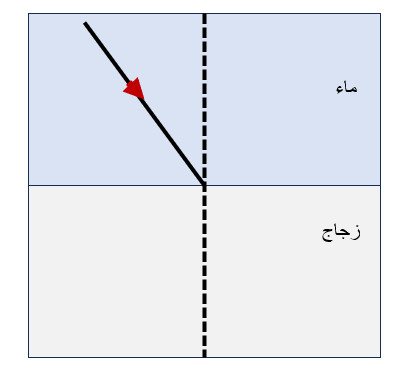
.....................................................................
الحلSolution
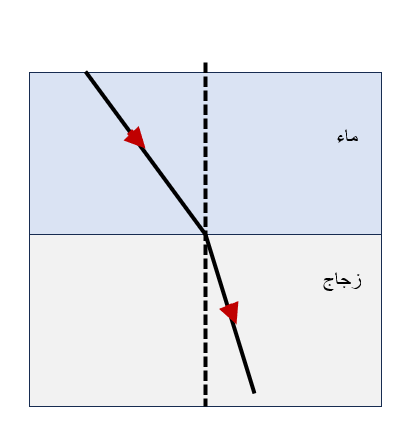
📌 (أ) \(n=\dfrac{c}{v}\): \(n_{water}=\dfrac{3\times10^8}{2.25\times10^8}=1.333\)، \(n_{glass}=\dfrac{3\times10^8}{1.81\times10^8}=1.657\).
📌 (ب) \(n_1\sin\theta_1=n_2\sin\theta_2\Rightarrow1.333\sin28^\circ=1.657\sin\theta_2\).
\(\sin\theta_2=0.378\Rightarrow\theta_2\approx22.2^\circ\) والشعاع ينكسر مقتربًا من العمود (من معامل أصغر إلى أكبر) كما في الشكل.
✅ \(n_{water}=1.333,\ n_{glass}=1.657,\ \theta_2\approx22.2^\circ\)
📌 (a) \(n=\dfrac{c}{v}\): \(n_{water}=\dfrac{3\times10^8}{2.25\times10^8}=1.333\), \(n_{glass}=\dfrac{3\times10^8}{1.81\times10^8}=1.657\).
📌 (b) \(n_1\sin\theta_1=n_2\sin\theta_2\Rightarrow1.333\sin28^\circ=1.657\sin\theta_2\).
\(\sin\theta_2=0.378\Rightarrow\theta_2\approx22.2^\circ\) and the ray bends toward the normal (from a lower to a higher index), as in the figure.
✅ \(n_{water}=1.333,\ n_{glass}=1.657,\ \theta_2\approx22.2^\circ\)
\[2\,\star\star\star\]
عدسة محدبة بعدها البؤري \(10\,cm\) وُضع أمامها جسم كما في الشكل (على بعد نحو \(25\,cm\)).
(أ) اكتب على الشكل البيانات المعبرة عن كل فراغ مشار إليه بسهم.
(ب) ارسم بالأشعة المنكسرة موقع الصورة واكتب صفاتها.
(ج) في أي موقع نضع الجسم لتظهر صورة مساوية له؟
(د) في أي موقع نضع الجسم فلا تظهر صورة؟ فسّر السبب.A convex lens of focal length \(10\,cm\) has an object in front of it as shown (about \(25\,cm\) away).
(a) Write on the figure the label for each blank indicated by an arrow.
(b) Draw the image position using refracted rays and write the image properties.
(c) Where must the object be placed to get an image equal in size to it?
(d) Where must the object be placed so that no image forms? Explain why.
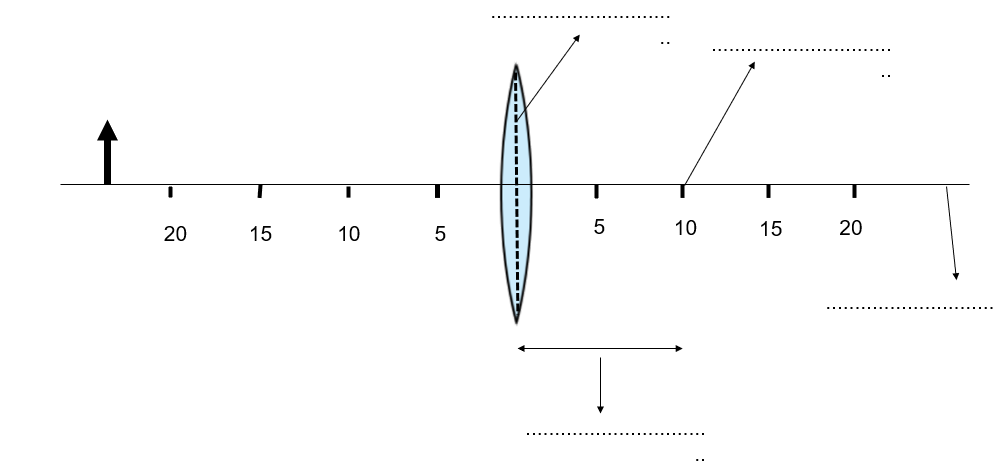
.....................................................................
الحلSolution
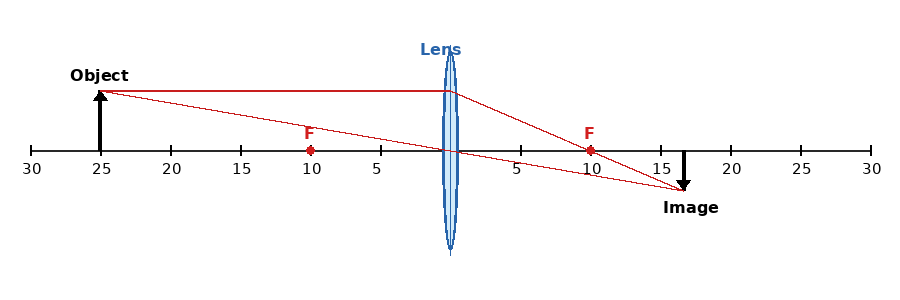
📌 (أ) الأسهم تشير من اليسار إلى اليمين إلى: المستوى الأساسي (المستوى العمودي المار بمركز العدسة)، البؤرة (النقطة على بعد \(10\,cm\) من العدسة)، المحور الأساسي (الخط الأفقي)، والبعد البؤري \(f=10\,cm\) (المسافة بين العدسة والبؤرة).
📌 (ب) الجسم على بعد نحو \(25\,cm\) أي بعد \(2F\) (\(2F=20\,cm\)): \(\dfrac1{10}=\dfrac1{25}+\dfrac1{x_i}\Rightarrow x_i\approx16.7\,cm\) فالصورة بين \(F\) و\(2F\) على الجانب الآخر، وهي حقيقية مقلوبة مصغرة.
📌 (ج) عند ضعف البعد البؤري \(x_o=2f=20\,cm\) فتتكون صورة حقيقية مقلوبة مساوية للجسم عند \(20\,cm\) خلف العدسة.
📌 (د) عند البؤرة \(x_o=f=10\,cm\) فتخرج الأشعة المنكسرة متوازية فلا تلتقي (ولا يلتقي امتدادها) فلا تتكون صورة.
✅ الصورة حقيقية مقلوبة مصغرة؛ مساوية للجسم عند \(2F\)؛ لا صورة عند \(F\)
📌 (a) The arrows point to: the principal plane (the vertical plane through the lens centre), the focus (the point \(10\,cm\) from the lens), the principal axis (the horizontal line) and the focal length \(f=10\,cm\) (the distance from lens to focus).
📌 (b) The object is about \(25\,cm\) away, beyond \(2F\) (\(2F=20\,cm\)): \(\dfrac1{10}=\dfrac1{25}+\dfrac1{x_i}\Rightarrow x_i\approx16.7\,cm\), so the image lies between \(F\) and \(2F\) on the other side and is real, inverted and diminished.
📌 (c) At twice the focal length, \(x_o=2f=20\,cm\), giving a real, inverted image equal in size at \(20\,cm\) behind the lens.
📌 (d) At the focus, \(x_o=f=10\,cm\), the refracted rays emerge parallel and never meet (nor do their extensions), so no image forms.
✅ The image is real, inverted, diminished; equal in size at \(2F\); no image at \(F\)
\[3\,\star\star\star\]
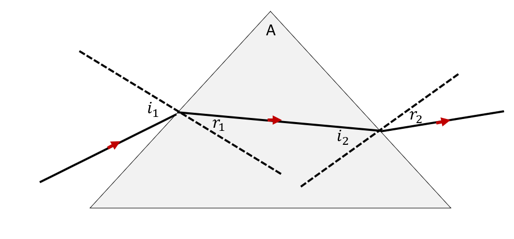
سقط شعاع ضوئي بزاوية \(60^\circ\) على سطح منشور زاويته الرأسية \(A=45^\circ\). إذا كان معامل انكسار مادة المنشور \(1.6\) ومعامل انكسار الهواء \(1\) فاحسب زاوية الخروج من المنشور.A light ray falls at an angle of \(60^\circ\) on a prism with an apex angle \(A=45^\circ\). If the refractive index of the prism is \(1.6\) and that of air is \(1\), calculate the angle of emergence from the prism.
.....................................................................
الحلSolution
📌 عند السطح الأول: \(1\times\sin60^\circ=1.6\sin r_1\) فيكون \(\sin r_1=\dfrac{0.866}{1.6}=0.541\Rightarrow r_1\approx32.8^\circ\).
📌 زاوية المنشور: \(A=r_1+i_2\Rightarrow i_2=45^\circ-32.8^\circ\approx12.2^\circ\).
📌 عند السطح الثاني: \(1.6\sin12.2^\circ=1\times\sin r_2\Rightarrow\sin r_2=0.339\Rightarrow r_2\approx19.8^\circ\).
✅ \(r_2\approx19.8^\circ\)
📌 At the first surface: \(1\times\sin60^\circ=1.6\sin r_1\) so \(\sin r_1=\dfrac{0.866}{1.6}=0.541\Rightarrow r_1\approx32.8^\circ\).
📌 The apex angle: \(A=r_1+i_2\Rightarrow i_2=45^\circ-32.8^\circ\approx12.2^\circ\).
📌 At the second surface: \(1.6\sin12.2^\circ=1\times\sin r_2\Rightarrow\sin r_2=0.339\Rightarrow r_2\approx19.8^\circ\).
✅ \(r_2\approx19.8^\circ\)
\[4\,\star\star\]
جسم ارتفاعه \(4\,cm\) وُضع على المحور الرئيسي لعدسة مقعرة بعدها البؤري \(10\,cm\) على بعد \(15\,cm\) من مركزها البصري.
(أ) أوجد بعد الصورة عن العدسة.
(ب) احسب تكبير الصورة واكتب صفاتها.
(ج) احسب طول الصورة.
(د) ارسم موقع تكوّن الصورة على الشكل.An object of height \(4\,cm\) is placed on the principal axis of a concave lens of focal length \(10\,cm\) at \(15\,cm\) from its optical centre.
(a) Find the image distance.
(b) Calculate the magnification and write the image properties.
(c) Calculate the height of the image.
(d) Draw the image position on the figure.
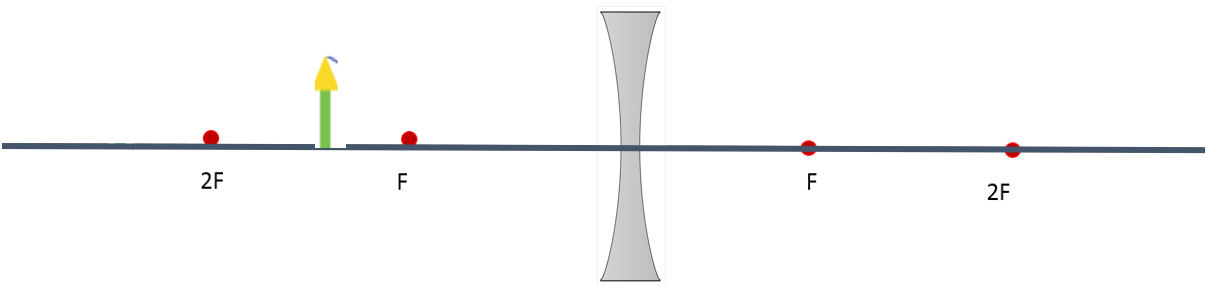
.....................................................................
الحلSolution
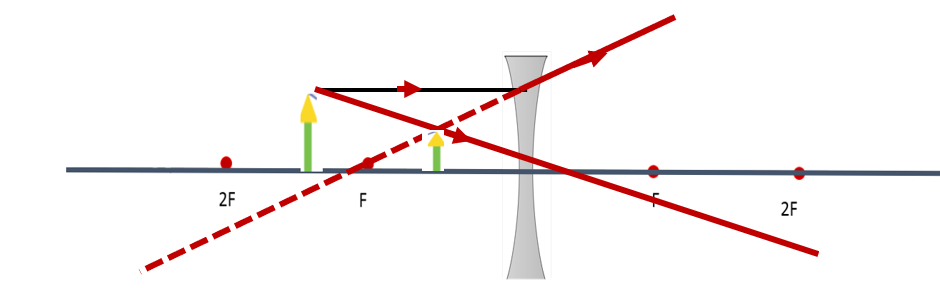
📌 (أ) للعدسة المقعرة \(f=-10\,cm\): \(\dfrac1{x_i}=\dfrac1f-\dfrac1{x_o}=-\dfrac1{10}-\dfrac1{15}=-\dfrac16\Rightarrow x_i=-6\,cm\).
📌 (ب) \(m=-\dfrac{x_i}{x_o}=-\dfrac{-6}{15}=+0.4\)؛ الإشارة السالبة لـ \(x_i\) تعني صورة وهمية على جهة الجسم، والتكبير الموجب يعني معتدلة، و\(0.4\lt 1\) أي مصغرة.
📌 (ج) \(h_i=m\,h_o=0.4\times4=1.6\,cm\).
📌 (د) نرسم شعاعًا موازيًا للمحور ينكسر مبتعدًا كأنه صادر من البؤرة على جهة الجسم، وشعاعًا مارًّا بالمركز البصري دون انكسار؛ يتقاطع امتداداهما على بعد \(6\,cm\) من العدسة على جهة الجسم، وهنا تقع الصورة.
✅ \(x_i=-6\,cm,\ m=+0.4,\ h_i=1.6\,cm\)
📌 (a) For the concave lens \(f=-10\,cm\): \(\dfrac1{x_i}=\dfrac1f-\dfrac1{x_o}=-\dfrac1{10}-\dfrac1{15}=-\dfrac16\Rightarrow x_i=-6\,cm\).
📌 (b) \(m=-\dfrac{x_i}{x_o}=-\dfrac{-6}{15}=+0.4\); the negative \(x_i\) means a virtual image on the object side, the positive magnification means upright, and \(0.4\lt 1\) means diminished.
📌 (c) \(h_i=m\,h_o=0.4\times4=1.6\,cm\).
📌 (d) Draw a ray parallel to the axis, which diverges as if it came from the focus on the object side, and a ray through the optical centre that is undeviated; their extensions meet \(6\,cm\) from the lens on the object side, where the image forms.
✅ \(x_i=-6\,cm,\ m=+0.4,\ h_i=1.6\,cm\)
لاحظت خطأ؟ أو عندك سؤال عن أحد الأسئلة؟ اكتبه بالتعليقات وحدد رقم السؤال بالضبط.
Noticed an error? Or have a question about one of the questions? Write it in the comments and specify the exact question number.