⚡ بنك الأسئلة: الشغل والطاقة الحركية
⚡ Question Bank: Work and Kinetic Energy
الشغل بقوة ثابتة ومتغيرة، الطاقة الحركية، نظرية الشغل والطاقة الحركية، الاحتكاك، والقدرة
Work by Constant and Variable Forces, Kinetic Energy, the Work–Kinetic Energy Theorem, Friction and Power
⏱️ 34 سؤال اختيار من متعدد بتصحيح فوري بمستويات متدرجة، وأربع مسائل مقالية محلولة، مع حل مفصل لكل سؤال⏱️ 34 multiple-choice questions of graded difficulty with instant feedback, and 4 solved essay problems, with a detailed solution for each
\[1\,\star\]
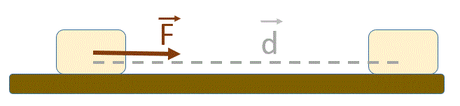
ما مقدار الشغل المبذول عند تطبيق قوة مقدارها \(10\ N\) لتحريك صندوق بمقدار \(4\ m\) باتجاه القوة؟What is the work done when a force of \(10\ N\) moves a box \(4\ m\) in the direction of the force?
\(W=60\ J\)\(W=60\ J\)
\(W=20\ J\)\(W=20\ J\)
\(W=40\ J\)\(W=40\ J\)
\(W=80\ J\)\(W=80\ J\)
الحلSolution
\(W=Fd=10\times4=40\ \mathrm{J}\)
✅ \(W=40\ J\) (C)
\(W=Fd=10\times4=40\ \mathrm{J}\)
✅ \(W=40\ J\) (C)
\[2\,\star\star\]
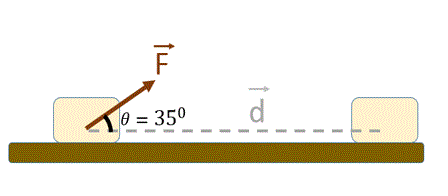
ما مقدار الشغل المبذول عند تطبيق قوة مقدارها \(60\ N\) تميل بزاوية \(35^\circ\) فوق الأفق لتحريك صندوق بمقدار \(10\ m\)؟What is the work done when a force of \(60\ N\) at \(35^\circ\) above the horizontal moves a box \(10\ m\)?
\(W=520.3\ J\)\(W=520.3\ J\)
\(W=312.8\ J\)\(W=312.8\ J\)
\(W=491.5\ J\)\(W=491.5\ J\)
\(W=615.6\ J\)\(W=615.6\ J\)
الحلSolution
📌 الشغل يعتمد على مركبة القوة باتجاه الإزاحة: \(W=Fd\cos\theta\).
\(W=60\times10\times\cos35^\circ=491.5\ \mathrm{J}\)
✅ \(W=491.5\ J\) (C)
📌 Work depends on the component of the force along the displacement: \(W=Fd\cos\theta\).
\(W=60\times10\times\cos35^\circ=491.5\ \mathrm{J}\)
✅ \(W=491.5\ J\) (C)
\[3\,\star\star\]
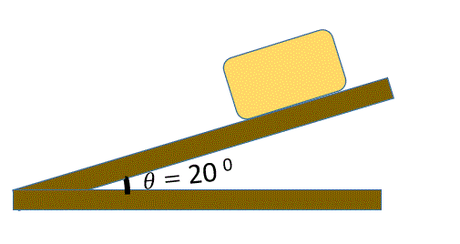
جسم كتلته \(3\ kg\) وُضع على مستوى مائل يميل على الأفق بزاوية \(\theta=20^\circ\) فانزلق نحو الأسفل مسافة \(4\ m\) كما في الشكل؛ شغل قوة الوزن يعادل (\(g=9.8\)):A \(3\ kg\) object on an incline at \(\theta=20^\circ\) slides down \(4\ m\) as shown; the work done by the weight is (\(g=9.8\)):
\(W=40.2\ J\)\(W=40.2\ J\)
\(W=110.5\ J\)\(W=110.5\ J\)
\(W=11.2\ J\)\(W=11.2\ J\)
\(W=4.1\ J\)\(W=4.1\ J\)
الحلSolution
📌 مركبة الوزن الموازية للمستوى \(mg\sin\theta\) هي التي تبذل الشغل.
\(W=mg\sin\theta\cdot d=3\times9.8\times\sin20^\circ\times4=40.2\ \mathrm{J}\)
✅ \(W=40.2\ J\) (A)
📌 The component of weight along the incline \(mg\sin\theta\) does the work.
\(W=mg\sin\theta\cdot d=3\times9.8\times\sin20^\circ\times4=40.2\ \mathrm{J}\)
✅ \(W=40.2\ J\) (A)
\[4\,\star\]
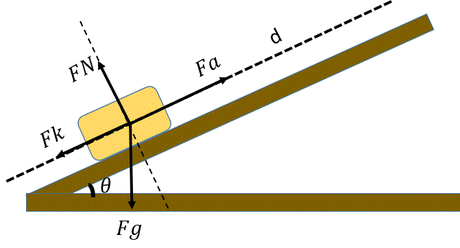
مكعب خشبي وُضع عند قاعدة مستوى مائل خشن وسُحب بقوة موازية للسطح نحو القمة؛ إحدى القوى التالية شغلها معدوم:A wooden cube at the base of a rough incline is pulled up the plane by a force parallel to the surface. One of the following forces does zero work:
\(W_{F_a}=0\)\(W_{F_a}=0\)
\(W_{F_g}=0\)\(W_{F_g}=0\)
\(W_{F_k}=0\)\(W_{F_k}=0\)
\(W_{F_N}=0\)\(W_{F_N}=0\)
الحلSolution
📌 القوة العمودية \(F_N\) عمودية على الإزاحة (\(\cos90^\circ=0\)) فشغلها صفر؛ أما قوة السحب والوزن والاحتكاك فلها مركبات باتجاه الحركة أو عكسها.
✅ \(W_{F_N}=0\) (D)
📌 The normal force \(F_N\) is perpendicular to the displacement (\(\cos90^\circ=0\)) so it does no work; the pull, the weight and the friction all have components along or against the motion.
✅ \(W_{F_N}=0\) (D)
\[5\,\star\star\]
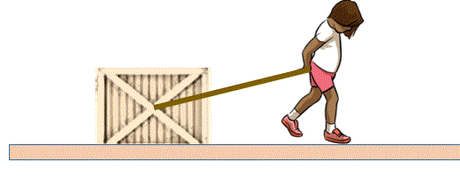
صندوق كتلته \(10\ kg\) على سطح أفقي خشن سُحب بحبل بقوة ثابتة \(50\ N\) تميل فوق الأفق بزاوية \(25^\circ\) فتحرك مسافة \(d=8\ m\)؛ فإذا كانت قوة الاحتكاك \(15\ N\) فإن الشغل الكلي المبذول على الصندوق:A \(10\ kg\) box on a rough horizontal surface is pulled by a rope with a constant \(50\ N\) force at \(25^\circ\) above the horizontal and moves \(d=8\ m\). If friction is \(15\ N\), the total work done on the box is:
\(W_{tot}=242.5\ J\)\(W_{tot}=242.5\ J\)
\(W_{tot}=482.5\ J\)\(W_{tot}=482.5\ J\)
\(W_{tot}=385.5\ J\)\(W_{tot}=385.5\ J\)
\(W_{tot}=255.5\ J\)\(W_{tot}=255.5\ J\)
الحلSolution
\(W_F=Fd\cos25^\circ=50\times8\times0.906=362.5\ \mathrm{J}\)
\(W_f=-15\times8=-120\ \mathrm{J}\)
📌 الوزن والقوة العمودية لا يبذلان شغلًا: \(W_{tot}=362.5-120=242.5\ \mathrm{J}\).
✅ \(W_{tot}=242.5\ J\) (A)
\(W_F=Fd\cos25^\circ=50\times8\times0.906=362.5\ \mathrm{J}\)
\(W_f=-15\times8=-120\ \mathrm{J}\)
📌 Weight and the normal force do no work: \(W_{tot}=362.5-120=242.5\ \mathrm{J}\).
✅ \(W_{tot}=242.5\ J\) (A)
\[6\,\star\star\]
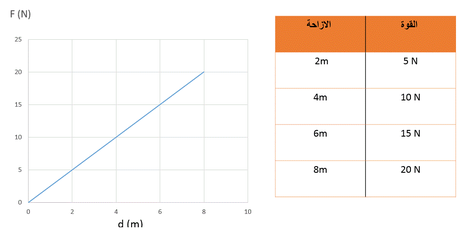
أثّرت قوة متغيرة على سيارة تتحرك على مستوى أفقي وسُجلت القوة والإزاحة في الجدول ورُسمت العلاقة بينهما؛ الشغل المبذول على الجسم يعادل:A variable force acts on a car on a horizontal surface; the force and displacement are recorded in the table and plotted. The work done on the object is:
\(W=20\ J\)\(W=20\ J\)
\(W=40\ J\)\(W=40\ J\)
\(W=80\ J\)\(W=80\ J\)
\(W=160\ J\)\(W=160\ J\)
الحلSolution
📌 الشغل = المساحة تحت منحنى القوة–الإزاحة (مثلث قاعدته \(8\ m\) وارتفاعه \(20\ N\)).
\(W=\tfrac12\times8\times20=80\ \mathrm{J}\)
✅ \(W=80\ J\) (C)
📌 Work = the area under the force–displacement graph (a triangle of base \(8\ m\) and height \(20\ N\)).
\(W=\tfrac12\times8\times20=80\ \mathrm{J}\)
✅ \(W=80\ J\) (C)
\[7\,\star\star\star\]
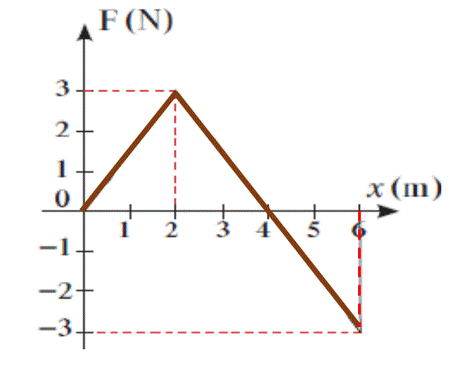
الخط البياني يبين العلاقة بين القوة والإزاحة لجسم متأثر بقوة متغيرة؛ الشغل المبذول من القوة:The graph shows force against displacement for an object acted on by a variable force; the work done by the force is:
\(W=9\ J\)\(W=9\ J\)
\(W=-6\ J\)\(W=-6\ J\)
\(W=6\ J\)\(W=6\ J\)
\(W=3\ J\)\(W=3\ J\)
الحلSolution
📌 من \(0\) إلى \(4\ m\) مساحة موجبة \(\tfrac12\times4\times3=+6\ \mathrm{J}\).
📌 من \(4\) إلى \(6\ m\) القوة سالبة: \(\tfrac12\times2\times(-3)=-3\ \mathrm{J}\).
\(W=6-3=3\ \mathrm{J}\)
✅ \(W=3\ J\) (D)
📌 From \(0\) to \(4\ m\) the area is positive: \(\tfrac12\times4\times3=+6\ \mathrm{J}\).
📌 From \(4\) to \(6\ m\) the force is negative: \(\tfrac12\times2\times(-3)=-3\ \mathrm{J}\).
\(W=6-3=3\ \mathrm{J}\)
✅ \(W=3\ J\) (D)
\[8\,\star\star\]
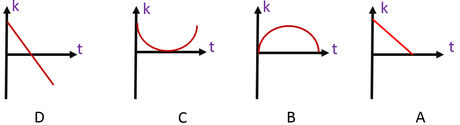
أحد الخطوط البيانية التالية لا يمكن أن يمثل العلاقة بين الطاقة الحركية لجسم والزمن:One of the following graphs cannot represent the relation between an object’s kinetic energy and time:
الرسم البياني AGraph A
الرسم البياني BGraph B
الرسم البياني CGraph C
الرسم البياني DGraph D
الحلSolution
📌 \(KE=\tfrac12mv^2\) لا تكون سالبة أبدًا لأن الكتلة موجبة ومربع السرعة موجب؛ والرسم D يهبط تحت المحور أي طاقة سالبة.
✅ الرسم البياني D (D)
📌 \(KE=\tfrac12mv^2\) can never be negative since the mass and the square of the speed are positive; graph D goes below the axis (negative energy).
✅ Graph D (D)
\[9\,\star\star\]
إحدى وحدات القياس التالية تعادل وحدة الطاقة جول \(J\):Which of the following units is equivalent to the joule \(J\):
\(\dfrac{kg\cdot m^2}{s}\)\(\dfrac{kg\cdot m^2}{s}\)
\(\dfrac{kg\cdot m^2}{s^2}\)\(\dfrac{kg\cdot m^2}{s^2}\)
\(\dfrac{kg\cdot m}{s}\)\(\dfrac{kg\cdot m}{s}\)
\(\dfrac{kg\cdot m}{s^2}\)\(\dfrac{kg\cdot m}{s^2}\)
الحلSolution
\(J=N\cdot m=\dfrac{kg\cdot m}{s^2}\cdot m=\dfrac{kg\cdot m^2}{s^2}\)
✅ \(\dfrac{kg\cdot m^2}{s^2}\) (B)
\(J=N\cdot m=\dfrac{kg\cdot m}{s^2}\cdot m=\dfrac{kg\cdot m^2}{s^2}\)
✅ \(\dfrac{kg\cdot m^2}{s^2}\) (B)
\[10\,\star\]
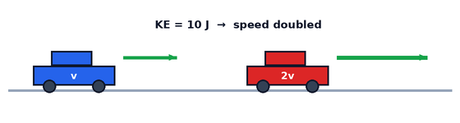
سيارة طاقتها الحركية \(10\ J\) فإذا زادت سرعتها إلى الضعف فإن طاقتها الحركية تصبح:A car has kinetic energy \(10\ J\). If its speed doubles, its kinetic energy becomes:
\(KE=80\ J\)\(KE=80\ J\)
\(KE=40\ J\)\(KE=40\ J\)
\(KE=60\ J\)\(KE=60\ J\)
\(KE=20\ J\)\(KE=20\ J\)
الحلSolution
📌 الطاقة الحركية تتناسب مع مربع السرعة: ضعف السرعة يعني أربعة أمثال الطاقة.
\(KE_2=2^2\times10=40\ \mathrm{J}\)
✅ \(KE=40\ J\) (B)
📌 Kinetic energy is proportional to the square of speed: doubling the speed quadruples the energy.
\(KE_2=2^2\times10=40\ \mathrm{J}\)
✅ \(KE=40\ J\) (B)
\[11\,\star\]
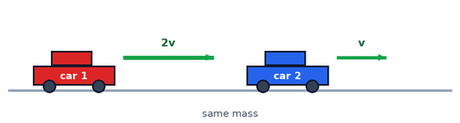
سيارتان لهما الكتلة نفسها وسرعة الأولى ضعف سرعة الثانية؛ النسبة بين الطاقة الحركية للأولى إلى الثانية:Two cars have the same mass and the speed of the first is twice that of the second; the ratio of the kinetic energy of the first to the second is:
\(\dfrac{KE_1}{KE_2}=2\)\(\dfrac{KE_1}{KE_2}=2\)
\(\dfrac{KE_1}{KE_2}=6\)\(\dfrac{KE_1}{KE_2}=6\)
\(\dfrac{KE_1}{KE_2}=8\)\(\dfrac{KE_1}{KE_2}=8\)
\(\dfrac{KE_1}{KE_2}=4\)\(\dfrac{KE_1}{KE_2}=4\)
الحلSolution
\(\dfrac{KE_1}{KE_2}=\dfrac{\tfrac12m(2v)^2}{\tfrac12mv^2}=4\)
✅ \(\dfrac{KE_1}{KE_2}=4\) (D)
\(\dfrac{KE_1}{KE_2}=\dfrac{\tfrac12m(2v)^2}{\tfrac12mv^2}=4\)
✅ \(\dfrac{KE_1}{KE_2}=4\) (D)
\[12\,\star\star\]
سيارة كتلتها \(1500\ kg\) تتحرك بسرعة \(10\ m/s\) تغيرت سرعتها إلى \(3\ m/s\)؛ التغير في الطاقة الحركية:A \(1500\ kg\) car moving at \(10\ m/s\) changes its speed to \(3\ m/s\); the change in kinetic energy is:
\(\Delta KE=25600\ J\)\(\Delta KE=25600\ J\)
\(\Delta KE=-56430\ J\)\(\Delta KE=-56430\ J\)
\(\Delta KE=-68250\ J\)\(\Delta KE=-68250\ J\)
\(\Delta KE=-34670\ J\)\(\Delta KE=-34670\ J\)
الحلSolution
\(\Delta KE=\tfrac12m(v_f^2-v_i^2)=\tfrac12\times1500\times(9-100)=-68250\ \mathrm{J}\)
✅ \(\Delta KE=-68250\ J\) (C)
\(\Delta KE=\tfrac12m(v_f^2-v_i^2)=\tfrac12\times1500\times(9-100)=-68250\ \mathrm{J}\)
✅ \(\Delta KE=-68250\ J\) (C)
\[13\,\star\star\star\]
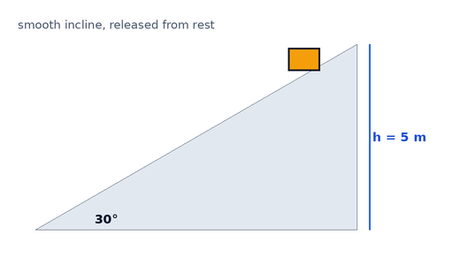
وُضع جسم على قمة مستوى مائل أملس يميل بزاوية \(\theta=30^\circ\) ويرتفع \(h=5\ m\) عن الأرض؛ احسب سرعته عند نهاية المستوى باستخدام نظرية الشغل والطاقة الحركية (\(g=9.8\)):An object is placed at the top of a smooth incline at \(\theta=30^\circ\) and height \(h=5\ m\); using the work–kinetic energy theorem its speed at the bottom is (\(g=9.8\)):
\(v_f=9.9\ m/s\)\(v_f=9.9\ m/s\)
\(v_f=6.4\ m/s\)\(v_f=6.4\ m/s\)
\(v_f=12.3\ m/s\)\(v_f=12.3\ m/s\)
\(v_f=7.8\ m/s\)\(v_f=7.8\ m/s\)
الحلSolution
📌 المستوى أملس فالوزن وحده يبذل شغلًا: \(W=mgh\) (الزاوية لا تؤثر).
\(mgh=\tfrac12mv_f^2\Rightarrow v_f=\sqrt{2gh}=\sqrt{2\times9.8\times5}=9.9\ \mathrm{m/s}\)
✅ \(v_f=9.9\ m/s\) (A)
📌 The incline is smooth so only the weight does work: \(W=mgh\) (the angle does not matter).
\(mgh=\tfrac12mv_f^2\Rightarrow v_f=\sqrt{2gh}=\sqrt{2\times9.8\times5}=9.9\ \mathrm{m/s}\)
✅ \(v_f=9.9\ m/s\) (A)
\[14\,\star\star\star\]
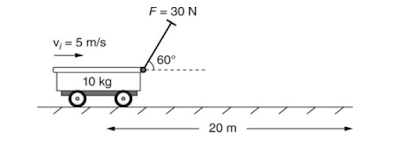
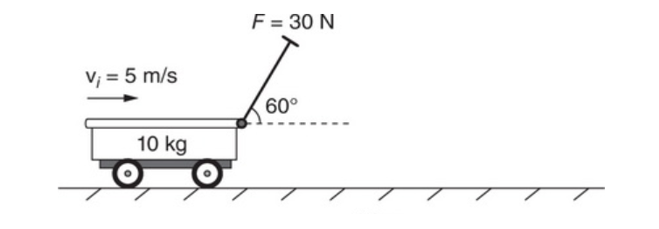
عربة كتلتها \(10\ kg\) تتحرك بسرعة \(5\ m/s\) سُحبت بقوة \(30\ N\) بمقبض يميل \(60^\circ\) فوق الأفق وتحركت \(20\ m\) دون احتكاك؛ سرعتها النهائية:A \(10\ kg\) cart moving at \(5\ m/s\) is pulled with \(30\ N\) by a handle at \(60^\circ\) above the horizontal for \(20\ m\), no friction; its final speed is:
\(v_f=14.3\ m/s\)\(v_f=14.3\ m/s\)
\(v_f=9.2\ m/s\)\(v_f=9.2\ m/s\)
\(v_f=6.8\ m/s\)\(v_f=6.8\ m/s\)
\(v_f=11.4\ m/s\)\(v_f=11.4\ m/s\)
الحلSolution
\(W=Fd\cos60^\circ=30\times20\times0.5=300\ \mathrm{J}\)
\(W=\tfrac12m(v_f^2-v_i^2)\Rightarrow300=5(v_f^2-25)\)
\(v_f^2=85\Rightarrow v_f=9.2\ \mathrm{m/s}\)
✅ \(v_f=9.2\ m/s\) (B)
\(W=Fd\cos60^\circ=30\times20\times0.5=300\ \mathrm{J}\)
\(W=\tfrac12m(v_f^2-v_i^2)\Rightarrow300=5(v_f^2-25)\)
\(v_f^2=85\Rightarrow v_f=9.2\ \mathrm{m/s}\)
✅ \(v_f=9.2\ m/s\) (B)
\[15\,\star\star\star\]
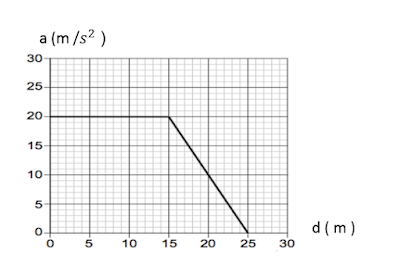
جسم كتلته \(3\ kg\) أثّرت عليه قوة متغيرة والرسم يبين تغير التسارع مع الإزاحة؛ الشغل المنجز على الجسم:A \(3\ kg\) object is acted on by a variable force; the graph shows how its acceleration changes with displacement. The work done on the object is:
\(W=1200\ J\)\(W=1200\ J\)
\(W=300\ J\)\(W=300\ J\)
\(W=900\ J\)\(W=900\ J\)
\(W=1500\ J\)\(W=1500\ J\)
الحلSolution
📌 \(F=ma\) فالشغل = الكتلة × المساحة تحت منحنى \(a\)–\(d\).
\(\text{area}=20\times15+\tfrac12\times10\times20=300+100=400\)
\(W=3\times400=1200\ \mathrm{J}\)
✅ \(W=1200\ J\) (A)
📌 \(F=ma\) so work = mass × the area under the \(a\)–\(d\) graph.
\(\text{area}=20\times15+\tfrac12\times10\times20=300+100=400\)
\(W=3\times400=1200\ \mathrm{J}\)
✅ \(W=1200\ J\) (A)
\[16\,\star\star\star\]
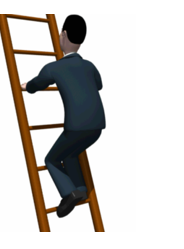
طالب كتلته \(50\ kg\) استغرق \(40\ s\) لتسلق درج ارتفاعه \(18\ m\)؛ القدرة التي استهلكها (\(g=9.81\)):A \(50\ kg\) student takes \(40\ s\) to climb stairs \(18\ m\) high; the power consumed is (\(g=9.81\)):
\(P=187.4\ W\)\(P=187.4\ W\)
\(P=115.9\ W\)\(P=115.9\ W\)
\(P=220.7\ W\)\(P=220.7\ W\)
\(P=330.1\ W\)\(P=330.1\ W\)
الحلSolution
\(P=\dfrac{mgh}{t}=\dfrac{50\times9.81\times18}{40}=220.7\ \mathrm{W}\)
✅ \(P=220.7\ W\) (C)
\(P=\dfrac{mgh}{t}=\dfrac{50\times9.81\times18}{40}=220.7\ \mathrm{W}\)
✅ \(P=220.7\ W\) (C)
\[17\,\star\]
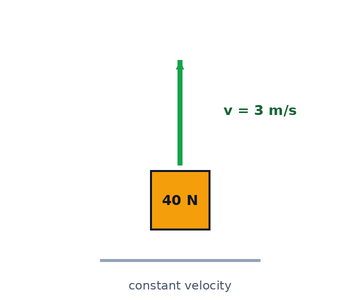
صندوق وزنه \(40\ N\) يُرفع بسرعة ثابتة \(3\ m/s\)؛ القدرة المطلوبة:A box weighing \(40\ N\) is lifted at a constant speed of \(3\ m/s\); the power required is:
\(P=43\ W\)\(P=43\ W\)
\(P=120\ W\)\(P=120\ W\)
\(P=13.3\ W\)\(P=13.3\ W\)
\(P=60\ W\)\(P=60\ W\)
الحلSolution
📌 السرعة ثابتة فقوة الرفع تساوي الوزن \(40\ N\).
\(P=Fv=40\times3=120\ \mathrm{W}\)
✅ \(P=120\ W\) (B)
📌 The speed is constant so the lifting force equals the weight \(40\ N\).
\(P=Fv=40\times3=120\ \mathrm{W}\)
✅ \(P=120\ W\) (B)
\[18\,\star\star\]
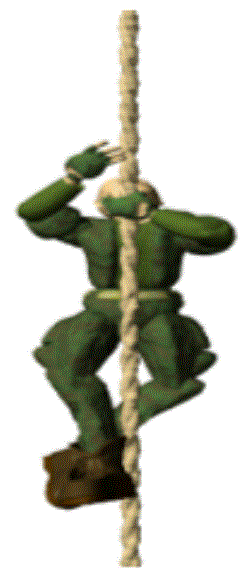
طالب وزنه \(700\ N\) تسلق حبلًا مسافة \(10\ m\) فاستهلك قدرة \(2.5\ hp\) (\(1\ hp=746\ W\))؛ الزمن الذي استغرقه:A student weighing \(700\ N\) climbs a rope \(10\ m\) using power \(2.5\ hp\) (\(1\ hp=746\ W\)); the time taken is:
\(t=4.25\ s\)\(t=4.25\ s\)
\(t=3.75\ s\)\(t=3.75\ s\)
\(t=2.5\ s\)\(t=2.5\ s\)
\(t=5.25\ s\)\(t=5.25\ s\)
الحلSolution
\(P=2.5\times746=1865\ \mathrm{W}\)
\(t=\dfrac{W}{P}=\dfrac{700\times10}{1865}=3.75\ \mathrm{s}\)
✅ \(t=3.75\ s\) (B)
\(P=2.5\times746=1865\ \mathrm{W}\)
\(t=\dfrac{W}{P}=\dfrac{700\times10}{1865}=3.75\ \mathrm{s}\)
✅ \(t=3.75\ s\) (B)
\[19\,\star\star\star\]
الرسم يبين العلاقة بين القوة والإزاحة لجسم؛ إحدى العبارات تعبر عن التسارع والتغير في الطاقة الحركية:The graph shows force against displacement for an object; which statement describes the acceleration and the change in kinetic energy?
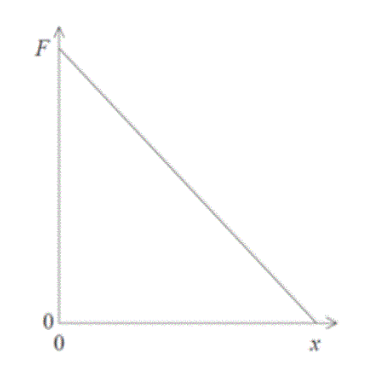
يقل التسارع - يزداد التغير في الطاقة الحركيةAcceleration decreases - change in KE increases
يقل التسارع - يقل التغير في الطاقة الحركيةAcceleration decreases - change in KE decreases
يزداد التسارع - يقل التغير في الطاقة الحركيةAcceleration increases - change in KE decreases
يزداد التسارع - يزداد التغير في الطاقة الحركيةAcceleration increases - change in KE increases
الحلSolution
📌 القوة تتناقص مع الإزاحة فالتسارع \(a=F/m\) يتناقص.
📌 القوة ما زالت موجبة فيستمر الشغل الموجب (المساحة تتراكم) فتزداد الطاقة الحركية، لكن بمعدل أقل.
✅ يقل التسارع - يزداد التغير في الطاقة الحركية (A)
📌 The force decreases with displacement so the acceleration \(a=F/m\) decreases.
📌 The force is still positive so the positive work (the area) keeps accumulating and the kinetic energy keeps increasing, at a decreasing rate.
✅ Acceleration decreases - change in KE increases (A)
\[20\,\star\star\]
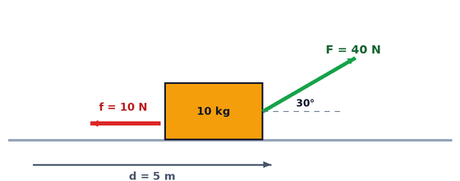
يُسحب صندوق كتلته \(10\ kg\) بقوة \(40\ N\) تميل \(30^\circ\) فوق الأفق مسافة \(5\ m\) على سطح خشن قوة احتكاكه \(10\ N\)؛ الشغل الكلي (الصافي) المبذول على الصندوق:A \(10\ kg\) box is pulled by a \(40\ N\) force at \(30^\circ\) above the horizontal for \(5\ m\) on a rough surface with friction \(10\ N\); the net work done on the box is:
\(W_{net}=123.2\ J\)\(W_{net}=123.2\ J\)
\(W_{net}=173.2\ J\)\(W_{net}=173.2\ J\)
\(W_{net}=150\ J\)\(W_{net}=150\ J\)
\(W_{net}=73.2\ J\)\(W_{net}=73.2\ J\)
الحلSolution
\(W_F=40\times5\times\cos30^\circ=173.2\ \mathrm{J}\)
\(W_f=-10\times5=-50\ \mathrm{J}\)
📌 الوزن والعمودية صفر: \(W_{net}=173.2-50=123.2\ \mathrm{J}\).
✅ \(W_{net}=123.2\ J\) (A)
\(W_F=40\times5\times\cos30^\circ=173.2\ \mathrm{J}\)
\(W_f=-10\times5=-50\ \mathrm{J}\)
📌 Weight and normal: zero. \(W_{net}=173.2-50=123.2\ \mathrm{J}\).
✅ \(W_{net}=123.2\ J\) (A)
\[21\,\star\star\star\]
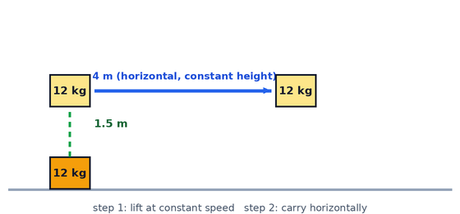
رفع شخص صندوقًا كتلته \(12\ kg\) رأسيًا مسافة \(1.5\ m\) بسرعة ثابتة ثم حمله أفقيًا مسافة \(4\ m\) بارتفاع ثابت (\(g=10\))؛ الشغل الكلي المبذول من قوة الرفع:A person lifts a \(12\ kg\) box vertically \(1.5\ m\) at constant speed then carries it horizontally \(4\ m\) at constant height (\(g=10\)); the total work done by the lifting force is:
\(660\ J\)\(660\ J\)
\(480\ J\)\(480\ J\)
\(0\)\(0\)
\(180\ J\)\(180\ J\)
الحلSolution
📌 الرفع: القوة \(mg=120\ N\) والإزاحة \(1.5\ m\): \(W_1=180\ \mathrm{J}\).
📌 الحمل أفقيًا: قوة الرفع رأسية والإزاحة أفقية (\(\cos90^\circ=0\)) فشغلها صفر.
\(W=180+0=180\ \mathrm{J}\)
✅ \(180\ J\) (D)
📌 Lifting: force \(mg=120\ N\), displacement \(1.5\ m\): \(W_1=180\ \mathrm{J}\).
📌 Carrying: the lifting force is vertical and the displacement horizontal (\(\cos90^\circ=0\)) so its work is zero.
\(W=180+0=180\ \mathrm{J}\)
✅ \(180\ J\) (D)
\[22\,\star\star\]
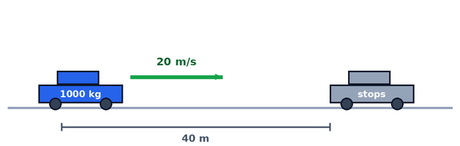
سيارة كتلتها \(1000\ kg\) تسير بسرعة \(20\ m/s\) ضُغط مكبحها فتوقفت بعد \(40\ m\)؛ متوسط قوة الكبح:A \(1000\ kg\) car moving at \(20\ m/s\) brakes to a stop after \(40\ m\); the average braking force is:
\(10000\ N\)\(10000\ N\)
\(2500\ N\)\(2500\ N\)
\(20000\ N\)\(20000\ N\)
\(5000\ N\)\(5000\ N\)
الحلSolution
\(\Delta KE=0-\tfrac12\times1000\times20^2=-200000\ \mathrm{J}\)
\(-Fd=\Delta KE\Rightarrow F=\dfrac{200000}{40}=5000\ \mathrm{N}\)
✅ \(5000\ N\) (D)
\(\Delta KE=0-\tfrac12\times1000\times20^2=-200000\ \mathrm{J}\)
\(-Fd=\Delta KE\Rightarrow F=\dfrac{200000}{40}=5000\ \mathrm{N}\)
✅ \(5000\ N\) (D)
\[23\,\star\star\star\]
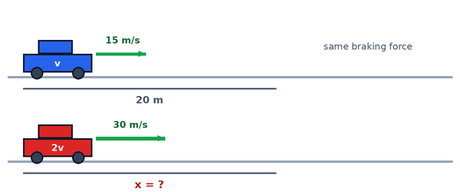
سيارة تسير بسرعة \(15\ m/s\) فتوقفت بعد \(20\ m\) عند الكبح؛ فإذا سارت بسرعة \(30\ m/s\) وكانت قوة الكبح نفسها فإن مسافة توقفها:A car at \(15\ m/s\) stops in \(20\ m\) when braking; at \(30\ m/s\) with the same braking force its stopping distance is:
\(40\ m\)\(40\ m\)
\(60\ m\)\(60\ m\)
\(80\ m\)\(80\ m\)
\(160\ m\)\(160\ m\)
الحلSolution
📌 \(Fx=\tfrac12mv^2\) فالمسافة تتناسب مع مربع السرعة.
\(x_2=x_1\left(\dfrac{v_2}{v_1}\right)^2=20\times4=80\ \mathrm{m}\)
✅ \(80\ m\) (C)
📌 \(Fx=\tfrac12mv^2\) so the stopping distance is proportional to the square of the speed.
\(x_2=x_1\left(\dfrac{v_2}{v_1}\right)^2=20\times4=80\ \mathrm{m}\)
✅ \(80\ m\) (C)
\[24\,\star\star\star\]
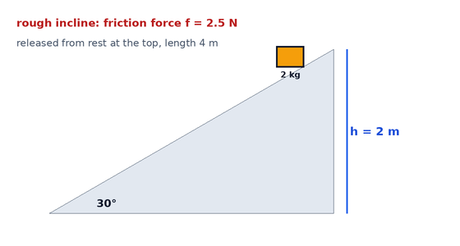
جسم كتلته \(2\ kg\) يُترك من قمة مستوى مائل خشن ارتفاعه \(2\ m\) وطوله \(4\ m\) وقوة الاحتكاك \(2.5\ N\)؛ سرعته عند القاعدة (\(g=10\)):A \(2\ kg\) body is released from the top of a rough incline \(2\ m\) high and \(4\ m\) long with friction \(2.5\ N\); its speed at the bottom is (\(g=10\)):
\(v=6.3\ m/s\)\(v=6.3\ m/s\)
\(v=5.5\ m/s\)\(v=5.5\ m/s\)
\(v=4.5\ m/s\)\(v=4.5\ m/s\)
\(v=7.7\ m/s\)\(v=7.7\ m/s\)
الحلSolution
\(W_g=mgh=2\times10\times2=40\ \mathrm{J}\)
\(W_f=-2.5\times4=-10\ \mathrm{J}\)
\(\tfrac12\times2\times v^2=30\Rightarrow v=\sqrt{30}=5.5\ \mathrm{m/s}\)
✅ \(v=5.5\ m/s\) (B)
\(W_g=mgh=2\times10\times2=40\ \mathrm{J}\)
\(W_f=-2.5\times4=-10\ \mathrm{J}\)
\(\tfrac12\times2\times v^2=30\Rightarrow v=\sqrt{30}=5.5\ \mathrm{m/s}\)
✅ \(v=5.5\ m/s\) (B)
\[25\,\star\star\star\]
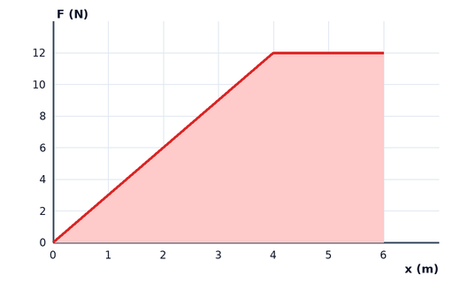
جسم كتلته \(2\ kg\) سرعته الابتدائية \(4\ m/s\) أثّرت عليه قوة تتغير مع الإزاحة كما في الرسم؛ سرعته بعد \(6\ m\):A \(2\ kg\) body with initial speed \(4\ m/s\) is acted on by a force that varies with displacement as shown; its speed after \(6\ m\) is:
\(v=8\ m/s\)\(v=8\ m/s\)
\(v=6.9\ m/s\)\(v=6.9\ m/s\)
\(v=5.7\ m/s\)\(v=5.7\ m/s\)
\(v=12\ m/s\)\(v=12\ m/s\)
الحلSolution
\(W=\tfrac12\times4\times12+12\times2=24+24=48\ \mathrm{J}\)
\(\tfrac12\times2\times v^2=\tfrac12\times2\times4^2+48=64\)
\(v=8\ \mathrm{m/s}\)
✅ \(v=8\ m/s\) (A)
\(W=\tfrac12\times4\times12+12\times2=24+24=48\ \mathrm{J}\)
\(\tfrac12\times2\times v^2=\tfrac12\times2\times4^2+48=64\)
\(v=8\ \mathrm{m/s}\)
✅ \(v=8\ m/s\) (A)
\[26\,\star\star\star\]
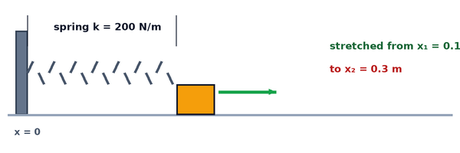
نابض ثابته \(k=200\ N/m\) استُطيل من الموضع \(x_1=0.1\ m\) إلى \(x_2=0.3\ m\)؛ الشغل المبذول لاستطالته:A spring with \(k=200\ N/m\) is stretched from \(x_1=0.1\ m\) to \(x_2=0.3\ m\); the work done stretching it is:
\(9\ J\)\(9\ J\)
\(1\ J\)\(1\ J\)
\(10\ J\)\(10\ J\)
\(8\ J\)\(8\ J\)
الحلSolution
\(F_1=kx_1=20\ \mathrm{N},\quad F_2=kx_2=60\ \mathrm{N}\)
\(W=\text{area of trapezoid}=\dfrac{20+60}{2}\times0.2=8\ \mathrm{J}\)
📌 أو بالقانون: \(W=\tfrac12k(x_2^2-x_1^2)=100(0.09-0.01)=8\ \mathrm{J}\).
✅ \(8\ J\) (D)
\(F_1=kx_1=20\ \mathrm{N},\quad F_2=kx_2=60\ \mathrm{N}\)
\(W=\text{area of trapezoid}=\dfrac{20+60}{2}\times0.2=8\ \mathrm{J}\)
📌 Or by the formula: \(W=\tfrac12k(x_2^2-x_1^2)=100(0.09-0.01)=8\ \mathrm{J}\).
✅ \(8\ J\) (D)
\[27\,\star\star\]
جسم كتلته \(m\) وسرعته \(v\) وطاقته الحركية \(KE\)؛ إذا تضاعفت كتلته ونقصت سرعته إلى النصف فإن طاقته الحركية تصبح:A body of mass \(m\), speed \(v\) and kinetic energy \(KE\); if its mass doubles and its speed is halved, its kinetic energy becomes:
\(KE\)\(KE\)
\(2KE\)\(2KE\)
\(\dfrac{KE}{4}\)\(\dfrac{KE}{4}\)
\(\dfrac{KE}{2}\)\(\dfrac{KE}{2}\)
الحلSolution
\(KE_2=\tfrac12(2m)\left(\dfrac v2\right)^2=\tfrac12\cdot\tfrac{2}{4}mv^2=\dfrac{KE}{2}\)
✅ \(\dfrac{KE}{2}\) (D)
\(KE_2=\tfrac12(2m)\left(\dfrac v2\right)^2=\tfrac12\cdot\tfrac{2}{4}mv^2=\dfrac{KE}{2}\)
✅ \(\dfrac{KE}{2}\) (D)
\[28\,\star\star\star\]
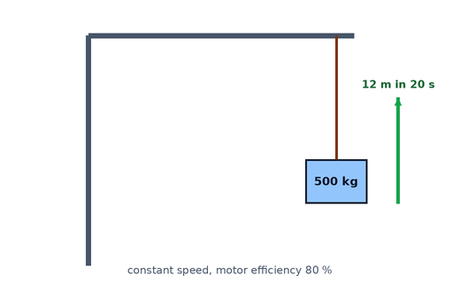
رافعة ترفع حمولة \(500\ kg\) مسافة \(12\ m\) بسرعة ثابتة خلال \(20\ s\) وكفاءة محركها \(80\%\) (\(g=10\))؛ القدرة التي يستهلكها المحرك:A crane lifts a \(500\ kg\) load \(12\ m\) at constant speed in \(20\ s\) and its motor efficiency is \(80\%\) (\(g=10\)); the power the motor consumes is:
\(3000\ W\)\(3000\ W\)
\(3750\ W\)\(3750\ W\)
\(2400\ W\)\(2400\ W\)
\(4800\ W\)\(4800\ W\)
الحلSolution
\(P_{out}=\dfrac{mgh}{t}=\dfrac{500\times10\times12}{20}=3000\ \mathrm{W}\)
\(P_{in}=\dfrac{P_{out}}{\text{eff}}=\dfrac{3000}{0.8}=3750\ \mathrm{W}\)
✅ \(3750\ W\) (B)
\(P_{out}=\dfrac{mgh}{t}=\dfrac{500\times10\times12}{20}=3000\ \mathrm{W}\)
\(P_{in}=\dfrac{P_{out}}{\text{eff}}=\dfrac{3000}{0.8}=3750\ \mathrm{W}\)
✅ \(3750\ W\) (B)
\[29\,\star\star\]
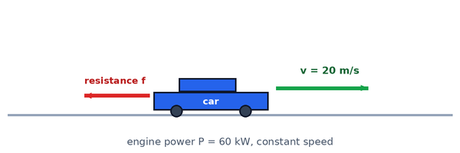
سيارة تعمل بقدرة ثابتة \(60\ kW\) وتسير بسرعة ثابتة \(20\ m/s\)؛ مقدار قوى المقاومة المؤثرة عليها:A car with constant engine power \(60\ kW\) moves at constant speed \(20\ m/s\); the resistive forces acting on it are:
\(1200\ N\)\(1200\ N\)
\(3000\ N\)\(3000\ N\)
\(300\ N\)\(300\ N\)
\(12000\ N\)\(12000\ N\)
الحلSolution
📌 السرعة ثابتة فقوة المحرك تساوي المقاومة.
\(f=F=\dfrac Pv=\dfrac{60000}{20}=3000\ \mathrm{N}\)
✅ \(3000\ N\) (B)
📌 The speed is constant so the engine force equals the resistance.
\(f=F=\dfrac Pv=\dfrac{60000}{20}=3000\ \mathrm{N}\)
✅ \(3000\ N\) (B)
\[30\,\star\star\]
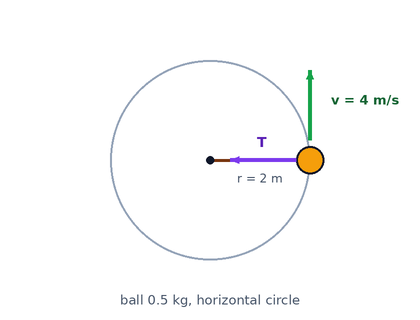
كرة كتلتها \(0.5\ kg\) تدور في مسار دائري أفقي نصف قطره \(2\ m\) بسرعة ثابتة \(4\ m/s\)؛ الشغل الذي تبذله قوة الشد في الخيط خلال نصف دورة:A \(0.5\ kg\) ball moves in a horizontal circle of radius \(2\ m\) at constant speed \(4\ m/s\); the work done by the string tension in half a revolution is:
\(0\)\(0\)
\(16\ J\)\(16\ J\)
\(8\ J\)\(8\ J\)
\(4\ J\)\(4\ J\)
الحلSolution
📌 الشد نحو المركز عمودي دائمًا على الإزاحة (المماسية) فشغله صفر، والطاقة الحركية ثابتة: \(\Delta KE=0\).
✅ A
📌 The tension toward the centre is always perpendicular to the (tangential) displacement so its work is zero and the kinetic energy is constant: \(\Delta KE=0\).
✅ A
\[31\,\star\star\star\]
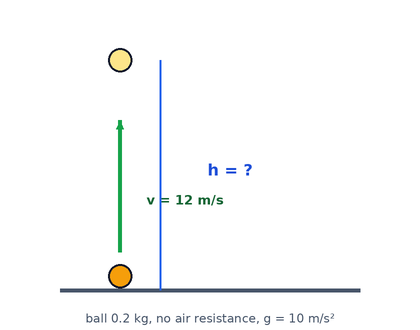
قُذفت كرة كتلتها \(0.2\ kg\) رأسيًا إلى الأعلى بسرعة \(12\ m/s\) وأُهملت مقاومة الهواء؛ أقصى ارتفاع تصل إليه (\(g=10\)):A \(0.2\ kg\) ball is thrown vertically upward at \(12\ m/s\) and air resistance is neglected; the maximum height it reaches is (\(g=10\)):
\(h=14.4\ m\)\(h=14.4\ m\)
\(h=7.2\ m\)\(h=7.2\ m\)
\(h=6\ m\)\(h=6\ m\)
\(h=3.6\ m\)\(h=3.6\ m\)
الحلSolution
\(W_g=-mgh=\Delta KE=0-\tfrac12\times0.2\times12^2=-14.4\ \mathrm{J}\)
\(h=\dfrac{14.4}{0.2\times10}=7.2\ \mathrm{m}\)
✅ \(h=7.2\ m\) (B)
\(W_g=-mgh=\Delta KE=0-\tfrac12\times0.2\times12^2=-14.4\ \mathrm{J}\)
\(h=\dfrac{14.4}{0.2\times10}=7.2\ \mathrm{m}\)
✅ \(h=7.2\ m\) (B)
\[32\,\star\star\star\]
يُسحب جسم كتلته \(5\ kg\) من السكون على مستوى مائل زاويته \(30^\circ\) وطوله \(4\ m\) بقوة موازية للمستوى \(40\ N\) والاحتكاك \(5\ N\)؛ سرعته عند القمة (\(g=10\)):A \(5\ kg\) body is pulled from rest up an incline of \(30^\circ\) and length \(4\ m\) by a force of \(40\ N\) parallel to the plane with friction \(5\ N\); its speed at the top is (\(g=10\)):
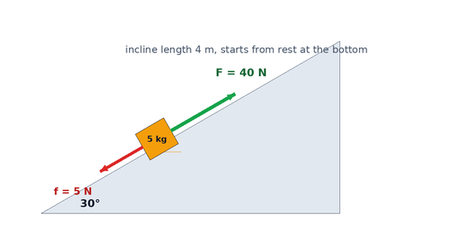
\(v=4.9\ m/s\)\(v=4.9\ m/s\)
\(v=7.5\ m/s\)\(v=7.5\ m/s\)
\(v=4\ m/s\)\(v=4\ m/s\)
\(v=2.8\ m/s\)\(v=2.8\ m/s\)
الحلSolution
\(W_F=40\times4=160\ \mathrm{J}\)
\(W_g=-mg\sin30^\circ\times4=-5\times10\times0.5\times4=-100\ \mathrm{J}\)
\(W_f=-5\times4=-20\ \mathrm{J}\)
\(\tfrac12\times5\times v^2=40\Rightarrow v=4\ \mathrm{m/s}\)
✅ \(v=4\ m/s\) (C)
\(W_F=40\times4=160\ \mathrm{J}\)
\(W_g=-mg\sin30^\circ\times4=-5\times10\times0.5\times4=-100\ \mathrm{J}\)
\(W_f=-5\times4=-20\ \mathrm{J}\)
\(\tfrac12\times5\times v^2=40\Rightarrow v=4\ \mathrm{m/s}\)
✅ \(v=4\ m/s\) (C)
\[33\,\star\star\star\]
الرسم يبين الطاقة الحركية لجسم كتلته \(2\ kg\) أثناء انزلاقه على سطح أفقي خشن؛ معامل الاحتكاك الحركي (\(g=10\)):The graph shows the kinetic energy of a \(2\ kg\) body sliding on a rough horizontal surface; the coefficient of kinetic friction is (\(g=10\)):
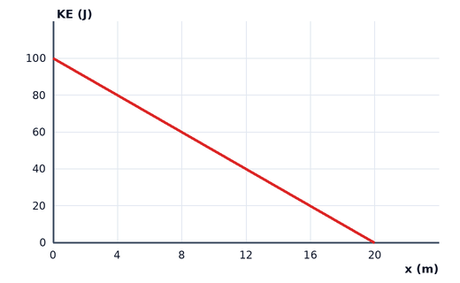
\(\mu_k=0.5\)\(\mu_k=0.5\)
\(\mu_k=0.1\)\(\mu_k=0.1\)
\(\mu_k=0.25\)\(\mu_k=0.25\)
\(\mu_k=0.4\)\(\mu_k=0.4\)
الحلSolution
📌 \(\Delta KE=-f\,x\) فقيمة الاحتكاك هي مقدار ميل الخط: \(f=\dfrac{100-0}{20}=5\ \mathrm{N}\).
\(\mu_k=\dfrac{f}{mg}=\dfrac{5}{2\times10}=0.25\)
✅ \(\mu_k=0.25\) (C)
📌 \(\Delta KE=-f\,x\) so the friction equals the magnitude of the slope: \(f=\dfrac{100-0}{20}=5\ \mathrm{N}\).
\(\mu_k=\dfrac{f}{mg}=\dfrac{5}{2\times10}=0.25\)
✅ \(\mu_k=0.25\) (C)
\[34\,\star\star\star\]
جسمان لهما الطاقة الحركية نفسها وكتلة الأول أربعة أمثال كتلة الثاني؛ النسبة بين سرعتيهما \(v_1/v_2\):Two bodies have the same kinetic energy and the mass of the first is four times that of the second; the ratio of their speeds \(v_1/v_2\) is:
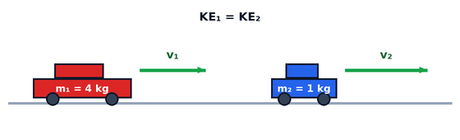
\(\dfrac12\)\(\dfrac12\)
\(2\)\(2\)
\(\dfrac14\)\(\dfrac14\)
\(4\)\(4\)
الحلSolution
\(\tfrac12m_1v_1^2=\tfrac12m_2v_2^2\Rightarrow\dfrac{v_1}{v_2}=\sqrt{\dfrac{m_2}{m_1}}\)
\(\dfrac{v_1}{v_2}=\sqrt{\dfrac14}=\dfrac12\)
✅ \(\dfrac12\) (A)
\(\tfrac12m_1v_1^2=\tfrac12m_2v_2^2\Rightarrow\dfrac{v_1}{v_2}=\sqrt{\dfrac{m_2}{m_1}}\)
\(\dfrac{v_1}{v_2}=\sqrt{\dfrac14}=\dfrac12\)
✅ \(\dfrac12\) (A)
📝 المسائل المقالية
📝 Essay Problems
\[1\,\star\star\]
صندوق كتلته \(m=20\ kg\) على حزام ناقل يتحرك بسرعة \(v=3\ m/s\). (أ) احسب طاقته الحركية. (ب) يدفعه شخص بقوة أفقية ثابتة \(F_a=100\ N\) نحو اليمين عبر إزاحة \(d=2\ m\) ومتوسط قوة الاحتكاك المعاكسة \(F_k=15\ N\): حدد القوى على الشكل واحسب الشغل الكلي. (ج) احسب سرعة الصندوق في نهاية الدفع.A box of mass \(m=20\ kg\) is on a conveyor belt moving at \(v=3\ m/s\). (a) Calculate its kinetic energy. (b) A person pushes it with a constant horizontal force \(F_a=100\ N\) to the right over \(d=2\ m\) while the average friction is \(F_k=15\ N\): identify the forces and calculate the total work. (c) Calculate the speed of the box at the end of the push.
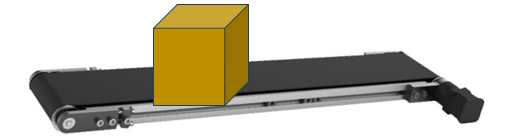
.....................................................................
الحلSolution
📌 (أ) \(KE_i=\tfrac12mv^2=\tfrac12\times20\times3^2=90\ \mathrm{J}\).
📌 (ب) القوى: الوزن لأسفل والعمودية لأعلى (شغلهما صفر)، قوة الدفع \(100\ N\) يمينًا، والاحتكاك \(15\ N\) يسارًا.
\(W_{tot}=(F_a-F_k)d=(100-15)\times2=170\ \mathrm{J}\).
📌 (ج) \(KE_f=KE_i+W=90+170=260\ \mathrm{J}\) ومنها \(v=\sqrt{\dfrac{2\times260}{20}}=\sqrt{26}=5.1\ \mathrm{m/s}\).
✅ \(W_{tot}=170\ J,\ v=5.1\ m/s\)
📌 (a) \(KE_i=\tfrac12mv^2=\tfrac12\times20\times3^2=90\ \mathrm{J}\).
📌 (b) Forces: weight down and normal up (zero work), the push \(100\ N\) to the right and friction \(15\ N\) to the left.
\(W_{tot}=(F_a-F_k)d=(100-15)\times2=170\ \mathrm{J}\).
📌 (c) \(KE_f=KE_i+W=90+170=260\ \mathrm{J}\) so \(v=\sqrt{\dfrac{2\times260}{20}}=\sqrt{26}=5.1\ \mathrm{m/s}\).
✅ \(W_{tot}=170\ J,\ v=5.1\ m/s\)
\[2\,\star\star\]
عربة كتلتها \(m=10\ kg\) تتحرك أفقيًا بسرعة \(v_i=5\ m/s\) وسُحبت بقوة \(F_a=30\ N\) بمقبض يميل \(60^\circ\) فوق الأفق حتى أصبحت سرعتها \(v_f=8\ m/s\)؛ احسب الإزاحة المقطوعة عند وصولها إلى هذه السرعة بفرض عدم وجود احتكاك.A cart of mass \(m=10\ kg\) moves horizontally at \(v_i=5\ m/s\) and is pulled with \(F_a=30\ N\) by a handle at \(60^\circ\) above the horizontal until its speed is \(v_f=8\ m/s\); find the displacement covered, assuming no friction.
.....................................................................
الحلSolution
\(W=\Delta KE=\tfrac12\times10\times(8^2-5^2)=195\ \mathrm{J}\).
\(F_a\cos60^\circ\cdot d=195\Rightarrow15\,d=195\).
\(d=13\ \mathrm{m}\).
✅ \(d=13\ m\)
\(W=\Delta KE=\tfrac12\times10\times(8^2-5^2)=195\ \mathrm{J}\).
\(F_a\cos60^\circ\cdot d=195\Rightarrow15\,d=195\).
\(d=13\ \mathrm{m}\).
✅ \(d=13\ m\)
\[3\,\star\star\star\]
جسم كتلته \(4\ kg\) ينزلق على سطح أفقي خشن بسرعة \(10\ m/s\) فيتوقف بعد \(12.5\ m\) (\(g=10\)). احسب: (أ) الشغل الذي بذلته قوة الاحتكاك. (ب) قوة الاحتكاك. (ج) معامل الاحتكاك الحركي.A \(4\ kg\) body slides on a rough horizontal surface at \(10\ m/s\) and stops after \(12.5\ m\) (\(g=10\)). Calculate: (a) the work done by friction, (b) the friction force, (c) the coefficient of kinetic friction.
.....................................................................
الحلSolution
📌 (أ) \(W_f=\Delta KE=0-\tfrac12\times4\times10^2=-200\ \mathrm{J}\).
📌 (ب) \(-f\,d=-200\Rightarrow f=\dfrac{200}{12.5}=16\ \mathrm{N}\).
📌 (ج) \(\mu_k=\dfrac{f}{mg}=\dfrac{16}{40}=0.4\).
✅ \(W_f=-200\ J,\ f=16\ N,\ \mu_k=0.4\)
📌 (a) \(W_f=\Delta KE=0-\tfrac12\times4\times10^2=-200\ \mathrm{J}\).
📌 (b) \(-f\,d=-200\Rightarrow f=\dfrac{200}{12.5}=16\ \mathrm{N}\).
📌 (c) \(\mu_k=\dfrac{f}{mg}=\dfrac{16}{40}=0.4\).
✅ \(W_f=-200\ J,\ f=16\ N,\ \mu_k=0.4\)
\[4\,\star\star\star\]
محرك مصعد يرفع كتلة إجمالية \(800\ kg\) بسرعة ثابتة \(2\ m/s\) وكفاءته \(80\%\) (\(g=10\)). احسب: (أ) القدرة المفيدة. (ب) القدرة المستهلكة من المحرك. (ج) الطاقة المستهلكة خلال \(30\ s\).An elevator motor lifts a total mass of \(800\ kg\) at a constant speed of \(2\ m/s\) and has efficiency \(80\%\) (\(g=10\)). Calculate: (a) the useful power, (b) the power consumed by the motor, (c) the energy consumed in \(30\ s\).
.....................................................................
الحلSolution
📌 (أ) \(P_{out}=Fv=mgv=800\times10\times2=16000\ \mathrm{W}\).
📌 (ب) \(P_{in}=\dfrac{16000}{0.8}=20000\ \mathrm{W}\).
📌 (ج) \(E=P_{in}\,t=20000\times30=6\times10^5\ \mathrm{J}\).
✅ \(16\ kW,\ 20\ kW,\ 6\times10^5\ J\)
📌 (a) \(P_{out}=Fv=mgv=800\times10\times2=16000\ \mathrm{W}\).
📌 (b) \(P_{in}=\dfrac{16000}{0.8}=20000\ \mathrm{W}\).
📌 (c) \(E=P_{in}\,t=20000\times30=6\times10^5\ \mathrm{J}\).
✅ \(16\ kW,\ 20\ kW,\ 6\times10^5\ J\)
لاحظت خطأ؟ أو عندك سؤال عن أحد الأسئلة؟ اكتبه بالتعليقات وحدد رقم السؤال بالضبط.
Noticed an error? Or have a question about one of the questions? Write it in the comments and specify the exact question number.