💥 بنك الأسئلة: الزخم وحفظ الزخم
💥 Question Bank: Momentum and Conservation of Momentum
الزخم والدفع، نظرية الدفع–الزخم، القوة المتوسطة، حفظ الزخم والارتداد والتصادمات، والزخم الزاوي
Momentum and Impulse, the Impulse–Momentum Theorem, Average Force, Conservation of Momentum, Recoil and Collisions, Angular Momentum
⏱️ 35 سؤال اختيار من متعدد بتصحيح فوري بمستويات متدرجة، ومسألة مقالية محلولة، مع حل مفصل لكل سؤال⏱️ 35 multiple-choice questions of graded difficulty with instant feedback, and 2 solved essay problem, with a detailed solution for each
\[1\,\star\]
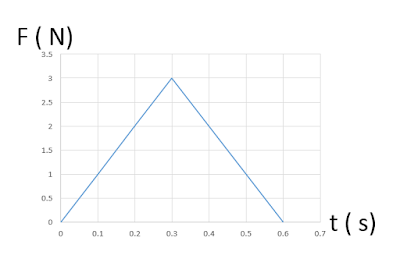
الخط البياني التالي يبين العلاقة بين القوة المؤثرة على عربة صغيرة والزمن؛ التغير في الزخم يعادل:The graph shows the force acting on a small cart against time. The change in momentum is:
\(\Delta P=1.8\ \mathrm{N\cdot s}\)\(\Delta P=1.8\ \mathrm{N\cdot s}\)
\(\Delta P=1.2\ \mathrm{N\cdot s}\)\(\Delta P=1.2\ \mathrm{N\cdot s}\)
\(\Delta P=0.9\ \mathrm{N\cdot s}\)\(\Delta P=0.9\ \mathrm{N\cdot s}\)
\(\Delta P=0.6\ \mathrm{N\cdot s}\)\(\Delta P=0.6\ \mathrm{N\cdot s}\)
الحلSolution
📌 التغير في الزخم = الدفع = المساحة تحت منحنى القوة–الزمن (مثلث قاعدته \(0.6\ s\) وارتفاعه \(3\ N\)).
\(\Delta P=\tfrac12\times0.6\times3=0.9\ \mathrm{N\cdot s}\)
✅ \(\Delta P=0.9\ \mathrm{N\cdot s}\) (C)
📌 The change in momentum = impulse = the area under the force–time curve (a triangle of base \(0.6\ s\) and height \(3\ N\)).
\(\Delta P=\tfrac12\times0.6\times3=0.9\ \mathrm{N\cdot s}\)
✅ \(\Delta P=0.9\ \mathrm{N\cdot s}\) (C)
\[2\,\star\]
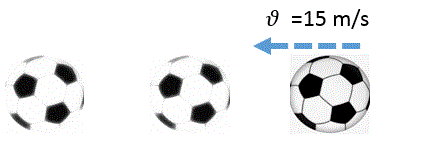
كرة كتلتها \(0.4\ kg\) تتحرك بسرعة \(15\ m/s\) نحو الغرب؛ زخم الكرة (الشرق موجب):A ball of mass \(0.4\ kg\) moves at \(15\ m/s\) towards the west; its momentum (east positive) is:
\(P=2\ \mathrm{kg\cdot m/s}\)\(P=2\ \mathrm{kg\cdot m/s}\)
\(P=6\ \mathrm{kg\cdot m/s}\)\(P=6\ \mathrm{kg\cdot m/s}\)
\(P=-2\ \mathrm{kg\cdot m/s}\)\(P=-2\ \mathrm{kg\cdot m/s}\)
\(P=-6\ \mathrm{kg\cdot m/s}\)\(P=-6\ \mathrm{kg\cdot m/s}\)
الحلSolution
\(P=mv=0.4\times(-15)=-6\ \mathrm{kg\cdot m/s}\)
📌 الإشارة السالبة لأن الحركة نحو الغرب.
✅ \(P=-6\ \mathrm{kg\cdot m/s}\) (D)
\(P=mv=0.4\times(-15)=-6\ \mathrm{kg\cdot m/s}\)
📌 The minus sign because the motion is towards the west.
✅ \(P=-6\ \mathrm{kg\cdot m/s}\) (D)
\[3\,\star\]
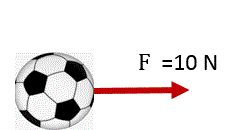
كرة ساكنة كتلتها \(0.5\ kg\) أثّرت عليها قوة ثابتة \(10\ N\) شرقًا مدة \(2\ s\)؛ سرعتها لحظة زوال القوة:A ball at rest of mass \(0.5\ kg\) is acted on by a constant \(10\ N\) force east for \(2\ s\); its speed when the force stops is:
\(v_f=20\ \mathrm{m/s}\)\(v_f=20\ \mathrm{m/s}\)
\(v_f=40\ \mathrm{m/s}\)\(v_f=40\ \mathrm{m/s}\)
\(v_f=30\ \mathrm{m/s}\)\(v_f=30\ \mathrm{m/s}\)
\(v_f=10\ \mathrm{m/s}\)\(v_f=10\ \mathrm{m/s}\)
الحلSolution
\(F\,\Delta t=m(v_f-v_i)\Rightarrow10\times2=0.5\,v_f\)
\(v_f=\dfrac{20}{0.5}=40\ \mathrm{m/s}\)
✅ \(v_f=40\ \mathrm{m/s}\) (B)
\(F\,\Delta t=m(v_f-v_i)\Rightarrow10\times2=0.5\,v_f\)
\(v_f=\dfrac{20}{0.5}=40\ \mathrm{m/s}\)
✅ \(v_f=40\ \mathrm{m/s}\) (B)
\[4\,\star\star\]
كرة كتلتها \(0.4\ kg\) تتحرك بسرعة \(10\ m/s\) شرقًا أثّرت عليها قوة ثابتة \(10\ N\) شرقًا فصارت سرعتها \(15\ m/s\)؛ زمن تأثير القوة:A \(0.4\ kg\) ball moves at \(10\ m/s\) east and a constant \(10\ N\) force east makes its speed \(15\ m/s\); the time the force acts is:
\(\Delta t=0.35\ \mathrm{s}\)\(\Delta t=0.35\ \mathrm{s}\)
\(\Delta t=0.3\ \mathrm{s}\)\(\Delta t=0.3\ \mathrm{s}\)
\(\Delta t=0.25\ \mathrm{s}\)\(\Delta t=0.25\ \mathrm{s}\)
\(\Delta t=0.2\ \mathrm{s}\)\(\Delta t=0.2\ \mathrm{s}\)
الحلSolution
\(F\,\Delta t=m(v_f-v_i)=0.4(15-10)=2\ \mathrm{N\cdot s}\)
\(\Delta t=\dfrac{2}{10}=0.2\ \mathrm{s}\)
✅ \(\Delta t=0.2\ \mathrm{s}\) (D)
\(F\,\Delta t=m(v_f-v_i)=0.4(15-10)=2\ \mathrm{N\cdot s}\)
\(\Delta t=\dfrac{2}{10}=0.2\ \mathrm{s}\)
✅ \(\Delta t=0.2\ \mathrm{s}\) (D)
\[5\,\star\]
إحدى الوحدات التالية تكافئ وحدة الدفع \(\mathrm{N\cdot s}\):Which of the following units is equivalent to the unit of impulse \(\mathrm{N\cdot s}\)?
\(\dfrac{kg\cdot m}{s}\)\(\dfrac{kg\cdot m}{s}\)
\(\dfrac{kg\cdot m^2}{s^2}\)\(\dfrac{kg\cdot m^2}{s^2}\)
\(\dfrac{kg\cdot m}{s^2}\)\(\dfrac{kg\cdot m}{s^2}\)
\(\dfrac{kg\cdot m^2}{s}\)\(\dfrac{kg\cdot m^2}{s}\)
الحلSolution
\(\mathrm{N\cdot s}=\dfrac{kg\cdot m}{s^2}\cdot s=\dfrac{kg\cdot m}{s}\)
📌 وهي وحدة الزخم نفسها لأن الدفع = التغير في الزخم.
✅ \(\dfrac{kg\cdot m}{s}\) (A)
\(\mathrm{N\cdot s}=\dfrac{kg\cdot m}{s^2}\cdot s=\dfrac{kg\cdot m}{s}\)
📌 This is the unit of momentum, since impulse = the change in momentum.
✅ \(\dfrac{kg\cdot m}{s}\) (A)
\[6\,\star\star\]
كرة كتلتها \(0.5\ kg\) اصطدمت بالأرض بسرعة \(10\ m/s\) وارتدت بسرعة \(10\ m/s\)؛ التغير في كمية الحركة:A \(0.5\ kg\) ball hits the ground at \(10\ m/s\) and rebounds at \(10\ m/s\); the change in momentum is:
\(\Delta P=0\)\(\Delta P=0\)
\(\Delta P=20\ \mathrm{N\cdot s}\) نحو الأعلى\(\Delta P=20\ \mathrm{N\cdot s}\) upward
\(\Delta P=10\ \mathrm{N\cdot s}\) نحو الأعلى\(\Delta P=10\ \mathrm{N\cdot s}\) upward
\(\Delta P=10\ \mathrm{N\cdot s}\) نحو الأسفل\(\Delta P=10\ \mathrm{N\cdot s}\) downward
الحلSolution
📌 نعتبر الأعلى موجبًا: \(v_i=-10\) و\(v_f=+10\ m/s\).
\(\Delta P=0.5(10)-0.5(-10)=10\ \mathrm{N\cdot s}\)
✅ \(\Delta P=10\ \mathrm{N\cdot s}\) نحو الأعلى (C)
📌 Upward positive: \(v_i=-10\) and \(v_f=+10\ m/s\).
\(\Delta P=0.5(10)-0.5(-10)=10\ \mathrm{N\cdot s}\)
✅ \(\Delta P=10\ \mathrm{N\cdot s}\) upward (C)
\[7\,\star\star\]
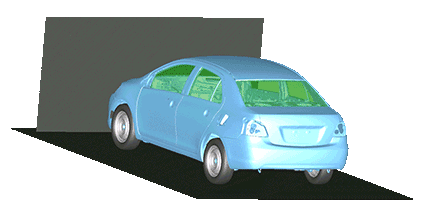
سيارة كتلتها \(1000\ kg\) تسير بسرعة \(30\ m/s\) اصطدمت بجدار وتوقفت خلال \(5\ s\)؛ متوسط قوة الجدار على السيارة:A \(1000\ kg\) car at \(30\ m/s\) hits a wall and stops in \(5\ s\); the average force of the wall on the car is:
\(F=-6000\ N\)\(F=-6000\ N\)
\(F=3000\ N\)\(F=3000\ N\)
\(F=6000\ N\)\(F=6000\ N\)
\(F=-3000\ N\)\(F=-3000\ N\)
الحلSolution
\(F=\dfrac{\Delta P}{\Delta t}=\dfrac{1000(0-30)}{5}=-6000\ \mathrm{N}\)
📌 القوة عكس اتجاه الحركة.
✅ \(F=-6000\ N\) (A)
\(F=\dfrac{\Delta P}{\Delta t}=\dfrac{1000(0-30)}{5}=-6000\ \mathrm{N}\)
📌 The force is opposite to the motion.
✅ \(F=-6000\ N\) (A)
\[8\,\star\]
سيارة كتلتها \(1000\ kg\) تتحرك شرقًا بـ \(20\ m/s\) فرمل السائق حتى توقفت خلال \(6\ s\)؛ القوة المتوسطة التي أثّر بها الفرامل:A \(1000\ kg\) car moves east at \(20\ m/s\); the driver brakes to a stop in \(6\ s\); the average braking force is:

\(F=2222.2\ N\)\(F=2222.2\ N\)
\(F=1666.7\ N\)\(F=1666.7\ N\)
\(F=-3333.3\ N\)\(F=-3333.3\ N\)
\(F=3333.3\ N\)\(F=3333.3\ N\)
الحلSolution
\(F=\dfrac{m(v_f-v_i)}{\Delta t}=\dfrac{1000(0-20)}{6}=-3333.3\ \mathrm{N}\)
📌 الإشارة السالبة: نحو الغرب (عكس الحركة).
✅ \(F=-3333.3\ N\) (C)
\(F=\dfrac{m(v_f-v_i)}{\Delta t}=\dfrac{1000(0-20)}{6}=-3333.3\ \mathrm{N}\)
📌 The minus sign: westward (opposite to the motion).
✅ \(F=-3333.3\ N\) (C)
\[9\,\star\star\]
سيارة تتحرك بسرعة \(10\ m/s\)؛ النسبة بين طاقتها الحركية وزخمها:A car moves at \(10\ m/s\); the ratio of its kinetic energy to its momentum is:
\(20\ m/s\)\(20\ m/s\)
\(5\ m/s\)\(5\ m/s\)
\(10\ m/s\)\(10\ m/s\)
\(2.5\ m/s\)\(2.5\ m/s\)
الحلSolution
\(\dfrac{K}{P}=\dfrac{\tfrac12mv^2}{mv}=\dfrac{v}{2}=\dfrac{10}{2}=5\ \mathrm{m/s}\)
📌 (الإجابة في المصدر 7.5 غير صحيحة؛ النسبة تساوي نصف السرعة.)
✅ \(5\ m/s\) (B)
\(\dfrac{K}{P}=\dfrac{\tfrac12mv^2}{mv}=\dfrac{v}{2}=\dfrac{10}{2}=5\ \mathrm{m/s}\)
📌 (The source’s 7.5 is incorrect; the ratio equals half the speed.)
✅ \(5\ m/s\) (B)
\[10\,\star\star\]
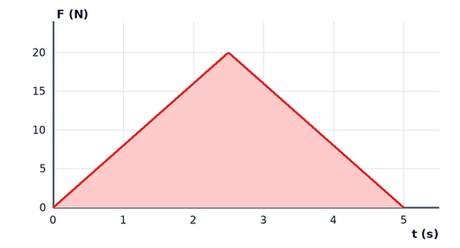
الرسم يمثل منحنى القوة والزمن المؤثرة على كرة كتلتها \(0.5\ kg\) تتحرك بسرعة \(5\ m/s\) قبل التأثير؛ سرعتها بعد التأثير مدة \(5\ s\) (القوة بنفس اتجاه الحركة):The graph is the force–time curve of a force on a \(0.5\ kg\) ball moving at \(5\ m/s\); its speed after the force acts for \(5\ s\) (force along the motion) is:
\(v_f=55\ m/s\)\(v_f=55\ m/s\)
\(v_f=105\ m/s\)\(v_f=105\ m/s\)
\(v_f=65\ m/s\)\(v_f=65\ m/s\)
\(v_f=75\ m/s\)\(v_f=75\ m/s\)
الحلSolution
\(J=\text{area}=\tfrac12\times5\times20=50\ \mathrm{N\cdot s}\)
\(J=m(v_f-v_i)\Rightarrow v_f=5+\dfrac{50}{0.5}=105\ \mathrm{m/s}\)
✅ \(v_f=105\ m/s\) (B)
\(J=\text{area}=\tfrac12\times5\times20=50\ \mathrm{N\cdot s}\)
\(J=m(v_f-v_i)\Rightarrow v_f=5+\dfrac{50}{0.5}=105\ \mathrm{m/s}\)
✅ \(v_f=105\ m/s\) (B)
\[11\,\star\]
طائرة كتلتها \(3000\ kg\) تتحرك نحو الغرب بسرعة ثابتة \(200\ m/s\)؛ زخمها:A \(3000\ kg\) airplane moves west at a constant \(200\ m/s\); its momentum is:
\(P=6\times10^5\) kg·m/s نحو الغرب\(P=6\times10^5\) kg·m/s west
\(P=4\times10^5\) kg·m/s نحو الغرب\(P=4\times10^5\) kg·m/s west
\(P=6\times10^5\) kg·m/s نحو الشرق\(P=6\times10^5\) kg·m/s east
\(P=4\times10^5\) kg·m/s نحو الشرق\(P=4\times10^5\) kg·m/s east
الحلSolution
\(P=mv=3000\times200=6\times10^5\ \mathrm{kg\cdot m/s}\)
📌 نحو الغرب (اتجاه السرعة).
✅ \(P=6\times10^5\) kg·m/s نحو الغرب (A)
\(P=mv=3000\times200=6\times10^5\ \mathrm{kg\cdot m/s}\)
📌 Towards the west (the direction of the velocity).
✅ \(P=6\times10^5\) kg·m/s west (A)
\[12\,\star\star\]
رائد فضاء كتلته \(95\ kg\) يحمل خزان أكسجين فارغًا كتلته \(30\ kg\) وهو ساكن بالنسبة إلى المكوك؛ رمى الخزان بعيدًا بسرعة \(2\ m/s\) (بالنسبة للمكوك). سرعته:An astronaut of mass \(95\ kg\) holding an empty tank of \(30\ kg\) is at rest relative to the shuttle; he throws the tank away at \(2\ m/s\) (relative to the shuttle). His speed is:
\(v=0.63\ m/s\)\(v=0.63\ m/s\)
\(v=0.55\ m/s\)\(v=0.55\ m/s\)
\(v=0.42\ m/s\)\(v=0.42\ m/s\)
\(v=0.37\ m/s\)\(v=0.37\ m/s\)
الحلSolution
📌 حفظ الزخم من السكون: \(0=95v+30(-2)\).
\(v=\dfrac{60}{95}=0.63\ \mathrm{m/s}\)
✅ \(v=0.63\ m/s\) (A)
📌 Conservation of momentum from rest: \(0=95v+30(-2)\).
\(v=\dfrac{60}{95}=0.63\ \mathrm{m/s}\)
✅ \(v=0.63\ m/s\) (A)
\[13\,\star\star\]
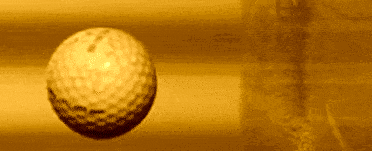
كرة غولف \(0.14\ kg\) تتحرك نحو جدار بـ \(60\ m/s\) وترتد بـ \(55\ m/s\) خلال \(0.15\ s\)؛ متوسط القوة من الجدار على الكرة:A \(0.14\ kg\) golf ball hits a wall at \(60\ m/s\) and rebounds at \(55\ m/s\) in \(0.15\ s\); the average force of the wall on the ball is:
\(F=107.3\ N\) نحو الشرق\(F=107.3\ N\) east
\(F=85.6\ N\) نحو الشرق\(F=85.6\ N\) east
\(F=-85.6\ N\) نحو الغرب\(F=-85.6\ N\) west
\(F=-107.3\ N\) نحو الغرب\(F=-107.3\ N\) west
الحلSolution
\(F=\dfrac{m(v_f-v_i)}{\Delta t}=\dfrac{0.14(-55-60)}{0.15}=-107.3\ \mathrm{N}\)
✅ \(F=-107.3\ N\) نحو الغرب (D)
\(F=\dfrac{m(v_f-v_i)}{\Delta t}=\dfrac{0.14(-55-60)}{0.15}=-107.3\ \mathrm{N}\)
✅ \(F=-107.3\ N\) west (D)
\[14\,\star\star\star\]
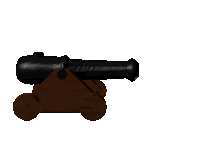
مدفع كتلته \(1000\ kg\) يطلق قذيفة كتلتها \(5\ kg\) أفقيًا بـ \(150\ m/s\) نحو اليمين؛ سرعة ارتداد المدفع:A \(1000\ kg\) cannon fires a \(5\ kg\) shell horizontally at \(150\ m/s\) to the right; the recoil velocity of the cannon is:
\(v=-2.5\ m/s\)\(v=-2.5\ m/s\)
\(v=-0.75\ m/s\)\(v=-0.75\ m/s\)
\(v=-1.75\ m/s\)\(v=-1.75\ m/s\)
\(v=-1.5\ m/s\)\(v=-1.5\ m/s\)
الحلSolution
📌 الزخم الابتدائي صفر: \(0=1000\,v+5(150)\).
\(v=-\dfrac{750}{1000}=-0.75\ \mathrm{m/s}\)
✅ \(v=-0.75\ m/s\) (B)
📌 The initial momentum is zero: \(0=1000\,v+5(150)\).
\(v=-\dfrac{750}{1000}=-0.75\ \mathrm{m/s}\)
✅ \(v=-0.75\ m/s\) (B)
\[15\,\star\star\star\]
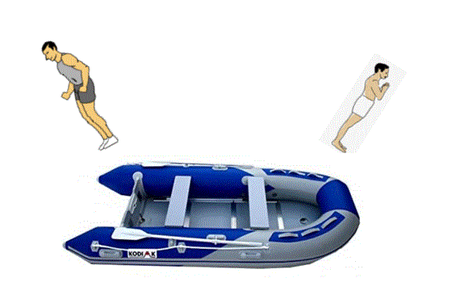
طوافة مطاطية كتلتها \(30\ kg\) ساكنة تحمل سباحين كتلتاهما \(50\ kg\) و\(70\ kg\)، قفزا معًا الأول نحو اليمين بـ \(4\ m/s\) والثاني نحو اليسار بـ \(6\ m/s\)؛ سرعة الطوافة واتجاهها:A \(30\ kg\) raft at rest carries swimmers of \(50\ kg\) and \(70\ kg\); they jump together, the first right at \(4\ m/s\) and the second left at \(6\ m/s\); the raft’s velocity and direction are:
\(v=5.42\ m/s\) نحو الشرق\(v=5.42\ m/s\) east
\(v=-7.33\ m/s\) نحو الغرب\(v=-7.33\ m/s\) west
\(v=7.33\ m/s\) نحو الشرق\(v=7.33\ m/s\) east
\(v=-5.42\ m/s\) نحو الغرب\(v=-5.42\ m/s\) west
الحلSolution
\(0=30v+50(4)+70(-6)=30v-220\)
\(v=\dfrac{220}{30}=+7.33\ \mathrm{m/s}\)
📌 موجبة: نحو الشرق (اليمين).
✅ \(v=7.33\ m/s\) نحو الشرق (C)
\(0=30v+50(4)+70(-6)=30v-220\)
\(v=\dfrac{220}{30}=+7.33\ \mathrm{m/s}\)
📌 Positive: east (right).
✅ \(v=7.33\ m/s\) east (C)
\[16\,\star\star\]
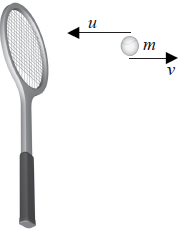
كرة تنس كتلتها \(m\) تتحرك نحو اليسار بسرعة \(u\) وتصطدم بالمضرب وترتد نحو اليمين بسرعة \(v\)؛ مقدار التغير في كمية حركتها:A tennis ball of mass \(m\) moves left at speed \(u\), hits a racket and rebounds right at speed \(v\); the magnitude of its change in momentum is:
\(\Delta p=m(u-v)\)\(\Delta p=m(u-v)\)
\(\Delta p=m(v+u)\)\(\Delta p=m(v+u)\)
\(\Delta p=m(v-u)\)\(\Delta p=m(v-u)\)
\(\Delta p=-m(v+u)\)\(\Delta p=-m(v+u)\)
الحلSolution
📌 اليمين موجب: \(p_i=-mu\) و\(p_f=+mv\).
\(\Delta p=mv-(-mu)=m(v+u)\)
✅ \(\Delta p=m(v+u)\) (B)
📌 Right positive: \(p_i=-mu\) and \(p_f=+mv\).
\(\Delta p=mv-(-mu)=m(v+u)\)
✅ \(\Delta p=m(v+u)\) (B)
\[17\,\star\star\]
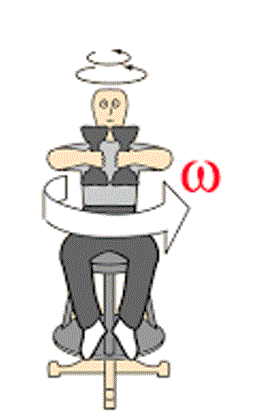
رجل على مقعد دوار يدور دورة كل \(0.25\ s\) مع عقارب الساعة وعزم قصوره \(I=0.3\ kg\cdot m^2\)؛ زخمه الزاوي:A man on a rotating stool turns once every \(0.25\ s\) clockwise, with moment of inertia \(I=0.3\ kg\cdot m^2\); his angular momentum is:
\(L=-7.5\ kg\cdot m^2/s\)\(L=-7.5\ kg\cdot m^2/s\)
\(L=-5.4\ kg\cdot m^2/s\)\(L=-5.4\ kg\cdot m^2/s\)
\(L=-8.3\ kg\cdot m^2/s\)\(L=-8.3\ kg\cdot m^2/s\)
\(L=-3.8\ kg\cdot m^2/s\)\(L=-3.8\ kg\cdot m^2/s\)
الحلSolution
\(\omega=\dfrac{2\pi}{T}=\dfrac{2\pi}{0.25}=25.1\ \mathrm{rad/s}\)
\(L=I\omega=0.3\times25.1=7.5\ \mathrm{kg\cdot m^2/s}\)
📌 سالب لأن الدوران مع عقارب الساعة. (وحدته kg·m²/s.)
✅ \(L=-7.5\ kg\cdot m^2/s\) (A)
\(\omega=\dfrac{2\pi}{T}=\dfrac{2\pi}{0.25}=25.1\ \mathrm{rad/s}\)
\(L=I\omega=0.3\times25.1=7.5\ \mathrm{kg\cdot m^2/s}\)
📌 Negative since the rotation is clockwise. (Its unit is kg·m²/s.)
✅ \(L=-7.5\ kg\cdot m^2/s\) (A)
\[18\,\star\star\]
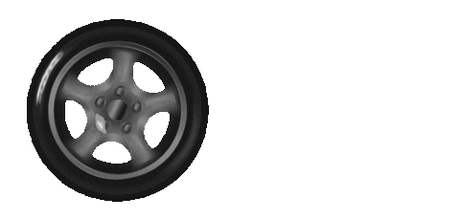
إطار سيارة نصف قطره \(22\ cm\) يدور بمعدل \(300\ rpm\) وعزم قصوره \(0.4\ kg\cdot m^2\) فُرمل بعزم احتكاك \(6.1\ N\cdot m\)؛ زمن التوقف:A car tyre of radius \(22\ cm\) spins at \(300\ rpm\) with \(I=0.4\ kg\cdot m^2\) and is braked by a friction torque \(6.1\ N\cdot m\); the stopping time is:
\(t=2.1\ s\)\(t=2.1\ s\)
\(t=3.4\ s\)\(t=3.4\ s\)
\(t=5.6\ s\)\(t=5.6\ s\)
\(t=4.5\ s\)\(t=4.5\ s\)
الحلSolution
\(\omega=300\times\dfrac{2\pi}{60}=31.4\ \mathrm{rad/s}\)
\(\tau t=I\omega\Rightarrow t=\dfrac{0.4\times31.4}{6.1}=2.1\ \mathrm{s}\)
✅ \(t=2.1\ s\) (A)
\(\omega=300\times\dfrac{2\pi}{60}=31.4\ \mathrm{rad/s}\)
\(\tau t=I\omega\Rightarrow t=\dfrac{0.4\times31.4}{6.1}=2.1\ \mathrm{s}\)
✅ \(t=2.1\ s\) (A)
\[19\,\star\star\star\]
كتلة طين \(4\ kg\) أُسقطت على حافة قرص نصف قطره \(1\ m\) يدور بـ \(5\ rad/s\) وعزم قصوره \(1\ kg\cdot m^2\)؛ سرعته الزاوية بعد ذلك:A \(4\ kg\) lump of clay is dropped on the rim of a disk of radius \(1\ m\) rotating at \(5\ rad/s\) with \(I=1\ kg\cdot m^2\); its angular velocity afterwards is:
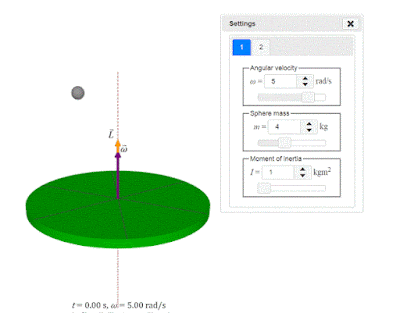
\(\omega=4\ rad/s\)\(\omega=4\ rad/s\)
\(\omega=2\ rad/s\)\(\omega=2\ rad/s\)
\(\omega=1\ rad/s\)\(\omega=1\ rad/s\)
\(\omega=3\ rad/s\)\(\omega=3\ rad/s\)
الحلSolution
\(I_{\text{clay}}=mr^2=4\times1^2=4\ \mathrm{kg\cdot m^2}\)
\(1\times5=(1+4)\omega_f\Rightarrow\omega_f=1\ \mathrm{rad/s}\)
✅ \(\omega=1\ rad/s\) (C)
\(I_{\text{clay}}=mr^2=4\times1^2=4\ \mathrm{kg\cdot m^2}\)
\(1\times5=(1+4)\omega_f\Rightarrow\omega_f=1\ \mathrm{rad/s}\)
✅ \(\omega=1\ rad/s\) (C)
\[20\,\star\star\star\]
نجم نصف قطره \(7\times10^5\ km\) ينهار إلى نصف قطر \(10\ km\) ويدور دورة كل 30 يومًا (كرة متجانسة بلا فقد كتلة)؛ سرعته الزاوية بعد الانهيار:A star of radius \(7\times10^5\ km\) collapses to a radius of \(10\ km\) and rotates once every 30 days (a uniform sphere, no mass lost); its angular velocity after the collapse is:
\(\omega_2=2.4\times10^{-6}\ rad/s\)\(\omega_2=2.4\times10^{-6}\ rad/s\)
\(\omega_2=0.17\ rad/s\)\(\omega_2=0.17\ rad/s\)
\(\omega_2=6.0\times10^{2}\ rad/s\)\(\omega_2=6.0\times10^{2}\ rad/s\)
\(\omega_2=1.2\times10^{4}\ rad/s\)\(\omega_2=1.2\times10^{4}\ rad/s\)
الحلSolution
\(\omega_1=\dfrac{2\pi}{30\times86400}=2.42\times10^{-6}\ \mathrm{rad/s}\)
📌 حفظ الزخم الزاوي (\(I\propto r^2\)): \(\omega_2=\omega_1\left(\dfrac{r_1}{r_2}\right)^2=2.42\times10^{-6}\times(7\times10^4)^2\).
\(\omega_2\approx1.2\times10^{4}\ \mathrm{rad/s}\)
✅ \(\omega_2=1.2\times10^{4}\ rad/s\) (D)
\(\omega_1=\dfrac{2\pi}{30\times86400}=2.42\times10^{-6}\ \mathrm{rad/s}\)
📌 Conservation of angular momentum (\(I\propto r^2\)): \(\omega_2=\omega_1\left(\dfrac{r_1}{r_2}\right)^2=2.42\times10^{-6}\times(7\times10^4)^2\).
\(\omega_2\approx1.2\times10^{4}\ \mathrm{rad/s}\)
✅ \(\omega_2=1.2\times10^{4}\ rad/s\) (D)
\[21\,\star\star\]
يبين الرسم قوة تؤثر على جسم كتلته \(5\ kg\) كان ساكنًا. سرعته بعد \(4\ s\):The figure shows a force acting on a \(5\ kg\) body initially at rest. Its speed after \(4\ s\) is:
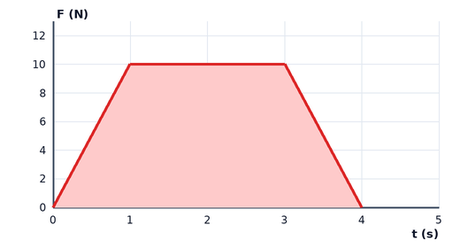
\(6\ m/s\)\(6\ m/s\)
\(3\ m/s\)\(3\ m/s\)
\(8\ m/s\)\(8\ m/s\)
\(12\ m/s\)\(12\ m/s\)
الحلSolution
📌 الدفع = مساحة شبه المنحرف: \(\tfrac12(1)(10)+(2)(10)+\tfrac12(1)(10)=30\ \mathrm{N\cdot s}\).
\(v=\dfrac{J}{m}=\dfrac{30}{5}=6\ \mathrm{m/s}\)
✅ \(6\ m/s\) (A)
📌 Impulse = the area of the trapezoid: \(\tfrac12(1)(10)+(2)(10)+\tfrac12(1)(10)=30\ \mathrm{N\cdot s}\).
\(v=\dfrac{J}{m}=\dfrac{30}{5}=6\ \mathrm{m/s}\)
✅ \(6\ m/s\) (A)
\[22\,\star\star\star\]
تؤثر القوة الموضحة في الرسم على جسم كتلته \(2\ kg\) سرعته الابتدائية \(+2\ m/s\). سرعته بعد \(7\ s\):The force shown acts on a \(2\ kg\) body with initial velocity \(+2\ m/s\). Its velocity after \(7\ s\) is:
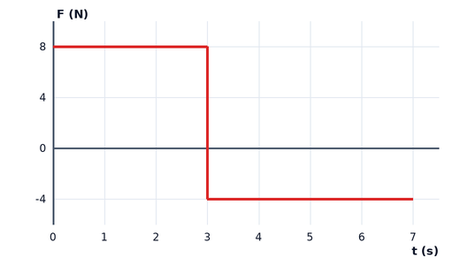
\(v=10\ m/s\)\(v=10\ m/s\)
\(v=2\ m/s\)\(v=2\ m/s\)
\(v=6\ m/s\)\(v=6\ m/s\)
\(v=-2\ m/s\)\(v=-2\ m/s\)
الحلSolution
📌 الدفع الصافي = المساحة الموجبة − المساحة السالبة: \(8\times3-4\times4=24-16=8\ \mathrm{N\cdot s}\).
\(v=2+\dfrac{8}{2}=6\ \mathrm{m/s}\)
✅ \(v=6\ m/s\) (C)
📌 Net impulse = positive area − negative area: \(8\times3-4\times4=24-16=8\ \mathrm{N\cdot s}\).
\(v=2+\dfrac{8}{2}=6\ \mathrm{m/s}\)
✅ \(v=6\ m/s\) (C)
\[23\,\star\star\]
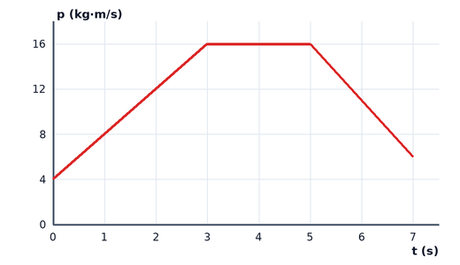
يمثل الرسم زخم جسم مع الزمن. القوة المؤثرة عليه في الفترة من \(5\ s\) إلى \(7\ s\):The graph shows the momentum of a body against time. The force on it from \(5\ s\) to \(7\ s\) is:
\(F=-5\ N\)\(F=-5\ N\)
\(F=+5\ N\)\(F=+5\ N\)
\(F=-10\ N\)\(F=-10\ N\)
\(F=0\)\(F=0\)
الحلSolution
📌 ميل منحنى الزخم–الزمن = القوة.
\(F=\dfrac{\Delta p}{\Delta t}=\dfrac{6-16}{7-5}=-5\ \mathrm{N}\)
✅ \(F=-5\ N\) (A)
📌 The slope of the momentum–time graph = the force.
\(F=\dfrac{\Delta p}{\Delta t}=\dfrac{6-16}{7-5}=-5\ \mathrm{N}\)
✅ \(F=-5\ N\) (A)
\[24\,\star\star\star\]
عربة كتلتها \(2\ kg\) تتحرك بـ \(6\ m/s\) تصطدم تصادمًا مرنًا بعربة كتلتها \(4\ kg\) ساكنة. سرعة العربة الثانية بعد التصادم:A \(2\ kg\) cart moving at \(6\ m/s\) collides elastically with a \(4\ kg\) cart at rest. The speed of the second cart afterwards is:
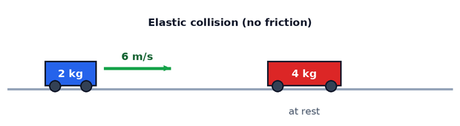
\(v_2=3\ m/s\)\(v_2=3\ m/s\)
\(v_2=2\ m/s\)\(v_2=2\ m/s\)
\(v_2=6\ m/s\)\(v_2=6\ m/s\)
\(v_2=4\ m/s\)\(v_2=4\ m/s\)
الحلSolution
📌 مرن: حفظ الزخم والطاقة: \(v_2=\dfrac{2m_1}{m_1+m_2}v_1\).
\(v_2=\dfrac{2(2)}{6}\times6=4\ \mathrm{m/s}\ (v_1=-2\ \mathrm{m/s})\)
✅ \(v_2=4\ m/s\) (D)
📌 Elastic: momentum and energy conserved: \(v_2=\dfrac{2m_1}{m_1+m_2}v_1\).
\(v_2=\dfrac{2(2)}{6}\times6=4\ \mathrm{m/s}\ (v_1=-2\ \mathrm{m/s})\)
✅ \(v_2=4\ m/s\) (D)
\[25\,\star\star\]
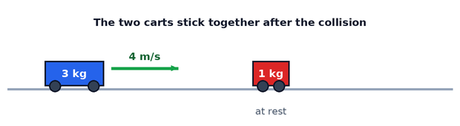
عربتان كما في الرسم تلتحمان بعد التصادم. الطاقة الحركية الضائعة:The two carts in the figure stick together after the collision. The kinetic energy lost is:
\(18\ J\)\(18\ J\)
\(24\ J\)\(24\ J\)
\(0\)\(0\)
\(6\ J\)\(6\ J\)
الحلSolution
\(v=\dfrac{3\times4}{3+1}=3\ \mathrm{m/s}\)
\(\Delta K=\tfrac12(3)(4)^2-\tfrac12(4)(3)^2=24-18=6\ \mathrm{J}\)
✅ \(6\ J\) (D)
\(v=\dfrac{3\times4}{3+1}=3\ \mathrm{m/s}\)
\(\Delta K=\tfrac12(3)(4)^2-\tfrac12(4)(3)^2=24-18=6\ \mathrm{J}\)
✅ \(6\ J\) (D)
\[26\,\star\star\star\]
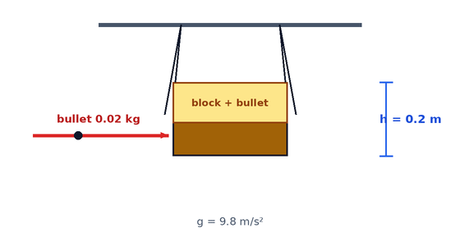
رصاصة كتلتها \(0.02\ kg\) استقرت في كتلة معلقة كتلتها \(1.98\ kg\) فارتفع النظام \(0.2\ m\) (آلة البندول القذفي). سرعة الرصاصة (\(g=9.8\ m/s^2\)):A \(0.02\ kg\) bullet embeds in a hanging block of \(1.98\ kg\) and the system rises \(0.2\ m\) (a ballistic pendulum). The bullet’s speed (\(g=9.8\ m/s^2\)) is:
\(v\approx99\ m/s\)\(v\approx99\ m/s\)
\(v\approx2\ m/s\)\(v\approx2\ m/s\)
\(v\approx198\ m/s\)\(v\approx198\ m/s\)
\(v\approx400\ m/s\)\(v\approx400\ m/s\)
الحلSolution
📌 بعد الالتحام تتحول الطاقة الحركية إلى وضع: \(v_c=\sqrt{2gh}=\sqrt{2(9.8)(0.2)}=1.98\ \mathrm{m/s}\).
\(0.02\,v=(0.02+1.98)(1.98)\Rightarrow v\approx198\ \mathrm{m/s}\)
✅ \(v\approx198\ m/s\) (C)
📌 After sticking, kinetic energy becomes potential: \(v_c=\sqrt{2gh}=\sqrt{2(9.8)(0.2)}=1.98\ \mathrm{m/s}\).
\(0.02\,v=(0.02+1.98)(1.98)\Rightarrow v\approx198\ \mathrm{m/s}\)
✅ \(v\approx198\ m/s\) (C)
\[27\,\star\star\]
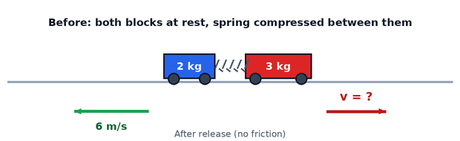
كتلتان \(2\ kg\) و\(3\ kg\) ساكنتان على سطح أملس بينهما نابض مضغوط؛ عند تحريره تحركت الكتلة \(2\ kg\) نحو اليسار بسرعة \(6\ m/s\). سرعة الكتلة \(3\ kg\):Masses \(2\ kg\) and \(3\ kg\) at rest on a smooth surface have a compressed spring between them; on release the \(2\ kg\) mass moves left at \(6\ m/s\). The speed of the \(3\ kg\) mass is:
\(v=9\ m/s\)\(v=9\ m/s\)
\(v=4\ m/s\)\(v=4\ m/s\)
\(v=6\ m/s\)\(v=6\ m/s\)
\(v=2\ m/s\)\(v=2\ m/s\)
الحلSolution
📌 الزخم الكلي صفر: \(0=2(-6)+3v\).
\(v=\dfrac{12}{3}=4\ \mathrm{m/s}\ (\text{نحو اليمين / to the right})\)
✅ \(v=4\ m/s\) (B)
📌 The total momentum is zero: \(0=2(-6)+3v\).
\(v=\dfrac{12}{3}=4\ \mathrm{m/s}\ (\text{نحو اليمين / to the right})\)
✅ \(v=4\ m/s\) (B)
\[28\,\star\star\]
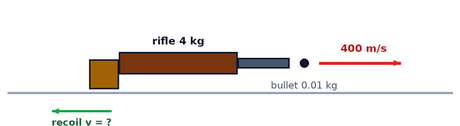
بندقية كتلتها \(4\ kg\) تطلق رصاصة \(0.01\ kg\) بسرعة \(400\ m/s\). سرعة ارتداد البندقية:A \(4\ kg\) rifle fires a \(0.01\ kg\) bullet at \(400\ m/s\). The recoil speed of the rifle is:
\(0.1\ m/s\)\(0.1\ m/s\)
\(1\ m/s\)\(1\ m/s\)
\(10\ m/s\)\(10\ m/s\)
\(4\ m/s\)\(4\ m/s\)
الحلSolution
\(0=4v+0.01(400)\Rightarrow v=-\dfrac{4}{4}=-1\ \mathrm{m/s}\)
✅ \(1\ m/s\) (B)
\(0=4v+0.01(400)\Rightarrow v=-\dfrac{4}{4}=-1\ \mathrm{m/s}\)
✅ \(1\ m/s\) (B)
\[29\,\star\star\star\]
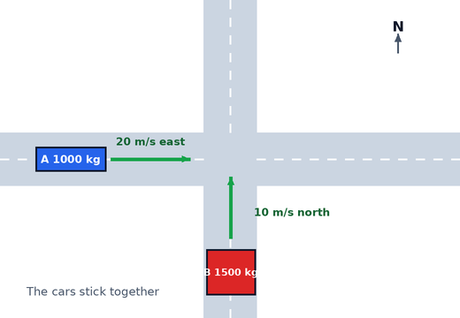
تصادمت السيارتان كما في الرسم والتحمتا. مقدار سرعتهما بعد التصادم:The two cars in the figure collide and stick together. Their speed after the collision is:
\(14\ m/s\)\(14\ m/s\)
\(8\ m/s\)\(8\ m/s\)
\(6\ m/s\)\(6\ m/s\)
\(10\ m/s\)\(10\ m/s\)
الحلSolution
\(P_x:\ 1000(20)=2500\,v_x\Rightarrow v_x=8\ \mathrm{m/s}\)
\(P_y:\ 1500(10)=2500\,v_y\Rightarrow v_y=6\ \mathrm{m/s}\)
\(v=\sqrt{8^2+6^2}=10\ \mathrm{m/s}\ (37^\circ\ \text{شمال الشرق / north of east})\)
✅ \(10\ m/s\) (D)
\(P_x:\ 1000(20)=2500\,v_x\Rightarrow v_x=8\ \mathrm{m/s}\)
\(P_y:\ 1500(10)=2500\,v_y\Rightarrow v_y=6\ \mathrm{m/s}\)
\(v=\sqrt{8^2+6^2}=10\ \mathrm{m/s}\ (37^\circ\ \text{شمال الشرق / north of east})\)
✅ \(10\ m/s\) (D)
\[30\,\star\star\star\]
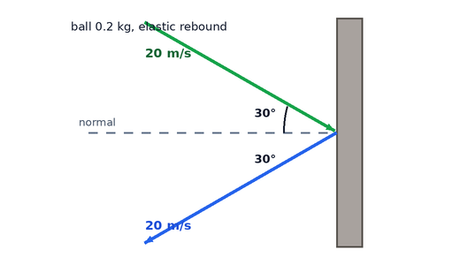
كرة كتلتها \(0.2\ kg\) تصطدم بجدار بسرعة \(20\ m/s\) بزاوية \(30^\circ\) مع العمود على الجدار وترتد بالسرعة نفسها وبالزاوية نفسها. مقدار التغير في زخمها:A \(0.2\ kg\) ball hits a wall at \(20\ m/s\) at \(30^\circ\) to the normal and rebounds with the same speed and angle. The magnitude of its change in momentum is:
\(4\ N\cdot s\)\(4\ N\cdot s\)
\(8\ N\cdot s\)\(8\ N\cdot s\)
\(6.93\ N\cdot s\)\(6.93\ N\cdot s\)
\(0\)\(0\)
الحلSolution
📌 المركّبة الموازية للجدار لا تتغير، والعمودية تنعكس: \(\Delta p=2mv\cos30^\circ\).
\(\Delta p=2(0.2)(20)(0.866)=6.93\ \mathrm{N\cdot s}\)
✅ \(6.93\ N\cdot s\) (C)
📌 The component along the wall is unchanged and the normal one reverses: \(\Delta p=2mv\cos30^\circ\).
\(\Delta p=2(0.2)(20)(0.866)=6.93\ \mathrm{N\cdot s}\)
✅ \(6.93\ N\cdot s\) (C)
\[31\,\star\star\]
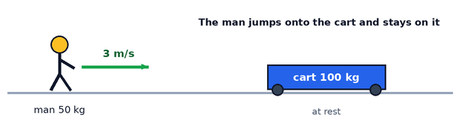
رجل كتلته \(50\ kg\) يركض بـ \(3\ m/s\) ويقفز على عربة ساكنة كتلتها \(100\ kg\) ويبقى عليها (بلا احتكاك). سرعة العربة والرجل:A \(50\ kg\) man running at \(3\ m/s\) jumps onto a \(100\ kg\) cart at rest and stays on it (no friction). The speed of the cart and man is:
\(1.5\ m/s\)\(1.5\ m/s\)
\(3\ m/s\)\(3\ m/s\)
\(1\ m/s\)\(1\ m/s\)
\(2\ m/s\)\(2\ m/s\)
الحلSolution
\(50(3)=(50+100)v\Rightarrow v=\dfrac{150}{150}=1\ \mathrm{m/s}\)
✅ \(1\ m/s\) (C)
\(50(3)=(50+100)v\Rightarrow v=\dfrac{150}{150}=1\ \mathrm{m/s}\)
✅ \(1\ m/s\) (C)
\[32\,\star\star\star\]
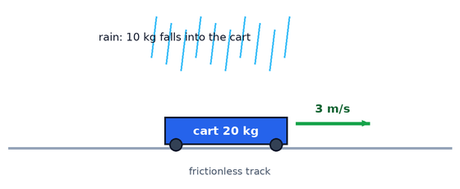
عربة كتلتها \(20\ kg\) تتحرك بـ \(3\ m/s\) على سكة أفقية ملساء، تساقط عليها مطر رأسيًا فتجمّع فيها \(10\ kg\) من الماء. سرعة العربة بعد ذلك:A \(20\ kg\) cart moves at \(3\ m/s\) on a smooth horizontal track; rain falls vertically and \(10\ kg\) of water collects in it. Its speed afterwards is:
\(2\ m/s\)\(2\ m/s\)
\(3\ m/s\)\(3\ m/s\)
\(4.5\ m/s\)\(4.5\ m/s\)
\(1\ m/s\)\(1\ m/s\)
الحلSolution
📌 لا توجد قوة أفقية خارجية فيُحفظ الزخم الأفقي، والماء ساقط رأسيًا أفقيًا ساكن: \(20(3)=(20+10)v\).
\(v=\dfrac{60}{30}=2\ \mathrm{m/s}\)
✅ \(2\ m/s\) (A)
📌 There is no horizontal external force so horizontal momentum is conserved, and the vertically falling water has no horizontal motion: \(20(3)=(20+10)v\).
\(v=\dfrac{60}{30}=2\ \mathrm{m/s}\)
✅ \(2\ m/s\) (A)
\[33\,\star\star\star\]
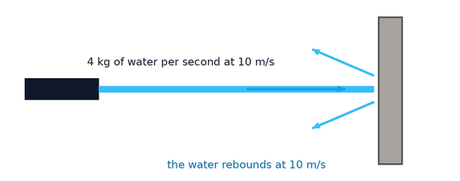
خرطوم يقذف \(4\ kg\) من الماء كل ثانية بسرعة \(10\ m/s\) على جدار فيرتد الماء بالسرعة نفسها. متوسط القوة على الجدار:A hose throws \(4\ kg\) of water every second at \(10\ m/s\) onto a wall and the water rebounds with the same speed. The average force on the wall is:
\(40\ N\)\(40\ N\)
\(80\ N\)\(80\ N\)
\(20\ N\)\(20\ N\)
\(160\ N\)\(160\ N\)
الحلSolution
📌 في كل ثانية يتغير زخم الماء: \(\Delta p=m[v-(-v)]=2mv\).
\(F=\dfrac{\Delta p}{\Delta t}=\dfrac{2(4)(10)}{1}=80\ \mathrm{N}\)
✅ \(80\ N\) (B)
📌 Each second the momentum of the water changes by \(\Delta p=m[v-(-v)]=2mv\).
\(F=\dfrac{\Delta p}{\Delta t}=\dfrac{2(4)(10)}{1}=80\ \mathrm{N}\)
✅ \(80\ N\) (B)
\[34\,\star\star\]
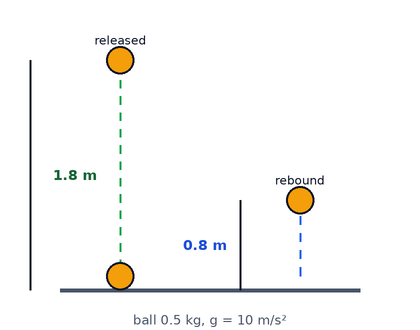
كرة كتلتها \(0.5\ kg\) سقطت من ارتفاع \(1.8\ m\) فارتدت إلى ارتفاع \(0.8\ m\) (\(g=10\ m/s^2\)). مقدار الدفع من الأرض:A \(0.5\ kg\) ball is dropped from \(1.8\ m\) and rebounds to \(0.8\ m\) (\(g=10\ m/s^2\)). The impulse of the ground has magnitude:
\(2\ N\cdot s\)\(2\ N\cdot s\)
\(5\ N\cdot s\)\(5\ N\cdot s\)
\(1\ N\cdot s\)\(1\ N\cdot s\)
\(10\ N\cdot s\)\(10\ N\cdot s\)
الحلSolution
\(v_i=\sqrt{2gh_1}=\sqrt{36}=6\ \mathrm{m/s},\ \ v_f=\sqrt{2gh_2}=\sqrt{16}=4\ \mathrm{m/s}\)
\(J=m(v_f+v_i)=0.5(4+6)=5\ \mathrm{N\cdot s}\)
✅ \(5\ N\cdot s\) (B)
\(v_i=\sqrt{2gh_1}=\sqrt{36}=6\ \mathrm{m/s},\ \ v_f=\sqrt{2gh_2}=\sqrt{16}=4\ \mathrm{m/s}\)
\(J=m(v_f+v_i)=0.5(4+6)=5\ \mathrm{N\cdot s}\)
✅ \(5\ N\cdot s\) (B)
\[35\,\star\star\]
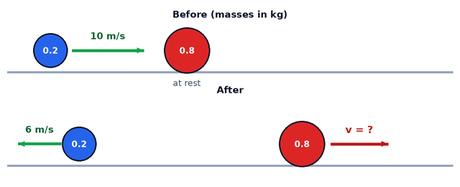
كرة كتلتها \(0.2\ kg\) تتحرك بـ \(10\ m/s\) تصطدم بكرة كتلتها \(0.8\ kg\) ساكنة فترتد الأولى بـ \(6\ m/s\). سرعة الكرة الثانية بعد التصادم:A \(0.2\ kg\) ball moving at \(10\ m/s\) hits a \(0.8\ kg\) ball at rest and rebounds at \(6\ m/s\). The speed of the second ball afterwards is:
\(2\ m/s\)\(2\ m/s\)
\(6\ m/s\)\(6\ m/s\)
\(1.5\ m/s\)\(1.5\ m/s\)
\(4\ m/s\)\(4\ m/s\)
الحلSolution
\(0.2(10)=0.2(-6)+0.8\,v\Rightarrow2+1.2=0.8\,v\)
\(v=\dfrac{3.2}{0.8}=4\ \mathrm{m/s}\)
✅ \(4\ m/s\) (D)
\(0.2(10)=0.2(-6)+0.8\,v\Rightarrow2+1.2=0.8\,v\)
\(v=\dfrac{3.2}{0.8}=4\ \mathrm{m/s}\)
✅ \(4\ m/s\) (D)
📝 المسائل المقالية
📝 Essay Problems
\[1\,\star\star\]
يركل لاعب كرة قدم كرة كتلتها \(m=0.4\ kg\) تتحرك بسرعة \(v_i=8\ m/s\) نحو الغرب فتنطلق بسرعة \(v_f=20\ m/s\) شرقًا، وكان زمن التلامس \(0.5\ s\). (أ) استنتج من قانون نيوتن الثاني العلاقة بين الدفع والتغير في الزخم واكتب وحدة الدفع. (ب) احسب متوسط القوة التي أثّرت بها القدم.A footballer kicks a \(m=0.4\ kg\) ball moving at \(v_i=8\ m/s\) west so that it leaves at \(v_f=20\ m/s\) east; the contact lasts \(0.5\ s\). (a) Derive from Newton’s second law the relation between impulse and the change in momentum and give the unit of impulse. (b) Find the average force of the foot.
.....................................................................
الحلSolution
📌 (أ) \(F=ma=m\dfrac{v_f-v_i}{\Delta t}\Rightarrow F\,\Delta t=mv_f-mv_i=\Delta p\)؛ فالدفع \(J=F\Delta t\) يساوي التغير في الزخم، ووحدته \(\mathrm{N\cdot s}=\mathrm{kg\cdot m/s}\).
📌 (ب) الشرق موجب: \(\Delta p=0.4(20-(-8))=0.4\times28=11.2\ \mathrm{N\cdot s}\).
\(F=\dfrac{\Delta p}{\Delta t}=\dfrac{11.2}{0.5}=22.4\ \mathrm{N}\) نحو الشرق. (القوة أعظم ما يمكن لحظة أقصى انضغاط للكرة في منتصف زمن التلامس.)
✅ \(F=22.4\ N\) شرقًا
📌 (a) \(F=ma=m\dfrac{v_f-v_i}{\Delta t}\Rightarrow F\,\Delta t=mv_f-mv_i=\Delta p\); the impulse \(J=F\Delta t\) equals the change in momentum, with unit \(\mathrm{N\cdot s}=\mathrm{kg\cdot m/s}\).
📌 (b) East positive: \(\Delta p=0.4(20-(-8))=0.4\times28=11.2\ \mathrm{N\cdot s}\).
\(F=\dfrac{\Delta p}{\Delta t}=\dfrac{11.2}{0.5}=22.4\ \mathrm{N}\) east. (The force is greatest at the moment of maximum compression of the ball, in the middle of the contact time.)
✅ \(F=22.4\ N\) east
\[2\,\star\star\]
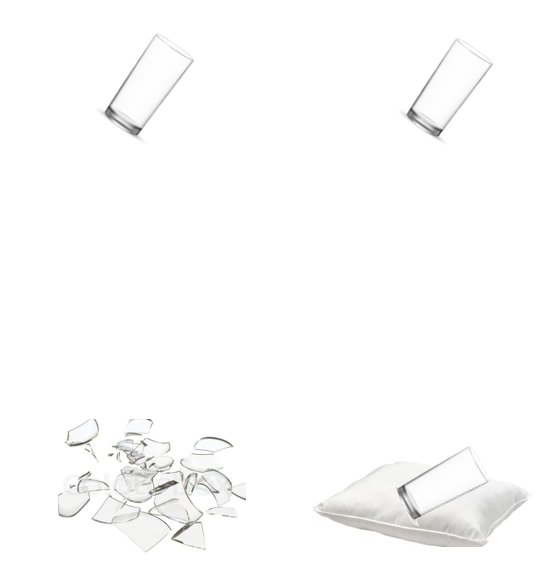
كأسان زجاجيان متماثلان تُركا يسقطان من الارتفاع نفسه، أحدهما يرتطم بالأرض والآخر يسقط على وسادة. (أ) قارن بين الدفع الذي يتلقاه كل كأس مع بيان السبب. (ب) لماذا ينكسر الكأس المرتطم بالأرض؟Two identical glass cups are dropped from the same height, one hitting the ground and the other falling on a cushion. (a) Compare the impulse received by each cup and give the reason. (b) Why does the cup hitting the ground break?
.....................................................................
الحلSolution
📌 (أ) الدفعان متساويان: للكأسين الكتلة نفسها وسرعة الاصطدام نفسها وكلاهما يتوقف، فالتغير في الزخم \(\Delta p=0-mv\) نفسه، والدفع = \(\Delta p\).
📌 (ب) من \(F=\Delta p/\Delta t\): على الأرض يتوقف الكأس في زمن قصير جدًا فتكون القوة المتوسطة كبيرة فتنكسر، أما الوسادة فتطيل زمن التوقف فتقل القوة ولا ينكسر.
✅ الدفع متساوٍ، والقوة أكبر على الأرض
📌 (a) The impulses are equal: the cups have the same mass and impact speed and both stop, so the change in momentum \(\Delta p=0-mv\) is the same, and the impulse = \(\Delta p\).
📌 (b) From \(F=\Delta p/\Delta t\): on the ground the cup stops in a very short time so the average force is large and it breaks, whereas the cushion lengthens the stopping time so the force is smaller and it does not break.
✅ The impulse is equal; the force is larger on the ground
لاحظت خطأ؟ أو عندك سؤال عن أحد الأسئلة؟ اكتبه بالتعليقات وحدد رقم السؤال بالضبط.
Noticed an error? Or have a question about one of the questions? Write it in the comments and specify the exact question number.