🔌 بنك الأسئلة: الدوائر الكهربائية البسيطة
🔌 Question Bank: Simple Electrical Circuits
التوصيل على التوالي والتوازي، المقاومة المكافئة، قانون أوم، أجهزة القياس، قانونا كيرشوف، والقدرة والمنصهر
Series and Parallel Connections, Equivalent Resistance, Ohm’s Law, Measuring Instruments, Kirchhoff’s Laws, Power and Fuses
⏱️ 48 سؤال اختيار من متعدد بتصحيح فوري بمستويات متدرجة، و10 مسائل مقالية محلولة⏱️ 48 multiple-choice questions of graded difficulty with instant feedback, plus 10 solved essay problems
\[1\,\star\]
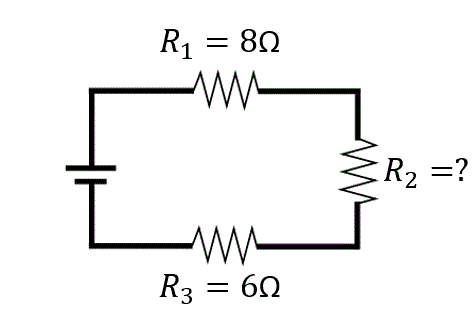
ثلاث مقاومات متصلة على التوالي كما في الشكل، حُسبت المقاومة المكافئة فكانت \(25\,\Omega\)، فإن قيمة المقاوم الثاني تعادل:Three resistors are connected in series as shown. The equivalent resistance was found to be \(25\,\Omega\). The value of the second resistor is:
\(R_2=7\,\Omega\)\(R_2=7\,\Omega\)
\(R_2=9\,\Omega\)\(R_2=9\,\Omega\)
\(R_2=11\,\Omega\)\(R_2=11\,\Omega\)
\(R_2=13\,\Omega\)\(R_2=13\,\Omega\)
الحلSolution
📌 المعطيات من الشكل: \(R_1=8\,\Omega\) و\(R_3=6\,\Omega\)، والمقاومة المكافئة \(R_{eq}=25\,\Omega\).
📌 على التوالي: \(R_{eq}=R_1+R_2+R_3\Rightarrow25=8+R_2+6\).
\(R_2=25-14=11\,\Omega\).
✅ \(R_2=11\,\Omega\) (C)
📌 From the figure: \(R_1=8\,\Omega\) and \(R_3=6\,\Omega\), and \(R_{eq}=25\,\Omega\).
📌 In series: \(R_{eq}=R_1+R_2+R_3\Rightarrow25=8+R_2+6\).
\(R_2=25-14=11\,\Omega\).
✅ \(R_2=11\,\Omega\) (C)
\[2\,\star\]
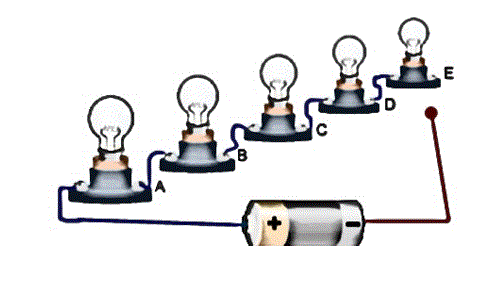
خمسة مصابيح متماثلة (مقاومة كل منها واحدة) وُصلت على التوالي فكانت المقاومة المكافئة \(120\,\Omega\). مقاومة كل مصباح:Five identical lamps are connected in series and the equivalent resistance is \(120\,\Omega\). The resistance of each lamp is:
\(R=24\,\Omega\)\(R=24\,\Omega\)
\(R=600\,\Omega\)\(R=600\,\Omega\)
\(R=60\,\Omega\)\(R=60\,\Omega\)
\(R=20\,\Omega\)\(R=20\,\Omega\)
الحلSolution
📌 لمقاومات متماثلة على التوالي: \(R_{eq}=n\,R\) حيث \(n\) عدد المقاومات.
\(120=5R\Rightarrow R=\dfrac{120}{5}=24\,\Omega\).
✅ \(R=24\,\Omega\) (A)
📌 For identical resistors in series: \(R_{eq}=n\,R\) where \(n\) is the number of resistors.
\(120=5R\Rightarrow R=\dfrac{120}{5}=24\,\Omega\).
✅ \(R=24\,\Omega\) (A)
\[3\,\star\star\]
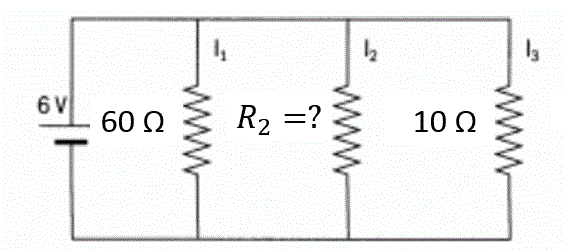
ثلاث مقاومات متصلة على التوازي كما في الشكل (المقاومتان \(60\,\Omega\) و\(10\,\Omega\) والمقاومة الثانية مجهولة). حُسبت المقاومة المكافئة فكانت \(6\,\Omega\)، فإن قيمة المقاوم الثاني تعادل:Three resistors are connected in parallel as shown (the resistors \(60\,\Omega\) and \(10\,\Omega\), and the second is unknown). The equivalent resistance is \(6\,\Omega\). The value of the second resistor is:
\(R_2=10\,\Omega\)\(R_2=10\,\Omega\)
\(R_2=30\,\Omega\)\(R_2=30\,\Omega\)
\(R_2=20\,\Omega\)\(R_2=20\,\Omega\)
\(R_2=40\,\Omega\)\(R_2=40\,\Omega\)
الحلSolution
📌 على التوازي: \(\dfrac{1}{R_{eq}}=\dfrac{1}{R_1}+\dfrac{1}{R_2}+\dfrac{1}{R_3}\).
\(\dfrac{1}{6}=\dfrac{1}{60}+\dfrac{1}{R_2}+\dfrac{1}{10}\).
\(\dfrac{1}{R_2}=\dfrac{10-1-6}{60}=\dfrac{3}{60}=\dfrac{1}{20}\Rightarrow R_2=20\,\Omega\).
✅ \(R_2=20\,\Omega\) (C)
📌 In parallel: \(\dfrac{1}{R_{eq}}=\dfrac{1}{R_1}+\dfrac{1}{R_2}+\dfrac{1}{R_3}\).
\(\dfrac{1}{6}=\dfrac{1}{60}+\dfrac{1}{R_2}+\dfrac{1}{10}\).
\(\dfrac{1}{R_2}=\dfrac{10-1-6}{60}=\dfrac{3}{60}=\dfrac{1}{20}\Rightarrow R_2=20\,\Omega\).
✅ \(R_2=20\,\Omega\) (C)
\[4\,\star\]
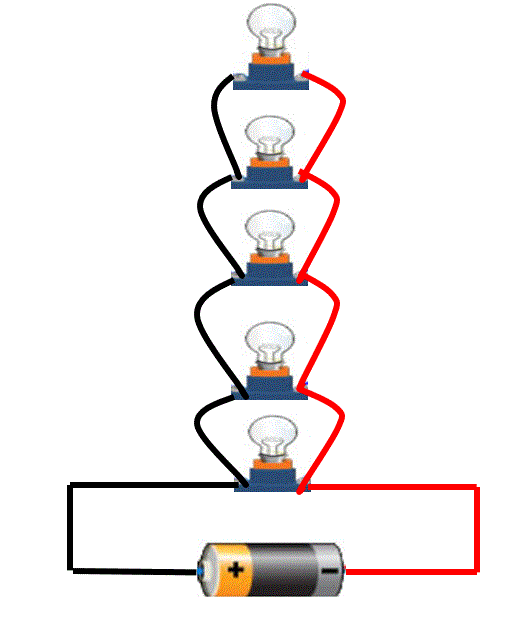
خمسة مصابيح متماثلة وُصلت على التوازي فكانت المقاومة المكافئة \(12\,\Omega\). مقاومة كل مصباح:Five identical lamps are connected in parallel and the equivalent resistance is \(12\,\Omega\). The resistance of each lamp is:
\(R=2.4\,\Omega\)\(R=2.4\,\Omega\)
\(R=20\,\Omega\)\(R=20\,\Omega\)
\(R=60\,\Omega\)\(R=60\,\Omega\)
\(R=18\,\Omega\)\(R=18\,\Omega\)
الحلSolution
📌 لمقاومات متماثلة على التوازي: \(R_{eq}=\dfrac{R}{n}\).
\(12=\dfrac{R}{5}\Rightarrow R=12\times5=60\,\Omega\).
✅ \(R=60\,\Omega\) (C)
📌 For identical resistors in parallel: \(R_{eq}=\dfrac{R}{n}\).
\(12=\dfrac{R}{5}\Rightarrow R=12\times5=60\,\Omega\).
✅ \(R=60\,\Omega\) (C)
\[5\,\star\]
أحد الخيارات التالية لا يُعدّ من ميزات التوصيل على التوالي:Which of the following is not a characteristic of the series connection?
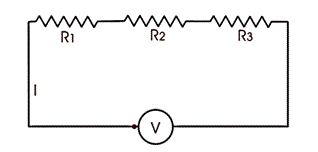
نحصل على مقاومة مكافئة أكبر من أي مقاومةThe equivalent resistance is larger than any single resistance
التيار المار في المقاومات متساوٍThe current through the resistors is the same
المقاوم الأكبر يحتاج إلى جهد أكبرThe larger resistor has a larger voltage
إذا انقطع جزء من الدائرة تعمل بقية الدائرةIf one part of the circuit breaks the rest still works
الحلSolution
📌 ميزات التوالي: المقاومة المكافئة = المجموع (أكبر من أي مقاومة)، والتيار واحد في الجميع، وفرق الجهد على كل مقاوم يتناسب مع مقاومته.
📌 أما انقطاع جزء فيوقف الدائرة كلها في التوالي؛ وبقاء بقية الدائرة عاملة ميزة التوازي.
✅ إذا انقطع جزء من الدائرة تعمل بقية الدائرة (D)
📌 Series features: the equivalent resistance = the sum (larger than any one), the current is the same everywhere and the voltage across each resistor is proportional to its resistance.
📌 In series a break stops the whole circuit; the rest staying on is a parallel feature.
✅ If one part of the circuit breaks the rest still works (D)
\[6\,\star\]
أحد الخيارات التالية لا يُعدّ من ميزات التوصيل على التوازي:Which of the following is not a characteristic of the parallel connection?
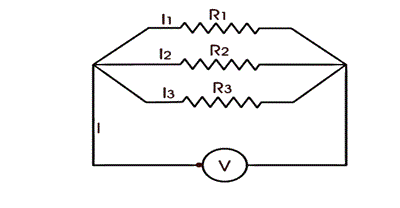
فرق الجهد متساوٍ على المقاوماتThe voltage across the resistors is the same
المقاوم الأكبر يمر به تيار أكبرThe larger resistor carries a larger current
إذا انقطع جزء من الدائرة يعمل باقيهاIf one part breaks the rest still works
المقاومة المكافئة أصغر من أي مقاومةThe equivalent resistance is smaller than any single resistance
الحلSolution
📌 في التوازي الجهد واحد على الجميع فالتيار \(I=V/R\) يتناسب عكسيًا مع المقاومة: المقاوم الأكبر يمر به تيار أصغر.
✅ المقاوم الأكبر يمر به تيار أكبر (B)
📌 In parallel the voltage is the same on all, so the current \(I=V/R\) is inversely proportional to the resistance: the larger resistor carries the smaller current.
✅ The larger resistor carries a larger current (B)
\[7\,\star\star\]
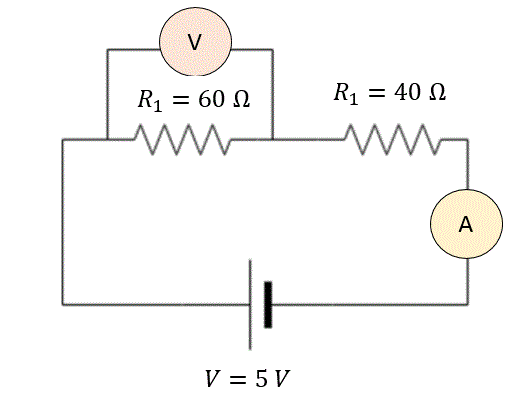
مقاومتان \(R_1=60\,\Omega\) و\(R_2=40\,\Omega\) متصلتان على التوالي بمصدر \(5\,V\)، وفولتميتر موصول على \(R_1\). قراءة الفولتميتر:Two resistors \(R_1=60\,\Omega\) and \(R_2=40\,\Omega\) are connected in series to a \(5\,V\) source and a voltmeter is connected across \(R_1\). The voltmeter reading is:
\(V=2\,V\)\(V=2\,V\)
\(V=3\,V\)\(V=3\,V\)
\(V=1\,V\)\(V=1\,V\)
\(V=4\,V\)\(V=4\,V\)
الحلSolution
📌 قاسم الجهد على التوالي: \(V_1=\dfrac{R_1}{R_1+R_2}\,V_{total}\).
\(V_1=\dfrac{60}{100}\times5=3\,V\).
✅ \(V=3\,V\) (B)
📌 Voltage divider in series: \(V_1=\dfrac{R_1}{R_1+R_2}\,V_{total}\).
\(V_1=\dfrac{60}{100}\times5=3\,V\).
✅ \(V=3\,V\) (B)
\[8\,\star\star\]
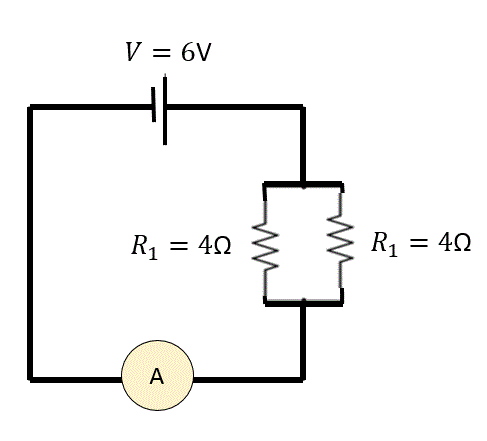
مقاومتان \(R_1=R_2=4\,\Omega\) على التوازي مع بطارية \(6\,V\)، والأميتر على التوالي مع البطارية. قراءة الأميتر:Two resistors \(R_1=R_2=4\,\Omega\) are connected in parallel with a \(6\,V\) battery, the ammeter being in series with the battery. The ammeter reading is:
\(I=3\,A\)\(I=3\,A\)
\(I=1\,A\)\(I=1\,A\)
\(I=2\,A\)\(I=2\,A\)
\(I=4\,A\)\(I=4\,A\)
الحلSolution
\(R_{eq}=\dfrac{4\times4}{4+4}=2\,\Omega\).
📌 الأميتر يقيس التيار الكلي: \(I=\dfrac{V}{R_{eq}}=\dfrac{6}{2}=3\,A\).
✅ \(I=3\,A\) (A)
\(R_{eq}=\dfrac{4\times4}{4+4}=2\,\Omega\).
📌 The ammeter measures the total current: \(I=\dfrac{V}{R_{eq}}=\dfrac{6}{2}=3\,A\).
✅ \(I=3\,A\) (A)
\[9\,\star\star\]
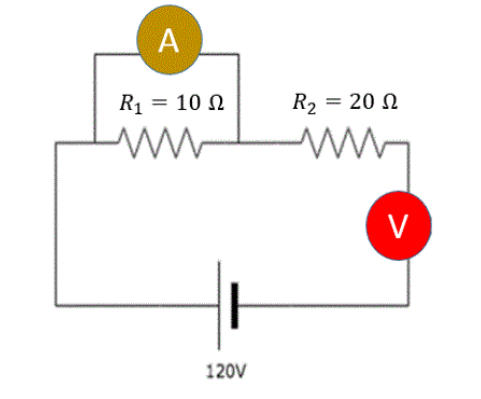
وُصل الأميتر والفولتميتر في الدائرة بشكل خاطئ (الفولتميتر على التوالي والأميتر على التوازي مع \(R_1\)) ومصدر الجهد \(120\,V\). قراءة الجهازين:The ammeter and voltmeter are connected incorrectly (the voltmeter in series and the ammeter in parallel with \(R_1\)) and the source is \(120\,V\). The readings are:
\(V=120\,V,\ I=0\,A\)\(V=120\,V,\ I=0\,A\)
\(V=120\,V,\ I=1.2\,A\)\(V=120\,V,\ I=1.2\,A\)
\(V=0\,V,\ I=1.2\,A\)\(V=0\,V,\ I=1.2\,A\)
\(V=0\,V,\ I=0\,A\)\(V=0\,V,\ I=0\,A\)
الحلSolution
📌 الفولتميتر مقاومته عالية جدًا وهو موصول على التوالي فيمنع مرور التيار تقريبًا: \(I\approx0\).
📌 ولا يهبط جهد على بقية العناصر لأن التيار صفر، فيقرأ الفولتميتر جهد المصدر كاملًا \(120\,V\).
✅ \(V=120\,V,\ I=0\,A\) (A)
📌 The voltmeter has a very high resistance and is in series, so it practically blocks the current: \(I\approx0\).
📌 With zero current there is no voltage drop across the other elements, so the voltmeter reads the whole source voltage \(120\,V\).
✅ \(V=120\,V,\ I=0\,A\) (A)
\[10\,\star\star\]
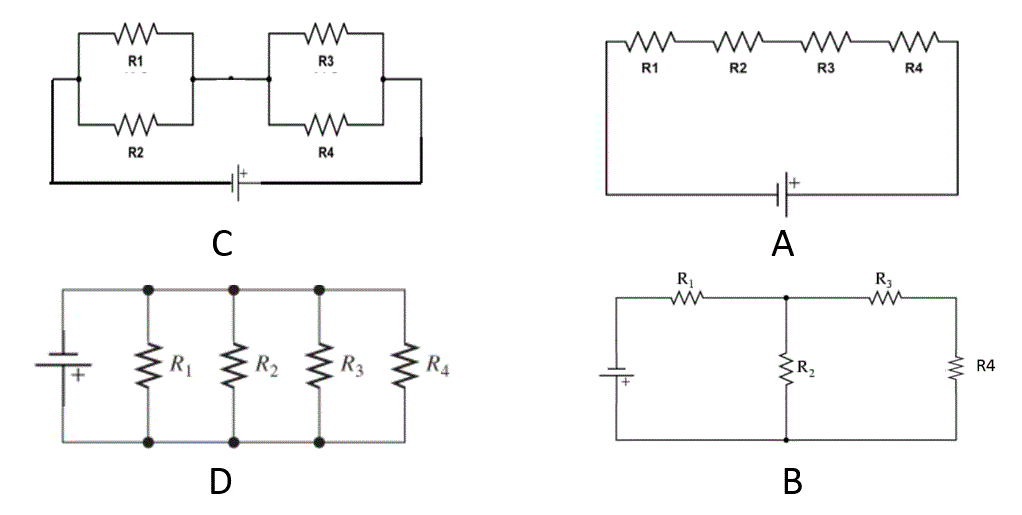
أربع مقاومات بطرق مختلفة (الشكل). في أي توصيل تكون المقاومة المكافئة أقل ما يمكن؟Four resistors are connected in different ways (the figure). In which connection is the equivalent resistance the smallest?
AA
BB
CC
DD
الحلSolution
📌 على التوالي (الشكل A) المقاومة أكبر ما يمكن، وعلى التوازي تكون المقاومة المكافئة أصغر من أي مقاومة منفردة.
📌 الشكل D يمثل المقاومات الأربع كلها على التوازي فيعطي أقل مقاومة مكافئة.
✅ D
📌 In series (figure A) the resistance is largest, while in parallel the equivalent resistance is smaller than any single one.
📌 Figure D shows all four resistors in parallel, which gives the smallest equivalent resistance.
✅ D
\[11\,\star\star\star\]
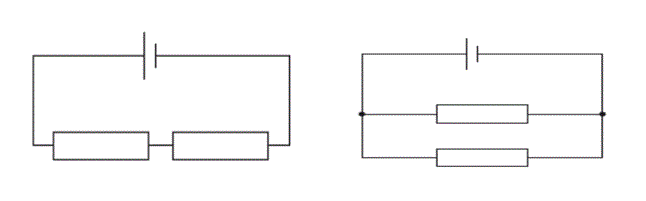
مقاومتان \(R_2\gt R_1\)؛ مقاومتهما المكافئة على التوالي \(9\,\Omega\) وعلى التوازي \(2\,\Omega\). قيمة كل مقاوم:Two resistors with \(R_2\gt R_1\); their equivalent resistance in series is \(9\,\Omega\) and in parallel \(2\,\Omega\). The value of each resistor is:
\(R_1=1,\ R_2=8\)\(R_1=1,\ R_2=8\)
\(R_1=4,\ R_2=5\)\(R_1=4,\ R_2=5\)
\(R_1=2,\ R_2=7\)\(R_1=2,\ R_2=7\)
\(R_1=3,\ R_2=6\)\(R_1=3,\ R_2=6\)
الحلSolution
📌 على التوالي: \(R_1+R_2=9\) ... (1).
📌 على التوازي: \(\dfrac{R_1R_2}{R_1+R_2}=2\Rightarrow R_1R_2=2\times9=18\) ... (2).
📌 عددان مجموعهما \(9\) وحاصل ضربهما \(18\): \(3\) و\(6\)؛ ولأن \(R_2\gt R_1\) فإن \(R_1=3\,\Omega,\ R_2=6\,\Omega\).
✅ \(R_1=3,\ R_2=6\) (D)
📌 In series: \(R_1+R_2=9\) ... (1).
📌 In parallel: \(\dfrac{R_1R_2}{R_1+R_2}=2\Rightarrow R_1R_2=2\times9=18\) ... (2).
📌 Two numbers with sum \(9\) and product \(18\): \(3\) and \(6\); since \(R_2\gt R_1\), \(R_1=3\,\Omega,\ R_2=6\,\Omega\).
✅ \(R_1=3,\ R_2=6\) (D)
\[12\,\star\star\star\]
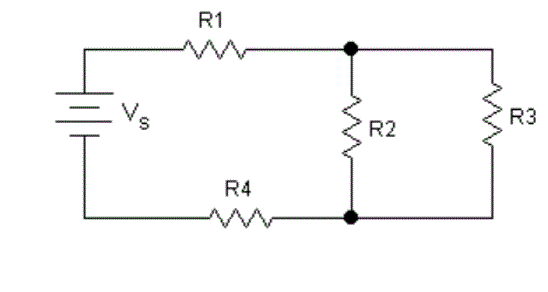
أربع مقاومات متساوية؛ المقاومتان الثانية والثالثة على التوازي، وهما على التوالي مع المقاومتين الأولى والرابعة، والمقاومة المكافئة الكلية \(5\,\Omega\). مقدار كل مقاومة:Four equal resistors: the second and third are in parallel, and together they are in series with the first and the fourth; the total equivalent resistance is \(5\,\Omega\). The value of each resistor is:
\(R=4\,\Omega\)\(R=4\,\Omega\)
\(R=3\,\Omega\)\(R=3\,\Omega\)
\(R=2\,\Omega\)\(R=2\,\Omega\)
\(R=6\,\Omega\)\(R=6\,\Omega\)
الحلSolution
📌 المقاومتان الثانية والثالثة على التوازي: \(R_{23}=\dfrac{R}{2}\).
\(R_{eq}=R+\dfrac{R}{2}+R=\dfrac{5R}{2}\).
\(\dfrac{5R}{2}=5\Rightarrow R=2\,\Omega\).
✅ \(R=2\,\Omega\) (C)
📌 The second and third in parallel: \(R_{23}=\dfrac{R}{2}\).
\(R_{eq}=R+\dfrac{R}{2}+R=\dfrac{5R}{2}\).
\(\dfrac{5R}{2}=5\Rightarrow R=2\,\Omega\).
✅ \(R=2\,\Omega\) (C)
\[13\,\star\star\star\]
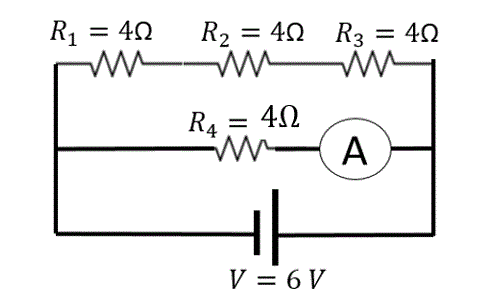
أربع مقاومات متساوية \(R=4\,\Omega\) مع بطارية \(6\,V\) كما في الشكل (ثلاث منها على التوالي، وهي والمقاومة الرابعة على التوازي). قراءة الأميتر الموصول مع المقاومة الرابعة:Four equal resistors \(R=4\,\Omega\) with a \(6\,V\) battery as shown (three in series, and they are in parallel with the fourth). The reading of the ammeter in series with the fourth resistor is:
\(I=0.5\,A\)\(I=0.5\,A\)
\(I=2\,A\)\(I=2\,A\)
\(I=1.5\,A\)\(I=1.5\,A\)
\(I=2.5\,A\)\(I=2.5\,A\)
الحلSolution
📌 الفرع الذي فيه \(R_4\) موصول مباشرة بقطبي البطارية: \(V_4=6\,V\).
\(I_4=\dfrac{V_4}{R_4}=\dfrac{6}{4}=1.5\,A\).
✅ \(I=1.5\,A\) (C)
📌 The branch with \(R_4\) is connected directly across the battery: \(V_4=6\,V\).
\(I_4=\dfrac{V_4}{R_4}=\dfrac{6}{4}=1.5\,A\).
✅ \(I=1.5\,A\) (C)
\[14\,\star\star\star\]
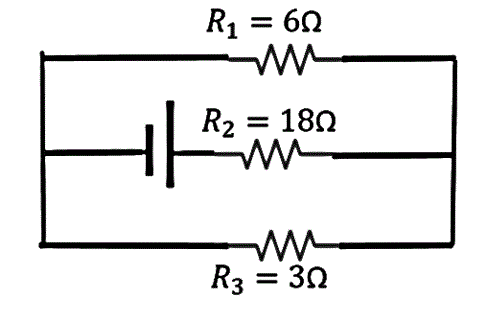
ثلاث مقاومات كما في الشكل: \(R_1=6\,\Omega\) و\(R_2=18\,\Omega\) و\(R_3=3\,\Omega\) والبطارية في فرع \(R_2\). المقاومة المكافئة التي «تراها» البطارية:Three resistors as shown: \(R_1=6\,\Omega\), \(R_2=18\,\Omega\) and \(R_3=3\,\Omega\), with the battery in the branch of \(R_2\). The equivalent resistance the battery «sees» is:
\(R_{eq}=1.8\,\Omega\)\(R_{eq}=1.8\,\Omega\)
\(R_{eq}=20\,\Omega\)\(R_{eq}=20\,\Omega\)
\(R_{eq}=14\,\Omega\)\(R_{eq}=14\,\Omega\)
\(R_{eq}=6.4\,\Omega\)\(R_{eq}=6.4\,\Omega\)
الحلSolution
📌 \(R_1\) و\(R_3\) على التوازي: \(R_{13}=\dfrac{6\times3}{6+3}=2\,\Omega\).
📌 والناتج على التوالي مع \(R_2\) (البطارية في فرعه): \(R_{eq}=2+18=20\,\Omega\).
✅ \(R_{eq}=20\,\Omega\) (B)
📌 \(R_1\) and \(R_3\) in parallel: \(R_{13}=\dfrac{6\times3}{6+3}=2\,\Omega\).
📌 The result is in series with \(R_2\) (the battery is in its branch): \(R_{eq}=2+18=20\,\Omega\).
✅ \(R_{eq}=20\,\Omega\) (B)
\[15\,\star\star\]
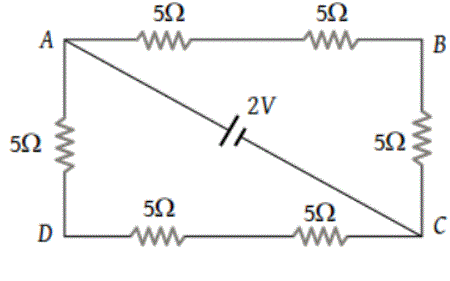
في الشكل ست مقاومات كل منها \(5\,\Omega\) وبطارية \(2\,V\) موصولة بين النقطتين \(A\) و\(C\). فرق الجهد \(V_{AB}\):In the figure six resistors of \(5\,\Omega\) each and a \(2\,V\) battery are connected between the points \(A\) and \(C\). The potential difference \(V_{AB}\) is:
\(V_{AB}=\tfrac{2}{3}\,V\)\(V_{AB}=\tfrac{2}{3}\,V\)
\(V_{AB}=\tfrac{3}{2}\,V\)\(V_{AB}=\tfrac{3}{2}\,V\)
\(V_{AB}=\tfrac{3}{4}\,V\)\(V_{AB}=\tfrac{3}{4}\,V\)
\(V_{AB}=\tfrac{4}{3}\,V\)\(V_{AB}=\tfrac{4}{3}\,V\)
الحلSolution
📌 المسار \(A\to B\to C\) فيه ثلاث مقاومات على التوالي \(5+5+5=15\,\Omega\) (مقاومتان بين \(A\) و\(B\) ثم واحدة بين \(B\) و\(C\))، والمسار الآخر مماثل، والبطارية تعطي \(2\,V\) بين \(A\) و\(C\).
📌 قاسم الجهد: \(V_{AB}=\dfrac{10}{15}\times2=\dfrac{4}{3}\,V\).
✅ \(V_{AB}=\tfrac{4}{3}\,V\) (D)
📌 The path \(A\to B\to C\) has three resistors in series \(5+5+5=15\,\Omega\) (two between \(A\) and \(B\) then one between \(B\) and \(C\)), the other path is identical, and the battery gives \(2\,V\) between \(A\) and \(C\).
📌 Voltage divider: \(V_{AB}=\dfrac{10}{15}\times2=\dfrac{4}{3}\,V\).
✅ \(V_{AB}=\tfrac{4}{3}\,V\) (D)
\[16\,\star\star\]
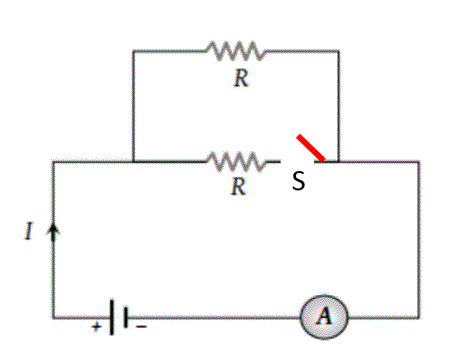
مقاومتان متساويتان، إحداهما موصولة بالمفتاح \(S\) وهي على التوازي مع الأخرى (الشكل). عند غلق المفتاح تصبح قراءة الأميتر:Two equal resistors, one of them connected through the switch \(S\) and in parallel with the other (the figure). When the switch is closed the ammeter reading:
تقل للنصفis halved
تبقى كما هيstays the same
تزداد للضعفdoubles
تزداد أربعة أضعافbecomes four times
الحلSolution
📌 قبل الغلق: \(I_1=\dfrac{V}{R}\).
📌 بعد الغلق تصبح المقاومتان على التوازي \(R_{eq}=\dfrac{R}{2}\) فـ \(I_2=\dfrac{V}{R/2}=\dfrac{2V}{R}=2I_1\).
✅ تزداد للضعف (C)
📌 Before closing: \(I_1=\dfrac{V}{R}\).
📌 After closing the two are in parallel \(R_{eq}=\dfrac{R}{2}\) so \(I_2=\dfrac{V}{R/2}=\dfrac{2V}{R}=2I_1\).
✅ doubles (C)
\[17\,\star\star\star\]
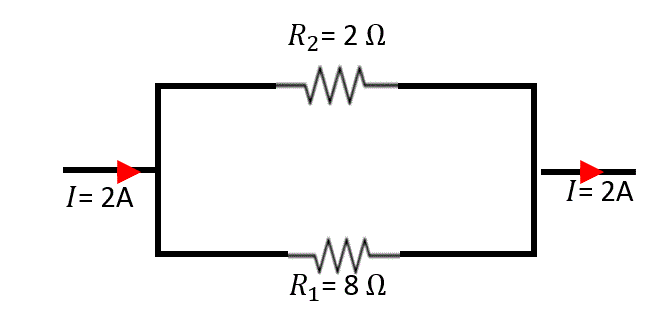
يتفرع تيار \(2\,A\) في مقاومتين على التوازي \(R_2=2\,\Omega\) و\(R_1=8\,\Omega\) كما في الشكل. شدة التيار المار في \(R_1\):A current of \(2\,A\) divides into two parallel resistors \(R_2=2\,\Omega\) and \(R_1=8\,\Omega\) as shown. The current through \(R_1\) is:
\(I=0.4\,A\)\(I=0.4\,A\)
\(I=0.8\,A\)\(I=0.8\,A\)
\(I=0.6\,A\)\(I=0.6\,A\)
\(I=0.2\,A\)\(I=0.2\,A\)
الحلSolution
📌 \(R_{12}=\dfrac{8\times2}{8+2}=1.6\,\Omega\).
📌 الجهد على الفرعين \(V=I\,R_{12}=2\times1.6=3.2\,V\).
\(I_1=\dfrac{V}{R_1}=\dfrac{3.2}{8}=0.4\,A\).
✅ \(I=0.4\,A\) (A)
📌 \(R_{12}=\dfrac{8\times2}{8+2}=1.6\,\Omega\).
📌 The voltage across the two branches \(V=I\,R_{12}=2\times1.6=3.2\,V\).
\(I_1=\dfrac{V}{R_1}=\dfrac{3.2}{8}=0.4\,A\).
✅ \(I=0.4\,A\) (A)
\[18\,\star\star\]
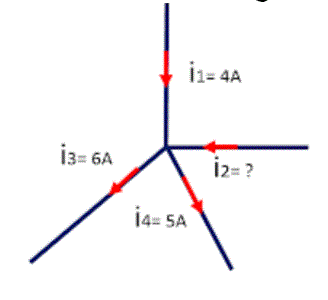
من قانون كيرشوف الأول (قانون التيارات)، التيار \(I_2\) في الشكل (الداخلان \(I_1=4\,A\) و\(I_2\)، والخارجان \(I_3=6\,A\) و\(I_4=5\,A\)) يساوي:From Kirchhoff’s first law (the current law), the current \(I_2\) in the figure (entering: \(I_1=4\,A\) and \(I_2\); leaving: \(I_3=6\,A\) and \(I_4=5\,A\)) equals:
\(I_2=4\,A\)\(I_2=4\,A\)
\(I_2=3\,A\)\(I_2=3\,A\)
\(I_2=7\,A\)\(I_2=7\,A\)
\(I_2=5\,A\)\(I_2=5\,A\)
الحلSolution
📌 قانون كيرشوف الأول: مجموع التيارات الداخلة إلى نقطة = مجموع التيارات الخارجة منها.
\(I_1+I_2=I_3+I_4\Rightarrow4+I_2=6+5\Rightarrow I_2=7\,A\).
✅ \(I_2=7\,A\) (C)
📌 Kirchhoff’s first law: the sum of the currents entering a junction = the sum of the currents leaving it.
\(I_1+I_2=I_3+I_4\Rightarrow4+I_2=6+5\Rightarrow I_2=7\,A\).
✅ \(I_2=7\,A\) (C)
\[19\,\star\star\]
ثلاث مقاومات متساوية قيمة كل منها \(100\,\Omega\) (تُستعمل كلها). أيّ القيم التالية لا يمكن أن تكون المقاومة المكافئة؟Three equal resistors of \(100\,\Omega\) each (all of them used). Which of the following values cannot be the equivalent resistance?
\(150\,\Omega\)\(150\,\Omega\)
\(20\,\Omega\)\(20\,\Omega\)
\(300\,\Omega\)\(300\,\Omega\)
\(33.3\,\Omega\)\(33.3\,\Omega\)
الحلSolution
📌 الثلاث على التوالي \(300\,\Omega\)؛ الثلاث على التوازي \(33.3\,\Omega\)؛ اثنتان على التوازي مع الثالثة على التوالي \(100+50=150\,\Omega\)؛ واثنتان على التوالي مع الثالثة على التوازي \(\dfrac{200\times100}{300}=66.7\,\Omega\).
📌 أصغر قيمة ممكنة \(33.3\,\Omega\)، فالقيمة \(20\,\Omega\) أقل منها ولا يمكن الحصول عليها.
✅ \(20\,\Omega\) (B)
📌 All three in series \(300\,\Omega\); all three in parallel \(33.3\,\Omega\); two in parallel in series with the third \(100+50=150\,\Omega\); two in series in parallel with the third \(\dfrac{200\times100}{300}=66.7\,\Omega\).
📌 The smallest possible value is \(33.3\,\Omega\), so \(20\,\Omega\) is below it and cannot be obtained.
✅ \(20\,\Omega\) (B)
\[20\,\star\star\]
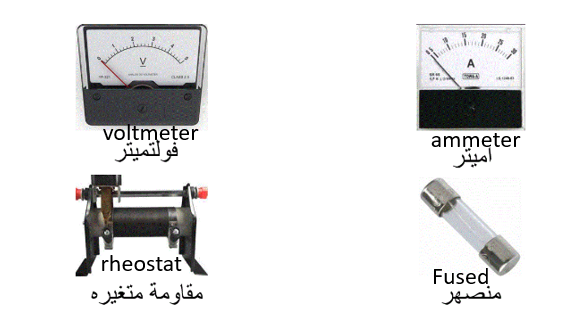
أي جهاز إذا وُصل على التوالي في الدائرة يمنع مرور التيار تقريبًا؟Which instrument, if connected in series in the circuit, practically blocks the current?
فولتميترa voltmeter
منصهرa fuse
أميترan ammeter
مقاومة متغيرةa rheostat
الحلSolution
📌 الفولتميتر مقاومته كبيرة جدًا ويُوصل على التوازي؛ فإذا وُصل على التوالي منع مرور التيار تقريبًا.
📌 الأميتر مقاومته صغيرة جدًا ويُوصل على التوالي، والمنصهر والمقاومة المتغيرة يُوصلان على التوالي أيضًا دون منع التيار.
✅ فولتميتر (A)
📌 A voltmeter has a very large resistance and is connected in parallel; connected in series it practically blocks the current.
📌 The ammeter has a very small resistance and is connected in series; the fuse and the rheostat are also connected in series without blocking the current.
✅ a voltmeter (A)
\[21\,\star\star\]
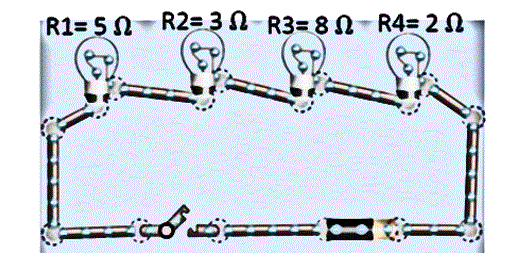
أربعة مصابيح على التوالي مقاوماتها \(R_1=5\,\Omega\) و\(R_2=3\,\Omega\) و\(R_3=8\,\Omega\) و\(R_4=2\,\Omega\). أي المصابيح أكثر سطوعًا؟Four lamps in series have resistances \(R_1=5\,\Omega\), \(R_2=3\,\Omega\), \(R_3=8\,\Omega\) and \(R_4=2\,\Omega\). Which lamp is the brightest?
\(R_3=8\)\(R_3=8\)
\(R_1=5\)\(R_1=5\)
\(R_2=3\)\(R_2=3\)
\(R_4=2\)\(R_4=2\)
الحلSolution
📌 على التوالي التيار واحد في الجميع والقدرة \(P=I^{2}R\) تتناسب طرديًا مع المقاومة.
📌 أكبر مقاومة \(R_3=8\,\Omega\) فمصباحها أكثر سطوعًا.
✅ \(R_3=8\) (A)
📌 In series the current is the same in all and the power \(P=I^{2}R\) is directly proportional to the resistance.
📌 The largest resistance is \(R_3=8\,\Omega\), so its lamp is the brightest.
✅ \(R_3=8\) (A)
\[22\,\star\star\star\]
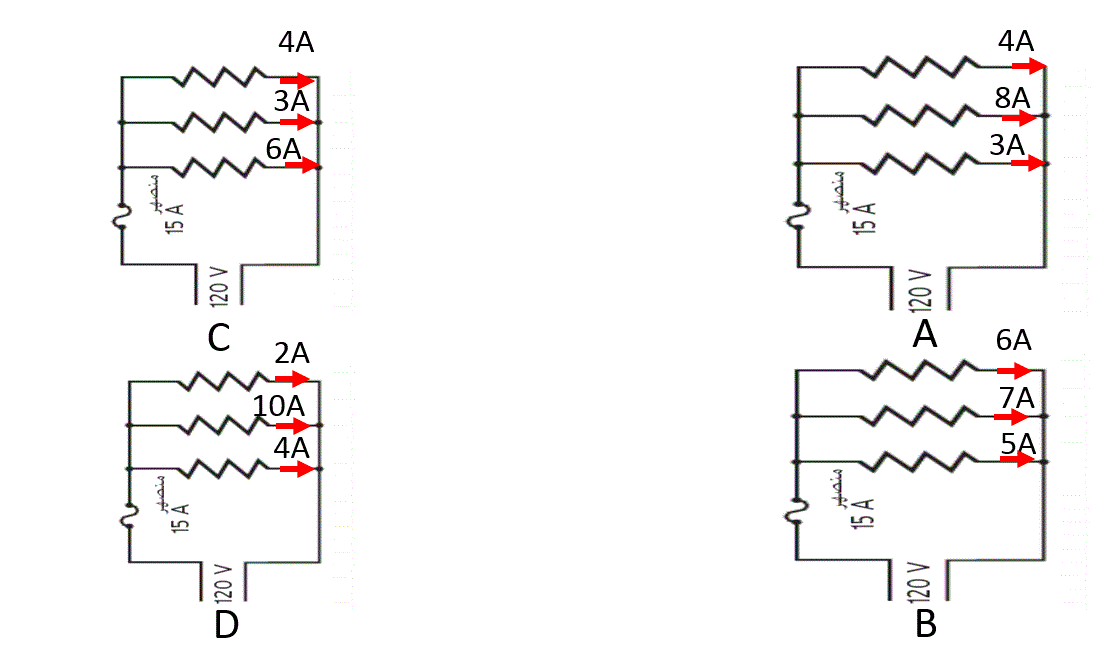
مجموعة مقاومات مع منصهر \(15\,A\) على التوالي في الدارة الرئيسية (الأشكال). أي الدوائر تصلح لهذا المنصهر (التيار الكلي أقل من \(15\,A\))؟A group of resistors with a \(15\,A\) fuse in series in the main line (the figures). Which circuit is suitable for this fuse (the total current below \(15\,A\))?
AA
BB
CC
DD
الحلSolution
📌 التيار الكلي هو مجموع تيارات الفروع المتوازية: الدائرة A \(4+8+3=15\,A\) (يساوي حد المنصهر تمامًا فلا هامش أمان)، B \(6+7+5=18\,A\)، D \(2+10+4=16\,A\).
📌 الدائرة C فقط تعطي \(4+3+6=13\,A\lt 15\,A\) فيصلح لها المنصهر.
✅ C
📌 The total current is the sum of the currents of the parallel branches: circuit A \(4+8+3=15\,A\) (exactly the fuse limit, no safety margin), B \(6+7+5=18\,A\), D \(2+10+4=16\,A\).
📌 Only circuit C gives \(4+3+6=13\,A\lt 15\,A\), so the fuse suits it.
✅ C
\[23\,\star\]
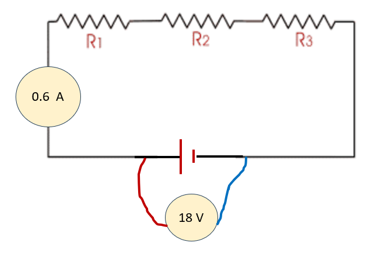
ثلاث مقاومات على التوالي \(R_1=5\,\Omega\) و\(R_2=10\,\Omega\) و\(R_3\) مجهولة؛ قراءة الأميتر \(0.6\,A\) وفرق جهد البطارية \(18\,V\). قيمة \(R_3\):Three resistors in series \(R_1=5\,\Omega\), \(R_2=10\,\Omega\) and an unknown \(R_3\); the ammeter reads \(0.6\,A\) and the battery voltage is \(18\,V\). The value of \(R_3\) is:
\(R_3=5\,\Omega\)\(R_3=5\,\Omega\)
\(R_3=15\,\Omega\)\(R_3=15\,\Omega\)
\(R_3=20\,\Omega\)\(R_3=20\,\Omega\)
\(R_3=10\,\Omega\)\(R_3=10\,\Omega\)
الحلSolution
\(R_{eq}=\dfrac{V}{I}=\dfrac{18}{0.6}=30\,\Omega\).
\(30=5+10+R_3\Rightarrow R_3=15\,\Omega\).
✅ \(R_3=15\,\Omega\) (B)
\(R_{eq}=\dfrac{V}{I}=\dfrac{18}{0.6}=30\,\Omega\).
\(30=5+10+R_3\Rightarrow R_3=15\,\Omega\).
✅ \(R_3=15\,\Omega\) (B)
\[24\,\star\star\]
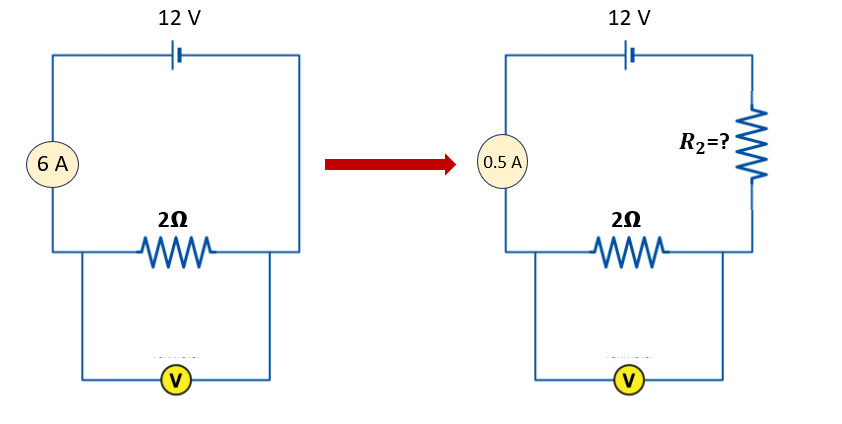
مقاومة \(R=2\,\Omega\) مع بطارية \(12\,V\) يمر فيها تيار \(6\,A\). نريد أن يصبح التيار \(0.5\,A\) بإضافة مقاومة على التوالي. قيمة المقاومة المضافة:A resistor \(R=2\,\Omega\) with a \(12\,V\) battery carries a current of \(6\,A\). We want the current to become \(0.5\,A\) by adding a resistor in series. The added resistance is:
\(R=16\,\Omega\)\(R=16\,\Omega\)
\(R=18\,\Omega\)\(R=18\,\Omega\)
\(R=20\,\Omega\)\(R=20\,\Omega\)
\(R=22\,\Omega\)\(R=22\,\Omega\)
الحلSolution
\(R_{total}=\dfrac{V}{I}=\dfrac{12}{0.5}=24\,\Omega\).
\(R_{added}=24-2=22\,\Omega\).
✅ \(R=22\,\Omega\) (D)
\(R_{total}=\dfrac{V}{I}=\dfrac{12}{0.5}=24\,\Omega\).
\(R_{added}=24-2=22\,\Omega\).
✅ \(R=22\,\Omega\) (D)
\[25\,\star\star\]
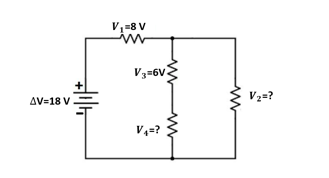
مجموعة مقاومات متصلة ببطارية \(\Delta V=18\,V\)، فرق الجهد على \(R_1\) هو \(V_1=8\,V\) وعلى \(R_3\) هو \(V_3=6\,V\) (\(R_3\) و\(R_4\) على التوالي في فرع، و\(R_2\) في الفرع الموازي له). باستخدام قانون كيرشوف للحلقات:A group of resistors is connected to a battery \(\Delta V=18\,V\); the voltage across \(R_1\) is \(V_1=8\,V\) and across \(R_3\) it is \(V_3=6\,V\) (\(R_3\) and \(R_4\) in series in one branch, and \(R_2\) in the parallel branch). Using Kirchhoff’s loop rule:
\(V_2=8,\ V_4=10\)\(V_2=8,\ V_4=10\)
\(V_2=10,\ V_4=4\)\(V_2=10,\ V_4=4\)
\(V_2=2,\ V_4=4\)\(V_2=2,\ V_4=4\)
\(V_2=6,\ V_4=14\)\(V_2=6,\ V_4=14\)
الحلSolution
📌 الحلقة التي فيها \(R_1\) و\(R_2\): \(18-8-V_2=0\Rightarrow V_2=10\,V\).
📌 الفرع \(R_3\) و\(R_4\) موازٍ لـ \(R_2\) فمجموع جهديهما \(10\,V\): \(V_3+V_4=10\Rightarrow V_4=10-6=4\,V\).
✅ \(V_2=10,\ V_4=4\) (B)
📌 The loop containing \(R_1\) and \(R_2\): \(18-8-V_2=0\Rightarrow V_2=10\,V\).
📌 The branch of \(R_3\) and \(R_4\) is parallel to \(R_2\), so their voltages add up to \(10\,V\): \(V_3+V_4=10\Rightarrow V_4=10-6=4\,V\).
✅ \(V_2=10,\ V_4=4\) (B)
\[26\,\star\star\]
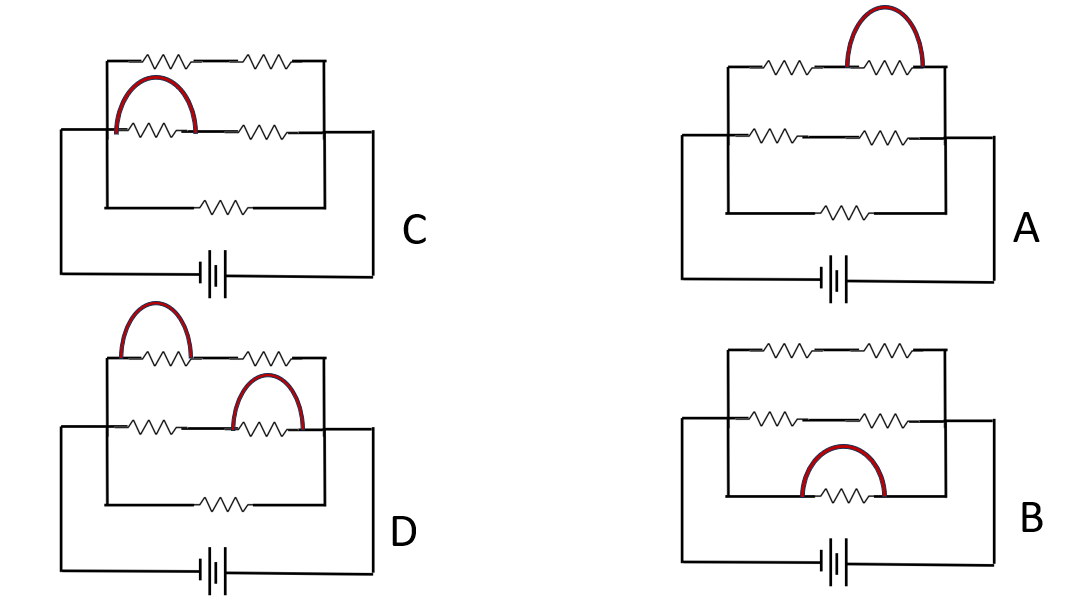
أيّ الأشكال التالية يمثل دائرة قصر؟Which of the following figures represents a short circuit?
AA
BB
CC
DD
الحلSolution
📌 تحدث دائرة القصر عندما يوجد مسار موصل بلا مقاومة بين قطبي المصدر، فيكبر التيار كثيرًا.
📌 في الشكل B يوصل السلك الفرع السفلي (مقاومة واحدة) فيصبح فرعًا بلا مقاومة بالتوازي مع بقية الفروع: المقاومة المكافئة صفر ودائرة قصر. أما في A وC وD فالأسلاك تقصّر مقاومة واحدة من فرع فيه مقاومتان فتبقى في كل فرع مقاومة.
✅ B
📌 A short circuit occurs when there is a path of zero resistance between the source terminals, so the current becomes very large.
📌 In figure B the wire bridges the bottom branch (a single resistor), leaving a zero-resistance branch in parallel with the others: the equivalent resistance is zero, a short circuit. In A, C and D the wires bypass only one resistor of a two-resistor branch, so every branch keeps some resistance.
✅ B
\[27\,\star\star\]
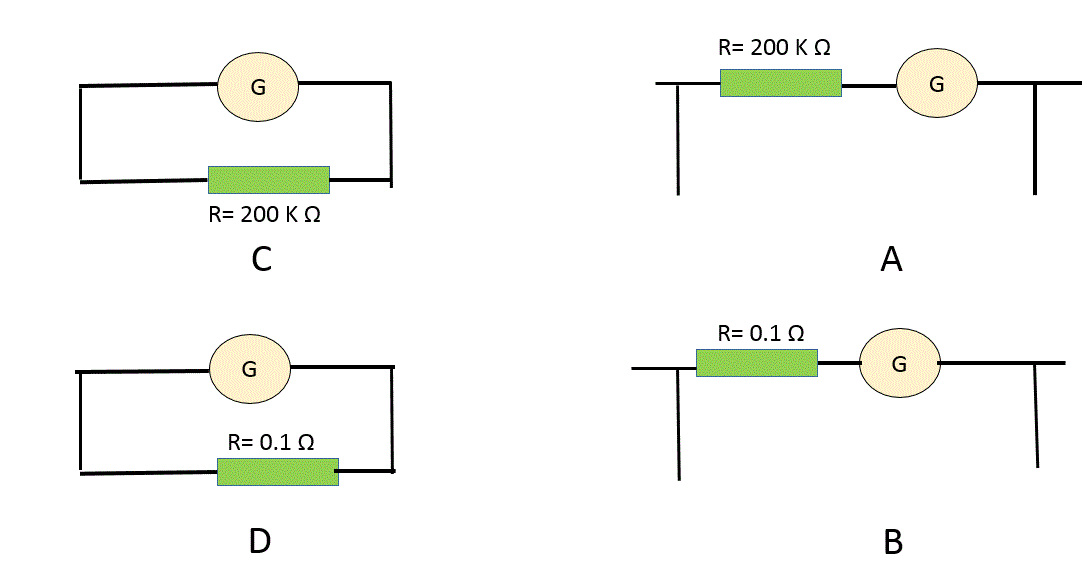
أيّ الأشكال التالية يمثل جلفانومترًا مُحوَّلًا إلى أميتر؟Which figure represents a galvanometer converted into an ammeter?
AA
BB
CC
DD
الحلSolution
📌 لتحويل الجلفانومتر إلى أميتر نوصل مقاومة صغيرة جدًا (مجزّئ تيار) على التوازي معه فيمر معظم التيار فيها.
📌 الشكل D فيه مقاومة \(0.1\,\Omega\) على التوازي مع الجلفانومتر. (مقاومة كبيرة على التوالي، مثل \(200\,k\Omega\)، تحوّله إلى فولتميتر.)
✅ D
📌 To convert a galvanometer into an ammeter we connect a very small resistance (a shunt) in parallel with it so most of the current passes through it.
📌 Figure D has a \(0.1\,\Omega\) resistor in parallel with the galvanometer. (A large series resistance, such as \(200\,k\Omega\), converts it into a voltmeter.)
✅ D
\[28\,\star\star\star\]
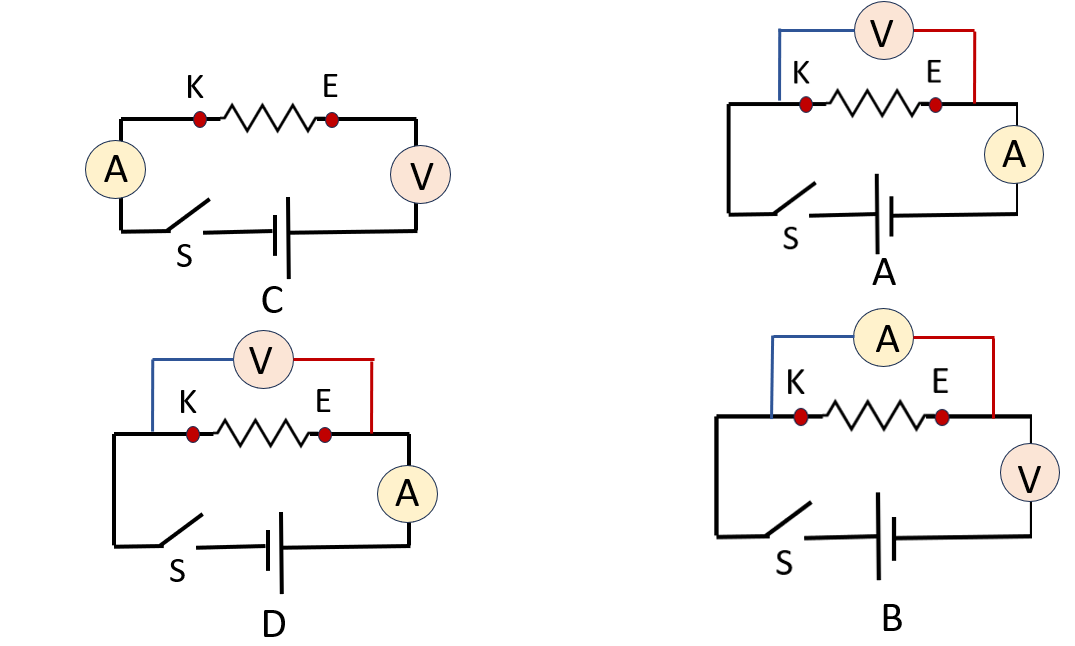
أيّ الدوائر التالية يمر فيها، عند غلق المفتاح، تيار اصطلاحي من النقطة \(E\) إلى النقطة \(K\) عبر المقاوم (مع توصيل صحيح للأميتر والفولتميتر)؟In which circuit does a conventional current flow, when the switch is closed, from the point \(E\) to the point \(K\) through the resistor (with correct connection of the ammeter and the voltmeter)?
AA
BB
CC
DD
الحلSolution
📌 التيار الاصطلاحي يخرج من القطب الموجب (الخط الأطول في رمز البطارية) ويعود إلى القطب السالب.
📌 في الدائرة D القطب الموجب جهة اليمين فيمر التيار عبر الأميتر إلى \(E\) ثم المقاوم إلى \(K\) ثم المفتاح، والفولتميتر على التوازي مع المقاوم والأميتر على التوالي (توصيل صحيح).
✅ D
📌 The conventional current leaves the positive terminal (the longer line in the battery symbol) and returns to the negative one.
📌 In circuit D the positive terminal is on the right so the current passes through the ammeter to \(E\), then through the resistor to \(K\), then the switch; the voltmeter is in parallel with the resistor and the ammeter in series (correct connection).
✅ D
\[29\,\star\star\]
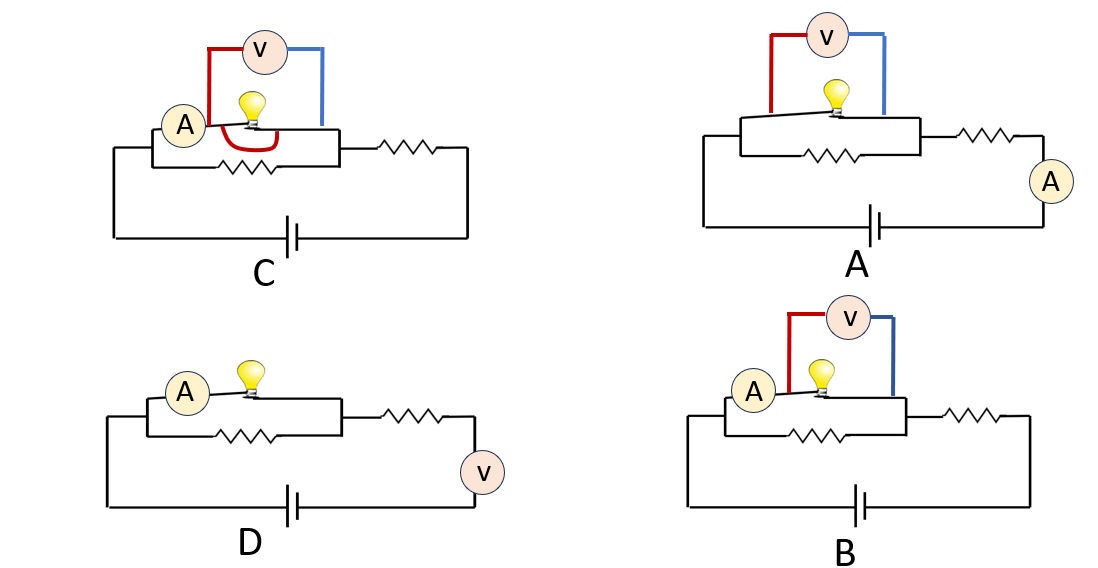
أيّ الرسوم التخطيطية يوضح الطريقة الصحيحة لقياس شدة التيار المار في المصباح وفرق الجهد بين طرفيه؟Which diagram shows the correct way to measure the current through the lamp and the voltage across it?
AA
BB
CC
DD
الحلSolution
📌 الأميتر على التوالي مع المصباح (في فرعه) والفولتميتر على التوازي مع المصباح.
📌 هذا ما يحققه الشكل B فقط؛ ففي A الأميتر في الدارة الرئيسية فيقيس التيار الكلي، وفي D الفولتميتر خارج المصباح.
✅ B
📌 The ammeter in series with the lamp (in its branch) and the voltmeter in parallel with the lamp.
📌 Only figure B does this; in A the ammeter is in the main line so it measures the total current, and in D the voltmeter is not across the lamp.
✅ B
\[30\,\star\star\star\]
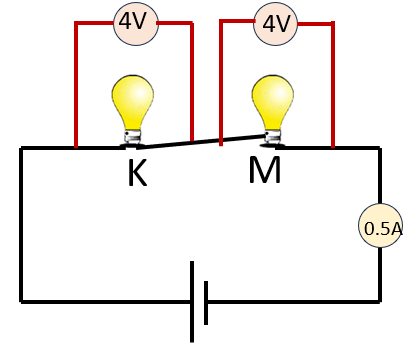
إذا احترق المصباح \(K\) (مصباحان \(K\) و\(M\) على التوالي ببطارية \(8\,V\)، ولكل منهما فولتميتر)، تصبح القراءات:If the lamp \(K\) burns out (two lamps \(K\) and \(M\) in series with an \(8\,V\) battery, each with a voltmeter), the readings become:
\(V_K=0,\ V_M=4,\ I=0\)\(V_K=0,\ V_M=4,\ I=0\)
\(V_K=0,\ V_M=0,\ I=0\)\(V_K=0,\ V_M=0,\ I=0\)
\(V_K=0,\ V_M=4,\ I=0.5\)\(V_K=0,\ V_M=4,\ I=0.5\)
\(V_K=8,\ V_M=0,\ I=0\)\(V_K=8,\ V_M=0,\ I=0\)
الحلSolution
📌 احتراق \(K\) يفتح الدائرة فالتيار \(I=0\).
📌 لا يمر تيار في \(M\) فلا هبوط جهد عليه: \(V_M=0\). أما فولتميتر \(K\) فيصبح موصولًا بقطبي البطارية عبر \(M\) (بلا هبوط جهد) فيقرأ جهد المصدر \(V_K=8\,V\).
✅ \(V_K=8,\ V_M=0,\ I=0\) (D)
📌 Burning out \(K\) opens the circuit so \(I=0\).
📌 No current flows in \(M\) so there is no voltage drop across it: \(V_M=0\). The voltmeter of \(K\) is now connected across the battery through \(M\) (no drop) so it reads the source voltage \(V_K=8\,V\).
✅ \(V_K=8,\ V_M=0,\ I=0\) (D)
\[31\,\star\star\]
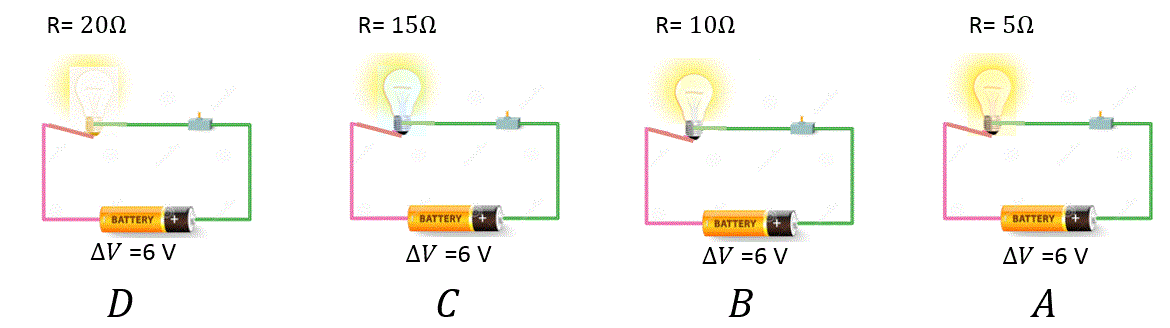
أربع دوائر فيها بطارية \(6\,V\) ومصباح مقاومته \(20,\ 15,\ 10,\ 5\,\Omega\) على الترتيب (D وC وB وA). أي المصابيح يستهلك أكبر طاقة في ساعة؟Four circuits each have a \(6\,V\) battery and a lamp of resistance \(20,\ 15,\ 10,\ 5\,\Omega\) respectively (D, C, B and A). Which lamp consumes the most energy in an hour?
AA
BB
CC
DD
الحلSolution
📌 الطاقة \(E=P\,t\) والزمن واحد، والجهد واحد فالقدرة \(P=\dfrac{V^{2}}{R}\) تتناسب عكسيًا مع المقاومة.
📌 المصباح A له أصغر مقاومة \(5\,\Omega\) فأكبر قدرة \(\dfrac{36}{5}=7.2\,W\) وأكبر طاقة.
✅ A
📌 The energy is \(E=P\,t\) with the same time and the same voltage, so the power \(P=\dfrac{V^{2}}{R}\) is inversely proportional to the resistance.
📌 Lamp A has the smallest resistance \(5\,\Omega\) so the largest power \(\dfrac{36}{5}=7.2\,W\) and the greatest energy.
✅ A
\[32\,\star\star\star\]
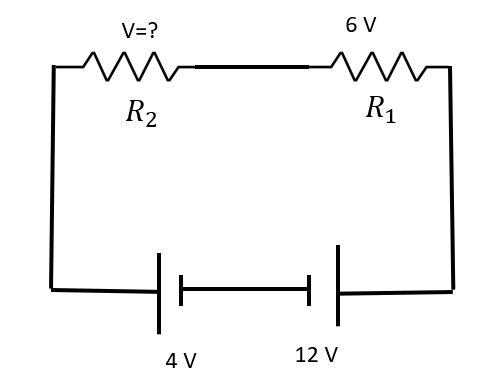
بطاريتان في دائرة على التوالي بقطبية متعاكسة (\(4\,V\) و\(12\,V\))، مع مقاومتين \(R_1\) و\(R_2\)؛ فرق الجهد على \(R_1\) يساوي \(6\,V\). من قاعدة كيرشوف للحلقة، \(V_2\) يساوي:Two batteries in series with opposing polarity (\(4\,V\) and \(12\,V\)) drive two resistors \(R_1\) and \(R_2\); the voltage across \(R_1\) is \(6\,V\). From Kirchhoff’s loop rule \(V_2\) equals:
\(V_2=2\,V\)\(V_2=2\,V\)
\(V_2=14\,V\)\(V_2=14\,V\)
\(V_2=4\,V\)\(V_2=4\,V\)
\(V_2=10\,V\)\(V_2=10\,V\)
الحلSolution
📌 البطاريتان متعاكستا القطبية فالقوة الدافعة الصافية \(12-4=8\,V\).
📌 قاعدة الحلقة: \(8-V_1-V_2=0\Rightarrow V_2=8-6=2\,V\).
✅ \(V_2=2\,V\) (A)
📌 The batteries oppose each other so the net emf is \(12-4=8\,V\).
📌 The loop rule: \(8-V_1-V_2=0\Rightarrow V_2=8-6=2\,V\).
✅ \(V_2=2\,V\) (A)
\[33\,\star\]
مادة تنعدم مقاومتها الكهربائية عند درجة حرارة \(T=77.3\,K\) (وجهد \(V=0\))، ما اسم هذه المواد؟A material whose electrical resistance vanishes at the temperature \(T=77.3\,K\) (and \(V=0\)). What are such materials called?
الموصلاتConductors
العوازلInsulators
فائقة التوصيلSuperconductors
أشباه الموصلاتSemiconductors
الحلSolution
📌 المواد فائقة التوصيل تنعدم مقاومتها الكهربائية عند درجات حرارة منخفضة جدًا، وأول مادة اكتُشفت كانت الزئبق عند \(4.2\,K\).
✅ فائقة التوصيل (C)
📌 Superconductors lose their electrical resistance at very low temperatures; the first one discovered was mercury at \(4.2\,K\).
✅ Superconductors (C)
\[34\,\star\]
مقاومة \(4\,\Omega\) موصولة بمصدر جهده \(12\,V\). شدة التيار المار فيها:A resistor of \(4\,\Omega\) is connected to a \(12\,V\) source. The current through it is:
\(3\,A\)\(3\,A\)
\(48\,A\)\(48\,A\)
\(0.33\,A\)\(0.33\,A\)
\(8\,A\)\(8\,A\)
الحلSolution
📌 قانون أوم: \(I=\dfrac{V}{R}=\dfrac{12}{4}=3\,A\).
✅ \(3\,A\) (A)
📌 Ohm’s law: \(I=\dfrac{V}{R}=\dfrac{12}{4}=3\,A\).
✅ \(3\,A\) (A)
\[35\,\star\]
جهاز قياس فرق الجهد بين طرفي عنصر في دائرة وطريقة توصيله:The instrument that measures the potential difference across a circuit element and how it is connected:
الفولتميتر على التواليthe voltmeter, in series
الفولتميتر على التوازيthe voltmeter, in parallel
الأميتر على التوازيthe ammeter, in parallel
الأميتر على التواليthe ammeter, in series
الحلSolution
📌 الفولتميتر يقيس فرق الجهد ويُوصل على التوازي مع العنصر (مقاومته كبيرة جدًا)، والأميتر يقيس التيار على التوالي.
✅ الفولتميتر على التوازي (B)
📌 The voltmeter measures the potential difference and is connected in parallel with the element (very large resistance); the ammeter measures the current in series.
✅ the voltmeter, in parallel (B)
\[36\,\star\]
ثلاث مقاومات \(2\,\Omega\) و\(3\,\Omega\) و\(5\,\Omega\) على التوالي. المقاومة المكافئة:Three resistors \(2\,\Omega\), \(3\,\Omega\) and \(5\,\Omega\) in series. The equivalent resistance is:
\(0.97\,\Omega\)\(0.97\,\Omega\)
\(30\,\Omega\)\(30\,\Omega\)
\(3.3\,\Omega\)\(3.3\,\Omega\)
\(10\,\Omega\)\(10\,\Omega\)
الحلSolution
\(R_{eq}=2+3+5=10\,\Omega\).
✅ \(10\,\Omega\) (D)
\(R_{eq}=2+3+5=10\,\Omega\).
✅ \(10\,\Omega\) (D)
\[37\,\star\star\]
مقاومتان \(6\,\Omega\) و\(3\,\Omega\) على التوازي. المقاومة المكافئة:Two resistors \(6\,\Omega\) and \(3\,\Omega\) in parallel. The equivalent resistance is:
\(9\,\Omega\)\(9\,\Omega\)
\(2\,\Omega\)\(2\,\Omega\)
\(4.5\,\Omega\)\(4.5\,\Omega\)
\(18\,\Omega\)\(18\,\Omega\)
الحلSolution
\(R_{eq}=\dfrac{6\times3}{6+3}=\dfrac{18}{9}=2\,\Omega\) (وهي أصغر من أصغر المقاومتين).
✅ \(2\,\Omega\) (B)
\(R_{eq}=\dfrac{6\times3}{6+3}=\dfrac{18}{9}=2\,\Omega\) (smaller than the smallest resistor).
✅ \(2\,\Omega\) (B)
\[38\,\star\star\]
مقاومتان \(4\,\Omega\) و\(8\,\Omega\) على التوالي بمصدر \(12\,V\). فرق الجهد على المقاومة \(8\,\Omega\):Two resistors \(4\,\Omega\) and \(8\,\Omega\) in series with a \(12\,V\) source. The voltage across the \(8\,\Omega\) resistor is:
\(4\,V\)\(4\,V\)
\(6\,V\)\(6\,V\)
\(12\,V\)\(12\,V\)
\(8\,V\)\(8\,V\)
الحلSolution
\(I=\dfrac{12}{4+8}=1\,A\).
\(V=IR=1\times8=8\,V\).
✅ \(8\,V\) (D)
\(I=\dfrac{12}{4+8}=1\,A\).
\(V=IR=1\times8=8\,V\).
✅ \(8\,V\) (D)
\[39\,\star\star\]
مقاومتان \(6\,\Omega\) و\(12\,\Omega\) على التوازي بمصدر \(12\,V\). التيار الكلي الخارج من المصدر:Two resistors \(6\,\Omega\) and \(12\,\Omega\) in parallel with a \(12\,V\) source. The total current from the source is:
\(1\,A\)\(1\,A\)
\(2\,A\)\(2\,A\)
\(3\,A\)\(3\,A\)
\(4\,A\)\(4\,A\)
الحلSolution
📌 لكل فرع الجهد نفسه \(12\,V\): \(I_1=\dfrac{12}{6}=2\,A\) و\(I_2=\dfrac{12}{12}=1\,A\).
📌 التيار الكلي \(2+1=3\,A\).
✅ \(3\,A\) (C)
📌 Each branch has the same voltage \(12\,V\): \(I_1=\dfrac{12}{6}=2\,A\) and \(I_2=\dfrac{12}{12}=1\,A\).
📌 The total current is \(2+1=3\,A\).
✅ \(3\,A\) (C)
\[40\,\star\star\]
مصباح مكتوب عليه \(60\,W,\ 120\,V\) يعمل على جهده المقنن. مقاومته:A lamp rated \(60\,W,\ 120\,V\) works at its rated voltage. Its resistance is:
\(0.5\,\Omega\)\(0.5\,\Omega\)
\(2\,\Omega\)\(2\,\Omega\)
\(7200\,\Omega\)\(7200\,\Omega\)
\(240\,\Omega\)\(240\,\Omega\)
الحلSolution
📌 \(P=\dfrac{V^{2}}{R}\Rightarrow R=\dfrac{V^{2}}{P}=\dfrac{120^{2}}{60}=240\,\Omega\).
✅ \(240\,\Omega\) (D)
📌 \(P=\dfrac{V^{2}}{R}\Rightarrow R=\dfrac{V^{2}}{P}=\dfrac{120^{2}}{60}=240\,\Omega\).
✅ \(240\,\Omega\) (D)
\[41\,\star\star\star\]
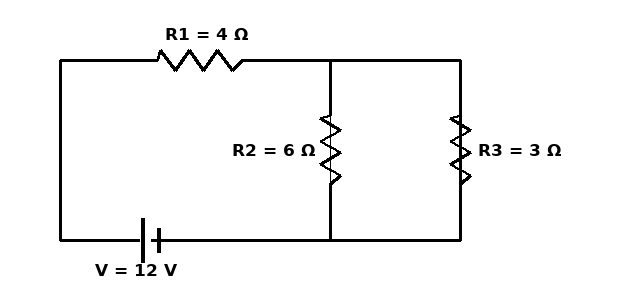
في الشكل: \(R_1=4\,\Omega\) على التوالي مع \(R_2=6\,\Omega\) و\(R_3=3\,\Omega\) الموصولتين على التوازي، ومصدر \(12\,V\). فرق الجهد بين طرفي \(R_3\):In the figure: \(R_1=4\,\Omega\) in series with \(R_2=6\,\Omega\) and \(R_3=3\,\Omega\) connected in parallel, and a \(12\,V\) source. The voltage across \(R_3\) is:
\(8\,V\)\(8\,V\)
\(4\,V\)\(4\,V\)
\(6\,V\)\(6\,V\)
\(2\,V\)\(2\,V\)
الحلSolution
\(R_{23}=\dfrac{6\times3}{9}=2\,\Omega\) ثم \(R_{eq}=4+2=6\,\Omega\).
\(I=\dfrac{12}{6}=2\,A\) ومنه \(V_{23}=2\times2=4\,V\) وهو فرق الجهد على \(R_3\).
✅ \(4\,V\) (B)
\(R_{23}=\dfrac{6\times3}{9}=2\,\Omega\) then \(R_{eq}=4+2=6\,\Omega\).
\(I=\dfrac{12}{6}=2\,A\) so \(V_{23}=2\times2=4\,V\), which is the voltage across \(R_3\).
✅ \(4\,V\) (B)
\[42\,\star\star\star\]
أُضيف مصباح ثالث مماثل على التوازي مع مصباحين موصولين ببطارية مثالية. التيار الخارج من البطارية:A third identical lamp is added in parallel with two lamps connected to an ideal battery. The current from the battery:
يقلdecreases
لا يتغيرdoes not change
يزدادincreases
ينعدمbecomes zero
الحلSolution
📌 إضافة فرع جديد على التوازي تُنقص المقاومة المكافئة، والجهد ثابت فالتيار \(I=V/R_{eq}\) يزداد (بإضافة تيار الفرع الجديد).
✅ يزداد (C)
📌 Adding a new parallel branch decreases the equivalent resistance; the voltage is constant so the current \(I=V/R_{eq}\) increases (by the current of the new branch).
✅ increases (C)
\[43\,\star\star\star\]
مصباحان مكتوب على الأول \(60\,W\) وعلى الثاني \(100\,W\) (كلاهما \(120\,V\)) وُصلا على التوالي بمصدر \(120\,V\). أيهما أكثر سطوعًا؟Two lamps rated \(60\,W\) and \(100\,W\) (both \(120\,V\)) are connected in series to a \(120\,V\) source. Which is brighter?
مصباح 60 واطthe 60 W lamp
مصباح 100 واطthe 100 W lamp
متساويان في السطوعthey are equally bright
لا يضيء أي منهماneither lights
الحلSolution
📌 المقاومتان: \(R_{60}=\dfrac{120^{2}}{60}=240\,\Omega\) و\(R_{100}=\dfrac{120^{2}}{100}=144\,\Omega\).
📌 على التوالي التيار واحد والقدرة \(P=I^{2}R\) أكبر للمقاومة الأكبر، فمصباح \(60\,W\) أكثر سطوعًا (عكس حالة التوازي).
✅ مصباح 60 واط (A)
📌 The resistances: \(R_{60}=\dfrac{120^{2}}{60}=240\,\Omega\) and \(R_{100}=\dfrac{120^{2}}{100}=144\,\Omega\).
📌 In series the current is the same and the power \(P=I^{2}R\) is larger for the larger resistance, so the \(60\,W\) lamp is brighter (the opposite of the parallel case).
✅ the 60 W lamp (A)
\[44\,\star\star\star\]
مقاومتان \(100\,\Omega\) و\(300\,\Omega\) على التوالي بمصدر \(20\,V\). فرق الجهد على المقاومة \(300\,\Omega\):Two resistors \(100\,\Omega\) and \(300\,\Omega\) in series with a \(20\,V\) source. The voltage across the \(300\,\Omega\) resistor is:
\(15\,V\)\(15\,V\)
\(5\,V\)\(5\,V\)
\(10\,V\)\(10\,V\)
\(20\,V\)\(20\,V\)
الحلSolution
📌 قاسم الجهد: \(V=\dfrac{300}{100+300}\times20=15\,V\).
✅ \(15\,V\) (A)
📌 Voltage divider: \(V=\dfrac{300}{100+300}\times20=15\,V\).
✅ \(15\,V\) (A)
\[45\,\star\star\star\]
أربع مقاومات متماثلة \(6\,\Omega\): مقاومتان على التوالي وُصلتا على التوازي مع مقاومتين أخريين على التوالي. المقاومة المكافئة:Four identical resistors of \(6\,\Omega\): two in series connected in parallel with two others in series. The equivalent resistance is:
\(3\,\Omega\)\(3\,\Omega\)
\(6\,\Omega\)\(6\,\Omega\)
\(12\,\Omega\)\(12\,\Omega\)
\(24\,\Omega\)\(24\,\Omega\)
الحلSolution
📌 كل فرع: \(6+6=12\,\Omega\).
📌 الفرعان متماثلان على التوازي: \(R_{eq}=\dfrac{12}{2}=6\,\Omega\).
✅ \(6\,\Omega\) (B)
📌 Each branch: \(6+6=12\,\Omega\).
📌 The two identical branches in parallel: \(R_{eq}=\dfrac{12}{2}=6\,\Omega\).
✅ \(6\,\Omega\) (B)
\[46\,\star\star\star\star\]
يدخل تيار \(8\,A\) إلى نقطة تتفرع منها مقاومتان على التوازي \(3\,\Omega\) و\(6\,\Omega\). التيار المار في المقاومة \(3\,\Omega\):A current of \(8\,A\) enters a junction from which two resistors \(3\,\Omega\) and \(6\,\Omega\) branch in parallel. The current through the \(3\,\Omega\) resistor is:
\(2.67\,A\)\(2.67\,A\)
\(4\,A\)\(4\,A\)
\(5.33\,A\)\(5.33\,A\)
\(8\,A\)\(8\,A\)
الحلSolution
📌 التيار يتوزع عكسيًا مع المقاومة: \(I_3=8\times\dfrac{6}{3+6}=5.33\,A\).
📌 تحقق: \(V=\dfrac{3\times6}{9}\times8=16\,V\) ومنه \(I_3=\dfrac{16}{3}=5.33\,A\) و\(I_6=2.67\,A\) ومجموعهما \(8\,A\).
✅ \(5.33\,A\) (C)
📌 The current divides inversely with the resistance: \(I_3=8\times\dfrac{6}{3+6}=5.33\,A\).
📌 Check: \(V=\dfrac{3\times6}{9}\times8=16\,V\) so \(I_3=\dfrac{16}{3}=5.33\,A\) and \(I_6=2.67\,A\), summing to \(8\,A\).
✅ \(5.33\,A\) (C)
\[47\,\star\star\star\star\]
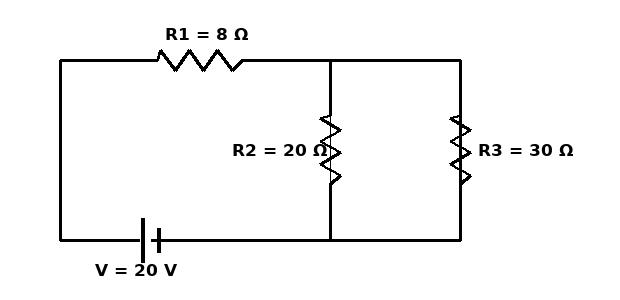
في الشكل: \(R_1=8\,\Omega\) على التوالي مع المقاومتين \(R_2=20\,\Omega\) و\(R_3=30\,\Omega\) الموصولتين على التوازي، ومصدر \(20\,V\). التيار المار في \(R_3\):In the figure: \(R_1=8\,\Omega\) in series with \(R_2=20\,\Omega\) and \(R_3=30\,\Omega\) connected in parallel, and a \(20\,V\) source. The current through \(R_3\) is:
\(0.4\,A\)\(0.4\,A\)
\(0.2\,A\)\(0.2\,A\)
\(0.67\,A\)\(0.67\,A\)
\(1\,A\)\(1\,A\)
الحلSolution
\(R_{23}=\dfrac{20\times30}{50}=12\,\Omega\) و\(R_{eq}=8+12=20\,\Omega\).
\(I=\dfrac{20}{20}=1\,A\) ثم \(V_{23}=1\times12=12\,V\) فـ \(I_3=\dfrac{12}{30}=0.4\,A\).
✅ \(0.4\,A\) (A)
\(R_{23}=\dfrac{20\times30}{50}=12\,\Omega\) and \(R_{eq}=8+12=20\,\Omega\).
\(I=\dfrac{20}{20}=1\,A\) then \(V_{23}=1\times12=12\,V\) so \(I_3=\dfrac{12}{30}=0.4\,A\).
✅ \(0.4\,A\) (A)
\[48\,\star\star\star\star\]
كم مقاومة قيمة كل منها \(10\,\Omega\) يجب وصلها على التوازي لنحصل على مقاومة مكافئة \(2\,\Omega\)؟How many resistors of \(10\,\Omega\) each must be connected in parallel to obtain an equivalent resistance of \(2\,\Omega\)?
\(2\)\(2\)
\(4\)\(4\)
\(20\)\(20\)
\(5\)\(5\)
الحلSolution
📌 لمقاومات متماثلة على التوازي \(R_{eq}=\dfrac{R}{n}\).
\(2=\dfrac{10}{n}\Rightarrow n=5\).
✅ D
📌 For identical resistors in parallel \(R_{eq}=\dfrac{R}{n}\).
\(2=\dfrac{10}{n}\Rightarrow n=5\).
✅ D
📝 المسائل المقالية
📝 Essay Problems
\[1\,\star\star\]
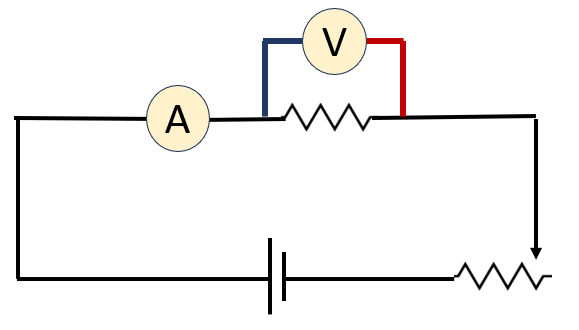
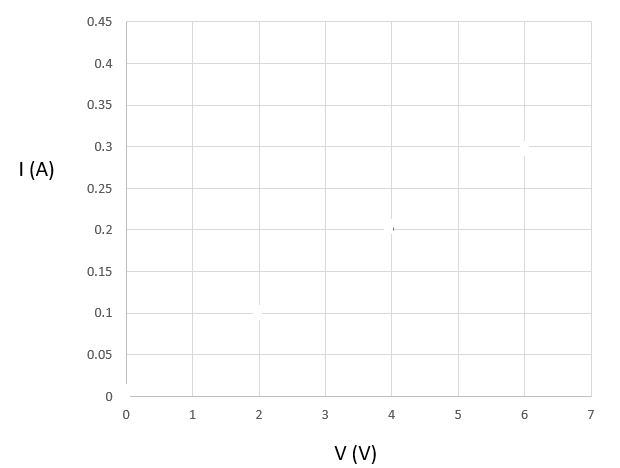
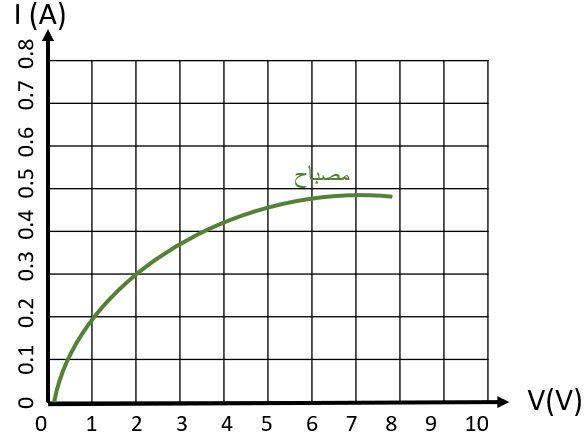
في الدائرة أدناه درس طالب العلاقة بين فرق الجهد وشدة التيار لمقاوم أومي. (أ) حدد وحدة قياس المقاوم. (ب) حدد وظيفة المقاوم الأومي في الدائرة. (ج) غُيّر جهد المصدر بالمقاوم المتغير فسُجّلت القيم: \((V,I)=(2\,V,0.1\,A),(4,0.2),(6,0.3),(8,0.4)\)؛ ارسم الخط البياني بين \(I\) و\(V\). (د) احسب من الخط مقدار المقاوم. (هـ) احسب القدرة المستهلكة عند \(V=6\,V\). (و) رُسم لمصباح الخط البياني الثاني: هل يُطبّق قانون أوم؟ فسّر.In the circuit below a student studied the relation between voltage and current for an ohmic resistor. (a) State the unit of the resistor. (b) State the function of the ohmic resistor in the circuit. (c) The source voltage was changed with the rheostat and the values \((V,I)=(2\,V,0.1\,A),(4,0.2),(6,0.3),(8,0.4)\) were recorded; plot the graph of \(I\) against \(V\). (d) From the graph find the resistance. (e) Find the power consumed at \(V=6\,V\). (f) The graph of a lamp is shown second: does Ohm’s law apply? Explain.
.....................................................................
الحلSolution
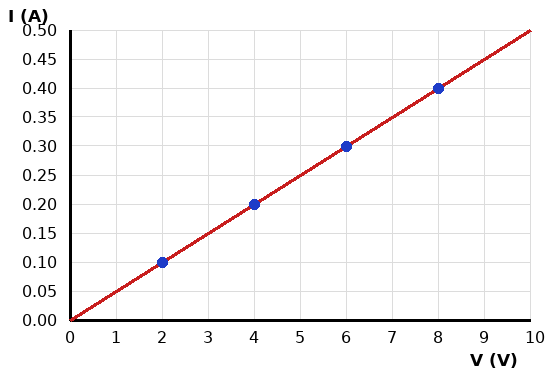
📌 (أ) وحدة المقاومة الأوم \(\Omega\).
📌 (ب) يتحكم المقاوم في شدة التيار وفق قانون أوم \(V=IR\): كلما زادت قيمته قل التيار عند الجهد نفسه.
📌 (ج) النقاط الأربع تقع على خط مستقيم يمر بنقطة الأصل (الرسم أدناه).
📌 (د) الميل \(\dfrac{\Delta V}{\Delta I}=\dfrac{8-0}{0.4-0}=20\,\Omega\) وهي قيمة المقاومة.
📌 (هـ) \(I=\dfrac{6}{20}=0.3\,A\) فـ \(P=VI=6\times0.3=1.8\,W\).
📌 (و) لا؛ فمنحنى المصباح ليس خطًا مستقيمًا لأن مقاومة فتيله ترتفع بارتفاع درجة حرارته، فلا يتناسب التيار طرديًا مع الجهد (مقاوم لا أومي).
✅ \(R=20\,\Omega,\ P=1.8\,W\)
📌 (a) The unit of resistance is the ohm \(\Omega\).
📌 (b) The resistor controls the current according to Ohm’s law \(V=IR\): the larger its value the smaller the current at the same voltage.
📌 (c) The four points lie on a straight line through the origin (the drawing below).
📌 (d) The slope \(\dfrac{\Delta V}{\Delta I}=\dfrac{8-0}{0.4-0}=20\,\Omega\) is the resistance.
📌 (e) \(I=\dfrac{6}{20}=0.3\,A\) so \(P=VI=6\times0.3=1.8\,W\).
📌 (f) No; the lamp curve is not a straight line because the filament resistance rises as its temperature rises, so the current is not proportional to the voltage (a non-ohmic device).
✅ \(R=20\,\Omega,\ P=1.8\,W\)
\[2\,\star\star\]
(أ) أداة تعمل على ممانعة مرور التيار في الدائرة: ما اسمها؟ وما العوامل التي تغيّر قيمتها؟ (ب) يسمح جلد الإنسان بمرور تيار \(0.05\,A\) دون إحساس؛ فسّر ما يحدث عند التعرق. (ج) وُصل مصباح ببطارية فكان فرق الجهد بين طرفيه \(V=20\,V\) والتيار \(I=5\,A\)؛ احسب مقاومته والقدرة المستهلكة. (د) استُبدل بالمصباح مصباح مقاومته نصف مقاومته (بالجهد نفسه): ماذا يطرأ على القدرة المستهلكة؟(a) A device that opposes the flow of current in a circuit: what is it called and which factors change its value? (b) Human skin allows a current of \(0.05\,A\) without sensation; explain what happens when sweating. (c) A lamp is connected to a battery with a voltage \(V=20\,V\) across it and a current \(I=5\,A\); find its resistance and the power consumed. (d) The lamp is replaced by another with half the resistance (same voltage): what happens to the power?
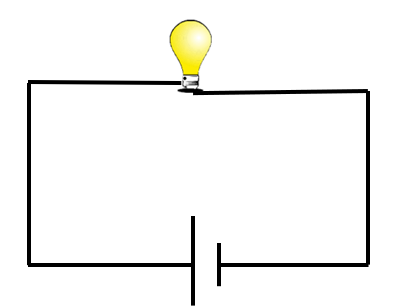
.....................................................................
الحلSolution
📌 (أ) المقاومة (المقاوم). تتوقف على طول الموصل ومساحة مقطعه ونوع مادته ودرجة حرارته: \(R=\rho\dfrac{L}{A}\).
📌 (ب) عند التعرق تزداد رطوبة الجلد وتقل مقاومته فيزداد التيار المار في الجسم (وهو أخطر).
📌 (ج) \(R=\dfrac{V}{I}=\dfrac{20}{5}=4\,\Omega\) و\(P=VI=20\times5=100\,W\).
📌 (د) \(R_2=2\,\Omega\) فـ \(I_2=\dfrac{20}{2}=10\,A\) و\(P_2=20\times10=200\,W\): تتضاعف القدرة لأن التيار يتضاعف عند نقصان المقاومة إلى النصف بالجهد نفسه.
✅ \(R=4\,\Omega,\ P=100\,W\)؛ \(P_2=200\,W\)
📌 (a) The resistor. It depends on the length of the conductor, its cross-section, the material and the temperature: \(R=\rho\dfrac{L}{A}\).
📌 (b) When sweating the skin becomes moister and its resistance falls, so the current through the body increases (which is more dangerous).
📌 (c) \(R=\dfrac{V}{I}=\dfrac{20}{5}=4\,\Omega\) and \(P=VI=20\times5=100\,W\).
📌 (d) \(R_2=2\,\Omega\) so \(I_2=\dfrac{20}{2}=10\,A\) and \(P_2=20\times10=200\,W\): the power doubles because the current doubles when the resistance is halved at the same voltage.
✅ \(R=4\,\Omega,\ P=100\,W\); \(P_2=200\,W\)
\[3\,\star\star\]
وُصلت ثلاث مقاومات \(R_1=3\,\Omega\) و\(R_2=9\,\Omega\) و\(R_3=18\,\Omega\) على التوالي ببطارية \(\Delta V=30\,V\). (أ) ماذا تستنتج من مسار التيار؟ (ب) احسب المقاومة المكافئة وقارنها بمقاومات الدائرة. (ج) احسب شدة التيار المار في كل مقاوم. (د) احسب فرق الجهد على كل مقاوم.Three resistors \(R_1=3\,\Omega\), \(R_2=9\,\Omega\) and \(R_3=18\,\Omega\) are connected in series to a battery \(\Delta V=30\,V\). (a) What do you conclude from the current path? (b) Find the equivalent resistance and compare it with the resistors of the circuit. (c) Find the current through each resistor. (d) Find the voltage across each resistor.
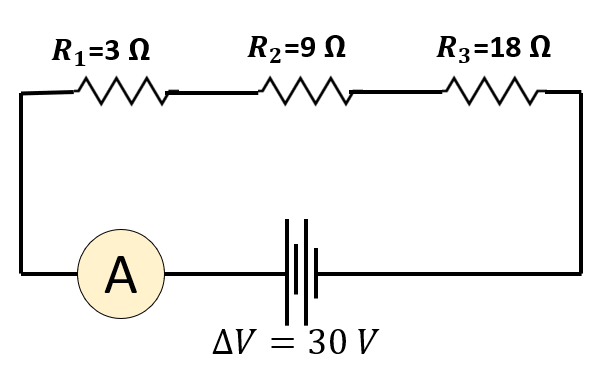
.....................................................................
الحلSolution
📌 (أ) للتيار مسار واحد فقط، فالتيار نفسه يمر في كل المقاومات.
📌 (ب) \(R_{eq}=3+9+18=30\,\Omega\) وهي أكبر من أي مقاومة منفردة.
📌 (ج) \(I=\dfrac{30}{30}=1\,A\) في كل مقاوم (متساوٍ).
📌 (د) \(V_1=3\,V,\ V_2=9\,V,\ V_3=18\,V\) ومجموعها \(30\,V\): يتوزع الجهد بنسبة المقاومات.
✅ \(R_{eq}=30\,\Omega,\ I=1\,A\)
📌 (a) The current has only one path, so the same current passes through all the resistors.
📌 (b) \(R_{eq}=3+9+18=30\,\Omega\), larger than any single resistor.
📌 (c) \(I=\dfrac{30}{30}=1\,A\) in each resistor (the same).
📌 (d) \(V_1=3\,V,\ V_2=9\,V,\ V_3=18\,V\), summing to \(30\,V\): the voltage is shared in proportion to the resistances.
✅ \(R_{eq}=30\,\Omega,\ I=1\,A\)
\[4\,\star\star\star\]
ثلاث مقاومات \(R_1=8\,\Omega\) و\(R_2=10\,\Omega\) و\(R_3=15\,\Omega\) موصولة على التوازي ببطارية \(18\,V\) كما في الشكل (أميتر في كل فرع وأميتر رئيسي). (أ) احسب المقاومة المكافئة. (ب) احسب قراءة كل أميتر.Three resistors \(R_1=8\,\Omega\), \(R_2=10\,\Omega\) and \(R_3=15\,\Omega\) are connected in parallel to an \(18\,V\) battery as shown (an ammeter in each branch and a main ammeter). (a) Find the equivalent resistance. (b) Find the reading of each ammeter.
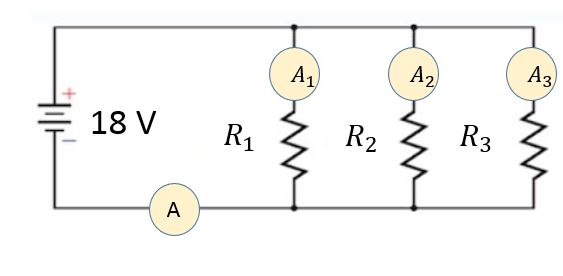
.....................................................................
الحلSolution
📌 (أ) \(\dfrac{1}{R_{eq}}=\dfrac18+\dfrac1{10}+\dfrac1{15}=\dfrac{15+12+8}{120}=\dfrac{35}{120}\) فـ \(R_{eq}=\dfrac{120}{35}\approx3.43\,\Omega\).
📌 (ب) الجهد \(18\,V\) على كل فرع: \(I_1=\dfrac{18}{8}=2.25\,A\)، \(I_2=\dfrac{18}{10}=1.8\,A\)، \(I_3=\dfrac{18}{15}=1.2\,A\).
📌 الأميتر الرئيسي \(I=2.25+1.8+1.2=5.25\,A\) (وتحقق: \(18/3.43=5.25\)).
✅ \(R_{eq}\approx3.43\,\Omega,\ I=5.25\,A\)
📌 (a) \(\dfrac{1}{R_{eq}}=\dfrac18+\dfrac1{10}+\dfrac1{15}=\dfrac{15+12+8}{120}=\dfrac{35}{120}\) so \(R_{eq}=\dfrac{120}{35}\approx3.43\,\Omega\).
📌 (b) The voltage \(18\,V\) is across every branch: \(I_1=\dfrac{18}{8}=2.25\,A\), \(I_2=\dfrac{18}{10}=1.8\,A\), \(I_3=\dfrac{18}{15}=1.2\,A\).
📌 The main ammeter \(I=2.25+1.8+1.2=5.25\,A\) (check: \(18/3.43=5.25\)).
✅ \(R_{eq}\approx3.43\,\Omega,\ I=5.25\,A\)
\[5\,\star\star\]
ثلاث مقاومات \(R_1=6\,\Omega\) و\(R_2=12\,\Omega\) (على التوازي) و\(R_3=2\,\Omega\) (على التوالي معهما) كما في الشكل، وقراءة الأميتر \(I=3\,A\). (أ) احسب المقاومة المكافئة. (ب) احسب فرق الجهد بين طرفي البطارية. (ج) احسب شدة التيار المار في \(R_1\).Three resistors \(R_1=6\,\Omega\) and \(R_2=12\,\Omega\) (in parallel) and \(R_3=2\,\Omega\) (in series with them) as shown, and the ammeter reads \(I=3\,A\). (a) Find the equivalent resistance. (b) Find the voltage across the battery. (c) Find the current through \(R_1\).
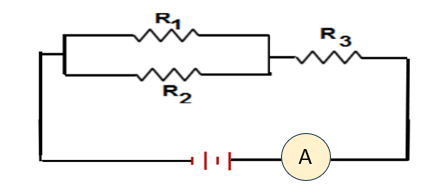
.....................................................................
الحلSolution
📌 (أ) \(R_{12}=\dfrac{6\times12}{6+12}=4\,\Omega\) و\(R_{eq}=4+2=6\,\Omega\).
📌 (ب) \(V=IR_{eq}=3\times6=18\,V\).
📌 (ج) \(V_{12}=3\times4=12\,V\) فـ \(I_1=\dfrac{12}{6}=2\,A\).
✅ \(R_{eq}=6\,\Omega,\ V=18\,V,\ I_1=2\,A\)
📌 (a) \(R_{12}=\dfrac{6\times12}{6+12}=4\,\Omega\) and \(R_{eq}=4+2=6\,\Omega\).
📌 (b) \(V=IR_{eq}=3\times6=18\,V\).
📌 (c) \(V_{12}=3\times4=12\,V\) so \(I_1=\dfrac{12}{6}=2\,A\).
✅ \(R_{eq}=6\,\Omega,\ V=18\,V,\ I_1=2\,A\)
\[6\,\star\star\star\]
في الدائرة أدناه \(R_1=30\,\Omega\) (على التوالي مع بقية الدائرة) والفرعان المتوازيان: \(R_2=60\,\Omega\) في فرع، و\(R_3=40\,\Omega\) و\(R_4=20\,\Omega\) على التوالي في الفرع الآخر. قيست بالملتيميتر \(R_{eq}=60\,\Omega\)، \(V_{tot}=120\,V\)، \(I_{tot}=2\,A\). احسب قراءة الأميتر الجديدة في كل حالة: (أ) انقطع سلك \(R_4\). (ب) وُصل سلك بين طرفي \(R_4\). (ج) وُصل سلك بين طرفي \(R_2\).In the circuit below \(R_1=30\,\Omega\) is in series with the rest of the circuit and the two parallel branches are: \(R_2=60\,\Omega\) in one branch, and \(R_3=40\,\Omega\) and \(R_4=20\,\Omega\) in series in the other. The multimeter measured \(R_{eq}=60\,\Omega\), \(V_{tot}=120\,V\), \(I_{tot}=2\,A\). Find the new ammeter reading in each case: (a) the wire of \(R_4\) breaks. (b) a wire is connected across \(R_4\). (c) a wire is connected across \(R_2\).
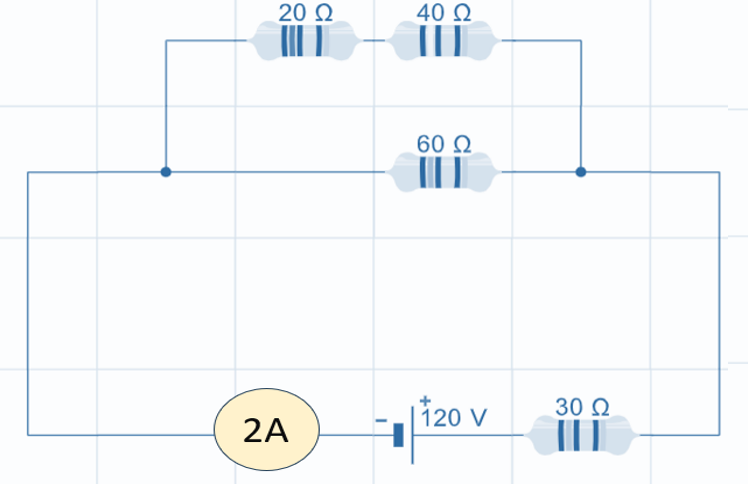
.....................................................................
الحلSolution
📌 الأصل: فرع \(R_3+R_4=60\,\Omega\) على التوازي مع \(R_2=60\,\Omega\) فيعطي \(30\,\Omega\)، ثم \(R_{eq}=30+30=60\,\Omega\) و\(I=\dfrac{120}{60}=2\,A\) ✔.
📌 (أ) انقطاع \(R_4\) يفتح فرع \(R_3,R_4\) فيبقى فرع \(R_2\) وحده: \(R_{eq}=30+60=90\,\Omega\) و\(I=\dfrac{120}{90}=1.33\,A\).
📌 (ب) تقصير \(R_4\) يجعل الفرع \(40\,\Omega\) فقط: \(\dfrac{40\times60}{100}=24\,\Omega\) ثم \(R_{eq}=30+24=54\,\Omega\) و\(I=\dfrac{120}{54}=2.22\,A\).
📌 (ج) تقصير \(R_2\) يجعل مقاومة المجموعة المتوازية صفرًا: \(R_{eq}=30\,\Omega\) و\(I=\dfrac{120}{30}=4\,A\).
✅ \(1.33\,A,\ 2.22\,A,\ 4\,A\)
📌 Originally: the branch \(R_3+R_4=60\,\Omega\) in parallel with \(R_2=60\,\Omega\) gives \(30\,\Omega\), then \(R_{eq}=30+30=60\,\Omega\) and \(I=\dfrac{120}{60}=2\,A\) ✔.
📌 (a) A break in \(R_4\) opens the branch of \(R_3,R_4\) so only the branch of \(R_2\) remains: \(R_{eq}=30+60=90\,\Omega\) and \(I=\dfrac{120}{90}=1.33\,A\).
📌 (b) Shorting \(R_4\) leaves that branch with \(40\,\Omega\) only: \(\dfrac{40\times60}{100}=24\,\Omega\) then \(R_{eq}=30+24=54\,\Omega\) and \(I=\dfrac{120}{54}=2.22\,A\).
📌 (c) Shorting \(R_2\) makes the parallel group zero: \(R_{eq}=30\,\Omega\) and \(I=\dfrac{120}{30}=4\,A\).
✅ \(1.33\,A,\ 2.22\,A,\ 4\,A\)
\[7\,\star\star\star\]
في الشكل أربع مقاومات ببطارية: \(R_4=4\,\Omega\) على التوالي مع المقاومتين المتوازيتين \(R_2=8\,\Omega\) و\(R_3=6\,\Omega\)، ثم الأميتر ثم \(R_1=2\,\Omega\) والفولتميتر على \(R_1\)، وشدة التيار في \(R_3\) تساوي \(I_3=2\,A\). (أ) أوجد قراءة الأميتر. (ب) أوجد قراءة الفولتميتر.In the figure four resistors with a battery: \(R_4=4\,\Omega\) in series with the parallel pair \(R_2=8\,\Omega\) and \(R_3=6\,\Omega\), then the ammeter and \(R_1=2\,\Omega\) with the voltmeter across \(R_1\); the current in \(R_3\) is \(I_3=2\,A\). (a) Find the ammeter reading. (b) Find the voltmeter reading.
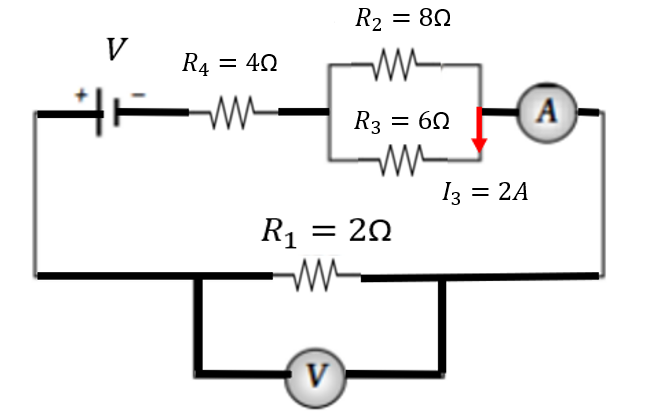
.....................................................................
الحلSolution
📌 (أ) الجهد على المقاومتين المتوازيتين \(V_{23}=I_3R_3=2\times6=12\,V\) فـ \(I_2=\dfrac{12}{8}=1.5\,A\).
📌 الأميتر على التوالي مع المجموعة فيقرأ التيار الكلي: \(I=I_2+I_3=1.5+2=3.5\,A\).
📌 (ب) الفولتميتر على \(R_1\): \(V_1=IR_1=3.5\times2=7\,V\).
✅ \(I=3.5\,A,\ V=7\,V\)
📌 (a) The voltage across the parallel pair \(V_{23}=I_3R_3=2\times6=12\,V\) so \(I_2=\dfrac{12}{8}=1.5\,A\).
📌 The ammeter is in series with the group, so it reads the total current: \(I=I_2+I_3=1.5+2=3.5\,A\).
📌 (b) The voltmeter is across \(R_1\): \(V_1=IR_1=3.5\times2=7\,V\).
✅ \(I=3.5\,A,\ V=7\,V\)
\[8\,\star\star\star\]
ثلاث مقاومات على التوازي ببطارية كما في الشكل: الأميتر الرئيسي يقرأ \(6\,A\)، و\(R_1=9\,\Omega\)، و\(R_2=6\,\Omega\) يمر فيها \(3\,A\)، و\(R_3\) مجهولة. (أ) احسب شدة التيار في \(R_1\). (ب) احسب شدة التيار في \(R_3\). (ج) احسب قيمة \(R_3\).Three resistors in parallel with a battery as shown: the main ammeter reads \(6\,A\), \(R_1=9\,\Omega\), \(R_2=6\,\Omega\) carries \(3\,A\) and \(R_3\) is unknown. (a) Find the current in \(R_1\). (b) Find the current in \(R_3\). (c) Find the value of \(R_3\).
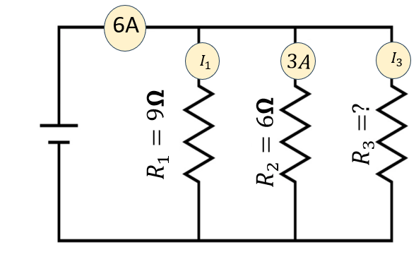
.....................................................................
الحلSolution
📌 جهد الفروع \(V=I_2R_2=3\times6=18\,V\).
📌 (أ) \(I_1=\dfrac{18}{9}=2\,A\).
📌 (ب) \(I_3=6-3-2=1\,A\).
📌 (ج) \(R_3=\dfrac{18}{1}=18\,\Omega\).
✅ \(I_1=2\,A,\ I_3=1\,A,\ R_3=18\,\Omega\)
📌 The voltage of the branches \(V=I_2R_2=3\times6=18\,V\).
📌 (a) \(I_1=\dfrac{18}{9}=2\,A\).
📌 (b) \(I_3=6-3-2=1\,A\).
📌 (c) \(R_3=\dfrac{18}{1}=18\,\Omega\).
✅ \(I_1=2\,A,\ I_3=1\,A,\ R_3=18\,\Omega\)
\[9\,\star\star\]
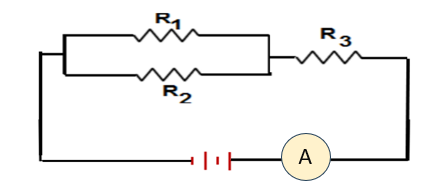
وُصلت ثلاث مقاومات \(R_1=6\,\Omega\) و\(R_2=12\,\Omega\) (على التوازي) و\(R_3=2\,\Omega\) (على التوالي معهما) ببطارية \(\Delta V=12\,V\) كما في الشكل. (أ) احسب المقاومة المكافئة. (ب) احسب القدرة المصروفة في \(R_3\). (ج) احسب شدة التيار المار في \(R_1\).Three resistors \(R_1=6\,\Omega\) and \(R_2=12\,\Omega\) (in parallel) and \(R_3=2\,\Omega\) (in series with them) are connected to a battery \(\Delta V=12\,V\) as shown. (a) Find the equivalent resistance. (b) Find the power dissipated in \(R_3\). (c) Find the current through \(R_1\).
.....................................................................
الحلSolution
📌 (أ) \(R_{12}=4\,\Omega\) و\(R_{eq}=4+2=6\,\Omega\).
📌 \(I=\dfrac{12}{6}=2\,A\).
📌 (ب) \(P_3=I^{2}R_3=2^{2}\times2=8\,W\).
📌 (ج) \(V_{12}=2\times4=8\,V\) فـ \(I_1=\dfrac{8}{6}=1.33\,A\).
✅ \(R_{eq}=6\,\Omega,\ P_3=8\,W,\ I_1=1.33\,A\)
📌 (a) \(R_{12}=4\,\Omega\) and \(R_{eq}=4+2=6\,\Omega\).
📌 \(I=\dfrac{12}{6}=2\,A\).
📌 (b) \(P_3=I^{2}R_3=2^{2}\times2=8\,W\).
📌 (c) \(V_{12}=2\times4=8\,V\) so \(I_1=\dfrac{8}{6}=1.33\,A\).
✅ \(R_{eq}=6\,\Omega,\ P_3=8\,W,\ I_1=1.33\,A\)
\[10\,\star\star\star\star\]
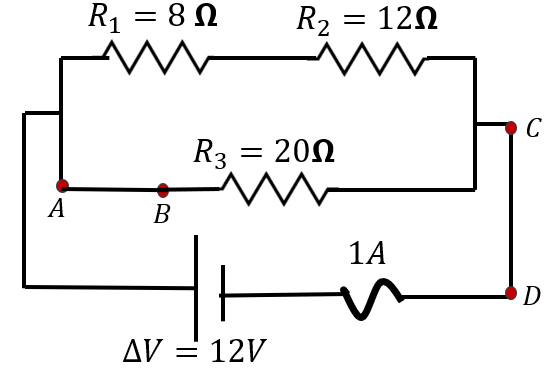
في الشكل: \(R_1=8\,\Omega\) و\(R_2=12\,\Omega\) على التوالي، وهما على التوازي مع \(R_3=20\,\Omega\) بين النقطتين \(A\) و\(C\)، وبطارية \(\Delta V=12\,V\) ومنصهر على التوالي مكتوب عليه \(1\,A\). (أ) هل يصلح المنصهر للدائرة؟ بيّن بالحساب. (ب) لمعالجة المشكلة لدينا مقاوم \(R_4=5\,\Omega\): أين يُوصل بين \(AB\) أو \(CD\)؟ ولماذا؟ (ج) لو وُضع المنصهر في الفرع الذي فيه \(R_3\) فقط، هل يحمي الدائرة؟In the figure: \(R_1=8\,\Omega\) and \(R_2=12\,\Omega\) in series, together in parallel with \(R_3=20\,\Omega\) between \(A\) and \(C\), a battery \(\Delta V=12\,V\) and a fuse in series rated \(1\,A\). (a) Is the fuse suitable? Show by calculation. (b) To fix the problem we have a resistor \(R_4=5\,\Omega\): where should it be connected, between \(AB\) or \(CD\)? Why? (c) If the fuse were placed in the branch of \(R_3\) only, would it protect the circuit?
.....................................................................
الحلSolution
📌 (أ) الفرع الأول \(R_1+R_2=20\,\Omega\) على التوازي مع \(R_3=20\,\Omega\): \(R_{eq}=10\,\Omega\).
\(I=\dfrac{12}{10}=1.2\,A\gt 1\,A\): سينصهر المنصهر فهو لا يصلح.
📌 (ب) يجب أن يكون \(R_4\) على التوالي مع المنصهر وكل الدائرة (بين \(C\) و\(D\)) فيزداد المقاومة الكلية إلى \(15\,\Omega\) ويصبح التيار \(\dfrac{12}{15}=0.8\,A\lt 1\,A\). أما بين \(A\) و\(B\) فيكون في فرع \(R_3\) وحده: \(\dfrac{20\times25}{45}=11.1\,\Omega\) والتيار \(1.08\,A\gt 1\,A\) فلا يكفي.
📌 (ج) لا؛ فالمنصهر في فرع واحد يحمل تيار ذلك الفرع فقط (\(\dfrac{12}{20}=0.6\,A\)) ولا ينصهر حتى لو زاد التيار الكلي عن \(1\,A\)؛ ويجب أن يكون المنصهر في المسار الرئيسي ليحمل التيار الكلي.
✅ \(I=1.2\,A\gt 1\,A\)؛ \(R_4\) بين \(C\) و\(D\) فيصبح \(I=0.8\,A\)
📌 (a) The first branch \(R_1+R_2=20\,\Omega\) in parallel with \(R_3=20\,\Omega\): \(R_{eq}=10\,\Omega\).
\(I=\dfrac{12}{10}=1.2\,A\gt 1\,A\): the fuse would blow, so it is not suitable.
📌 (b) \(R_4\) must be in series with the fuse and the whole circuit (between \(C\) and \(D\)): the total resistance rises to \(15\,\Omega\) and the current becomes \(\dfrac{12}{15}=0.8\,A\lt 1\,A\). Between \(A\) and \(B\) it would be in the branch of \(R_3\) only: \(\dfrac{20\times25}{45}=11.1\,\Omega\) and the current \(1.08\,A\gt 1\,A\), which is not enough.
📌 (c) No; a fuse in one branch carries only that branch current (\(\dfrac{12}{20}=0.6\,A\)) and does not blow even if the total current exceeds \(1\,A\); the fuse must be in the main line to carry the total current.
✅ \(I=1.2\,A\gt 1\,A\); \(R_4\) between \(C\) and \(D\) giving \(I=0.8\,A\)
لاحظت خطأ؟ أو عندك سؤال عن أحد الأسئلة؟ اكتبه بالتعليقات وحدد رقم السؤال بالضبط.
Noticed an error? Or have a question about one of the questions? Write it in the comments and specify the exact question number.