🔄 بنك الأسئلة: الحركة الدائرية
🔄 Question Bank: Circular Motion
الإزاحة والسرعة الزاوية، الزمن الدوري والتردد، السرعة الخطية، العجلة والقوة المركزية، البندول المخروطي، الدائرة الرأسية والمنعطفات
Angular Displacement and Speed, Period and Frequency, Linear Speed, Centripetal Acceleration and Force, the Conical Pendulum, Vertical Circles and Curves
⏱️ 33 سؤال اختيار من متعدد بتصحيح فوري بمستويات متدرجة، و5 مسائل مقالية محلولة بالرسم⏱️ 33 multiple-choice questions of graded difficulty with instant feedback, plus 5 solved essay problems with drawings
\[1\,\star\]
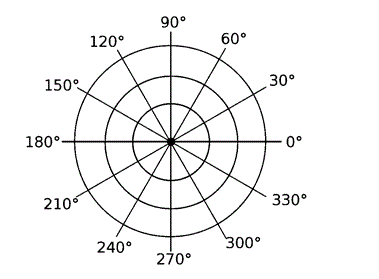
جسم يتحرك حركة دائرية فقطع إزاحة زاوية قدرها \(65^{\circ}\) مع عقارب الساعة. الإزاحة الزاوية بوحدة الراديان:An object moves in a circle through an angular displacement of \(65^{\circ}\) clockwise. The angular displacement in radians is:
\(\theta=-1.53\,rad\)\(\theta=-1.53\,rad\)
\(\theta=1.13\,rad\)\(\theta=1.13\,rad\)
\(\theta=-1.13\,rad\)\(\theta=-1.13\,rad\)
\(\theta=1.53\,rad\)\(\theta=1.53\,rad\)
الحلSolution
📌 معامل التحويل: \(\pi\,rad=180^{\circ}\) فيكون \(65^{\circ}=65\times\dfrac{\pi}{180}=1.13\,rad\).
📌 الدوران مع عقارب الساعة يُعدّ بالاتفاق اتجاهًا سالبًا (الموجب عكس عقارب الساعة)، فالإزاحة الزاوية \(\theta=-1.13\,rad\).
✅ \(\theta=-1.13\,rad\) (C)
📌 The conversion factor is \(\pi\,rad=180^{\circ}\) so \(65^{\circ}=65\times\dfrac{\pi}{180}=1.13\,rad\).
📌 Rotation clockwise is by convention negative (positive is counterclockwise), so the angular displacement is \(\theta=-1.13\,rad\).
✅ \(\theta=-1.13\,rad\) (C)
\[2\,\star\]
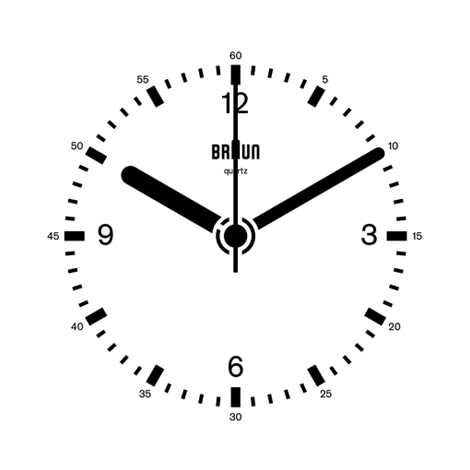
السرعة الزاوية لعقرب الدقائق في الساعة تساوي:The angular speed of the minute hand of a clock is:
\(\omega=-0.104\,rad/s\)\(\omega=-0.104\,rad/s\)
\(\omega=0.104\,rad/s\)\(\omega=0.104\,rad/s\)
\(\omega=1.74\times10^{-3}\,rad/s\)\(\omega=1.74\times10^{-3}\,rad/s\)
\(\omega=-1.74\times10^{-3}\,rad/s\)\(\omega=-1.74\times10^{-3}\,rad/s\)
الحلSolution
📌 يتم عقرب الدقائق دورة واحدة (\(2\pi\)) خلال \(3600\,s\) (ساعة واحدة): \(\omega=\dfrac{\Delta\theta}{\Delta t}=\dfrac{2\pi}{T}=\dfrac{2\pi}{3600}=1.74\times10^{-3}\,rad/s\).
📌 الدوران مع عقارب الساعة سالب، فالجواب \(\omega=-1.74\times10^{-3}\,rad/s\) (ومقدارها \(1.74\times10^{-3}\)).
✅ \(\omega=-1.74\times10^{-3}\,rad/s\) (D)
📌 The minute hand makes one revolution (\(2\pi\)) in \(3600\,s\) (one hour): \(\omega=\dfrac{\Delta\theta}{\Delta t}=\dfrac{2\pi}{T}=\dfrac{2\pi}{3600}=1.74\times10^{-3}\,rad/s\).
📌 Clockwise rotation is negative, so the answer is \(\omega=-1.74\times10^{-3}\,rad/s\) (its magnitude is \(1.74\times10^{-3}\)).
✅ \(\omega=-1.74\times10^{-3}\,rad/s\) (D)
\[3\,\star\]
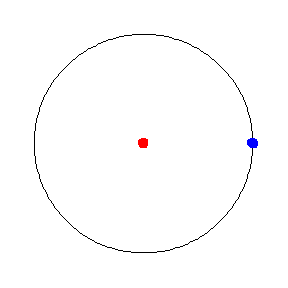
في الحركة الدائرية المنتظمة تكون السرعة الخطية للجسم:In uniform circular motion the linear velocity of the body is:
ثابتة المقدار وثابتة الاتجاهconstant in magnitude and constant in direction
متغيرة المقدار ومتغيرة الاتجاهchanging in magnitude and in direction
متغيرة المقدار وثابتة الاتجاهchanging in magnitude and constant in direction
ثابتة المقدار ومتغيرة الاتجاهconstant in magnitude and changing in direction
الحلSolution
📌 المقدار (السرعة العددية) ثابت في الحركة الدائرية المنتظمة، لكن السرعة الخطية متجهة مماسية لمسار الحركة، ويتغير اتجاهها في كل لحظة لأن المماس يتغير.
✅ ثابتة المقدار ومتغيرة الاتجاه (D)
📌 The magnitude (the speed) is constant in uniform circular motion, but the linear velocity is a vector tangent to the path and its direction changes at every instant because the tangent keeps changing.
✅ constant in magnitude and changing in direction (D)
\[4\,\star\]
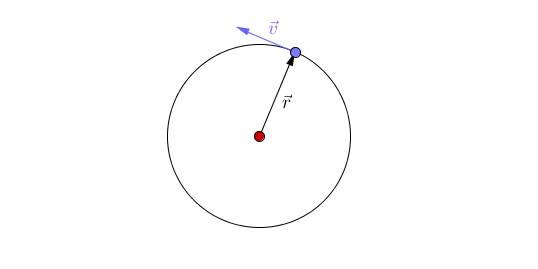
يتحرك جسم حركة دائرية منتظمة فيتم ثلاث دورات ونصف عكس عقارب الساعة كل \(2\,s\). سرعته الزاوية بوحدة \(rad/s\):A body moves in uniform circular motion making three and a half revolutions counterclockwise every \(2\,s\). Its angular speed in \(rad/s\) is:
\(\omega=3.5\pi\)\(\omega=3.5\pi\)
\(\omega=4\pi\)\(\omega=4\pi\)
\(\omega=7\pi\)\(\omega=7\pi\)
\(\omega=6\pi\)\(\omega=6\pi\)
الحلSolution
📌 دورة واحدة \(=2\pi\,rad\) فـ \(3.5\,rev=7\pi\,rad\).
\(\omega=\dfrac{\Delta\theta}{\Delta t}=\dfrac{7\pi}{2}=3.5\pi\,rad/s\) (موجبة لأن الدوران عكس عقارب الساعة).
✅ \(\omega=3.5\pi\) (A)
📌 One revolution \(=2\pi\,rad\) so \(3.5\,rev=7\pi\,rad\).
\(\omega=\dfrac{\Delta\theta}{\Delta t}=\dfrac{7\pi}{2}=3.5\pi\,rad/s\) (positive because the rotation is counterclockwise).
✅ \(\omega=3.5\pi\) (A)
\[5\,\star\]
جسم يتحرك حركة دائرية والإزاحة الزاوية له بدلالة الزمن \(\theta=0.5\,t^{2}+2t+4\). سرعته الزاوية عند اللحظة \(t=5\,s\):A body moves in a circle with angular displacement \(\theta=0.5\,t^{2}+2t+4\). Its angular speed at \(t=5\,s\) is:
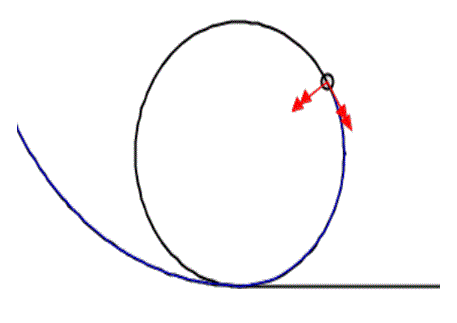
\(\omega=5\,rad/s\)\(\omega=5\,rad/s\)
\(\omega=7\,rad/s\)\(\omega=7\,rad/s\)
\(\omega=6.7\,rad/s\)\(\omega=6.7\,rad/s\)
\(\omega=26.5\,rad/s\)\(\omega=26.5\,rad/s\)
الحلSolution
📌 السرعة الزاوية اللحظية مشتقة الإزاحة الزاوية: \(\omega=\dfrac{d\theta}{dt}=t+2\).
عند \(t=5\,s\): \(\omega=5+2=7\,rad/s\).
✅ \(\omega=7\,rad/s\) (B)
📌 The instantaneous angular speed is the derivative of the angular displacement: \(\omega=\dfrac{d\theta}{dt}=t+2\).
At \(t=5\,s\): \(\omega=5+2=7\,rad/s\).
✅ \(\omega=7\,rad/s\) (B)
\[6\,\star\]
مروحة تدور بسرعة زاوية \(\omega=60\pi\,rad/s\). زمنها الدوري بالثانية:A fan rotates with an angular speed \(\omega=60\pi\,rad/s\). Its period in seconds is:
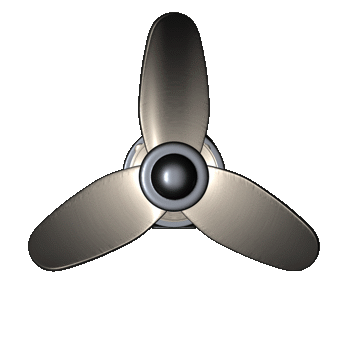
\(T=30\,s\)\(T=30\,s\)
\(T=\dfrac{1}{60}\,s\)\(T=\dfrac{1}{60}\,s\)
\(T=\dfrac{1}{30}\,s\)\(T=\dfrac{1}{30}\,s\)
\(T=60\,s\)\(T=60\,s\)
الحلSolution
\(\omega=\dfrac{2\pi}{T}\Rightarrow T=\dfrac{2\pi}{\omega}=\dfrac{2\pi}{60\pi}=\dfrac{1}{30}\,s\).
✅ \(T=\dfrac{1}{30}\,s\) (C)
\(\omega=\dfrac{2\pi}{T}\Rightarrow T=\dfrac{2\pi}{\omega}=\dfrac{2\pi}{60\pi}=\dfrac{1}{30}\,s\).
✅ \(T=\dfrac{1}{30}\,s\) (C)
\[7\,\star\]
رُبط حجر بخيط طوله \(0.6\,m\) وأُدير في مستوى أفقي بزمن دوري \(0.4\,s\). عجلته المركزية:A stone is tied to a string \(0.6\,m\) long and whirled in a horizontal plane with a period of \(0.4\,s\). Its centripetal acceleration is:
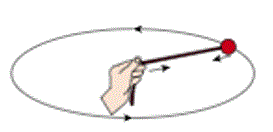
\(a_c=15\pi\,m/s^{2}\)\(a_c=15\pi\,m/s^{2}\)
\(a_c=40\pi\,m/s^{2}\)\(a_c=40\pi\,m/s^{2}\)
\(a_c=15\pi^{2}\,m/s^{2}\)\(a_c=15\pi^{2}\,m/s^{2}\)
\(a_c=40\pi^{2}\,m/s^{2}\)\(a_c=40\pi^{2}\,m/s^{2}\)
الحلSolution
\(\omega=\dfrac{2\pi}{T}=\dfrac{2\pi}{0.4}=5\pi\,rad/s\).
\(a_c=r\,\omega^{2}=0.6\times(5\pi)^{2}=15\pi^{2}\,m/s^{2}\) (≈ \(148\,m/s^{2}\)).
✅ \(a_c=15\pi^{2}\,m/s^{2}\) (C)
\(\omega=\dfrac{2\pi}{T}=\dfrac{2\pi}{0.4}=5\pi\,rad/s\).
\(a_c=r\,\omega^{2}=0.6\times(5\pi)^{2}=15\pi^{2}\,m/s^{2}\) (≈ \(148\,m/s^{2}\)).
✅ \(a_c=15\pi^{2}\,m/s^{2}\) (C)
\[8\,\star\]
دلو مربوط بحبل طوله \(0.7\,m\) يُدار أفقيًا بسرعة مماسية \(v=2\,m/s\). عجلته المركزية:A bucket on a rope \(0.7\,m\) long is whirled horizontally with a tangential speed \(v=2\,m/s\). Its centripetal acceleration is:
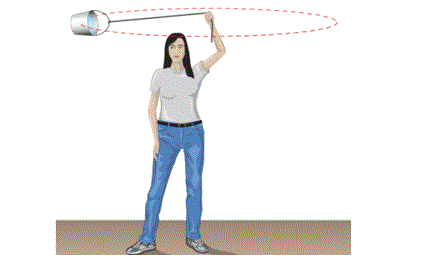
\(a_c=1.4\,m/s^{2}\)\(a_c=1.4\,m/s^{2}\)
\(a_c=3.6\,m/s^{2}\)\(a_c=3.6\,m/s^{2}\)
\(a_c=2.8\,m/s^{2}\)\(a_c=2.8\,m/s^{2}\)
\(a_c=5.7\,m/s^{2}\)\(a_c=5.7\,m/s^{2}\)
الحلSolution
\(a_c=\dfrac{v^{2}}{r}=\dfrac{2^{2}}{0.7}=5.7\,m/s^{2}\).
✅ \(a_c=5.7\,m/s^{2}\) (D)
\(a_c=\dfrac{v^{2}}{r}=\dfrac{2^{2}}{0.7}=5.7\,m/s^{2}\).
✅ \(a_c=5.7\,m/s^{2}\) (D)
\[9\,\star\star\]
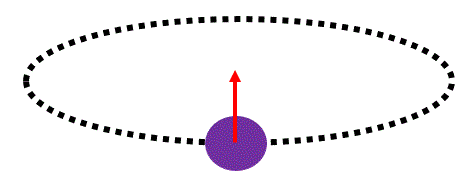
كرة كتلتها \(0.5\,kg\) مربوطة بخيط طوله \(0.4\,m\) تدور في مستوى أفقي \(2.5\) دورة خلال \(5\,s\). قوة الجذب المركزية المؤثرة عليها:A ball of mass \(0.5\,kg\) is tied to a string \(0.4\,m\) long and whirled horizontally making \(2.5\) revolutions in \(5\,s\). The centripetal force on it is:
\(F_c=2.5\,N\)\(F_c=2.5\,N\)
\(F_c=1.97\,N\)\(F_c=1.97\,N\)
\(F_c=3.25\,N\)\(F_c=3.25\,N\)
\(F_c=1.25\,N\)\(F_c=1.25\,N\)
الحلSolution
\(\omega=\dfrac{\Delta\theta}{\Delta t}=\dfrac{2.5\times2\pi}{5}=\pi\,rad/s\).
\(F_c=m\,\omega^{2}r=0.5\times\pi^{2}\times0.4=1.97\,N\).
✅ \(F_c=1.97\,N\) (B)
\(\omega=\dfrac{\Delta\theta}{\Delta t}=\dfrac{2.5\times2\pi}{5}=\pi\,rad/s\).
\(F_c=m\,\omega^{2}r=0.5\times\pi^{2}\times0.4=1.97\,N\).
✅ \(F_c=1.97\,N\) (B)
\[10\,\star\]
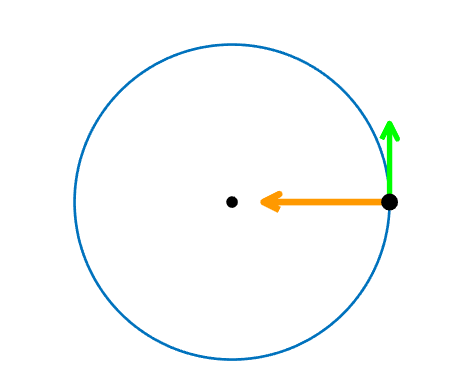
حجر مربوط بخيط يدور بحركة دائرية منتظمة في مستوى أفقي. إذا انقطع الخيط فإن الحجر:A stone tied to a string moves in uniform circular motion in a horizontal plane. If the string breaks, the stone:
يسقط على الأرض كأنه سقوط حرfalls to the ground as if in free fall
يتحرك بتسارع أكبر من عجلة الجاذبيةmoves with an acceleration greater than gravity
يتحرك بسرعة ثابتة حتى يصل إلى الأرضmoves at constant velocity until it reaches the ground
يستمر بالحركة بخط مستقيم باتجاه السرعة الخطية لحظة القطعcontinues in a straight line in the direction of its linear velocity at the moment of breaking
الحلSolution
📌 عند انقطاع الخيط تزول القوة المركزية فلا تبقى قوة أفقية تؤثر في الحجر، فيتحرك وفق قانون نيوتن الأول بخط مستقيم بالسرعة المماسية التي كان عليها (يصبح كأنه مقذوف أفقيًا).
📌 ويسقط رأسيًا تحت تأثير الجاذبية أثناء ذلك، فلا يبقى بسرعة ثابتة حتى يصل الأرض.
✅ يستمر بالحركة بخط مستقيم باتجاه السرعة الخطية لحظة القطع (D)
📌 When the string breaks the centripetal force disappears, no horizontal force remains, and by Newton's first law the stone moves in a straight line with the tangential velocity it had (it becomes a horizontal projectile).
📌 Meanwhile it falls under gravity, so it does not keep a constant velocity all the way to the ground.
✅ continues in a straight line in the direction of its linear velocity at the moment of breaking (D)
\[11\,\star\]
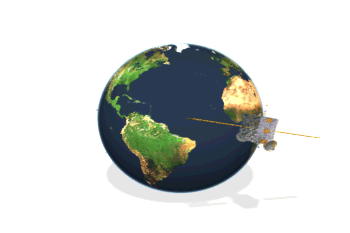
يتحرك قمر صناعي في مسار دائري منتظم حول الأرض نصف قطره \(8500\,km\) وزمنه الدوري \(2\,day\). سرعته الخطية:A satellite moves in a uniform circular orbit around the Earth with a radius of \(8500\,km\) and a period of \(2\,days\). Its linear speed is:
\(v=309\,m/s\)\(v=309\,m/s\)
\(v=210\,m/s\)\(v=210\,m/s\)
\(v=512\,m/s\)\(v=512\,m/s\)
\(v=518\,m/s\)\(v=518\,m/s\)
الحلSolution
📌 \(R=8500\times1000=8.5\times10^{6}\,m\) و\(T=2\times24\times3600=172800\,s\).
\(\omega=\dfrac{2\pi}{T}=3.63\times10^{-5}\,rad/s\) ثم \(v=\omega R=3.63\times10^{-5}\times8.5\times10^{6}=309\,m/s\).
✅ \(v=309\,m/s\) (A)
📌 \(R=8500\times1000=8.5\times10^{6}\,m\) and \(T=2\times24\times3600=172800\,s\).
\(\omega=\dfrac{2\pi}{T}=3.63\times10^{-5}\,rad/s\) then \(v=\omega R=3.63\times10^{-5}\times8.5\times10^{6}=309\,m/s\).
✅ \(v=309\,m/s\) (A)
\[12\,\star\]
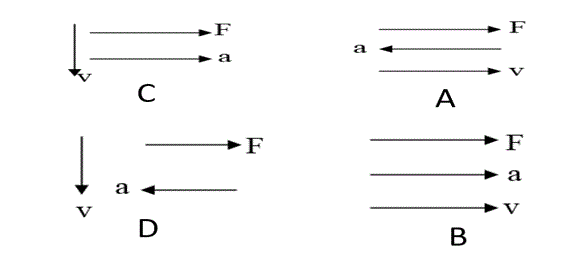
أي المخططات التالية يمثل العلاقة بين اتجاهات السرعة الخطية والعجلة المركزية والقوة المركزية لجسم يتحرك حركة دائرية منتظمة؟Which diagram represents the relation between the directions of the linear velocity, the centripetal acceleration and the centripetal force of a body in uniform circular motion?
AA
BB
CC
DD
الحلSolution
📌 القوة المركزية والعجلة المركزية لهما الاتجاه نفسه دائمًا نحو مركز الدائرة (قانون نيوتن الثاني \(F=ma\)).
📌 والسرعة مماسية فهي عمودية على كل من العجلة والقوة. الشكل C هو الوحيد الذي تتفق فيه \(F\) و\(a\) وتتعامد \(v\) عليهما.
✅ C
📌 The centripetal force and the centripetal acceleration always have the same direction, toward the centre of the circle (Newton's second law \(F=ma\)).
📌 The velocity is tangent, so it is perpendicular to both the acceleration and the force. Figure C is the only one in which \(F\) and \(a\) agree and \(v\) is perpendicular to them.
✅ C
\[13\,\star\]
إطار دراجة نصف قطره \(35\,cm\) يدور بسرعة زاوية \(5\,rad/s\) ثم زادت إلى \(15\,rad/s\) خلال \(12\,s\). التسارع الخطي (المماسي) لحافة الإطار:A bicycle wheel of radius \(35\,cm\) rotates at \(5\,rad/s\) and then speeds up to \(15\,rad/s\) in \(12\,s\). The linear (tangential) acceleration of the rim is:

\(a_t=0.75\,m/s^{2}\)\(a_t=0.75\,m/s^{2}\)
\(a_t=0.46\,m/s^{2}\)\(a_t=0.46\,m/s^{2}\)
\(a_t=0.14\,m/s^{2}\)\(a_t=0.14\,m/s^{2}\)
\(a_t=0.29\,m/s^{2}\)\(a_t=0.29\,m/s^{2}\)
الحلSolution
📌 العجلة الزاوية \(\alpha=\dfrac{\omega_f-\omega_i}{\Delta t}=\dfrac{15-5}{12}=0.83\,rad/s^{2}\).
\(a_t=r\,\alpha=0.35\times0.83=0.29\,m/s^{2}\).
✅ \(a_t=0.29\,m/s^{2}\) (D)
📌 The angular acceleration is \(\alpha=\dfrac{\omega_f-\omega_i}{\Delta t}=\dfrac{15-5}{12}=0.83\,rad/s^{2}\).
\(a_t=r\,\alpha=0.35\times0.83=0.29\,m/s^{2}\).
✅ \(a_t=0.29\,m/s^{2}\) (D)
\[14\,\star\star\star\]
قرص كمبيوتر نصف قطره \(0.06\,m\) يدور بعجلة مركزية \(a_c=33750\,m/s^{2}\). تردد دورانه:A computer disk of radius \(0.06\,m\) rotates with a centripetal acceleration \(a_c=33750\,m/s^{2}\). Its frequency is:

\(f=235.7\,Hz\)\(f=235.7\,Hz\)
\(f=102.6\,Hz\)\(f=102.6\,Hz\)
\(f=98.6\,Hz\)\(f=98.6\,Hz\)
\(f=119.4\,Hz\)\(f=119.4\,Hz\)
الحلSolution
\(a_c=r\,\omega^{2}\Rightarrow\omega=\sqrt{\dfrac{a_c}{r}}=\sqrt{\dfrac{33750}{0.06}}=750\,rad/s\).
\(f=\dfrac{\omega}{2\pi}=\dfrac{750}{2\pi}=119.4\,Hz\).
✅ \(f=119.4\,Hz\) (D)
\(a_c=r\,\omega^{2}\Rightarrow\omega=\sqrt{\dfrac{a_c}{r}}=\sqrt{\dfrac{33750}{0.06}}=750\,rad/s\).
\(f=\dfrac{\omega}{2\pi}=\dfrac{750}{2\pi}=119.4\,Hz\).
✅ \(f=119.4\,Hz\) (D)
\[15\,\star\star\star\]
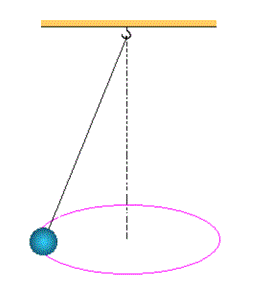
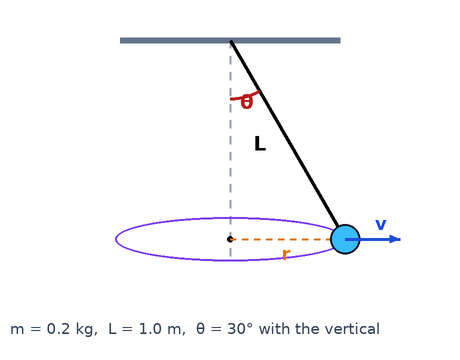
بندول مخروطي طول خيطه \(L\) عُلّقت في طرفه الحر كتلة \(m\) وتدور بحركة دائرية منتظمة في مستوى أفقي ويصنع الخيط زاوية \(\theta\) مع الخط الرأسي كما في الشكل. القوة المركزية تساوي:A conical pendulum of string length \(L\) carries a mass \(m\) at its free end and moves in uniform circular motion in a horizontal plane, the string making an angle \(\theta\) with the vertical as shown. The centripetal force equals:
\(F_c=T\sin\theta\)\(F_c=T\sin\theta\)
\(F_c=mg\cos\theta\)\(F_c=mg\cos\theta\)
\(F_c=m\,\omega\,r\)\(F_c=m\,\omega\,r\)
\(F_c=T\cos\theta\)\(F_c=T\cos\theta\)
الحلSolution
📌 على الكتلة قوتان: الوزن \(mg\) نحو الأسفل والشد \(T\) على امتداد الخيط. نحلّل الشد: مركبة رأسية \(T\cos\theta\) ومركبة أفقية \(T\sin\theta\).
📌 المحصلة الرأسية صفر: \(T\cos\theta=mg\)، والمركبة الأفقية نحو المركز هي القوة المركزية: \(F_c=T\sin\theta=m\omega^{2}r\). (والخيار \(m\omega r\) خاطئ لأن الصحيح \(m\omega^{2}r\)).
✅ \(F_c=T\sin\theta\) (A)
📌 Two forces act on the mass: the weight \(mg\) downward and the tension \(T\) along the string. Resolve the tension: a vertical component \(T\cos\theta\) and a horizontal component \(T\sin\theta\).
📌 The vertical resultant is zero: \(T\cos\theta=mg\), and the horizontal component toward the centre is the centripetal force: \(F_c=T\sin\theta=m\omega^{2}r\). (The option \(m\omega r\) is wrong; the correct form is \(m\omega^{2}r\)).
✅ \(F_c=T\sin\theta\) (A)
\[16\,\star\star\star\]
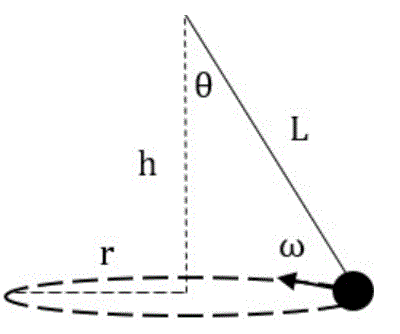
بندول مخروطي طول خيطه \(0.6\,m\) يصنع خيطه زاوية \(\theta=25^{\circ}\) مع الخط الرأسي (كما في الشكل). السرعة الزاوية للكتلة:A conical pendulum of string length \(0.6\,m\) has its string making an angle \(\theta=25^{\circ}\) with the vertical (as in the figure). The angular speed of the mass is:
\(\omega=6.3\,rad/s\)\(\omega=6.3\,rad/s\)
\(\omega=4.2\,rad/s\)\(\omega=4.2\,rad/s\)
\(\omega=7.3\,rad/s\)\(\omega=7.3\,rad/s\)
\(\omega=5.5\,rad/s\)\(\omega=5.5\,rad/s\)
الحلSolution
📌 من الحالة السابقة: \(T\cos\theta=mg\) و\(T\sin\theta=m\omega^{2}r\) مع \(r=L\sin\theta\).
📌 بقسمة المعادلتين: \(\tan\theta=\dfrac{\omega^{2}L\sin\theta}{g}\Rightarrow\omega^{2}=\dfrac{g}{L\cos\theta}\).
\(\omega=\sqrt{\dfrac{9.81}{0.6\times\cos25^{\circ}}}=4.2\,rad/s\).
✅ \(\omega=4.2\,rad/s\) (B)
📌 From the previous case: \(T\cos\theta=mg\) and \(T\sin\theta=m\omega^{2}r\) with \(r=L\sin\theta\).
📌 Dividing the equations: \(\tan\theta=\dfrac{\omega^{2}L\sin\theta}{g}\Rightarrow\omega^{2}=\dfrac{g}{L\cos\theta}\).
\(\omega=\sqrt{\dfrac{9.81}{0.6\times\cos25^{\circ}}}=4.2\,rad/s\).
✅ \(\omega=4.2\,rad/s\) (B)
\[17\,\star\star\star\]
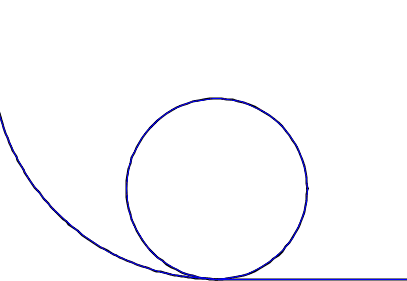
في عربة أفعوانية يشعر الراكب بانعدام الوزن الظاهري عند قمة مسار دائري رأسي نصف قطره \(r=6\,m\) (بإهمال الاحتكاك). السرعة الخطية عند القمة:On a roller coaster the rider feels weightless at the top of a vertical circular track of radius \(r=6\,m\) (friction neglected). The linear speed at the top is:
\(v=7.67\,m/s\)\(v=7.67\,m/s\)
\(v=12\,m/s\)\(v=12\,m/s\)
\(v=10.3\,m/s\)\(v=10.3\,m/s\)
\(v=4.53\,m/s\)\(v=4.53\,m/s\)
الحلSolution
📌 عند القمة القوة المركزية نحو الأسفل: \(mg+N=\dfrac{mv^{2}}{r}\).
📌 انعدام الوزن الظاهري يعني \(N=0\) فيكون \(mg=\dfrac{mv^{2}}{r}\Rightarrow v=\sqrt{gr}=\sqrt{9.81\times6}=7.67\,m/s\).
✅ \(v=7.67\,m/s\) (A)
📌 At the top the centripetal force points downward: \(mg+N=\dfrac{mv^{2}}{r}\).
📌 Apparent weightlessness means \(N=0\) so \(mg=\dfrac{mv^{2}}{r}\Rightarrow v=\sqrt{gr}=\sqrt{9.81\times6}=7.67\,m/s\).
✅ \(v=7.67\,m/s\) (A)
\[18\,\star\]
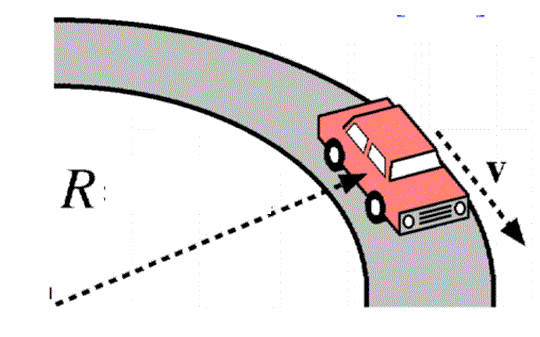
تتحرك سيارة بسرعة ثابتة حول مسار دائري أفقي. القوة المركزية المؤثرة عليها هي دائمًا:A car moves at constant speed around a horizontal circular track. The centripetal force acting on it is always:
قوة الاحتكاك الجانبي بين الإطارات والمسارthe lateral friction between the tyres and the road
القوة الأمامية من المحركthe forward force from the engine
وزن السيارةthe weight of the car
صفرzero
الحلSolution
📌 الوزن والقوة العمودية متعامدان مع المسار ويتوازنان رأسيًا، أما القوة الأفقية نحو المركز فهي الاحتكاك الجانبي بين الإطارات والطريق.
📌 القوة المركزية ليست قوة جديدة بل محصلة القوى نحو المركز.
✅ قوة الاحتكاك الجانبي بين الإطارات والمسار (A)
📌 The weight and the normal force are perpendicular to the plane of the track and balance vertically; the horizontal force toward the centre is the lateral friction between the tyres and the road.
📌 The centripetal force is not a new force but the resultant of the forces toward the centre.
✅ the lateral friction between the tyres and the road (A)
\[19\,\star\]
زاوية قدرها \(90^{\circ}\) تعادل بالراديان:An angle of \(90^{\circ}\) is equal in radians to:
\(\pi\approx3.14\,rad\)\(\pi\approx3.14\,rad\)
\(\dfrac{\pi}{2}\approx1.57\,rad\)\(\dfrac{\pi}{2}\approx1.57\,rad\)
\(\dfrac{\pi}{4}\approx0.79\,rad\)\(\dfrac{\pi}{4}\approx0.79\,rad\)
\(2\pi\approx6.28\,rad\)\(2\pi\approx6.28\,rad\)
الحلSolution
\(90^{\circ}\times\dfrac{\pi}{180^{\circ}}=\dfrac{\pi}{2}=1.57\,rad\).
✅ \(\dfrac{\pi}{2}\approx1.57\,rad\) (B)
\(90^{\circ}\times\dfrac{\pi}{180^{\circ}}=\dfrac{\pi}{2}=1.57\,rad\).
✅ \(\dfrac{\pi}{2}\approx1.57\,rad\) (B)
\[20\,\star\]
تردد دوران قرص \(120\) دورة في الدقيقة (rpm). سرعته الزاوية:A disc rotates at \(120\) revolutions per minute (rpm). Its angular speed is:
\(2\pi\,rad/s\)\(2\pi\,rad/s\)
\(4\pi\,rad/s\approx12.6\,rad/s\)\(4\pi\,rad/s\approx12.6\,rad/s\)
\(120\pi\,rad/s\)\(120\pi\,rad/s\)
\(240\pi\,rad/s\)\(240\pi\,rad/s\)
الحلSolution
📌 \(120\,rpm=\dfrac{120}{60}=2\,rev/s=2\,Hz\).
\(\omega=2\pi f=2\pi\times2=4\pi\,rad/s\).
✅ \(4\pi\,rad/s\approx12.6\,rad/s\) (B)
📌 \(120\,rpm=\dfrac{120}{60}=2\,rev/s=2\,Hz\).
\(\omega=2\pi f=2\pi\times2=4\pi\,rad/s\).
✅ \(4\pi\,rad/s\approx12.6\,rad/s\) (B)
\[21\,\star\]
جسم يدور بسرعة زاوية \(5\,rad/s\) على دائرة نصف قطرها \(0.4\,m\). سرعته الخطية:A body rotates at \(5\,rad/s\) on a circle of radius \(0.4\,m\). Its linear speed is:
\(2\,m/s\)\(2\,m/s\)
\(12.5\,m/s\)\(12.5\,m/s\)
\(0.08\,m/s\)\(0.08\,m/s\)
\(8\,m/s\)\(8\,m/s\)
الحلSolution
\(v=\omega r=5\times0.4=2\,m/s\).
✅ \(2\,m/s\) (A)
\(v=\omega r=5\times0.4=2\,m/s\).
✅ \(2\,m/s\) (A)
\[22\,\star\]
في الحركة الدائرية المنتظمة تكون العجلة:In uniform circular motion the acceleration is:
صفرًا لأن السرعة ثابتةzero because the speed is constant
مماسية لمسار الحركةtangent to the path
نحو الخارجdirected outward
نحو مركز الدائرة وثابتة المقدارdirected toward the centre of the circle and constant in magnitude
الحلSolution
📌 السرعة تتغير في الاتجاه (وإن ثبت مقدارها) فللجسم عجلة، وهي مركزية \(a_c=\dfrac{v^{2}}{r}\) نحو المركز ومقدارها ثابت.
✅ نحو مركز الدائرة وثابتة المقدار (D)
📌 The velocity changes in direction (although its magnitude is constant), so the body has an acceleration, and it is centripetal, \(a_c=\dfrac{v^{2}}{r}\), toward the centre with constant magnitude.
✅ directed toward the centre of the circle and constant in magnitude (D)
\[23\,\star\]
جسم يدور بتردد \(4\,Hz\). زمنه الدوري:A body rotates with frequency \(4\,Hz\). Its period is:
\(4\,s\)\(4\,s\)
\(0.4\,s\)\(0.4\,s\)
\(0.25\,s\)\(0.25\,s\)
\(25\,s\)\(25\,s\)
الحلSolution
\(T=\dfrac{1}{f}=\dfrac{1}{4}=0.25\,s\).
✅ \(0.25\,s\) (C)
\(T=\dfrac{1}{f}=\dfrac{1}{4}=0.25\,s\).
✅ \(0.25\,s\) (C)
\[24\,\star\star\]
سيارة تسير بسرعة \(10\,m/s\) في منعطف دائري نصف قطره \(25\,m\). عجلتها المركزية:A car moves at \(10\,m/s\) around a circular bend of radius \(25\,m\). Its centripetal acceleration is:
\(4\,m/s^{2}\)\(4\,m/s^{2}\)
\(0.4\,m/s^{2}\)\(0.4\,m/s^{2}\)
\(2.5\,m/s^{2}\)\(2.5\,m/s^{2}\)
\(250\,m/s^{2}\)\(250\,m/s^{2}\)
الحلSolution
\(a_c=\dfrac{v^{2}}{r}=\dfrac{100}{25}=4\,m/s^{2}\).
✅ \(4\,m/s^{2}\) (A)
\(a_c=\dfrac{v^{2}}{r}=\dfrac{100}{25}=4\,m/s^{2}\).
✅ \(4\,m/s^{2}\) (A)
\[25\,\star\star\]
إذا ضوعفت سرعة جسم يتحرك على دائرة نصف قطرها ثابت فإن عجلته المركزية:If the speed of a body moving on a circle of fixed radius is doubled, its centripetal acceleration:
تتضاعفdoubles
تنقص إلى النصفis halved
تصبح أربعة أضعافbecomes four times as large
لا تتغيرdoes not change
الحلSolution
\(a_c=\dfrac{v^{2}}{r}\propto v^{2}\) فمضاعفة \(v\) تجعلها \(4\) أضعاف.
✅ تصبح أربعة أضعاف (C)
\(a_c=\dfrac{v^{2}}{r}\propto v^{2}\) so doubling \(v\) makes it \(4\) times as large.
✅ becomes four times as large (C)
\[26\,\star\star\]
جسم كتلته \(2\,kg\) يتحرك على دائرة نصف قطرها \(3\,m\) بسرعة \(6\,m/s\). القوة المركزية:A body of mass \(2\,kg\) moves on a circle of radius \(3\,m\) at \(6\,m/s\). The centripetal force is:
\(12\,N\)\(12\,N\)
\(72\,N\)\(72\,N\)
\(4\,N\)\(4\,N\)
\(24\,N\)\(24\,N\)
الحلSolution
\(F_c=\dfrac{mv^{2}}{r}=\dfrac{2\times36}{3}=24\,N\).
✅ \(24\,N\) (D)
\(F_c=\dfrac{mv^{2}}{r}=\dfrac{2\times36}{3}=24\,N\).
✅ \(24\,N\) (D)
\[27\,\star\star\star\]
أكبر سرعة تستطيع بها سيارة أن تدور في منعطف أفقي مستوٍ نصف قطره \(50\,m\) ومعامل الاحتكاك السكوني بين الإطارات والطريق \(0.5\) هي (\(g=9.81\,m/s^{2}\)):The maximum speed with which a car can go around a flat horizontal bend of radius \(50\,m\), with a coefficient of static friction \(0.5\) between tyres and road, is (\(g=9.81\,m/s^{2}\)):
\(22.1\,m/s\)\(22.1\,m/s\)
\(15.7\,m/s\)\(15.7\,m/s\)
\(7.8\,m/s\)\(7.8\,m/s\)
\(24.5\,m/s\)\(24.5\,m/s\)
الحلSolution
📌 الاحتكاك السكوني هو القوة المركزية، وأكبر قيمة له \(\mu mg\): \(\mu mg=\dfrac{mv^{2}}{r}\).
\(v_{max}=\sqrt{\mu g r}=\sqrt{0.5\times9.81\times50}=15.7\,m/s\) (لا تعتمد على كتلة السيارة).
✅ \(15.7\,m/s\) (B)
📌 Static friction is the centripetal force, and its largest value is \(\mu mg\): \(\mu mg=\dfrac{mv^{2}}{r}\).
\(v_{max}=\sqrt{\mu g r}=\sqrt{0.5\times9.81\times50}=15.7\,m/s\) (independent of the mass of the car).
✅ \(15.7\,m/s\) (B)
\[28\,\star\star\star\]
كرة كتلتها \(0.5\,kg\) مربوطة بخيط طوله \(1\,m\) تتأرجح في دائرة رأسية، وسرعتها عند أخفض نقطة \(5\,m/s\). الشد في الخيط عند هذه النقطة (\(g=9.81\,m/s^{2}\)):A ball of mass \(0.5\,kg\) on a string \(1\,m\) long swings in a vertical circle and its speed at the lowest point is \(5\,m/s\). The tension in the string at that point is (\(g=9.81\,m/s^{2}\)):
\(T=17.4\,N\)\(T=17.4\,N\)
\(T=12.5\,N\)\(T=12.5\,N\)
\(T=7.6\,N\)\(T=7.6\,N\)
\(T=4.9\,N\)\(T=4.9\,N\)
الحلSolution
📌 عند أخفض نقطة المحصلة نحو المركز (الأعلى): \(T-mg=\dfrac{mv^{2}}{r}\).
\(T=mg+\dfrac{mv^{2}}{r}=0.5\times9.81+\dfrac{0.5\times25}{1}=4.9+12.5=17.4\,N\).
✅ \(T=17.4\,N\) (A)
📌 At the lowest point the resultant toward the centre (upward) is: \(T-mg=\dfrac{mv^{2}}{r}\).
\(T=mg+\dfrac{mv^{2}}{r}=0.5\times9.81+\dfrac{0.5\times25}{1}=4.9+12.5=17.4\,N\).
✅ \(T=17.4\,N\) (A)
\[29\,\star\star\]
جسم بدأ دورانه بسرعة زاوية \(2\,rad/s\) وعجلته الزاوية ثابتة \(3\,rad/s^{2}\). سرعته الزاوية بعد \(4\,s\):A body starts rotating at \(2\,rad/s\) with a constant angular acceleration of \(3\,rad/s^{2}\). Its angular speed after \(4\,s\) is:
\(12\,rad/s\)\(12\,rad/s\)
\(6\,rad/s\)\(6\,rad/s\)
\(14\,rad/s\)\(14\,rad/s\)
\(20\,rad/s\)\(20\,rad/s\)
الحلSolution
\(\omega=\omega_0+\alpha t=2+3\times4=14\,rad/s\).
✅ \(14\,rad/s\) (C)
\(\omega=\omega_0+\alpha t=2+3\times4=14\,rad/s\).
✅ \(14\,rad/s\) (C)
\[30\,\star\star\]
يبدأ جسم دورانه من السكون بعجلة زاوية ثابتة \(2\,rad/s^{2}\). الإزاحة الزاوية خلال أول \(3\,s\):A body starts rotating from rest with a constant angular acceleration of \(2\,rad/s^{2}\). Its angular displacement during the first \(3\,s\) is:
\(6\,rad\)\(6\,rad\)
\(9\,rad\)\(9\,rad\)
\(18\,rad\)\(18\,rad\)
\(3\,rad\)\(3\,rad\)
الحلSolution
\(\theta=\omega_0t+\tfrac12\alpha t^{2}=0+\tfrac12\times2\times9=9\,rad\).
✅ \(9\,rad\) (B)
\(\theta=\omega_0t+\tfrac12\alpha t^{2}=0+\tfrac12\times2\times9=9\,rad\).
✅ \(9\,rad\) (B)
\[31\,\star\star\]
السرعة الزاوية لدوران الأرض حول محورها (يومٌ كامل \(86400\,s\)):The angular speed of the Earth's rotation about its axis (a full day of \(86400\,s\)) is:
\(7.3\times10^{-4}\,rad/s\)\(7.3\times10^{-4}\,rad/s\)
\(7.3\times10^{-5}\,rad/s\)\(7.3\times10^{-5}\,rad/s\)
\(1.2\times10^{-5}\,rad/s\)\(1.2\times10^{-5}\,rad/s\)
\(4.2\times10^{-3}\,rad/s\)\(4.2\times10^{-3}\,rad/s\)
الحلSolution
\(\omega=\dfrac{2\pi}{T}=\dfrac{2\pi}{86400}=7.27\times10^{-5}\,rad/s\).
✅ \(7.3\times10^{-5}\,rad/s\) (B)
\(\omega=\dfrac{2\pi}{T}=\dfrac{2\pi}{86400}=7.27\times10^{-5}\,rad/s\).
✅ \(7.3\times10^{-5}\,rad/s\) (B)
\[32\,\star\star\]
القوة التي تبقي قمرًا صناعيًا في مداره الدائري حول الأرض هي:The force that keeps a satellite in its circular orbit around the Earth is:
قوة طرد مركزية نحو الخارجa centrifugal force outward
قوة دفع المحرك المستمرthe continuous thrust of an engine
قوة جذب الأرض (الجاذبية) وهي القوة المركزيةthe Earth's gravitational attraction, which is the centripetal force
قوة الاحتكاك مع الهواءfriction with the air
الحلSolution
📌 الجاذبية هي المحصلة نحو مركز الأرض فتُمثّل القوة المركزية: \(\dfrac{GMm}{r^{2}}=\dfrac{mv^{2}}{r}\) ومنه \(v=\sqrt{GM/r}\) وهي لا تعتمد على كتلة القمر.
📌 لا توجد قوة «طرد مركزي» حقيقية تؤثر في القمر؛ هي أثر القصور الذاتي فقط.
✅ قوة جذب الأرض (الجاذبية) وهي القوة المركزية (C)
📌 Gravity is the resultant toward the centre of the Earth so it acts as the centripetal force: \(\dfrac{GMm}{r^{2}}=\dfrac{mv^{2}}{r}\), so \(v=\sqrt{GM/r}\), which does not depend on the mass of the satellite.
📌 There is no real “centrifugal force” acting on the satellite; it is only an effect of inertia.
✅ the Earth's gravitational attraction, which is the centripetal force (C)
\[33\,\star\star\star\]
جسم يتحرك على دائرة بتسارع زاوي فكانت عجلته المركزية \(3\,m/s^{2}\) وعجلته المماسية \(4\,m/s^{2}\) عند لحظة معينة. مقدار عجلته الكلية:A body moves on a circle with an angular acceleration so that at some instant its centripetal acceleration is \(3\,m/s^{2}\) and its tangential acceleration is \(4\,m/s^{2}\). The magnitude of its total acceleration is:
\(5\,m/s^{2}\)\(5\,m/s^{2}\)
\(7\,m/s^{2}\)\(7\,m/s^{2}\)
\(1\,m/s^{2}\)\(1\,m/s^{2}\)
\(12\,m/s^{2}\)\(12\,m/s^{2}\)
الحلSolution
📌 العجلتان متعامدتان (المركزية نحو المركز والمماسية على المماس) فنجمعهما بمثلث قائم: \(a=\sqrt{a_c^{2}+a_t^{2}}=\sqrt{9+16}=5\,m/s^{2}\).
✅ \(5\,m/s^{2}\) (A)
📌 The two accelerations are perpendicular (centripetal toward the centre, tangential along the tangent) so we add them with a right triangle: \(a=\sqrt{a_c^{2}+a_t^{2}}=\sqrt{9+16}=5\,m/s^{2}\).
✅ \(5\,m/s^{2}\) (A)
📝 المسائل المقالية
📝 Essay Problems
\[1\,\star\star\]
بندول مخروطي: كتلة \(m=0.2\,kg\) معلّقة بخيط طوله \(L=1.0\,m\) تدور في دائرة أفقية بسرعة ثابتة المقدار، ويصنع الخيط زاوية \(\theta=30^{\circ}\) مع الخط الرأسي (الشكل) (\(g=9.81\,m/s^{2}\)). احسب: (أ) الشد في الخيط. (ب) نصف قطر الدائرة. (ج) القوة المركزية. (د) السرعة الخطية للكتلة. (هـ) الزمن الدوري. (و) ارسم مخطط القوى على الكتلة.A conical pendulum: a mass \(m=0.2\,kg\) hangs on a string of length \(L=1.0\,m\) and moves in a horizontal circle at constant speed, the string making an angle \(\theta=30^{\circ}\) with the vertical (figure) (\(g=9.81\,m/s^{2}\)). Find: (a) the tension in the string. (b) the radius of the circle. (c) the centripetal force. (d) the linear speed of the mass. (e) the period. (f) Draw the free-body diagram of the mass.
.....................................................................
الحلSolution
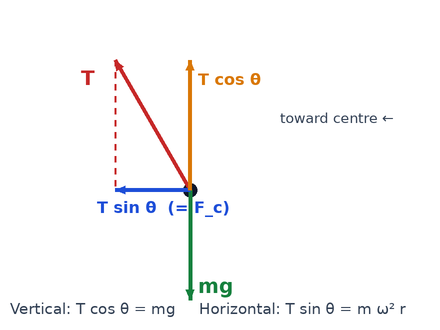
📌 (أ) لا تسارع رأسي، فمركبة الشد الرأسية توازن الوزن: \(T\cos\theta=mg\) ومنه \(T=\dfrac{mg}{\cos\theta}=\dfrac{0.2\times9.81}{\cos30^{\circ}}=2.27\,N\).
📌 (ب) \(r=L\sin\theta=1.0\times\sin30^{\circ}=0.5\,m\).
📌 (ج) المركبة الأفقية للشد هي القوة المركزية: \(F_c=T\sin\theta=2.27\times0.5=1.13\,N\) (أو \(mg\tan\theta\)).
📌 (د) \(F_c=\dfrac{mv^{2}}{r}\Rightarrow v=\sqrt{\dfrac{F_c\,r}{m}}=\sqrt{\dfrac{1.13\times0.5}{0.2}}=1.68\,m/s\).
📌 (هـ) \(T_{period}=\dfrac{2\pi r}{v}=\dfrac{2\pi\times0.5}{1.68}=1.87\,s\).
📌 (و) على الكتلة قوتان فقط: الوزن \(mg\) للأسفل والشد \(T\) على امتداد الخيط، ولا توجد قوة ثالثة اسمها «القوة المركزية» (هي محصلتهما كما في الرسم).
✅ \(T=2.27\,N,\ r=0.5\,m,\ F_c=1.13\,N,\ v=1.68\,m/s,\ T_{period}=1.87\,s\)
📌 (a) There is no vertical acceleration, so the vertical component of the tension balances the weight: \(T\cos\theta=mg\) so \(T=\dfrac{mg}{\cos\theta}=\dfrac{0.2\times9.81}{\cos30^{\circ}}=2.27\,N\).
📌 (b) \(r=L\sin\theta=1.0\times\sin30^{\circ}=0.5\,m\).
📌 (c) The horizontal component of the tension is the centripetal force: \(F_c=T\sin\theta=2.27\times0.5=1.13\,N\) (or \(mg\tan\theta\)).
📌 (d) \(F_c=\dfrac{mv^{2}}{r}\Rightarrow v=\sqrt{\dfrac{F_c\,r}{m}}=\sqrt{\dfrac{1.13\times0.5}{0.2}}=1.68\,m/s\).
📌 (e) \(T_{period}=\dfrac{2\pi r}{v}=\dfrac{2\pi\times0.5}{1.68}=1.87\,s\).
📌 (f) Only two forces act on the mass: the weight \(mg\) downward and the tension \(T\) along the string; there is no third force called the “centripetal force” (it is their resultant, as in the drawing).
✅ \(T=2.27\,N,\ r=0.5\,m,\ F_c=1.13\,N,\ v=1.68\,m/s,\ T_{period}=1.87\,s\)
\[2\,\star\star\star\]
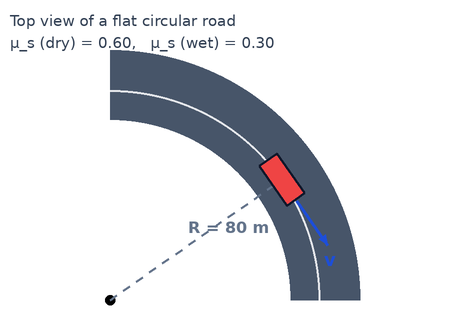
سيارة تسير على منعطف دائري أفقي مستوٍ نصف قطره \(R=80\,m\) (الشكل) ومعامل الاحتكاك السكوني بين الإطارات والطريق الجاف \(0.60\) وللطريق المبلل \(0.30\) (\(g=9.81\,m/s^{2}\)). (أ) ما القوة التي تؤدي دور القوة المركزية؟ (ب) احسب أكبر سرعة آمنة على الطريق الجاف بالمتر/الثانية وبالكيلومتر/الساعة. (ج) هل تنزلق سيارة تسير بسرعة \(25\,m/s\)؟ علّل بحساب معامل الاحتكاك اللازم. (د) احسب أكبر سرعة آمنة على الطريق المبلل. (هـ) هل تتغير السرعة العظمى إذا ازدادت كتلة السيارة؟A car travels around a flat horizontal circular bend of radius \(R=80\,m\) (figure). The coefficient of static friction between the tyres and the dry road is \(0.60\) and for the wet road \(0.30\) (\(g=9.81\,m/s^{2}\)). (a) Which force acts as the centripetal force? (b) Find the maximum safe speed on the dry road in m/s and in km/h. (c) Does a car moving at \(25\,m/s\) skid? Justify with the friction coefficient needed. (d) Find the maximum safe speed on the wet road. (e) Does the maximum speed change if the mass of the car increases?
.....................................................................
الحلSolution
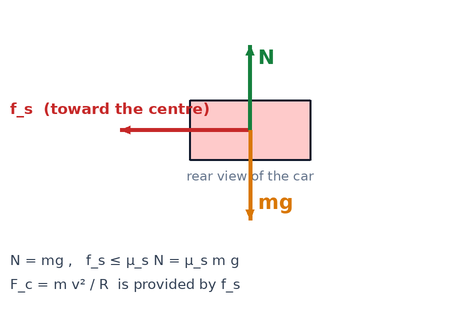
📌 (أ) قوة الاحتكاك السكوني الجانبي بين الإطارات والطريق هي المركزية (الوزن والقوة العمودية متعامدان مع مستوى الدوران ويتوازنان).
📌 (ب) أكبر احتكاك \(f_{max}=\mu_s N=\mu_s mg\) ويجب أن يعادل \(\dfrac{mv^{2}}{R}\): \(v_{max}=\sqrt{\mu_s g R}=\sqrt{0.60\times9.81\times80}=21.7\,m/s\) أي نحو \(78\,km/h\).
📌 (ج) المعامل اللازم عند \(25\,m/s\): \(\mu_{req}=\dfrac{v^{2}}{gR}=\dfrac{625}{9.81\times80}=0.80\) وهو أكبر من \(0.60\) المتاح، فلا يكفي الاحتكاك وتنزلق السيارة نحو الخارج.
📌 (د) \(v_{max}=\sqrt{0.30\times9.81\times80}=15.3\,m/s\) (نحو \(55\,km/h\)) أي أقل بمقدار \(\sqrt{2}\) مرة تقريبًا.
📌 (هـ) لا؛ الكتلة تُختصر من المعادلة \(\mu mg=\dfrac{mv^{2}}{R}\) فلا تؤثر في \(v_{max}\).
✅ \(v_{dry}=21.7\,m/s\ (78\,km/h),\ \mu_{req}=0.80\gt 0.60\ (skids),\ v_{wet}=15.3\,m/s\)
📌 (a) The lateral static friction between the tyres and the road is the centripetal force (the weight and the normal force are perpendicular to the plane of rotation and balance each other).
📌 (b) The greatest friction is \(f_{max}=\mu_s N=\mu_s mg\) and it must equal \(\dfrac{mv^{2}}{R}\): \(v_{max}=\sqrt{\mu_s g R}=\sqrt{0.60\times9.81\times80}=21.7\,m/s\), i.e. about \(78\,km/h\).
📌 (c) The coefficient needed at \(25\,m/s\) is \(\mu_{req}=\dfrac{v^{2}}{gR}=\dfrac{625}{9.81\times80}=0.80\), larger than the available \(0.60\), so friction is not enough and the car skids outward.
📌 (d) \(v_{max}=\sqrt{0.30\times9.81\times80}=15.3\,m/s\) (about \(55\,km/h\)), smaller by a factor of about \(\sqrt{2}\).
📌 (e) No; the mass cancels from \(\mu mg=\dfrac{mv^{2}}{R}\) so it does not affect \(v_{max}\).
✅ \(v_{dry}=21.7\,m/s\ (78\,km/h),\ \mu_{req}=0.80\gt 0.60\ (skids),\ v_{wet}=15.3\,m/s\)
\[3\,\star\star\star\]
كرة كتلتها \(0.4\,kg\) مربوطة بخيط طوله \(r=0.8\,m\) وتدور في دائرة رأسية (الشكل) (\(g=9.81\,m/s^{2}\)). (أ) ما أقل سرعة عند النقطة العليا A ليبقى الخيط مشدودًا؟ (ب) إذا كانت سرعتها عند A هي هذه القيمة فما سرعتها عند النقطة السفلى B (بإهمال الاحتكاك)؟ (ج) احسب الشد في الخيط عند B وقارنه بوزن الكرة. (د) ارسم مخطط القوى عند A وعند B.A ball of mass \(0.4\,kg\) is tied to a string of length \(r=0.8\,m\) and moves in a vertical circle (figure) (\(g=9.81\,m/s^{2}\)). (a) What is the minimum speed at the top A for the string to stay taut? (b) If its speed at A is that value, what is its speed at the bottom B (friction neglected)? (c) Find the tension in the string at B and compare it with the weight of the ball. (d) Draw the free-body diagrams at A and at B.
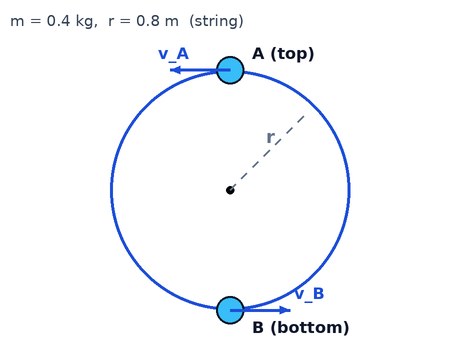
.....................................................................
الحلSolution
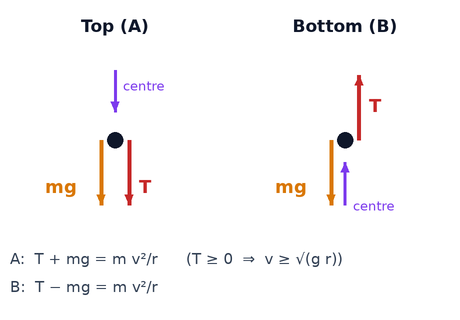
📌 (أ) عند A الوزن والشد كلاهما نحو المركز (الأسفل): \(T+mg=\dfrac{mv_A^{2}}{r}\). أقل سرعة عندما \(T=0\): \(mg=\dfrac{mv_A^{2}}{r}\Rightarrow v_A=\sqrt{gr}=\sqrt{9.81\times0.8}=2.80\,m/s\).
📌 (ب) الطاقة محفوظة (الشد عمودي على الحركة فلا يبذل شغلًا) والارتفاع بين النقطتين \(2r\): \(\tfrac12mv_B^{2}=\tfrac12mv_A^{2}+mg(2r)\) ومنه \(v_B^{2}=v_A^{2}+4gr=gr+4gr=5gr=39.2\) و\(v_B=6.26\,m/s\).
📌 (ج) عند B الشد نحو الأعلى (المركز) والوزن للأسفل: \(T_B-mg=\dfrac{mv_B^{2}}{r}\) ومنه \(T_B=mg+\dfrac{mv_B^{2}}{r}=0.4\times9.81+\dfrac{0.4\times39.2}{0.8}=3.92+19.6=23.5\,N\) أي \(6\,mg\) (ستة أضعاف الوزن).
📌 (د) انظر الرسم: عند A سهمان للأسفل (\(T\) و\(mg\)) وعند B الشد للأعلى والوزن للأسفل، والمحصلة في الحالتين نحو المركز.
✅ \(v_A=2.80\,m/s,\ v_B=6.26\,m/s,\ T_B=23.5\,N=6mg\)
📌 (a) At A the weight and the tension both point toward the centre (downward): \(T+mg=\dfrac{mv_A^{2}}{r}\). The minimum speed occurs when \(T=0\): \(mg=\dfrac{mv_A^{2}}{r}\Rightarrow v_A=\sqrt{gr}=\sqrt{9.81\times0.8}=2.80\,m/s\).
📌 (b) Energy is conserved (the tension is perpendicular to the motion and does no work) and the height between the points is \(2r\): \(\tfrac12mv_B^{2}=\tfrac12mv_A^{2}+mg(2r)\) so \(v_B^{2}=v_A^{2}+4gr=gr+4gr=5gr=39.2\) and \(v_B=6.26\,m/s\).
📌 (c) At B the tension points upward (toward the centre) and the weight downward: \(T_B-mg=\dfrac{mv_B^{2}}{r}\) so \(T_B=mg+\dfrac{mv_B^{2}}{r}=0.4\times9.81+\dfrac{0.4\times39.2}{0.8}=3.92+19.6=23.5\,N\), i.e. \(6\,mg\) (six times the weight).
📌 (d) See the drawing: at A two arrows point downward (\(T\) and \(mg\)), at B the tension is upward and the weight downward, and in both cases the resultant points toward the centre.
✅ \(v_A=2.80\,m/s,\ v_B=6.26\,m/s,\ T_B=23.5\,N=6mg\)
\[4\,\star\star\]
عجلة نصف قطرها \(r=0.5\,m\) تبدأ الدوران من السكون بعجلة زاوية ثابتة \(\alpha=2\,rad/s^{2}\) (الشكل). بعد \(4\,s\) احسب: (أ) السرعة الزاوية. (ب) الإزاحة الزاوية بالراديان وبعدد الدورات. (ج) السرعة الخطية للنقطة P على الحافة. (د) العجلة المماسية والعجلة المركزية للنقطة P. (هـ) مقدار العجلة الكلية والزاوية التي تصنعها مع نصف القطر. (و) ارسم متجهات العجلات عند P.A wheel of radius \(r=0.5\,m\) starts rotating from rest with a constant angular acceleration \(\alpha=2\,rad/s^{2}\) (figure). After \(4\,s\) find: (a) the angular speed. (b) the angular displacement in radians and in revolutions. (c) the linear speed of the point P on the rim. (d) the tangential and the centripetal acceleration of P. (e) the magnitude of the total acceleration and the angle it makes with the radius. (f) Draw the acceleration vectors at P.
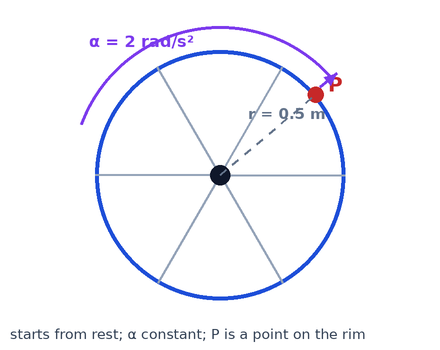
.....................................................................
الحلSolution
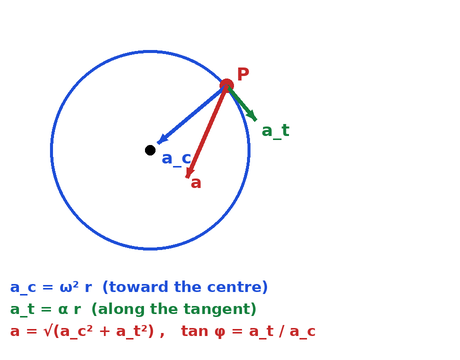
📌 (أ) \(\omega=\omega_0+\alpha t=0+2\times4=8\,rad/s\).
📌 (ب) \(\theta=\omega_0t+\tfrac12\alpha t^{2}=\tfrac12\times2\times16=16\,rad\) أي \(\dfrac{16}{2\pi}=2.55\) دورة.
📌 (ج) \(v=\omega r=8\times0.5=4\,m/s\).
📌 (د) \(a_t=\alpha r=2\times0.5=1\,m/s^{2}\) (ثابتة) و\(a_c=\omega^{2}r=64\times0.5=32\,m/s^{2}\) (تزداد مع الزمن).
📌 (هـ) العجلتان متعامدتان: \(a=\sqrt{a_c^{2}+a_t^{2}}=\sqrt{32^{2}+1^{2}}=32.02\,m/s^{2}\) و\(\tan\varphi=\dfrac{a_t}{a_c}=\dfrac{1}{32}\Rightarrow\varphi=1.8^{\circ}\) عن نصف القطر (أي تكاد تكون نحو المركز).
📌 (و) في الرسم: \(a_c\) نحو المركز، \(a_t\) على المماس بإتجاه الدوران، والمحصلة \(a\) بينهما.
✅ \(\omega=8\,rad/s,\ \theta=16\,rad,\ v=4\,m/s,\ a_t=1,\ a_c=32,\ a=32.02\,m/s^{2}\)
📌 (a) \(\omega=\omega_0+\alpha t=0+2\times4=8\,rad/s\).
📌 (b) \(\theta=\omega_0t+\tfrac12\alpha t^{2}=\tfrac12\times2\times16=16\,rad\), i.e. \(\dfrac{16}{2\pi}=2.55\) revolutions.
📌 (c) \(v=\omega r=8\times0.5=4\,m/s\).
📌 (d) \(a_t=\alpha r=2\times0.5=1\,m/s^{2}\) (constant) and \(a_c=\omega^{2}r=64\times0.5=32\,m/s^{2}\) (it grows with time).
📌 (e) The two accelerations are perpendicular: \(a=\sqrt{a_c^{2}+a_t^{2}}=\sqrt{32^{2}+1^{2}}=32.02\,m/s^{2}\) and \(\tan\varphi=\dfrac{a_t}{a_c}=\dfrac{1}{32}\Rightarrow\varphi=1.8^{\circ}\) from the radius (almost directly toward the centre).
📌 (f) In the drawing: \(a_c\) toward the centre, \(a_t\) along the tangent in the direction of rotation, and the resultant \(a\) between them.
✅ \(\omega=8\,rad/s,\ \theta=16\,rad,\ v=4\,m/s,\ a_t=1,\ a_c=32,\ a=32.02\,m/s^{2}\)
\[5\,\star\star\star\]
منعطف دائري نصف قطره \(R=60\,m\) أُنشئ مائلًا (الشكل) ليسير فيه السيارات بسرعة \(15\,m/s\) دون الاعتماد على الاحتكاك (\(g=9.81\,m/s^{2}\)). (أ) ارسم القوى المؤثرة على سيارة كتلتها \(1200\,kg\) على الطريق المائل. (ب) احسب زاوية الميل \(\theta\). (ج) احسب القوة العمودية \(N\) التي يؤثر بها الطريق على السيارة. (د) ما السرعة التي يصلح لها منعطف نفسه إذا كانت زاوية ميله \(15^{\circ}\)؟ (هـ) ماذا يحدث لسيارة تسير على المنعطف الأول بسرعة أكبر من \(15\,m/s\) وكان الطريق أملس تمامًا؟A circular bend of radius \(R=60\,m\) is banked (figure) so that cars can take it at \(15\,m/s\) without relying on friction (\(g=9.81\,m/s^{2}\)). (a) Draw the forces acting on a car of mass \(1200\,kg\) on the banked road. (b) Find the angle of banking \(\theta\). (c) Find the normal force \(N\) exerted by the road on the car. (d) For what speed would the same bend be ideal if it were banked at \(15^{\circ}\)? (e) What happens to a car moving faster than \(15\,m/s\) on the first bend if the road is perfectly smooth?
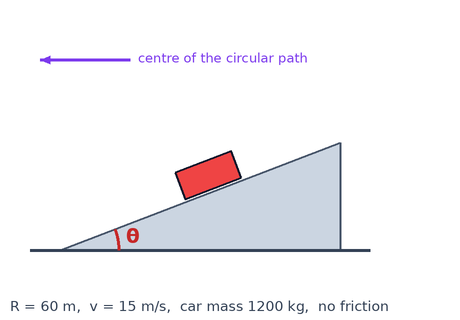
.....................................................................
الحلSolution
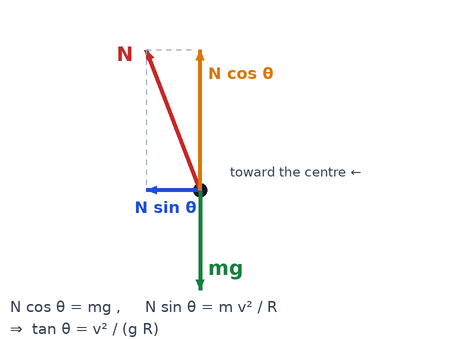
📌 (أ) القوتان: الوزن \(mg\) رأسيًا للأسفل والقوة العمودية \(N\) عمودية على سطح الطريق (تميل نحو مركز المنعطف بزاوية \(\theta\) عن الرأسي) كما في الرسم.
📌 (ب) رأسيًا: \(N\cos\theta=mg\)، وأفقيًا (نحو المركز): \(N\sin\theta=\dfrac{mv^{2}}{R}\). بالقسمة: \(\tan\theta=\dfrac{v^{2}}{gR}=\dfrac{225}{9.81\times60}=0.382\) ومنه \(\theta=20.9^{\circ}\) (لا تعتمد الزاوية على كتلة السيارة).
📌 (ج) \(N=\dfrac{mg}{\cos\theta}=\dfrac{1200\times9.81}{\cos20.9^{\circ}}=1.26\times10^{4}\,N\) وهي أكبر من الوزن \(1.18\times10^{4}\,N\).
📌 (د) \(v=\sqrt{gR\tan\theta}=\sqrt{9.81\times60\times\tan15^{\circ}}=\sqrt{157.7}=12.6\,m/s\).
📌 (هـ) القوة العمودية وحدها لا تكفي لتأمين القوة المركزية اللازمة (تتطلب \(\tan\theta\) أكبر)، فتنزلق السيارة إلى أعلى المنحدر نحو الخارج؛ وفي الواقع يمنعها الاحتكاك من الانزلاق حتى سرعة معينة.
✅ \(\theta=20.9^{\circ},\ N=1.26\times10^{4}\,N,\ v_{15^{\circ}}=12.6\,m/s\)
📌 (a) The two forces: the weight \(mg\) vertically downward and the normal force \(N\) perpendicular to the road surface (tilted toward the centre of the bend by \(\theta\) from the vertical), as in the drawing.
📌 (b) Vertically: \(N\cos\theta=mg\), horizontally (toward the centre): \(N\sin\theta=\dfrac{mv^{2}}{R}\). Dividing: \(\tan\theta=\dfrac{v^{2}}{gR}=\dfrac{225}{9.81\times60}=0.382\) so \(\theta=20.9^{\circ}\) (the angle does not depend on the mass of the car).
📌 (c) \(N=\dfrac{mg}{\cos\theta}=\dfrac{1200\times9.81}{\cos20.9^{\circ}}=1.26\times10^{4}\,N\), larger than the weight \(1.18\times10^{4}\,N\).
📌 (d) \(v=\sqrt{gR\tan\theta}=\sqrt{9.81\times60\times\tan15^{\circ}}=\sqrt{157.7}=12.6\,m/s\).
📌 (e) The normal force alone cannot supply the larger centripetal force required (a larger \(\tan\theta\) would be needed), so the car slides up the slope toward the outside; in reality friction prevents the slide up to a certain speed.
✅ \(\theta=20.9^{\circ},\ N=1.26\times10^{4}\,N,\ v_{15^{\circ}}=12.6\,m/s\)
لاحظت خطأ؟ أو عندك سؤال عن أحد الأسئلة؟ اكتبه بالتعليقات وحدد رقم السؤال بالضبط.
Noticed an error? Or have a question about one of the questions? Write it in the comments and specify the exact question number.