"My Lord, enable me to be grateful for Your favor which You have bestowed upon me and upon my parents, and to work righteousness of which You approve, and make righteous for me my offspring. Indeed, I have repented to You, and indeed, I am of the Muslims." (Quran 46:15)
"Our Lord, grant us from among our wives and offspring comfort to our eyes, and make us an example for the righteous." (Quran 25:74)
🧲 امتحان تجريبي: الحث الكهرومغناطيسي والمجالات الكهربائية والمغناطيسية في الفراغ
🧲 Practice Exam: Electromagnetic Induction and Electric/Magnetic Fields in Vacuum
الصف 12 عام 🇦🇪 دولة الإمارات العربية المتحدة
Grade 12 General 🇦🇪 United Arab Emirates
⏱️ 27 سؤال اختيار من متعدد بتصحيح فوري، و7 أسئلة مقالية محلولة بالكامل⏱️ 27 multiple-choice questions with instant feedback, plus 7 fully-solved essay questions
\[1\,\star\]
أحد الحلقات المعدنية التالية لا يتولد فيها قوة محركة مستحثةIn which of the following cases is NO induced EMF generated in the metal loop
A: دخول الحلقة إلى المجالA: The loop entering the field
B: حركة الحلقة داخل المجال المنتظم (دون تغيير مساحتها أو اتجاهها)B: The loop moving within the uniform field (without changing its area or orientation)
C: خروج الحلقة من المجالC: The loop exiting the field
D: دوران الحلقة في المجالD: The loop rotating within the field
الحلSolution
📌 الفكرة: الفرق الجهد المستحث ينتج فقط عن تغيّر التدفق المغناطيسي عبر الحلقة (تغيّر في المساحة المعرضة للمجال، أو في زاويتها، أو في شدة المجال).
📌 التطبيق: في الحالة B، الحلقة بالكامل داخل منطقة مجال منتظم وتتحرك دون أن تغيّر مساحتها أو اتجاهها بالنسبة للمجال، فالتدفق المغناطيسي يبقى ثابتًا تمامًا، ولا يتولد أي قوة محركة مستحثة. أما الحالات الأخرى (الدخول، الخروج، الدوران) فكلها تغيّر التدفق.
✅ B: حركة الحلقة داخل المجال المنتظم
📌 Idea: Induced EMF results only from a change in magnetic flux through the loop (a change in exposed area, angle, or field strength).
📌 Application: In case B, the loop stays entirely within a uniform field region and moves without changing its area or orientation relative to the field, so the flux remains perfectly constant and no EMF is induced. The other cases (entering, exiting, rotating) all change the flux.
✅ B: The loop moving within the uniform field
\[2\,\star\star\]
أحد الأسلاك المعدنية التالية يتولد بها تيار مستحث من الطرف \(a\rightarrow b\) عند حركة السلك بالسهم المبين داخل المجال المغناطيسي المنتظمIn which of the following cases is an induced current generated from terminal \(a\) to \(b\) as the wire moves in the direction shown, within a uniform magnetic field
A
B
C
D
الحلSolution
📌 القاعدة: اتجاه القوة على الشحنات الموجبة داخل السلك المتحرك يعطى بـ \(F=qv\times B\)؛ هذا الاتجاه يحدد قطبية السلك واتجاه التيار داخله.
📌 التطبيق: في الحالة C فقط، يعطي حساب \(v\times B\) قوة تدفع الشحنات الموجبة من طرف a نحو طرف b داخل السلك، مطابقًا للمطلوب بالضبط. في باقي الحالات (A، B، D)، تكون القوة الناتجة من b نحو a (عكس الاتجاه المطلوب).
✅ الحالة C
📌 Rule: The force on positive charges in the moving wire is given by \(F=qv\times B\); this direction determines the wire\u2019s polarity and internal current direction.
📌 Application: Only in case C does \(v\times B\) push positive charges from terminal a toward terminal b inside the wire, exactly as required. In the other cases (A, B, D), the resulting force is from b toward a (the opposite direction).
✅ Case C
\[3\,\star\]
عند حركة سلك موصل بأحد الاتجاهات الموضحة في الشكل أدناه، يتولد بين طرفي السلك قوة محركة مستحثةWhen a conducting wire moves in one of the directions shown below, an induced EMF is generated between its two ends
A
B
C
D
الحلSolution
📌 القاعدة: يتولد فرق جهد بين طرفي الموصل فقط عندما يكون للقوة \(F=qv\times B\) مركبة على طول محور الموصل نفسه، أي عندما لا تكون حركته موازية للمجال (فلا قوة أصلًا) ولا موازية لمحوره الخاص (فالقوة تكون عمودية على الموصل ولا تدفع الشحنات على طوله).
📌 التطبيق: حركة السلك في الاتجاه A (عموديًا على مستوى يحوي كلًا من محور السلك والمجال المغناطيسي) هي الحالة الوحيدة التي تنتج قوة لها مركبة فعلية على طول السلك، فيتولد فرق جهد بين طرفيه. أما الحركة على طول محور السلك نفسه (B)، أو بمحاذاة/بعكس اتجاه المجال (C وD)، فلا تُنتج أي فرق جهد بين طرفيه.
✅ الحالة A
📌 Rule: A potential difference appears between the ends of a conductor only when the force \(F=qv\times B\) has a component along the conductor\u2019s own axis — i.e. when the motion is neither parallel to the field (no force at all) nor along the conductor\u2019s own length (force perpendicular to it, driving no charge along its length).
📌 Application: Motion in direction A (perpendicular to the plane containing both the wire\u2019s axis and the field) is the only case producing a force with a real component along the wire, generating an EMF between its ends. Motion along the wire\u2019s own axis (B), or parallel/antiparallel to the field (C, D), produces no EMF.
✅ Case A
\[4\,\star\]
ما هو المبدأ الأساسي الذي يعمل عليه المولد الكهربائي؟What is the basic principle behind how an electric generator works?
قانون كولومCoulomb's law
قانون أمبيرAmpère's law
قانون أومOhm's law
قانون فاراداي للحث الكهرومغناطيسيFaraday's law of electromagnetic induction
الحلSolution
📌 الفكرة: المولد الكهربائي يدوّر ملفًا داخل مجال مغناطيسي، فيتغيّر التدفق المغناطيسي المخترق للملف باستمرار، مما يولّد قوة دافعة كهربائية مستحثة حسب قانون فاراداي للحث الكهرومغناطيسي — وهذا هو المبدأ الأساسي لعمل كل المولدات.
✅ قانون فاراداي للحث الكهرومغناطيسي
📌 Idea: A generator rotates a coil within a magnetic field, continuously changing the flux through it, which induces an EMF according to Faraday's law of electromagnetic induction — the fundamental principle behind every generator.
✅ Faraday's law of electromagnetic induction
\[5\,\star\star\]
ملف يدور في مجال مغناطيسي كما في الشكل أدناه مكوّنًا ما يعرف بمولد تيار متردد. تم تصوير الملف وهو يدور عكس عقارب الساعة في مراحل مختلفة (المواقع 1 إلى 5 عند الزوايا °0، °90، °180، °270، °360). في أي من هذه المراحل تنعدم القوة الدافعة الكهربائية المستحثة؟A coil rotates in a magnetic field, forming what is known as an AC generator. It was photographed rotating counterclockwise at different stages (positions 1 to 5, at angles 0°, 90°, 180°, 270°, 360°). At which stages does the induced EMF vanish?
2 - 4
2 - 3 - 5
1 - 3
1 - 3 - 5
الحلSolution
📌 القاعدة: في هذا الوضع القياسي، يكون مستوى الملف مُوازيًا للمجال المغناطيسي عند الزوايا 0°، 180°، 360° (متجه المساحة عموديًا على المجال، فالتدفق فيها صفر لكن هذه بالتحديد نقاط عبور التدفق من الموجب للسالب أو العكس)، بينما القوة الدافعة المستحثة \(\varepsilon=\varepsilon_{max}\sin(\theta)\) تنعدم بالضبط عند هذه الزوايا (0°، 180°، 360°)، أي عند المواقع 1، 3، 5.
✅ المواقع 1 - 3 - 5
📌 Rule: In this standard setup, the coil plane is parallel to the field at 0°, 180°, 360°, and the induced EMF \(\varepsilon=\varepsilon_{max}\sin(\theta)\) vanishes exactly at these angles — positions 1, 3, 5.
✅ Positions 1 - 3 - 5
\[6\,\star\]
أحد الإجابات التالية تعبّر عن تحوّلات الطاقة التي تحدث في المولد الكهربائيWhich of the following describes the energy transformation that occurs in an electric generator
الطاقة الضوئية إلى طاقة حركيةLight energy to kinetic energy
الطاقة الميكانيكية إلى طاقة كهربائيةMechanical energy to electrical energy
الطاقة الميكانيكية إلى طاقة صوتيةMechanical energy to sound energy
الطاقة الكهربائية إلى طاقة حركيةElectrical energy to kinetic energy
الحلSolution
📌 الفكرة: المولد يُدار بواسطة قوة ميكانيكية خارجية (كالتوربينات) تُدوّر الملف، فتتحول هذه الطاقة الميكانيكية إلى طاقة كهربائية عبر الحث الكهرومغناطيسي.
✅ الطاقة الميكانيكية إلى طاقة كهربائية
📌 Idea: A generator is driven by an external mechanical force (e.g. a turbine) rotating the coil, converting that mechanical energy into electrical energy via electromagnetic induction.
✅ Mechanical energy to electrical energy
\[7\,\star\star\]
ملف يدور باتجاه عقارب الساعة في مجال مغناطيسي، ومتصل من خلال حلقتين بمقاوم. في أي من المراحل الموضحة تكون شدة التيار في المقاوم أعظم ما يمكن؟A coil rotates clockwise in a magnetic field, connected via two slip rings to a resistor. At which of the shown stages is the current in the resistor at its maximum?
B , D
B , C
A , C
A , D
الحلSolution
📌 القاعدة: التيار المستحث يكون أعظم ما يمكن عندما يكون مستوى الملف مُوازيًا للمجال المغناطيسي (عندها يكون معدل تغيّر التدفق، وبالتالي القوة الدافعة المستحثة والتيار، في أقصى قيمة له)، وهذا يحدث مرتين خلال كل دورة كاملة.
📌 التطبيق: من بين المراحل الأربع الموضحة، الحالتان A وC هما اللتان يكون فيهما مستوى الملف مُوازيًا للمجال، فيكون التيار فيهما أعظميًا.
✅ A , C
📌 Rule: The induced current is maximum when the coil plane is parallel to the magnetic field (where the rate of flux change, and hence the EMF and current, peak) — this happens twice per full rotation.
📌 Application: Among the four stages shown, A and C are the ones where the coil plane is parallel to the field, giving maximum current.
✅ A , C
\[8\,\star\star\star\]
ملف يدور في منطقة مجال مغناطيسي منتظم، فنتج تيار متغيّر القيمة كل لحظة والاتجاه كل نصف دورة. تم رسم العلاقة بين شدة التيار والزمن كما في الشكل. تم أخذ صورة لدوران الملف في لحظة ما (الصورة المرفقة)؛ حدد الموقع الممكن للتيار عند هذه الصورةA coil rotates in a uniform field, producing a current that varies continuously and reverses direction every half-cycle. The current-vs-time graph is shown. A photo was taken of the coil at a certain instant; determine the possible current position for this photo
الموقع APosition A
الموقع BPosition B
الموقع CPosition C
الموقع DPosition D
الحلSolution
📌 الفكرة: الصورة المرفقة تُظهر الملف في وضع دوران وسيط (لا يوازي المجال تمامًا، ولا يعامده تمامًا)، أي في مرحلة انتقالية بعد بلوغ ذروة موجبة، ما يقابل نقطة على المنحنى بعد القمة مباشرة وقبل الوصول للصفر — وهذا بالضبط ما تمثله النقطة B على الرسم البياني (قيمة موجبة متناقصة، وليست القمة ولا الصفر ولا القاع).
✅ الموقع B
📌 Idea: The photo shows the coil at an intermediate rotational stage (neither parallel nor perpendicular to the field) — a transitional phase just past a positive peak, matching point B on the graph (a decreasing positive value, not the peak, zero, or trough).
✅ Position B
\[9\,\star\]
ملف يدور في مجال مغناطيسي ومتصل من خلال حلقتين بمقاوم. أي الأشكال التالية يعبّر عن التيار اللحظي المستحث المار في المقاوم؟A coil rotates in a magnetic field and is connected through two slip rings to a resistor. Which of the following graphs represents the instantaneous induced current in the resistor?
منحنى ثابت القيمة (تيار مستمر)A constant (DC-like) curve
منحنى يبقى موجبًا بالكامل (نبضات متكررة)A curve that stays entirely positive (repeating pulses)
منحنى جيبي منتظم يتناوب بين موجب وسالبA regular sinusoidal curve alternating between positive and negative
منحنى مربّع متقطع يتناوب بين مستويينA stepped square wave alternating between two levels
الحلSolution
📌 الفكرة: الملف يدور بسرعة زاوية ثابتة في مجال منتظم، فتتغير الزاوية بين مساحته والمجال باستمرار وبانتظام، مما يعطي تيارًا مستحثًا يتبع دالة جيبية منتظمة (متناوبة بين موجب وسالب بلا توقف أو تسطح)، وهذا يستبعد الأشكال الأخرى.
✅ منحنى جيبي منتظم يتناوب بين موجب وسالب
📌 Idea: The coil rotates at constant angular speed in a uniform field, so the angle between its area and the field changes continuously and regularly, giving an induced current that follows a regular sinusoidal function, ruling out the other shapes.
✅ A regular sinusoidal curve alternating between positive and negative
\[10\,\star\star\]
مولد تيار متردد رُسمت العلاقة بين التيار والزمن فنتج الخط البياني التالي (بالنقاط A، B، C). القدرة المنتجة بواسطة مولد التيار المتردد تكون موجبةFor an AC generator, the current-vs-time graph is shown (points A, B, C). The power produced by the AC generator is positive
في الموقع AAt position A
في الموقع BAt position B
في الموقع CAt position C
في جميع المواقع السابقةAt all the positions above
الحلSolution
📌 الفكرة: القدرة المبددة في مقاومة تُعطى بـ \(P=I^2R\)، وهي دائمًا غير سالبة (موجبة أو صفر) بغضّ النظر عن إشارة التيار، لأن التيار مربّع في المعادلة. لذا فالقدرة موجبة عند أي نقطة يكون فيها التيار غير صفري، سواء كان موجبًا (كما عند A) أو سالبًا (كما عند B).
✅ في جميع المواقع السابقة
📌 Idea: Power dissipated in a resistor is \(P=I^2R\), which is always non-negative regardless of the current's sign, since current is squared. So power is positive at any point where the current is nonzero, whether positive (as at A) or negative (as at B).
✅ At all the positions above
\[11\,\star\]
مولد تيار متردد، القيمة العظمى للجهد والتيار الناتج عن دوران الملف في مجال مغناطيسي تعادل \(I_m=2\,A\) و\(V_m=12\,V\). فإن متوسط القدرة المبددة في الدائرة التي يمر بها التيار تعادلAn AC generator has maximum current and voltage \(I_m=2\,A\) and \(V_m=12\,V\). The average power dissipated in the circuit equals
\(P=12\,W\)
\(P=9\,W\)
\(P=6\,W\)
\(P=16.9\,W\)
الحلSolution
📌 المعادلة: \(P_{avg}=\dfrac{1}{2}I_mV_m\) (لدائرة حيث التيار والجهد متوافقان في الطور)
📌 Equation: \(P_{avg}=\dfrac{1}{2}I_mV_m\) (for in-phase current and voltage)
📌 Result: \(P_{avg}=12\,W\)
✅ P = 12 W
\[12\,\star\star\]
مولد تيار متردد متصل بمقاوم \(R=10\,\Omega\). رُسمت العلاقة بين فرق الجهد الناتج من المولد والزمن فنتج الخط البياني التالي. فإن متوسط القدرة المبددة في المقاوم تعادلAn AC generator is connected to a resistor \(R=10\,\Omega\). The generated voltage-vs-time graph is shown. The average power dissipated in the resistor equals
📌 القدرة المتوسطة: \(P_{avg}=\dfrac{V_{rms}^2}{R}=\dfrac{(10.61)^2}{10}\approx11.25\,W\)
✅ \(P=11.25\,W\)
📌 From the graph: \(V_{max}=15\,V\)
📌 RMS voltage: \(V_{rms}\approx10.61\,V\)
📌 Average power: \(P_{avg}\approx11.25\,W\)
✅ P = 11.25 W
\[13\,\star\]
تيار متردد شدته العظمى \(2\,A\) يمر خلال مقاوم مقداره \(R=6\,\Omega\). فإن القدرة المتوسطة التي يصرفها المقاوم تعادلAn AC current with maximum \(2\,A\) flows through a resistor \(R=6\,\Omega\). The average power dissipated by the resistor equals
سلك موصل متصل بدائرة مغلقة تم تحريكه بسرعة ثابتة نحو اليسار بحيث يقطع خطوط المجال المغناطيسي المتجه نحو الداخل. فإن اتجاه التيار المستحث في السلك، والقوة المغناطيسية المؤثرة عليه، يعبّر عنه الشكلA conducting wire in a closed circuit moves at constant speed to the left, cutting field lines directed into the page. The direction of the induced current in the wire, and the magnetic force on it, is represented by the figure
الشكل (A)Figure (A)
الشكل (B)Figure (B)
الشكل (C)Figure (C)
الشكل (D)Figure (D)
الحلSolution
📌 قانون لنز: القوة المغناطيسية الناتجة عن التيار المستحث في السلك يجب أن تعارض حركة السلك دائمًا (تعاكس اتجاه سرعته)؛ بما أن السلك يتحرك نحو اليسار، فإن القوة \(F_B\) يجب أن تتجه نحو اليمين.
📌 الاستبعاد والتحديد: هذا الشرط وحده يستبعد أي شكل تكون فيه \(F_B\) بنفس اتجاه السرعة (نحو اليسار)، ويبقي فقط الأشكال التي تحقق \(F_B\) نحو اليمين. من بين هذه، الشكل B هو المطابق لاتجاه التيار الناتج فعليًا من قاعدة اليد اليمنى \(F=qv\times B\) على طول السلك.
✅ الشكل (B)
📌 Lenz's law: The magnetic force resulting from the induced current must always oppose the wire's motion; since the wire moves left, \(F_B\) must point right.
📌 Elimination and identification: This alone rules out any figure where \(F_B\) points left (same as v); among those with \(F_B\) pointing right, figure B matches the current direction obtained from \(F=qv\times B\) along the wire.
✅ Figure (B)
\[15\,\star\]
عندما يتحرك موصل في مجال مغناطيسي فتتولد فيه قوة دافعة كهربية مستحثة، فإن اتجاه التيار المستحث يكون بحيثWhen a conductor moves in a magnetic field and an induced EMF is generated, the induced current direction is such that it
يعاكس التغيّر في التدفق المغناطيسيOpposes the change in magnetic flux
يكون عموديًا على مستوى التدفق المغناطيسيIs perpendicular to the plane of the magnetic flux
يعزز التغيّر في التدفق المغناطيسيReinforces the change in magnetic flux
لا يتأثر بالتغيّر في التدفق المغناطيسيIs unaffected by the change in magnetic flux
الحلSolution
📌 قانون لنز: ينص قانون لنز على أن التيار المستحث يكون دائمًا باتجاه يعارض (يقاوم) سبب حدوثه، أي التغيّر في التدفق المغناطيسي — وهذا مظهر من مظاهر حفظ الطاقة.
✅ يعاكس التغيّر في التدفق المغناطيسي
📌 Lenz's law: Lenz's law states that the induced current always flows in a direction that opposes the change causing it — a manifestation of energy conservation.
✅ Opposes the change in magnetic flux
\[16\,\star\star\]
ملف متصل بجلفانوميتر، وبجواره مغناطيس. تم إبعاد المغناطيس عن الملف. أي الخيارات التالية يعبّر بشكل صحيح عن أقطاب الملف المغناطيسية واتجاه التيار المستحث فيه؟A coil is connected to a galvanometer, with a nearby magnet. The magnet is moved away from the coil. Which option correctly shows the coil\u2019s magnetic poles and the induced current direction?
الشكل AFigure A
الشكل BFigure B
الشكل CFigure C
الشكل DFigure D
الحلSolution
📌 قانون لنز: عند إبعاد المغناطيس، ينخفض التدفق المغناطيسي عبر الملف. يعارض التيار المستحث هذا النقصان بمحاولة "جذب" المغناطيس المبتعد، فيصبح الوجه المواجه للملف قطبًا معاكسًا لقطب المغناطيس المواجه له.
📌 التحديد: الشكل D هو الوحيد الذي يطابق قطبية الملف الناتجة عن هذا الشرط مع اتجاه اللف الفعلي الموضح ومسار التيار المطابق لقاعدة اليد اليمنى.
✅ الشكل D
📌 Lenz's law: As the magnet recedes, the flux through the coil decreases. The induced current opposes this decrease by trying to "attract" the receding magnet, so the coil\u2019s facing side becomes the opposite pole to the magnet\u2019s facing pole.
📌 Identification: Figure D is the only one matching this required polarity with the actual winding direction shown and the current path from the right-hand rule.
✅ Figure D
\[17\,\star\star\]
حلقتان إحداهما مصنوعة من الخشب والأخرى من الألمنيوم، وُضعتا على الأرض. تُرك مغناطيسان بشكل رأسي من نفس الارتفاع ليسقط كلاهما بشكل حر (بإهمال مقاومة الهواء). أي الإجابات التالية صحيحة؟Two rings, one wooden and one aluminum, sit on the ground. Two identical magnets are dropped freely from the same height above each ring (neglecting air resistance). Which of the following is correct?
كلا المغناطيسين يصلان إلى الأرض في نفس اللحظةBoth magnets reach the ground at the same instant
المغناطيس الساقط على حلقة الألمنيوم يصل أولًاThe magnet falling on the aluminum ring arrives first
المغناطيس الساقط على حلقة الخشب يصل أولًاThe magnet falling on the wooden ring arrives first
لا يمكن تحديد ذلك حتى نعرف كتلة المغناطيسات الساقطةThis cannot be determined without knowing the magnets\u2019 mass
الحلSolution
📌 الفكرة: الخشب عازل (لا تتولد فيه تيارات إعصارية/دوامية)، فسقوط المغناطيس خلاله لا يواجه أي مقاومة مغناطيسية إضافية، ويسقط سقوطًا حرًا عاديًا. أما الألمنيوم موصل، فحركة المغناطيس النسبية بالنسبة له تُولّد تيارات دوامية (Eddy currents) تُعارض حركته حسب قانون لنز، منتجة قوة "كبح مغناطيسي" تُبطئ سقوطه.
📌 النتيجة: المغناطيس الساقط على حلقة الخشب (بلا كبح مغناطيسي) يصل إلى الأرض أولًا.
✅ المغناطيس الساقط على حلقة الخشب يصل أولًا
📌 Idea: Wood is an insulator (no eddy currents form), so the magnet falls through it unimpeded, in ordinary free fall. Aluminum is a conductor, so the magnet's relative motion induces eddy currents that oppose it per Lenz's law, producing magnetic braking that slows its fall.
📌 Result: The magnet falling through the wooden ring (no magnetic braking) reaches the ground first.
✅ The magnet falling on the wooden ring arrives first
\[18\,\star\]
مصباحان \(B_1\) و\(B_2\)؛ الأول متصل بمقاوم والثاني متصل بملف، كما في الشكل. عند إغلاق المفتاح S مباشرة، فإن المصباح الذي يضيء أولًا هوTwo bulbs \(B_1\) and \(B_2\); the first in series with a resistor, the second with an inductor, as shown. When switch S is closed, the bulb that lights up first is
يضيء المصباح \(B_1\) أولًاBulb \(B_1\) lights up first
يضيء المصباح \(B_2\) أولًاBulb \(B_2\) lights up first
كلا المصباحين لا يضيءNeither bulb lights up
كلا المصباحين يضيء مباشرة معًاBoth bulbs light up together immediately
الحلSolution
📌 الفكرة: الملف (المحاثة) يعارض أي تغيّر مفاجئ في التيار المار به (بفعل قوته الدافعة الذاتية المعاكسة)، فيبدأ تيار فرع \(B_2\) من الصفر ويتصاعد تدريجيًا حسب \(i(t)=I_{max}(1-e^{-Rt/L})\). أما فرع \(B_1\) (مقاوم فقط) فلا يعارض التغيّر المفاجئ، فيصل إليه التيار الكامل فور إغلاق المفتاح مباشرة، فيضيء أولًا، بينما يتصاعد ضوء \(B_2\) تدريجيًا بعده.
✅ يضيء \(B_1\) أولًا
📌 Idea: The inductor opposes any sudden change in its current (via its own back-EMF), so the current in branch B2 starts at zero and ramps up gradually. Branch B1 (plain resistor) does not oppose sudden current change, so it lights up immediately, while B2 brightens gradually afterward.
✅ B1 lights up first
\[19\,\star\]
نواة من الحديد لُفّت أسلاك على طرفيها، ووُصل أحدهما بمصدر طاقة والآخر بجهاز. أي الأشكال التالية لا يُعتبر محوّلًا كهربائيًا؟An iron core has wires wound on both ends; one is connected to a power source and the other to a device. Which of the following is NOT considered a transformer?
الشكل AFigure A
الشكل BFigure B
الشكل CFigure C
الشكل DFigure D
الحلSolution
📌 الفكرة: يعمل المحوّل بمبدأ الحث المتبادل، ويتطلب تيارًا متغيرًا (متردّدًا) في الملف الابتدائي لإحداث تدفق مغناطيسي متغيّر يُستحث منه جهد في الملف الثانوي.
📌 التحديد: الشكل B هو الوحيد المتصل ببطارية (مصدر تيار مستمر ثابت)؛ تيار مستمر ثابت ينتج تدفقًا مغناطيسيًا ثابتًا (غير متغيّر)، فلا يُستحث أي جهد في الملف الثانوي، وبالتالي لا يعمل هذا التوصيل كمحوّل فعليًا.
✅ الشكل B
📌 Idea: A transformer works by mutual induction, requiring a changing (AC) current in the primary coil to produce a changing flux that induces a voltage in the secondary.
📌 Identification: Figure B is the only one connected to a battery (steady DC source); a steady DC current produces a constant, unchanging flux, so no voltage is induced in the secondary — this connection does not actually function as a transformer.
✅ Figure B
\[20\,\star\]
من ميزات أسلاك نقل الطاقة من المحطة إلى المدينة أنه يجب أن تكونA key feature required of the power-transmission wires from the station to the city is that they must be
مقاومتها النوعية منخفضة ومساحة مقطعها صغيرةLow resistivity and small cross-sectional area
مقاومتها النوعية مرتفعة ومساحة مقطعها مرتفعةHigh resistivity and large cross-sectional area
مقاومتها النوعية منخفضة ومساحة مقطعها كبيرةLow resistivity and large cross-sectional area
مقاومتها النوعية مرتفعة ومساحة مقطعها صغيرةHigh resistivity and small cross-sectional area
الحلSolution
📌 الفكرة: الفاقد في أسلاك النقل \(P_{lost}=I^2R\) حيث \(R=\rho L/A\)؛ لتقليل الفاقد، يجب أن تكون مقاومة السلك (وبالتالي R) أصغر ما يمكن، وهذا يتحقق باستخدام مادة ذات مقاومة نوعية منخفضة (كالنحاس أو الألمنيوم) ومساحة مقطع عرضي كبيرة.
✅ مقاومتها النوعية منخفضة ومساحة مقطعها كبيرة
📌 Idea: Line losses are \(P_{lost}=I^2R\) with \(R=\rho L/A\); to minimize loss, resistance must be as small as possible, achieved with a low-resistivity material (like copper or aluminum) and a large cross-sectional area.
✅ Low resistivity and large cross-sectional area
\[21\,\star\]
لنقل الطاقة من المحطة إلى المدن، يتم وضع محولات للتقليل من الطاقة الضائعة. ويكون نوع المحولات الموضوعةTo transmit power from the station to cities, transformers are used to reduce power loss. The types of transformers used are
عند المحطة خافضة للجهد رافعة للتيار؛ عند المدينة رافعة للجهد خافضة للتيارAt the station: step-down voltage, step-up current; at the city: step-up voltage, step-down current
عند المحطة رافعة للجهد خافضة للتيار؛ عند المدينة خافضة للجهد رافعة للتيارAt the station: step-up voltage, step-down current; at the city: step-down voltage, step-up current
عند المحطة خافضة للجهد خافضة للتيار؛ عند المدينة رافعة للجهد خافضة للتيارAt the station: step-down voltage, step-down current; at the city: step-up voltage, step-down current
عند المحطة رافعة للجهد خافضة للتيار؛ عند المدينة رافعة للجهد رافعة للتيارAt the station: step-up voltage, step-down current; at the city: step-up voltage, step-up current
الحلSolution
📌 الفكرة: عند محطة التوليد، تُستخدم محولات رافعة للجهد (خافضة للتيار) لتقليل شدة التيار في خطوط النقل الطويلة، فيقل الفاقد \(I^2R\). وعند وصول الطاقة للمدينة، تُستخدم محولات خافضة للجهد (رافعة للتيار) لإعادة الجهد إلى مستوى آمن ومناسب للاستخدام المنزلي.
✅ عند المحطة رافعة للجهد خافضة للتيار؛ عند المدينة خافضة للجهد رافعة للتيار
📌 Idea: At the generating station, step-up (voltage) transformers reduce the current in the long transmission lines, cutting \(I^2R\) losses. At the city, step-down transformers restore the voltage to a safe level suitable for household use.
✅ Station: step-up voltage/step-down current; City: step-down voltage/step-up current
\[22\,\star\]
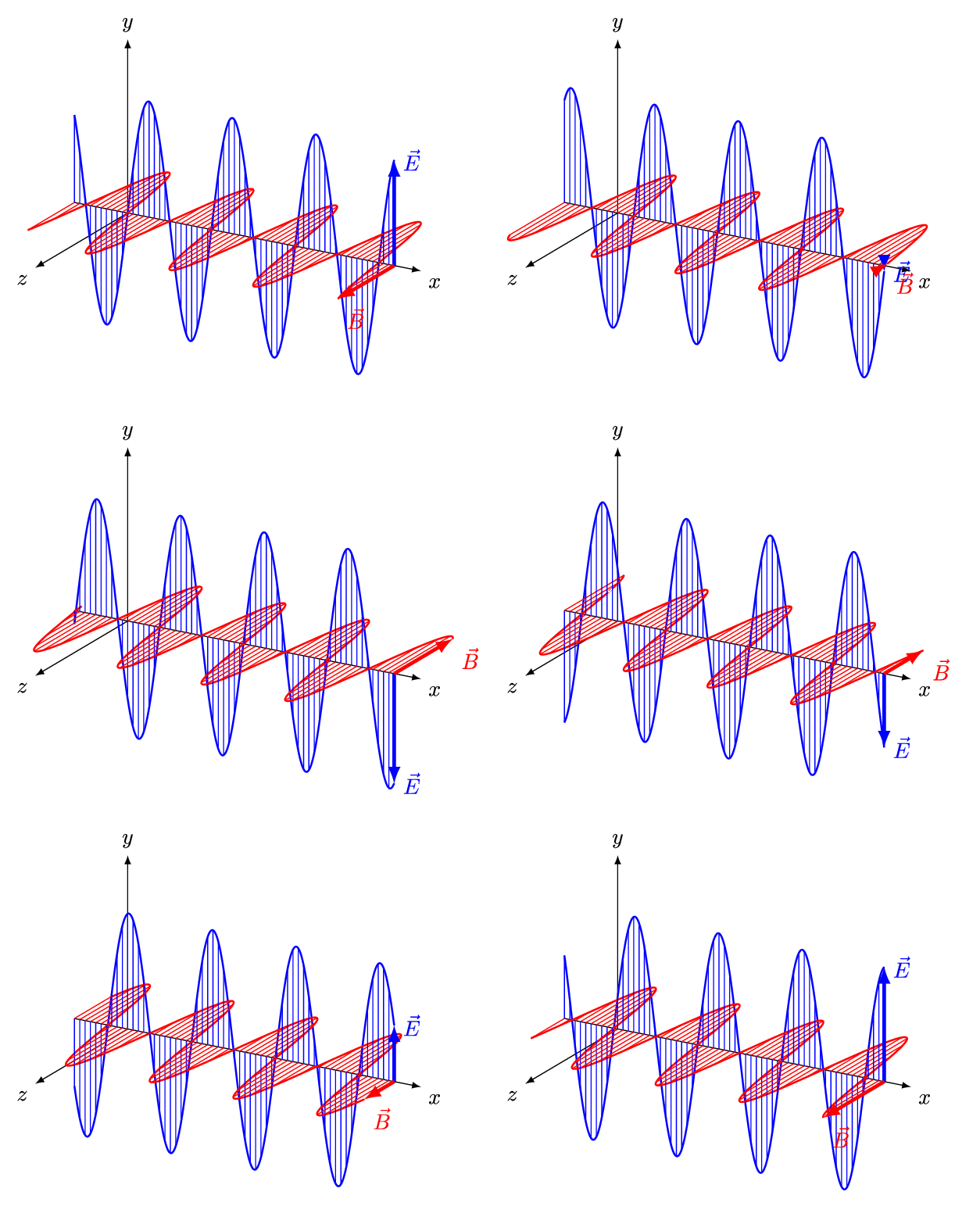
إذا كانت موجة كهرومغناطيسية تنتشر نحو اليمين، وكان المجال الكهربائي يتجه نحو الداخل والخارج، فإن المجال المغناطيسي يتجه نحوAn electromagnetic wave propagates to the right, with its electric field oscillating in/out of the page. The magnetic field oscillates along
الشمال والجنوبNorth and south
الشمال والشرقNorth and east
الشرق والغربEast and west
الشرق والغربEast and west
الحلSolution
📌 القاعدة: في أي موجة كهرومغناطيسية، المجالان الكهربائي والمغناطيسي متعامدان على بعضهما وعلى اتجاه الانتشار. بما أن E يتذبذب داخل/خارج الصفحة وانتشار الموجة أفقي، فإن B يجب أن يتذبذب في الاتجاه العمودي الثالث المتبقي.
✅ الشمال والجنوب
📌 Rule: In any EM wave, E and B are mutually perpendicular and both perpendicular to the propagation direction. Since E oscillates in/out of the page and propagation is horizontal, B must oscillate along the remaining perpendicular direction.
✅ North and south
\[23\,\star\star\]
أحد الإجابات التالية ليست من صفات الموجات الكهرومغناطيسيةWhich of the following is NOT a property of electromagnetic waves
جميع الموجات الكهرومغناطيسية تنتقل بنفس السرعة في الفراغAll EM waves travel at the same speed in vacuum
لا تحتاج الموجة الكهرومغناطيسية إلى وسط كي تنتشر فيهEM waves do not need a medium to propagate
جميع الموجات الكهرومغناطيسية تُعتبر مرئيةAll EM waves are considered visible
كلما زاد تردد الموجة زادت طاقتهاThe higher a wave\u2019s frequency, the greater its energy
الحلSolution
📌 الفكرة: الطيف الكهرومغناطيسي واسع جدًا (موجات راديو، مايكروويف، تحت أحمر، مرئي، فوق بنفسجي، أشعة سينية، جاما)، والضوء المرئي هو جزء صغير جدًا منه فقط. معظم الموجات الكهرومغناطيسية غير مرئية للعين البشرية، فالعبارة "جميعها مرئية" خاطئة.
✅ جميع الموجات الكهرومغناطيسية تُعتبر مرئية
📌 Idea: The EM spectrum is vast (radio, microwave, infrared, visible, ultraviolet, X-ray, gamma), and visible light is only a tiny part of it. Most EM waves are invisible to the human eye, so "all are visible" is false.
✅ All EM waves are considered visible
\[24\,\star\star\]
أحد العبارات التالية لا تمثل صفات الأمواج الكهرومغناطيسيةWhich of the following statements does NOT represent a property of electromagnetic waves
تنتشر في جميع الأوساط بنفس السرعةThey propagate at the same speed in all media
تُعتبر الأمواج الكهرومغناطيسية مستعرضةEM waves are transverse
يتم إنتاجها من خلال اهتزاز شحناتThey are produced by oscillating charges
تزداد طاقتها بزيادة الترددTheir energy increases with frequency
الحلSolution
📌 الفكرة: سرعة الموجة الكهرومغناطيسية تساوي c فقط في الفراغ؛ في الأوساط المادية (كالماء أو الزجاج)، تقل سرعتها حسب معامل انكسار الوسط (\(v=c/n\))، وتختلف باختلاف الوسط. لذا فالعبارة "تنتشر بنفس السرعة في جميع الأوساط" خاطئة.
✅ تنتشر في جميع الأوساط بنفس السرعة
📌 Idea: EM waves travel at speed c only in vacuum; in material media they slow down depending on the refractive index (\(v=c/n\)), varying by medium — so "same speed in all media" is false.
✅ They propagate at the same speed in all media
\[25\,\star\]
ما هو العنصر الذي يتم تعديله (تضمينه) في إشارة AM؟What element is modulated in an AM signal?
الترددFrequency
الطورPhase
السعةAmplitude
جميع ما سبقAll of the above
الحلSolution
📌 الفكرة: AM تعني "Amplitude Modulation" (تضمين السعة): تُضمَّن إشارة الصوت في الموجة الحاملة عن طريق تغيير سعة الموجة الحاملة تبعًا لإشارة الصوت، مع بقاء ترددها ثابتًا.
✅ السعة
📌 Idea: AM stands for "Amplitude Modulation": the audio signal is encoded by varying the carrier wave\u2019s amplitude according to the audio signal, while its frequency stays constant.
✅ Amplitude
\[26\,\star\]
أي من التقنيتين توفر جودة صوت أفضل، AM أم FM؟Which technique provides better sound quality, AM or FM?
AM
FM
متساويتان في الجودةEqual in quality
تعتمد على المسافةDepends on distance
الحلSolution
📌 الفكرة: إشارات FM (تضمين التردد) أقل تأثرًا بالتشويش والضوضاء الكهربائية من إشارات AM (تضمين السعة)، لأن معظم مصادر التشويش تؤثر على سعة الإشارة وليس ترددها، لذا تُستخدم FM لبث الموسيقى عالية الجودة.
✅ FM
📌 Idea: FM signals are much less affected by electrical noise and interference than AM signals, since most noise affects a signal\u2019s amplitude rather than its frequency, which is why FM is used for high-fidelity music broadcasting.
✅ FM
\[27\,\star\]
لماذا يمكن أن تكون هوائيات FM داخلية في أجهزة الراديو، بينما هوائيات AM تحتاج غالبًا إلى أن تكون خارجية؟Why can FM antennas be internal in radios, while AM antennas usually need to be external?
هوائيات FM أصغر حجمًا بسبب الترددات الأعلىFM antennas are smaller in size due to higher frequencies
لأن إشارات FM أضعف من إشارات AMBecause FM signals are weaker than AM signals
هوائيات AM تحتاج إلى تبريدAM antennas require cooling
لأن هوائيات FM لا تتأثر بالعوائقBecause FM antennas are unaffected by obstacles
الحلSolution
📌 الفكرة: حجم الهوائي الفعال يرتبط عكسيًا بتردد الموجة (طرديًا مع طولها الموجي). ترددات FM (نحو 88-108 ميجاهرتز) أعلى بكثير من ترددات AM (530-1700 كيلوهرتز)، أي أن طولها الموجي أقصر بكثير، فيكفيها هوائي أصغر بكثير (يمكن دمجه داخليًا)، بينما تحتاج AM لهوائي أطول بكثير (غالبًا خارجي).
✅ هوائيات FM أصغر حجمًا بسبب الترددات الأعلى
📌 Idea: An antenna's effective size scales with the wave's wavelength (inversely with frequency). FM frequencies (~88-108 MHz) are far higher than AM's (530-1700 kHz), giving a much shorter wavelength, so a much smaller (internal) antenna suffices, while AM needs a much longer (often external) one.
✅ FM antennas are smaller due to higher frequencies
✍️ أسئلة مقالية
✍️ Essay Questions
\[1\,\star\star\]
في ظاهرة الحث الكهرومغناطيسي، حُرِّك سلك موصل (جزء من دائرة مغلقة) داخل مجال مغناطيسي، فتولّد تيار مستحث كما في الشكل (اتجاه حركة السلك للأسفل، والتيار يخرج من الطرف B إلى الدائرة الخارجية)In electromagnetic induction, a conducting wire (part of a closed circuit) was moved within a magnetic field, generating an induced current as shown (the wire moves downward, and current exits at terminal B into the external circuit)
حدد القطبين الموجب والسالب للسلك (A وB)Determine the positive and negative terminals of the wire (A and B)
حدد اتجاه التيار المستحث داخل السلكDetermine the induced current direction inside the wire
باستخدام قاعدة اليد اليمنى، حدد اتجاه المجال المغناطيسيUsing the right-hand rule, determine the magnetic field's direction
احسب أقل شدة للمجال المغناطيسي أحدثت هذه القوة المحركة المستحثة، علمًا أن \(EMF=0.15\,V\)، \(L=0.2\,m\)، \(v=3\,m/s\)Calculate the minimum field magnitude that produced this induced EMF, given \(EMF=0.15\,V\), \(L=0.2\,m\), \(v=3\,m/s\)
الحلSolution
📌 الأقطاب: بما أن التيار يخرج من الطرف B إلى الدائرة الخارجية، فإن B هو القطب الموجب (+) للسلك (يشبه القطب الموجب للبطارية)، وA هو القطب السالب (−).
📌 اتجاه التيار داخل السلك: داخل السلك نفسه (بصفته مصدر القوة الدافعة)، يتجه التيار من A إلى B (من السالب إلى الموجب داخليًا، تمامًا كما يحدث داخل أي مصدر جهد).
📌 اتجاه المجال: بتطبيق \(F=qv\times B\) (أو قاعدة الكف اليمنى: الإبهام باتجاه السرعة v للأسفل، الأصابع تُطوى نحو اتجاه المجال، وراحة اليد تدفع باتجاه القوة على الشحنة الموجبة نحو B)، يتحدد اتجاه المجال المغناطيسي المطلوب بما يتوافق مع دفع الشحنات الموجبة من A نحو B.
📌 حساب أقل مجال: أقل مجال يحدث عندما يكون السلك عموديًا تمامًا على كل من v وB (الحالة المثلى \(\sin\theta=1\))، فتُستخدم المعادلة الكاملة: \(EMF=BLv\Rightarrow B=\dfrac{EMF}{Lv}=\dfrac{0.15}{0.2\times3}=\dfrac{0.15}{0.6}=0.25\,T\)
✅ B هو الطرف الموجب، والتيار داخل السلك من A إلى B، وأقل مجال \(B=0.25\,T\)
📌 Terminals: Since current exits at B into the external circuit, B is the positive (+) terminal and A is the negative (−) terminal.
📌 Current direction inside the wire: Inside the wire itself (as the EMF source), current flows from A to B.
📌 Field direction: Applying \(F=qv\times B\) (or the right-hand rule) with v downward, the field direction is whatever makes the force on positive charges point from A toward B.
📌 Minimum field calculation: \(EMF=BLv\Rightarrow B=EMF/(Lv)=0.15/0.6=0.25\,T\)
✅ B is the positive terminal, current inside the wire flows A to B, and the minimum field is B = 0.25 T
\[2\,\star\star\]
سلك موصل طوله \(0.2\,m\) تم تحريكه بشكل يقطع خطوط المجال المغناطيسي، وبسرعة عمودية على المجال مقدارها \(20\,m/s\)، على سكة بدون احتكاك ومتصلة بمقاومة مقدارها \(5\,\Omega\). إذا كانت شدة المجال المغناطيسي \(B=0.2\,T\)A conducting wire of length \(0.2\,m\) moves perpendicular to a magnetic field at \(20\,m/s\), on frictionless rails connected to a \(5\,\Omega\) resistor. Given \(B=0.2\,T\)
احسب شدة التيار المستحث المار في المقاومةCalculate the induced current in the resistor
حدد اتجاه التيار داخل المقاوم على الشكلDetermine the current direction in the resistor, as shown in the figure
الحلSolution
📌 فرق الجهد المستحث: \(EMF=BLv=0.2\times0.2\times20=0.8\,V\)
📌 الاتجاه: يُحدَّد اتجاه التيار في الدائرة الخارجية (بما فيها المقاوم) بتطبيق \(F=qv\times B\) على السلك المتحرك لتحديد قطبيته، ثم تتبّع الدائرة المغلقة من الطرف الموجب عبر المقاوم وصولًا للطرف السالب.
✅ \(I=0.16\,A\)
📌 Induced EMF: \(EMF=BLv=0.8\,V\)
📌 Current: \(I=0.8/5=0.16\,A\)
📌 Direction: Determined by applying \(F=qv\times B\) to find the moving wire's polarity, then tracing the closed circuit from the positive terminal through the resistor to the negative terminal.
✅ I = 0.16 A
\[3\,\star\star\]
مولد تيار متردد؛ رُسمت العلاقة بين شدة التيار والزمن وفرق الجهد والزمن فنتج الخطّان البيانيّان الموضحانAn AC generator; the current-vs-time and voltage-vs-time graphs are shown
احسب القيمة الفعالة لفرق الجهدCalculate the RMS voltage
احسب القدرة المتوسطة المبددة داخل الدائرةCalculate the average power dissipated in the circuit
ارسم العلاقة بين القدرة المبددة والزمنSketch the dissipated-power-vs-time relationship
الحلSolution
📌 من الرسمين: \(I_{max}=2\,A\)، \(V_{max}=6\,V\)، والتيار والجهد متوافقان تمامًا في الطور (يبلغان الذروة معًا).
📌 القدرة المتوسطة: \(P_{avg}=\dfrac{1}{2}V_{max}I_{max}=\dfrac{1}{2}\times6\times2=6\,W\)
📌 شكل الرسم: بما أن \(P(t)=V(t)\times I(t)=V_{max}I_{max}\sin^2(\omega t)\)، فإن القدرة اللحظية موجبة دائمًا (لا تصبح سالبة أبدًا)، وتتذبذب بين 0 و12W (القيمة القصوى \(V_{max}I_{max}\))، حول متوسط قدره 6W، وبضعف تردد التيار والجهد (أي بنصف الزمن الدوري).
✅ \(V_{rms}\approx4.24\,V\)، \(P_{avg}=6\,W\)
📌 From the graphs: \(I_{max}=2\,A\), \(V_{max}=6\,V\), in phase.
📌 RMS voltage: \(V_{rms}\approx4.24\,V\)
📌 Average power: \(P_{avg}=\frac12 V_{max}I_{max}=6\,W\)
📌 Graph shape: \(P(t)=V_{max}I_{max}\sin^2(\omega t)\) is always non-negative, oscillating between 0 and 12W around an average of 6W, at twice the frequency of I and V.
✅ V_rms ≈ 4.24 V, P_avg = 6 W
\[4\,\star\star\]
مولد تيار متردد يعطي تيارًا فعالًا مقداره \(5\,A\)، ومقاومة الحمل \(10\,\Omega\)An AC generator supplies an RMS current of \(5\,A\), with load resistance \(10\,\Omega\)
احسب القدرة المتوسطة المبددة في الحملCalculate the average power dissipated in the load
احسب الجهد الفعال على طرفي الحملCalculate the RMS voltage across the load
احسب أقصى تيار يمر في الحملCalculate the maximum current through the load
الحلSolution
📌 القدرة المتوسطة: \(P_{avg}=I_{rms}^2R=(5)^2\times10=250\,W\)
📌 Maximum current: \(I_{max}=I_{rms}\sqrt2\approx7.07\,A\)
✅ P_avg = 250 W, V_rms = 50 V, I_max ≈ 7.07 A
\[5\,\star\star\star\]
صنع أحد المتعلمين محوّلًا مثاليًا عدد لفات ملفه الابتدائي 4 لفات وعدد لفات ملفه الثانوي 8 لفات. وصله أولًا بمصدر تيار مستمر ووصل الطرف الآخر بجهازA student built an ideal transformer with 4 primary turns and 8 secondary turns. It was first connected to a DC source, with a device on the other end
هل يعمل المحوّل في هذه الحالة؟ فسّر السببDoes the transformer work in this case? Explain why
تم تغيير المصدر إلى تيار متردد جهده الفعال \(110\,V\) يسمح بمرور تيار فعال \(2\,A\). ما نوع المحوّل؟The source was changed to AC with RMS voltage \(110\,V\) and RMS current \(2\,A\). What type of transformer is this?
احسب شدة التيار وفرق الجهد الفعالين الواصلين إلى الجهاز المتصل بالملف الثانويCalculate the RMS current and voltage delivered to the device on the secondary
الحلSolution
📌 عمل المحوّل مع التيار المستمر: لا يعمل. المحوّل يعتمد على الحث الكهرومغناطيسي، الذي يتطلب تدفقًا مغناطيسيًا متغيرًا مع الزمن. التيار المستمر الثابت ينتج تدفقًا ثابتًا (غير متغيّر)، فلا يُستحث أي جهد في الملف الثانوي.
📌 نوع المحوّل: بما أن \(N_S=8>N_P=4\)، فهو محوّل رافع للجهد (خافض للتيار).
📌 التيار الثانوي: (محوّل مثالي، \(P_P=P_S\)): \(I_S=I_P\times\dfrac{N_P}{N_S}=2\times\dfrac{4}{8}=1\,A\)
✅ لا يعمل مع التيار المستمر؛ رافع للجهد؛ \(V_S=220\,V\)، \(I_S=1\,A\)
📌 DC operation: It does not work. Transformers rely on electromagnetic induction, requiring a time-varying flux. Steady DC produces constant flux, so no voltage is induced in the secondary.
📌 Transformer type: Since \(N_S=8>N_P=4\), it is a step-up (voltage) transformer.
✅ Does not work with DC; step-up transformer; V_S = 220 V, I_S = 1 A
\[6\,\star\star\]
محوّل خافض للجهد عدد لفات ملفيه \(12:6\)، وُصل بمصدر تيار متردد فرق جهده الفعال \(110\,V\) وشدة تياره الفعالة \(2\,A\)، ووُصل الطرف الآخر بمصباحA step-down transformer with a 12:6 turns ratio is connected to an AC source of RMS voltage \(110\,V\) and RMS current \(2\,A\), with a lamp on the other side
احسب فرق الجهد الفعال الذي يصل للمصباحCalculate the RMS voltage reaching the lamp
احسب شدة التيار الفعال الذي يصل للمصباحCalculate the RMS current reaching the lamp
الحلSolution
📌 الجهد على المصباح: \(\dfrac{V_S}{V_P}=\dfrac{N_S}{N_P}=\dfrac{6}{12}=0.5\Rightarrow V_S=110\times0.5=55\,V\)
📌 التيار في المصباح: \(I_S=I_P\times\dfrac{N_P}{N_S}=2\times\dfrac{12}{6}=2\times2=4\,A\)
✅ \(V_S=55\,V\)، \(I_S=4\,A\)
📌 Lamp voltage: \(V_S=110\times(6/12)=55\,V\)
📌 Lamp current: \(I_S=2\times(12/6)=4\,A\)
✅ V_S = 55 V, I_S = 4 A
\[7\,\star\star\star\]
أكمل الجدول التالي الذي يوضّح خصائص بعض أنواع الموجات الكهرومغناطيسية، علمًا بأن \(c=3\times10^8\,m/s\)Complete the following table showing properties of some electromagnetic wave types, given \(c=3\times10^8\,m/s\)
موجات الراديو: الطول الموجي \(1\rightarrow10^4\,m\)، K=1 (الهواء)، السرعة \(3\times10^8\,m/s\) — احسب مدى الترددRadio waves: wavelength \(1\rightarrow10^4\,m\), K=1 (air), speed \(3\times10^8\,m/s\) — calculate the frequency range
الأشعة تحت الحمراء: التردد \(10^{12}\rightarrow4.3\times10^{14}\,Hz\)، K=2.3 (بولي إيثيلين) — احسب مدى الطول الموجي وسرعة الموجة في الوسطInfrared: frequency \(10^{12}\rightarrow4.3\times10^{14}\,Hz\), K=2.3 (polyethylene) — calculate the wavelength range and wave speed in the medium
الضوء المرئي: الطول الموجي \(400\rightarrow700\,nm\)، السرعة في الزجاج \(2.45\times10^8\,m/s\) — احسب مدى التردد وثابت العزل K للزجاجVisible light: wavelength \(400\rightarrow700\,nm\), speed in glass \(2.45\times10^8\,m/s\) — calculate the frequency range and the dielectric constant K of glass
الحلSolution
📌 موجات الراديو (التردد): \(f=c/\lambda\): عند \(\lambda=1\,m\)، \(f=3\times10^8\,Hz\)؛ عند \(\lambda=10^4\,m\)، \(f=3\times10^4\,Hz\). المدى: \(3\times10^4\rightarrow3\times10^8\,Hz\). الاستخدامات: البث الإذاعي والتلفزيوني، الاتصالات.
📌 الأشعة تحت الحمراء (سرعة الموجة): \(v=\dfrac{c}{\sqrt K}=\dfrac{3\times10^8}{\sqrt{2.3}}\approx1.98\times10^8\,m/s\)
📌 الأشعة تحت الحمراء (الطول الموجي): \(\lambda=v/f\): عند \(f=10^{12}\,Hz\)، \(\lambda\approx1.98\times10^{-4}\,m\)؛ عند \(f=4.3\times10^{14}\,Hz\)، \(\lambda\approx4.6\times10^{-7}\,m\). الاستخدامات: التصوير الحراري، أجهزة التحكم عن بُعد، التدفئة.
📌 الضوء المرئي (التردد): \(f=c/\lambda\): عند \(\lambda=400\,nm\)، \(f=7.5\times10^{14}\,Hz\)؛ عند \(\lambda=700\,nm\)، \(f\approx4.29\times10^{14}\,Hz\). الاستخدامات: الرؤية البشرية، الأجهزة البصرية، التصوير.
📌 الضوء المرئي (ثابت العزل K): \(v=c/\sqrt{K}\Rightarrow K=(c/v)^2=(3\times10^8/2.45\times10^8)^2\approx1.5\)