🎯 نواتج التعلم
🎯 Learning Outcomes
بعد دراسة هذا الدرس ستكون قادرًا على أن:
After this lesson you will be able to:
- تعرّف كمية الحركة الخطية \(\vec p=m\vec v\) وتحسبها مع اتجاهها.Define linear momentum \(\vec p=m\vec v\) and calculate it with its direction.
- تستنتج أن \(F=\mathrm{d}p/\mathrm{d}t\) وأن \(K=p^2/2m\).Derive that \(F=\mathrm{d}p/\mathrm{d}t\) and that \(K=p^2/2m\).
- تعرّف الدفع \(J=F\Delta t\) وتطبّق نظرية الدفع–كمية الحركة \(J=\Delta p\).Define impulse \(J=F\Delta t\) and apply the impulse–momentum theorem \(J=\Delta p\).
- تحسب القوة المتوسطة في التصادم وتفسّر دور زمن التأثير.Calculate the average force in a collision and explain the role of the contact time.
- تحسب التغير في كمية الحركة في بعدين بطرح المتجهات.Calculate the change in momentum in two dimensions by subtracting vectors.
🚀 كمية الحركة الخطية
🚀 Linear Momentum
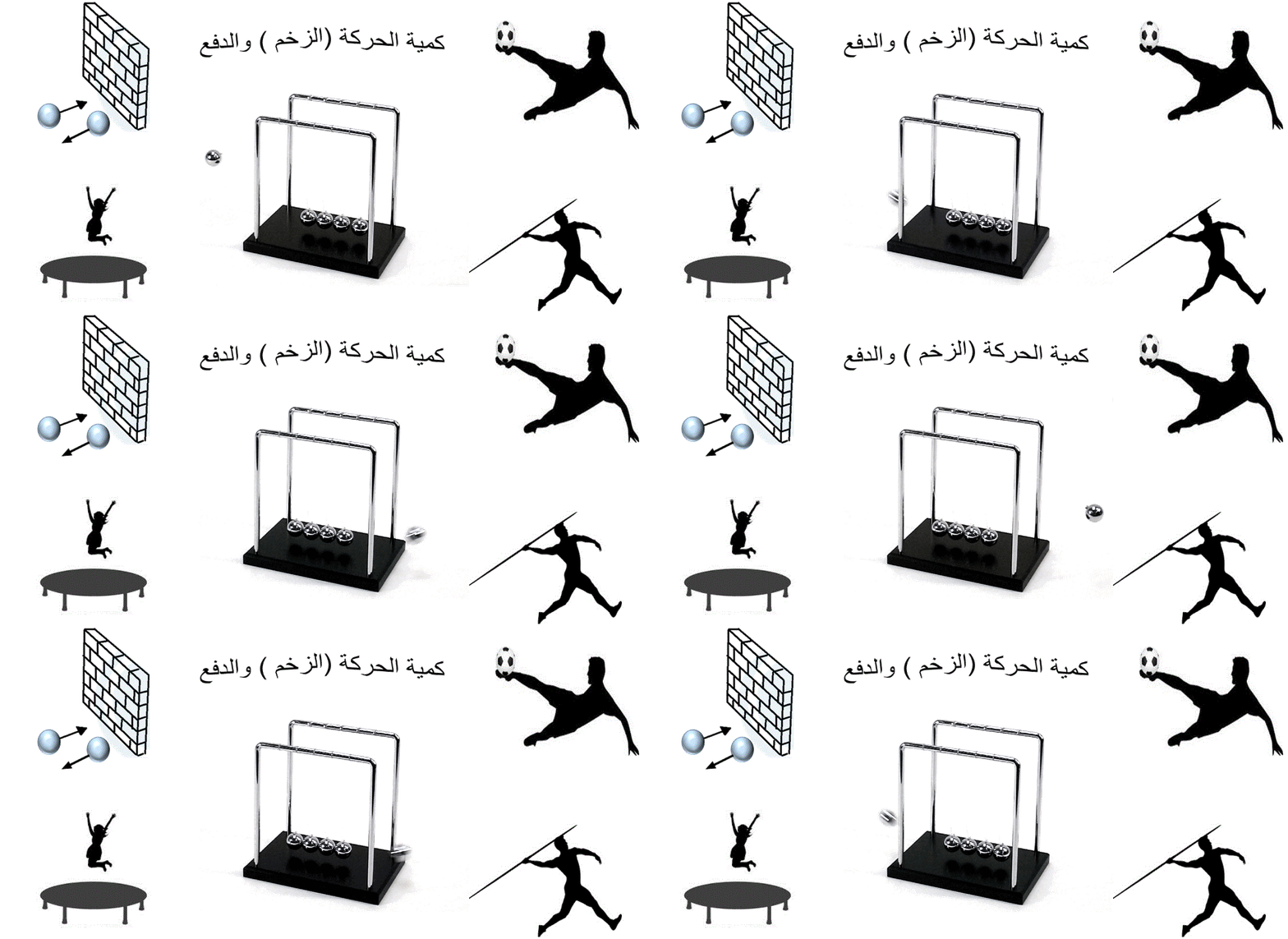
كمية الحركة والدفع: كلما زادت الكتلة أو السرعة زادت صعوبة إيقاف الجسم.
Momentum and impulse: the greater the mass or the speed the harder it is to stop the body.
عندما نؤثر بقوة على جسم قابل للحركة خلال فترة زمنية معينة فإن متجهة سرعته تتغير. نسمّي حاصل ضرب كتلة الجسم في متجهة سرعته كمية الحركة (أو الزخم)، وهي كمية متجهة اتجاهها اتجاه السرعة، ويرمز لها \(\vec p\):
When we apply a force to a movable body over a time interval its velocity vector changes. The product of the body’s mass and its velocity vector is called its momentum; it is a vector quantity with the direction of the velocity and is denoted \(\vec p\):
📌 كمية الحركة
📌 Momentum
\[\vec p=m\,\vec v\qquad[\mathrm{kg\cdot m/s}]\]
الجسم الثقيل أو السريع يحتاج إلى «جهد» أكبر لإيقافه: شاحنة بطيئة وكرة بسرعة كبيرة قد يكون لهما كمية الحركة نفسها.
A heavy or fast body needs more “effort” to stop it: a slow truck and a fast ball may have the same momentum.
⚠️ الاتجاه مهم
⚠️ Direction matters
اختر اتجاهًا موجبًا واحدًا ثم ضع إشارة سالبة لأي سرعة في الاتجاه المعاكس. جسمان بالسرعة نفسها في اتجاهين متعاكسين لهما زخمان متعاكسان، ومجموعهما صفر.
Choose one positive direction and give a negative sign to any velocity in the opposite direction. Two bodies with the same speed in opposite directions have opposite momenta whose sum is zero.
طائرة كتلتها \(3000\ \mathrm{kg}\) تتحرك نحو الغرب بسرعة ثابتة \(200\ \mathrm{m/s}\). ما كمية حركتها؟
An airplane of mass \(3000\ \mathrm{kg}\) moves west at a constant \(200\ \mathrm{m/s}\). What is its momentum?
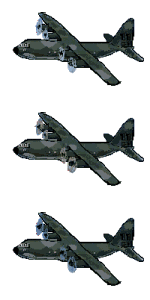
الطائرة في المثال 1.
The airplane of example 1.
علاقة كمية الحركة بالقوة
Momentum and Force
نشتق كمية الحركة بالنسبة للزمن مستعملين قاعدة مشتقة الضرب (مشتقة الأول × الثاني + مشتقة الثاني × الأول):
We differentiate momentum with respect to time using the product rule (derivative of the first × the second + derivative of the second × the first):
📌 قانون نيوتن الثاني بصيغة كمية الحركة
📌 Newton’s second law in terms of momentum
\[\dfrac{\mathrm{d}p}{\mathrm{d}t}=\dfrac{\mathrm{d}(mv)}{\mathrm{d}t}=v\dfrac{\mathrm{d}m}{\mathrm{d}t}+m\dfrac{\mathrm{d}v}{\mathrm{d}t}\]
عندما تكون الكتلة ثابتة \(\mathrm{d}m/\mathrm{d}t=0\) و\(\mathrm{d}v/\mathrm{d}t=a\) فيصبح:
When the mass is constant \(\mathrm{d}m/\mathrm{d}t=0\) and \(\mathrm{d}v/\mathrm{d}t=a\) so it becomes:
\[\dfrac{\mathrm{d}p}{\mathrm{d}t}=ma=F\]
هذه هي الصيغة الأشمل لقانون نيوتن الثاني: القوة هي المعدل الزمني لتغير كمية الحركة، وتصلح حتى عندما تتغير الكتلة أثناء الحركة كما في الصاروخ (يحرق الوقود فتنقص كتلته).
This is the more general form of Newton’s second law: force is the rate of change of momentum, and it holds even when the mass changes during motion, as for a rocket (it burns fuel so its mass decreases).
الطاقة الحركية وكمية الحركة
Kinetic Energy and Momentum
📌 \(K\) بدلالة \(p\)
📌 \(K\) in terms of \(p\)
نضرب الطاقة الحركية \(K=\tfrac12mv^2\) في \(m/m\):
Multiply the kinetic energy \(K=\tfrac12mv^2\) by \(m/m\):
\[K=\dfrac{m^2v^2}{2m}=\dfrac{p^2}{2m}\]
ومنها \(K/p=v/2\). فلجسمين لهما الزخم نفسه تكون الطاقة الحركية أكبر للجسم الأخف.
Hence \(K/p=v/2\). For two bodies with the same momentum the lighter one has the greater kinetic energy.
🧪 تجربة 1: كمية الحركة: أي جسم أصعب إيقافًا؟
🧪 Experiment 1: Momentum: which body is harder to stop?
اختر جسمًا (شاحنة، سيارة، كرة بيسبول، رصاصة، عربة) أو عدّل الكتلة والسرعة بنفسك ثم اضغط «حرّك الجسم». كمية الحركة \(p=mv\) متجهة، ويدل الرسم اللوغاريتمي على أن رصاصة صغيرة سريعة قد تساوي كرة بطيئة، وأن الشاحنة البطيئة لها زخم هائل. الزمن اللازم لإيقاف الجسم بقوة ثابتة \(F\) هو \(t=p/F\).
Choose a body (truck, car, baseball, bullet, cart) or set the mass and the speed yourself then press “Move the body”. Momentum \(p=mv\) is a vector, and the logarithmic chart shows that a small fast bullet can equal a slow ball and that a slow truck has a huge momentum. The time needed to stop the body with a constant force \(F\) is \(t=p/F\).
طائرة تتحرك بسرعة ثابتة \(100\ \mathrm{m/s}\). ما النسبة بين طاقتها الحركية وكمية حركتها؟
An airplane moves at a constant \(100\ \mathrm{m/s}\). What is the ratio of its kinetic energy to its momentum?
جسمان لهما كمية الحركة نفسها وكتلة الأول أربعة أمثال كتلة الثاني. نسبة الطاقة الحركية \(K_1/K_2\):
Two bodies have the same momentum and the first’s mass is four times the second’s. The ratio \(K_1/K_2\) is:
💥 الدفع
💥 Impulse
من \(F=\mathrm{d}p/\mathrm{d}t\) نكتب \(F\,\mathrm{d}t=\mathrm{d}p\) ثم نكامل فنجد أن حاصل ضرب القوة في زمن تأثيرها يساوي التغير في كمية الحركة. نسمّي القوة × الزمن الدفع ويرمز له \(J\) (ووحدته \(\mathrm{N\cdot s}\) وهي نفسها \(\mathrm{kg\cdot m/s}\)).
From \(F=\mathrm{d}p/\mathrm{d}t\) we write \(F\,\mathrm{d}t=\mathrm{d}p\) and integrate to find that the force times the time it acts equals the change in momentum. We call force × time the impulse, denoted \(J\) (unit \(\mathrm{N\cdot s}\), which is the same as \(\mathrm{kg\cdot m/s}\)).
📌 نظرية الدفع–كمية الحركة
📌 The impulse–momentum theorem
\[\int F\,\mathrm{d}t=\int\mathrm{d}p\ \Rightarrow\ J=F\,\Delta t=\Delta p=p_f-p_i\]
للقوة المتغيرة \(J\) هو المساحة تحت منحنى \(F\)–\(t\) ونستعمل \(F_{avg}=\Delta p/\Delta t\) للقوة المتوسطة.
For a varying force \(J\) is the area under the \(F\)–\(t\) curve and we use \(F_{avg}=\Delta p/\Delta t\) for the average force.
🧪 تجربة 2: الدفع: قوة ثابتة تغيّر كمية الحركة
🧪 Experiment 2: Impulse: a constant force changes the momentum
عربة تتحرك بسرعة \(v_0\) تؤثر عليها قوة ثابتة \(F\) لمدة \(\Delta t\) بعد ثانيتين من البدء. اضغط «طبّق القوة» وراقب: المساحة تحت منحنى \(F\)–\(t\) هي الدفع \(J=F\Delta t\)، وهي تساوي التغير في كمية الحركة \(\Delta p\) المرسوم في المنحنى السفلي (ميله هو \(F\)). جرّب قوة عكسية لإبطاء العربة.
A cart moves at \(v_0\) and a constant force \(F\) acts on it for \(\Delta t\) two seconds after the start. Press “Apply the force” and watch: the area under the \(F\)–\(t\) curve is the impulse \(J=F\Delta t\), which equals the change in momentum \(\Delta p\) drawn in the lower graph (its slope is \(F\)). Try an opposite force to slow the cart.
💡 لماذا تُستعمل الوسائد؟
💡 Why are cushions used?
لتغيير كمية الحركة بمقدار محدد \(\Delta p\) يمكن أن نستعمل قوة كبيرة في زمن قصير أو قوة صغيرة في زمن طويل. الوسادة الهوائية وثني الركبتين عند الهبوط وحزام الأمان تطيل زمن التوقف \(\Delta t\) فتنقص القوة \(F=\Delta p/\Delta t\) وتقل الإصابة.
To change the momentum by a given \(\Delta p\) one may use a large force for a short time or a small force for a long time. The airbag, bending the knees on landing and the seat belt lengthen the stopping time \(\Delta t\) so the force \(F=\Delta p/\Delta t\) is smaller and the injury less.
أمثلة محلولة
Worked Examples
كرة كتلتها \(0.5\ \mathrm{kg}\) اصطدمت بالأرض بسرعة \(10\ \mathrm{m/s}\) وارتدت بسرعة \(10\ \mathrm{m/s}\). ما التغير في كمية حركتها؟
A \(0.5\ \mathrm{kg}\) ball hits the ground at \(10\ \mathrm{m/s}\) and rebounds at \(10\ \mathrm{m/s}\). What is the change in its momentum?
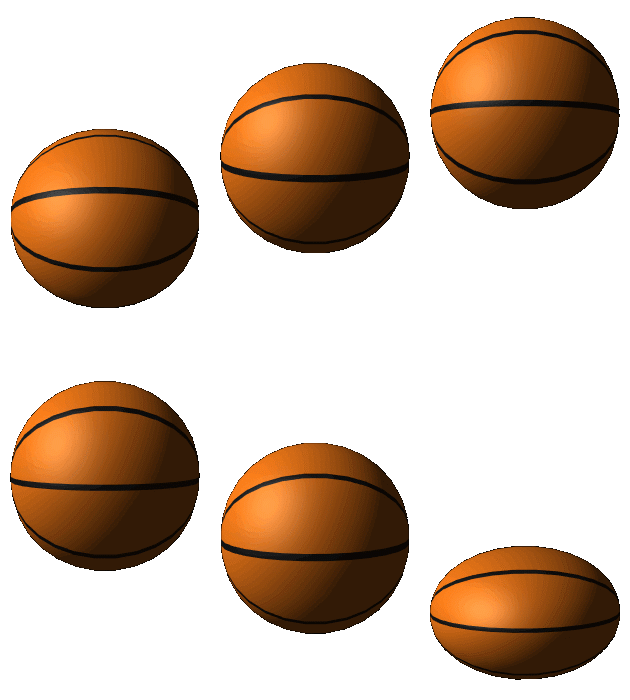
الكرة في المثال 3.
The ball of example 3.
كرة غولف كتلتها \(0.14\ \mathrm{kg}\) تتحرك نحو جدار بسرعة \(60\ \mathrm{m/s}\) فاصطدمت به وارتدت بسرعة \(55\ \mathrm{m/s}\). دام التصادم \(0.15\ \mathrm{s}\). ما متوسط القوة التي أثّر بها الجدار على الكرة؟
A \(0.14\ \mathrm{kg}\) golf ball moves towards a wall at \(60\ \mathrm{m/s}\), hits it and rebounds at \(55\ \mathrm{m/s}\). The impact lasts \(0.15\ \mathrm{s}\). What is the average force the wall exerts on the ball?
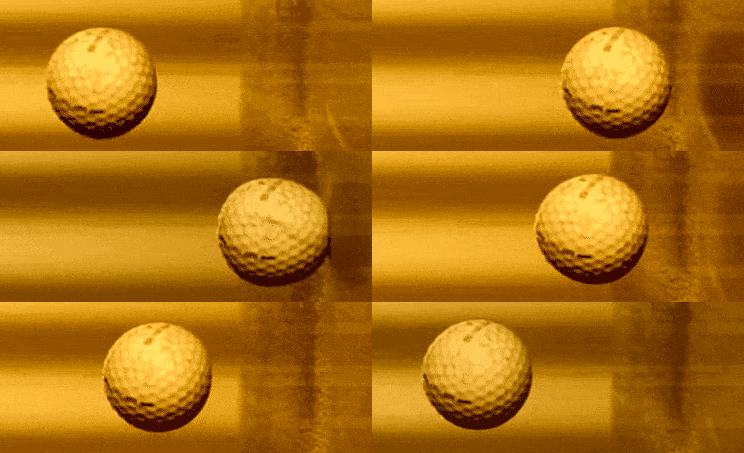
كرة الغولف ترتد عن الجدار.
The golf ball rebounding from the wall.
🧪 تجربة 3: كرة ترتد عن جدار: القوة المتوسطة
🧪 Experiment 3: A ball rebounding from a wall: the average force
كرة غولف (\(0.14\ \mathrm{kg}\)) تصطدم بجدار بـ \(60\ \mathrm{m/s}\) وترتد بـ \(55\ \mathrm{m/s}\) خلال \(0.15\ \mathrm{s}\). اضغط «اضرب الجدار». التغير في كمية الحركة \(\Delta p=m(-v_f-v_i)\) (الاتجاه الأول موجب نحو الجدار)، والقوة المتوسطة \(F=\Delta p/\Delta t\). اختر شكل نبضة القوة: تتغير القيمة العظمى لكن المتوسط (الخط الأخضر) ثابت.
A golf ball (\(0.14\ \mathrm{kg}\)) hits a wall at \(60\ \mathrm{m/s}\) and rebounds at \(55\ \mathrm{m/s}\) within \(0.15\ \mathrm{s}\). Press “Hit the wall”. The change in momentum is \(\Delta p=m(-v_f-v_i)\) (the first direction, towards the wall, is positive) and the average force is \(F=\Delta p/\Delta t\). Choose the shape of the force pulse: the peak changes but the average (the green line) stays the same.
لإيقاف الجسم نفسه بالتغير نفسه في كمية الحركة، إطالة زمن التوقف إلى الضعف تجعل القوة المتوسطة:
To stop the same body with the same change in momentum, doubling the stopping time makes the average force:
🧭 التغير في كمية الحركة في بعدين
🧭 The Change in Momentum in Two Dimensions
عندما يتغير اتجاه الحركة في المستوى نحسب \(\Delta\vec p=\vec p_f-\vec p_i\) بمركّبات المتجهين على محورين (شرق–غرب و شمال–جنوب)، ثم نستعمل فيثاغورس للمقدار وظل الزاوية للاتجاه. لا نطرح الطولين عدديًا.
When the direction of motion changes in a plane we calculate \(\Delta\vec p=\vec p_f-\vec p_i\) by components of the two vectors on two axes (east–west and north–south), then use Pythagoras for the magnitude and the tangent for the direction. We do not subtract the two lengths numerically.
في لعبة البيسبول رُميت كرة كتلتها \(140\ \mathrm{g}\) بسرعة \(40\ \mathrm{m/s}\) بزاوية \(10^\circ\) جنوب الشرق، فضُربت بمضرب وعادت بسرعة \(55\ \mathrm{m/s}\) بزاوية \(17^\circ\) شمال الغرب. ما التغير في كمية حركتها؟
In baseball a \(140\ \mathrm{g}\) ball is thrown at \(40\ \mathrm{m/s}\) at \(10^\circ\) south of east, hit by a bat and returned at \(55\ \mathrm{m/s}\) at \(17^\circ\) north of west. What is the change in its momentum?

كرة البيسبول في المثال 5.
The baseball of example 5.
🧪 تجربة 4: التغير في كمية الحركة في بعدين (كرة البيسبول)
🧪 Experiment 4: The change in momentum in two dimensions (the baseball)
كرة بيسبول تقترب بسرعة \(v_i\) بزاوية جنوب الشرق، وتعود بسرعة \(v_f\) بزاوية شمال الغرب. اضغط «ارسم المتجهات»: \(\Delta\vec p=\vec p_f-\vec p_i\) يُرسم من نهاية \(\vec p_i\) إلى نهاية \(\vec p_f\). لاحظ أن طول \(\Delta p\) ليس الفرق بين طولي المتجهين. القيم الافتراضية هي مسألة الدرس.
A baseball approaches with speed \(v_i\) at an angle south of east and returns with speed \(v_f\) at an angle north of west. Press “Draw the vectors”: \(\Delta\vec p=\vec p_f-\vec p_i\) is drawn from the tip of \(\vec p_i\) to the tip of \(\vec p_f\). Notice that the length of \(\Delta p\) is not the difference between the two lengths. The default values are the lesson’s problem.
تغيّر اتجاه جسم بسرعة ثابتة المقدار من الشرق إلى الغرب. التغير في كمية حركته:
A body of constant speed reverses its direction from east to west. The change in its momentum is:
📚 ملخص الدرس
📚 Lesson Summary
| الفكرةIdea | القاعدةRule |
|---|---|
| كمية الحركةMomentum | \(\vec p=m\vec v\ [\mathrm{kg\cdot m/s}]\)\(\vec p=m\vec v\ [\mathrm{kg\cdot m/s}]\) |
| القوةForce | \(F=\mathrm{d}p/\mathrm{d}t=ma\ (m\ \text{ثابتة / constant})\)\(F=\mathrm{d}p/\mathrm{d}t=ma\ (m\ \text{ثابتة / constant})\) |
| الطاقة الحركيةKinetic energy | \(K=\dfrac{p^2}{2m}\)\(K=\dfrac{p^2}{2m}\) |
| الدفعImpulse | \(J=F\Delta t=\Delta p=p_f-p_i\)\(J=F\Delta t=\Delta p=p_f-p_i\) |
| القوة المتوسطةAverage force | \(F_{avg}=\Delta p/\Delta t\)\(F_{avg}=\Delta p/\Delta t\) |
| في بعدينIn two dimensions | \(\Delta\vec p=\vec p_f-\vec p_i\) بالمركّبات\(\Delta\vec p=\vec p_f-\vec p_i\) by components |
⚠️ أخطاء شائعة
⚠️ Common mistakes
- إهمال إشارة السرعة (الاتجاه) عند حساب \(\Delta p\)؛ فالارتداد يضاعف التغير.Ignoring the sign (direction) of the velocity when finding \(\Delta p\); a rebound doubles the change.
- الخلط بين كمية الحركة (متجهة) والطاقة الحركية (غير متجهة).Confusing momentum (a vector) with kinetic energy (not a vector).
- طرح طولي المتجهين بدل طرحهما بالمركّبات في بعدين.Subtracting the lengths of the vectors instead of subtracting them by components in two dimensions.
- الظن أن القوة المتوسطة تساوي القيمة العظمى للقوة في التصادم.Thinking the average force equals the maximum force in a collision.
🧪 اختبر نفسك: امتحان من 20 سؤالاً
🧪 Test Yourself: a 20-Question Exam
أنهِ الدرس بالاختبار التفاعلي التالي؛ أسئلته تجمع بين الفهم والحساب وتغطي جميع أقسام الدرس.
Finish with the interactive exam below; its questions mix understanding with calculation and cover every section of the lesson.
اختبار كمية الحركة الخطية والدفع Linear Momentum and Impulse Quiz
20 سؤالاً - كمية الحركة والدفع والقوة المتوسطة والتغير في بعدين 20 Questions - momentum, impulse, average force and change in two dimensions
• عدد الأسئلة: 20 سؤالاً
• مدة الاختبار: 30 دقيقة
• لا يمكنك تغيير إجاباتك أو إعادة الاختبار إلا بعد 24 ساعة من التسليم.
• تأكد من إجاباتك قبل التسليم! 📌 Important Instructions:
• Number of questions: 20 questions
• Quiz duration: 30 minutes
• You cannot change your answers or retake the quiz for 24 hours after submission.
• Make sure of your answers before submitting!
🔗 محاكيات GeoGebra للاستعانة بها عند اللزوم
🔗 GeoGebra Simulations to Use When Needed
اضغط «تشغيل» لتعمل المحاكاة هنا داخل الدرس؛ ويمكن للطالب الرجوع إليها لتجربة الفكرة بطريقة أخرى.
Press “Run” to run the simulation right here inside the lesson; the student can use it to try the idea in another way.