🎯 نواتج التعلم
🎯 Learning Outcomes
بعد دراسة هذا الدرس ستكون قادرًا على أن:
After this lesson you will be able to:
- تعرّف قوة الاحتكاك وتحدد اتجاهها وتفسّر نشأتها.Define the friction force, determine its direction and explain its origin.
- تفرّق بين الاحتكاك السكوني والحركي وتفسّر رسمهما البياني.Distinguish static from kinetic friction and interpret their graph.
- تحسب \(f_{s,max}=\mu_sN\) و\(f_k=\mu_kN\) وتجد معاملي الاحتكاك.Calculate \(f_{s,max}=\mu_sN\) and \(f_k=\mu_kN\) and find the two friction coefficients.
- ترسم القوى المؤثرة في جسم على مستوى أفقي أو مائل خشن.Draw the forces acting on a body on a rough horizontal or inclined plane.
- تحلّ مسائل الحركة والاتزان مع الاحتكاك وتعرف الزاوية الحرجة.Solve problems of motion and equilibrium with friction and know the critical angle.
🧱 ما قوة الاحتكاك؟
🧱 What is the Friction Force?
قوة الاحتكاك هي مقاومة جسم للحركة عندما يتحرك (أو يحاول التحرك) على سطح جسم آخر. وهي ليست قوة أساسية كالجاذبية أو القوة الكهرومغناطيسية؛ إذ يرى العلماء أنها نتاج التجاذب الكهرومغناطيسي بين الجزيئات المشحونة للسطحين المتلامسين (فالأسطح مهما بدت ملساء فهي خشنة على المستوى المجهري).
Friction is the resistance of a body to motion when it moves (or tries to move) on the surface of another body. It is not a fundamental force like gravity or electromagnetism; scientists see it as the result of the electromagnetic attraction between the charged particles of the two touching surfaces (however smooth a surface looks, it is rough at the microscopic level).
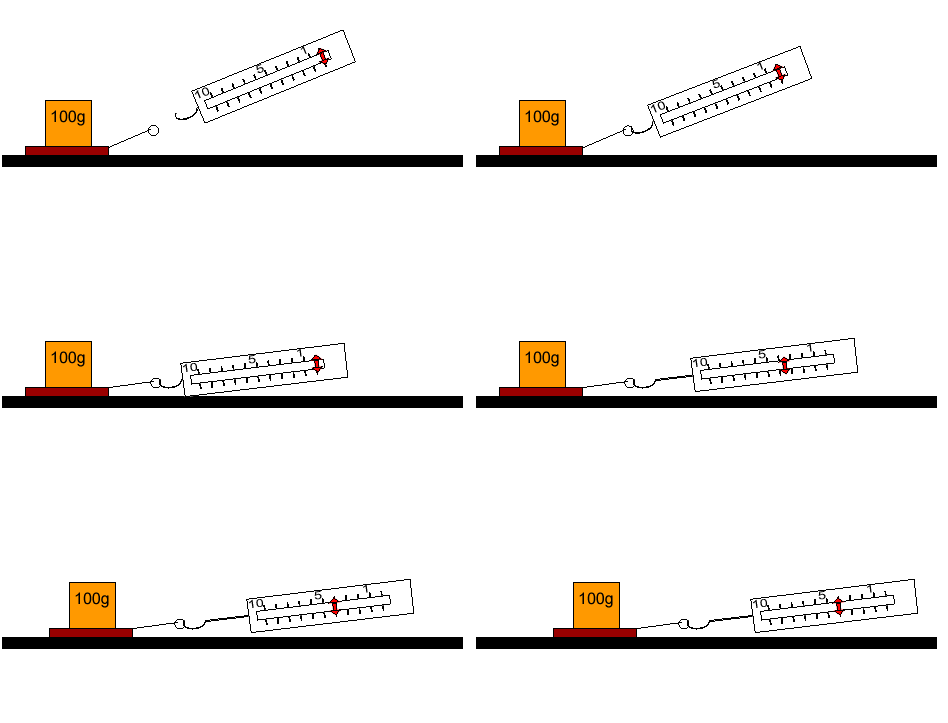
نسحب الجسم بميزان نابضي أفقيًا: القراءة عند بدء الحركة تساوي قوة الاحتكاك.
We pull the body horizontally with a spring balance: the reading at the start of motion equals the friction force.
خصائص قوة الاحتكاك
Properties of the friction force
- اتجاهها دائمًا عكس حركة الجسم (أو عكس اتجاه ميله للحركة) وموازٍ للسطح الذي يتحرك عليه.Its direction is always opposite to the motion of the body (or to its tendency to move) and parallel to the surface on which it moves.
- وحدتها النيوتن \(\mathrm N\) وهي قوة تلامس.Its unit is the newton \(\mathrm N\) and it is a contact force.
- لا تعتمد (تقريبًا) على مساحة التلامس، وتعتمد على القوة العمودية وطبيعة السطحين.It does not (approximately) depend on the contact area; it depends on the normal force and the nature of the two surfaces.
⚖️ الاحتكاك السكوني والاحتكاك الحركي
⚖️ Static and Kinetic Friction
| وجه المقارنةAspect | الاحتكاك السكونيStatic friction | الاحتكاك الحركيKinetic friction |
|---|---|---|
| متى يظهر؟When does it appear? | عندما نؤثر بقوة شدّ في الجسم ويبقى ساكنًاWhen we pull the body and it stays at rest | عندما نؤثر بقوة شدّ والجسم يتحركWhen we pull and the body moves |
| الاتجاهDirection | عكس القوة المؤثرة (عكس ميل الجسم للحركة)Opposite to the applied force (the tendency to move) | عكس اتجاه الحركةOpposite to the motion |
| المقدارMagnitude | يساوي القوة المؤثرة \(f_s=F\) حتى قيمة عظمى \(f_{s,max}=\mu_sN\)Equals the applied force \(f_s=F\) up to a maximum \(f_{s,max}=\mu_sN\) | ثابت تقريبًا \(f_k=\mu_kN\)Approximately constant \(f_k=\mu_kN\) |
| المقارنةComparison | قيمته العظمى أكبرIts maximum is larger | أصغر من القيمة العظمى للسكونيSmaller than the static maximum |
| الوحدةUnit | نيوتن \(\mathrm N\)newton \(\mathrm N\) | نيوتن \(\mathrm N\)newton \(\mathrm N\) |
| العواملFactors | القوة العمودية وطبيعة السطحينThe normal force and the nature of the surfaces | القوة العمودية وطبيعة السطحينThe normal force and the nature of the surfaces |
لذلك نحتاج إلى قوة أكبر لبدء حركة صندوق منها لإبقائه متحركًا: بمجرد أن يبدأ الجسم بالحركة تهبط قوة الاحتكاك من القيمة السكونية العظمى إلى القيمة الحركية الأصغر.
That is why we need a larger force to start a box moving than to keep it moving: as soon as the body starts to move the friction drops from the maximum static value to the smaller kinetic value.
🧪 جرّب بنفسك: من السكون إلى الحركة
🧪 Try It Yourself: From Rest to Motion
🧪 تجربة 1: الاحتكاك السكوني ثم الحركي: زِد القوة تدريجيًا
🧪 Experiment 1: Static then Kinetic Friction: Increase the Force Gradually
اختر الكتلة ونوع السطح، ثم اضغط «زِد القوة تدريجيًا» (أو حرّك شريط القوة بنفسك) وراقب: قوة الاحتكاك السكوني تساوي القوة المؤثرة حتى تبلغ قيمتها العظمى، وعندها يبدأ الجسم بالحركة وتهبط قوة الاحتكاك إلى قيمة الاحتكاك الحركي.
Choose the mass and the type of surface, then press “Increase the force gradually” (or move the force slider yourself) and watch: the static friction equals the applied force until it reaches its maximum value, then the body starts to move and the friction drops to the kinetic friction value.
جسم كتلته \(5\ \mathrm{kg}\) على سطح خشبي (\(\mu_s=0.5\) و\(\mu_k=0.3\)). أوجد الاحتكاك السكوني الأعظم والحركي، ثم قوة الاحتكاك عند التأثير بقوة \(20\ \mathrm N\) وعند \(30\ \mathrm N\). (\(g=9.8\))
A \(5\ \mathrm{kg}\) body on a wooden surface (\(\mu_s=0.5\) and \(\mu_k=0.3\)). Find the maximum static and the kinetic friction, then the friction when a force of \(20\ \mathrm N\) and of \(30\ \mathrm N\) acts. (\(g=9.8\))
🎯 القوة العمودية ومعاملا الاحتكاك
🎯 The Normal Force and the Friction Coefficients
تتناسب قوة الاحتكاك طرديًا مع القوة العمودية \(N\) التي يضغط بها السطح على الجسم، وثابت التناسب هو معامل الاحتكاك \(\mu\) وهو عدد بلا وحدة لأنه نسبة بين قوتين.
The friction force is directly proportional to the normal force \(N\) with which the surface presses on the body, and the constant of proportionality is the friction coefficient \(\mu\), a number without a unit because it is the ratio of two forces.
📌 معاملا الاحتكاك
📌 The friction coefficients
\[\mu_s=\frac{f_{s,max}}{N},\qquad \mu_k=\frac{f_k}{N}\]
\[f_{s}\le\mu_sN,\qquad f_k=\mu_kN\]
| المادتان المتلامستانContacting materials | \(\mu_s\) سكوني\(\mu_s\) static | \(\mu_k\) حركي\(\mu_k\) kinetic |
|---|---|---|
| مطاط على أسفلتRubber on asphalt | 1.0 | 0.8 |
| خشب على خشبWood on wood | 0.5 | 0.3 |
| معدن على معدنMetal on metal | 0.4 | 0.3 |
| جليد على جليدIce on ice | 0.1 | 0.05 |
لاحظ دائمًا أن \(\mu_s\gt \mu_k\). وكيف نحسب \(N\)؟ نطبّق قانون نيوتن على المحور العمودي على السطح:
Always note that \(\mu_s\gt \mu_k\). And how do we find \(N\)? We apply Newton’s law along the axis perpendicular to the surface:
| الحالةCase | القوة العمودية \(N\)Normal force \(N\) |
|---|---|
| سطح أفقي وقوة سحب أفقيةHorizontal surface, horizontal pull | \(N=mg\) |
| سحب بقوة \(F\) تميل للأعلى بزاوية \(\theta\)Pull with a force \(F\) inclined upward at \(\theta\) | \(N=mg-F\sin\theta\) |
| دفع بقوة \(F\) تميل للأسفل بزاوية \(\theta\)Push with a force \(F\) inclined downward at \(\theta\) | \(N=mg+F\sin\theta\) |
| مستوى مائل بزاوية \(\theta\)Incline at \(\theta\) | \(N=mg\cos\theta\) |
يُسحب صندوق كتلته \(10\ \mathrm{kg}\) بحبل يميل \(30^\circ\) على الأفقي بقوة \(50\ \mathrm N\) على سطح معامل احتكاكه الحركي \(0.2\). أوجد تسارعه. (\(g=10\))
A \(10\ \mathrm{kg}\) box is pulled by a rope inclined \(30^\circ\) to the horizontal with a force of \(50\ \mathrm N\) on a surface with a kinetic friction coefficient \(0.2\). Find its acceleration. (\(g=10\))
🧪 جرّب بنفسك: السحب على مستوى أفقي
🧪 Try It Yourself: Pulling on a Horizontal Plane
🧪 حركة جسم على مستوى أفقي
🧪 Motion on a Horizontal Surface
اضبط القوة المؤثرة والكتلة ومعامل الاحتكاك وراقب مخطط القوى: \(N=mg\)، والاحتكاك، والتسارع.
Set the applied force, the mass and the friction coefficient and watch the free-body diagram: \(N=mg\), friction and acceleration.
📐 الاحتكاك على مستوى مائل
📐 Friction on an Inclined Plane
نحلّل الوزن إلى مركّبتين: موازية للمستوى \(mg\sin\theta\) (تسحب الجسم للأسفل) وعمودية عليه \(mg\cos\theta\) (تساوي \(N\)). والاحتكاك موازٍ للمستوى وعكس الحركة أو عكس ميلها: أي إلى أعلى المستوى إذا انزلق الجسم للأسفل.
We resolve the weight into two components: parallel to the plane \(mg\sin\theta\) (pulling the body down) and perpendicular to it \(mg\cos\theta\) (equal to \(N\)). The friction is parallel to the plane and opposite to the motion or its tendency: up the plane if the body slides down.
📌 المستوى المائل الخشن
📌 The rough inclined plane
\[a=g(\sin\theta-\mu_k\cos\theta)\]
\[\text{at rest if }\ \tan\theta\le\mu_s\ \ (\theta_c=\tan^{-1}\mu_s)\]
وعندما يُسحب الجسم إلى أعلى المستوى يصبح الاحتكاك إلى أسفل المستوى: \(F-mg\sin\theta-\mu_kmg\cos\theta=ma\).
When the body is pulled up the plane the friction points down the plane: \(F-mg\sin\theta-\mu_kmg\cos\theta=ma\).
جسم على مستوى مائل زاويته \(30^\circ\) ومعامل الاحتكاك السكوني \(0.6\) والحركي \(0.5\). هل ينزلق؟ وإن زاد الميل إلى \(45^\circ\) فما تسارعه؟ (\(g=10\))
A body on an incline of \(30^\circ\) with a coefficient of static friction \(0.6\) and kinetic \(0.5\). Does it slide? And if the inclination increases to \(45^\circ\) what is its acceleration? (\(g=10\))
🧪 جرّب بنفسك: المستوى المائل الخشن
🧪 Try It Yourself: the Rough Inclined Plane
🧪 حركة جسم على مستوى مائل
🧪 Motion on an Inclined Plane
غيّر زاوية الميل والكتلة ومعامل الاحتكاك وراقب المركبتين \(mg\sin\theta\) و\(mg\cos\theta\) والتسارع.
Change the angle of the incline, the mass and the friction coefficient and watch the components \(mg\sin\theta\) and \(mg\cos\theta\) and the acceleration.
✏️ تمرين: حدّد القوى المؤثرة في كل جسم
✏️ Exercise: Determine the Forces on Each Body
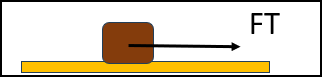 أثّرت قوة شدّ نحو اليمين موازية للسطح الأفقي الخشن وبقي الجسم ساكنًاA tension force to the right parallel to the rough horizontal surface; the body stays at rest | 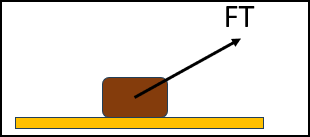 أثّرت قوة شدّ نحو اليمين تميل عن الأفق بزاوية فتحرك الجسم على مستوى أفقي خشنA tension force to the right inclined to the horizontal; the body moves on a rough horizontal plane |
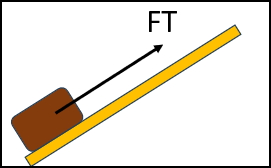 أثّرت قوة شدّ موازية للسطح لترفع الجسم إلى قمة المستوى المائل الخشنA tension force parallel to the surface lifts the body to the top of a rough inclined plane | 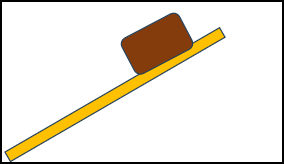 ترك جسم ينزلق على مستوى مائل خشنA body is left to slide down a rough inclined plane |
حدّد القوى المؤثرة في كل جسم من الأجسام الأربعة.
Determine the forces acting on each of the four bodies.
🚚 تطبيق: الاحتكاك يحرّك الأجسام
🚚 Application: Friction Makes Bodies Move
الاحتكاك ليس معيقًا دائمًا: فهو الذي يجعلنا نمشي (تدفع القدم الأرض للخلف والاحتكاك السكوني يدفعنا للأمام)، ويحرّك السيارة (احتكاك الإطار بالطريق)، ويُبقي الصندوق ثابتًا على شاحنة متسارعة حتى حدٍّ أقصى للتسارع \(a_{max}=\mu_sg\).
Friction is not always a hindrance: it makes us walk (the foot pushes the ground backward and static friction pushes us forward), it moves the car (the friction of the tyre with the road) and it keeps a box fixed on an accelerating truck up to a maximum acceleration \(a_{max}=\mu_sg\).
🧪 القصور الذاتي: صندوق على شاحنة
🧪 Inertia: a Box on a Truck
تتسارع الشاحنة بتسارع \(a\) وبين الصندوق والشاحنة احتكاك \(\mu\). إن كان \(a\) أكبر من \(\mu g\) انزلقت الشاحنة وبقي الصندوق في حالته؛ وإلا تحرك معها.
The truck accelerates with \(a\) and there is friction \(\mu\) between the box and the truck. If \(a\) exceeds \(\mu g\) the truck slides away and the box stays in its state; otherwise it moves with it.
صندوق على شاحنة معامل الاحتكاك السكوني بينهما \(0.4\). ما أكبر تسارع للشاحنة لا ينزلق معه الصندوق؟ (\(g=10\))
A box on a truck with a coefficient of static friction \(0.4\) between them. What is the largest acceleration of the truck at which the box does not slip? (\(g=10\))
📊 مقارنة: الاحتكاك السكوني والحركي
📊 Comparison: Static and Kinetic Friction
| نقطة المقارنةPoint of comparison | الاحتكاك السكونيStatic friction | الاحتكاك الحركيKinetic friction |
|---|---|---|
| الجسمThe body | على وشك الحركة / ساكنAbout to move / at rest | يتحركMoving |
| الاتجاهDirection | عكس القوة المؤثرةOpposite to the applied force | عكس الحركةOpposite to the motion |
| المقدارMagnitude | أكبر (قيمته العظمى)Larger (its maximum) | أصغرSmaller |
| الوحدةUnit | نيوتنNewton | نيوتنNewton |
| العواملFactors | طبيعة السطحين، القوة العموديةThe nature of the surfaces, the normal force | طبيعة السطحين، القوة العموديةThe nature of the surfaces, the normal force |
⚠️ أخطاء شائعة
⚠️ Common Mistakes
تجنّب هذه الأخطاء
Avoid these mistakes
- «الاحتكاك السكوني دائمًا \(\mu_sN\)»: خطأ؛ هو يساوي القوة المؤثرة، و\(\mu_sN\) قيمته العظمى فقط.“Static friction is always \(\mu_sN\)”: wrong; it equals the applied force, and \(\mu_sN\) is only its maximum.
- اعتبار \(N=mg\) دائمًا: على المستوى المائل أو مع قوة مائلة تتغير \(N\).Taking \(N=mg\) always: on an incline or with an oblique force \(N\) changes.
- الاعتقاد أن الاحتكاك يزداد بزيادة مساحة التلامس: لا يعتمد عليها تقريبًا.Thinking friction increases with the contact area: it does not depend on it (approximately).
- رسم الاحتكاك في اتجاه الحركة: هو عكسها دائمًا.Drawing the friction in the direction of the motion: it is always opposite to it.
📝 ملخص الدرس
📝 Lesson Summary
أهم ما تعلمناه
Key points
- الاحتكاك يعاكس الحركة أو ميلها ويوازي السطح، ونوعاه السكوني والحركي.Friction opposes the motion or its tendency and is parallel to the surface; its two types are static and kinetic.
- \(f_s=F\) حتى \(f_{s,max}=\mu_sN\)؛ وبعدها \(f_k=\mu_kN\) أصغر منها.\(f_s=F\) up to \(f_{s,max}=\mu_sN\); then \(f_k=\mu_kN\), which is smaller.
- \(\mu\) بلا وحدة و\(\mu_s\gt \mu_k\)؛ و\(N\) تُحسب من الاتزان العمودي.\(\mu\) has no unit and \(\mu_s\gt \mu_k\); \(N\) is found from the perpendicular equilibrium.
- على المستوى المائل: \(a=g(\sin\theta-\mu_k\cos\theta)\) ويبقى الجسم ساكنًا إذا \(\tan\theta\le\mu_s\).On an incline: \(a=g(\sin\theta-\mu_k\cos\theta)\) and the body stays at rest if \(\tan\theta\le\mu_s\).
🎲 تدرّب على المسائل
🎲 Practice Problems
🧪 تدرّب: مسائل الاحتكاك
🧪 Practice: Friction Problems
مسائل عشوائية بأرقام مختلفة (g = 9.8). احسب واكتب الجواب ثم اضغط «تحقّق».
Random problems with different numbers (g = 9.8). Work it out, enter the answer and press “Check”.
✅ قيّم نفسك
✅ Self-Check
متى تظهر قوة الاحتكاك السكوني؟
When does the static friction force appear?
جسم كتلته \(10\ \mathrm{kg}\) و\(\mu_s=0.4\) (\(g=10\)). أكبر احتكاك سكوني:
A \(10\ \mathrm{kg}\) body with \(\mu_s=0.4\) (\(g=10\)). The maximum static friction:
جسم ساكن قوة الاحتكاك السكوني العظمى عليه \(30\ \mathrm N\) وأُثّر فيه بقوة \(20\ \mathrm N\). قوة الاحتكاك:
A body at rest with a maximum static friction of \(30\ \mathrm N\) is acted on by a force of \(20\ \mathrm N\). The friction force:
أي العبارات صحيحة؟
Which statement is correct?
🧪 اختبر نفسك: امتحان من 20 سؤالاً
🧪 Test Yourself: a 20-Question Exam
أنهِ الدرس بالاختبار التفاعلي التالي؛ أسئلته تجمع بين الفهم والحساب وتغطي جميع أقسام الدرس.
Finish with the interactive exam below; its questions mix understanding with calculation and cover every section of the lesson.
اختبار قوة الاحتكاك Friction Quiz
20 سؤالاً - الاحتكاك السكوني والحركي، معامل الاحتكاك، المستوى الأفقي والمائل 20 Questions - static and kinetic friction, the friction coefficient, horizontal and inclined planes
• عدد الأسئلة: 20 سؤالاً
• مدة الاختبار: 30 دقيقة
• لا يمكنك تغيير إجاباتك أو إعادة الاختبار إلا بعد 24 ساعة من التسليم.
• تأكد من إجاباتك قبل التسليم! 📌 Important Instructions:
• Number of questions: 20 questions
• Quiz duration: 30 minutes
• You cannot change your answers or retake the quiz for 24 hours after submission.
• Make sure of your answers before submitting!
🔗 محاكيات GeoGebra للاستعانة بها عند اللزوم
🔗 GeoGebra Simulations to Use When Needed
اضغط «تشغيل» لتعمل المحاكاة هنا داخل الدرس؛ ويمكن للطالب الرجوع إليها لتجربة الفكرة بطريقة أخرى.
Press “Run” to run the simulation right here inside the lesson; the student can use it to try the idea in another way.