🎯 نواتج التعلم
🎯 Learning Outcomes
بعد دراسة هذا الدرس ستكون قادرًا على أن:
After this lesson you will be able to:
- تحسب محصلة متجهين متعامدين بفيثاغورس وتحدد اتجاهها.Calculate the resultant of two perpendicular vectors by Pythagoras and find its direction.
- تحسب محصلة متجهين بينهما زاوية بقانون جيب التمام وتحدد اتجاهها.Calculate the resultant of two vectors at an angle by the law of cosines and find its direction.
- تكتب المتجه بدلالة متجهات الوحدة \(\hat i,\hat j,\hat k\) وتجمع المتجهات وتطرحها بالمركبات.Write a vector with the unit vectors \(\hat i,\hat j,\hat k\) and add and subtract vectors by components.
- تحسب الضرب القياسي \(\vec A\cdot\vec B\) وتستخدمه في الزاوية بين متجهين والشغل.Compute the dot product \(\vec A\cdot\vec B\) and use it for the angle between vectors and for work.
- تحسب الضرب الاتجاهي \(\vec A\times\vec B\) وتحدد اتجاهه بقاعدة اليد اليمنى.Compute the cross product \(\vec A\times\vec B\) and find its direction by the right-hand rule.
📏 محصلة متجهين متعامدين
📏 The Resultant of Two Perpendicular Vectors
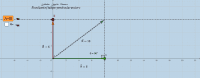
المتجهان المتعامدان هما متجهان تبلغ الزاوية بينهما \(90^\circ\)، كأن يتحرك شخص شرقًا ثم شمالًا. عند وضعهما من الذيل إلى الرأس يكوّنان ضلعي مثلث قائم الزاوية وترُه المحصلة \(\vec R\)، فنحسب مقدارها بنظرية فيثاغورس واتجاهها بالظل.
Perpendicular vectors make a \(90^\circ\) angle, as when someone walks east and then north. Placed head to tail they form the two legs of a right triangle whose hypotenuse is the resultant \(\vec R\), so Pythagoras gives its magnitude and the tangent gives its direction.
📌 المعادلات الأساسية
📌 Basic equations
\[R=\sqrt{A^{2}+B^{2}}\]
\[\theta=\tan^{-1}\!\left(\frac{B}{A}\right)\]
\(\theta\) هي الزاوية بين المحصلة والمتجه \(A\) (المتجه الأفقي). ويُعبَّر عن الاتجاه بالشرق أو الغرب أو الشمال أو الجنوب مع الزاوية، مثل «\(53^\circ\) جنوب الغرب».
\(\theta\) is the angle between the resultant and the vector \(A\) (the horizontal one). Direction is stated with the compass points and the angle, such as “\(53^\circ\) south of west”.
🔬 الاشتقاق الرياضي
🔬 Mathematical Derivation
خطوات الاشتقاق
Steps of the derivation
- نفرض متجهين متعامدين \(\vec A\) و\(\vec B\) ونضعهما من الذيل إلى الرأس.Take two perpendicular vectors \(\vec A\) and \(\vec B\) and place them head to tail.
- المحصلة \(\vec R=\vec A+\vec B\) تكمل المثلث القائم.The resultant \(\vec R=\vec A+\vec B\) completes the right triangle.
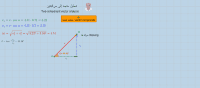
- نطبق نظرية فيثاغورس: \(R^2=A^2+B^2\).Apply Pythagoras: \(R^2=A^2+B^2\).
- الزاوية من المثلث: \(\tan\theta=\dfrac{\text{المقابل}}{\text{المجاور}}=\dfrac{B}{A}\).The angle from the triangle: \(\tan\theta=\dfrac{\text{opposite}}{\text{adjacent}}=\dfrac{B}{A}\).
🧪 جرّب بنفسك: المتجهان المتعامدان
🧪 Try It Yourself: Perpendicular Vectors
🧪 تجربة 1: محصلة متجهين متعامدين: فيثاغورس
🧪 Experiment 1: The Resultant of Two Perpendicular Vectors: Pythagoras
المتجه \(A\) شرقًا و\(B\) شمالًا. غيّر المقدارين ولاحظ المحصلة \(R\) ووتر المثلث القائم والزاوية \(\theta\).
The vector \(A\) points east and \(B\) north. Change the two magnitudes and watch the resultant \(R\), the hypotenuse of the right triangle, and the angle \(\theta\).
تحرك أحمد نحو الغرب مسافة \(60\ \mathrm m\) ثم غيّر اتجاهه وتحرك \(80\ \mathrm m\) نحو الجنوب. أوجد مقدار محصلة الإزاحتين واتجاهها.
Ahmed moved \(60\ \mathrm m\) west, then changed direction and moved \(80\ \mathrm m\) south. Find the magnitude and direction of the resultant displacement.
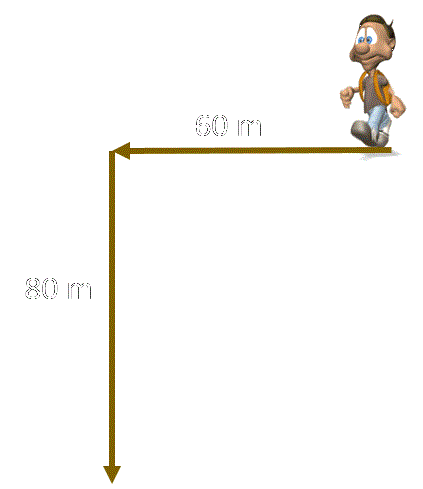
أحمد يتحرك \(60\ \mathrm m\) غربًا ثم \(80\ \mathrm m\) جنوبًا.
Ahmed walks \(60\ \mathrm m\) west then \(80\ \mathrm m\) south.
تحرك أحمد \(60\ \mathrm m\) غربًا ثم \(80\ \mathrm m\) جنوبًا. المحصلة تعادل:
Ahmed moved \(60\ \mathrm m\) west then \(80\ \mathrm m\) south. The resultant equals:
🏗️ تطبيق هندسي
🏗️ An Engineering Application
في حساب القوى على الجسور تكون القوى الأفقية والرأسية متعامدة، فتُحسب القوة المحصلة من \(R=\sqrt{F_{h}^2+F_{v}^2}\). وكذلك الطيار الذي يطير بسرعة \(V_{plane}\) وتهب رياح جانبية عمودية عليه بسرعة \(V_{wind}\) تكون سرعته المحصلة \(\sqrt{V_{plane}^2+V_{wind}^2}\).
In calculating forces on bridges the horizontal and vertical forces are perpendicular, so the resultant force is \(R=\sqrt{F_h^2+F_v^2}\). Likewise an aircraft flying at \(V_{plane}\) in a perpendicular crosswind \(V_{wind}\) has the resultant speed \(\sqrt{V_{plane}^2+V_{wind}^2}\).
متجه أفقي \(3\ \mathrm N\) ومتجه رأسي \(4\ \mathrm N\). أوجد المحصلة واتجاهها.
A horizontal vector of \(3\ \mathrm N\) and a vertical vector of \(4\ \mathrm N\). Find the resultant and its direction.
🔺 محصلة متجهين بينهما زاوية: قانون جيب التمام
🔺 Two Vectors at an Angle: the Law of Cosines
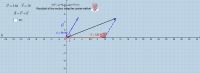
إذا كانت الزاوية بين المتجهين \(\theta\) (وهما خارجان من نقطة واحدة) فإن المحصلة هي قطر متوازي الأضلاع المنشأ عليهما، ويحسب مقدارها بقانون جيب التمام. ولاحظ أن الإشارة موجبة \(+2AB\cos\theta\) لأن \(\theta\) هنا الزاوية بين المتجهين لا زاوية المثلث؛ فالمتجهان في اتجاه واحد (\(\theta=0\)) يعطيان أكبر محصلة \(A+B\).
If the angle between the two vectors, drawn from one point, is \(\theta\), the resultant is the diagonal of the parallelogram built on them and its magnitude comes from the law of cosines. Note the plus sign \(+2AB\cos\theta\): here \(\theta\) is the angle between the vectors, not the triangle angle, so vectors in the same direction (\(\theta=0\)) give the largest resultant \(A+B\).
📌 المقدار والاتجاه
📌 Magnitude and direction
\[R^{2}=A^{2}+B^{2}+2AB\cos\theta\]
\[\tan\varphi=\frac{B\sin\theta}{A+B\cos\theta}\]
\(\varphi\) هي الزاوية بين المحصلة والمتجه \(A\). عندما \(\theta=90^\circ\) نعود إلى فيثاغورس، وعندما \(\theta=180^\circ\) تكون \(R=|A-B|\).
\(\varphi\) is the angle between the resultant and \(A\). When \(\theta=90^\circ\) we return to Pythagoras, and when \(\theta=180^\circ\) we get \(R=|A-B|\).
الاشتقاق
Derivation
- من المثلث المتكوّن بوضع المتجهين من الذيل إلى الرأس تكون الزاوية الداخلية \(180^\circ-\theta\).In the triangle formed head to tail the interior angle is \(180^\circ-\theta\).
- قانون جيب التمام: \(R^2=A^2+B^2-2AB\cos(180^\circ-\theta)\).The law of cosines: \(R^2=A^2+B^2-2AB\cos(180^\circ-\theta)\).
- وبما أن \(\cos(180^\circ-\theta)=-\cos\theta\) فإن \(R^2=A^2+B^2+2AB\cos\theta\).Since \(\cos(180^\circ-\theta)=-\cos\theta\), \(R^2=A^2+B^2+2AB\cos\theta\).
🧪 جرّب بنفسك: قانون جيب التمام
🧪 Try It Yourself: the Law of Cosines
🧪 تجربة 2: محصلة متجهين بينهما زاوية: قانون جيب التمام
🧪 Experiment 2: The Resultant of Two Vectors at an Angle: the Law of Cosines
غيّر المقدارين والزاوية \(\varphi\) بين المتجهين (ذيل مع ذيل) وراقب المحصلة (قطر متوازي الأضلاع) واتجاهها.
Change the two magnitudes and the angle \(\varphi\) between the vectors (tail to tail) and watch the resultant (the diagonal of the parallelogram) and its direction.
تؤثر قوة \(50\ \mathrm N\) بزاوية \(60^\circ\) على قوة أخرى \(30\ \mathrm N\). أوجد مقدار المحصلة واتجاهها.
A force of \(50\ \mathrm N\) acts at \(60^\circ\) to another force of \(30\ \mathrm N\). Find the magnitude and direction of the resultant.
متجهان \(5\) و\(5\) والزاوية بينهما \(60^\circ\). مقدار المحصلة:
Two vectors \(5\) and \(5\) with \(60^\circ\) between them. The magnitude of the resultant:
➡️ المتجهات بدلالة متجهات الوحدة: بعدان
➡️ Vectors with Unit Vectors: Two Dimensions
المتجه في بعدين يُكتب \(\vec A=A_x\hat i+A_y\hat j\) حيث \(\hat i\) و\(\hat j\) متجها وحدة في اتجاهي المحورين \(x\) و\(y\) (مقدار كل منهما 1)، و\(A_x\) المركبة الأفقية و\(A_y\) المركبة الرأسية. وإذا عُلم المقدار والزاوية \(\theta\) مع المحور الأفقي:
A vector in two dimensions is written \(\vec A=A_x\hat i+A_y\hat j\) where \(\hat i\) and \(\hat j\) are unit vectors (magnitude 1) along the \(x\) and \(y\) axes, \(A_x\) being the horizontal and \(A_y\) the vertical component. If the magnitude and the angle \(\theta\) with the horizontal are known:
📌 التحليل إلى مركبتين
📌 Resolution into components
\[A_x=|A|\cos\theta,\qquad A_y=|A|\sin\theta\]
\[|A|=\sqrt{A_x^2+A_y^2},\qquad \theta=\tan^{-1}\frac{A_y}{A_x}\]
متجه قوة \(50\ \mathrm N\) يصنع زاوية \(30^\circ\) مع المحور الأفقي. أوجد مركبتيه.
A force vector of \(50\ \mathrm N\) makes \(30^\circ\) with the horizontal axis. Find its components.
➕ جمع المتجهات بالمركبات
➕ Adding Vectors by Components
لجمع متجهين نجمع المركبات المتناظرة: الأفقية مع الأفقية والرأسية مع الرأسية، وهذه أسهل طريقة لجمع أي عدد من المتجهات.
To add two vectors we add the corresponding components: horizontal with horizontal and vertical with vertical. This is the easiest way to add any number of vectors.
📌 قاعدة الجمع
📌 The rule of addition
\[\vec R=\vec A+\vec B=(A_x+B_x)\,\hat i+(A_y+B_y)\,\hat j\]
إذا كان \(\vec A=3\hat i+4\hat j\) و\(\vec B=2\hat i-5\hat j\) فأوجد \(\vec R=\vec A+\vec B\) ومقدارها واتجاهها.
If \(\vec A=3\hat i+4\hat j\) and \(\vec B=2\hat i-5\hat j\), find \(\vec R=\vec A+\vec B\), its magnitude and direction.
🧊 المتجهات في ثلاثة أبعاد: الجمع والطرح
🧊 Vectors in Three Dimensions: Addition and Subtraction
المتجه في الفضاء يحتاج ثلاث مركبات: \(\vec A=A_x\hat i+A_y\hat j+A_z\hat k\) حيث \(\hat k\) متجه الوحدة على المحور \(z\). ويعمل الجمع والطرح بالطريقة نفسها مركّبةً مركّبة، ومقداره \(|A|=\sqrt{A_x^2+A_y^2+A_z^2}\).
A vector in space needs three components: \(\vec A=A_x\hat i+A_y\hat j+A_z\hat k\) where \(\hat k\) is the unit vector on the \(z\) axis. Addition and subtraction work the same way component by component, and its magnitude is \(|A|=\sqrt{A_x^2+A_y^2+A_z^2}\).
📌 الجمع والطرح
📌 Addition and subtraction
\[\vec A+\vec B=(A_x+B_x)\hat i+(A_y+B_y)\hat j+(A_z+B_z)\hat k\]
\[\vec A-\vec B=(A_x-B_x)\hat i+(A_y-B_y)\hat j+(A_z-B_z)\hat k\]
🧪 جرّب بنفسك: جمع وطرح المتجهات
🧪 Try It Yourself: Adding and Subtracting Vectors
🧪 تجربة 3: جمع المتجهات وطرحها بالمركبات (ثلاثة أبعاد)
🧪 Experiment 3: Adding and Subtracting Vectors by Components (3D)
اختر مركبات \(A\) و\(B\) بالمنزلقات وبدّل بين الجمع والطرح، وراقب المحصلة مركّبةً مركّبة. اجعل \(z=0\) لتعود إلى بعدين.
Choose the components of \(A\) and \(B\) with the sliders and switch between addition and subtraction; watch the result component by component. Set \(z=0\) to return to two dimensions.
إذا كان \(\vec A=2\hat i+3\hat j-\hat k\) و\(\vec B=\hat i-2\hat j+4\hat k\) فأوجد \(\vec A+\vec B\) و\(\vec A-\vec B\).
If \(\vec A=2\hat i+3\hat j-\hat k\) and \(\vec B=\hat i-2\hat j+4\hat k\), find \(\vec A+\vec B\) and \(\vec A-\vec B\).
✖️ الضرب القياسي (Dot Product)
✖️ The Scalar Product (Dot Product)
الضرب القياسي لمتجهين عملية ناتجها عدد لا اتجاه له. هندسيًا هو مقدار أحد المتجهين مضروبًا في مسقط الآخر عليه، ويفيد في إيجاد الزاوية بين متجهين وفي تعريف الشغل \(W=\vec F\cdot\vec d\).
The scalar product of two vectors is an operation whose result is a number with no direction. Geometrically it is the magnitude of one vector times the projection of the other on it. It is used to find the angle between vectors and to define work \(W=\vec F\cdot\vec d\).
📌 الصيغتان الهندسية والجبرية
📌 Geometric and algebraic forms
\[\vec A\cdot\vec B=|A||B|\cos\theta\]
\[\vec A\cdot\vec B=A_xB_x+A_yB_y+A_zB_z\]
\(\hat i\cdot\hat i=\hat j\cdot\hat j=\hat k\cdot\hat k=1\) و\(\hat i\cdot\hat j=\hat j\cdot\hat k=\hat k\cdot\hat i=0\). ومن الصيغتين: \(\cos\theta=\dfrac{\vec A\cdot\vec B}{|A||B|}\).
\(\hat i\cdot\hat i=\hat j\cdot\hat j=\hat k\cdot\hat k=1\) and \(\hat i\cdot\hat j=\hat j\cdot\hat k=\hat k\cdot\hat i=0\). From the two forms: \(\cos\theta=\dfrac{\vec A\cdot\vec B}{|A||B|}\).
خصائص الضرب القياسي
Properties of the dot product
- الناتج كمية قياسية.The result is a scalar.
- تبديلي: \(\vec A\cdot\vec B=\vec B\cdot\vec A\)، وتوزيعي: \(\vec A\cdot(\vec B+\vec C)=\vec A\cdot\vec B+\vec A\cdot\vec C\).Commutative: \(\vec A\cdot\vec B=\vec B\cdot\vec A\), and distributive: \(\vec A\cdot(\vec B+\vec C)=\vec A\cdot\vec B+\vec A\cdot\vec C\).
- موجب عندما تكون الزاوية حادة، وصفر عندما يتعامد المتجهان، وسالب عندما تكون الزاوية منفرجة.Positive for an acute angle, zero for perpendicular vectors, negative for an obtuse angle.
🧪 جرّب بنفسك: الضرب القياسي
🧪 Try It Yourself: the Dot Product
🧪 تجربة 4: الضرب القياسي: \(AB\cos\theta\)
🧪 Experiment 4: The Dot Product: \(AB\cos\theta\)
غيّر المقدارين والزاوية بينهما وراقب ناتج الضرب القياسي ومسقط \(B\) على \(A\) وإشارة الناتج.
Change the two magnitudes and the angle between them and watch the dot product, the projection of \(B\) on \(A\), and the sign of the result.
إذا كان \(\vec A=3\hat i-5\hat j+2\hat k\) و\(\vec B=7\hat i+\hat j-4\hat k\) فأوجد \(\vec A\cdot\vec B\) والزاوية بينهما.
If \(\vec A=3\hat i-5\hat j+2\hat k\) and \(\vec B=7\hat i+\hat j-4\hat k\), find \(\vec A\cdot\vec B\) and the angle between them.
أي من التالية يعطي ضربًا قياسيًا يساوي صفرًا؟
Which pair has a zero dot product?
❌ الضرب الاتجاهي (Cross Product)
❌ The Vector Product (Cross Product)
الضرب الاتجاهي لمتجهين ناتجه متجه جديد عمودي على المستوي الذي يحويهما، واتجاهه بقاعدة اليد اليمنى: حرّك أصابعك من \(\vec A\) نحو \(\vec B\) فيشير الإبهام إلى اتجاه \(\vec A\times\vec B\). ومقداره يساوي مساحة متوازي الأضلاع المنشأ على المتجهين.
The vector product of two vectors is a new vector perpendicular to the plane containing them, with its direction given by the right-hand rule: curl your fingers from \(\vec A\) toward \(\vec B\) and your thumb points along \(\vec A\times\vec B\). Its magnitude equals the area of the parallelogram built on the two vectors.
📌 المقدار والصيغة الجبرية
📌 Magnitude and algebraic form
\[|\vec A\times\vec B|=|A||B|\sin\theta\]
\[\vec A\times\vec B=\begin{vmatrix}\hat i&\hat j&\hat k\\A_x&A_y&A_z\\B_x&B_y&B_z\end{vmatrix}=(A_yB_z-A_zB_y)\hat i-(A_xB_z-A_zB_x)\hat j+(A_xB_y-A_yB_x)\hat k\]
\(\hat i\times\hat j=\hat k\) و\(\hat j\times\hat k=\hat i\) و\(\hat k\times\hat i=\hat j\)، وبعكس الترتيب تتغير الإشارة.
\(\hat i\times\hat j=\hat k\), \(\hat j\times\hat k=\hat i\), \(\hat k\times\hat i=\hat j\); reversing the order flips the sign.
خصائص الضرب الاتجاهي
Properties of the cross product
- الناتج متجه جديد عمودي على المتجهين.The result is a new vector perpendicular to both.
- غير تبديلي: \(\vec A\times\vec B=-(\vec B\times\vec A)\).Not commutative: \(\vec A\times\vec B=-(\vec B\times\vec A)\).
- يساوي صفرًا للمتجهين المتوازيين، ويكون أكبر ما يمكن عند التعامد.It is zero for parallel vectors and greatest when they are perpendicular.
🧪 جرّب بنفسك: الضرب الاتجاهي
🧪 Try It Yourself: the Cross Product
🧪 تجربة 5: الضرب الاتجاهي: \(AB\sin\theta\)
🧪 Experiment 5: The Cross Product: \(AB\sin\theta\)
غيّر المقدارين والزاوية وراقب مساحة متوازي الأضلاع (مقدار الناتج) واتجاهه عموديًا على الصفحة، وبدّل الترتيب لترى انعكاس الاتجاه.
Change the magnitudes and the angle and watch the parallelogram area (the magnitude of the result) and its direction perpendicular to the page; swap the order to see the direction flip.
إذا كان \(\vec A=2\hat i+\hat j-3\hat k\) و\(\vec B=4\hat i-\hat j+5\hat k\) فأوجد \(\vec A\times\vec B\).
If \(\vec A=2\hat i+\hat j-3\hat k\) and \(\vec B=4\hat i-\hat j+5\hat k\), find \(\vec A\times\vec B\).
إذا كان \(\vec A\times\vec B=\vec C\) فإن \(\vec B\times\vec A\) يساوي:
If \(\vec A\times\vec B=\vec C\) then \(\vec B\times\vec A\) equals:
🌍 تطبيقات عملية
🌍 Practical Applications
| الضرب القياسيDot product | الضرب الاتجاهيCross product |
|---|---|
| الشغل \(W=\vec F\cdot\vec d\)Work \(W=\vec F\cdot\vec d\) | عزم الدوران \(\vec\tau=\vec r\times\vec F\)Torque \(\vec\tau=\vec r\times\vec F\) |
| الإضاءة في الرسوميات: الزاوية بين الضوء والسطحLighting in graphics: angle between light and surface | القوة المغناطيسية \(\vec F=q\,\vec v\times\vec B\)Magnetic force \(\vec F=q\,\vec v\times\vec B\) |
| اتجاه الحركة بالنسبة لاتجاه الريحDirection of motion relative to the wind | الزخم الزاوي \(\vec L=\vec r\times\vec p\) والمساحات والحجومAngular momentum \(\vec L=\vec r\times\vec p\), areas and volumes |
⚖️ الفرق الجوهري بينهما
⚖️ The Fundamental Difference
| الخاصيةProperty | الضرب القياسيDot product | الضرب الاتجاهيCross product |
|---|---|---|
| ناتج العمليةResult | عدد قياسيa scalar | متجهa vector |
| الاتجاهDirection | لا يوجدnone | عمودي على المستويperpendicular to the plane |
| التبادليةCommutativity | \(A\cdot B=B\cdot A\)\(A\cdot B=B\cdot A\) | \(A\times B=-B\times A\)\(A\times B=-B\times A\) |
| يساوي صفرًا عندماEquals zero when | المتجهان متعامدانthe vectors are perpendicular | المتجهان متوازيانthe vectors are parallel |
🎲 تدرّب
🎲 Practice
🧪 تجربة 6: تدرّب: مسائل المتجهات
🧪 Experiment 6: Practice: Vector Problems
مسائل عشوائية بأرقام مختلفة. احسب واكتب الجواب ثم اضغط «تحقّق».
Random problems with different numbers. Work it out, enter the answer and press “Check”.
📊 جدول ملخص القواعد
📊 Summary of the Rules
| القاعدةRule | العلاقةRelation |
|---|---|
| متجهان متعامدانPerpendicular vectors | \(R=\sqrt{A^2+B^2},\ \theta=\tan^{-1}(B/A)\)\(R=\sqrt{A^2+B^2},\ \theta=\tan^{-1}(B/A)\) |
| جيب التمامLaw of cosines | \(R^2=A^2+B^2+2AB\cos\theta\)\(R^2=A^2+B^2+2AB\cos\theta\) |
| الاتجاهDirection | \(\tan\varphi=B\sin\theta/(A+B\cos\theta)\)\(\tan\varphi=B\sin\theta/(A+B\cos\theta)\) |
| المركبتانComponents | \(A_x=A\cos\theta,\ A_y=A\sin\theta\)\(A_x=A\cos\theta,\ A_y=A\sin\theta\) |
| الجمع/الطرحAdd/subtract | \(\vec A\pm\vec B=(A_x\pm B_x)\hat i+\dots\)\(\vec A\pm\vec B=(A_x\pm B_x)\hat i+\dots\) |
| القياسيDot | \(AB\cos\theta=A_xB_x+A_yB_y+A_zB_z\)\(AB\cos\theta=A_xB_x+A_yB_y+A_zB_z\) |
| الاتجاهيCross | \(|A\times B|=AB\sin\theta\)\(|A\times B|=AB\sin\theta\) |
🧪 اختبر نفسك: امتحان من 20 سؤالاً
🧪 Test Yourself: a 20-Question Exam
أنهِ الدرس بالاختبار التفاعلي التالي؛ أسئلته تجمع بين الفهم والحساب وتغطي جميع أقسام الدرس.
Finish with the interactive exam below; its questions mix understanding with calculation and cover every section of the lesson.
اختبار قواعد المتجهات Vector Rules Quiz
20 سؤالاً - الكميات المتجهة والقياسية، فيثاغورس، قانون جيب التمام، تحليل المتجهات والمحصلة بالمركبات 20 Questions - vector and scalar quantities, Pythagoras, the law of cosines, resolving vectors and the resultant by components
• عدد الأسئلة: 20 سؤالاً
• مدة الاختبار: 30 دقيقة
• لا يمكنك تغيير إجاباتك أو إعادة الاختبار إلا بعد 24 ساعة من التسليم.
• تأكد من إجاباتك قبل التسليم! 📌 Important Instructions:
• Number of questions: 20 questions
• Quiz duration: 30 minutes
• You cannot change your answers or retake the quiz for 24 hours after submission.
• Make sure of your answers before submitting!
🔗 محاكيات GeoGebra للاستعانة بها عند اللزوم
🔗 GeoGebra Simulations to Use When Needed
اضغط «تشغيل» لتعمل المحاكاة هنا داخل الدرس؛ ويمكن للطالب الرجوع إليها لتجربة الفكرة بطريقة أخرى.
Press “Run” to run the simulation right here inside the lesson; the student can use it to try the idea in another way.