🎯 نواتج التعلم
🎯 Learning Outcomes
بعد دراسة هذا الدرس ستكون قادرًا على أن:
After this lesson you will be able to:
- تنص على قانون هوك وتفسّر معنى الإشارة السالبة في \(F=-k\,\Delta x\).State Hooke’s law and explain the meaning of the negative sign in \(F=-k\,\Delta x\).
- تحسب ثابت النابض والقوة والاستطالة من التجربة ومن الرسم البياني.Calculate the spring constant, the force and the extension from an experiment and from a graph.
- تفسّر ميل الخط البياني \(F\)–\(\Delta L\) والمساحة تحته.Interpret the slope of the \(F\)–\(\Delta L\) graph and the area under it.
- تحسب طاقة الوضع المرونية \(PE=\tfrac12kx^2\) وتدرك أنها تتناسب مع مربع الاستطالة.Calculate the elastic potential energy \(PE=\tfrac12kx^2\) and recognise that it is proportional to the square of the extension.
- تجد الثابت المكافئ لنابضين على التوالي وعلى التوازي.Find the equivalent constant of two springs in series and in parallel.
📖 مقدمة تاريخية
📖 Historical Introduction
صاغ العالم الإنجليزي روبرت هوك هذا القانون عام 1676، ويُعدّ من أساسيات ميكانيكا المواد المرنة. والجسم المرن هو الذي يعود إلى شكله الأصلي بعد زوال القوة المشوِّهة، كالنابض (الزنبرك). أما إذا زادت القوة كثيرًا فقد يتشوّه الجسم تشوهًا دائمًا (لدنًا) أو ينكسر، ولذلك يصحّ القانون في النطاق المرن فقط.
The English scientist Robert Hooke formulated this law in 1676; it is one of the foundations of the mechanics of elastic materials. An elastic body returns to its original shape when the deforming force is removed, like a spring. If the force is too large the body may be deformed permanently (plastically) or break, so the law holds within the elastic range only.
📐 قانون هوك
📐 Hooke’s Law
تتناسب قوة الاستعادة التي يؤثر بها النابض طرديًا مع إزاحة طرفه عن موضع الاتزان (طوله الطبيعي)، وتكون في عكس اتجاه الإزاحة:
The restoring force exerted by a spring is directly proportional to the displacement of its end from the equilibrium position (its natural length), and it acts opposite to the displacement:
📌 قانون هوك
📌 Hooke’s law
\[F=-k\,\Delta x\]
معاني الرموز
Meaning of the symbols
- \(F\): قوة الاستعادة التي يؤثر بها النابض، وحدتها النيوتن \(\mathrm N\).\(F\): the restoring force exerted by the spring, measured in newtons \(\mathrm N\).
- \(k\): ثابت النابض (مقياس صلابته)، وحدته \(\mathrm{N/m}\).\(k\): the spring constant (a measure of its stiffness), in \(\mathrm{N/m}\).
- \(\Delta x\): إزاحة طرف النابض عن موضع الاتزان (استطالة أو انضغاط)، وحدتها المتر \(\mathrm m\).\(\Delta x\): displacement of the spring’s end from equilibrium (stretch or compression), in metres \(\mathrm m\).
معنى الإشارة السالبة: إذا سحبنا النابض نحو اليمين (\(\Delta x\gt 0\)) دفع النابض نحو اليسار (\(F\lt 0\)) محاولًا إعادته، وإذا ضغطناه دفع نحو اليمين. أما القوة الخارجية التي نؤثر بها نحن فتساوي في المقدار \(F=k\,\Delta x\) وتعاكس قوة النابض؛ ولذلك نكتب في التجارب \(F=k\,\Delta L\) بالمقدار.
Meaning of the negative sign: if we pull the spring to the right (\(\Delta x\gt 0\)) it pushes to the left (\(F\lt 0\)) trying to restore itself, and if we compress it, it pushes to the right. The external force we apply has the magnitude \(F=k\,\Delta x\) and opposes the spring’s force; that is why in the experiments we write \(F=k\,\Delta L\) in magnitude.
ثابت النابض \(k\): قيمة كبيرة تعني نابضًا صلبًا يحتاج قوة كبيرة لاستطالته، ويعتمد على مادة النابض وأبعاده (قطر السلك وعدد اللفات وطوله)؛ فالنابض الأقصر والأسمك أصلب. ولهذا لا يمكن إعطاء قيمة \(k\) «للمادة» وحدها، بل لكل نابض بعينه.
The spring constant \(k\): a large value means a stiff spring that needs a large force to stretch it; it depends on the spring’s material and dimensions (wire diameter, number of coils and length): a shorter and thicker spring is stiffer. So \(k\) cannot be quoted for a “material” alone but for each particular spring.
🧪 جرّب بنفسك: قوة الاستعادة
🧪 Try It Yourself: the Restoring Force
🧪 تجربة 2: قوة الاستعادة وطاقة الوضع المرونية
🧪 Experiment 2: The Restoring Force and the Elastic Potential Energy
حرّك الإزاحة \(x\) وغيّر الثابت \(k\) وراقب قوة الاستعادة \(F=-kx\) تعاكس الإزاحة، ورسم \(F\)–\(x\) وطاقة الوضع كمساحة المثلث؛ ثم اضغط «أفلت الجسم».
Move the displacement \(x\) and change the constant \(k\) and watch the restoring force \(F=-kx\) oppose the displacement, the \(F\)–\(x\) graph and the potential energy as the area of the triangle; then press “Release the body”.
🧪 تجربة: علّق كتلًا مختلفة في النابض
🧪 Experiment: Hang Different Masses on the Spring
نعلّق في النابض كتلًا مختلفة \(m_1=10\ \mathrm g\)، \(m_2=20\ \mathrm g\)، \(m_3=60\ \mathrm g\)، \(m_4=30\ \mathrm g\) ونقيس الاستطالة \(\Delta L\) في كل مرة. وبما أن الجسم متزن فإن قوة النابض تساوي الوزن: \(F=mg\) (نأخذ \(g=10\ \mathrm{m/s^2}\)).
We hang different masses \(m_1=10\ \mathrm g\), \(m_2=20\ \mathrm g\), \(m_3=60\ \mathrm g\), \(m_4=30\ \mathrm g\) on the spring and measure the extension \(\Delta L\) each time. Since the body is in equilibrium the spring force equals the weight: \(F=mg\) (we take \(g=10\ \mathrm{m/s^2}\)).
🧪 تجربة 1: تجربة تعليق الكتل في النابض ورسم F–ΔL
🧪 Experiment 1: Hanging Masses on a Spring and Plotting F–ΔL
اختر الكتلة وثابت النابض ثم اضغط «علّق الكتلة» واقرأ الاستطالة على المسطرة بعد أن تستقر، وسجّل القياس. كرّر مع كتل مختلفة وراقب نقاط الرسم \(F\)–\(\Delta L\) تقع على خط مستقيم ميله \(k\).
Choose the mass and the spring constant, press “Hang the mass”, read the extension on the ruler once it settles, and record the reading. Repeat with different masses and watch the points of the \(F\)–\(\Delta L\) graph lie on a straight line of slope \(k\).
| المحاولةTrial | الكتلة \(m\) (kg)Mass \(m\) (kg) | القوة \(F=mg\) (N)Force \(F=mg\) (N) | الاستطالة \(\Delta L\) (m)Extension \(\Delta L\) (m) | \(F/\Delta L\) (N/m)\(F/\Delta L\) (N/m) |
|---|---|---|---|---|
| 1 | 0.010 | 0.1 | 0.005 | 20 |
| 2 | 0.020 | 0.2 | 0.010 | 20 |
| 3 | 0.060 | 0.6 | 0.030 | 20 |
| 4 | 0.030 | 0.3 | 0.015 | 20 |
لاحظ أن النسبة \(F/\Delta L\) ثابتة في كل المحاولات وتساوي \(20\ \mathrm{N/m}\) وهي ثابت النابض؛ أي أن القوة تتناسب طرديًا مع الاستطالة.
Notice that the ratio \(F/\Delta L\) is constant in all trials and equals \(20\ \mathrm{N/m}\), the spring constant; so the force is directly proportional to the extension.
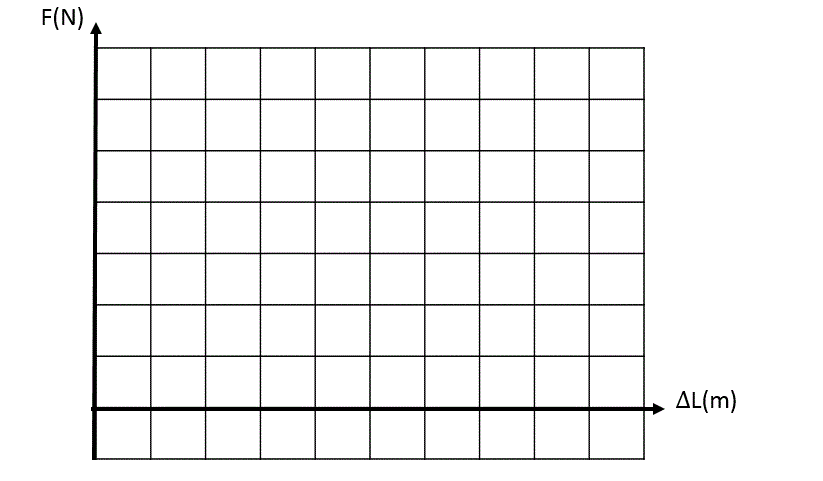
ارسم النقاط الأربع على الشبكة: \(F\) على المحور الرأسي و\(\Delta L\) على الأفقي.
Plot the four points on the grid: \(F\) on the vertical axis and \(\Delta L\) on the horizontal.
📊 تحليل الخط البياني
📊 Analysing the Graph
عند رسم \(F\) مع \(\Delta L\) ينتج خط مستقيم يمر بنقطة الأصل. ميل هذا الخط يساوي ثابت النابض، والمساحة تحته تساوي الشغل المبذول على النابض، وهذا الشغل يتخزّن في النابض طاقةَ وضعٍ مرونية.
Plotting \(F\) against \(\Delta L\) gives a straight line through the origin. The slope of this line equals the spring constant and the area under it equals the work done on the spring, which is stored in the spring as elastic potential energy.
📌 الميل والمساحة
📌 Slope and area
\[k=\frac{\Delta F}{\Delta L}=\frac{F_2-F_1}{L_2-L_1}\]
\[PE_s=\text{area of the triangle}=\tfrac12\,F\,\Delta L\]
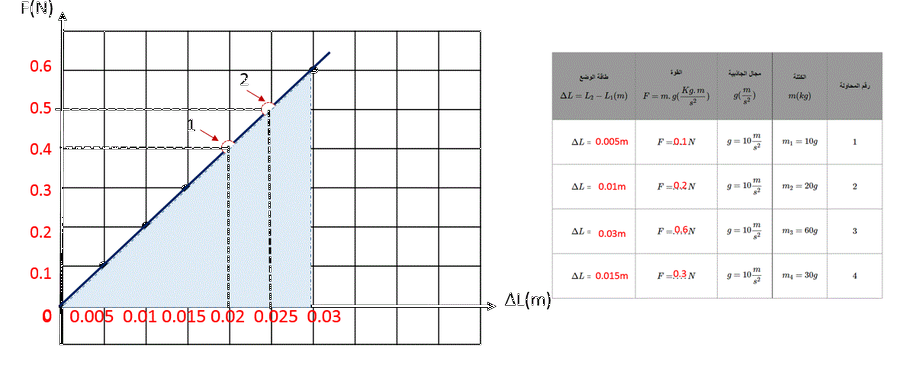
الرسم البياني للتجربة: الميل \(=20\ \mathrm{N/m}\).
The experiment graph: the slope \(=20\ \mathrm{N/m}\).
من الرسم البياني للتجربة: النقطتان \((0.020\ \mathrm m,\ 0.4\ \mathrm N)\) و\((0.025\ \mathrm m,\ 0.5\ \mathrm N)\). أوجد ثابت النابض، ثم أوجد طاقة الوضع المرونية عند \(\Delta L=0.03\ \mathrm m\) و\(F=0.6\ \mathrm N\).
From the experiment graph: the two points \((0.020\ \mathrm m,\ 0.4\ \mathrm N)\) and \((0.025\ \mathrm m,\ 0.5\ \mathrm N)\). Find the spring constant, then the elastic potential energy at \(\Delta L=0.03\ \mathrm m\) and \(F=0.6\ \mathrm N\).
نابض ثابته \(200\ \mathrm{N/m}\) أثّرت عليه قوة شدّ مقدارها \(50\ \mathrm N\). أوجد استطالته.
A spring of constant \(200\ \mathrm{N/m}\) is pulled by a force of \(50\ \mathrm N\). Find its extension.
عُلّق جسم كتلته \(2\ \mathrm{kg}\) في نابض فاستطال \(0.1\ \mathrm m\) (\(g=10\ \mathrm{m/s^2}\)). أوجد ثابت النابض.
A body of mass \(2\ \mathrm{kg}\) hung from a spring stretches it \(0.1\ \mathrm m\) (\(g=10\ \mathrm{m/s^2}\)). Find the spring constant.
🔋 طاقة الوضع المرونية
🔋 Elastic Potential Energy
طاقة الوضع المرونية هي الطاقة المخزّنة في الجسم المرن (كالنابض) نتيجة تشويهه بالشدّ أو الضغط. وكلما زادت قوة الشدّ زادت الاستطالة وزادت الطاقة المخزّنة. وبما أن القوة تزداد من صفر إلى \(F=kx\) فالقوة المتوسطة \(\tfrac12kx\) والشغل:
Elastic potential energy is the energy stored in an elastic body (such as a spring) as a result of deforming it by stretching or compressing. The greater the pulling force the greater the extension and the greater the stored energy. Since the force increases from zero to \(F=kx\) its average is \(\tfrac12kx\) and the work is:
📌 طاقة الوضع المرونية
📌 Elastic potential energy
\[PE_s=\tfrac12F\,x=\tfrac12kx^{2}\]
\[W=\int_0^{x}kx\,dx=\tfrac12kx^{2}\]
الطاقة تتناسب طرديًا مع مربع الاستطالة: فإذا تضاعفت الاستطالة تضاعفت الطاقة أربع مرات. وحدة الطاقة الجول \(\mathrm J\).
The energy is proportional to the square of the extension: if the extension doubles the energy becomes four times as large. The unit of energy is the joule \(\mathrm J\).
نابض ثابته \(100\ \mathrm{N/m}\) مستطال \(0.2\ \mathrm m\). أوجد القوة وطاقة الوضع المرونية المخزّنة.
A spring of constant \(100\ \mathrm{N/m}\) is stretched \(0.2\ \mathrm m\). Find the force and the stored elastic potential energy.
يخزّن نابض طاقة وضع مرونية \(8\ \mathrm J\) عند استطالة \(0.4\ \mathrm m\). أوجد القوة المؤثرة عند هذه الاستطالة.
A spring stores \(8\ \mathrm J\) of elastic potential energy at an extension of \(0.4\ \mathrm m\). Find the force acting at this extension.
🔗 توصيل النوابض
🔗 Combining Springs
عند توصيل نابضين على التوالي (طرفًا بطرف) تكون القوة نفسها في كل منهما وتتجمّع الاستطالتان فيصير النظام أليَن؛ وعند توصيلهما على التوازي تكون الاستطالة واحدة وتتجمّع القوتان فيصير النظام أصلب:
When two springs are connected in series (end to end) the force is the same in both and the extensions add, so the system is softer; when they are connected in parallel the extension is the same and the forces add, so the system is stiffer:
📌 الثابت المكافئ
📌 The equivalent constant
\[\text{series: }\ \frac{1}{k_{eq}}=\frac{1}{k_1}+\frac{1}{k_2}\ \Rightarrow\ k_{eq}=\frac{k_1k_2}{k_1+k_2}\]
\[\text{parallel: }\ k_{eq}=k_1+k_2\]
🧪 جرّب بنفسك: التوالي والتوازي
🧪 Try It Yourself: Series and Parallel
🧪 تجربة 3: النوابض على التوالي وعلى التوازي
🧪 Experiment 3: Springs in Series and in Parallel
علّق الكتلة نفسها بنابضين على التوالي ثم بالنابضين نفسيهما على التوازي، وغيّر \(k_1\) و\(k_2\) و\(m\) وقارن الثابت المكافئ والاستطالة (g = 10).
Hang the same mass on two springs in series and then on the same two springs in parallel, change \(k_1\), \(k_2\) and \(m\) and compare the equivalent constant and the extension (g = 10).
نابضان متطابقان \(k\) على التوالي: \(k_{eq}=k/2\) (يقل إلى النصف)، وعلى التوازي: \(k_{eq}=2k\) (يتضاعف). ويشبه ذلك توصيل المقاومات في الدوائر الكهربائية مع تبادل الحالتين.
Two identical springs \(k\) in series give \(k_{eq}=k/2\) (halved), and in parallel \(k_{eq}=2k\) (doubled). This resembles connecting resistors in electric circuits with the two cases exchanged.
🌍 تطبيقات عملية
🌍 Practical Applications
أين نستفيد من قانون هوك؟
Where do we use Hooke’s law?
- أنظمة التعليق في السيارات والدراجات لامتصاص الصدمات.Suspension systems of cars and bicycles to absorb shocks.
- الموازين الزنبركية: تدرّج على أساس \(F=kx\).Spring balances: calibrated on the basis of \(F=kx\).
- الأقواس والسهام وأحزمة الأمان (تخزين الطاقة المرونية).Bows and arrows and safety belts (storing elastic energy).
- الهندسة الطبية، مثل أسلاك تقويم الأسنان، ودراسة خواص المواد.Medical engineering, such as orthodontic wires, and the study of the properties of materials.
📋 ملخص الدرس
📋 Lesson Summary
| الكميةQuantity | القانونLaw | الوحدةUnit |
|---|---|---|
| قوة الاستعادةRestoring force | \(F=-k\,\Delta x\) | نيوتن (N)newton (N) |
| ثابت النابضSpring constant | \(k=\dfrac{F}{\Delta x}\) | نيوتن/متر (N/m)newton/metre (N/m) |
| طاقة الوضع المرونيةElastic potential energy | \(PE_s=\tfrac12kx^2\) | جول (J)joule (J) |
| على التواليIn series | \(\dfrac1{k_{eq}}=\dfrac1{k_1}+\dfrac1{k_2}\) | نيوتن/مترN/m |
| على التوازيIn parallel | \(k_{eq}=k_1+k_2\) | نيوتن/مترN/m |
🔹 نصائح مهمة
🔹 Important tips
- قانون هوك صحيح فقط في النطاق المرن للمادة.Hooke’s law is valid only within the elastic range of the material.
- الإشارة السالبة تعني أن القوة تعاكس الإزاحة.The negative sign means the force opposes the displacement.
- الطاقة تتناسب طرديًا مع مربع الإزاحة، فتضاعف الإزاحة يربّع الطاقة أربع مرات.The energy is proportional to the square of the displacement, so doubling the displacement makes the energy four times larger.
- حوّل السنتيمتر إلى متر والجرام إلى كيلوجرام قبل التعويض.Convert centimetres to metres and grams to kilograms before substituting.
🎲 تدرّب على المسائل
🎲 Practice Problems
🧪 تجربة 4: تدرّب: مسائل قانون هوك
🧪 Experiment 4: Practice: Hooke’s Law Problems
مسائل عشوائية بأرقام مختلفة. احسب واكتب الجواب ثم اضغط «تحقّق».
Random problems with different numbers. Work it out, enter the answer and press “Check”.
✅ قيّم نفسك
✅ Self-Check
نابض ثابته \(300\ \mathrm{N/m}\) استطال \(0.15\ \mathrm m\). القوة المؤثرة:
A spring of constant \(300\ \mathrm{N/m}\) is stretched \(0.15\ \mathrm m\). The applied force:
إذا تضاعفت استطالة نابض فإن طاقة الوضع المرونية المخزّنة:
If the extension of a spring is doubled the stored elastic potential energy:
ميل الخط البياني بين القوة والاستطالة لنابض يمثل:
The slope of the force–extension graph of a spring represents:
نابضان متطابقان ثابت كلٍّ منهما \(k\) موصولان على التوالي. الثابت المكافئ:
Two identical springs of constant \(k\) are connected in series. The equivalent constant:
🧪 اختبر نفسك: امتحان من 20 سؤالاً
🧪 Test Yourself: a 20-Question Exam
أنهِ الدرس بالاختبار التفاعلي التالي؛ أسئلته تجمع بين الفهم والحساب وتغطي جميع أقسام الدرس.
Finish with the interactive exam below; its questions mix understanding with calculation and cover every section of the lesson.
اختبار قانون هوك وتطبيقاته Hooke’s Law Quiz
20 سؤالاً - قانون هوك، ثابت النابض، طاقة الوضع المرونية، الخط البياني، توصيل النوابض 20 Questions - Hooke’s law, the spring constant, elastic potential energy, the graph and combining springs
• عدد الأسئلة: 20 سؤالاً
• مدة الاختبار: 30 دقيقة
• لا يمكنك تغيير إجاباتك أو إعادة الاختبار إلا بعد 24 ساعة من التسليم.
• تأكد من إجاباتك قبل التسليم! 📌 Important Instructions:
• Number of questions: 20 questions
• Quiz duration: 30 minutes
• You cannot change your answers or retake the quiz for 24 hours after submission.
• Make sure of your answers before submitting!
🔗 محاكيات GeoGebra للاستعانة بها عند اللزوم
🔗 GeoGebra Simulations to Use When Needed
اضغط «تشغيل» لتعمل المحاكاة هنا داخل الدرس؛ ويمكن للطالب الرجوع إليها لتجربة الفكرة بطريقة أخرى.
Press “Run” to run the simulation right here inside the lesson; the student can use it to try the idea in another way.