🎯 نواتج التعلم
🎯 Learning Outcomes
بعد دراسة هذا الدرس ستكون قادرًا على أن:
After this lesson you will be able to:
- تنص قانون نيوتن الثاني وتكتبه \(\vec F=m\vec a\).State Newton’s second law and write it \(\vec F=m\vec a\).
- تفسّر العلاقة الطردية بين التسارع والقوة (بثبات الكتلة) والعكسية مع الكتلة (بثبات القوة).Explain the direct relation between acceleration and force (at constant mass) and the inverse relation with mass (at constant force).
- تجري التجربة بالعربة والكتلة المعلّقة وتسجّل البيانات وتمثّلها بيانيًا.Carry out the cart and hanging-mass experiment, record the data and graph it.
- تحلّ مسائل \(F=ma\) لإيجاد القوة أو الكتلة أو التسارع.Solve \(F=ma\) problems to find the force, mass or acceleration.
📖 نص القانون
📖 The Law
📌 قانون نيوتن الثاني
📌 Newton’s second law
\[\vec F=m\,\vec a\]
«محصلة القوى المؤثرة في جسم قابل للحركة ينتج عنها تسارع يتناسب طرديًا معها وعكسيًا مع كتلة الجسم، وفي اتجاه المحصلة». أي: كلما زادت القوة زاد التسارع، وكلما زادت الكتلة قلّ التسارع.
“The net force acting on a body that is free to move produces an acceleration directly proportional to it and inversely proportional to the mass of the body, in the direction of the net force.” That is: the greater the force the greater the acceleration, and the greater the mass the smaller the acceleration.
تفسير
Interpretation
- \(a=\dfrac{F}{m}\): عند ثبات الكتلة \(a\propto F\).\(a=\dfrac{F}{m}\): at constant mass \(a\propto F\).
- عند ثبات القوة \(a\propto\dfrac1m\).At constant force \(a\propto\dfrac1m\).
- وحدة القوة النيوتن: \(1\ \mathrm N=1\ \mathrm{kg\cdot m/s^2}\).The unit of force is the newton: \(1\ \mathrm N=1\ \mathrm{kg\cdot m/s^2}\).
🧪 جرّب بنفسك: حلّال F = ma
🧪 Try It Yourself: the F = ma Solver
🧪 حلّال قانون نيوتن الثاني
🧪 The Second-Law Solver
اختر الكمية المجهولة (\(a\) أو \(F\) أو \(m\)) وغيّر الأخريين؛ يُحسب المجهول ويُحرَّك الصندوق بالتسارع الناتج.
Choose the unknown quantity (\(a\), \(F\) or \(m\)) and change the other two; the unknown is computed and the crate moves with the resulting acceleration.
⚙️ تجربة العربة والكتلة المعلّقة
⚙️ The Cart and Hanging-Mass Experiment
تُربط عربة كتلتها \(m_c\) بخيط يمرّ على بكرة إلى كتلة معلّقة \(m_h\)، ويجب أن يكون المستوى أملس. وزن الكتلة المعلّقة \(F=m_hg\) (تُعتبر \(g=10\ \mathrm{m/s^2}\)) هو القوة المحرّكة للجملة كلها، وتسارعها \(a=\dfrac{m_hg}{m_c+m_h}\)، وقوة الشد على العربة \(T=m_ca\).
A cart of mass \(m_c\) is tied by a string over a pulley to a hanging mass \(m_h\), and the surface must be smooth. The weight of the hanging mass \(F=m_hg\) (take \(g=10\ \mathrm{m/s^2}\)) is the driving force of the whole system, whose acceleration is \(a=\dfrac{m_hg}{m_c+m_h}\), and the tension on the cart is \(T=m_ca\).
وللحصول على نتائج صحيحة في المحاكاة الأصلية (GeoGebra في آخر الصفحة) اتبع المرحلتين:
To get correct results in the original simulation (GeoGebra at the end of the page) follow the two stages:
المرحلة الأولى: التسارع والقوة (بثبات الكتلة)
Stage 1: Acceleration and Force (constant mass)
خطوات التجربة
Steps
- اجعل كتلة الجملة ثابتة: انقل \(100\ \mathrm g\) من العربة إلى الكتلة المعلّقة في كل مرة.Keep the system mass constant: move \(100\ \mathrm g\) from the cart to the hanging mass each time.
- اقرأ التسارع وقوة الشد من المحاكاة وسجّلهما في الجدول.Read the acceleration and the tension from the simulation and record them in the table.
- ارسم الخط البياني \(a\)–\(F\): خط مستقيم يمرّ بالأصل.Plot the \(a\)–\(F\) graph: a straight line through the origin.
🧪 تجربة 1: التسارع والقوة (كتلة الجملة ثابتة)
🧪 Experiment 1: Acceleration and Force (constant system mass)
كتلة العربة مع أقراصها (100 g لكل قرص) + الأقراص المعلّقة = \(1.0\ \mathrm{kg}\) دائمًا. انقل قرصًا تلو الآخر إلى الكتلة المعلّقة فتزداد القوة \(F=m_2g\) (\(g=10\)) وتبقى كتلة الجملة ثابتة. أطلق العربة وسجّل القراءة.
The cart with its discs (100 g each) + the hanging discs = \(1.0\ \mathrm{kg}\) always. Move one disc at a time to the hanging mass so the force \(F=m_2g\) (\(g=10\)) grows while the system mass stays constant. Release the cart and record the reading.
المرحلة الثانية: التسارع ومقلوب الكتلة (بثبات القوة)
Stage 2: Acceleration and Inverse Mass (constant force)
خطوات التجربة
Steps
- اجعل قوة الشد ثابتة (كتلة معلّقة ثابتة) وغيّر كتلة العربة وحمولتها.Keep the tension constant (a constant hanging mass) and change the mass of the cart and its load.
- سجّل الكتلة الكلية والتسارع في كل مرة، ثم احسب \(1/m\).Record the total mass and the acceleration each time, then compute \(1/m\).
- ارسم \(a\) مقابل \(1/m\): خط مستقيم ميله القوة \(F\).Plot \(a\) against \(1/m\): a straight line whose slope is the force \(F\).
🧪 تجربة 2: التسارع ومقلوب الكتلة (القوة ثابتة)
🧪 Experiment 2: Acceleration and Inverse Mass (constant force)
يُعلَّق قرصان (\(m_2=0.2\ \mathrm{kg}\)) فتكون القوة ثابتة \(F=2\ \mathrm N\). أضف أقراصًا إلى العربة لتزيد كتلة الجملة \(M\)، أطلق العربة وسجّل التسارع، وراقب العلاقة بين \(a\) و\(1/M\).
Two discs are hung (\(m_2=0.2\ \mathrm{kg}\)) so the force is constant \(F=2\ \mathrm N\). Add discs to the cart to increase the system mass \(M\), release the cart and record the acceleration; watch the relation between \(a\) and \(1/M\).
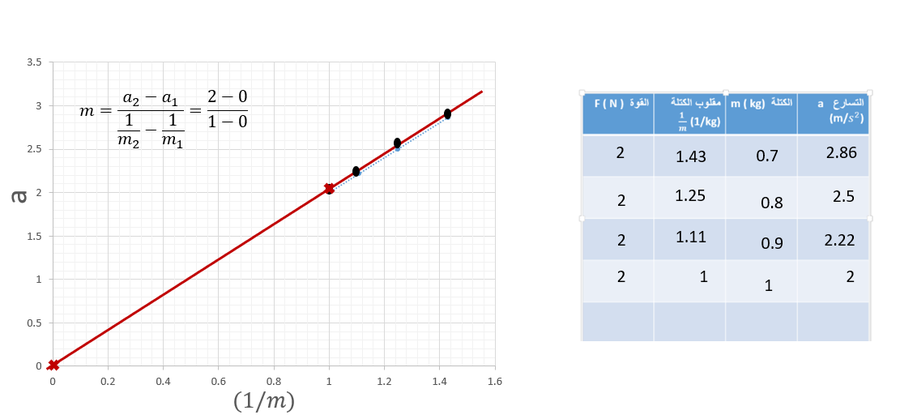
قيم نموذجية لـ \(F=2\ \mathrm N\): الميل \(\dfrac{2-0}{1-0}=2\ \mathrm N\).
Typical values for \(F=2\ \mathrm N\): the slope is \(\dfrac{2-0}{1-0}=2\ \mathrm N\).
| F (N)F (N) | m (kg)m (kg) | 1/m (1/kg)1/m (1/kg) | a (m/s²)a (m/s²) |
|---|---|---|---|
| 22 | 0.70.7 | 1.431.43 | 2.862.86 |
| 22 | 0.80.8 | 1.251.25 | 2.52.5 |
| 22 | 0.90.9 | 1.111.11 | 2.222.22 |
| 22 | 1.01.0 | 1.001.00 | 2.02.0 |
تلميح
Hint
الميل بين أي نقطتين \(\dfrac{a_2-a_1}{1/m_2-1/m_1}\) يساوي القوة \(F=2\ \mathrm N\)؛ وهذا يؤكد \(F=ma\).
The slope between any two points \(\dfrac{a_2-a_1}{1/m_2-1/m_1}\) equals the force \(F=2\ \mathrm N\), which confirms \(F=ma\).
📚 مسائل محلولة
📚 Solved Problems
كتلة جسم \(m=2\ \mathrm{kg}\) وقوة مؤثرة \(F=10\ \mathrm N\). احسب التسارع.
A body of mass \(m=2\ \mathrm{kg}\) and a force \(F=10\ \mathrm N\). Find the acceleration.
قوة ثابتة \(F=12\ \mathrm N\) وكتلة \(m=3\ \mathrm{kg}\). احسب التسارع.
A constant force \(F=12\ \mathrm N\) and a mass \(m=3\ \mathrm{kg}\). Find the acceleration.
(من نمط التجربة) الكتلة الكلية \(m=1.5\ \mathrm{kg}\) وقوة الشد \(F=6\ \mathrm N\). احسب التسارع.
(Experimental style) The total mass \(m=1.5\ \mathrm{kg}\) and the tension \(F=6\ \mathrm N\). Find the acceleration.
عربة كتلتها \(0.8\ \mathrm{kg}\) ومعلّق بها \(0.2\ \mathrm{kg}\) (\(g=10\)). أوجد تسارع الجملة وقوة الشد.
A cart of \(0.8\ \mathrm{kg}\) with a \(0.2\ \mathrm{kg}\) hanging mass (\(g=10\)). Find the acceleration of the system and the tension.
إذا تضاعفت كتلة النظام وبقيت القوة ثابتة فماذا يحدث للتسارع؟ فسّر.
If the mass of the system doubles and the force stays constant, what happens to the acceleration? Explain.
📝 مسائل للتدريب
📝 Practice Problems
حاول قبل أن تفتح الحل في المدرّب أدناه
Try before opening the solution in the trainer below
- قوة \(20\ \mathrm N\) تؤثر في جسم كتلته \(4\ \mathrm{kg}\): احسب التسارع، وماذا يحدث له إذا تضاعفت القوة؟A force of \(20\ \mathrm N\) acts on a \(4\ \mathrm{kg}\) body: find the acceleration and what happens if the force doubles.
- جسم كتلته \(5\ \mathrm{kg}\) يتسارع \(2\ \mathrm{m/s^2}\): احسب القوة المؤثرة.A \(5\ \mathrm{kg}\) body accelerates at \(2\ \mathrm{m/s^2}\): find the force.
- ثبّت \(m=2\ \mathrm{kg}\) وغيّر \(F=4,6,8,10\ \mathrm N\): كوّن جدولًا وارسم \(a\) مقابل \(F\).Keep \(m=2\ \mathrm{kg}\) and take \(F=4,6,8,10\ \mathrm N\): make a table and plot \(a\) against \(F\).
- ثبّت \(F=10\ \mathrm N\) وغيّر \(m=1,2,3,4\ \mathrm{kg}\): سجّل \(a\) وارسم \(a\) مقابل \(1/m\).Keep \(F=10\ \mathrm N\) and take \(m=1,2,3,4\ \mathrm{kg}\): record \(a\) and plot \(a\) against \(1/m\).
🎲 تدرّب
🎲 Practice
🧪 تدرّب: مسائل قانون نيوتن الثاني
🧪 Practice: Newton’s Second Law Problems
مسائل عشوائية بأرقام مختلفة. احسب واكتب الجواب ثم اضغط «تحقّق».
Random problems with different numbers. Work it out, enter the answer and press “Check”.
📊 جدول ملخص
📊 Summary
| الكميةQuantity | العلاقةRelation |
|---|---|
| القانونThe law | \(F=ma\)\(F=ma\) |
| التسارعAcceleration | \(a=F/m\)\(a=F/m\) |
| القوةForce | \(F=ma\)\(F=ma\) |
| الكتلةMass | \(m=F/a\)\(m=F/a\) |
| الجملة (عربة + كتلة معلقة)The system (cart + hanging mass) | \(a=m_hg/(m_c+m_h),\ T=m_ca\)\(a=m_hg/(m_c+m_h),\ T=m_ca\) |
🧪 اختبر نفسك: امتحان من 20 سؤالاً
🧪 Test Yourself: a 20-Question Exam
أنهِ الدرس بالاختبار التفاعلي التالي؛ أسئلته تجمع بين الفهم والحساب وتغطي جميع أقسام الدرس.
Finish with the interactive exam below; its questions mix understanding with calculation and cover every section of the lesson.
اختبار قانون نيوتن الثاني Newton’s Second Law Quiz
20 سؤالاً - الكميات المتجهة والقياسية، فيثاغورس، قانون جيب التمام، تحليل المتجهات والمحصلة بالمركبات 20 Questions - vector and scalar quantities, Pythagoras, the law of cosines, resolving vectors and the resultant by components
• عدد الأسئلة: 20 سؤالاً
• مدة الاختبار: 30 دقيقة
• لا يمكنك تغيير إجاباتك أو إعادة الاختبار إلا بعد 24 ساعة من التسليم.
• تأكد من إجاباتك قبل التسليم! 📌 Important Instructions:
• Number of questions: 20 questions
• Quiz duration: 30 minutes
• You cannot change your answers or retake the quiz for 24 hours after submission.
• Make sure of your answers before submitting!
🔗 محاكيات GeoGebra للاستعانة بها عند اللزوم
🔗 GeoGebra Simulations to Use When Needed
اضغط «تشغيل» لتعمل المحاكاة هنا داخل الدرس؛ ويمكن للطالب الرجوع إليها لتجربة الفكرة بطريقة أخرى.
Press “Run” to run the simulation right here inside the lesson; the student can use it to try the idea in another way.