1) عزم القوة
لماذا يسهل فتح الباب عندما ندفعه بعيداً عن مفصلته، ويصعب ذلك عندما ندفعه قربها، مع أن القوة في الحالتين واحدة؟ السبب أن القوة وحدها لا تكفي لتدوير الجسم، بل يدخل بعدها عن محور الدوران في التأثير. لذلك نقول إن للقوة عزم دوران حول محور ما إذا كانت قادرة على إحداث حركة دورانية لجسم حول هذا المحور.
تعريف: عزم الدوران (τ) قيمة متجهة تقيس مدى قدرة القوة على تدوير الجسم حول محور، وهو حاصل ضرب القوة في طول ذراعها.
\[ \tau = r \cdot F \cdot \sin\theta \]
حيث: \(\tau\) عزم الدوران (N·m)، \(r\) طول ذراع القوة (m)، \(F\) مقدار القوة (N)، \(\theta\) الزاوية بين متجه القوة والذراع.
ماذا يعني "ذراع القوة"؟
ذراع القوة \(r\) هو المسافة العمودية من محور الدوران إلى خط عمل القوة. تخيّل أنك تسحب الباب مباشرة في اتجاه المفصلة: الذراع يساوي صفراً والعزم يساوي صفراً، فلن يتحرك الباب مهما شددت.
شرح إضافي: لماذا \(\sin\theta\)؟ العزم يعتمد على المركبة العمودية للقوة فقط (أي \(F\sin\theta\))، لأن المركبة الموازية للذراع تسحب الجسم نحو المحور ولا تدوّره. إذا كانت \(\theta = 90^\circ\) فإن كل القوة عمودية على الذراع و\(\sin 90^\circ = 1\)، أي أن \(\tau = rF\) وهو أكبر ما يمكن. وإذا كانت \(\theta = 0^\circ\) أو \(180^\circ\) فإن \(\sin\theta = 0\) والعزم معدوم.
وحدة العزم
وحدة العزم في النظام الدولي هي نيوتن·متر (N·m). قد تتساوى عددياً مع وحدة الجول، لكننا لا نكتبه جولاً لأن الجول وحدة الشغل والطاقة (كمية قياسية)، بينما العزم كمية متجهة.
2) اتجاه متجه العزم: قاعدة اليد اليمنى
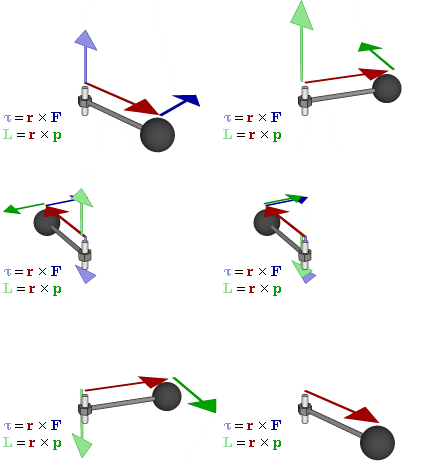
ضع أصابع يدك اليمنى في اتجاه الذراع \(\vec r\)، ثم اطوها نحو اتجاه القوة \(\vec F\)، فيشير الإبهام إلى اتجاه متجه العزم \(\vec\tau\). السبب أن العزم هو ضرب اتجاهي \(\vec\tau = \vec r \times \vec F\)، وهو عمودي على المستوى الذي يحوي \(\vec r\) و\(\vec F\).
لماذا نحتاج إلى الإشارة؟ في المسائل المستوية (كل القوى في مستوى الصفحة) يكون متجه العزم إما خارجاً من الصفحة أو داخلها. لتسهيل الحساب نتفق على: الدوران عكس عقارب الساعة موجب (+)، والدوران مع عقارب الساعة سالب (−). الإشارة هنا تدل على اتجاه الدوران، والمقدار هو القيمة المطلقة.
🖥️ محاكاة: حساب عزم الدوران
في هذه المحاكاة يدور جسم دائري حول محور يمر بمركزه، وتُطبَّق عليه قوة ثابتة عند حافته. استخدم خانات الاختيار لتحديد نوع الجسم (كرة صلبة، غلاف كروي، أسطوانة صلبة، غلاف أسطواني)، والمنزلقات لضبط نصف القطر والكتلة ومقدار القوة. اضغط "ابدأ" لبدء الرسم المتحرك، و"إعادة الضبط" لإعادته.
ماذا تلاحظ؟ القوة هنا عمودية على نصف القطر عند الحافة، لذلك \(\tau = F \cdot R\). زيادة القوة أو نصف القطر تزيد العزم. أما نوع الجسم فلا يغيّر العزم المؤثر، بل يغيّر استجابته له (التسارع الزاوي)، كما سنرى في قسم القصور الذاتي.
3) محصلة العزوم
قد تؤثر في الجسم عدة قوى عند نقاط مختلفة، وكل قوة تولّد عزماً. محصلة العزوم هي المجموع الجبري لعزوم هذه القوى: \(\tau_{net} = \sum \tau\). واتجاه الدوران الفعلي يتحدد بإشارة المحصلة، أي أن الجسم يدور في اتجاه العزم الأكبر مقداراً.
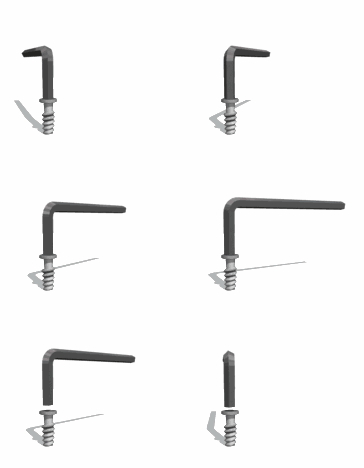
هذا ما يفسّر استعمال المفتاح الطويل: عند ثبات القوة، كلما زاد طول الذراع زاد العزم، فيسهل فك البرغي المتصلب.
مثال محلول
جسم قابل للدوران حول محور يمر بمركزه، تؤثر فيه قوتان متساويتان \(F_1 = F_2 = 50\) N، وبعداهما \(r_1 = 30\) cm و\(r_2 = 50\) cm.
الخطوة 1: القوة الأولى عمودية على الذراع (\(\theta = 90^\circ\)) وتدوّر الجسم عكس عقارب الساعة، فعزمها موجب:
\[ \tau_1 = r_1 F_1 \sin 90^\circ = 0.3 \times 50 \times 1 = +15\ \text{N·m} \]
الخطوة 2: القوة الثانية تصنع \(60^\circ\) مع الذراع وتدوّر الجسم مع عقارب الساعة، فعزمها سالب:
\[ \tau_2 = -r_2 F_2 \sin 60^\circ = -0.5 \times 50 \times 0.866 = -21.65\ \text{N·m} \]
الخطوة 3: محصلة العزوم:
\[ \tau_{net} = \tau_1 + \tau_2 = +15 - 21.65 = -6.65\ \text{N·m} \]
الإشارة السالبة تعني أن الجسم سيدور في النهاية مع عقارب الساعة. لاحظ أن القوة الثانية زاويتها \(60^\circ\) تُقلل مركبتها العمودية، لكن ذراعها أطول، فيبقى عزمها أكبر مقداراً من عزم الأولى.
ملاحظة مهمة: متى ينعدم عزم القوة؟
أي قوة تمر بمحور الدوران، أو توازي محور الدوران، يكون عزمها معدوماً.
لماذا؟ القوة التي تمر بالمحور ذراعها صفر. أما القوة الموازية للمحور فإن متجه عزمها يكون عمودياً على المحور نفسه، ولا يدوّر الجسم حول هذا المحور، لأن الذي يدوّره هو مركبة العزم على امتداد المحور فقط.
🧪 تجربة 1
محصلة عزم الدوران على عارضة
الهدف: تحديد محصلة العزوم المؤثرة في عارضة قابلة للدوران حول محور، وربط إشارة المحصلة باتجاه الدوران.
- حدّد محور الدوران (نقطة الارتكاز) على العارضة.
- ضع قوة واحدة على إحدى الجهتين، وغيّر بعدها عن المحور، ولاحظ تغيّر العزم.
- أضف قوة ثانية على الجهة المقابلة، واحسب محصلة العزوم بالقانون، ثم قارن النتيجة بالمحاكاة.
ماذا تلاحظ؟ بقاء القوة ثابتة مع زيادة البعد عن المحور يزيد العزم. وإذا تساوت العزوم المتعاكسة في المقدار فإن العارضة لا تدور.
4) تطبيق على محصلة العزوم: لعبة الميزان
في هذه المحاكاة توجد أوزان مختلفة على لعبة الميزان، ولكل منها عزم دوران. القوة المؤثرة هي وزن الجسم حيث \(W = m g\) بحيث \(g = 10\) m/s²، والذراع هو بُعد الجسم عن نقطة الارتكاز (الوتد). في الطرف الأيسر وزن ثابت \(F_0 = 12.5\) N.
أكمل بيانات الجدول، ثم طبّق على المحاكاة للتأكد من النتائج
اعتبر أن عزم الجهة اليسرى موجب (عكس عقارب الساعة) وعزم الجهة اليمنى سالب (مع عقارب الساعة)، فتكون \(\tau_{net} = \tau_L + \tau_R\).
| محصلة العزوم \(\tau_{net}\) |
عزم الجهة اليسرى \(\tau_L = +m_1 g r_1\) |
عزم الجهة اليمنى \(\tau_R = -m_2 g r_2\) |
| \(\tau_{net} =\) ......... |
\(m_1 = 5\) kg, \(r_1 = 10\) m
.............. |
\(m_2 = 8\) kg, \(r_2 = 6\) m
.............. |
| \(\tau_{net} =\) ......... |
\(m_1 = 7\) kg, \(r_1 = 3\) m
.............. |
\(m_2 = 9\) kg, \(r_2 = 3\) m
.............. |
| \(\tau_{net} =\) ......... |
\(m_1 = 3\) kg, \(r_1 = 8\) m
.............. |
\(m_2 = 8\) kg, \(r_2 = 3\) m
.............. |
| \(\tau_{net} =\) ......... |
\(m_1 = 5\) kg, \(r_1 = 10\) m
.............. |
\(m_2 = 2\) kg, \(r_2 = 2\) m
.............. |
عرض حل الجدول
نستخدم \(g = 10\) m/s² فيكون الوزن \(W = mg\)، وعزم كل جهة \(= W \times r\).
- الصف 1: \(\tau_L = +5 \times 10 \times 10 = +500\)، \(\tau_R = -8 \times 10 \times 6 = -480\)، والمحصلة \(= +20\) N·m (عكس عقارب الساعة).
- الصف 2: \(\tau_L = +7 \times 10 \times 3 = +210\)، \(\tau_R = -9 \times 10 \times 3 = -270\)، والمحصلة \(= -60\) N·m (مع عقارب الساعة).
- الصف 3: \(\tau_L = +3 \times 10 \times 8 = +240\)، \(\tau_R = -8 \times 10 \times 3 = -240\)، والمحصلة \(= 0\) (اتزان دوراني).
- الصف 4: \(\tau_L = +5 \times 10 \times 10 = +500\)، \(\tau_R = -2 \times 10 \times 2 = -40\)، والمحصلة \(= +460\) N·m (عكس عقارب الساعة).
لاحظ أن الصف 3 هو الوحيد المتزن، لأن العزمين متساويان في المقدار ومتعاكسان في الاتجاه.
5) عزم القصور الذاتي
ما الذي يجعل دوران الكتاب أسهل في حالة دون أخرى؟ كلما كان الدوران أسهل نقول إن القصور الذاتي الدوراني للجسم أقل.
عزم القصور الذاتي (I): مقياس لممانعة الجسم لتغيّر حالته الدورانية، أي لمقاومته للتسارع الزاوي عند تأثير عزم دوران.
يعتمد على كتلة الجسم وتوزيع هذه الكتلة بالنسبة للمحور، ولذلك يُحدَّد دائماً مع ذكر المحور. وهو لكتلة نقطية:
\[ I = m\,r^2 \]
وللجسم المكوّن من عدة كتل نقطية: \(I = \sum m_i r_i^2\).
شرح إضافي: لماذا \(r^2\) وليس \(r\)؟ المسافة تدخل مربعة، لذلك إذا ضاعفت بعد الكتلة عن المحور فإن \(I\) يصبح أربعة أمثال. هذا يفسّر لماذا يصعب تدوير عصا تمسكها من طرفها أكثر من تدويرها من منتصفها: كتلتها بعيدة عن المحور في الحالة الأولى.
شرح إضافي: القصور الخطي والدوراني. الكتلة \(m\) هي مقياس ممانعة الجسم لتغيّر سرعته الخطية، أما \(I\) فهو المقابل الدوراني لها، ويعتمد على الكتلة وتوزيعها معاً.
\[ \tau_{net} = I\,\alpha \]
هذه العلاقة هي المقابل الدوراني لقانون نيوتن الثاني \(F = ma\): العزم يسبب تسارعاً زاوياً \(\alpha\)، وكلما كان \(I\) أكبر قلّ التسارع الزاوي الناتج عن العزم نفسه.
أمثلة على عزوم القصور الذاتي
| الجسم | عزم القصور الذاتي حول محور التماثل |
|---|
| كرة مصمتة | \(I = \frac{2}{5} M R^2\) |
| كرة مجوفة (غلاف كروي) | \(I = \frac{2}{3} M R^2\) |
| أسطوانة مصمتة / قرص | \(I = \frac{1}{2} M R^2\) |
| أسطوانة مجوفة (غلاف أسطواني) | \(I = M R^2\) |
الكتلة نفسها أحياناً تعطي قيماً مختلفة لـ \(I\) حسب توزيعها: كل الكتلة في الغلاف الأسطواني بعيدة عن المحور، فيكون \(I\) أكبر من الأسطوانة المصمتة ذات الكتلة والنصف قطر نفسهما.
في أي حالة يكون دوران الكتاب أسهل؟ يكون أسهل عندما تكون معظم كتلته قريبة من محور الدوران، لأن قيمة \(I\) تقل كلما اقتربت الكتلة من المحور.
🧪 تجربة 2
سباق التدحرج على مستوى مائل
الهدف: مقارنة عزوم القصور الذاتي لأجسام متساوية الكتلة تنزل على المستوى المائل نفسه.
- اختر الأجسام: كرة مصمتة، كرة مجوفة، أسطوانة مصمتة، أسطوانة مجوفة، ومكعباً.
- أطلق جميع الأجسام من أعلى المستوى نفسه في اللحظة نفسها.
- سجّل ترتيب وصولها إلى الأسفل، ثم قارن الترتيب بعزوم القصور الذاتي لكل جسم.
ماذا تلاحظ؟ الجسم ذو عزم القصور الأصغر يصل أولاً، والمكعب المنزلق يصل قبل الأجسام المتدحرجة لأنه لا يكتسب طاقة دورانية.
الاستنتاج: \(a = \dfrac{g\sin\theta}{1+I/mR^2}\)، أي أن التسارع يقل كلما زاد \(I\).
التدحرج على المنحدر: من يصل أولاً؟
في هذه المحاكاة كتل متساوية: كرة مجوفة، وكرة مصمتة، وأسطوانة مجوفة، وأسطوانة مصمتة تتدحرج على سطح مائل دون انزلاق، ومكعب ينزلق. لاحظ أي الأجسام يصل أولاً (له عزم قصور أقل) وأيها يصل متأخراً (له عزم قصور أكبر).
شرح إضافي: لماذا يتباطأ الجسم الذي له \(I\) أكبر؟ عند التدحرج دون انزلاق، جزء من طاقة الوضع يتحول إلى طاقة دورانية، ولا يبقى كله للحركة الانتقالية. ويعطي الحساب تسارع المركز الكتلي:
\[ a = \frac{g\sin\theta}{1 + \dfrac{I}{mR^2}} \]
لذلك نحصل على الترتيب من الأسرع إلى الأبطأ بين الأجسام المتدحرجة: كرة مصمتة (\(\frac{I}{mR^2}=0.4\)) ← أسطوانة مصمتة (\(0.5\)) ← كرة مجوفة (\(0.67\)) ← أسطوانة مجوفة (\(1\)). أما المكعب المنزلق (بلا احتكاك) فلا يكتسب طاقة دورانية، لذلك يصل أولاً على المنحدر نفسه.
أمثلة محلولة
مثال 1: كتلة نقطية \(m = 2\) kg على بعد \(0.5\) m من المحور:
\[ I = m r^2 = 2 \times (0.5)^2 = 0.5\ \text{kg·m}^2 \]
مثال 2: قرص مصمت كتلته \(4\) kg ونصف قطره \(0.3\) m:
\[ I = \tfrac{1}{2} M R^2 = \tfrac{1}{2} \times 4 \times (0.3)^2 = 0.18\ \text{kg·m}^2 \]
مثال 3: كتلة نقطية \(2\) kg تتحرك على مسار دائري نصف قطره \(0.8\) m، والسرعة الزاوية \(3\) rad/s. ما عزم قصورها الذاتي؟
\[ I = m r^2 = 2 \times (0.8)^2 = 1.28\ \text{kg·m}^2 \]
شرح: السرعة الزاوية (3 rad/s) لا تدخل في حساب \(I\) أبداً. \(I\) يتعلق بالكتلة وبعدها عن المحور فقط، والسرعة الزاوية تؤثر في الطاقة الحركية الدورانية وليس في القصور الذاتي.
6) مركز الكتلة والاستقرار
مركز الكتلة: نقطة على الجسم تتركز فيها كتلته كلها، ويتحرك كأن كل الكتلة فيها.
إذا كان الجسم الصلب معرّضاً لقوى محصلتها صفر، فإن مركز كتلته يتحرك حركة مستقيمة منتظمة (أو يبقى ساكناً). وفي حقل الجاذبية المنتظم يتطابق مركز الكتلة مع مركز الثقل.
شرح إضافي: كيف تجده عملياً؟ علّق الجسم من نقطة ما، ثم ارسم خطاً شاقولياً من تلك النقطة. كرر التعليق من نقطة أخرى وارسم خطاً ثانياً. نقطة تقاطع الخطين هي مركز الكتلة. وفي الجسم المتجانس المتماثل يقع مركز الكتلة عند مركز التماثل.
متى يكون الجسم أكثر اتزاناً واستقراراً؟
في هذه المحاكاة تضغط على الأيقونة الموجودة بجوار كل جسم لتغيير القاعدة وبُعد المركز، ثم تغيّر ميل المستوى عبر المجرى الموجود على اليسار، حتى تصبح قوة الوزن قادرة على تدوير الجسم وقلبه.
لاحظ ماذا يحدث كلما كانت قاعدة الجسم أكبر ومركز الكتلة قريباً من القاعدة.
شرح إضافي: لماذا يقلب الجسم؟ يبقى الجسم مستقراً ما دام الخط الشاقولي المار بمركز الكتلة يقع داخل القاعدة. إذا خرج هذا الخط عن القاعدة، يصبح عزم الوزن حول حافة القاعدة يدوّر الجسم ويقلبه. لذلك: القاعدة الكبيرة تعني أن الخط يحتاج إلى مسافة أكبر ليخرج منها، والمركز المنخفض يعني أن الجسم يحتاج إلى إمالة أكبر ليصل الخط إلى الحافة.
7) الاتزان الدوراني
متى يكون الجسم في حالة اتزان؟
ليتحقق الاتزان الكامل لابد من توافر شرطين:
1. الاتزان الدوراني: محصلة عزوم القوى تساوي صفراً: \(\sum \tau = 0\).
2. الاتزان الانتقالي: محصلة القوى المؤثرة في الجسم تساوي صفراً: \(\sum \vec F = 0\).
شرح إضافي: لماذا الشرطان معاً؟
• قد تكون \(\sum \tau = 0\) ومع ذلك يتحرك الجسم انتقالياً، مثل جسم تؤثر فيه قوة محصلة تمر بمركزه: عزمها حول المركز صفر، لكن الجسم يتسارع انتقالياً.
• وقد تكون \(\sum \vec F = 0\) ومع ذلك يدور الجسم، مثل زوج قوى: قوتان متساويتان ومتعاكستان لكنهما لا تمران بخط واحد، فتدوّران الجسم دون أن تحركاه انتقالياً.
🧪 تجربة 3
اتزان عارضة تحت ثلاث قوى
الهدف: التحقق من شرطي الاتزان لعارضة تؤثر فيها ثلاث قوى حول محور دوران.
- علّق القوى الثلاث على جانبي المحور بأبعاد وقيم مختلفة.
- احسب عزم كل قوة، مع اعتبار الدوران عكس عقارب الساعة موجباً.
- تحقق من أن محصلة العزوم تساوي صفراً، ثم تحقق من أن القوى كلها (مع قوة الارتكاز) محصلتها صفر، وجرّب تغيير إحدى القوى وأعد الحساب.
ماذا تلاحظ؟ تتوازن العارضة عندما تتعادل العزوم الموجبة مع السالبة، وهذا ممكن بتعديل الأبعاد أو القيم.
اختيار محور الدوران
إذا كان الجسم في حالة اتزان، فإن مجموع العزوم يساوي صفراً حول أي محور تختاره. لذلك اختر المحور عند نقطة تمر بها قوة مجهولة، فتختفي هذه القوة من معادلة العزوم وتصبح المسألة أسهل.
في هذه المحاكاة علّق كتلاً مختلفة على أبعاد مختلفة عن محور الدوران محققاً الاتزان الدوراني، وتأكد من ذلك بحساب محصلة العزوم. توقع كيف يتغير الاتزان عند تغيير موضع الأجسام على اللوح، ثم تحقق بالحساب.
مثال تطبيقي: ميزان متزن حول الوتد. علّقت كتلة \(4\) kg على بعد \(1.5\) m على اليسار، وأردنا موازنتها بكتلة \(m\) على بعد \(0.5\) m على اليمين.
\[ \sum \tau = 0 \;\Rightarrow\; 4 \times 10 \times 1.5 = m \times 10 \times 0.5 \;\Rightarrow\; 60 = 5m \;\Rightarrow\; m = 12\ \text{kg} \]
شرح: لاحظ أن الكتلة الأصغر تحتاج إلى بعد أكبر لتوازن الكتلة الأكبر، فالذراع هو الذي يعوّض الفرق في الكتلة.
ملخص الدرس
• عزم القوة: \(\tau = r F \sin\theta\)، ويعتمد على الذراع والمركبة العمودية للقوة.
• محصلة العزوم: مجموع العزوم الجبرية، والموجب عكس عقارب الساعة.
• القوة التي تمر بالمحور أو توازيه لا تُدوّر الجسم حوله.
• عزم القصور الذاتي: \(I = \sum m r^2\)، ويعتمد على الكتلة وتوزيعها بالنسبة للمحور، والعلاقة \(\tau = I\alpha\).
• مركز الكتلة: النقطة التي تتركز فيها كتلة الجسم، والاستقرار يزداد بقاعدة كبيرة ومركز منخفض.
• الاتزان الكامل: \(\sum \vec F = 0\) و\(\sum \tau = 0\).
🎯 امتحان الدرس: 20 سؤالاً
أجب عن الأسئلة ثم سلّم الاختبار لترى النتيجة والحل. تنبيه: الإجابة نهائية بمجرد اختيارها.
1) Torque
Why is a door easier to open when you push it far from its hinge than when you push it near the hinge, even though the force is the same? Because a force alone does not decide rotation: its distance from the axis of rotation matters too. We say a force has a torque about an axis if it can cause the body to rotate about that axis.
Definition: Torque (τ) is a vector quantity that measures how strongly a force can rotate a body about an axis. It equals the force multiplied by its lever arm.
\[ \tau = r \cdot F \cdot \sin\theta \]
where \(\tau\) is torque (N·m), \(r\) is the lever arm (m), \(F\) is the force magnitude (N), and \(\theta\) is the angle between the force and the lever arm.
What is the "lever arm"?
The lever arm \(r\) is the perpendicular distance from the axis of rotation to the line of action of the force. If you pull a door straight toward its hinge, the lever arm and the torque are both zero, and the door will not move no matter how hard you pull.
Extra explanation: why \(\sin\theta\)? Torque depends only on the perpendicular component of the force, \(F\sin\theta\). The component along the arm pulls the body toward the axis and does not rotate it. If \(\theta = 90^\circ\), the whole force is perpendicular and \(\sin 90^\circ = 1\), so \(\tau = rF\), the maximum possible. If \(\theta = 0^\circ\) or \(180^\circ\), then \(\sin\theta = 0\) and the torque is zero.
Unit of torque
The SI unit of torque is the newton-meter (N·m). It has the same value as the joule numerically, but we do not write it as a joule because the joule is a unit of work and energy (a scalar), while torque is a vector.
2) Direction of the torque vector: the right-hand rule
Point the fingers of your right hand along the lever arm \(\vec r\), then curl them toward the force \(\vec F\). Your thumb points along the torque vector \(\vec\tau\). This is because torque is a cross product \(\vec\tau = \vec r \times \vec F\), which is perpendicular to the plane containing \(\vec r\) and \(\vec F\).
Why do we need a sign? In planar problems (all forces in the page plane), the torque vector points either out of the page or into it. For easy calculation we agree that: counterclockwise rotation is positive (+), and clockwise rotation is negative (−). The sign shows the direction of rotation; the magnitude is the absolute value.
🖥️ Simulation: Calculating Torque
A circular body rotates about an axis through its center, and a constant force is applied at its rim. Use the checkboxes to choose the body type (solid sphere, spherical shell, solid cylinder, cylindrical shell), and the sliders to adjust the radius, mass and force. Press "Start" to begin the animation and "Reset" to restart it.
What do you notice? The force is perpendicular to the radius at the rim, so \(\tau = F \cdot R\). Increasing the force or the radius increases the torque. The body type does not change the torque applied; it changes how the body responds to it (the angular acceleration), as we will see in the moment of inertia section.
3) Net Torque
Several forces may act on a body at different points, and each produces a torque. The net torque is the algebraic sum of these torques: \(\tau_{net} = \sum \tau\). The actual rotation direction is given by the sign of the net torque, i.e. the body rotates in the direction of the larger torque.
This explains why a long wrench is used: for the same force, a longer lever arm gives a larger torque, so a stuck screw is easier to turn.
Worked example
A body can rotate about an axis through its center. Two equal forces \(F_1 = F_2 = 50\) N act on it, at distances \(r_1 = 30\) cm and \(r_2 = 50\) cm.
Step 1: The first force is perpendicular to the arm (\(\theta = 90^\circ\)) and turns the body counterclockwise, so its torque is positive:
\[ \tau_1 = r_1 F_1 \sin 90^\circ = 0.3 \times 50 \times 1 = +15\ \text{N·m} \]
Step 2: The second force makes \(60^\circ\) with the arm and turns the body clockwise, so its torque is negative:
\[ \tau_2 = -r_2 F_2 \sin 60^\circ = -0.5 \times 50 \times 0.866 = -21.65\ \text{N·m} \]
Step 3: Net torque:
\[ \tau_{net} = \tau_1 + \tau_2 = +15 - 21.65 = -6.65\ \text{N·m} \]
The negative sign means the body will eventually rotate clockwise. The second force has a \(60^\circ\) angle, which reduces its perpendicular component, but its lever arm is longer, so its torque is still larger in magnitude than the first.
Important note: when is a torque zero?
Any force that passes through the axis of rotation, or is parallel to it, produces zero torque about that axis.
Why? A force through the axis has a lever arm of zero. A force parallel to the axis produces a torque vector perpendicular to the axis, so it cannot turn the body about that axis; only the component of the torque along the axis does that.
🧪 Experiment 1
Net torque on a beam
Goal: Find the net torque acting on a beam that can rotate about an axis, and relate the sign of the net torque to the direction of rotation.
- Identify the axis of rotation (the pivot) on the beam.
- Apply one force on one side, change its distance from the axis, and observe how the torque changes.
- Add a second force on the opposite side, calculate the net torque with the formula, then compare your result with the simulation.
What do you notice? Keeping the force fixed while increasing the distance from the axis increases the torque. If the opposite torques are equal in magnitude, the beam does not rotate.
4) Applying Net Torque: The Seesaw
This simulation has several weights on a seesaw, and each produces a torque. The force is the weight of the object, \(W = mg\) with \(g = 10\) m/s², and the lever arm is the distance from the object to the pivot (the fulcrum). On the left, the weight is fixed at \(F_0 = 12.5\) N.
Complete the table, then check your results in the simulation
Take the left-side torque as positive (counterclockwise) and the right-side torque as negative (clockwise), so \(\tau_{net} = \tau_{\text{left}} + \tau_{\text{right}}\).
| Net torque \(\tau_{net}\) |
Left of pivot \(\tau_{\text{left}} = +m_1 g r_1\) |
Right of pivot \(\tau_{\text{right}} = -m_2 g r_2\) |
| \(\tau_{net} =\) ......... |
\(m_1 = 5\) kg, \(r_1 = 10\) m
.............. |
\(m_2 = 8\) kg, \(r_2 = 6\) m
.............. |
| \(\tau_{net} =\) ......... |
\(m_1 = 7\) kg, \(r_1 = 3\) m
.............. |
\(m_2 = 9\) kg, \(r_2 = 3\) m
.............. |
| \(\tau_{net} =\) ......... |
\(m_1 = 3\) kg, \(r_1 = 8\) m
.............. |
\(m_2 = 8\) kg, \(r_2 = 3\) m
.............. |
| \(\tau_{net} =\) ......... |
\(m_1 = 5\) kg, \(r_1 = 10\) m
.............. |
\(m_2 = 2\) kg, \(r_2 = 2\) m
.............. |
Show the table solution
With \(g = 10\) m/s², each weight is \(W = mg\), and the torque of each side is \(W \times r\).
- Row 1: \(\tau_{\text{left}} = +5 \times 10 \times 10 = +500\), \(\tau_{\text{right}} = -8 \times 10 \times 6 = -480\), net \(= +20\) N·m (counterclockwise).
- Row 2: \(\tau_{\text{left}} = +7 \times 10 \times 3 = +210\), \(\tau_{\text{right}} = -9 \times 10 \times 3 = -270\), net \(= -60\) N·m (clockwise).
- Row 3: \(\tau_{\text{left}} = +3 \times 10 \times 8 = +240\), \(\tau_{\text{right}} = -8 \times 10 \times 3 = -240\), net \(= 0\) (rotational equilibrium).
- Row 4: \(\tau_{\text{left}} = +5 \times 10 \times 10 = +500\), \(\tau_{\text{right}} = -2 \times 10 \times 2 = -40\), net \(= +460\) N·m (counterclockwise).
Row 3 is the only balanced case, because its two torques are equal in magnitude and opposite in direction.
5) Moment of Inertia
Why is it easier to rotate a book in some ways than in others? The easier the rotation, the smaller the rotational inertia of the body.
Moment of inertia (I): a measure of how strongly a body resists changes in its rotational motion, i.e. how much it resists angular acceleration under a torque.
It depends on the mass and on how that mass is distributed relative to the axis, so it is always defined with respect to a specific axis. For a point mass:
\[ I = m\,r^2 \]
For a body made of several point masses: \(I = \sum m_i r_i^2\).
Extra explanation: why \(r^2\) and not \(r\)? The distance enters squared. If you double the distance of a mass from the axis, \(I\) becomes four times larger. This is why it is harder to swing a stick held at one end than one held at its middle: its mass is farther from the axis in the first case.
Extra explanation: linear vs. rotational. Mass \(m\) measures how hard it is to change the linear velocity of a body. Moment of inertia \(I\) is its rotational counterpart, and depends on both the mass and how it is distributed.
\[ \tau_{net} = I\,\alpha \]
This is the rotational counterpart of Newton's second law \(F = ma\): a torque produces an angular acceleration \(\alpha\), and for the same torque a larger \(I\) gives a smaller \(\alpha\).
Moments of inertia of common shapes
| Body | Moment of inertia about its symmetry axis |
|---|
| Solid sphere | \(I = \frac{2}{5} M R^2\) |
| Spherical shell (hollow sphere) | \(I = \frac{2}{3} M R^2\) |
| Solid cylinder / disk | \(I = \frac{1}{2} M R^2\) |
| Cylindrical shell (hollow cylinder) | \(I = M R^2\) |
A hollow cylinder has the same mass and radius as a solid one, but all of its mass is at distance \(R\) from the axis, so its \(I\) is larger.
In which case is the book easier to rotate? It is easier when most of its mass is close to the axis of rotation, because \(I\) decreases as the mass gets closer to the axis.
🧪 Experiment 2
Rolling race on an inclined plane
Goal: Compare the moments of inertia of equal-mass bodies descending the same inclined plane.
- Choose the bodies: solid sphere, hollow sphere, solid cylinder, hollow cylinder, and a cube.
- Release all bodies from the top of the same plane at the same moment.
- Record the order in which they reach the bottom, then compare it with each body's moment of inertia.
What do you notice? The body with the smallest moment of inertia arrives first. The sliding cube arrives before all rolling bodies because it gains no rotational energy.
Conclusion: \(a = \dfrac{g\sin\theta}{1+I/mR^2}\): the acceleration decreases as \(I\) increases.
Rolling down a slope: who arrives first?
In this simulation all masses are equal: a hollow sphere, a solid sphere, a hollow cylinder and a solid cylinder roll down an inclined plane without slipping, and a cube slides. Observe which body arrives first (smaller moment of inertia) and which arrives last (larger moment of inertia).
Extra explanation: why does a larger \(I\) mean slower rolling? When a body rolls without slipping, part of the potential energy becomes rotational kinetic energy, so less of it is left for translation. The acceleration of the center of mass is:
\[ a = \frac{g\sin\theta}{1 + \dfrac{I}{mR^2}} \]
So among the rolling bodies, the order from fastest to slowest is: solid sphere (\(\frac{I}{mR^2}=0.4\)) → solid cylinder (\(0.5\)) → hollow sphere (\(0.67\)) → hollow cylinder (\(1\)). The cube, which slides without friction, gains no rotational energy at all, so it arrives first on the same slope.
Worked examples
Example 1: A point mass \(m = 2\) kg at \(0.5\) m from the axis:
\[ I = m r^2 = 2 \times (0.5)^2 = 0.5\ \text{kg·m}^2 \]
Example 2: A solid disk of mass \(4\) kg and radius \(0.3\) m:
\[ I = \tfrac{1}{2} M R^2 = \tfrac{1}{2} \times 4 \times (0.3)^2 = 0.18\ \text{kg·m}^2 \]
Example 3: A 2 kg point mass moves on a circle of radius \(0.8\) m with angular velocity \(3\) rad/s. Find its moment of inertia.
\[ I = m r^2 = 2 \times (0.8)^2 = 1.28\ \text{kg·m}^2 \]
Explanation: The angular velocity (3 rad/s) does not enter the calculation of \(I\). \(I\) depends only on the mass and its distance from the axis; the angular velocity affects the rotational kinetic energy, not the moment of inertia.
6) Center of Mass and Stability
Center of mass: the point of a body where its entire mass can be considered to be concentrated.
If a rigid body is subjected to forces whose net is zero, its center of mass moves in a straight line at constant velocity (or stays at rest). In a uniform gravitational field, the center of mass coincides with the center of gravity.
Extra explanation: how do you find it in practice? Hang the object from one point and draw a vertical line from that point. Hang it again from another point and draw a second line. The intersection of the two lines is the center of mass. For a uniform, symmetric object it lies at the center of symmetry.
When is an object most stable?
In this simulation, click the icon next to each object to change its base and the position of its center, then change the incline of the plane using the channel on the left, until the weight is able to turn and tip the object over.
Notice what happens as the base gets larger and the center of mass gets closer to the base.
Extra explanation: why does an object tip over? The object stays stable as long as the vertical line through its center of mass falls inside its base. If that line leaves the base, the torque of the weight about the edge of the base turns the object over. A large base means the line must travel farther to leave it, and a low center of mass means the object must be tilted more before the line reaches the edge.
7) Rotational Equilibrium
When is a body in equilibrium?
Two basic conditions must be met for full equilibrium:
1. Rotational equilibrium: the net torque is zero, \(\sum \tau = 0\).
2. Translational equilibrium: the net force is zero, \(\sum \vec F = 0\).
Extra explanation: why do we need both?
• You can have \(\sum \tau = 0\) and still move: a body acted on by a net force through its center of mass has zero torque about that center, yet it accelerates linearly.
• You can have \(\sum \vec F = 0\) and still rotate: a couple, i.e. two equal and opposite forces whose lines of action do not coincide. They turn the body without moving its center.
🧪 Experiment 3
A beam in equilibrium under three forces
Goal: Verify the two equilibrium conditions for a beam acted on by three forces about an axis of rotation.
- Hang the three forces on both sides of the axis at different distances and with different values.
- Calculate the torque of each force, taking counterclockwise rotation as positive.
- Check that the net torque is zero, then check that all forces (including the pivot force) add to zero. Change one force and repeat the calculation.
What do you notice? The beam balances when the positive torques equal the negative ones in magnitude, which can be achieved by adjusting the distances or the values.
Choosing the axis of rotation
If a body is in equilibrium, the sum of torques is zero about any axis you choose. So pick an axis through the point where an unknown force acts. That unknown force then has zero lever arm and disappears from the torque equation, which makes the problem easier.
In this simulation, hang different masses at different distances from the axis to achieve rotational equilibrium, and confirm it by calculating the net torque. Predict how the balance changes when you move the objects on the board, then verify with the calculation.
Worked example: A seesaw balances about its pivot. A \(4\) kg mass is placed \(1.5\) m to the left, and we want to balance it with a mass \(m\) placed \(0.5\) m to the right.
\[ \sum \tau = 0 \;\Rightarrow\; 4 \times 10 \times 1.5 = m \times 10 \times 0.5 \;\Rightarrow\; 60 = 5m \;\Rightarrow\; m = 12\ \text{kg} \]
Explanation: The smaller mass needs a larger distance to balance the larger one. The lever arm compensates for the difference in mass.
Lesson summary
• Torque: \(\tau = r F \sin\theta\), which depends on the lever arm and the perpendicular component of the force.
• Net torque: the algebraic sum of torques; positive means counterclockwise.
• A force through the axis, or parallel to it, does not rotate the body about that axis.
• Moment of inertia: \(I = \sum m r^2\), depends on mass and its distribution; \(\tau = I\alpha\).
• Center of mass: the point where the mass is concentrated; stability increases with a large base and a low center of mass.
• Full equilibrium: \(\sum \vec F = 0\) and \(\sum \tau = 0\).
🎯 Lesson Exam: 20 Questions
Answer the questions, then submit the quiz to see your result and the solutions. Note: answers are final once selected.