🎯 نواتج التعلم
🎯 Learning Outcomes
بعد دراسة هذا الدرس ستكون قادرًا على أن:
After this lesson you will be able to:
- تعرّف طاقة الوضع الجذبية \(U_g=mgh\) وتفهم دور مستوى الاختبار والإشارة.Define the gravitational potential energy \(U_g=mgh\) and understand the role of the reference level and the sign.
- تميّز بين القوى المحافظة وغير المحافظة بالشغل على مسار مغلق.Distinguish conservative from non-conservative forces by the work on a closed path.
- تربط الشغل بطاقة الوضع \(\Delta U=-W\) وتحسب طاقة الوضع المرونية \(U_s=\tfrac12kx^2\).Relate work to potential energy \(\Delta U=-W\) and calculate the elastic potential energy \(U_s=\tfrac12kx^2\).
- تستنتج القوة من طاقة الوضع \(F=-dU/dx\) وتقرأ منحنى \(U(x)\).Find the force from the potential energy \(F=-dU/dx\) and read a \(U(x)\) graph.
- تطبّق حفظ الطاقة الميكانيكية على المستوى المائل والبندول والزنبرك ومع الاحتكاك.Apply conservation of mechanical energy to the incline, the pendulum and the spring, and with friction.
🔋 طاقة الوضع
🔋 Potential Energy
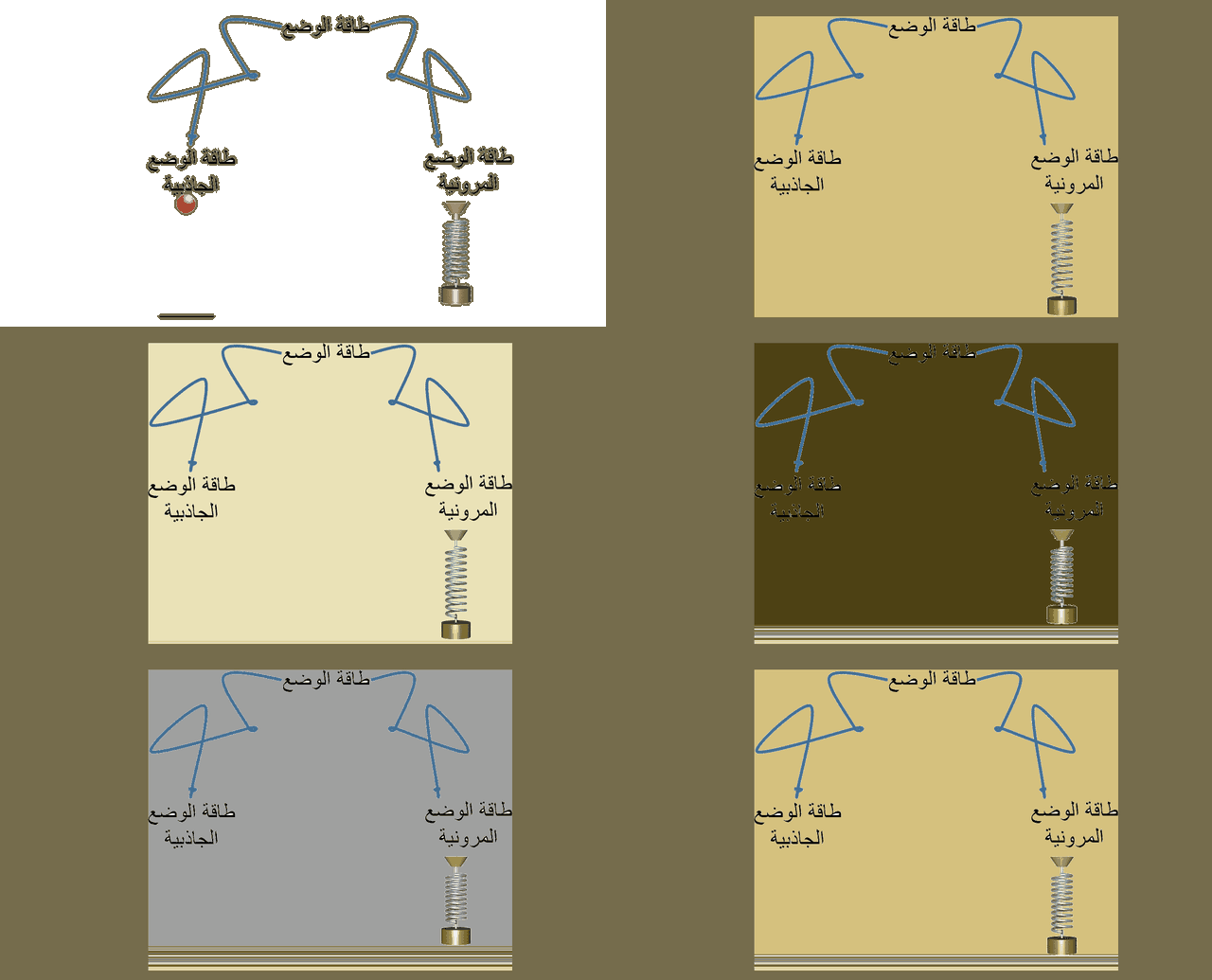
طاقة الوضع نوعان: جذبية (للكرة) ومرونية (للزنبرك).
Potential energy has two kinds: gravitational (for the ball) and elastic (for the spring).
طاقة الوضع هي الطاقة التي يختزنها الجسم نتيجة موضعه أو ترتيب أجزائه. وأشهر نوعين: طاقة الوضع الجذبية (بسبب الارتفاع) وطاقة الوضع المرونية (بسبب تشوّه جسم مرن).
Potential energy is the energy a body stores because of its position or the arrangement of its parts. The two best-known kinds are gravitational potential energy (due to height) and elastic potential energy (due to the deformation of an elastic body).
📌 طاقة الوضع الجذبية
📌 Gravitational potential energy
\[U_g=m\,g\,h\]
هي الطاقة التي يختزنها جسم نتيجة موضعه من مستوى اختبار صفري، ووحدتها الجول (J). \(h\) الارتفاع عن مستوى الاختبار، و\(g\) مجال الجاذبية (\(\mathrm{N/kg}\)).
It is the energy a body stores because of its position relative to a zero reference level, measured in joules (J). \(h\) is the height above the reference level and \(g\) the gravitational field (\(\mathrm{N/kg}\)).
كرة تُركت تسقط من ارتفاع \(2\ \mathrm{m}\) عن الأرض فانخفضت طاقة الوضع لها بمقدار \(3\ \mathrm{J}\) عند وصولها الأرض. أحسب كتلة الكرة (\(g=10\ \mathrm{N/kg}\)).
A ball is dropped from \(2\ \mathrm{m}\) above the ground and its potential energy decreases by \(3\ \mathrm{J}\) when it reaches the ground. Find its mass (\(g=10\ \mathrm{N/kg}\)).
🎚️ مستوى الاختبار والإشارة
🎚️ The reference level and the sign
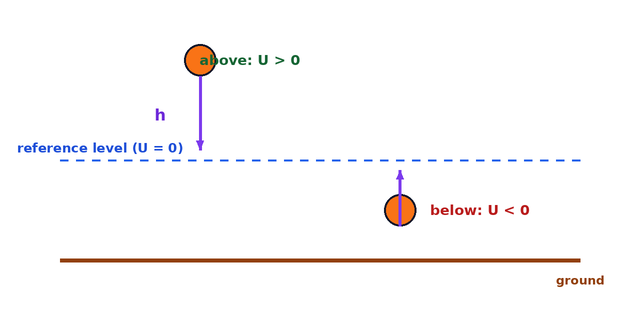
مستوى الاختبار نختاره نحن: فوقه \(U\gt 0\) وتحته \(U\lt 0\).
We choose the reference level: above it \(U\gt 0\) and below it \(U\lt 0\).
⚖️ ما الذي لا يتغيّر؟ (شرح إضافي)
⚖️ What does not change? (extra)
تغيير مستوى الاختبار يغيّر قيمة \(U\) لكنه لا يغيّر الفرق \(\Delta U=mg\Delta h\) ولا الشغل ولا السرعة. لذلك المهم دائمًا هو التغير في طاقة الوضع.
Changing the reference level changes the value of \(U\) but not the difference \(\Delta U=mg\Delta h\), nor the work, nor the speed. What matters is always the change in potential energy.
صندوق كتلته \(5\ \mathrm{kg}\) على سطح طاولة ارتفاعها \(1\ \mathrm{m}\) عن الأرض. أوجد طاقة وضعه (\(g=10\)) إذا كان مستوى الاختبار: (أ) الأرض، (ب) سطح الطاولة، (ج) سقف الغرفة على ارتفاع \(3\ \mathrm{m}\).
A \(5\ \mathrm{kg}\) box sits on a table top \(1\ \mathrm{m}\) above the floor. Find its potential energy (\(g=10\)) if the reference level is: (a) the floor, (b) the table top, (c) the ceiling at \(3\ \mathrm{m}\).
جسم كتلته \(2\ \mathrm{kg}\) على ارتفاع \(5\ \mathrm{m}\) فوق مستوى الاختبار (\(g=10\)). طاقة وضعه:
A \(2\ \mathrm{kg}\) body is \(5\ \mathrm{m}\) above the reference level (\(g=10\)). Its potential energy is:
🧪 جرّب بنفسك: طاقة الوضع ومستوى الاختبار
🧪 Try It Yourself: Potential Energy and the Reference Level
🧪 تجربة 1: ارفع الجسم وغيّر مستوى الاختبار
🧪 Experiment 1: Lift the Body and Move the Reference Level
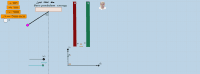
غيّر الكتلة \(m\) و\(g\) وارتفاع الجسم عن الأرض \(h\) (أو اسحب الجسم بالفأرة)، وحرّك مستوى الاختبار بالمنزلق: طاقة الوضع \(U=mg(h-h_0)\) قد تصبح سالبة، لكن التغير \(\Delta U\) عند رفع الجسم لا يتغير. اضغط «ارفع الجسم» لترى شغل الوزن \(W=-\Delta U\).
Change the mass \(m\), \(g\) and the height \(h\) of the body above the ground and move the reference level with the slider: the potential energy \(U=mg(h-h_0)\) may become negative but the change \(\Delta U\) when the body is lifted does not change. Press “Lift the body” to see the work of weight \(W=-\Delta U\).
🔁 القوى المحافظة وغير المحافظة
🔁 Conservative and Non-Conservative Forces
لنحدّد هل القوة محافظة، ندرس حالتين.
To decide whether a force is conservative we study two cases.
الحالة الأولى: رفع صندوق وإعادته (قوة الوزن)
Case 1: lifting a box and returning it (weight)
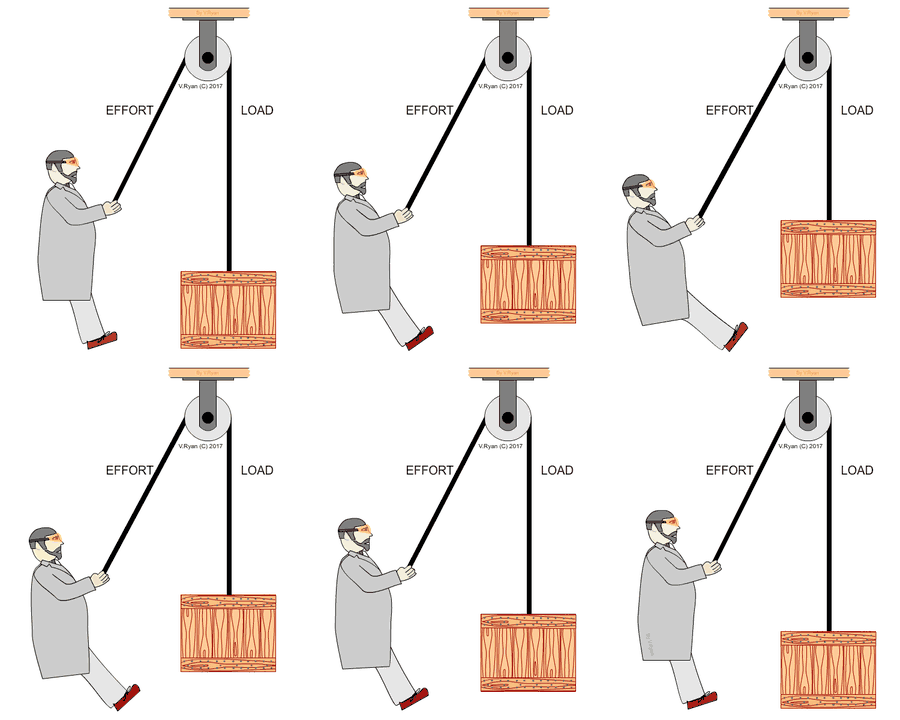
يُرفع الصندوق إلى ارتفاع \(h\) ثم يُعاد إلى الأرض.
The box is lifted to a height \(h\) and then returned to the ground.
📌 شغل الوزن على مسار مغلق
📌 The work of weight on a closed path
أثناء الرفع: \(W_1=F_g\,d\cos180^\circ=-mgh\). أثناء الإنزال: \(W_2=F_g\,d\cos0^\circ=+mgh\).
While lifting: \(W_1=F_g\,d\cos180^\circ=-mgh\). While lowering: \(W_2=F_g\,d\cos0^\circ=+mgh\).
\[W_{tot}=W_1+W_2=0\]
✅ نتائج: الوزن قوة محافظة
✅ Results: weight is a conservative force
• الشغل المبذول من قوة محافظة على مسار مغلق = صفر.
• شغل القوى المحافظة لا يعتمد على المسار وإنما على نقطتي البداية والنهاية.
• The work of a conservative force over a closed path is zero.
• The work of conservative forces does not depend on the path but only on the starting and ending points.
الحالة الثانية: دفع صندوق على مستوى خشن (الاحتكاك)
Case 2: pushing a box on a rough surface (friction)
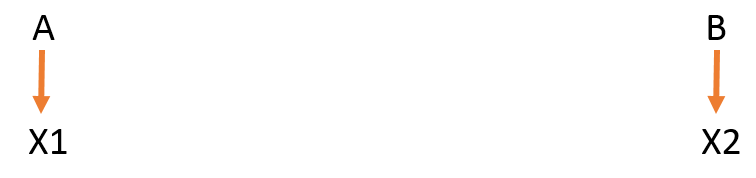
يُدفع الصندوق من الموضع \(A\) إلى \(B\) ثم يُعاد إلى \(A\).
The box is pushed from \(A\) to \(B\) and then returned to \(A\).
📌 شغل الاحتكاك على مسار مغلق
📌 The work of friction on a closed path
\[W_1=-\mu_k mg\,(x_B-x_A),\qquad W_2=-\mu_k mg\,(x_B-x_A)\]
\[W_{tot}=-2\mu_k\,m\,g\,(x_B-x_A)\ne0\]
الاحتكاك يعاكس الحركة دائمًا فيكون شغله سالبًا في الاتجاهين: قوة غير محافظة، وشغلها يعتمد على المسار.
Friction always opposes the motion so its work is negative in both directions: a non-conservative force, and its work depends on the path.
| قوة محافظةConservative force | قوة غير محافظةNon-conservative force | |
|---|---|---|
| مثالExample | الوزن، قوة الزنبرك، قوة كولومweight, spring force, Coulomb force | الاحتكاك، مقاومة الهواءfriction, air resistance |
| الشغل على مسار مغلقWork on a closed path | صفرzero | لا يساوي الصفرnot zero |
| يعتمد على المسار؟Depends on the path? | لاno | نعمyes |
| طاقة وضع مرتبطةAssociated potential energy | نعمyes | لاno |
شغل قوة محافظة على مسار مغلق يساوي:
The work of a conservative force over a closed path is:
صندوق كتلته \(5\ \mathrm{kg}\) يُدفع مسافة \(2\ \mathrm{m}\) ذهابًا وإيابًا على سطح معامل احتكاكه الحركي \(0.2\) (\(g=10\)). الشغل الكلي للاحتكاك:
A \(5\ \mathrm{kg}\) box is pushed \(2\ \mathrm{m}\) to and fro on a surface of kinetic friction coefficient \(0.2\) (\(g=10\)). The total work of friction is:
📐 علاقة الشغل بطاقة الوضع الجذبية
📐 Work and Gravitational Potential Energy
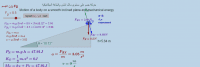
رُفع مكعب وزنه \(F_g=mg\) على مستوى مائل عديم الاحتكاك بقوة دفع إلى ارتفاع \(h\)، ومستوى الاختبار هو الأرض (\(\alpha\) زاوية ميل المستوى، \(d\) المسافة على المستوى).
A cube of weight \(F_g=mg\) is raised on a frictionless inclined plane by a pushing force to a height \(h\); the reference level is the ground (\(\alpha\) is the angle of the plane, \(d\) the distance along it).
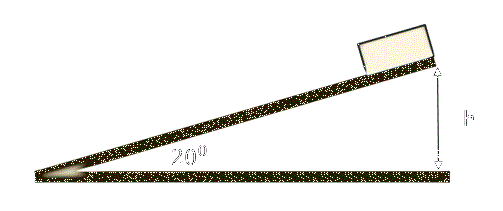
مكعب على مستوى مائل يميل \(20^\circ\) وارتفاعه \(h\).
A cube on a plane inclined at \(20^\circ\) with height \(h\).
📌 الاشتقاق
📌 The derivation
\[U_{g1}=0,\quad U_{g2}=mgh\ \Rightarrow\ \Delta U_g=mgh\]
\[W(F_g)=mg\,d\cos(90^\circ+\alpha)=-mg\,d\sin\alpha=-mgh\]
\[\Delta U_g=-W(F_g)\]
التغير في طاقة الوضع يساوي سالب شغل القوة المحافظة، ولا يظهر في العلاقة طول المستوى ولا ميله، بل الارتفاع فقط.
The change in potential energy equals the negative of the work of the conservative force; neither the length nor the slope of the plane appears, only the height.
🧪 جرّب بنفسك: أي مسار تختار؟
🧪 Try It Yourself: Which Path?
🧪 تجربة 2: أي مسار تختار؟ شغل الوزن والاحتكاك
🧪 Experiment 2: Which Path? The Work of Weight and of Friction
ارفع الجسم من \(A\) إلى \(B\) بمسار رأسي أو مائل أو درجي. شغل الوزن \(-mgh\) لا يعتمد على المسار، أما شغل الاحتكاك فيعتمد عليه. اضغط «انقل الجسم» ثم «أعده إلى A» لترى أن الشغل الكلي للوزن على المسار المغلق صفر وللاحتكاك لا.
Move the body from \(A\) to \(B\) along a vertical, inclined or stepped path. The work of weight \(-mgh\) does not depend on the path but the work of friction does. Press “Move the body” then “Return to A” to see that the total work of weight on the closed path is zero and that of friction is not.
🌀 طاقة الوضع المرونية
🌀 Elastic Potential Energy
هي الطاقة التي يختزنها جسم مرن (كالزنبرك) نتيجة وضع جسيماته بالنسبة لبعضها. قوة الزنبرك \(F_x=-kx\) فنحصل على التغير في طاقة الوضع من تكامل سالب القوة:
It is the energy an elastic body (such as a spring) stores because of the arrangement of its particles. The spring force is \(F_x=-kx\), so the change in potential energy follows from integrating the negative of the force:
📌 الاشتقاق والنتيجة
📌 Derivation and result
\[\Delta U_s=\int_{x_0}^{x}-F_x\,dx=\int_{x_0}^{x}kx\,dx=\tfrac12kx^2-\tfrac12kx_0^2\]
\[U_s=\tfrac12\,k\,x^2\]
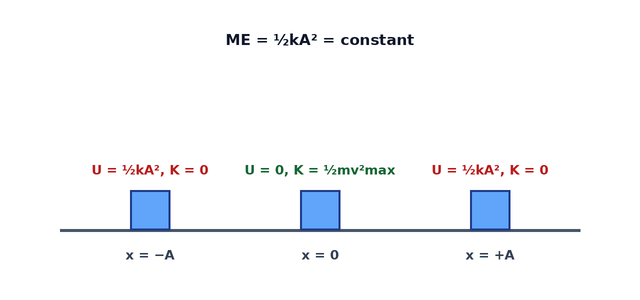
طاقة الزنبرك بين أقصى الإزاحة وموضع الاتزان.
The spring’s energy between maximum displacement and equilibrium.
زنبرك ثابت صلابته \(k=10\ \mathrm{N/m}\). ما الشغل اللازم لاستطالته \(0.4\ \mathrm{m}\)؟ وما الشغل الإضافي لاستطالته من \(0.4\) إلى \(0.8\ \mathrm{m}\)؟
A spring has stiffness \(k=10\ \mathrm{N/m}\). What work is needed to stretch it \(0.4\ \mathrm{m}\)? And the extra work to stretch it from \(0.4\) to \(0.8\ \mathrm{m}\)?
زنبرك \(k=100\ \mathrm{N/m}\) ضُغط \(0.2\ \mathrm{m}\). طاقة وضعه:
A spring \(k=100\ \mathrm{N/m}\) is compressed \(0.2\ \mathrm{m}\). Its potential energy is:
📉 طاقة الوضع والقوة
📉 Potential Energy and Force
حصلنا على طاقة الوضع بتكامل سالب القوة، وبالعملية العكسية نحصل على القوة من سالب مشتقة طاقة الوضع:
We obtained the potential energy by integrating the negative of the force; by the reverse process the force is the negative derivative of the potential energy:
📌 القوة من طاقة الوضع
📌 Force from potential energy
\[F_x=-\frac{dU(x)}{dx},\qquad F_y=-\frac{dU(y)}{dy},\qquad F_z=-\frac{dU(z)}{dz}\]
القوة هي سالب ميل منحنى \(U(x)\): أكبر قوة عند أشد ميل، وصفر عند الأجزاء الأفقية، وتتجه نحو الأسفل على منحنى \(U\).
The force is the negative slope of the \(U(x)\) curve: the largest force where the slope is steepest, zero on the flat parts, and it points “downhill” on the \(U\) curve.
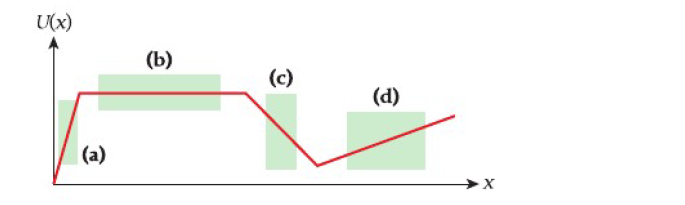
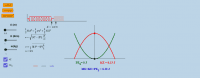
منحنى طاقة الوضع \(U(x)\) بأربع مناطق (a) و(b) و(c) و(d).
The potential energy curve \(U(x)\) with four regions (a), (b), (c) and (d).
من منحنى \(U(x)\) في الشكل: في أي منطقة تكون القوة أكبر ما يمكن؟ وفي أي منطقة تنعدم؟
From the \(U(x)\) curve in the figure: in which region is the force greatest? In which is it zero?
طاقة وضع جسيم \(U(x)=3x^2\) (بالجول و\(x\) بالمتر). أوجد القوة عند \(x=2\ \mathrm{m}\).
The potential energy of a particle is \(U(x)=3x^2\) (joules, \(x\) in metres). Find the force at \(x=2\ \mathrm{m}\).
قوة جسيم تساوي \(-dU/dx\). إذا كان منحنى \(U\) أفقيًا في منطقة فإن القوة فيها:
The force on a particle equals \(-dU/dx\). If the \(U\) curve is horizontal in a region the force there is:
🧪 جرّب بنفسك: القوة من منحنى طاقة الوضع
🧪 Try It Yourself: Force from the Potential Curve
🧪 تجربة 3: القوة من منحنى طاقة الوضع
🧪 Experiment 3: The Force from the Potential-Energy Curve
اختر شكل المنحنى \(U(x)\) وحرّك الجسم بالمنزلق: المماس يمثّل الميل والقوة \(F=-dU/dx\) سهم تحت المنحنى. نقاط الاتزان حيث الميل صفر. اضغط «حرّر الجسم» لتراه يتحرك بتأثير هذه القوة ويتذبذب بين نقطتين (طاقة ميكانيكية ثابتة).
Choose the shape of the \(U(x)\) curve and move the body with the slider: the tangent represents the slope and the force \(F=-dU/dx\) is an arrow under the curve. Equilibrium points are where the slope is zero. Press “Release the body” to watch it move under this force and oscillate between two points (constant mechanical energy).
♻️ الطاقة الميكانيكية ومبدأ حفظ الطاقة
♻️ Mechanical Energy and Conservation of Energy
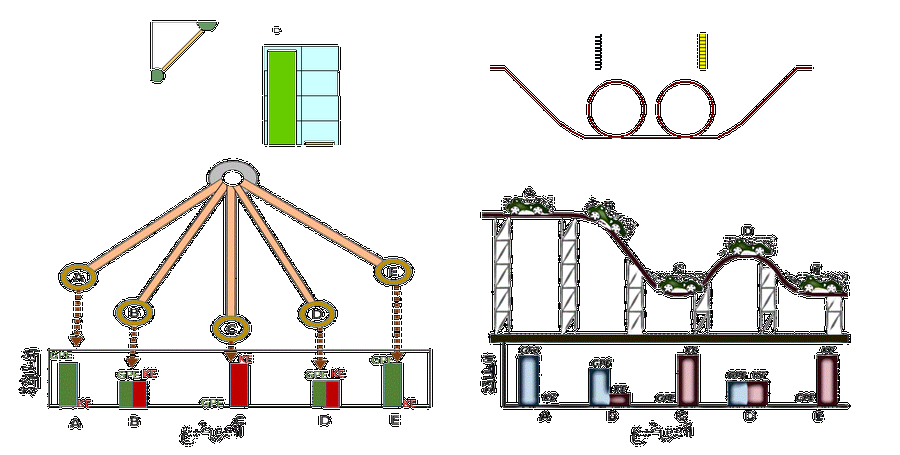
بندول وقطار الملاهي: أعمدة طاقة الحركة وطاقة الوضع والطاقة الميكانيكية.
A pendulum and a roller coaster: bars of kinetic energy, potential energy and mechanical energy.
📌 الطاقة الميكانيكية
📌 Mechanical energy
\[ME=K+U\]
في نظام معزول تؤثر فيه قوى محافظة فقط تبقى الطاقة الميكانيكية ثابتة: \(K_1+U_1=K_2+U_2\). تتحول الطاقة من شكل لآخر ولا تفنى ولا تُستحدث. الطاقة كمية قياسية، لكن الطاقة الحركية لا تكون سالبة أبدًا.
In an isolated system acted on by conservative forces only the mechanical energy stays constant: \(K_1+U_1=K_2+U_2\). Energy changes from one form to another and is neither created nor destroyed. Energy is a scalar, yet kinetic energy is never negative.
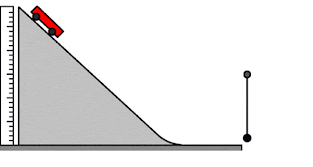
سيارة تنزلق على منحدر: أين طاقة الوضع أكبر؟ وأين الحركية أكبر؟
A car sliding down a ramp: where is the potential energy greatest? Where is the kinetic energy greatest?
اعتبر سطح الأرض مستوى مرجعيًا. سيارة تنزلق من أعلى منحدر: أين تكون طاقة وضعها أكبر ما يمكن؟ وأين تبلغ طاقتها الحركية أعلى قيمة؟
Take the ground as the reference level. A car slides from the top of a ramp: where is its potential energy greatest? Where does its kinetic energy reach its highest value?
🕰️ البندول
🕰️ The pendulum
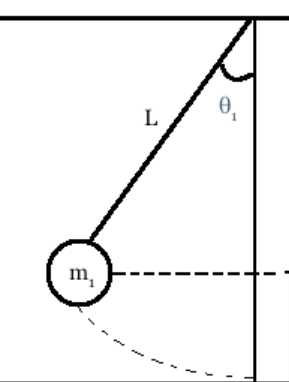
بندول طوله \(L\) يصنع زاوية \(\theta\) مع الرأسي: \(h=L-L\cos\theta\) إذا كان مستوى الاختبار موضع الاتزان.
A pendulum of length \(L\) at angle \(\theta\) to the vertical: \(h=L-L\cos\theta\) if the reference level is the equilibrium position.
🎚️ ارتفاع البندول
🎚️ The pendulum’s height
• مستوى الاختبار = موضع الاتزان (أسفل البندول): \(h=L-L\cos\theta\) و\(U=mgL(1-\cos\theta)\ge0\).
• مستوى الاختبار = المستوى الأفقي المار بنقطة التعليق: \(h=-L\cos\theta\) فتكون طاقة الوضع سالبة.
• Reference level = the equilibrium position (the bottom): \(h=L-L\cos\theta\) and \(U=mgL(1-\cos\theta)\ge0\).
• Reference level = the horizontal plane through the pivot: \(h=-L\cos\theta\) so the potential energy is negative.
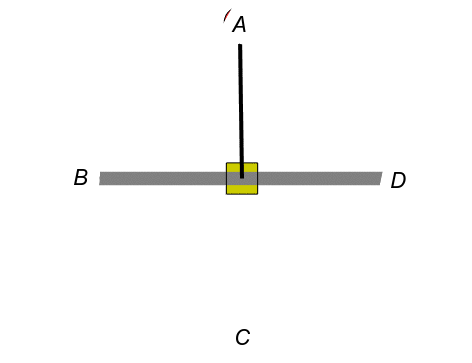
بندول: النقاط \(A\) (أعلى) و\(B\) و\(D\) (على المستوى الأفقي المرجعي) و\(C\) (أسفل).
A pendulum: points \(A\) (top), \(B\) and \(D\) (on the reference horizontal plane) and \(C\) (bottom).
في الشكل المستوى المرجعي هو المستوى الأفقي \(BD\). أين طاقة الحركة أكبر؟ وأين طاقة الوضع أكبر؟ وأين تكون طاقة الوضع سالبة؟
In the figure the reference level is the horizontal plane \(BD\). Where is the kinetic energy greatest? Where is the potential energy greatest? Where is it negative?
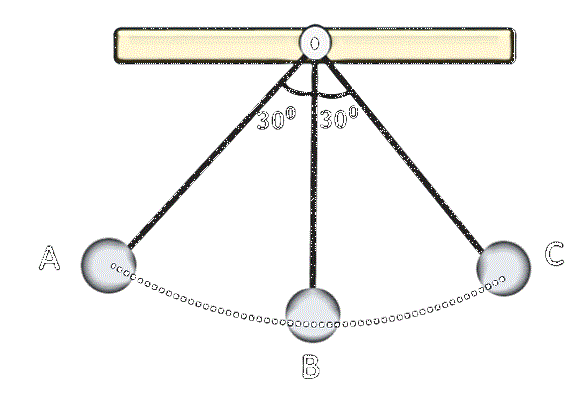
بندول يتأرجح بين \(A\) و\(C\) مارًّا بالموضع \(B\) (زاوية \(30^\circ\)).
A pendulum swinging between \(A\) and \(C\) through \(B\) (angle \(30^\circ\)).
خيط طوله \(L=0.8\ \mathrm{m}\) علّقت به كتلة \(0.2\ \mathrm{kg}\) وأُبعدت \(30^\circ\) عن الاتزان عند \(A\) وتُركت. أكمل بيانات الجدول (المستوى الصفري موضع الاتزان \(B\)، \(g=9.8\)).
A string of length \(L=0.8\ \mathrm{m}\) carries a \(0.2\ \mathrm{kg}\) mass displaced \(30^\circ\) from equilibrium at \(A\) and released. Complete the table (zero level at the equilibrium \(B\), \(g=9.8\)).
| الموضعPosition | الارتفاع \(h\)Height \(h\) | \(U\) (J)\(U\) (J) | \(K\) (J)\(K\) (J) | \(ME\) (J)\(ME\) (J) |
|---|---|---|---|---|
| AA | 0.107 m0.107 m | 0.210.21 | 00 | 0.210.21 |
| BB | 00 | 00 | 0.210.21 | 0.210.21 |
| CC | 0.107 m0.107 m | 0.210.21 | 00 | 0.210.21 |
بندول طوله \(1\ \mathrm{m}\) أُبعد \(60^\circ\) وتُرك. سرعته عند الموضع الرأسي (\(g=9.8\)):
A pendulum of length \(1\ \mathrm{m}\) is pulled \(60^\circ\) aside and released. Its speed at the vertical position (\(g=9.8\)) is:
🧪 جرّب بنفسك: البندول
🧪 Try It Yourself: The Pendulum
🧪 تجربة 4: البندول: تبادل الطاقة وإشارة طاقة الوضع
🧪 Experiment 4: The Pendulum: Energy Exchange and the Sign of U
غيّر طول البندول وزاوية الإبعاد ثم اضغط «أطلق البندول». بدّل مستوى الاختبار بين موضع الاتزان ونقطة التعليق لترى أن طاقة الوضع تصبح سالبة بينما الطاقة الميكانيكية تتغير بمقدار ثابت فقط والسرعة نفسها.
Change the length and the release angle then press “Release the pendulum”. Switch the reference level between the equilibrium position and the pivot to see the potential energy become negative while the speed stays the same.
🛷 المستوى المائل الأملس
🛷 The smooth inclined plane
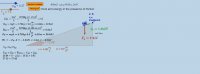
مكعب خشبي كتلته \(0.5\ \mathrm{kg}\) وُضع على مستوى مائل أملس طوله \(1\ \mathrm{m}\) يميل \(20^\circ\) فوق الأفق وتُرك لينزلق. أحسب سرعته عند نهاية المستوى (\(g=9.8\)).
A \(0.5\ \mathrm{kg}\) wooden cube is placed on a smooth inclined plane \(1\ \mathrm{m}\) long at \(20^\circ\) above the horizontal and released. Find its speed at the end of the plane (\(g=9.8\)).
أُسقط جسمان مختلفا الكتلة من الارتفاع نفسه على مستوى مائل أملس. سرعتاهما عند القاع:
Two bodies of different mass are released from the same height on a smooth incline. Their speeds at the bottom are:
🌱 الزنبرك وحفظ الطاقة
🌱 The Spring and Conservation of Energy
جسم كتلته \(m\) على زنبرك ثابته \(k\) أُبعد عن الاتزان فيهتز. بغياب الاحتكاك تبقى الطاقة الميكانيكية ثابتة: \(\tfrac12kx^2+\tfrac12mv^2=\tfrac12kA^2\).
A body of mass \(m\) on a spring of stiffness \(k\) is pulled from equilibrium and oscillates. Without friction the mechanical energy is constant: \(\tfrac12kx^2+\tfrac12mv^2=\tfrac12kA^2\).
📌 السرعة من حفظ الطاقة
📌 The speed from conservation of energy
\[v_{max}=A\sqrt{\frac{k}{m}}\quad(x=0),\qquad v=\sqrt{\left(A^2-x^2\right)\frac{k}{m}}\]
عند أقصى إزاحة \(v=0\) و\(U=\tfrac12kA^2\)؛ وعند موضع الاتزان \(x=0\) و\(U=0\) والسرعة أعظم ما يمكن.
At maximum displacement \(v=0\) and \(U=\tfrac12kA^2\); at equilibrium \(x=0\), \(U=0\) and the speed is greatest.
جسم كتلته \(0.5\ \mathrm{kg}\) على زنبرك \(k=200\ \mathrm{N/m}\) وسعة الاهتزاز \(0.1\ \mathrm{m}\). أوجد أقصى سرعة والسرعة عند \(x=0.06\ \mathrm{m}\).
A \(0.5\ \mathrm{kg}\) body on a spring \(k=200\ \mathrm{N/m}\) oscillates with amplitude \(0.1\ \mathrm{m}\). Find the maximum speed and the speed at \(x=0.06\ \mathrm{m}\).
زنبرك \(k=200\ \mathrm{N/m}\) وجسم \(0.5\ \mathrm{kg}\) وسعة \(0.1\ \mathrm{m}\). أقصى سرعة:
A spring \(k=200\ \mathrm{N/m}\), a \(0.5\ \mathrm{kg}\) body and amplitude \(0.1\ \mathrm{m}\). The maximum speed is:
🧪 جرّب بنفسك: الزنبرك
🧪 Try It Yourself: The Spring
🧪 تجربة 5: الزنبرك: الطاقة المرونية والسرعة
🧪 Experiment 5: The Spring: Elastic Energy and Speed
غيّر ثابت الزنبرك والكتلة والسعة ثم اضغط «أطلق». تتبادل الطاقة بين \(U_s=\tfrac12kx^2\) و\(K\) ويبقى المجموع \(\tfrac12kA^2\). حرّك المنزلق الموضع \(x\) (والجسم ساكن) لتقرأ السرعة عند أي موضع.
Change the spring constant, the mass and the amplitude then press “Release”. The energy swaps between \(U_s=\tfrac12kx^2\) and \(K\) while the sum stays \(\tfrac12kA^2\). Move the position \(x\) slider (with the body at rest) to read the speed at any position.
🔥 القوى غير المحافظة ونظرية الشغل–الطاقة
🔥 Non-Conservative Forces and the Work–Energy Theorem
عند حركة جسم على مستوى خشن يُستهلك جزء من الطاقة في الاحتكاك ويتحول إلى طاقة حرارية؛ فمجموع الطاقة الميكانيكية الابتدائية وشغل قوة الاحتكاك يساوي الطاقة الميكانيكية النهائية:
When a body moves on a rough surface part of the energy is used up by friction and becomes thermal energy; the sum of the initial mechanical energy and the work of friction equals the final mechanical energy:
📌 مع الاحتكاك
📌 With friction
\[K_1+U_1+W_{f}=K_2+U_2,\qquad W_f=-\mu_k\,mg\cos\alpha\ \,d\lt 0\]
الطاقة المفقودة \(|W_f|\) تساوي الطاقة الحرارية الناتجة: الطاقة الكلية محفوظة لكن الطاقة الميكانيكية تقل.
The lost energy \(|W_f|\) equals the thermal energy produced: the total energy is conserved but the mechanical energy decreases.
جسم كتلته \(2\ \mathrm{kg}\) انزلق من السكون من ارتفاع \(5\ \mathrm{m}\) على مستوى خشن فوصل القاع بسرعة \(6\ \mathrm{m/s}\) (\(g=10\)). أوجد شغل الاحتكاك والطاقة الحرارية.
A \(2\ \mathrm{kg}\) body slides from rest from a height of \(5\ \mathrm{m}\) on a rough plane and reaches the bottom at \(6\ \mathrm{m/s}\) (\(g=10\)). Find the work of friction and the thermal energy.
انزلق جسم على مستوى خشن من السكون. الطاقة الميكانيكية عند القاع مقارنة بأعلى المستوى:
A body slides from rest on a rough plane. The mechanical energy at the bottom compared with the top is:
🧪 جرّب بنفسك: المسار والاحتكاك
🧪 Try It Yourself: The Track and Friction
🧪 تجربة 6: كرة على مسار: حفظ الطاقة والاحتكاك
🧪 Experiment 6: A Ball on a Track: Conservation of Energy and Friction
اختر شكل المسار وموضع البداية ومعامل الاحتكاك \(\mu\) ثم اضغط «أطلق الكرة». بدون احتكاك يبقى مجموع \(K+U\) ثابتًا؛ ومع الاحتكاك تتناقص الطاقة الميكانيكية ويظهر عمود الطاقة الحرارية.
Choose the track shape, the starting point and the friction coefficient \(\mu\) then press “Release the ball”. Without friction \(K+U\) stays constant; with friction the mechanical energy decreases and a thermal-energy bar appears.
🧪 تجربة 7: تدريب: طاقة الوضع وحفظ الطاقة
🧪 Experiment 7: Practice: Potential Energy and Conservation of Energy
مسائل عشوائية: طاقة الوضع، طاقة الزنبرك، سرعة من حفظ الطاقة، وشغل الاحتكاك. احسب واكتب الجواب بالوحدة المطلوبة ثم اضغط «تحقّق».
Random problems: potential energy, spring energy, speed from conservation of energy and the work of friction. Work it out, enter the answer in the requested unit and press “Check”.
✅ ملخص الدرس
✅ Lesson Summary
| الموضوعTopic | العلاقةRelation | ملاحظةNote |
|---|---|---|
| طاقة الوضع الجذبيةGravitational PE | \(U_g=mgh\) | فوق مستوى الاختبار موجبة وتحته سالبةpositive above the reference level, negative below |
| الشغل والطاقةWork and energy | \(\Delta U=-W_{cons}\) | القوة المحافظة: شغل المسار المغلق صفرconservative: zero work on a closed path |
| الزنبركThe spring | \(U_s=\tfrac12kx^2\) | \(v_{max}=A\sqrt{k/m}\)\(v_{max}=A\sqrt{k/m}\) |
| القوةForce | \(F=-dU/dx\) | ميل المنحنىthe slope of the curve |
| حفظ الطاقةConservation | \(K_1+U_1=K_2+U_2\) | بغياب الاحتكاكwithout friction |
| مع الاحتكاكWith friction | \(K_1+U_1+W_f=K_2+U_2\) | \(W_f\lt 0\)\(W_f\lt 0\) |
🧪 اختبر نفسك: امتحان من 20 سؤالاً
🧪 Test Yourself: a 20-Question Exam
أنهِ الدرس بالاختبار التفاعلي التالي؛ أسئلته تجمع بين الفهم والحساب وتغطي جميع أقسام الدرس.
Finish with the interactive exam below; its questions mix understanding with calculation and cover every section of the lesson.
اختبار طاقة الوضع وحفظ الطاقة Potential Energy and Conservation of Energy Quiz
20 سؤالاً - طاقة الوضع، القوى المحافظة، حفظ الطاقة الميكانيكية، الزنبرك، والاحتكاك 20 Questions - potential energy, conservative forces, conservation of mechanical energy, the spring and friction
• عدد الأسئلة: 20 سؤالاً
• مدة الاختبار: 30 دقيقة
• لا يمكنك تغيير إجاباتك أو إعادة الاختبار إلا بعد 24 ساعة من التسليم.
• تأكد من إجاباتك قبل التسليم! 📌 Important Instructions:
• Number of questions: 20 questions
• Quiz duration: 30 minutes
• You cannot change your answers or retake the quiz for 24 hours after submission.
• Make sure of your answers before submitting!
🔗 محاكيات GeoGebra للاستعانة بها عند اللزوم
🔗 GeoGebra Simulations to Use When Needed
اضغط «تشغيل» لتعمل المحاكاة هنا داخل الدرس؛ ويمكن للطالب الرجوع إليها لتجربة الفكرة بطريقة أخرى.
Press “Run” to run the simulation right here inside the lesson; the student can use it to try the idea in another way.