🎯 نواتج التعلم
🎯 Learning Outcomes
بعد دراسة هذا الدرس ستكون قادرًا على أن:
After this lesson you will be able to:
- تحسب التغير في طاقة وضع شحنة في مجال منتظم \(\Delta U=-qEd\cos\theta\) وتحدد إشارته.Calculate the change in potential energy of a charge in a uniform field \(\Delta U=-qEd\cos\theta\) and determine its sign.
- تعرّف الجهد وتحسب جهد شحنة نقطية ومجموعة شحنات \(V=k\sum q_i/r_i\).Define the potential and calculate the potential of a point charge and of a group of charges \(V=k\sum q_i/r_i\).
- تحسب فرق الجهد بين نقطتين وتربطه بالشغل والطاقة الحركية.Calculate the potential difference between two points and relate it to the work and the kinetic energy.
- تفسّر سطوح تساوي الجهد وعلاقتها بخطوط المجال، وتستخرج المجال من الجهد \(E=-dV/dx\).Explain the equipotential surfaces and their relation to the field lines, and derive the field from the potential \(E=-dV/dx\).
- تحسب طاقة وضع نظام من الشحنات النقطية.Calculate the potential energy of a system of point charges.
📎 معلومات سابقة
📎 Prior Knowledge
📌 العمل والطاقة
📌 Work and energy
\[E=K+U\ ,\quad \Delta K+\Delta U=0\ ,\quad W=\Delta K\ ,\quad W=-\Delta U\ ,\quad W=Fd\cos\theta\]
الشغل موجب إذا كانت القوة (أو أحد مركباتها) باتجاه الإزاحة، وسالب إذا كانت عكسها، ومعدوم إذا كانت عمودية على الإزاحة. وفي نظام معزول تبقى الطاقة الكلية ثابتة.
The work is positive if the force (or one of its components) is in the direction of the displacement, negative if it is opposite to it, and zero if it is perpendicular to the displacement. In an isolated system the total energy stays constant.
🔋 طاقة الوضع: الجذبية والكهربائية
🔋 Potential Energy: Gravitational and Electric
| وجه المقارنةAspect | طاقة الوضع الكهربائيةElectric potential energy | طاقة الوضع الجذبيةGravitational potential energy |
|---|---|---|
| ماذا يحدث؟What happens? | تُترك شحنة في مجال شحنة أخرىA charge is left in the field of another charge | تُترك كرة بعيدًا عن سطح الأرض في مجال الأرضA ball is left away from the Earth’s surface in the Earth’s field |
| القانونLaw | \(U_e=k\dfrac{Qq}{r}\) | \(U_G=mgh\) |
| تزدادIncreases | عند تحريك الشحنة عكس ما تفعله القوة الكهربائيةWhen the charge is moved against the electric force | عند رفع الجسم بعيدًا عن الأرضWhen the body is raised away from the Earth |
| تقلDecreases | عندما تتحرك الشحنة تلقائيًا بتأثير المجالWhen the charge moves spontaneously under the field | عندما يسقط الجسمWhen the body falls |
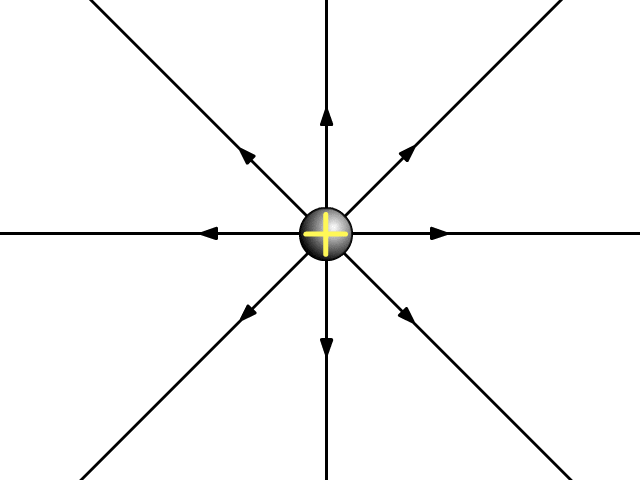
شحنة في مجال شحنة موجبة: طاقة الوضع الكهربائية
A charge in the field of a positive charge: electric potential energy

كرة في مجال الأرض: طاقة الوضع الجذبية
A ball in the Earth’s field: gravitational potential energy
📏 التغير في طاقة الوضع الكهربائية في مجال منتظم
📏 The Change in Electric Potential Energy in a Uniform Field
طاقة الوضع الكهربائية هي الطاقة المخزنة في نظام شحنات بسبب مواضعها النسبية. وعند تحريك شحنة \(q\) في مجال منتظم \(E\) إزاحة \(d\) تصنع زاوية \(\theta\) مع المجال تبذل القوة الكهربائية \(F=qE\) شغلًا \(W=qEd\cos\theta\)، فيكون:
Electric potential energy is the energy stored in a system of charges because of their relative positions. When a charge \(q\) is moved in a uniform field \(E\) a displacement \(d\) making an angle \(\theta\) with the field, the electric force \(F=qE\) does a work \(W=qEd\cos\theta\), so:
📌 التغير في طاقة الوضع
📌 The change in potential energy
\[\Delta U=-W=-qEd\cos\theta\qquad,\qquad \Delta U=-qEd\]
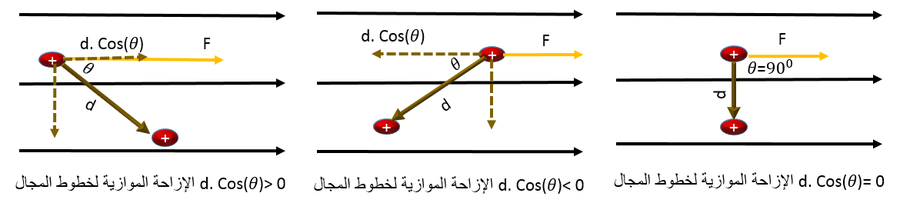
الحالات الثلاث: \(d\cos\theta\gt 0\) و\(\lt 0\) و\(=0\)
The three cases: \(d\cos\theta\gt 0\), \(\lt 0\) and \(=0\)
| نوع الشحنةKind of charge | اتجاه الحركةDirection of motion | التغير في \(U\)Change in \(U\) |
|---|---|---|
| موجبةPositive | باتجاه المجالAlong the field | تقل (\(\Delta U\lt 0\))Decreases (\(\Delta U\lt 0\)) |
| موجبةPositive | عكس المجالAgainst the field | تزداد (\(\Delta U\gt 0\))Increases (\(\Delta U\gt 0\)) |
| سالبةNegative | باتجاه المجالAlong the field | تزداد (\(\Delta U\gt 0\))Increases (\(\Delta U\gt 0\)) |
| سالبةNegative | عكس المجالAgainst the field | تقل (\(\Delta U\lt 0\))Decreases (\(\Delta U\lt 0\)) |
| أي شحنةAny charge | عموديًا على المجالPerpendicular to the field | تبقى ثابتة (\(\Delta U=0\))Stays constant (\(\Delta U=0\)) |
🧪 تجربة 1: التغير في طاقة وضع شحنة
🧪 Experiment 1: The Change in the Potential Energy of a Charge
ننقل شحنة بين نقطتين في مجال منتظم ونتحكم في نوعها ومقدارها والمجال والإزاحة والزاوية لنتحقق من إشارة \\(\\Delta U\\).
We move a charge between two points in a uniform field and control its kind and magnitude, the field, the displacement and the angle to verify the sign of \\(\\Delta U\\).
🛠️ خطوات العمل
🛠️ Procedure
- ابدأ بشحنة موجبة وزاوية \\(0^\\circ\\) وسجّل \\(W\\) و\\(\\Delta U\\).Start with a positive charge and an angle \\(0^\\circ\\) and record \\(W\\) and \\(\\Delta U\\).
- غيّر الزاوية إلى \\(180^\\circ\\) ثم \\(90^\\circ\\) وقارن الإشارات.Change the angle to \\(180^\\circ\\) then \\(90^\\circ\\) and compare the signs.
- اجعل الشحنة سالبة وكرّر.Make the charge negative and repeat.
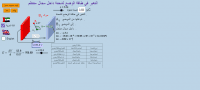
🧪 تجربة 1: التغير في طاقة وضع شحنة في مجال منتظم
🧪 Experiment 1: The Change in the Potential Energy of a Charge in a Uniform Field
تُنقل شحنة من A إلى B في مجال كهربائي منتظم. غيّر نوع الشحنة ومقدارها والمجال والإزاحة والزاوية \(\theta\) بين الإزاحة والمجال وراقب \(W\) و\(\Delta U\).
A charge is moved from A to B in a uniform electric field. Change the kind and the magnitude of the charge, the field, the displacement and the angle \(\theta\) between the displacement and the field and watch \(W\) and \(\Delta U\).
🔎 ماذا نلاحظ؟ وما الاستنتاج؟
🔎 What do we observe? What is the conclusion?
- \\(\\Delta U\\) يساوي \\(-W\\) دائمًا: ما يبذله المجال من شغل موجب يُنقص طاقة الوضع.\\(\\Delta U\\) always equals \\(-W\\): positive work done by the field decreases the potential energy.
- عند \\(\\theta=90^\\circ\\) لا يبذل المجال شغلًا ولا تتغير الطاقة.At \\(\\theta=90^\\circ\\) the field does no work and the energy does not change.
التغير في طاقة الوضع في مجال منتظم: \\(\\Delta U=-qEd\\cos\\theta\\) (كمية قياسية تُقاس بالجول).
The change in potential energy in a uniform field: \\(\\Delta U=-qEd\\cos\\theta\\) (a scalar measured in joules).
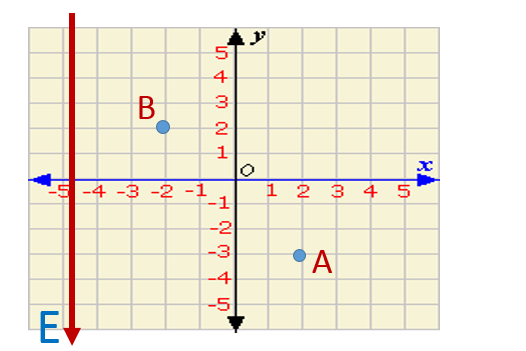
بروتون يتحرك من \(A(2,-3)\) إلى \(B(-2,2)\) في مجال \(E=4\times10^3\ \mathrm{N/C}\) نحو \(-y\)
A proton moves from \(A(2,-3)\) to \(B(-2,2)\) in a field \(E=4\times10^3\ \mathrm{N/C}\) toward \(-y\)
بروتون (\(q=1.6\times10^{-19}\ \mathrm C\)) تحرك من \(A(2\ \mathrm m,-3\ \mathrm m)\) إلى \(B(-2\ \mathrm m,2\ \mathrm m)\) في مجال منتظم \(E=4\times10^3\ \mathrm{N/C}\) يتجه نحو المحور الرأسي السالب. أوجد التغير في طاقة وضعه.
A proton (\(q=1.6\times10^{-19}\ \mathrm C\)) moves from \(A(2\ \mathrm m,-3\ \mathrm m)\) to \(B(-2\ \mathrm m,2\ \mathrm m)\) in a uniform field \(E=4\times10^3\ \mathrm{N/C}\) directed toward the negative vertical axis. Find the change in its potential energy.
↔️ ثنائي القطب في مجال منتظم (قراءة ذاتية)
↔️ A Dipole in a Uniform Field (Self-Study)
ثنائي القطب شحنتان متساويتان في المقدار ومتعاكستان في النوع. شحنته الكلية صفر، لكن المجال المنتظم يؤثر فيه بعزم دوران \(\vec\tau=\vec p\times\vec E\) حيث \(p\) عزم ثنائي القطب. وهو يخزّن طاقة وضع تعتمد على الزاوية \(\theta\) بين \(\vec p\) و\(\vec E\):
A dipole is two charges equal in magnitude and opposite in kind. Its total charge is zero, but a uniform field exerts a torque \(\vec\tau=\vec p\times\vec E\) on it where \(p\) is the dipole moment. It stores a potential energy that depends on the angle \(\theta\) between \(\vec p\) and \(\vec E\):
📌 طاقة وضع ثنائي القطب
📌 The potential energy of a dipole
\[U=-\vec p\cdot\vec E=-pE\cos\theta\]
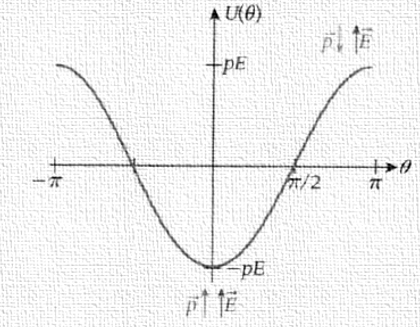
العلاقة بين طاقة الوضع وزاوية ثنائي القطب مع المجال
The relation between the potential energy and the angle of the dipole with the field
أصغر طاقة (\(-pE\)) عند \(\theta=0\) (ثنائي القطب مع المجال: وضع مستقر) وأكبر طاقة (\(+pE\)) عند \(\theta=180^\circ\) (عكس المجال: وضع غير مستقر).
The minimum energy (\(-pE\)) is at \(\theta=0\) (the dipole along the field: a stable position) and the maximum energy (\(+pE\)) is at \(\theta=180^\circ\) (against the field: an unstable position).
⚡ الجهد الكهربائي
⚡ The Electric Potential
الجهد الكهربائي عند نقطة هو طاقة الوضع الكهربائية لوحدة الشحنات الموجبة، أي الشغل اللازم لنقل شحنة اختبار موجبة من اللانهاية إلى النقطة مقسومًا على الشحنة (دون تسارع): \(V=\dfrac{U}{q}\). ووحدته الفولت: \(1\ \mathrm V=1\ \mathrm{J/C}\). وهو كمية قياسية (لها إشارة فقط).
The electric potential at a point is the electric potential energy per unit positive charge, i.e., the work needed to bring a positive test charge from infinity to the point divided by the charge (without acceleration): \(V=\dfrac{U}{q}\). Its unit is the volt: \(1\ \mathrm V=1\ \mathrm{J/C}\). It is a scalar quantity (it has only a sign).
📌 جهد شحنة نقطية
📌 The potential of a point charge
\[V=k\,\frac{Q}{r}\qquad,\qquad k=8.99\times10^{9}\ \mathrm{N\,m^2/C^2}\]
خصائص الجهد
Properties of the potential
- كمية قياسية؛ الشحنة الموجبة تنتج جهدًا موجبًا والسالبة جهدًا سالبًا.A scalar; a positive charge produces a positive potential and a negative one a negative potential.
- يتناسب عكسيًا مع \(r\) (وليس \(r^2\)) ويعتمد على بعد النقطة عن الشحنة.Inversely proportional to \(r\) (not \(r^2\)) and depends on the distance of the point from the charge.
- جهد اللانهاية صفر بالاصطلاح.The potential at infinity is zero by convention.
شحنة نقطية \(Q=+5\ \mathrm{nC}\). أوجد الجهد عند نقطة تبعد عنها \(0.3\ \mathrm m\).
A point charge \(Q=+5\ \mathrm{nC}\). Find the potential at a point \(0.3\ \mathrm m\) from it.
🧪 تجربة 2: جهد شحنة نقطية
🧪 Experiment 2: The Potential of a Point Charge
نغيّر الشحنة والمسافة ونراقب كيف يتغير الجهد وكيف يبقى الجداء \\(V\\cdot r\\) ثابتًا.
We change the charge and the distance and watch how the potential changes and how the product \\(V\\cdot r\\) stays constant.
🛠️ خطوات العمل
🛠️ Procedure
- اضبط \\(Q=5\\ \\mathrm{nC}\\) و\\(r=0.3\\ \\mathrm m\\) وسجّل الجهد.Set \\(Q=5\\ \\mathrm{nC}\\) and \\(r=0.3\\ \\mathrm m\\) and record the potential.
- ضاعف المسافة وقارن النسبة.Double the distance and compare the ratio.
- اجعل الشحنة سالبة وراقب إشارة الجهد.Make the charge negative and watch the sign of the potential.
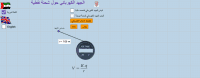
🧪 تجربة 2: جهد شحنة نقطية
🧪 Experiment 2: The Potential of a Point Charge
غيّر مقدار الشحنة (وإشارتها) وبعد النقطة P عنها وراقب الجهد \(V=kQ/r\) ومنحنى \(V\) مع \(r\).
Change the magnitude (and the sign) of the charge and the distance of the point P from it and watch the potential \(V=kQ/r\) and the curve of \(V\) against \(r\).
🔎 ماذا نلاحظ؟ وما الاستنتاج؟
🔎 What do we observe? What is the conclusion?
- عند مضاعفة \\(r\\) يقل الجهد إلى النصف.When \\(r\\) doubles the potential is halved.
- إشارة الجهد هي إشارة الشحنة، ومنحناه قطع زائد.The sign of the potential is the sign of the charge, and its curve is a hyperbola.
جهد شحنة نقطية \\(V=kQ/r\\): كمية قياسية تعتمد على إشارة الشحنة وبعد النقطة.
The potential of a point charge \\(V=kQ/r\\): a scalar depending on the sign of the charge and the distance of the point.
🧮 الجهد لمجموعة شحنات (مبدأ التراكب)
🧮 The Potential of a Group of Charges (Superposition)
الجهد كمية قياسية، فيكون الجهد الكلي عند نقطة هو المجموع الجبري لجهود الشحنات عندها (بإشارتها): \(V=k\sum\dfrac{q_i}{r_i}\). فلا حاجة إلى تحليل المتجهات كما في المجال.
The potential is a scalar so the total potential at a point is the algebraic sum of the potentials of the charges at it (with their signs): \(V=k\sum\dfrac{q_i}{r_i}\). There is no need to resolve vectors as with the field.
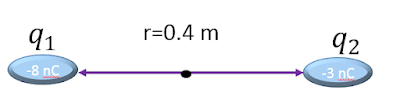
شحنتان \(-8\ \mathrm{nC}\) و\(-3\ \mathrm{nC}\) تبعدان \(0.4\ \mathrm m\): الجهد في المنتصف
Two charges \(-8\ \mathrm{nC}\) and \(-3\ \mathrm{nC}\) \(0.4\ \mathrm m\) apart: the potential at the middle
أوجد الجهد في منتصف المسافة بين الشحنتين \(q_1=-8\ \mathrm{nC}\) و\(q_2=-3\ \mathrm{nC}\) المتباعدتين \(0.4\ \mathrm m\) (\(k=9\times10^{9}\)).
Find the potential at the midpoint between the charges \(q_1=-8\ \mathrm{nC}\) and \(q_2=-3\ \mathrm{nC}\) which are \(0.4\ \mathrm m\) apart (\(k=9\times10^{9}\)).
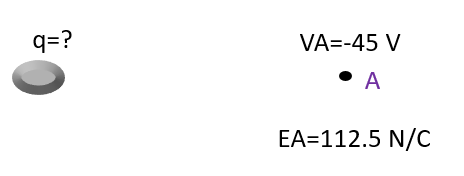
عند النقطة A: \(V_A=-45\ \mathrm V\) و\(E=112.5\ \mathrm{N/C}\)
At the point A: \(V_A=-45\ \mathrm V\) and \(E=112.5\ \mathrm{N/C}\)
جهد نقطة \(V_A=-45\ \mathrm V\) والمجال عندها \(E=112.5\ \mathrm{N/C}\). أوجد مقدار الشحنة المسببة ونوعها وبعدها عن النقطة.
The potential of a point is \(V_A=-45\ \mathrm V\) and the field at it is \(E=112.5\ \mathrm{N/C}\). Find the magnitude and the kind of the causing charge and its distance from the point.
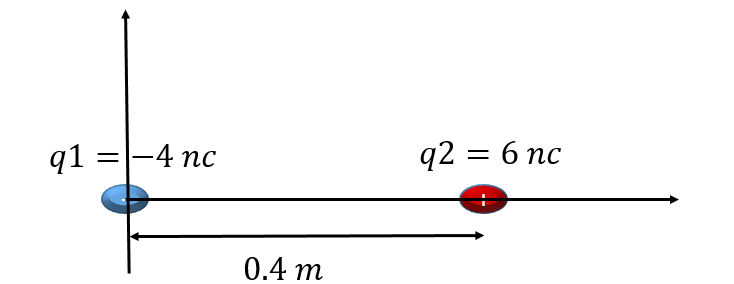
\(q_1=-4\ \mathrm{nC}\) و\(q_2=+6\ \mathrm{nC}\) تبعدان \(0.4\ \mathrm m\)
\(q_1=-4\ \mathrm{nC}\) and \(q_2=+6\ \mathrm{nC}\) are \(0.4\ \mathrm m\) apart
شحنتان \(q_1=-4\ \mathrm{nC}\) عند الأصل و\(q_2=+6\ \mathrm{nC}\) عند \(x=0.4\ \mathrm m\). أين ينعدم الجهد على امتداد الخط الواصل بينهما؟
Two charges \(q_1=-4\ \mathrm{nC}\) at the origin and \(q_2=+6\ \mathrm{nC}\) at \(x=0.4\ \mathrm m\). Where does the potential vanish on the line joining them?
🧪 تجربة 3: الجهد على الخط الواصل بين شحنتين
🧪 Experiment 3: The Potential on the Line Joining Two Charges
نحرّك نقطة على الخط الواصل بين شحنتين ونراقب الجهد الكلي ومواضع انعدامه.
We move a point along the line joining two charges and watch the total potential and the positions where it vanishes.
🛠️ خطوات العمل
🛠️ Procedure
- اضبط \\(q_1=-4\\) و\\(q_2=+6\\ \\mathrm{nC}\\) وحرّك P ولاحظ تغيّر إشارة \\(V\\).Set \\(q_1=-4\\) and \\(q_2=+6\\ \\mathrm{nC}\\) and move P and notice the change of the sign of \\(V\\).
- اضغط «انقل P إلى موضع انعدام الجهد» وسجّل الموضعين.Press “Move P to a zero-potential position” and record the two positions.
- اجعل الشحنتين من النوع نفسه وابحث عن انعدام الجهد.Make the two charges of the same kind and look for a vanishing of the potential.
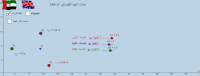
🧪 تجربة 3: الجهد على الخط الواصل بين شحنتين
🧪 Experiment 3: The Potential on the Line Joining Two Charges
الشحنة \(q_1\) عند \(x=0\) و\(q_2\) عند \(x=0.4\ \mathrm m\). حرّك النقطة P على المحور وراقب الجهد الكلي ومواضع انعدامه.
The charge \(q_1\) is at \(x=0\) and \(q_2\) at \(x=0.4\ \mathrm m\). Move the point P along the axis and watch the total potential and the positions where it vanishes.
🔎 ماذا نلاحظ؟ وما الاستنتاج؟
🔎 What do we observe? What is the conclusion?
- للشحنتين المختلفتين يوجد موضعان ينعدم عندهما الجهد: بينهما وخارجهما قرب الأصغر.For two different charges there are two positions where the potential vanishes: between them and outside near the smaller one.
- للمتشابهتين لا ينعدم الجهد على الخط لأن الجهدين لهما الإشارة نفسها.For like charges the potential does not vanish on the line because the two potentials have the same sign.
انعدام الجهد لا يعني انعدام المجال: عند \\(V=0\\) قد يبقى المجال غير صفري.
A vanishing potential does not mean a vanishing field: at \\(V=0\\) the field may remain non-zero.
🔋 فرق الجهد بين نقطتين
🔋 The Potential Difference Between Two Points
فرق الجهد بين نقطتين هو الشغل اللازم لنقل وحدة الشحنة بينهما (بسالب إشارة الشغل الذي يبذله المجال): \(\Delta V=V_B-V_A=\dfrac{\Delta U}{q}=-\dfrac{W_{A\to B}}{q}\). وحسب نظرية الشغل والطاقة \(W=\Delta K\) فيمكن استخراجه من تغير سرعة شحنة.
The potential difference between two points is the work needed to move a unit charge between them (with the sign opposite to the work done by the field): \(\Delta V=V_B-V_A=\dfrac{\Delta U}{q}=-\dfrac{W_{A\to B}}{q}\). By the work-energy theorem \(W=\Delta K\) it can be found from the change in speed of a charge.
بروتون تحرك بين نقطتين في مجال كهربائي، بدأ بسرعة \(40\ \mathrm{m/s}\) عند \(A\) وأصبحت سرعته \(10^4\ \mathrm{m/s}\) عند \(B\). أوجد فرق الجهد بين النقطتين (\(q_p=1.6\times10^{-19}\ \mathrm C\) و\(m_p=1.67\times10^{-27}\ \mathrm{kg}\)).
A proton moved between two points in an electric field, starting with a speed of \(40\ \mathrm{m/s}\) at \(A\) and reaching a speed of \(10^4\ \mathrm{m/s}\) at \(B\). Find the potential difference between the two points (\(q_p=1.6\times10^{-19}\ \mathrm C\) and \(m_p=1.67\times10^{-27}\ \mathrm{kg}\)).
تتحرك شحنة موجبة تلقائيًا بتأثير المجال فتزداد طاقتها الحركية. حركتها تكون:
A positive charge moves spontaneously under the field so its kinetic energy increases. Its motion is:
🗺️ سطوح تساوي الجهد
🗺️ Equipotential Surfaces
سطح تساوي الجهد هو مجموعة النقاط التي لها الجهد نفسه، فعند تحريك شحنة عليه \(\Delta V=0\) ومن ثم \(W=-q\,\Delta V=0\) أي لا يبذل المجال شغلًا. ولذلك يكون المجال دائمًا عموديًا على سطوح تساوي الجهد ومتجهًا من الجهد الأعلى إلى الأدنى.
An equipotential surface is the set of points that have the same potential, so when a charge moves on it \(\Delta V=0\) and hence \(W=-q\,\Delta V=0\), i.e., the field does no work. So the field is always perpendicular to equipotential surfaces and directed from the higher to the lower potential.
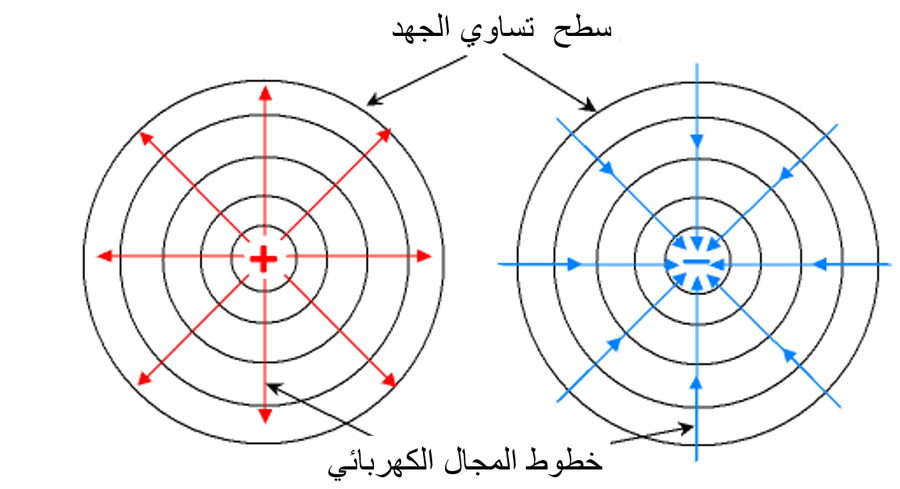
شحنة نقطية: سطوح تساوي الجهد كرات متحدة المركز (موجبة وسالبة)
A point charge: the equipotential surfaces are concentric spheres (positive and negative)
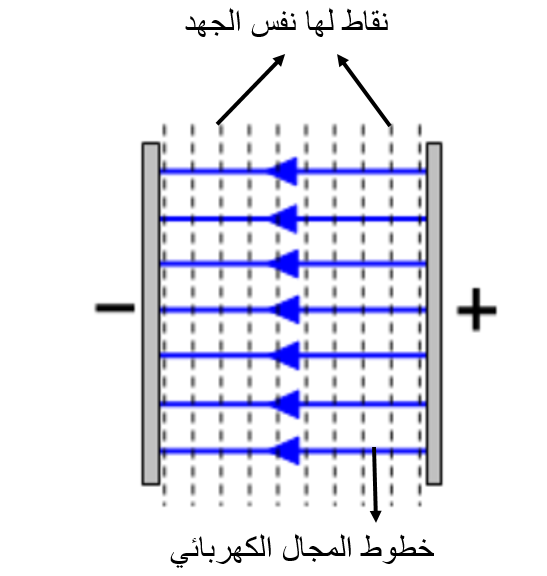
مجال منتظم: سطوح تساوي الجهد مستويات عمودية على الخطوط
Uniform field: the equipotential surfaces are planes perpendicular to the lines
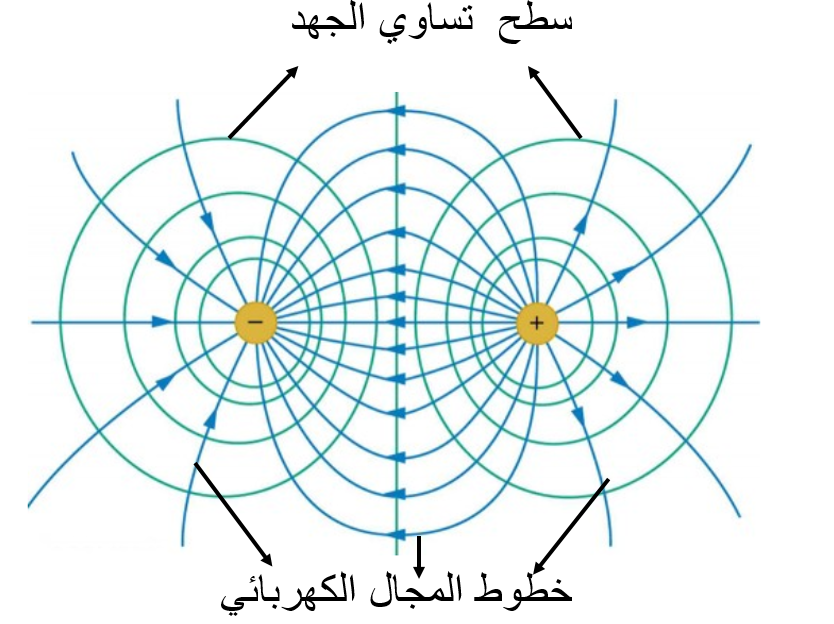
شحنتان مختلفتان: سطوح تساوي الجهد وخطوط المجال
Two different charges: equipotential surfaces and field lines
🧪 تجربة 4: خريطة سطوح تساوي الجهد
🧪 Experiment 4: The Equipotential Map
نرسم خريطة الجهد لشحنتين ونتأكد أن المجال عمودي على سطوح تساوي الجهد.
We draw the potential map of two charges and make sure that the field is perpendicular to the equipotential surfaces.
🛠️ خطوات العمل
🛠️ Procedure
- اضبط شحنتين متساويتين مختلفتين وراقب الخط \\(V=0\\) في المنتصف.Set two equal different charges and watch the line \\(V=0\\) at the middle.
- حرّك P وراقب سهم المجال الأخضر بالنسبة إلى الخطوط.Move P and watch the green field arrow relative to the lines.
- اجعل الشحنتين متشابهتين وقارن الشكل.Make the two charges alike and compare the shape.
🧪 تجربة 4: خريطة سطوح تساوي الجهد لشحنتين
🧪 Experiment 4: Equipotential Map of Two Charges
تُظهر الخريطة الجهد بالألوان (أحمر موجب وأزرق سالب) وخطوط تساوي الجهد. حرّك النقطة P لقراءة \(V\) واتجاه المجال \(\vec E\).
The map shows the potential with colours (red positive and blue negative) and the equipotential lines. Move the point P to read \(V\) and the direction of the field \(\vec E\).
🔎 ماذا نلاحظ؟ وما الاستنتاج؟
🔎 What do we observe? What is the conclusion?
- سهم المجال عمودي على خط تساوي الجهد ويتجه من الأحمر إلى الأزرق.The field arrow is perpendicular to the equipotential line and points from the red to the blue.
- تتقارب الخطوط حيث المجال أقوى.The lines are closer together where the field is stronger.
سطوح تساوي الجهد عمودية دائمًا على خطوط المجال، والمجال يشير نحو الجهد الأقل.
The equipotential surfaces are always perpendicular to the field lines, and the field points toward the lower potential.
📐 فرق الجهد في مجال منتظم
📐 The Potential Difference in a Uniform Field
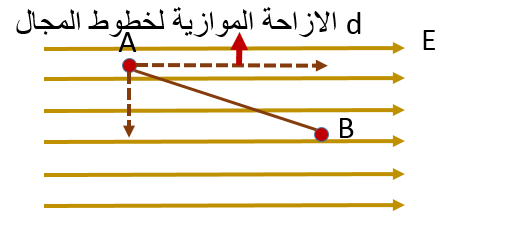
النقطتان A وB في مجال منتظم والإزاحة \(d\) موازية للمجال
Points A and B in a uniform field with the displacement \(d\) parallel to the field
📌 فرق الجهد في مجال منتظم
📌 The potential difference in a uniform field
\[\Delta V_{AB}=-\frac{W_{A\to B}}{q}=-\frac{qEd}{q}=-E\,d\]
يقل الجهد بمقدار \(Ed\) كلما تحركنا مسافة \(d\) باتجاه المجال، ولا يتغير عند الحركة عموديًا عليه. ووحدة المجال تُكتب أيضًا \(\mathrm{V/m}\).
The potential decreases by \(Ed\) every time we move a distance \(d\) along the field, and does not change when moving perpendicular to it. The unit of the field can also be written \(\mathrm{V/m}\).
مجال منتظم \(E=500\ \mathrm{N/C}\). أوجد فرق الجهد بين نقطتين تبعدان \(0.4\ \mathrm m\) على امتداد خط مجال (من الأولى إلى الثانية باتجاه المجال).
A uniform field \(E=500\ \mathrm{N/C}\). Find the potential difference between two points \(0.4\ \mathrm m\) apart along a field line (from the first to the second along the field).
🧪 تجربة 5: فرق الجهد في مجال منتظم
🧪 Experiment 5: The Potential Difference in a Uniform Field
نحرّك نقطتين بين لوحين ونحسب فرق الجهد والشغل ونتحقق من أن الجهد يعتمد على الإحداثي الموازي للمجال فقط.
We move two points between two plates, calculate the potential difference and the work, and verify that the potential depends only on the coordinate parallel to the field.
🛠️ خطوات العمل
🛠️ Procedure
- حرّك \\(x_B\\) باتجاه اللوح السالب وراقب الإشارة.Move \\(x_B\\) toward the negative plate and watch the sign.
- حرّكه نحو اللوح الموجب وقارن.Move it toward the positive plate and compare.
- اجعل \\(x_B=x_A\\) وغيّر \\(y_B\\) فقط.Make \\(x_B=x_A\\) and change \\(y_B\\) only.
🧪 تجربة 5: فرق الجهد في مجال منتظم
🧪 Experiment 5: The Potential Difference in a Uniform Field
بين لوحين مشحونين مجال منتظم. حرّك النقطتين A وB وراقب \(\Delta V_{AB}=-Ed\) وعلاقة الجهد بالموضع.
There is a uniform field between two charged plates. Move the points A and B and watch \(\Delta V_{AB}=-Ed\) and the relation of the potential to position.
🔎 ماذا نلاحظ؟ وما الاستنتاج؟
🔎 What do we observe? What is the conclusion?
- \\(\\Delta V\\) سالب عند الحركة باتجاه المجال وموجب عكسه.\\(\\Delta V\\) is negative when moving along the field and positive against it.
- عند الحركة عموديًا (\\(x\\) ثابتة) يكون \\(\\Delta V=0\\) ويكون الشغل صفرًا.When moving perpendicularly (\\(x\\) constant) \\(\\Delta V=0\\) and the work is zero.
الجهد في المجال المنتظم دالة خطية في \\(x\\): \\(V=-Ex+C\\) ومنحناه خط مستقيم ميله \\(-E\\).
The potential in a uniform field is a linear function of \\(x\\): \\(V=-Ex+C\\) and its graph is a straight line of slope \\(-E\\).
🌀 أمثلة محلولة: التكامل والاشتقاق
🌀 Worked Examples: Integration and Differentiation
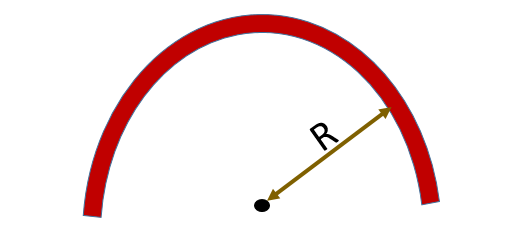
سلك مشحون على شكل نصف دائرة نصف قطرها \(R\) والنقطة في مركزه
A charged wire in the shape of a semicircle of radius \(R\) with the point at its centre
سلك مشحون بانتظام بكثافة \(\lambda=4\times10^{-8}\ \mathrm{C/m}\) مثني على شكل نصف دائرة نصف قطرها \(R\). أوجد الجهد في مركز انحنائه.
A wire uniformly charged with a density \(\lambda=4\times10^{-8}\ \mathrm{C/m}\) is bent into a semicircle of radius \(R\). Find the potential at its centre of curvature.
📌 المجال من الجهد
📌 The field from the potential
\[E_x=-\frac{\partial V}{\partial x}\ ,\quad E_y=-\frac{\partial V}{\partial y}\ ,\quad E_z=-\frac{\partial V}{\partial z}\]
جهد حيز من الفراغ \(V(x,y,z)=5x^2+8xy+7z\) (بالفولت). أوجد المجال عند النقطة \((5,-2,-3)\ \mathrm m\).
The potential of a region of space is \(V(x,y,z)=5x^2+8xy+7z\) (in volts). Find the field at the point \((5,-2,-3)\ \mathrm m\).
🧩 طاقة وضع نظام من الشحنات النقطية
🧩 The Potential Energy of a System of Point Charges
طاقة وضع نظام هي الشغل اللازم لتجميع شحناته من اللانهاية. نحضر الشحنة الأولى (دون شغل \(U=0\))، ثم الثانية فنبذل \(kq_1q_2/r_{12}\)، ثم الثالثة فنبذل \(kq_1q_3/r_{13}+kq_2q_3/r_{23}\). فيكون مجموع الأزواج:
The potential energy of a system is the work needed to assemble its charges from infinity. We bring the first charge (no work, \(U=0\)), then the second for which we do \(kq_1q_2/r_{12}\), then the third for which we do \(kq_1q_3/r_{13}+kq_2q_3/r_{23}\). So the sum over the pairs is:
📌 طاقة وضع نظام شحنات
📌 The potential energy of a system of charges
\[U=k\left(\frac{q_1q_2}{r_{12}}+\frac{q_1q_3}{r_{13}}+\frac{q_2q_3}{r_{23}}\right)=k\sum_{i\lt j}\frac{q_iq_j}{r_{ij}}\]
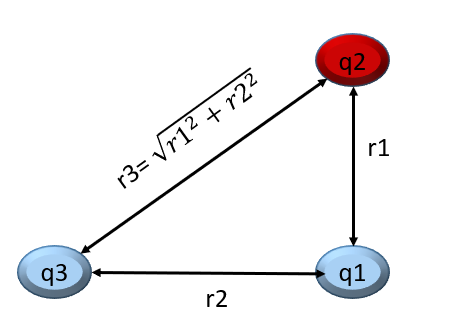
ثلاث شحنات على رؤوس مثلث قائم الزاوية
Three charges on the vertices of a right triangle
ثلاث شحنات \(q_1=+2\ \mu\mathrm C\) و\(q_2=-3\ \mu\mathrm C\) و\(q_3=+4\ \mu\mathrm C\) على رؤوس مثلث قائم: \(r_{12}=0.3\ \mathrm m\) و\(r_{13}=0.4\ \mathrm m\) و\(r_{23}=0.5\ \mathrm m\). أوجد طاقة وضع النظام (\(k=9\times10^{9}\)).
Three charges \(q_1=+2\ \mu\mathrm C\), \(q_2=-3\ \mu\mathrm C\) and \(q_3=+4\ \mu\mathrm C\) on the vertices of a right triangle: \(r_{12}=0.3\ \mathrm m\), \(r_{13}=0.4\ \mathrm m\) and \(r_{23}=0.5\ \mathrm m\). Find the potential energy of the system (\(k=9\times10^{9}\)).
🧪 تجربة 6: طاقة وضع نظام من ثلاث شحنات
🧪 Experiment 6: The Potential Energy of a System of Three Charges
نجمع طاقات الأزواج الثلاثة لشحنات على رؤوس مثلث ونلاحظ أثر الإشارات.
We add the energies of the three pairs of charges on the vertices of a triangle and notice the effect of the signs.
🛠️ خطوات العمل
🛠️ Procedure
- اضبط القيم \\(+2\\) و\\(-3\\) و\\(+4\\ \\mu\\mathrm C\\) وسجّل \\(U_{12}\\) و\\(U_{13}\\) و\\(U_{23}\\).Set the values \\(+2\\), \\(-3\\) and \\(+4\\ \\mu\\mathrm C\\) and record \\(U_{12}\\), \\(U_{13}\\) and \\(U_{23}\\).
- اجعل الشحنات الثلاث موجبة وقارن إشارة \\(U\\).Make the three charges positive and compare the sign of \\(U\\).
- بدّل إشارة إحداها وراقب تأثيرها في المجموع.Change the sign of one of them and watch its effect on the sum.
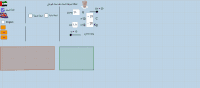
🧪 تجربة 6: طاقة وضع نظام من ثلاث شحنات
🧪 Experiment 6: The Potential Energy of a System of Three Charges
ثلاث شحنات على رؤوس مثلث قائم أطواله \(0.3\), \(0.4\), \(0.5\ \mathrm m\). غيّر الشحنات وتتبع إسهام كل زوج في طاقة الوضع الكلية.
Three charges on the vertices of a right triangle with sides \(0.3\), \(0.4\), \(0.5\ \mathrm m\). Change the charges and follow the contribution of every pair to the total potential energy.
🔎 ماذا نلاحظ؟ وما الاستنتاج؟
🔎 What do we observe? What is the conclusion?
- الزوج المتشابه الشحنة يعطي طاقة موجبة، والمختلف يعطي سالبة.A like pair gives a positive energy and an unlike pair gives a negative one.
- الطاقة الكلية السالبة تعني نظامًا مترابطًا نحتاج شغلًا لتفريقه.A negative total energy means a bound system that needs work to be separated.
طاقة وضع النظام تُجمع على الأزواج مرة واحدة لكل زوج، وإشارتها تحدد هل النظام متنافر (موجبة) أم مترابط (سالبة).
The potential energy of a system is summed over the pairs once for each pair, and its sign tells whether the system is repulsive (positive) or bound (negative).
طاقة وضع نظام من شحنتين مختلفتين في النوع تكون:
The potential energy of a system of two charges of different kinds is:
🚀 تطبيقات
🚀 Applications
أين نصادف الجهد وطاقة الوضع؟
Where do we meet the potential and the potential energy?
- المكثفات وتخزين الطاقة بين الألواح، والبطاريات (فرق جهد بين قطبين).Capacitors storing energy between plates, and batteries (a potential difference between two terminals).
- أنبوب الأشعة المهبطية ومسرّعات الجسيمات: تتسارع الشحنات بفرق جهد \(qV=\tfrac12mv^2\).The cathode ray tube and particle accelerators: the charges accelerate by a potential difference \(qV=\tfrac12mv^2\).
- تخطيط القلب (ECG) وقياس فرق الجهد في الأنظمة البيولوجية، والحماية من الصواعق.The electrocardiogram (ECG) and measuring the potential difference in biological systems, and protection from lightning.
⚠️ أخطاء شائعة
⚠️ Common Mistakes
تجنّب هذه الأخطاء
Avoid these mistakes
- الخلط بين الجهد (\(1/r\)) والمجال (\(1/r^2\)).Confusing the potential (\(1/r\)) with the field (\(1/r^2\)).
- تحليل الجهود كمتجهات بدل جمعها جبريًا بإشاراتها.Resolving the potentials as vectors instead of adding them algebraically with their signs.
- نسيان إشارة الشحنة عند حساب \(\Delta U=q\Delta V\).Forgetting the sign of the charge when calculating \(\Delta U=q\Delta V\).
- الظن أن \(V=0\) يعني \(E=0\) (والعكس).Thinking that \(V=0\) means \(E=0\) (and the opposite).
📚 ملخص
📚 Summary
أهم ما تعلمناه
Key points
- \(\Delta U=-W=-qEd\cos\theta\)؛ \(V=kQ/r\)؛ \(V=k\sum q_i/r_i\) (قياسية).\(\Delta U=-W=-qEd\cos\theta\); \(V=kQ/r\); \(V=k\sum q_i/r_i\) (scalar).
- \(\Delta V=\Delta U/q=-W/q\) و\(\Delta V=-Ed\) في مجال منتظم.\(\Delta V=\Delta U/q=-W/q\) and \(\Delta V=-Ed\) in a uniform field.
- سطوح تساوي الجهد عمودية على المجال ولا يُبذل شغل عليها؛ و\(E=-dV/dx\).The equipotential surfaces are perpendicular to the field and no work is done on them; and \(E=-dV/dx\).
- طاقة وضع نظام \(U=k\sum_{i\lt j}q_iq_j/r_{ij}\).The potential energy of a system \(U=k\sum_{i\lt j}q_iq_j/r_{ij}\).
🧪 اختبر نفسك: امتحان من 20 سؤالاً
🧪 Test Yourself: a 20-Question Exam
أنهِ الدرس بالاختبار التفاعلي التالي؛ أسئلته تجمع بين الفهم والحساب وتغطي جميع أقسام الدرس.
Finish with the interactive exam below; its questions mix understanding with calculation and cover every section of the lesson.
اختبار طاقة الوضع والجهد الكهربائي (12A) Electric Potential Energy and Potential (12A) Quiz
20 سؤالاً - طاقة الوضع والجهد وفرق الجهد وسطوح تساوي الجهد 20 Questions - potential energy, potential, potential difference and equipotential surfaces
• عدد الأسئلة: 20 سؤالاً
• مدة الاختبار: 30 دقيقة
• لا يمكنك تغيير إجاباتك أو إعادة الاختبار إلا بعد 24 ساعة من التسليم.
• تأكد من إجاباتك قبل التسليم! 📌 Important Instructions:
• Number of questions: 20 questions
• Quiz duration: 30 minutes
• You cannot change your answers or retake the quiz for 24 hours after submission.
• Make sure of your answers before submitting!
🔗 محاكيات GeoGebra للاستعانة بها عند اللزوم
🔗 GeoGebra Simulations to Use When Needed
اضغط «تشغيل» لتعمل المحاكاة هنا داخل الدرس؛ ويمكن للطالب الرجوع إليها لتجربة الفكرة بطريقة أخرى.
Press “Run” to run the simulation right here inside the lesson; the student can use it to try the idea in another way.