🎯 نواتج التعلم
🎯 Learning Outcomes
بعد دراسة هذا الدرس ستكون قادرًا على أن:
After this lesson you will be able to:
- تعرّف سطح تساوي الجهد وتفسّر لماذا لا يُبذل شغل عند الحركة عليه وأن المجال عمودي عليه دائمًا.Define an equipotential surface and explain why no work is done when moving on it and why the field is always perpendicular to it.
- ترسم أو تتعرف سطوح تساوي الجهد لشحنة نقطية ولمجال منتظم ولشحنتين متماثلتين ومختلفتين.Draw or recognize the equipotential surfaces of a point charge, a uniform field and two like or unlike charges.
- تحسب الجهد الكهربائي لشحنة نقطية ولمجموعة شحنات بالجمع الجبري \(V=k\sum q_i/r_i\) وتحدد مواضع انعدامه.Calculate the electric potential of a point charge and of a group of charges by the algebraic sum \(V=k\sum q_i/r_i\) and find where it vanishes.
- تحسب فرق الجهد في مجال منتظم \(\Delta V=-Ed\) وتجد المجال من الجهد \(E=-dV/dx\).Calculate the potential difference in a uniform field \(\Delta V=-Ed\) and find the field from the potential \(E=-dV/dx\).
- تحسب طاقة وضع نظام من الشحنات النقطية \(U=k\sum q_iq_j/r_{ij}\) وتفسّر إشارتها.Calculate the potential energy of a system of point charges \(U=k\sum q_iq_j/r_{ij}\) and interpret its sign.
🗺️ سطوح تساوي الجهد
🗺️ Equipotential Surfaces
يمكن لشحنة أن تتحرك بين نقطتين داخل مجال كهربائي دون أن يبذل المجال شغلًا عليها. يحدث ذلك عندما تكون النقطتان لهما الجهد نفسه: فإذا كان \(\Delta V=0\) فإن الشغل الذي يبذله المجال على الشحنة:
A charge can move between two points inside an electric field without the field doing any work on it. This happens when the two points are at the same potential: if \(\Delta V=0\) then the work done by the field on the charge is:
\[\Delta V=-\frac{W}{q}=0\quad\Rightarrow\quad W=0\]
💡 ما هو سطح تساوي الجهد؟
💡 What Is an Equipotential Surface?
سطح تساوي الجهد هو سطح (أو خط في المستوى) تكون جميع نقاطه عند الجهد نفسه. أي حركة لشحنة على هذا السطح لا تتطلب شغلًا. وهذا يقودنا إلى خاصية مهمة جدًا:
An equipotential surface is a surface (or a line in a plane) all of whose points are at the same potential. Moving a charge along it requires no work. This leads to a very important property:
- المجال الكهربائي عمودي دائمًا على سطح تساوي الجهد. السبب: لو كان للمجال مركبة موازية للسطح لبذل شغلًا على شحنة تتحرك على السطح فيتغير الجهد، وهذا يناقض أن الجهد ثابت على السطح.The electric field is always perpendicular to an equipotential surface. Reason: if the field had a component parallel to the surface it would do work on a charge moving along the surface and the potential would change, contradicting that the potential is constant on the surface.
- لا يتقاطع سطحان لهما جهدان مختلفان (وإلا كان للنقطة المشتركة جهدان في آن واحد).Two equipotential surfaces of different potential never cross (otherwise the common point would have two potentials at once).
- يتجه المجال من الجهد الأعلى إلى الجهد الأدنى. وحيث تتقارب السطوح (عند فروق جهد متساوية) يكون المجال أقوى.The field points from higher to lower potential. Where the surfaces (drawn at equal potential steps) are closer together the field is stronger.
1️⃣ شحنة نقطية موجبة أو سالبة
1️⃣ A Single Positive or Negative Point Charge
النقاط التي لها البعد نفسه عن شحنة نقطية (موجبة أو سالبة) لها الجهد نفسه، لأن الجهد يعتمد على \(r\) فقط. فسطوح تساوي الجهد كرات متحدة المركز حول الشحنة (دوائر في الرسم المستوي)، وخطوط المجال أنصاف أقطار تخرج من الموجبة وتدخل في السالبة.
Points at the same distance from a point charge (positive or negative) have the same potential, since the potential depends only on \(r\). The equipotential surfaces are therefore concentric spheres around the charge (circles in a plane drawing), and the field lines are radii leaving a positive charge or entering a negative one.
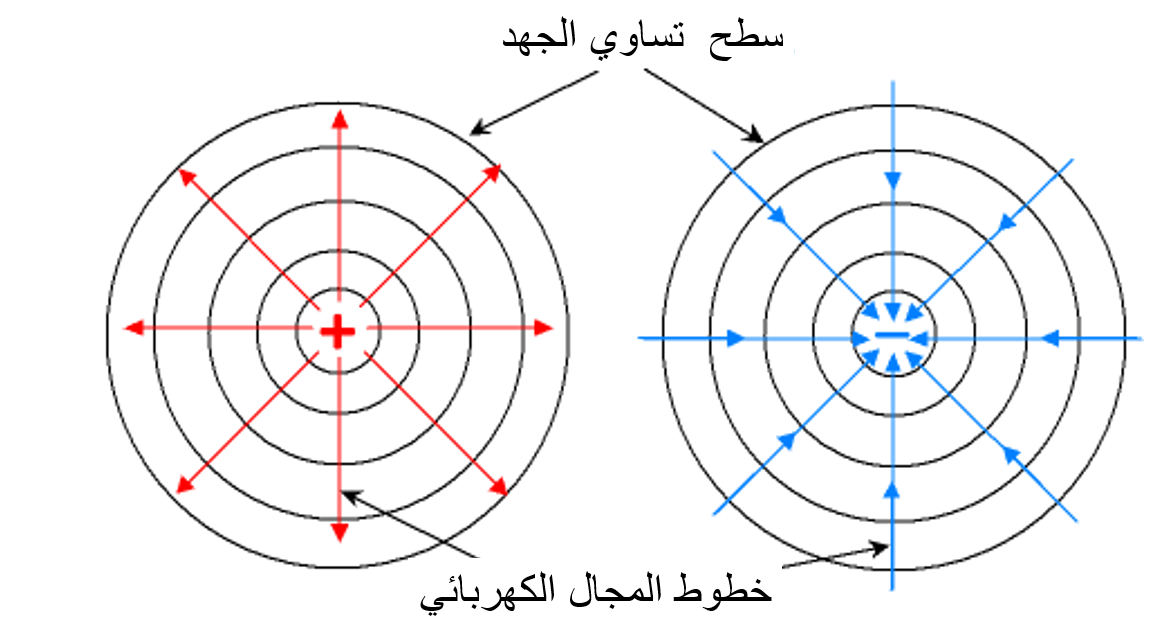
يسار: شحنة موجبة (خطوط المجال إلى الخارج). يمين: شحنة سالبة (خطوط المجال إلى الداخل). الدوائر هي سطوح تساوي الجهد.
Left: a positive charge (field lines outward). Right: a negative charge (field lines inward). The circles are equipotential surfaces.
2️⃣ مجال كهربائي منتظم
2️⃣ A Uniform Electric Field
النقاط الواقعة على مستوٍ عمودي على خطوط المجال المنتظم لها الجهد نفسه، فسطوح تساوي الجهد مستويات متوازية عمودية على خطوط المجال (كما بين لوحين متوازيين مشحونين)، والمسافات بينها متساوية لفروق جهد متساوية.
Points on a plane perpendicular to the lines of a uniform field have the same potential, so the equipotential surfaces are parallel planes perpendicular to the field lines (as between two oppositely charged parallel plates), equally spaced for equal potential steps.
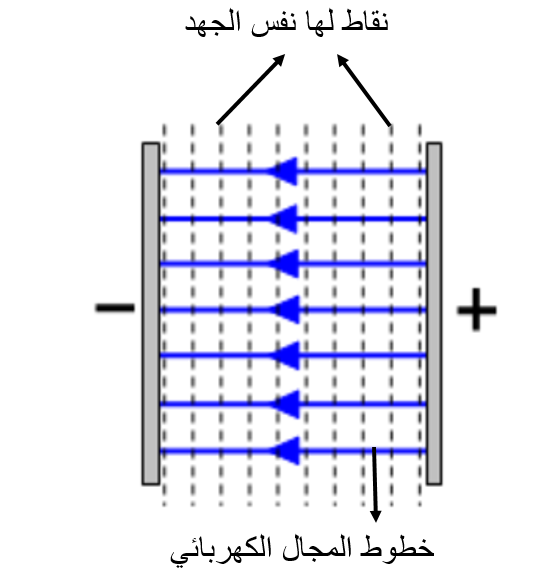
المجال المنتظم: خطوط المجال متوازية وسطوح تساوي الجهد مستويات عمودية عليها.
A uniform field: parallel field lines and equipotential planes perpendicular to them.
3️⃣ شحنتان نقطيتان مختلفتان في النوع (ثنائي القطب)
3️⃣ Two Point Charges of Opposite Sign (a Dipole)
حول كل شحنة منفردة وبالقرب منها تشبه سطوح تساوي الجهد الدوائر التي رأيناها للشحنة المنفردة، لكن الشكل (وكذلك المجال) يختلف في المنطقة الواصلة بين الشحنتين وبعيدًا عنهما. وهناك سطح الجهد الصفري الذي يقطع الخط الواصل بينهما ويتخذ شكل مستوٍ في حالة الشحنتين المتساويتين مقدارًا.
Close around each charge the equipotential surfaces look like the circles of a single charge, but the shape (and the field) differs in the region between the charges and far from them. There is a zero-potential surface crossing the line joining them; for two charges of equal magnitude it is a plane.
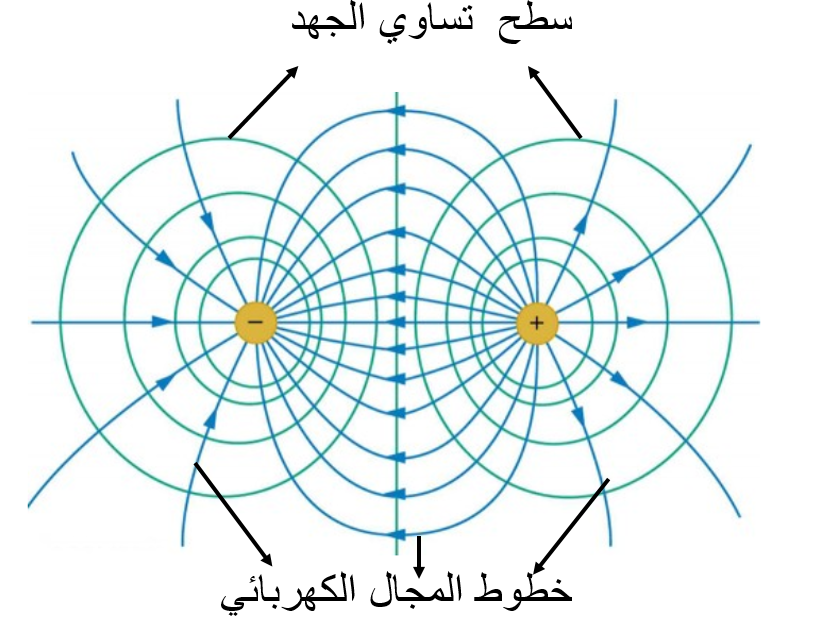
شحنتان مختلفتان في النوع: خطوط المجال تخرج من الموجبة وتدخل في السالبة، وسطوح تساوي الجهد تتعامد معها دائمًا.
Two opposite charges: field lines leave the positive one and enter the negative one, and the equipotentials always cross them at right angles.
4️⃣ شحنتان نقطيتان متماثلتان في النوع
4️⃣ Two Point Charges of the Same Sign
حول كل شحنة منفردة تشبه السطوح دوائر الشحنة المنفردة أيضًا، لكن في المنطقة الواصلة بين الشحنتين يختلف شكلها عن حالة الشحنتين المختلفتين: تلتحم السطوح البعيدة في سطح واحد أكبر يحيط بالشحنتين، وتوجد نقطة بينهما (عند التماثل منتصف المسافة) ينعدم عندها المجال مع أن الجهد لا ينعدم. وبعيدًا عن الشحنتين تبدو السطوح كدوائر لشحنة واحدة مجموعها.
Around each charge the surfaces again resemble the single-charge circles, but between the charges the picture differs from the opposite-sign case: farther surfaces merge into one larger surface enclosing both charges, and there is a point between them (the midpoint, for equal charges) where the field vanishes even though the potential does not. Far away the surfaces look like circles around a single charge equal to the total.
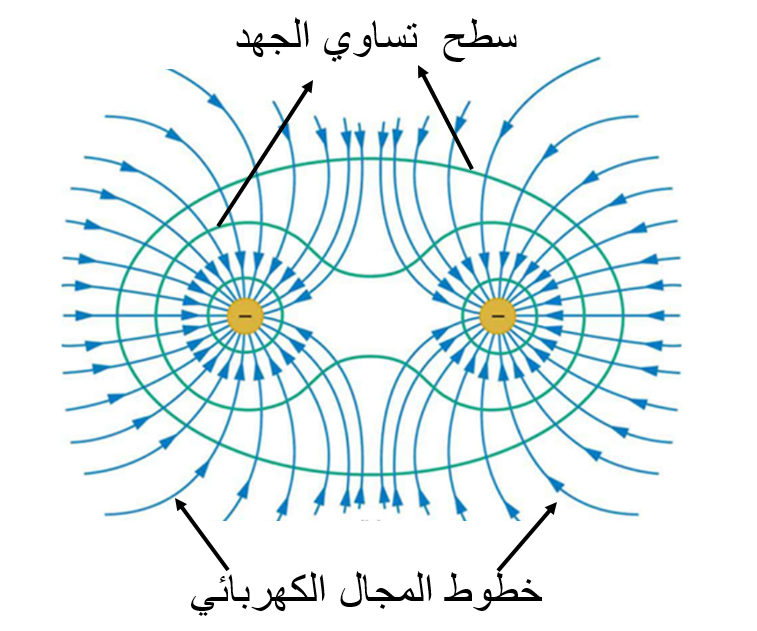
شحنتان من النوع نفسه: خطوط المجال لا تتقاطع بل تتنافر، وتنعدم شدة المجال عند نقطة المنتصف.
Two like charges: the field lines repel one another rather than cross, and the field vanishes at the midpoint.
شحنة اختبار \(q\) تتحرك بين نقطتين تقعان على سطح تساوي الجهد نفسه. فإن الشغل الذي يبذله المجال الكهربائي عليها يعادل:
A test charge \(q\) moves between two points on the same equipotential surface. The work done on it by the electric field is:
🧪 تجربة: خريطة سطوح تساوي الجهد
🧪 Experiment: The Equipotential Map
في التجربة التالية اضبط شحنتي النقطتين (يمكن أن تكونا موجبتين أو سالبتين أو مختلفتين) والمسافة بينهما، وستظهر خريطة الجهد مع خطوط تساوي الجهد كل \(10\ V\). اضغط على أي نقطة في الخريطة (أو اسحب) لتضع مجسًّا يقرأ الجهد والمجال عنده ويرسم سطح الجهد الذي يمر به. فعّل «متجهات المجال» لترى أنها تتعامد مع خطوط تساوي الجهد.
In the next experiment set the two point charges (positive, negative or one of each) and their separation, and you will see the potential map with equipotential lines every \(10\ V\). Click (or drag) anywhere on the map to place a probe that reads the potential and the field there and draws the equipotential through it. Switch on “field vectors” to see that they cross the equipotential lines at right angles.
🧪 تجربة 1: خريطة سطوح تساوي الجهد لشحنتين
🧪 Experiment 1: Equipotential Map of Two Charges
الألوان: أحمر = جهد موجب، أزرق = جهد سالب، والخطوط السوداء تساوي الجهد كل \(10\ V\) (الخط الأسمك هو \(0\ V\)). اضغط على الخريطة أو اسحب لتحريك المجس. جرّب: شحنتان متساويتان مختلفتان في النوع، ثم متماثلتان، ثم شحنة صغيرة بجوار كبيرة.
Colors: red = positive potential, blue = negative; the black lines are equipotentials every \(10\ V\) (the thick line is \(0\ V\)). Click or drag on the map to move the probe. Try: two equal charges of opposite sign, then of the same sign, then a small charge next to a large one.
⚡ الجهد الكهربائي لتوزيعات الشحنات
⚡ Electric Potential of Charge Distributions
📜 تعريف الجهد
📜 Definition of Potential
الجهد الكهربائي عند نقطة هو الشغل اللازم (الذي تبذله قوة خارجية) لنقل شحنة اختبار من اللانهاية إلى تلك النقطة مقسومًا على شحنة الاختبار (مع الجهد عند اللانهاية صفر). ويُعبَّر عنه بالشغل الذي يبذله المجال على الشحنة بإشارة سالبة:
The electric potential at a point is the work needed (done by an external force) to bring a test charge from infinity to that point, divided by the test charge (taking the potential at infinity as zero). Equivalently, in terms of the work done by the field on the charge, with a minus sign:
\[\Delta V=V_f-V_i=-\frac{W_{\infty\to r}}{q}=-\int_{\infty}^{r}\frac{\vec F\cdot d\vec s}{q}=-\int_{\infty}^{r}\vec E\cdot d\vec s\]
وحدة الجهد الفولت \(1\ V=1\ J/C\).
The unit of potential is the volt, \(1\ V=1\ J/C\).
✍️ اشتقاق جهد شحنة نقطية
✍️ Deriving the Potential of a Point Charge
لشحنة نقطية \(q\) مجالها على بعد \(r\) هو \(E=\dfrac{kq}{r^2}\) في الاتجاه القطري. نكامل من اللانهاية إلى \(r\) (والتكامل على المسار القطري \(d\vec s=dr\)):
A point charge \(q\) produces a field \(E=\dfrac{kq}{r^2}\) in the radial direction. Integrating from infinity to \(r\) (along a radial path \(d\vec s=dr\)):
\[\Delta V=-\int_{\infty}^{r}\frac{kq}{r^2}\,dr=-kq\left[-\frac{1}{r}\right]_{\infty}^{r}=\frac{kq}{r}\;\;\Rightarrow\;\;V_r-V_\infty=V_r-0=\frac{kq}{r}\]
📜 جهد شحنة نقطية والمبدأ التراكبي
📜 Potential of a Point Charge and Superposition
\[V=\frac{kq}{r}\qquad\qquad V_{net}=\sum_i\frac{kq_i}{r_i}\]
- الجهد كمية قياسية (لا اتجاه له): نجمع جهود الشحنات عند النقطة جبريًّا مع إشارة كل شحنة، على عكس المجال الذي نجمعه اتجاهيًّا.Potential is a scalar (no direction): we add the potentials of the charges at the point algebraically with each charge’s sign, unlike the field, which is added as a vector.
- جهد شحنة موجبة موجب وجهد شحنة سالبة سالب، ويقل مقداره بالابتعاد بنسبة \(1/r\) (أبطأ من المجال \(1/r^2\)).The potential of a positive charge is positive and of a negative charge negative, and its magnitude falls as \(1/r\) (more slowly than the field’s \(1/r^2\)).
- الثابت \(k=\dfrac{1}{4\pi\epsilon_0}=9\times10^9\ N\cdot m^2/C^2\).The constant \(k=\dfrac{1}{4\pi\epsilon_0}=9\times10^9\ N\cdot m^2/C^2\).
💡 تنبيه: الجهد الصفري لا يعني المجال الصفري
💡 Careful: Zero Potential Does Not Mean Zero Field
عند منتصف شحنتين متساويتين مقدارًا ومختلفتين في النوع يكون الجهد صفرًا (الجهدان متساويان مقدارًا ومتعاكسان) لكن المجال لا ينعدم (يجمعان في الاتجاه نفسه). وعند منتصف شحنتين متماثلتين ينعدم المجال لكن الجهد لا ينعدم (يجمعان). فالجهد والمجال كميتان مختلفتان؛ العلاقة بينهما هي معدل تغيّر الجهد مع الموضع (سنراها لاحقًا).
At the midpoint of two charges of equal magnitude and opposite sign the potential is zero (the two potentials are equal and opposite) but the field is not zero (the fields add in the same direction). At the midpoint of two like charges the field vanishes but the potential does not (the potentials add). Potential and field are different quantities\; the relation between them is the rate of change of potential with position (seen later).
🧪 تجربة 2: حساب الجهد الكلي عند نقطة (كمية قياسية)
🧪 Experiment 2: The Net Potential at a Point (a Scalar)
ضع حتى ثلاث شحنات (مقدار كل شحنة بالنانوكولوم وموضعها بالأمتار) ونقطة الحساب، ثم اضغط «احسب». سيُظهر البرنامج جهد كل شحنة \(\dfrac{kq}{r}\) ثم مجموعها الجبري. غيّر إشارات الشحنات وتأكد أن الجهد كمية قياسية (لا يحتاج إلى اتجاهات). ضع \(q=0\) لتعطيل شحنة.
Place up to three charges (each in nC with its position in meters) and the evaluation point, then press “Calculate”. The program shows each charge’s potential \(\dfrac{kq}{r}\) and then their algebraic sum. Change the signs and confirm that potential is a scalar (no directions needed). Set \(q=0\) to disable a charge.
| q (nC) | x (m) | y (m) | |
|---|---|---|---|
| 1 | |||
| 2 | |||
| 3 | |||
| نقطة الحسابPoint |
شحنتان نقطيتان: \(+3\ nC\) و \(-3\ nC\) تفصل بينهما \(0.4\ m\). فإن الجهد الكهربائي عند منتصف المسافة بينهما يعادل:
Two point charges, \(+3\ nC\) and \(-3\ nC\), are \(0.4\ m\) apart. The electric potential at the midpoint between them is:
🎯 نقطة انعدام الجهد على الخط الواصل بين شحنتين
🎯 The Zero-Potential Point on the Line Between Two Charges
في الشكل شحنتان: الأولى سالبة \(q_1=-4\ nC\) عند نقطة الأصل، والثانية موجبة \(q_2=6\ nC\) على بعد \(0.4\ m\) منها. أين تقع نقطة انعدام الجهد على الخط الواصل بين الشحنتين؟
In the figure the first charge is negative, \(q_1=-4\ nC\), at the origin, and the second is positive, \(q_2=6\ nC\), \(0.4\ m\) away. Where is the zero-potential point on the line between the charges?
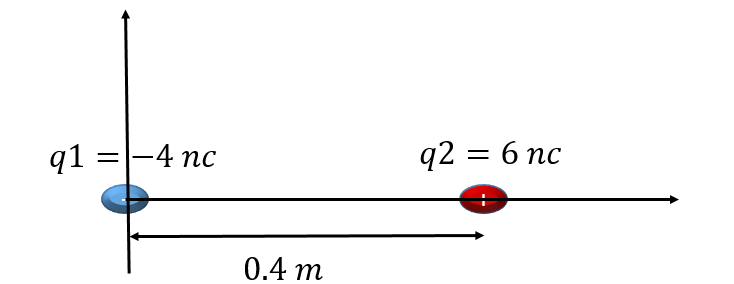
في الشكل أعلاه (شحنة سالبة \(-4\ nC\) عند نقطة الأصل وموجبة \(6\ nC\) على بعد \(0.4\ m\))، نقطة انعدام الجهد على الخط الواصل بين الشحنتين تقع عند الموقع:
In the figure above (a \(-4\ nC\) charge at the origin and a \(6\ nC\) charge \(0.4\ m\) away), the zero-potential point on the line between the charges is at:
🔋 فرق الجهد الكهربائي في مجال منتظم
🔋 Potential Difference in a Uniform Field
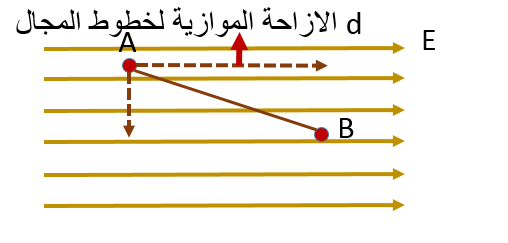
نقطتان A وB في مجال منتظم: المهم هو الإزاحة \(d\) الموازية لخطوط المجال.
Two points A and B in a uniform field: what matters is the displacement \(d\) parallel to the field lines.
في مجال منتظم \(E\) تتأثر الشحنة \(q\) بقوة ثابتة \(F=qE\). فالشغل الذي يبذله المجال عند تحرك الشحنة مسافة \(d\) بموازاة المجال هو \(W=qEd\)، ومنه:
In a uniform field \(E\) a charge \(q\) feels a constant force \(F=qE\). The work done by the field when the charge moves a distance \(d\) parallel to the field is \(W=qEd\), hence:
📜 العلاقة بين الجهد والمجال المنتظم
📜 Potential and a Uniform Field
\[\Delta V_{AB}=V_B-V_A=-\frac{W_{A\to B}}{q}=-\frac{qEd}{q}=-E\,d\]
- \(d\) هي مركبة الإزاحة من \(A\) إلى \(B\) في اتجاه المجال (موجبة إذا تحركنا مع المجال وسالبة إذا تحركنا عكسه). الحركة عموديًا على المجال لا تغيّر الجهد (\(d=0\)).\(d\) is the component of the displacement from \(A\) to \(B\) along the field (positive if we move with the field, negative if against it). Moving perpendicular to the field does not change the potential (\(d=0\)).
- الجهد يقل في اتجاه المجال ويزداد عكسه. فمع المجال \(\Delta V\lt 0\) وعكسه \(\Delta V\gt 0\).The potential decreases along the field and increases against it. Moving with the field \(\Delta V\lt 0\), against it \(\Delta V\gt 0\).
- تُقاس شدة المجال أيضًا بوحدة \(V/m\) وهي تكافئ \(N/C\).Field strength can also be measured in \(V/m\), equivalent to \(N/C\).
🧪 تجربة 3: فرق الجهد في مجال منتظم
🧪 Experiment 3: Potential Difference in a Uniform Field
اضبط شدة المجال واتجاهه، وحرّك النقطتين \(A\) و\(B\). يحسب البرنامج مركبة الإزاحة بموازاة المجال \(d\) ثم \(\Delta V_{AB}=-Ed\). جرّب: \(B\) في اتجاه المجال، ثم عكسه، ثم عموديًا عليه (تحصل على \(\Delta V=0\): النقطتان على سطح تساوي الجهد نفسه).
Set the field strength and direction, and move points \(A\) and \(B\). The program finds the displacement component along the field \(d\) and then \(\Delta V_{AB}=-Ed\). Try: \(B\) along the field, then against it, then perpendicular to it (you get \(\Delta V=0\): the points lie on the same equipotential surface).
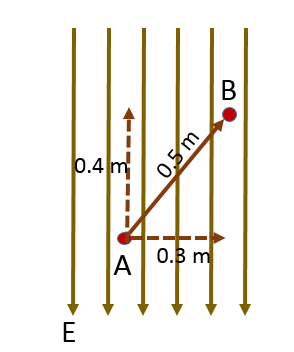
في الشكل مجال منتظم شدته \(E=500\ N/C\) متجه إلى الأسفل. النقطتان \(A\) و \(B\) والأبعاد على الرسم. فإن فرق الجهد \(\Delta V_{AB}=V_B-V_A\) يعادل:
The figure shows a uniform field of strength \(E=500\ N/C\) pointing downward. Points \(A\) and \(B\) and the distances are shown. The potential difference \(\Delta V_{AB}=V_B-V_A\) is:
🌈 جهد توزيع متصل للشحنة
🌈 Potential of a Continuous Charge Distribution
عندما تكون الشحنة موزعة على جسم (سلك أو حلقة...) نقسّمه إلى عناصر صغيرة شحنة كل منها \(dq\) تعتبر نقطية، ونجمع (نكامل) جهودها \(dV=\dfrac{k\,dq}{r}\) (جمع قياسي، لا مركبات!). وإذا كانت الشحنة موزعة على طول بكثافة \(\lambda\) (شحنة لكل وحدة طول) فإن \(dq=\lambda\,dL\).
When charge is spread over a body (a wire, a ring...) we split it into tiny elements, each of charge \(dq\) treated as a point charge, and add (integrate) their potentials \(dV=\dfrac{k\,dq}{r}\) (a scalar sum, no components!). If the charge is spread along a length with density \(\lambda\) (charge per unit length) then \(dq=\lambda\,dL\).
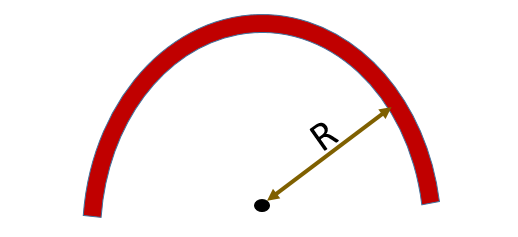
سلك مشحون بانتظام على امتداد طوله بكثافة شحنة \(\lambda=4\times10^{-8}\ C/m\)، ثُني على شكل نصف دائرة نصف قطرها \(R\). احسب جهد نقطة في مركز انحناء السلك.
A wire is uniformly charged along its length with linear charge density \(\lambda=4\times10^{-8}\ C/m\) and bent into a semicircle of radius \(R\). Find the potential at the center of curvature of the wire.
🧭 إيجاد المجال الكهربائي من الجهد
🧭 Finding the Electric Field from the Potential
عرفنا أن \(\Delta V=-\int\vec E\cdot d\vec s\). وبالعكس: من الشغل الذي يبذله المجال في إزاحة صغيرة \(d\vec s\):
We saw that \(\Delta V=-\int\vec E\cdot d\vec s\). Conversely, from the work done by the field in a small displacement \(d\vec s\):
\[dW=q\,\vec E\cdot d\vec s,\quad dW=-q\,dV\;\Rightarrow\;E_s=-\frac{dV}{ds}\]
\[E_x=-\frac{\partial V}{\partial x},\qquad E_y=-\frac{\partial V}{\partial y},\qquad E_z=-\frac{\partial V}{\partial z}\]
💡 ماذا تقول هذه العلاقة؟
💡 What Does This Relation Say?
- المجال هو سالب معدل تغيّر الجهد مع الموضع (ميل منحنى الجهد). فحيث يتغير الجهد بسرعة (سطوح متقاربة) يكون المجال كبيرًا، وحيث الجهد ثابت (على السطح) تكون مركبة المجال على السطح صفرًا.The field is the negative rate of change of potential with position (the slope of the potential). Where the potential changes quickly (surfaces close together) the field is large, and where the potential is constant (along a surface) the field component along it is zero.
- إشارة السالب: المجال يتجه نحو تناقص الجهد.The minus sign: the field points toward decreasing potential.
- عندما يتعلق الجهد بأكثر من إحداثي نستخدم المشتقات الجزئية (نشتق بالنسبة لإحداثي واحد ونعتبر الباقي ثوابت).When the potential depends on several coordinates we use partial derivatives (differentiate with respect to one coordinate treating the others as constants).
الجهد الكهربائي في حيز من الفراغ يعطى بالعلاقة \(V(x,y,z)=5x^2+8xy+7z\) (بالفولت والإحداثيات بالمتر). احسب المجال الكهربائي عند النقطة \((5,\,-2,\,-3)\).
The electric potential in a region of space is given by \(V(x,y,z)=5x^2+8xy+7z\) (in volts, coordinates in meters). Find the electric field at the point \((5,\,-2,\,-3)\).
🔋 طاقة الوضع الكهربائية لنظام من الشحنات النقطية
🔋 Electric Potential Energy of a System of Point Charges
طاقة الوضع الكهربائية للنظام هي الشغل الذي يبذله عامل خارجي لتجميع الشحنات من اللانهاية (حيث طاقة الوضع صفر) في أوضاعها النهائية. من تعريف الجهد \(V=\dfrac{U}{q}\): الطاقة لشحنة اختبار \(q\) موضوعة عند نقطة جهدها \(V\) هي \(U=qV\)، ولشحنة \(q\) عند بعد \(r\) من شحنة \(Q\):
The electric potential energy of a system is the work done by an external agent in assembling the charges from infinity (where the potential energy is zero) into their final positions. From the definition \(V=\dfrac{U}{q}\): the energy of a test charge \(q\) placed at a point of potential \(V\) is \(U=qV\), and for a charge \(q\) at a distance \(r\) from a charge \(Q\):
\[U=qV=q\,\frac{kQ}{r}=k\,\frac{Q\,q}{r}\]
💡 معنى إشارة طاقة الوضع
💡 What the Sign of U Means
- \(U\gt 0\) (شحنتان من النوع نفسه): تتنافران، ولا بد من بذل شغل موجب لتقريبهما، وإذا تُركتا حرّتين ابتعدتا وتحولت الطاقة إلى حركية.\(U\gt 0\) (like charges): they repel\; positive work must be done to bring them together, and if released they fly apart and the energy becomes kinetic.
- \(U\lt 0\) (شحنتان مختلفتان): تتجاذبان، والنظام «مقيَّد»؛ ولفصلهما إلى اللانهاية يلزم شغل خارجي موجب مقداره \(|U|\).\(U\lt 0\) (unlike charges): they attract\; the system is “bound”, and separating them to infinity requires external work equal to \(|U|\).
- طاقة الوضع كمية قياسية تُحسب بإشارات الشحنات، وصفرها عند الانفصال اللانهائي.Potential energy is a scalar, computed with the signs of the charges, and is zero for infinite separation.
🧱 تجميع ثلاث شحنات خطوة بخطوة
🧱 Assembling Three Charges Step by Step
لدينا ثلاث شحنات على رؤوس مثلث قائم الزاوية كما في الشكل (الزاوية القائمة عند \(q_1\)). نحسب طاقة النظام بإحضار الشحنات من اللانهاية واحدة بعد أخرى:
Three charges sit at the vertices of a right triangle as shown (the right angle is at \(q_1\)). We find the energy of the system by bringing the charges in from infinity one at a time:
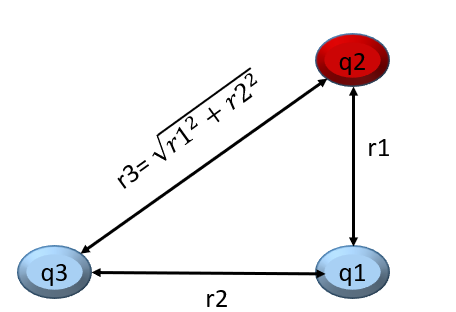
النظام النهائي: \(r_3=\sqrt{r_1^2+r_2^2}\).
The final system: \(r_3=\sqrt{r_1^2+r_2^2}\).
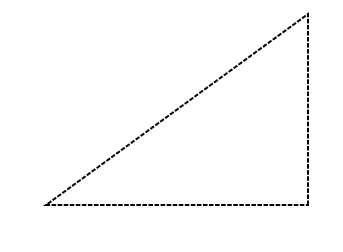
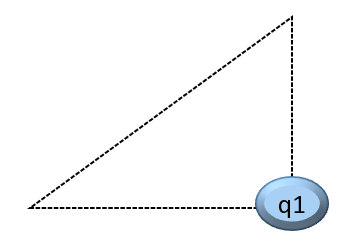
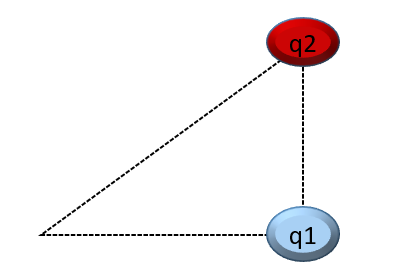
الخطوات: (1) الشحنات في اللانهاية، (2) نحضر \(q_1\) وحدها، (3) نحضر \(q_2\) بجوار \(q_1\).
Steps: (1) charges at infinity, (2) bring in \(q_1\) alone, (3) bring \(q_2\) next to \(q_1\).
📜 خطوات التجميع
📜 The Assembly Steps
- الشحنة الأولى وحدها (لا مجال يؤثر فيها): \(U_1=0\).The first charge alone (no field acts on it): \(U_1=0\).
- إحضار \(q_2\) بجوار \(q_1\) على بعد \(r_1\): \(U_{12}=k\dfrac{q_1q_2}{r_1}\).Bringing \(q_2\) next to \(q_1\) at distance \(r_1\): \(U_{12}=k\dfrac{q_1q_2}{r_1}\).
- إحضار \(q_3\) بجوار \(q_1\) و\(q_2\) (تؤثران فيها معًا): تُضاف طاقتا الزوجين \(k\dfrac{q_1q_3}{r_2}+k\dfrac{q_2q_3}{r_3}\).Bringing \(q_3\) in next to \(q_1\) and \(q_2\) (both act on it): add the energies of the two new pairs \(k\dfrac{q_1q_3}{r_2}+k\dfrac{q_2q_3}{r_3}\).
\[U=k\frac{q_1q_2}{r_1}+k\frac{q_1q_3}{r_2}+k\frac{q_2q_3}{\sqrt{r_1^2+r_2^2}}\]
قاعدة عامة: طاقة النظام = مجموع طاقة كل زوج من الشحنات \(U=\sum_{i\lt j}k\dfrac{q_iq_j}{r_{ij}}\)، فنظام من \(n\) شحنة فيه \(\dfrac{n(n-1)}{2}\) زوجًا (ثلاثة أزواج لثلاث شحنات). والترتيب الذي نُحضر به الشحنات لا يغيّر الطاقة النهائية.
General rule: the energy of the system = the sum over every pair of charges \(U=\sum_{i\lt j}k\dfrac{q_iq_j}{r_{ij}}\), so a system of \(n\) charges has \(\dfrac{n(n-1)}{2}\) pairs (three pairs for three charges). The order in which the charges are brought in does not change the final energy.
في الشكل: \(q_1=+2\ nC\) عند الزاوية القائمة، و\(q_2=+3\ nC\) على بعد \(r_1=0.3\ m\) منها، و\(q_3=-4\ nC\) على بعد \(r_2=0.4\ m\) منها. احسب طاقة الوضع الكهربائية للنظام.
In the figure: \(q_1=+2\ nC\) at the right-angle vertex, \(q_2=+3\ nC\) at \(r_1=0.3\ m\) from it, and \(q_3=-4\ nC\) at \(r_2=0.4\ m\) from it. Find the electric potential energy of the system.
شحنتان نقطيتان \(+3\ nC\) و \(-2\ nC\) تفصل بينهما \(0.1\ m\). ما طاقة الوضع الكهربائية للنظام؟
Two point charges, \(+3\ nC\) and \(-2\ nC\), are \(0.1\ m\) apart. What is the electric potential energy of the system?
🧪 تجربة 4: طاقة الوضع لثلاث شحنات
🧪 Experiment 4: Potential Energy of Three Charges
غيّر الشحنات الثلاث والمسافتين \(r_1\) و\(r_2\) (الزاوية القائمة عند \(q_1\)) ولاحظ طاقة كل زوج ومجموعها. تتبّع خطوات التجميع: الأولى وحدها صفر، ثم الثانية، ثم الثالثة. لاحظ متى تصبح الطاقة سالبة (نظام مقيَّد) ومتى موجبة.
Change the three charges and the distances \(r_1\) and \(r_2\) (right angle at \(q_1\)) and watch the energy of each pair and their total. Follow the assembly steps: the first alone is zero, then the second, then the third. Notice when the energy becomes negative (bound system) and when positive.
| الخطوةStep | الطاقة المضافة (J)Energy added (J) | طاقة النظام حتى الآن (J)System energy so far (J) |
|---|---|---|
| 1) إحضار \(q_1\)1) bring in \(q_1\) | 0 | 0 |
| 2) إحضار \(q_2\): \(U_{12}\)2) bring in \(q_2\): \(U_{12}\) | 0 | 0 |
| 3) إحضار \(q_3\): \(U_{13}+U_{23}\)3) bring in \(q_3\): \(U_{13}+U_{23}\) | 0 | 0 |
📝 ملخص الدرس
📝 Lesson Summary
- سطح تساوي الجهد: جهده ثابت، والشغل عليه صفر، والمجال عمودي عليه ويتجه نحو الجهد الأقل.Equipotential surface: constant potential, zero work along it, with the field perpendicular to it and pointing toward lower potential.
- \(V=\dfrac{kq}{r}\) لشحنة نقطية، والجهد الكلي مجموع جبري: \(V=\sum\dfrac{kq_i}{r_i}\).\(V=\dfrac{kq}{r}\) for a point charge, and the net potential is an algebraic sum: \(V=\sum\dfrac{kq_i}{r_i}\).
- في المجال المنتظم \(\Delta V_{AB}=-Ed\) (\(d\) مركبة الإزاحة بموازاة المجال).In a uniform field \(\Delta V_{AB}=-Ed\) (\(d\) is the displacement component parallel to the field).
- المجال من الجهد: \(E_x=-\dfrac{\partial V}{\partial x}\) وهكذا.Field from potential: \(E_x=-\dfrac{\partial V}{\partial x}\) and so on.
- \(U=k\dfrac{q_1q_2}{r}\) لزوج، ولنظام: مجموع طاقات جميع الأزواج؛ \(U\lt 0\) نظام مقيَّد و\(U\gt 0\) نظام متنافر.\(U=k\dfrac{q_1q_2}{r}\) for a pair, and for a system the sum over all pairs\; \(U\lt 0\) bound, \(U\gt 0\) repulsive.
🧪 اختبر نفسك: امتحان من 20 سؤالاً
🧪 Test Yourself: a 20-Question Exam
أنهِ الدرس بالاختبار التفاعلي التالي؛ أسئلته بمستوى متوسط وعالٍ وتجمع بين الفهم والحساب.
Finish with the interactive exam below; its questions are of medium and high difficulty and mix understanding with calculation.
اختبار سطوح تساوي الجهد وطاقة الوضع Equipotential Surfaces and Potential Energy Quiz
20 سؤالاً - سطوح تساوي الجهد، جهد الشحنات النقطية، المجال والجهد، وطاقة الوضع 20 Questions - Equipotentials, Potential of Point Charges, Field and Potential, and Potential Energy
• عدد الأسئلة: 20 سؤالاً
• مدة الاختبار: 30 دقيقة
• لا يمكنك تغيير إجاباتك أو إعادة الاختبار إلا بعد 24 ساعة من التسليم.
• تأكد من إجاباتك قبل التسليم! 📌 Important Instructions:
• Number of questions: 20 questions
• Quiz duration: 30 minutes
• You cannot change your answers or retake the quiz for 24 hours after submission.
• Make sure of your answers before submitting!
🔗 محاكيات GeoGebra للاستعانة بها عند اللزوم
🔗 GeoGebra Simulations to Use When Needed
اضغط «تشغيل» لتعمل المحاكاة هنا داخل الدرس؛ ويمكن للطالب الرجوع إليها لتجربة الفكرة بطريقة أخرى.
Press “Run” to run the simulation right here inside the lesson; the student can use it to try the idea in another way.