✅ حلول مفصّلة لكل سؤال📂 الموجات🎯 مستوى سهل إلى متوسط
للتواصل: 00971504825082
🔹 ما هي الموجة؟
🔹 What is a Wave?
الموجة: اضطراب ينقل الطاقة خلال المادة أو الفضاء دون أن يحدث انتقال لجزيئات المادة.Wave: a disturbance that transfers energy through matter or space without transferring the medium's particles.
الوسط: المادة التي تنتقل من خلالها الموجة.Medium: the material through which the wave travels.
تتنوع الموجات إلى ميكانيكية (تحتاج وسطًا، مثل الصوت) وكهرومغناطيسية (لا تحتاج وسطًا)، وإلى مستعرضة (تهتز عموديًا على اتجاه الانتشار) وطولية (تهتز موازية له) — راجع درس أنواع الأمواج لتفصيل هذه الأنواع بالصور والمحاكيات.
Waves are mechanical (need a medium, e.g. sound) or electromagnetic (no medium needed), and transverse (particles vibrate perpendicular to propagation) or longitudinal (parallel). See the Types of Waves lesson for full detail with images and simulations.
📏 خصائص الموجة والمصطلحات
📏 Wave Properties and Terminology
للموجات خصائص وثيقة الصلة بخصائص اهتزازات الجسيمات — يُعرَّف الزمن الدوري والتردد والسعة بنفس طريقة تذبذبات الجسيمات:
Wave properties closely mirror particle-oscillation properties — period, frequency, and amplitude are defined the same way:
الزمن الدوري (T): الزمن اللازم لعمل اهتزازة كاملة (وحدته: الثانية).Period (T): time for one complete oscillation (unit: second).
التردد (f): عدد الاهتزازات في الثانية الواحدة (وحدته: هرتز).Frequency (f): oscillations per second (unit: Hertz).
السعة (A): أقصى إزاحة عن موضع الاتزان (وحدتها: المتر).Amplitude (A): maximum displacement from equilibrium (unit: meter).
الطول الموجي (λ): المسافة من قمة إلى أخرى، أو بين أي نقطتين متتاليتين متفقتين بالطور (وحدته: المتر).Wavelength (λ): distance from one crest to the next, or between two consecutive in-phase points (unit: meter).
🎯 استكشاف خصائص الموجة🎯 Explore Wave Properties
💡 تعتمد سرعة الموجة على الوسيط الذي تنتقل عبره فقط، وليس على ترددها أو طولها الموجي. أما تردد الموجة فيحدده المصدر، ولا يعتمد على الوسط الذي تنتقل خلاله.💡 Wave speed depends only on the medium — not on frequency or wavelength. Frequency is set by the source and doesn't depend on the medium.
🔹 معادلة الموجة
🔹 Wave Equation
يعتمد الطول الموجي على كل من سرعة الموجة وترددها:
Wavelength depends on both wave speed and frequency:
\[ v = f\lambda \quad\Leftrightarrow\quad \lambda=\frac{v}{f} \]
📊 تمثيل الموجة بيانيًا📊 Graphical Representation of a Wave
📌 ملخص: الموجات تنقل الطاقة دون نقل المادة؛ الموجات الميكانيكية تحتاج وسطًا؛ الموجات المستعرضة تهتز عموديًا على اتجاهها والطولية موازية له؛ سرعة الموجة تعتمد على الوسط فقط؛ ومعادلة الموجة \(v=f\lambda\).📌 Summary: waves transfer energy without matter; mechanical waves need a medium; transverse waves vibrate perpendicular to their direction, longitudinal ones parallel; wave speed depends only on the medium; and the wave equation is \(v=f\lambda\).
📝 أسئلة الاختيار من متعدد (30 سؤالًا)
📝 Multiple-Choice Questions (30)
\[1\,\star\]
ما تعريف الموجة في الفيزياء؟What is the definition of a wave in physics?
انتقال جزيئات المادة من مكان إلى آخرMovement of matter's particles from place to place
اضطراب ينقل الطاقة خلال المادة أو الفضاء دون انتقال لجزيئات المادةA disturbance transferring energy through matter/space without transferring particles
تغير في درجة حرارة المادةA change in the material's temperature
حركة دائرية للجسيماتCircular motion of particles
الحلSolution
الموجة اضطراب ينقل الطاقة دون نقل جزيئات المادة.
✅ الإجابة الصحيحة: B
A wave is a disturbance that transfers energy without transferring the medium's particles.
✅ Correct answer: B
\[2\,\star\]
ما هو الوسط في الموجات؟What is the medium in waves?
الطاقة التي تحملها الموجةThe energy the wave carries
المادة التي تنتقل من خلالها الموجةThe material the wave travels through
سرعة الموجةThe wave's speed
تردد الموجةThe wave's frequency
الحلSolution
الوسط هو المادة التي تنتقل من خلالها الموجة، مثل الهواء للصوت والماء لموجات الماء.
✅ الإجابة الصحيحة: B
The medium is the material the wave travels through, e.g. air for sound, water for water waves.
✅ Correct answer: B
\[3\,\star\]
ما هي الموجات الميكانيكية؟What are mechanical waves?
موجات تحتاج إلى وسط مادي لتنتقل من خلالهWaves that need a material medium to travel through
موجات لا تحتاج إلى وسط ماديWaves that need no material medium
موجات تنتقل بالفراغ فقطWaves that only travel through vacuum
موجات تنقل المادة معهاWaves that carry matter along
الحلSolution
مثال: الموجات الصوتية، لا يمكن أن تنتقل عبر الفراغ لأنها تحتاج جسيمات تتذبذب.
✅ الإجابة الصحيحة: A
Example: sound waves — cannot travel through vacuum since they need oscillating particles.
✅ Correct answer: A
\[4\,\star\]
في الموجة المستعرضة، كيف تتحرك جزيئات الوسط بالنسبة لاتجاه الموجة؟In a transverse wave, how do medium particles move relative to the wave direction?
موازية لاتجاه حركة الموجةParallel to the wave direction
عموديًا على اتجاه حركة الموجةPerpendicular to the wave direction
في اتجاه عشوائيIn a random direction
دائريةCircularly
الحلSolution
مثال: موجة على حبل مشدود، يتحرك الحبل رأسيًا بينما تنتقل الموجة أفقيًا.
✅ الإجابة الصحيحة: B
Example: a wave on a taut string — the string moves vertically while the wave travels horizontally.
✅ Correct answer: B
\[5\,\star\]
في الموجة الطولية، كيف تتحرك جزيئات الوسط بالنسبة لاتجاه الموجة؟In a longitudinal wave, how do medium particles move relative to the wave direction?
عموديًا على اتجاه حركة الموجةPerpendicular to the wave direction
في اتجاه عشوائيIn a random direction
موازية لاتجاه حركة الموجةParallel to the wave direction
دائريةCircularly
الحلSolution
مثال: الموجات الصوتية — تتحرك جزيئات الهواء ذهابًا وإيابًا في نفس اتجاه انتشار الصوت.
✅ الإجابة الصحيحة: C
Example: sound waves — air particles move back and forth along the sound's propagation direction.
✅ Correct answer: C
\[6\,\star\]
ما هو الزمن الدوري (T) للموجة؟What is a wave's period (T)?
عدد الاهتزازات في الثانيةThe number of oscillations per second
الزمن اللازم لعمل اهتزازة كاملةThe time for one complete oscillation
أقصى إزاحة عن الاتزانThe maximum displacement from equilibrium
المسافة بين قمة وأخرىThe distance between two crests
الحلSolution
وحدته الثانية (s). العلاقة بالتردد: T=1/f.
✅ الإجابة الصحيحة: B
Unit: second (s). Relation to frequency: T=1/f.
✅ Correct answer: B
\[7\,\star\]
ما هو التردد (f) للموجة؟What is a wave's frequency (f)?
الزمن اللازم لعمل اهتزازة كاملةThe time for one complete oscillation
أقصى إزاحة عن الاتزانThe maximum displacement from equilibrium
عدد الاهتزازات في الثانية الواحدةThe number of oscillations per second
المسافة بين قمة وأخرىThe distance between two crests
الحلSolution
وحدته الهرتز (Hz). العلاقة بالزمن الدوري: f=1/T.
✅ الإجابة الصحيحة: C
Unit: Hertz (Hz). Relation to period: f=1/T.
✅ Correct answer: C
\[8\,\star\]
ما هي السعة (A) في الموجة؟What is a wave's amplitude (A)?
المسافة بين قمة وأخرىDistance between two crests
الزمن اللازم لعمل اهتزازة كاملةTime for one complete oscillation
أقصى إزاحة عن موضع الاتزانMaximum displacement from equilibrium
عدد الاهتزازات بالثانيةOscillations per second
الحلSolution
تمثل مقدار الطاقة المنقولة؛ كلما زادت السعة زادت الطاقة. وحدتها المتر.
✅ الإجابة الصحيحة: C
Represents transported energy; larger amplitude means more energy. Unit: meter.
✅ Correct answer: C
\[9\,\star\]
ما هو الطول الموجي (λ)؟What is wavelength (λ)?
أقصى إزاحة عن الاتزانMaximum displacement from equilibrium
المسافة من قمة إلى أخرى أو بين نقطتين متفقتين بالطورDistance from crest to crest, or between two in-phase points
الزمن اللازم لعمل اهتزازة كاملةTime for one complete oscillation
عدد الاهتزازات بالثانيةOscillations per second
الحلSolution
وحدته المتر (m).
✅ الإجابة الصحيحة: B
Unit: meter (m).
✅ Correct answer: B
\[10\,\star\]
ماذا تعتمد عليه سرعة الموجة؟What does wave speed depend on?
الوسط الذي تنتقل عبره، وليس ترددها أو طولها الموجيThe medium it travels through, not frequency or wavelength
التردد فقطFrequency only
الطول الموجي فقطWavelength only
سعة الموجةThe wave's amplitude
الحلSolution
سرعة الصوت بالهواء تختلف عنها بالماء؛ التردد يحدده المصدر لا الوسط.
✅ الإجابة الصحيحة: A
Sound speed in air differs from water; frequency is set by the source, not the medium.
✅ Correct answer: A
\[11\,\star\]
ما معادلة الموجة التي تربط السرعة والتردد والطول الموجي؟What is the wave equation relating speed, frequency, and wavelength?
v = f / λv = f / λ
v = λ / fv = λ / f
v = f × λv = f × λ
f = v × λf = v × λ
الحلSolution
v=fλ تربط الخصائص الثلاث للموجة معًا.
✅ الإجابة الصحيحة: C
v=fλ links all three wave properties together.
✅ Correct answer: C
\[12\,\star\]
موجة ترددها 50 Hz وطولها الموجي 2 متر. ما سرعتها؟A wave has f=50 Hz and λ=2 m. Find its speed.
25 m/s25 m/s
50 m/s50 m/s
200 m/s200 m/s
100 m/s100 m/s
الحلSolution
v=f×λ=50×2=100 m/s
✅ الإجابة الصحيحة: D
v=f×λ=50×2=100 m/s
✅ Correct answer: D
\[13\,\star\]
موجة سرعتها 340 m/s وترددها 170 Hz. ما طولها الموجي؟A wave has v=340 m/s and f=170 Hz. Find its wavelength.
2 m2 m
0.5 m0.5 m
1 m1 m
4 m4 m
الحلSolution
λ=v/f=340/170=2 m
✅ الإجابة الصحيحة: A
λ=v/f=340/170=2 m
✅ Correct answer: A
\[14\,\star\]
موجة طولها الموجي 0.5 متر وسرعتها 150 m/s. ما ترددها؟A wave has λ=0.5 m and v=150 m/s. Find its frequency.
75 Hz75 Hz
150 Hz150 Hz
300 Hz300 Hz
600 Hz600 Hz
الحلSolution
f=v/λ=150/0.5=300 Hz
✅ الإجابة الصحيحة: C
f=v/λ=150/0.5=300 Hz
✅ Correct answer: C
\[15\,\star\]
ما هي الموجات السطحية؟What are surface waves?
موجات تنشأ في أعماق المحيطات وتتبع جسيمات الماء مسارًا دائريًاWaves arising in ocean depths where water particles follow a circular path
موجات تتحرك بخط مستقيم فقطWaves moving only in a straight line
موجات لا تحتاج وسطًاWaves needing no medium
موجات طولية بحتةPurely longitudinal waves
الحلSolution
حركة مركبة: طولية أحيانًا ومستعرضة أحيانًا أخرى — هي ما يميّز الموجات السطحية.
✅ الإجابة الصحيحة: A
A combined motion — sometimes longitudinal, sometimes transverse — is what characterizes surface waves.
✅ Correct answer: A
\[16\,\star\star\]
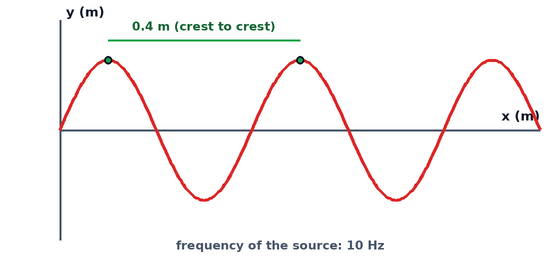
يمثل الرسم موجة تنتقل في حبل وترددها \(10\,Hz\). فإن سرعتها:The graph shows a wave on a rope with frequency \(10\,Hz\). Its speed is:
\(4\,m/s\)\(4\,m/s\)
\(0.4\,m/s\)\(0.4\,m/s\)
\(25\,m/s\)\(25\,m/s\)
\(2.5\,m/s\)\(2.5\,m/s\)
الحلSolution
📌 الخطوة 1: الطول الموجي من الرسم (المسافة بين قمتين): \(\lambda=0.4\,m\)
📌 الخطوة 2: \(v=f\lambda=10\times0.4=4\,m/s\)
✅ الإجابة الصحيحة: A
📌 Step 1: The wavelength from the graph (crest to crest): \(\lambda=0.4\,m\)
📌 Step 2: \(v=f\lambda=10\times0.4=4\,m/s\)
✅ Correct answer: A
\[17\,\star\star\]
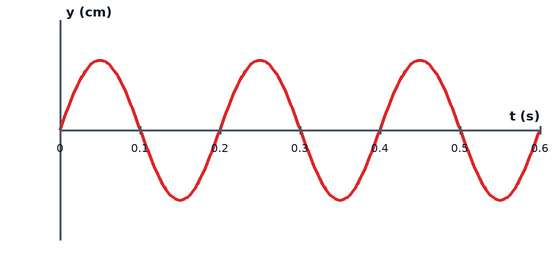
يمثل الرسم إزاحة جسيم من الوسط مع الزمن عند مرور موجة. فإن تردد الموجة:The graph shows the displacement of a particle of the medium against time as a wave passes. The frequency of the wave is:
\(0.2\,Hz\)\(0.2\,Hz\)
\(10\,Hz\)\(10\,Hz\)
\(5\,Hz\)\(5\,Hz\)
\(2.5\,Hz\)\(2.5\,Hz\)
الحلSolution
📌 الخطوة 1: الزمن الدوري من الرسم (اهتزازة كاملة): \(T=0.2\,s\)
📌 Step 1: The period from the graph (one full oscillation): \(T=0.2\,s\)
📌 Step 2: \(f=\dfrac{1}{T}=\dfrac{1}{0.2}=5\,Hz\)
✅ Correct answer: C
\[18\,\star\star\]
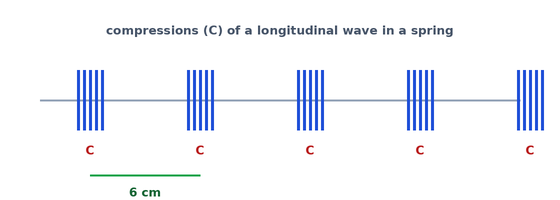
يوضح الشكل موجة طولية في نابض فيها مناطق انضغاط (C). فإن الطول الموجي هو المسافة بين:The figure shows a longitudinal wave in a spring with compressions (C). The wavelength is the distance between:
مركزي انضغاطين متتاليين (6 cm في الشكل)the centres of two successive compressions (6 cm in the figure)
انضغاط واحد وأقرب تخلخل إليهone compression and the nearest rarefaction
قمة وقاع متتاليينa crest and the next trough
أول وآخر جسيم في النابضthe first and last particle of the spring
الحلSolution
📌 الخطوة 1: الطول الموجي في الموجة الطولية هو المسافة بين مركزي انضغاطين متتاليين (أو تخلخلين متتاليين).
📌 الخطوة 2: وهو في الشكل \(\lambda=6\,cm\) (والمسافة إلى أقرب تخلخل نصف الطول الموجي فقط).
✅ الإجابة الصحيحة: A
📌 Step 1: In a longitudinal wave the wavelength is the distance between the centres of two successive compressions (or two successive rarefactions).
📌 Step 2: In the figure \(\lambda=6\,cm\) (the distance to the nearest rarefaction is only half a wavelength).
✅ Correct answer: A
\[19\,\star\star\]
موجة صوتية ترددها \(250\,Hz\) وطولها الموجي \(1.36\,m\) في الهواء. فإن طولها الموجي إذا ازداد ترددها إلى \(500\,Hz\) في الهواء نفسه:A sound wave in air has frequency \(250\,Hz\) and wavelength \(1.36\,m\). Its wavelength if the frequency rises to \(500\,Hz\) in the same air is:
\(2.72\,m\)\(2.72\,m\)
\(1.36\,m\)\(1.36\,m\)
\(0.34\,m\)\(0.34\,m\)
\(0.68\,m\)\(0.68\,m\)
الحلSolution
📌 الخطوة 1: سرعة الموجة تعتمد على الوسط وحده: \(v=250\times1.36=340\,m/s\) وتبقى ثابتة.
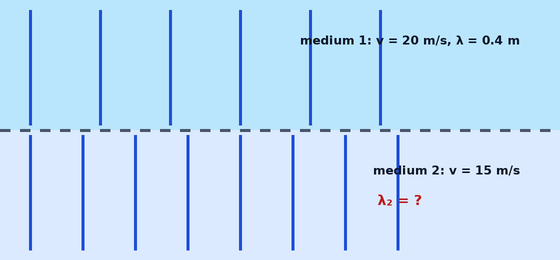
موجة تنتقل من وسط سرعتها فيه \(20\,m/s\) وطولها الموجي \(0.4\,m\) إلى وسط ثانٍ سرعتها فيه \(15\,m/s\) كما في الشكل. فإن طولها الموجي في الوسط الثاني:A wave moves from a medium where its speed is \(20\,m/s\) and wavelength \(0.4\,m\) into a second medium where its speed is \(15\,m/s\) as shown. Its wavelength in the second medium is:
\(0.4\,m\)\(0.4\,m\)
\(0.53\,m\)\(0.53\,m\)
\(0.2\,m\)\(0.2\,m\)
\(0.3\,m\)\(0.3\,m\)
الحلSolution
📌 الخطوة 1: التردد يحدده المصدر ولا يتغير عند الانتقال بين الوسطين: \(f=\dfrac{v_1}{\lambda_1}=\dfrac{20}{0.4}=50\,Hz\)
عند مضاعفة سعة الاهتزاز في موجة على حبل مع بقاء التردد والحبل كما هما فإن الطول الموجي وسرعة الموجة على الترتيب:If the amplitude of a wave on a rope is doubled while the frequency and the rope stay the same, the wavelength and the wave speed:
يتضاعفانboth double
يقلان للنصفboth halve
لا يتغيرانboth stay the same
يتضاعف الطول الموجي وتبقى السرعةthe wavelength doubles and the speed stays the same
الحلSolution
📌 الخطوة 1: سرعة الموجة تعتمد على خصائص الوسط (الحبل) فقط وليس على السعة.
📌 الخطوة 2: وبما أن \(\lambda=v/f\) و\(v\) و\(f\) ثابتان يبقى الطول الموجي ثابتًا؛ السعة تغيّر الطاقة فقط.
✅ الإجابة الصحيحة: C
📌 Step 1: The wave speed depends only on the medium (the rope), not on the amplitude.
📌 Step 2: Since \(\lambda=v/f\) with \(v\) and \(f\) fixed, the wavelength is unchanged; the amplitude only changes the energy.
✅ Correct answer: C
\[22\,\star\star\]
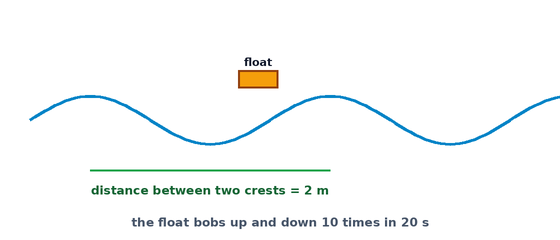
يهتز طوف على سطح الماء 10 مرات خلال \(20\,s\) والمسافة بين قمتين متتاليتين \(2\,m\) كما في الشكل. فإن سرعة الموجة:A float on the water bobs up and down 10 times in \(20\,s\) and the distance between two successive crests is \(2\,m\) as shown. The wave speed is:
📌 Step 1: The frequency: \(f=\dfrac{10}{20}=0.5\,Hz\) and the wavelength \(\lambda=2\,m\)
📌 Step 2: \(v=f\lambda=0.5\times2=1\,m/s\)
✅ Correct answer: A
\[23\,\star\star\]
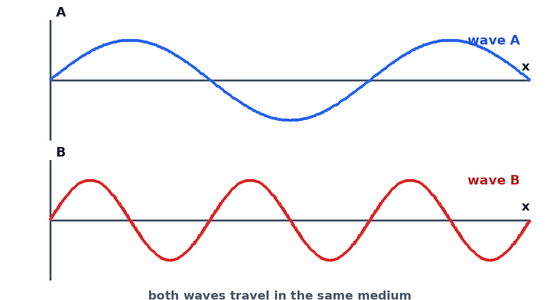
الموجتان A وB في الشكل تنتقلان في الوسط نفسه، والطول الموجي للموجة A ضعف طول الموجة B. فإن النسبة بين ترددهما \(\dfrac{f_A}{f_B}\):Waves A and B in the figure travel in the same medium and the wavelength of A is twice that of B. The ratio of their frequencies \(\dfrac{f_A}{f_B}\) is:
\(2\)\(2\)
\(\dfrac12\)\(\dfrac12\)
\(1\)\(1\)
\(4\)\(4\)
الحلSolution
📌 الخطوة 1: الوسط واحد فالسرعة واحدة: \(f=\dfrac{v}{\lambda}\) ويتناسب التردد عكسيًا مع الطول الموجي.
موجة فوق صوتية ترددها \(40\,kHz\) تنتقل في الهواء بسرعة \(340\,m/s\). فإن طولها الموجي:An ultrasonic wave of frequency \(40\,kHz\) travels in air at \(340\,m/s\). Its wavelength is:
\(8.5\,m\)\(8.5\,m\)
\(8.5\,mm\)\(8.5\,mm\)
\(0.85\,m\)\(0.85\,m\)
\(1.2\,cm\)\(1.2\,cm\)
الحلSolution
📌 الخطوة 1: \(\lambda=\dfrac{v}{f}=\dfrac{340}{40\times10^3}=8.5\times10^{-3}\,m=8.5\,mm\) (طول موجي صغير ولذلك تفيد في الكشف الدقيق).
✅ الإجابة الصحيحة: B
📌 Step 1: \(\lambda=\dfrac{v}{f}=\dfrac{340}{40\times10^3}=8.5\times10^{-3}\,m=8.5\,mm\) (a short wavelength, useful for fine detection).
✅ Correct answer: B
\[25\,\star\star\]
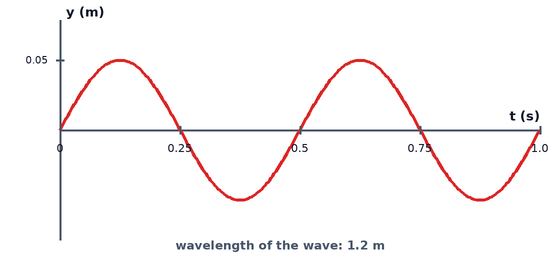
يمثل الرسم إزاحة نقطة في وسط مع الزمن عند مرور موجة طولها الموجي \(1.2\,m\). فإن سرعة الموجة:The graph shows the displacement of a point of a medium against time as a wave of wavelength \(1.2\,m\) passes. The wave speed is:
\(0.6\,m/s\)\(0.6\,m/s\)
\(1.2\,m/s\)\(1.2\,m/s\)
\(4.8\,m/s\)\(4.8\,m/s\)
\(2.4\,m/s\)\(2.4\,m/s\)
الحلSolution
📌 الخطوة 1: الزمن الدوري من الرسم: \(T=0.5\,s\) فيكون التردد \(f=2\,Hz\)
📌 الخطوة 2: \(v=f\lambda=2\times1.2=2.4\,m/s\)
✅ الإجابة الصحيحة: D
📌 Step 1: The period from the graph: \(T=0.5\,s\) so the frequency is \(f=2\,Hz\)
📌 Step 2: \(v=f\lambda=2\times1.2=2.4\,m/s\)
✅ Correct answer: D
\[26\,\star\star\]
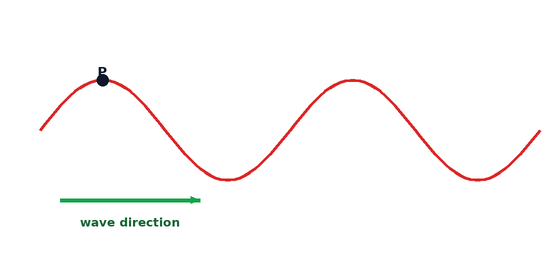
تنتقل موجة مستعرضة نحو اليمين في حبل كما في الشكل. فإن جسيم الحبل \(P\) يهتز باتجاه:A transverse wave travels to the right along a rope as shown. The rope particle \(P\) vibrates in a direction:
موازٍ لاتجاه انتشار الموجةparallel to the direction of wave propagation
يدور في دائرة حول موضعه فقطaround a circle about its position only
ينتقل مع الموجة نحو اليمينtraveling with the wave to the right
عمودي على اتجاه انتشار الموجة (أعلى وأسفل)perpendicular to the direction of wave propagation (up and down)
الحلSolution
📌 الخطوة 1: في الموجة المستعرضة تهتز جسيمات الوسط عموديًا على اتجاه انتشار الموجة.
📌 الخطوة 2: تنتقل الطاقة مع الموجة أما الجسيمات فتبقى حول مواضع اتزانها.
✅ الإجابة الصحيحة: D
📌 Step 1: In a transverse wave the particles of the medium vibrate perpendicular to the direction of propagation.
📌 Step 2: The energy travels with the wave while the particles stay around their equilibrium positions.
✅ Correct answer: D
\[27\,\star\star\]
إذا تضاعف تردد مصدر موجات في وسط معين فإن الطول الموجي:If the frequency of a wave source in a given medium doubles, the wavelength:
يقل إلى النصفis halved
يتضاعفdoubles
لا يتغيرdoes not change
يصبح أربعة أمثالbecomes four times as large
الحلSolution
📌 الخطوة 1: السرعة ثابتة في الوسط الواحد: \(\lambda=\dfrac{v}{f}\) فعند مضاعفة التردد يقل الطول الموجي للنصف.
✅ الإجابة الصحيحة: A
📌 Step 1: The speed is fixed in a given medium: \(\lambda=\dfrac{v}{f}\) so doubling the frequency halves the wavelength.
✅ Correct answer: A
\[28\,\star\star\]
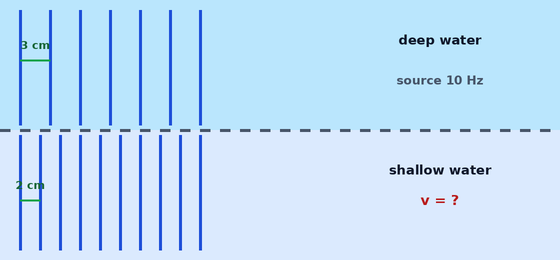
في حوض موجات ترددها \(10\,Hz\) كانت المسافة بين قمتين متتاليتين \(3\,cm\) في الماء العميق و\(2\,cm\) في الماء الضحل كما في الشكل. فإن سرعة الموجة في الماء الضحل:In a ripple tank with a \(10\,Hz\) source the distance between successive crests is \(3\,cm\) in deep water and \(2\,cm\) in shallow water as shown. The wave speed in the shallow water is:
\(0.3\,m/s\)\(0.3\,m/s\)
\(0.2\,m/s\)\(0.2\,m/s\)
\(0.02\,m/s\)\(0.02\,m/s\)
\(5\,m/s\)\(5\,m/s\)
الحلSolution
📌 الخطوة 1: التردد ثابت (\(10\,Hz\)) والطول الموجي في الضحل \(\lambda=0.02\,m\)
📌 الخطوة 2: \(v=f\lambda=10\times0.02=0.2\,m/s\) (أقل من \(0.3\,m/s\) في الماء العميق).
✅ الإجابة الصحيحة: B
📌 Step 1: The frequency is constant (\(10\,Hz\)) and the wavelength in shallow water is \(\lambda=0.02\,m\)
📌 Step 2: \(v=f\lambda=10\times0.02=0.2\,m/s\) (less than \(0.3\,m/s\) in deep water).
✅ Correct answer: B
\[29\,\star\star\]
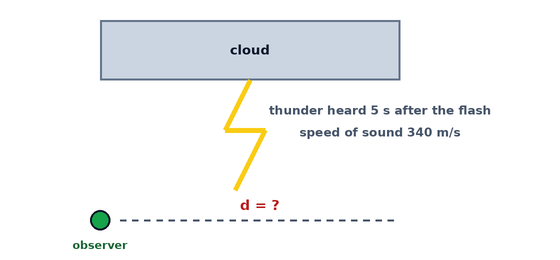
رأى مراقب وميض برق ثم سمع الرعد بعد \(5\,s\) كما في الشكل (سرعة الصوت \(340\,m/s\) وسرعة الضوء كبيرة جدًا). فإن بُعد البرق عنه:An observer sees a lightning flash and hears the thunder \(5\,s\) later as shown (speed of sound \(340\,m/s\), light being extremely fast). The distance of the lightning from the observer is:
\(68\,m\)\(68\,m\)
\(340\,m\)\(340\,m\)
\(850\,m\)\(850\,m\)
\(1700\,m\)\(1700\,m\)
الحلSolution
📌 الخطوة 1: الضوء يصل لحظيًا تقريبًا فيكون الزمن هو زمن انتقال الصوت.
📌 الخطوة 2: \(d=vt=340\times5=1700\,m\)
✅ الإجابة الصحيحة: D
📌 Step 1: The light arrives almost instantly so the time is the travel time of the sound.
📌 Step 2: \(d=vt=340\times5=1700\,m\)
✅ Correct answer: D
\[30\,\star\star\]
عند انتقال موجة صوتية من الهواء إلى الماء فإن الذي لا يتغير هو:When a sound wave passes from air into water, the quantity that does not change is:
السرعةthe speed
الطول الموجيthe wavelength
السرعة والطول الموجي معًاboth speed and wavelength
الترددthe frequency
الحلSolution
📌 الخطوة 1: التردد يحدده المصدر فلا يتغير بتغير الوسط.
📌 الخطوة 2: أما السرعة فتتغير بتغير الوسط وبالتالي يتغير الطول الموجي (\(\lambda=v/f\)).
✅ الإجابة الصحيحة: D
📌 Step 1: The frequency is set by the source so it does not change with the medium.
📌 Step 2: The speed changes with the medium and therefore so does the wavelength (\(\lambda=v/f\)).
✅ Correct answer: D
لاحظت خطأ؟ أو عندك سؤال عن أحد الأسئلة؟ اكتبه بالتعليقات وحدد رقم السؤال.