🎯 نواتج التعلم
🎯 Learning Outcomes
بعد دراسة هذا الدرس ستكون قادرًا على أن:
After this lesson you will be able to:
- تعرّف حيود الضوء وتذكر شرط حدوثه، وتفسّر بمبدأ هويجنز انتشار الموجة خلف الفتحة.Define the diffraction of light, state the condition for it, and explain with Huygens' principle how the wave spreads beyond an opening.
- تصف نمط حيود الشق المفرد وتطبّق شرط الحدود الدنيا \(a\sin\theta=m\lambda\).Describe the single-slit diffraction pattern and apply the condition for minima \(a\sin\theta=m\lambda\).
- تحسب عرض الهدبة المركزية \(\Delta y=2\lambda L/a\) وتحدد العوامل المؤثرة فيه.Calculate the central fringe width \(\Delta y=2\lambda L/a\) and tell which factors affect it.
- تفرّق بين الحيود والتداخل، وتفسّر عمل محزوز الحيود وتطبّق \(d\sin\theta=m\lambda\) وتحسب أعلى رتبة.Distinguish diffraction from interference, explain how a diffraction grating works, apply \(d\sin\theta=m\lambda\) and find the highest order.
- تفسّر تشتت الضوء في المنشور ولماذا ينحرف البنفسجي أكثر من الأحمر.Explain the dispersion of light in a prism and why violet is deviated more than red.
- تفسّر استطارة الضوء (رايلي ومي) وتربطها بلون السماء والغروب والغيوم.Explain the scattering of light (Rayleigh and Mie) and link it to the colour of the sky, the sunset and the clouds.
〰️ ما هو حيود الضوء؟
〰️ What Is the Diffraction of Light?
📘 حيود الضوء
📘 The diffraction of light
الحيود ظاهرة انحراف الموجة الضوئية عن مسارها المستقيم الأصلي، وانتشارها خلف الحاجز، عندما تمر خلال فتحة ضيقة أو تعبر حافة حادة لحاجز أثناء انتشارها.
Diffraction is the bending of a light wave away from its original straight path, and its spreading behind a barrier, when it passes through a narrow opening or past a sharp edge of a barrier while it propagates.
📌 شرط حدوث حيود واضح
📌 The condition for clear diffraction
حتى يظهر الحيود بوضوح يجب أن يكون عرض الفتحة (أو سمك الحاجز) قريبًا من الطول الموجي للموجة. ويزداد الحيود كلما كان الطول الموجي أكبر من عرض الفتحة، أي كلما صغرت النسبة \(a/\lambda\).
For clear diffraction the width of the opening (or the thickness of the barrier) must be close to the wavelength of the wave. The diffraction grows as the wavelength becomes larger than the opening, i.e. as the ratio \(a/\lambda\) gets smaller.
🧠 توضيح إضافي: لماذا نسمع من خلف الباب ولا نرى؟
🧠 Extra explanation: why can we hear around a door but not see around it?
الصوت طوله الموجي بين \(1.7\ cm\) و\(17\ m\) تقريبًا، أي قريب من عرض الباب فيحيد بقوة وننتشر في الغرفة ونسمعه من الزاوية. أما الضوء فطوله الموجي نحو \(400\)–\(700\ nm\) (أي أقل من جزء من ألف من المليمتر) فهو أصغر بكثير من عرض الباب فيبدو ينتشر في خطوط مستقيمة ويصنع ظلًّا حادًّا. ولا يظهر حيود الضوء إلا إذا استخدمنا فتحات أو أسلاكًا رفيعة جدًا (أجزاء من المليمتر أو أقل) كما في تجارب هذا الدرس.
Sound has a wavelength between roughly \(1.7\ cm\) and \(17\ m\), comparable to the width of a door, so it diffracts strongly, spreads in the room and can be heard around the corner. Light has a wavelength of only about \(400\)–\(700\ nm\) (less than a thousandth of a millimetre), much smaller than the door, so it seems to travel in straight lines and makes a sharp shadow. Light diffraction shows only with very thin openings or wires (fractions of a millimetre or less), as in the experiments of this lesson.
🌊 مبدأ هويجنز
🌊 Huygens' Principle
📘 مبدأ هويجنز
📘 Huygens' principle
كل نقطة على جبهة الموجة تُعدّ مصدرًا لموجات ثانوية كروية (دائرية في بعدين) تنتشر بسرعة الموجة نفسها؛ والجبهة الجديدة هي المماس المشترك لهذه الموجات الثانوية (أو هي مجموعها بحسب الطور).
Every point on a wavefront acts as a source of spherical secondary wavelets (circular in two dimensions) that spread with the wave's own speed; the new wavefront is the common tangent to these wavelets (or, more exactly, their sum taking the phase into account).
🧠 توضيح إضافي: كيف يفسّر هويجنز الحيود؟
🧠 Extra explanation: how does Huygens explain diffraction?
عندما تصل الجبهة المستوية إلى فتحة فإن النقاط التي في الفتحة وحدها تستمر في إرسال موجات ثانوية، أما بقية الجبهة فيحجبها الحاجز. فإذا كانت الفتحة واسعة جدًا فالموجات الثانوية الكثيرة تتداخل بحيث تعطي جبهة مستوية تقريبًا ولا ينحني غير الحواف. وإذا كانت الفتحة ضيقة قريبة من \(\lambda\) فهي تشبه مصدرًا نقطيًا فتنتشر منها موجة دائرية في كل الاتجاهات. وهذا ما تبيّنه التجربة التالية.
When the plane wavefront reaches an opening, only the points inside the opening keep sending wavelets, while the rest of the front is blocked by the barrier. If the opening is very wide, the many wavelets add up to an almost plane front and only the edges bend. If the opening is narrow and close to \(\lambda\), it behaves like a point source and a circular wave spreads from it in every direction. This is what the next experiment shows.
🧪 تجربة 1: موجات تمر عبر فتحة: متى يظهر الحيود؟
🧪 Experiment 1: Waves passing through an opening: when does diffraction appear?
موجات مستوية تسقط على حاجز فيه فتحة. يحسب البرنامج الموجة بعد الفتحة بتطبيق مبدأ هويجنز (كل نقطة من الفتحة مصدر لموجات ثانوية دائرية) ويجمعها. غيّر الطول الموجي وعرض الفتحة، أو جرّب الأزرار الجاهزة، وراقب النسبة \(a/\lambda\): عندما تكبر كثيرًا يضعف الحيود، وعندما تقترب من 1 أو تقل تنتشر الموجة في كل الاتجاهات.
Plane waves strike a barrier with an opening. The program computes the wave beyond the opening by applying Huygens' principle (every point of the opening is a source of circular secondary wavelets) and adds them. Change the wavelength and the opening width, or try the ready buttons, and watch the ratio \(a/\lambda\): when it is large the diffraction is weak, and when it approaches 1 or less the wave spreads in every direction.
📐 حيود الشق المفرد
📐 Single-Slit Diffraction
عندما يسقط ضوء أحادي اللون (ليزر مثلًا) على شق ضيق عرضه \(a\) ثم نضع شاشة خلفه على بعد \(L\) يظهر عليها نمط: هدبة مركزية ساطعة وعريضة تحيط بها أهداب مضيئة أضيق وأضعف تفصل بينها أهداب مظلمة (حدود دنيا). هذه الأهداب تنتج من تداخل الموجات الثانوية الصادرة من نقاط الشق نفسه.
When monochromatic light (a laser, for example) falls on a narrow slit of width \(a\) and a screen is placed at a distance \(L\) behind it, a pattern appears: a wide bright central fringe surrounded by narrower, weaker bright fringes separated by dark fringes (minima). These fringes come from the interference of the secondary wavelets coming from points of the same slit.
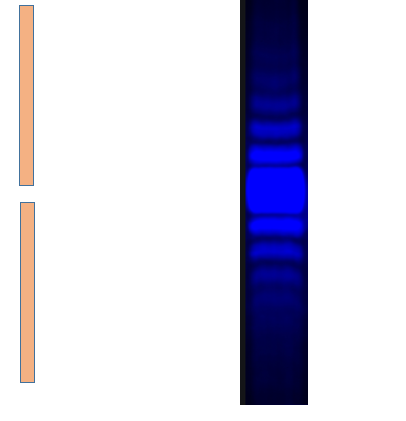
نمط حيود الشق المفرد (ضوء أزرق): الهدبة المركزية ساطعة وأعرض ضعفين من الأهداب الجانبية وهي أضعف منها.
The single-slit pattern (blue light): the central fringe is bright and twice as wide as the side fringes, which are weaker.
🔢 الخطوات الرياضية
🔢 The mathematical steps
1) شرط الحدود الدنيا (الأهداب المظلمة)
1) The condition for minima (dark fringes)
\[a\,\sin\theta=m\,\lambda\qquad m=\pm1,\pm2,\pm3,\dots\]
\(m=\pm1\) للحد الأدنى الأول على جانبي الهدبة المركزية. (لاحظ أن \(m=0\) ليس حدًّا أدنى: إنه مركز الهدبة الساطعة.)
\(m=\pm1\) gives the first minimum on each side of the central fringe. (Note that \(m=0\) is not a minimum: it is the centre of the bright fringe.)
🧠 توضيح إضافي: من أين جاء الشرط \(a\sin\theta=m\lambda\)؟
🧠 Extra explanation: where does \(a\sin\theta=m\lambda\) come from?
نقسّم الشق إلى نصفين. موجة من نقطة في النصف الأول وموجة من النقطة المقابلة لها في النصف الثاني (يبعدان \(a/2\)) فرق المسير بينهما نحو \(\tfrac a2\sin\theta\). إذا كان هذا الفرق \(\tfrac\lambda2\) تلغي كل موجة نظيرتها (تداخل هدّام) فيحدث الحد الأدنى الأول: \(\tfrac a2\sin\theta=\tfrac\lambda2\Rightarrow a\sin\theta=\lambda\). وبتقسيم الشق إلى 4 أجزاء نحصل على \(a\sin\theta=2\lambda\) وهكذا.
Split the slit into two halves. A wave from a point in the first half and a wave from the corresponding point of the second half (a distance \(a/2\) apart) have a path difference of about \(\tfrac a2\sin\theta\). If this difference is \(\tfrac\lambda2\), each wave cancels its partner (destructive interference) and the first minimum occurs: \(\tfrac a2\sin\theta=\tfrac\lambda2\Rightarrow a\sin\theta=\lambda\). Splitting the slit into 4 parts gives \(a\sin\theta=2\lambda\), and so on.
2) تقريب الزوايا الصغيرة
2) The small-angle approximation
\[\sin\theta\approx\tan\theta\approx\theta\quad(\theta\ \text{in radians})\]
عندما تكون \(\theta\) صغيرة جدًا (أقل من نحو \(5^{\circ}\)) كما هو الحال في تجارب الشق لأن \(L\gg a\).
When \(\theta\) is very small (less than about \(5^{\circ}\)), as in slit experiments because \(L\gg a\).
3) موضع أول حد أدنى على الشاشة
3) The position of the first minimum on the screen
\[y=L\tan\theta\approx L\,\dfrac{\lambda}{a}\]
\(y\) هي المسافة من مركز الهدبة المركزية إلى أول حد أدنى.
\(y\) is the distance from the centre of the central fringe to the first minimum.
4) عرض الهدبة المركزية
4) The width of the central fringe
\[\Delta y=2y=\dfrac{2\lambda L}{a}\]
\(\lambda\): الطول الموجي، \(L\): بعد الشاشة عن الشق، \(a\): عرض الشق. وهذا هو العرض بين أول حدّين أدنيين على جانبي الهدبة المركزية.
\(\lambda\): the wavelength, \(L\): the distance from the slit to the screen, \(a\): the slit width. This is the width between the first two minima on either side of the central fringe.
| إذا...If... | عرض الهدبة المركزيةThe central fringe width | السببReason |
|---|---|---|
| نقص عرض الشق \(a\)the slit width \(a\) decreases | يزدادincreases | \(\Delta y\propto1/a\): الشق الأضيق يُحيد الضوء أكثر\(\Delta y\propto1/a\): a narrower slit diffracts the light more |
| زاد الطول الموجي \(\lambda\) (من الأزرق إلى الأحمر)the wavelength \(\lambda\) grows (blue to red) | يزدادincreases | \(\Delta y\propto\lambda\)\(\Delta y\propto\lambda\) |
| زاد بعد الشاشة \(L\)the screen distance \(L\) grows | يزدادincreases | \(\Delta y\propto L\): تتباعد الأشعة أكثر\(\Delta y\propto L\): the rays spread farther |
🧠 توضيح إضافي: شكل النمط
🧠 Extra explanation: the shape of the pattern
الهدبة المركزية أعرض مرتين من كل هدبة جانبية (عرض كل منها \(\lambda L/a\))، وأشد سطوعًا بكثير: شدة أول هدبة جانبية نحو \(4.5\%\) فقط من شدة الهدبة المركزية، والثانية نحو \(1.6\%\). ولذلك يبدو النمط في الرسم كأن الهدبة المركزية تحمل معظم الضوء.
The central fringe is twice as wide as each side fringe (whose width is \(\lambda L/a\)) and far brighter: the first side fringe has only about \(4.5\%\) of the intensity of the central one, and the second about \(1.6\%\). So the central fringe carries most of the light.
🧪 تجربة 2: حيود الشق المفرد: نمط الأهداب وعرض الهدبة المركزية
🧪 Experiment 2: Single-slit diffraction: the fringe pattern and the central fringe width
غيّر لون الضوء (الطول الموجي) وعرض الشق وبعد الشاشة. الرسم العلوي شدة الإضاءة على الشاشة، والنقاط الحمراء مواضع الحدود الدنيا \(m=\pm1,\pm2,\dots\)، وتحته صورة الأهداب. ثم جرّب «اختبر نفسك»: احسب عرض الهدبة المركزية بالميليمتر من القانون \(\Delta y=2\lambda L/a\) وتحقق من إجابتك.
Change the colour of the light (the wavelength), the slit width and the screen distance. The upper graph is the light intensity on the screen, the red dots are the minima \(m=\pm1,\pm2,\dots\), and below it is the picture of the fringes. Then try the “Test yourself” part: calculate the central fringe width in millimetres from \(\Delta y=2\lambda L/a\) and check your answer.
شق عرضه \(0.2\ mm\) يسقط عليه ضوء طوله الموجي \(600\ nm\) وبعد الشاشة \(2\ m\). عرض الهدبة المركزية:
A slit \(0.2\ mm\) wide is lit by light of wavelength \(600\ nm\) and the screen is \(2\ m\) away. The width of the central fringe is:
ماذا يحدث لنمط حيود شق مفرد إذا ضيّقنا الشق مع بقاء كل شيء آخر ثابتًا؟
What happens to the diffraction pattern of a single slit if we make the slit narrower, everything else unchanged?
✏️ مثال محلول
✏️ Worked example
في تجربة حيود شق مفرد استُخدم شق عرضه \(0.3\ mm\)، ووُضعت الشاشة على بعد \(1.8\ m\) منه، فقيس عرض الهدبة المركزية فكان \(5.3\ mm\) (ضوء أزرق كما في الشكل). ما الطول الموجي للضوء؟
In a single-slit experiment a slit \(0.3\ mm\) wide was used and the screen was placed \(1.8\ m\) from it. The central fringe width measured \(5.3\ mm\) (blue light, as in the figure). What is the wavelength of the light?
احسب الطول الموجي للضوء في المثال السابق:
Calculate the wavelength of the light in the previous example:
ضوء طوله الموجي \(500\ nm\) يسقط على شق عرضه \(2\ \mu m\). زاوية أول حد أدنى:
Light of wavelength \(500\ nm\) falls on a slit \(2\ \mu m\) wide. The angle of the first minimum is:
⚖️ الحيود والتداخل: ما الفرق؟
⚖️ Diffraction and Interference: What Is the Difference?
كلتا الظاهرتين تنتج من تراكب الموجات، لكنهما تختلفان في مصدر الموجات المتراكبة:
Both phenomena come from the superposition of waves, but they differ in the source of the waves that are superposed:
| وجه المقارنةAspect | حيود الشق المفردSingle-slit diffraction | تداخل الشقين (يونغ)Double-slit interference (Young) |
|---|---|---|
| مصدر الموجات المتراكبةSource of the superposed waves | موجات ثانوية من نقاط الشق الواحدwavelets from points of one slit | موجتان من شقين مختلفينtwo waves from two different slits |
| الأهداب المضيئةThe bright fringes | الهدبة المركزية أعرض مرتين وأشد كثيرًا وبقية الأهداب ضعيفةthe central fringe is twice as wide and much brighter; the others are weak | أهداب متساوية العرض والشدة تقريبًاfringes of nearly equal width and intensity |
| شرط الحد الأدنىCondition for a minimum | \(a\sin\theta=m\lambda\)\(a\sin\theta=m\lambda\) | \(d\sin\theta=(m+\tfrac12)\lambda\)\(d\sin\theta=(m+\tfrac12)\lambda\) |
| شرط الحد الأقصىCondition for a maximum | بالقرب من منتصف الأهداب بين الحدين الأدنيينroughly midway between the minima | \(d\sin\theta=m\lambda\)\(d\sin\theta=m\lambda\) |
🧠 توضيح إضافي: الشقان الحقيقيان يجمعان الظاهرتين
🧠 Extra explanation: real double slits combine both effects
في تجربة يونغ الحقيقية كل شق له عرض محدود فيحيد الضوء، ويتراكب الحيود مع التداخل: تظهر أهداب التداخل المتساوية داخل غلاف هو نمط حيود الشق المفرد، فتختفي بعض أهداب التداخل عند الحدود الدنيا لنمط الحيود.
In a real Young experiment each slit has a finite width and so diffracts the light, and diffraction is combined with interference: the equal interference fringes appear inside an envelope that is the single-slit diffraction pattern, so some interference fringes vanish at the minima of the diffraction pattern.
🎼 محزوز الحيود
🎼 The Diffraction Grating
محزوز الحيود أداة بصرية فيها عدد كبير جدًا من الشقوق (الخطوط) المتوازية المتقاربة والمتساوية البعد، تُستخدم لتفريق الضوء إلى ألوانه (أطواله الموجية). يقوم عمله على الحيود من كل شق والتداخل بين الموجات الصادرة من الشقوق جميعها. تكون المسافة بين شقين متتاليين \(d\) صغيرة جدًا (نحو \(2\ \mu m\) أو أقل في الأجهزة الدقيقة)، وإذا كان في المليمتر الواحد \(N\) شق فإن \(d=\dfrac{1\ mm}{N}\).
A diffraction grating is an optical device with a very large number of parallel, closely and equally spaced slits (lines), used to separate light into its colours (wavelengths). It works through the diffraction from every slit and the interference between the waves coming from all the slits. The distance \(d\) between two successive slits is very small (about \(2\ \mu m\) or less in precise instruments), and if there are \(N\) slits per millimetre then \(d=\dfrac{1\ mm}{N}\).
📌 شرط التداخل البنّاء (الأهداب الساطعة)
📌 The condition for constructive interference (bright fringes)
\[d\,\sin\theta=m\,\lambda\qquad m=0,\pm1,\pm2,\dots\]
\(d\): المسافة بين شقين متتاليين، \(\theta\): زاوية الحيود، \(m\): رتبة الهدبة (\(m=0\) الهدبة المركزية)، \(\lambda\): الطول الموجي. أعلى رتبة ممكنة تحقق \(\sin\theta\le1\) أي \(m\le\dfrac{d}{\lambda}\).
\(d\): the distance between two successive slits, \(\theta\): the diffraction angle, \(m\): the order of the fringe (\(m=0\) the central fringe), \(\lambda\): the wavelength. The highest possible order satisfies \(\sin\theta\le1\), i.e. \(m\le\dfrac{d}{\lambda}\).
🧠 توضيح إضافي: لماذا يصنع المحزوز خطوطًا ساطعة رفيعة؟
🧠 Extra explanation: why does a grating give thin, bright lines?
في الشقين تظهر أهداب عريضة، أما عند وجود آلاف الشقوق فإن الاتفاق في الطور يتحقق بدقة شديدة فقط عند الزوايا التي تحقق \(d\sin\theta=m\lambda\)؛ وعند أي زاوية أخرى تتوزع أطوار الموجات الكثيرة فتلغي إحداها الأخرى تقريبًا. لذلك تكون الأهداب الساطعة رفيعة حادة تفصل بينها مناطق مظلمة، وهذا يسمح بفصل لونين متقاربين بدقة أكبر كثيرًا من الشقين. (ملاحظة: الشرط \((m+\tfrac12)\lambda\) للحد الأدنى صحيح للشقين فقط؛ أما في المحزوز فالظلام يملأ ما بين الأهداب الساطعة.)
With two slits the fringes are broad, but with thousands of slits agreement in phase occurs with great sharpness only at the angles satisfying \(d\sin\theta=m\lambda\); at any other angle the phases of the many waves are spread out and nearly cancel each other. So the bright fringes are thin and sharp with dark regions between them, which allows two close colours to be separated far better than with two slits. (Note: the condition \((m+\tfrac12)\lambda\) for a minimum is true for two slits only; with a grating the darkness fills the space between the bright fringes.)
🌈 الضوء الأبيض والمحزوز
🌈 White light and the grating
الضوء الأبيض مزيج من أطوال موجية كثيرة، وكل طول موجي له زاوية مختلفة \(\sin\theta=m\lambda/d\). لذلك تظهر في كل رتبة \(m\ge1\) حزمة طيفية كاملة: البنفسجي (الأقصر طولًا) الأقرب إلى المركز والأحمر (الأطول) الأبعد، أما المركز \(m=0\) فيبقى أبيض لأن \(\theta=0\) لكل الألوان. وهذا عكس المنشور الذي ينحرف فيه البنفسجي أكثر.
White light is a mixture of many wavelengths, and each has a different angle \(\sin\theta=m\lambda/d\). So in every order \(m\ge1\) a whole spectral band appears: violet (the shortest) nearest to the centre and red (the longest) farthest, while the centre \(m=0\) stays white because \(\theta=0\) for all colours. This is the opposite of a prism, where violet is deviated more.
🧪 تجربة 3: محزوز الحيود: الرتب الطيفية
🧪 Experiment 3: The diffraction grating: the spectral orders
غيّر عدد الشقوق في كل ملّيمتر ولون الضوء. تظهر الأهداب الساطعة عند الزوايا التي تحقق \(d\sin\theta=m\lambda\). كلما زاد عدد الشقوق (قلّ \(d\)) ابتعدت الأهداب وقلّ عدد الرتب. وعند «الضوء الأبيض» ترى طيفًا في كل رتبة: البنفسجي أقرب إلى المركز.
Change the number of lines per millimetre and the colour of the light. The bright fringes appear at the angles satisfying \(d\sin\theta=m\lambda\). The more lines (the smaller \(d\)) the farther apart the fringes and the fewer the orders. With “white light” you see a spectrum in every order: violet is nearest to the centre.
🛠️ استخدامات محزوز الحيود
🛠️ Uses of the diffraction grating
- التحليل الطيفي: في المطياف لتحليل ضوء النجوم والمواد الكيميائية ومعرفة تركيبها من خطوطها الطيفية.
- البصريات والاتصالات: فصل الأطوال الموجية في أنظمة الليزر والألياف الضوئية.
- الأقراص المدمجة (CD/DVD): مساراتها المتقاربة تعمل كمحزوز انعكاسي فتظهر عليها ألوان قوس المطر عند سقوط الضوء الأبيض.
- Spectral analysis: in the spectrometer, to analyse the light of stars and chemicals and find their composition from their spectral lines.
- Optics and communications: separating wavelengths in laser and optical-fibre systems.
- Compact discs (CD/DVD): their closely spaced tracks act as a reflection grating, so rainbow colours appear on them in white light.
محزوز فيه \(500\) شق لكل مليمتر يسقط عليه ضوء طوله الموجي \(600\ nm\). زاوية الرتبة الأولى:
A grating has \(500\) slits per millimetre and light of wavelength \(600\ nm\) falls on it. The angle of the first order is:
ما أعلى رتبة يمكن رؤيتها لمحزوز مسافة الشقوق فيه \(2\ \mu m\) عند استخدام ضوء \(600\ nm\)؟
What is the highest order that can be seen with a grating of slit spacing \(2\ \mu m\) using \(600\ nm\) light?
🌈 تشتت الضوء
🌈 Dispersion of Light
📘 تشتت الضوء
📘 Dispersion of light
تشتت الضوء هو تفرّق الضوء الأبيض إلى ألوانه المكوّنة عند انكساره في وسط شفاف كالمنشور الزجاجي، لأن معامل انكسار المادة يختلف باختلاف الطول الموجي (أو التردد) فينكسر كل لون بدرجة مختلفة.
Dispersion is the separation of white light into its component colours when it is refracted in a transparent medium such as a glass prism, because the refractive index of the material depends on the wavelength (or frequency), so each colour is refracted by a different amount.
🧠 توضيح إضافي: لماذا ينحرف البنفسجي أكثر؟
🧠 Extra explanation: why is violet deviated more?
سرعة الضوء في الزجاج تختلف باختلاف لونه: \(n=\dfrac{c}{v}\)، وفي الزجاج يكبر \(n\) كلما قصر الطول الموجي. فالبنفسجي (الأقصر طولًا، \(n\) أكبر) يبطؤ أكثر فينكسر بزاوية أكبر وينحرف عن مساره الأصلي أكثر، أما الأحمر (الأطول طولًا، \(n\) أقل) فينحرف أقل. وبعد الخروج من المنشور يفصل بين الألوان مقدار الانحراف المختلف فيظهر الطيف: أحمر، برتقالي، أصفر، أخضر، أزرق، نيلي، بنفسجي.
The speed of light in glass depends on its colour: \(n=\dfrac{c}{v}\), and in glass \(n\) grows as the wavelength shrinks. Violet (the shortest, with the larger \(n\)) slows down more, is refracted through a larger angle and is deviated more, while red (the longest, with the smaller \(n\)) is deviated less. After leaving the prism the different deviations separate the colours and the spectrum appears: red, orange, yellow, green, blue, indigo, violet.
وتفسّر هذه الظاهرة أيضًا قوس المطر (انكسار وانعكاس داخلي وتشتت في قطرات الماء)، وتُسبّب الانحراف اللوني في العدسات البسيطة.
The same phenomenon explains the rainbow (refraction, internal reflection and dispersion in water droplets), and it causes chromatic aberration in simple lenses.
🧪 تجربة 4: تشتت الضوء في منشور
🧪 Experiment 4: Dispersion of light in a prism
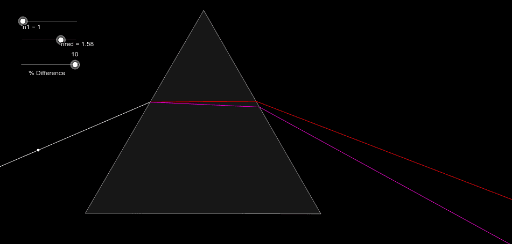
يسقط شعاع على منشور من زجاج الصوان (تشتته أكبر من الزجاج العادي ليظهر الطيف واضحًا). اختر ضوءًا أبيض لترى الألوان تتفرق، أو لونًا واحدًا بتحريك الطول الموجي. غيّر زاوية سقوط الشعاع وزاوية رأس المنشور. معامل الانكسار يكبر كلما صغر الطول الموجي، فيكون انحراف البنفسجي أكبر من انحراف الأحمر. وإذا كبرت الزاوية جدًا قد يحدث انعكاس كلي داخل المنشور.
A ray falls on a prism of flint glass (its dispersion is larger than ordinary glass so the spectrum is clear). Choose white light to see the colours spread, or a single colour by moving the wavelength. Change the angle of incidence and the apex angle of the prism. The refractive index grows as the wavelength shrinks, so violet is deviated more than red. If the angle gets too large, total internal reflection may occur inside the prism.
عند مرور الضوء الأبيض في منشور زجاجي، أي اللونين ينحرف أقل؟
When white light passes through a glass prism, which colour is deviated the least?
☁️ استطارة الضوء
☁️ Scattering of Light
📘 استطارة الضوء
📘 Scattering of light
الاستطارة (التشتت العشوائي) ظاهرة ينتشر فيها الضوء في اتجاهات مختلفة بسبب تفاعله مع جسيمات الوسط الذي يمر فيه أو اضطراباته. وهي تختلف عن تشتت الألوان في المنشور، وتعتمد على حجم الجسيمات مقارنة بالطول الموجي.
Scattering is a phenomenon in which light spreads in different directions because of its interaction with particles or irregularities in the medium it passes through. It differs from the dispersion of colours in a prism, and it depends on the size of the particles compared with the wavelength.
| النوعType | الجسيماتParticles | الاعتماد على \(\lambda\)Dependence on \(\lambda\) | أمثلةExamples |
|---|---|---|---|
| استطارة رايليRayleigh scattering | أصغر بكثير من \(\lambda\) (جزيئات الهواء)much smaller than \(\lambda\) (air molecules) | \(I\propto\dfrac{1}{\lambda^{4}}\)\(I\propto\dfrac{1}{\lambda^{4}}\) | السماء الزرقاء، الغروب الأحمرthe blue sky, the red sunset |
| استطارة ميMie scattering | قريبة من \(\lambda\) أو أكبر (قطرات الماء والغبار)comparable to or larger than \(\lambda\) (water droplets, dust) | ضعيفة، تستطير كل الألوان تقريبًا بالتساويweak: all colours are scattered about equally | الغيوم والضباب البيضاءwhite clouds and fog |
📌 قانون رايلي
📌 Rayleigh's law
\[I_{scattered}\propto\dfrac{1}{\lambda^{4}}\]
الضوء الأزرق (\(\lambda\approx450\ nm\)) يُستطار أكثر من الأحمر (\(\lambda\approx700\ nm\)) بنحو \(\left(\dfrac{700}{450}\right)^{4}\approx5.9\) مرة. وفي استطارة مي تُعرَّف كفاءة الاستطارة \(Q_{sca}=\dfrac{\sigma_{sca}}{\pi a^{2}}\) حيث \(\sigma_{sca}\) مقطع الاستطارة و\(a\) نصف قطر الجسيم.
Blue light (\(\lambda\approx450\ nm\)) is scattered about \(\left(\dfrac{700}{450}\right)^{4}\approx5.9\) times more than red (\(\lambda\approx700\ nm\)). In Mie scattering the scattering efficiency is defined as \(Q_{sca}=\dfrac{\sigma_{sca}}{\pi a^{2}}\), where \(\sigma_{sca}\) is the scattering cross-section and \(a\) the radius of the particle.
🧠 توضيح إضافي: لماذا السماء زرقاء والغروب أحمر؟
🧠 Extra explanation: why is the sky blue and the sunset red?
أثناء النهار تتجه أشعة الشمس عبر طبقة جوية رقيقة نسبيًا فيُستطار الأزرق في كل اتجاه (استطارة رايلي) ونراه من كل أنحاء السماء. عند الغروب يقطع الضوء مسافة أطول بكثير في الجو فتُستطار معظم الألوان القصيرة بعيدًا عن خط النظر، ويصل إلينا الضوء الأحمر والبرتقالي فتحمرّ الشمس والأفق. (والبنفسجي أكثر استطارة من الأزرق لكن شدته في ضوء الشمس أقل وعيوننا أقل حساسية له فنرى السماء زرقاء.) أما الغيوم فتتكوّن من قطرات أكبر بكثير فتستطير جميع الألوان معًا (مي) فتظهر بيضاء.
During the day the Sun's rays cross a relatively thin layer of the atmosphere and the blue is scattered in every direction (Rayleigh scattering), so we see it from every part of the sky. At sunset the light crosses a much longer path in the air, so most of the short wavelengths are scattered away from the line of sight and the red and orange light reaches us, making the Sun and the horizon red. (Violet is scattered even more than blue, but there is less of it in sunlight and our eyes are less sensitive to it, so we see a blue sky.) Clouds are made of much larger droplets that scatter all colours together (Mie scattering), so they look white.
| الظاهرةPhenomenon | التفسيرExplanation |
|---|---|
| قوس المطرRainbow | انكسار وانعكاس داخلي وتشتت في قطرات الماءrefraction, internal reflection and dispersion in water droplets |
| الغيوم البيضاءWhite clouds | استطارة ميMie scattering |
| السماء الزرقاء والغروب الأحمرThe blue sky and the red sunset | استطارة رايليRayleigh scattering |
| ألوان قرص CDThe colours of a CD | حيود وتداخل (محزوز انعكاسي)diffraction and interference (a reflection grating) |
🧪 تجربة 5: استطارة رايلي: لماذا السماء زرقاء والغروب أحمر؟
🧪 Experiment 5: Rayleigh scattering: why is the sky blue and the sunset red?
الرسم الأيسر يعرض شدة الاستطارة \(\propto1/\lambda^{4}\) لكل لون؛ حرّك الطول الموجي لترى النقطة السوداء. والمشهد الأيمن يعرض لون السماء والشمس بحسب طول مسار الضوء في الجو \(m\) (1 = الشمس في السمت، وقيم كبيرة = قرب الأفق). كلما زاد المسار استُطير الأزرق أكثر فيصل ضوء أحمر أكثر إلى عيننا.
The left graph shows the scattering intensity \(\propto1/\lambda^{4}\) of each colour; move the wavelength to see the black dot. The right-hand scene shows the colour of the sky and the Sun according to the length \(m\) of the light's path through the atmosphere (1 = Sun overhead, large values = near the horizon). The longer the path, the more blue is scattered away and the more red light reaches the eye.
لماذا تبدو السماء زرقاء في النهار؟
Why does the sky look blue in the daytime?
تبدو الغيوم بيضاء لأن قطراتها:
Clouds look white because their droplets:
نسبة استطارة الضوء البنفسجي (\(400\ nm\)) إلى الأحمر (\(700\ nm\)) بحسب قانون رايلي تساوي تقريبًا:
The ratio of the scattering of violet light (\(400\ nm\)) to red (\(700\ nm\)) by Rayleigh's law is about:
📋 ملخص الدرس
📋 Lesson Summary
| الموضوعTopic | القانون / الفكرةLaw / idea |
|---|---|
| شرط الحيود الواضحCondition for clear diffraction | \(a\approx\lambda\) |
| الحد الأدنى في الشق المفردMinima of a single slit | \(a\sin\theta=m\lambda,\ m=\pm1,\pm2,\dots\) |
| عرض الهدبة المركزيةCentral fringe width | \(\Delta y=\dfrac{2\lambda L}{a}\) |
| محزوز الحيودDiffraction grating | \(d\sin\theta=m\lambda,\ d=\dfrac{1}{N},\ m_{max}\le\dfrac{d}{\lambda}\) |
| تشتت الضوءDispersion | \(n\) تكبر بنقصان \(\lambda\): البنفسجي أكثر انحرافًا\(n\) grows as \(\lambda\) shrinks: violet is deviated more |
| استطارة رايليRayleigh scattering | \(I\propto\dfrac{1}{\lambda^{4}}\) |
🧪 اختبر نفسك: امتحان من 20 سؤالاً
🧪 Test Yourself: a 20-Question Exam
أنهِ الدرس بالاختبار التفاعلي التالي؛ أسئلته تجمع بين الفهم والحساب وتغطي جميع أقسام الدرس.
Finish with the interactive exam below; its questions mix understanding with calculation and cover every section of the lesson.
اختبار حيود الضوء Diffraction of Light Quiz
20 سؤالاً - حيود الشق المفرد، محزوز الحيود، تشتت الضوء، والاستطارة 20 Questions - Single-Slit Diffraction, the Diffraction Grating, Dispersion and Scattering
• عدد الأسئلة: 20 سؤالاً
• مدة الاختبار: 30 دقيقة
• لا يمكنك تغيير إجاباتك أو إعادة الاختبار إلا بعد 24 ساعة من التسليم.
• تأكد من إجاباتك قبل التسليم! 📌 Important Instructions:
• Number of questions: 20 questions
• Quiz duration: 30 minutes
• You cannot change your answers or retake the quiz for 24 hours after submission.
• Make sure of your answers before submitting!
🔗 محاكيات GeoGebra للاستعانة بها عند اللزوم
🔗 GeoGebra Simulations to Use When Needed
اضغط «تشغيل» لتعمل المحاكاة هنا داخل الدرس؛ ويمكن للطالب الرجوع إليها لتجربة الفكرة بطريقة أخرى.
Press “Run” to run the simulation right here inside the lesson; the student can use it to try the idea in another way.