🎯 نواتج التعلم
🎯 Learning Outcomes
بعد دراسة هذا الدرس ستكون قادرًا على أن:
After this lesson you will be able to:
- تشتقّ حفظ الزخم من قانون نيوتن الثالث وتفسّر لماذا يتغيّر زخما الجسمين بالمقدار نفسه وبالاتجاه المعاكس.Derive conservation of momentum from Newton’s third law and explain why the two momenta change by equal and opposite amounts.
- تحدّد شروط النظام المغلق المعزول الذي يُحفظ فيه الزخم.State the conditions of a closed, isolated system in which momentum is conserved.
- تطبّق \(m_1v_{i1}+m_2v_{i2}=m_1v_{f1}+m_2v_{f2}\) على التصادمات بإشارات صحيحة.Apply \(m_1v_{i1}+m_2v_{i2}=m_1v_{f1}+m_2v_{f2}\) to collisions with correct signs.
- تميّز بين التصادم المرن وغير المرن والتام اللامرونة وتحسب الطاقة الضائعة.Distinguish elastic, inelastic and perfectly inelastic collisions and calculate the energy lost.
- تحلّ مسائل الارتداد (المدفع، الطفلان، الانفجار) وتقارن الطاقات الحركية.Solve recoil problems (the cannon, two skaters, an explosion) and compare the kinetic energies.
🤔 لنبدأ بسؤال
🤔 Let Us Start with a Question
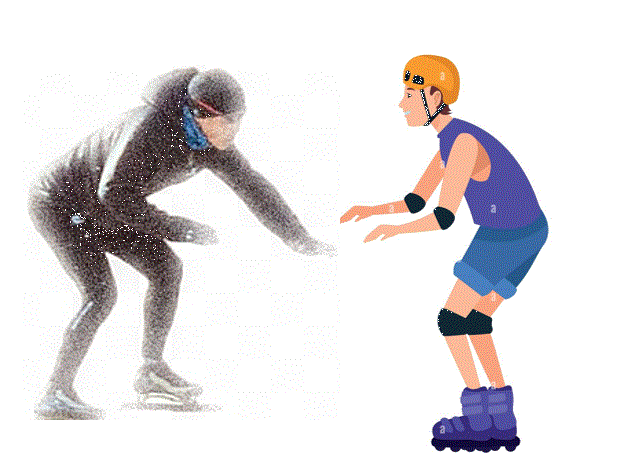
متزلجان يتدافعان على الجليد: أيّهما يؤثر في الآخر بقوة أكبر؟ وأيّهما يتغيّر زخمه أكثر؟
Two skaters pushing each other on ice: which one exerts the larger force on the other? Which one changes momentum more?
إذا تصادم جسمان فأيّهما يؤثّر على الآخر بقوة أكبر؟ ومن يتغيّر زخمه أكثر؟ فكّر قبل أن تقرأ الإجابة.
If two bodies collide, which one exerts the larger force on the other? Which one changes its momentum more? Think before reading the answer.
💡 الجواب: التأثير متبادل ومتكافئ
💡 The answer: the interaction is mutual and equal
بقانون نيوتن الثالث القوتان متساويتان في المقدار ومتعاكستان في الاتجاه، وتؤثران في الفترة الزمنية نفسها \(\Delta t\) لأن الجسمين متلامسان طوال التصادم.
By Newton’s third law the two forces are equal in magnitude and opposite in direction, and they act for the same time \(\Delta t\) because the bodies are in contact throughout the collision.
إذن يتغيّر زخما الجسمين بالمقدار نفسه وبعكس الاتجاه، حتى لو اختلفت الكتلتان؛ والجسم الأخفّ تتغيّر سرعته أكثر.
So the two momenta change by the same amount in opposite directions even if the masses differ; it is the lighter body whose velocity changes more.
🔗 من قانون نيوتن الثالث إلى حفظ الزخم
🔗 From Newton’s Third Law to Conservation of Momentum
📌 الاشتقاق خطوة بخطوة
📌 The derivation step by step
\[\vec F_1=-\vec F_2\]
الفترة الزمنية متساوية فنضرب الطرفين في \(\Delta t\) (الدفع):
The time interval is the same so we multiply both sides by \(\Delta t\) (the impulse):
\[\vec F_1\,\Delta t=-\vec F_2\,\Delta t\ \Rightarrow\ \Delta\vec P_1=-\Delta\vec P_2\]
\[P_{f1}-P_{i1}=-(P_{f2}-P_{i2})\ \Rightarrow\ \vec P_{i1}+\vec P_{i2}=\vec P_{f1}+\vec P_{f2}\]
🔍 معنى النتيجة
🔍 What the result means
الزخم الكلي للنظام (المجموع الاتجاهي لزخمي الجسمين) ثابت قبل التفاعل وبعده؛ ما يخسره جسم يكسبه الآخر تمامًا.
The total momentum of the system (the vector sum of the two momenta) is the same before and after; what one body loses the other gains exactly.
🧱 النظام المغلق المعزول
🧱 The Closed, Isolated System
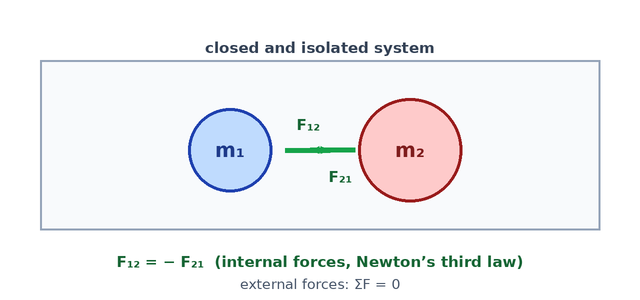
نظام مكوّن من جسمين: القوتان الداخليتان متساويتان ومتعاكستان ومحصلة القوى الخارجية تساوي صفرًا.
A two-body system: the internal forces are equal and opposite and the net external force is zero.
✅ شرطا حفظ الزخم
✅ The two conditions for conservation
• نظام مغلق: لا تؤثر قوى خارجية على النظام المكوّن من الجسمين المتفاعلين (أو تتزن محصلتها: كالوزن مع قوة الطاولة).
• Closed system: no external forces act on the system made of the two interacting bodies (or their resultant is zero, like weight balancing the table’s force).
• نظام معزول: لا يوجد تبادل تفاعل بين النظام والوسط المحيط به (كالاحتكاك أو دفع شخص من الخارج).
• Isolated system: there is no interaction between the system and its surroundings (such as friction or someone pushing from outside).
في هذه الشروط فقط: \(\vec P_{i1}+\vec P_{i2}=\vec P_{f1}+\vec P_{f2}\) أي \(m_1\vec v_{i1}+m_2\vec v_{i2}=m_1\vec v_{f1}+m_2\vec v_{f2}\).
Only under these conditions: \(\vec P_{i1}+\vec P_{i2}=\vec P_{f1}+\vec P_{f2}\), i.e. \(m_1\vec v_{i1}+m_2\vec v_{i2}=m_1\vec v_{f1}+m_2\vec v_{f2}\).
⚠️ انتبه للإشارات
⚠️ Mind the signs
الزخم كمية متجهة: نختار اتجاهًا موجبًا (عادةً نحو اليمين) فتكون السرعة نحو اليمين موجبة ونحو اليسار سالبة، ونكتب الإشارة مع كل سرعة قبل التعويض.
Momentum is a vector: choose a positive direction (usually to the right) so a velocity to the right is positive and to the left is negative, and write the sign with each velocity before substituting.
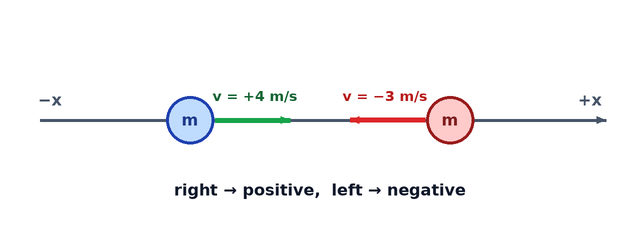
الاصطلاح: نحو اليمين موجب ونحو اليسار سالب.
Convention: right is positive and left is negative.
🧰 خطوات حل مسائل حفظ الزخم
🧰 Steps for solving momentum problems
1) ارسم الجسمين قبل التفاعل وبعده وحدّد الاتجاه الموجب.
2) اكتب \(\sum P_i=\sum P_f\) بإشارات السرعات.
3) عوّض واحسب المجهول.
4) راجع الإشارة: السالبة تعني عكس الاتجاه الموجب.
1) Sketch the bodies before and after and choose the positive direction.
2) Write \(\sum P_i=\sum P_f\) with the signs of the velocities.
3) Substitute and solve for the unknown.
4) Check the sign: a negative value means opposite to the positive direction.
💥 أنواع التفاعلات
💥 Types of Interactions
| النوعType | الزخمMomentum | الطاقة الحركيةKinetic energy | مثالExample |
|---|---|---|---|
| تصادم مرنElastic collision | محفوظconserved | محفوظةconserved | كرتان بلياردو، تصادم الذراتbilliard balls, atoms |
| تصادم غير مرنInelastic collision | محفوظconserved | تقل (تتحول إلى حرارة وتشوّه)decreases (heat and deformation) | كرة طينية ترتدّ قليلًاa clay ball bouncing a little |
| تصادم تام اللامرونةPerfectly inelastic collision | محفوظconserved | أكبر فقد ممكن، يلتحم الجسمانmaximum loss, the bodies stick | سيارتان تلتحمانtwo cars locking together |
| ارتداد / انفجارRecoil / explosion | محفوظ (الكلي صفر إن بدأ ساكنًا)conserved (total zero if it starts at rest) | تزداد (من طاقة مخزّنة)increases (from stored energy) | مدفع، طفلان يتدافعانa cannon, two kids pushing |
💡 تذكّر
💡 Remember
الزخم محفوظ في كل أنواع التصادم في نظام معزول، أما الطاقة الحركية فتُحفظ في التصادم المرن فقط.
Momentum is conserved in every type of collision in an isolated system, while kinetic energy is conserved only in an elastic collision.
✏️ أمثلة محلولة
✏️ Worked Examples
كرة كتلتها \(1\ \mathrm{kg}\) ساكنة اصطدمت بها كرة كتلتها \(0.5\ \mathrm{kg}\) تتحرك بسرعة أفقية \(15\ \mathrm{m/s}\) نحو اليمين، فتحركت الكرة الكبيرة بسرعة \(10\ \mathrm{m/s}\) نحو اليمين. أحسب سرعة الكرة الصغيرة بعد التصادم.
A \(1\ \mathrm{kg}\) ball is at rest and a \(0.5\ \mathrm{kg}\) ball hits it moving at \(15\ \mathrm{m/s}\) to the right; the big ball moves off at \(10\ \mathrm{m/s}\) to the right. Find the velocity of the small ball after the collision.
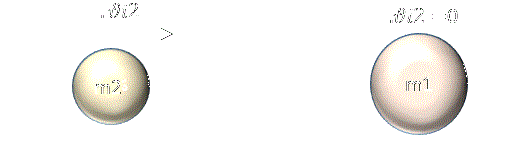
شكل المثال 1: الكرة الصغيرة تصطدم بالكبيرة الساكنة فترتدّ.
Example 1: the small ball hits the stationary big ball and rebounds.
🔎 تحقّق من الطاقة (شرح إضافي)
🔎 Energy check (extra explanation)
قبل: \(K_i=\tfrac12(0.5)(15)^2=56.25\ \mathrm{J}\). بعد: \(K_f=\tfrac12(1)(10)^2+\tfrac12(0.5)(5)^2=50+6.25=56.25\ \mathrm{J}\). الطاقة محفوظة أيضًا إذن التصادم مرن.
Before: \(K_i=\tfrac12(0.5)(15)^2=56.25\ \mathrm{J}\). After: \(K_f=\tfrac12(1)(10)^2+\tfrac12(0.5)(5)^2=50+6.25=56.25\ \mathrm{J}\). The energy is conserved too, so the collision is elastic.
جسم كتلته \(2\ \mathrm{kg}\) يتحرك بسرعة \(6\ \mathrm{m/s}\) اصطدم بجسم كتلته \(4\ \mathrm{kg}\) ساكن فالتحما معًا. أوجد سرعتهما بعد التصادم والطاقة الحركية الضائعة.
A \(2\ \mathrm{kg}\) body moving at \(6\ \mathrm{m/s}\) hits a \(4\ \mathrm{kg}\) body at rest and they stick together. Find their common velocity and the kinetic energy lost.
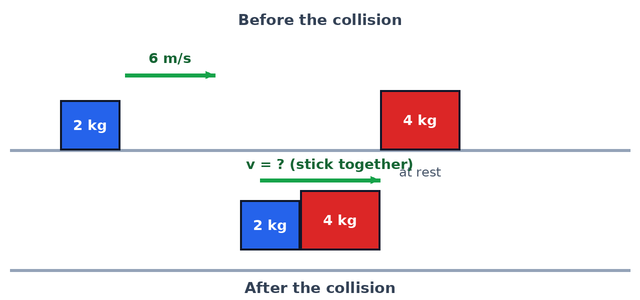
شكل المثال 2: تصادم تام اللامرونة.
Example 2: a perfectly inelastic collision.
جسمان كتلتاهما \(3\ \mathrm{kg}\) و\(1\ \mathrm{kg}\) يتحركان نحو بعضهما: الأول بسرعة \(4\ \mathrm{m/s}\) نحو اليمين والثاني بسرعة \(2\ \mathrm{m/s}\) نحو اليسار. يلتحمان بعد التصادم. أوجد سرعتهما.
Two bodies of masses \(3\ \mathrm{kg}\) and \(1\ \mathrm{kg}\) move toward each other: the first at \(4\ \mathrm{m/s}\) to the right and the second at \(2\ \mathrm{m/s}\) to the left. They stick together. Find their velocity.
كرة \(1\ \mathrm{kg}\) تتحرك بسرعة \(4\ \mathrm{m/s}\) اصطدمت بكرة مماثلة ساكنة والتحمتا. سرعتهما بعد التصادم:
A \(1\ \mathrm{kg}\) ball moving at \(4\ \mathrm{m/s}\) hits an identical ball at rest and they stick together. Their velocity afterwards is:
أي العبارات صحيحة في تصادم تام اللامرونة بين جسمين في نظام معزول؟
Which statement is correct for a perfectly inelastic collision between two bodies in an isolated system?
📌 التصادم المرن في بُعد واحد (شرح إضافي)
📌 One-dimensional elastic collision (extra)
\[v_{f1}=\frac{m_1-m_2}{m_1+m_2}\,v_{i1}+\frac{2m_2}{m_1+m_2}\,v_{i2}\qquad v_{f2}=\frac{2m_1}{m_1+m_2}\,v_{i1}+\frac{m_2-m_1}{m_1+m_2}\,v_{i2}\]
تنتج هاتان العلاقتان من حفظ الزخم وحفظ الطاقة معًا. وإذا تساوت الكتلتان تتبادل الكرتان سرعتيهما.
These two relations come from conservation of momentum and of energy together. If the masses are equal the balls exchange their velocities.
🧪 جرّب بنفسك: التصادمات
🧪 Try It Yourself: Collisions
🧪 تجربة 1: مختبر التصادمات: غيّر الكتل والسرعات ومعامل الارتداد
🧪 Experiment 1: The Collision Lab: Change the Masses, Velocities and Restitution
اختر كتلتي العربتين وسرعتيهما الابتدائيتين (الإشارة السالبة نحو اليسار) ومعامل الارتداد \(e\) (\(1\) تصادم مرن، \(0\) التحام تام) ثم اضغط «أطلق». تُظهر الأعمدة الزخم والطاقة الحركية قبل التصادم وبعده: الزخم الكلي يبقى ثابتًا دائمًا.
Choose the masses and initial velocities of the two carts (a negative sign means to the left) and the coefficient of restitution \(e\) (\(1\) elastic, \(0\) perfectly inelastic) then press “Launch”. The bars show momentum and kinetic energy before and after the collision: the total momentum always stays the same.
🧪 تجربة 2: تدريب: حلّ المسألة ثم تحقّق
🧪 Experiment 2: Practice: Solve the Problem then Check
تظهر لك مسألة عشوائية (التحام، أو إيجاد سرعة مجهولة، أو ارتداد). احسب الجواب بحفظ الزخم واكتبه (مع الإشارة) ثم اضغط «تحقّق». استعمل «أرني الحل» إن احتجت إلى الخطوات.
A random problem appears (sticking, an unknown velocity, or a recoil). Work out the answer using conservation of momentum, enter it (with its sign) and press “Check”. Use “Show the solution” if you need the steps.
🚀 الارتداد
🚀 Recoil
عندما يتفاعل جسمان في نظام مغلق ويبدآن من السكون، كما في تدافع طفلين على سطح أملس أو إطلاق قذيفة من مدفع، يكون الزخم الكلي قبل التفاعل صفرًا، فيجب أن يبقى صفرًا بعده: يتحرك الجسمان في اتجاهين متعاكسين.
When two bodies of a closed system start from rest, as in two children pushing each other on a smooth surface or a cannon firing a shell, the total momentum before the interaction is zero, so it must stay zero afterwards: the bodies move in opposite directions.
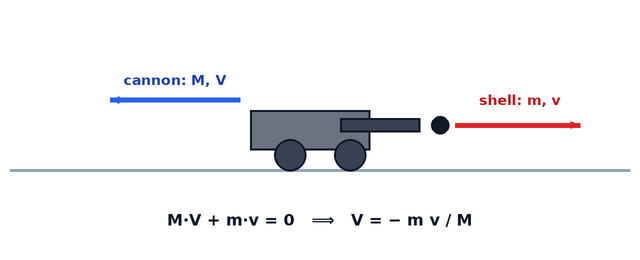
مدفع كتلته \(M\) يطلق قذيفة كتلتها \(m\): يرتدّ المدفع في الاتجاه المعاكس لحركة القذيفة.
A cannon of mass \(M\) fires a shell of mass \(m\): the cannon recoils opposite to the shell’s motion.
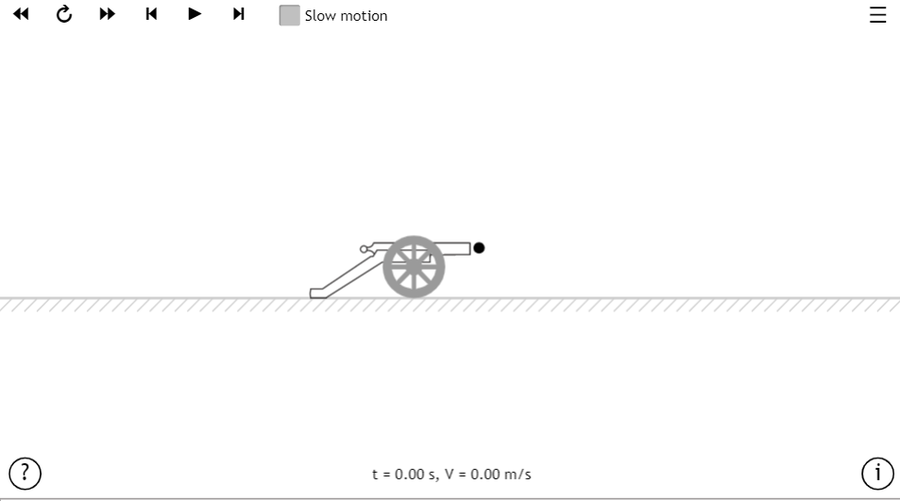
لقطة من محاكاة المدفع والقذيفة (GeoGebra) في أسفل الدرس.
A view of the cannon and shell simulation (GeoGebra) linked at the bottom of the lesson.
📌 سرعة الارتداد
📌 Recoil velocity
القوى الداخلية هي القوى المتبادلة بين المدفع والقذيفة. قبل الإطلاق \(P_i=0\):
The internal forces are the mutual forces between the cannon and the shell. Before firing \(P_i=0\):
\[0=m_1v_{f1}+m_2v_{f2}\ \Rightarrow\ v_{f2}=-\frac{m_1\,v_{f1}}{m_2}\]
الإشارة السالبة: عكس اتجاه القذيفة، والسرعتان تتناسبان عكسيًا مع الكتلتين: \(\dfrac{v_2}{v_1}=\dfrac{m_1}{m_2}\).
The negative sign: opposite to the shell; the speeds are inversely proportional to the masses: \(\dfrac{v_2}{v_1}=\dfrac{m_1}{m_2}\).
⚡ ماذا عن الطاقة؟ (شرح إضافي)
⚡ What about energy? (extra)
الزخمان متساويان في المقدار لكن الطاقتين الحركيتين مختلفتان: \(K=\dfrac{P^2}{2m}\) فالجسم الأخف يأخذ طاقة حركية أكبر: \(\dfrac{K_1}{K_2}=\dfrac{m_2}{m_1}\).
The momenta are equal in size but the kinetic energies are different: \(K=\dfrac{P^2}{2m}\) so the lighter body gets the greater kinetic energy: \(\dfrac{K_1}{K_2}=\dfrac{m_2}{m_1}\).
هذه الطاقة تأتي من طاقة مخزّنة (كيميائية في البارود أو مرونية في نابض)، ولذلك تزداد الطاقة الحركية الكلية رغم ثبات الزخم.
This energy comes from stored energy (chemical in the powder or elastic in a spring), so the total kinetic energy increases even though the momentum stays the same.
يطلق مدفع كتلته \(1000\ \mathrm{kg}\) قذيفة كتلتها \(5\ \mathrm{kg}\) بسرعة \(200\ \mathrm{m/s}\) على سطح أملس. أوجد سرعة ارتداد المدفع والطاقة الحركية لكل منهما.
A \(1000\ \mathrm{kg}\) cannon fires a \(5\ \mathrm{kg}\) shell at \(200\ \mathrm{m/s}\) on a smooth surface. Find the recoil velocity of the cannon and the kinetic energy of each.
متزلجان ساكنان على الجليد يتدافعان: كتلة الأول \(60\ \mathrm{kg}\) وكتلة الثاني \(40\ \mathrm{kg}\). ابتعد الأول بسرعة \(2\ \mathrm{m/s}\) نحو اليمين. ما سرعة الثاني؟
Two skaters at rest on ice push each other: the first has mass \(60\ \mathrm{kg}\) and the second \(40\ \mathrm{kg}\). The first moves away at \(2\ \mathrm{m/s}\) to the right. What is the second’s velocity?
بندقية كتلتها \(5\ \mathrm{kg}\) أطلقت رصاصة \(0.02\ \mathrm{kg}\) بسرعة \(500\ \mathrm{m/s}\). سرعة ارتداد البندقية:
A \(5\ \mathrm{kg}\) rifle fires a \(0.02\ \mathrm{kg}\) bullet at \(500\ \mathrm{m/s}\). The rifle’s recoil velocity is:
بعد انفجار جسم ساكن إلى قطعتين مختلفتي الكتلة، القطعة الأخف:
After a stationary body explodes into two pieces of different mass, the lighter piece has:
🧪 جرّب بنفسك: الارتداد والانفجار
🧪 Try It Yourself: Recoil and Explosion
🧪 تجربة 3: المدفع والقذيفة: اضغط «أطلق» وراقب الارتداد
🧪 Experiment 3: The Cannon and the Shell: Press “Fire” and Watch the Recoil
حدّد كتلة المدفع وكتلة القذيفة وسرعتها ثم اضغط «أطلق». يتحرك المدفع إلى اليسار بينما تنطلق القذيفة إلى اليمين؛ لاحظ تساوي الزخمين مقدارًا واختلاف الطاقتين الحركيتين.
Set the cannon mass, the shell mass and its speed then press “Fire”. The cannon moves to the left while the shell goes to the right; notice that the momenta are equal in size but the kinetic energies differ.
🛷 الانفجار لنظام متحرك (شرح إضافي)
🛷 Explosion of a Moving System (extra)
إذا كان النظام يتحرك قبل الانفصال فإن زخمه الكلي ليس صفرًا؛ يبقى مساويًا \((m_1+m_2)v_0\)، ويتابع مركز الكتلة حركته بالسرعة \(v_0\) نفسها بعد الانفصال، فالقوى الداخلية لا تغيّر حركة مركز الكتلة.
If the system is moving before it separates its total momentum is not zero; it stays \((m_1+m_2)v_0\), and the centre of mass keeps moving with the same \(v_0\) after the separation, since internal forces do not change the motion of the centre of mass.
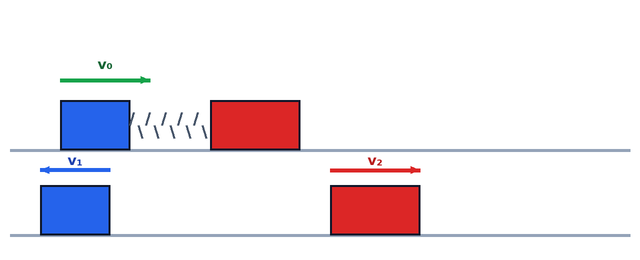
عربتان تتحركان معًا بسرعة \(v_0\) وبينهما نابض مضغوط؛ بعد تحريره يتحرك كل منهما بسرعة مختلفة.
Two carts moving together at \(v_0\) with a compressed spring between them; after release each moves at a different velocity.
عربتان كتلتاهما \(2\ \mathrm{kg}\) و\(3\ \mathrm{kg}\) تتحركان معًا بسرعة \(5\ \mathrm{m/s}\) وبينهما نابض مضغوط. بعد تحرير النابض تحركت العربة \(2\ \mathrm{kg}\) بسرعة \(8\ \mathrm{m/s}\) في الاتجاه نفسه. أوجد سرعة الأخرى والطاقة التي حرّرها النابض.
Two carts of \(2\ \mathrm{kg}\) and \(3\ \mathrm{kg}\) move together at \(5\ \mathrm{m/s}\) with a compressed spring between them. After the spring is released the \(2\ \mathrm{kg}\) cart moves at \(8\ \mathrm{m/s}\) in the same direction. Find the other cart’s velocity and the energy released by the spring.
🧪 تجربة 4: نابض بين عربتين متحركتين: مركز الكتلة لا يتغيّر
🧪 Experiment 4: A Spring between Moving Carts: the Centre of Mass Is Unaffected
عربتان متصلتان بنابض مضغوط تتحركان بسرعة \(v_0\). اضغط «حرّر النابض» فتنفصلان بسرعتين مختلفتين، بينما يتابع مركز الكتلة (المعيّن بالنقطة الذهبية) سرعته \(v_0\) دون تغيّر، والزخم الكلي ثابت.
Two carts joined by a compressed spring move at \(v_0\). Press “Release the spring” and they separate with different velocities, while the centre of mass (the golden dot) keeps its velocity \(v_0\) and the total momentum is constant.
✅ ملخص الدرس
✅ Lesson Summary
| الموضوعTopic | العلاقةRelation | الفكرةIdea |
|---|---|---|
| حفظ الزخمConservation of momentum | \(\sum\vec P_i=\sum\vec P_f\) | نظام مغلق معزولclosed, isolated system |
| التصادم المرنElastic collision | \(\sum P_i=\sum P_f,\ \sum K_i=\sum K_f\) | الطاقة محفوظة أيضًاenergy conserved too |
| تام اللامرونةPerfectly inelastic | \(v=\dfrac{m_1v_1+m_2v_2}{m_1+m_2}\) | يلتحمان وتضيع طاقةthey stick and energy is lost |
| الارتدادRecoil | \(V=-\dfrac{mv}{M}\) | عكسي مع الكتلة والاتجاه معاكسinversely proportional to mass, opposite direction |
| الطاقة بعد الانفجارEnergy after an explosion | \(K=\dfrac{P^2}{2m}\) | الأخف أكبر طاقةthe lighter gets more energy |
🧪 اختبر نفسك: امتحان من 20 سؤالاً
🧪 Test Yourself: a 20-Question Exam
أنهِ الدرس بالاختبار التفاعلي التالي؛ أسئلته تجمع بين الفهم والحساب وتغطي جميع أقسام الدرس.
Finish with the interactive exam below; its questions mix understanding with calculation and cover every section of the lesson.
اختبار حفظ الزخم والارتداد Conservation of Momentum and Recoil Quiz
20 سؤالاً - الزخم، النظام المعزول، التصادمات، الارتداد، والانفجار 20 Questions - momentum, isolated systems, collisions, recoil and explosions
• عدد الأسئلة: 20 سؤالاً
• مدة الاختبار: 30 دقيقة
• لا يمكنك تغيير إجاباتك أو إعادة الاختبار إلا بعد 24 ساعة من التسليم.
• تأكد من إجاباتك قبل التسليم! 📌 Important Instructions:
• Number of questions: 20 questions
• Quiz duration: 30 minutes
• You cannot change your answers or retake the quiz for 24 hours after submission.
• Make sure of your answers before submitting!
🔗 محاكيات GeoGebra للاستعانة بها عند اللزوم
🔗 GeoGebra Simulations to Use When Needed
اضغط «تشغيل» لتعمل المحاكاة هنا داخل الدرس؛ ويمكن للطالب الرجوع إليها لتجربة الفكرة بطريقة أخرى.
Press “Run” to run the simulation right here inside the lesson; the student can use it to try the idea in another way.