🎯 نواتج التعلم
🎯 Learning Outcomes
بعد دراسة هذا الدرس ستكون قادرًا على أن:
After this lesson you will be able to:
- تعرّف المقذوف وتفسّر استقلال الحركة الأفقية عن الحركة الرأسية.Define a projectile and explain the independence of the horizontal and vertical motions.
- تحلّ مسائل المقذوف الرأسي (أقصى ارتفاع، زمن الصعود، زمن الرحلة، سرعة الارتطام).Solve vertical projectile problems (maximum height, time of rise, flight time and impact speed).
- تحسب زمن السقوط والمدى وسرعة الارتطام لمقذوف أُطلق أفقيًا من ارتفاع.Calculate the fall time, the range and the impact speed of a projectile launched horizontally from a height.
- تحلّل سرعة القذف بزاوية وتحسب زمن الرحلة وأقصى ارتفاع والمدى.Resolve the launch velocity at an angle and calculate the flight time, the maximum height and the range.
- تقارن مدى المقذوفات بزوايا مختلفة وتفسّر الزاويتين المتتامتين وزاوية \(45^\circ\).Compare the ranges of projectiles at different angles and explain complementary angles and the \(45^\circ\) angle.
🧭 ما هو المقذوف؟ مبدأ استقلال الحركتين
🧭 What Is a Projectile? Independence of the Motions
المقذوف جسم يُقذف ثم يتحرك تحت تأثير الجاذبية الأرضية وحدها (نهمل مقاومة الهواء). ومساره يتحدّد بالسرعة الابتدائية وزاوية القذف وارتفاع نقطة القذف. والفكرة المحورية في الدرس: الحركة الأفقية والحركة الرأسية مستقلتان؛ فالأفقية منتظمة بسرعة ثابتة (لأنه لا تسارع أفقيًا)، والرأسية بتسارع ثابت \(g\approx9.8\ \mathrm{m/s^2}\) نحو الأسفل.
A projectile is a body that is thrown and then moves under the influence of Earth’s gravity alone (air resistance is neglected). Its path is determined by the initial speed, the launch angle and the launch height. The central idea of the lesson: the horizontal and vertical motions are independent; the horizontal one is uniform at a constant speed (there is no horizontal acceleration) and the vertical one has a constant acceleration \(g\approx9.8\ \mathrm{m/s^2}\) downward.
📌 الاصطلاح المستعمل
📌 The convention used
- نأخذ \(g=9.8\ \mathrm{m/s^2}\) (ويُقرَّب أحيانًا إلى \(10\)) والاتجاه إلى الأعلى موجب.We take \(g=9.8\ \mathrm{m/s^2}\) (sometimes rounded to \(10\)) and up as positive.
- التسارع الأفقي \(a_x=0\) والتسارع الرأسي \(a_y=-g\).The horizontal acceleration is \(a_x=0\) and the vertical acceleration is \(a_y=-g\).
- الزمن \(t\) مشترك بين الحركتين، وهو الرابط بينهما.The time \(t\) is common to both motions and is the link between them.
⬆️ أولًا: حركة المقذوف الرأسي
⬆️ 1. Vertical Projectile Motion
يُقذف الجسم رأسيًا إلى أعلى أو إلى أسفل، فتكون الحركة في بعد واحد بتسارع \(-g\). ندرسها لأنها أساس فيزياء الحركة، ولها تطبيقات في هندسة الصواريخ وتحليل حركات الرياضات كالسلة. والمعادلات (مع اعتبار الأعلى موجبًا):
The body is thrown vertically upward or downward, so the motion is in one dimension with acceleration \(-g\). We study it because it is the foundation of the physics of motion and it applies to rocket engineering and the analysis of sports such as basketball. The equations (taking up as positive):
📌 معادلات الحركة الرأسية
📌 Equations of vertical motion
\[v=v_0-gt\]
\[y=y_0+v_0t-\tfrac12gt^2\]
\[v^2=v_0^2-2g\,(y-y_0)\]
\[H=y_0+\frac{v_0^2}{2g},\qquad t_{up}=\frac{v_0}{g}\]
ما يجب أن تعرفه: يفقد الجسم \(9.8\ \mathrm{m/s}\) من سرعته كل ثانية أثناء الصعود، وعند القمة \(v=0\) لكن التسارع يبقى \(-g\)، وتتحول الطاقة الحركية إلى طاقة وضع عند القمة. وإذا وُجدت مقاومة هواء كان زمن الهبوط أكبر من زمن الصعود، أما في حالتنا (بلا هواء) فهما متساويان عند العودة إلى مستوى القذف.
What you must know: the body loses \(9.8\ \mathrm{m/s}\) of its speed every second while rising; at the top \(v=0\) but the acceleration remains \(-g\), and the kinetic energy has turned into potential energy at the top. With air resistance the time of fall would be longer than the time of rise; in our case (no air) they are equal when returning to the launch level.
قُذف جسم رأسيًا إلى أعلى بسرعة \(50\ \mathrm{m/s}\) من ارتفاع \(100\ \mathrm m\) عن الأرض (\(g=9.8\ \mathrm{m/s^2}\)). أوجد زمن الصعود وأقصى ارتفاع عن الأرض وسرعته لحظة الارتطام وزمن الرحلة كلها.
A body is thrown vertically upward at \(50\ \mathrm{m/s}\) from a height of \(100\ \mathrm m\) above the ground (\(g=9.8\ \mathrm{m/s^2}\)). Find the time of rise, the maximum height above the ground, its velocity on impact and the whole flight time.
| الزمن (s)Time (s) | الارتفاع (m)Height (m) | السرعة (m/s)Velocity (m/s) |
|---|---|---|
| 0 | 100 | +50 |
| 5.1 | 227.55 | 0 |
| 11.92 | 0 | −66.78 |
🧪 جرّب بنفسك: المقذوف الرأسي
🧪 Try It Yourself: the Vertical Projectile
🧪 تجربة 1: المقذوف الرأسي مع رسوم h وv وa
🧪 Experiment 1: Vertical Projectile with the h, v and a Graphs
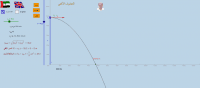
اضبط سرعة القذف \(v_0\) وارتفاع نقطة القذف \(h_0\) ثم اضغط «تشغيل» (أو حرّك شريط التقدّم)، وراقب الكرة والمتجهين \(v\) و\(a\) ورسوم \(h\) و\(v\) و\(a\) مع الزمن.
Set the launch speed \(v_0\) and the launch height \(h_0\) then press “Play” (or move the progress bar) and watch the ball, the vectors \(v\) and \(a\) and the graphs of \(h\), \(v\) and \(a\) against time.
➡️ ثانيًا: القذف الأفقي من ارتفاع
➡️ 2. Horizontal Launch from a Height
يُقذف الجسم أفقيًا بسرعة \(v_0\) من ارتفاع \(h\)، فتكون السرعة الابتدائية الرأسية صفرًا. المركبة الأفقية \(v_x=v_0\) ثابتة، والمركبة الرأسية \(v_y=gt\) تزداد كما في السقوط الحر، فيكون المسار قطعًا مكافئًا. وزمن الطيران يتحدد بالارتفاع فقط:
The body is thrown horizontally at \(v_0\) from a height \(h\), so the initial vertical velocity is zero. The horizontal component \(v_x=v_0\) is constant and the vertical component \(v_y=gt\) grows as in free fall, so the path is a parabola. The flight time is determined by the height only:
📌 القذف الأفقي
📌 Horizontal launch
\[t=\sqrt{\frac{2h}{g}}\]
\[R=v_0\,t\]
\[v_y=gt,\qquad v=\sqrt{v_x^2+v_y^2},\qquad \tan\alpha=\frac{v_y}{v_x}\]
أين نستفيد منه؟
Where is it used?
- إسقاط المساعدات من الطائرات.Dropping relief supplies from aircraft.
- حساب مسارات القذائف وحركة الكرات في الرياضات.Calculating the paths of shells and of balls in sports.
- أنظمة الملاحة الجوية.Air navigation systems.
قُذف جسم أفقيًا بسرعة \(50\ \mathrm{m/s}\) من ارتفاع \(100\ \mathrm m\) (\(g=9.8\ \mathrm{m/s^2}\)). أوجد زمن السقوط والمدى والسرعة الكلية عند الارتطام.
A body is thrown horizontally at \(50\ \mathrm{m/s}\) from a height of \(100\ \mathrm m\) (\(g=9.8\ \mathrm{m/s^2}\)). Find the fall time, the range and the total speed on impact.
🧪 جرّب بنفسك: القذف الأفقي
🧪 Try It Yourself: Horizontal Launch
🧪 تجربة 2: القذف الأفقي من ارتفاع
🧪 Experiment 2: Horizontal Launch from a Height
اضبط الارتفاع \(h\) والسرعة الأفقية \(v_0\) ثم شغّل الحركة؛ لاحظ أن ظلّ الكرة على الأرض يتحرك بانتظام وظلّها على الجدار الرأسي يتسارع، وأن زمن السقوط لا يتأثر بـ\(v_0\).
Set the height \(h\) and the horizontal speed \(v_0\) then play the motion; notice that the ball’s shadow on the ground moves uniformly while its shadow on the vertical wall accelerates, and that the fall time is not affected by \(v_0\).
↗️ ثالثًا: المقذوف بزاوية
↗️ 3. Projectile Launched at an Angle
يُقذف الجسم بسرعة \(v_0\) بزاوية \(\theta\) فوق الأفقي، فنحلّل السرعة إلى مركبتين: أفقية ثابتة ورأسية تتناقص بفعل الجاذبية ثم تنعكس.
The body is launched at speed \(v_0\) at an angle \(\theta\) above the horizontal, so we resolve the velocity into two components: a constant horizontal one and a vertical one that decreases because of gravity and then reverses.
📌 المركبتان والمعادلات
📌 The components and the equations
\[v_{0x}=v_0\cos\theta,\qquad v_{0y}=v_0\sin\theta\]
\[x=v_0\cos\theta\;t,\qquad y=h_0+v_0\sin\theta\;t-\tfrac12gt^2\]
\[t=\frac{v_0\sin\theta+\sqrt{v_0^2\sin^2\theta+2gh_0}}{g}\]
\[H=h_0+\frac{v_0^2\sin^2\theta}{2g},\qquad R=v_0\cos\theta\;t\]
📌 مسار المقذوف
📌 The trajectory
\[y=h_0+(\tan\theta)\,x-\frac{g\,x^2}{2v_0^2\cos^2\theta}\]
حالات خاصة
Special cases
- \(\theta=45^\circ\): أقصى مدى أفقي عند القذف من مستوى الأرض.\(\theta=45^\circ\): the maximum horizontal range when launched from ground level.
- \(\theta=90^\circ\): حركة رأسية خالصة والمدى صفر.\(\theta=90^\circ\): pure vertical motion and zero range.
- \(\theta=0\): قذف أفقي من الارتفاع \(h_0\).\(\theta=0\): a horizontal launch from the height \(h_0\).
قُذف جسم بسرعة \(50\ \mathrm{m/s}\) بزاوية \(45^\circ\) من ارتفاع \(10\ \mathrm m\) (\(g=9.8\ \mathrm{m/s^2}\)). أوجد زمن الرحلة والمدى وأقصى ارتفاع عن الأرض.
A body is launched at \(50\ \mathrm{m/s}\) at \(45^\circ\) from a height of \(10\ \mathrm m\) (\(g=9.8\ \mathrm{m/s^2}\)). Find the flight time, the range and the maximum height above the ground.
قُذف جسم من الأرض بسرعة \(20\ \mathrm{m/s}\) بزاوية \(30^\circ\). أوجد زمن الرحلة وأقصى ارتفاع والمدى (\(g=9.8\ \mathrm{m/s^2}\)).
A body is launched from the ground at \(20\ \mathrm{m/s}\) at \(30^\circ\). Find the flight time, the maximum height and the range (\(g=9.8\ \mathrm{m/s^2}\)).
🧪 جرّب بنفسك: المقذوف بزاوية
🧪 Try It Yourself: the Angled Projectile
🧪 تجربة 3: المقذوف بزاوية
🧪 Experiment 3: Projectile Launched at an Angle
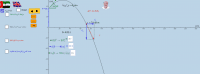
اضبط سرعة القذف والزاوية وارتفاع نقطة القذف ثم شغّل الحركة؛ وراقب المركبتين \(v_x\) و\(v_y\) والزمن والمدى وأقصى ارتفاع. فعّل المقارنة لترى مسار الزاوية المتممة.
Set the launch speed, the angle and the launch height then play the motion; watch the components \(v_x\) and \(v_y\), the time, the range and the maximum height. Turn on the comparison to see the path of the complementary angle.
⚖️ رابعًا: مقارنة المقذوفات بزوايا مختلفة
⚖️ 4. Comparing Projectiles at Different Angles
عند القذف من مستوى الأرض (نقطتا القذف والسقوط على المستوى نفسه) يكون المدى:
When launching from ground level (launch and landing points on the same level) the range is:
📌 المدى
📌 The range
\[R=\frac{v_0^{2}\sin2\theta}{g}\qquad\Rightarrow\qquad R_{max}=\frac{v_0^2}{g}\ \ (\theta=45^\circ)\]
لأن \(\sin2\theta=\sin2(90^\circ-\theta)\) فإن الزاويتين المتتامتين (مجموعهما \(90^\circ\)) تعطيان المدى نفسه، لكن الزاوية الأكبر تصل إلى ارتفاع أكبر وتبقى في الهواء زمنًا أطول. وهذه الصيغة لا تصلح إذا اختلف مستوى القذف عن مستوى السقوط (استعمل \(R=v_{0x}\,t\)).
Because \(\sin2\theta=\sin2(90^\circ-\theta)\) the complementary angles (adding up to \(90^\circ\)) give the same range, but the larger angle reaches a greater height and stays in the air longer. This formula does not hold if the launch level differs from the landing level (use \(R=v_{0x}\,t\)).
نفس المدى بزاويتين مختلفتين
The same range with two different angles
| الزاوية \(\theta\)Angle \(\theta\) | المدى \(R\)Range \(R\) | السرعة الرأسية \(v_y\)Vertical velocity \(v_y\) |
|---|---|---|
| \(30^\circ\) | 100 m | \(0.5\,v_0\) |
| \(60^\circ\) | 100 m | \(0.87\,v_0\) |
نفس السرعة الابتدائية بزوايا مختلفة
The same initial speed at different angles
إذا كان \(v_0^2/g=100\ \mathrm m\) (أي \(R_{max}=100\ \mathrm m\)) فإن:
If \(v_0^2/g=100\ \mathrm m\) (i.e. \(R_{max}=100\ \mathrm m\)) then:
| الزاوية \(\theta\)Angle \(\theta\) | المدى \(R\)Range \(R\) | السرعة الرأسية \(v_y\)Vertical velocity \(v_y\) |
|---|---|---|
| \(30^\circ\) | 86.6 m | \(0.5\,v_0\) |
| \(45^\circ\) | 100 m | \(0.71\,v_0\) |
| \(60^\circ\) | 86.6 m | \(0.87\,v_0\) |
قذف لاعب كرة من الأرض فكان مداها \(100\ \mathrm m\) عند الزاوية \(30^\circ\). ما مداها بالسرعة نفسها عند \(60^\circ\)؟ وما أصغر سرعة قذف تحقق مدى \(100\ \mathrm m\) (\(g=9.8\ \mathrm{m/s^2}\))؟
A player kicks a ball from the ground and its range at \(30^\circ\) is \(100\ \mathrm m\). What is its range with the same speed at \(60^\circ\)? And what is the smallest launch speed that achieves a range of \(100\ \mathrm m\) (\(g=9.8\ \mathrm{m/s^2}\))?
🧪 جرّب بنفسك: المدى مع الزاوية
🧪 Try It Yourself: Range against Angle
🧪 تجربة 4: المدى مع الزاوية: الزاويتان المتتامتان
🧪 Experiment 4: Range against Angle: the Complementary Angles
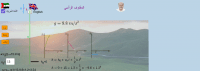
غيّر زاوية القذف (من مستوى الأرض) وراقب مسارَي \(\theta\) و\(90^\circ-\theta\) وموقعهما على منحنى \(R\)–\(\theta\): المدى متساوٍ وأقصى مدى عند \(45^\circ\).
Change the launch angle (from ground level) and watch the paths of \(\theta\) and \(90^\circ-\theta\) and their positions on the \(R\)–\(\theta\) curve: equal ranges and the maximum range at \(45^\circ\).
🌍 تطبيقات عملية
🌍 Practical Applications
أين نستفيد من حركة المقذوفات؟
Where do we use projectile motion?
- الرياضة: اختيار زاوية رمي الكرة أو القرص أو الجلة.Sports: choosing the angle for throwing a ball, a discus or a shot.
- المدفعية: ضبط زوايا المدافع وحساب مدى القذائف.Artillery: setting the gun angles and calculating the range of shells.
- إطلاق الصواريخ والأقمار الصناعية وتحسين زوايا الإطلاق.Launching rockets and satellites and optimising the launch angles.
- الألعاب النارية وتصميم مسارات الانفجار.Fireworks and designing the paths of the bursts.
⚠️ أخطاء شائعة
⚠️ Common Mistakes
تجنّب هذه الأخطاء
Avoid these mistakes
- خلط الحركتين: استعمل \(g\) في المحور الرأسي فقط، والسرعة الأفقية تبقى ثابتة.Mixing the motions: use \(g\) on the vertical axis only; the horizontal speed stays constant.
- الظن أن السرعة الأفقية تؤثر في زمن السقوط، والصحيح أنه يتحدد بالارتفاع فقط.Thinking that the horizontal speed affects the fall time; it is determined by the height only.
- نسيان تحليل السرعة إلى مركبتين \(v_0\cos\theta\) و\(v_0\sin\theta\) في المقذوف بزاوية.Forgetting to resolve the velocity into \(v_0\cos\theta\) and \(v_0\sin\theta\) for an angled projectile.
- استعمال \(R=v_0^2\sin2\theta/g\) عند اختلاف مستوى القذف عن مستوى السقوط.Using \(R=v_0^2\sin2\theta/g\) when the launch level differs from the landing level.
📝 ملخص الدرس
📝 Lesson Summary
| نوع الحركةType of motion | القوانينEquations |
|---|---|
| رأسيVertical | \(v=v_0-gt,\ y=y_0+v_0t-\tfrac12gt^2,\ H=y_0+\dfrac{v_0^2}{2g}\) |
| أفقيHorizontal | \(t=\sqrt{2h/g},\ R=v_0t,\ v_y=gt\) |
| بزاويةAngled | \(v_x=v_0\cos\theta,\ v_y=v_0\sin\theta,\ R=\dfrac{v_0^2\sin2\theta}{g}\) |
🎲 تدرّب على المسائل
🎲 Practice Problems
🧪 تجربة 5: تدرّب: مسائل حركة المقذوفات
🧪 Experiment 5: Practice: Projectile Motion Problems
مسائل عشوائية بأرقام مختلفة. احسب واكتب الجواب ثم اضغط «تحقّق».
Random problems with different numbers. Work it out, enter the answer and press “Check”.
✅ قيّم نفسك
✅ Self-Check
قُذف جسم أفقيًا من ارتفاع \(80\ \mathrm m\) (\(g=10\ \mathrm{m/s^2}\)). زمن سقوطه:
A body is thrown horizontally from a height of \(80\ \mathrm m\) (\(g=10\ \mathrm{m/s^2}\)). Its fall time:
أي زاويتين تعطيان المدى نفسه (القذف من الأرض)؟
Which two angles give the same range (launch from the ground)?
السرعة الأفقية لمقذوف (بلا مقاومة هواء) أثناء حركته:
The horizontal speed of a projectile (no air resistance) during its motion:
المركبة الرأسية لسرعة \(50\ \mathrm{m/s}\) بزاوية \(30^\circ\) فوق الأفقي:
The vertical component of a velocity of \(50\ \mathrm{m/s}\) at \(30^\circ\) above the horizontal:
🧪 اختبر نفسك: امتحان من 20 سؤالاً
🧪 Test Yourself: a 20-Question Exam
أنهِ الدرس بالاختبار التفاعلي التالي؛ أسئلته تجمع بين الفهم والحساب وتغطي جميع أقسام الدرس.
Finish with the interactive exam below; its questions mix understanding with calculation and cover every section of the lesson.
اختبار حركة المقذوفات Projectile Motion Quiz
20 سؤالاً - المقذوف الرأسي والأفقي وبزاوية، الزمن والمدى وأقصى ارتفاع، مقارنة الزوايا 20 Questions - vertical, horizontal and angled projectiles, time, range and maximum height, comparing angles
• عدد الأسئلة: 20 سؤالاً
• مدة الاختبار: 30 دقيقة
• لا يمكنك تغيير إجاباتك أو إعادة الاختبار إلا بعد 24 ساعة من التسليم.
• تأكد من إجاباتك قبل التسليم! 📌 Important Instructions:
• Number of questions: 20 questions
• Quiz duration: 30 minutes
• You cannot change your answers or retake the quiz for 24 hours after submission.
• Make sure of your answers before submitting!
🔗 محاكيات GeoGebra للاستعانة بها عند اللزوم
🔗 GeoGebra Simulations to Use When Needed
اضغط «تشغيل» لتعمل المحاكاة هنا داخل الدرس؛ ويمكن للطالب الرجوع إليها لتجربة الفكرة بطريقة أخرى.
Press “Run” to run the simulation right here inside the lesson; the student can use it to try the idea in another way.