🔭 من المركزية الأرضية إلى قوانين كبلر
🔭 From an Earth-Centred Universe to Kepler’s Laws
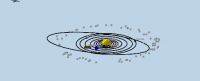
قبل قرون كان الاعتقاد أن الأرض ثابتة في مركز الكون وأن الكواكب تدور حولها في دوائر. ثم اقترح كوبرنيكوس أن الشمس هي المركز (المركزية الشمسية). وبعد سنوات من الأرصاد الدقيقة التي جمعها تايكو براهي للكوكب المريخ، حلّلها تلميذه يوهانس كبلر فاكتشف ثلاثة قوانين تصف حركة الكواكب بدقة، ثم فسّرها نيوتن بقانون الجذب العام.
Centuries ago people believed the Earth was fixed at the centre of the universe and that the planets circled it in circles. Then Copernicus proposed that the Sun is the centre (the heliocentric model). After years of precise observations of Mars collected by Tycho Brahe, his student Johannes Kepler analysed them and discovered three laws that describe planetary motion accurately; Newton then explained them with the law of universal gravitation.
🔎 توضيح إضافي: لماذا تهمنا هذه القوانين؟
🔎 Extra Explanation: Why Do These Laws Matter?
هذه القوانين الثلاثة تجريبية (وصفية): تصف كيف تتحرك الكواكب دون أن تفسّر لماذا. وبعد نيوتن أصبحت نتائج لقانون الجذب العام وقوانين الحركة، وهي نفسها تصف حركة الأقمار الصناعية وأقمار الكواكب والمذنّبات. وفسّرت أيضًا الحركات التراجعية الظاهرية للكواكب.
These three laws are empirical (descriptive): they describe how the planets move without explaining why. After Newton they became consequences of the law of universal gravitation and the laws of motion, and they also describe artificial satellites, planetary moons and comets. They also explained the apparent retrograde motions of the planets.
1️⃣ قانون كبلر الأول (قانون المدارات)
1️⃣ Kepler’s First Law (the Law of Orbits)
📜 النص
📜 Statement
كل كوكب يدور حول الشمس في مدار إهليلجي (قطع ناقص)، والشمس تقع في إحدى بؤرتيه.
Every planet moves around the Sun in an elliptical orbit with the Sun at one of its foci.
🧩 مفردات الإهليلج
🧩 Vocabulary of the Ellipse
- البؤرتان \(F_1\) و\(F_2\): نقطتان ثابتتان؛ مجموع بعدي أي نقطة على الإهليلج عنهما ثابت \(r_1+r_2=2a\).The foci \(F_1\) and \(F_2\): two fixed points; the sum of the distances of any point of the ellipse from them is constant, \(r_1+r_2=2a\).
- نصف المحور الأكبر \(a\) ونصف المحور الأصغر \(b\)، ومركز الإهليلج عند تقاطع المحورين.The semi-major axis \(a\) and semi-minor axis \(b\); the centre is where the axes cross.
- الاستطالة \(e=\dfrac{c}{a}\) حيث \(c\) بعد البؤرة عن المركز: \(e=0\) دائرة، وكلما كبرت \(e\) زاد تفلطح المدار. (مدار الأرض \(e\approx0.017\) أي شبه دائري).Eccentricity \(e=\dfrac{c}{a}\) where \(c\) is the distance of a focus from the centre: \(e=0\) is a circle, and the larger \(e\) is the flatter the orbit. (The Earth’s orbit has \(e\approx0.017\), almost a circle).
- الحضيض أقرب نقطة إلى الشمس: \(r_p=a(1-e)\)، والأوج أبعد نقطة: \(r_a=a(1+e)\)؛ ومنهما \(a=\dfrac{r_p+r_a}{2}\).Perihelion is the nearest point to the Sun, \(r_p=a(1-e)\), and aphelion the farthest, \(r_a=a(1+e)\); hence \(a=\dfrac{r_p+r_a}{2}\).
عند أي نقطة على مدار إهليلجي، مجموع بعدي الكوكب عن البؤرتين يساوي:
At any point of an elliptical orbit, the sum of the planet’s distances from the two foci equals:
2️⃣ قانون كبلر الثاني (قانون المساحات)
2️⃣ Kepler’s Second Law (the Law of Areas)
📜 النص
📜 Statement
الخط الواصل بين الكوكب والشمس يمسح مساحات متساوية في أزمنة متساوية.
The line joining a planet to the Sun sweeps out equal areas in equal times.
\[\dfrac{\Delta A}{\Delta t}=\text{constant}\]
💡 النتيجة وتفسيرها
💡 The Consequence and Its Explanation
بما أن القطاع القريب من الشمس قصير وعريض والبعيد طويل وضيق فلكي تتساوى المساحتان في الزمن نفسه يجب أن يقطع الكوكب قوسًا أطول عندما يقترب من الشمس، أي أن سرعته تزداد كلما اقترب من الشمس وتقل كلما ابتعد. فهي أكبر ما يمكن عند الحضيض وأصغر ما يمكن عند الأوج.
The sector near the Sun is short and wide and the far one is long and narrow, so for the two areas to be equal in the same time the planet must cover a longer arc when it is close to the Sun, i.e. its speed increases as it approaches the Sun and decreases as it moves away. It is greatest at perihelion and least at aphelion.
وللتحقق من ذلك عند الحضيض والأوج (حيث يكون متجه السرعة عموديًا على نصف القطر) نكتب حفظ الزخم الزاوي: \(r_p\,v_p=r_a\,v_a\)، فالنسبة \(\dfrac{v_p}{v_a}=\dfrac{r_a}{r_p}\).
To check this at perihelion and aphelion (where the velocity is perpendicular to the radius) we use conservation of angular momentum: \(r_p\,v_p=r_a\,v_a\), so \(\dfrac{v_p}{v_a}=\dfrac{r_a}{r_p}\).
🧪 جرّب بنفسك: القانونان الأول والثاني
🧪 Try It Yourself: the First and Second Laws
🧪 تجربة 1: المدار الإهليلجي والمساحات المتساوية
🧪 Experiment 1: The Elliptical Orbit and Equal Areas
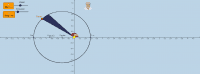
الشمس في إحدى البؤرتين (الصفراء). غيّر الاستطالة \(e\) (صفر = دائرة) وسرعة الحركة، وراقب: مجموع بعدي الكوكب عن البؤرتين \(r_1+r_2\) ثابت \(=2a\)، وسرعة الكوكب أكبر ما يمكن عند الحضيض (أقرب نقطة) وأصغر ما يمكن عند الأوج. اضغط «أظهر المساحات المتساوية»: القطاعات الملوّنة يمسحها الكوكب في أزمنة متساوية فمساحاتها متساوية رغم اختلاف أشكالها.
The Sun sits at one focus (yellow). Change the eccentricity \(e\) (zero = a circle) and the speed, and watch: the sum of the planet’s distances to the two foci \(r_1+r_2\) is constant \(=2a\), and the speed is greatest at perihelion (the nearest point) and least at aphelion. Press “Show equal areas”: the colored sectors are swept in equal times so their areas are equal despite their different shapes.
يكون الكوكب أسرع ما يمكن في مداره حول الشمس عندما يكون:
A planet moves fastest in its orbit around the Sun when it is:
3️⃣ قانون كبلر الثالث (قانون الأزمنة)
3️⃣ Kepler’s Third Law (the Law of Periods)
📜 النص
📜 Statement
مربع زمن الدورة \(T\) لكوكب حول الشمس يتناسب طرديًا مع مكعب نصف المحور الأكبر \(a\) لمداره (ويُسمّى «متوسط البعد» \(r\) للمدارات شبه الدائرية):
The square of the period \(T\) of a planet around the Sun is directly proportional to the cube of the semi-major axis \(a\) of its orbit (called the “mean distance” \(r\) for almost circular orbits):
\[T^{2}\propto r^{3}\qquad\Longrightarrow\qquad\left(\dfrac{T_1}{T_2}\right)^{2}=\left(\dfrac{r_1}{r_2}\right)^{3}\]
🔎 توضيح إضافي: الأرض مرجعًا
🔎 Extra Explanation: Using the Earth as a Reference
إذا قيسَ الزمن بالسنوات (\(T_E=1\,yr\)) والبعد بالوحدة الفلكية (\(r_E=1\,AU\)، وهو متوسط بعد الأرض عن الشمس) تصبح العلاقة بسيطة جدًا: \(\boxed{T^{2}=r^{3}}\) أي \(T=r^{3/2}\). مثلًا كوكب على بعد \(4\,AU\) زمنه \(4^{3/2}=8\) سنوات.
If time is measured in years (\(T_E=1\,yr\)) and distance in astronomical units (\(r_E=1\,AU\), the mean Earth–Sun distance) the relation becomes very simple: \(\boxed{T^{2}=r^{3}}\), i.e. \(T=r^{3/2}\). For example a planet at \(4\,AU\) has a period of \(4^{3/2}=8\) years.
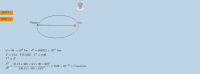
كوكب يدور حول الشمس وزمنه الدوري \(7500\) يوم. احسب نصف قطر مداره بدلالة نصف قطر مدار الأرض \(r\) (زمن الأرض \(365\) يومًا).
A planet orbits the Sun with a period of \(7500\) days. Find the radius of its orbit in terms of the Earth’s orbital radius \(r\) (the Earth’s period is \(365\) days).
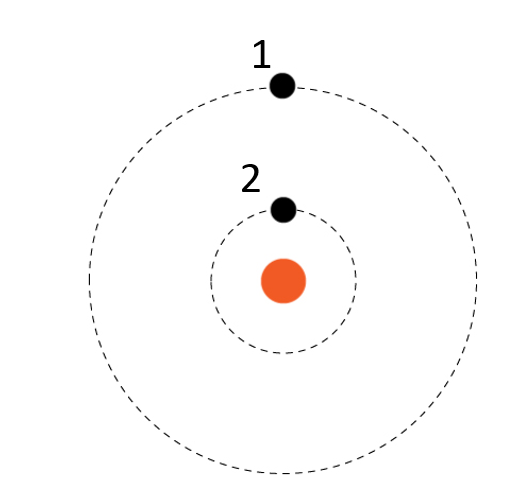
الكوكب 1 هو الكوكب المطلوب (الأبعد) والكوكب 2 هو الأرض.
Planet 1 is the required planet (the farther) and planet 2 is the Earth.
كوكب يدور حول الشمس وزمنه الدوري \(7500\) أيام. نصف قطر مداره بدلالة نصف قطر مدار الأرض \(r\):
A planet orbits the Sun with a period of \(7500\) days. Its orbital radius in terms of the Earth’s orbital radius \(r\) is:
كوكب يدور حول الشمس في مدار متوسط نصف قطره \(7.5\) أمثال متوسط نصف قطر مدار الأرض. زمنه الدوري بالسنوات:
A planet orbits the Sun at a mean radius \(7.5\) times that of the Earth’s orbit. Its period in years is:
🧪 جرّب بنفسك: القانون الثالث
🧪 Try It Yourself: the Third Law
🧪 تجربة 2: قانون كبلر الثالث
🧪 Experiment 2: Kepler’s Third Law
النقاط الخضراء هي كواكب المجموعة الشمسية، وتقع كلها على خط مستقيم في الرسم اللوغاريتمي (ميله 1.5) لأن \(T^2\propto a^3\). حرّك \(a\) لترى زمن الدورة \(T=\sqrt{a^3/M}\)، وغيّر كتلة النجم \(M\) (بوحدة كتلة الشمس) لترى أن الخط ينزاح: النجم الأثقل يجعل الدورة أقصر عند البعد نفسه. لاحظ أن النسبة \(T^2/a^3\) تساوي 1 تقريبًا لكل كواكب الشمس.
The green dots are the planets of the solar system; they all lie on one straight line in the log–log plot (slope 1.5) because \(T^2\propto a^3\). Move \(a\) to see the period \(T=\sqrt{a^3/M}\), and change the star’s mass \(M\) (in solar masses) to see the line shift: a heavier star gives a shorter period at the same distance. Note that \(T^2/a^3\) is about 1 for all the Sun’s planets.
🍎 قانون الجذب العام لنيوتن
🍎 Newton’s Law of Universal Gravitation
بعد دراسة أعمال من سبقوه وجد نيوتن أن بين أي جسمين ماديين قوة تجاذب، وأن هذه القوة هي سبب بقاء الكواكب في مداراتها حول الشمس (وتجاذب الكواكب بعضها مع بعض أيضًا). وهي نفسها التي تسقط التفاحة نحو الأرض وتُبقي القمر في مداره.
After studying the work of those before him, Newton found that there is an attractive force between any two material bodies, and that this force is why the planets stay in their orbits around the Sun (and the planets also attract one another). It is the same force that makes an apple fall to the Earth and keeps the Moon in orbit.
📜 القانون
📜 The Law
قوة التجاذب بين جسمين تتناسب طرديًا مع حاصل ضرب كتلتيهما وعكسيًا مع مربع المسافة بين مركزيهما (ولذلك يُسمّى «قانون التربيع العكسي»):
The attractive force between two bodies is directly proportional to the product of their masses and inversely proportional to the square of the distance between their centres (hence the name “inverse-square law”):
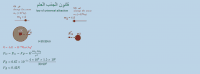
\[F_g=G\,\dfrac{m_1\,m_2}{r^{2}}\qquad G=6.67\times10^{-11}\ \dfrac{N\cdot m^{2}}{kg^{2}}\]
\(G\) هو ثابت الجذب الكوني وقيمته واحدة في الكون كله.
\(G\) is the universal gravitational constant, and it has the same value everywhere in the universe.
🔎 توضيحات إضافية مهمة
🔎 Important Extra Explanations
- القوتان المتبادلتان بين الجسمين متساويتان في المقدار ومتعاكستان (القانون الثالث لنيوتن)، حتى لو اختلفت الكتلتان كثيرًا: تجذب الأرض الشمعة بقدر ما تجذبها الشمعة.The two mutual forces are equal in magnitude and opposite (Newton’s third law) even if the masses differ a great deal: the Earth pulls a candle exactly as strongly as the candle pulls the Earth.
- \(G\) صغيرة جدًا، لذلك لا نلاحظ التجاذب بين الأجسام العادية: كتلتان \(1\,kg\) تفصل بينهما \(1\,m\) تتجاذبان بقوة \(6.67\times10^{-11}\,N\) فقط، ولا يظهر التجاذب إلا إذا كان أحد الجسمين هائل الكتلة (كوكب).\(G\) is very small, so we do not notice attraction between everyday objects: two \(1\,kg\) masses \(1\,m\) apart attract each other with only \(6.67\times10^{-11}\,N\); the attraction shows only when one body is enormous (a planet).
- المسافة \(r\) تُقاس بين مركزي الجسمين (فعلى سطح الأرض \(r=R_E\)، لا صفرًا).The distance \(r\) is measured between the centres of the two bodies (on the Earth’s surface \(r=R_E\), not zero).
- وهو يفسّر وزننا: \(mg=G\dfrac{M m}{R^{2}}\Rightarrow g=\dfrac{GM}{R^{2}}\approx9.8\,m/s^{2}\) على سطح الأرض، وعلى ارتفاع \(h\) يصبح \(g=\dfrac{GM}{(R+h)^{2}}\) فيقل.It explains our weight: \(mg=G\dfrac{M m}{R^{2}}\Rightarrow g=\dfrac{GM}{R^{2}}\approx9.8\,m/s^{2}\) on the Earth’s surface, and at altitude \(h\) we have \(g=\dfrac{GM}{(R+h)^{2}}\), which is smaller.
🌍 تطبيقات الدراسة
🌍 Applications
- فهم حركة الكواكب والأجرام السماوية.Understanding the motion of planets and celestial bodies.
- تصميم الأقمار الصناعية والمركبات الفضائية.Designing satellites and spacecraft.
- دراسة المد والجزر في المحيطات.Studying ocean tides.
- تطبيقات في الجيوفيزياء واكتشاف الموارد الطبيعية.Applications in geophysics and natural-resource exploration.
احسب وزن شخص كتلته \(70\,kg\) على سطح الأرض بقانون الجذب العام (\(M_E=5.97\times10^{24}\,kg\)، \(R_E=6.38\times10^{6}\,m\)).
Find the weight of a \(70\,kg\) person on the Earth’s surface using the law of universal gravitation (\(M_E=5.97\times10^{24}\,kg\), \(R_E=6.38\times10^{6}\,m\)).
🧪 جرّب بنفسك: حاسبة القوة وتغيّرها
🧪 Try It Yourself: the Force Calculator and How It Changes
🧪 تجربة 3: قانون الجذب العام
🧪 Experiment 3: The Law of Universal Gravitation
اضبط الكتلتين والمسافة (على مقياس لوغاريتمي لتغطية الكرات الصغيرة والكواكب)، فتحسب التجربة \(F=G\dfrac{m_1m_2}{r^2}\). اضغط «اعتبر هذه القوة مرجعًا \(F\)» ثم جرّب الأزرار: مضاعفة إحدى الكتلتين، ومضاعفة المسافة، وتنصيفها؛ وانظر النسبة \(F_2/F\) (2 و4 و1/4 و4...). هذه هي أسئلة «قيّم نفسك».
Set the two masses and the distance (on a logarithmic scale to cover small balls and planets) and the experiment computes \(F=G\dfrac{m_1m_2}{r^2}\). Press “Take this force as the reference \(F\)” and then try the buttons: doubling one mass, doubling the distance and halving it; and read the ratio \(F_2/F\) (2, 1/4, 4...). These are the self-check questions.
بأي عامل تزداد قوة التجاذب الكتلي بين جسمين إذا زاد مقدار كل من الكتلتين إلى الضعف مع بقاء البعد بينهما ثابتًا؟
By what factor does the gravitational force between two bodies increase if each of the two masses is doubled while the distance stays the same?
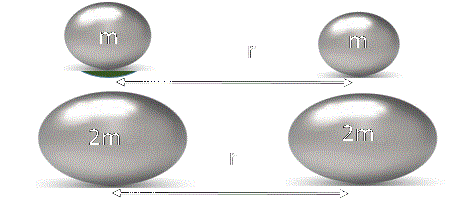
الحالة الأولى كتلتان \(m\) والثانية كتلتان \(2m\) على المسافة نفسها \(r\).
The first case has two masses \(m\), the second two masses \(2m\), at the same distance \(r\).
بأي عامل تتغير قوة التجاذب الكتلي بين جسمين إذا زاد البعد بينهما إلى الضعف مع بقاء الكتلتين ثابتتين؟
By what factor does the gravitational force between two bodies change if the distance between them is doubled while the masses stay the same?
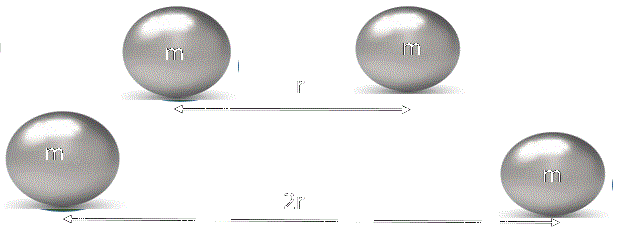
الحالة الأولى المسافة \(r\) والثانية المسافة \(2r\) والكتلتان ثابتتان.
The first case has distance \(r\), the second \(2r\), with the masses unchanged.
على ارتفاع يساوي نصف قطر الأرض فوق سطحها (أي على بعد \(2R\) من مركزها) يصبح تسارع الجاذبية:
At an altitude equal to the Earth’s radius above its surface (i.e. \(2R\) from its centre) the gravitational acceleration becomes:
🧮 الجذب العام وقانون كبلر الثالث
🧮 Universal Gravitation and Kepler’s Third Law
يمكن اشتقاق قانون كبلر الثالث من قانون الجذب العام: قوة التجاذب بين الشمس والكوكب هي نفسها القوة المركزية في حركته الدائرية (نفترض مدارًا دائريًا لتبسيط الاشتقاق).
Kepler’s third law can be derived from the law of universal gravitation: the attraction between the Sun and the planet is the same as the centripetal force of its circular motion (we assume a circular orbit to simplify the derivation).
🧮 الاشتقاق خطوة بخطوة
🧮 The Derivation Step by Step
- \(F_g=F_c\Rightarrow G\dfrac{M_s\,m}{r^{2}}=m\,a_c\).\(F_g=F_c\Rightarrow G\dfrac{M_s\,m}{r^{2}}=m\,a_c\).
- التسارع المركزي \(a_c=\omega^{2}r=\left(\dfrac{2\pi}{T}\right)^{2}r=\dfrac{4\pi^{2}}{T^{2}}\,r\).The centripetal acceleration is \(a_c=\omega^{2}r=\left(\dfrac{2\pi}{T}\right)^{2}r=\dfrac{4\pi^{2}}{T^{2}}\,r\).
- نعوّض: \(G\dfrac{M_s\,m}{r^{2}}=m\dfrac{4\pi^{2}}{T^{2}}\,r\) (تُحذف كتلة الكوكب \(m\)!).Substituting: \(G\dfrac{M_s\,m}{r^{2}}=m\dfrac{4\pi^{2}}{T^{2}}\,r\) (the planet’s mass \(m\) cancels!).
- \(G\,M_s\,T^{2}=4\pi^{2}r^{3}\Rightarrow T^{2}=\dfrac{4\pi^{2}}{G\,M_s}\,r^{3}\).\(G\,M_s\,T^{2}=4\pi^{2}r^{3}\Rightarrow T^{2}=\dfrac{4\pi^{2}}{G\,M_s}\,r^{3}\).
\[T=2\pi\sqrt{\dfrac{r^{3}}{G\,M_s}}\]
💡 ماذا نستنتج؟
💡 What Do We Conclude?
مربع الزمن الدوري يتناسب طرديًا مع مكعب نصف القطر ولا يعتمد على كتلة الكوكب بل على كتلة الجرم المركزي \(M_s\) فقط؛ فالنسبة \(\dfrac{T^{2}}{r^{3}}=\dfrac{4\pi^{2}}{GM_s}\) ثابتة لكل الأجسام التي تدور حول الجرم نفسه. وهي نتيجة كبلر الثالثة نفسها، وتتيح قياس كتلة الشمس أو الأرض من مدار جسم يدور حولها.
The square of the period is proportional to the cube of the radius and does not depend on the planet’s mass but only on the mass of the central body \(M_s\); so the ratio \(\dfrac{T^{2}}{r^{3}}=\dfrac{4\pi^{2}}{GM_s}\) is the same for all bodies orbiting the same central body. This is Kepler’s third law itself, and it lets us measure the mass of the Sun or the Earth from the orbit of a body circling it.
🛰️ سرعة القمر الصناعي وزمنه الدوري
🛰️ The Speed and Period of a Satellite
القمر الذي يدور حول الأرض يخضع لقوة الجذب بينه وبين الأرض وهي نفسها القوة المركزية في حركته الدائرية:
A satellite orbiting the Earth is acted on by the gravitational attraction between it and the Earth, and this is the same as the centripetal force of its circular motion:
🧮 اشتقاق السرعة المدارية
🧮 Deriving the Orbital Speed
- \(F_g=F_c\Rightarrow G\dfrac{M_E\,m}{r^{2}}=m\,\dfrac{v^{2}}{r}\).\(F_g=F_c\Rightarrow G\dfrac{M_E\,m}{r^{2}}=m\,\dfrac{v^{2}}{r}\).
- تُحذف كتلة القمر \(m\) ونضرب في \(r\): \(v^{2}=\dfrac{G\,M_E}{r}\).The satellite’s mass \(m\) cancels and we multiply by \(r\): \(v^{2}=\dfrac{G\,M_E}{r}\).
\[v=\sqrt{\dfrac{G\,M_E}{r}}\qquad r=R_E+h\qquad T=\dfrac{2\pi r}{v}=2\pi\sqrt{\dfrac{r^{3}}{G\,M_E}}\]
🔎 توضيحات إضافية
🔎 Extra Explanations
- السرعة والزمن لا يعتمدان على كتلة القمر، بل على بعده \(r\) عن مركز الأرض: كلما ارتفع القمر قلّت سرعته وطال زمنه الدوري (\(v\propto1/\sqrt r\) و\(T\propto r^{3/2}\)).Speed and period do not depend on the satellite’s mass but on its distance \(r\) from the Earth’s centre: the higher the satellite, the slower it moves and the longer its period (\(v\propto1/\sqrt r\) and \(T\propto r^{3/2}\)).
- محطة الفضاء الدولية على ارتفاع نحو \(400\,km\): \(v\approx7.7\,km/s\) والدورة نحو \(92\) دقيقة. أما القمر الثابت بالنسبة للأرض فزمنه \(24\) ساعة فيرى المراقب أنه ساكن في السماء، وارتفاعه نحو \(3.6\times10^{4}\,km\) فوق خط الاستواء.The International Space Station is at about \(400\,km\): \(v\approx7.7\,km/s\) and a period of about \(92\) minutes. A geostationary satellite has a \(24\)-hour period so it appears fixed in the sky; its altitude is about \(3.6\times10^{4}\,km\) above the equator.
- رواد المحطة «عديمو الوزن» لا لأن الجاذبية انعدمت (هي نحو \(90\%\) من قيمتها على الأرض) بل لأنهم والمحطة في سقوط حر مستمر نحو الأرض ويتحركون جانبيًا بسرعة تُبقيهم في المدار.The station’s astronauts are “weightless” not because gravity vanished (it is about \(90\%\) of its surface value) but because they and the station are in continuous free fall toward the Earth while moving sideways fast enough to stay in orbit.
قمر صناعي يدور حول الأرض على ارتفاع \(2000\,km\) من سطحها. احسب زمنه الدوري وسرعته المدارية (\(M_E=5.97\times10^{24}\,kg\)، \(R_E=6.38\times10^{6}\,m\)، \(G=6.67\times10^{-11}\)).
A satellite orbits the Earth at an altitude of \(2000\,km\). Find its period and orbital speed (\(M_E=5.97\times10^{24}\,kg\), \(R_E=6.38\times10^{6}\,m\), \(G=6.67\times10^{-11}\)).
🧪 جرّب بنفسك: الأقمار الصناعية
🧪 Try It Yourself: Satellites
🧪 تجربة 4: الأقمار الصناعية: السرعة والزمن الدوري
🧪 Experiment 4: Satellites: Speed and Period
غيّر ارتفاع القمر عن سطح الجرم، فتحسب التجربة \(r=R+h\) و\(v=\sqrt{GM/r}\) و\(T=2\pi\sqrt{r^3/GM}\). جرّب الأزرار: «مثال الدرس (2000 km)» لتتحقق من الحل، و«محطة الفضاء» و«ثابت بالنسبة للأرض» (دورته 24 ساعة). لاحظ أنه كلما ارتفع القمر قلّت سرعته وزاد زمنه الدوري.
Change the satellite’s altitude above the surface and the experiment computes \(r=R+h\), \(v=\sqrt{GM/r}\) and \(T=2\pi\sqrt{r^3/GM}\). Try the buttons: “Lesson example (2000 km)” to check the solved example, “Space station” and “Geostationary” (period 24 h). Note that the higher the satellite, the slower it moves and the longer its period.
إذا أصبح نصف قطر مدار قمر صناعي أربعة أمثاله، فإن سرعته المدارية:
If the radius of a satellite’s orbit becomes four times as large, its orbital speed:
في الحالة نفسها (نصف قطر المدار أربعة أمثاله) فإن الزمن الدوري للقمر:
In the same case (the orbit radius four times as large), the satellite’s period:
📝 ملخص الدرس
📝 Lesson Summary
📝 أهم ما تعلمناه
📝 Key Points
- كبلر 1: المدارات إهليلجية والشمس في إحدى البؤرتين (\(r_1+r_2=2a\)).Kepler 1: orbits are ellipses with the Sun at one focus (\(r_1+r_2=2a\)).
- كبلر 2: المساحات المتساوية في أزمنة متساوية؛ فالسرعة أكبر عند الحضيض وأصغر عند الأوج.Kepler 2: equal areas in equal times; the speed is greatest at perihelion and least at aphelion.
- كبلر 3: \(\left(\dfrac{T_1}{T_2}\right)^{2}=\left(\dfrac{r_1}{r_2}\right)^{3}\) وبالأرض مرجعًا \(T^{2}=r^{3}\).Kepler 3: \(\left(\dfrac{T_1}{T_2}\right)^{2}=\left(\dfrac{r_1}{r_2}\right)^{3}\) and with the Earth as a reference \(T^{2}=r^{3}\).
- الجذب العام: \(F=G\dfrac{m_1m_2}{r^{2}}\)، تتضاعف أربع مرات بمضاعفة الكتلتين وتصبح الربع بمضاعفة المسافة.Universal gravitation: \(F=G\dfrac{m_1m_2}{r^{2}}\); it becomes four times as large when both masses are doubled and one quarter when the distance is doubled.
- \(T=2\pi\sqrt{\dfrac{r^{3}}{GM}}\) و\(v=\sqrt{\dfrac{GM}{r}}\): لا يعتمدان على كتلة الجسم الدائر.\(T=2\pi\sqrt{\dfrac{r^{3}}{GM}}\) and \(v=\sqrt{\dfrac{GM}{r}}\): they do not depend on the orbiting body’s mass.
🧪 اختبر نفسك: امتحان من 20 سؤالاً
🧪 Test Yourself: a 20-Question Exam
أنهِ الدرس بالاختبار التفاعلي التالي؛ أسئلته بمستوى متقدم وعالٍ وتجمع بين الفهم والحساب.
Finish with the interactive exam below; its questions are of medium and high difficulty and mix understanding with calculation.
اختبار حركة الكواكب والجاذبية Planetary Motion and Gravitation Quiz
20 سؤالاً - قوانين كبلر، قانون الجذب العام، سرعة الأقمار الصناعية وزمنها الدوري 20 Questions - Kepler’s Laws, Universal Gravitation, Satellite Speed and Period
• عدد الأسئلة: 20 سؤالاً
• مدة الاختبار: 30 دقيقة
• لا يمكنك تغيير إجاباتك أو إعادة الاختبار إلا بعد 24 ساعة من التسليم.
• تأكد من إجاباتك قبل التسليم! 📌 Important Instructions:
• Number of questions: 20 questions
• Quiz duration: 30 minutes
• You cannot change your answers or retake the quiz for 24 hours after submission.
• Make sure of your answers before submitting!
🔗 محاكيات GeoGebra للاستعانة بها عند اللزوم
🔗 GeoGebra Simulations to Use When Needed
اضغط «تشغيل» لتعمل المحاكاة هنا داخل الدرس؛ ويمكن للطالب الرجوع إليها لتجربة الفكرة بطريقة أخرى.
Press “Run” to run the simulation right here inside the lesson; the student can use it to try the idea in another way.