🎯 نواتج التعلم
🎯 Learning Outcomes
بعد دراسة هذا الدرس ستكون قادرًا على أن:
After this lesson you will be able to:
- تعرّف طاقة الوضع الكهربائية.Define electric potential energy.
- تستنتج متى تزداد ومتى تقل طاقة الوضع الكهربائية لشحنة موجبة وسالبة.Conclude when the electric potential energy of a positive or negative charge increases or decreases.
- تعرّف معنى جهد نقطة.Define the meaning of the potential at a point.
- تحسب فرق الجهد بين نقطتين.Calculate the potential difference between two points.
- تحدد متى يكون فرق الجهد بين نقطتين موجبًا ومتى يكون سالبًا ومتى يكون معدومًا.Decide when the potential difference between two points is positive, negative or zero.
- تستخدم العلاقات الرياضية لحساب الجهد حول شحنة نقطية.Use the mathematical relations to calculate the potential around a point charge.
- تستخدم العلاقات الرياضية لحساب فرق الجهد بين نقطتين في مجال كهربائي منتظم.Use the mathematical relations to calculate the potential difference between two points in a uniform field.
- تستنتج الغاية من تجربة ميليكان.Conclude the purpose of Millikan’s experiment.
- تحسب شحنة قطرة زيت مشحونة من خلال اتزانها في منطقة مجال كهربائي.Calculate the charge of a charged oil drop from its equilibrium in an electric field.
🔋 تغير طاقة الوضع: الجذبية والكهربائية
🔋 Changes in Potential Energy: Gravitational and Electric
نقارن بين طاقة الوضع الجذبية لكرة قرب الأرض وطاقة الوضع الكهربائية لشحنة في مجال كهربائي. القاعدة نفسها في الحالتين: تقل طاقة الوضع عندما يتحرك الجسم باتجاه القوة التي يؤثر بها المجال (فيستطيع العودة وحده)، وتزداد عندما نحرّكه عكس تلك القوة (ويحتاج قوة خارجية).
We compare the gravitational potential energy of a ball near the Earth with the electric potential energy of a charge in an electric field. The rule is the same in both cases: potential energy decreases when the body moves along the force exerted by the field (it cannot return by itself), and increases when we move it against that force (it can then return by itself).
| السؤالQuestion | الجوابAnswer |
|---|---|
| ماذا يحدث لطاقة الوضع لكرة عندما نرفعها عن سطح الأرض؟What happens to the potential energy of a ball when we lift it above the Earth’s surface? | تزداد طاقة الوضع الجذبية، وإذا تُركت الكرة سقطت وعادت إلى موضعها وحدها (تقل طاقة وضعها). أما كلما اقتربت الكرة من سطح الأرض فتقل طاقة وضعها ولا تستطيع العودة وحدها إلى موضعها المرتفع.Its gravitational potential energy increases, and if released the ball falls back by itself (its potential energy decreases). As the ball moves closer to the surface its potential energy decreases and it cannot return to the higher position by itself. |
| ماذا يحدث لطاقة الوضع الكهربائية لشحنة موجبة عندما تتحرك باتجاه المجال؟What happens to the electric potential energy of a positive charge moved along the field? | تقل (القوة باتجاه المجال) فهي غير قادرة على العودة إلى موقعها وحدها.It decreases (the force is along the field); the charge cannot return to its position by itself. |
| … لشحنة سالبة تتحرك عكس اتجاه المجال؟… for a negative charge moved against the field? | تقل (القوة على السالبة عكس المجال) فهي غير قادرة على العودة إلى موقعها دون تأثير قوى خارجية.It decreases (the force on a negative charge is opposite to the field); it cannot return by itself without external forces. |
| … لشحنة سالبة تتحرك باتجاه المجال؟… for a negative charge moved along the field? | تزداد، فهي قادرة على العودة إلى موقعها وحدها.It increases; it can return to its position by itself. |
| … لشحنة موجبة تتحرك عكس اتجاه المجال؟… for a positive charge moved against the field? | تزداد، فهي قادرة على العودة إلى موقعها دون تأثير قوى خارجية.It increases; it can return by itself without external forces. |
📝 أكمل بيانات الجدول
📝 Complete the Table
| التغير في طاقة الوضع الكهربائية | اتجاه حركة الشحنة | نوع الشحنة |
|---|---|---|
| باتجاه المجال | موجبة | |
| عكس المجال | موجبة | |
| باتجاه المجال | سالبة | |
| عكس المجال | سالبة |
تحركت شحنة سالبة عكس اتجاه المجال الكهربائي. طاقة وضعها:
A negative charge moves opposite to the electric field. Its potential energy:
⚡ الجهد الكهربائي وفرق الجهد بين نقطتين
⚡ Electric Potential and Potential Difference
📜 الجهد عند نقطة
📜 The Potential at a Point
الجهد عند نقطة هو طاقة الوضع التي تختزنها وحدة الشحنة عند تلك النقطة. فلحساب الجهد عند نقطة داخل مجال كهربائي نضع شحنة اختبار عندها ونحدد طاقة وضعها الكهربائية ثم نقسم على شحنة الاختبار:
The potential at a point is the potential energy stored per unit charge at that point. To find the potential at a point inside an electric field we place a test charge there, determine its electric potential energy and divide by the test charge:
\[V=\dfrac{PE}{q}\]
📜 فرق الجهد بين نقطتين \(A\) و\(B\)
📜 The Potential Difference Between Points \(A\) and \(B\)
فرق الجهد هو جهد النقطة النهائية مطروحًا منه جهد النقطة البدائية:
The potential difference is the potential of the final point minus that of the initial point:
\[\Delta V_{AB}=V_B-V_A=\dfrac{PE_B}{q}-\dfrac{PE_A}{q}=\dfrac{\Delta PE_{AB}}{q}\]
🔎 علاقتها بالشغل (توضيح إضافي)
🔎 The Relation to Work (Extra Explanation)
التغير في طاقة الوضع يساوي الشغل المبذول بقوة خارجية لنقل الشحنة بتمهّل من \(A\) إلى \(B\): \(\Delta PE_{AB}=W_{A\to B}\)، فيكون \(\Delta V_{AB}=\dfrac{W_{A\to B}}{q}\). أما إذا حُسب الشغل الذي تبذله قوة المجال نفسها (قوة داخلية) فنضيف إشارة سالبة لتتحقق المساواة: \(\Delta V_{AB}=-\dfrac{W_{A\to B}}{q}\). ووحدة الجهد وفرق الجهد هي الفولت (\(1\,V=1\,J/C\)).
The change in potential energy equals the work done by an external force in moving the charge slowly from \(A\) to \(B\): \(\Delta PE_{AB}=W_{A\to B}\), so \(\Delta V_{AB}=\dfrac{W_{A\to B}}{q}\). If instead we use the work done by the field itself (an internal force) we add a minus sign for the equality to hold: \(\Delta V_{AB}=-\dfrac{W_{A\to B}}{q}\). The unit of potential and of potential difference is the volt (\(1\,V=1\,J/C\)).
➕➖ متى يكون فرق الجهد موجبًا أو سالبًا أو معدومًا؟
➕➖ When Is the Potential Difference Positive, Negative or Zero?
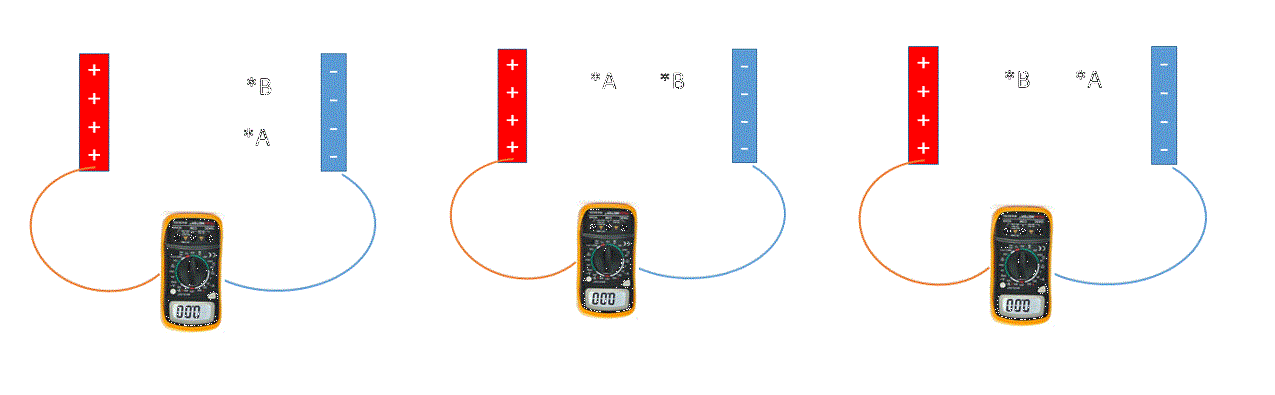
ثلاث حالات للنقطتين \(A\) و\(B\) بين لوحين مشحونين.
Three cases for the points \(A\) and \(B\) between two charged plates.
للإجابة نضع شحنة اختبار عند نقطة البداية ونفترض أن قوة خارجية (معاكسة لقوة المجال) تنقلها إلى نقطة النهاية، ثم ننظر إلى الشغل المبذول:
To answer, we imagine a test charge at the starting point carried to the end point by an external force (opposite to the force of the field), and look at the work done:
📜 القاعدة
📜 The Rule
- إذا كانت القوة الخارجية باتجاه الإزاحة فالشغل موجب: \(\Delta V_{AB}\gt 0\) (انتقلنا إلى نقطة أعلى جهدًا).If the external force is along the displacement the work is positive: \(\Delta V_{AB}\gt 0\) (we moved to a point of higher potential).
- إذا كانت عكس الإزاحة فالشغل سالب: \(\Delta V_{AB}\lt 0\) (إلى نقطة أقل جهدًا).If it is opposite to the displacement the work is negative: \(\Delta V_{AB}\lt 0\) (to a point of lower potential).
- إذا كانت عمودية على الإزاحة فالشغل معدوم: \(\Delta V_{AB}=0\) (النقطتان لهما الجهد نفسه).If it is perpendicular to the displacement the work is zero: \(\Delta V_{AB}=0\) (the two points have the same potential).
وفي الشكل: الحالة 1 على خط عمودي على المجال ⇒ \(\Delta V_{AB}=0\)؛ الحالة 2: \(A\) أقرب إلى اللوح الموجب فجهدها أعلى ⇒ \(\Delta V_{AB}=V_B-V_A\lt 0\)؛ الحالة 3: \(B\) أقرب إلى الموجب ⇒ \(\Delta V_{AB}\gt 0\).
In the figure: case 1 lies on a line perpendicular to the field ⇒ \(\Delta V_{AB}=0\); case 2: \(A\) is nearer the positive plate so its potential is higher ⇒ \(\Delta V_{AB}=V_B-V_A\lt 0\); case 3: \(B\) is nearer the positive plate ⇒ \(\Delta V_{AB}\gt 0\).
إذا كان \(V_B\gt V_A\) فإن فرق الجهد \(\Delta V_{AB}=V_B-V_A\):
If \(V_B\gt V_A\), the potential difference \(\Delta V_{AB}=V_B-V_A\) is:
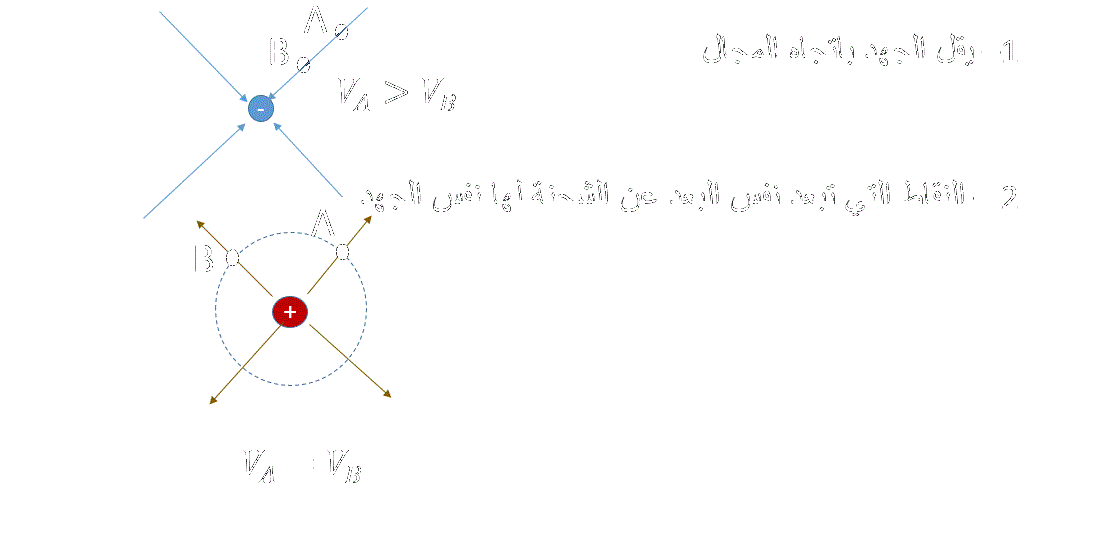
1) يقل الجهد باتجاه المجال. 2) النقاط التي تبعد البعد نفسه عن الشحنة النقطية لها الجهد نفسه.
1) The potential falls along the field. 2) Points at the same distance from a point charge have the same potential.
🧪 جرّب بنفسك: قياس الجهد
🧪 Try It Yourself: Measuring Potential
🧪 تجربة 1: قياس الجهد وفرق الجهد حول شحنة
🧪 Experiment 1: Measuring Potential and Potential Difference Around a Charge
اختر نوع الشحنة المولّدة للمجال (موجبة أو سالبة)، ثم حرّك مقياسَي الجهد \(A\) و\(B\) (بالسحب على الرسم أو بالمنزلقات) إلى المواضع المطلوبة. يعرض البرنامج \(V_A\) و\(V_B\) و\(\Delta V_{AB}=V_B-V_A\). قس الجهد لنقطتين لهما البعد نفسه عن الشحنة (زر «نفس البعد») ماذا تستنتج؟ ثم لعدة نقاط على خط واحد باتجاه المجال (زر «على خط المجال») ماذا تستنتج؟
Choose the sign of the charge that creates the field (positive or negative), then move the potential meters \(A\) and \(B\) (by dragging on the drawing or with the sliders) to the required places. The program shows \(V_A\), \(V_B\) and \(\Delta V_{AB}=V_B-V_A\). Measure the potential at two points at the same distance from the charge (the “Same distance” button): what do you conclude? Then at several points on one line along the field (the “Along the field” button): what do you conclude?
🟦 فرق الجهد في مجال كهربائي منتظم
🟦 The Potential Difference in a Uniform Electric Field
أي الأشكال التالية يمثل مجالًا منتظمًا وأيها غير منتظم؟
Which of the following figures represents a uniform field and which a non-uniform one?

من اليسار: شحنة موجبة، لوحان متوازيان، شحنة سالبة، شحنتان مختلفتان.
From the left: a positive charge, two parallel plates, a negative charge, two unlike charges.
🔎 صفات المجال المنتظم
🔎 Properties of a Uniform Field
المجال المنتظم ثابت المقدار والاتجاه عند جميع النقاط، خطوطه مستقيمة متوازية تبعد البعد نفسه عن بعضها. وهو الموجود بين لوحي مكثف (الشكل الثاني)؛ أما المجالات حول الشحنات النقطية (الأشكال الأول والثالث والرابع) فخطوطها غير متوازية ولذلك هي غير منتظمة.
A uniform field has constant magnitude and direction at all points; its lines are straight, parallel and equally spaced. It is the field between the plates of a capacitor (the second figure); the fields around point charges (the first, third and fourth figures) have non-parallel lines and are therefore non-uniform.
🧪 جرّب بنفسك: الجهد بين لوحي مكثف
🧪 Try It Yourself: The Potential Between Capacitor Plates
🧪 تجربة 2: الجهد بين لوحي مكثف (مجال منتظم)
🧪 Experiment 2: The Potential Between Capacitor Plates (Uniform Field)
اللوح الموجب (يسار) جهده \(\Delta V\) واللوح السالب (يمين) جهده صفر. اسحب النقاط \(A\) و\(B\) و\(C\) بين اللوحين وانظر جهد كل منها: كلما اقتربت النقطة من اللوح الموجب زاد جهدها، والنقطتان الواقعتان على خط عمودي على المجال لهما الجهد نفسه. غيّر \(\Delta V\) والبعد \(d\) وراقب المجال \(E=\Delta V/d\).
The positive plate (left) is at \(\Delta V\) and the negative plate (right) is at zero. Drag the points \(A\), \(B\) and \(C\) between the plates and read their potentials: the nearer a point is to the positive plate, the higher its potential, and two points on a line perpendicular to the field have the same potential. Change \(\Delta V\) and the separation \(d\) and watch the field \(E=\Delta V/d\).
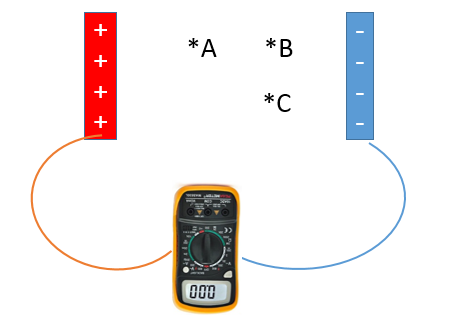
لوحان مشحونان والنقاط \(A\) و\(B\) و\(C\) بينهما.
Two charged plates and the points \(A\), \(B\) and \(C\) between them.
📊 نتائج قياسات مثال (فرق الجهد بين اللوحين \(1.5\,V\))
📊 Measurements of an Example (plate difference \(1.5\,V\))
جهد اللوح الموجب \(V^{+}=1.5\,V\) وجهد اللوح السالب \(V^{-}=0\). وعند قياس الجهد بين اللوح السالب والنقاط نجد: \(V_A=1\,V\) و\(V_B=0.5\,V\) و\(V_C=0.5\,V\). نستنتج: (1) يقل الجهد باتجاه المجال. (2) النقاط الواقعة على خط عمودي على المجال لها الجهد نفسه (\(B\) و\(C\)).
The potential of the positive plate is \(V^{+}=1.5\,V\) and that of the negative plate \(V^{-}=0\). Measuring from the negative plate to the points we find \(V_A=1\,V\), \(V_B=0.5\,V\) and \(V_C=0.5\,V\). We conclude: (1) the potential falls along the field; (2) points on a line perpendicular to the field have the same potential (\(B\) and \(C\)).
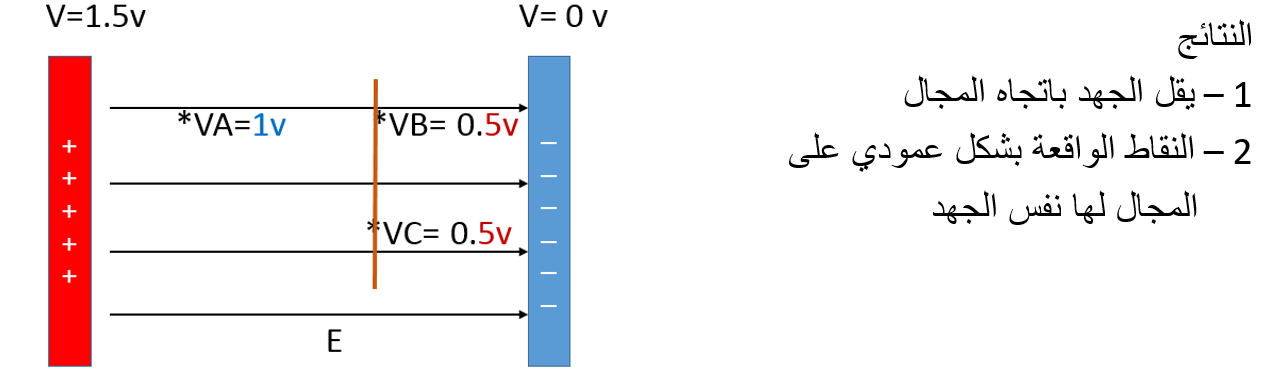
\(V^{+}=1.5\,V\)، \(V_A=1\,V\)، \(V_B=V_C=0.5\,V\)، \(V^{-}=0\). الخط البرتقالي خط تساوي الجهد.
\(V^{+}=1.5\,V\), \(V_A=1\,V\), \(V_B=V_C=0.5\,V\), \(V^{-}=0\). The orange line is an equipotential line.
📜 العلاقة
📜 The Relation
يُعطى فرق الجهد في مجال منتظم بالعلاقة:
The potential difference in a uniform field is given by:
\[\Delta V_{AB}=-E\,d_{\parallel}\qquad\left(\text{in magnitude: }\Delta V=E\,d\right)\]
\(E\) شدة المجال، و\(d\) الإزاحة الموازية لخطوط المجال (موجبة باتجاه المجال). وهذا يفسّر القاعدة: الجهد يقل باتجاه المجال (\(\Delta V\lt 0\) عند \(d\gt 0\)) ويزداد عكسه. وعلى مستوٍ عمودي على المجال \(d=0\) فلا يتغير الجهد. ومنها \(E=\dfrac{|\Delta V|}{d}\) بين لوحين (بالفولت/متر).
\(E\) is the field strength and \(d\) is the displacement parallel to the field lines (positive along the field). This explains the rule: the potential falls along the field (\(\Delta V\lt 0\) for \(d\gt 0\)) and rises against it. On a plane perpendicular to the field \(d=0\) so the potential does not change. Hence \(E=\dfrac{|\Delta V|}{d}\) between two plates (in volts per metre).
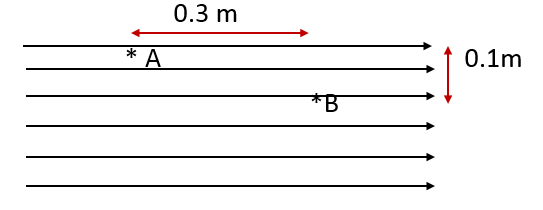
الإزاحة الموازية لخطوط المجال \(d=0.3\,m\) والعمودية \(0.1\,m\) لا تؤثر.
The displacement parallel to the field lines is \(d=0.3\,m\) while the perpendicular \(0.1\,m\) does not matter.
ثلاث نقاط داخل مجال منتظم كما في الشكل، وكان \(V_A=8\,V\) و\(V_B=6\,V\) و\(V_C=8\,V\). أي الأشكال يمثل خطوط المجال الصحيحة؟
Three points lie in a uniform field as in the figure with \(V_A=8\,V\), \(V_B=6\,V\) and \(V_C=8\,V\). Which figure shows the correct field lines?
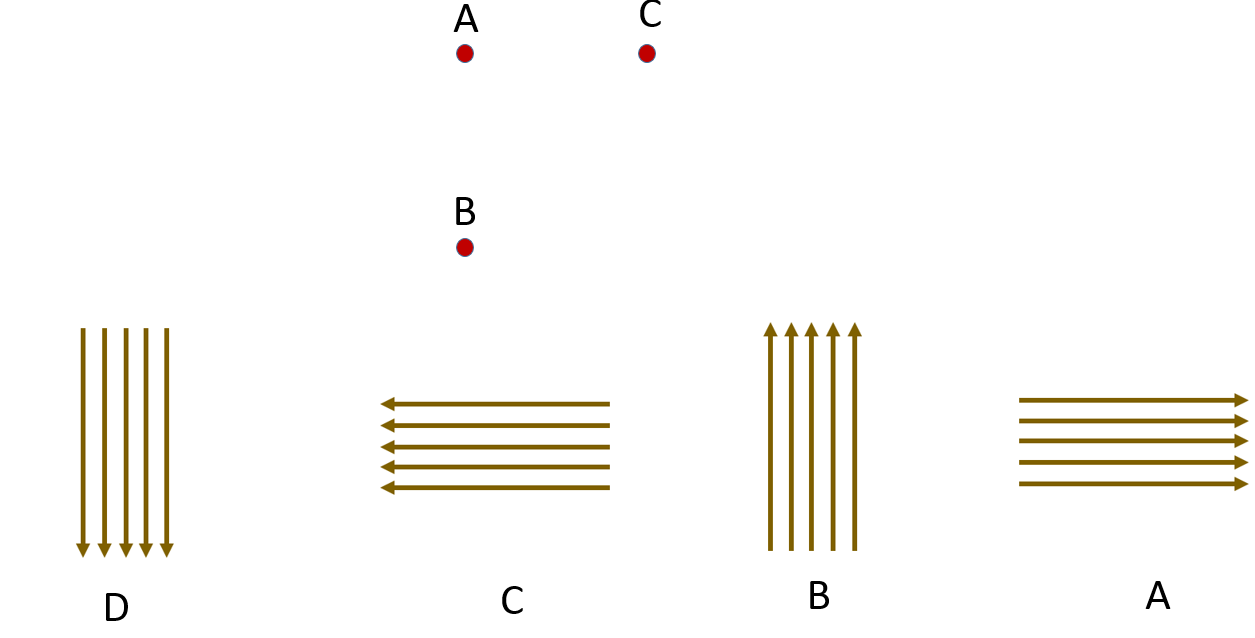
النقاط الثلاث (أعلى) وأشكال خطوط المجال الأربعة (أسفل).
The three points (top) and the four field-line drawings (bottom).
في الشكل مجال كهربائي منتظم شدته \(E=1000\,N/C\) نحو الأعلى، والنقطة \(a\) تعلو النقطة \(c\) بمقدار \(0.3\,m\)، والنقطة \(d\) على يسار \(c\) بمقدار \(0.1\,m\) وعلى الارتفاع نفسه. فرق الجهد \(\Delta V_{ad}\) يعادل:
In the figure a uniform field of strength \(E=1000\,N/C\) points upward; point \(a\) is \(0.3\,m\) above \(c\) and \(d\) is \(0.1\,m\) to the left of \(c\) at the same height. The potential difference \(\Delta V_{ad}\) is:
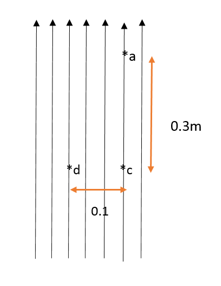
النقاط \(a\) و\(c\) و\(d\) في مجال منتظم نحو الأعلى.
The points \(a\), \(c\) and \(d\) in an upward uniform field.
🛢️ تجربة ميليكان لتحديد الشحنة الأولية
🛢️ Millikan’s Experiment for the Elementary Charge
في سنة 1909 توصّل روبرت ميليكان (أستاذ في جامعة شيكاغو) بمساعدة هارفي فليتشر إلى القيمة التقريبية للشحنة الأولية للإلكترون، بطريقة تسمى تجربة قطرات الزيت المشحونة. وهي تعتمد على دراسة قطرات زيت مشحونة في مجال كهربائي.
In 1909 Robert Millikan (a professor at the University of Chicago), helped by Harvey Fletcher, found the approximate value of the elementary charge of the electron by a method called the charged oil-drop experiment, which studies charged oil drops in an electric field.
🎯 الغاية والفكرة
🎯 The Purpose and the Idea
الغاية: تحديد شحنة الإلكترون بدراسة حركة قطرات الزيت في مجال كهربائي. الفكرة: تُرشّ قطرات زيت متأينة قليلًا بين لوحين أفقيين مشحونين (العلوي موجب والسفلي سالب). عندما لا يوجد مجال تسقط القطرة بفعل الجاذبية. وعند تشغيل المجال تؤثر على القطرة قوتان: وزنها \(mg\) نحو الأسفل والقوة الكهربائية \(qE\) (نحو الأعلى للقطرة السالبة). يغيّر ميليكان فرق الجهد حتى تتوقف القطرة عن الحركة، فتتساوى القوتان.
Purpose: to determine the charge of the electron by studying the motion of oil drops in an electric field. Idea: slightly ionised oil drops are sprayed between two horizontal charged plates (the upper positive, the lower negative). With no field the drop falls under gravity. When the field is on, two forces act on the drop: its weight \(mg\) downward and the electric force \(qE\) (upward for a negative drop). Millikan changes the voltage until the drop stops, when the two forces are equal.
🧮 الاستنتاج
🧮 The Derivation
- الاتزان: \(F_e=F_g\Rightarrow qE=mg\).Equilibrium: \(F_e=F_g\Rightarrow qE=mg\).
- شدة المجال بين لوحين: \(E=\dfrac{\Delta V}{d}\) (النسبة بين فرق الجهد والبعد بين اللوحين).The field between the plates: \(E=\dfrac{\Delta V}{d}\) (the ratio of the potential difference to the plate separation).
\[q=\dfrac{m\,g}{E}=\dfrac{m\,g\,d}{\Delta V}\]
بعد تكرار التجربة مرات كثيرة لوحظ أن الشحنة \(q\) على القطرات دائمًا مضاعف صحيح لشحنة أساسية \(e\): \(q=n\,e\) حيث \(n=1,2,3,\dots\)، وقيمتها \(e\approx1.602\times10^{-19}\,C\) (شحنة الإلكترون). وهذا يدل على أن الشحنة مكمّاة (تأتي في وحدات).
After repeating the experiment many times it was observed that the charge \(q\) on the drops is always an integer multiple of a basic charge \(e\): \(q=n\,e\) with \(n=1,2,3,\dots\), and \(e\approx1.602\times10^{-19}\,C\) (the electron’s charge). This shows that charge is quantised (it comes in units).
| المفهومQuantity | الرمزSymbol | الوصف (الوحدة)Description (unit) |
|---|---|---|
| كتلة القطرةDrop mass | \(m\) | كمية المادة في الجسم (kg)the amount of matter (kg) |
| شحنة القطرةDrop charge | \(q\) | الشحنة الكهربائية للقطرة (C)the electric charge of the drop (C) |
| شدة المجال الكهربائيField strength | \(E\) | قوة المجال المؤثر على الشحنة (N/C)the field acting on the charge (N/C) |
| عجلة الجاذبية الأرضيةGravitational acceleration | \(g\) | تسارع الجسم تحت تأثير الجاذبية (m/s²)acceleration of a body under gravity (m/s²) |
🧪 جرّب بنفسك: اتزان قطرة الزيت
🧪 Try It Yourself: Balancing an Oil Drop
🧪 تجربة 3: تجربة ميليكان — اتزان قطرة الزيت
🧪 Experiment 3: Millikan’s Experiment — Balancing an Oil Drop
قطرة زيت صغيرة تحمل \(n\) من الشحنات الأولية السالبة بين لوحين المسافة بينهما \(1\,cm\) (اللوح العلوي موجب فالمجال نحو الأسفل والقوة الكهربائية على القطرة السالبة نحو الأعلى). زِد فرق الجهد حتى تتوقف القطرة (القوة الكهربائية = الوزن)، فإذا اتزنت يعرض البرنامج \(q=\dfrac{mg}{E}\) وعدد الشحنات \(n=q/e\). اضغط «قطرة عشوائية» ثم أوجد فرق الجهد المناسب بنفسك، أو «اضبط للاتزان» لترى الجهد المطلوب.
A small oil drop carrying \(n\) negative elementary charges is between two plates \(1\,cm\) apart (the upper plate is positive so the field points downward and the electric force on the negative drop points upward). Raise the voltage until the drop stops (electric force = weight); when it is balanced the program shows \(q=\dfrac{mg}{E}\) and the number of charges \(n=q/e\). Press “Random drop” and find the right voltage yourself, or “Set for balance” to see the required voltage.
🧮 حاسبة شحنة القطرة
🧮 The Drop-Charge Calculator
🧪 تجربة 4: حاسبة شحنة قطرة الزيت
🧪 Experiment 4: The Oil-Drop Charge Calculator
القطرة متزنة عند فرق جهد \(V\) بين لوحين المسافة بينهما \(d\). أدخل \(d\) و\(V\) وكثافة الزيت \(\rho\) وحجم القطرة \(Vol\)، فتُحسب كتلتها \(m=\rho\,Vol\) ثم الشحنة \(q=\dfrac{mg}{E}=\dfrac{\rho\,Vol\,g\,d}{V}\) وعدد الشحنات الأولية \(n=q/e\) (\(g=9.81\,m/s^2\)). جرّب أن تغيّر \(V\) قليلًا لترى كيف يبتعد \(n\) عن العدد الصحيح.
The drop is balanced at a voltage \(V\) between plates a distance \(d\) apart. Enter \(d\), \(V\), the oil density \(\rho\) and the drop volume \(Vol\); the mass \(m=\rho\,Vol\) is computed, then the charge \(q=\dfrac{mg}{E}=\dfrac{\rho\,Vol\,g\,d}{V}\) and the number of elementary charges \(n=q/e\) (\(g=9.81\,m/s^2\)). Try changing \(V\) slightly and see how \(n\) moves away from an integer.
❓ أسئلة على التجربة
❓ Questions on the Experiment
قطرة الزيت المشحونة بشحنة موجبة: ما سبب اتجاه حركتها نحو الأرض؟
A positively charged oil drop: why does it move toward the Earth?
عند دخول القطرة الصندوق المشحون حدّد اتجاه المجال الكهربائي والقوى المؤثرة عليها.
When the drop enters the charged box, state the direction of the electric field and the forces acting on it.
ما العلاقة التي تُحسب بها شدة المجال داخل الصندوق؟
What relation gives the field strength inside the box?
غيّر ميليكان شدة المجال حتى أصبحت القطرة متزنة؛ استنتج علاقة حساب شحنة القطرة.
Millikan changed the field until the drop was balanced; derive the relation for the drop’s charge.
قطرة زيت كتلتها \(3.2\times10^{-15}\,kg\) متزنة في مجال شدته \(1.96\times10^{5}\,N/C\) (\(g=9.8\,m/s^{2}\)). شحنتها:
An oil drop of mass \(3.2\times10^{-15}\,kg\) is in equilibrium in a field of strength \(1.96\times10^{5}\,N/C\) (\(g=9.8\,m/s^{2}\)). Its charge is:
أهم استنتاج من تجارب ميليكان على قطرات الزيت:
The most important conclusion from Millikan’s oil-drop experiments is that the charge on a drop is:
📝 ملخص الدرس
📝 Lesson Summary
📝 أهم ما تعلمناه
📝 Key Points
- تقل طاقة الوضع عند الحركة باتجاه قوة المجال وتزداد عكسها (للموجبة: باتجاه المجال تقل، وللسالبة: باتجاه المجال تزداد).Potential energy falls when moving along the field’s force and rises against it (positive: along the field decreases; negative: along the field increases).
- \(V=\dfrac{PE}{q}\) و\(\Delta V_{AB}=V_B-V_A=\dfrac{\Delta PE}{q}\): موجب عند الانتقال إلى جهد أعلى، وسالب إلى جهد أقل، ومعدوم على خط عمودي على المجال.\(V=\dfrac{PE}{q}\) and \(\Delta V_{AB}=V_B-V_A=\dfrac{\Delta PE}{q}\): positive when moving to a higher potential, negative to a lower one, zero along a line perpendicular to the field.
- في المجال المنتظم \(\Delta V=-E\,d_\parallel\) ويقل الجهد باتجاه المجال، و\(E=\Delta V/d\) بين لوحين.In a uniform field \(\Delta V=-E\,d_\parallel\) and the potential falls along the field; \(E=\Delta V/d\) between two plates.
- ميليكان: \(qE=mg\Rightarrow q=\dfrac{mgd}{\Delta V}\) و\(q=ne\) مع \(e\approx1.602\times10^{-19}\,C\).Millikan: \(qE=mg\Rightarrow q=\dfrac{mgd}{\Delta V}\) and \(q=ne\) with \(e\approx1.602\times10^{-19}\,C\).
🧪 اختبر نفسك: امتحان من 20 سؤالاً
🧪 Test Yourself: a 20-Question Exam
أنهِ الدرس بالاختبار التفاعلي التالي؛ أسئلته بمستوى متقدم وعالٍ وتجمع بين الفهم والحساب.
Finish with the interactive exam below; its questions are of medium and high difficulty and mix understanding with calculation.
اختبار تطبيقات المجالات الكهربائية Applications of Electric Fields Quiz
20 سؤالاً - طاقة الوضع، الجهد وفرق الجهد، المجال المنتظم، وتجربة ميليكان 20 Questions - Potential Energy, Potential and Potential Difference, the Uniform Field, and Millikan’s Experiment
• عدد الأسئلة: 20 سؤالاً
• مدة الاختبار: 30 دقيقة
• لا يمكنك تغيير إجاباتك أو إعادة الاختبار إلا بعد 24 ساعة من التسليم.
• تأكد من إجاباتك قبل التسليم! 📌 Important Instructions:
• Number of questions: 20 questions
• Quiz duration: 30 minutes
• You cannot change your answers or retake the quiz for 24 hours after submission.
• Make sure of your answers before submitting!
🔗 محاكيات GeoGebra للاستعانة بها عند اللزوم
🔗 GeoGebra Simulations to Use When Needed
اضغط «تشغيل» لتعمل المحاكاة هنا داخل الدرس؛ ويمكن للطالب الرجوع إليها لتجربة الفكرة بطريقة أخرى.
Press “Run” to run the simulation right here inside the lesson; the student can use it to try the idea in another way.