تطبيقات القوة المغناطيسية: مكبر الصوت، الجلفانومتر، المحرك الكهربائي وانحراف الجسيمات المشحونة.
Applications of the magnetic force: the loudspeaker, the galvanometer, the electric motor and the deflection of charged particles.
🎯 نواتج التعلم
🎯 Learning Outcomes
بعد دراسة هذا الدرس ستكون قادرًا على أن:
After this lesson you will be able to:
- تحسب القوة المغناطيسية على سلك يحمل تيارًا \(F=ILB\sin\theta\) وتحدّد اتجاهها بقاعدة الكف.Calculate the magnetic force on a current-carrying wire \(F=ILB\sin\theta\) and find its direction with the palm rule.
- تفسّر عمل مكبر الصوت بوصفه تطبيقًا للقوة على سلك في مجال.Explain how a loudspeaker works as an application of the force on a wire in a field.
- تصف تركيب الجلفانومتر وتحوّله إلى أميتر أو فولتوميتر وتحسب مقاومة التحويل.Describe the galvanometer and convert it into an ammeter or a voltmeter, calculating the required resistance.
- تفسّر عمل المحرك الكهربائي ودور المبدّل وتحسب عزم الازدواج.Explain how an electric motor works, the role of the commutator, and calculate the torque.
- تحسب القوة على جسيم مشحون متحرك \(F=qvB\sin\theta\) وتحدّد اتجاهها ومسار الجسيم.Calculate the force on a moving charge \(F=qvB\sin\theta\) and find its direction and the particle’s path.
🧲 القوة المغناطيسية على سلك يحمل تيارًا
🧲 The Magnetic Force on a Current-Carrying Wire
إذا وُضع سلك يمر به تيار في مجال مغناطيسي لا يوازي السلك فإنه يتأثر بقوة لها مقدار واتجاه. سبب القوة أن الشحنات المتحركة داخل السلك (التيار) تتأثر كلٌّ منها بقوة المجال، فتنتقل القوة إلى السلك كله.
A wire carrying a current placed in a magnetic field that is not parallel to the wire experiences a force with a magnitude and a direction. The moving charges inside the wire (the current) each feel the field’s force, and the force is passed on to the whole wire.
📌 القوة على سلك في مجال
📌 Force on a wire in a field
\[F=I\,L\,B\,\sin\theta\]
\(I\): شدة التيار في السلك (A) — \(L\): طول السلك داخل المجال (m) — \(B\): شدة المجال المغناطيسي (T) — \(\theta\): الزاوية بين اتجاه التيار واتجاه المجال.
\(I\): current in the wire (A) — \(L\): length of wire inside the field (m) — \(B\): magnetic field strength (T) — \(\theta\): the angle between the current direction and the field.
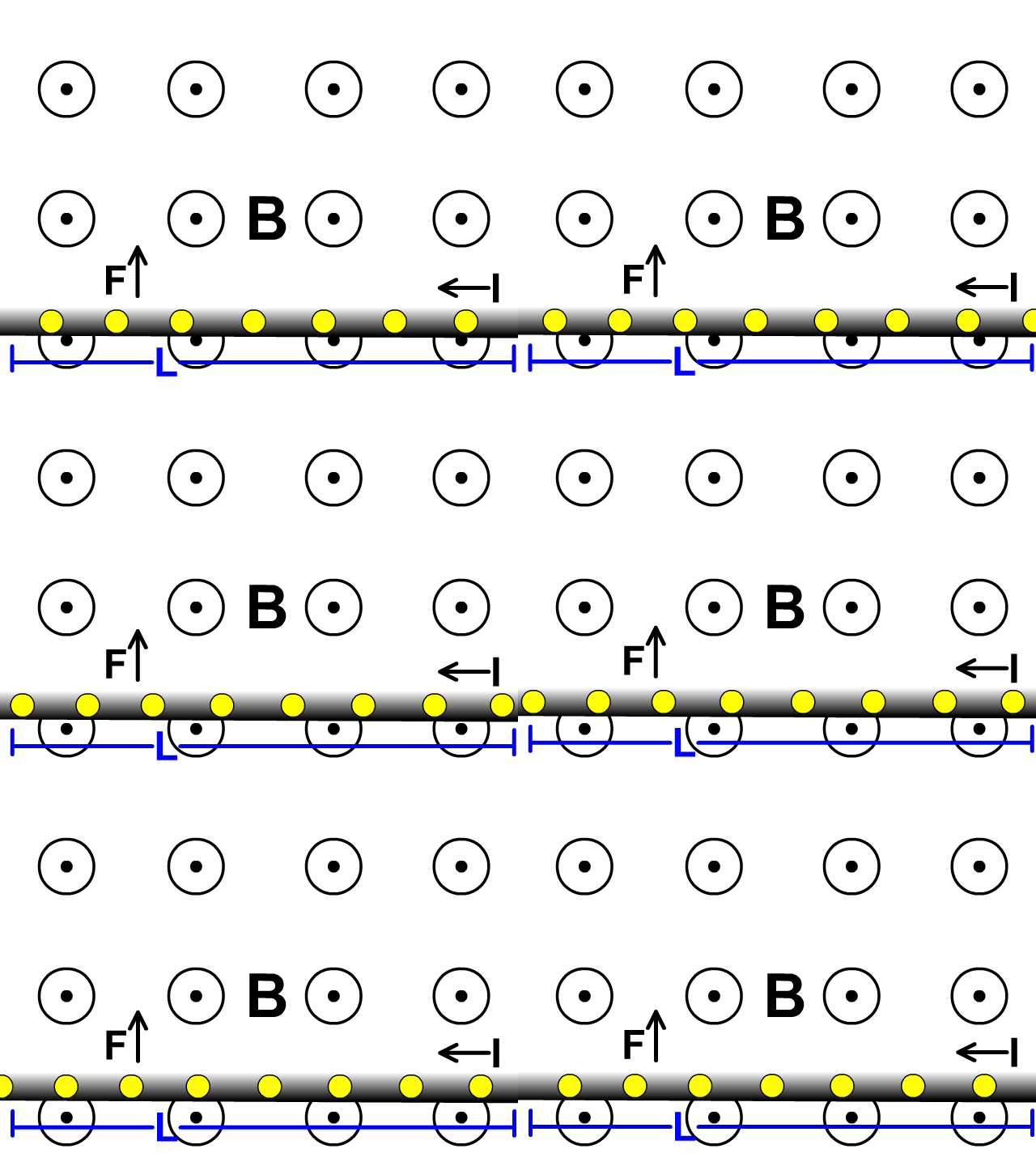
سلك طوله \(L\) يمر به تيار في مجال \(B\) (النقاط تعني مجالًا خارجًا من الصفحة): تظهر قوة \(F\) عمودية على السلك وعلى المجال.
A wire of length \(L\) carrying a current in a field \(B\) (the dots mean a field out of the page): a force \(F\) appears perpendicular to both the wire and the field.
💡 من أين جاءت العلاقة؟
💡 Where does the formula come from?
في طول \(L\) من السلك مساحة مقطعه \(A\) وعدد حاملات الشحنة في وحدة الحجم \(n\) يوجد \(N=nAL\) حاملًا، وتتأثر كل شحنة بقوة \(qv_dB\sin\theta\) حيث \(v_d\) سرعة الانسياق.
In a length \(L\) of wire of cross-section \(A\) and \(n\) charge carriers per unit volume there are \(N=nAL\) carriers, and each feels a force \(qv_dB\sin\theta\) where \(v_d\) is the drift speed.
القوة الكلية \(F=nAL\,q v_d B\sin\theta=(nqv_dA)\,L B\sin\theta\)، والمقدار بين القوسين هو التيار \(I\) فنحصل على \(F=ILB\sin\theta\).
The total force is \(F=nAL\,q v_d B\sin\theta=(nqv_dA)\,L B\sin\theta\) and the bracket is the current \(I\), giving \(F=ILB\sin\theta\).
📐 متى تكون القوة أكبر ما يمكن؟ ومتى تنعدم؟
📐 When is the force largest? When is it zero?
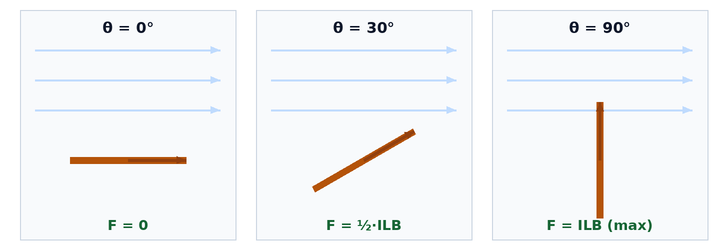
القوة تتناسب مع \(\sin\theta\): تنعدم عندما يوازي السلك المجال، وتكون أكبر ما يمكن عندما يكون عموديًا عليه.
The force is proportional to \(\sin\theta\): it vanishes when the wire is parallel to the field and is largest when it is perpendicular to it.
| الزاوية \(\theta\)Angle \(\theta\) | \(\sin\theta\)\(\sin\theta\) | القوةForce |
|---|---|---|
| \(0^\circ\) أو \(180^\circ\) (السلك يوازي المجال)\(0^\circ\) or \(180^\circ\) (wire parallel to the field) | 00 | \(F=0\) — لا تتأثر الشحنات المتحركة على امتداد المجال\(F=0\) — charges moving along the field feel no force |
| \(30^\circ\)\(30^\circ\) | 0.50.5 | \(F=\tfrac12ILB\)\(F=\tfrac12ILB\) |
| \(90^\circ\) (عمودي على المجال)\(90^\circ\) (perpendicular to the field) | 11 | \(F_{max}=ILB\) — أكبر قيمة\(F_{max}=ILB\) — the maximum value |
🖐️ اتجاه القوة: قاعدة الكف لليد اليمنى
🖐️ Direction of the force: the right-hand palm rule
افتح كفّ يدك اليمنى: اجعل الأصابع في اتجاه المجال \(B\) والإبهام في اتجاه التيار الاصطلاحي \(I\) (من القطب الموجب إلى السالب خارج البطارية)، فتكون القوة \(F\) خارجة من راحة الكف وعمودية على الاتجاهين.
Open your right hand: point the fingers along the field \(B\) and the thumb along the conventional current \(I\) (from the positive to the negative terminal outside the battery); the force \(F\) comes out of the palm, perpendicular to both.
بديل: قاعدة الأصابع الثلاثة لليد اليمنى — السبابة \(B\) والإبهام \(I\) والوسطى \(F\). وبعض الكتب تستعمل اليد اليسرى مع تيار الإلكترونات (اتجاه حركة الإلكترونات) وتعطي النتيجة نفسها.
Alternative: the three-finger rule of the right hand — index \(B\), thumb \(I\), middle \(F\). Some books use the left hand with the electron current (the direction electrons move) and get the same result.
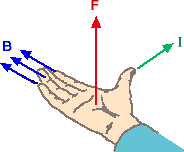
قاعدة الكف: الأصابع مع \(B\) والإبهام مع \(I\) فتخرج \(F\) من راحة الكف.
The palm rule: fingers with \(B\), thumb with \(I\), and \(F\) comes out of the palm.
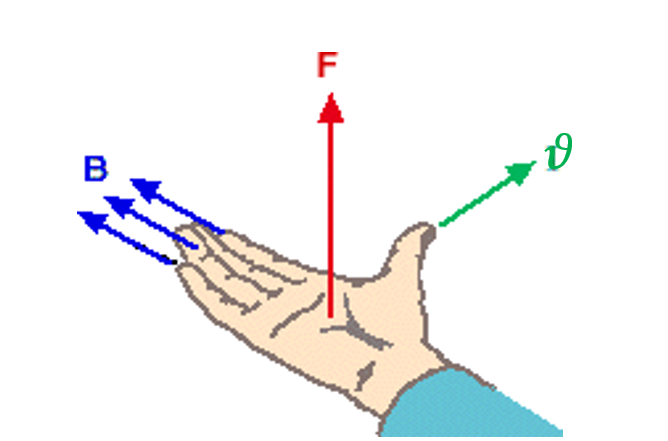
عندما لا يتعامد السلك مع المجال تبقى القوة عمودية على مستواهما، ومقدارها يعتمد على \(\sin\theta\).
When the wire is not perpendicular to the field the force is still perpendicular to their plane, with a magnitude depending on \(\sin\theta\).
⚠️ تنبيه مهم
⚠️ Important note
القوة المغناطيسية عمودية دائمًا على السلك وعلى المجال معًا؛ فهي لا تدفع السلك على امتداد التيار ولا على امتداد المجال، وتنعكس باتجاه التيار أو بعكس المجال.
The magnetic force is always perpendicular to both the wire and the field; it never pushes the wire along the current or along the field, and it reverses if the current or the field is reversed.
وحدة المجال التسلا: \(1\ \mathrm{T}=1\ \mathrm{N/(A\cdot m)}\) أي القوة المؤثرة على سلك طوله \(1\ \mathrm{m}\) يمر به \(1\ \mathrm{A}\) عموديًا على المجال.
The tesla: \(1\ \mathrm{T}=1\ \mathrm{N/(A\cdot m)}\), the force on \(1\ \mathrm{m}\) of wire carrying \(1\ \mathrm{A}\) perpendicular to the field.
✏️ أمثلة محلولة
✏️ Worked Examples
سلك طوله \(0.5\ \mathrm{m}\) يمر به تيار \(8\ \mathrm{A}\) موضوع في مجال مغناطيسي شدته \(0.4\ \mathrm{T}\) وبشكل موازٍ للمجال. أوجد القوة المغناطيسية المؤثرة على السلك.
A wire of length \(0.5\ \mathrm{m}\) carries \(8\ \mathrm{A}\) and is placed in a field of \(0.4\ \mathrm{T}\) parallel to the field. Find the magnetic force on the wire.
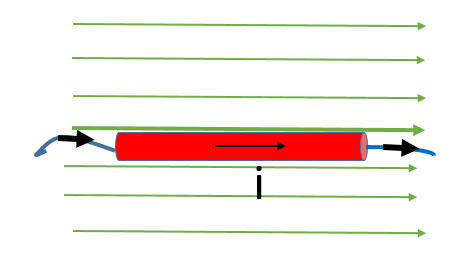
شكل المثال 1: السلك موازٍ لخطوط المجال.
Example 1: the wire is parallel to the field lines.
سلك طوله \(0.5\ \mathrm{m}\) يمر به تيار \(8\ \mathrm{A}\) في مجال شدته \(0.4\ \mathrm{T}\) وهو عمودي على المجال كما في الشكل. أوجد مقدار القوة المغناطيسية واتجاهها.
A wire of length \(0.5\ \mathrm{m}\) carries \(8\ \mathrm{A}\) in a field of \(0.4\ \mathrm{T}\) and is perpendicular to the field as shown. Find the magnitude and direction of the magnetic force.
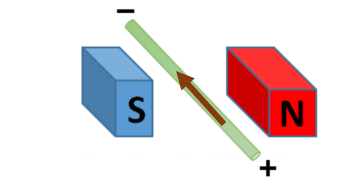
شكل المثال 2: سلك بين قطبي مغناطيس وعمودي على المجال.
Example 2: a wire between the poles of a magnet, perpendicular to the field.
سلك طوله \(0.2\ \mathrm{m}\) يمر به تيار \(5\ \mathrm{A}\) في مجال \(0.3\ \mathrm{T}\) ويصنع زاوية \(30^\circ\) مع المجال. القوة المؤثرة عليه:
A wire of length \(0.2\ \mathrm{m}\) carries \(5\ \mathrm{A}\) in a field of \(0.3\ \mathrm{T}\) and makes \(30^\circ\) with the field. The force on it is:
إذا تضاعف التيار في سلك وزادت الزاوية بينه وبين المجال من \(30^\circ\) إلى \(90^\circ\) مع بقاء \(L\) و\(B\) ثابتين فإن القوة تصبح:
If the current in a wire doubles and the angle with the field increases from \(30^\circ\) to \(90^\circ\) with \(L\) and \(B\) unchanged, the force becomes:
سلك يحمل تيارًا نحو الشمال في مجال مغناطيسي نحو الشرق (في مستوى أفقي). اتجاه القوة المغناطيسية (قاعدة الكف اليمنى):
A wire carries a current toward the north in a magnetic field pointing east (in a horizontal plane). By the right-hand palm rule the force points:
🧪 جرّب بنفسك: القوة على سلك
🧪 Try It Yourself: the Force on a Wire
🧪 تجربة 1: سلك معلّق في مجال مغناطيسي: يتأرجح بتأثير القوة
🧪 Experiment 1: A Hanging Wire in a Magnetic Field: It Swings under the Force
سلك معلّق بخيط بين قطبي مغناطيس (المجال رأسي)، ويمر به تيار عمودي على الصفحة. اضغط «أغلق المفتاح» فتتأرجح الكتلة وتستقر عند زاوية تحقق \(\tan\alpha=F/mg\) حيث \(F=ILB\). جرّب عكس التيار أو عكس قطبي المغناطيس، ثم سجّل قياسات بتيارات مختلفة لترى أن \(F\) تتناسب طرديًا مع \(I\). أنجز المهام في الصندوق الأصفر.
A wire hangs on a string between the poles of a magnet (the field is vertical) and carries a current perpendicular to the page. Press “Close the switch” and the mass swings and settles at an angle satisfying \(\tan\alpha=F/mg\) where \(F=ILB\). Try reversing the current or swapping the poles and watch the direction reverse, then record measurements at different currents to see that \(F\) is proportional to \(I\). Complete the missions in the yellow box.
🧪 تجربة 2: مدرّب الاتجاه: طبّق قاعدة الكف
🧪 Experiment 2: Direction Trainer: Apply the Palm Rule
يظهر لك مجال مغناطيسي واتجاه تيار (أو سرعة شحنة). اختر اتجاه القوة الصحيح من الأزرار ثم اضغط «سؤال جديد». بدّل بين سلك وشحنة موجبة وإلكترون لترى كيف تنعكس القوة للشحنة السالبة. الاصطلاح: ⊙ خارج الصفحة، ⊗ داخل الصفحة.
A magnetic field and a current direction (or a charge velocity) appear. Choose the correct force direction with the buttons, then press “New question”. Switch between a wire, a positive charge and an electron to see how the force reverses for a negative charge. Convention: ⊙ out of the page, ⊗ into the page.
🔊 التطبيق الأول: مكبّر الصوت
🔊 Application 1: The Loudspeaker
يتكوّن مكبّر الصوت من مغناطيس دائم يولّد مجالًا شعاعيًا، وملف سلك ملفوف على أسطوانة ورقية مثبتة بمخروط من الورق المقوّى. عندما يمرّ في الملف تيار متردّد يمثّل الإشارة الصوتية تؤثّر في الملف قوة \(F=ILB\) تتغيّر بتغيّر التيار، فيهتزّ المخروط بالتردّد نفسه فيحرّك الهواء ويولّد موجات صوتية.
A loudspeaker consists of a permanent magnet giving a radial field and a coil of wire wound on a paper tube fixed to a cardboard cone. When an alternating current carrying the audio signal flows in the coil, a force \(F=ILB\) acts on it and varies with the current, so the cone vibrates at the same frequency, moving the air and producing sound waves.
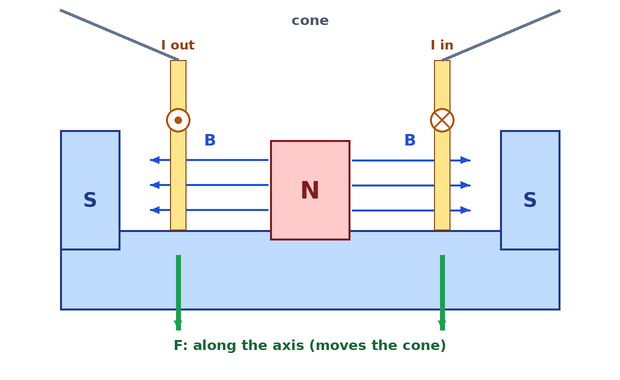
مقطع في مكبر الصوت: التيار في الملف عمودي على المجال الشعاعي فتنشأ قوة محورية تحرّك المخروط.
Cross-section of a loudspeaker: the current in the coil is perpendicular to the radial field, so an axial force moves the cone.
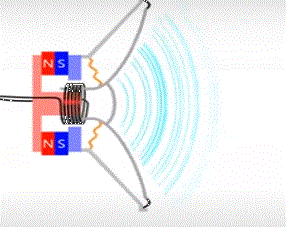
مكبّر صوت: مخروط من الورق المقوّى ملفوف عليه سلك من النحاس بين قطبي مغناطيس.
A loudspeaker: a cardboard cone with copper wire wound on it between the poles of a magnet.
💡 أفكار أساسية
💡 Key ideas
• المجال شعاعي، فيكون عموديًا على كل جزء من الملف في أي لحظة (\(\theta=90^\circ\)) وتكون القوة \(F=BIL\) حيث \(L\) طول سلك الملف كله.
• The field is radial, so it is perpendicular to every part of the coil at all times (\(\theta=90^\circ\)) and the force is \(F=BIL\), where \(L\) is the total length of the coil wire.
• ينعكس اتجاه القوة كلما انعكس اتجاه التيار، فيتحرك المخروط ذهابًا وإيابًا؛ وتردّد الاهتزاز يساوي تردّد التيار.
• The force reverses each time the current reverses, so the cone moves back and forth; the vibration frequency equals the current’s frequency.
• زيادة شدة التيار تزيد سعة الاهتزاز أي علوّ الصوت، وتغيّر التردّد تغيّر درجة الصوت.
• A larger current increases the amplitude, i.e. the loudness, and changing the frequency changes the pitch.
مكبّر صوت على شكل مخروط من الورق المقوّى ملفوف عليه سلك من النحاس طوله \(6.28\ \mathrm{m}\) وبشكل عمودي على المجال المغناطيسي، يمر به تيار شدته \(3\ \mathrm{mA}\) فتأثر السلك بقوة مقدارها \(0.02\ \mathrm{N}\). أوجد أقل شدة للمجال المغناطيسي تحقّق ذلك.
A loudspeaker cone has copper wire of length \(6.28\ \mathrm{m}\) wound on it, perpendicular to the magnetic field, carrying \(3\ \mathrm{mA}\), and the wire feels a force of \(0.02\ \mathrm{N}\). Find the smallest field strength that gives this.
في مكبّر الصوت إذا تضاعفت شدة التيار في الملف وبقي المجال والملف ثابتين فإن القوة المؤثرة على الملف:
In a loudspeaker, if the current in the coil doubles with the field and the coil unchanged, the force on the coil:
🧪 تجربة 3: مكبّر الصوت: تيار متردد يحرّك المخروط
🧪 Experiment 3: The Loudspeaker: an Alternating Current Moves the Cone
يُعرض مقطع في مكبّر الصوت بحركة مُبطّأة (÷100) كي ترى الاهتزاز. اضغط «أرسل الإشارة» فيمرّ تيار متردد في الملف فتتغيّر القوة \(F=BIL\) ويهتزّ المخروط بتردد الإشارة، وتنتشر الموجات. ويمكنك الضغط على «صوت حقيقي» لتسمع النغمة بالتردد المختار.
A cross-section of a loudspeaker is shown in slow motion (÷100) so you can see the vibration. Press “Send the signal”: an alternating current flows in the coil, the force \(F=BIL\) changes and the cone vibrates at the signal’s frequency while waves spread out. You can also press “Real sound” to hear the tone at the chosen frequency.
🎛️ التطبيق الثاني: الجلفانومتر
🎛️ Application 2: The Galvanometer
الجلفانومتر جهاز حسّاس يُستعمل لقياس التيارات الصغيرة جدًا، ويمكن بتعديل بسيط أن يعمل أميترًا أو فولتوميترًا.
The galvanometer is a sensitive instrument that measures very small currents, and with a simple modification it can serve as an ammeter or a voltmeter.
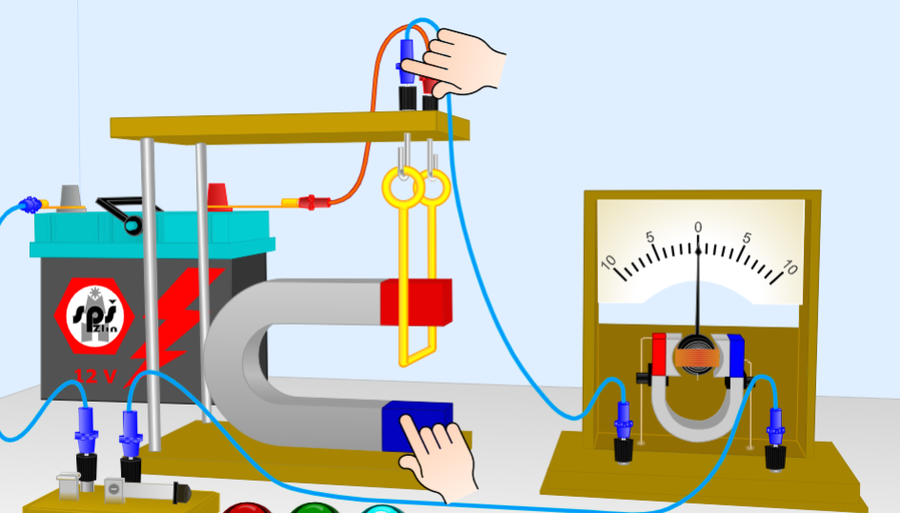
مكوّنات الجلفانومتر: مغناطيس دائم، ملف ملفوف على أسطوانة، مؤشر، وزنبرك لإعادة المؤشر إلى الصفر.
Parts of the galvanometer: a permanent magnet, a coil wound on a cylinder, a pointer and a spring that returns the pointer to zero.
🔧 مكوّنات الجلفانومتر وعمله
🔧 Parts and operation
• مجال مغناطيسي من مغناطيس دائم.
• أسطوانة تدور حول محورها ملفوف عليها سلك (ملف).
• إبرة مؤشر متصلة بالأسطوانة.
• زنبرك يعيد الأسطوانة والمؤشر إلى الصفر.
• A magnetic field from a permanent magnet.
• A cylinder free to rotate with a coil of wire wound on it.
• A pointer attached to the cylinder.
• A spring that returns the cylinder and pointer to zero.
عند مرور تيار في الملف تؤثّر قوتان متعاكستان على ضلعيه فينشأ عزم يدير الملف والمؤشر؛ يزداد التواء الزنبرك حتى يتساوى عزمه مع العزم المغناطيسي فيستقر المؤشر. وعند انقطاع التيار يعيد الزنبرك المؤشر إلى الصفر.
When a current flows in the coil, two opposite forces act on its sides and produce a torque that turns the coil and pointer; the spring twists until its torque balances the magnetic torque and the pointer rests. When the current stops the spring returns the pointer to zero.
انحراف المؤشر يتناسب طرديًا مع التيار المار في الملف؛ ولذلك يمكن معايرة التدريج بالأمبير أو بالفولت.
The pointer’s deflection is directly proportional to the current in the coil, which is why the scale can be calibrated in amperes or volts.
🔁 تحويل الجلفانومتر إلى أميتر
🔁 Converting the galvanometer into an ammeter
يتحمّل الجلفانومتر تيارًا صغيرًا \(I_g\) فقط. لقياس تيارات أكبر نصل به على التوازي مقاومة صغيرة جدًا تُسمّى مجزّئ التيار \(S\) (shunt)، فيمرّ معظم التيار فيها ويمرّ الجزء \(I_g\) فقط في الجلفانومتر.
A galvanometer can only carry a small current \(I_g\). To measure larger currents we connect a very small resistance in parallel with it, called the shunt \(S\), so most of the current flows through it and only \(I_g\) goes through the galvanometer.
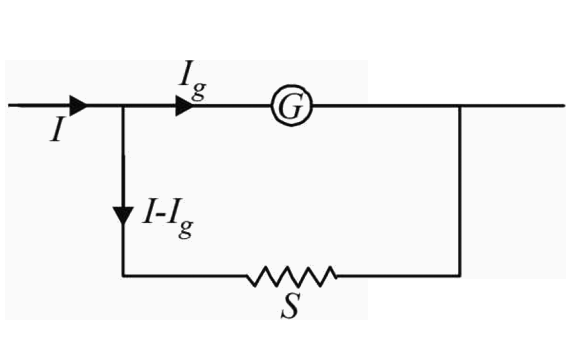
الشكل 1: أميتر — مقاومة صغيرة \(S\) على التوازي مع الجلفانومتر \(G\).
Figure 1: an ammeter — a small resistance \(S\) in parallel with the galvanometer \(G\).
📌 مقاومة المجزّئ
📌 The shunt resistance
\[I_gR_g=(I-I_g)\,S\quad\Rightarrow\quad S=\frac{I_g\,R_g}{I-I_g}\]
\(R_g\): مقاومة الجلفانومتر، \(I_g\): تيار الانحراف الأعظم له، \(I\): أكبر تيار نريد قياسه. المقاومتان على التوازي فلهما فرق الجهد نفسه.
\(R_g\): galvanometer resistance, \(I_g\): its full-scale current, \(I\): the largest current we want to measure. The two resistances are in parallel, so they have the same potential difference.
🔁 تحويل الجلفانومتر إلى فولتوميتر
🔁 Converting the galvanometer into a voltmeter
لقياس فرق جهد نصل بالجلفانومتر على التوالي مقاومة كبيرة جدًا تُسمّى مضاعف الجهد \(R\) (multiplier)، فيقلّ التيار المار فيه فلا يتغيّر التيار في الدارة المراد قياس جهدها.
To measure a potential difference we connect a very large resistance in series with the galvanometer, called the multiplier \(R\), so the current through it is small and the circuit under test is not disturbed.
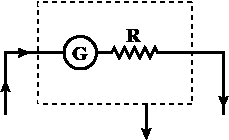
الشكل 2: فولتوميتر — مقاومة كبيرة \(R\) على التوالي مع الجلفانومتر \(G\).
Figure 2: a voltmeter — a large resistance \(R\) in series with the galvanometer \(G\).
📌 مقاومة المضاعف
📌 The multiplier resistance
\[V=I_g\,(R_g+R)\quad\Rightarrow\quad R=\frac{V}{I_g}-R_g\]
\(V\): أكبر فرق جهد نريد قياسه (الانحراف الأعظم).
\(V\): the largest potential difference we want to measure (full-scale deflection).
| الجهازInstrument | طريقة التوصيلConnection | المقاومة المضافةAdded resistance | الاستعمالUse |
|---|---|---|---|
| أميترAmmeter | مجزّئ تيار على التوازي مع الجلفانومترshunt in parallel with the galvanometer | صغيرة جدًاvery small | يُوصل في الدارة على التوالي ومقاومته صغيرةconnected in series in the circuit, low resistance |
| فولتوميترVoltmeter | مضاعف جهد على التوالي مع الجلفانومترmultiplier in series with the galvanometer | كبيرة جدًاvery large | يُوصل على التوازي مع العنصر ومقاومته كبيرةconnected in parallel with the element, high resistance |
جلفانومتر مقاومته \(50\ \Omega\) وأكبر تيار يتحمله \(2\ \mathrm{mA}\). ما مقاومة المجزّئ اللازمة لتحويله إلى أميتر مداه \(1\ \mathrm{A}\)؟
A galvanometer of resistance \(50\ \Omega\) can carry at most \(2\ \mathrm{mA}\). What shunt turns it into an ammeter of range \(1\ \mathrm{A}\)?
للجلفانومتر نفسه (\(R_g=50\ \Omega\)، \(I_g=2\ \mathrm{mA}\)) ما قيمة المقاومة التي توصل على التوالي لتحويله إلى فولتوميتر مداه \(10\ \mathrm{V}\)؟
For the same galvanometer (\(R_g=50\ \Omega\), \(I_g=2\ \mathrm{mA}\)) what series resistance makes a voltmeter of range \(10\ \mathrm{V}\)?
لتحويل جلفانومتر إلى أميتر نصل به:
To convert a galvanometer into an ammeter we connect to it:
🧪 تجربة 4: الجلفانومتر: حوّله إلى أميتر أو فولتوميتر
🧪 Experiment 4: The Galvanometer: Turn It into an Ammeter or a Voltmeter
اختر الجهاز ثم حدّد مقاومة الجلفانومتر وتيار انحرافه الأعظم والمدى المطلوب؛ تحسب التجربة مقاومة المجزّئ \(S\) (أميتر، على التوازي) أو مقاومة المضاعف \(R\) (فولتوميتر، على التوالي). اضغط «طبّق القياس» لترى المؤشر يتحرك وكم يمرّ في الجلفانومتر.
Choose the instrument then set the galvanometer resistance, its full-scale current and the required range; the experiment calculates the shunt \(S\) (ammeter, in parallel) or the multiplier \(R\) (voltmeter, in series). Press “Apply the measurement” to watch the pointer move and see how much flows through the galvanometer.
⚙️ التطبيق الثالث: المحرّك الكهربائي
⚙️ Application 3: The Electric Motor
المحرّك الكهربائي جهاز يحوّل الطاقة الكهربائية إلى طاقة حركية (ميكانيكية). يتكوّن من: مجال مغناطيسي، ملف قابل للدوران، أنصاف حلقات (المبدّل)، فرشاتين، ومصدر تيار مستمر.
An electric motor converts electrical energy into kinetic (mechanical) energy. It consists of a magnetic field, a rotating coil, split rings (the commutator), two brushes and a DC source.
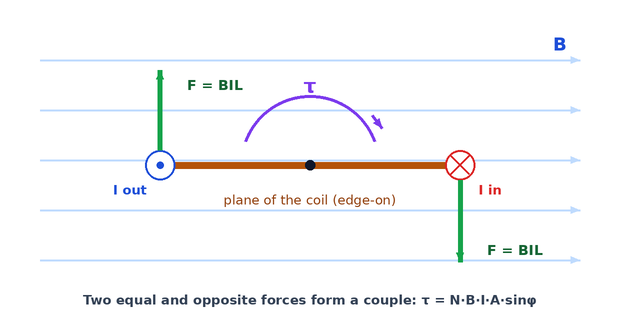
منظر محوري للملف: القوتان \(BIL\) متساويتان ومتعاكستان على ضلعي الملف فتشكّلان ازدواجًا يدير الملف.
End view of the coil: the two forces \(BIL\) are equal and opposite on the coil’s two sides and form a couple that turns the coil.
🔍 كيف يدور الملف؟
🔍 How does the coil turn?
الضلعان المتقابلان من الملف يمر فيهما التيار باتجاهين متعاكسين، فتؤثّر عليهما قوتان متساويتان في المقدار ومتعاكستان في الاتجاه (قاعدة الكف)؛ هذا ازدواج يولّد عزمًا يدير الملف.
The two opposite sides of the coil carry current in opposite directions, so they feel equal and opposite forces (palm rule); this couple produces a torque that turns the coil.
يتغيّر العزم مع زاوية الملف: يكون أكبر ما يمكن عندما يوازي مستوى الملف المجال، وينعدم عندما يتعامد مستواه مع المجال.
The torque varies with the coil’s angle: it is largest when the plane of the coil is parallel to the field and zero when the plane is perpendicular to it.
المبدّل (نصفا حلقة) يعكس اتجاه التيار في الملف كل نصف دورة، فيبقى العزم في الاتجاه نفسه ويستمر الدوران بدل أن يتذبذب الملف.
The commutator (split ring) reverses the current in the coil every half turn, so the torque keeps the same sense and the coil keeps rotating instead of oscillating.
📌 عزم الازدواج على ملف
📌 Torque on a coil
\[\tau=N\,B\,I\,A\,\sin\varphi\]
\(N\): عدد اللفات، \(A\): مساحة الملف (\(\mathrm{m^2}\))، \(\varphi\): الزاوية بين العمودي على مستوى الملف والمجال. العزم الأعظم \(\tau_{max}=NBIA\) عندما \(\varphi=90^\circ\).
\(N\): number of turns, \(A\): area of the coil (\(\mathrm{m^2}\)), \(\varphi\): the angle between the normal to the coil’s plane and the field. The maximum torque \(\tau_{max}=NBIA\) occurs for \(\varphi=90^\circ\).
ملف مستطيل من \(100\) لفة أبعاده \(10\ \mathrm{cm}\times5\ \mathrm{cm}\) يمر به تيار \(2\ \mathrm{A}\) في مجال منتظم \(0.4\ \mathrm{T}\). أوجد العزم الأعظم، والعزم عندما يصنع العمودي على مستوى الملف زاوية \(30^\circ\) مع المجال.
A rectangular coil of \(100\) turns measuring \(10\ \mathrm{cm}\times5\ \mathrm{cm}\) carries \(2\ \mathrm{A}\) in a uniform field of \(0.4\ \mathrm{T}\). Find the maximum torque and the torque when the normal to the coil makes \(30^\circ\) with the field.
وظيفة المبدّل (أنصاف الحلقات) في المحرك الكهربائي:
The function of the commutator (split rings) in an electric motor is to:
🧪 تجربة 5: المحرك الكهربائي: دوّر الملف وتحكّم بالمبدّل
🧪 Experiment 5: The Electric Motor: Spin the Coil and Control the Commutator
يظهر منظر محوري لملف داخل مجال أفقي. اضغط «وصّل البطارية» فيؤثر على ضلعي الملف ازدواج يديره. جرّب إلغاء المبدّل لترى الملف يتذبذب ثم يتوقف بدل أن يدور، ثم أعده لتراه يدور باستمرار. المنحنى يبيّن العزم مع الزاوية.
An end view of a coil in a horizontal field is shown. Press “Connect the battery” and a couple acts on the two sides of the coil and turns it. Try removing the commutator to see the coil oscillate and stop instead of rotating, then restore it to see it spin continuously. The graph shows the torque against the angle.
⚛️ القوة المغناطيسية على شحنة متحركة
⚛️ The Magnetic Force on a Moving Charge
إذا قُذف جسيم مشحون في منطقة مجال مغناطيسي وبشكل لا يوازي المجال فإنه يتأثر بقوة تجعله ينحرف عن مساره دون أن تتغيّر سرعته؛ إذ تكون القوة عمودية دائمًا على اتجاه الحركة فتغيّر الاتجاه فقط.
If a charged particle is projected into a magnetic field and not parallel to it, it feels a force that makes it deflect without any change in its speed: the force is always perpendicular to the motion, so it changes only the direction.
📌 القوة على شحنة متحركة
📌 Force on a moving charge
\[F=q\,v\,B\,\sin\theta\]
\(q\): مقدار الشحنة (C)، \(v\): سرعتها (m/s)، \(B\): شدة المجال (T)، \(\theta\): الزاوية بين السرعة والمجال.
\(q\): the charge (C), \(v\): its speed (m/s), \(B\): the field strength (T), \(\theta\): the angle between the velocity and the field.
🖐️ اتجاه القوة على الشحنة
🖐️ Direction of the force on the charge
نطبّق قاعدة الكف لليد اليمنى: الأصابع نحو \(B\)، والإبهام نحو اتجاه حركة الشحنة \(v\)، فتخرج القوة من راحة الكف إذا كانت الشحنة موجبة. أما إذا كانت الشحنة سالبة (إلكترون) فإن القوة تكون بعكس الاتجاه الناتج (أو نستعمل اليد اليسرى).
Apply the right-hand palm rule: fingers along \(B\), thumb along the velocity \(v\) of the charge; the force comes out of the palm for a positive charge. For a negative charge (an electron) the force is opposite to that direction (or use the left hand).
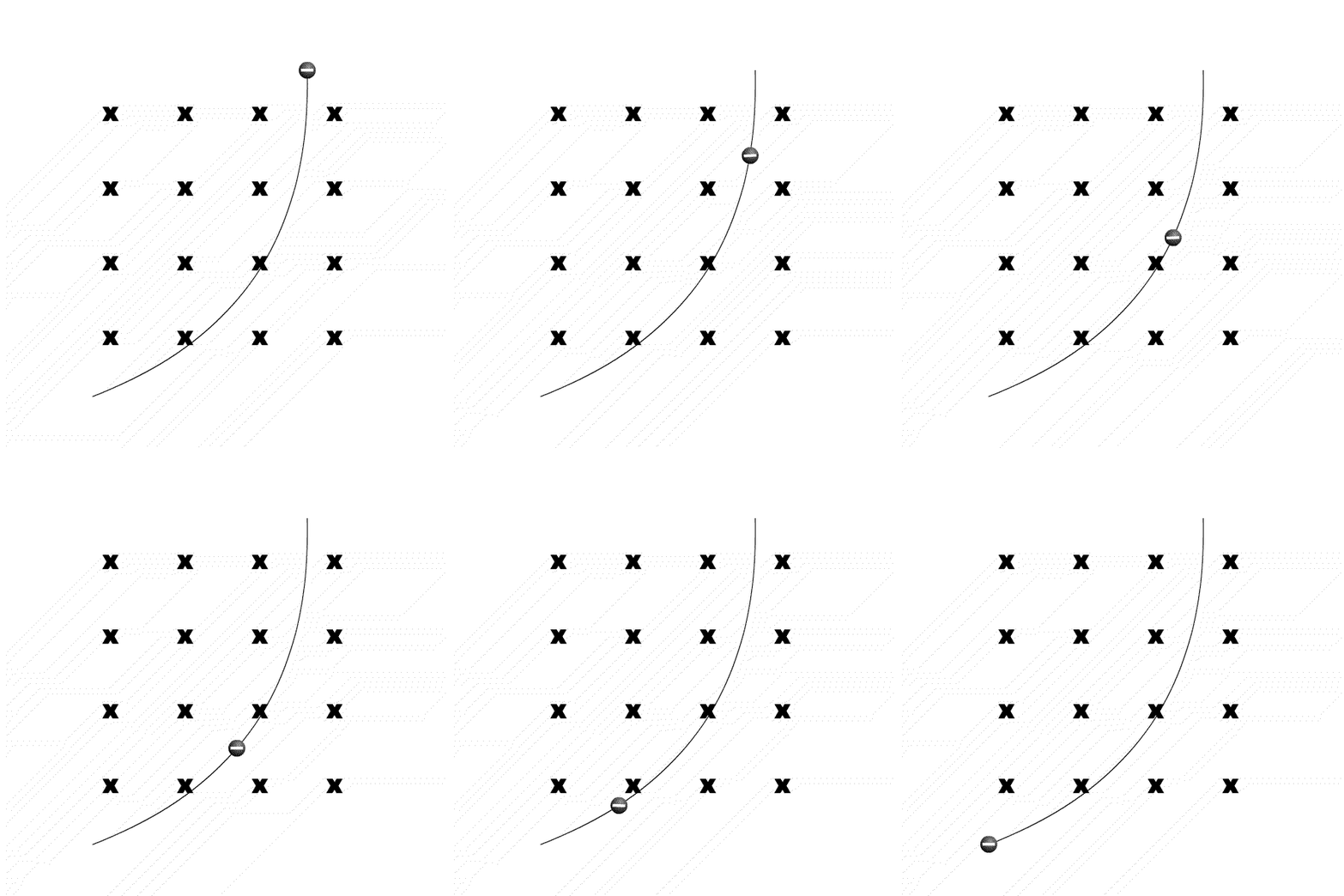
مسار شحنة تدخل مجالًا مغناطيسيًا: ينحني المسار بسبب القوة العمودية على السرعة.
The path of a charge entering a magnetic field: the path bends because of the force perpendicular to the velocity.
🌀 مسار الجسيم في المجال المنتظم
🌀 The path in a uniform field
عندما تدخل الشحنة عموديًا على مجال منتظم تعمل القوة المغناطيسية قوة مركزية فيدور الجسيم في دائرة بسرعة ثابتة المقدار:
When the charge enters perpendicular to a uniform field, the magnetic force acts as a centripetal force and the particle moves in a circle at constant speed:
\[qvB=\frac{mv^2}{r}\ \Rightarrow\ r=\frac{mv}{qB}\]
القوة المغناطيسية لا تبذل شغلًا لأنها عمودية على الإزاحة، لذلك لا تتغير الطاقة الحركية للجسيم.
The magnetic force does no work because it is perpendicular to the displacement, so the particle’s kinetic energy does not change.
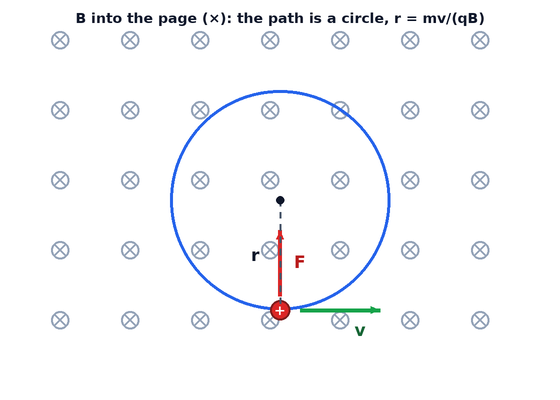
جسيم موجب يتحرك عموديًا على مجال داخل الصفحة: القوة نحو المركز ومساره دائرة نصف قطرها \(r=mv/qB\).
A positive particle moving perpendicular to a field into the page: the force points to the centre and the path is a circle of radius \(r=mv/qB\).
يتحرك شعاع من الإلكترونات بين قطبي المغناطيس كما في الشكل. في أي اتجاه ينحرف الشعاع الإلكتروني بتأثير القوة المغناطيسية؟
A beam of electrons moves between the poles of a magnet as shown. In which direction is the electron beam deflected by the magnetic force?
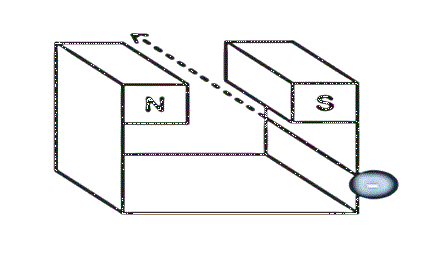
شكل المثال 7: شعاع إلكتروني بين قطبي مغناطيس على شكل حدوة.
Example 7: an electron beam between the poles of a horseshoe magnet.
جسيم شحنته \(4\ \mu\mathrm{C}\) دخل منطقة مجال مغناطيسي شدته \(0.2\ \mathrm{T}\) بشكل عمودي على المجال وبسرعة \(2\times10^{4}\ \mathrm{m/s}\). أوجد القوة المغناطيسية المؤثرة عليه.
A particle of charge \(4\ \mu\mathrm{C}\) enters a magnetic field of \(0.2\ \mathrm{T}\) perpendicular to the field at a speed of \(2\times10^{4}\ \mathrm{m/s}\). Find the magnetic force on it.
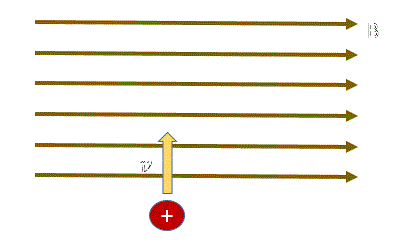
شكل المثال 8: شحنة موجبة تتحرك عموديًا على خطوط المجال.
Example 8: a positive charge moving perpendicular to the field lines.
بروتون (\(q=1.6\times10^{-19}\ \mathrm{C}\)، \(m=1.67\times10^{-27}\ \mathrm{kg}\)) يتحرك بسرعة \(2\times10^{6}\ \mathrm{m/s}\) عموديًا على مجال \(0.5\ \mathrm{T}\). أوجد القوة ونصف قطر المسار.
A proton (\(q=1.6\times10^{-19}\ \mathrm{C}\), \(m=1.67\times10^{-27}\ \mathrm{kg}\)) moves at \(2\times10^{6}\ \mathrm{m/s}\) perpendicular to a field of \(0.5\ \mathrm{T}\). Find the force and the radius of the path.
جسيم موجب يتحرك نحو الأعلى في مجال مغناطيسي متجه إلى داخل الصفحة. القوة المغناطيسية عليه تتجه:
A positive particle moves upward in a magnetic field directed into the page. The magnetic force on it points:
إلكترون (\(q=1.6\times10^{-19}\ \mathrm{C}\)) سرعته \(3\times10^{6}\ \mathrm{m/s}\) عمودية على مجال \(0.2\ \mathrm{T}\). القوة المؤثرة عليه:
An electron (\(q=1.6\times10^{-19}\ \mathrm{C}\)) with speed \(3\times10^{6}\ \mathrm{m/s}\) is perpendicular to a field of \(0.2\ \mathrm{T}\). The force on it is:
🧪 تجربة 6: جسيم مشحون في مجال مغناطيسي: مسار دائري
🧪 Experiment 6: A Charged Particle in a Magnetic Field: a Circular Path
اختر الجسيم (بروتون، إلكترون، جسيم ألفا) والسرعة والمجال ثم اضغط «أطلق الجسيم». القوة \(qvB\) عمودية على السرعة فيدور الجسيم في دائرة نصف قطرها \(r=mv/qB\). جرّب تغيير الشحنة وعكس اتجاه المجال لترى اتجاه الدوران. الحركة مُبطّأة للتوضيح.
Choose the particle (proton, electron, alpha particle), the speed and the field then press “Launch the particle”. The force \(qvB\) is perpendicular to the velocity so the particle moves in a circle of radius \(r=mv/qB\). Change the charge and reverse the field to see the sense of rotation. The motion is slowed for clarity.
✅ ملخص الدرس
✅ Lesson Summary
| الموضوعTopic | القانونLaw | الاتجاه / الفكرةDirection / idea |
|---|---|---|
| سلك يحمل تيارًا في مجالCurrent-carrying wire in a field | \(F=ILB\sin\theta\) | قاعدة الكف: \(B\) أصابع، \(I\) إبهام، \(F\) من الراحةpalm rule: \(B\) fingers, \(I\) thumb, \(F\) from the palm |
| مكبّر الصوتLoudspeaker | \(F=BIL\) | تيار متردد ⟹ اهتزاز المخروط بالتردد نفسهAC current ⟹ the cone vibrates at the same frequency |
| الجلفانومتر ← أميترGalvanometer → ammeter | \(S=\dfrac{I_gR_g}{I-I_g}\) | مقاومة صغيرة على التوازيa small resistance in parallel |
| الجلفانومتر ← فولتوميترGalvanometer → voltmeter | \(R=\dfrac{V}{I_g}-R_g\) | مقاومة كبيرة على التواليa large resistance in series |
| المحرك الكهربائيElectric motor | \(\tau=NBIA\sin\varphi\) | المبدّل يعكس التيار كل نصف دورةthe commutator reverses the current every half turn |
| شحنة متحركةMoving charge | \(F=qvB\sin\theta,\ r=\dfrac{mv}{qB}\) | عمودية على السرعة: مسار دائري ولا شغلperpendicular to the velocity: circular path, no work |
🧪 اختبر نفسك: امتحان من 20 سؤالاً
🧪 Test Yourself: a 20-Question Exam
أنهِ الدرس بالاختبار التفاعلي التالي؛ أسئلته تجمع بين الفهم والحساب وتغطي جميع أقسام الدرس.
Finish with the interactive exam below; its questions mix understanding with calculation and cover every section of the lesson.
اختبار تطبيقات القوة المغناطيسية Applications of the Magnetic Force Quiz
20 سؤالاً - القوة على سلك، مكبّر الصوت، الجلفانومتر، المحرك الكهربائي، والقوة على الشحنات المتحركة 20 Questions - the force on a wire, the loudspeaker, the galvanometer, the electric motor and the force on moving charges
• عدد الأسئلة: 20 سؤالاً
• مدة الاختبار: 30 دقيقة
• لا يمكنك تغيير إجاباتك أو إعادة الاختبار إلا بعد 24 ساعة من التسليم.
• تأكد من إجاباتك قبل التسليم! 📌 Important Instructions:
• Number of questions: 20 questions
• Quiz duration: 30 minutes
• You cannot change your answers or retake the quiz for 24 hours after submission.
• Make sure of your answers before submitting!
🔗 محاكيات GeoGebra للاستعانة بها عند اللزوم
🔗 GeoGebra Simulations to Use When Needed
اضغط «تشغيل» لتعمل المحاكاة هنا داخل الدرس؛ ويمكن للطالب الرجوع إليها لتجربة الفكرة بطريقة أخرى.
Press “Run” to run the simulation right here inside the lesson; the student can use it to try the idea in another way.