🎯 نواتج التعلم
🎯 Learning Outcomes
بعد دراسة هذا الدرس ستكون قادرًا على أن:
After this lesson you will be able to:
- تفسّر تجربة لنز لسلك يتحرك في مجال وتحسب \(\varepsilon=BLv\) والتيار والقوة المغناطيسية والسرعة الحدية.Explain Lenz’s experiment of a rod moving in a field and calculate \(\varepsilon=BLv\), the current, the magnetic force and the terminal speed.
- تنص على قاعدة لنز وتحدد اتجاه التيار المستحث عند اقتراب مغناطيس من ملف وابتعاده.State Lenz’s law and find the direction of the induced current as a magnet approaches or leaves a coil.
- تفسّر المولد والمحرك والقوة الدافعة المعاكسة وتيار بدء التشغيل.Explain the generator, the motor, the back EMF and the starting current.
- تعرّف التيارات الدوامية وتذكر أضرارها وتطبيقاتها وطرق التقليل منها.Define eddy currents and list their harm, their applications and ways to reduce them.
- تشرح الحث الذاتي والثابت الزمني \(\tau=L/R\)، والمحول ونسبة \(\dfrac{V_S}{V_P}=\dfrac{N_S}{N_P}\).Explain self-induction and the time constant \(\tau=L/R\), and the transformer with the ratio \(\dfrac{V_S}{V_P}=\dfrac{N_S}{N_P}\).
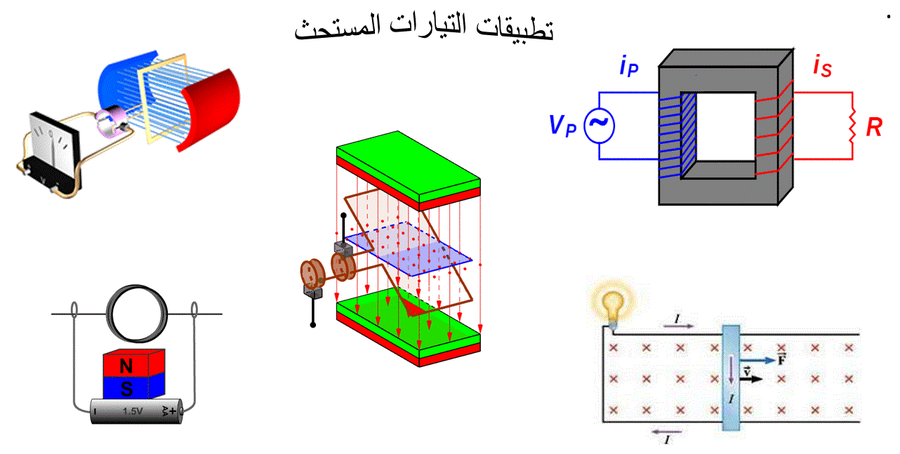
ملخص مصوّر: المولد والمحول وقاعدة لنز وسلك يقطع المجال.
An illustrated summary: the generator, the transformer, Lenz’s rule and a wire cutting the field.
🔁 تذكير: ما التيار المستحث؟
🔁 Reminder: what is an induced current?
عندما يتغير التدفق المغناطيسي \(\Phi_B\) خلال ملف أو دائرة تتولد قوة دافعة كهربائية مستحثة \(\varepsilon=-N\dfrac{\Delta\Phi_B}{\Delta t}\) (قانون فاراداي)، فإذا كانت الدائرة مغلقة مرّ تيار مستحث. وإشارة السالب هي قاعدة لنز التي نتناولها في هذا الدرس مع تطبيقاتها.
When the magnetic flux \(\Phi_B\) through a coil or circuit changes, an induced EMF \(\varepsilon=-N\dfrac{\Delta\Phi_B}{\Delta t}\) appears (Faraday’s law), and if the circuit is closed an induced current flows. The minus sign is Lenz’s rule, which we study here with its applications.
🧑🔬 تجربة هنريش لنز
🧑🔬 Heinrich Lenz’s Experiment
لاحظ العالم هنريش لنز أنه عند تحريك سلك بحيث يقطع خطوط المجال المغناطيسي يتولد فيه تيار مستحث، وتنشأ قوة مغناطيسية تحاول إعاقة حركة السلك.
The scientist Heinrich Lenz observed that when a wire is moved so that it cuts magnetic field lines an induced current is generated in it, and a magnetic force arises that tries to hinder the wire’s motion.
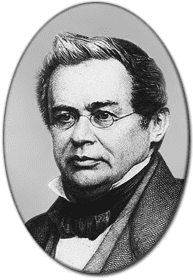
هنريش لنز (1804–1865).
Heinrich Lenz (1804–1865).
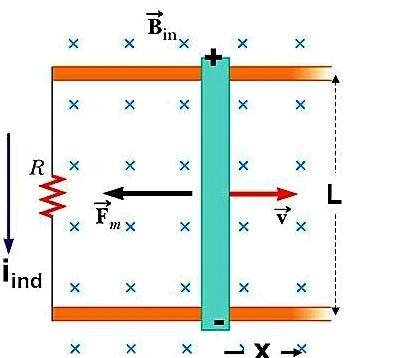
سلك يتحرك بسرعة \(v\) في مجال إلى داخل الصفحة: يمر تيار \(I\) وتعاكس \(F_m\) الحركة.
A rod moving at speed \(v\) in a field into the page: a current \(I\) flows and \(F_m\) opposes the motion.
📘 تسلسل الأحداث
📘 The chain of events
- نؤثر في السلك بقوة خارجية ثابتة \(F\) فيتسارع ويقطع خطوط المجال.We apply a constant external force \(F\) to the rod, so it accelerates and cuts the field lines.
- تتولد \(\varepsilon=BLv\) فيمر تيار \(I=\dfrac{BLv}{R}\) (اتجاهه بقاعدة الكف/اليد اليمنى).An EMF \(\varepsilon=BLv\) appears and a current \(I=\dfrac{BLv}{R}\) flows (its direction by the right-hand rule).
- يؤثر المجال في السلك الحامل للتيار بقوة \(F_m=BIL=\dfrac{B^2L^2v}{R}\) معاكسة للحركة.The field exerts on the current-carrying rod a force \(F_m=BIL=\dfrac{B^2L^2v}{R}\) that opposes the motion.
- كلما زادت \(v\) زاد \(I\) وزادت \(F_m\) حتى تتساوى مع \(F\): عندها العجلة صفر ويتحرك السلك بسرعة ثابتة هي السرعة الحدية.As \(v\) grows \(I\) and \(F_m\) grow until \(F_m=F\): the acceleration is then zero and the rod moves at a constant speed, the terminal speed.
- إذا زالت القوة الخارجية بقيت \(F_m\) وحدها فأوقفت السلك.If the external force vanishes \(F_m\) remains alone and stops the rod.
📌 السرعة الحدية
📌 The terminal speed
\[F_m=F\;\Longrightarrow\;\dfrac{B^2L^2v_T}{R}=F\;\Longrightarrow\;v_T=\dfrac{F\,R}{B^{2}L^{2}}\]
وبقاء الطاقة: عند السرعة الحدية القدرة التي تبذلها القوة الخارجية \(Fv_T\) تساوي القدرة المتحولة إلى حرارة في المقاومة \(I^2R\).
And by energy conservation: at the terminal speed the power supplied by the external force \(Fv_T\) equals the power turned into heat in the resistor \(I^2R\).
🧪 تجربة 1: تجربة لنز: سلك يُسحب بقوة ثابتة في مجال مغناطيسي
🧪 Experiment 1: Lenz’s experiment: a rod pulled by a constant force in a magnetic field
يُسحب السلك المعدني على سكتين بقوة ثابتة \(F\) داخل مجال \(B\) (إلى داخل الصفحة). حرّك شريط الزمن لترى كيف تتولد \(\varepsilon=BLv\) والتيار \(I\) وقوة مغناطيسية \(F_m=BIL\) تعاكس الحركة فتزداد حتى تساوي \(F\) فتثبت السرعة. فعّل «أزل القوة الخارجية» لترى توقف السلك.
A metal rod is pulled along rails by a constant force \(F\) in a field \(B\) (into the page). Move the time slider to see \(\varepsilon=BLv\), the current \(I\) and a magnetic force \(F_m=BIL\) that opposes the motion and grows until it equals \(F\), so the speed becomes constant. Tick “Remove the external force” to see the rod stop.
سلك طوله \(L=0.5\ \mathrm{m}\) يُسحب بقوة ثابتة \(F=0.25\ \mathrm{N}\) على سكتين في مجال \(B=1\ \mathrm{T}\) ومقاومة الدائرة \(R=2\ \Omega\). احسب السرعة الحدية والتيار عندها، وتحقق من حفظ الطاقة.
A rod of length \(L=0.5\ \mathrm{m}\) is pulled by a constant force \(F=0.25\ \mathrm{N}\) along rails in a field \(B=1\ \mathrm{T}\); the circuit resistance is \(R=2\ \Omega\). Find the terminal speed and the current then, and check energy conservation.
عندما يتحرك السلك بسرعة ثابتة تحت تأثير قوة خارجية ثابتة في مجال مغناطيسي فإن القوة المغناطيسية عليه:
When the rod moves at constant speed under a constant external force in a magnetic field the magnetic force on it:
🧲 قاعدة لنز
🧲 Lenz’s Law
📌 قاعدة لنز
📌 Lenz’s law
يكون اتجاه التيار المستحث بحيث يولّد مجالًا مغناطيسيًا يقاوم التغير في التدفق الذي سبّب هذا التيار.
The induced current flows in a direction such that it produces a magnetic field that opposes the change in the flux that caused it.
وهي تعبير عن حفظ الطاقة: لو ساعد التيار المستحث التغير لازداد التغير ذاتيًا وتولدت طاقة من العدم.
It expresses conservation of energy: if the induced current helped the change the change would feed itself and energy would appear from nothing.
| حركة المغناطيسMagnet’s motion | التدفقFlux | المجال المستحثInduced field | القوةForce |
|---|---|---|---|
| يقترب من الملفapproaches the coil | يزدادincreases | معاكس لمجال المغناطيسopposite to the magnet’s field | تنافر (يمنع الاقتراب)repulsion (resists the approach) |
| يبتعد عن الملفleaves the coil | يتناقصdecreases | بالاتجاه نفسهin the same direction | تجاذب (يمنع الابتعاد)attraction (resists leaving) |
🧭 طريقة تحديد اتجاه التيار
🧭 Finding the direction of the current
- حدّد اتجاه المجال الأصلي \(\vec B\) عبر الملف وهل يزداد تدفقه أم يتناقص.Find the direction of the original field \(\vec B\) through the coil and whether its flux increases or decreases.
- إن ازداد التدفق فالمجال المستحث عكس الأصلي، وإن تناقص فبالاتجاه نفسه.If the flux increases the induced field is opposite to the original; if it decreases, in the same direction.
- بقاعدة قبضة اليد اليمنى للملف حدّد اتجاه التيار الذي يولّد المجال المستحث.With the right-hand grip rule for a coil find the current that produces that induced field.
🧪 تجربة 2: قاعدة لنز: مغناطيس يقترب من ملف ويبتعد
🧪 Experiment 2: Lenz’s law: a magnet approaching and leaving a coil
اسحب المغناطيس (أو اضغط «قرّب خطوة» و«أبعد خطوة») نحو الملف وبعيدًا عنه. يتغير التدفق \(\Phi\) فيتولد تيار مستحث يولّد مجالًا يقاوم هذا التغير: عند الاقتراب تنافر، وعند الابتعاد تجاذب. بدّل قطب المغناطيس لتلاحظ انعكاس اتجاه التيار.
Drag the magnet (or press “One step closer” and “One step away”) towards the coil and away from it. The flux \(\Phi\) changes so an induced current creates a field that opposes the change: repulsion on approach, attraction on leaving. Switch the magnet’s pole to see the current reverse.
يقترب القطب الشمالي لمغناطيس من ملف. يصير وجه الملف المقابل للمغناطيس:
The north pole of a magnet approaches a coil. The face of the coil towards the magnet becomes:
⚙️ المولد والمحرك وقاعدة لنز
⚙️ The Generator, the Motor and Lenz’s Law
📘 المولد: لماذا نحتاج قدرة ميكانيكية؟
📘 The generator: why do we need mechanical power?
عند تدوير ملف في مجال مغناطيسي تتولد قوة دافعة مستحثة، فإذا وُصل بحمل مرّ تيار مستحث يولّد عزمًا معاكسًا للدوران (قاعدة لنز). كلما زاد التيار المسحوب (حمل أكبر) زاد هذا العزم المقاوم، فنحتاج إلى قدرة ميكانيكية أكبر لإبقاء المولد يدور بالسرعة نفسها. وهذه الطاقة الميكانيكية هي مصدر الطاقة الكهربائية الناتجة.
When a coil is turned in a magnetic field an induced EMF appears, and if it is connected to a load an induced current flows that produces a torque opposing the rotation (Lenz’s law). The more current is drawn (a bigger load) the larger this resisting torque, so more mechanical power is needed to keep the generator at the same speed. That mechanical energy is the source of the electrical energy produced.
📘 المحرك: لماذا يسحب تيارًا كبيرًا لحظة التشغيل؟
📘 The motor: why does it draw a large current at start-up?
عندما يدور ملف المحرك في المجال تتولد فيه قوة دافعة مستحثة معاكسة لجهد المصدر تُسمّى القوة الدافعة العكسية \(\varepsilon_{back}\) وتتناسب مع السرعة الزاوية. فيكون التيار \(I=\dfrac{V-\varepsilon_{back}}{R}\).
When the motor’s coil turns in the field an induced EMF appears opposing the supply voltage, called the back EMF \(\varepsilon_{back}\), proportional to the angular speed. So the current is \(I=\dfrac{V-\varepsilon_{back}}{R}\).
لحظة التشغيل السرعة صفر فتكون \(\varepsilon_{back}=0\) والتيار كبير جدًا \(I=\dfrac{V}{R}\)، ثم يتناقص التيار كلما ازدادت السرعة. لذلك تُحدث المكيفات والمضخات ارتفاعًا لحظيًا في التيار عند بدء التشغيل.
At start-up the speed is zero so \(\varepsilon_{back}=0\) and the current is very large \(I=\dfrac{V}{R}\), then it falls as the speed rises. That is why air conditioners and pumps cause a momentary current surge when they start.
محرك كهربائي مقاومة ملفه \(R=2\ \Omega\) ويعمل على جهد \(220\ \mathrm{V}\). احسب التيار لحظة التشغيل، وعندما تبلغ القوة الدافعة العكسية \(200\ \mathrm{V}\).
An electric motor has a coil resistance \(R=2\ \Omega\) and runs on \(220\ \mathrm{V}\). Find the current at start-up and when the back EMF reaches \(200\ \mathrm{V}\).
يسحب المحرك أكبر تيار:
The motor draws its largest current:
🌀 التيارات الدوامية (تيارات فوكو)
🌀 Eddy Currents (Foucault Currents)
التيار الدوامي هو تيار مستحث يتولد في كتلة موصلة (لا في سلك) عندما يتغير التدفق المغناطيسي الذي يخترقها أو تتحرك في مجال، فتدور تيارات مغلقة (دوامات) داخل المعدن. بقاعدة لنز تولّد هذه التيارات مجالات تقاوم الحركة أو التغير، وتتبدد طاقتها حرارة بتأثير جول \(I^2R\).
An eddy current is an induced current that forms in a conducting mass (not a wire) when the magnetic flux through it changes or it moves in a field, so closed currents (eddies) circulate inside the metal. By Lenz’s law these currents create fields that oppose the motion or the change, and their energy is lost as heat by Joule heating \(I^2R\).
| الجانبAspect | التفاصيلDetails |
|---|---|
| الضررHarm | تسخين أقلب المحولات والمحركات وضياع الطاقةheating of transformer and motor cores and wasted energy |
| التقليل منهاReducing them | قلب مصنوع من صفائح معزولة أو مشقوق، فتنقطع مسارات التيارa core made of insulated laminations or slotted, which breaks the current paths |
| تطبيقات مفيدةUseful applications | مواقد الحث، الفرامل المغناطيسية للقطارات، كاشفات المعادن، التسخين بالحث، أجهزة التخميدinduction cookers, magnetic brakes for trains, metal detectors, induction heating, damping devices |
🧪 تجربة 3: التيارات الدوامية: بندول والتنهوفن
🧪 Experiment 3: Eddy currents: the Waltenhofen pendulum
يتأرجح لوح معدني بين قطبي مغناطيس. اختر نوع اللوح وفعّل المجال، ثم اضغط «أطلق البندول» (أو حرّك شريط الزمن): في اللوح المصمت تتولد تيارات دوامية كبيرة تنتج قوة مغناطيسية فرملية فيتوقف بسرعة وتسخن اللوح؛ وفي المشقوق تقل التيارات، وفي العازل تنعدم.
A metal plate swings between the poles of a magnet. Choose the kind of plate and switch the field on, then press “Release the pendulum” (or move the time slider): in a solid plate large eddy currents form and give a magnetic braking force so it stops quickly and the plate warms; in a slotted plate the currents are weak, and in an insulator there are none.
تُصنع أقلاب المحولات من صفائح رقيقة معزولة بعضها عن بعض بهدف:
Transformer cores are made of thin laminations insulated from one another in order to:
⏳ الحث الذاتي
⏳ Self-Induction
في دائرة تحتوي ملفًا، حين يتغير التيار فيه يتغير التدفق خلال الملف نفسه فتتولد فيه قوة دافعة مستحثة ذاتيًا تعاكس تغير التيار (قاعدة لنز). وتُقاس خاصية الملف هذه بـ المحاثّة \(L\) بوحدة الهنري (H):
In a circuit containing a coil, when the current changes the flux through the coil itself changes so a self-induced EMF appears in it opposing the change of the current (Lenz’s law). This property of a coil is measured by the inductance \(L\) in henries (H):
\[\varepsilon_L=-L\,\dfrac{\Delta I}{\Delta t}\]
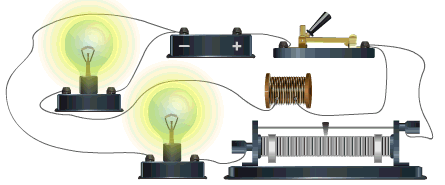
مصباحان: العلوي مع ملف والسفلي مع مقاوم؛ الملف يؤخر إضاءة مصباحه.
Two lamps: the upper one with a coil and the lower with a resistor; the coil delays its lamp.
📘 نمو التيار وتلاشيه
📘 Growth and decay of the current
- عند الإغلاق: يتولد تيار مستحث معاكس للتيار الأصلي فلا يبلغ التيار قيمته العظمى فورًا: \(I(t)=I_\infty\left(1-e^{-t/\tau}\right)\).On closing: an induced current opposite to the original one flows so the current does not reach its maximum at once: \(I(t)=I_\infty\left(1-e^{-t/\tau}\right)\).
- عند الفتح: يتولد تيار مستحث بالاتجاه نفسه فلا ينعدم التيار فورًا: \(I(t)=I_\infty e^{-t/\tau}\).On opening: an induced current in the same direction flows so the current does not vanish at once: \(I(t)=I_\infty e^{-t/\tau}\).
- الثابت الزمني \(\tau=\dfrac{L}{R}\)، والطاقة المخزنة في الملف \(U=\tfrac12LI^2\).The time constant \(\tau=\dfrac{L}{R}\), and the energy stored in the coil \(U=\tfrac12LI^2\).
🧪 تجربة 4: الحث الذاتي: دائرة حيّة بمصباحين
🧪 Experiment 4: Self-induction: a live circuit with two lamps
المصباح A موصول على التوالي مع ملف \(L\)، والمصباح B مع مقاوم، والفرعان متوازيان مع بطارية. اضغط «أغلق المفتاح» (أو انقر المفتاح في الرسم) ثم افتحه بعد ذلك، وراقب: تحرك الشحنات الزرقاء، وسطوع المصباحين، ومنحنيَي التيار والقوة الدافعة الذاتية \(\varepsilon_L=-L\,di/dt\) وهي تُرسم لحظة بلحظة.
Lamp A is in series with a coil \(L\), lamp B with a resistor, and the two branches are in parallel with a battery. Press “Close the switch” (or click the switch in the drawing) and later open it, then watch: the moving blue charges, the brightness of the two lamps, and the current and self-induced EMF \(\varepsilon_L=-L\,di/dt\) graphs drawn live.
دائرة فيها ملف محاثته \(L=2\ \mathrm{H}\) ومقاومته الكلية \(R=10\ \Omega\) وبطارية \(20\ \mathrm{V}\). احسب التيار النهائي والثابت الزمني والتيار بعد \(0.2\ \mathrm{s}\) من الإغلاق والطاقة المخزنة.
A circuit has a coil of inductance \(L=2\ \mathrm{H}\), total resistance \(R=10\ \Omega\) and a \(20\ \mathrm{V}\) battery. Find the final current, the time constant, the current \(0.2\ \mathrm{s}\) after closing and the stored energy.
ملف محاثته \(2\ \mathrm{H}\) ينمو فيه التيار من صفر إلى \(2\ \mathrm{A}\) خلال \(0.1\ \mathrm{s}\). ما القوة الدافعة المستحثة ذاتيًا (متوسطها)؟
A coil of inductance \(2\ \mathrm{H}\) has its current rise from zero to \(2\ \mathrm{A}\) in \(0.1\ \mathrm{s}\). What is the (average) self-induced EMF?
عند فتح دائرة فيها ملف يمر به تيار فإن التيار المستحث ذاتيًا:
When a circuit containing a coil carrying a current is opened the self-induced current:
🔌 المحولات الكهربائية
🔌 Electrical Transformers
المحول جهاز يرفع الجهد المتردد أو يخفضه. يتكون من ملف ابتدائي متصل بمصدر تيار متردد وملف ثانوي متصل بالجهاز، ويلتفان على نواة من الحديد (مصفحة). يعمل بظاهرة الحث المتبادل: تغيّر التيار في الابتدائي يغيّر التدفق في الثانوي فيتولد فيه جهد مستحث.
A transformer raises or lowers an alternating voltage. It consists of a primary coil connected to an AC source and a secondary coil connected to the device, both wound on an iron core (laminated). It works by mutual induction: the changing current in the primary changes the flux in the secondary so a voltage is induced in it.
📌 المحول المثالي
📌 The ideal transformer
\[\dfrac{V_S}{V_P}=\dfrac{N_S}{N_P},\qquad V_PI_P=V_SI_S\]
ومنه \(\dfrac{I_S}{I_P}=\dfrac{N_P}{N_S}\): ما نربحه في الجهد نخسره في التيار، فالقدرة لا تزداد. وفي المحول الحقيقي \(P_{out}=\eta P_{in}\) بكفاءة \(\eta\lt 1\).
Hence \(\dfrac{I_S}{I_P}=\dfrac{N_P}{N_S}\): what we gain in voltage we lose in current, so the power does not increase. In a real transformer \(P_{out}=\eta P_{in}\) with efficiency \(\eta\lt 1\).
| النوعKind | عدد اللفاتTurns | الجهدVoltage | التيارCurrent |
|---|---|---|---|
| رافع للجهدstep-up | \(N_S\gt N_P\)\(N_S\gt N_P\) | يرتفعrises | ينخفضfalls |
| خافض للجهدstep-down | \(N_S\lt N_P\)\(N_S\lt N_P\) | ينخفضfalls | يرتفعrises |
| محول عزلisolation | \(N_S=N_P\)\(N_S=N_P\) | لا يتغيرunchanged | لا يتغيرunchanged |
💡 محول العزل
💡 The isolation transformer
عدد لفاته الابتدائي والثانوي متساوٍ فلا يرفع الجهد ولا يخفضه، ويُستعمل لعزل دائرة عن أخرى في الأجهزة الحساسة فلا يحدث تداخل أو خطر صعق مباشر من الشبكة.
Its primary and secondary have equal turns so it neither raises nor lowers the voltage, and it is used to isolate one circuit from another in sensitive equipment so there is no interference or direct shock hazard from the mains.
🧪 تجربة 5: المحول الكهربائي: ارفع الجهد أو اخفضه
🧪 Experiment 5: The transformer: step the voltage up or down
غيّر عدد لفات الملفين الابتدائي \(N_P\) والثانوي \(N_S\) وجهد المصدر والمقاومة والكفاءة. لاحظ أن \(V_S/V_P=N_S/N_P\) وأن القدرة لا تزيد: حين يرتفع الجهد ينخفض التيار. اضغط «محول عزل» لتجعل اللفات متساوية.
Change the turns of the primary \(N_P\) and secondary \(N_S\), the source voltage, the load and the efficiency. Notice that \(V_S/V_P=N_S/N_P\) and that power does not increase: when the voltage rises the current falls. Press “Isolation transformer” to make the turns equal.
محول مثالي عدد لفات ابتدائيه \(500\) وثانويه \(100\)، وصل ابتدائيه بمصدر \(220\ \mathrm{V}\) وثانويه بمقاومة \(22\ \Omega\). احسب جهد الثانوي وتياريه وتيار الابتدائي.
An ideal transformer has \(500\) primary turns and \(100\) secondary turns; its primary is connected to \(220\ \mathrm{V}\) and its secondary to a \(22\ \Omega\) resistor. Find the secondary voltage, both currents.
محول رافع كفاءته \(90\%\) ابتدائيه \(100\) لفة وثانويه \(2000\) لفة ويعمل على \(12\ \mathrm{V}\) ويغذي حملًا مقاومته \(240\ \Omega\). احسب \(V_S\) و\(P_{out}\) و\(P_{in}\) و\(I_P\).
A step-up transformer of efficiency \(90\%\) has \(100\) primary and \(2000\) secondary turns, runs on \(12\ \mathrm{V}\) and feeds a load of \(240\ \Omega\). Find \(V_S\), \(P_{out}\), \(P_{in}\) and \(I_P\).
محول رافع للجهد يكون فيه:
In a step-up transformer:
⚡ لماذا نرفع الجهد لنقل الطاقة؟
⚡ Why do we raise the voltage to transmit power?
لنقل قدرة \(P\) بتيار أصغر نرفع الجهد (\(P=VI\))، فتنقص الطاقة الضائعة حرارةً في الأسلاك \(I^2R\) كثيرًا. وعند المستهلك نخفض الجهد بمحول خافض.
To transmit a power \(P\) with a smaller current we raise the voltage (\(P=VI\)), which greatly reduces the energy lost as heat in the wires \(I^2R\). At the consumer a step-down transformer lowers it.
📚 ملخص الدرس
📚 Lesson Summary
| الفكرةIdea | القاعدةRule |
|---|---|
| سلك يقطع المجالRod cutting the field | \(\varepsilon=BLv,\ F_m=\dfrac{B^2L^2v}{R},\ v_T=\dfrac{FR}{B^2L^2}\)\(\varepsilon=BLv,\ F_m=\dfrac{B^2L^2v}{R},\ v_T=\dfrac{FR}{B^2L^2}\) |
| قاعدة لنزLenz’s law | المجال المستحث يقاوم التغير في التدفقthe induced field opposes the flux change |
| المحركMotor | \(I=\dfrac{V-\varepsilon_{back}}{R}\)\(I=\dfrac{V-\varepsilon_{back}}{R}\) |
| الحث الذاتيSelf-induction | \(\varepsilon_L=-L\dfrac{\Delta I}{\Delta t},\ \tau=\dfrac{L}{R},\ U=\tfrac12LI^2\)\(\varepsilon_L=-L\dfrac{\Delta I}{\Delta t},\ \tau=\dfrac{L}{R},\ U=\tfrac12LI^2\) |
| المحول المثاليIdeal transformer | \(\dfrac{V_S}{V_P}=\dfrac{N_S}{N_P}=\dfrac{I_P}{I_S}\)\(\dfrac{V_S}{V_P}=\dfrac{N_S}{N_P}=\dfrac{I_P}{I_S}\) |
⚠️ أخطاء شائعة
⚠️ Common mistakes
- الظن أن التيار المستحث يعاكس المجال دائمًا؛ هو يعاكس التغير في التدفق (يساعد المجال عند تناقصه).Thinking the induced current always opposes the field; it opposes the change in flux (it helps the field when the flux decreases).
- القول إن المحرك يحتاج تيارًا كبيرًا «ليتغلب على لنز»؛ السبب أن القوة الدافعة العكسية صفر لحظة التشغيل.Saying the motor needs a large current “to overcome Lenz”; the reason is that the back EMF is zero at start-up.
- الظن أن المحول الرافع يرفع القدرة؛ يرفع الجهد ويخفض التيار والقدرة ثابتة (أو أقل).Thinking a step-up transformer raises the power; it raises the voltage and lowers the current while the power stays the same (or less).
- تطبيق \(V_S/V_P=N_S/N_P\) على التيار المستمر؛ المحول يعمل بالتيار المتردد فقط.Applying \(V_S/V_P=N_S/N_P\) to direct current; a transformer works only with AC.
- نسيان أن \(\tau=L/R\) بالثواني عند الحساب بالهنري والأوم.Forgetting that \(\tau=L/R\) is in seconds when using henries and ohms.
🧪 اختبر نفسك: امتحان من 20 سؤالاً
🧪 Test Yourself: a 20-Question Exam
أنهِ الدرس بالاختبار التفاعلي التالي؛ أسئلته تجمع بين الفهم والحساب وتغطي جميع أقسام الدرس.
Finish with the interactive exam below; its questions mix understanding with calculation and cover every section of the lesson.
اختبار تطبيقات التيارات المستحثة Applications of Induced Currents Quiz
20 سؤالاً - قاعدة لنز والتيارات الدوامية والحث الذاتي والمحولات 20 Questions - Lenz’s law, eddy currents, self-induction and transformers
• عدد الأسئلة: 20 سؤالاً
• مدة الاختبار: 30 دقيقة
• لا يمكنك تغيير إجاباتك أو إعادة الاختبار إلا بعد 24 ساعة من التسليم.
• تأكد من إجاباتك قبل التسليم! 📌 Important Instructions:
• Number of questions: 20 questions
• Quiz duration: 30 minutes
• You cannot change your answers or retake the quiz for 24 hours after submission.
• Make sure of your answers before submitting!
🔗 محاكيات GeoGebra للاستعانة بها عند اللزوم
🔗 GeoGebra Simulations to Use When Needed
اضغط «تشغيل» لتعمل المحاكاة هنا داخل الدرس؛ ويمكن للطالب الرجوع إليها لتجربة الفكرة بطريقة أخرى.
Press “Run” to run the simulation right here inside the lesson; the student can use it to try the idea in another way.