🎯 نواتج التعلم
🎯 Learning Outcomes
بعد دراسة هذا الدرس ستكون قادرًا على أن:
After this lesson you will be able to:
- تنصّ على مبدأ التراكب: المجال المحصل المجموع الاتجاهي لمجالات الشحنات كلٍّ على حدة.State the superposition principle: the resultant field is the vector sum of the fields of the charges each by itself.
- تحسب المجال لشحنتين أو أكثر على خط واحد وتحدد اتجاهه من إشارات الشحنات.Calculate the field of two or more charges on one line and determine its direction from the signs of the charges.
- تطبّق طريقة المركبات في المستوي لإيجاد مقدار المحصلة واتجاهها \(E=\sqrt{E_x^2+E_y^2}\) و\(\theta=\tan^{-1}(E_y/E_x)\).Apply the components method in the plane to find the magnitude and the direction of the resultant \(E=\sqrt{E_x^2+E_y^2}\) and \(\theta=\tan^{-1}(E_y/E_x)\).
- تحدد نقطة انعدام المجال وتستعمل التماثل لتبسيط المسائل.Determine the point where the field vanishes and use symmetry to simplify problems.
➕ مبدأ التراكب
➕ The Superposition Principle
يصف قانون كولوم التفاعل بين شحنتين فقط. فإذا وُجدت عدة شحنات فإن كل شحنة تولّد مجالها الخاص كأن غيرها غير موجود، ويكون المجال المحصل عند نقطة هو المجموع الاتجاهي لهذه المجالات. وتُطبَّق عليه قواعد جمع المتجهات.
Coulomb’s law describes the interaction between only two charges. If there are several charges each charge generates its own field as if the others did not exist, and the resultant field at a point is the vector sum of these fields. The rules of vector addition apply to it.
📌 مبدأ التراكب
📌 The superposition principle
\[\vec E_{net}=\sum_{i}\vec E_i=\vec E_1+\vec E_2+\cdots+\vec E_n\qquad,\qquad E_i=\frac{k|q_i|}{r_i^{2}}\]
اتجاه مجال كل شحنة
The direction of the field of each charge
- شحنة موجبة: المجال يبتعد عنها على امتداد الخط الواصل إلى النقطة.A positive charge: the field moves away from it along the line to the point.
- شحنة سالبة: المجال يتجه نحوها.A negative charge: the field is directed toward it.
- المقدار \(E=k|q|/r^2\) دائمًا موجب، والاتجاه يحدّده نوع الشحنة.The magnitude \(E=k|q|/r^2\) is always positive, and the direction is determined by the type of the charge.
📏 شحنات على خط واحد
📏 Charges on One Line
عندما تقع الشحنات والنقطة على خط واحد نختار اتجاهًا موجبًا (مثل نحو اليمين) ونجمع المجالات جبريًّا بإشاراتها. وبين شحنتين مختلفتين يتجه المجالان في الاتجاه نفسه فيجمعان، وبين متماثلتين يتعاكسان فيُطرح أحدهما من الآخر.
When the charges and the point are on one line we choose a positive direction (for example toward the right) and add the fields algebraically with their signs. Between two unlike charges the two fields are in the same direction so they add, and between two like charges they are opposite so one is subtracted from the other.
الشحنة \(q_1=2\ \mu\mathrm C\) و\(q_2=-3\ \mu\mathrm C\) والنقطة \(P\) بينهما على بعد \(1\ \mathrm m\) من كل منهما. أوجد المجال عند \(P\).
The charge \(q_1=2\ \mu\mathrm C\) and \(q_2=-3\ \mu\mathrm C\) and the point \(P\) between them at a distance of \(1\ \mathrm m\) from each. Find the field at \(P\).
اتجاه المحصلة من \(q_1\) (الموجبة) نحو \(q_2\) (السالبة) لأن المجالين في الاتجاه نفسه.
The direction of the resultant is from \(q_1\) (the positive) toward \(q_2\) (the negative) because the two fields are in the same direction.
الشحنة \(q_1=-6\ \mu\mathrm C\) عند الأصل و\(q_2=4\ \mu\mathrm C\) عند \(x=5\ \mathrm{cm}\). أوجد المجال عند \(x=8\ \mathrm{cm}\).
The charge \(q_1=-6\ \mu\mathrm C\) is at the origin and \(q_2=4\ \mu\mathrm C\) at \(x=5\ \mathrm{cm}\). Find the field at \(x=8\ \mathrm{cm}\).
🧪 تجربة 1: شحنتان على خط واحد
🧪 Experiment 1: Two Charges on One Line
نضع النقطة في مواضع مختلفة بين الشحنتين وخارجهما ونقرأ المجالين والمحصلة.
We put the point at different positions between the two charges and outside them and read the two fields and the resultant.
🛠️ خطوات العمل
🛠️ Procedure
- اضبط القيم الأصلية وتحقق من \(31.5\times10^6\ \mathrm{N/C}\).Set the original values and check \(31.5\times10^6\ \mathrm{N/C}\).
- حرّك النقطة بين الشحنتين وراقب الاتجاهين.Move the point between the two charges and watch the two directions.
- بدّل إشارة إحدى الشحنتين وكرّر.Reverse the sign of one charge and repeat.
🧪 تجربة 1: شحنتان على خط واحد
🧪 Experiment 1: Two Charges on One Line
شحنتان \(q_1\) عند \(x=0\) و\(q_2\) عند \(x=5\ \mathrm{cm}\). حرّك النقطة \(P\) وغيّر الشحنتين وراقب المجالين والمحصلة.
Two charges \(q_1\) at \(x=0\) and \(q_2\) at \(x=5\ \mathrm{cm}\). Move the point \(P\), change the two charges and watch the two fields and the resultant.
🔎 ماذا نلاحظ؟ وما الاستنتاج؟
🔎 What do we observe? What is the conclusion?
- خارج الشحنتين غالبًا يتعاكس المجالان فتنقص المحصلة.Outside the two charges the two fields are mostly opposite so the resultant decreases.
- المحصلة تعتمد على الإشارات والمسافات معًا.The resultant depends on the signs and the distances together.
\(E_{net}=\sum E_i\) بإشاراتها على خط واحد.
\(E_{net}=\sum E_i\) with their signs on one line.
شحنتان موجبتان متساويتان، المجال الكهربائي عند منتصف المسافة بينهما:
Two equal positive charges, the electric field at the midpoint between them:
📐 طريقة المركبات في المستوي
📐 The Components Method in the Plane
عندما تكون المجالات في اتجاهات مختلفة نحلّل كل مجال إلى مركبتين على المحورين، نجمع المركبات الأفقية معًا والرأسية معًا، ثم نجد مقدار المحصلة واتجاهها.
When the fields are in different directions we resolve each field into two components on the two axes, add the horizontal components together and the vertical ones together, then find the magnitude and the direction of the resultant.
خطوات الحل
The steps of the solution
- نحسب مقدار كل مجال \(E_i=k|q_i|/r_i^2\) ونحدد اتجاهه (بعيدًا عن الموجبة ونحو السالبة).We calculate the magnitude of each field \(E_i=k|q_i|/r_i^2\) and determine its direction (away from a positive one and toward a negative one).
- نحلّل: \(E_{ix}=E_i\cos\theta_i\) و\(E_{iy}=E_i\sin\theta_i\) مع الإشارات.We resolve: \(E_{ix}=E_i\cos\theta_i\) and \(E_{iy}=E_i\sin\theta_i\) with the signs.
- نجمع: \(E_x=\sum E_{ix}\) و\(E_y=\sum E_{iy}\).We add: \(E_x=\sum E_{ix}\) and \(E_y=\sum E_{iy}\).
- المحصلة: \(E=\sqrt{E_x^2+E_y^2}\) والاتجاه \(\theta=\tan^{-1}(E_y/E_x)\).The resultant: \(E=\sqrt{E_x^2+E_y^2}\) and the direction \(\theta=\tan^{-1}(E_y/E_x)\).
شحنتان \(q_1=-3\ \mathrm{nC}\) و\(q_2=5\ \mathrm{nC}\) على رأسين لمثلث قائم، والنقطة \(A\) على بعد \(3\ \mathrm{cm}\) من الأولى (أفقيًا) و\(4\ \mathrm{cm}\) من الثانية (رأسيًا). أوجد المحصلة عند \(A\).
Two charges \(q_1=-3\ \mathrm{nC}\) and \(q_2=5\ \mathrm{nC}\) at two vertices of a right triangle, and the point \(A\) at \(3\ \mathrm{cm}\) from the first (horizontally) and \(4\ \mathrm{cm}\) from the second (vertically). Find the resultant at \(A\).
🧪 تجربة 2: المركبات والمحصلة
🧪 Experiment 2: The Components and the Resultant
نسحب النقطة في المستوي ونرى المجالين ومركّبات المحصلة ومقدارها واتجاهها.
We drag the point in the plane and see the two fields and the components of the resultant, its magnitude and its direction.
🛠️ خطوات العمل
🛠️ Procedure
- اسحب \(P\) إلى أماكن مختلفة وراقب \(E_x\) و\(E_y\).Drag \(P\) to different places and watch \(E_x\) and \(E_y\).
- اجعل الشحنتين متماثلتين وضع \(P\) على العمود المنصف.Make the two charges alike and put \(P\) on the perpendicular bisector.
- اجعلهما متعاكستين وكرّر.Make them opposite and repeat.
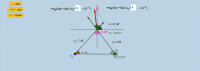
🧪 تجربة 2: طريقة المركبات في المستوي (كمحاكاة GeoGebra)
🧪 Experiment 2: The Components Method in a Plane (like the GeoGebra applet)
شحنتان في المستوي والنقطة \(P\) تسحبها بالفأرة. نحلّل كل مجال إلى مركبتين ونجمع المركبات لنحصل على المحصلة ومقدارها واتجاهها.
Two charges in the plane and the point \(P\) that you drag with the mouse. We resolve each field into two components and add the components to get the resultant, its magnitude and its direction.
🔎 ماذا نلاحظ؟ وما الاستنتاج؟
🔎 What do we observe? What is the conclusion?
- على العمود المنصف لشحنتين متماثلتين تتلاشى المركبتان الأفقيتان.On the perpendicular bisector of two like charges the horizontal components cancel.
- وعلى العمود المنصف لمتعاكستين تتلاشى المركبتان الرأسيتان.And on the perpendicular bisector of two opposite ones the vertical components cancel.
\(E=\sqrt{E_x^2+E_y^2}\) و\(\theta=\tan^{-1}(E_y/E_x)\).
\(E=\sqrt{E_x^2+E_y^2}\) and \(\theta=\tan^{-1}(E_y/E_x)\).
لإيجاد محصلة مجالين في اتجاهين متعامدين نستعمل:
To find the resultant of two fields in two perpendicular directions we use:
🎯 نقطة انعدام المجال
🎯 The Null Point of the Field
تُسمّى النقطة التي ينعدم عندها المجال المحصل نقطة التعادل. ولكي ينعدم المجال يجب أن يكون المجالان متساويين مقدارًا ومتعاكسين اتجاهًا: بين شحنتين متماثلتين (أقرب إلى الأصغر)، أو خارج الخط الواصل بين شحنتين مختلفتين (أقرب إلى الأصغر مقدارًا). ولا توجد نقطة تعادل لشحنتين متساويتين متعاكستين على الخط.
The point at which the resultant field vanishes is called the null point. For the field to vanish the two fields must be equal in magnitude and opposite in direction: between two like charges (closer to the smaller), or outside the segment joining two unlike charges (closer to the smaller in magnitude). There is no null point on the line for two equal opposite charges.
شحنتان \(q_1=4\ \mathrm{nC}\) و\(q_2=1\ \mathrm{nC}\) تفصل بينهما \(30\ \mathrm{cm}\). أين ينعدم المجال؟
Two charges \(q_1=4\ \mathrm{nC}\) and \(q_2=1\ \mathrm{nC}\) separated by \(30\ \mathrm{cm}\). Where does the field vanish?
🧪 تجربة 3: أين ينعدم المجال؟
🧪 Experiment 3: Where Does the Field Vanish?
نرسم \(E_{net}(x)\) ونبحث عن النقطة التي يقطع فيها المنحنى المحور.
We draw \(E_{net}(x)\) and look for the point at which the curve cuts the axis.
🛠️ خطوات العمل
🛠️ Procedure
- اترك \(q_1=4\) و\(q_2=1\ \mathrm{nC}\) وحرّك \(x\) حتى ينعدم المجال.Keep \(q_1=4\) and \(q_2=1\ \mathrm{nC}\) and move \(x\) until the field vanishes.
- اجعل إحدى الشحنتين سالبة وابحث عن نقطة التعادل.Make one of the charges negative and look for the null point.
🧪 تجربة 3: أين ينعدم المجال؟
🧪 Experiment 3: Where Does the Field Vanish?
شحنتان تفصل بينهما \(30\ \mathrm{cm}\). حرّك النقطة على الخط وراقب منحنى \(E_{net}(x)\) وابحث عن النقطة التي ينعدم عندها المجال.
Two charges separated by \(30\ \mathrm{cm}\). Move the point along the line, watch the curve \(E_{net}(x)\) and look for the point at which the field vanishes.
🔎 ماذا نلاحظ؟ وما الاستنتاج؟
🔎 What do we observe? What is the conclusion?
- نقطة التعادل أقرب إلى الشحنة الأصغر مقدارًا.The null point is closer to the smaller charge in magnitude.
- بين المتماثلتين المنحنى يقطع المحور بين الشحنتين.Between like charges the curve cuts the axis between the two charges.
\(\dfrac{|q_1|}{x^2}=\dfrac{|q_2|}{(d\mp x)^2}\).
\(\dfrac{|q_1|}{x^2}=\dfrac{|q_2|}{(d\mp x)^2}\).
🔷 التماثل
🔷 Symmetry
عند مركز مضلّع منتظم تحيط به شحنات متساوية على رؤوسه تتلاشى المجالات بالتماثل (المجموع صفر). وإذا حذفنا شحنة واحدة يبقى مجال الشحنة المقابلة لها فقط \(kq/R^2\)؛ وإذا عكسنا إشارتها فالمحصلة \(2kq/R^2\).
At the centre of a regular polygon surrounded by equal charges at its vertices the fields cancel by symmetry (the sum is zero). If we remove one charge only the field of the opposite charge remains \(kq/R^2\); and if we reverse its sign the resultant is \(2kq/R^2\).
أربع شحنات \(+5\ \mathrm{nC}\) على رؤوس مربع قطره \(20\ \mathrm{cm}\). أوجد المجال عند مركزه، ثم عند حذف إحداها.
Four charges \(+5\ \mathrm{nC}\) at the vertices of a square whose diagonal is \(20\ \mathrm{cm}\). Find the field at its centre, then after removing one of them.
🧪 تجربة 4: التماثل في مضلّع منتظم
🧪 Experiment 4: Symmetry in a Regular Polygon
نغيّر عدد الرؤوس ونحذف شحنة أو نعكس إشارتها.
We change the number of vertices and remove a charge or reverse its sign.
🛠️ خطوات العمل
🛠️ Procedure
- اترك \(n=4\) وتأكد أن المجال صفر.Keep \(n=4\) and make sure that the field is zero.
- اضغط «احذف شحنة» وقارن بـ\(kq/R^2\).Press “Remove one charge” and compare with \(kq/R^2\).
- اضغط «اعكس إشارة» وقارن بـ\(2kq/R^2\).Press “Reverse the sign” and compare with \(2kq/R^2\).
🧪 تجربة 4: التماثل: المجال عند مركز مضلّع منتظم
🧪 Experiment 4: Symmetry: The Field at the Centre of a Regular Polygon
شحنات متساوية على رؤوس مضلّع منتظم. غيّر عدد الرؤوس ثم احذف شحنة أو اعكس إشارتها وراقب المجال عند المركز.
Equal charges at the vertices of a regular polygon. Change the number of vertices then remove a charge or reverse its sign and watch the field at the centre.
🔎 ماذا نلاحظ؟ وما الاستنتاج؟
🔎 What do we observe? What is the conclusion?
- المجال صفر لأي عدد رؤوس \(n\ge2\) عند تساوي الشحنات.The field is zero for any number of vertices \(n\ge2\) when the charges are equal.
- كل مجال يُلغي مقابله لذلك يكفي النظر إلى الشحنة الناقصة.Every field cancels its opposite so it is enough to look at the missing charge.
التماثل يختصر الحساب.
Symmetry shortens the calculation.
🚀 تطبيقات
🚀 Applications
أين نستعمل التراكب؟
Where do we use the superposition?
- تصميم الهوائيات وتوزيع المجالات في الاتصالات اللاسلكية.Designing antennas and the distribution of the fields in wireless communications.
- تحليل الدوائر الإلكترونية المعقدة والأنظمة الطبية مثل MRI.Analyzing complex electronic circuits and medical systems such as MRI.
- حسابات الحماية من الصواعق وتصميم أنظمة التأريض.Lightning-protection calculations and designing earthing systems.
⚠️ أخطاء شائعة
⚠️ Common Mistakes
تجنّب هذه الأخطاء
Avoid these mistakes
- جمع مقادير المجالات جمعًا عدديًّا دون الانتباه إلى الاتجاه.Adding the magnitudes of the fields numerically without paying attention to the direction.
- الخطأ في اتجاه مجال الشحنة السالبة (يتجه نحوها لا بعيدًا عنها).A mistake in the direction of the field of the negative charge (it is directed toward it not away from it).
- استعمال \(\cos\) و\(\sin\) بزاوية مقيسة من محور خاطئ.Using \(\cos\) and \(\sin\) with an angle measured from a wrong axis.
- نسيان تحويل cm و\(\mu\mathrm C\) و nC إلى الوحدات الأساسية.Forgetting to convert cm, \(\mu\mathrm C\) and nC to the base units.
📚 ملخص
📚 Summary
أهم ما تعلمناه
Key points
- المجال المحصل = المجموع الاتجاهي لمجالات الشحنات: \(\vec E_{net}=\sum\vec E_i\).The resultant field = the vector sum of the fields of the charges: \(\vec E_{net}=\sum\vec E_i\).
- مجال كل شحنة \(E=k|q|/r^2\): بعيدًا عن الموجبة ونحو السالبة.The field of each charge \(E=k|q|/r^2\): away from a positive one and toward a negative one.
- على خط واحد نجمع جبريًّا؛ وفي المستوي نستعمل المركبات \(E=\sqrt{E_x^2+E_y^2}\).On one line we add algebraically; and in the plane we use the components \(E=\sqrt{E_x^2+E_y^2}\).
- نقطة التعادل: مجالان متساويان ومتعاكسان؛ والتماثل يلغي المجالات المتقابلة.The null point: two equal and opposite fields; and symmetry cancels the opposite fields.
🧪 اختبر نفسك: امتحان من 20 سؤالاً
🧪 Test Yourself: a 20-Question Exam
أنهِ الدرس بالاختبار التفاعلي التالي؛ أسئلته تجمع بين الفهم والحساب وتغطي جميع أقسام الدرس.
Finish with the interactive exam below; its questions mix understanding with calculation and cover every section of the lesson.
اختبار تراكب المجالات الكهربائية عند نقطة Superposition of Electric Fields Quiz
20 سؤالاً - مبدأ التراكب والمركبات والمحصلة 20 Questions - the superposition principle, components and the resultant
• عدد الأسئلة: 20 سؤالاً
• مدة الاختبار: 30 دقيقة
• لا يمكنك تغيير إجاباتك أو إعادة الاختبار إلا بعد 24 ساعة من التسليم.
• تأكد من إجاباتك قبل التسليم! 📌 Important Instructions:
• Number of questions: 20 questions
• Quiz duration: 30 minutes
• You cannot change your answers or retake the quiz for 24 hours after submission.
• Make sure of your answers before submitting!
🔗 محاكيات GeoGebra للاستعانة بها عند اللزوم
🔗 GeoGebra Simulations to Use When Needed
اضغط «تشغيل» لتعمل المحاكاة هنا داخل الدرس؛ ويمكن للطالب الرجوع إليها لتجربة الفكرة بطريقة أخرى.
Press “Run” to run the simulation right here inside the lesson; the student can use it to try the idea in another way.