🎯 نواتج التعلم
🎯 Learning Outcomes
بعد دراسة هذا الدرس ستكون قادرًا على أن:
After this lesson you will be able to:
- تعرّف التداخل البناء والهدام للموجات وتحدد شرط كل منهما بدلالة فرق المسار وفرق الطور.Define constructive and destructive interference of waves and state the condition for each in terms of path difference and phase difference.
- تفسّر لماذا يلزم منبعان مترابطان وضوء وحيد اللون لمشاهدة التداخل.Explain why two coherent sources and monochromatic light are needed to see interference.
- تطبّق علاقات تجربة شقي يونغ \(d\sin\theta=m\lambda\) و\(\Delta y=\lambda L/d\) في حل المسائل.Apply the relations of Young's double-slit experiment \(d\sin\theta=m\lambda\) and \(\Delta y=\lambda L/d\) to solve problems.
- تفسّر ألوان الأغشية الرقيقة (فقاعة الصابون وبقعة الزيت) بتداخل الشعاعين المنعكسين.Explain the colours of thin films (soap bubbles and oil patches) by the interference of the two reflected rays.
- تحدد انقلاب الطور عند السطوح وتختار شرط التداخل الصحيح \(2nd=(m+\tfrac12)\lambda_0\) أو \(2nd=m\lambda_0\).Decide the phase inversion at the surfaces and choose the correct interference condition \(2nd=(m+\tfrac12)\lambda_0\) or \(2nd=m\lambda_0\).
- تحسب سمك غشاء يعطي تداخلًا بناءً أو هدّامًا عند طول موجي معلوم، وتفسّر الطلاء المانع للانعكاس.Calculate the thickness of a film that gives constructive or destructive interference at a given wavelength, and explain the anti-reflection coating.
〰️ تداخل الموجات
〰️ Interference of Waves
📘 التداخل
📘 Interference
عندما تلتقي موجتان أو أكثر في الوسط نفسه وفي اللحظة نفسها تتراكب إزاحاتهما فتكون الإزاحة المحصلة عند أي نقطة هي مجموع الإزاحات (مبدأ التراكب). وتسمى هذه الظاهرة تداخل الموجات، والضوء موجة فيتداخل كالأمواج الأخرى.
When two or more waves meet in the same medium at the same time their displacements add, so the resultant displacement at any point is the sum of the displacements (the principle of superposition). This is called wave interference, and light is a wave so it interferes like other waves.
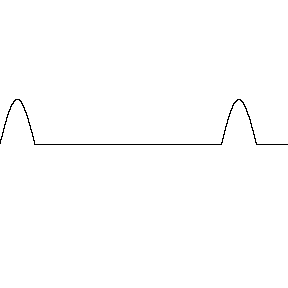
تداخل بنّاء: قمة مع قمة فتنتج موجة سعتها أكبر من سعة كل منهما.
Constructive interference: crest with crest gives a wave whose amplitude is larger than that of either wave.
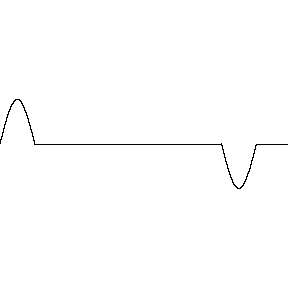
تداخل هدّام: قمة مع قاع فتنتج موجة سعتها أصغر أو تختفي.
Destructive interference: crest with trough gives a smaller wave or the wave vanishes.
| وجه المقارنةComparison | التداخل البنّاءConstructive interference | التداخل الهدّامDestructive interference |
|---|---|---|
| اللقاءMeeting | قمة مع قمة أو قاع مع قاع (نفس الطور)crest with crest or trough with trough (in phase) | قمة مع قاع (متعاكستان في الطور)crest with trough (opposite in phase) |
| السعة المحصلةResultant amplitude | \(A_1+A_2\) أكبر من كل منهما\(A_1+A_2\) larger than either | \(|A_1-A_2|\) (صفر إذا تساوتا)\(|A_1-A_2|\) (zero if equal) |
| فرق الطورPhase difference | \(0,\ 2\pi,\ 4\pi,\dots\)\(0,\ 2\pi,\ 4\pi,\dots\) | \(\pi,\ 3\pi,\ 5\pi,\dots\)\(\pi,\ 3\pi,\ 5\pi,\dots\) |
| فرق المسارPath difference | \(\Delta=m\lambda\)\(\Delta=m\lambda\) | \(\Delta=(m+\tfrac12)\lambda\)\(\Delta=(m+\tfrac12)\lambda\) |
| إضاءة الضوءBrightness of light | هدبة مضيئةbright fringe | هدبة مظلمةdark fringe |
💡 شرح إضافي: الطاقة لا تضيع في التداخل الهدام
💡 Extra explanation: the energy is not destroyed in destructive interference
في التداخل الهدام لا «تُفنى» الطاقة، بل تُعاد توزيعها: تختفي الموجة في المواضع المظلمة وتتركز الطاقة في المواضع المضيئة، والطاقة الكلية محفوظة. ولهذا تكون شدة الضوء في الهدبة المضيئة أكبر من مجموع شدتي المنبعين لو كانا غير مترابطين.
In destructive interference the energy is not “destroyed” but redistributed: the wave disappears at the dark places and the energy is concentrated at the bright places, so the total energy is conserved. This is why the intensity at a bright fringe is larger than the sum of the intensities of two non-coherent sources.
شروط مشاهدة التداخل الضوئي
Conditions for seeing the interference of light
تغيّر المنابع الضوئية العادية طور موجاتها عشوائيًا ملايين المرات في الثانية، لذلك لا نرى تداخلًا بين مصباحين منفصلين. ولكي يظهر نمط ثابت واضح يلزم:
Ordinary light sources change the phase of their waves randomly millions of times per second, so we do not see interference between two separate lamps. To see a steady clear pattern we need:
📘 المنبعان المترابطان
📘 Coherent sources
- منبعان مترابطان: فرق الطور بينهما ثابت لا يتغير مع الزمن (يمكن الحصول عليهما بتمرير الضوء نفسه عبر شقين أو بالانعكاس من سطحين).Coherent sources: the phase difference between them is constant in time (they can be obtained by passing the same light through two slits or by reflection from two surfaces).
- ضوء وحيد اللون: طول موجي واحد، فلا تتداخل أطوال موجية مختلفة بمواضع مختلفة فتختلط الأهداب.Monochromatic light: a single wavelength, otherwise different wavelengths interfere at different places and the fringes are smeared.
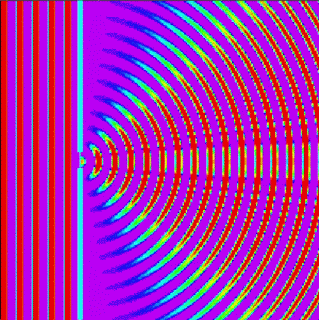
اليسار: ضوء وحيد اللون ومنبعان مترابطان فتظهر أهداب واضحة. اليمين: ضوء غير وحيد اللون فيكون النمط ملوّنًا وغير واضح.
Left: monochromatic light and coherent sources give clear fringes. Right: non-monochromatic light gives a coloured, unclear pattern.
🧪 تجربة 1: تداخل موجتين من منبعين مترابطين
🧪 Experiment 1: Interference of waves from two coherent sources
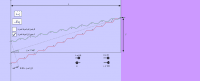
منبعان نقطيان يهتزان معًا (في الطور نفسه) فيصدران موجات دائرية. المناطق الزرقاء قمم والحمراء قيعان. شغّل الخطوط الخضراء لترى مواضع التداخل البناء (\(\Delta=m\lambda\)) والبرتقالية المتقطعة لمواضع التداخل الهدام (\(\Delta=(m+\tfrac12)\lambda\)). غيّر المسافة بين المنبعين وحرّك النقطة الصفراء على الشاشة وراقب فرق المسار.
Two point sources vibrate together (in phase) and emit circular waves. Blue regions are crests and red ones troughs. Turn on the green lines to see where interference is constructive (\(\Delta=m\lambda\)) and the dashed orange lines for destructive interference (\(\Delta=(m+\tfrac12)\lambda\)). Change the distance between the sources and move the yellow point along the screen and watch the path difference.
أي العبارات التالية تصف التداخل البنّاء؟
Which of the following describes constructive interference?
لماذا لا نرى نمط تداخل ثابتًا عند إضاءة حاجز بمصباحين منفصلين؟
Why do we not see a steady interference pattern when a wall is lit by two separate lamps?
📏 فرق المسار وفرق الطور
📏 Path Difference and Phase Difference
يصل الضوء من المنبعين إلى نقطة \(P\) بمسارين طولاهما \(r_1\) و\(r_2\). الفرق \(\Delta=|r_2-r_1|\) هو فرق المسار، ويرتبط بفرق الطور بالعلاقة:
Light from the two sources reaches a point \(P\) along two paths of lengths \(r_1\) and \(r_2\). The difference \(\Delta=|r_2-r_1|\) is the path difference, and it is related to the phase difference by:
\[\Delta\phi=\dfrac{2\pi}{\lambda}\,\Delta\]
📘 شرطا التداخل (منبعان في الطور نفسه)
📘 Conditions for interference (two sources in phase)
\[\text{constructive: }\Delta=m\lambda\quad(m=0,1,2,\dots)\]
\[\text{destructive: }\Delta=\left(m+\tfrac12\right)\lambda\quad(m=0,1,2,\dots)\]
أي: إذا كان فرق المسار صفرًا أو عددًا صحيحًا من الأطوال الموجية فالتداخل بنّاء، وإذا كان عددًا فرديًا من أنصاف الطول الموجي فالتداخل هدّام.
That is: if the path difference is zero or a whole number of wavelengths the interference is constructive, and if it is an odd number of half-wavelengths it is destructive.
يصل ضوء طوله الموجي \(600\ \mathrm{nm}\) إلى نقطة من منبعين مترابطين في الطور نفسه، وفرق المسار \(300\ \mu\mathrm{m}\). ما نوع التداخل؟
Light of wavelength \(600\ \mathrm{nm}\) from two coherent sources in phase reaches a point and the path difference is \(300\ \mu\mathrm{m}\). What is the type of interference?
فرق المسار عند نقطة \(2.4\ \mu\mathrm{m}\) وطول الموجة \(0.8\ \mu\mathrm{m}\) (المنبعان في الطور نفسه). التداخل:
The path difference at a point is \(2.4\ \mu\mathrm{m}\) and the wavelength is \(0.8\ \mu\mathrm{m}\) (the sources are in phase). The interference is:
نقطة فرق المسار عندها \(1.5\lambda\) من منبعين مترابطين في الطور. ما نوع التداخل؟
A point has a path difference of \(1.5\lambda\) from two coherent sources in phase. What type of interference is there?
🔦 تجربة شقي يونغ
🔦 Young's Double-Slit Experiment
في عام 1801 مرّر توماس يونغ ضوءًا وحيد اللون عبر شقين ضيقين متقاربين، فتحوّل كل شق إلى منبع ثانوي، والمنبعان الناتجان مترابطان لأنهما من الموجة نفسها. ظهر على الشاشة نمط من أهداب مضيئة ومظلمة متعاقبة، وهذا دليل على الطبيعة الموجية للضوء.
In 1801 Thomas Young passed monochromatic light through two narrow close slits, so each slit became a secondary source, and the two sources are coherent because they come from the same wave. A pattern of alternating bright and dark fringes appeared on the screen, which is evidence for the wave nature of light.
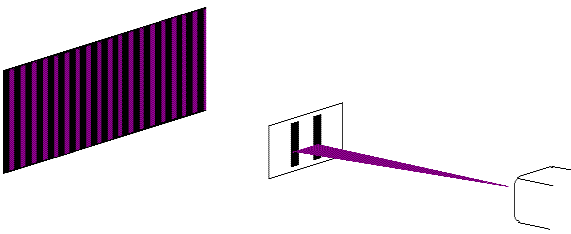
ليزر (ضوء وحيد اللون) يضيء شقين فتظهر على الشاشة أهداب مضيئة ومظلمة متعاقبة.
A laser (monochromatic light) lights two slits and alternating bright and dark fringes appear on the screen.
إذا كانت المسافة بين الشقين \(d\) والمسافة إلى الشاشة \(L\) أكبر كثيرًا من \(d\) فإن الشعاعين المتجهين إلى نقطة على الشاشة يكادان يكونان متوازيين، ويكون فرق المسار بينهما:
If the slit separation is \(d\) and the distance to the screen \(L\) is much larger than \(d\), the two rays going to a point on the screen are almost parallel, and the path difference between them is:
\[\Delta=d\sin\theta\]
📘 مواضع الأهداب
📘 Positions of the fringes
\[\text{bright: }d\sin\theta=m\lambda\qquad m=0,\pm1,\pm2,\dots\]
\[\text{dark: }d\sin\theta=\left(m+\tfrac12\right)\lambda\qquad m=0,\pm1,\pm2,\dots\]
الرتبة \(m=0\) هي الهدبة المركزية المضيئة (\(\theta=0\)). وكل رتبة \(m\) تتكرر على جانبي الهدبة المركزية.
The order \(m=0\) is the central bright fringe (\(\theta=0\)). Every order \(m\) appears on both sides of the central fringe.
| الهدبةFringe | فرق المسارPath difference | نوعهاType |
|---|---|---|
| المركزيةCentral | \(0\)\(0\) | مضيئةbright |
| أول مظلمةFirst dark | \(\tfrac12\lambda\)\(\tfrac12\lambda\) | مظلمةdark |
| أول مضيئةFirst bright | \(\lambda\)\(\lambda\) | مضيئةbright |
| ثاني مظلمةSecond dark | \(\tfrac32\lambda\)\(\tfrac32\lambda\) | مظلمةdark |
| ثاني مضيئةSecond bright | \(2\lambda\)\(2\lambda\) | مضيئةbright |
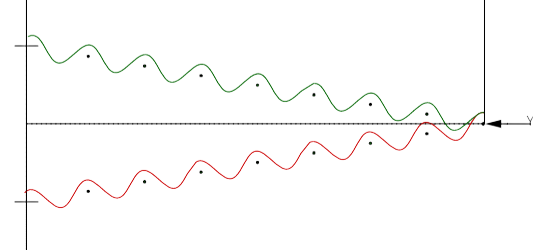
الهدبة المركزية: المسافتان من الشقين متساويتان (فرق المسار صفر) فتتداخل الموجتان بناءً.
Central fringe: the distances from the two slits are equal (zero path difference) so the waves interfere constructively.
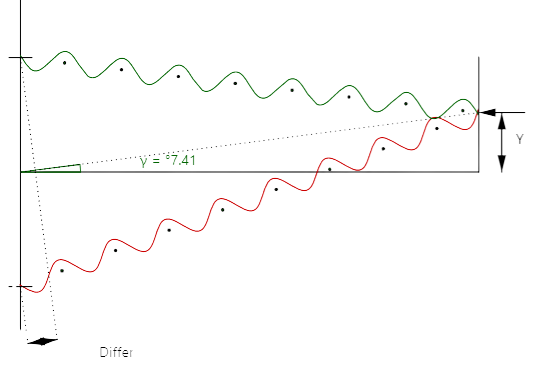
أول هدبة مظلمة: فرق المسار نصف طول موجي فتلتقي قمة بقاع.
First dark fringe: the path difference is half a wavelength so a crest meets a trough.
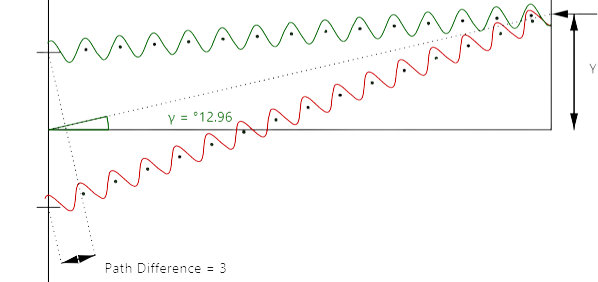
أول هدبة مضيئة: فرق المسار طول موجي كامل فتلتقي قمة بقمة.
First bright fringe: the path difference is one full wavelength so a crest meets a crest.
الأهداب على الشاشة (الزوايا الصغيرة)
Fringes on the screen (small angles)
عندما تكون الزاوية صغيرة (\(\theta\ll1\)) يكون \(\sin\theta\approx\tan\theta=y/L\) حيث \(y\) بعد الهدبة عن المركز، فنحصل على:
When the angle is small (\(\theta\ll1\)) we have \(\sin\theta\approx\tan\theta=y/L\), where \(y\) is the distance of the fringe from the centre, so:
📘 العلاقات العملية
📘 Working relations
\[y_m=\dfrac{m\lambda L}{d}\ \ (\text{bright}),\qquad y_m=\dfrac{\left(m+\tfrac12\right)\lambda L}{d}\ \ (\text{dark})\]
\[\Delta y=\dfrac{\lambda L}{d}\]
\(\Delta y\) هو البعد بين هدبتين مضيئتين متتاليتين (أو مظلمتين متتاليتين)، ويسمى عرض الهدبة.
\(\Delta y\) is the distance between two successive bright (or dark) fringes and is called the fringe spacing.
💡 شرح إضافي: كيف تتغير الأهداب؟
💡 Extra explanation: how do the fringes change?
من العلاقة \(\Delta y=\lambda L/d\) نستنتج:
From \(\Delta y=\lambda L/d\) we conclude:
- زيادة الطول الموجي \(\lambda\) (من الأزرق إلى الأحمر) تزيد عرض الهدبة: الضوء الأحمر يعطي أهدابًا أوسع من الأزرق.Increasing the wavelength \(\lambda\) (blue to red) increases the fringe spacing: red light gives wider fringes than blue.
- زيادة بعد الشاشة \(L\) تزيد عرض الهدبة.Increasing the screen distance \(L\) increases the fringe spacing.
- تقليل المسافة بين الشقين \(d\) يزيد عرض الهدبة (تقارب الشقين يوسّع النمط)، وتباعدهما يضيّقه حتى لا تُرى الأهداب.Decreasing the slit separation \(d\) increases the fringe spacing (close slits widen the pattern) while larger separation narrows it until the fringes can hardly be seen.
- عند الإضاءة بالضوء الأبيض تكون الهدبة المركزية بيضاء (كل الألوان بفرق مسار صفر) وتظهر على جانبيها أطياف ملوّنة لأن لكل لون عرض هدبة مختلفًا.With white light the central fringe is white (all colours with zero path difference) and coloured spectra appear on both sides because each colour has a different fringe spacing.
🧪 تجربة 2: تجربة شقي يونغ: أهداب التداخل على الشاشة
🧪 Experiment 2: Young's double-slit experiment: the fringes on the screen
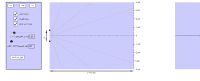
غيّر الطول الموجي (لون الضوء) والمسافة بين الشقين وبعد الشاشة. الشريط الملون هو الشاشة، والمنحنى تحتها شدة الإضاءة. النقاط الحمراء مواضع الأهداب المضيئة \(m=0,\pm1,\pm2,\dots\). ثم احسب بنفسك المسافة بين هدبتين مضيئتين وتحقق من إجابتك.
Change the wavelength (the colour of the light), the distance between the slits and the distance to the screen. The coloured strip is the screen and the curve under it is the intensity. The red dots mark the bright fringes \(m=0,\pm1,\pm2,\dots\). Then calculate the distance between two bright fringes yourself and check your answer.
في تجربة يونغ كان \(\lambda=600\ \mathrm{nm}\) و\(d=0.20\ \mathrm{mm}\) و\(L=2.0\ \mathrm{m}\). احسب عرض الهدبة \(\Delta y\) وبُعد أول هدبة مضيئة عن المركز.
In a Young experiment \(\lambda=600\ \mathrm{nm}\), \(d=0.20\ \mathrm{mm}\) and \(L=2.0\ \mathrm{m}\). Find the fringe spacing \(\Delta y\) and the distance of the first bright fringe from the centre.
عرض الهدبة في تجربة يونغ \(3.0\ \mathrm{mm}\) عندما \(d=0.25\ \mathrm{mm}\) و\(L=1.5\ \mathrm{m}\). احسب الطول الموجي للضوء.
The fringe spacing in a Young experiment is \(3.0\ \mathrm{mm}\) with \(d=0.25\ \mathrm{mm}\) and \(L=1.5\ \mathrm{m}\). Find the wavelength of the light.
إذا قلّت المسافة بين الشقين \(d\) إلى النصف في تجربة يونغ فإن عرض الهدبة:
If the slit separation \(d\) is halved in a Young experiment, the fringe spacing:
أين تقع الهدبة المركزية في تجربة يونغ؟
Where is the central fringe in a Young experiment?
عند استبدال ضوء أزرق بضوء أحمر في تجربة يونغ (مع بقاء باقي الشروط) فإن عرض الهدبة:
When blue light is replaced by red light in a Young experiment (other conditions unchanged), the fringe spacing:
🫧 الأغشية الرقيقة
🫧 Thin Films
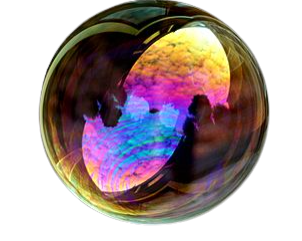
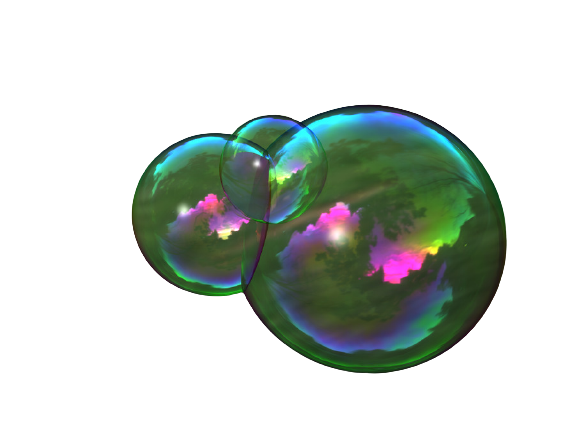
تظهر ألوان زاهية على فقاعات الصابون وعلى بقع الزيت فوق الماء. السبب ليس صبغة، بل تداخل ضوء منعكس عن السطحين العلوي والسفلي للغشاء الرقيق الذي سمكه من رتبة الطول الموجي للضوء.
Bright colours appear on soap bubbles and on oil patches over water. The cause is not a dye but the interference of light reflected from the upper and lower surfaces of a thin film whose thickness is of the order of the wavelength of light.
الشعاعان المنعكسان
The two reflected rays
يسقط الضوء على غشاء سمكه \(d\) ومعامل انكساره \(n\): ينعكس جزء منه عن السطح العلوي (الشعاع 1)، وينفذ الباقي فينعكس جزء منه عن السطح السفلي ويخرج (الشعاع 2). يقطع الشعاع 2 مسافة إضافية \(2d\) داخل الغشاء (للسقوط العمودي تقريبًا)، فيتداخل مع الشعاع 1.
Light falls on a film of thickness \(d\) and refractive index \(n\): part is reflected from the upper surface (ray 1), the rest enters and part of it is reflected from the lower surface and comes out (ray 2). Ray 2 travels an extra distance \(2d\) inside the film (for near-normal incidence) and interferes with ray 1.
انقلاب الطور عند الانعكاس
Phase inversion on reflection
📘 قاعدة انقلاب الطور
📘 The phase-inversion rule
ينقلب طور الموجة (فرق طور \(\pi\)، أي نصف طول موجي) إذا انعكست عند سطح وسط أكبر معامل انكسار من الوسط الذي جاءت منه (من وسط أقل كثافة ضوئية إلى أكثر كثافة ضوئية). ولا ينقلب طورها إذا انعكست عند سطح وسط معامل انكساره أقل.
The wave is inverted (phase change \(\pi\), i.e. half a wavelength) if it is reflected at the surface of a medium of larger refractive index than the one it came from (from a lower to a higher optical density). It is not inverted if it is reflected at a medium of smaller index.
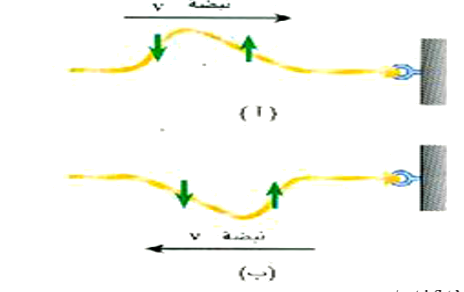
تشبيه بحبل: عند النهاية الثابتة (وسط أثقل) ينقلب النبض، وعند النهاية الحرة (وسط أخف) لا ينقلب.
String analogy: at a fixed end (heavier medium) the pulse is inverted, at a free end (lighter medium) it is not.
💡 شرح إضافي: الطول الموجي داخل الغشاء
💡 Extra explanation: the wavelength inside the film
داخل الغشاء يكون الطول الموجي \(\lambda_n=\lambda_0/n\) حيث \(\lambda_0\) طوله في الفراغ (أو الهواء). فالمسافة الإضافية \(2d\) تساوي \(2d/\lambda_n=2nd/\lambda_0\) من الأطوال الموجية، ولذلك يظهر الحاصل \(2nd\) (فرق المسار البصري) في الشروط التالية.
Inside the film the wavelength is \(\lambda_n=\lambda_0/n\), where \(\lambda_0\) is its value in vacuum (or air). The extra distance \(2d\) equals \(2d/\lambda_n=2nd/\lambda_0\) wavelengths, which is why the product \(2nd\) (the optical path difference) appears in the conditions below.
📘 شرطا التداخل في الأغشية الرقيقة (سقوط عمودي تقريبًا)
📘 Interference conditions in thin films (near-normal incidence)
الحالة 1: ينقلب طور أحد الشعاعين فقط (مثل فقاعة الصابون في الهواء، أو الزيت على الماء):
Case 1: only one of the two rays is inverted (such as a soap film in air, or oil on water):
\[\text{constructive: }2nd=\left(m+\tfrac12\right)\lambda_0\qquad\text{destructive: }2nd=m\lambda_0\]
الحالة 2: ينقلب طور الشعاعين معًا أو لا ينقلب أي منهما (مثل طلاء مانع للانعكاس على زجاج):
Case 2: both rays are inverted or neither is (such as an anti-reflection coating on glass):
\[\text{constructive: }2nd=m\lambda_0\qquad\text{destructive: }2nd=\left(m+\tfrac12\right)\lambda_0\]
وتتبدّل الشروط بين الحالتين لأن انقلاب أحد الشعاعين يضيف نصف طول موجي إلى فرق المسار الفعّال.
The conditions swap between the two cases because the inversion of one ray adds half a wavelength to the effective path difference.
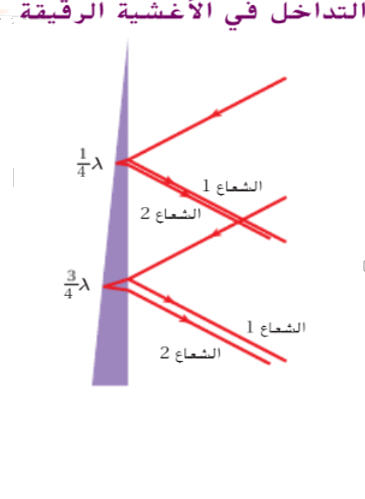
غشاء على شكل إسفين: يكون التداخل بنّاء أو هدّامًا حسب السمك فتظهر أهداب متعاقبة.
A wedge-shaped film: the interference is constructive or destructive depending on the thickness, giving alternating fringes.
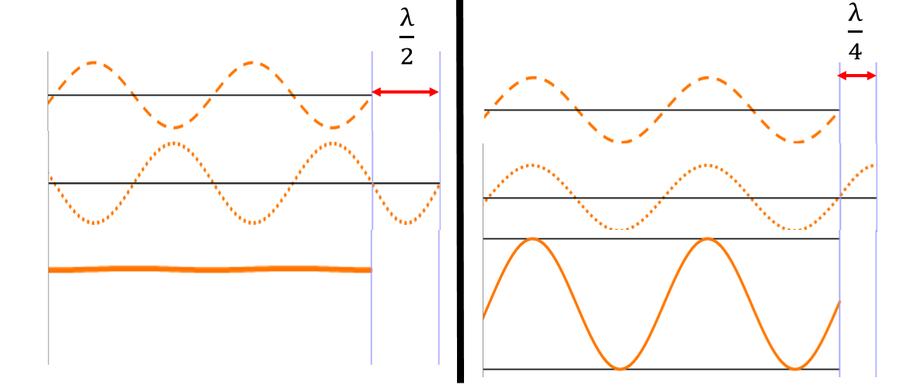
سمك الغشاء \(\lambda/4\) أو \(\lambda/2\) (داخل الغشاء) يحدد هل يتداخل الشعاعان بنّاءً أم هدّامًا.
A film thickness of \(\lambda/4\) or \(\lambda/2\) (inside the film) decides whether the two rays interfere constructively or destructively.
💡 شرح إضافي: حالتان تُحفظان
💡 Extra explanation: two cases to remember
لغشاء في الهواء (الحالة 1):
For a film in air (case 1):
- \(d\to0\) (غشاء أرق بكثير من الطول الموجي): الشعاعان متعاكسان في الطور فيحدث تداخل هدّام ويبدو الغشاء أسود (كما تبدو قمة فقاعة الصابون قبل أن تنفجر).\(d\to0\) (a film much thinner than the wavelength): the rays are opposite in phase so the interference is destructive and the film looks black (like the top of a soap bubble before it bursts).
- \(d=\lambda_0/(4n)\): \(2nd=\lambda_0/2\) فيكون التداخل بنّاء (أقوى انعكاس).\(d=\lambda_0/(4n)\): \(2nd=\lambda_0/2\) so the interference is constructive (strongest reflection).
- \(d=\lambda_0/(2n)\): \(2nd=\lambda_0\) فيكون التداخل هدّامًا (انعكاس ضعيف).\(d=\lambda_0/(2n)\): \(2nd=\lambda_0\) so the interference is destructive (weak reflection).
أما اللون الذي نراه فهو الطول الموجي الذي يتحقق عنده التداخل البنّاء عند سمك معين؛ ولأن السمك يتغير على الغشاء (يزداد نحو الأسفل بفعل الجاذبية) تظهر ألوان متدرجة. وتتغير الألوان أيضًا بتغيّر زاوية النظر.
The colour we see is the wavelength for which the interference is constructive at that thickness; because the thickness varies over the film (it grows toward the bottom due to gravity) graded colours appear. The colours also change with the viewing angle.
🧪 تجربة 3: التداخل في الأغشية الرقيقة
🧪 Experiment 3: Interference in thin films
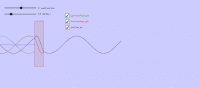
يسقط ضوء على غشاء رقيق فيعود منه شعاعان: ① من السطح العلوي و② من السطح السفلي بعد ذهاب وإياب داخل الغشاء. اختر نوع الغشاء أو غيّر السمك ومعامل الانكسار، وراقب: عدد انقلابات الطور، والشرط المناسب، والأطوال الموجية التي ينعكس ضوؤها بشدة، ولون الضوء المنعكس.
Light falls on a thin film and two rays return: ① from the top surface and ② from the bottom surface after a round trip inside the film. Choose the type of film or change the thickness and the refractive index, and watch the number of phase inversions, the matching condition, the wavelengths reflected strongly and the colour of the reflected light.
غشاء صابون في الهواء معامل انكساره \(1.33\). ما أقل سمك غير صفري يعطي أقوى انعكاس لضوء طوله الموجي \(550\ \mathrm{nm}\)؟
A soap film in air has refractive index \(1.33\). What is the least non-zero thickness that gives the strongest reflection of light of wavelength \(550\ \mathrm{nm}\)?
غشاء زيت (\(n=1.45\)) سمكه \(400\ \mathrm{nm}\) فوق الماء (\(n=1.33\)). ما الطول الموجي في المرئي الذي ينعكس بقوة؟
An oil film (\(n=1.45\)) of thickness \(400\ \mathrm{nm}\) lies on water (\(n=1.33\)). Which visible wavelength is strongly reflected?
الطلاء المانع للانعكاس
Anti-reflection coatings
تُطلى العدسات والخلايا الشمسية بغشاء رقيق معامل انكساره بين معامل الهواء ومعامل الزجاج (مثل فلوريد المغنيسيوم \(n=1.38\) على زجاج \(n=1.52\)). ينقلب طور الشعاعين معًا (الحالة 2)، فنختار السمك بحيث يكون التداخل هدّامًا فيقل الانعكاس ويزداد الضوء النافذ:
Lenses and solar cells are coated with a thin film whose refractive index lies between those of air and glass (such as magnesium fluoride \(n=1.38\) on glass \(n=1.52\)). Both rays are inverted (case 2), so we choose the thickness for destructive interference, which reduces reflection and increases the transmitted light:
\[2nd=\tfrac12\lambda_0\ \Rightarrow\ d_{min}=\dfrac{\lambda_0}{4n}\]
احسب أقل سمك لطبقة \(\mathrm{MgF_2}\) (\(n=1.38\)) على زجاج (\(n=1.52\)) لتقليل انعكاس ضوء طوله الموجي \(550\ \mathrm{nm}\).
Find the least thickness of an \(\mathrm{MgF_2}\) layer (\(n=1.38\)) on glass (\(n=1.52\)) that reduces the reflection of light of wavelength \(550\ \mathrm{nm}\).
متى ينقلب طور الموجة الضوئية عند الانعكاس؟
When is the phase of a light wave inverted on reflection?
غشاء صابون في الهواء، سمكه \(d=\lambda_0/(4n)\). نوع التداخل بين الشعاعين المنعكسين:
A soap film in air has thickness \(d=\lambda_0/(4n)\). The interference between the two reflected rays is:
لماذا تظهر قمة فقاعة الصابون سوداء قبل انفجارها؟
Why does the top of a soap bubble look black just before it bursts?
أقل سمك لطبقة مانعة للانعكاس (\(n=1.25\)) على زجاج لضوء \(500\ \mathrm{nm}\) (ينقلب الطور عند السطحين) هو:
The least thickness of an anti-reflection layer (\(n=1.25\)) on glass for light of \(500\ \mathrm{nm}\) (phase inverted at both surfaces) is:
📚 ملخص الدرس
📚 Lesson Summary
| المفهومConcept | الفكرة / القانونIdea / Law |
|---|---|
| شرط التداخلCondition for interference | منبعان مترابطان وضوء وحيد اللونcoherent sources and monochromatic light |
| بنّاء / هدّام (منبعان في الطور)Constructive / destructive (sources in phase) | \(\Delta=m\lambda\ /\ \Delta=(m+\tfrac12)\lambda\)\(\Delta=m\lambda\ /\ \Delta=(m+\tfrac12)\lambda\) |
| شقا يونغYoung's slits | \(d\sin\theta=m\lambda\ ,\ \Delta y=\dfrac{\lambda L}{d}\)\(d\sin\theta=m\lambda\ ,\ \Delta y=\dfrac{\lambda L}{d}\) |
| انقلاب الطورPhase inversion | عند الانعكاس من وسط معامل انكساره أكبرon reflection from a medium of larger refractive index |
| غشاء رقيق (انقلاب شعاع واحد)Thin film (one ray inverted) | \(\text{constr.: }2nd=(m+\tfrac12)\lambda_0\ ;\ \text{destr.: }2nd=m\lambda_0\)\(\text{constr.: }2nd=(m+\tfrac12)\lambda_0\ ;\ \text{destr.: }2nd=m\lambda_0\) |
| غشاء رقيق (انقلاب الشعاعين أو لا أحد)Thin film (both or none inverted) | \(\text{constr.: }2nd=m\lambda_0\ ;\ \text{destr.: }2nd=(m+\tfrac12)\lambda_0\)\(\text{constr.: }2nd=m\lambda_0\ ;\ \text{destr.: }2nd=(m+\tfrac12)\lambda_0\) |
| الطلاء المانع للانعكاسAnti-reflection coating | \(d_{min}=\dfrac{\lambda_0}{4n}\)\(d_{min}=\dfrac{\lambda_0}{4n}\) |
⚠️ أخطاء شائعة
⚠️ Common mistakes
- استعمال الطول الموجي في الفراغ \(\lambda_0\) بدل الطول الموجي داخل الغشاء \(\lambda_0/n\) (الصيغة \(2nd\) تأخذ ذلك في الحسبان).Using the vacuum wavelength \(\lambda_0\) instead of the wavelength in the film \(\lambda_0/n\) (the form \(2nd\) already accounts for it).
- نسيان انقلاب الطور فيعكس الطالب شرطي البناء والهدم.Forgetting the phase inversion, so the constructive and destructive conditions are swapped.
- الخلط بين شرط البناء \(d\sin\theta=m\lambda\) وشرط الهدم \(d\sin\theta=(m+\tfrac12)\lambda\) في تجربة يونغ.Mixing up the bright condition \(d\sin\theta=m\lambda\) and the dark condition \(d\sin\theta=(m+\tfrac12)\lambda\) in Young's experiment.
- إهمال تحويل الوحدات (nm، mm، µm) إلى المتر قبل التعويض.Neglecting to convert the units (nm, mm, µm) to metres before substituting.
🧪 اختبر نفسك: امتحان من 20 سؤالاً
🧪 Test Yourself: a 20-Question Exam
أنهِ الدرس بالاختبار التفاعلي التالي؛ أسئلته تجمع بين الفهم والحساب وتغطي جميع أقسام الدرس.
Finish with the interactive exam below; its questions mix understanding with calculation and cover every section of the lesson.
اختبار تداخل الضوء والأغشية الرقيقة Interference of Light and Thin Films Quiz
20 سؤالاً - التداخل البناء والهدام، شقا يونغ، والأغشية الرقيقة 20 Questions - Constructive and Destructive Interference, Young's Double Slit and Thin Films
• عدد الأسئلة: 20 سؤالاً
• مدة الاختبار: 30 دقيقة
• لا يمكنك تغيير إجاباتك أو إعادة الاختبار إلا بعد 24 ساعة من التسليم.
• تأكد من إجاباتك قبل التسليم! 📌 Important Instructions:
• Number of questions: 20 questions
• Quiz duration: 30 minutes
• You cannot change your answers or retake the quiz for 24 hours after submission.
• Make sure of your answers before submitting!
🔗 محاكيات GeoGebra للاستعانة بها عند اللزوم
🔗 GeoGebra Simulations to Use When Needed
اضغط «تشغيل» لتعمل المحاكاة هنا داخل الدرس؛ ويمكن للطالب الرجوع إليها لتجربة الفكرة بطريقة أخرى.
Press “Run” to run the simulation right here inside the lesson; the student can use it to try the idea in another way.