🎯 نواتج التعلم
🎯 Learning Outcomes
بعد دراسة هذا الدرس ستكون قادرًا على أن:
After this lesson you will be able to:
- تربط الشحنة بالتيار والزمن \(Q=It\) وبعدد الإلكترونات \(Q=ne\).Relate the charge to the current and the time \(Q=It\) and to the number of electrons \(Q=ne\).
- تصف فكرة تجربة ميليكان وخطواتها وهدفها (تحديد الشحنة الأولية).Describe the idea of Millikan’s experiment, its steps and its aim (determining the elementary charge).
- تطبّق شرط الاتزان \(qE=mg\) وتحسب شحنة القطرة \(q=mg/E=mgd/V\) وعدد الشحنات \(n=q/e\).Apply the balance condition \(qE=mg\) and calculate the charge of the drop \(q=mg/E=mgd/V\) and the number of charges \(n=q/e\).
- تفسّر أن الشحنة مكمّاة (مضاعفات صحيحة لـ \(e=1.602\times10^{-19}\ \mathrm C\)) وتستنتج \(e\) من عدة قياسات.Explain that charge is quantized (integer multiples of \(e=1.602\times10^{-19}\ \mathrm C\)) and deduce \(e\) from several measurements.
⚡ العلاقات الكهربائية الأساسية
⚡ Basic Electrical Relationships
📌 الشحنة والتيار والزمن وعدد الإلكترونات
📌 Charge, current, time and number of electrons
\[Q=I\,t\qquad,\qquad Q=n\,e\qquad,\qquad e=1.6\times10^{-19}\ \mathrm C\]
\(Q\) الشحنة بالكولوم، و\(I\) شدة التيار بالأمبير، و\(t\) الزمن بالثانية، و\(n\) عدد صحيح (عدد الإلكترونات)، و\(e\) الشحنة الأولية. والكولوم الواحد يساوي شحنة نحو \(6.25\times10^{18}\) إلكترونًا.
\(Q\) is the charge in coulombs, \(I\) the current in amperes, \(t\) the time in seconds, \(n\) an integer (the number of electrons) and \(e\) the elementary charge. One coulomb equals the charge of about \(6.25\times10^{18}\) electrons.
يمرّ في سلك تيار \(0.2\ \mathrm A\) مدة \(8\ \mathrm s\). ما الشحنة وعدد الإلكترونات التي مرّت؟
A current of \(0.2\ \mathrm A\) passes in a wire for \(8\ \mathrm s\). What is the charge and the number of electrons that passed?
🧪 تجربة 1: الشحنة والتيار والزمن وعدد الإلكترونات
🧪 Experiment 1: Charge, Current, Time and the Number of Electrons
نربط بين شدة التيار والزمن والشحنة وعدد الإلكترونات المارة في سلك.
We relate the current, the time, the charge and the number of electrons passing in a wire.
🛠️ خطوات العمل
🛠️ Procedure
- اضبط \\(I=1\\ \\mathrm{mA}\\) و\\(t=1\\ \\mathrm s\\) وسجّل \\(Q\\) و\\(n\\).Set \\(I=1\\ \\mathrm{mA}\\) and \\(t=1\\ \\mathrm s\\) and record \\(Q\\) and \\(n\\).
- ضاعف الزمن وراقب تضاعف \\(Q\\) و\\(n\\).Double the time and watch \\(Q\\) and \\(n\\) double.
- اضغط «شغّل» وتتبّع اتجاه حركة الإلكترونات.Press “Run” and follow the direction of the motion of the electrons.
🧪 تجربة 1: الشحنة والتيار والزمن وعدد الإلكترونات
🧪 Experiment 1: Charge, Current, Time and the Number of Electrons
غيّر شدة التيار والزمن وراقب الشحنة \(Q=It\) وعدد الإلكترونات \(n=Q/e\) المارة في السلك.
Change the current and the time and watch the charge \(Q=It\) and the number of electrons \(n=Q/e\) passing through the wire.
🔎 ماذا نلاحظ؟ وما الاستنتاج؟
🔎 What do we observe? What is the conclusion?
- حتى تيار صغير (1 mA) يحمل عددًا هائلًا من الإلكترونات (\\(6\\times10^{15}\\) كل ثانية).Even a small current (1 mA) carries an enormous number of electrons (\\(6\\times10^{15}\\) every second).
- الإلكترونات تتحرك عكس اتجاه التيار الاصطلاحي.The electrons move opposite to the direction of the conventional current.
الشحنة \\(Q=It\\) وعدد الإلكترونات \\(n=Q/e\\).
The charge \\(Q=It\\) and the number of electrons \\(n=Q/e\\).
🛢️ تجربة ميليكان لتحديد الشحنة الأولية
🛢️ Millikan’s Experiment to Determine the Elementary Charge
في سنة 1909 توصّل روبرت ميليكان (أستاذ في جامعة شيكاغو) بمساعدة هارفي فليتشر إلى قيمة الشحنة الأولية للإلكترون بطريقة تسمى تجربة قطرات الزيت المشحونة. تعتمد على دراسة قطرات زيت صغيرة مشحونة داخل مجال كهربائي منتظم بين لوحين متوازيين.
In 1909 Robert Millikan (a professor at the University of Chicago) with the help of Harvey Fletcher reached the value of the elementary charge of the electron by a method called the charged oil-drop experiment. It relies on studying tiny charged oil drops inside a uniform electric field between two parallel plates.
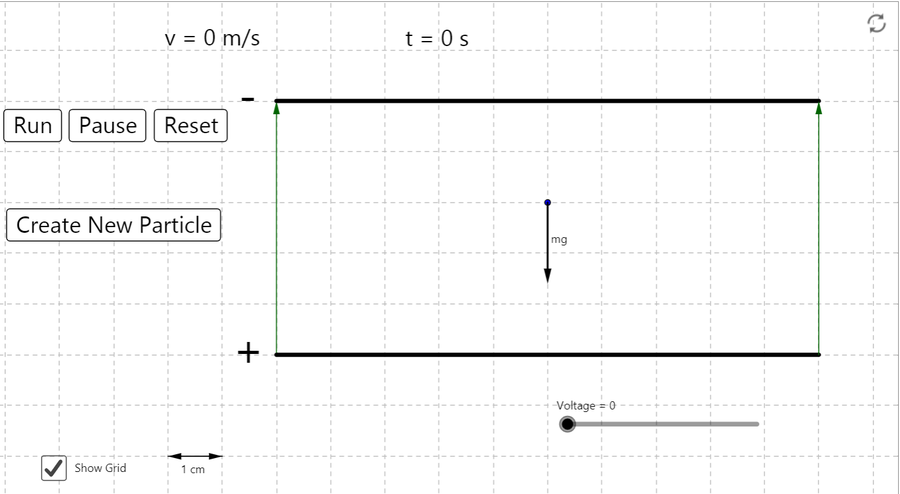
محاكاة تجربة ميليكان: لوحان متوازيان وقطرة تتأثر بالوزن وبالقوة الكهربائية
A simulation of Millikan’s experiment: two parallel plates and a drop acted on by the weight and by the electric force
الهدف والخطوات
The aim and the steps
- رشّ قطرات زيت صغيرة تكتسب شحنة بالاحتكاك (أو بالتأيين).Spraying tiny oil drops that gain charge by friction (or by ionization).
- تعريضها لمجال كهربائي منتظم قابل للتعديل بين لوحين متوازيين.Exposing them to an adjustable uniform electric field between two parallel plates.
- ضبط فرق الجهد حتى تتوقف قطرة معلّقة في الهواء.Adjusting the potential difference until a drop is suspended in the air.
- حساب الشحنة من الاتزان: القوة الكهربائية = وزن القطرة.Calculating the charge from the equilibrium: the electric force = the weight of the drop.
- تكرار القياس لقطرات كثيرة وإيجاد القاسم المشترك الأكبر لشحناتها، وهو \(e\).Repeating the measurement for many drops and finding the greatest common divisor of their charges, which is \(e\).
| المفهومConcept | الرمزSymbol | الوحدةUnit |
|---|---|---|
| كتلة القطرةMass of the drop | \(m\) | \(\mathrm{kg}\) |
| شحنة القطرةCharge of the drop | \(q\) | \(\mathrm C\) |
| شدة المجال الكهربائيElectric field | \(E\) | \(\mathrm{N/C}=\mathrm{V/m}\) |
| تسارع الجاذبيةGravitational acceleration | \(g\) | \(\mathrm{m/s^2}\) |
| فرق الجهد بين اللوحينPotential difference | \(V\) | \(\mathrm V\) |
| المسافة بين اللوحينPlate separation | \(d\) | \(\mathrm m\) |
📐 المعادلات الأساسية
📐 The Basic Equations
وزن القطرة: \(F_g=mg\) حيث الكتلة \(m=\rho V_{drop}=\rho\cdot\tfrac43\pi r^3\) (الكثافة × الحجم)، والقوة الكهربائية: \(F_e=qE\)، والمجال بين اللوحين: \(E=\dfrac{V}{d}\).
The weight of the drop: \(F_g=mg\) where the mass \(m=\rho V_{drop}=\rho\cdot\tfrac43\pi r^3\) (density × volume), the electric force: \(F_e=qE\) and the field between the plates: \(E=\dfrac{V}{d}\).
📌 شرط الاتزان
📌 The balance condition
\[qE=mg\ \Rightarrow\ q=\frac{mg}{E}=\frac{mgd}{V}\qquad,\qquad n=\frac{q}{e}\]
لوحان بينهما فرق جهد \(12\ \mathrm V\) والمسافة بينهما \(0.03\ \mathrm m\). أوجد شدة المجال بينهما.
Two plates have a potential difference of \(12\ \mathrm V\) and the distance between them is \(0.03\ \mathrm m\). Find the field between them.
قطرة زيت كتلتها \(3.27\times10^{-15}\ \mathrm{kg}\) معلّقة في مجال \(2\times10^{5}\ \mathrm{V/m}\). أوجد شحنتها وعدد الشحنات الأولية عليها (\(g=9.8\ \mathrm{m/s^2}\)).
An oil drop of mass \(3.27\times10^{-15}\ \mathrm{kg}\) is suspended in a field of \(2\times10^{5}\ \mathrm{V/m}\). Find its charge and the number of elementary charges on it (\(g=9.8\ \mathrm{m/s^2}\)).
🧪 تجربة 2: ميزان ميليكان: تعليق قطرة زيت
🧪 Experiment 2: Millikan’s Balance: Suspending an Oil Drop
قطرة زيت مشحونة بين لوحين نضبط الجهد حتى تتعلق ثم نحسب شحنتها وعدد الشحنات الأولية عليها.
A charged oil drop between two plates; we adjust the voltage until it is suspended then calculate its charge and the number of elementary charges on it.
🛠️ خطوات العمل
🛠️ Procedure
- حرّك شريط الجهد \\(V\\) ببطء وراقب القطرة: تصعد إذا كانت \\(qE\gt mg\\) وتهبط إذا كانت \\(qE\lt mg\\).Move the voltage slider \\(V\\) slowly and watch the drop: it rises if \\(qE\gt mg\\) and falls if \\(qE\lt mg\\).
- عندما تتوقف القطرة (تصير خضراء) سجّل \\(V\\) وكتلتها \\(m\\).When the drop stops (turns green) record \\(V\\) and its mass \\(m\\).
- احسب \\(q=mgd/V\\) ثم \\(n=q/e\\) وأدخل \\(n\\) في «اختبر نفسك»، وكرّر مع قطرة جديدة.Calculate \\(q=mgd/V\\) then \\(n=q/e\\) and enter \\(n\\) in “Test yourself”, and repeat with a new drop.
🧪 تجربة 2: ميزان ميليكان: تعليق قطرة زيت
🧪 Experiment 2: Millikan’s Balance: Suspending an Oil Drop
قطرة زيت مشحونة بين لوحين متوازيين يفصل بينهما \(d=1.0\ \mathrm{cm}\). اضبط فرق الجهد \(V\) حتى تتعلق القطرة، ثم احسب شحنتها \(q=mgd/V\) وعدد الشحنات الأولية \(n=q/e\).
A charged oil drop between two parallel plates separated by \(d=1.0\ \mathrm{cm}\). Adjust the potential difference \(V\) until the drop is suspended, then calculate its charge \(q=mgd/V\) and the number of elementary charges \(n=q/e\).
🔎 ماذا نلاحظ؟ وما الاستنتاج؟
🔎 What do we observe? What is the conclusion?
- جهد التعليق يختلف من قطرة لأخرى لأن شحنتها \\(ne\\) مختلفة.The balance voltage differs from one drop to another because their charge \\(ne\\) is different.
- الناتج \\(n\\) دائمًا عدد صحيح.The result \\(n\\) is always an integer.
عند التعليق \\(qE=mg\\): \\(q=mgd/V\\) و\\(n=q/e\\) عدد صحيح.
At balance \\(qE=mg\\): \\(q=mgd/V\\) and \\(n=q/e\\) is an integer.
🔬 كيف نعرف كتلة القطرة؟
🔬 How Do We Know the Mass of the Drop?
القطرة أصغر من أن تُوزن، فكان ميليكان يتركها تسقط دون مجال فتبلغ سرعة حدية \(v\) عندما يتزن وزنها مع مقاومة الهواء (قانون ستوكس \(F=6\pi\eta r v\)). ومنها يحسب نصف قطرها ثم كتلتها:
The drop is too small to be weighed, so Millikan let it fall without a field and it reached a terminal velocity \(v\) when its weight balanced the air resistance (Stokes’ law \(F=6\pi\eta r v\)). From it he calculated its radius and then its mass:
📌 نصف القطر والكتلة
📌 The radius and the mass
\[r=\sqrt{\frac{9\eta v}{2\rho g}}\qquad,\qquad m=\rho\,\frac43\pi r^3\]
سقطت قطرة زيت (\(\rho=886\ \mathrm{kg/m^3}\)) بسرعة حدية \(1.0\times10^{-4}\ \mathrm{m/s}\) في هواء لزوجته \(\eta=1.8\times10^{-5}\ \mathrm{Pa\cdot s}\). أوجد نصف قطرها وكتلتها.
An oil drop (\(\rho=886\ \mathrm{kg/m^3}\)) fell with a terminal velocity of \(1.0\times10^{-4}\ \mathrm{m/s}\) in air of viscosity \(\eta=1.8\times10^{-5}\ \mathrm{Pa\cdot s}\). Find its radius and its mass.
🔢 الاستنتاج: الشحنة مكمّاة
🔢 The Conclusion: Charge Is Quantized
بعد تكرار التجربة لقطرات كثيرة لاحظ ميليكان أن شحنة أي قطرة تساوي دائمًا عددًا صحيحًا من شحنة أساسية واحدة: \(q=ne\) حيث \(n=1,2,3,\dots\). ولا توجد شحنة بمقدار \(0.5e\) أو \(1.5e\). وقد تحدّدت الشحنة الأولية \(e\approx1.602\times10^{-19}\ \mathrm C\). ونال ميليكان جائزة نوبل في الفيزياء عام 1923 على هذا الاكتشاف.
After repeating the experiment for many drops Millikan noticed that the charge of any drop is always an integer multiple of one fundamental charge: \(q=ne\) where \(n=1,2,3,\dots\). There is no charge of \(0.5e\) or \(1.5e\). The elementary charge was determined \(e\approx1.602\times10^{-19}\ \mathrm C\). Millikan received the Nobel Prize in Physics in 1923 for this discovery.
🧪 تجربة 3: اكتشاف الشحنة الأولية
🧪 Experiment 3: Discovering the Elementary Charge
أمامنا شحنات ثماني قطرات قاسها ميليكان؛ نبحث عن القاسم المشترك الأكبر الذي يجعلها كلها أعدادًا صحيحة.
We have the charges of eight drops measured by Millikan; we look for the greatest common divisor that makes all of them integers.
🛠️ خطوات العمل
🛠️ Procedure
- حرّك \\(e_c\\) ببطء وراقب نواتج القسمة \\(q_i/e_c\\).Move \\(e_c\\) slowly and watch the quotients \\(q_i/e_c\\).
- جرّب \\(0.8\\) و\\(1.6\\) و\\(3.2\\) وسجّل عدد النواتج الصحيحة في كل مرة.Try \\(0.8\\), \\(1.6\\) and \\(3.2\\) and record the number of integer results each time.
- اضغط «تلميح» للتأكد من القيمة.Press “Hint” to make sure of the value.
🧪 تجربة 3: اكتشاف الشحنة الأولية من قياسات القطرات
🧪 Experiment 3: Finding the Elementary Charge from the Drops’ Measurements
قاس ميليكان شحنات قطرات كثيرة. هنا ثماني شحنات (بالوحدة \(10^{-19}\ \mathrm C\)). غيّر الشحنة الاختبارية \(e_c\) وابحث عن أكبر قيمة تجعل جميع نواتج القسمة أعدادًا صحيحة.
Millikan measured the charges of many drops. Here are eight charges (in units of \(10^{-19}\ \mathrm C\)). Change the trial charge \(e_c\) and look for the greatest value that makes all the quotients integers.
🔎 ماذا نلاحظ؟ وما الاستنتاج؟
🔎 What do we observe? What is the conclusion?
- عند \\(0.8\\) تكون النواتج صحيحة أيضًا لكنها ضِعف الحقيقية؛ فنأخذ الأكبر.At \\(0.8\\) the results are integers too but they are double the real ones; so we take the greatest.
- عند \\(3.2\\) تظهر كسور (0.5 و1.5) فلا تصلح.At \\(3.2\\) fractions appear (0.5 and 1.5) so it does not fit.
الشحنة الأولية \\(e=1.6\\times10^{-19}\\ \\mathrm C\\) هي أصغر شحنة حرة، وكل شحنة مضاعف صحيح لها.
The elementary charge \\(e=1.6\\times10^{-19}\\ \\mathrm C\\) is the smallest free charge and every charge is an integer multiple of it.
إذا كانت شحنة قطرة \(6.4\times10^{-19}\ \mathrm C\) فإن عدد الإلكترونات الزائدة عليها:
If the charge of a drop is \(6.4\times10^{-19}\ \mathrm C\) then the number of excess electrons on it is:
قطرة زيت شحنتها \(4.8\times10^{-19}\ \mathrm C\) (\(m=1.0\times10^{-15}\ \mathrm{kg}\)). ما شدة المجال اللازمة لتعليقها؟
An oil drop has a charge of \(4.8\times10^{-19}\ \mathrm C\) (\(m=1.0\times10^{-15}\ \mathrm{kg}\)). What field is needed to suspend it?
🚀 أهمية التجربة
🚀 The Importance of the Experiment
لماذا تُعدّ تجربة ميليكان مهمة؟
Why is Millikan’s experiment important?
- أثبتت أن الشحنة الكهربائية مكمّاة لا مستمرة.It proved that electric charge is quantized, not continuous.
- حدّدت شحنة الإلكترون بدقة، فعرفنا منها كتلته من \(e/m\) لثومسون.It determined the charge of the electron precisely, from which we know its mass using Thomson’s \(e/m\).
- ثبّتت مفهوم الجسيمات الأولية في الفيزياء الحديثة.It established the concept of elementary particles in modern physics.
⚠️ أخطاء شائعة
⚠️ Common Mistakes
تجنّب هذه الأخطاء
Avoid these mistakes
- كتابة الكتلة \(m=\rho/V\)؛ الصحيح \(m=\rho V\).Writing the mass \(m=\rho/V\); the correct one is \(m=\rho V\).
- نسيان أن \(E=V/d\) وأن الشحنة \(q=mgd/V\) لا \(mg/V\).Forgetting that \(E=V/d\) and that the charge is \(q=mgd/V\) not \(mg/V\).
- الخلط في الوحدات: g و cm و µm؛ حوّل كل شيء إلى SI.Mixing the units: g, cm and µm; convert everything to SI.
- الظن أن الشحنة الناتجة قد تكون كسرًا من \(e\).Thinking that the resulting charge may be a fraction of \(e\).
📚 ملخص
📚 Summary
أهم ما تعلمناه
Key points
- \(Q=It\) و\(Q=ne\) و\(E=V/d\) و\(F_e=qE\) و\(F_g=mg\).\(Q=It\), \(Q=ne\), \(E=V/d\), \(F_e=qE\) and \(F_g=mg\).
- عند التعليق \(qE=mg\) فتكون \(q=mgd/V\).At balance \(qE=mg\) so \(q=mgd/V\).
- الشحنة مكمّاة \(q=ne\) مع \(e\approx1.602\times10^{-19}\ \mathrm C\).The charge is quantized \(q=ne\) with \(e\approx1.602\times10^{-19}\ \mathrm C\).
🧪 اختبر نفسك: امتحان من 20 سؤالاً
🧪 Test Yourself: a 20-Question Exam
أنهِ الدرس بالاختبار التفاعلي التالي؛ أسئلته تجمع بين الفهم والحساب وتغطي جميع أقسام الدرس.
Finish with the interactive exam below; its questions mix understanding with calculation and cover every section of the lesson.
اختبار تجربة ميليكان والشحنة المكمّاة Millikan’s Experiment and Quantized Charge Quiz
20 سؤالاً - ميليكان والشحنة المكمّاة 20 Questions - Millikan’s experiment and quantized charge
• عدد الأسئلة: 20 سؤالاً
• مدة الاختبار: 30 دقيقة
• لا يمكنك تغيير إجاباتك أو إعادة الاختبار إلا بعد 24 ساعة من التسليم.
• تأكد من إجاباتك قبل التسليم! 📌 Important Instructions:
• Number of questions: 20 questions
• Quiz duration: 30 minutes
• You cannot change your answers or retake the quiz for 24 hours after submission.
• Make sure of your answers before submitting!
🔗 محاكيات GeoGebra للاستعانة بها عند اللزوم
🔗 GeoGebra Simulations to Use When Needed
اضغط «تشغيل» لتعمل المحاكاة هنا داخل الدرس؛ ويمكن للطالب الرجوع إليها لتجربة الفكرة بطريقة أخرى.
Press “Run” to run the simulation right here inside the lesson; the student can use it to try the idea in another way.