🎯 نواتج التعلم
🎯 Learning Outcomes
بعد دراسة هذا الدرس ستكون قادرًا على أن:
After this lesson you will be able to:
- تعرّف انكسار الضوء وتفسّر سببه، وتحدد الكميات التي تتغير والتي تبقى ثابتة عند الانكسار.Define the refraction of light, explain its cause, and tell which quantities change and which stay constant.
- تحدد على الرسم الشعاع الساقط والمنكسر وزاويتي السقوط والانكسار والعمود والسطح الفاصل.Identify on a diagram the incident and refracted rays, the angles of incidence and refraction, the normal and the boundary.
- تحسب معامل الانكسار \(n=c/v\) وتربطه بسرعة الضوء والطول الموجي في الوسط.Calculate the refractive index \(n=c/v\) and relate it to the speed and the wavelength of light in the medium.
- تحدد اتجاه الانكسار (نحو العمود أو بعيدًا عنه) من مقارنة سرعة الضوء في الوسطين.Decide the direction of bending (toward or away from the normal) by comparing the speed of light in the two media.
- تطبّق قانون سنل \(n_1\sin\theta_1=n_2\sin\theta_2\) في حل المسائل.Apply Snell's law \(n_1\sin\theta_1=n_2\sin\theta_2\) to solve problems.
- تحسب الزاوية الحرجة \(\sin\theta_c=n_2/n_1\) وتفسّر الانعكاس الكلي الداخلي وتطبيقاته كالألياف البصرية.Calculate the critical angle \(\sin\theta_c=n_2/n_1\) and explain total internal reflection and its applications such as optical fibres.
🥤 ما هو انكسار الضوء؟
🥤 What Is the Refraction of Light?
📘 انكسار الضوء
📘 The refraction of light
انكسار الضوء هو تغيّر اتجاه انتشار الموجة الضوئية عندما تنتقل من وسط شفاف إلى وسط شفاف آخر مختلف عنه.
The refraction of light is the change in the direction of propagation of a light wave when it passes from one transparent medium into a different transparent medium.
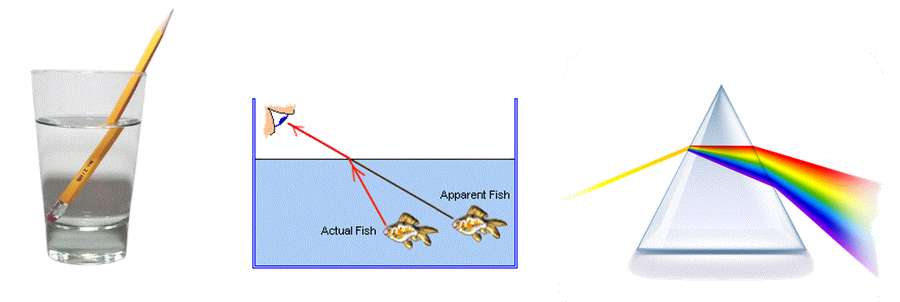
أمثلة من حياتنا: القلم يبدو مكسورًا في كوب الماء، والسمكة تبدو أقرب إلى السطح من موضعها الحقيقي، والمنشور يفرّق الضوء الأبيض إلى ألوانه.
Everyday examples: a pencil looks broken in a glass of water, a fish looks nearer to the surface than it really is, and a prism splits white light into its colours.
🔍 ماذا يتغير وماذا يبقى ثابتًا عند الانكسار؟
🔍 What changes and what stays constant?
- تتغير سرعة الموجة \(v\) لأن سرعة الضوء تعتمد على الوسط الذي يعبره.The speed of the wave \(v\) changes because the speed of light depends on the medium it crosses.
- يتغير الطول الموجي \(\lambda\) لأن \(v=f\lambda\) والتردد ثابت.The wavelength \(\lambda\) changes because \(v=f\lambda\) and the frequency is constant.
- يبقى التردد \(f\) ثابتًا لأن مصدر الموجات الساقطة والمنكسرة واحد؛ فعدد القمم التي تصل السطح في الثانية هو عدد القمم التي تغادره في الثانية نفسها.The frequency \(f\) stays constant because the source of the incident and refracted waves is the same: the number of crests reaching the boundary per second is the number leaving it per second.
💡 شرح إضافي: لماذا ينحرف الضوء؟
💡 Extra explanation: why does light bend?
تخيّل صفًّا من الجنود يسيرون معًا ثم يدخلون أرضًا طينية بزاوية: الجندي الذي يدخل الطين أولًا يبطؤ، بينما الذين خلفه ما زالوا يسيرون بسرعتهم، فيدور الصف كله وتتغير زاويته. وكذلك جبهة الموجة: الجزء الذي يدخل الوسط الأبطأ أولًا يتباطأ فيدور مستوى الجبهة وينحرف الشعاع المتعامد معها.
Imagine a row of soldiers marching together and entering a muddy field at an angle: the soldier who enters the mud first slows down while those behind keep their speed, so the whole row turns. A wavefront behaves the same way: the part that enters the slower medium first slows down, the wavefront turns, and the ray perpendicular to it bends.
لهذا لا ينحرف الشعاع الساقط عموديًا على السطح: فجبهة الموجة تدخل الوسط كلها في اللحظة نفسها، فتتباطأ كلها معًا وتبقى تسير في الاتجاه نفسه (ولو تغيّرت السرعة).
This is why a ray falling perpendicular to the surface is not bent: the whole wavefront enters the medium at the same instant, so all of it slows down together and keeps moving in the same direction (although its speed changes).
🧪 تجربة 1: انكسار الموجة عند السطح الفاصل
🧪 Experiment 1: Refraction of a wave at a boundary
تسقط موجة مستوية من الوسط العلوي على السطح الفاصل. الخطوط الداكنة هي قمم الموجة، والسهم البرتقالي هو الشعاع. غيّر معاملي الانكسار وزاوية السقوط ولاحظ: يتغير الطول الموجي وسرعة الموجة في الوسط الثاني، بينما التردد ثابت لأن المصدر واحد، فينحرف الشعاع. ثم جرّب الأزرار الجاهزة، وراقب متى يحدث الانعكاس الكلي.
A plane wave falls from the upper medium onto the boundary. The dark lines are the wave crests and the orange arrow is the ray. Change the two refractive indices and the angle of incidence and notice that the wavelength and the speed of the wave change in the second medium while the frequency stays constant because the source is the same, so the ray bends. Then try the ready buttons and watch when total reflection occurs.
أي الكميات التالية تبقى ثابتة عند انتقال الضوء من الهواء إلى الماء؟
Which of the following quantities stays constant when light passes from air into water?
ضوء طوله الموجي \(589\ \mathrm{nm}\) في الهواء، دخل الماء (\(n=1.33\)). ما طوله الموجي في الماء تقريبًا؟
Light of wavelength \(589\ \mathrm{nm}\) in air enters water (\(n=1.33\)). What is its wavelength in water, approximately?
📐 أجزاء رسم الانكسار
📐 The Parts of a Refraction Diagram
قبل حل المسائل لا بد من إتقان تسمية عناصر الرسم. انظر إلى الشكل ثم اكتب في الجدول أسفله رقم كل عنصر.
Before solving problems you must be able to name the elements of the diagram. Look at the figure, then write the number of each element in the table below it.
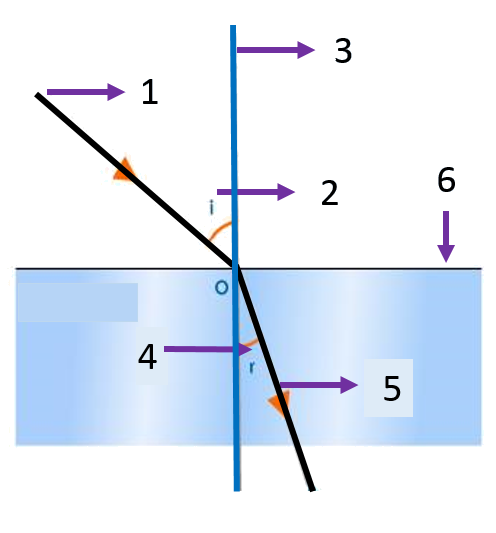
رسم انكسار الضوء: ست عناصر مرقمة من 1 إلى 6.
A refraction diagram with six elements numbered 1 to 6.
| العنصرElement | الرقمNumber |
|---|---|
| الشعاع الساقط يمثل الرقمThe incident ray is number | |
| الشعاع المنكسر يمثل الرقمThe refracted ray is number | |
| زاوية السقوط تمثل الرقمThe angle of incidence is number | |
| زاوية الانكسار تمثل الرقمThe angle of refraction is number | |
| العمود على السطح (العمود المقام) يمثل الرقمThe normal to the surface is number | |
| السطح الفاصل بين الوسطين يمثل الرقمThe boundary between the two media is number |
💡 شرح إضافي: كيف تقيس الزوايا؟
💡 Extra explanation: how are the angles measured?
تُقاس زاويتا السقوط والانكسار دائمًا من العمود المقام على السطح عند نقطة السقوط، وليس من السطح نفسه. فإذا أعطتك المسألة الزاوية بين الشعاع والسطح فاطرحها من \(90^{\circ}\) لتحصل على زاوية السقوط.
The angles of incidence and refraction are always measured from the normal to the surface at the point of incidence, not from the surface itself. If a problem gives the angle between the ray and the surface, subtract it from \(90^{\circ}\) to get the angle of incidence.
قانونا الانكسار: (1) يقع الشعاع الساقط والشعاع المنكسر والعمود المقام في مستوى واحد. (2) \(n_1\sin\theta_1=n_2\sin\theta_2\) (قانون سنل).
The two laws of refraction: (1) the incident ray, the refracted ray and the normal lie in one plane. (2) \(n_1\sin\theta_1=n_2\sin\theta_2\) (Snell's law).
🔢 معامل الانكسار
🔢 The Refractive Index
📘 معامل الانكسار
📘 The refractive index
معامل الانكسار لوسط ما هو النسبة بين سرعة الضوء في الفراغ \(c\) وسرعته في ذلك الوسط \(v\):
The refractive index of a medium is the ratio of the speed of light in a vacuum \(c\) to its speed in that medium \(v\):
\[n=\dfrac{c}{v}\qquad(c=3.00\times10^{8}\ \mathrm{m/s})\]
ليس له وحدة لأنه نسبة، وهو أكبر من 1 أو يساويه دائمًا (للفراغ \(n=1\)) لأن سرعة الضوء في الفراغ هي أكبر سرعة ممكنة. وكلما كبر \(n\) قلّت سرعة الضوء في الوسط.
It has no unit because it is a ratio, and it is always greater than or equal to 1 (\(n=1\) for a vacuum) because the speed of light in a vacuum is the greatest possible speed. The larger \(n\) is, the slower light travels in the medium.
| الوسطMedium | معامل الانكسار \(n\)Refractive index \(n\) | سرعة الضوء \(v\) (\(\times10^{8}\ \mathrm{m/s}\))Speed of light \(v\) (\(\times10^{8}\ \mathrm{m/s}\)) |
|---|---|---|
| الفراغVacuum | 1.00001.0000 | 3.003.00 |
| الهواءAir | 1.00031.0003 | 3.003.00 |
| الماءWater | 1.331.33 | 2.252.25 |
| الإيثانولEthanol | 1.361.36 | 2.202.20 |
| الزجاج العادي (كراون)Crown glass | 1.521.52 | 1.971.97 |
| الكوارتزQuartz | 1.541.54 | 1.951.95 |
| الزجاج الصواني (فلينت)Flint glass | 1.621.62 | 1.851.85 |
| الألماسDiamond | 2.422.42 | 1.241.24 |
القيم السابقة لضوء طوله الموجي \(589\ \mathrm{nm}\) (ضوء الصوديوم الأصفر)، فمعامل الانكسار يتغير قليلًا مع اللون.
The values above are for light of wavelength \(589\ \mathrm{nm}\) (yellow sodium light); the refractive index changes slightly with colour.
💡 شرح إضافي: الكثافة البصرية والطول الموجي
💡 Extra explanation: optical density and wavelength
يسمى الوسط الذي معامل انكساره أكبر أكثف بصريًا. والكثافة البصرية لا تعني الكثافة الكتلية دائمًا: فالزيت أخف من الماء لكن معامل انكساره أكبر منه.
A medium with a larger refractive index is called optically denser. Optical density does not always mean mass density: oil is lighter than water but its refractive index is larger.
بما أن التردد ثابت فإن \(\dfrac{\lambda_2}{\lambda_1}=\dfrac{v_2}{v_1}=\dfrac{n_1}{n_2}\)، وإذا كان الوسط الأول فراغًا أو هواءً فإن \(\lambda=\lambda_0/n\).
Since the frequency is constant, \(\dfrac{\lambda_2}{\lambda_1}=\dfrac{v_2}{v_1}=\dfrac{n_1}{n_2}\), and if the first medium is a vacuum or air then \(\lambda=\lambda_0/n\).
ما سرعة الضوء في الألماس (\(n=2.42\))؟ وما طول موجة ضوء أخضر (\(\lambda_0=550\ \mathrm{nm}\) في الهواء) داخله؟ وما ترددها؟
What is the speed of light in diamond (\(n=2.42\))? What is the wavelength inside it of green light (\(\lambda_0=550\ \mathrm{nm}\) in air), and what is its frequency?
سرعة الضوء في وسط شفاف \(2.0\times10^{8}\ \mathrm{m/s}\). ما معامل انكسار الوسط؟
The speed of light in a transparent medium is \(2.0\times10^{8}\ \mathrm{m/s}\). What is the refractive index of the medium?
↪️ اتجاه الانكسار
↪️ The Direction of Bending
يتحدد اتجاه الانحراف بمقارنة سرعة الضوء في الوسطين (أو معاملي الانكسار):
The direction of bending is decided by comparing the speed of light in the two media (or their refractive indices):
| الحالةCase | السرعة ومعامل الانكسارSpeed and refractive index | اتجاه الانكسارDirection of bending |
|---|---|---|
| من وسط سرعة الضوء فيه أكبر إلى وسط سرعته أقل (مثل هواء ← ماء)From a medium of larger speed to one of smaller speed (e.g. air → water) | \(v_2\lt v_1\ ,\ n_2\gt n_1\)\(v_2\lt v_1\ ,\ n_2\gt n_1\) | يقترب من العمود ( \(\theta_2\lt \theta_1\) )toward the normal ( \(\theta_2\lt \theta_1\) ) |
| من وسط سرعته أقل إلى وسط سرعته أكبر (مثل ماء ← هواء)From a medium of smaller speed to one of larger speed (e.g. water → air) | \(v_2\gt v_1\ ,\ n_2\lt n_1\)\(v_2\gt v_1\ ,\ n_2\lt n_1\) | يبتعد عن العمود ( \(\theta_2\gt \theta_1\) )away from the normal ( \(\theta_2\gt \theta_1\) ) |
| السقوط عموديًا على السطح الفاصلIncidence perpendicular to the boundary | \(\theta_1=0\)\(\theta_1=0\) | لا ينحرف الشعاع ( \(\theta_2=0\) ) وإن تغيّرت سرعتهthe ray is not deviated ( \(\theta_2=0\) ) although its speed changes |
| السقوط داخل الوسط نفسهTravelling inside the same medium | \(n_1=n_2\)\(n_1=n_2\) | لا يحدث انكسارno refraction occurs |
💡 شرح إضافي: كيف أتذكر الاتجاه؟
💡 Extra explanation: how to remember the direction
قاعدة عملية: «الأبطأ أقرب إلى العمود». الشعاع يكون دائمًا أقرب إلى العمود في الوسط الذي يبطئ فيه الضوء (معامل انكساره أكبر)، وأبعد عن العمود في الوسط الأسرع.
A practical rule: “slower is closer to the normal”. The ray is always closer to the normal in the medium where light is slower (larger refractive index) and farther from the normal in the faster medium.
هذا يفسّر لماذا تبدو أجسام تحت الماء أقرب إلى السطح: الأشعة الخارجة من الماء إلى الهواء تبتعد عن العمود، فيتتبعها دماغنا خطًا مستقيمًا إلى الخلف ويرى الجسم أعلى من موضعه. ولمراقب ينظر عموديًا يكون العمق الظاهري \(d^{\prime}=d\,\dfrac{n_2}{n_1}\)؛ فبركة عمقها \(2.0\ \mathrm{m}\) (\(n_1=1.33\)) تبدو بعمق نحو \(1.5\ \mathrm{m}\).
This explains why things under water look nearer to the surface: rays leaving the water into the air bend away from the normal, and our brain traces them back in straight lines and sees the object higher than it is. For an observer looking straight down the apparent depth is \(d^{\prime}=d\,\dfrac{n_2}{n_1}\); a pool \(2.0\ \mathrm{m}\) deep (\(n_1=1.33\)) looks about \(1.5\ \mathrm{m}\) deep.
ينتقل شعاع ضوئي من الهواء إلى الزجاج بزاوية سقوط \(40^{\circ}\). في أي اتجاه ينكسر؟
A light ray passes from air into glass with an angle of incidence of \(40^{\circ}\). In which direction is it refracted?
📏 قانون سنل
📏 Snell's Law
اكتشف العالم الهولندي سنل عام 1621 علاقة رياضية بسيطة بين زاويتي السقوط والانكسار ومعاملي انكسار الوسطين:
In 1621 the Dutch scientist Snell discovered a simple mathematical relation between the angles of incidence and refraction and the refractive indices of the two media:
📘 قانون سنل
📘 Snell's law
\[n_1\sin\theta_1=n_2\sin\theta_2\]
\(n_1\): معامل انكسار الوسط الأول (الذي يأتي منه الضوء)، \(n_2\): معامل انكسار الوسط الثاني، \(\theta_1\): زاوية السقوط، \(\theta_2\): زاوية الانكسار (كلتاهما تقاس من العمود).
\(n_1\): refractive index of the first medium (where the light comes from), \(n_2\): refractive index of the second medium, \(\theta_1\): angle of incidence, \(\theta_2\): angle of refraction (both measured from the normal).
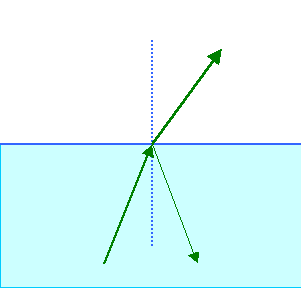
شعاع ضوئي يصل إلى السطح الفاصل بين وسطين: ينكسر جزء منه وينعكس جزء آخر.
A light ray reaching the boundary between two media: part of it is refracted and part is reflected.
💡 شرح إضافي: خطوات حل مسائل قانون سنل
💡 Extra explanation: steps for solving Snell's-law problems
- ارسم الشكل وحدّد العمود، وسمِّ الوسط الأول (الذي يأتي منه الضوء) والثاني.Draw the figure, mark the normal and name the first medium (where the light comes from) and the second.
- تأكد أن الزاوية المعطاة تقاس من العمود لا من السطح.Make sure the given angle is measured from the normal, not from the surface.
- عوّض في \(\sin\theta_2=\dfrac{n_1}{n_2}\sin\theta_1\).Substitute into \(\sin\theta_2=\dfrac{n_1}{n_2}\sin\theta_1\).
- إن كانت النتيجة أكبر من 1 فلا انكسار: انعكاس كلي. وإلا فاحسب \(\theta_2=\sin^{-1}(\ldots)\) وتحقق أن الاتجاه (نحو العمود أو بعيدًا عنه) منطقي.If the result is greater than 1 there is no refraction: total internal reflection. Otherwise calculate \(\theta_2=\sin^{-1}(\ldots)\) and check that the direction (toward or away from the normal) makes sense.
🧪 تجربة 2: تحقق من قانون سنل
🧪 Experiment 2: Verifying Snell's law
اختر الوسطين وغيّر زاوية السقوط. يحسب البرنامج الطرفين \(n_1\sin\theta_1\) و\(n_2\sin\theta_2\) ويعرضهما: ستجدهما متساويين في كل مرة. ثم احسب زاوية الانكسار بنفسك وتحقق من إجابتك.
Choose the two media and change the angle of incidence. The program calculates both sides \(n_1\sin\theta_1\) and \(n_2\sin\theta_2\) and shows them: they are equal every time. Then calculate the angle of refraction yourself and check your answer.
ينتقل ضوء من الهواء (\(n=1\)) إلى الماء (\(n=1.33\)) بزاوية سقوط \(30^{\circ}\). احسب زاوية الانكسار.
Light passes from air (\(n=1\)) into water (\(n=1.33\)) with an angle of incidence of \(30^{\circ}\). Find the angle of refraction.
ينتقل الضوء من الماء (\(n=1.33\)) إلى الهواء بزاوية سقوط \(40^{\circ}\). احسب زاوية الانكسار، وبيّن اتجاه الانحراف.
Light passes from water (\(n=1.33\)) into air with an angle of incidence of \(40^{\circ}\). Find the angle of refraction and the direction of bending.
سقط شعاع من الهواء على سطح زجاج (\(n=1.5\)) بزاوية سقوط \(30^{\circ}\). ما زاوية الانكسار؟
A ray falls from air onto glass (\(n=1.5\)) with an angle of incidence of \(30^{\circ}\). What is the angle of refraction?
ينتقل الضوء من الماء (\(n=1.33\)) إلى الهواء بزاوية سقوط \(30^{\circ}\). زاوية الانكسار في الهواء:
Light passes from water (\(n=1.33\)) into air with an angle of incidence of \(30^{\circ}\). The angle of refraction in air is:
شعاع من الهواء يسقط على مادة مجهولة بزاوية \(45^{\circ}\) فينكسر بزاوية \(30^{\circ}\). ما معامل انكسار المادة؟
A ray from air falls on an unknown material at \(45^{\circ}\) and is refracted at \(30^{\circ}\). What is the refractive index of the material?
💎 الزاوية الحرجة والانعكاس الكلي الداخلي
💎 The Critical Angle and Total Internal Reflection
أسقط ضوءًا من وسط معامل انكساره أكبر إلى وسط معامل انكساره أقل (مثل ماء ← هواء). يبتعد الشعاع المنكسر عن العمود، فتكون زاوية الانكسار أكبر من زاوية السقوط. وكلما زدنا زاوية السقوط اقتربت زاوية الانكسار من \(90^{\circ}\).
Send light from a medium of larger refractive index into one of smaller index (such as water → air). The refracted ray bends away from the normal, so the angle of refraction is larger than the angle of incidence. As we increase the angle of incidence the angle of refraction approaches \(90^{\circ}\).
📘 الزاوية الحرجة
📘 The critical angle
الزاوية الحرجة \(\theta_c\) هي زاوية السقوط (في الوسط الأكثف) التي تقابلها زاوية انكسار \(90^{\circ}\). من قانون سنل: \(n_1\sin\theta_c=n_2\sin90^{\circ}\) فيكون:
The critical angle \(\theta_c\) is the angle of incidence (in the denser medium) for which the angle of refraction is \(90^{\circ}\). From Snell's law \(n_1\sin\theta_c=n_2\sin90^{\circ}\), so:
\[\sin\theta_c=\dfrac{n_2}{n_1}\qquad(n_1\gt n_2)\]
📘 الانعكاس الكلي الداخلي
📘 Total internal reflection
إذا زادت زاوية السقوط عن الزاوية الحرجة (\(\theta_1\gt \theta_c\)) لا ينكسر الضوء بل ينعكس كليًا داخل الوسط الأكثف. شرطا حدوثه: (1) انتقال الضوء من وسط أكثف بصريًا إلى وسط أقل كثافة (\(n_1\gt n_2\))، و(2) زاوية السقوط أكبر من الزاوية الحرجة.
If the angle of incidence exceeds the critical angle (\(\theta_1\gt \theta_c\)) the light is not refracted but is totally reflected inside the denser medium. Two conditions are needed: (1) the light goes from an optically denser medium to a less dense one (\(n_1\gt n_2\)), and (2) the angle of incidence is greater than the critical angle.
💡 شرح إضافي: لماذا لا توجد زاوية حرجة عند الدخول إلى وسط أكثف؟
💡 Extra explanation: why is there no critical angle when entering a denser medium?
عندما يدخل الضوء وسطًا أكثف (\(n_2\gt n_1\)) يكون \(\sin\theta_2=\dfrac{n_1}{n_2}\sin\theta_1\lt 1\) مهما كانت \(\theta_1\)، فهناك دائمًا زاوية انكسار ممكنة (أكبر قيمة لها \(\theta_c\) نفسها عند \(\theta_1=90^{\circ}\)). أما في الانتقال إلى وسط أخف فقد يصبح \(\dfrac{n_1}{n_2}\sin\theta_1\gt 1\) وهذا مستحيل رياضيًا، فلا يوجد شعاع منكسر.
When light enters a denser medium (\(n_2\gt n_1\)) we get \(\sin\theta_2=\dfrac{n_1}{n_2}\sin\theta_1\lt 1\) whatever \(\theta_1\) is, so a refracted ray always exists (its largest angle is \(\theta_c\) itself, at \(\theta_1=90^{\circ}\)). When going into a less dense medium, \(\dfrac{n_1}{n_2}\sin\theta_1\) can exceed 1, which is impossible, so no refracted ray exists.
ملاحظة: حتى قبل الزاوية الحرجة ينعكس جزء ضعيف من الضوء عند السطح الفاصل، وعند الزاوية الحرجة وما بعدها يصبح الانعكاس كاملًا (100%).
Note: even before the critical angle a weak part of the light is reflected at the boundary, and at and beyond the critical angle the reflection becomes complete (100%).
🧪 تجربة 3: الزاوية الحرجة والانعكاس الكلي
🧪 Experiment 3: The critical angle and total internal reflection
الضوء يسقط من الوسط الأسفل (الأكثف) إلى الأعلى. زد زاوية السقوط تدريجيًا وراقب زاوية الانكسار تقترب من \(90^{\circ}\) عند الزاوية الحرجة، وبعدها يختفي الشعاع المنكسر ويحدث انعكاس كلي. ثم احسب الزاوية الحرجة للزوج المعروض.
The light falls from the lower (denser) medium upward. Increase the angle of incidence gradually and watch the angle of refraction approach \(90^{\circ}\) at the critical angle; beyond it the refracted ray disappears and total reflection occurs. Then calculate the critical angle for the pair shown.
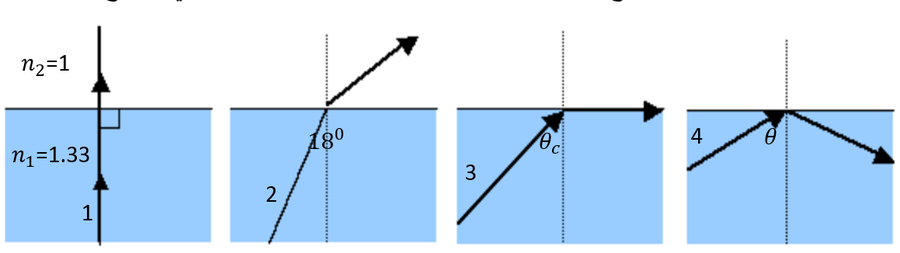
أربعة أشعة تسقط من الماء إلى الهواء: (1) عمودي، (2) زاوية \(18^{\circ}\)، (3) زاوية حرجة، (4) أكبر من الحرجة.
Four rays going from water to air: (1) perpendicular, (2) at \(18^{\circ}\), (3) at the critical angle, (4) greater than critical.
في الشكل أربع حالات لسقوط الضوء من الماء (\(n=1.33\)) إلى الهواء. (أ) الشعاع 1 لم ينكسر: لماذا؟ (ب) احسب زاوية الانكسار للشعاع 2 (زاوية سقوطه \(18^{\circ}\)). (ج) احسب الزاوية الحرجة للشعاع 3. (د) لماذا حدث انعكاس كلي للشعاع 4؟
The figure shows four cases of light falling from water (\(n=1.33\)) into air. (a) Ray 1 was not deviated: why? (b) Find the angle of refraction of ray 2 (its angle of incidence is \(18^{\circ}\)). (c) Find the critical angle for ray 3. (d) Why did ray 4 undergo total reflection?
ما الزاوية الحرجة لانتقال الضوء من الزجاج (\(n=1.5\)) إلى الهواء؟
What is the critical angle for light going from glass (\(n=1.5\)) to air?
أي الشرطين التاليين يلزم معًا لحدوث الانعكاس الكلي الداخلي؟
Which pair of conditions is needed together for total internal reflection?
🌐 تطبيقات الانعكاس الكلي
🌐 Applications of Total Internal Reflection
🔗 الألياف البصرية
🔗 Optical fibres
الليف البصري خيط رفيع من الزجاج أو البلاستيك له قلب معامل انكساره أكبر، يحيط به غلاف معامل انكساره أقل. يدخل الضوء من أحد الطرفين ويسقط على جدار القلب بزاوية أكبر من الزاوية الحرجة فينعكس كليًا مرة بعد مرة (دون فقد يُذكر) حتى يخرج من الطرف الآخر ولو انحنى الليف. وتستخدم في نقل الإنترنت والاتصالات.
An optical fibre is a thin strand of glass or plastic with a core of larger refractive index surrounded by a cladding of smaller index. Light enters at one end and meets the wall of the core at an angle larger than the critical angle, so it is totally reflected again and again (with negligible loss) until it leaves at the other end, even if the fibre is bent. They carry internet and telecommunication signals.
🧪 تجربة 4: الليف البصري: ضوء محبوس بالانعكاس الكلي
🧪 Experiment 4: The optical fibre: light trapped by total internal reflection
يدخل الشعاع من الهواء إلى قلب الليف ثم يصطدم بجداره. غيّر زاوية الدخول ومعاملي انكسار القلب والغلاف: إذا كانت زاوية سقوط الشعاع على الجدار أكبر من الزاوية الحرجة انعكس كليًا وسار على طول الليف، وإلا تسرب الضوء إلى الغلاف.
The ray enters the core of the fibre from the air and then strikes its wall. Change the entry angle and the refractive indices of the core and the cladding: if the angle at which the ray meets the wall is greater than the critical angle it is totally reflected and travels along the fibre; otherwise the light leaks into the cladding.
📌 تطبيقات أخرى
📌 Other applications
- المناظير الطبية: حزم من الألياف تنقل الضوء إلى داخل الجسم والصورة إلى الخارج لفحص الأعضاء دون جراحة.Medical endoscopes: bundles of fibres carry light into the body and the image out, to examine organs without surgery.
- العاكسات الضوئية: في إشارات المرور وعاكسات الدراجات والسيارات تنعكس الأشعة كليًا داخل منشورات صغيرة فتعود نحو مصدرها.Reflectors: in road signs and bicycle or car reflectors the rays are totally reflected inside small prisms and return toward their source.
- تألق الألماس: زاويته الحرجة صغيرة (\(\approx24.4^{\circ}\)) لأن معامل انكساره كبير (2.42)، فيحبس الضوء بانعكاسات كلية متعددة قبل أن يخرج من أوجهه المقطوعة بعناية.The sparkle of diamond: its critical angle is small (\(\approx24.4^{\circ}\)) because its refractive index is large (2.42), so it traps light by many total reflections before it leaves through its carefully cut faces.
- السراب: ينكسر الضوء في طبقات الهواء الساخن قرب الأرض (أقل كثافة بصرية) وينعكس كليًا فنرى «بركة» مائية وهمية.Mirages: light is refracted in the layers of hot air near the ground (optically less dense) and totally reflected, so we see an imaginary “pool” of water.
لماذا يجب أن يكون معامل انكسار غلاف الليف البصري أقل من معامل انكسار قلبه؟
Why must the refractive index of the cladding of an optical fibre be less than that of its core?
قيمة الزاوية الحرجة لانتقال الضوء من الألماس (\(n=2.42\)) إلى الهواء تقريبًا:
The critical angle for light going from diamond (\(n=2.42\)) to air is approximately:
بركة عمقها الحقيقي \(2.0\ \mathrm{m}\) (\(n=1.33\)) تُرى من الأعلى عموديًا. ما عمقها الظاهري تقريبًا؟
A pool of real depth \(2.0\ \mathrm{m}\) (\(n=1.33\)) is viewed vertically from above. What is its apparent depth, approximately?
📚 ملخص الدرس
📚 Lesson Summary
| المفهومConcept | الفكرة / القانونIdea / Law |
|---|---|
| الانكسارRefraction | تغير اتجاه الضوء عند الانتقال بين وسطين؛ تتغير \(v\) و\(\lambda\) ويبقى \(f\) ثابتًاthe light changes direction on passing between two media; \(v\) and \(\lambda\) change while \(f\) stays constant |
| معامل الانكسارRefractive index | \(n=\dfrac{c}{v}\ge1\)\(n=\dfrac{c}{v}\ge1\) |
| الاتجاهDirection | إلى وسط أبطأ: نحو العمود؛ إلى وسط أسرع: بعيدًا عنه؛ عموديًا: لا ينحرفinto a slower medium: toward the normal; into a faster one: away; perpendicular: not deviated |
| قانون سنلSnell's law | \(n_1\sin\theta_1=n_2\sin\theta_2\)\(n_1\sin\theta_1=n_2\sin\theta_2\) |
| الزاوية الحرجةCritical angle | \(\sin\theta_c=\dfrac{n_2}{n_1}\ ,\ n_1\gt n_2\)\(\sin\theta_c=\dfrac{n_2}{n_1}\ ,\ n_1\gt n_2\) |
| الانعكاس الكليTotal reflection | \(n_1\gt n_2\) و\(\theta_1\gt \theta_c\)\(n_1\gt n_2\) and \(\theta_1\gt \theta_c\) |
⚠️ أخطاء شائعة
⚠️ Common mistakes
- قياس الزاوية من السطح بدلًا من العمود.Measuring the angle from the surface instead of from the normal.
- عكس ترتيب \(n_1\) و\(n_2\) في قانون سنل؛ \(n_1\) دائمًا للوسط الذي يأتي منه الضوء.Swapping \(n_1\) and \(n_2\) in Snell's law; \(n_1\) always belongs to the medium the light comes from.
- الاعتقاد أن التردد أو اللون يتغير عند الانكسار؛ يتغير الطول الموجي والسرعة فقط.Thinking that the frequency or colour changes on refraction; only the wavelength and the speed change.
- البحث عن زاوية حرجة عند الانتقال إلى وسط أكثف؛ لا توجد زاوية حرجة إلا إذا كان \(n_1\gt n_2\).Looking for a critical angle when entering a denser medium; there is none unless \(n_1\gt n_2\).
🧪 اختبر نفسك: امتحان من 20 سؤالاً
🧪 Test Yourself: a 20-Question Exam
أنهِ الدرس بالاختبار التفاعلي التالي؛ أسئلته تجمع بين الفهم والحساب وتغطي جميع أقسام الدرس.
Finish with the interactive exam below; its questions mix understanding with calculation and cover every section of the lesson.
اختبار انكسار الضوء وقانون سنل Refraction of Light and Snell's Law Quiz
20 سؤالاً - معامل الانكسار، قانون سنل، الزاوية الحرجة، والانعكاس الكلي الداخلي 20 Questions - Refractive Index, Snell's Law, the Critical Angle and Total Internal Reflection
• عدد الأسئلة: 20 سؤالاً
• مدة الاختبار: 30 دقيقة
• لا يمكنك تغيير إجاباتك أو إعادة الاختبار إلا بعد 24 ساعة من التسليم.
• تأكد من إجاباتك قبل التسليم! 📌 Important Instructions:
• Number of questions: 20 questions
• Quiz duration: 30 minutes
• You cannot change your answers or retake the quiz for 24 hours after submission.
• Make sure of your answers before submitting!
🔗 محاكيات GeoGebra للاستعانة بها عند اللزوم
🔗 GeoGebra Simulations to Use When Needed
اضغط «تشغيل» لتعمل المحاكاة هنا داخل الدرس؛ ويمكن للطالب الرجوع إليها لتجربة الفكرة بطريقة أخرى.
Press “Run” to run the simulation right here inside the lesson; the student can use it to try the idea in another way.