🎯 نواتج التعلم
🎯 Learning Outcomes
بعد دراسة هذا الدرس ستكون قادرًا على أن:
After this lesson you will be able to:
- تفسّر نشوء ق.د.ك. حركية في سلك يقطع خطوط المجال وتحسبها \(\Delta V=BLv\sin\theta\).Explain how a motional emf arises in a wire cutting field lines and calculate it \(\Delta V=BLv\sin\theta\).
- تحدد اتجاه التيار المستحث وقوة المجال المعاكسة لحركة القضيب وتحسب القدرة.Find the direction of the induced current and of the magnetic force opposing the rod’s motion and calculate the power.
- تفرّق بين المحرك والمولد، وبين مولد التيار المتردد والمستمر، وتحسب \(\varepsilon_{max}=NBA\omega\).Distinguish a motor from a generator and an AC from a DC generator, and calculate \(\varepsilon_{max}=NBA\omega\).
- تشرح المجال الكهربائي المستحث وتكتب \(\oint\vec E\cdot d\vec\ell=-\dfrac{d\Phi_B}{dt}\).Explain the induced electric field and write \(\oint\vec E\cdot d\vec\ell=-\dfrac{d\Phi_B}{dt}\).
- تعرّف الحث الذاتي ومعامل \(L\) وتحسب \(L=\dfrac{\mu_0N^2A}{\ell}\) والثابت الزمني \(\tau=\dfrac{L}{R}\).Define self-induction and the coefficient \(L\) and calculate \(L=\dfrac{\mu_0N^2A}{\ell}\) and the time constant \(\tau=\dfrac{L}{R}\).
- تفسّر الحث المتبادل وتستخدم \(\varepsilon_2=-M\dfrac{di_1}{dt}\).Explain mutual induction and use \(\varepsilon_2=-M\dfrac{di_1}{dt}\).
🧲 ظاهرة الحث الكهرومغناطيسي: سلك يقطع خطوط المجال
🧲 Electromagnetic Induction: a Wire Cutting Field Lines
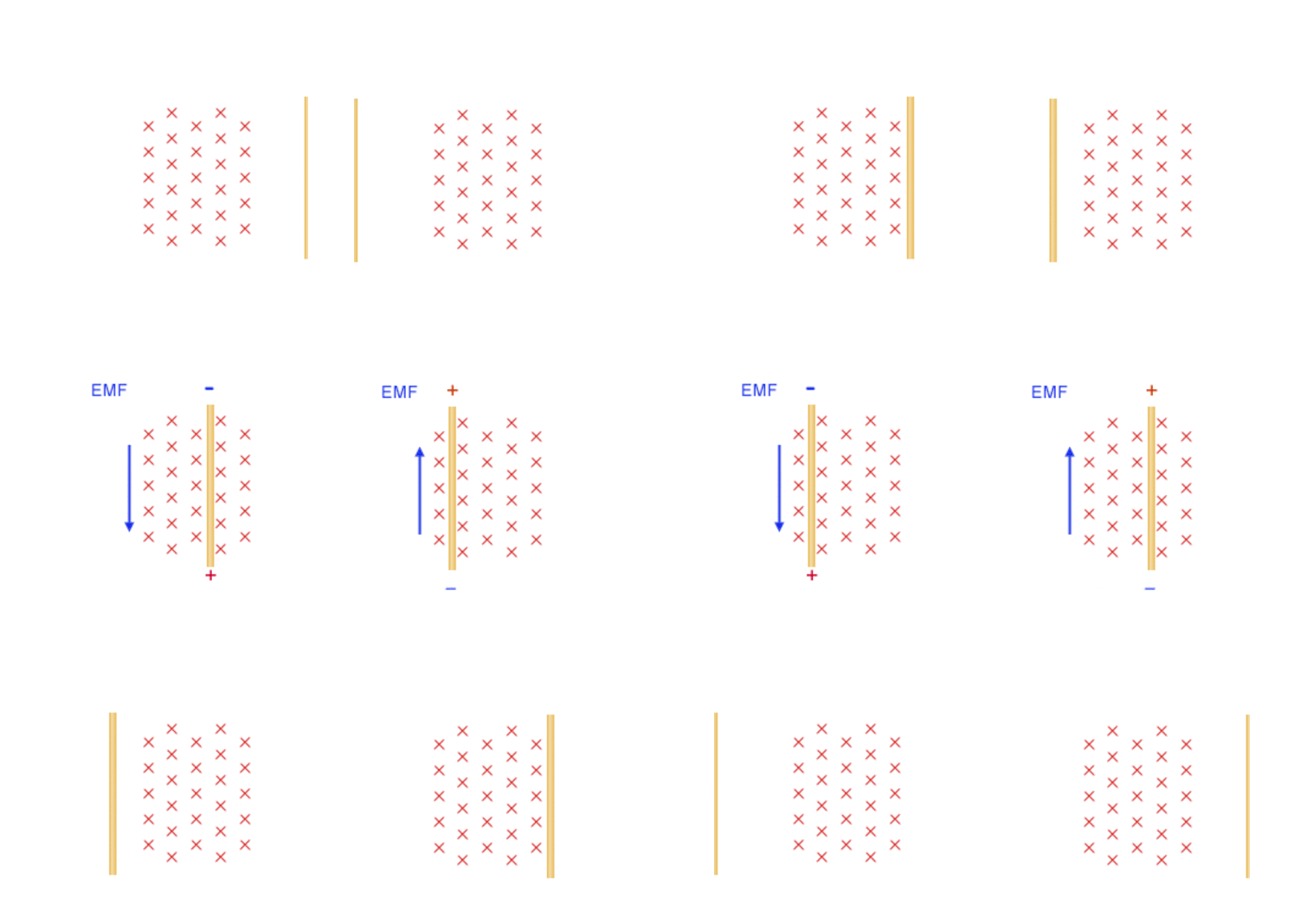
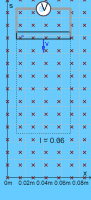
سلك موصل يتحرك عموديًا على خطوط المجال المغناطيسي (علامات × نحو الصفحة).
A conducting wire moving perpendicular to the magnetic field lines (× marks into the page).
عندما يتحرك سلك موصل بحيث يقطع خطوط المجال المغناطيسي وهو جزء من دائرة مغلقة، تتولد بين طرفيه قوة محركة مستحثة (ق.د.ك.) ويمر فيه تيار مستحث. السبب كما يلي:
When a conducting wire moves so that it cuts the magnetic field lines and is part of a closed circuit, an induced emf arises between its ends and an induced current flows. The reason is as follows:
🔬 كيف تنشأ ق.د.ك. الحركة؟
🔬 How does the motional emf arise?
- يتحرك السلك بسرعة \(v\) فتتحرك معه إلكتروناته الحرة وتتأثر بقوة مغناطيسية \(\vec F_B=q\vec v\times\vec B\).The wire moves with velocity \(v\) so its free electrons move with it and feel a magnetic force \(\vec F_B=q\vec v\times\vec B\).
- تندفع الإلكترونات نحو أحد طرفي السلك مخلّفةً شحنة موجبة في الطرف الآخر.The electrons are pushed toward one end of the wire, leaving positive charge at the other end.
- ينشأ داخل السلك مجال كهربائي متزايد \(E\) يؤثر في الشحنات بقوة كهربائية معاكسة للقوة المغناطيسية.An increasing electric field \(E\) arises inside the wire and acts on the charges with an electric force opposite to the magnetic force.
- يتوقف انفصال الشحنات عندما تتساوى القوتان.The separation of charge stops when the two forces become equal.
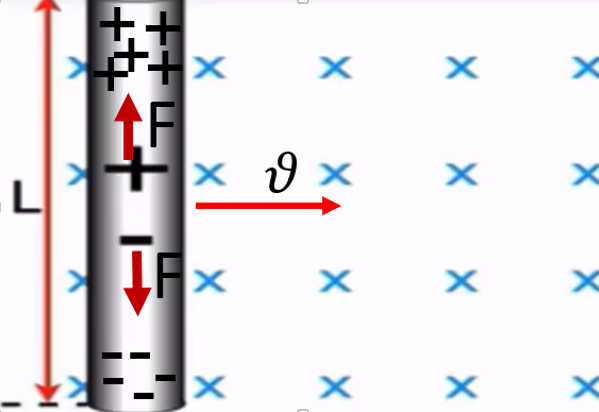
الشحنات تنفصل في السلك المتحرك: القوة المغناطيسية \(F\) على كل شحنة وفرق جهد بين الطرفين.
The charges separate in the moving wire: the magnetic force \(F\) acts on each charge and a potential difference appears between the ends.
📘 ق.د.ك. الحركية
📘 The motional emf
عند التوازن:
At equilibrium:
\[F_E=F_B\ \Rightarrow\ qE=qvB\ \Rightarrow\ E=vB\]
وبما أن المجال داخل السلك المنتظم \(E=\dfrac{\Delta V}{L}\):
and since the field inside the uniform wire is \(E=\dfrac{\Delta V}{L}\):
\[\Delta V_{ind}=BLv\]
\[\Delta V_{ind}=BLv\sin\theta\]
حيث \(\theta\) هي الزاوية بين سرعة السلك والمجال المغناطيسي.
where \(\theta\) is the angle between the velocity of the wire and the magnetic field.
إذا كان السلك جزءًا من دائرة مغلقة يمر تيار خارج السلك من القطب الموجب إلى السالب، وداخل السلك (الذي يعمل كمصدر) من السالب إلى الموجب.
If the wire is part of a closed circuit a current flows outside the wire from the positive terminal to the negative one, and inside the wire (which acts as the source) from the negative to the positive.
💡 شرح إضافي: ثلاث طرق للنظر إلى الظاهرة نفسها
💡 Extra explanation: three ways to look at the same phenomenon
1) القوة على الشحنات: \(\Delta V=BLv\) كما اشتققناه. 2) تغير التدفق: إذا انزلق القضيب على سكتين مسافة \(x\) فمساحة الدائرة \(Lx\) والتدفق \(\Phi=BLx\)، فيكون \(\varepsilon=\dfrac{d\Phi}{dt}=BL\dfrac{dx}{dt}=BLv\) (النتيجة نفسها). 3) الطاقة: التيار المستحث \(I=\dfrac{BLv}{R}\) يمر في القضيب داخل المجال فتؤثر فيه قوة \(F=BIL=\dfrac{B^2L^2v}{R}\) تعاكس حركته (قانون لنز)؛ لذلك نبذل قوة خارجية مساوية لها لنحافظ على السرعة، وشغلنا يتحول إلى حرارة في المقاومة: \(Fv=\dfrac{(BLv)^2}{R}=\Delta V\,I\). لو لم تعاكس القوة الحركة لحصلنا على طاقة من لا شيء!
1) Force on the charges: \(\Delta V=BLv\) as derived. 2) Change of flux: if the rod slides a distance \(x\) on two rails the area is \(Lx\) and the flux \(\Phi=BLx\), so \(\varepsilon=\dfrac{d\Phi}{dt}=BL\dfrac{dx}{dt}=BLv\) (the same result). 3) Energy: the induced current \(I=\dfrac{BLv}{R}\) flows in the rod inside the field so a force \(F=BIL=\dfrac{B^2L^2v}{R}\) acts on it opposing its motion (Lenz’s law); so we must apply an equal external force to keep the speed constant, and our work becomes heat in the resistor: \(Fv=\dfrac{(BLv)^2}{R}=\Delta V\,I\). If the force did not oppose the motion we would get energy from nothing!
🧪 تجربة 1: سلك موصل يتحرك في مجال مغناطيسي (الحث الحركي)
🧪 Experiment 1: A conductor moving in a magnetic field (motional emf)
ينزلق قضيب موصل طوله \(L\) بسرعة ثابتة \(v\) على سكتين موصولتين بمقاومة \(R\) داخل مجال \(B\) عمودي على المستوى. تؤثر القوة المغناطيسية على الشحنات فتنشأ ق.د.ك. \(\Delta V=BLv\) ويمر تيار \(I=\dfrac{\Delta V}{R}\)، وتؤثر على القضيب قوة \(F=BLI\) تعاكس حركته؛ فلا بد من قوة خارجية مساوية لها لإبقاء السرعة ثابتة، وقدرتها \(Fv\) تساوي القدرة الحرارية \(\Delta V\,I\). غيّر المتغيرات وراقب الأرقام. (حركة القضيب مبطّأة.)
A conducting rod of length \(L\) slides at constant speed \(v\) on two rails joined by a resistor \(R\) in a field \(B\) perpendicular to the plane. The magnetic force acts on the charges so an emf \(\Delta V=BLv\) arises and a current \(I=\dfrac{\Delta V}{R}\) flows, and a force \(F=BLI\) acts on the rod opposing its motion; an equal external force is needed to keep the speed constant, and its power \(Fv\) equals the heating power \(\Delta V\,I\). Change the variables and watch the numbers. (The rod moves in slowed motion.)
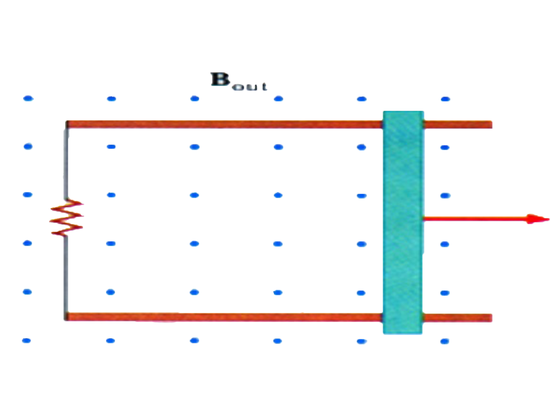
قضيب موصل يتحرك على سكة بدون احتكاك متصلة بمقاومة، والمجال خارج الصفحة (للمثال 1).
A conducting rod moving on a frictionless rail connected to a resistor, the field is out of the page (for Example 1).
سلك موصل طوله \(0.2\ \mathrm{m}\) حُرّك بسرعة عمودية على المجال مقدارها \(20\ \mathrm{m/s}\) على سكة بدون احتكاك متصلة بمقاومة \(5\ \Omega\)، وشدة المجال \(B=0.2\ \mathrm{T}\). احسب التيار المستحث في المقاومة والقوة الخارجية اللازمة لإبقاء السرعة ثابتة وقدرتها.
A conducting wire of length \(0.2\ \mathrm{m}\) is moved at \(20\ \mathrm{m/s}\) perpendicular to the field along a frictionless rail connected to a resistance of \(5\ \Omega\); the field is \(B=0.2\ \mathrm{T}\). Calculate the induced current in the resistor, the external force needed to keep the speed constant and its power.
سلك يتحرك بسرعة \(v\) موازية لخطوط المجال المغناطيسي. فرق الجهد المستحث بين طرفيه:
A wire moves with speed \(v\) parallel to the magnetic field lines. The induced potential difference between its ends is:
إذا تضاعفت سرعة القضيب وتضاعفت شدة المجال معًا فإن \(\Delta V_{ind}\):
If the speed of the rod and the field strength are both doubled, \(\Delta V_{ind}\):
القوة المغناطيسية التي يؤثر بها المجال في قضيب يمر فيه تيار مستحث ويتحرك:
The magnetic force exerted by the field on a rod carrying an induced current while moving:
🚁 قضيب أو مروحة تدور حول طرفها
🚁 A Rod or a Propeller Rotating About One End
في مروحة أو عقرب يدور حول محور في مجال \(B\) تختلف سرعة نقاطه: النقطة على بُعد \(r\) من المحور سرعتها \(v=\omega r\). لا يمكن استخدام \(BLv\) بسرعة واحدة، فنجمع الإسهامات الصغيرة:
In a propeller or a hand rotating about an axis in a field \(B\) the points have different speeds: a point at a distance \(r\) from the axis has speed \(v=\omega r\). We cannot use \(BLv\) with one speed so we add the small contributions:
📘 ق.د.ك. في ساق تدور حول طرفها
📘 The emf in a rod rotating about its end
\[d(\Delta V)=B\,v\,dr=B\,\omega r\,dr\]
\[\Delta V_{ind}=\int_0^{L}B\omega r\,dr=\dfrac12B\omega L^2\]
(المتوسط: سرعة منتصف الساق \(\omega L/2\) فيكون \(B L\cdot\omega L/2\)).
(Check: the speed of the middle of the rod is \(\omega L/2\) so \(BL\cdot\omega L/2\)).
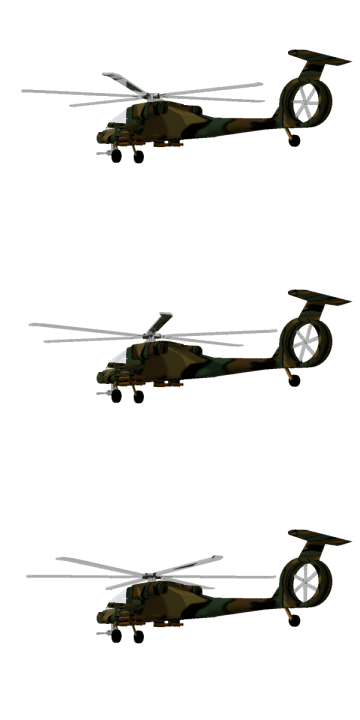
مروحية تحلق أفقيًا؛ مراوحها تقطع المجال المغناطيسي للأرض (للمثال 2).
A helicopter flying horizontally; its blades cut the Earth’s magnetic field (for Example 2).
مروحية مراوحها من الألمنيوم قطر دورانها \(8\ \mathrm{m}\) (طول كل ريشة من المحور \(4\ \mathrm{m}\)) تطير أفقيًا فوق الإمارات حيث شدة المجال \(0.4\times10^{-4}\ \mathrm{T}\) ومروحتها تدور بسرعة زاوية \(200\ \mathrm{rad/s}\). احسب فرق الجهد المستحث بين المحور وطرف الريشة.
A helicopter with aluminium blades whose rotation diameter is \(8\ \mathrm{m}\) (each blade is \(4\ \mathrm{m}\) from the axis) flies horizontally over the Emirates where the field is \(0.4\times10^{-4}\ \mathrm{T}\) and the propeller turns at \(200\ \mathrm{rad/s}\). Calculate the induced potential difference between the axis and the tip of a blade.
سلك طوله \(0.4\ \mathrm{m}\) يتحرك بسرعة \(10\ \mathrm{m/s}\) في مجال \(0.5\ \mathrm{T}\) بحيث تصنع سرعته مع المجال زاوية \(30^\circ\). احسب ق.د.ك. المستحثة.
A wire of length \(0.4\ \mathrm{m}\) moves at \(10\ \mathrm{m/s}\) in a field of \(0.5\ \mathrm{T}\) with its velocity making an angle of \(30^\circ\) with the field. Calculate the induced emf.
🏭 المولدات والمحركات
🏭 Generators and Motors
| الأداةDevice | تحول الطاقةEnergy conversion | المبدأPrinciple |
|---|---|---|
| المحرك الكهربائيElectric motor | كهربائية ← حركيةelectrical → kinetic | قوة مغناطيسية على ملف يمر فيه تيار (عزم)magnetic force on a current-carrying coil (torque) |
| المولد الكهربائيElectric generator | حركية ← كهربائيةkinetic → electrical | تغير التدفق عبر ملف يدور (حث كهرومغناطيسي)change of flux through a rotating coil (induction) |
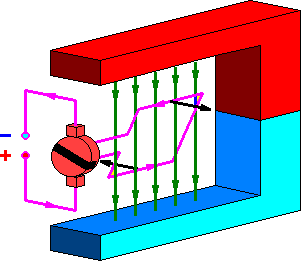
المحرك: بطارية تمرر تيارًا في ملف داخل المجال فتتولد قوتان تُديران الملف.
The motor: a battery passes a current through a coil in the field so two forces turn the coil.
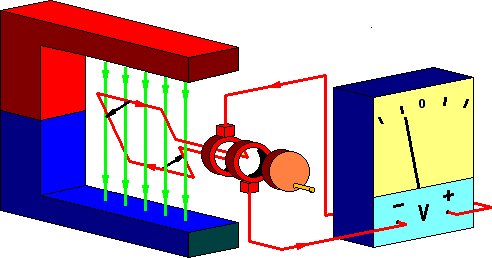
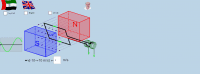
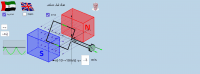
المولد: تُدار الحلقة ميكانيكيًا داخل المجال فيتولد تيار يسجله الفولتميتر.
The generator: the loop is turned mechanically in the field so a current is produced and recorded by the voltmeter.
المولد جهاز يحوّل الطاقة الميكانيكية إلى طاقة كهربائية بتغيير التدفق المغناطيسي عبر ملف، فتُستحث ق.د.ك. بين طرفيه. نظريًا يمكن تغيير التدفق بتحريك المغناطيس بالنسبة للملف أو الملف بالنسبة للمغناطيس، والثانية أسهل عمليًا فهي المستخدمة غالبًا.
The generator is a device that converts mechanical energy into electrical energy by changing the magnetic flux through a coil so an emf is induced between its ends. In theory the flux can be changed by moving the magnet relative to the coil or the coil relative to the magnet; the second is easier in practice and is the one usually used.
⚙️ ما الذي يُدير الملف عمليًا؟
⚙️ What turns the coil in practice?
نحتاج طاقة تُدير الملف داخل المجال، وتختلف مصادرها:
We need energy to turn the coil in the field, and its sources differ:
- طاقة الرياح والمياه الساقطة: تدير الريش أو العنفات مباشرةً.Wind energy and falling water: they turn the blades or turbines directly.
- الوقود الأحفوري (الفحم) والغاز والنفط والطاقة النووية والطاقة الشمسية المركّزة وغاز الصرف الصحي الحيوي: تُسخّن الماء فيتبخر ويدير بخاره العنفة.Fossil fuel (coal), gas and oil, nuclear energy, concentrated solar power and sewage biogas: they heat water and its steam turns the turbine.
ملاحظة: الألواح الشمسية الكهروضوئية العادية تنتج الكهرباء دون ملف يدور، لذلك ليست مولدًا بالمعنى الذي ندرسه.
Note: ordinary photovoltaic solar panels produce electricity with no rotating coil, so they are not a generator in the sense we study.
مولد التيار المتردد (AC)
The alternating-current (AC) generator
يدور ملف عدد لفاته \(N\) ومساحته \(A\) بسرعة زاوية \(\omega\) في مجال منتظم \(B\)، فتكون الزاوية بين العمودي على الملف والمجال \(\theta=\omega t\). يتصل الملف بدائرة خارجية عبر حلقتين منزلقتين فيعكس التيار اتجاهه كل نصف دورة.
A coil of \(N\) turns and area \(A\) rotates with angular speed \(\omega\) in a uniform field \(B\) so the angle between the normal of the coil and the field is \(\theta=\omega t\). The coil is connected to the external circuit through two slip rings so the current reverses its direction every half cycle.
📘 الجهد المتردد المولَّد
📘 The generated alternating voltage
\[\Phi_B=BA\cos\omega t\]
\[\varepsilon=-N\dfrac{d\Phi_B}{dt}=NBA\,\omega\sin\omega t\]
\[\varepsilon_{max}=NBA\,\omega=2\pi f\,NBA\]
💡 شرح إضافي: متى يكون الجهد أعظم؟
💡 Extra explanation: when is the voltage maximum?
يكون التدفق \(\Phi_B\) أعظم ما يمكن (\(\theta=0\)) حين يكون مستوى الملف عموديًا على المجال، لكن معدل تغيره عندئذ صفر فتكون \(\varepsilon=0\). وتكون \(\varepsilon\) أعظم ما يمكن حين يكون مستوى الملف موازيًا للمجال (\(\theta=90^\circ\)) فالتدفق عندها صفر لكنه يتغير بأسرع ما يمكن. أي أن منحنى \(\varepsilon\) يسبق منحنى \(\Phi_B\) بربع دورة، وهذا ما تلاحظه في التجربة التفاعلية أدناه.
The flux \(\Phi_B\) is maximum (\(\theta=0\)) when the plane of the coil is perpendicular to the field, but its rate of change is then zero so \(\varepsilon=0\). The emf \(\varepsilon\) is maximum when the plane of the coil is parallel to the field (\(\theta=90^\circ\)): the flux is then zero but changes fastest. So the \(\varepsilon\) curve is a quarter cycle apart from the \(\Phi_B\) curve, as you can see in the interactive lab below.
مولد التيار المستمر (DC)
The direct-current (DC) generator
في مولد التيار المستمر تُستبدل الحلقتان بـحلقة مشقوقة (عاكس التيار) نصفاها معزولان عن بعضهما، فتنقلب توصيلات الملف بالدائرة الخارجية كل نصف دورة في اللحظة التي ينعكس فيها اتجاه الجهد المستحث، فيبقى التيار في الدائرة الخارجية باتجاه واحد (لكنه نابض يتغير مقداره). ولتنعيمه تُستخدم عدة ملفات مزاحة.
In the DC generator the two rings are replaced by a split-ring commutator whose two halves are insulated from each other, so the connections between the coil and the external circuit are reversed every half cycle at the moment when the induced voltage changes its direction; the current in the external circuit therefore keeps one direction (but is pulsating, its size varies). To smooth it several shifted coils are used.
🧪 تجربة 2: المولد الكهربائي: متردد ومستمر
🧪 Experiment 2: The electric generator: AC and DC
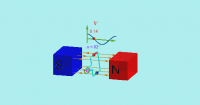
يدور ملف عدد لفاته \(N\) ومساحته \(A\) بسرعة زاوية \(\omega\) داخل مجال منتظم \(B\). التدفق عبره \(\Phi=BA\cos\theta\) فتُستحث ق.د.ك. \(\varepsilon=-N\dfrac{d\Phi}{dt}=NBA\omega\sin\theta\). في مولد التيار المتردد تنقل حلقتان منزلقتان الجهد المتردد؛ وفي مولد التيار المستمر تقلب الحلقة المشقوقة (عاكس التيار) التوصيل كل نصف دورة فيصبح الجهد نابضًا باتجاه واحد. غيّر القيم واختر النوع. (الدوران مبطّأ: كل دورتين خلال 4 ثوانٍ.)
A coil of \(N\) turns and area \(A\) rotates with angular speed \(\omega\) in a uniform field \(B\). The flux through it is \(\Phi=BA\cos\theta\) so an emf \(\varepsilon=-N\dfrac{d\Phi}{dt}=NBA\omega\sin\theta\) is induced. In the AC generator two slip rings carry the alternating voltage; in the DC generator a split-ring commutator reverses the connection every half turn so the voltage is pulsating in one direction. Change the values and choose the type. (The rotation is slowed: two cycles in every 4 seconds.)
💡 شرح إضافي: المحرك والمولد وجهان لعملة واحدة
💡 Extra explanation: the motor and the generator are two sides of one coin
عندما يعمل المحرك يدور ملفه في المجال فتُستحث فيه ق.د.ك. عكسية \(\varepsilon_{back}\) تعاكس جهد المصدر، فيكون تياره \(I=\dfrac{V-\varepsilon_{back}}{R}\). لذلك يسحب المحرك تيارًا كبيرًا لحظة التشغيل (قبل أن يدور) ويقل تياره مع ازدياد سرعته. وعلى العكس فإن المولد الذي يغذي حملًا يمر في ملفه تيار فيتأثر الملف بعزم مغناطيسي يعاكس دورانه (قانون لنز)، ولذلك يلزم دائمًا بذل شغل ميكانيكي (توربين) ليبقى دوّارًا — وهو مصدر الطاقة الكهربائية.
When the motor runs its coil rotates in the field so a back emf \(\varepsilon_{back}\) is induced in it opposing the source voltage, and its current is \(I=\dfrac{V-\varepsilon_{back}}{R}\). So a motor draws a large current at start (before it turns) and its current falls as its speed grows. Conversely, in a generator that feeds a load a current flows in its coil so the coil feels a magnetic torque opposing its rotation (Lenz’s law); therefore mechanical work (a turbine) must always be supplied to keep it turning — and it is the source of the electrical energy.
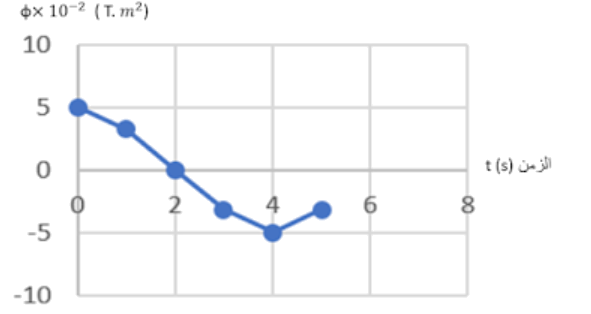
الخط البياني للتدفق عبر الملف مع الزمن (للمثال 4).
The graph of the flux through the coil against time (for Example 4).
ملف يدور في مجال مغناطيسي عدد لفاته \(20\) بمعدل ثابت ومحوره عمودي على المجال، رُسم تدفقه \(\Phi_B\) مع الزمن فنتج الخط البياني الموضح. أوجد أعظم فرق جهد مستحث في الملف.
A coil of \(20\) turns rotates at a constant rate in a magnetic field with its axis perpendicular to the field; its flux \(\Phi_B\) was plotted against time giving the shown graph. Find the maximum induced potential difference in the coil.
ملف عدد لفاته \(50\) ومساحته \(0.04\ \mathrm{m^2}\) يدور بمعدل \(20\) دورة في الثانية في مجال \(B=0.3\ \mathrm{T}\). احسب أعظم جهد مستحث ومعادلة الجهد اللحظي.
A coil of \(50\) turns and area \(0.04\ \mathrm{m^2}\) rotates at \(20\) revolutions per second in a field \(B=0.3\ \mathrm{T}\). Calculate the maximum induced voltage and the equation of the instantaneous voltage.
عند مضاعفة تردد دوران ملف المولد (مع بقاء \(N,B,A\)) فإن أعظم جهد مستحث:
When the rotation frequency of the generator coil is doubled (with \(N,B,A\) unchanged) the maximum induced voltage:
أي العبارات تميّز مولد التيار المستمر عن المتردد؟
Which statement distinguishes the DC generator from the AC one?
يكون جهد المولد المتردد صفرًا عندما يكون مستوى الملف:
The voltage of the AC generator is zero when the plane of the coil is:
🌀 المجال الكهربائي المستحث
🌀 The Induced Electric Field
عندما يتغير التدفق عبر ملف يتولد فرق جهد مستحث، ويتولد تيار مستحث، وهذا يعني أنه نشأ في الملف مجال كهربائي مستحث يدفع الشحنات حتى لو لم يكن هناك أي مصدر. نحسبه بحساب الشغل على شحنة تتحرك مرة واحدة في مسار دائري نصف قطره \(r\) والمجال \(E\) مماس له:
When the flux through a coil changes an induced potential difference arises and an induced current flows, which means that an induced electric field has been created in the coil that pushes the charges even though there is no source. We find it by calculating the work on a charge moving once around a circular path of radius \(r\) with the field \(E\) tangent to it:
📘 من الشغل إلى قانون فاراداي
📘 From the work to Faraday’s law
\[W=\oint\vec F\cdot d\vec\ell=\oint q\vec E\cdot d\vec\ell=qE\,(2\pi r)\]
والشغل على الشحنة يساوي \(q\) مضروبًا في فرق الجهد المستحث:
and the work on the charge equals \(q\) times the induced potential difference:
\[W=q\,\Delta V_{ind}\ \Rightarrow\ \Delta V_{ind}=E\,(2\pi r)=\oint\vec E\cdot d\vec\ell\]
ومن قانون فاراداي:
and from Faraday’s law:
\[\oint\vec E\cdot d\vec\ell=-\dfrac{d\Phi_B}{dt}\]
💡 شرح إضافي: لماذا هذا المجال مختلف؟
💡 Extra explanation: why is this field different?
المجال الكهربائي الساكن (من شحنات) خطوطه تبدأ من شحنة موجبة وتنتهي في سالبة، والشغل الكلي فيه على مسار مغلق صفر. أما المجال المستحث فخطوطه حلقات مغلقة والشغل على شحنة تدور حول حلقة لا يساوي صفرًا بل \(-\dfrac{d\Phi_B}{dt}\) لكل وحدة شحنة؛ فهو مجال غير محافظ وهو الذي يدير الإلكترونات في ملف تغير تدفقه. مثال: إذا تغير مجال منتظم \(B\) داخل دائرة نصف قطرها \(r\) بمعدل \(\dfrac{dB}{dt}\) فإن \(E\,(2\pi r)=\pi r^2\dfrac{dB}{dt}\) أي \(E=\dfrac{r}{2}\dfrac{dB}{dt}\) (يزداد خطيًا مع \(r\) داخل الدائرة).
The static electric field (from charges) has lines that begin on a positive charge and end on a negative one and the total work in it around a closed path is zero. The induced field has closed-loop lines and the work on a charge going around a loop is not zero but \(-\dfrac{d\Phi_B}{dt}\) per unit charge; it is a non-conservative field and it is what drives the electrons in a coil whose flux changes. Example: if a uniform field \(B\) inside a circle of radius \(r\) changes at a rate \(\dfrac{dB}{dt}\) then \(E\,(2\pi r)=\pi r^2\dfrac{dB}{dt}\) i.e. \(E=\dfrac{r}{2}\dfrac{dB}{dt}\) (it grows linearly with \(r\) inside the circle).
مجال مغناطيسي منتظم يزداد بمعدل \(0.5\ \mathrm{T/s}\) داخل منطقة دائرية نصف قطرها \(0.2\ \mathrm{m}\). احسب المجال الكهربائي المستحث على مسافة \(0.1\ \mathrm{m}\) من المركز.
A uniform magnetic field increases at a rate of \(0.5\ \mathrm{T/s}\) inside a circular region of radius \(0.2\ \mathrm{m}\). Calculate the induced electric field at a distance of \(0.1\ \mathrm{m}\) from the centre.
خطوط المجال الكهربائي المستحث بتغير تدفق مغناطيسي:
The field lines of the electric field induced by a changing magnetic flux are:
🔁 ظاهرة الحث الذاتي
🔁 Self-Induction
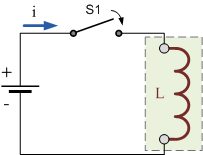
دائرة بطارية ومفتاح وملف معامل حثه الذاتي \(L\).
A circuit with a battery, a switch and a coil of self-inductance \(L\).
لحظة إغلاق المفتاح تتولد في الملف قوة محركة مستحثة معاكسة للمسبب نتيجة تغير التيار المار فيه، فينمو التيار تدريجيًا في الدائرة. ولحظة فتح الدائرة يقل التيار تدريجيًا نتيجة قوة محركة مستحثة مشابهة للمسبب (تحافظ على التيار) فتؤخر اضمحلاله.
At the instant the switch is closed an induced emf opposing the cause arises in the coil because the current through it is changing, so the current grows gradually in the circuit. At the instant the circuit is opened the current decreases gradually because of an induced emf in the same sense as the cause (it keeps the current going), which delays its decay.
📘 الحث الذاتي ومعامل \(L\)
📘 Self-induction and the coefficient \(L\)
\[\Delta V_{ind}=-L\,\dfrac{di}{dt}\]
\(L\) معامل الحث الذاتي للملف ويقاس بالهنري \(\mathrm{H}\). ومن قانون فاراداي \(\Delta V_{ind}=-N\dfrac{d\Phi_B}{dt}\) فنساوي:
\(L\) is the self-inductance of the coil measured in henries \(\mathrm{H}\). From Faraday’s law \(\Delta V_{ind}=-N\dfrac{d\Phi_B}{dt}\) so we equate:
\[-L\dfrac{di}{dt}=-N\dfrac{d\Phi_B}{dt}\ \Rightarrow\ L\,i=N\,\Phi_B\]
وللملف اللولبي الطويل \(\Phi_B=AB=A\dfrac{\mu_0Ni}{\ell}\) فيكون:
For a long solenoid \(\Phi_B=AB=A\dfrac{\mu_0Ni}{\ell}\) so:
\[L\,i=N\,A\dfrac{\mu_0Ni}{\ell}\ \Rightarrow\ L=\dfrac{\mu_0N^2A}{\ell}=\mu_0n^2A\,\ell\]
حيث \(n=\dfrac{N}{\ell}\) عدد اللفات في وحدة الطول.
where \(n=\dfrac{N}{\ell}\) is the number of turns per unit length.
💡 شرح إضافي: ماذا يعني \(L\)؟ ولماذا يُسمى «قصور التيار»؟
💡 Extra explanation: what does \(L\) mean? Why is it called “the inertia of the current”?
\(L\) تعتمد فقط على شكل الملف (\(N,A,\ell\) ونوع قلبه) وليس على التيار: مضاعفة عدد اللفات مع بقاء الطول تضاعف \(L\) أربع مرات (\(L\propto N^2\)) لأن التدفق يتضاعف وعدد اللفات التي يخترقها يتضاعف. وإدخال قلب حديدي يضرب \(L\) في معامل النفاذية النسبية. وكما تقاوم الكتلة تغير السرعة يقاوم الملف تغير التيار: كلما كبرت \(L\) كان نمو التيار أبطأ، ويُقاس ذلك بالثابت الزمني \(\tau=\dfrac{L}{R}\) (زمن بلوغ \(63\%\) من القيمة النهائية).
\(L\) depends only on the shape of the coil (\(N,A,\ell\) and the kind of its core) and not on the current: doubling the number of turns with the same length makes \(L\) four times larger (\(L\propto N^2\)) because the flux doubles and the number of turns it threads doubles. Inserting an iron core multiplies \(L\) by the relative permeability. As mass resists a change of velocity the coil resists a change of current: the bigger \(L\) the slower the growth of the current, measured by the time constant \(\tau=\dfrac{L}{R}\) (the time to reach \(63\%\) of the final value).
\[i(t)=\dfrac VR\left(1-e^{-t/\tau}\right)\ ,\qquad U_B=\tfrac12Li^2\]
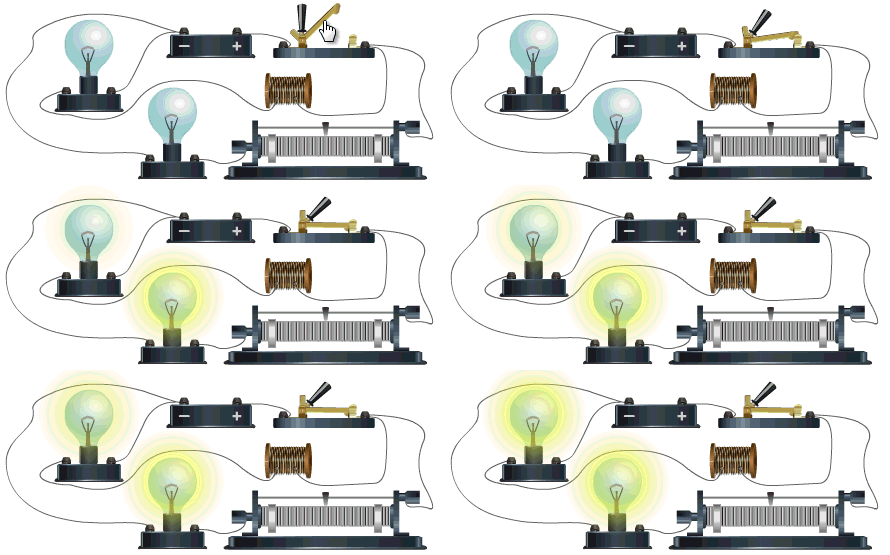
مصباحان: العلوي متصل بملف والسفلي بمقاوم؛ الملف يؤخر إضاءة المصباح عند غلق الدائرة.
Two lamps: the upper one is connected to a coil and the lower to a resistor; the coil delays the lighting of the lamp when the circuit is closed.
في الصورة المتحركة مصباحان: العلوي متصل بملف والسفلي متصل بمقاوم. الملف يؤخر إضاءة المصباح عند غلق الدائرة لأن التيار فيه ينمو تدريجيًا بسبب ظاهرة الحث الذاتي.
In the animation there are two lamps: the upper is connected to a coil and the lower to a resistor. The coil delays the lighting of the lamp when the circuit is closed because the current in it grows gradually due to self-induction.
🧪 تجربة 3: الحث الذاتي: نمو التيار واضمحلاله في ملف
🧪 Experiment 3: Self-induction: growth and decay of the current in a coil
عند إغلاق المفتاح يتغير التيار في الملف فتتولد ق.د.ك. ذاتية \(\varepsilon_L=-L\dfrac{di}{dt}\) تعاكس السبب فينمو التيار تدريجيًا \(i=I_{max}(1-e^{-t/\tau})\) بدل أن يقفز فورًا. وعند فتح المفتاح (تحويل الملف إلى حلقة مغلقة عبر المقاومة) تحافظ \(\varepsilon_L\) على التيار فيضمحل تدريجيًا \(i=I_0e^{-t/\tau}\). الثابت الزمني \(\tau=\dfrac{L}{R}\). (الدورة كاملة مبطّأة إلى 8 ثوانٍ، والخط المتقطع يوضح الدائرة بلا ملف.)
When the switch closes the current in the coil changes so a self-induced emf \(\varepsilon_L=-L\dfrac{di}{dt}\) arises that opposes the cause, so the current grows gradually \(i=I_{max}(1-e^{-t/\tau})\) instead of jumping at once. When the switch is opened (the coil is turned into a closed loop through the resistor) \(\varepsilon_L\) keeps the current going so it decays gradually \(i=I_0e^{-t/\tau}\). The time constant is \(\tau=\dfrac{L}{R}\). (The whole cycle is slowed to 8 seconds, and the dashed line shows the circuit without a coil.)
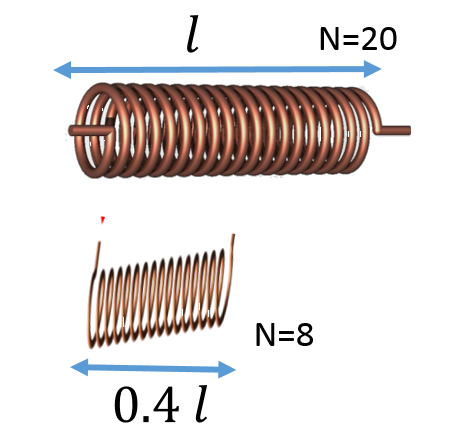
ملف \(20\) لفة وجزء مقتطع منه \(8\) لفات وطوله \(0.4\) من الطول (للمثال 7).
A coil of \(20\) turns and a cut part of it with \(8\) turns whose length is \(0.4\) of the original (for Example 7).
ملف يتكون من \(20\) لفة ومعامل حثه الذاتي \(0.4\ \mathrm{H}\). اقتُطع منه جزء فيه \(8\) لفات طوله \(0.4\) من الطول الأصلي. احسب معامل الحث الذاتي للجزء المقتطع.
A coil of \(20\) turns has a self-inductance of \(0.4\ \mathrm{H}\). A part containing \(8\) turns and having \(0.4\) of the original length is cut from it. Calculate the self-inductance of the cut part.
ملف معامل حثه الذاتي \(0.5\ \mathrm{H}\) ومقاومته \(25\ \Omega\) وُصل ببطارية \(50\ \mathrm{V}\). احسب الثابت الزمني والتيار النهائي والتيار بعد زمن يساوي \(\tau\).
A coil of self-inductance \(0.5\ \mathrm{H}\) and resistance \(25\ \Omega\) is connected to a \(50\ \mathrm{V}\) battery. Calculate the time constant, the final current and the current after a time equal to \(\tau\).
إذا تضاعف عدد لفات ملف لولبي مع بقاء طوله ومساحته ونوع قلبه فإن معامل حثه الذاتي:
If the number of turns of a solenoid is doubled with its length, area and core unchanged its self-inductance:
لحظة إغلاق مفتاح دائرة فيها ملف، القوة المحركة المستحثة ذاتيًا:
At the instant the switch of a circuit containing a coil is closed the self-induced emf:
وحدة معامل الحث الذاتي هي:
The unit of self-inductance is:
🔗 ظاهرة الحث المتبادل
🔗 Mutual Induction
لنأخذ دائرتين متجاورتين. عند إغلاق المفتاح في الدائرة 1 لا يصل التيار فورًا إلى قيمته العظمى بل تدريجيًا بسبب الحث الذاتي، فيتغير المجال عند الملف 2 وتتولد فيه ق.د.ك. متبادلة. وبسبب الحث الذاتي في الملف 2 لن يصل تياره بدوره إلى قيمته العظمى فجأة، فيتغير المجال عند الملف 1 ويُستحث فيه جهد. هذا ما يُعرف بالحث الذاتي والمتبادل.
Take two neighbouring circuits. When the switch in circuit 1 is closed the current does not reach its maximum value at once but gradually because of self-induction, so the field at coil 2 changes and a mutual emf is induced in it. Because of self-induction in coil 2 its own current also does not jump to its maximum, so the field at coil 1 changes and a voltage is induced in it. This is what is known as self- and mutual induction.
📘 معامل الحث المتبادل \(M\)
📘 The mutual inductance \(M\)
تأثير الدائرة الثانية في الأولى (الملف الابتدائي):
The effect of circuit 2 on circuit 1 (the primary coil):
\[\Delta V_{ind\,1}=-M\dfrac{di_2}{dt}=-N_1\dfrac{d\Phi_1}{dt}\]
تأثير الدائرة الأولى في الثانية (الملف الثانوي):
The effect of circuit 1 on circuit 2 (the secondary coil):
\[\Delta V_{ind\,2}=-M\dfrac{di_1}{dt}=-N_2\dfrac{d\Phi_2}{dt}\]
ومعامل الحث المتبادل لتأثير الدائرة الأولى في الثانية يساوي معامله لتأثير الثانية في الأولى: \(M_{12}=M_{21}=M\) ويُقاس بالهنري أيضًا.
and the mutual inductance for the effect of circuit 1 on circuit 2 equals that for the effect of circuit 2 on circuit 1: \(M_{12}=M_{21}=M\), also measured in henries.
لاحظ ظاهرة الحث المتبادل في المحاكاة التالية في الحالات: غلق وفتح الدائرة 1، زيادة ونقصان المقاومة المتغيرة فيها، زيادة وإنقاص طول الملف، وإدخال وإخراج نواة الحديد. وبما أن ما يهم هو تغير التدفق عند الملف 2، فالنتائج (قانون لنز) كما يلي:
Observe mutual induction in the following simulation in these cases: closing and opening circuit 1, increasing and decreasing the variable resistance in it, lengthening and shortening the coil, and inserting and removing the iron core. Since what matters is the change of flux at coil 2, the results (Lenz’s law) are:
| التغير في الدائرة 1Change in circuit 1 | تغير التدفق عند الملف 2Flux change at coil 2 | التيار المستحث في الدائرة 2Induced current in circuit 2 |
|---|---|---|
| غلق المفتاحclosing the switch | يزدادincreases | عكس اتجاه تيار الدائرة 1opposite to the current of circuit 1 |
| فتح المفتاحopening the switch | ينقصdecreases | بنفس اتجاه تيار الدائرة 1in the same sense as the current of circuit 1 |
| إنقاص المقاومة / إدخال نواة الحديد / ضغط الملفdecreasing R / inserting the iron core / compressing the coil | يزدادincreases | يعاكس الزيادة (عكس تيار 1)opposes the increase (opposite to current 1) |
| زيادة المقاومة / إخراج النواة / إبعاد الحلقاتincreasing R / removing the core / stretching the coil | ينقصdecreases | يعاكس النقصان (بنفس اتجاه تيار 1)opposes the decrease (same sense as current 1) |
💡 شرح إضافي: على ماذا يعتمد \(M\)؟ وماذا يحدث إذا لم يتغير التيار؟
💡 Extra explanation: what does \(M\) depend on? And what if the current does not change?
\(M\) تعتمد على هندسة الدائرتين: عدد لفات كل منهما (\(N_1,N_2\)) وشكلهما والمسافة بينهما ومحاذاة محوريهما، ونوع الوسط (نواة حديد مشتركة تزيدها كثيرًا كما في المحول). وأكبر قيمة لها حين يخترق كل التدفق من إحداهما الأخرى. أما إذا كان تيار الدائرة 1 ثابتًا فلا ق.د.ك. متبادلة مهما كان كبيرًا لأن \(\dfrac{di_1}{dt}=0\) — ولهذا يعمل المحول بالتيار المتردد فقط. وإذا تغير التيار بمعدل ثابت كانت \(\varepsilon_2\) ثابتة المقدار، وإذا كان جيبيًا كانت جيبية متأخرة بربع دورة عن التيار.
\(M\) depends on the geometry of the two circuits: the number of turns of each (\(N_1,N_2\)), their shape, the distance between them and the alignment of their axes, and the medium (a shared iron core increases it greatly as in the transformer). It is largest when all the flux of one passes through the other. If the current of circuit 1 is constant there is no mutual emf however large it is because \(\dfrac{di_1}{dt}=0\) — this is why the transformer works with alternating current only. If the current changes at a constant rate \(\varepsilon_2\) has a constant size, and if it is sinusoidal \(\varepsilon_2\) is sinusoidal and a quarter cycle behind the current.
🧪 تجربة 4: الحث المتبادل بين دائرتين
🧪 Experiment 4: Mutual induction between two circuits
تغيّر التيار \(i_1\) في الدائرة الأولى يغيّر التدفق عبر الدائرة الثانية فتُستحث فيها ق.د.ك. \(\varepsilon_2=-M\dfrac{di_1}{dt}\) (يسجلها الجلفانومتر G). لا تُستحث ق.د.ك. إذا كان \(i_1\) ثابتًا مهما كان كبيرًا. اختر نمط تغير التيار: إغلاق ثم فتح (نمو واضمحلال \(i_1\) بثابت \(\tau\))، أو منحدر خطي (معدل ثابت فتكون \(\varepsilon_2\) ثابتة المقدار)، أو تيار متردد (فتكون \(\varepsilon_2\) جيبية متأخرة ربع دورة). (الدورة مبطّأة إلى 8 ثوانٍ.)
A change of the current \(i_1\) in circuit 1 changes the flux through circuit 2 so an emf \(\varepsilon_2=-M\dfrac{di_1}{dt}\) is induced in it (recorded by the galvanometer G). No emf is induced if \(i_1\) is constant, however large it is. Choose how the current changes: close then open (growth and decay of \(i_1\) with constant \(\tau\)), a linear ramp (constant rate so \(\varepsilon_2\) has a constant size), or an alternating current (so \(\varepsilon_2\) is sinusoidal, a quarter cycle behind). (The cycle is slowed to 8 seconds.)
معامل الحث المتبادل بين ملفين \(M=0.2\ \mathrm{H}\). تغير تيار الملف الأول من \(5\ \mathrm{A}\) إلى \(1\ \mathrm{A}\) خلال \(0.1\ \mathrm{s}\) بمعدل ثابت. احسب ق.د.ك. المستحثة في الملف الثاني.
The mutual inductance between two coils is \(M=0.2\ \mathrm{H}\). The current of the first coil changes from \(5\ \mathrm{A}\) to \(1\ \mathrm{A}\) in \(0.1\ \mathrm{s}\) at a constant rate. Calculate the emf induced in the second coil.
تيار الملف الأول \(i_1=4\sin(50t)\ \mathrm{A}\) و\(M=0.1\ \mathrm{H}\). اكتب معادلة ق.د.ك. المستحثة في الملف الثاني وأعظم قيمة لها.
The current of the first coil is \(i_1=4\sin(50t)\ \mathrm{A}\) and \(M=0.1\ \mathrm{H}\). Write the equation of the emf induced in the second coil and its maximum value.
يعمل المحول بالتيار المتردد وليس بتيار مستمر ثابت لأن:
The transformer works with alternating current and not with a steady direct current because:
أي إجراء يزيد معامل الحث المتبادل بين ملفين متجاورين؟
Which action increases the mutual inductance between two neighbouring coils?
📚 ملخص الدرس
📚 Lesson Summary
| الظاهرةPhenomenon | القانونLaw |
|---|---|
| سلك يقطع خطوط المجالA wire cutting field lines | \(\Delta V=BLv\sin\theta\)\(\Delta V=BLv\sin\theta\) |
| قضيب يدور حول طرفهA rod rotating about its end | \(\Delta V=\tfrac12B\omega L^2\)\(\Delta V=\tfrac12B\omega L^2\) |
| مولد (ملف يدور)Generator (a rotating coil) | \(\varepsilon=NBA\omega\sin\omega t\ ,\ \varepsilon_{max}=NBA\omega\)\(\varepsilon=NBA\omega\sin\omega t\ ,\ \varepsilon_{max}=NBA\omega\) |
| المجال المستحثInduced field | \(\oint\vec E\cdot d\vec\ell=-\dfrac{d\Phi_B}{dt}\)\(\oint\vec E\cdot d\vec\ell=-\dfrac{d\Phi_B}{dt}\) |
| الحث الذاتيSelf-induction | \(\Delta V=-L\dfrac{di}{dt}\ ,\ L=\dfrac{\mu_0N^2A}{\ell}\ ,\ \tau=\dfrac LR\)\(\Delta V=-L\dfrac{di}{dt}\ ,\ L=\dfrac{\mu_0N^2A}{\ell}\ ,\ \tau=\dfrac LR\) |
| الحث المتبادلMutual induction | \(\Delta V_2=-M\dfrac{di_1}{dt}\ ,\ M_{12}=M_{21}\)\(\Delta V_2=-M\dfrac{di_1}{dt}\ ,\ M_{12}=M_{21}\) |
⚠️ أخطاء شائعة
⚠️ Common mistakes
- نسيان الزاوية: \(\Delta V=BLv\) صحيحة فقط إذا كانت \(v\perp B\)؛ وإلا تُضرب في \(\sin\theta\).Forgetting the angle: \(\Delta V=BLv\) is valid only if \(v\perp B\); otherwise it is multiplied by \(\sin\theta\).
- الاعتقاد بأن الجهد أعظم حين التدفق أعظم؛ الجهد أعظم حين معدل تغير التدفق أعظم (مستوى الملف موازٍ للمجال).Thinking the voltage is maximum when the flux is maximum; the voltage is maximum when the rate of change of flux is maximum (the plane of the coil parallel to the field).
- الخلط بين مولد AC ومولد DC: الفرق في الحلقتين المنزلقتين مقابل الحلقة المشقوقة.Confusing the AC and DC generators: the difference is slip rings versus a split ring.
- الاعتقاد بأن \(L\) تتوقف على التيار؛ هي خاصية هندسية للملف (\(L\propto N^2\)).Thinking \(L\) depends on the current; it is a geometric property of the coil (\(L\propto N^2\)).
- نسيان تحويل الوحدات: \(\mathrm{cm^2}\) إلى \(\mathrm{m^2}\) و\(\mathrm{mH}\) إلى \(\mathrm{H}\)، واستعمال \(\omega=2\pi f\).Forgetting unit conversions: \(\mathrm{cm^2}\) to \(\mathrm{m^2}\) and \(\mathrm{mH}\) to \(\mathrm{H}\), and using \(\omega=2\pi f\).
- الظن أن التيار الثابت الكبير في الابتدائي يستحث تيارًا في الثانوي؛ لا حث دون تغير.Thinking a large steady current in the primary induces a current in the secondary; there is no induction without a change.
🧪 اختبر نفسك: امتحان من 20 سؤالاً
🧪 Test Yourself: a 20-Question Exam
أنهِ الدرس بالاختبار التفاعلي التالي؛ أسئلته تجمع بين الفهم والحساب وتغطي جميع أقسام الدرس.
Finish with the interactive exam below; its questions mix understanding with calculation and cover every section of the lesson.
اختبار المولدات والحث الذاتي والمتبادل (12A) Generators, Self- and Mutual Induction (12A) Quiz
20 سؤالاً - الحث الحركي والمولدات والحث الذاتي والمتبادل 20 Questions - motional emf, generators, self- and mutual induction
• عدد الأسئلة: 20 سؤالاً
• مدة الاختبار: 30 دقيقة
• لا يمكنك تغيير إجاباتك أو إعادة الاختبار إلا بعد 24 ساعة من التسليم.
• تأكد من إجاباتك قبل التسليم! 📌 Important Instructions:
• Number of questions: 20 questions
• Quiz duration: 30 minutes
• You cannot change your answers or retake the quiz for 24 hours after submission.
• Make sure of your answers before submitting!
🔗 محاكيات GeoGebra للاستعانة بها عند اللزوم
🔗 GeoGebra Simulations to Use When Needed
اضغط «تشغيل» لتعمل المحاكاة هنا داخل الدرس؛ ويمكن للطالب الرجوع إليها لتجربة الفكرة بطريقة أخرى.
Press “Run” to run the simulation right here inside the lesson; the student can use it to try the idea in another way.