🎯 نواتج التعلم
🎯 Learning Outcomes
بعد دراسة هذا الدرس ستكون قادرًا على أن:
After this lesson you will be able to:
- تصف عمل المكثف في الدائرة وكيف يخزّن الشحنة والطاقة بين لوحيه.Describe how a capacitor works in a circuit and how it stores charge and energy between its plates.
- تحسب السعة \(C=Q/\Delta V\) وتعرف أن السعة خاصية هندسية للمكثف لا تعتمد على \(Q\) ولا على \(\Delta V\).Calculate the capacitance \(C=Q/\Delta V\) and know that the capacitance is a geometric property of the capacitor that does not depend on \(Q\) nor on \(\Delta V\).
- تفسّر شحن المكثف وتفريغه عبر مقاومة وتحسب الثابت الزمني \(\tau=RC\).Explain the charging and the discharging of a capacitor through a resistance and calculate the time constant \(\tau=RC\).
- تحسب سعة المكثف المستوي والأسطواني والكروي من أبعاده.Calculate the capacitance of a parallel-plate, a cylindrical and a spherical capacitor from its dimensions.
- تحسب السعة المكافئة لمكثفات على التوالي وعلى التوازي وتوزيع الشحنة وفرق الجهد بينها.Calculate the equivalent capacitance of capacitors in series and in parallel and the distribution of charge and potential difference among them.
- تحسب الطاقة المختزنة \(U=\tfrac12C\Delta V^2\) وأثر العازل الكهربائي \(\kappa\) في السعة والمجال والطاقة.Calculate the stored energy \(U=\tfrac12C\Delta V^2\) and the effect of the dielectric \(\kappa\) on the capacitance, the field and the energy.
🔋 عمل المكثف في الدوائر الكهربائية
🔋 Capacitor Operation in Electric Circuits
المكثف أداة كهربائية تعمل على تخزين شحنات كهربائية (تملك طاقة) وتفرّغها عند اللزوم. وفي أبسط أنواعه يتكوّن من لوحين معدنيين يفصل بينهما مادة عازلة.
A capacitor is an electrical device that stores electric charges (which carry energy) and releases them when needed. In its simplest form it consists of two metal plates separated by an insulating material.
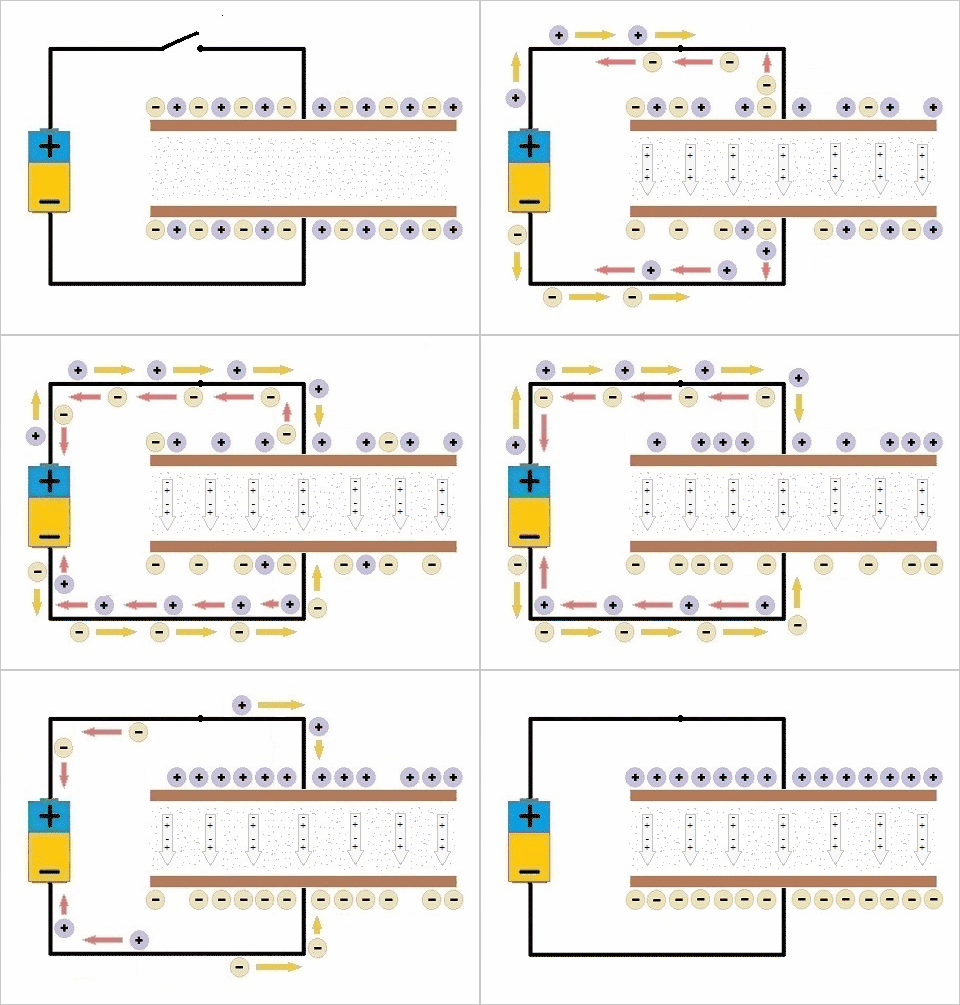
عند إغلاق المفتاح تتحرك الشحنات من البطارية فتتجمع شحنة موجبة على أحد اللوحين وسالبة على اللوح الآخر.
When the switch is closed, charges move from the battery so that positive charge builds up on one plate and negative charge on the other.
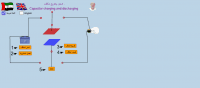
في التجربة الأولى أدناه يظهر كيف يخزّن المكثف الطاقة عند وصله ببطارية، وكيف يفرّغ شحناته دفعة واحدة عند وصله بمصباح أو مقاومة. وهذا ما يحدث في فلاش آلة التصوير: تشحن البطارية المكثف ببطء، ثم يفرّغ المكثف طاقته في لحظة قصيرة فيصدر وميضًا قويًا.
The first experiment below shows how a capacitor stores energy when connected to a battery and releases its charges all at once when connected to a lamp or a resistor. This is what happens in a camera flash: the battery charges the capacitor slowly, then the capacitor releases its energy in a very short moment, producing a strong flash.
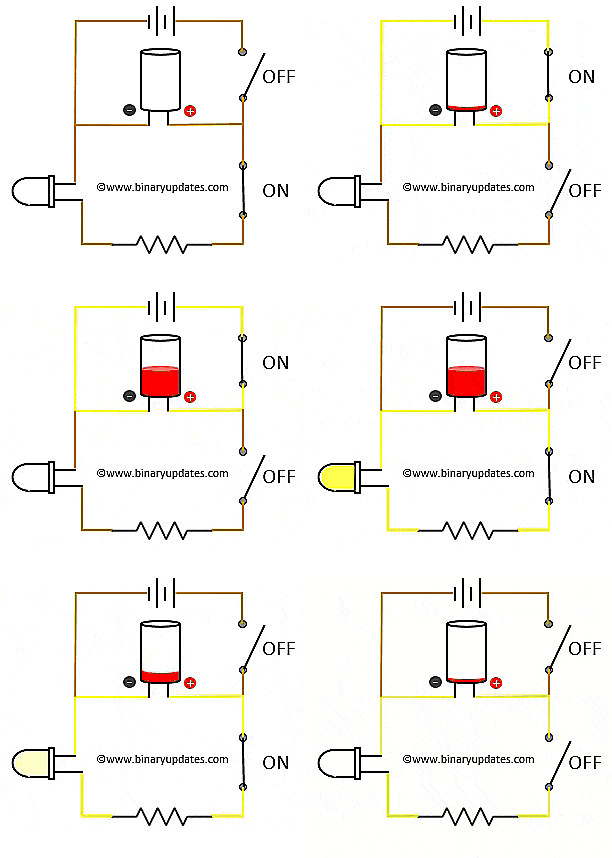
دائرة فلاش آلة التصوير: يشحن المكثف عند وضع المفتاح في وضع الشحن ويفرّغ في المصباح عند التشغيل.
A camera-flash circuit: the capacitor charges in the charging position and discharges through the lamp when switched on.
🧪 تجربة 1: شحن المكثف وتفريغه
🧪 Experiment 1: Charging and Discharging a Capacitor
اضغط «شحن» لوصل المكثف بالبطارية عبر المقاومة، ثم «تفريغ» لتفريغه في المقاومة والمصباح. لاحظ كيف يتغير جهد المكثف أُسّيًا مع الزمن وكيف تتحكم \(R\) و\(C\) في سرعة العملية.
Press “Charge” to connect the capacitor to the battery through the resistor, then “Discharge” to let it discharge through the resistor and the lamp. Watch the capacitor voltage change exponentially and see how \(R\) and \(C\) control the speed.
يشبه المكثف البطارية في عمله، وبينهما تشابه واختلاف:
A capacitor works somewhat like a battery; they have similarities and differences:
| وجه المقارنةAspect | المكثفCapacitor | البطاريةBattery |
|---|---|---|
| وجه التشابهSimilarity | كلاهما يخزّن شحنات لها طاقة ويفرّغها عند اللزومBoth store charges that carry energy and release them when needed | |
| وجه الاختلافDifference | يفرّغ شحناته في فترة زمنية قصيرة دفعة واحدةDischarges in a short time, all at once | يفرّغ شحناته خلال فترة زمنية طويلةDischarges over a long period |
📏 سعة المكثف
📏 Capacitance
سعة المكثف هي مقدرة المكثف على استيعاب الشحنات؛ وقد يكون المكثف غير مشحون ومع ذلك نقول إن له سعة، فهي خاصية للمكثف نفسه (شكله وأبعاده والمادة العازلة فيه) وليست مرتبطة بشحنته الحالية.
The capacitance of a capacitor is its ability to hold charge. A capacitor may be uncharged and we still say it has a capacitance: it is a property of the capacitor itself (its shape, dimensions and insulating material), not of its present charge.
📜 تعريف السعة
📜 Definition of Capacitance
السعة النسبة بين شحنة أحد اللوحين وفرق الجهد بين اللوحين:
Capacitance is the ratio of the charge on one plate to the potential difference between the plates:
\[C=\dfrac{Q}{\Delta V}\]
وحدتها الفاراد \(F=C/V\). وبما أن الفاراد وحدة كبيرة جدًا نستخدم \(\mu F=10^{-6}\,F\) و\(nF=10^{-9}\,F\) و\(pF=10^{-12}\,F\). وعندما نذكر «شحنة المكثف» نقصد شحنة أحد اللوحين، لا مجموع شحنتي اللوحين.
Its unit is the farad \(F=C/V\). Since the farad is very large we use \(\mu F=10^{-6}\,F\), \(nF=10^{-9}\,F\) and \(pF=10^{-12}\,F\). When we speak of “the charge of a capacitor” we mean the charge on one plate, not the sum of the charges on both plates.
🧪 تجربة 2: العلاقة بين الشحنة والجهد (حساب السعة)
🧪 Experiment 2: Charge versus Voltage (Finding the Capacitance)
اختر سعة المكثف، ثم غيّر جهد البطارية وسجّل قياسًا في كل مرة. ارسم الشحنة مقابل الجهد: ما شكل الخط؟ احسب ميله وقارنه بالسعة. (تتصفّر الجدول عند تغيير السعة.)
Choose the capacitor’s capacitance, then change the battery voltage and record a measurement each time. Plot charge against voltage: what is the shape of the line? Find its slope and compare it with the capacitance. (The table clears when you change the capacitance.)
| فرق الجهد (V)Voltage (V) | الشحنة \(Q\) (nC)Charge \(Q\) (nC) | \(Q/\Delta V\) (nF)\(Q/\Delta V\) (nF) |
|---|
أحد الوحدات التالية تعادل الفاراد:
One of the following units is equivalent to the farad:
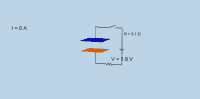
طُبّق فرق جهد \(12\,V\) بين طرفي مكثف فاكتسب شحنة \(3\,nC\)، ثم غُيّر جهد المصدر إلى \(7\,V\) كما في الشكل. أحد الإجابات التالية تعبّر عن شحنة المكثف وسعته بعد تغيّر جهد المصدر:
A potential difference of \(12\,V\) is applied across a capacitor and it acquires a charge of \(3\,nC\). The source voltage is then changed to \(7\,V\) as shown. Which answer gives the charge and the capacitance after the change?
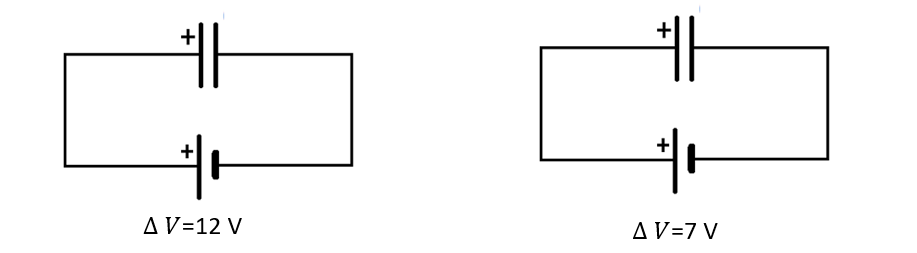
قبل التغيير: \(\Delta V=12\,V\) — بعد التغيير: \(\Delta V=7\,V\)
Before: \(\Delta V=12\,V\) — after: \(\Delta V=7\,V\)
⏱️ شحن وتفريغ المكثف
⏱️ Charging and Discharging a Capacitor
عند توصيل لوحي المكثف بمصدر تتحرك الإلكترونات من اللوح المتصل بالقطب الموجب إلى اللوح المتصل بالقطب السالب عبر الدائرة الخارجية، فيكتسب أحد اللوحين شحنة موجبة والآخر سالبة. ولا يعبر التيار المادة العازلة بين اللوحين.
When the plates are connected to a source, electrons move through the external circuit from the plate joined to the positive terminal toward the plate joined to the negative terminal, so one plate becomes positive and the other negative. No current crosses the insulator between the plates.
1️⃣ عملية الشحن
1️⃣ Charging Process
- عند إغلاق الدائرة تتحرك الإلكترونات من اللوح المتصل بالقطب الموجب إلى اللوح المتصل بالقطب السالب.When the circuit is closed, electrons move from the plate connected to the positive terminal toward the plate connected to the negative terminal.
- تتراكم الشحنات على لوحي المكثف وينشأ مجال كهربائي بين اللوحين.Charges accumulate on the plates and an electric field is set up between them.
- يزداد جهد المكثف ويقل التيار تدريجيًا حتى يتوقف عندما يساوي جهد المكثف جهد المصدر.The capacitor voltage rises and the current falls gradually until it stops when the capacitor voltage equals the source voltage.
جهد المكثف في أثناء الشحن عبر مقاومة \(R\):
Capacitor voltage while charging through a resistance \(R\):
\[V_C(t)=V_0\left(1-e^{-t/RC}\right)\]
2️⃣ عملية التفريغ
2️⃣ Discharging Process
- عند توصيل المكثف المشحون بمقاومة أو مصباح (دائرة مغلقة بلا مصدر) تعمل الشحنات المخزنة كمصدر للطاقة.When the charged capacitor is connected to a resistor or a lamp (a closed circuit without a source), the stored charges act as an energy source.
- يمر التيار في الاتجاه المعاكس لاتجاهه في أثناء الشحن.The current flows in the direction opposite to its direction during charging.
- تتناقص الشحنة والجهد أُسّيًا مع الزمن حتى ينعدما.The charge and the voltage decrease exponentially with time until they reach zero.
جهد المكثف في أثناء التفريغ:
Capacitor voltage while discharging:
\[V_C(t)=V_0\,e^{-t/RC}\]
📝 ملاحظات هامة
📝 Important Notes
- الثابت الزمني \(\tau=RC\) يحدد سرعة العملية: بعد زمن \(\tau\) يبلغ جهد المكثف \(63\%\) من جهد المصدر في الشحن، ويهبط إلى \(37\%\) من قيمته الابتدائية في التفريغ.The time constant \(\tau=RC\) sets the speed: after a time \(\tau\) the capacitor voltage reaches \(63\%\) of the source voltage while charging, and falls to \(37\%\) of its initial value while discharging.
- السعة \(C\) تحدد كمية الشحنة التي يخزنها المكثف عند جهد معين، والمقاومة \(R\) تؤثر في معدل الشحن والتفريغ.The capacitance \(C\) determines how much charge the capacitor stores at a given voltage, and the resistance \(R\) affects the charging and discharging rate.
- مكثف متصل ببطارية: يساوي جهده جهد البطارية عند اكتمال الشحن ولا يتغير ما دام جهد البطارية ثابتًا.A capacitor connected to a battery: its voltage equals the battery voltage when charging is complete and stays constant as long as the battery voltage is unchanged.
- مكثف شُحن ثم فُصل عن البطارية: تبقى شحنته ثابتة ما لم يحدث تفريغ.A capacitor that was charged and then disconnected from the battery keeps a constant charge unless it is discharged.
- من تطبيقاتها: دوائر التوقيت الإلكترونية، وإضاءة الطوارئ، ومرشحات التيار في مصادر الطاقة.Applications include electronic timing circuits, emergency lighting, and current filters in power supplies.
📐 سعة المكثف: المستوي والأسطواني والكروي
📐 Capacitance of Planar, Cylindrical and Spherical Capacitors
تعتمد سعة المكثف على شكله وأبعاده وعلى المادة العازلة التي بين لوحيه. وفيما يلي أشهر ثلاثة أنواع:
A capacitor’s capacitance depends on its shape, its dimensions and the insulator between its plates. The three most common types are:
| مكثف مستوٍParallel-plate | مكثف أسطوانيCylindrical | مكثف كرويSpherical |
|---|---|---|
لوحان متقابلان المسافة بينهما صغيرة: أحدهما موجب والآخر سالب.Two facing plates with a small separation: one positive, one negative.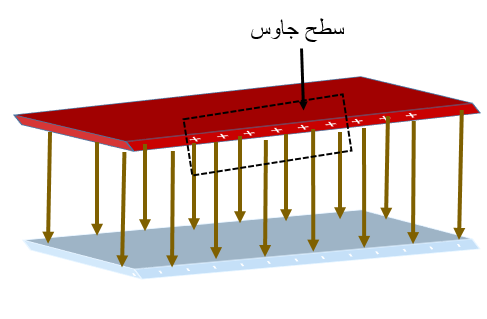 \[C=\epsilon_0\dfrac{A}{d}\] |
أسطوانتان متحدتا المحور: الداخلية موجبة والخارجية سالبة.Two coaxial cylinders: the inner positive, the outer negative.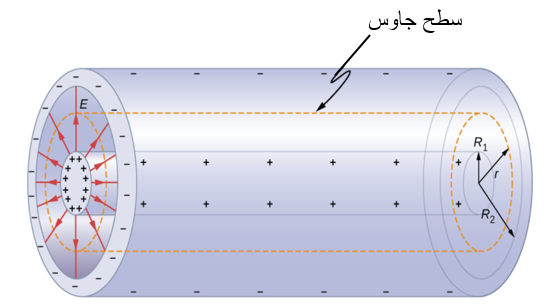 \[C=\dfrac{2\pi\epsilon_0L}{\ln\left(r_2/r_1\right)}\] |
كرتان متحدتا المركز: الداخلية موجبة والخارجية سالبة.Two concentric spheres: the inner positive, the outer negative.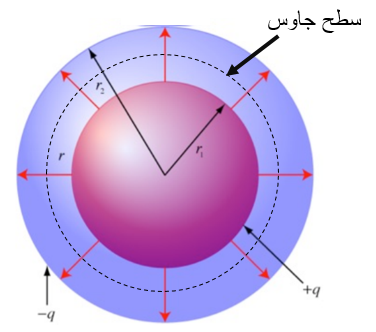 \[C=4\pi\epsilon_0\dfrac{r_1r_2}{r_2-r_1}\] |
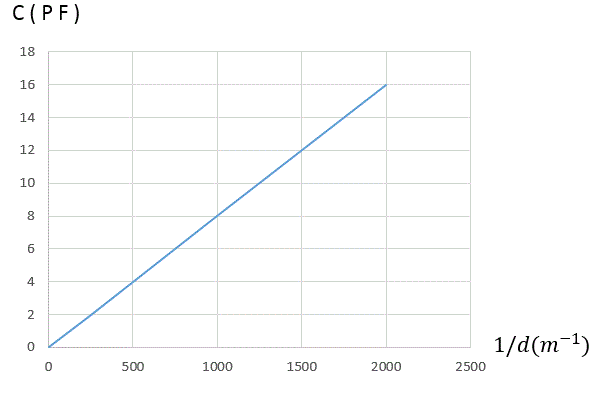
وللمكثف المستوي نتعلم من الصيغة \(C=\epsilon_0\dfrac{A}{d}\) أن السعة تتناسب طرديًا مع المساحة المشتركة بين اللوحين \(A\) وعكسيًا مع المسافة بينهما \(d\). جرّب ذلك في التجربة التالية، وانتبه لما يحدث لشحنة المكثف وجهده في الحالتين (متصل بالبطارية أو مفصول عنها).
For the parallel-plate capacitor the formula \(C=\epsilon_0\dfrac{A}{d}\) shows that the capacitance is directly proportional to the common area of the plates \(A\) and inversely proportional to their separation \(d\). Try it in the next experiment, and notice what happens to the capacitor’s charge and voltage in both cases (connected to the battery or disconnected).
🧪 تجربة 3: العوامل المؤثرة في المكثف المستوي والعازل
🧪 Experiment 3: Factors Affecting a Parallel-Plate Capacitor, and the Dielectric
غيّر المساحة \(A\) والمسافة \(d\) وثابت العزل \(K\) ولاحظ \(C\) و\(Q\) و\(\Delta V\) و\(E\) و\(U\). بدّل بين «متصل بالبطارية» و«مفصول عنها» (تثبت الشحنة عند لحظة الفصل). اضغط «اعتمد الحالة مرجعًا» لتقارن بالقيم السابقة (×).
Change the area \(A\), the separation \(d\) and the dielectric constant \(K\) and watch \(C\), \(Q\), \(\Delta V\), \(E\) and \(U\). Switch between “connected to the battery” and “disconnected” (the charge is fixed at the moment of disconnecting). Press “Set current state as reference” to compare with earlier values (×).
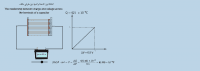
درس طالب العوامل المؤثرة في سعة مكثف مستوٍ فغيّر البعد بين اللوحين مع بقاء باقي العوامل ثابتة، ورسم العلاقة بين السعة ومقلوب البعد بين اللوحين فنتج الخط البياني المبين. فإن المساحة المشتركة بين اللوحين تعادل:
A student studied the factors affecting the capacitance of a parallel-plate capacitor by changing the plate separation while keeping all other factors constant, and plotted capacitance against the reciprocal of the separation, giving the graph shown. The common area of the plates equals:
🔗 توصيل المكثفات
🔗 Connecting Capacitors
يمكن توصيل عدة مكثفات معًا على التوازي أو على التوالي، ونسمي مكثفًا واحدًا يعطي الأثر نفسه المكثف المكافئ \(C_{eq}\).
Several capacitors can be connected in parallel or in series; a single capacitor having the same effect is called the equivalent capacitor \(C_{eq}\).
🔌 التوصيل على التوازي
🔌 Parallel Connection
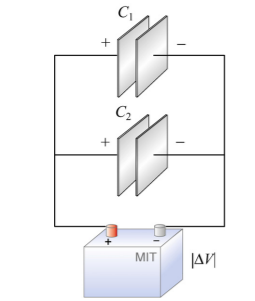
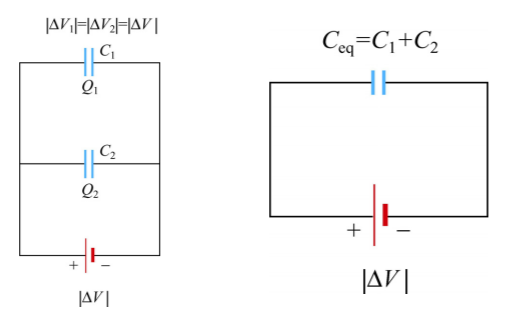
مكثفان على التوازي مع بطارية، والمكثف المكافئ لهما.
Two capacitors in parallel with a battery, and their equivalent capacitor.
📜 خصائص التوصيل على التوازي
📜 Properties of Parallel Connection
- لكل مكثف لوحان: أحدهما متصل بالقطب الموجب والآخر بالقطب السالب، فجهد كل مكثف يساوي جهد البطارية: \(\Delta V=V_1=V_2\).Each capacitor has two plates, one joined to the positive terminal and the other to the negative terminal, so each capacitor’s voltage equals the battery voltage: \(\Delta V=V_1=V_2\).
- يخزّن كل مكثف شحنة بحسب سعته، فتتوزع الشحنة الكلية عليها: \(q_{tot}=q_1+q_2\).Each capacitor stores charge according to its capacitance, so the total charge is shared among them: \(q_{tot}=q_1+q_2\).
\[C_{eq}\,\Delta V=C_1V_1+C_2V_2\;\Rightarrow\;C_{eq}=C_1+C_2+C_3+\cdots+C_n\]
السعة المكافئة في التوازي دائمًا أكبر من أي سعة في المجموعة. ويُستخدم هذا التوصيل لزيادة السعة كما في أنظمة تخزين الطاقة وفي دوائر التوقيت والترشيح.
The equivalent capacitance in parallel is always greater than any capacitance in the group. This connection is used to increase capacitance, as in energy-storage systems and in timing and filtering circuits.
ثلاثة مكثفات سعاتها \(C_1=4\,\mu F\) و \(C_2=6\,\mu F\) و \(C_3=2\,\mu F\) موصولة على التوازي. أوجد سعتها المكافئة.
Three capacitors \(C_1=4\,\mu F\), \(C_2=6\,\mu F\) and \(C_3=2\,\mu F\) are connected in parallel. Find their equivalent capacitance.
🔗 التوصيل على التوالي
🔗 Series Connection
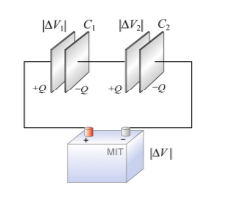
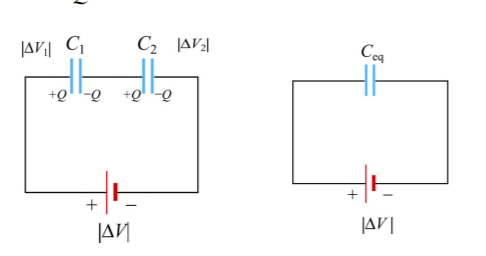
مكثفان على التوالي مع بطارية، والمكثف المكافئ لهما.
Two capacitors in series with a battery, and their equivalent capacitor.
📜 خصائص التوصيل على التوالي
📜 Properties of Series Connection
- يشحن اللوح المتصل بالقطب الموجب للبطارية بشحنة موجبة، ويشحن اللوح الآخر بالحث بشحنة سالبة، وتشحن الألواح بالتتابع، فتحمل جميع المكثفات الشحنة نفسها: \(q_{tot}=q_1=q_2\).The plate joined to the battery’s positive terminal becomes positive and the other plate is charged by induction with negative charge; the plates charge one after another, so all capacitors carry the same charge: \(q_{tot}=q_1=q_2\).
- يتوزع جهد البطارية على المكثفات: \(\Delta V=V_1+V_2\)، ويحتاج المكثف الأكبر سعة إلى فرق جهد أقل ليشحن بالشحنة نفسها.The battery voltage is shared among the capacitors: \(\Delta V=V_1+V_2\), and the larger capacitor needs a smaller potential difference to hold the same charge.
\[\dfrac{q_{tot}}{C_{eq}}=\dfrac{q_1}{C_1}+\dfrac{q_2}{C_2}\;\Rightarrow\;\dfrac{1}{C_{eq}}=\dfrac{1}{C_1}+\dfrac{1}{C_2}+\cdots+\dfrac{1}{C_n}\]
السعة المكافئة في التوالي دائمًا أقل من أصغر سعة في المجموعة. ويُستخدم هذا التوصيل لتحمّل جهود كهربائية أعلى لأن الجهد يتوزع على المكثفات.
The equivalent capacitance in series is always less than the smallest capacitance in the group. This connection is used to withstand higher voltages because the voltage is shared among the capacitors.
مكثفان سعتاهما \(C_1=4\,\mu F\) و \(C_2=6\,\mu F\) موصولان على التوالي. أوجد سعتهما المكافئة.
Two capacitors \(C_1=4\,\mu F\) and \(C_2=6\,\mu F\) are connected in series. Find their equivalent capacitance.
🧪 تجربة 4: تدرّب على التوصيل على التوالي والتوازي
🧪 Experiment 4: Practice with Series and Parallel Connections
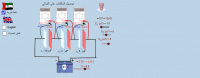
اختر طريقة التوصيل، ثم احسب القيم المطلوبة (بالنانوفاراد والنانوكولوم والفولت) وأدخلها، واضغط «تحقق». يمكنك تغيير القيم أو طلب «مسألة جديدة». يُقبل الخطأ حتى \(2\%\).
Choose the connection, calculate the required values (in nF, nC and V) and enter them, then press “Check”. You can change the values or ask for a “New problem”. Errors up to \(2\%\) are accepted.
| المعطياتGiven | \(C_1\) (nF) | \(C_2\) (nF) | \(C_3\) (nF) | \(V\) (V) |
|---|---|---|---|---|
| القيمValues |
| المطلوبRequired | إجابتكYour answer | الوحدةUnit |
|---|---|---|
✍️ مثال محلول: توصيل مختلط
✍️ Worked Example: Mixed Connection
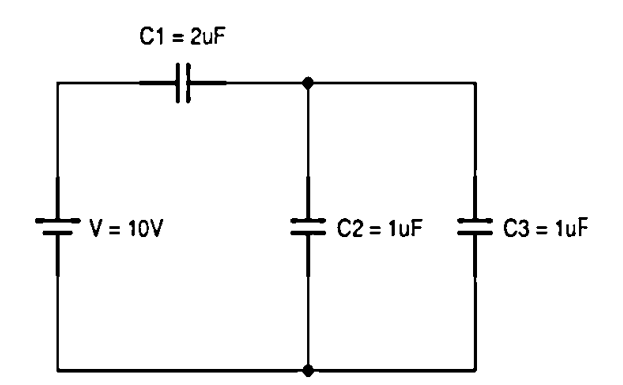
في الدائرة المبينة: \(C_1=2\,\mu F\) و \(C_2=1\,\mu F\) و \(C_3=1\,\mu F\) وجهد البطارية \(10\,V\). احسب السعة المكافئة، ثم شحنة كل مكثف وفرق الجهد بين طرفيه.
In the circuit shown, \(C_1=2\,\mu F\), \(C_2=1\,\mu F\), \(C_3=1\,\mu F\) and the battery voltage is \(10\,V\). Find the equivalent capacitance, then the charge on each capacitor and the potential difference across it.
🔋 الطاقة المختزنة في المكثف
🔋 Energy Stored in a Capacitor
عند شحن مكثف نبذل شغلًا لنقل الشحنات من لوح إلى آخر، ويتحول هذا الشغل إلى طاقة مختزنة في المكثف. فإذا نقلنا شحنة صغيرة \(dq\) عبر فرق جهد \(\Delta V=\dfrac{q}{C}\) فإن الشغل المبذول:
Charging a capacitor requires work to move charges from one plate to the other, and this work is stored as energy in the capacitor. Moving a small charge \(dq\) across a potential difference \(\Delta V=\dfrac{q}{C}\) takes work:
📜 اشتقاق الطاقة المختزنة
📜 Deriving the Stored Energy
\[dW=\Delta V\,dq=\dfrac{q}{C}\,dq\;\Rightarrow\;U=W=\int_0^{Q}\dfrac{q}{C}\,dq=\dfrac{1}{2}\dfrac{Q^2}{C}\]
وبما أن \(C=\dfrac{q}{\Delta V}\) فإن \(q=C\,\Delta V\) ويكون:
Since \(C=\dfrac{q}{\Delta V}\) we have \(q=C\,\Delta V\), so:
\[U=\dfrac{1}{2}\dfrac{q^2}{C}=\dfrac{1}{2}q\,\Delta V=\dfrac{1}{2}C\,\Delta V^2\]
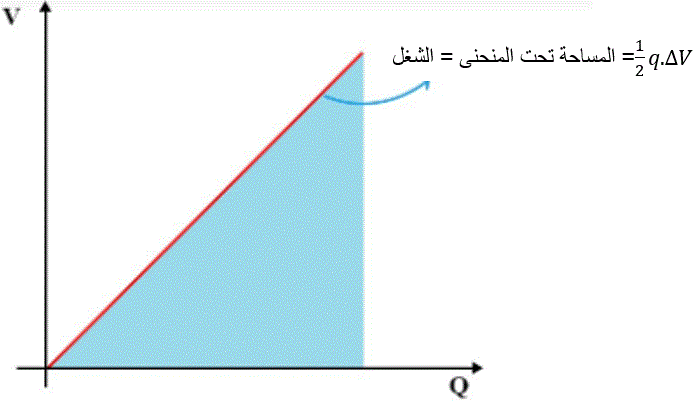
الشغل المبذول في شحن المكثف يساوي المساحة المحصورة تحت منحنى (الجهد–الشحنة): \(U=\tfrac{1}{2}q\,\Delta V\).
The work done in charging the capacitor equals the area under the voltage–charge graph: \(U=\tfrac{1}{2}q\,\Delta V\).
كثافة الطاقة هي الطاقة المختزنة في وحدة الحجم. وللمكثف المستوي حجم المجال بين اللوحين \(Ad\)، ومنه:
Energy density is the energy stored per unit volume. For a parallel-plate capacitor the volume of the field region is \(Ad\), so:
📜 كثافة الطاقة
📜 Energy Density
\[u=\dfrac{U}{Ad}=\dfrac{\frac12C\,\Delta V^2}{Ad}=\dfrac{\frac12\frac{\epsilon_0A}{d}\Delta V^2}{Ad}=\dfrac12\epsilon_0\left(\dfrac{\Delta V}{d}\right)^2=\dfrac12\epsilon_0E^2\]
مكثف هوائي مستوٍ مساحة كل لوح فيه \(1.13\,m^2\) والمسافة بين لوحيه \(1\,mm\) وُصل بمصدر جهده \(300\,V\). احسب سعته والطاقة المختزنة فيه وكثافة الطاقة. (\(\epsilon_0=8.85\times10^{-12}\,F/m\))
A parallel-plate air capacitor has plates of area \(1.13\,m^2\) separated by \(1\,mm\) and is connected to a \(300\,V\) source. Find its capacitance, the stored energy and the energy density. (\(\epsilon_0=8.85\times10^{-12}\,F/m\))
🧱 المكثفات والعوازل الكهربائية
🧱 Capacitors and Dielectrics
عند وضع مادة عازلة بين لوحي مكثف تزداد سعته بعامل \(K\) يسمى ثابت العزل الكهربائي، وتتغير قيمته بحسب نوع المادة (\(K=1\) للفراغ وأكبر من 1 لأي مادة عازلة). وتصبح سعة المكثف المستوي:
When an insulator (dielectric) is placed between the plates of a capacitor its capacitance increases by a factor \(K\) called the dielectric constant, whose value depends on the material (\(K=1\) for vacuum and larger than 1 for any dielectric). The capacitance of a parallel-plate capacitor becomes:
📜 سعة المكثف مع العازل
📜 Capacitance with a Dielectric
\[C=K\,C_0=K\,\epsilon_0\dfrac{A}{d}\]
ولتفسير زيادة السعة هناك حالتان:
To explain the increase in capacitance there are two cases:
1️⃣ المكثف متصل بالبطارية
1️⃣ The capacitor stays connected to the battery
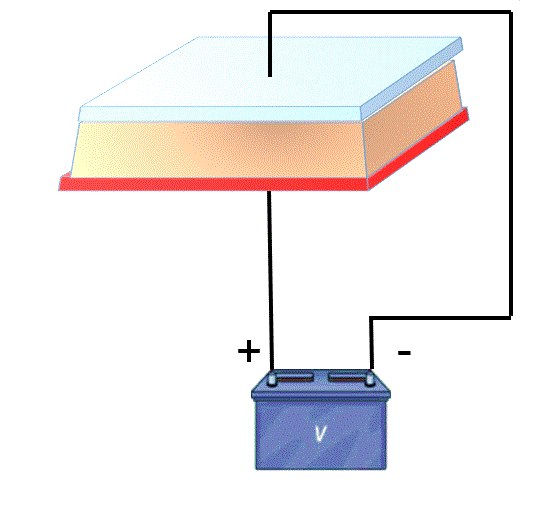
إدخال مادة عازلة بين لوحي مكثف متصل بالبطارية.
Inserting a dielectric between the plates of a capacitor connected to the battery.
تستقطب المادة العازلة فينشأ فيها مجال كهربائي يعاكس مجال المكثف، فينخفض فرق الجهد بين لوحيه لحظيًا عن جهد البطارية. فتدفع البطارية شحنة إضافية إلى اللوحين فتزداد شحنة المكثف حتى يعود جهده يساوي جهد البطارية. إذن في النهاية: الجهد ثابت والشحنة تزداد، ومن \(C=\dfrac{q}{\Delta V}\) نستنتج أن السعة تزداد. (المجال الناتج عن الشحنات الحرة يزداد، أما المجال الكلي داخل العازل \(E=\dfrac{\Delta V}{d}\) فيبقى ثابتًا.)
The dielectric becomes polarized and produces an electric field opposing the capacitor’s field, so the potential difference across the plates momentarily drops below the battery voltage. The battery then pushes extra charge onto the plates, so the capacitor’s charge increases until its voltage again equals the battery voltage. In the end the voltage is constant and the charge increases, and from \(C=\dfrac{q}{\Delta V}\) we conclude the capacitance increases. (The field due to the free charges increases, but the net field inside the dielectric \(E=\dfrac{\Delta V}{d}\) stays constant.)
2️⃣ المكثف شُحن ثم فُصل عن البطارية
2️⃣ The capacitor was charged and then disconnected
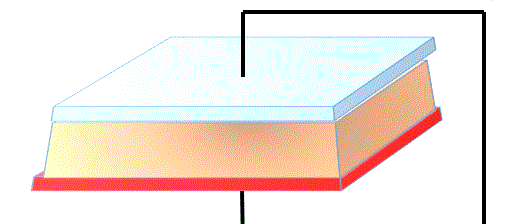
إدخال مادة عازلة بين لوحي مكثف مفصول عن البطارية.
Inserting a dielectric between the plates of a capacitor disconnected from the battery.
تستقطب المادة العازلة وينشأ فيها مجال يعاكس مجال المكثف فينخفض المجال بين اللوحين ويقل فرق الجهد \(\Delta V\)، وبما أن المكثف مفصول فإن الشحنة ثابتة. ومن \(C=\dfrac{q}{\Delta V}\): قل الجهد بثبات الشحنة، فهذا دليل على أن السعة تزداد.
The dielectric becomes polarized and produces a field opposing the capacitor’s field, so the field between the plates and the potential difference \(\Delta V\) decrease; since the capacitor is disconnected, the charge is constant. From \(C=\dfrac{q}{\Delta V}\): the voltage falls at constant charge, which shows that the capacitance increases.
| الكميةQuantity | متصل بالبطاريةConnected to battery | مفصول عن البطاريةDisconnected |
|---|---|---|
| C | ↑ \(\times K\) | ↑ \(\times K\) |
| Q | تزداد \(\times K\)increases \(\times K\) | ثابتةconstant |
| \(\Delta V\) | ثابتconstant | يقل \(\div K\)decreases \(\div K\) |
| E | ثابتconstant | يقل \(\div K\)decreases \(\div K\) |
| U | تزداد \(\times K\)increases \(\times K\) | تقل \(\div K\)decreases \(\div K\) |
📝 ملخص الدرس
📝 Lesson Summary
- السعة \(C=\dfrac{Q}{\Delta V}\) خاصية للمكثف وحدتها الفاراد.Capacitance \(C=\dfrac{Q}{\Delta V}\) is a property of the capacitor; its unit is the farad.
- مستوٍ: \(C=\epsilon_0\dfrac{A}{d}\)، أسطواني: \(C=\dfrac{2\pi\epsilon_0L}{\ln(r_2/r_1)}\)، كروي: \(C=4\pi\epsilon_0\dfrac{r_1r_2}{r_2-r_1}\).Planar: \(C=\epsilon_0\dfrac{A}{d}\); cylindrical: \(C=\dfrac{2\pi\epsilon_0L}{\ln(r_2/r_1)}\); spherical: \(C=4\pi\epsilon_0\dfrac{r_1r_2}{r_2-r_1}\).
- التوازي: \(C_{eq}=\sum C_i\)، الجهد متساوٍ والشحنات تتوزع. التوالي: \(\dfrac{1}{C_{eq}}=\sum\dfrac{1}{C_i}\)، الشحنة متساوية والجهد يتوزع.Parallel: \(C_{eq}=\sum C_i\), equal voltage, charges shared. Series: \(\dfrac{1}{C_{eq}}=\sum\dfrac{1}{C_i}\), equal charge, voltage shared.
- الطاقة المختزنة \(U=\dfrac12C\Delta V^2=\dfrac12q\Delta V=\dfrac{q^2}{2C}\) وكثافتها \(u=\dfrac12\epsilon_0E^2\).Stored energy \(U=\dfrac12C\Delta V^2=\dfrac12q\Delta V=\dfrac{q^2}{2C}\) with density \(u=\dfrac12\epsilon_0E^2\).
- العازل يضرب السعة في \(K\): مع البطارية تبقى \(\Delta V\) ثابتة وتزداد \(q\)، ومع الفصل تبقى \(q\) ثابتة ويقل \(\Delta V\).A dielectric multiplies the capacitance by \(K\): with the battery connected \(\Delta V\) stays constant and \(q\) increases; when disconnected \(q\) stays constant and \(\Delta V\) decreases.
🧪 اختبر نفسك: امتحان من 20 سؤالاً
🧪 Test Yourself: a 20-Question Exam
أنهِ الدرس بالاختبار التفاعلي التالي؛ أسئلته بمستوى متوسط وعالٍ وتجمع بين الفهم والحساب.
Finish with the interactive exam below; its questions are of medium and high difficulty and mix understanding with calculation.
اختبار المكثفات Capacitors Quiz
20 سؤالاً - السعة، التوصيل على التوالي والتوازي، الطاقة المختزنة، والعوازل 20 Questions - Capacitance, Series and Parallel Connections, Stored Energy, and Dielectrics
• عدد الأسئلة: 20 سؤالاً
• مدة الاختبار: 30 دقيقة
• لا يمكنك تغيير إجاباتك أو إعادة الاختبار إلا بعد 24 ساعة من التسليم.
• تأكد من إجاباتك قبل التسليم! 📌 Important Instructions:
• Number of questions: 20 questions
• Quiz duration: 30 minutes
• You cannot change your answers or retake the quiz for 24 hours after submission.
• Make sure of your answers before submitting!
🔗 محاكيات GeoGebra للاستعانة بها عند اللزوم
🔗 GeoGebra Simulations to Use When Needed
اضغط «تشغيل» لتعمل المحاكاة هنا داخل الدرس؛ ويمكن للطالب الرجوع إليها لتجربة الفكرة بطريقة أخرى.
Press “Run” to run the simulation right here inside the lesson; the student can use it to try the idea in another way.