🎯 نواتج التعلم
🎯 Learning Outcomes
بعد دراسة هذا الدرس ستكون قادرًا على أن:
After this lesson you will be able to:
- تعرّف المقذوف الأفقي وتفسّر أن سرعته الابتدائية أفقية فقط.Define a horizontal projectile and explain that its initial velocity is purely horizontal.
- تفسّر استقلال الحركتين: سرعة ثابتة أفقيًا وسقوط حر رأسيًا.Explain the independence of the two motions: constant velocity horizontally and free fall vertically.
- تحسب زمن السقوط \(t=\sqrt{2h/g}\) والمدى الأفقي \(R=v_0\,t\).Calculate the time of fall \(t=\sqrt{2h/g}\) and the horizontal range \(R=v_0\,t\).
- تحسب السرعة (مقدارًا واتجاهًا) عند أي لحظة وعند الاصطدام بالأرض.Calculate the velocity (magnitude and direction) at any instant and at impact with the ground.
- تحدد العوامل التي يعتمد عليها زمن السقوط والمدى.Tell which factors the time of fall and the range depend on.
- تحلّ مسائل على المقذوف الأفقي (قذف من منصة أو طائرة أو حافة طاولة).Solve problems on the horizontal projectile (launched from a cliff, a plane or a table edge).
✈️ مقدمة: ما المقذوف الأفقي؟
✈️ Introduction: What Is a Horizontal Projectile?
الحركة الأفقية للمقذوفات حالة خاصة من الحركة في بعدين، يُقذف فيها الجسم بسرعة ابتدائية أفقية من ارتفاع معين دون أي دفع رأسي. وهي نموذج مثالي لدراسة أثر الجاذبية الأرضية على الأجسام المتحركة.
The horizontal motion of projectiles is a special case of motion in two dimensions in which the body is launched with a horizontal initial velocity from a certain height with no vertical push. It is an ideal model for studying the effect of Earth’s gravity on moving bodies.
📘 المقذوف الأفقي
📘 The horizontal projectile
المقذوفات أجسام قُذفت بسرعة ابتدائية ثم تحركت تحت تأثير وزنها فقط (مع إهمال مقاومة الهواء). في المقذوف الأفقي تكون السرعة الابتدائية \(v_0\) أفقية تمامًا، أي أن زاوية القذف \(\theta=0^{\circ}\) والمركبة الرأسية الابتدائية \(v_{0y}=0\). وسنأخذ في هذا الدرس \(g=9.81\ m/s^{2}\).
Projectiles are bodies thrown with an initial velocity that then move under their weight alone (neglecting air resistance). For a horizontal projectile the initial velocity \(v_0\) is purely horizontal, i.e. the launch angle is \(\theta=0^{\circ}\) and the initial vertical component is \(v_{0y}=0\). In this lesson we take \(g=9.81\ m/s^{2}\).
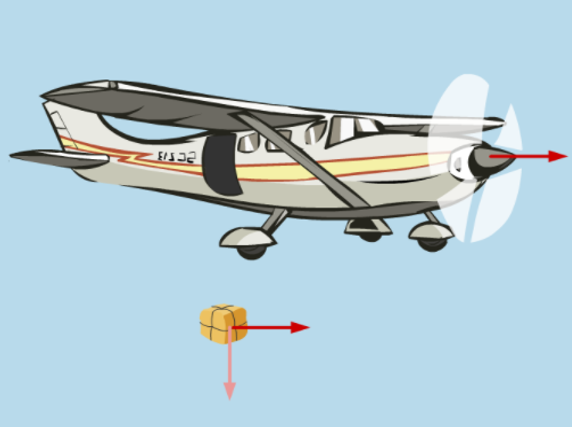
صندوق مُسقَط من طائرة: يحتفظ بسرعة الطائرة الأفقية ويسقط رأسيًا في الوقت نفسه.
A box dropped from a plane: it keeps the plane’s horizontal velocity and falls vertically at the same time.
أمثلة: صندوق إغاثة يُسقَط من طائرة، حجر يُقذف أفقيًا من حافة جرف، كرة تتدحرج عن حافة طاولة، قذيفة تنطلق أفقيًا من مدفع على سطح مبنى. وفي كل منها يتحرك الجسم في الوقت نفسه على المحور الأفقي \(X\) والمحور الرأسي \(Y\)، ونسهّل الدراسة بتناول كل محور على حدة.
Examples: a relief box dropped from a plane, a stone thrown horizontally from a cliff edge, a ball rolling off a table, a shell fired horizontally from a cannon on a roof. In each case the body moves simultaneously along the horizontal axis \(X\) and the vertical axis \(Y\), and we simplify the study by treating each axis separately.
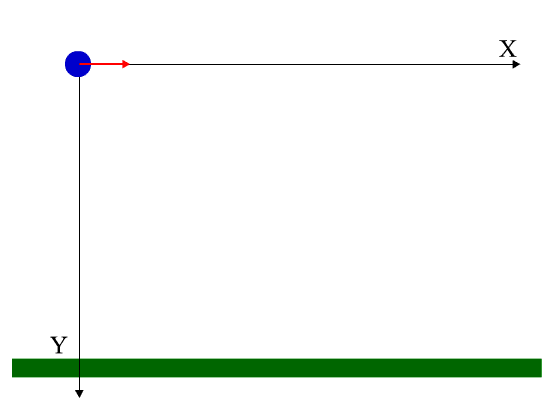
الجسم يبدأ من نقطة الأصل بسرعة أفقية فوق سطح الأرض.
The body starts from the origin with a horizontal velocity above the ground.
🧩 استقلال الحركتين
🧩 The Independence of the Two Motions
🧠 الفكرة الأساسية
🧠 The key idea
الجاذبية تؤثر رأسيًا فقط، فلا توجد قوة أفقية. لذلك:
Gravity acts vertically only, so there is no horizontal force. Therefore:
- على المحور الأفقي: التسارع صفر فالحركة بسرعة ثابتة \(v_x=v_0\) والمعادلة \(x=v_0\,t\).Along the horizontal axis: the acceleration is zero so the motion is at constant velocity \(v_x=v_0\) and the equation is \(x=v_0\,t\).
- على المحور الرأسي: التسارع \(g\) نحو الأسفل والسرعة الابتدائية الرأسية صفر، فالحركة سقوط حر (سرعة متغيّرة).Along the vertical axis: the acceleration is \(g\) downward and the initial vertical velocity is zero, so the motion is free fall (variable velocity).
الحركتان مستقلتان: لا تؤثر إحداهما في الأخرى، والذي يربط بينهما هو الزمن \(t\) فقط.
The two motions are independent: neither affects the other, and the only link between them is the time \(t\).
📌 معادلتا الحركة (نقطة الأصل عند نقطة القذف، الأعلى موجب)
📌 The two equations of motion (origin at the launch point, upward positive)
\[x=v_0\,t\qquad\qquad y=-\tfrac12\,g\,t^{2}\]
أي أن المسافة التي يهبطها الجسم رأسيًا \(d=\tfrac12 g t^{2}\) (وهي موجبة)، وإشارة \(y\) السالبة تعني أن الجسم تحت نقطة القذف.
So the distance the body falls vertically is \(d=\tfrac12 g t^{2}\) (a positive number), and the negative sign of \(y\) just means the body is below the launch point.
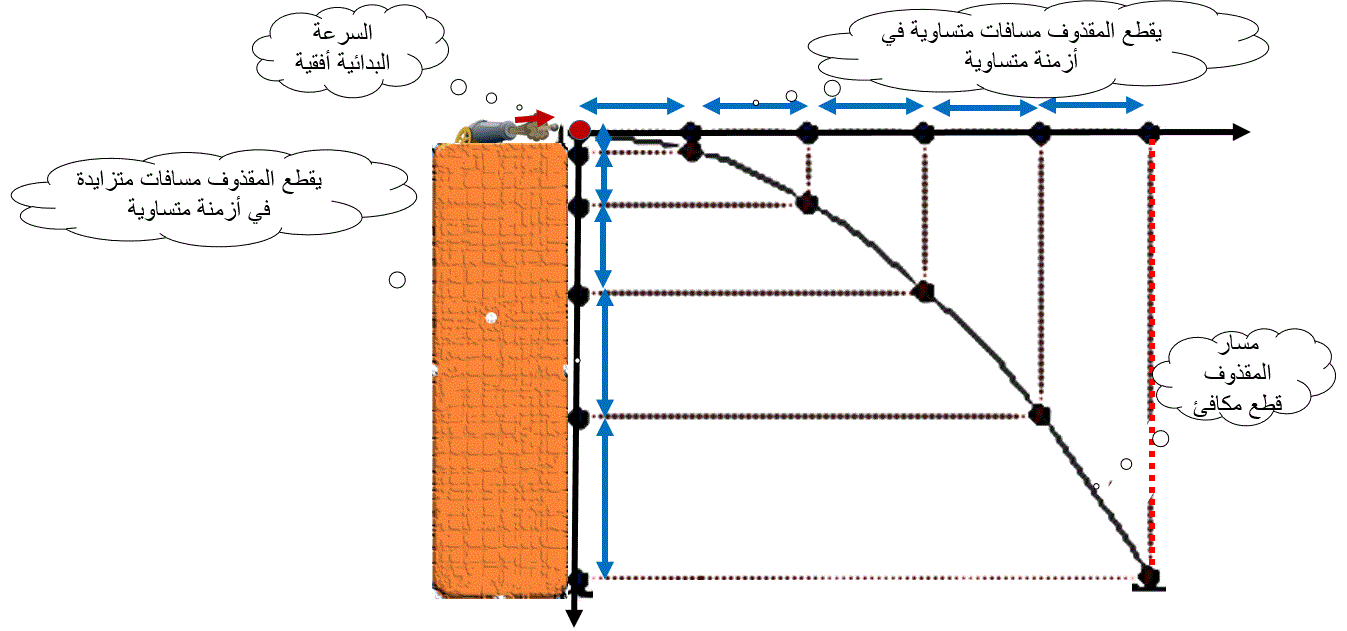
يقطع المقذوف مسافات أفقية متساوية في أزمنة متساوية، ومسافات رأسية متزايدة؛ فمساره قطع مكافئ.
The projectile covers equal horizontal distances in equal times and increasing vertical distances; its path is a parabola.
🧠 توضيح إضافي: لماذا تتزايد المسافات الرأسية بنسبة \(1:3:5:7\)؟
🧠 Extra explanation: why do the vertical distances grow in the ratio \(1:3:5:7\)?
الجسم يسقط رأسيًا من السكون، فالمسافة المقطوعة من البداية \(d=\tfrac12gt^{2}\) تتناسب مع \(t^{2}\). إذا صوّرنا الجسم كل \(0.5\ s\) فالمسافات الكلية تتناسب مع \(1,\,4,\,9,\,16\) والمسافات بين كل نقطتين متتاليتين تتناسب مع \(1,\,3,\,5,\,7\) (الأعداد الفردية). أما أفقيًا فالمسافات بين النقاط متساوية لأن السرعة ثابتة.
The body falls vertically from rest, so the distance from the start \(d=\tfrac12gt^{2}\) is proportional to \(t^{2}\). If we photograph it every \(0.5\ s\), the total distances are proportional to \(1,\,4,\,9,\,16\) and the gaps between successive points to \(1,\,3,\,5,\,7\) (the odd numbers). Horizontally the gaps are equal because the velocity is constant.
جدول مثال لجسم قُذف أفقيًا بسرعة \(10\ m/s\):
A sample table for a body thrown horizontally at \(10\ m/s\):
| الزمن \(t\) (s)Time \(t\) (s) | المدى الأفقي \(x=10t\) (m)Horizontal \(x=10t\) (m) | المسافة الهابطة \(\tfrac12gt^{2}\) (m)Distance fallen \(\tfrac12gt^{2}\) (m) |
|---|---|---|
| 0.5 | 5 | 1.23 |
| 1 | 10 | 4.91 |
| 1.5 | 15 | 11.04 |
| 2 | 20 | 19.62 |
في التجربة التالية اضبط السرعة والارتفاع، وشغّل الحركة أو تقدّم بها كل \(0.5\ s\) وسجّل القراءات؛ وأظهر الكرة الساقطة سقوطًا حرًا لترى أنها تصل إلى الأرض في اللحظة نفسها مع الكرة المقذوفة أفقيًا (وهي تغني عن تجربة showmethephysics ومحاكاة GeoGebra «المقذوف الأفقي 1» وجدول الإدخال).
In the next experiment set the speed and the height, run the motion or advance it every \(0.5\ s\) and record the readings; show the freely falling ball to see that it reaches the ground at the same instant as the horizontally thrown ball (it replaces the showmethephysics experiment, the GeoGebra “horizontal projectile 1” simulation and the input table).
🧪 تجربة 1: المقذوف الأفقي: المحاكاة الرئيسية وجدول القراءات
🧪 Experiment 1: The horizontal projectile: the main simulation and the readings table
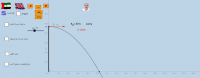
اضبط السرعة الأفقية الابتدائية والارتفاع، ثم اضغط «شغّل»، أو «خطوة 0.5 ث» لتتقدم بها كل نصف ثانية فتُسجَّل القراءة في الجدول (الزمن والمدى الأفقي والارتفاع والسرعة الرأسية). أظهر «الكرة الساقطة» (البرتقالية الصغيرة بجانب الجرف) لتقارن: هي تصل إلى الأرض في اللحظة نفسها! الخطوط الأفقية الرمادية تربط الكرتين عند الارتفاع نفسه كل \(0.5\ s\). (تستخدم التجارب \(g=9.81\ m/s^{2}\).)
Set the initial horizontal speed and the height, then press “Run”, or “Step 0.5 s” to advance it every half second so the reading is recorded in the table (time, horizontal range, height and vertical velocity). Show the “dropped ball” (the small orange one beside the cliff) to compare: it reaches the ground at the same instant! The grey horizontal lines join the two balls at the same height every \(0.5\ s\). (The experiments use \(g=9.81\ m/s^{2}\).)
🔎 ما نستنتجه من التجربة
🔎 What we conclude from the experiment
- السرعة الأفقية \(v_x\) تبقى ثابتة (في غياب مقاومة الهواء).The horizontal velocity \(v_x\) stays constant (without air resistance).
- السرعة الرأسية \(v_y\) تتغير بتأثير الجاذبية: تزداد بمقدار \(9.81\ m/s\) كل ثانية.The vertical velocity \(v_y\) changes under gravity: it increases by \(9.81\ m/s\) every second.
- الارتفاع الابتدائي \(h\): المسافة الرأسية عن سطح الأرض.The initial height \(h\): the vertical distance above the ground.
- زمن التحليق \(t\): المدة حتى يصطدم الجسم بالأرض.The time of flight \(t\): the duration until the body hits the ground.
⏱️ زمن السقوط والمدى الأفقي
⏱️ The Time of Fall and the Horizontal Range
يصل الجسم إلى الأرض عندما يهبط المسافة \(h\) كلها. ومن المعادلة الرأسية نحصل على زمن السقوط، ثم نعوّضه في المعادلة الأفقية للحصول على المدى:
The body reaches the ground when it has fallen the whole distance \(h\). From the vertical equation we get the time of fall, then we substitute it in the horizontal equation to get the range:
🧮 الاشتقاق
🧮 The derivation
- عند الاصطدام \(y=-h\): \(-h=-\tfrac12g\,t^{2}\Rightarrow h=\tfrac12g\,t^{2}\).At impact \(y=-h\): \(-h=-\tfrac12g\,t^{2}\Rightarrow h=\tfrac12g\,t^{2}\).
- زمن السقوط: \(t=\sqrt{\dfrac{2h}{g}}\).The time of fall: \(t=\sqrt{\dfrac{2h}{g}}\).
- المدى الأفقي: \(R=v_0\,t=v_0\sqrt{\dfrac{2h}{g}}\).The horizontal range: \(R=v_0\,t=v_0\sqrt{\dfrac{2h}{g}}\).
📌 القوانين الأساسية
📌 The basic formulae
\[t=\sqrt{\dfrac{2h}{g}}\]
\[R=v_0\,t=v_0\sqrt{\dfrac{2h}{g}}\]
\[v_y=g\,t,\qquad v=\sqrt{v_x^{2}+v_y^{2}}\]
🧠 توضيح إضافي: على ماذا يعتمد كل منهما؟
🧠 Extra explanation: what does each depend on?
- زمن السقوط يعتمد على الارتفاع \(h\) فقط (وعلى \(g\))؛ لا يعتمد على السرعة الأفقية ولا على الكتلة. لذلك تصل كرتان من الارتفاع نفسه إحداهما تُترك والأخرى تُقذف أفقيًا إلى الأرض معًا.The time of fall depends on the height \(h\) only (and on \(g\)); it does not depend on the horizontal speed or on the mass. That is why two balls from the same height, one dropped and one thrown horizontally, reach the ground together.
- المدى الأفقي يعتمد على السرعة \(v_0\) وعلى الارتفاع \(h\): مضاعفة \(v_0\) تضاعف المدى، ومضاعفة \(h\) أربع مرات تضاعف المدى مرتين (لأن \(R\propto\sqrt h\)).The horizontal range depends on the speed \(v_0\) and on the height \(h\): doubling \(v_0\) doubles the range, and making \(h\) four times larger doubles the range (because \(R\propto\sqrt h\)).
قارن بنفسك بين قذفتين في التجربة التالية: غيّر السرعة والارتفاع لكل منهما وانظر زمن السقوط والمدى.
Compare two launches yourself in the next experiment: change the speed and the height of each and look at the time of fall and the range.
🧪 تجربة 3: قارن بين قذفتين: ماذا يؤثر في الزمن والمدى؟
🧪 Experiment 3: Compare two launches: what affects the time and the range?
تُقذف الكرة A (برتقالية) والكرة B (زرقاء) أفقيًا من جرفين. غيّر سرعة كل منهما وارتفاعها، أو اضغط أحد الأزرار الجاهزة، وراقب زمن السقوط والمدى لكل منهما: متى يتساوى الزمنان؟ ومتى يتساوى المدى؟
Ball A (orange) and ball B (blue) are thrown horizontally from two cliffs. Change the speed and the height of each, or press one of the ready buttons, and watch the time of fall and the range of each: when are the two times equal? When are the ranges equal?
تحلّق طائرة على ارتفاع \(500\ m\) بسرعة أفقية \(80\ m/s\) وتُسقط صندوق إغاثة. احسب زمن سقوطه والمسافة الأفقية التي يقطعها قبل أن يصل إلى الأرض (\(g=9.81\ m/s^{2}\)).
A plane flies at a height of \(500\ m\) with a horizontal speed of \(80\ m/s\) and drops a relief box. Find its time of fall and the horizontal distance it covers before reaching the ground (\(g=9.81\ m/s^{2}\)).
تتدحرج كرة عن حافة طاولة ارتفاعها \(1.2\ m\) وتصطدم بالأرض على بعد \(0.9\ m\) أفقيًا من الحافة. ما سرعتها لحظة مغادرتها الطاولة؟ (\(g=9.81\ m/s^{2}\))
A ball rolls off the edge of a table \(1.2\ m\) high and hits the floor \(0.9\ m\) horizontally from the edge. What was its speed when it left the table? (\(g=9.81\ m/s^{2}\))
وقف طالب على سطح مرتفع يرتفع عن الأرض \(40\ m\) وقذف حجرًا بسرعة أفقية \(10\ m/s\). أقصى مدى أفقي يصل إليه الحجر (\(g=9.81\ m/s^{2}\)):
A student stands on a roof \(40\ m\) above the ground and throws a stone horizontally at \(10\ m/s\). The maximum horizontal range of the stone (\(g=9.81\ m/s^{2}\)) is:
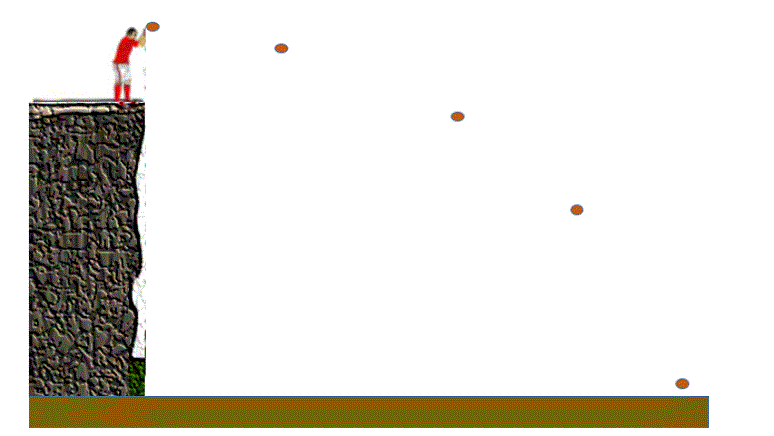
حجر يُقذف أفقيًا من قمة جرف.
A stone thrown horizontally from the top of a cliff.
تُلقى صخرة أفقيًا من قمة جرف بسرعة \(15\ m/s\) فكان مداها الأفقي \(45\ m\) (الشكل أعلاه). ارتفاع الجرف عن سطح الأرض (\(g=9.81\ m/s^{2}\)):
A rock is thrown horizontally from the top of a cliff at \(15\ m/s\) and its horizontal range is \(45\ m\) (the figure above). The height of the cliff above the ground (\(g=9.81\ m/s^{2}\)) is:
🚀 السرعة عند أي نقطة من المسار
🚀 The Velocity at Any Point of the Path
كل نقطة من المسار لها سرعتان: سرعة على المحور \(X\) وسرعة على المحور \(Y\)، ثم نجمعهما اتجاهيًا (مثلث قائم) لنحصل على السرعة الكلية:
Every point of the path has two velocities: one along \(X\) and one along \(Y\), then we combine them as vectors (a right triangle) to get the total velocity:
📌 السرعة عند اللحظة \(t\)
📌 The velocity at the instant \(t\)
\[v_x=v_0\ (\text{constant}),\qquad v_y=g\,t\ (\text{downward})\]
\[v=\sqrt{v_x^{2}+v_y^{2}},\qquad \tan\alpha=\dfrac{v_y}{v_x}=\dfrac{g\,t}{v_0}\]
\(\alpha\) زاوية السرعة تحت الأفق، وهي تزداد مع الزمن لأن \(v_y\) تزداد بينما \(v_x\) ثابتة؛ والسرعة مماسّة للمسار دائمًا. ويمكن أيضًا إيجاد \(v_y\) بدلالة المسافة الهابطة: \(v_y^{2}=2g\,d\).
\(\alpha\) is the angle of the velocity below the horizontal; it grows with time because \(v_y\) increases while \(v_x\) is constant; the velocity is always tangent to the path. \(v_y\) can also be found from the fallen distance: \(v_y^{2}=2g\,d\).
🧠 توضيح إضافي: السرعة لحظة الاصطدام
🧠 Extra explanation: the speed at impact
عند الوصول إلى الأرض \(d=h\) فتكون \(v_y^{2}=2gh\) ومنه:
At the ground \(d=h\) so \(v_y^{2}=2gh\) and hence:
\[v_{\text{impact}}=\sqrt{v_0^{2}+2g\,h}\]
أي أن مربع السرعة الكلية هو مجموع مربع السرعة الأفقية \(v_0^{2}\) ومربع سرعة السقوط الحر من الارتفاع نفسه \(2gh\)؛ وبالطاقة: \(\tfrac12mv^{2}=\tfrac12mv_0^{2}+mgh\) (النتيجة نفسها).
That is, the square of the total speed is the sum of the square of the horizontal speed \(v_0^{2}\) and the square of the free-fall speed from the same height \(2gh\); by energy: \(\tfrac12mv^{2}=\tfrac12mv_0^{2}+mgh\) (the same result).
حرّك منزلق الزمن في التجربة التالية وراقب السهمين \(v_x\) و\(v_y\) والسرعة الكلية (وهي تغني عن محاكاة GeoGebra «القذف الأفقي: السرعة عند أي موقع»).
Move the time slider in the next experiment and watch the arrows \(v_x\), \(v_y\) and the total velocity (it replaces the GeoGebra simulation “horizontal projection: the velocity at any position”).
🧪 تجربة 2: السرعة عند أي لحظة (أي موقع)
🧪 Experiment 2: The velocity at any instant (any position)
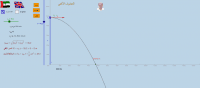
حرّك منزلق الزمن من لحظة القذف إلى لحظة الوصول للأرض. يرسم البرنامج السهم الأفقي \(v_x\) (ثابت الطول) والرأسي \(v_y\) (يتزايد) والسرعة الكلية \(v\) (مماسّة للمسار) ويحسب مقدارها واتجاهها تحت الأفق.
Move the time slider from the launch instant to the landing instant. The program draws the horizontal arrow \(v_x\) (constant length), the vertical one \(v_y\) (growing) and the total velocity \(v\) (tangent to the path) and computes its magnitude and its direction below the horizontal.
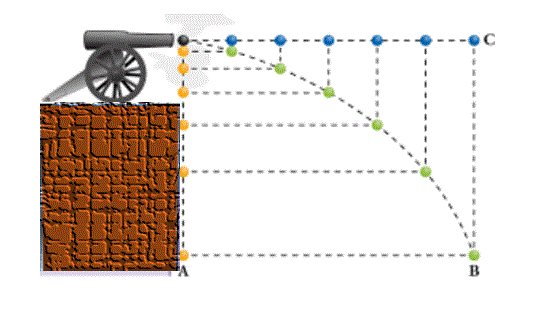
قذيفة تنطلق أفقيًا من مدفع على سطح مبنى (المواقع A وB وC).
A shell fired horizontally from a cannon on a roof (positions A, B and C).
نُصب مدفع على سطح مبنى ارتفاعه \(50\ m\) وأُطلقت قذيفة بسرعة أفقية \(90\ m/s\). سرعة ارتطام القذيفة بالأرض (\(g=9.81\ m/s^{2}\)):
A cannon is mounted on a roof \(50\ m\) high and fires a shell with a horizontal speed of \(90\ m/s\). The speed of impact with the ground (\(g=9.81\ m/s^{2}\)) is:
في المثال 1 (طائرة على ارتفاع \(500\ m\) بسرعة \(80\ m/s\)) احسب سرعة الصندوق لحظة وصوله إلى الأرض واتجاهها.
In example 1 (a plane at \(500\ m\) with \(80\ m/s\)) find the speed of the box when it reaches the ground and its direction.
〰️ معادلة المسار
〰️ The Equation of the Path
نحذف الزمن بين المعادلتين: من \(x=v_0t\) نجد \(t=x/v_0\) ونعوّض في \(y=-\tfrac12gt^{2}\):
We eliminate the time between the two equations: from \(x=v_0t\) we get \(t=x/v_0\) and substitute in \(y=-\tfrac12gt^{2}\):
📌 معادلة المسار
📌 The equation of the path
\[y=-\dfrac{g}{2\,v_0^{2}}\,x^{2}\]
وهي معادلة قطع مكافئ رأسه عند نقطة القذف: كلما زادت \(v_0\) صار المسار أكثر انبساطًا (انحناؤه أقل).
This is the equation of a parabola with its vertex at the launch point: the greater \(v_0\), the flatter the path (less curved).
🛠️ التطبيقات العملية
🛠️ Practical Applications
أين نستفيد من المقذوف الأفقي؟
Where do we use the horizontal projectile?
- أنظمة إسقاط الإغاثة الجوية: يُحسب موضع الإسقاط قبل الهدف بالمدى \(R=v_0\sqrt{2h/g}\).Air relief drop systems: the release point before the target is calculated with the range \(R=v_0\sqrt{2h/g}\).
- حسابات مسارات القذائف (الطلقة المنطلقة أفقيًا من ارتفاع).Calculating the paths of shells (a round fired horizontally from a height).
- تحليل حركة الكرات في الرياضات المختلفة (كرة تُركل أو تُدحرج عن حافة).Analysing the motion of balls in different sports (a ball kicked or rolled off an edge).
- أنظمة الملاحة الجوية.Air navigation systems.
شاهد الفيديو التالي لتوضيح الفكرة:
Watch the following video for an illustration of the idea:
كرتان على الارتفاع نفسه: تُركت الأولى لتسقط سقوطًا حرًا وقُذفت الثانية أفقيًا. أيّ الكرتين تصل إلى الأرض أولًا؟
Two balls at the same height: the first is dropped and falls freely, the second is thrown horizontally. Which ball reaches the ground first?
قُذف جسم أفقيًا من ارتفاع ثابت فبلغ مدىً أفقيًا \(R\). إذا ضوعفت السرعة الأفقية (والارتفاع نفسه) فإن المدى:
A body is thrown horizontally from a fixed height and reaches a horizontal range \(R\). If the horizontal speed is doubled (same height) the range becomes:
خلال حركة مقذوف أفقي (بإهمال مقاومة الهواء) أي المقادير التالية يبقى ثابتًا؟
During the motion of a horizontal projectile (neglecting air resistance) which of the following quantities stays constant?
📝 ملخص الدرس
📝 Lesson Summary
أهم ما تعلّمناه
Key points
- المقذوف الأفقي: سرعة ابتدائية أفقية \(v_0\) ورأسية صفر؛ مساره قطع مكافئ.Horizontal projectile: horizontal initial velocity \(v_0\) and zero vertical one; its path is a parabola.
- الحركتان مستقلتان: أفقيًا \(a=0\)، \(x=v_0t\)؛ رأسيًا سقوط حر \(a=g\)، \(y=-\tfrac12gt^{2}\)، \(v_y=gt\).The two motions are independent: horizontally \(a=0\), \(x=v_0t\); vertically free fall \(a=g\), \(y=-\tfrac12gt^{2}\), \(v_y=gt\).
- زمن السقوط \(t=\sqrt{2h/g}\) (لا يعتمد على \(v_0\) ولا الكتلة)، والمدى \(R=v_0t\).The time of fall \(t=\sqrt{2h/g}\) (independent of \(v_0\) and the mass), and the range \(R=v_0t\).
- السرعة: \(v=\sqrt{v_x^{2}+v_y^{2}}\) و\(\tan\alpha=v_y/v_x\)؛ عند الاصطدام \(v=\sqrt{v_0^{2}+2gh}\).The velocity: \(v=\sqrt{v_x^{2}+v_y^{2}}\) and \(\tan\alpha=v_y/v_x\); at impact \(v=\sqrt{v_0^{2}+2gh}\).
- الطريقة: ابدأ بالمحور الذي تعرف منه الزمن (أفقيًا إن عُلم المدى، ورأسيًا إن عُلم الارتفاع) ثم انتقل إلى المحور الآخر.The method: start with the axis from which you can find the time (horizontal if the range is known, vertical if the height is) then move to the other axis.
🧪 اختبر نفسك: امتحان من 20 سؤالاً
🧪 Test Yourself: a 20-Question Exam
أنهِ الدرس بالاختبار التفاعلي التالي؛ أسئلته تجمع بين الفهم والحساب وتغطي جميع أقسام الدرس.
Finish with the interactive exam below; its questions mix understanding with calculation and cover every section of the lesson.
اختبار المقذوف الأفقي Horizontal Projectile Quiz
20 سؤالاً - زمن السقوط، المدى الأفقي، السرعة عند أي نقطة، واستقلال الحركتين 20 Questions - Time of Fall, Horizontal Range, the Velocity at Any Point and the Independence of the Two Motions
• عدد الأسئلة: 20 سؤالاً
• مدة الاختبار: 30 دقيقة
• لا يمكنك تغيير إجاباتك أو إعادة الاختبار إلا بعد 24 ساعة من التسليم.
• تأكد من إجاباتك قبل التسليم! 📌 Important Instructions:
• Number of questions: 20 questions
• Quiz duration: 30 minutes
• You cannot change your answers or retake the quiz for 24 hours after submission.
• Make sure of your answers before submitting!
🔗 محاكيات GeoGebra للاستعانة بها عند اللزوم
🔗 GeoGebra Simulations to Use When Needed
اضغط «تشغيل» لتعمل المحاكاة هنا داخل الدرس؛ ويمكن للطالب الرجوع إليها لتجربة الفكرة بطريقة أخرى.
Press “Run” to run the simulation right here inside the lesson; the student can use it to try the idea in another way.