🎯 نواتج التعلم
🎯 Learning Outcomes
بعد دراسة هذا الدرس ستكون قادرًا على أن:
After this lesson you will be able to:
- تصف أقطاب المغناطيس والتجاذب والتنافر وخصائص خطوط المجال المغناطيسي.Describe the poles of a magnet, attraction and repulsion, and the properties of magnetic field lines.
- تفسّر النطاقات المغناطيسية وسبب انجذاب الحديد دون النحاس وسبب بقاء القطبين بعد كسر المغناطيس.Explain magnetic domains, why iron is attracted but copper is not, and why a broken magnet still has two poles.
- تحسب القوة المغناطيسية على شحنة \(F=qvB\sin\theta\) وتحدد اتجاهها بقاعدة اليد اليمنى.Calculate the magnetic force on a charge \(F=qvB\sin\theta\) and find its direction with the right-hand rule.
- تحلّ مسائل المسار الدائري \(r=mv/qB\) والزمن الدوري والتردد، وتفسّر عمل السيكلوترون ومطياف الكتلة ومنقي السرعات.Solve circular-path problems \(r=mv/qB\), the period and the frequency, and explain the cyclotron, the mass spectrometer and the velocity selector.
- تحلّل المسار اللولبي وتحسب القوة على سلك \(F=ILB\sin\theta\) وتفهم تأثير هول وجهده.Analyse the helical path, calculate the force on a wire \(F=ILB\sin\theta\) and understand the Hall effect and its voltage.
🧲 المغناطيس وأقطابه
🧲 The Magnet and Its Poles
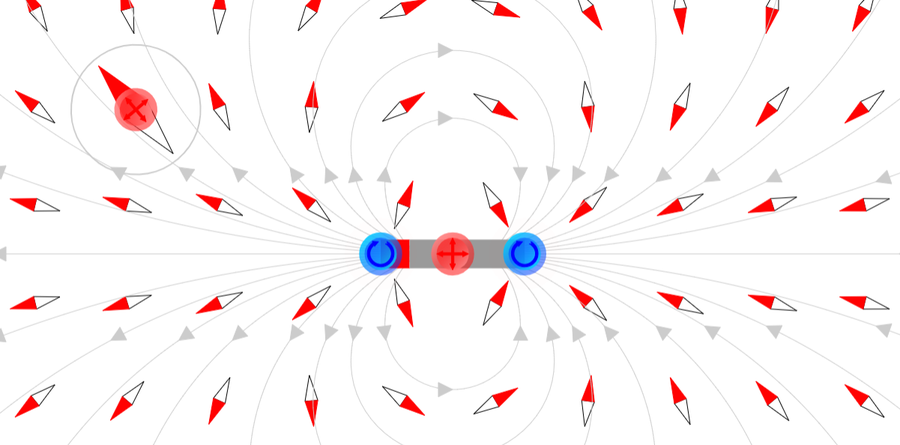
مجموعة بوصلات حول مغناطيس قضيبي: كل إبرة تأخذ اتجاه المجال عند موضعها.
A set of compasses around a bar magnet: each needle takes the direction of the field at its position.
للمغناطيس قطبان: قطب شمالي N وقطب جنوبي S. وتنشأ بين الأقطاب قوى: الأقطاب المختلفة تتجاذب، والأقطاب المتشابهة تتنافر. ولا يمكن فصل قطب واحد عن الآخر.
A magnet has two poles: a north pole N and a south pole S. Forces act between poles: unlike poles attract and like poles repel. One pole can never be separated from the other.
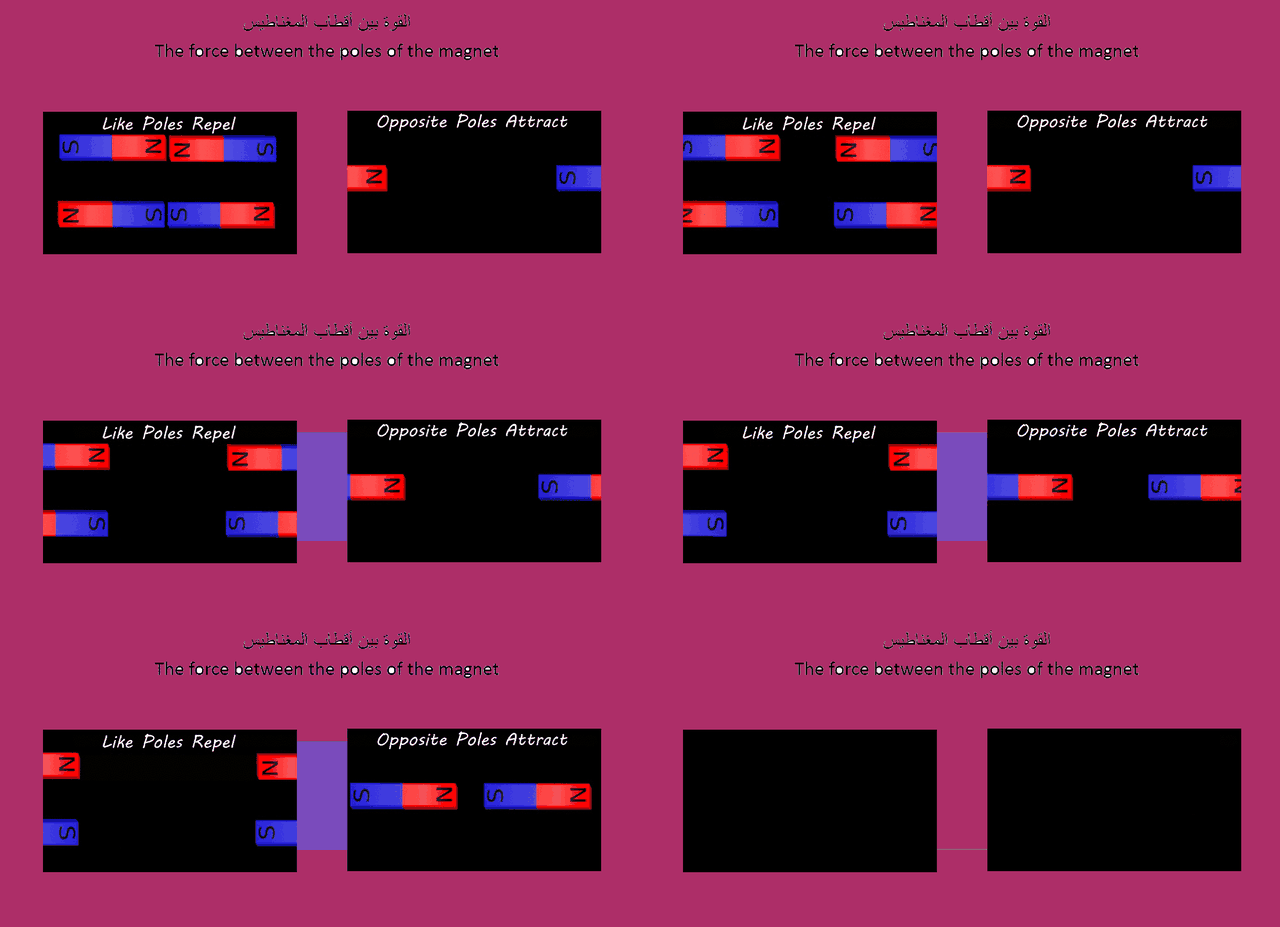
تنافر القطبين المتشابهين وتجاذب القطبين المختلفين.
Repulsion of like poles and attraction of unlike poles.
🧭 لماذا سُمّي القطب الشمالي بهذا الاسم؟
🧭 Why is it called the “north” pole?
القطب الشمالي للمغناطيس (أو لإبرة البوصلة) هو الطرف الذي يتجه نحو الشمال الجغرافي عندما يكون المغناطيس حرّ الحركة. وبما أن الأقطاب المختلفة تتجاذب، فإن الأرض نفسها مغناطيس عملاق يقع قطبه المغناطيسي الجنوبي قرب الشمال الجغرافي، فينجذب إليه قطبنا الشمالي.
The north pole of a magnet (or a compass needle) is the end that points toward geographic north when the magnet is free to turn. Since unlike poles attract, the Earth itself is a giant magnet whose magnetic south pole lies near geographic north, and our north pole is attracted to it.
قُرّب القطب الشمالي لمغناطيس من القطب الشمالي لمغناطيس آخر. ماذا يحدث؟
The north pole of one magnet is brought near the north pole of another magnet. What happens?
🌐 خطوط المجال المغناطيسي
🌐 Magnetic Field Lines
المغناطيس يُحدِث حوله حيّزًا تظهر فيه قوى مغناطيسية يُسمّى المجال المغناطيسي \(\vec B\) ويُقاس بوحدة التسلا \((\mathrm T)\). ولتمثيله نرسم خطوط المجال وهي خطوط وهمية لها الخصائص الآتية:
A magnet creates a region around it where magnetic forces appear, called the magnetic field \(\vec B\), measured in tesla \((\mathrm T)\). To represent it we draw field lines, imaginary lines with the following properties:
📋 خصائص خطوط المجال المغناطيسي
📋 Properties of magnetic field lines
- مسارات مغلقة: تخرج من القطب الشمالي وتدخل القطب الجنوبي خارج المغناطيس، وتكمل من الجنوبي إلى الشمالي داخله.Closed loops: they leave the north pole and enter the south pole outside the magnet, and continue from south to north inside it.
- الاتجاه: اتجاه المجال عند أي نقطة هو المماس لخط المجال عند تلك النقطة (وهو اتجاه الطرف الشمالي لإبرة البوصلة).Direction: the field direction at any point is the tangent to the line at that point (the direction of the north end of a compass needle).
- لا تتقاطع أبدًا: لأن للمجال اتجاهًا واحدًا فقط عند كل نقطة.They never cross: the field has only one direction at each point.
- الكثافة: تتكاثف الخطوط حيث المجال قوي (عند القطبين) وتتباعد حيث يضعف (عند الوسط وبعيدًا عن المغناطيس).Density: the lines crowd together where the field is strong (at the poles) and spread out where it is weak (at the middle and far from the magnet).
🧪 جرّب بنفسك: المغناطيس والبوصلة وخطوط المجال
🧪 Try It Yourself: the Magnet, the Compass and the Field Lines
🧪 تجربة 1: المغناطيس والبوصلة وخطوط المجال
🧪 Experiment 1: The Magnet, the Compass and the Field Lines
اسحب البوصلة (أو اضغط في أي مكان على الرسم) لترى كيف تأخذ إبرتها اتجاه مماس خط المجال. اضغط «برادة الحديد» لإظهار شكل المجال، وبدّل بين مغناطيس واحد ومغناطيسين متجاذبين أو متنافرين ثم الأرض. لاحظ أين تتكاثف الخطوط وأين يقوى المجال.
Drag the compass (or click anywhere on the picture) to see its needle take the direction of the tangent to the field line. Press “Iron filings” to reveal the shape of the field, and switch between one magnet, two attracting or two repelling magnets, and the Earth. Notice where the lines crowd together and where the field is strong.
📏 مجال منتظم ومجال غير منتظم
📏 Uniform and Non-Uniform Fields
المجال المنتظم ثابت المقدار والاتجاه عند جميع النقاط؛ خطوطه مستقيمة متوازية ومتساوية البعد (كالمجال بين قطبين كبيرين متقابلين). أما غير المنتظم فيتغير مقداره أو اتجاهه أو كلاهما من نقطة لأخرى، وخطوطه منحنية أو غير متساوية البعد (كمجال مغناطيس قضيبي).
A uniform field has constant magnitude and direction at every point; its lines are straight, parallel and equally spaced (like the field between two large facing poles). A non-uniform field changes in magnitude, direction or both from point to point, and its lines are curved or unequally spaced (like the field of a bar magnet).
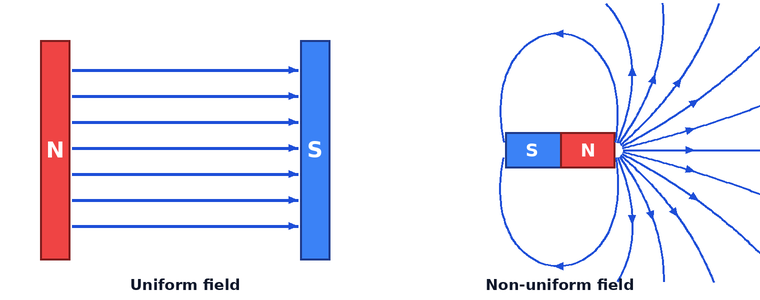
مجال منتظم (يسار) وغير منتظم (يمين).
A uniform field (left) and a non-uniform field (right).
أي مجموعة من المواد تنجذب إلى المغناطيس: (حديد، نيكل، كوبالت) أم (نحاس، خشب، بلاستيك)؟ ولماذا؟
Which group of materials is attracted to a magnet: (iron, nickel, cobalt) or (copper, wood, plastic)? Why?
🔬 النطاقات المغناطيسية
🔬 Magnetic Domains
داخل المادة توجد مناطق صغيرة جدًا تُسمّى النطاقات المغناطيسية؛ كل نطاق مغناطيس صغير يضم عددًا هائلًا من الذرات المتجهة جميعها بالاتجاه نفسه. وسبب مغناطيسية الذرة حركة إلكتروناتها (مدارًا وحول نفسها).
Inside matter there are very small regions called magnetic domains; each domain is a tiny magnet containing a huge number of atoms all pointing the same way. The magnetism of an atom comes from the motion of its electrons (in orbit and spinning).
| وجه المقارنةComparison | الحديد (مادة مغناطيسية)Iron (magnetic material) | النحاس (غير مغناطيسية)Copper (non-magnetic) |
|---|---|---|
| نطاقاتهIts domains | حرة يمكن إدارتهاfree to turn | عشوائية وتُلغي بعضهاrandom, cancelling each other |
| عند اقتراب مغناطيسNear a magnet | تصطف باتجاه المجال فتُغنَط القطعةthey line up with the field so the piece is magnetised | لا تتغيرno change |
| بعد إبعاد المغناطيسAfter removing the magnet | يبقى بعض المغنطة (مغنطة متبقية)some magnetisation remains (remanence) | لا شيءnothing |
| القوة على القطعةThe force on the piece | انجذاب إلى المغناطيسattracted to the magnet | لا تنجذبnot attracted |
🧪 جرّب بنفسك: نطاقات الحديد والنحاس
🧪 Try It Yourself: the Domains of Iron and Copper
🧪 تجربة 2: نطاقات الحديد والنحاس
🧪 Experiment 2: The Domains of Iron and Copper
قرّب المغناطيس من قطعتين: حديد (أو نيكل أو كوبالت) وقطعة مادة غير مغناطيسية. كل مستطيل صغير نطاق مغناطيسي (الأحمر قطبه الشمالي). حرّك المنزلق أو اضغط الأزرار ولاحظ اصطفاف نطاقات الحديد وبقاء النحاس عشوائيًا، ثم أبعد المغناطيس ولاحظ المغنطة المتبقية، واطرق القطعة لتُزيلها.
Bring the magnet near two pieces: iron (or nickel or cobalt) and a non-magnetic material. Every small rectangle is a magnetic domain (red is its north pole). Move the slider or press the buttons and watch the iron domains line up while the copper stays random, then move the magnet away to see the remanent magnetisation, and hammer the piece to remove it.
عند كسر مغناطيس إلى قطع يصبح كل جزء مغناطيسًا له قطبان شمالي وجنوبي. ما السبب؟
When a magnet is broken into pieces, every piece becomes a magnet with a north and a south pole. Why?
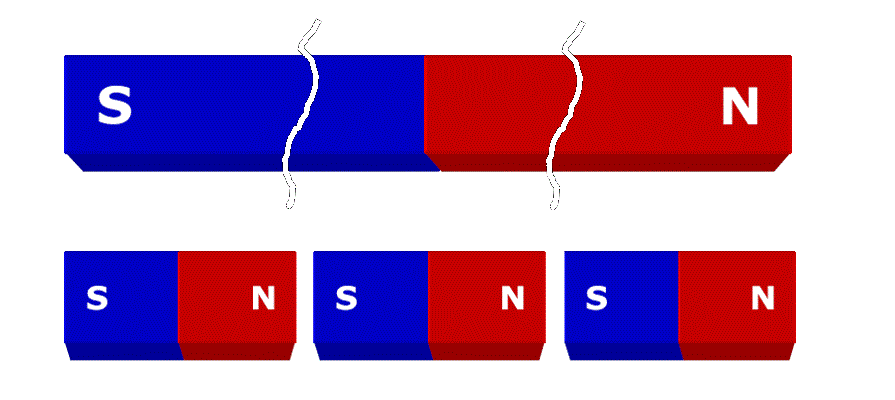
كسر المغناطيس: كل قطعة مغناطيس كامل بقطبين.
Breaking a magnet: every piece is a complete magnet with two poles.
🧪 جرّب بنفسك: اكسر المغناطيس
🧪 Try It Yourself: Break the Magnet
🧪 تجربة 3: اكسر المغناطيس: هل نحصل على قطب منفرد؟
🧪 Experiment 3: Break the Magnet: Can We Get a Single Pole?
اضغط على المغناطيس في أي موضع لقطعه (أو استعمل زر «اقطع من المنتصف»). كل قطعة تصبح مغناطيسًا كاملًا بقطبين جديدين مهما صغرت. حاول الحصول على قطب شمالي وحده!
Click on the magnet anywhere to cut it (or use the “Cut in the middle” button). Every piece becomes a complete magnet with two new poles however small it is. Try to get a north pole on its own!
أحد الأشكال التالية يمثل خطوط مجال مغناطيسي، أيها؟
One of the following patterns represents magnetic field lines. Which one?
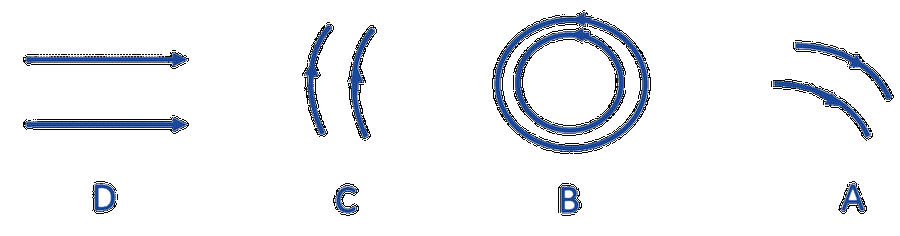
أربعة أنماط من الخطوط: أيها يمثّل مجالًا مغناطيسيًا؟
Four line patterns: which one represents a magnetic field?
أي العبارات التالية عن خطوط المجال المغناطيسي صحيحة؟
Which statement about magnetic field lines is correct?
🌍 المجال المغناطيسي للأرض
🌍 The Earth’s Magnetic Field
الأرض مغناطيس عملاق: قطبها المغناطيسي الشمالي قرب القطب الجغرافي الجنوبي، وقطبها المغناطيسي الجنوبي قرب القطب الجغرافي الشمالي. ولهذا يشير الطرف الشمالي للبوصلة إلى الشمال الجغرافي. المجال يحمي الأرض من العواصف الشمسية.
The Earth is a giant magnet: its magnetic north pole is near the geographic south pole and its magnetic south pole is near the geographic north pole. This is why the north end of a compass points to geographic north. The field protects the Earth from solar storms.
☀️ العواصف الشمسية والشفق القطبي
☀️ Solar storms and the aurora
العواصف الشمسية جسيمات مشحونة تنحرف بتأثير مجال الأرض فلا تصل إلى سطحها؛ وتتمكّن من الدخول قرب القطبين حيث تكون الخطوط عمودية تقريبًا، فتُثير جزيئات الهواء وتُنتج الشفق القطبي.
Solar storms are charged particles that are deflected by the Earth’s field so they do not reach the surface; they can enter near the poles where the lines are nearly vertical, exciting air molecules and producing the aurora.
وأقطاب الأرض المغناطيسية تتحرك باستمرار (بمعدل عشرات الكيلومترات في السنة)، ولذلك فإن البوصلة لا تعطي اتجاه الشمال الجغرافي بدقة تامة؛ والفرق بينهما يُسمّى زاوية الانحراف.
The Earth’s magnetic poles move continuously (tens of kilometres a year), so a compass does not give true geographic north exactly; the difference is called the declination.
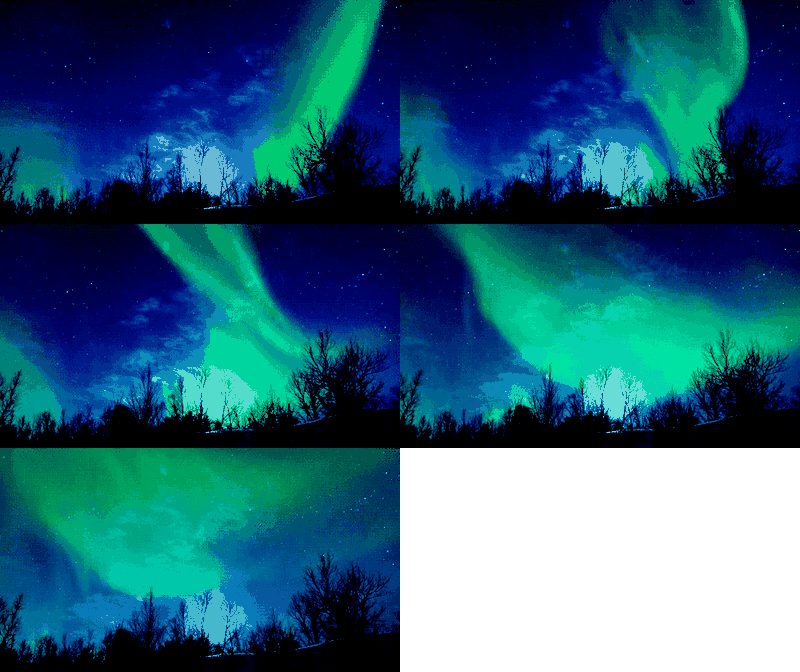
الشفق القطبي قرب القطبين.
The aurora near the poles.
يشير الطرف الشمالي لإبرة البوصلة إلى الشمال الجغرافي لأن:
The north end of a compass needle points to geographic north because:
⚡ القوة المغناطيسية المؤثرة على شحنة
⚡ The Magnetic Force on a Charge
إذا قُذف جسيم مشحون في مجال مغناطيسي وكانت سرعته لا توازي المجال فإنه يتأثر بقوة ينحرف بها عن مساره. هذه القوة تغيّر اتجاه حركة الجسيم ولا تغيّر مقدار سرعته لأنها دائمًا عمودية على السرعة.
If a charged particle is projected into a magnetic field and its velocity is not parallel to the field, it feels a force that deflects it from its path. This force changes the direction of the particle’s motion but not its speed, because it is always perpendicular to the velocity.
📌 مقدار القوة واتجاهها
📌 Magnitude and direction of the force
\[F_B=q\,v\,B\sin\theta\]
حيث \(\theta\) الزاوية بين السرعة \(\vec v\) والمجال \(\vec B\). القوة عظمى عندما \(\theta=90^\circ\)، وصفر عندما تكون السرعة موازية للمجال \((\theta=0^\circ\ \text{أو}\ 180^\circ)\) أو عندما تكون الشحنة ساكنة \((v=0)\).
where \(\theta\) is the angle between the velocity \(\vec v\) and the field \(\vec B\). The force is maximum when \(\theta=90^\circ\) and zero when the velocity is parallel to the field \((\theta=0^\circ\text{ or }180^\circ)\) or the charge is at rest \((v=0)\).
الاتجاه (اليد اليمنى للشحنة الموجبة): السبابة باتجاه المجال \(\vec B\)، والإبهام باتجاه السرعة \(\vec v\)، فتشير الوسطى إلى اتجاه القوة \(\vec F\)، وهي عمودية على السرعة والمجال معًا. للشحنة السالبة يُعكس اتجاه القوة.
Direction (right hand for a positive charge): index finger along the field \(\vec B\), thumb along the velocity \(\vec v\); the middle finger then gives the direction of the force \(\vec F\), perpendicular to both. For a negative charge the force is reversed.
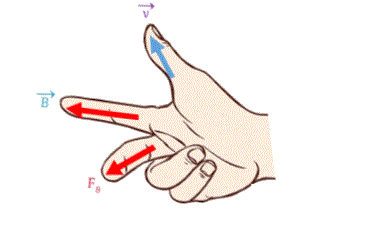
قاعدة اليد اليمنى: السرعة \(v\) والمجال \(B\) والقوة \(F_B\).
The right-hand rule: velocity \(v\), field \(B\) and force \(F_B\).
🧪 جرّب بنفسك: مدرّب اتجاه القوة
🧪 Try It Yourself: the Force-Direction Trainer
🧪 تجربة 4: مدرّب الاتجاه: طبّق قاعدة الكف
🧪 Experiment 4: Direction Trainer: Apply the Palm Rule
يظهر لك مجال مغناطيسي واتجاه تيار (أو سرعة شحنة). اختر اتجاه القوة الصحيح من الأزرار ثم اضغط «سؤال جديد». بدّل بين سلك وشحنة موجبة وإلكترون لترى كيف تنعكس القوة للشحنة السالبة. الاصطلاح: ⊙ خارج الصفحة، ⊗ داخل الصفحة.
A magnetic field and a current direction (or a charge velocity) appear. Choose the correct force direction with the buttons, then press “New question”. Switch between a wire, a positive charge and an electron to see how the force reverses for a negative charge. Convention: ⊙ out of the page, ⊗ into the page.
جسيم وزنه \(0.005\ \mathrm N\) وشحنته \(q=3\ \mathrm{nC}\) قُذف عموديًا على مجال منتظم بسرعة \(2\times10^{6}\ \mathrm{m/s}\) نحو الغرب، فاستمر في مساره دون أن ينحرف بفعل الجاذبية. أوجد مقدار المجال واتجاهه.
A particle of weight \(0.005\ \mathrm N\) and charge \(q=3\ \mathrm{nC}\) is projected perpendicular to a uniform field at \(2\times10^{6}\ \mathrm{m/s}\) toward the west and keeps its path without being deflected by gravity. Find the magnitude and direction of the field.
أي الوحدات التالية تكافئ وحدة المجال المغناطيسي تسلا \((\mathrm T)\)؟
Which of the following units is equivalent to the tesla \((\mathrm T)\)?
🔄 حركة جسيم مشحون في مجال مغناطيسي منتظم
🔄 A Charged Particle in a Uniform Magnetic Field
عندما يُقذف جسيم مشحون عموديًا على مجال منتظم فإن القوة المغناطيسية ثابتة المقدار (الشحنة والمجال والسرعة ثوابت) وتبقى عمودية على السرعة في كل لحظة. هذه هي شروط القوة المركزية، فيتخذ الجسيم مسارًا دائريًا بسرعة ثابتة المقدار.
When a charged particle is projected perpendicular to a uniform field, the magnetic force is constant in magnitude (charge, field and speed are constant) and stays perpendicular to the velocity at every instant. These are the conditions of a centripetal force, so the particle follows a circular path at constant speed.
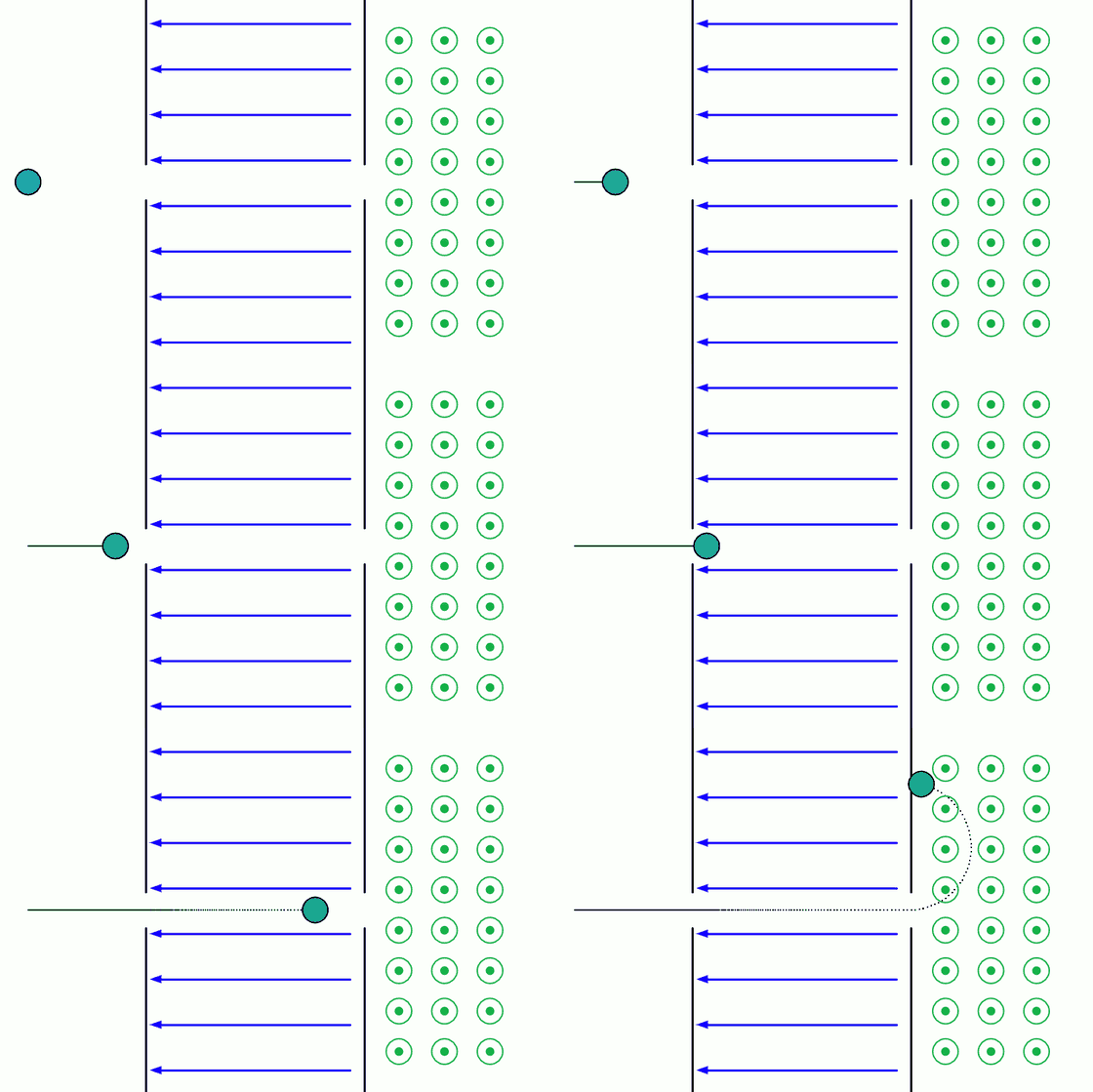
جسيمات مشحونة تدور في دوائر داخل مجال مغناطيسي.
Charged particles moving in circles inside a magnetic field.
📌 نصف قطر المسار الدائري
📌 The radius of the circular path
\[F_B=F_c\ \Rightarrow\ qvB=\frac{mv^2}{r}\]
\[r=\frac{m\,v}{q\,B}\]
يزداد نصف القطر بزيادة الكتلة والسرعة، ويقل بزيادة الشحنة والمجال. ويكون الدوران مع عقارب الساعة أو عكسها بحسب إشارة الشحنة واتجاه المجال.
The radius grows with the mass and the speed and shrinks with the charge and the field. The rotation is clockwise or anticlockwise depending on the sign of the charge and the direction of the field.
🧪 جرّب بنفسك: المسار الدائري
🧪 Try It Yourself: the Circular Path
🧪 تجربة 5: جسيم مشحون في مجال مغناطيسي: مسار دائري
🧪 Experiment 5: A Charged Particle in a Magnetic Field: a Circular Path
اختر الجسيم (بروتون، إلكترون، جسيم ألفا) والسرعة والمجال ثم اضغط «أطلق الجسيم». القوة \(qvB\) عمودية على السرعة فيدور الجسيم في دائرة نصف قطرها \(r=mv/qB\). جرّب تغيير الشحنة وعكس اتجاه المجال لترى اتجاه الدوران. الحركة مُبطّأة للتوضيح.
Choose the particle (proton, electron, alpha particle), the speed and the field then press “Launch the particle”. The force \(qvB\) is perpendicular to the velocity so the particle moves in a circle of radius \(r=mv/qB\). Change the charge and reverse the field to see the sense of rotation. The motion is slowed for clarity.
دخل بروتون ونترون وإلكترون منطقة مجال منتظم بالسرعة نفسها وبشكل عمودي على المجال. أي الإجابات تصف حركتها بشكل صحيح؟
A proton, a neutron and an electron enter a uniform field with the same speed, perpendicular to the field. Which answer describes their motion correctly?
⏱️ الزمن الدوري والتردد والسرعة الزاوية
⏱️ Period, Frequency and Angular Speed
بقسمة محيط الدائرة على السرعة نحصل على زمن الدورة الواحدة؛ ونلاحظ أنه لا يعتمد على السرعة ولا على نصف القطر:
Dividing the circumference by the speed gives the time of one revolution; notice that it does not depend on the speed or on the radius:
📌 العلاقات
📌 The relations
\[T=\frac{2\pi r}{v}=\frac{2\pi m}{qB}\]
\[f=\frac1T=\frac{qB}{2\pi m},\qquad \omega=2\pi f=\frac{qB}{m}\]
الجسيم الأسرع يدور في دائرة أكبر لكنه يقطعها في الزمن نفسه تمامًا؛ وهذه الخاصية هي أساس عمل السيكلوترون.
A faster particle moves in a bigger circle but takes exactly the same time to go round; this property is the basis of the cyclotron.
قُذف بروتون عموديًا على مجال منتظم شدته \(0.5\ \mathrm T\) فاتخذ مسارًا دائريًا. تردد حركته الدائرية (\(q_p=1.6\times10^{-19}\ \mathrm C\)، \(m_p=1.67\times10^{-27}\ \mathrm{kg}\)):
A proton is projected perpendicular to a uniform field of \(0.5\ \mathrm T\) and moves in a circle. Its frequency (\(q_p=1.6\times10^{-19}\ \mathrm C\), \(m_p=1.67\times10^{-27}\ \mathrm{kg}\)) is:
🔭 حجرة الإسقاط الزمني
🔭 The Time Projection Chamber
في هذه الحجرة تتصادم أنوية ثقيلة فتنتج آلاف الجسيمات المشحونة، وهي تؤيّن الغاز الموجود داخل الحجرة فتترك أثرًا. وبوجود مجال مغناطيسي تنحرف الجسيمات في مسارات دائرية أو لولبية؛ ومن نصف قطر كل مسار \(r=mv/qB\) وجهة انحنائه يستنتج العلماء زخم الجسيم وإشارة شحنته ويدرسون سلوكه.
In this chamber heavy nuclei collide and produce thousands of charged particles which ionise the gas inside the chamber and leave a trail. With a magnetic field the particles bend in circular or helical paths; from the radius of each path \(r=mv/qB\) and the way it curves, scientists deduce the particle’s momentum and the sign of its charge and study its behaviour.
🌀 السيكلوترون (المسرّع الدوراني)
🌀 The Cyclotron
جهاز يُسرّع الجسيمات المشحونة. يتكوّن من شفرتين نصف دائريتين (على شكل حرف D) متصلتين بمصدر جهد متردد بينهما فجوة، ويؤثر فيهما مجال مغناطيسي عمودي على مستويهما.
A device that accelerates charged particles. It consists of two D-shaped metal halves (dees) connected to an alternating voltage with a gap between them, in a magnetic field perpendicular to their plane.
⚙️ كيف يعمل؟
⚙️ How does it work?
- المجال الكهربائي في الفجوة يزيد سرعة الجسيم (يكتسب طاقة \(qV\) عند كل عبور).The electric field in the gap increases the particle’s speed (it gains energy \(qV\) at each crossing).
- المجال المغناطيسي يحني مساره في نصف دائرة داخل الشفرة؛ ويزداد نصف القطر بزيادة السرعة فيتخذ مسارًا حلزونيًا.The magnetic field bends its path into a semicircle inside a dee; the radius grows with the speed so the path is a spiral.
- الزمن الدوري لا يتغير بزيادة السرعة، لذلك يمكن عكس إشارة الجهد بتردد ثابت \(f=qB/2\pi m\) فيكون الجسيم متسارعًا عند كل عبور (شرط الرنين).The period does not change as the speed grows, so the voltage can be reversed at a fixed frequency \(f=qB/2\pi m\) and the particle is accelerated at every crossing (the resonance condition).
📌 طاقة الخروج
📌 The exit energy
\[v_{max}=\frac{qBR}{m},\qquad K_{max}=\frac12mv_{max}^2=\frac{q^2B^2R^2}{2m}\]
طاقة الخروج تتحدد بنصف قطر الشفرة \(R\) والمجال \(B\) ولا تعتمد على فرق جهد التسارع (الجهد الأكبر يعني دورات أقل فقط).
The exit energy is fixed by the dee radius \(R\) and the field \(B\) and does not depend on the accelerating voltage (a larger voltage only means fewer turns).
🧪 جرّب بنفسك: السيكلوترون
🧪 Try It Yourself: the Cyclotron
🧪 تجربة 6: السيكلوترون: شرط الرنين وطاقة الخروج
🧪 Experiment 6: The Cyclotron: the Resonance Condition and the Exit Energy
بروتون يبدأ من المركز بين الشفرتين؛ في كل مرة يعبر الفجوة يكتسب طاقة \(qV\) إذا كان الجهد في الاتجاه الصحيح، فيزداد نصف قطر مساره حتى يخرج عند \(R\). غيّر نسبة تردد الجهد إلى تردد الدوران \(f_{ac}/f_c\) وراقب ضياع الرنين (عند \(1\) يكون التسارع أعظم).
A proton starts at the centre between the dees; each time it crosses the gap it gains \(qV\) if the voltage has the right direction, so the radius of its path grows until it leaves at \(R\). Change the ratio of the voltage frequency to the rotation frequency \(f_{ac}/f_c\) and watch resonance be lost (at \(1\) the acceleration is greatest).
سيكلوترون مجاله \(B=1.5\ \mathrm T\) ونصف قطر شفرتيه \(R=0.5\ \mathrm m\). أوجد أكبر طاقة حركة يكتسبها بروتون (\(q=1.6\times10^{-19}\ \mathrm C\)، \(m=1.67\times10^{-27}\ \mathrm{kg}\)) بالإلكترون-فولت.
A cyclotron has \(B=1.5\ \mathrm T\) and dee radius \(R=0.5\ \mathrm m\). Find the greatest kinetic energy a proton (\(q=1.6\times10^{-19}\ \mathrm C\), \(m=1.67\times10^{-27}\ \mathrm{kg}\)) can gain, in electron-volts.
⚖️ منقي السرعات ومطياف الكتلة
⚖️ The Velocity Selector and the Mass Spectrometer
يتكون مطياف الكتلة من: (1) مصدر الأيونات، (2) حجرة منقي السرعات، (3) منطقة مجال مغناطيسي ثم جهاز كشف الجسيمات. يُستخدم لفصل الأيونات بحسب كتلتها وتحديد نظائر العنصر.
A mass spectrometer consists of: (1) an ion source, (2) a velocity-selector chamber, (3) a region of magnetic field followed by a particle detector. It is used to separate ions by their mass and to identify the isotopes of an element.
📌 منقي السرعات
📌 The velocity selector
\[qE=qvB\ \Rightarrow\ v=\frac{E}{B}\]
يوجد في الحجرة مجال كهربائي \(E\) ومجال مغناطيسي \(B\) متعامدان فتكون القوتان متعاكستين؛ تمرّ دون انحراف الأيونات التي سرعتها \(v=E/B\) فقط، أيًّا كانت شحنتها وكتلتها.
The chamber contains an electric field \(E\) and a magnetic field \(B\) that are perpendicular, so the two forces are opposite; only ions with speed \(v=E/B\) pass undeflected, whatever their charge and mass.
\[r=\frac{m\,v}{q\,B_2}\ \Rightarrow\ r\propto m\]
بعد المنقي تدخل الأيونات مجالًا \(B_2\) فتدور في نصف دائرة نصف قطرها \(r=mv/qB_2\): الأثقل يرتطم بالكاشف أبعد من الأخف.
After the selector the ions enter a field \(B_2\) and move in a semicircle of radius \(r=mv/qB_2\): the heavier ion strikes the detector farther away than the lighter one.
🧪 جرّب بنفسك: منقي السرعات والمطياف
🧪 Try It Yourself: the Velocity Selector and the Spectrometer
🧪 تجربة 7: منقي السرعات ومطياف الكتلة
🧪 Experiment 7: The Velocity Selector and the Mass Spectrometer
تنطلق أيونات النيون بسرعات مختلفة (\(0.6v\) … \(1.4v\)). يمرّر المنقي السرعة \(v=E/B_1\) فقط، ثم يدور الأيونان \(\mathrm{^{20}Ne}\) و\(\mathrm{^{22}Ne}\) في المجال \(B_2\) بنصفي قطر مختلفين فيرتطمان بموضعين مختلفين. اضغط «أطلق الأيونات».
Neon ions are emitted with different speeds (\(0.6v\) … \(1.4v\)). The selector passes only \(v=E/B_1\), then \(\mathrm{^{20}Ne}\) and \(\mathrm{^{22}Ne}\) move in \(B_2\) with different radii and hit two different places. Press “Launch the ions”.
❓ أسئلة المعلم بعد التجربة
❓ The teacher’s questions after the experiment
- عمل مصدر الأيونات: تحويل العينة إلى أيونات (جسيمات مشحونة) بالتأيين وقذفها بسرعات مختلفة.The ion source: it turns the sample into ions (charged particles) by ionisation and ejects them at different speeds.
- عمل منقي السرعات: يسمح بمرور الأيونات ذات سرعة محددة فقط عبر فتحته، بمجالين كهربائي ومغناطيسي متعامدين تتساوى فيهما القوتان الكهربائية والمغناطيسية.The velocity selector: it lets only ions of one specific speed through its slit, using perpendicular electric and magnetic fields in which the electric and magnetic forces are equal.
- غاية المجال الكهربائي: يؤثر بقوة \(qE\) تعاكس القوة المغناطيسية فيُنقّي السرعات (وقد يُستخدم فرق جهد قبل المنقي لتسريع الأيونات).The purpose of the electric field: it exerts a force \(qE\) opposite to the magnetic force, so it selects the speed (a potential difference may also be used before the selector to accelerate the ions).
- غاية المجال المغناطيسي: يحرف مسار الأيونات في نصف دائرة بحسب نسبة كتلتها إلى شحنتها فتفصل بعضها عن بعض.The purpose of the magnetic field: it bends the ions into a semicircle according to their mass-to-charge ratio, separating them from one another.
- لو لم يكن المجالان متعامدين: لن تتزن القوتان ولن تصل الأيونات إلى الكاشف.If the fields were not perpendicular: the forces could not balance and the ions would not reach the detector.
- سرعة الأيونات الواصلة: \(v=E/B\).The speed of the ions that arrive: \(v=E/B\).
- اصطدام في موضعين على اللوح: يوجد نظيران للعنصر (كتلتان مختلفتان).Hits at two places on the plate: the element has two isotopes (two different masses).
يدخل جسيم ألفا (شحنته \(+2e\)) منقي السرعات فلا ينحرف. إذا كانت النسبة \(B/E=0.0025\ \mathrm{T\cdot C/N}\) فإن سرعته:
An alpha particle (charge \(+2e\)) enters the velocity selector and is not deflected. If the ratio \(B/E=0.0025\ \mathrm{T\cdot C/N}\), its speed is:
🌪️ قذف الجسيم بشكل غير عمودي: المسار اللولبي
🌪️ A Non-Perpendicular Projection: the Helical Path
إذا قُذف الجسيم بزاوية \(\theta\) مع المجال (غير عمودية وغير موازية) فنحلّل سرعته إلى مركّبتين: \(v_\perp=v\sin\theta\) عمودية على المجال فتسبّب الدوران في دائرة، و\(v_\parallel=v\cos\theta\) موازية للمجال لا تتأثر بقوة فتتقدّم بالجسيم على امتداد المجال. الحصيلة مسار لولبي.
If the particle is projected at an angle \(\theta\) to the field (neither perpendicular nor parallel) we resolve its velocity into two components: \(v_\perp=v\sin\theta\), perpendicular to the field, which causes circular rotation, and \(v_\parallel=v\cos\theta\), parallel to the field, which feels no force and carries the particle along the field. The result is a helical path.
📌 نصف القطر والخطوة
📌 The radius and the pitch
\[r=\frac{m\,v\sin\theta}{q\,B},\qquad T=\frac{2\pi m}{qB},\qquad p=v\cos\theta\cdot T\]
الخطوة \(p\) هي المسافة على امتداد المجال في دورة واحدة. عند \(\theta=90^\circ\) المسار دائرة، وعند \(\theta=0\) خط مستقيم.
The pitch \(p\) is the distance along the field in one turn. At \(\theta=90^\circ\) the path is a circle and at \(\theta=0\) a straight line.
🧪 جرّب بنفسك: المسار اللولبي
🧪 Try It Yourself: the Helical Path
🧪 تجربة 8: المسار اللولبي: زاوية القذف والخطوة
🧪 Experiment 8: The Helical Path: Projection Angle and Pitch
محور المجال أفقي. غيّر الزاوية \(\theta\) بين السرعة والمجال ثم اضغط «أطلق»: ترى المسار اللولبي ومسقطه الدائري. عند \(90^\circ\) دائرة، وعند \(0\) خط مستقيم، وما بينهما لولب تزداد خطوته مع \(\cos\theta\).
The field axis is horizontal. Change the angle \(\theta\) between the velocity and the field then press “Launch”: you see the helix and its circular projection. At \(90^\circ\) it is a circle, at \(0\) a straight line, and in between a helix whose pitch grows with \(\cos\theta\).
مجال مغناطيسي منتظم شدته \(5\times10^{-2}\ \mathrm T\) نحو الشرق. قُذف إلكترون بسرعة \(4\times10^{6}\ \mathrm{m/s}\) بزاوية \(60^\circ\) فوق محور الشرق داخل المجال. نصف قطر مساره الدائري:
A uniform field of \(5\times10^{-2}\ \mathrm T\) points east. An electron is projected at \(4\times10^{6}\ \mathrm{m/s}\) at \(60^\circ\) above the east axis inside the field. The radius of its circular path is:
🧠 اختبر فهمك: اتجاه الانحراف والشحنة
🧠 Check Your Understanding: Direction of Deflection and Sign of Charge
يتحرك شعاع من الإلكترونات بين قطبي مغناطيس كما في الشكل (القطب N على اليسار والقطب S على اليمين والشعاع نحو داخل الصفحة). ينحرف الشعاع نحو:
An electron beam moves between the poles of a magnet as shown (N on the left, S on the right, and the beam moving into the page). The beam is deflected:
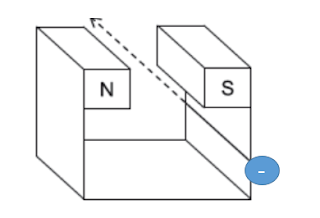
شعاع إلكتروني بين قطبي مغناطيس.
An electron beam between the poles of a magnet.
جسيمان لهما الكتلة نفسها ومقدار الشحنة نفسه قُذفا عموديًا على مجال مغناطيسي منتظم (نحو الداخل) كما في الشكل: يدور الأول (1) مع عقارب الساعة والثاني (2) عكسها. أي الإجابات تصف الجسيمين؟
Two particles with the same mass and the same magnitude of charge are projected perpendicular to a uniform field (into the page) as shown: particle 1 rotates clockwise and particle 2 anticlockwise. Which answer describes them?
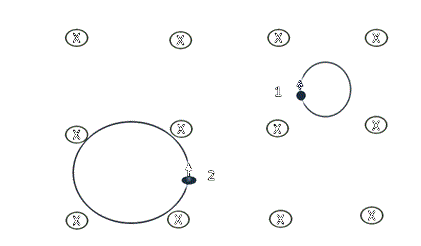
جسيمان يدوران في دائرتين مختلفتين.
Two particles in two different circles.
🔌 القوة المغناطيسية على سلك يحمل تيارًا (قوة لورنتز)
🔌 The Magnetic Force on a Current-Carrying Wire (Lorentz Force)
التيار الكهربائي شحنات متحركة، فإذا وُضع سلك يحمل تيارًا في مجال مغناطيسي لا يوازي طوله تأثرت شحناته المتحركة بقوة مغناطيسية فينتقل تأثيرها إلى السلك كله. لنستنتج القانون:
An electric current is moving charges, so when a current-carrying wire is placed in a magnetic field that is not parallel to it, its moving charges feel a magnetic force that is transferred to the whole wire. Let us derive the law:
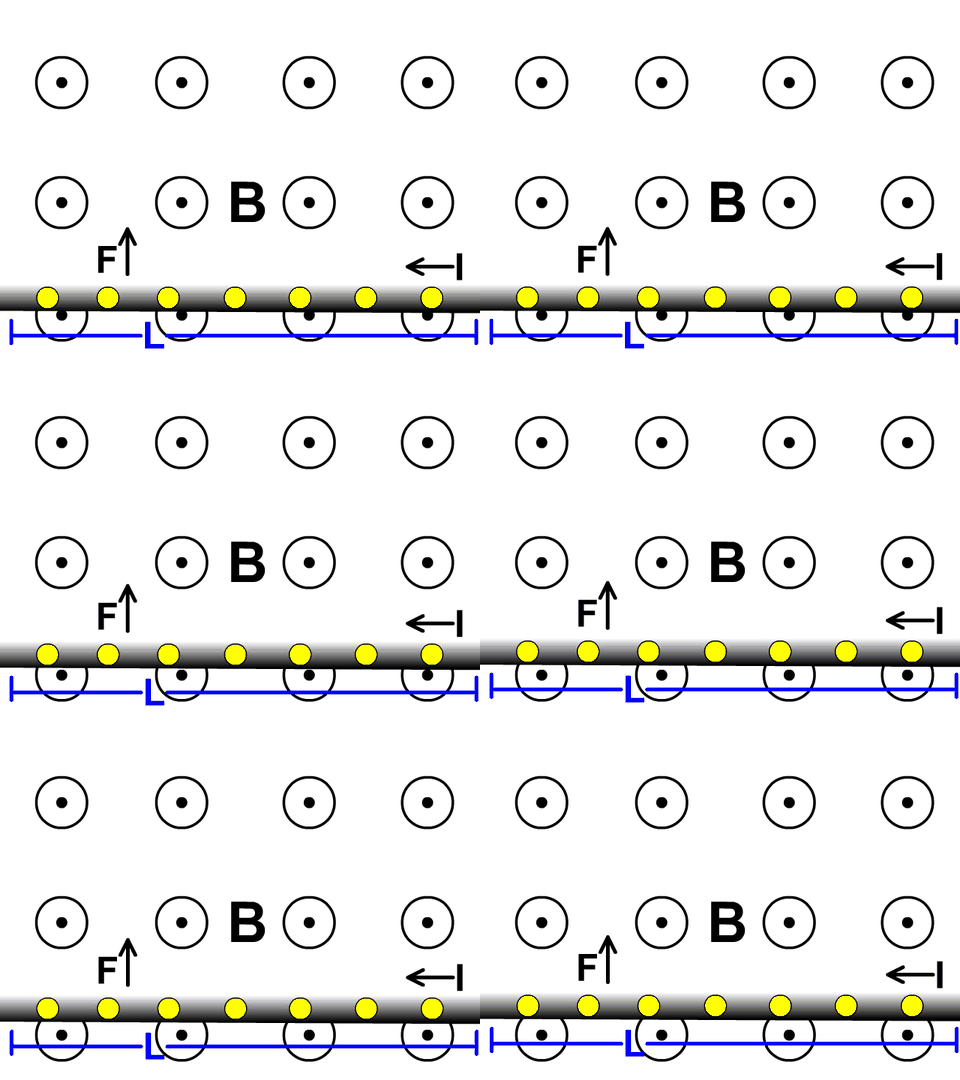
سلك يمرّ به تيار \(I\) في مجال \(B\): تتأثر الشحنات المتحركة فيه بقوة.
A wire carrying a current \(I\) in a field \(B\): its moving charges feel a force.
📌 الاستنتاج
📌 The derivation
\[I=\frac{q}{t}\ \Rightarrow\ q=I\,t=I\,\frac{L}{v}\]
\[F=q\,v\,B\sin\theta=I\,\frac{L}{v}\,v\,B\sin\theta\]
\[F=I\,L\,B\sin\theta\]
\(L\) طول السلك داخل المجال، و\(\theta\) الزاوية بين السلك (اتجاه التيار) والمجال. الاتجاه بالقاعدة نفسها لكن بوضع الإبهام باتجاه التيار التقليدي.
\(L\) is the length of wire inside the field and \(\theta\) the angle between the wire (the current direction) and the field. The direction follows the same rule with the thumb along the conventional current.
سلك طوله داخل المجال \(0.4\ \mathrm m\) يمرّ به تيار \(5\ \mathrm A\) في مجال \(0.3\ \mathrm T\). أوجد القوة عندما يكون السلك عموديًا على المجال، وعندما يصنع معه زاوية \(30^\circ\).
A wire with \(0.4\ \mathrm m\) inside the field carries \(5\ \mathrm A\) in a field of \(0.3\ \mathrm T\). Find the force when the wire is perpendicular to the field and when it makes \(30^\circ\) with it.
🧪 جرّب بنفسك: سلك معلّق في مجال
🧪 Try It Yourself: a Hanging Wire in a Field
🧪 تجربة 9: سلك معلّق في مجال مغناطيسي: يتأرجح بتأثير القوة
🧪 Experiment 9: A Hanging Wire in a Magnetic Field: It Swings under the Force
سلك معلّق بخيط بين قطبي مغناطيس (المجال رأسي)، ويمر به تيار عمودي على الصفحة. اضغط «أغلق المفتاح» فتتأرجح الكتلة وتستقر عند زاوية تحقق \(\tan\alpha=F/mg\) حيث \(F=ILB\). جرّب عكس التيار أو عكس قطبي المغناطيس، ثم سجّل قياسات بتيارات مختلفة لترى أن \(F\) تتناسب طرديًا مع \(I\). أنجز المهام في الصندوق الأصفر.
A wire hangs on a string between the poles of a magnet (the field is vertical) and carries a current perpendicular to the page. Press “Close the switch” and the mass swings and settles at an angle satisfying \(\tan\alpha=F/mg\) where \(F=ILB\). Try reversing the current or swapping the poles and watch the direction reverse, then record measurements at different currents to see that \(F\) is proportional to \(I\). Complete the missions in the yellow box.
🧱 تأثير هول
🧱 The Hall Effect
لنأخذ شريحة موصلة يمر بها تيار \(I\) (ارتفاعها \(h\) وعرضها \(d\) وطولها \(L\)) في مجال مغناطيسي عمودي عليها. ما الذي يحدث بعد زمن قصير؟
Take a conducting strip carrying a current \(I\) (height \(h\), width \(d\), length \(L\)) in a magnetic field perpendicular to it. What happens after a short time?
🧠 خطوات الفكرة
🧠 The idea step by step
- تتحرك حاملات الشحنة (إلكترونات عكس التيار التقليدي) فتؤثر فيها القوة المغناطيسية وتدفعها نحو أحد طرفي الشريحة.The charge carriers (electrons move opposite to the conventional current) feel the magnetic force and are pushed toward one edge of the strip.
- تتراكم الشحنة على ذلك الطرف ويظهر على الطرف المقابل شحنة معاكسة، فينشأ مجال كهربائي عرضي \(E_H\) وفرق جهد عرضي \(\Delta V_H\).Charge piles up on that edge and the opposite edge shows the opposite charge, so a transverse electric field \(E_H\) and a transverse voltage \(\Delta V_H\) appear.
- يستمر التراكم حتى تتساوى القوة الكهربائية مع المغناطيسية فيستقر جهد هول.The pile-up continues until the electric force equals the magnetic force, and then the Hall voltage settles.
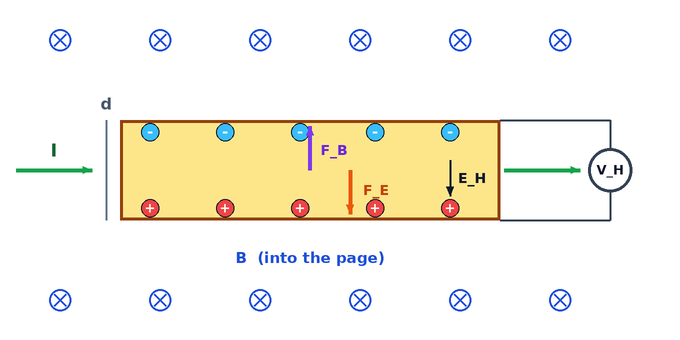
شريحة هول: التيار والمجال والحافتان المشحونتان وجهد هول.
A Hall strip: the current, the field, the charged edges and the Hall voltage.
📌 العلاقات
📌 The relations
\[qE_H=q\,v_d\,B\ \Rightarrow\ E_H=v_dB,\qquad \Delta V_H=E_H\,d=v_d\,B\,d\]
\[v_d=\frac{I}{n\,e\,A}=\frac{I}{n\,e\,h\,d}\ \Rightarrow\ \Delta V_H=\frac{I\,B}{n\,e\,h}\]
\[B=\frac{\Delta V_H\;n\,e\,h}{I}\]
\(n\) عدد الحاملات في وحدة الحجم، \(h\) سمك الشريحة في اتجاه المجال. تُستخدم العلاقة لقياس المجال المغناطيسي بمجسّ هول، ولمعرفة إشارة حاملات الشحنة (قطبية جهد هول) وعددها في وحدة الحجم.
\(n\) is the number of carriers per unit volume and \(h\) the thickness of the strip along the field. The relation is used to measure a magnetic field with a Hall probe and to find the sign of the charge carriers (the polarity of the Hall voltage) and their number per unit volume.
🧪 جرّب بنفسك: تأثير هول
🧪 Try It Yourself: the Hall Effect
🧪 تجربة 10: تأثير هول: جهد عرضي من القوة المغناطيسية
🧪 Experiment 10: The Hall Effect: a Transverse Voltage from the Magnetic Force
مرّر تيارًا في الشريحة ثم اضغط «مرّر التيار»: تدفع القوة المغناطيسية \(F_B\) الحاملات نحو حافة واحدة فتتراكم الشحنة وتنشأ قوة كهربائية \(F_E\) تزداد حتى تتساوى مع \(F_B\) فيستقر جهد هول \(V_H=IB/neh\). غيّر نوع الحاملات واتجاه المجال لترى القطبية تنعكس.
Pass a current through the strip and press “Pass the current”: the magnetic force \(F_B\) pushes the carriers toward one edge so charge piles up and an electric force \(F_E\) grows until it equals \(F_B\), when the Hall voltage settles at \(V_H=IB/neh\). Change the carrier type and the field direction to see the polarity reverse.
شريحة سمكها \(h=1\ \mathrm{mm}\) وعرضها \(d=10\ \mathrm{mm}\) يمر بها تيار \(10\ \mathrm{mA}\) في مجال \(0.2\ \mathrm T\). إذا كان عدد الحاملات في وحدة الحجم \(n=10^{22}\ \mathrm{m^{-3}}\) فما جهد هول؟
A strip of thickness \(h=1\ \mathrm{mm}\) and width \(d=10\ \mathrm{mm}\) carries \(10\ \mathrm{mA}\) in a field of \(0.2\ \mathrm T\). If the number of carriers per unit volume is \(n=10^{22}\ \mathrm{m^{-3}}\), what is the Hall voltage?
🧪 اختبر نفسك: امتحان من 20 سؤالاً
🧪 Test Yourself: a 20-Question Exam
أنهِ الدرس بالاختبار التفاعلي التالي؛ أسئلته تجمع بين الفهم والحساب وتغطي جميع أقسام الدرس.
Finish with the interactive exam below; its questions mix understanding with calculation and cover every section of the lesson.
اختبار المغناطيسية Magnetism Quiz
20 سؤالاً - الأقطاب وخطوط المجال، النطاقات، القوة على شحنة وسلك، المسار الدائري واللولبي، السيكلوترون، المطياف، تأثير هول 20 Questions - poles and field lines, domains, force on a charge and a wire, circular and helical paths, the cyclotron, the spectrometer, the Hall effect
• عدد الأسئلة: 20 سؤالاً
• مدة الاختبار: 30 دقيقة
• لا يمكنك تغيير إجاباتك أو إعادة الاختبار إلا بعد 24 ساعة من التسليم.
• تأكد من إجاباتك قبل التسليم! 📌 Important Instructions:
• Number of questions: 20 questions
• Quiz duration: 30 minutes
• You cannot change your answers or retake the quiz for 24 hours after submission.
• Make sure of your answers before submitting!
🔗 محاكيات GeoGebra للاستعانة بها عند اللزوم
🔗 GeoGebra Simulations to Use When Needed
اضغط «تشغيل» لتعمل المحاكاة هنا داخل الدرس؛ ويمكن للطالب الرجوع إليها لتجربة الفكرة بطريقة أخرى.
Press “Run” to run the simulation right here inside the lesson; the student can use it to try the idea in another way.