🎯 نواتج التعلم
🎯 Learning Outcomes
بعد دراسة هذا الدرس ستكون قادرًا على أن:
After this lesson you will be able to:
- تفسّر كيف يولّد المجال المغناطيسي المتغير مجالًا كهربائيًا (فاراداي) والمجال الكهربائي المتغير مجالًا مغناطيسيًا (مكسويل).Explain how a changing magnetic field produces an electric field (Faraday) and a changing electric field produces a magnetic field (Maxwell).
- تحسب تيار الإزاحة \(I_d=\varepsilon_0\,d\Phi_E/dt\) والمجال المغناطيسي الناتج عنه.Calculate the displacement current \(I_d=\varepsilon_0\,d\Phi_E/dt\) and the magnetic field it produces.
- تذكر خصائص الموجات الكهرومغناطيسية وتطبّق \(c=\lambda f\) و\(v=c/\sqrt K\).State the properties of electromagnetic waves and apply \(c=\lambda f\) and \(v=c/\sqrt K\).
- ترتّب أنواع الأمواج الكهرومغناطيسية السبعة وتذكر استخدام كل منها.Order the seven types of electromagnetic waves and state a use of each.
- تشرح إرسال الموجات واستقبالها (المذبذب والمغيّر والمضخم والهوائي ودائرة \(LC\)).Explain how waves are sent and received (oscillator, modulator, amplifier, antenna and the \(LC\) circuit).
- تطبّق الاستقطاب وقانون مالوس \(I=I_0\cos^2\theta\).Apply polarization and Malus's law \(I=I_0\cos^2\theta\).
👨🔬 جيمس كلارك مكسويل
👨🔬 James Clerk Maxwell
| المعلومةItem | التفاصيلDetails |
|---|---|
| الميلاد والوفاةBorn / died | وُلد في 13 يونيو 1831 في إدنبرة (اسكتلندا) وتوفي في كامبريدج (إنجلترا) في 5 نوفمبر 1879Born on 13 June 1831 in Edinburgh (Scotland) and died in Cambridge (England) on 5 November 1879 |
| إنجازهAchievement | وضع الأسس النظرية لنظرية المجال الكهرومغناطيسي بناءً على أفكار مايكل فاراداي، وأثبت أن الشحنات المتذبذبة تنتج موجات في مجال كهرومغناطيسي (1873)، فأسس النظرية الكهرومغناطيسية الكاملة للضوءHe laid the theoretical foundations of the electromagnetic field theory based on the ideas of Michael Faraday, and showed that oscillating charges produce waves in an electromagnetic field (1873), thus founding the complete electromagnetic theory of light |
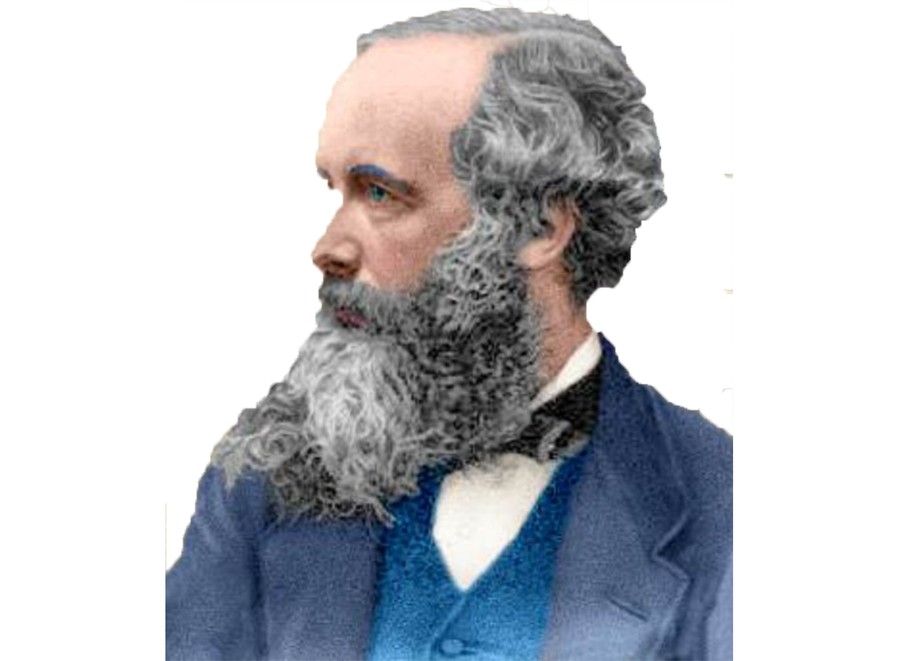
جيمس كلارك مكسويل (1831–1879).
James Clerk Maxwell (1831–1879).
🔁 المجال المتغير يولّد مجالًا
🔁 A Changing Field Produces a Field
📘 قانون فاراداي: مجال كهربائي ناتج من تغير المجال المغناطيسي
📘 Faraday's law: an electric field produced by a changing magnetic field
\[\oint\vec E\cdot d\vec\ell=-\dfrac{d\Phi_B}{dt}\]
المجال المغناطيسي المتغير يولّد مجالًا كهربائيًا خطوطه مغلقة (دائرية) حول خطوط المجال المغناطيسي.
A changing magnetic field produces an electric field whose lines are closed loops around the magnetic field lines.
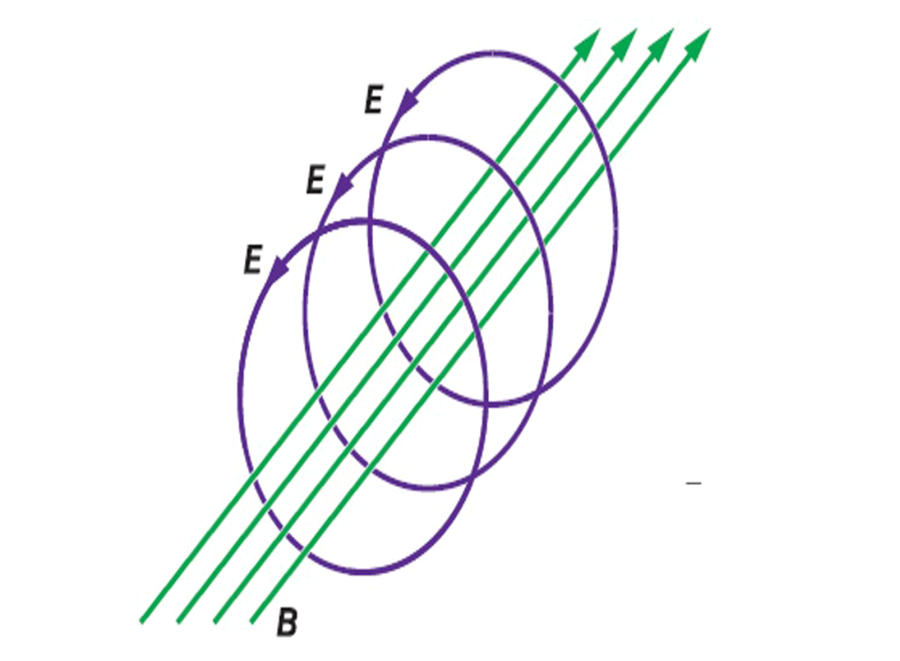
خطوط \(E\) المغلقة تحيط بخطوط \(B\) المتغيرة.
The closed \(E\) lines surround the changing \(B\) lines.
📘 قانون مكسويل: مجال مغناطيسي ناتج من تغير المجال الكهربائي
📘 Maxwell's law: a magnetic field produced by a changing electric field
\[\oint\vec B\cdot d\vec\ell=\mu_0\varepsilon_0\dfrac{d\Phi_E}{dt}\]
المجال الكهربائي المتغير يولّد مجالًا مغناطيسيًا خطوطه مغلقة حول خطوط المجال الكهربائي. وبهذه الخطوة توحّدت قوانين القوى الكهربائية والمغناطيسية في الطبيعة.
A changing electric field produces a magnetic field whose lines are closed loops around the electric field lines. With this step the laws of the electric and magnetic forces in nature were unified.
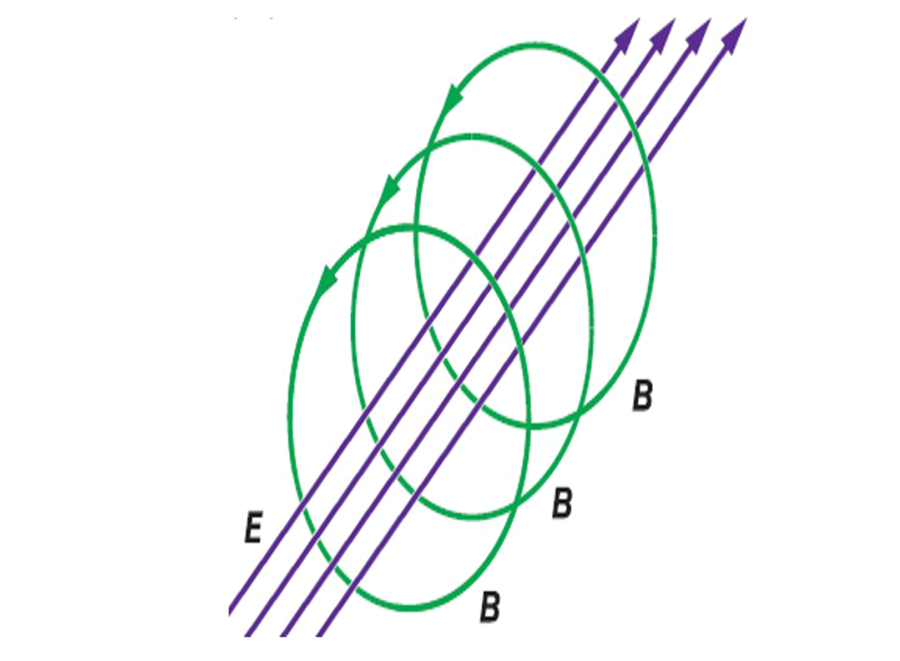
خطوط \(B\) المغلقة تحيط بخطوط \(E\) المتغيرة.
The closed \(B\) lines surround the changing \(E\) lines.
💡 شرح إضافي: لماذا أضاف مكسويل حدًّا جديدًا إلى قانون أمبير؟
💡 Extra explanation: why did Maxwell add a new term to Ampère's law?
قانون أمبير \(\oint\vec B\cdot d\vec\ell=\mu_0 I_{enc}\) يعطي المجال المغناطيسي حول سلك يمر فيه تيار. لكن عند مكثف يُشحن لا يمر تيار بين صفيحتيه (فراغ أو عازل) فلا يصلح القانون لسطح يمر بين الصفيحتين رغم وجود مجال مغناطيسي هناك. لاحظ مكسويل هذا القصور فأضاف حدًّا يعتمد على تغير الفيض الكهربائي، فصار القانون الشامل:
Ampère's law \(\oint\vec B\cdot d\vec\ell=\mu_0 I_{enc}\) gives the magnetic field around a wire carrying a current. But in a capacitor being charged no current passes between the plates (vacuum or insulator), so the law fails for a surface passing between the plates although a magnetic field exists there. Maxwell noticed this defect and added a term that depends on the change of the electric flux, giving the complete law:
\[\oint\vec B\cdot d\vec\ell=\mu_0\varepsilon_0\dfrac{d\Phi_E}{dt}+\mu_0 I_{enc}\]
في تيار ثابت في موصل (لا يتغير الفيض الكهربائي) يختزل القانون إلى قانون أمبير، وفي مجال متغير دون تيار موصل يبقى حد مكسويل وحده.
For a steady current in a conductor (no change of electric flux) the law reduces to Ampère's law, and for a changing field with no conduction current only Maxwell's term remains.
تيار الإزاحة
The displacement current
📘 تيار الإزاحة
📘 Displacement current
نسمّي الحد \(\varepsilon_0\,d\Phi_E/dt\) تيار الإزاحة \(I_d\)، فتصبح معادلة مكسويل–أمبير:
We call the term \(\varepsilon_0\,d\Phi_E/dt\) the displacement current \(I_d\), so the Maxwell–Ampère equation becomes:
\[I_d=\varepsilon_0\dfrac{d\Phi_E}{dt}=\varepsilon_0A\dfrac{dE}{dt}\qquad\oint\vec B\cdot d\vec\ell=\mu_0\,(I_d+I_{enc})\]
(في مجال منتظم عمودي على مساحة \(A\) يكون \(\Phi_E=EA\)). وهو ليس تيار شحنات حقيقيًا، لكنه يولّد المجال المغناطيسي كأنه تيار.
(for a uniform field perpendicular to an area \(A\), \(\Phi_E=EA\)). It is not a real flow of charges, but it produces the magnetic field as if it were a current.
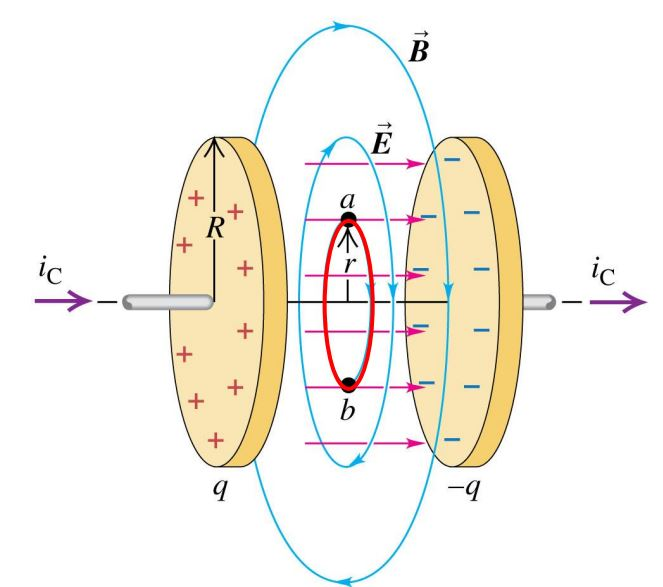
مكثف دائري يُشحن: التيار \(i_C\) في الأسلاك، وتيار الإزاحة بين الصفيحتين يولّد المجال \(B\) حول المحور.
A circular capacitor being charged: the current \(i_C\) in the wires, and the displacement current between the plates produces the field \(B\) around the axis.
💡 شرح إضافي: المجال داخل الصفيحة وخارجها
💡 Extra explanation: the field inside and outside the plate region
إذا كان نصف قطر الصفيحتين \(R\) والنقطة على بعد \(r\) من المحور:
If the radius of the plates is \(R\) and the point is at a distance \(r\) from the axis:
- داخل المنطقة (\(r\lt R\)): يحيط المسار بجزء من الفيض فقط، فيكون \(B=\dfrac{\mu_0\varepsilon_0\,r}{2}\dfrac{dE}{dt}\) ويزداد مع \(r\).Inside the region (\(r\lt R\)): the path encloses only part of the flux so \(B=\dfrac{\mu_0\varepsilon_0\,r}{2}\dfrac{dE}{dt}\), which increases with \(r\).
- خارج المنطقة (\(r\gt R\)): يحيط المسار بكل تيار الإزاحة فيكون \(B=\dfrac{\mu_0 I_d}{2\pi r}\) ويتناقص مع \(1/r\) كما حول سلك مستقيم.Outside the region (\(r\gt R\)): the path encloses the whole displacement current so \(B=\dfrac{\mu_0 I_d}{2\pi r}\), which falls as \(1/r\) as around a straight wire.
وعند \(r=R\) تتطابق العلاقتان.
At \(r=R\) the two relations give the same value.
🧪 تجربة 1: تيار الإزاحة والمجال المغناطيسي المستحث
🧪 Experiment 1: The displacement current and the induced magnetic field
مكثف دائري نصف قطر صفيحتيه \(R\) يُشحن فيتغير المجال الكهربائي بين صفيحتيه بمعدل \(dE/dt\). هذا المجال المتغير يولّد تيار إزاحة \(I_d=\varepsilon_0\,A\,\dfrac{dE}{dt}\) ويستحث مجالًا مغناطيسيًا حول المحور. غيّر \(R\) و\(dE/dt\) وبُعد النقطة \(r\)، وراقب المنحنى: \(B\) يزداد داخل الصفيحة ثم يتناقص خارجها بمقدار \(1/r\). احسب \(B\) وتحقق.
A circular capacitor with plates of radius \(R\) is being charged so the electric field between the plates changes at the rate \(dE/dt\). This changing field produces a displacement current \(I_d=\varepsilon_0\,A\,\dfrac{dE}{dt}\) and induces a magnetic field around the axis. Change \(R\), \(dE/dt\) and the distance \(r\) of the point, and watch the graph: \(B\) grows inside the plate region and then falls off outside as \(1/r\). Calculate \(B\) and check.
مجال كهربائي عمودي على سطح دائري نصف قطره \(8\ \mathrm{cm}\) يزداد بمعدل \(15\ \mathrm{V/(m\cdot s)}\). احسب المجال المغناطيسي على بُعد \(20\ \mathrm{cm}\) من مركز المنطقة الدائرية.
An electric field perpendicular to a circular surface of radius \(8\ \mathrm{cm}\) increases at the rate of \(15\ \mathrm{V/(m\cdot s)}\). Find the magnetic field at a distance of \(20\ \mathrm{cm}\) from the centre of the circular region.
للمنطقة نفسها في المثال السابق، احسب المجال المغناطيسي على بُعد \(4\ \mathrm{cm}\) من المركز (داخل الصفيحة).
For the same region as in the previous example, find the magnetic field at \(4\ \mathrm{cm}\) from the centre (inside the plate region).
ينص قانون مكسويل على أن:
Maxwell's law states that:
تيار الإزاحة بين صفيحتي مكثف يُشحن يُعطى بالعلاقة:
The displacement current between the plates of a capacitor being charged is given by:
خارج منطقة الصفيحتين يتناقص المجال المغناطيسي المستحث مع البعد \(r\) بحسب:
Outside the plate region the induced magnetic field decreases with the distance \(r\) as:
💡 سرعة الضوء
💡 The Speed of Light
معلومة للاطلاع: لاحظ عالم الفلك الدنماركي رومر (1644–1710) أثناء مراقبة المشتري وقمره آيو أن القمر يبدأ بالاختباء متأخرًا عندما تكون الأرض بعيدة عن المشتري عنه عندما تكون قريبة منه. فسّر ذلك بأن الضوء يحتاج إلى وقت إضافي ليقطع المسافة الزائدة (قطر مدار الأرض)، فحسب سرعة الضوء لأول مرة.
For information: the Danish astronomer Roemer (1644–1710) observed Jupiter and its moon Io and noticed that the moon starts to hide later when the Earth is far from Jupiter than when it is near. He explained this by the extra time light needs to cross the extra distance (the diameter of the Earth's orbit), and so he calculated the speed of light for the first time.
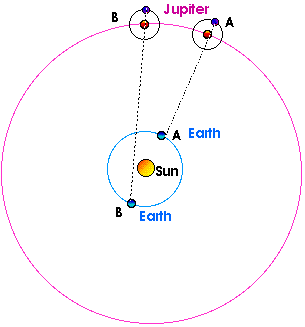
فكرة رومر: تأخر اختباء آيو عندما تبتعد الأرض عن المشتري.
Roemer's idea: Io's eclipse is delayed when the Earth moves away from Jupiter.
كانت القيمة التي حصل عليها أقل من القيمة المعروفة حاليًا بنحو ربعها (تقريبًا 25–30%)، والقيمة الحديثة الدقيقة للسرعة في الفراغ \(299\,792\,458\ \mathrm{m/s}\) ونأخذ منها:
The value he obtained was lower than the value known today by about a quarter (roughly 25–30%); the accurate modern value of the speed in vacuum is \(299\,792\,458\ \mathrm{m/s}\) and we use:
\[c=3.0\times10^{8}\ \mathrm{m/s}\]
🌊 خصائص الموجات الكهرومغناطيسية
🌊 Properties of Electromagnetic Waves
📘 الموجة الكهرومغناطيسية
📘 The electromagnetic wave
- لا تحتاج إلى وسط مادي لتنتشر فيه، فتنتقل في الفراغ.It does not need a material medium to propagate; it travels through vacuum.
- جميع الموجات الكهرومغناطيسية تنتقل في الفراغ بالسرعة نفسها \(c=3\times10^8\ \mathrm{m/s}\)، والضوء المرئي أحد مكوناتها.All electromagnetic waves travel through vacuum at the same speed \(c=3\times10^8\ \mathrm{m/s}\), and visible light is one of its components.
- هي موجات مستعرضة: المجالان \(\vec E\) و\(\vec B\) متعامدان معًا وعموديان على اتجاه الانتشار.They are transverse waves: the fields \(\vec E\) and \(\vec B\) are perpendicular to each other and to the direction of propagation.
\[c=v=\dfrac{x}{t}=\dfrac{\lambda}{T}=\lambda f\]
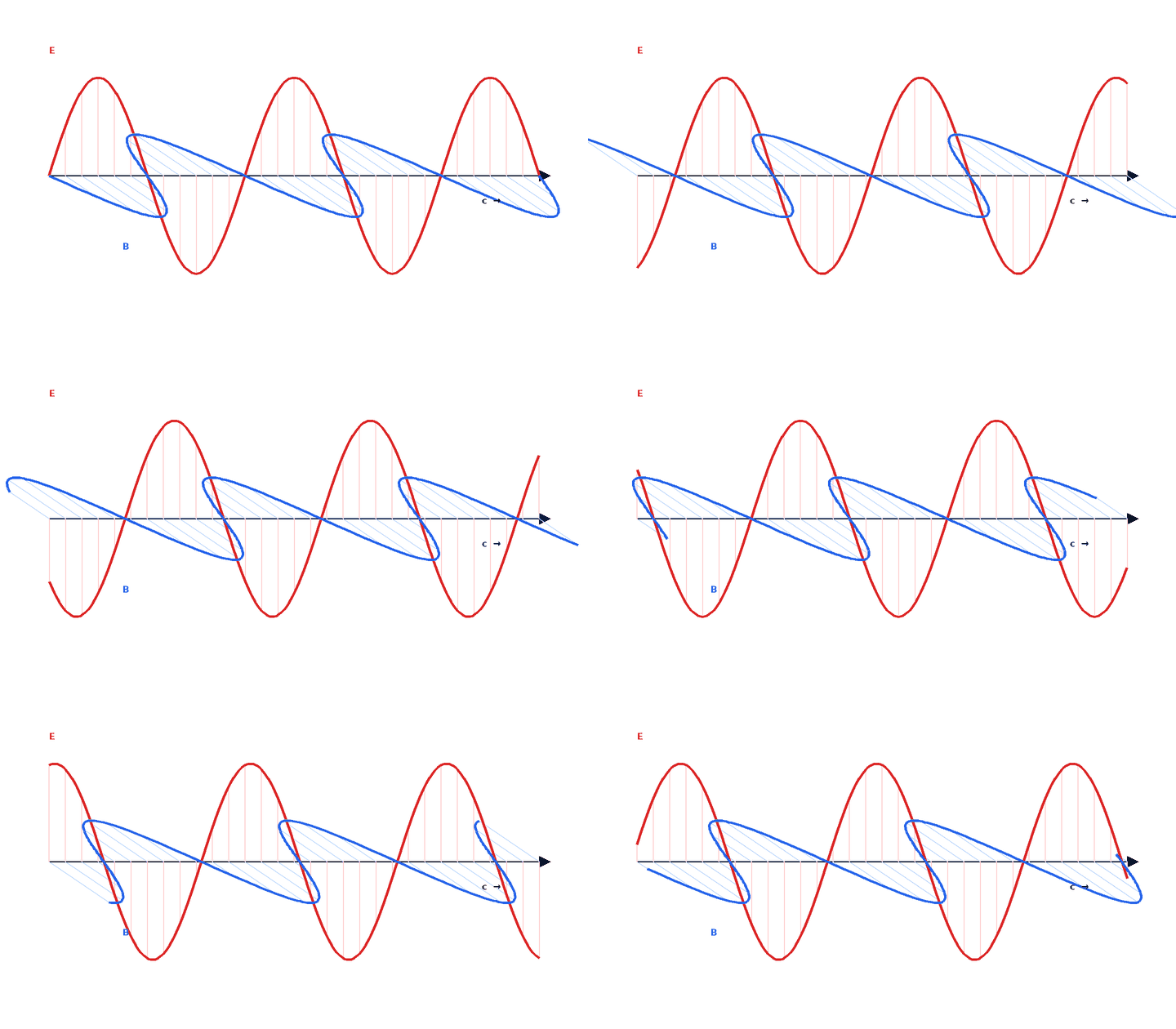
موجة كهرومغناطيسية متحركة: \(\vec E\) و\(\vec B\) متعامدان وفي الطور نفسه وعموديان على اتجاه الانتشار.
An animated electromagnetic wave: \(\vec E\) and \(\vec B\) are perpendicular, in phase, and perpendicular to the direction of propagation.
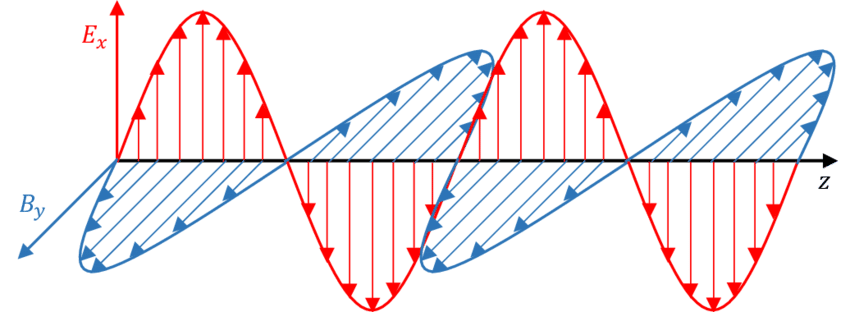
تغيّر \(E\) و\(B\) جيبيًا بالطور نفسه.
\(E\) and \(B\) vary sinusoidally in phase.
💡 شرح إضافي: لماذا تنتشر الموجة وحدها؟
💡 Extra explanation: why does the wave propagate by itself?
المجال الكهربائي المتغير يولّد مجالًا مغناطيسيًا متغيرًا، والمجال المغناطيسي المتغير يولّد بدوره مجالًا كهربائيًا متغيرًا، وهكذا يتجدد كل منهما بالآخر فتنتشر الموجة في الفراغ دون حاجة إلى وسط. وقد استنتج مكسويل من قوانينه أن سرعة هذه الموجة \(c=\dfrac{1}{\sqrt{\mu_0\varepsilon_0}}\approx3\times10^8\ \mathrm{m/s}\) وهي سرعة الضوء نفسها، فاستنتج أن الضوء موجة كهرومغناطيسية. وفي الموجة يتناسب مقدارا المجالين: \(E=cB\).
A changing electric field produces a changing magnetic field, and the changing magnetic field in turn produces a changing electric field, so each regenerates the other and the wave propagates through vacuum without needing a medium. From his laws Maxwell deduced that the speed of this wave is \(c=\dfrac{1}{\sqrt{\mu_0\varepsilon_0}}\approx3\times10^8\ \mathrm{m/s}\), which is the speed of light itself, so he concluded that light is an electromagnetic wave. In the wave the magnitudes of the two fields are proportional: \(E=cB\).
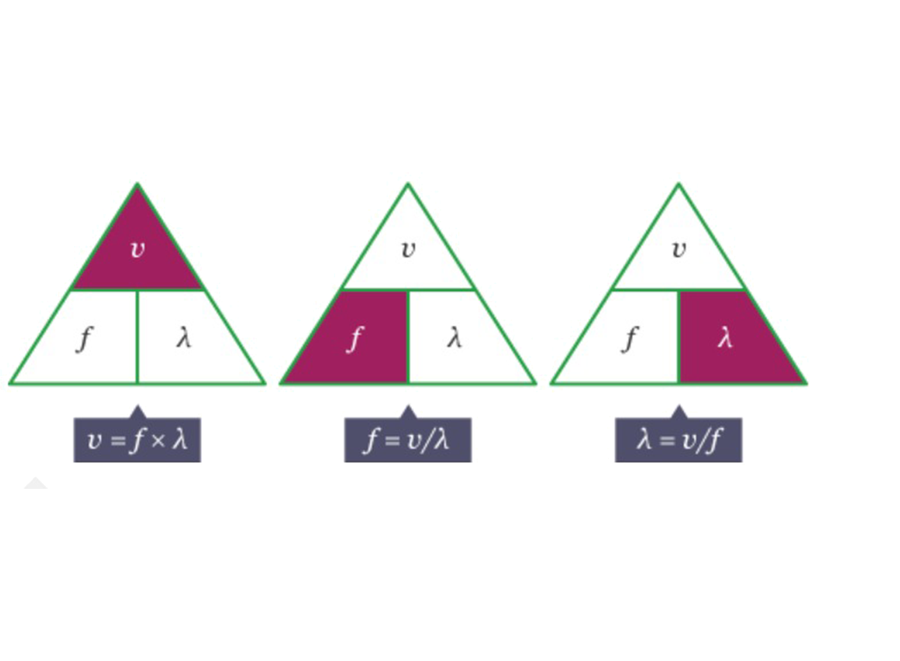
مثلث العلاقة \(v=f\lambda\): غطِّ المجهول لتحصل على العلاقة.
The triangle of \(v=f\lambda\): cover the unknown to get the relation.
الطول الموجي للضوء الأزرق \(\lambda=5\times10^{-7}\ \mathrm{m}\). احسب تردده.
The wavelength of blue light is \(\lambda=5\times10^{-7}\ \mathrm{m}\). Find its frequency.
ما تردد موجة كهرومغناطيسية طولها الموجي \(3.2\times10^{-7}\ \mathrm{m}\)؟
What is the frequency of an electromagnetic wave of wavelength \(3.2\times10^{-7}\ \mathrm{m}\)?
السرعة في الوسط المادي
The speed in a material medium
📘 السرعة في وسط
📘 The speed in a medium
سرعة الموجة في الوسط المادي أقل من سرعتها في الفراغ:
The speed of the wave in a material medium is less than in vacuum:
\[v=\dfrac{c}{\sqrt K}=\dfrac{c}{n}\qquad\sqrt K=n\]
حيث \(K\) ثابت العزل الكهربائي للوسط و\(n\) معامل انكساره (للأوساط غير المغناطيسية). أما التردد فلا يتغير بل يقصر الطول الموجي: \(\lambda_{medium}=\lambda_0/n\).
where \(K\) is the dielectric constant of the medium and \(n\) its refractive index (for non-magnetic media). The frequency does not change, instead the wavelength gets shorter: \(\lambda_{medium}=\lambda_0/n\).
ثابت العزل الكهربائي للزجاج \(K=2.28\). احسب سرعة الضوء في الزجاج، وطول موجة ضوء طوله في الفراغ \(600\ \mathrm{nm}\) داخله.
The dielectric constant of glass is \(K=2.28\). Find the speed of light in glass and the wavelength inside it of light whose wavelength in vacuum is \(600\ \mathrm{nm}\).
أي العبارات التالية صحيحة للموجات الكهرومغناطيسية؟
Which of the following statements about electromagnetic waves is correct?
تردد موجة طولها الموجي \(1.5\ \mathrm{m}\) في الفراغ:
The frequency of a wave of wavelength \(1.5\ \mathrm{m}\) in vacuum is:
عندما تنتقل موجة ضوئية من الفراغ إلى الزجاج يبقى ثابتًا:
When a light wave goes from vacuum into glass, what stays constant is:
سرعة الضوء في وسط ثابت عزله \(K=4\):
The speed of light in a medium of dielectric constant \(K=4\) is:
🌈 أنواع الأمواج الكهرومغناطيسية
🌈 Types of Electromagnetic Waves
المصدر الرئيسي للأمواج الكهرومغناطيسية في حياتنا هو الشمس، وتنقسم الأمواج إلى سبعة أنواع تختلف في الطول الموجي والتردد ولا في السرعة. نرتّبها من الأطول موجة (الأقل تردد) إلى الأقصر موجة (الأعلى تردد):
The main source of electromagnetic waves in our life is the Sun, and the waves are divided into seven types that differ in wavelength and frequency, not in speed. We order them from the longest wavelength (lowest frequency) to the shortest wavelength (highest frequency):
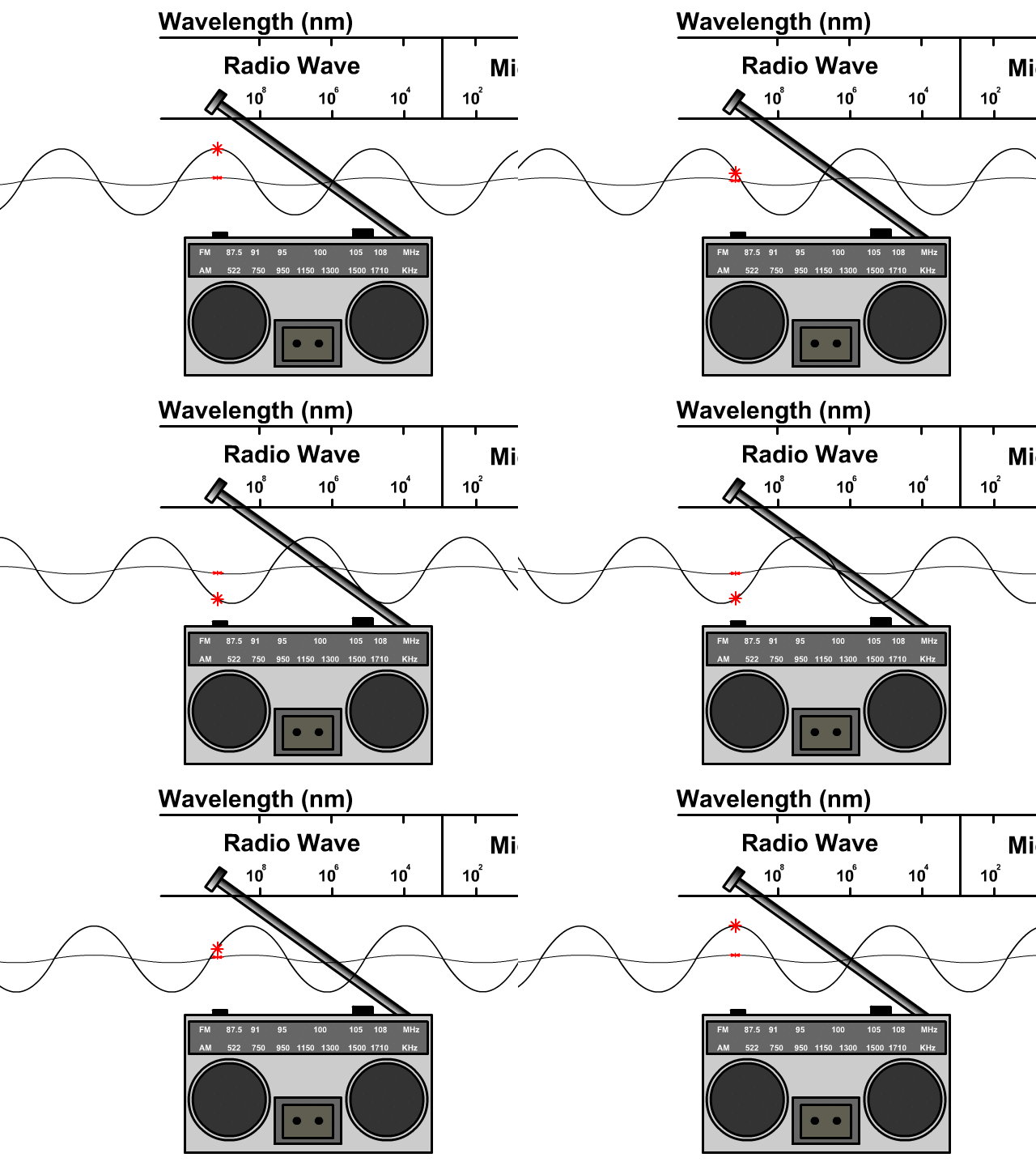
الأمواج الراديوية
Radio waves
الاستخدام: أجهزة البث الإذاعي والتلفزيوني
الطول الموجي التقريبي: > \(10^{-1}\ \mathrm{m}\)
Use: radio and television broadcasting
Approximate wavelength: > \(10^{-1}\ \mathrm{m}\)
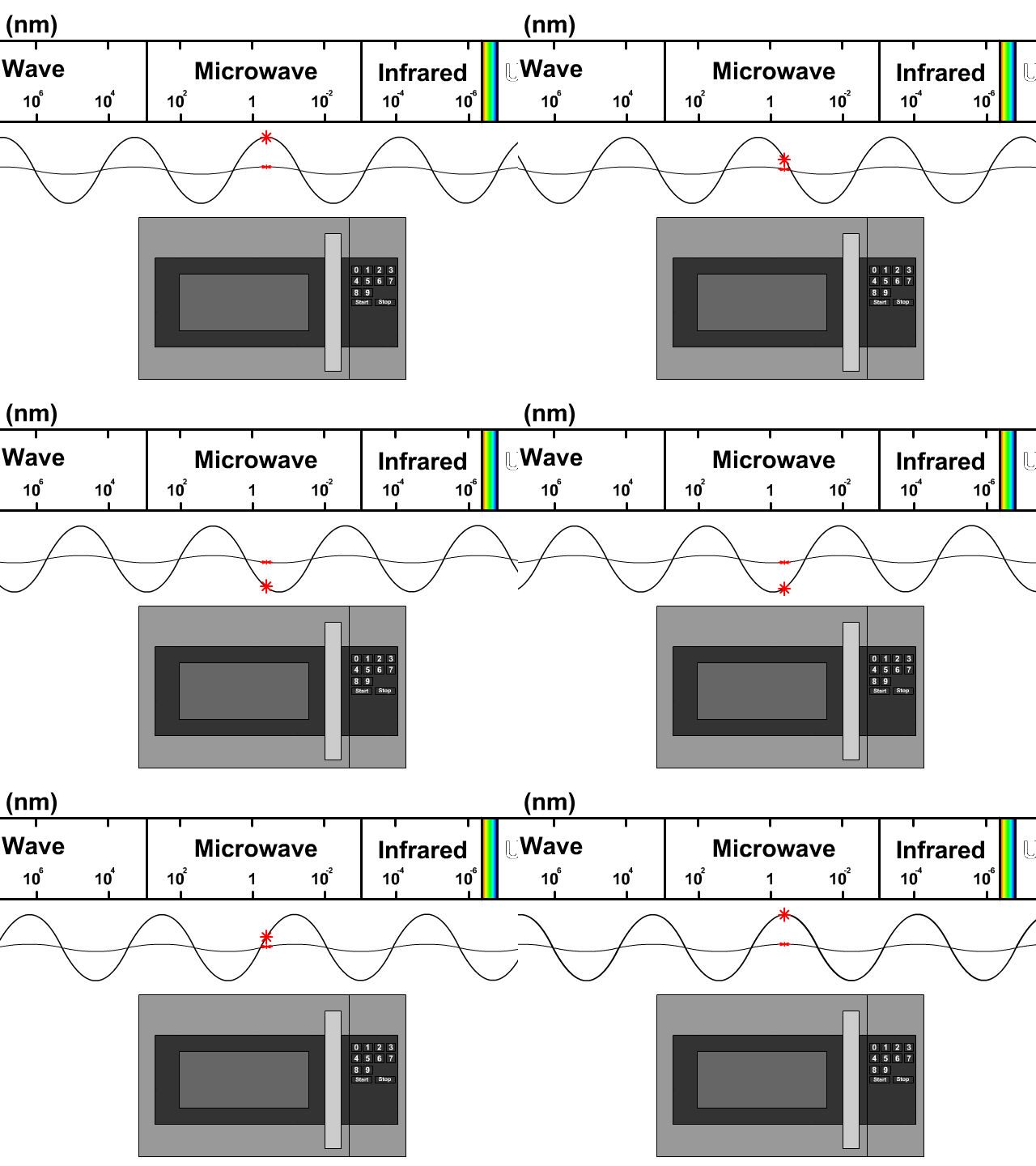
أمواج الميكروويف
Microwaves
الاستخدام: أفران الميكروويف والرادارات
الطول الموجي التقريبي: \(10^{-3}\) – \(10^{-1}\ \mathrm{m}\)
Use: microwave ovens and radar
Approximate wavelength: \(10^{-3}\) – \(10^{-1}\ \mathrm{m}\)
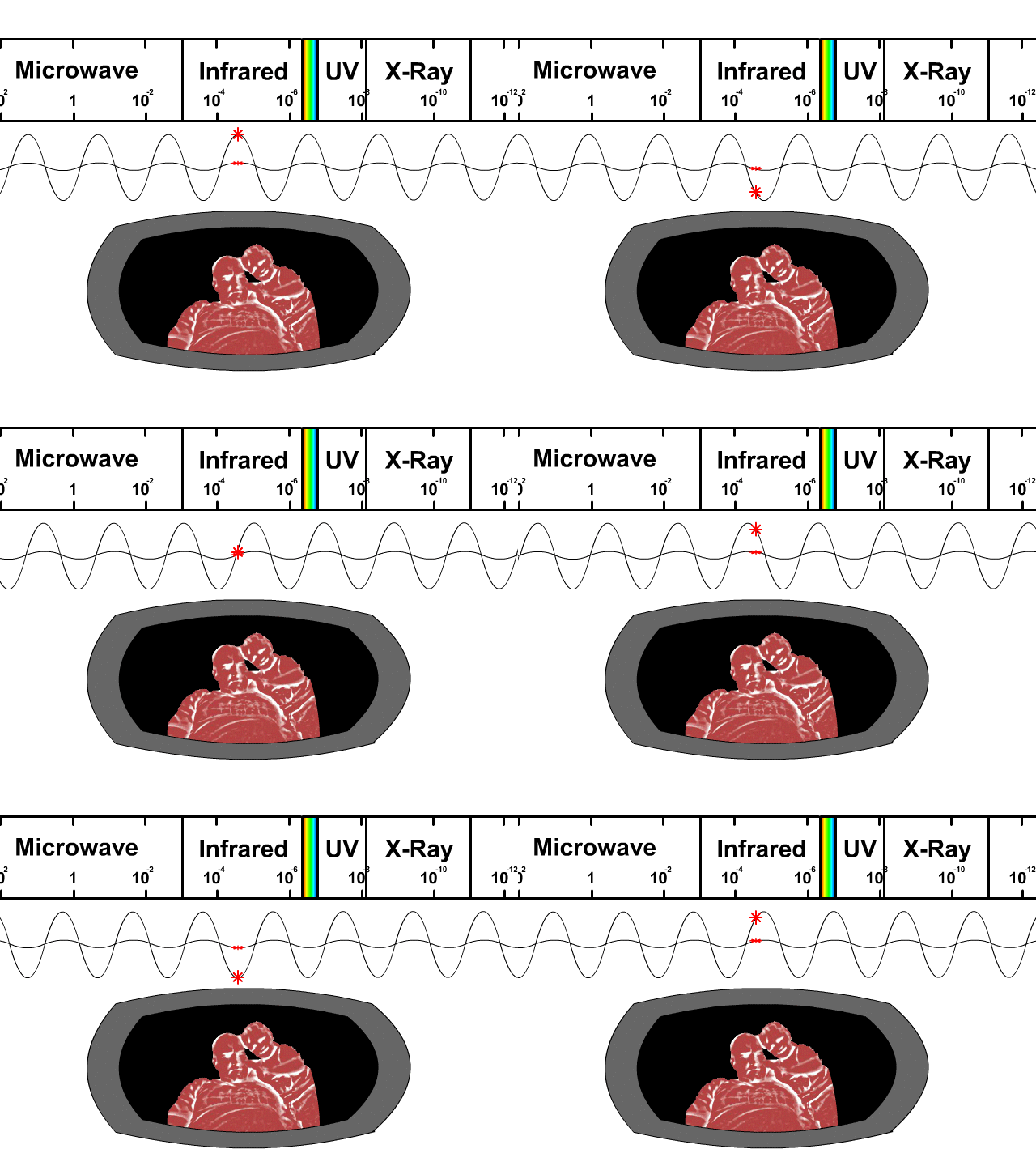
الأشعة تحت الحمراء
Infrared rays
الاستخدام: كاميرات التصوير الليلي وأجهزة التحكم عن بعد
الطول الموجي التقريبي: \(7\times10^{-7}\) – \(10^{-3}\ \mathrm{m}\)
Use: night-vision cameras and remote controls
Approximate wavelength: \(7\times10^{-7}\) – \(10^{-3}\ \mathrm{m}\)
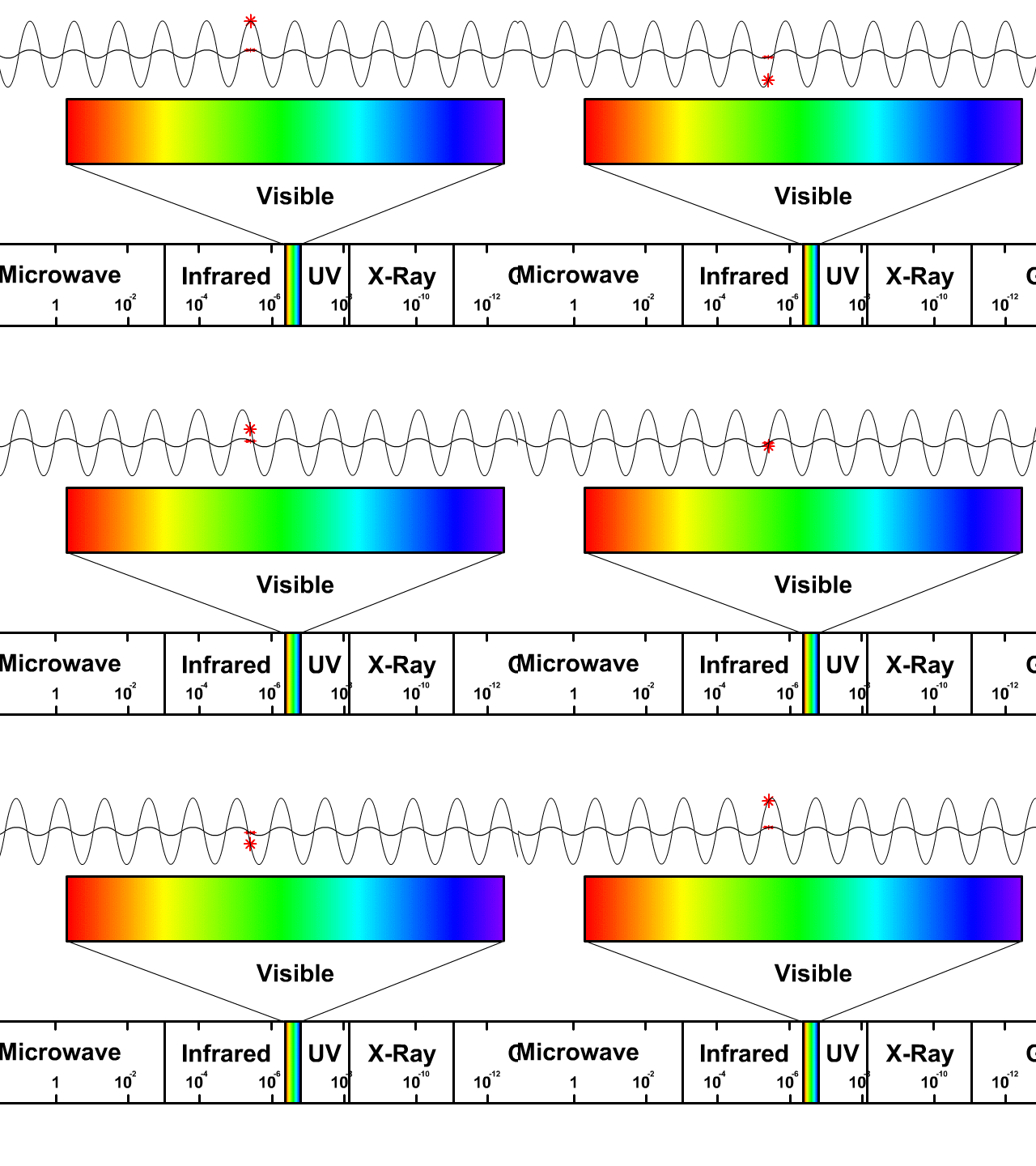
الضوء المرئي
Visible light
الاستخدام: الإضاءة في المنزل والمجهر ورؤية الأجسام
الطول الموجي التقريبي: \(4\times10^{-7}\) – \(7\times10^{-7}\ \mathrm{m}\)
Use: lighting at home, the microscope and seeing objects
Approximate wavelength: \(4\times10^{-7}\) – \(7\times10^{-7}\ \mathrm{m}\)
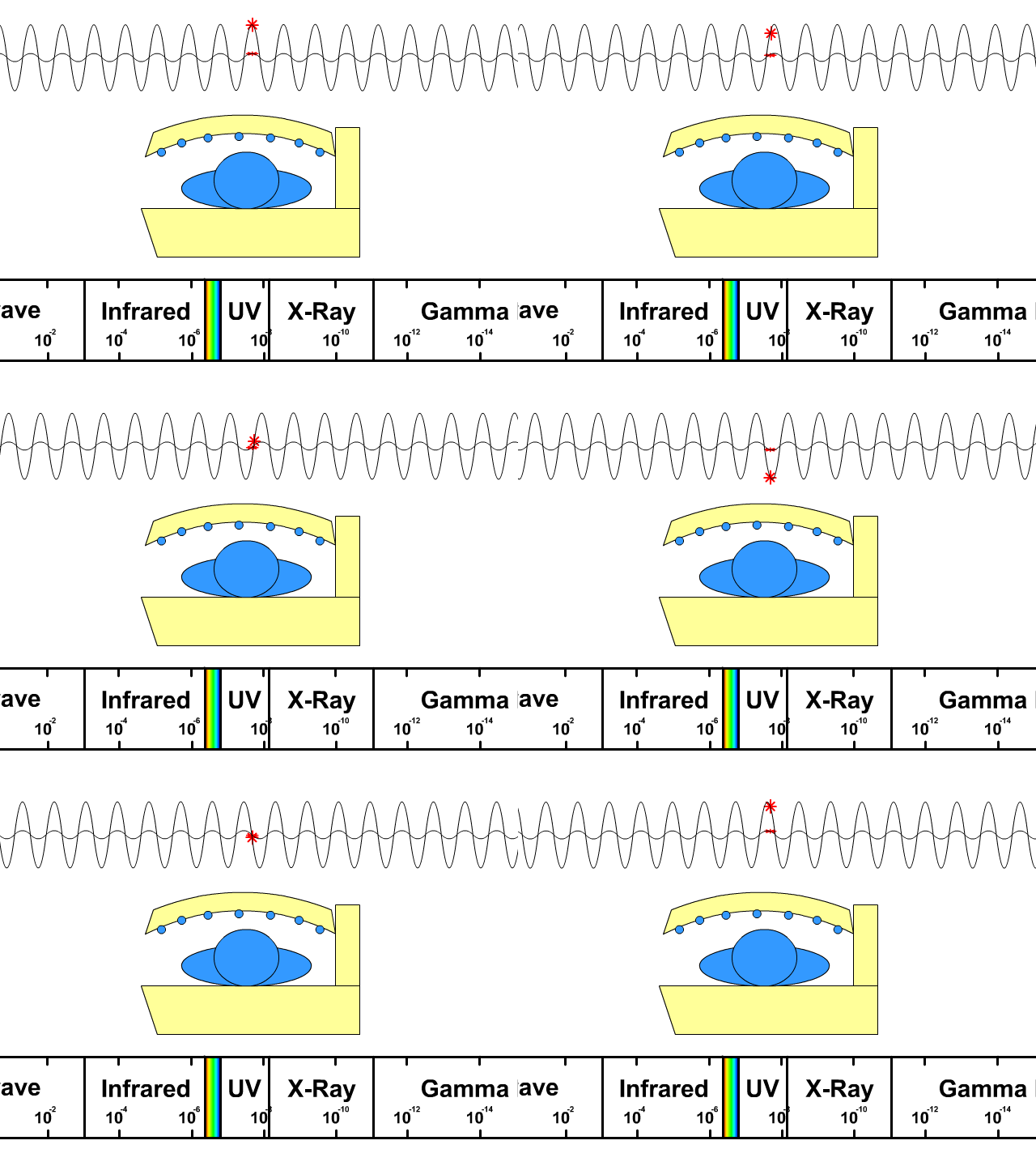
الأشعة فوق البنفسجية
Ultraviolet rays
الاستخدام: تعقيم مياه الشرب والأدوات الطبية
الطول الموجي التقريبي: \(10^{-8}\) – \(4\times10^{-7}\ \mathrm{m}\)
Use: sterilizing drinking water and medical tools
Approximate wavelength: \(10^{-8}\) – \(4\times10^{-7}\ \mathrm{m}\)
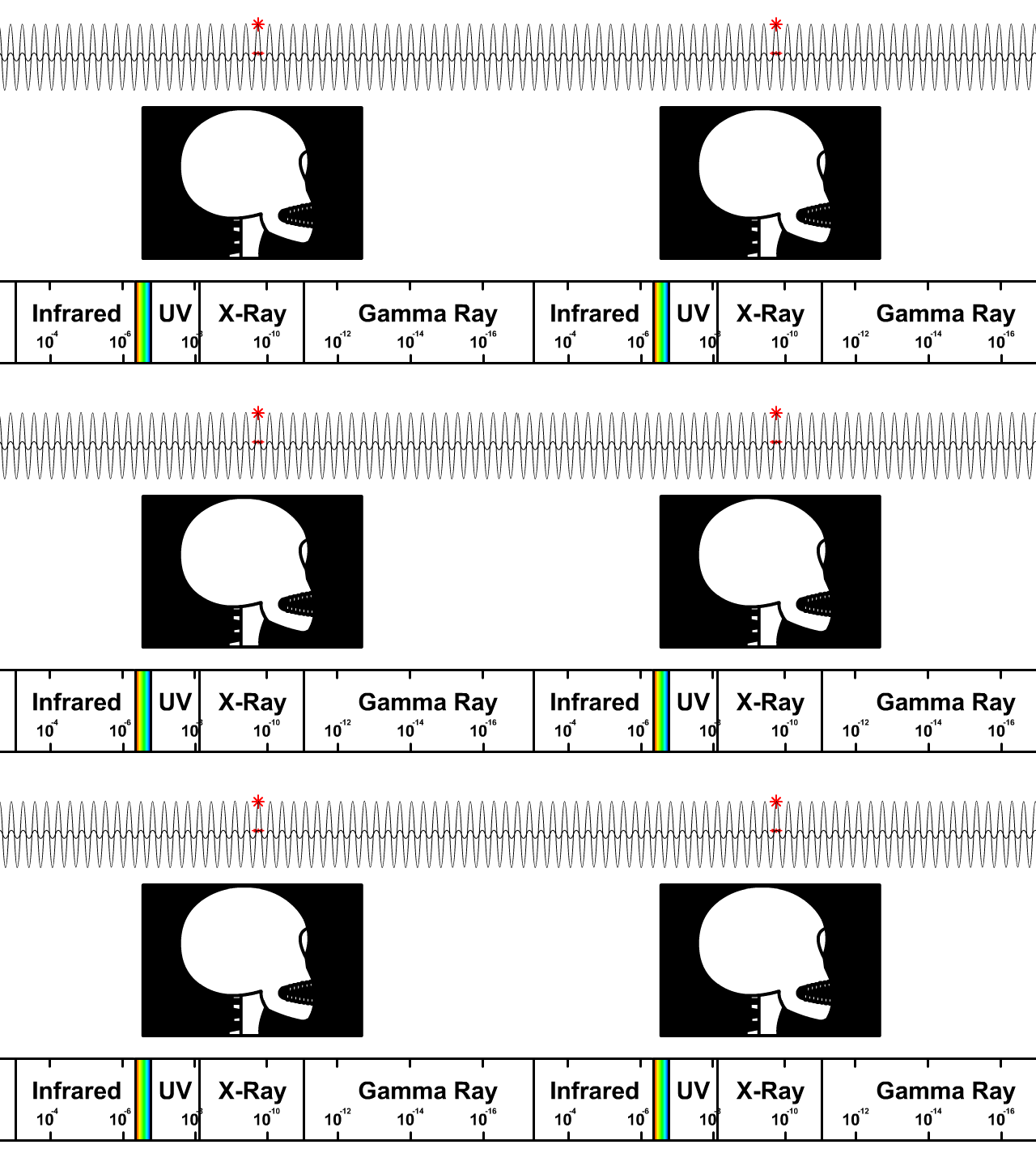
الأشعة السينية
X-rays
الاستخدام: التصوير الطبي ومعالجة بعض أورام السرطان
الطول الموجي التقريبي: \(10^{-11}\) – \(10^{-8}\ \mathrm{m}\)
Use: medical imaging and treating some cancer tumours
Approximate wavelength: \(10^{-11}\) – \(10^{-8}\ \mathrm{m}\)
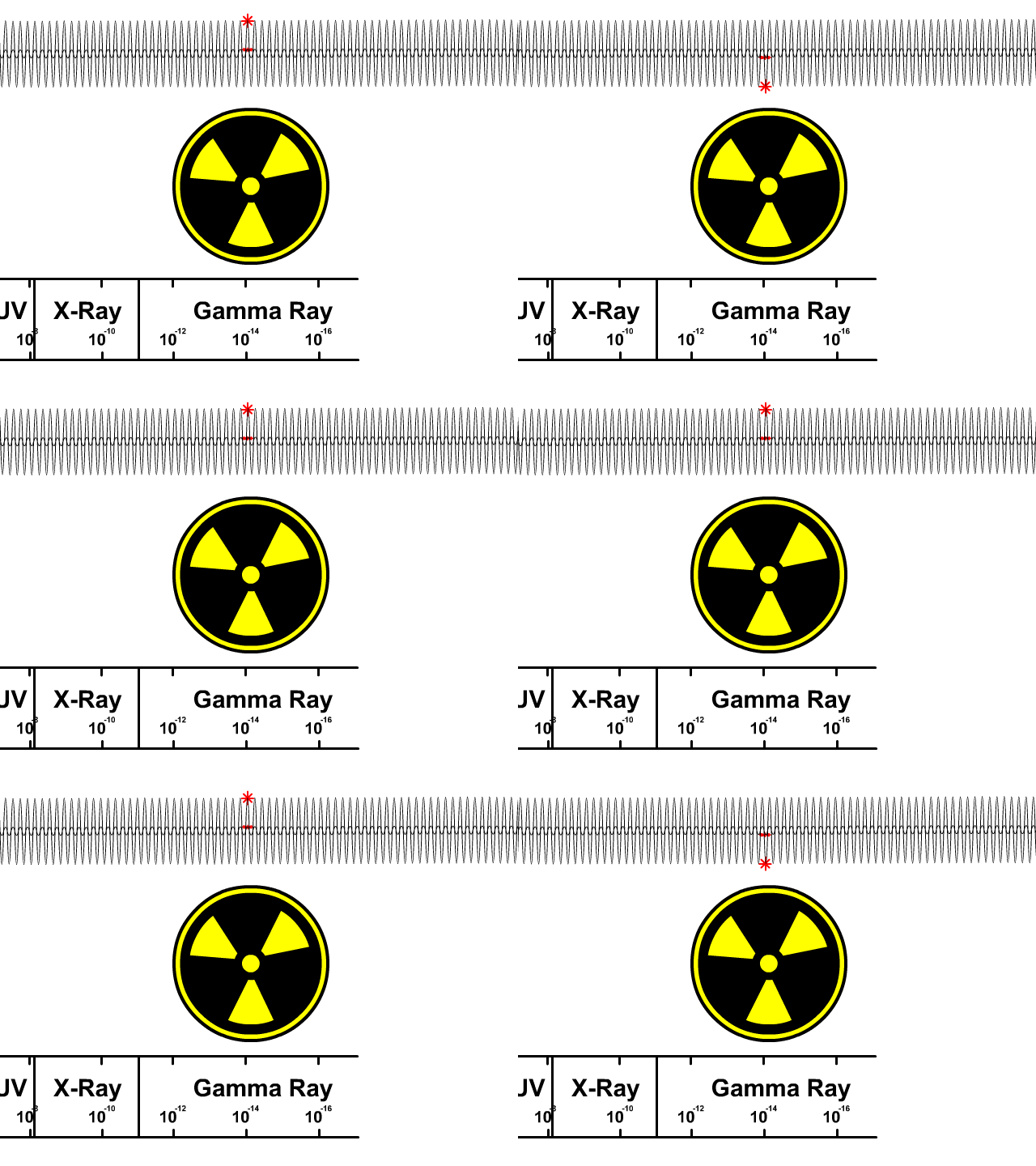
أشعة جاما
Gamma rays
الاستخدام: معالجة بعض أورام السرطان
الطول الموجي التقريبي: < \(10^{-11}\ \mathrm{m}\)
Use: treating some cancer tumours
Approximate wavelength: < \(10^{-11}\ \mathrm{m}\)
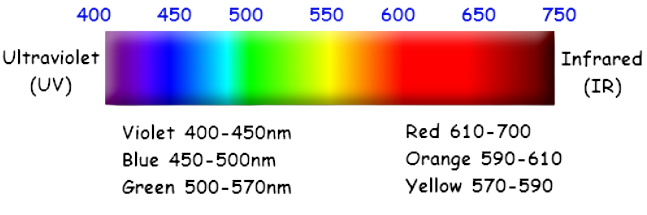
الضوء المرئي: من البنفسجي (≈400 nm) إلى الأحمر (≈750 nm).
Visible light: from violet (≈400 nm) to red (≈750 nm).
💡 شرح إضافي: علاقة الطول والتردد والطاقة
💡 Extra explanation: the relation between wavelength, frequency and energy
لأن \(c=\lambda f\) ثابتة، فكلما قصر الطول الموجي ازداد التردد، ولذلك فأشعة جاما والسينية عالية التردد (وطاقة فوتوناتها كبيرة وخطرها أكبر)، أما الراديو فمنخفضة التردد. والضوء المرئي مجال ضيق جدًا من الطيف. وكل أنواع الأمواج متماثلة في طبيعتها (مجالان \(E\) و\(B\) متذبذبان) وتختلف في كيفية توليدها وتفاعلها مع المادة.
Because \(c=\lambda f\) is constant, the shorter the wavelength the higher the frequency, so gamma and X-rays have high frequencies (high photon energy and more danger) while radio waves have low frequencies. Visible light is a very narrow part of the spectrum. All types of waves are the same in nature (oscillating \(E\) and \(B\) fields) and differ in how they are produced and how they interact with matter.
🧪 تجربة 2: طيف الموجات الكهرومغناطيسية والسرعة في الأوساط
🧪 Experiment 2: The electromagnetic spectrum and the speed in media
حرّك شريط الطول الموجي (مقياس لوغاريتمي) من الأمواج الراديوية إلى أشعة جاما. في الفراغ \(c=\lambda f=3\times10^8\ \mathrm{m/s}\) لكل الموجات الكهرومغناطيسية. ثم اختر وسطًا مثل الزجاج: تقل السرعة \(v=c/\sqrt K\) ويقصر الطول الموجي ويبقى التردد ثابتًا. احسب التردد وتحقق.
Move the wavelength slider (logarithmic scale) from radio waves to gamma rays. In vacuum \(c=\lambda f=3\times10^8\ \mathrm{m/s}\) for all electromagnetic waves. Then choose a medium such as glass: the speed decreases \(v=c/\sqrt K\), the wavelength gets shorter and the frequency stays constant. Calculate the frequency and check.
أي أنواع الأمواج الكهرومغناطيسية له أقصر طول موجي؟
Which type of electromagnetic wave has the shortest wavelength?
الأشعة المستخدمة في تعقيم مياه الشرب هي:
The rays used to sterilize drinking water are:
📡 إرسال الموجات الكهرومغناطيسية واستقبالها
📡 Sending and Receiving Electromagnetic Waves
نقل الموجة
Transmitting the wave
تُرسَل الموجات عبر هوائي، ويعمل فرق الجهد المتذبذب بين طرفيه على تسريع حركة الشحنات؛ وهذه الشحنات المتسارعة تولّد مجالًا مغناطيسيًا متغيرًا يولّد مجالًا كهربائيًا متغيرًا وهكذا، فتنتشر الموجة في الفراغ بسرعة الضوء.
Waves are sent through an antenna; the oscillating potential difference between its ends accelerates the charges, and these accelerated charges produce a changing magnetic field which produces a changing electric field, and so on, so the wave propagates through vacuum at the speed of light.
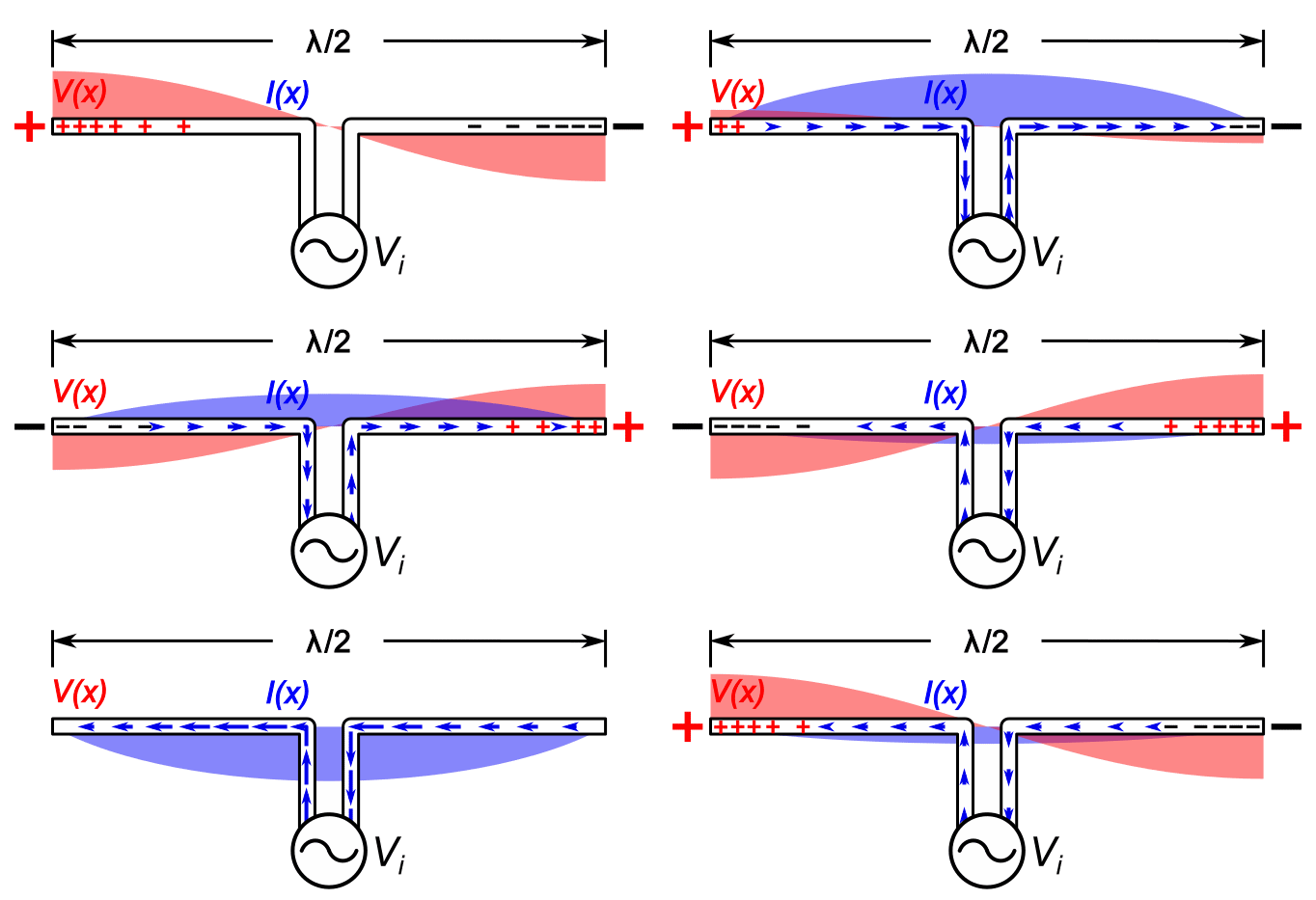
هوائي نصف موجي طوله \(\lambda/2\) يغذّيه مصدر متذبذب.
A half-wave antenna of length \(\lambda/2\) fed by an oscillating source.
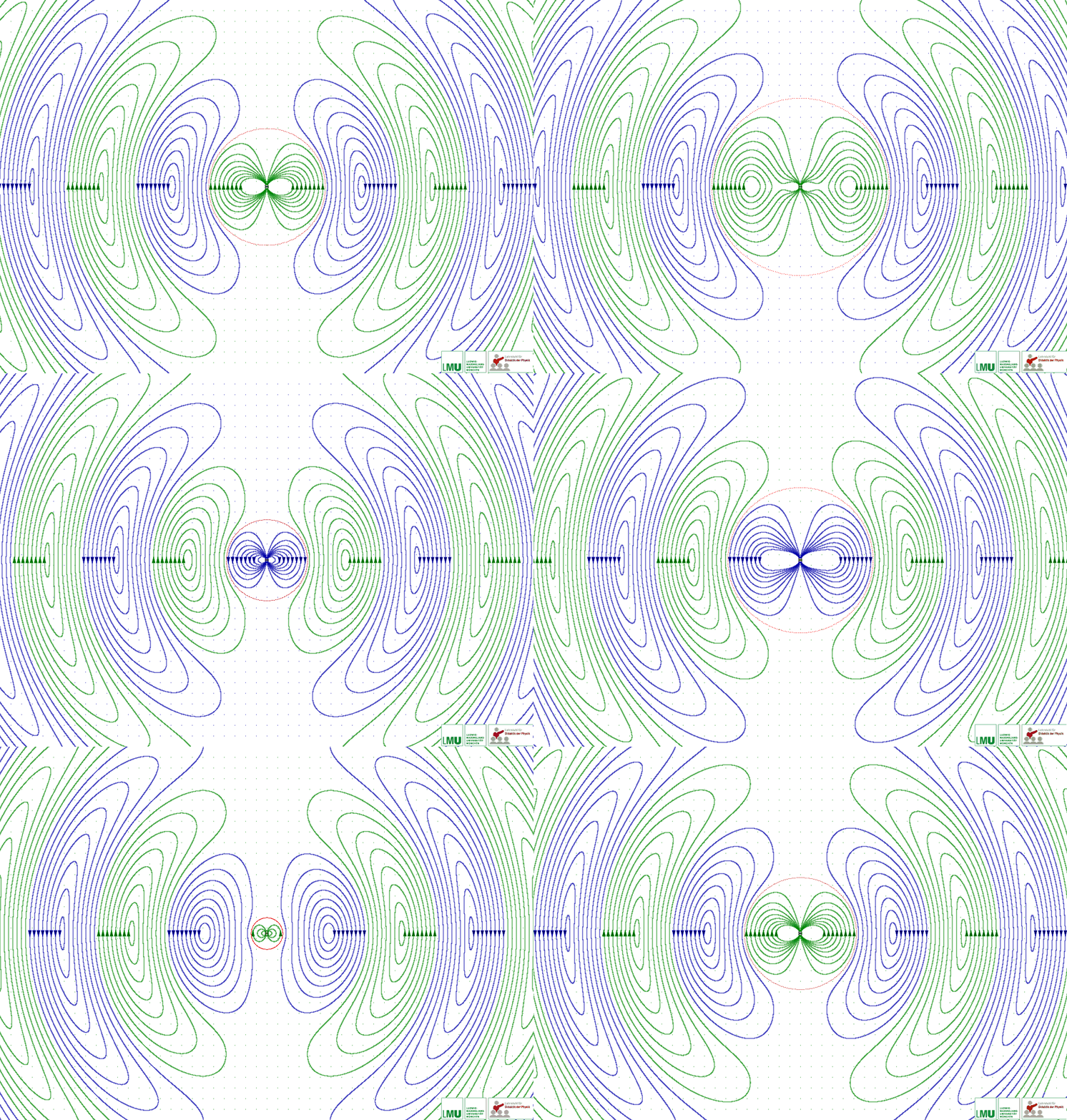
خطوط المجال حول ثنائي قطب متذبذب: المجال المتغير ينفصل ويتشكل موجة تنتشر.
Field lines around an oscillating dipole: the changing field detaches and forms a propagating wave.
📘 جهاز الإرسال
📘 The transmitter
لكل إذاعة موجة حاملة بتردد محدد. ويتكون جهاز الإرسال من:
Each radio station has a carrier wave of a specific frequency. The transmitter consists of:
- المذبذب: يولّد الموجة الحاملة.The oscillator: produces the carrier wave.
- المغيّر (المضمِّن): يغيّر تردد الموجة الحاملة أو سعتها فتحمل بيانات الصوت والصورة.The modulator: changes the frequency or the amplitude of the carrier wave so that it carries the sound and picture data.
- المضخم: يزيد فرق جهد الإشارة قبل إرسالها بالهوائي.The amplifier: increases the potential difference of the signal before it is sent by the antenna.
دائرة التذبذب \(LC\)
The \(LC\) oscillating circuit
يُضبط تردد التذبذب بدائرة تتكون من مكثف وملف حثي: يُشحن المكثف ببطارية ثم تُفصل البطارية ويُوصل المكثف بالملف، فتنتقل الطاقة ذهابًا وإيابًا بين المجال الكهربائي في المكثف والمجال المغناطيسي في الملف، ويتولد مجال كهربائي ومغناطيسي متغيران بتردد معين:
The oscillation frequency is set by a circuit made of a capacitor and an inductor: the capacitor is charged by a battery, then the battery is removed and the capacitor is connected to the coil, so the energy moves back and forth between the electric field in the capacitor and the magnetic field in the coil, producing changing electric and magnetic fields of a specific frequency:
\[f=\dfrac{1}{2\pi\sqrt{LC}}\]
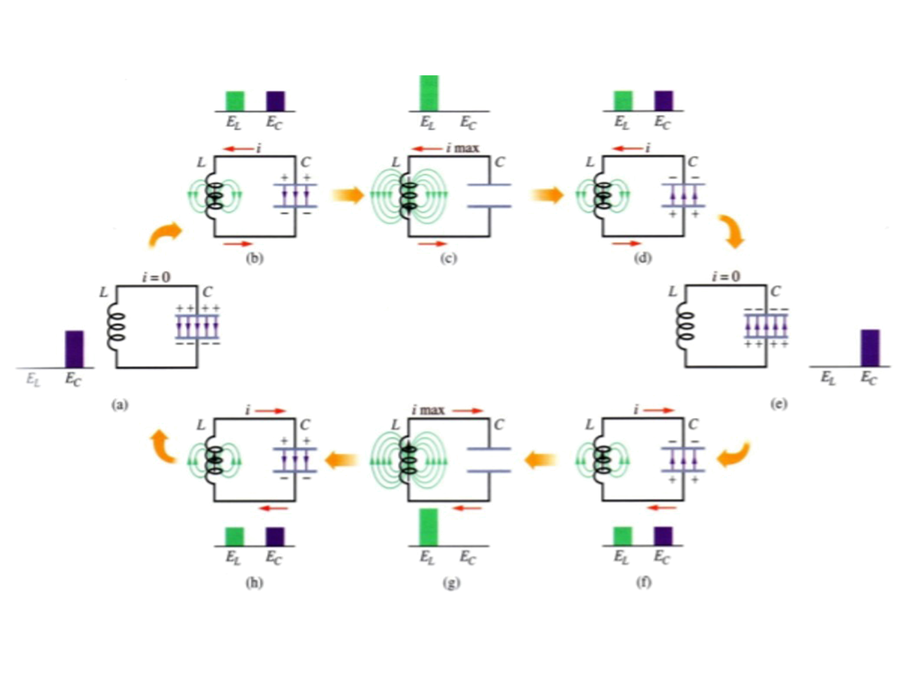
مراحل تذبذب دائرة \(LC\): تنتقل الطاقة بين المكثف والملف.
Stages of an \(LC\) oscillation: the energy moves between the capacitor and the coil.
💡 شرح إضافي: كيف نغيّر التردد؟
💡 Extra explanation: how do we change the frequency?
من \(f=1/(2\pi\sqrt{LC})\) نرى أن زيادة \(L\) أو \(C\) تقلل التردد، ولذلك نضبط محطة الراديو بتغيير سعة مكثف متغير. وتبقى سرعة الموجة المرسلة \(c\) وطولها الموجي \(\lambda=c/f\).
From \(f=1/(2\pi\sqrt{LC})\) we see that increasing \(L\) or \(C\) lowers the frequency, so we tune a radio station by changing the capacitance of a variable capacitor. The speed of the transmitted wave remains \(c\) and its wavelength is \(\lambda=c/f\).
استقبال الموجات
Receiving the waves
تُستقبل الموجات بسلك هوائي متصل بدائرة اهتزاز. الأفضل أن يكون طول الهوائي نصف طول الموجة المستقبَلة (وعادةً يُستعمل هوائي طوله ربع طول الموجة). ونضبط دائرة الاستقبال بحيث يساوي ترددها تردد الموجة القادمة (الرنين) فلا تلقى الموجة ممانعة وتدخل الدائرة بأكبر سعة.
Waves are received by a wire antenna connected to an oscillating circuit. It is best if the antenna length is half the wavelength of the received wave (usually an antenna of quarter the wavelength is used). We tune the receiving circuit so that its frequency equals the frequency of the incoming wave (resonance), so the wave meets no opposition and enters the circuit with the largest amplitude.
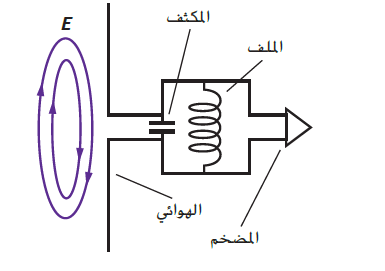
دائرة الاستقبال: هوائي ومكثف وملف ومضخم.
The receiving circuit: antenna, capacitor, coil and amplifier.
محطة إذاعية تبث بتردد \(100\ \mathrm{MHz}\). احسب طول موجتها وطول هوائي ربع موجة لاستقبالها.
A radio station broadcasts at \(100\ \mathrm{MHz}\). Find its wavelength and the length of a quarter-wave antenna to receive it.
دائرة استقبال سعة مكثفها \(20\ \mathrm{pF}\). ما معامل الحث اللازم لتضبط على \(100\ \mathrm{MHz}\)؟
A receiving circuit has a capacitor of \(20\ \mathrm{pF}\). What inductance is needed to tune it to \(100\ \mathrm{MHz}\)?
وظيفة المغيّر في جهاز الإرسال:
The function of the modulator in a transmitter is:
تردد دائرة \(LC\) يعطى بالعلاقة:
The frequency of an \(LC\) circuit is given by:
🕶️ الاستقطاب
🕶️ Polarization
الضوء موجة كهرومغناطيسية يهتز فيها المجال الكهربائي في مستوى والمجال المغناطيسي في مستوى عمودي عليه، واتجاه الانتشار عمودي على كليهما. تُعرف الموجة الضوئية التي تهتز في أكثر من مستوى بالضوء غير المستقطب، والضوء المنبعث من الشمس أو المصباح أو الأنبوب مصادر غير مستقطبة. أما استقطاب الضوء فهو السماح بمرور الاهتزاز في اتجاه واحد فقط.
Light is an electromagnetic wave in which the electric field vibrates in one plane and the magnetic field in a plane perpendicular to it, and the direction of propagation is perpendicular to both. A light wave vibrating in more than one plane is called unpolarized light; the light from the Sun, a lamp or a tube is unpolarized. Polarizing the light means letting only the vibration in one direction pass.
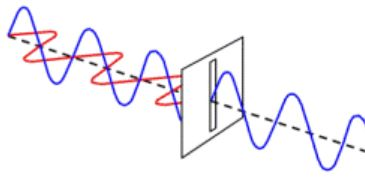
المرشح يسمح بمرور الاهتزاز الموازي لمحوره فقط.
The filter lets only the vibration parallel to its axis pass.
📘 شدة الضوء بعد المرشح
📘 The intensity after the filter
إذا سقط ضوء غير مستقطب شدته \(I_0\) على مرشح فإن الشدة النافذة (مهما كان اتجاه المرشح):
If unpolarized light of intensity \(I_0\) falls on a filter, the transmitted intensity (whatever the direction of the filter) is:
\[I=\dfrac{I_0}{2}\]
وإذا سقط ضوء مستقطب يصنع اتجاه استقطابه زاوية \(\theta\) مع محور المرشح (قانون مالوس):
If polarized light whose direction of polarization makes an angle \(\theta\) with the axis of the filter falls on it (Malus's law):
\[I=I_0\cos^2\theta\]
💡 شرح إضافي: لماذا \(\cos^2\theta\)؟ وماذا عن مرشحين؟
💡 Extra explanation: why \(\cos^2\theta\)? And what about two filters?
المرشح يمرّر مركبة المجال الكهربائي الموازية لمحوره فقط، أي \(E\cos\theta\)، والشدة تتناسب مع مربع سعة المجال فتصبح \(I\propto E^2\cos^2\theta\). عند \(\theta=0\) يمر كل الضوء، وعند \(\theta=90^\circ\) (مرشحان متعامدان) لا يمر شيء. وعند وضع مرشحين خلف ضوء غير مستقطب: يعطي الأول \(I_0/2\) ثم يعطي الثاني \((I_0/2)\cos^2\theta\).
The filter passes only the component of the electric field parallel to its axis, i.e. \(E\cos\theta\), and the intensity is proportional to the square of the field amplitude so \(I\propto E^2\cos^2\theta\). At \(\theta=0\) all the light passes and at \(\theta=90^\circ\) (two crossed filters) nothing passes. With two filters behind unpolarized light: the first gives \(I_0/2\) and the second then gives \((I_0/2)\cos^2\theta\).
🧪 تجربة 3: الاستقطاب وقانون مالوس
🧪 Experiment 3: Polarization and Malus's law
الضوء غير المستقطب يهتز في كل المستويات، والمرشح يسمح بمرور مركبة واحدة فتقل الشدة إلى النصف \(I=I_0/2\). وإذا كان الضوء مستقطبًا وصنعت زاوية \(\theta\) بين استقطابه ومحور المرشح فإن \(I=I_0\cos^2\theta\). اختر الحالة وغيّر الزاوية، ثم احسب الشدة وتحقق.
Unpolarized light vibrates in all planes and a filter lets one component through so the intensity falls to half \(I=I_0/2\). If the light is polarized and the angle between its polarization and the filter axis is \(\theta\), then \(I=I_0\cos^2\theta\). Choose the case, change the angle, then calculate the intensity and check.
ما الزاوية بين اتجاه استقطاب الضوء ومحور المرشح لتقليل شدته بنسبة \(60\%\)؟
What angle between the polarization direction of the light and the axis of the filter reduces its intensity by \(60\%\)?
ضوء غير مستقطب شدته \(80\ \mathrm{W/m^2}\) يمر في مرشح ثم في مرشح ثان يصنع محوره \(60^\circ\) مع الأول. احسب الشدة النهائية.
Unpolarized light of intensity \(80\ \mathrm{W/m^2}\) passes through a filter and then through a second filter whose axis makes \(60^\circ\) with the first. Find the final intensity.
ضوء غير مستقطب شدته \(I_0\) يمر في مرشح استقطاب. الشدة النافذة:
Unpolarized light of intensity \(I_0\) passes through a polarizing filter. The transmitted intensity is:
ضوء مستقطب شدته \(100\ \mathrm{W/m^2}\) يصنع اتجاه استقطابه \(60^\circ\) مع محور مرشح. الشدة النافذة:
Polarized light of intensity \(100\ \mathrm{W/m^2}\) has its polarization at \(60^\circ\) to the axis of a filter. The transmitted intensity is:
📚 ملخص الدرس
📚 Lesson Summary
| المفهومConcept | العلاقةRelation |
|---|---|
| قانون فارادايFaraday's law | \(\oint\vec E\cdot d\vec\ell=-\dfrac{d\Phi_B}{dt}\)\(\oint\vec E\cdot d\vec\ell=-\dfrac{d\Phi_B}{dt}\) |
| قانون مكسويل–أمبيرMaxwell–Ampère law | \(\oint\vec B\cdot d\vec\ell=\mu_0(I_d+I_{enc})\ ;\ I_d=\varepsilon_0\dfrac{d\Phi_E}{dt}\)\(\oint\vec B\cdot d\vec\ell=\mu_0(I_d+I_{enc})\ ;\ I_d=\varepsilon_0\dfrac{d\Phi_E}{dt}\) |
| سرعة الموجةWave speed | \(c=\lambda f=3\times10^8\ \mathrm{m/s}\ ;\ v=\dfrac{c}{\sqrt K}=\dfrac cn\)\(c=\lambda f=3\times10^8\ \mathrm{m/s}\ ;\ v=\dfrac{c}{\sqrt K}=\dfrac cn\) |
| دائرة التوليفTuning circuit | \(f=\dfrac{1}{2\pi\sqrt{LC}}\)\(f=\dfrac{1}{2\pi\sqrt{LC}}\) |
| الاستقطابPolarization | \(I=\dfrac{I_0}{2}\ (\text{unpolarized})\ ;\ I=I_0\cos^2\theta\ (\text{polarized})\)\(I=\dfrac{I_0}{2}\ (\text{unpolarized})\ ;\ I=I_0\cos^2\theta\ (\text{polarized})\) |
⚠️ أخطاء شائعة
⚠️ Common mistakes
- الظن أن تيار الإزاحة تيار شحنات حقيقي؛ هو تغير في الفيض الكهربائي يولّد مجالًا مغناطيسيًا.Thinking the displacement current is a real flow of charges; it is the change of the electric flux that produces a magnetic field.
- استعمال \(B=\mu_0I_d/(2\pi r)\) لنقطة داخل منطقة الصفيحتين؛ داخلها \(B\propto r\).Using \(B=\mu_0I_d/(2\pi r)\) for a point inside the plate region; inside it \(B\propto r\).
- الظن أن التردد يتغير عند انتقال الموجة إلى وسط آخر؛ الذي يتغير هو السرعة والطول الموجي.Thinking the frequency changes when the wave enters another medium; the speed and the wavelength change.
- تطبيق قانون مالوس على ضوء غير مستقطب؛ يمرّر المرشح نصفه فقط \(I_0/2\).Applying Malus's law to unpolarized light; the filter passes only half of it \(I_0/2\).
- استعمال الدرجات والراديان في الحاسبة بالشكل الخطأ عند حساب \(\cos^2\theta\).Using degrees and radians the wrong way on the calculator when computing \(\cos^2\theta\).
🧪 اختبر نفسك: امتحان من 20 سؤالاً
🧪 Test Yourself: a 20-Question Exam
أنهِ الدرس بالاختبار التفاعلي التالي؛ أسئلته تجمع بين الفهم والحساب وتغطي جميع أقسام الدرس.
Finish with the interactive exam below; its questions mix understanding with calculation and cover every section of the lesson.
اختبار المجالات الكهربائية والمغناطيسية في الفراغ (12A) Electric and Magnetic Fields in Vacuum (12A) Quiz
20 سؤالاً - تيار الإزاحة، الأمواج الكهرومغناطيسية، والاستقطاب 20 Questions - Displacement Current, EM Waves and Polarization
• عدد الأسئلة: 20 سؤالاً
• مدة الاختبار: 30 دقيقة
• لا يمكنك تغيير إجاباتك أو إعادة الاختبار إلا بعد 24 ساعة من التسليم.
• تأكد من إجاباتك قبل التسليم! 📌 Important Instructions:
• Number of questions: 20 questions
• Quiz duration: 30 minutes
• You cannot change your answers or retake the quiz for 24 hours after submission.
• Make sure of your answers before submitting!
🔗 محاكيات GeoGebra للاستعانة بها عند اللزوم
🔗 GeoGebra Simulations to Use When Needed
اضغط «تشغيل» لتعمل المحاكاة هنا داخل الدرس؛ ويمكن للطالب الرجوع إليها لتجربة الفكرة بطريقة أخرى.
Press “Run” to run the simulation right here inside the lesson; the student can use it to try the idea in another way.