🎯 نواتج التعلم
🎯 Learning Outcomes
بعد دراسة هذا الدرس ستكون قادرًا على أن:
After this lesson you will be able to:
- تجري تجارب لاستنتاج المجال والجهد لشحنة نقطية، ولاستنتاج المجال بين لوحين متوازيين.Carry out experiments to deduce the field and potential of a point charge, and the field between parallel plates.
- تحسب المجال والجهد عند نقاط مختلفة، وتجمع جهود عدة شحنات جبريًا.Calculate the field and potential at different points, and add the potentials of several charges algebraically.
- تفرّق بين المجال الكهربائي (متجه) والجهد الكهربائي (قياسي).Distinguish the electric field (a vector) from the electric potential (a scalar).
⚡ المجال الكهربائي لشحنة نقطية
⚡ The Electric Field of a Point Charge
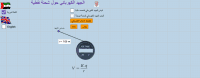
المجال الكهربائي في نقطة هو القوة لكل وحدة شحنة موجبة توضع فيها: \(E=F/q\). وهو متجه يتجه بعيدًا عن الشحنة الموجبة وإليها عند السالبة.
The electric field at a point is the force per unit positive charge placed there: \(E=F/q\). It is a vector pointing away from a positive charge and toward a negative one.
🧪 تجربة 1: المجال الكهربائي لشحنة نقطية
🧪 Experiment 1: the field of a point charge
الهدف: نقيس المجال على مسافات مختلفة من شحنة نقطية، لنعرف كيف يتغير مع البعد.
Goal: Measure the field at different distances from a point charge to find how it changes with distance.
- اضبط الشحنة Q (مثلًا 4 nC) وأبقها ثابتة طوال التجربة.Set the charge Q (e.g. 4 nC) and keep it fixed.
- حرّك المسبار إلى مسافة r، واقرأ المجال E، ثم اضغط «سجّل القراءة».Move the probe to a distance r, read E, and press “Record”.
- كرر من 5 إلى 6 مسافات مختلفة، ولاحظ أن المجال يضعف بسرعة مع البعد.Repeat for 5 to 6 different distances and notice how quickly the field weakens.
- بعد 3 قراءات يظهر رسم E مقابل 1/r²، فاستنتج القانون منه.After three readings the graph of E against 1/r² appears; deduce the law from it.
- Set the charge Q (e.g. 4 nC) and keep it fixed.
- Move the probe to a distance r, read E, and press “Record”.
- Repeat for 5 to 6 different distances and notice how quickly the field weakens.
- After three readings the graph of E against 1/r² appears; deduce the law from it.
| r (m) | E (N/C) |
|---|
📌 المجال لشحنة نقطية
📌 The field of a point charge
\[E=\frac{kQ}{r^2}\qquad k=\frac{1}{4\pi\varepsilon_0}\approx 8.99\times10^9\]
شحنة نقطية \(Q=4\,nC\). احسب المجال عند مسافة \(r=0.2\,m\).
A point charge \(Q=4\,nC\). Find the field at a distance \(r=0.2\,m\).
🔎 أيهما يتناقص أسرع؟
🔎 Which decreases faster?
عند مضاعفة المسافة، يصبح المجال ربع قيمته لأنه يتناسب مع \(1/r^2\). هذه السرعة في التناقص هي ما يميز المجال عن الجهد.
When the distance doubles, the field becomes a quarter of its value because it is proportional to \(1/r^2\). This faster decrease is what distinguishes the field from the potential.
المجال الكهربائي لشحنة نقطية موجبة يتجه:
The field of a positive point charge points:
عند مضاعفة المسافة من شحنة نقطية، يصبح المجال:
When the distance from a point charge doubles, the field becomes:
🔋 الجهد الكهربائي لشحنة نقطية
🔋 The Electric Potential of a Point Charge
الجهد الكهربائي عند نقطة هو الشغل المبذول لنقل وحدة شحنة موجبة من اللانهاية إليها. وهو كمية قياسية.
The electric potential at a point is the work done to move a unit positive charge there from infinity. It is a scalar quantity.
🧪 تجربة 2: الجهد الكهربائي لشحنة نقطية
🧪 Experiment 2: the potential of a point charge
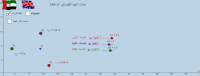
الهدف: نقيس الجهد الكهربائي على مسافات مختلفة من الشحنة، ونبحث عن علاقته بالبعد.
Goal: Measure the electric potential at different distances from the charge, and find its relation to distance.
- اضبط الشحنة Q (مثلًا 4 nC)، ثم اختر مسافة r للمسبار.Set the charge Q (e.g. 4 nC) and choose a probe distance r.
- اقرأ الجهد V، واضغط «سجّل القراءة». كرر من 5 إلى 6 مسافات.Read V and press “Record”. Repeat for 5 to 6 distances.
- لاحظ الجدول: الجهد يقل مع البعد، لكن ببطء أكبر من المجال.In the table: potential decreases with distance, but more slowly than the field.
- بعد 3 قراءات يظهر رسم V مقابل 1/r، فاستنتج القانون.After three readings the graph of V against 1/r appears; deduce the law.
- Set the charge Q (e.g. 4 nC) and choose a probe distance r.
- Read V and press “Record”. Repeat for 5 to 6 distances.
- In the table: potential decreases with distance, but more slowly than the field.
- After three readings the graph of V against 1/r appears; deduce the law.
| r (m) | V (V) |
|---|
📌 الجهد لشحنة نقطية
📌 The potential of a point charge
\[V=\frac{kQ}{r}\]
للشحنة نفسها، احسب الجهد عند \(r=0.2\,m\).
For the same charge, find the potential at \(r=0.2\,m\).
الجهد الكهربائي كمية:
Electric potential is a:
شحنتان متساويتان في المقدار ومختلفتان في الإشارة (\(+4\,nC\)، \(-4\,nC\)). ما الجهد عند نقطة تبعد المسافة نفسها عن الشحنتين؟
Two charges of equal size and opposite sign (\(+4\,nC\), \(-4\,nC\)). What is the potential at a point equidistant from both?
📏 المجال بين لوحين متوازيين
📏 The Field Between Parallel Plates
عند وضع فرق جهد بين لوحين متوازيين ينشأ بينهما مجال منتظم، مقداره يعتمد على فرق الجهد والمسافة بين اللوحين.
When a voltage is applied across two parallel plates, a uniform field forms between them, depending on the voltage and the separation.
🧪 تجربة 3: المجال بين لوحين متوازيين
🧪 Experiment 3: the field between parallel plates
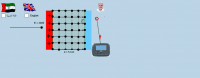
الهدف: نضع فرق جهد بين لوحين متوازيين، ونقيس المجال بينهما عند مسافات مختلفة بين اللوحين.
Goal: Apply a voltage across two parallel plates and measure the field between them at different separations.
- اضبط فرق الجهد V بين اللوحين (مثلًا 10 V)، واضبط المسافة d.Set the voltage V across the plates (e.g. 10 V) and the separation d.
- اقرأ المجال E = V/d، واضغط «سجّل القراءة».Read the field E = V/d and press “Record”.
- غيّر المسافة d إلى قيم مختلفة، وسجّل 5 قراءات على الأقل.Change d to different values and record at least 5 readings.
- لاحظ الرسم E بدلالة 1/d، ثم استنتج الجهد من الميل.Look at the graph of E against 1/d, then find the voltage from the slope.
- Set the voltage V across the plates (e.g. 10 V) and the separation d.
- Read the field E = V/d and press “Record”.
- Change d to different values and record at least 5 readings.
- Look at the graph of E against 1/d, then find the voltage from the slope.
| d (m) | E (N/C) |
|---|
📌 المجال بين لوحين متوازيين
📌 The field between parallel plates
\[E=\frac{V}{d}\]
لوحان متوازيان فرق الجهد بينهما \(10\,V\) والمسافة \(d=0.04\,m\). احسب المجال بينهما.
Parallel plates have a voltage of \(10\,V\) and separation \(d=0.04\,m\). Find the field between them.
بين لوحين متوازيين، المجال:
Between two parallel plates, the field is:
🔁 المقارنة بين الشحنة النقطية واللوحين
🔁 Comparing point charges and parallel plates
| الكميةQuantity | شحنة نقطيةPoint charge | لوحان متوازيانParallel plates |
|---|---|---|
| المجال EField E | kQ/r² (يتناقص مع r)kQ/r² (decreases with r) | V/d (منتظم)V/d (uniform) |
| الجهد VPotential V | kQ/rkQ/r | يتغير خطيًا بين اللوحينChanges linearly between plates |
| الكمية القياسيةScalar | الجهد قياسي، والمجال متجهPotential is scalar; field is vector | كذلكSame |
📌 ملخص الدرس
📌 Lesson Summary
- المجال لشحنة نقطية: \(E=\dfrac{kQ}{r^2}\)، متجه يبتعد عن الموجبة.
- الجهد لشحنة نقطية: \(V=\dfrac{kQ}{r}\)، كمية قياسية تُجمع جبريًا.
- بين لوحين متوازيين: \(E=\dfrac{V}{d}\)، والمجال منتظم.
- Field of a point charge: \(E=\dfrac{kQ}{r^2}\), a vector pointing away from a positive charge.
- Potential of a point charge: \(V=\dfrac{kQ}{r}\), a scalar added algebraically.
- Between parallel plates: \(E=\dfrac{V}{d}\), uniform.
🧪 اختبر نفسك: امتحان من 20 سؤالًا
🧪 Test Yourself: a 20-Question Exam
أنهِ الدرس بالاختبار التفاعلي التالي؛ أسئلته تجمع بين الفهم والحساب وتغطي جميع أقسام الدرس.
Finish with the interactive exam below; its questions mix understanding with calculation and cover every section of the lesson.
اختبار: المجال والجهد الكهربائي للشحنات النقطية Quiz: Electric Field and Potential of Point Charges
20 سؤالاً - المجال والجهد الكهربائي للشحنات النقطية 20 Questions - Electric Field and Potential of Point Charges
• عدد الأسئلة: 20 سؤالاً
• مدة الاختبار: 30 دقيقة
• لا يمكنك تغيير إجاباتك أو إعادة الاختبار إلا بعد 24 ساعة من التسليم.
• تأكد من إجاباتك قبل التسليم! 📌 Important Instructions:
• Number of questions: 20 questions
• Quiz duration: 30 minutes
• You cannot change your answers or retake the quiz for 24 hours after submission.
• Make sure of your answers before submitting!
تم بحمد الله شرح المجال والجهد الكهربائي للشحنات النقطية والمجال بين اللوحين المتوازيين.
Praise be to Allah, we have covered the field and potential of point charges and the field between parallel plates.
🔗 محاكيات GeoGebra للاستعانة بها عند اللزوم
🔗 GeoGebra Simulations to Use When Needed
اضغط «تشغيل» لتعمل المحاكاة هنا داخل الدرس، واضغط «ملء الصفحة» لعرضها على الشاشة كاملة.
Press “Run” to run the simulation inside the lesson, and “Full page” to show it across the whole screen.