🎯 نواتج التعلم
🎯 Learning Outcomes
بعد دراسة هذا الدرس ستكون قادرًا على أن:
After this lesson you will be able to:
- تعرّف المجال الكهربائي.Define the electric field.
- تحسب مقدار المجال الكهربائي وتحدد اتجاهه.Calculate the magnitude of the electric field and determine its direction.
- تخطّط خطوط المجال وتذكر صفاتها (تخطيط المجال).Plot the field lines and state their properties (field mapping).
- تحسب المجال الكهربائي عند نقطة تحيط بها شحنات نقطية.Calculate the electric field at a point surrounded by point charges.
- تشرح طريقة عمل مولّد فان دي غراف.Explain how a Van de Graaff generator works.
- تقارن بين حركة جسم في مجال الجاذبية الأرضية وحركة شحنة في مجال كهربائي.Compare the motion of a body in the Earth’s gravitational field with that of a charge in an electric field.
- تقدّم الأدلة على فقدان شحنة طاقة وضع أو اكتسابها عند حركتها مع المجال أو عكسه.Give evidence that a charge loses or gains potential energy when it moves with or against the field.
- تعرّف الجهد الكهربائي.Define the electric potential.
- تحسب الجهد الكهربائي حول شحنات نقطية.Calculate the electric potential around point charges.
- تستنتج العلاقة الرياضية لفرق الجهد بين نقطتين في مجال منتظم.Deduce the mathematical relation for the potential difference between two points in a uniform field.
- تذكر نتائج تجربة ميليكان.State the results of Millikan’s experiment.
- تستنتج العلاقة المعبّرة عن سعة المكثف.Deduce the relation that expresses the capacitance of a capacitor.
⚡ المجال الكهربائي
⚡ The Electric Field
| السؤالQuestion | الجوابAnswer |
|---|---|
| لماذا تبتعد وحدة الشحنة الموجبة عن شحنة موجبة؟ ولماذا تقترب من شحنة سالبة؟Why does a positive test charge move away from a positive charge, and toward a negative one? | لأن الشحنات المتشابهة تتنافر والمختلفة تتجاذب، فتؤثر الشحنة المصدر بقوة كهربائية على الشحنة القريبة منها.Because like charges repel and unlike charges attract, so the source charge exerts an electric force on a nearby charge. |
| ماذا يوجد حول الشحنات الكهربائية؟What exists around electric charges? | يوجد حولها مجال كهربائي: منطقة تحيط بالشحنة وتظهر فيها آثار القوة الكهربائية.An electric field: a region surrounding the charge where the effects of the electric force appear. |
| ما نوع الكمية الفيزيائية للمجال الكهربائي؟What kind of physical quantity is the electric field? | كمية متجهة لها مقدار واتجاه.A vector quantity with magnitude and direction. |
🔎 توضيح إضافي: فكرة المجال
🔎 Extra Explanation: the Idea of a Field
نفكّر في المجال كخاصية يمنحها الشحنة المصدر للفراغ حولها: توجد في كل نقطة حتى لو لم نضع هناك أي شحنة. فإذا وضعنا شحنة (شحنة اختبار) عند نقطة ظهرت عليها قوة. وبهذا نفصل بين دور المصدر (يصنع المجال) ودور الشحنة المختبَرة (تتأثر به). والمقارنة مفيدة: كما أن الأرض تصنع مجال جاذبية \(g\) في كل نقطة حولها يؤثر على أي كتلة، فإن الشحنة تصنع مجالًا كهربائيًا يؤثر على أي شحنة.
We think of the field as a property that the source charge gives to the space around it: it exists at every point even if no charge is placed there. If we place a charge (a test charge) at a point, a force appears on it. This separates the role of the source (it creates the field) from the role of the tested charge (it feels the field). The comparison is useful: just as the Earth creates a gravitational field \(g\) around it that acts on any mass, a charge creates an electric field that acts on any charge.
📐 حساب مقدار المجال الكهربائي
📐 Calculating the Magnitude of the Electric Field
نضع شحنة اختبار صغيرة وموجبة \(q\) عند النقطة المطلوب حساب المجال عندها (على بعد \(r\) من الشحنة المصدر \(Q\)) ونحسب القوة الكهربائية عليها، ثم نقسم على شحنة الاختبار:
We place a small positive test charge \(q\) at the point where the field is wanted (at distance \(r\) from the source charge \(Q\)), find the electric force on it, and divide by the test charge:
📜 القانون
📜 The Law
\[F_e=\dfrac{k\,Q\,q}{r^{2}}\qquad E=\dfrac{F_e}{q}=\dfrac{k\,Q\,q/r^{2}}{q}=\dfrac{k\,Q}{r^{2}}\]
ويقدّر بوحدة نيوتن/كولوم (\(N/C\)). ونلاحظ أن المجال لا يعتمد على شحنة الاختبار \(q\) (تُحذف)، بل على شحنة المصدر \(Q\) وبُعد النقطة \(r\) فقط: يتناسب طرديًا مع \(Q\) وعكسيًا مع \(r^{2}\). وتكافئ \(N/C\) الوحدة \(V/m\).
It is measured in newtons per coulomb (\(N/C\)). Notice that the field does not depend on the test charge \(q\) (it cancels) but only on the source charge \(Q\) and the distance \(r\): it is proportional to \(Q\) and inversely proportional to \(r^{2}\). \(N/C\) is equivalent to \(V/m\).
شحنة نقطية \(Q=+6\,\mu C\). احسب المجال عند نقطة تبعد \(0.2\,m\) عنها واتجاهه.
A point charge \(Q=+6\,\mu C\). Find the field at a point \(0.2\,m\) from it and its direction.
أي وحدة من الوحدات التالية تكافئ وحدة قياس المجال الكهربائي؟
Which of the following units is equivalent to the unit of the electric field?
🧭 تحديد اتجاه المجال الكهربائي
🧭 Determining the Direction of the Electric Field
📌 الطريقة الأولى: شحنة الاختبار
📌 Method 1: the Test Charge
نضع شحنة اختبار عند النقطة، وحسب قواعد المتجهات (ضرب عدد في متجه) \(\vec E=\dfrac{\vec F}{q}\):
We place a test charge at the point, and by the rules of vectors (a scalar times a vector) \(\vec E=\dfrac{\vec F}{q}\):
- إذا كانت شحنة الاختبار موجبة فاتجاه المجال نفس اتجاه القوة الكهربائية.If the test charge is positive, the field direction is the same as the force.
- إذا كانت سالبة فاتجاه المجال عكس اتجاه القوة.If it is negative the field direction is opposite to the force.
🧪 جرّب بنفسك: القوة والمجال
🧪 Try It Yourself: Force and Field
🧪 تجربة 1: شحنة الاختبار والقوة واتجاه المجال
🧪 Experiment 1: The Test Charge, the Force and the Direction of the Field
اختر نوع شحنة المصدر (في المركز) ونوع شحنة الاختبار القادمة، ثم انقر في أي مكان على الرسم لتضع شحنة اختبار. يظهر السهم الأخضر للقوة المؤثرة عليها والسهم البنفسجي لاتجاه المجال. لاحظ: عندما تكون شحنة الاختبار موجبة يكون المجال باتجاه القوة، وعندما تكون سالبة يكون المجال عكس القوة. وأن اتجاه المجال لا يتغير بتغيير شحنة الاختبار (يعتمد على شحنة المصدر فقط).
Choose the type of the source charge (at the centre) and of the next test charge, then click anywhere on the drawing to place a test charge. The green arrow shows the force on it and the purple arrow the direction of the field. Notice: when the test charge is positive the field is along the force, and when it is negative the field is opposite to the force. The direction of the field does not change with the test charge (it depends on the source charge only).
📊 الطريقة الثانية: خطوط المجال الكهربائي
📊 Method 2: Electric Field Lines
📌 اتجاه الخطوط
📌 The Direction of the Lines
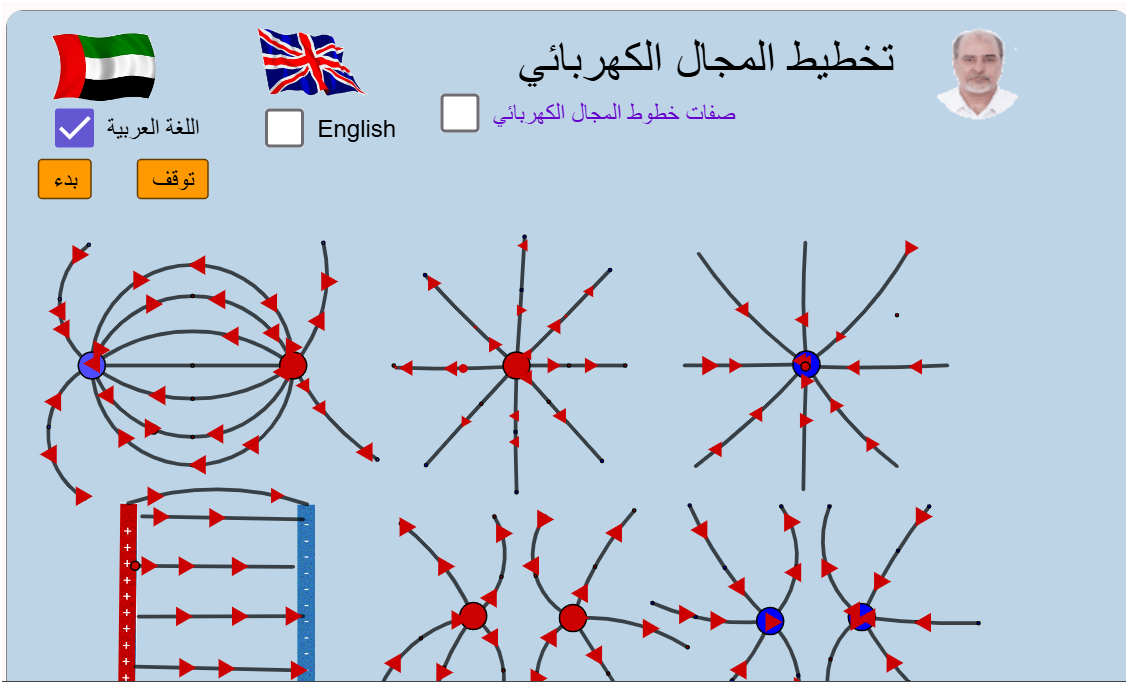
شحنة موجبة: خطوط المجال خارجة منها (تبتعد). شحنة سالبة: خطوط المجال داخلة عليها. ولشحنتين مختلفتين تخرج الخطوط من الموجبة وتنتهي على السالبة.
Positive charge: the field lines point outward from it. Negative charge: the field lines point inward toward it. For two unlike charges the lines leave the positive charge and end on the negative one.
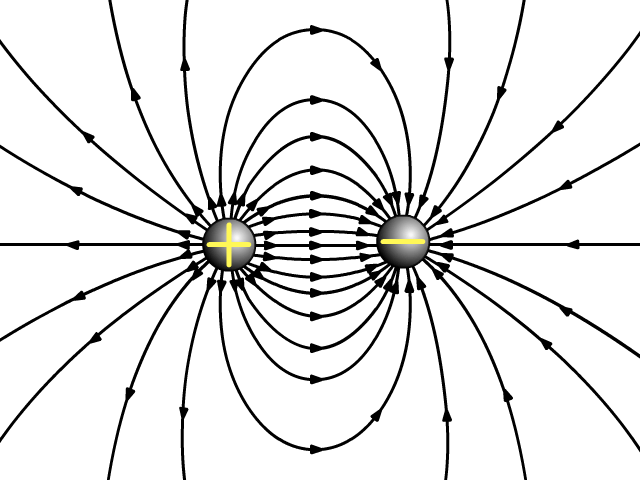
خطوط المجال لشحنتين مختلفتين (موجبة يسارًا وسالبة يمينًا).
Field lines of two unlike charges (positive on the left, negative on the right).
📋 صفات خطوط المجال الكهربائي
📋 Properties of Electric Field Lines
- خطوط وهمية تخرج من الشحنات الموجبة وتدخل في الشحنات السالبة.Imaginary lines that leave positive charges and enter negative charges.
- عدد الخطوط المرسومة يتناسب طرديًا مع مقدار الشحنة، وكثافتها (الخطوط في وحدة المساحة العمودية عليها) تتناسب مع شدة المجال: تتقارب حيث المجال أقوى وتتباعد حيث هو أضعف.The number of lines drawn is directly proportional to the magnitude of the charge, and their density (lines per unit area perpendicular to them) is proportional to the field strength: they crowd together where the field is stronger and spread apart where it is weaker.
- اتجاه المجال عند أي نقطة هو المماس لخط المجال عند تلك النقطة.The field direction at any point is the tangent to the field line at that point.
- خطوط المجال لا تتقاطع (لو تقاطعت لكان للمجال اتجاهان عند نقطة التقاطع).Field lines do not intersect (if they did, the field would have two directions at the crossing point).
- نوعا المجال: منتظم (ثابت المقدار والاتجاه عند كل النقاط، خطوطه مستقيمة متوازية)، وغير منتظم (غير ثابت المقدار أو الاتجاه أو كلاهما).Two kinds of field: uniform (constant magnitude and direction at all points, parallel straight lines) and non-uniform (magnitude or direction or both change).
🧪 جرّب بنفسك: تخطيط المجال
🧪 Try It Yourself: Field Mapping
🧪 تجربة 2: تخطيط المجال الكهربائي لشحنتين
🧪 Experiment 2: Mapping the Electric Field of Two Charges
كل سهم صغير يمثل اتجاه المجال عند موضعه، ولونه يدل على شدته (الأزرق ضعيف والأحمر قوي). اسحب النقطة \(P\) لترى متجه المجال \(\vec E\) عندها (الأخضر) ومركّبتيه وشدته. غيّر الشحنتين (موجبة/سالبة/متساوية/مختلفة)، وفعّل «خطوط المجال» لترى صفاتها: تخرج من الموجبة وتدخل في السالبة، ولا تتقاطع، وتتقارب حيث المجال أقوى، واتجاه المجال عند أي نقطة مماس للخط.
Each small arrow shows the direction of the field where it is, and its color shows the strength (blue weak, red strong). Drag the point \(P\) to see the field vector \(\vec E\) there (green) with its components and strength. Change the two charges (positive/negative/equal/unlike) and switch on “field lines” to see their properties: they leave the positive charge and enter the negative one, never cross, crowd together where the field is stronger, and the field at any point is tangent to the line.
أي العبارات التالية من صفات خطوط المجال الكهربائي؟
Which of the following is a property of electric field lines?
➕ المجال الناتج عن عدة شحنات (توضيح إضافي)
➕ The Field of Several Charges (Extra Explanation)
📌 مبدأ التراكب
📌 The Superposition Principle
المجال عند نقطة تحيط بها عدة شحنات نقطية هو المجموع الاتجاهي لمجالات الشحنات منفردة: \(\vec E=\vec E_1+\vec E_2+\cdots\). نحسب مقدار كل مجال بـ\(\dfrac{kq}{r^{2}}\) ونحدد اتجاهه (يبتعد عن الموجبة ويقترب من السالبة)، ثم نجمعها اتجاهيًا: على خط واحد نجمع جبريًا، وعند التعامد نستخدم فيثاغورث \(E=\sqrt{E_1^{2}+E_2^{2}}\).
The field at a point surrounded by several point charges is the vector sum of the fields of the charges separately: \(\vec E=\vec E_1+\vec E_2+\cdots\). We find the magnitude of each with \(\dfrac{kq}{r^{2}}\) and its direction (away from a positive charge, toward a negative one), then add them as vectors: along one line we add algebraically, and for perpendicular fields we use Pythagoras \(E=\sqrt{E_1^{2}+E_2^{2}}\).
نقطة \(P\) تبعد \(0.2\,m\) عن شحنة \(q_1=+8\,nC\) (فوقها) و\(0.2\,m\) عن شحنة \(q_2=+8\,nC\) (على يسارها) والخطان متعامدان. احسب المجال المحصّل عند \(P\).
A point \(P\) is \(0.2\,m\) from a charge \(q_1=+8\,nC\) (above it) and \(0.2\,m\) from a charge \(q_2=+8\,nC\) (to its left), the two lines being perpendicular. Find the net field at \(P\).
مجال كهربائي شدته \(E=500\,N/C\) نحو اليمين وُضع فيه إلكترون (شحنته \(1.6\times10^{-19}\,C\)) كما في الشكل. القوة الكهربائية على الإلكترون:
An electron (charge \(1.6\times10^{-19}\,C\)) is placed in an electric field of strength \(E=500\,N/C\) pointing to the right, as in the figure. The electric force on the electron is:
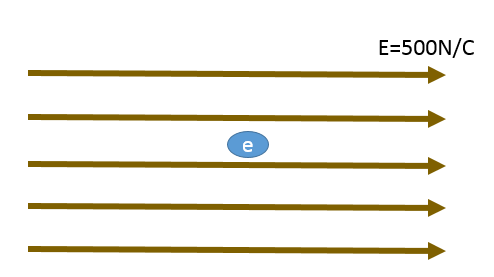
إلكترون في مجال \(E=500\,N/C\) نحو اليمين.
An electron in a field \(E=500\,N/C\) pointing right.
🔋 تغير طاقة الوضع: الجذبية والكهربائية
🔋 Changes in Potential Energy: Gravitational and Electric
نقارن بين طاقة الوضع الجذبية لكرة قرب الأرض وطاقة الوضع الكهربائية لشحنة في مجال كهربائي. القاعدة نفسها في الحالتين: تقل طاقة الوضع عندما يتحرك الجسم باتجاه القوة التي يؤثر بها المجال (فيستطيع العودة وحده)، وتزداد عندما نحرّكه عكس تلك القوة (ويحتاج قوة خارجية).
We compare the gravitational potential energy of a ball near the Earth with the electric potential energy of a charge in an electric field. The rule is the same in both cases: potential energy decreases when the body moves along the force exerted by the field (it cannot return by itself), and increases when we move it against that force (it can then return by itself).
| السؤالQuestion | الجوابAnswer |
|---|---|
| ماذا يحدث لطاقة الوضع لكرة عندما نرفعها عن سطح الأرض؟What happens to the potential energy of a ball when we lift it above the Earth’s surface? | تزداد طاقة الوضع الجذبية، وإذا تُركت الكرة سقطت وعادت إلى موضعها وحدها (تقل طاقة وضعها). أما كلما اقتربت الكرة من سطح الأرض فتقل طاقة وضعها ولا تستطيع العودة وحدها إلى موضعها المرتفع.Its gravitational potential energy increases, and if released the ball falls back by itself (its potential energy decreases). As the ball moves closer to the surface its potential energy decreases and it cannot return to the higher position by itself. |
| ماذا يحدث لطاقة الوضع الكهربائية لشحنة موجبة عندما تتحرك باتجاه المجال؟What happens to the electric potential energy of a positive charge moved along the field? | تقل (القوة باتجاه المجال) فهي غير قادرة على العودة إلى موقعها وحدها.It decreases (the force is along the field); the charge cannot return to its position by itself. |
| … لشحنة سالبة تتحرك عكس اتجاه المجال؟… for a negative charge moved against the field? | تقل (القوة على السالبة عكس المجال) فهي غير قادرة على العودة إلى موقعها دون تأثير قوى خارجية.It decreases (the force on a negative charge is opposite to the field); it cannot return by itself without external forces. |
| … لشحنة سالبة تتحرك باتجاه المجال؟… for a negative charge moved along the field? | تزداد، فهي قادرة على العودة إلى موقعها وحدها.It increases; it can return to its position by itself. |
| … لشحنة موجبة تتحرك عكس اتجاه المجال؟… for a positive charge moved against the field? | تزداد، فهي قادرة على العودة إلى موقعها دون تأثير قوى خارجية.It increases; it can return by itself without external forces. |
📝 أكمل بيانات الجدول
📝 Complete the Table
| التغير في طاقة الوضع الكهربائية | اتجاه حركة الشحنة | نوع الشحنة |
|---|---|---|
| باتجاه المجال | موجبة | |
| عكس المجال | موجبة | |
| باتجاه المجال | سالبة | |
| عكس المجال | سالبة |
تحركت شحنة سالبة عكس اتجاه المجال الكهربائي. طاقة وضعها:
A negative charge moves opposite to the electric field. Its potential energy:
⚡ الجهد الكهربائي وفرق الجهد بين نقطتين
⚡ Electric Potential and Potential Difference
📜 الجهد عند نقطة
📜 The Potential at a Point
الجهد عند نقطة هو طاقة الوضع التي تختزنها وحدة الشحنة عند تلك النقطة. فلحساب الجهد عند نقطة داخل مجال كهربائي نضع شحنة اختبار عندها ونحدد طاقة وضعها الكهربائية ثم نقسم على شحنة الاختبار:
The potential at a point is the potential energy stored per unit charge at that point. To find the potential at a point inside an electric field we place a test charge there, determine its electric potential energy and divide by the test charge:
\[V=\dfrac{PE}{q}\]
📜 فرق الجهد بين نقطتين \(A\) و\(B\)
📜 The Potential Difference Between Points \(A\) and \(B\)
فرق الجهد هو جهد النقطة النهائية مطروحًا منه جهد النقطة البدائية:
The potential difference is the potential of the final point minus that of the initial point:
\[\Delta V_{AB}=V_B-V_A=\dfrac{PE_B}{q}-\dfrac{PE_A}{q}=\dfrac{\Delta PE_{AB}}{q}\]
🔎 علاقتها بالشغل (توضيح إضافي)
🔎 The Relation to Work (Extra Explanation)
التغير في طاقة الوضع يساوي الشغل المبذول بقوة خارجية لنقل الشحنة بتمهّل من \(A\) إلى \(B\): \(\Delta PE_{AB}=W_{A\to B}\)، فيكون \(\Delta V_{AB}=\dfrac{W_{A\to B}}{q}\). أما إذا حُسب الشغل الذي تبذله قوة المجال نفسها (قوة داخلية) فنضيف إشارة سالبة لتتحقق المساواة: \(\Delta V_{AB}=-\dfrac{W_{A\to B}}{q}\). ووحدة الجهد وفرق الجهد هي الفولت (\(1\,V=1\,J/C\)).
The change in potential energy equals the work done by an external force in moving the charge slowly from \(A\) to \(B\): \(\Delta PE_{AB}=W_{A\to B}\), so \(\Delta V_{AB}=\dfrac{W_{A\to B}}{q}\). If instead we use the work done by the field itself (an internal force) we add a minus sign for the equality to hold: \(\Delta V_{AB}=-\dfrac{W_{A\to B}}{q}\). The unit of potential and of potential difference is the volt (\(1\,V=1\,J/C\)).
➕➖ متى يكون فرق الجهد موجبًا أو سالبًا أو معدومًا؟
➕➖ When Is the Potential Difference Positive, Negative or Zero?
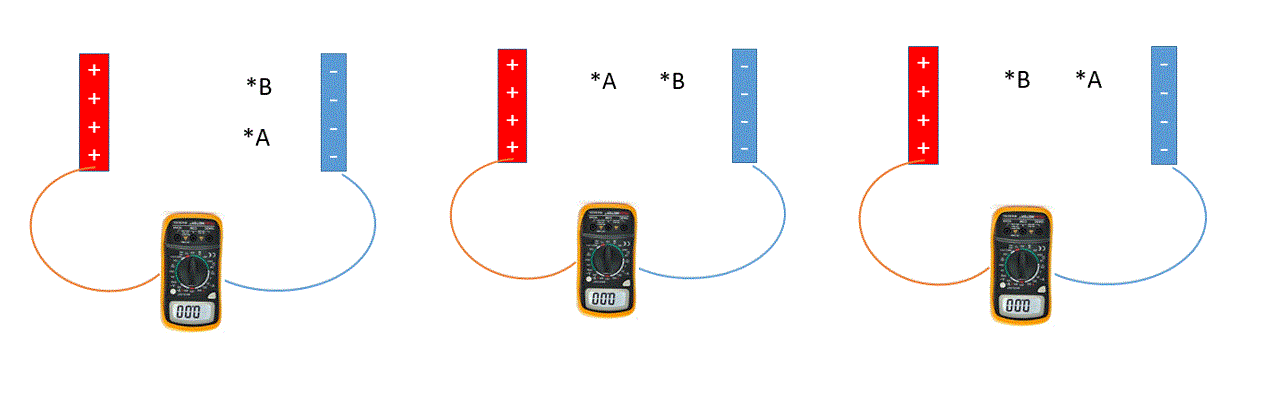
ثلاث حالات للنقطتين \(A\) و\(B\) بين لوحين مشحونين.
Three cases for the points \(A\) and \(B\) between two charged plates.
للإجابة نضع شحنة اختبار عند نقطة البداية ونفترض أن قوة خارجية (معاكسة لقوة المجال) تنقلها إلى نقطة النهاية، ثم ننظر إلى الشغل المبذول:
To answer, we imagine a test charge at the starting point carried to the end point by an external force (opposite to the force of the field), and look at the work done:
📜 القاعدة
📜 The Rule
- إذا كانت القوة الخارجية باتجاه الإزاحة فالشغل موجب: \(\Delta V_{AB}\gt 0\) (انتقلنا إلى نقطة أعلى جهدًا).If the external force is along the displacement the work is positive: \(\Delta V_{AB}\gt 0\) (we moved to a point of higher potential).
- إذا كانت عكس الإزاحة فالشغل سالب: \(\Delta V_{AB}\lt 0\) (إلى نقطة أقل جهدًا).If it is opposite to the displacement the work is negative: \(\Delta V_{AB}\lt 0\) (to a point of lower potential).
- إذا كانت عمودية على الإزاحة فالشغل معدوم: \(\Delta V_{AB}=0\) (النقطتان لهما الجهد نفسه).If it is perpendicular to the displacement the work is zero: \(\Delta V_{AB}=0\) (the two points have the same potential).
وفي الشكل: الحالة 1 على خط عمودي على المجال ⇒ \(\Delta V_{AB}=0\)؛ الحالة 2: \(A\) أقرب إلى اللوح الموجب فجهدها أعلى ⇒ \(\Delta V_{AB}=V_B-V_A\lt 0\)؛ الحالة 3: \(B\) أقرب إلى الموجب ⇒ \(\Delta V_{AB}\gt 0\).
In the figure: case 1 lies on a line perpendicular to the field ⇒ \(\Delta V_{AB}=0\); case 2: \(A\) is nearer the positive plate so its potential is higher ⇒ \(\Delta V_{AB}=V_B-V_A\lt 0\); case 3: \(B\) is nearer the positive plate ⇒ \(\Delta V_{AB}\gt 0\).
إذا كان \(V_B\gt V_A\) فإن فرق الجهد \(\Delta V_{AB}=V_B-V_A\):
If \(V_B\gt V_A\), the potential difference \(\Delta V_{AB}=V_B-V_A\) is:
🧪 جرّب بنفسك: قياس الجهد
🧪 Try It Yourself: Measuring Potential
🧪 تجربة 3: قياس الجهد وفرق الجهد حول شحنة
🧪 Experiment 3: Measuring Potential and Potential Difference Around a Charge
اختر نوع الشحنة المولّدة للمجال (موجبة أو سالبة)، ثم حرّك مقياسَي الجهد \(A\) و\(B\) (بالسحب على الرسم أو بالمنزلقات) إلى المواضع المطلوبة. يعرض البرنامج \(V_A\) و\(V_B\) و\(\Delta V_{AB}=V_B-V_A\). قس الجهد لنقطتين لهما البعد نفسه عن الشحنة (زر «نفس البعد») ماذا تستنتج؟ ثم لعدة نقاط على خط واحد باتجاه المجال (زر «على خط المجال») ماذا تستنتج؟
Choose the sign of the charge that creates the field (positive or negative), then move the potential meters \(A\) and \(B\) (by dragging on the drawing or with the sliders) to the required places. The program shows \(V_A\), \(V_B\) and \(\Delta V_{AB}=V_B-V_A\). Measure the potential at two points at the same distance from the charge (the “Same distance” button): what do you conclude? Then at several points on one line along the field (the “Along the field” button): what do you conclude?
✅ نتائج التجربة 3
✅ Results of Experiment 3
- يقل الجهد باتجاه المجال (وحول شحنة سالبة: النقطة الأبعد عن الشحنة أعلى جهدًا، \(V_A\gt V_B\) حين تكون \(A\) أبعد).The potential falls along the field (around a negative charge, the point farther from the charge is at the higher potential, \(V_A\gt V_B\) when \(A\) is farther).
- النقاط التي تبعد البعد نفسه عن الشحنة النقطية لها الجهد نفسه (\(V_A=V_B\)) مهما اختلف اتجاهها.Points at the same distance from a point charge have the same potential (\(V_A=V_B\)) whatever their direction.
🟦 فرق الجهد في مجال كهربائي منتظم
🟦 The Potential Difference in a Uniform Electric Field
أي الأشكال التالية يمثل مجالًا منتظمًا وأيها غير منتظم؟
Which of the following figures represents a uniform field and which a non-uniform one?

من اليسار: شحنة موجبة، لوحان متوازيان، شحنة سالبة، شحنتان مختلفتان.
From the left: a positive charge, two parallel plates, a negative charge, two unlike charges.
🔎 صفات المجال المنتظم
🔎 Properties of a Uniform Field
المجال المنتظم ثابت المقدار والاتجاه عند جميع النقاط، خطوطه مستقيمة متوازية تبعد البعد نفسه عن بعضها. وهو الموجود بين لوحي مكثف (الشكل الثاني)؛ أما المجالات حول الشحنات النقطية (الأشكال الأول والثالث والرابع) فخطوطها غير متوازية ولذلك هي غير منتظمة.
A uniform field has constant magnitude and direction at all points; its lines are straight, parallel and equally spaced. It is the field between the plates of a capacitor (the second figure); the fields around point charges (the first, third and fourth figures) have non-parallel lines and are therefore non-uniform.
🧪 جرّب بنفسك: الجهد بين لوحي مكثف
🧪 Try It Yourself: The Potential Between Capacitor Plates
🧪 تجربة 4: الجهد بين لوحي مكثف (مجال منتظم)
🧪 Experiment 4: The Potential Between Capacitor Plates (Uniform Field)
اللوح الموجب (يسار) جهده \(\Delta V\) واللوح السالب (يمين) جهده صفر. اسحب النقاط \(A\) و\(B\) و\(C\) بين اللوحين وانظر جهد كل منها: كلما اقتربت النقطة من اللوح الموجب زاد جهدها، والنقطتان الواقعتان على خط عمودي على المجال لهما الجهد نفسه. غيّر \(\Delta V\) والبعد \(d\) وراقب المجال \(E=\Delta V/d\).
The positive plate (left) is at \(\Delta V\) and the negative plate (right) is at zero. Drag the points \(A\), \(B\) and \(C\) between the plates and read their potentials: the nearer a point is to the positive plate, the higher its potential, and two points on a line perpendicular to the field have the same potential. Change \(\Delta V\) and the separation \(d\) and watch the field \(E=\Delta V/d\).
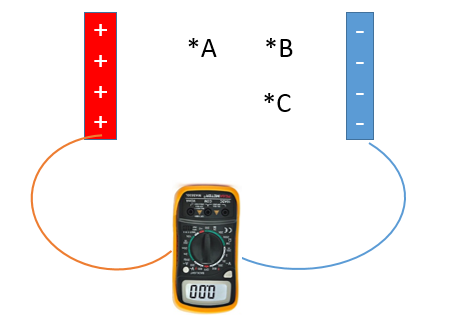
لوحان مشحونان والنقاط \(A\) و\(B\) و\(C\) بينهما.
Two charged plates and the points \(A\), \(B\) and \(C\) between them.
📊 نتائج قياسات مثال (فرق الجهد بين اللوحين \(1.5\,V\))
📊 Measurements of an Example (plate difference \(1.5\,V\))
جهد اللوح الموجب \(V^{+}=1.5\,V\) وجهد اللوح السالب \(V^{-}=0\). وعند قياس الجهد بين اللوح السالب والنقاط نجد: \(V_A=1\,V\) و\(V_B=0.5\,V\) و\(V_C=0.5\,V\). نستنتج: (1) يقل الجهد باتجاه المجال. (2) النقاط الواقعة على خط عمودي على المجال لها الجهد نفسه (\(B\) و\(C\)).
The potential of the positive plate is \(V^{+}=1.5\,V\) and that of the negative plate \(V^{-}=0\). Measuring from the negative plate to the points we find \(V_A=1\,V\), \(V_B=0.5\,V\) and \(V_C=0.5\,V\). We conclude: (1) the potential falls along the field; (2) points on a line perpendicular to the field have the same potential (\(B\) and \(C\)).
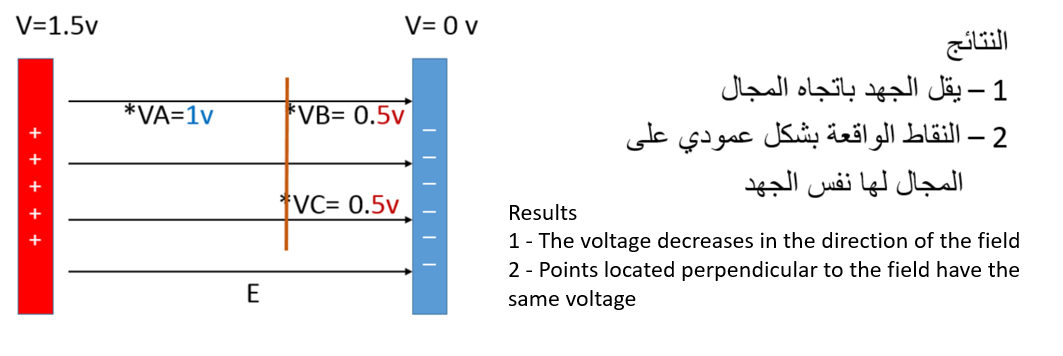
\(V^{+}=1.5\,V\)، \(V_A=1\,V\)، \(V_B=V_C=0.5\,V\)، \(V^{-}=0\). الخط البرتقالي خط تساوي الجهد.
\(V^{+}=1.5\,V\), \(V_A=1\,V\), \(V_B=V_C=0.5\,V\), \(V^{-}=0\). The orange line is an equipotential line.
📜 العلاقة
📜 The Relation
يُعطى فرق الجهد في مجال منتظم بالعلاقة:
The potential difference in a uniform field is given by:
\[\Delta V_{AB}=-E\,d_{\parallel}\qquad\left(\text{in magnitude: }\Delta V=E\,d\right)\]
\(E\) شدة المجال، و\(d\) الإزاحة الموازية لخطوط المجال (موجبة باتجاه المجال). وهذا يفسّر القاعدة: الجهد يقل باتجاه المجال (\(\Delta V\lt 0\) عند \(d\gt 0\)) ويزداد عكسه. وعلى مستوٍ عمودي على المجال \(d=0\) فلا يتغير الجهد. ومنها \(E=\dfrac{|\Delta V|}{d}\) بين لوحين (بالفولت/متر).
\(E\) is the field strength and \(d\) is the displacement parallel to the field lines (positive along the field). This explains the rule: the potential falls along the field (\(\Delta V\lt 0\) for \(d\gt 0\)) and rises against it. On a plane perpendicular to the field \(d=0\) so the potential does not change. Hence \(E=\dfrac{|\Delta V|}{d}\) between two plates (in volts per metre).
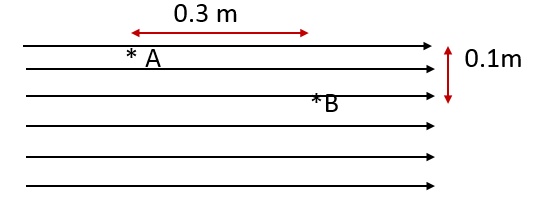
الإزاحة الموازية لخطوط المجال \(d=0.3\,m\) والعمودية \(0.1\,m\) لا تؤثر.
The displacement parallel to the field lines is \(d=0.3\,m\) while the perpendicular \(0.1\,m\) does not matter.
ثلاث نقاط داخل مجال منتظم كما في الشكل، وكان \(V_A=8\,V\) و\(V_B=6\,V\) و\(V_C=8\,V\). أي الأشكال يمثل خطوط المجال الصحيحة؟
Three points lie in a uniform field as in the figure with \(V_A=8\,V\), \(V_B=6\,V\) and \(V_C=8\,V\). Which figure shows the correct field lines?
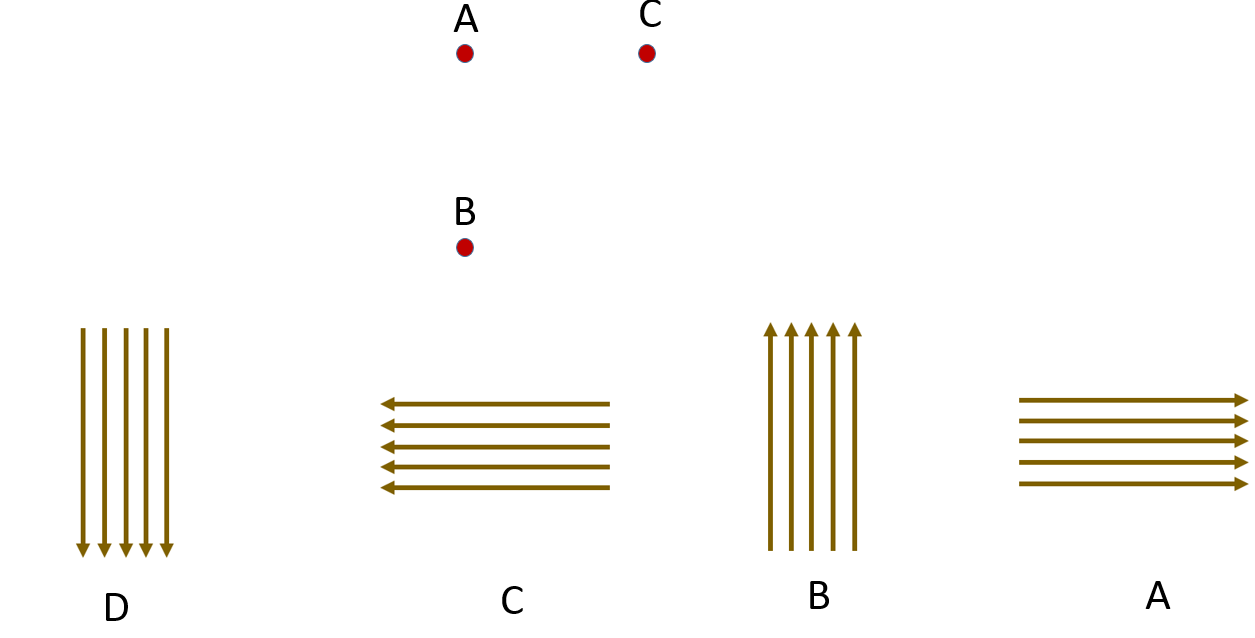
النقاط الثلاث (أعلى) وأشكال خطوط المجال الأربعة (أسفل).
The three points (top) and the four field-line drawings (bottom).
في الشكل مجال كهربائي منتظم شدته \(E=1000\,N/C\) نحو الأعلى، والنقطة \(a\) تعلو النقطة \(c\) بمقدار \(0.3\,m\)، والنقطة \(d\) على يسار \(c\) بمقدار \(0.1\,m\) وعلى الارتفاع نفسه. فرق الجهد \(\Delta V_{ad}\) يعادل:
In the figure a uniform field of strength \(E=1000\,N/C\) points upward; point \(a\) is \(0.3\,m\) above \(c\) and \(d\) is \(0.1\,m\) to the left of \(c\) at the same height. The potential difference \(\Delta V_{ad}\) is:
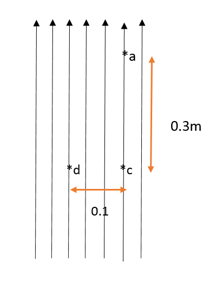
النقاط \(a\) و\(c\) و\(d\) في مجال منتظم نحو الأعلى.
The points \(a\), \(c\) and \(d\) in an upward uniform field.
🛢️ تجربة ميليكان لتحديد الشحنة الأولية
🛢️ Millikan’s Experiment for the Elementary Charge
في سنة 1909 توصّل روبرت ميليكان (أستاذ في جامعة شيكاغو) بمساعدة هارفي فليتشر إلى القيمة التقريبية للشحنة الأولية للإلكترون، بطريقة تسمى تجربة قطرات الزيت المشحونة. وهي تعتمد على دراسة قطرات زيت مشحونة في مجال كهربائي.
In 1909 Robert Millikan (a professor at the University of Chicago), helped by Harvey Fletcher, found the approximate value of the elementary charge of the electron by a method called the charged oil-drop experiment, which studies charged oil drops in an electric field.
🎯 الغاية والفكرة
🎯 The Purpose and the Idea
الغاية: تحديد شحنة الإلكترون بدراسة حركة قطرات الزيت في مجال كهربائي. الفكرة: تُرشّ قطرات زيت متأينة قليلًا بين لوحين أفقيين مشحونين (العلوي موجب والسفلي سالب). عندما لا يوجد مجال تسقط القطرة بفعل الجاذبية. وعند تشغيل المجال تؤثر على القطرة قوتان: وزنها \(mg\) نحو الأسفل والقوة الكهربائية \(qE\) (نحو الأعلى للقطرة السالبة). يغيّر ميليكان فرق الجهد حتى تتوقف القطرة عن الحركة، فتتساوى القوتان.
Purpose: to determine the charge of the electron by studying the motion of oil drops in an electric field. Idea: slightly ionised oil drops are sprayed between two horizontal charged plates (the upper positive, the lower negative). With no field the drop falls under gravity. When the field is on, two forces act on the drop: its weight \(mg\) downward and the electric force \(qE\) (upward for a negative drop). Millikan changes the voltage until the drop stops, when the two forces are equal.
🧮 الاستنتاج
🧮 The Derivation
- الاتزان: \(F_e=F_g\Rightarrow qE=mg\).Equilibrium: \(F_e=F_g\Rightarrow qE=mg\).
- شدة المجال بين لوحين: \(E=\dfrac{\Delta V}{d}\) (النسبة بين فرق الجهد والبعد بين اللوحين).The field between the plates: \(E=\dfrac{\Delta V}{d}\) (the ratio of the potential difference to the plate separation).
\[q=\dfrac{m\,g}{E}=\dfrac{m\,g\,d}{\Delta V}\]
بعد تكرار التجربة مرات كثيرة لوحظ أن الشحنة \(q\) على القطرات دائمًا مضاعف صحيح لشحنة أساسية \(e\): \(q=n\,e\) حيث \(n=1,2,3,\dots\)، وقيمتها \(e\approx1.602\times10^{-19}\,C\) (شحنة الإلكترون). وهذا يدل على أن الشحنة مكمّاة (تأتي في وحدات).
After repeating the experiment many times it was observed that the charge \(q\) on the drops is always an integer multiple of a basic charge \(e\): \(q=n\,e\) with \(n=1,2,3,\dots\), and \(e\approx1.602\times10^{-19}\,C\) (the electron’s charge). This shows that charge is quantised (it comes in units).
| المفهومQuantity | الرمزSymbol | الوصف (الوحدة)Description (unit) |
|---|---|---|
| كتلة القطرةDrop mass | \(m\) | كمية المادة في الجسم (kg)the amount of matter (kg) |
| شحنة القطرةDrop charge | \(q\) | الشحنة الكهربائية للقطرة (C)the electric charge of the drop (C) |
| شدة المجال الكهربائيField strength | \(E\) | قوة المجال المؤثر على الشحنة (N/C)the field acting on the charge (N/C) |
| عجلة الجاذبية الأرضيةGravitational acceleration | \(g\) | تسارع الجسم تحت تأثير الجاذبية (m/s²)acceleration of a body under gravity (m/s²) |
🧪 جرّب بنفسك: اتزان قطرة الزيت
🧪 Try It Yourself: Balancing an Oil Drop
🧪 تجربة 5: تجربة ميليكان — اتزان قطرة الزيت
🧪 Experiment 5: Millikan’s Experiment — Balancing an Oil Drop
قطرة زيت صغيرة تحمل \(n\) من الشحنات الأولية السالبة بين لوحين المسافة بينهما \(1\,cm\) (اللوح العلوي موجب فالمجال نحو الأسفل والقوة الكهربائية على القطرة السالبة نحو الأعلى). زِد فرق الجهد حتى تتوقف القطرة (القوة الكهربائية = الوزن)، فإذا اتزنت يعرض البرنامج \(q=\dfrac{mg}{E}\) وعدد الشحنات \(n=q/e\). اضغط «قطرة عشوائية» ثم أوجد فرق الجهد المناسب بنفسك، أو «اضبط للاتزان» لترى الجهد المطلوب.
A small oil drop carrying \(n\) negative elementary charges is between two plates \(1\,cm\) apart (the upper plate is positive so the field points downward and the electric force on the negative drop points upward). Raise the voltage until the drop stops (electric force = weight); when it is balanced the program shows \(q=\dfrac{mg}{E}\) and the number of charges \(n=q/e\). Press “Random drop” and find the right voltage yourself, or “Set for balance” to see the required voltage.
🧮 حاسبة شحنة القطرة
🧮 The Drop-Charge Calculator
🧪 تجربة 6: حاسبة شحنة قطرة الزيت
🧪 Experiment 6: The Oil-Drop Charge Calculator
القطرة متزنة عند فرق جهد \(V\) بين لوحين المسافة بينهما \(d\). أدخل \(d\) و\(V\) وكثافة الزيت \(\rho\) وحجم القطرة \(Vol\)، فتُحسب كتلتها \(m=\rho\,Vol\) ثم الشحنة \(q=\dfrac{mg}{E}=\dfrac{\rho\,Vol\,g\,d}{V}\) وعدد الشحنات الأولية \(n=q/e\) (\(g=9.81\,m/s^2\)). جرّب أن تغيّر \(V\) قليلًا لترى كيف يبتعد \(n\) عن العدد الصحيح.
The drop is balanced at a voltage \(V\) between plates a distance \(d\) apart. Enter \(d\), \(V\), the oil density \(\rho\) and the drop volume \(Vol\); the mass \(m=\rho\,Vol\) is computed, then the charge \(q=\dfrac{mg}{E}=\dfrac{\rho\,Vol\,g\,d}{V}\) and the number of elementary charges \(n=q/e\) (\(g=9.81\,m/s^2\)). Try changing \(V\) slightly and see how \(n\) moves away from an integer.
❓ أسئلة على التجربة
❓ Questions on the Experiment
قطرة الزيت المشحونة بشحنة موجبة: ما سبب اتجاه حركتها نحو الأرض؟
A positively charged oil drop: why does it move toward the Earth?
عند دخول القطرة الصندوق المشحون حدّد اتجاه المجال الكهربائي والقوى المؤثرة عليها.
When the drop enters the charged box, state the direction of the electric field and the forces acting on it.
ما العلاقة التي تُحسب بها شدة المجال داخل الصندوق؟
What relation gives the field strength inside the box?
غيّر ميليكان شدة المجال حتى أصبحت القطرة متزنة؛ استنتج علاقة حساب شحنة القطرة.
Millikan changed the field until the drop was balanced; derive the relation for the drop’s charge.
قطرة زيت كتلتها \(3.2\times10^{-15}\,kg\) متزنة في مجال شدته \(1.96\times10^{5}\,N/C\) (\(g=9.8\,m/s^{2}\)). شحنتها:
An oil drop of mass \(3.2\times10^{-15}\,kg\) is in equilibrium in a field of strength \(1.96\times10^{5}\,N/C\) (\(g=9.8\,m/s^{2}\)). Its charge is:
أهم استنتاج من تجارب ميليكان على قطرات الزيت:
The most important conclusion from Millikan’s oil-drop experiments is that the charge on a drop is:
💬 توزع الشحنة على الموصلات: حوار بين مدرس الفيزياء وطالب
💬 Charge on Conductors: a Dialogue Between a Physics Teacher and a Student
| 👨🏫 مدرس الفيزياء👨🏫 Physics teacher | 🧑🎓 الطالب🧑🎓 Student |
|---|---|
| عند شحن موصل، أين تتوضع الشحنات؟When a conductor is charged, where do the charges sit? | على السطح الخارجي للموصل.On the outer surface of the conductor. |
| هل تتحرك الشحنات على سطح الموصل ولماذا؟Do the charges move on the conductor’s surface, and why? | لا تتحرك: لأنه لا توجد مركّبة للمجال موازية للسطح؛ فالمجال عمودي على السطح.No, because there is no component of the field parallel to the surface; the field is perpendicular to the surface. |
| لو كان الموصل أجوف، هل توجد شحنات على سطحه الداخلي ولماذا؟If the conductor is hollow, are there charges on its inner surface, and why? | لا توجد: فالشحنات المتشابهة تتنافر وتتباعد قدر الإمكان، وأبعد مكان هو السطح الخارجي.No: like charges repel and spread as far apart as possible, and the farthest place is the outer surface. |
| لو كان للموصل رأس مدبب، هل يكون توزع الشحنات منتظمًا ولماذا؟If the conductor has a pointed tip, is the charge distribution uniform, and why? | لا: تتجمع الشحنات بكثافة أكبر عند الرأس المدبب (حيث نصف قطر الانحناء أصغر)، فيكون المجال هناك أقوى.No: the charges gather with a higher density at the pointed tip (where the radius of curvature is smallest), so the field there is stronger. |
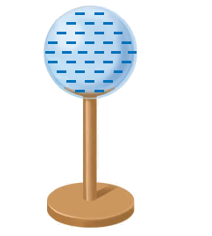
موصل كروي مشحون: الشحنات موزعة بانتظام على سطحه الخارجي.
A charged spherical conductor: the charge is spread uniformly over its outer surface.
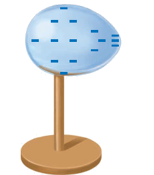
موصل بطرف مدبب: تزداد كثافة الشحنة عند الطرف المدبب.
A conductor with a pointed end: the charge density is greater at the pointed end.
🔎 توضيحات إضافية مهمة
🔎 Important Extra Explanations
- المجال داخل موصل في حالة اتزان كهروستاتيكي يساوي صفرًا: لو وُجد مجال لحرّك الشحنات الحرة حتى ينعدم. لذلك لا يؤثر المجال على ما بداخل موصل أجوف (يستعمل في «القفص الفاراداي» لحماية الأجهزة).The field inside a conductor in electrostatic equilibrium is zero: if a field existed it would move the free charges until it vanished. That is why the field does not affect what is inside a hollow conductor (the “Faraday cage” protecting equipment).
- المجال قرب السطح عمودي على السطح وشدته تتناسب مع كثافة الشحنة السطحية \(\sigma\): \(E=\dfrac{\sigma}{\varepsilon_0}\).The field near the surface is perpendicular to it and its strength is proportional to the surface charge density \(\sigma\): \(E=\dfrac{\sigma}{\varepsilon_0}\).
- لماذا يتجمع الشحن عند الأطراف المدبّبة؟ الموصل كله بجهد واحد، وللكرة \(V=\dfrac{kq}{R}\)؛ فالجزء الأصغر نصف قطر يحمل شحنة أقل لكن كثافتها \(\sigma\propto\dfrac{1}{R}\) أكبر، فيكون المجال عند الطرف المدبب أقوى. وهذا أساس مانعة الصواعق (طرف مدبب يفرّغ الشحنة بهدوء) وسبب تسرّب الشحنة من الأسلاك الحادة.Why does charge gather at pointed ends? The whole conductor is at one potential, and for a sphere \(V=\dfrac{kq}{R}\); the part with the smaller radius carries less charge but with a greater density \(\sigma\propto\dfrac{1}{R}\), so the field at the pointed end is stronger. This is the basis of the lightning rod (a pointed end discharging quietly) and of charge leaking from sharp wires.
⚙️ مولّد فان دي غراف (توضيح إضافي)
⚙️ The Van de Graaff Generator (Extra Explanation)
يعتمد المولّد على أن الشحنة التي تُلامس السطح الداخلي لموصل أجوف تنتقل كلها إلى سطحه الخارجي. يحمل حزام متحرك من مادة عازلة الشحنة (تُوضع عليه بفرشاة عند الأسفل) إلى داخل قبة معدنية مجوّفة، وهناك تنتقل الشحنة من الحزام إلى القبة وتستقر على سطحها الخارجي. ولأن الشحنة المضافة لا تجد مجالًا داخل القبة يمنعها، يمكن تكديس شحنة كبيرة وبلوغ جهد عالٍ جدًا (ملايين الفولت) فتتفرغ شرارات.
The generator relies on the fact that any charge touching the inner surface of a hollow conductor moves entirely to its outer surface. A moving belt of an insulating material carries charge (put on it by a brush at the bottom) into a hollow metal dome, where the charge passes from the belt to the dome and settles on its outer surface. Since the added charge meets no opposing field inside the dome, a large charge can be piled up and a very high potential (millions of volts) reached, producing sparks.
🧪 جرّب بنفسك: مولّد فان دي غراف
🧪 Try It Yourself: The Van de Graaff Generator
🧪 تجربة 8: مولّد فان دي غراف وطريقة عمله
🧪 Experiment 8: The Van de Graaff Generator and How It Works
الفكرة: شحنة موجبة تُرشّ على حزام عازل، يرفعها الحزام إلى داخل قبة معدنية جوفاء، فتنتقل كلها إلى سطح القبة الخارجي. وبتكرار ذلك يزداد جهد القبة \(V=\dfrac{kQ}{R}\) إلى مئات آلاف الفولتات. اختر «شرح خطوة بخطوة» ليتحرك حِملٌ واحد من الشحنة عبر مراحل العمل الست (يظهر رقم الخطوة وشرحها)، أو «شغّل المحرك» لترى التشغيل المستمر وتتابع جهد القبة على المقياس. ثم ضع شحنتي اختبار داخل القبة وخارجها لترى أن القوة داخلها صفر وخارجها لا تنعدم، وقرّب كرة مؤرّضة لترى الشرارة.
The idea: positive charge is sprayed onto an insulating belt, the belt lifts it into a hollow metal dome, and all of it moves to the dome’s outer surface. Repeating this raises the dome’s potential \(V=\dfrac{kQ}{R}\) to hundreds of thousands of volts. Choose “Step by step” to see a single packet of charge travel through the six stages (the step number and its explanation appear), or “Start the motor” for continuous operation while you follow the dome potential on the gauge. Then place two test charges inside and outside the dome to see that the force inside is zero while outside it is not, and bring a grounded sphere near to see the spark.
📌 لماذا تنتقل الشحنة إلى الخارج؟ الشحنات المتشابهة تتنافر وتبتعد قدر الإمكان، وفي الموصل الحر تتحرك حتى ينعدم المجال داخل المعدن. فتستقر على السطح الخارجي، ولا يوجد داخل القبة مجال يمنع شحنة جديدة من الدخول. لذلك لا يتوقف شحن القبة إلا عندما يتأيّن الهواء حولها (\(E\approx3\,MV/m\)).
📌 Why does the charge go outside? Like charges repel and move as far apart as possible, and in a free conductor they move until the field inside the metal vanishes. So they settle on the outer surface, and there is no field inside the dome to stop new charge entering. That is why charging stops only when the air around the dome ionises (\(E\approx3\,MV/m\)).
قبة نصف قطرها \(R=0.15\,m\)؛ جهد الانهيار نحو \(E_{air}R=3\times10^{6}\times0.15=450\,kV\)، وللشرارة عبر فجوة \(d\) يلزم نحو \(3\,kV\) لكل مليمتر.
A dome of radius \(R=0.15\,m\); the breakdown potential is about \(E_{air}R=3\times10^{6}\times0.15=450\,kV\), and a spark across a gap \(d\) needs about \(3\,kV\) per millimetre.
موصل كروي أجوف نصف قطره \(R=0.08\,m\) شُحن بشحنة سالبة \(Q=3\,\mu C\). شدة المجال عند نقطة تبعد \(r=0.05\,m\) عن مركزه:
A hollow spherical conductor of radius \(R=0.08\,m\) carries a negative charge \(Q=3\,\mu C\). The field at a point \(r=0.05\,m\) from its centre is:
🔋 سعة المكثف
🔋 Capacitance
📜 التعريف
📜 Definition
سعة المكثف هي مقدرته على استيعاب الشحنة (تخزينها). وقد يكون المكثف غير مشحون ومع ذلك نقول إن له سعة، فهي خاصية للمكثف نفسه (شكله وأبعاده وعازله) وليست للشحنة. وتُعرَّف بالنسبة بين شحنة أحد لوحيه وفرق الجهد بين لوحيه:
The capacitance of a capacitor is its ability to hold charge. A capacitor can be uncharged and we still say it has a capacitance: it is a property of the capacitor itself (its shape, dimensions and insulator), not of the charge. It is defined as the ratio of the charge on one plate to the potential difference between the plates:
\[C=\dfrac{Q}{\Delta V}\qquad 1\ F=1\ C/V\]
🧪 جرّب بنفسك: شحن المكثف وحساب سعته
🧪 Try It Yourself: Charging a Capacitor and Finding Its Capacitance
🧪 تجربة 7: شحن المكثف بالبطارية وسعته
🧪 Experiment 7: Charging a Capacitor With a Battery and Its Capacitance
يُشحن المكثف بوصله بالبطارية فتكتسب كل لوحة شحنة \(Q=CV\). غيّر فرق الجهد \(V\) واضغط «سجّل قراءة» عدة مرات لتملأ الجدول وترسم المنحنى \(Q\)–\(V\)؛ ثم احسب ميل الخط \(\dfrac{\Delta Q}{\Delta V}\). لاحظ: الشحنة تتناسب طرديًا مع فرق الجهد، والنسبة \(Q/V\) ثابتة ولا تتغير بتغيير الجهد أو الشحنة، وهي سعة المكثف ويساويها ميل الخط البياني. (تغيير \(C\) يمسح الجدول لأنه مكثف آخر.)
A capacitor is charged by connecting it to a battery and each plate gains a charge \(Q=CV\). Change the voltage \(V\) and press “Record reading” several times to fill the table and draw the \(Q\)–\(V\) graph; then compute the slope \(\dfrac{\Delta Q}{\Delta V}\). Notice: the charge is directly proportional to the voltage, the ratio \(Q/V\) is constant and does not change with the voltage or the charge, it is the capacitance and it equals the slope of the graph. (Changing \(C\) clears the table because it is a different capacitor.)
| # | \(Q\) (nC) | \(V\) (V) | \(C=Q/V\) (nF) |
|---|
✅ الاستنتاجات من التجربة
✅ Conclusions From the Experiment
- فرق الجهد بين طرفي المكثف يتناسب طرديًا مع شحنة المكثف.The potential difference across a capacitor is directly proportional to the capacitor’s charge.
- فرق الجهد والشحنة ليسا من العوامل المؤثرة في سعة المكثف؛ والدليل أن سعته لم تتغير عندما تغيّر الجهد والشحنة.The voltage and the charge are not factors affecting the capacitance; the evidence is that the capacitance did not change when the voltage and the charge changed.
- سعة المكثف تعادل ميل الخط البياني \(Q\)–\(V\): \(C=\dfrac{\Delta Q}{\Delta V}\).The capacitance equals the slope of the \(Q\)–\(V\) graph: \(C=\dfrac{\Delta Q}{\Delta V}\).
🔎 توضيح إضافي: ماذا يحدد السعة؟ ووحداتها
🔎 Extra Explanation: What Determines Capacitance, and Its Units
وحدة السعة الفاراد (\(1\,F=1\,C/V\))، وهي كبيرة جدًا فنستعمل \(\mu F\) و\(nF\) و\(pF\). فإذا قيست الشحنة بالنانو كولوم والجهد بالفولت فالنسبة بوحدة \(nC/V=nF\). وتتحدد السعة بتصميم المكثف: لمكثف اللوحين المتوازيين \(C=\varepsilon_0\dfrac{A}{d}\) فتزداد بزيادة مساحة اللوحين \(A\) وتقل بزيادة البعد \(d\) بينهما، وتزداد عند وضع مادة عازلة بين اللوحين.
The unit of capacitance is the farad (\(1\,F=1\,C/V\)), which is very large, so we use \(\mu F\), \(nF\) and \(pF\). If the charge is in nanocoulombs and the voltage in volts the ratio is in \(nC/V=nF\). The capacitance is fixed by the capacitor’s design: for a parallel-plate capacitor \(C=\varepsilon_0\dfrac{A}{d}\), so it grows with the plate area \(A\), falls with the separation \(d\), and increases when an insulating material is placed between the plates.
مكثف شحنته \(12\,nC\) عند فرق جهد \(6\,V\) بين طرفيه. سعته، وسعته إذا ضوعف الجهد إلى \(12\,V\):
A capacitor holds a charge of \(12\,nC\) at a potential difference of \(6\,V\) across it. Its capacitance, and its capacitance if the voltage is doubled to \(12\,V\):
📝 ملخص الدرس
📝 Lesson Summary
📝 أهم ما تعلمناه
📝 Key Points
- \(E=\dfrac{F}{q}=\dfrac{kQ}{r^{2}}\) بوحدة \(N/C\)؛ اتجاهه كاتجاه القوة على شحنة اختبار موجبة. ويُجمع المجال من عدة شحنات اتجاهيًا.\(E=\dfrac{F}{q}=\dfrac{kQ}{r^{2}}\) in \(N/C\); its direction is that of the force on a positive test charge. Fields of several charges add as vectors.
- خطوط المجال تخرج من الموجبة وتدخل في السالبة، لا تتقاطع، وكثافتها تدل على شدة المجال.Field lines leave positive and enter negative charges, never cross, and their density shows the field strength.
- تقل طاقة الوضع بالحركة باتجاه قوة المجال وتزداد عكسها. \(\Delta V_{AB}=V_B-V_A=\dfrac{\Delta PE}{q}\)، ويقل الجهد باتجاه المجال.Potential energy falls when moving along the field’s force and rises against it. \(\Delta V_{AB}=V_B-V_A=\dfrac{\Delta PE}{q}\), and the potential falls along the field.
- في المجال المنتظم \(\Delta V=-E\,d_\parallel\)، و\(E=\Delta V/d\) بين لوحين.In a uniform field \(\Delta V=-E\,d_\parallel\), and \(E=\Delta V/d\) between two plates.
- ميليكان: \(qE=mg\Rightarrow q=\dfrac{mgd}{\Delta V}\)، و\(q=ne\) (الشحنة مكمّاة).Millikan: \(qE=mg\Rightarrow q=\dfrac{mgd}{\Delta V}\), and \(q=ne\) (charge is quantised).
- الشحنة على السطح الخارجي للموصل، والمجال داخله صفر، وتزداد كثافتها عند الأطراف المدبّبة.Charge sits on the outer surface of a conductor, the field inside is zero, and the density is greater at pointed ends.
- سعة المكثف \(C=Q/\Delta V\) خاصية للمكثف لا تتغير بتغير الشحنة أو الجهد، وتساوي ميل المنحنى \(Q\)–\(V\).The capacitance \(C=Q/\Delta V\) is a property of the capacitor that does not change with the charge or the voltage, and equals the slope of the \(Q\)–\(V\) graph.
🧪 اختبر نفسك: امتحان من 20 سؤالاً
🧪 Test Yourself: a 20-Question Exam
أنهِ الدرس بالاختبار التفاعلي التالي؛ أسئلته بمستوى متقدم وعالٍ وتجمع بين الفهم والحساب.
Finish with the interactive exam below; its questions are of medium and high difficulty and mix understanding with calculation.
اختبار المجال الكهربائي وتطبيقاته Electric Field and Its Applications Quiz
20 سؤالاً - المجال الكهربائي وخطوطه، طاقة الوضع والجهد، المجال المنتظم، تجربة ميليكان، والمكثف 20 Questions - The Electric Field and Its Lines, Potential Energy and Potential, the Uniform Field, Millikan’s Experiment, and Capacitors
• عدد الأسئلة: 20 سؤالاً
• مدة الاختبار: 30 دقيقة
• لا يمكنك تغيير إجاباتك أو إعادة الاختبار إلا بعد 24 ساعة من التسليم.
• تأكد من إجاباتك قبل التسليم! 📌 Important Instructions:
• Number of questions: 20 questions
• Quiz duration: 30 minutes
• You cannot change your answers or retake the quiz for 24 hours after submission.
• Make sure of your answers before submitting!
🔗 محاكيات GeoGebra للاستعانة بها عند اللزوم
🔗 GeoGebra Simulations to Use When Needed
اضغط «تشغيل» لتعمل المحاكاة هنا داخل الدرس؛ ويمكن للطالب الرجوع إليها لتجربة الفكرة بطريقة أخرى.
Press “Run” to run the simulation right here inside the lesson; the student can use it to try the idea in another way.