🎯 نواتج التعلم
🎯 Learning Outcomes
بعد دراسة هذا الدرس ستكون قادرًا على أن:
After this lesson you will be able to:
- تعرّف المجال الكهربائي \(\vec E=\vec F/q\) وتحدد اتجاهه بشحنة اختبار وبخطوط المجال.Define the electric field \(\vec E=\vec F/q\) and determine its direction with a test charge and with field lines.
- تذكر خصائص خطوط المجال وتميّز بين المجال المنتظم وغير المنتظم.State the properties of the field lines and distinguish between the uniform and the non-uniform field.
- تحسب مجال شحنة نقطية \(E=kQ/r^2\) وتطبّق مبدأ التراكب على عدة شحنات.Calculate the field of a point charge \(E=kQ/r^2\) and apply the superposition principle to several charges.
- تحسب مجال ثنائي القطب على محوره وعلى عموده المنصف وعزم الدوران عليه في مجال منتظم.Calculate the field of a dipole on its axis and on its perpendicular bisector and the torque on it in a uniform field.
- تحسب القوة \(\vec F=q\vec E\) وحركة شحنة في مجال منتظم، وتتعرف مجال سلك مشحون.Calculate the force \(\vec F=q\vec E\) and the motion of a charge in a uniform field, and know the field of a charged wire.
⚡ تعريف المجال الكهربائي
⚡ The Definition of the Electric Field
المجال الكهربائي منطقة تحيط بالشحنة تظهر فيها آثار القوة الكهربائية على أي شحنة توضع فيها. ويُعرَّف المجال عند نقطة بأنه محصلة القوة الكهربائية المؤثرة على شحنة اختبار موجبة موضوعة عند تلك النقطة مقسومة على مقدار هذه الشحنة. وهو كمية متجهة لها مقدار واتجاه.
The electric field is a region around a charge in which the effects of the electric force appear on any charge placed in it. The field at a point is defined as the resultant electric force acting on a positive test charge placed at that point divided by the magnitude of this charge. It is a vector quantity that has a magnitude and a direction.
📌 المجال الكهربائي لشحنة نقطية
📌 The electric field of a point charge
\[\vec E=\frac{\vec F_e}{q}=\frac{kQq/r^2}{q}=\frac{kQ}{r^2}\qquad,\qquad k=8.99\times10^{9}\ \mathrm{N\cdot m^2/C^2}\]
حقائق مهمة
Important facts
- وحدة المجال \(\mathrm{N/C}\) وتكافئ \(\mathrm{V/m}\).The unit of the field is \(\mathrm{N/C}\) and it is equivalent to \(\mathrm{V/m}\).
- مقدار المجال لا يعتمد على شحنة الاختبار بل على شحنة المصدر والبعد عنها.The magnitude of the field does not depend on the test charge but on the source charge and the distance from it.
- يتناقص المجال بمربع البعد \(E\propto1/r^2\).The field decreases with the square of the distance \(E\propto1/r^2\).
أوجد المجال الكهربائي على بعد \(3\ \mathrm{cm}\) من شحنة نقطية \(2\ \mathrm{nC}\).
Find the electric field at a distance of \(3\ \mathrm{cm}\) from a point charge \(2\ \mathrm{nC}\).
أي وحدة مما يلي تكافئ وحدة المجال الكهربائي؟
Which of the following units is equivalent to the unit of the electric field?
🧭 تحديد اتجاه المجال
🧭 Determining the Direction of the Field
الطريقة الأولى (شحنة اختبار): نضع شحنة اختبار عند النقطة المطلوبة. إن كانت موجبة فاتجاه المجال هو اتجاه القوة نفسه، وإن كانت سالبة فاتجاه المجال عكس اتجاه القوة (لأن \(\vec E=\vec F/q\) وإشارة \(q\) تعكس المتجه).
The first method (a test charge): we put a test charge at the required point. If it is positive the direction of the field is the same as the direction of the force, and if it is negative the direction of the field is opposite to the direction of the force (because \(\vec E=\vec F/q\) and the sign of \(q\) reverses the vector).
🧪 تجربة 1: اتجاه المجال بشحنة اختبار
🧪 Experiment 1: The Direction of the Field With a Test Charge
اضغط على اللوحة لوضع شحنات اختبار موجبة وسالبة حول مصدر موجب ثم سالب.
Click on the board to put positive and negative test charges around a positive and then a negative source.
🛠️ خطوات العمل
🛠️ Procedure
- اختر المصدر موجبًا وشحنة اختبار موجبة وضعها في أكثر من موضع.Choose a positive source and a positive test charge and put it in more than one position.
- بدّل شحنة الاختبار إلى سالبة وقارن \(\vec F\) و\(\vec E\).Switch the test charge to negative and compare \(\vec F\) and \(\vec E\).
- بدّل المصدر إلى سالب وكرّر.Switch the source to negative and repeat.
🧪 تجربة 1: اتجاه المجال بشحنة اختبار
🧪 Experiment 1: The Direction of the Field Using a Test Charge
اختر نوع شحنة المصدر ونوع شحنة الاختبار ثم اضغط على اللوحة لوضع شحنات اختبار: يظهر سهم القوة \(\vec F\) (أخضر) وسهم المجال \(\vec E\) (بنفسجي).
Choose the sign of the source charge and of the test charge then click on the board to put test charges: the force arrow \(\vec F\) (green) and the field arrow \(\vec E\) (purple) appear.
🔎 ماذا نلاحظ؟ وما الاستنتاج؟
🔎 What do we observe? What is the conclusion?
- المجال لا يتغير بتغيير شحنة الاختبار؛ القوة هي التي تنعكس.The field does not change when the test charge changes; the force is what reverses.
- المجال يخرج من المصدر الموجب ويدخل في المصدر السالب.The field leaves a positive source and enters a negative source.
\(\vec E\) بنفس اتجاه \(\vec F\) على الموجبة وعكسه على السالبة.
\(\vec E\) has the direction of \(\vec F\) on a positive charge and the opposite on a negative one.
〰️ خطوط المجال الكهربائي
〰️ Electric Field Lines
الطريقة الثانية: رسم خطوط المجال. وهي خطوط وهمية تخرج من الشحنات الموجبة وتدخل في الشحنات السالبة، ويكون اتجاه المجال عند أي نقطة مماسًّا لخط المجال عندها.
The second method: drawing the field lines. They are imaginary lines that leave the positive charges and enter the negative charges, and the direction of the field at any point is tangent to the field line at it.
خصائص خطوط المجال
Properties of the field lines
- تخرج من الشحنات الموجبة وتدخل في الشحنات السالبة.They leave the positive charges and enter the negative charges.
- تناسب كثافة الخطوط مقدار الشحنة وشدة المجال: تزدحم قرب الشحنات.The density of the lines is proportional to the magnitude of the charge and the strength of the field: they crowd near the charges.
- اتجاه المجال عند نقطة مماس لخط المجال عندها.The direction of the field at a point is tangent to the field line at it.
- لا تتقاطع أبدًا (لو تقاطعا لكان للمجال اتجاهان عند النقطة نفسها).They never cross (if they crossed the field would have two directions at the same point).
| المجال المنتظمUniform field | المجال غير المنتظمNon-uniform field |
|---|---|
| ثابت المقدار والاتجاه عند كل النقاط، وخطوطه مستقيمة متوازية متساوية البعد.Constant in magnitude and direction at all points, its lines are straight, parallel and equally spaced. | يتغير مقداره أو اتجاهه أو كلاهما، وخطوطه منحنية أو غير متساوية البعد.Its magnitude or its direction or both change, its lines are curved or unequally spaced. |
🧪 تجربة 2: تخطيط المجال الكهربائي
🧪 Experiment 2: Mapping the Electric Field
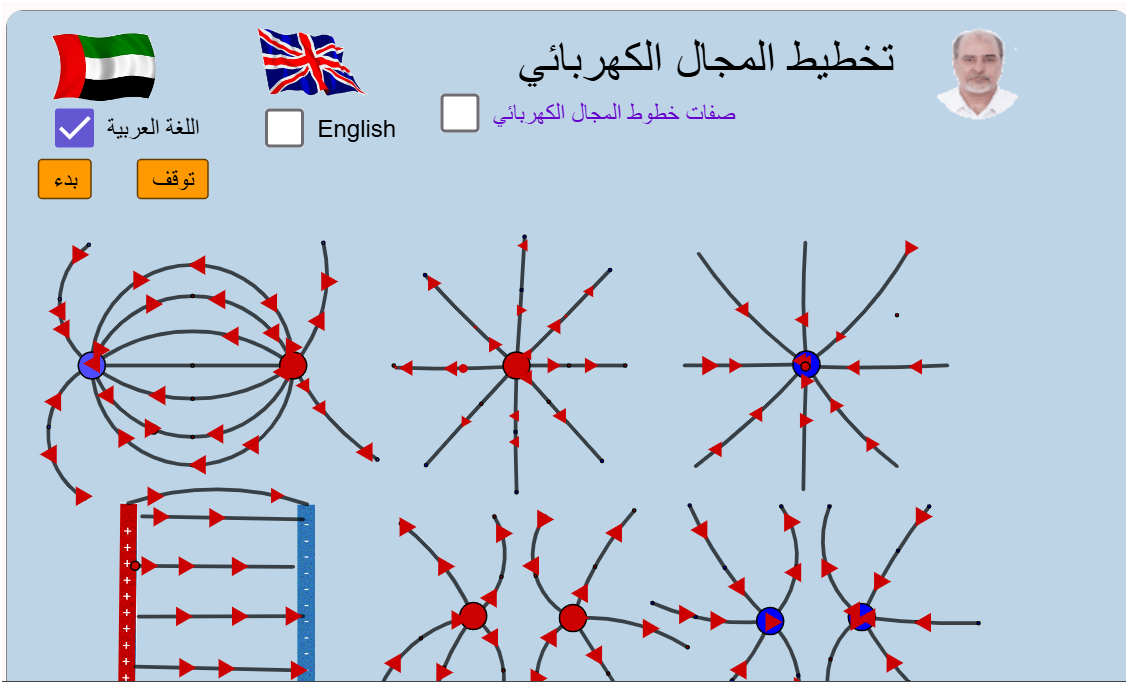
نرسم خطوط المجال لأربعة توزيعات ونسحب مسبارًا لنقرأ المجال عند أي نقطة.
We draw the field lines for four distributions and drag a probe to read the field at any point.
🛠️ خطوات العمل
🛠️ Procedure
- اعرض شحنة موجبة ثم سالبة ولاحظ اتجاه الخطوط.Show a positive and then a negative charge and notice the direction of the lines.
- اعرض ثنائي القطب وشحنتين موجبتين وقارن شكل الخطوط.Show the dipole and two positive charges and compare the shape of the lines.
- اسحب المسبار وراقب شدة المجال واتجاهه.Drag the probe and watch the strength and the direction of the field.
🧪 تجربة 2: تخطيط المجال الكهربائي (كمحاكاة GeoGebra)
🧪 Experiment 2: Mapping the Electric Field (like the GeoGebra applet)
اختر توزيع الشحنات وعدد خطوط المجال، ثم اسحب المسبار البرتقالي لترى اتجاه المجال وشدته عند أي نقطة.
Choose the distribution of the charges and the number of field lines, then drag the orange probe to see the direction and the strength of the field at any point.
🔎 ماذا نلاحظ؟ وما الاستنتاج؟
🔎 What do we observe? What is the conclusion?
- بين شحنتين متماثلتين توجد نقطة ينعدم عندها المجال وتتباعد الخطوط.Between two like charges there is a point at which the field vanishes and the lines move apart.
- بين شحنتين مختلفتين تكون الخطوط متقاربة ومتوازية تقريبًا فيكون المجال كبيرًا.Between two unlike charges the lines are close and almost parallel so the field is large.
الخطوط تمثّل المجال: اتجاهها مماس للمجال وكثافتها تعبّر عن شدته.
The lines represent the field: their direction is tangent to the field and their density expresses its strength.
➕ تراكب المجالات: الشحنات النقطية
➕ Superposition of Fields: Point Charges
كل شحنة نقطية تولّد حولها مجالًا مستقلًّا. وعند وجود أكثر من شحنة يكون المجال المحصل عند نقطة هو المجموع الاتجاهي للمجالات التي تولّدها كل شحنة على حدة (مبدأ التراكب). نحسب مقدار كل مجال \(E=kq/r^2\) ثم نحدّد اتجاهه (نحو السالبة، وبعيدًا عن الموجبة) ونجمع كمتجهات.
Every point charge generates its own independent field around it. When there is more than one charge the net field at a point is the vector sum of the fields generated by each charge separately (the superposition principle). We calculate the magnitude of each field \(E=kq/r^2\) then determine its direction (toward a negative one and away from a positive one) and add them as vectors.
الشحنة \(q_1=-6\ \mu\mathrm C\) عند نقطة الأصل و\(q_2=4\ \mu\mathrm C\) عند \(x=5\ \mathrm{cm}\). أوجد المجال عند \(x=8\ \mathrm{cm}\).
The charge \(q_1=-6\ \mu\mathrm C\) is at the origin and \(q_2=4\ \mu\mathrm C\) at \(x=5\ \mathrm{cm}\). Find the field at \(x=8\ \mathrm{cm}\).
شحنتان \(q_1=-3\ \mathrm{nC}\) و\(q_2=5\ \mathrm{nC}\) على رأسين لمثلث قائم، والنقطة \(A\) على بعد \(3\ \mathrm{cm}\) من الأولى (أفقيًا) و\(4\ \mathrm{cm}\) من الثانية (رأسيًا). أوجد المجال المحصل عند \(A\).
Two charges \(q_1=-3\ \mathrm{nC}\) and \(q_2=5\ \mathrm{nC}\) at two vertices of a right triangle, and the point \(A\) is at \(3\ \mathrm{cm}\) from the first (horizontally) and \(4\ \mathrm{cm}\) from the second (vertically). Find the net field at \(A\).
🧪 تجربة 3: تراكب المجالات عند نقطة
🧪 Experiment 3: Superposition of Fields at a Point
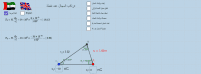
شحنتان على خط واحد ونقطة متحركة: نرى المجالين ومحصلتهما.
Two charges on a line and a movable point: we see the two fields and their net.
🛠️ خطوات العمل
🛠️ Procedure
- اضبط \(q_1=-6\), \(q_2=4\ \mu\mathrm C\) و\(x=8\ \mathrm{cm}\) وتحقق من \(31.5\times10^6\ \mathrm{N/C}\).Set \(q_1=-6\), \(q_2=4\ \mu\mathrm C\) and \(x=8\ \mathrm{cm}\) and check \(31.5\times10^6\ \mathrm{N/C}\).
- اجعل الشحنتين متماثلتين وحرّك النقطة بينهما حتى ينعدم المجال.Make the two charges alike and move the point between them until the field vanishes.
🧪 تجربة 3: تراكب المجالات عند نقطة
🧪 Experiment 3: Superposition of Fields at a Point
شحنتان على خط واحد: \(q_1\) عند \(x=0\) و\(q_2\) عند \(x=5\ \mathrm{cm}\). حرّك النقطة \(P\) وغيّر الشحنتين وراقب المجالين والمحصلة.
Two charges on a line: \(q_1\) at \(x=0\) and \(q_2\) at \(x=5\ \mathrm{cm}\). Move the point \(P\), change the two charges and watch the two fields and the net field.
🔎 ماذا نلاحظ؟ وما الاستنتاج؟
🔎 What do we observe? What is the conclusion?
- خارج الشحنتين يكون المجالان في اتجاهين متعاكسين غالبًا فيطرح أحدهما من الآخر.Outside the two charges the two fields are usually in opposite directions so one is subtracted from the other.
- بين شحنتين مختلفتين يتجه المجالان في اتجاه واحد فيجمعان.Between two unlike charges the two fields are in one direction so they add.
\(\vec E_{net}=\sum\vec E_i\) جمع اتجاهي.
\(\vec E_{net}=\sum\vec E_i\) a vector sum.
↔️ المجال الكهربائي لثنائي القطب (قراءة ذاتية)
↔️ The Electric Field of a Dipole (Self-Reading)
ثنائي القطب جسم يحمل شحنتين متساويتين في المقدار مختلفتين في النوع تفصل بينهما مسافة \(d\). يُعرَّف عزم ثنائي القطب \(p=qd\) وهو كمية متجهة اتجاهها من الشحنة السالبة إلى الموجبة. نحسب مجاله بجمع مجالي الشحنتين اتجاهيًّا.
A dipole is a body that has two charges of equal magnitude and different signs separated by a distance \(d\). The dipole moment is defined as \(p=qd\), a vector quantity directed from the negative to the positive charge. We calculate its field by adding the fields of the two charges as vectors.
📌 مجال ثنائي القطب عند \(r\gg d\)
📌 The field of a dipole at \(r\gg d\)
\[E_{axis}=\frac{2kp}{r^3}\qquad,\qquad E_{bisector}=\frac{kp}{r^3}\]
على المحور يكون المجال باتجاه \(\vec p\) ومقداره \(2kp/r^3\)، وعلى العمود المنصف تتلاشى المركبتان الرأسيتان وتتجمع الأفقيتان فيكون المجال \(kp/r^3\) عكس اتجاه \(\vec p\). ويتناقص المجال بمكعب البعد (أسرع من الشحنة النقطية).
On the axis the field is in the direction of \(\vec p\) and its magnitude is \(2kp/r^3\), and on the perpendicular bisector the two vertical components cancel and the horizontal ones add so the field is \(kp/r^3\) opposite to the direction of \(\vec p\). The field decreases with the cube of the distance (faster than a point charge).
ثنائي قطب شحنته \(5\ \mathrm{nC}\) والمسافة بين الشحنتين \(2\ \mathrm{cm}\). أوجد مجاله على محوره عند بعد \(20\ \mathrm{cm}\) من مركزه.
A dipole of charge \(5\ \mathrm{nC}\) and the distance between the charges \(2\ \mathrm{cm}\). Find its field on its axis at a distance of \(20\ \mathrm{cm}\) from its centre.
🧪 تجربة 4: مجال ثنائي القطب
🧪 Experiment 4: The Field of a Dipole
نحسب مجال ثنائي القطب على محوره وعلى عموده المنصف ونقارنه بالقانون التقريبي.
We calculate the field of a dipole on its axis and on its perpendicular bisector and compare it with the approximate law.
🛠️ خطوات العمل
🛠️ Procedure
- اختر «على المحور» وضاعف \(r\) وراقب نقصان المجال.Choose “On the axis” and double \(r\) and watch the field decrease.
- بدّل إلى العمود المنصف وقارن القيمة بالمحور.Switch to the perpendicular bisector and compare the value with the axis.
- قارن الحساب المباشر بالقانون التقريبي كلما كبر \(r\).Compare the direct calculation with the approximate law as \(r\) increases.
🧪 تجربة 4: المجال الناتج عن ثنائي القطب
🧪 Experiment 4: The Field of a Dipole
ثنائي قطب (\(+q\) و\(-q\) تفصل بينهما \(d\)). اختر موضع النقطة على المحور أو على العمود المنصف وغيّر \(q\) و\(d\) و\(r\).
A dipole (\(+q\) and \(-q\) separated by \(d\)). Choose the position of the point on the axis or on the perpendicular bisector and change \(q\), \(d\) and \(r\).
🔎 ماذا نلاحظ؟ وما الاستنتاج؟
🔎 What do we observe? What is the conclusion?
- عند مضاعفة \(r\) ينقص المجال إلى الثُّمن تقريبًا.When \(r\) is doubled the field decreases to about one eighth.
- يتطابق الحساب المباشر مع القانون التقريبي عندما \(r\gg d\).The direct calculation agrees with the approximate law when \(r\gg d\).
مجال الثنائي \(\propto1/r^3\).
The field of the dipole \(\propto1/r^3\).
📏 المجال الناتج عن التوزيعات المستمرة (إثرائي)
📏 The Field of Continuous Distributions (Enrichment)
عندما تتوزع الشحنة على سلك أو سطح أو حجم نقسّم الجسم إلى أجزاء صغيرة \(dq\) ونكامل المجالات. وبحسب نوع التوزيع: \(dq=\lambda\,dx\) على سلك، و\(dq=\sigma\,dA\) على سطح، و\(dq=\rho\,dV\) في حجم.
When the charge is distributed over a wire, a surface or a volume we divide the body into small parts \(dq\) and integrate the fields. According to the type of the distribution: \(dq=\lambda\,dx\) on a wire, \(dq=\sigma\,dA\) on a surface and \(dq=\rho\,dV\) in a volume.
📌 سلك مشحون بانتظام (على العمود المنصف)
📌 A uniformly charged wire (on the perpendicular bisector)
\[E=\frac{2k\lambda}{y}\,\frac{a}{\sqrt{a^2+y^2}}\qquad\xrightarrow{\ a\to\infty\ }\qquad E=\frac{2k\lambda}{y}\]
سلك طوله \(40\ \mathrm{cm}\) كثافة شحنته \(\lambda=10\ \mathrm{nC/m}\). أوجد مجاله على العمود المنصف على بعد \(10\ \mathrm{cm}\).
A wire of length \(40\ \mathrm{cm}\) with a charge density \(\lambda=10\ \mathrm{nC/m}\). Find its field on the perpendicular bisector at a distance of \(10\ \mathrm{cm}\).
🧪 تجربة 5: مجال سلك مشحون
🧪 Experiment 5: The Field of a Charged Wire
نغيّر طول السلك والبعد وكثافة الشحنة ونقارن بالسلك اللانهائي.
We change the length of the wire, the distance and the charge density and compare with the infinite wire.
🛠️ خطوات العمل
🛠️ Procedure
- اجعل \(a\) كبيرًا وراقب النسبة إلى السلك اللانهائي.Make \(a\) large and watch the ratio to the infinite wire.
- ضاعف \(y\) لسلك طويل وراقب المجال.Double \(y\) for a long wire and watch the field.
🧪 تجربة 7: المجال الناتج عن سلك مشحون (إثرائي)
🧪 Experiment 7: The Field of a Charged Wire (Enrichment)
سلك طوله \(2a\) مشحون بانتظام بكثافة خطية \(\lambda\). النقطة \(P\) على العمود المنصف على بعد \(y\). قارن المجال بقيمة السلك اللانهائي.
A wire of length \(2a\) uniformly charged with a linear density \(\lambda\). The point \(P\) is on the perpendicular bisector at a distance \(y\). Compare the field with the value of the infinite wire.
🔎 ماذا نلاحظ؟ وما الاستنتاج؟
🔎 What do we observe? What is the conclusion?
- تقترب النسبة من 1 عندما \(a\gg y\).The ratio approaches 1 when \(a\gg y\).
- للسلك الطويل \(E\propto1/y\) أي يتناقص ببطء أكثر من الشحنة النقطية.For a long wire \(E\propto1/y\), i.e. it decreases more slowly than a point charge.
\(E=2k\lambda a/\left(y\sqrt{a^2+y^2}\right)\).
\(E=2k\lambda a/\left(y\sqrt{a^2+y^2}\right)\).
🏹 القوة الكهربائية في مجال
🏹 The Electric Force in a Field
شحنة \(q\) موضوعة في مجال \(\vec E\) تتأثر بقوة \(\vec F=q\vec E\). الشحنة الموجبة تتحرك بنفس اتجاه المجال والسالبة عكسه، وتكتسب تسارعًا \(a=F/m\). في المجال المنتظم يكون التسارع ثابتًا فتتحرك الشحنة بحركة معادلاتها كحركة السقوط الحر.
A charge \(q\) placed in a field \(\vec E\) is acted on by a force \(\vec F=q\vec E\). A positive charge moves in the direction of the field and a negative one against it, and it gains an acceleration \(a=F/m\). In a uniform field the acceleration is constant so the charge moves with a motion whose equations are like those of free fall.
📌 القوة والتسارع
📌 The force and the acceleration
\[\vec F_e=q\vec E\qquad,\qquad a=\frac{qE}{m}\]
مجال كهربائي منتظم شدته \(500\ \mathrm{N/C}\). ما القوة على إلكترون فيه؟ (\(e=1.6\times10^{-19}\ \mathrm C\))
A uniform electric field of strength \(500\ \mathrm{N/C}\). What is the force on an electron in it? (\(e=1.6\times10^{-19}\ \mathrm C\))
اتجاه هذه القوة عكس اتجاه المجال لأن الإلكترون سالب.
The direction of this force is opposite to the direction of the field because the electron is negative.
كرة كتلتها \(5\ \mathrm g\) وشحنتها \(5\ \mu\mathrm C\) تُترك لتسقط. أوجد المجال المنتظم الذي يجعلها متزنة (\(g=9.8\ \mathrm{m/s^2}\)).
A sphere of mass \(5\ \mathrm g\) and charge \(5\ \mu\mathrm C\) is left to fall. Find the uniform field that makes it in equilibrium (\(g=9.8\ \mathrm{m/s^2}\)).
الشحنة موجبة، فيجب أن تكون القوة الكهربائية إلى أعلى لتوازن الوزن، أي أن المجال موجّه إلى أعلى.
The charge is positive so the electric force must be upward to balance the weight, i.e. the field is directed upward.
🧪 تجربة 6: القوة والحركة في مجال منتظم
🧪 Experiment 6: Force and Motion in a Uniform Field
نغيّر المجال والشحنة والكتلة ونطلق الشحنة لنرى حركتها.
We change the field, the charge and the mass and release the charge to see its motion.
🛠️ خطوات العمل
🛠️ Procedure
- اضبط شحنة موجبة واضغط «أطلق».Set a positive charge and press “Release”.
- اجعل الشحنة سالبة وأعد الإطلاق.Make the charge negative and release again.
- ضاعف \(E\) وراقب التسارع.Double \(E\) and watch the acceleration.
🧪 تجربة 5: القوة والحركة في مجال منتظم (كمحاكاة GeoGebra)
🧪 Experiment 5: Force and Motion in a Uniform Field (like the GeoGebra applet)
شحنة في مجال منتظم نحو اليمين. غيّر المجال والشحنة (موجبة أو سالبة) والكتلة، ثم اضغط «أطلق» لتشاهد حركتها بتسارع ثابت.
A charge in a uniform field toward the right. Change the field, the charge (positive or negative) and the mass, then press “Release” to watch its motion with constant acceleration.
🔎 ماذا نلاحظ؟ وما الاستنتاج؟
🔎 What do we observe? What is the conclusion?
- الشحنة الموجبة تتحرك مع المجال والسالبة عكسه.The positive charge moves with the field and the negative one against it.
- التسارع يتناسب طرديًا مع \(q\) و\(E\) وعكسيًا مع \(m\).The acceleration is directly proportional to \(q\) and \(E\) and inversely proportional to \(m\).
\(a=qE/m\) وحركة بتسارع ثابت.
\(a=qE/m\) and a motion with a constant acceleration.
🔄 ثنائي قطب في مجال منتظم (إثرائي)
🔄 A Dipole in a Uniform Field (Enrichment)
عند وضع ثنائي قطب في مجال منتظم تتأثر كل شحنة بقوة \(qE\)؛ القوتان متساويتان ومتعاكستان فمحصلتهما صفر لكنهما تولّدان عزم دوران يحاول تدوير الثنائي حتى يصبح \(\vec p\) موازيًا للمجال. وطاقة الوضع \(U=-pE\cos\theta\).
When a dipole is placed in a uniform field each charge is acted on by a force \(qE\); the two forces are equal and opposite so their resultant is zero but they produce a torque that tries to turn the dipole until \(\vec p\) becomes parallel to the field. The potential energy is \(U=-pE\cos\theta\).
📌 عزم الدوران
📌 The torque
\[\tau=q\,d\,E\sin\theta=pE\sin\theta\]
ثنائي قطب \(p=2\times10^{-10}\ \mathrm{C\cdot m}\) في مجال \(10^4\ \mathrm{N/C}\) والزاوية \(\theta=30^\circ\). أوجد عزم الدوران.
A dipole \(p=2\times10^{-10}\ \mathrm{C\cdot m}\) in a field \(10^4\ \mathrm{N/C}\) and the angle \(\theta=30^\circ\). Find the torque.
🧪 تجربة 7: عزم الدوران على ثنائي قطب
🧪 Experiment 7: The Torque on a Dipole
نغيّر الزاوية والشحنة والمسافة والمجال ونقرأ عزم الدوران.
We change the angle, the charge, the distance and the field and read the torque.
🛠️ خطوات العمل
🛠️ Procedure
- حرّك \(\theta\) من \(0\) إلى \(180^\circ\) وراقب العزم.Move \(\theta\) from \(0\) to \(180^\circ\) and watch the torque.
- غيّر \(q\) و\(d\) و\(E\) وراقب \(\tau\).Change \(q\), \(d\) and \(E\) and watch \(\tau\).
🧪 تجربة 6: ثنائي قطب في مجال منتظم (كمحاكاة GeoGebra)
🧪 Experiment 6: A Dipole in a Uniform Field (like the GeoGebra applet)
ثنائي قطب في مجال منتظم: القوتان متساويتان ومتعاكستان فتولدان عزم دوران \(\tau=pE\sin\theta\). غيّر الزاوية \(\theta\) والشحنة والمسافة والمجال.
A dipole in a uniform field: the two forces are equal and opposite so they produce a torque \(\tau=pE\sin\theta\). Change the angle \(\theta\), the charge, the distance and the field.
🔎 ماذا نلاحظ؟ وما الاستنتاج؟
🔎 What do we observe? What is the conclusion?
- العزم أكبر ما يمكن عند \(\theta=90^\circ\) وصفر عند \(0\) و\(180^\circ\).The torque is maximum at \(\theta=90^\circ\) and zero at \(0\) and \(180^\circ\).
- يتناسب العزم مع \(p\) و\(E\).The torque is proportional to \(p\) and \(E\).
\(\tau=pE\sin\theta\).
\(\tau=pE\sin\theta\).
🚀 تطبيقات
🚀 Applications
أين نستعمل المجال الكهربائي؟
Where do we use the electric field?
- طابعات الحبر النفّاث وأجهزة الترسيب الكهروستاتيكي لتنقية الهواء.Inkjet printers and electrostatic precipitators for cleaning the air.
- أنابيب أشعة المهبط وأجهزة قياس الذبذبات التي تحرّف الإلكترونات بمجال منتظم.Cathode-ray tubes and oscilloscopes that deflect the electrons with a uniform field.
- فهم جزيئات الماء القطبية وقدرتها على الإذابة بوصفها ثنائيات قطب.Understanding the polar water molecules and their ability to dissolve as dipoles.
- مانعات الصواعق ومظلات الحماية بتركّز المجال عند الأطراف المدببة.Lightning rods through the concentration of the field at pointed ends.
⚠️ أخطاء شائعة
⚠️ Common Mistakes
تجنّب هذه الأخطاء
Avoid these mistakes
- جمع مقادير المجالات جمعًا عدديًّا بدل الجمع الاتجاهي.Adding the magnitudes of the fields numerically instead of adding them as vectors.
- الظن أن اتجاه المجال يتغير بتغيير شحنة الاختبار؛ الذي يتغير هو القوة.Thinking that the direction of the field changes when the test charge changes; what changes is the force.
- نسيان تحويل cm و\(\mu\mathrm C\) و nC إلى المتر والكولوم.Forgetting to convert cm, \(\mu\mathrm C\) and nC to metres and coulombs.
- رسم خطوط مجال متقاطعة أو دون أسهم.Drawing crossed field lines or lines without arrows.
📚 ملخص
📚 Summary
أهم ما تعلمناه
Key points
- \(\vec E=\vec F/q=kQ/r^2\) وحدته \(\mathrm{N/C}\)، ويخرج من الموجب ويدخل في السالب.\(\vec E=\vec F/q=kQ/r^2\), its unit is \(\mathrm{N/C}\), and it leaves the positive and enters the negative.
- خطوط المجال لا تتقاطع وكثافتها تعبّر عن الشدة، والمجال المنتظم خطوطه متوازية متساوية البعد.The field lines never cross and their density expresses the strength, and the uniform field has parallel equally spaced lines.
- التراكب: \(\vec E_{net}=\sum\vec E_i\). ثنائي القطب: \(E_{axis}=2kp/r^3\) و\(E_{bis}=kp/r^3\).Superposition: \(\vec E_{net}=\sum\vec E_i\). Dipole: \(E_{axis}=2kp/r^3\) and \(E_{bis}=kp/r^3\).
- \(\vec F=q\vec E\) و\(a=qE/m\) و\(\tau=pE\sin\theta\).\(\vec F=q\vec E\), \(a=qE/m\) and \(\tau=pE\sin\theta\).
🧪 اختبر نفسك: امتحان من 20 سؤالاً
🧪 Test Yourself: a 20-Question Exam
أنهِ الدرس بالاختبار التفاعلي التالي؛ أسئلته تجمع بين الفهم والحساب وتغطي جميع أقسام الدرس.
Finish with the interactive exam below; its questions mix understanding with calculation and cover every section of the lesson.
اختبار المجال الكهربائي (12A) The Electric Field Quiz (12A)
20 سؤالاً - المجال الكهربائي وخطوطه والتراكب وثنائي القطب والقوة 20 Questions - the electric field, its lines, superposition, the dipole and the force
• عدد الأسئلة: 20 سؤالاً
• مدة الاختبار: 30 دقيقة
• لا يمكنك تغيير إجاباتك أو إعادة الاختبار إلا بعد 24 ساعة من التسليم.
• تأكد من إجاباتك قبل التسليم! 📌 Important Instructions:
• Number of questions: 20 questions
• Quiz duration: 30 minutes
• You cannot change your answers or retake the quiz for 24 hours after submission.
• Make sure of your answers before submitting!
🔗 محاكيات GeoGebra للاستعانة بها عند اللزوم
🔗 GeoGebra Simulations to Use When Needed
اضغط «تشغيل» لتعمل المحاكاة هنا داخل الدرس؛ ويمكن للطالب الرجوع إليها لتجربة الفكرة بطريقة أخرى.
Press “Run” to run the simulation right here inside the lesson; the student can use it to try the idea in another way.